E-commerce in Tourism Industry
Authors: 謝德威 (Ted) M9626938 林志宏 (Ken) M9708322 曹毅莉 (Nely) M9739975 鄭孟承 (Nash) M9702458
Class: 1st year of Department of International Trade Course: Electronic Commerce
Instructor: Dr. Kun-Huang Huarng
Department: Graduate Institute of International Trade Academic Year: Semester 1, 2008-2009
Abstract
Tourism sector has grown rapidly and given major contributions to economic development especially for developing and less-developed countries. As internet penetration is increasing, the use of e-commerce can be an effective tool to promote and open up new opportunities in tourism sector. Through the web, even tourism in remote areas can be accessed worldwide, reveal its potential, and become the source of development. Given the importance of e-commerce in tourism, it is essential that tourism organizations adopt e-commerce as their business strategy.
近年來,旅遊業在全球產業中迅速成長,於 2001 年已將近全球 GDP 之 11%, 為全球經濟帶來極大的貢獻,尤其對於開發中與未開發國家而言,其影響更為顯 著。現今社會中,隨著網際網路日益盛行,電子商務在旅遊業上之使用已發展成 為一有效的產業宣傳管道,不僅為旅遊業增加行銷推廣通路,更帶來許多不可預 測的新契機。藉由網際網路全球性的運行,地處偏遠抑或未開發之國家也能輕易 地向全球推銷展示其風俗民情,開發其潛能,並以利用電子商務為途徑來提升經 濟發展。電子商務的出現已大大改變原有旅遊產業之架構,並且引領其進入新的 紀元。基於電子商務為旅遊產業所帶來之種種優點與重要性,電子商務之應用對 旅遊產業而言儼然已成為一項不可或缺的商業行銷手法。
Table of Content
Chapter 1. Introduction ... 1
Chapter 2. Summary ... 3
Chapter 3. Reflection ... 7
List of Tables
Chapter 1. Introduction
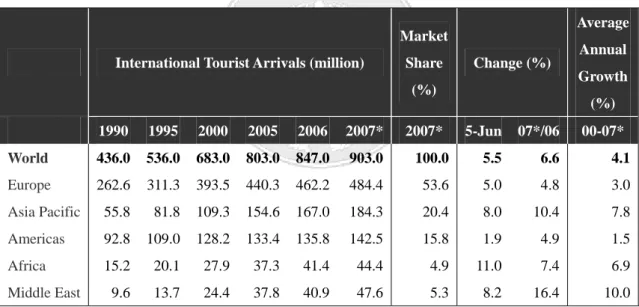
Over time, tourism sector has experienced continued growth and diversification to become one of the largest and fastest growing economic sectors in the world. The tourism generates an estimated 11% of global GDP and employing some 200 million people (Davison R.M., Harris R.W., and Vogel D.R., 2005). According to UNWTO Tourism Highlights 2008, worldwide international tourist arrival reached 903 million in 2007, up 6.6% on 2006 (Table 1). By 2010, international arrivals are expected to reach 1 billion, and 1.6 billion by 2020.
Table 1. International Tourist Arrivals
International Tourist Arrivals (million)
Market Share (%) Change (%) Average Annual Growth (%) 1990 1995 2000 2005 2006 2007* 2007* 5-Jun 07*/06 00-07* World 436.0 536.0 683.0 803.0 847.0 903.0 100.0 5.5 6.6 4.1 Europe 262.6 311.3 393.5 440.3 462.2 484.4 53.6 5.0 4.8 3.0 Asia Pacific 55.8 81.8 109.3 154.6 167.0 184.3 20.4 8.0 10.4 7.8 Americas 92.8 109.0 128.2 133.4 135.8 142.5 15.8 1.9 4.9 1.5 Africa 15.2 20.1 27.9 37.3 41.4 44.4 4.9 11.0 7.4 6.9 Middle East 9.6 13.7 24.4 37.8 40.9 47.6 5.3 8.2 16.4 10.0 Source: World Tourism Organization (UNWTO), 2008
Given the prospect of this industry, more and more tourist destinations have opened up and many of them are in developing countries. For many developing and least developed countries, tourism provides a significant potential for economic growth and development. Even in the rural and remote areas, community-based tourism (CBT) emerges as a mechanism for fostering locally based tourism operations, and catering the sensitivities and aspirations of the communities.
As e-commerce has grown becomes one of the most important tools for business development, the impact of e-commerce in tourism industry is no less evident. Internet has become an important marketing and promotion tool for tourism industry. According to the Travel Industry Association of America, 30% of the U.S. adult population used the Internet to look for information about destination or to check prices and schedules. Online transactions in the travel and tourism industry are continuously increasing, and the tourism industry is witnessing an acceptance of e-commerce to the extent that the entire industry structure is changing.
E-commerce for tourism is not only about transactional activities but also retention of customers. E-commerce offers opportunities for tourism organizations to expand customer base, build communication with customers and related partners in a more cost effective way. For customers, e-commerce helps them access more information of their tourist destinations and services, communicate with tourism organization, and make a booking at relatively low cost.
Although given with many advantages of e-commerce on tourism industry, building e-commerce is never been easy, especially for tourism organizations in less developed countries. In this paper we will study about e-tourism in some less developed countries, their reception and obstacles in adopting e-commerce. And we will have some reflection and recommendations on this issue.
Chapter 2. Summary
E-commerce in tourism industry has grown become an important issue. We found several papers studying about the importance and adoption of e-commerce in tourism industry. One of them is E-Commerce and Tourism (Werthner H., Ricci F., 2004). This paper described that tourism is an information-based business, which e-commerce has already been playing a significant role by allowing information flow through the Internet on a worldwide basis with virtually no entry barriers.
The Web is not only providing information, but it is changing the needs of consumers, who are increasingly less loyal, take more frequent vacations of shorter duration, and take less time between choosing and consuming a tourism product. The tourism product in particular has to do with emotional experiences, so it’s not just business. Travel agent should take a consideration with travelers, so it mentioned some features about the industry and how they use e-commerce to satisfy the need of consumers. The last and important point is that e-commerce can change the structure and create opportunities of travel and tourism.
Some papers study about tourism in less developed countries. These countries can benefit from great wealth in wildlife and unique resorts. In E-commerce Adoption of Travel and Tourism Organizations in South Africa, Kenya, Zimbabwe and Uganda (Maswera T, Dawson R, Edwards J, 2006) the authors carried out surveys on four popular tourist destinations in Africa- South Africa, Kenya, Zimbabwe and Uganda- which are particularly well known for the transitional Africa tourist attraction. The purpose of these surveys is to identify if the eastern and southern African tourist organization are falling behind their European and American counterparts in their use of e-commerce to support their businesses and to identify what the African organizations must do to “catch up”.
First, a survey was carried out to find the nature and extent of e-commerce adoption by tourism organizations from South Africa, Kenya, Zimbabwe and Uganda. Second, the other survey of tourism organizations from USA and Western Europe was also carried out.
Surveys revealed that e-commerce in tourism industry of these less developed countries are left behind those of developed countries. Few of the African organizations are embracing e-commerce and the majority had room for considerable improvements. The African websites were found to be generally informative but lacked interactive facilities for online transactions. So these African organizations should evolve their websites into marketing tools to capitalize on the potential Internet market.
As continuation of this research, the author wrote another paper titled Recommendations for E-Commerce Systems in the Tourism Industry of Sub-Saharan Africa (Maswera T., Edwards J., Dawson R., 2007). This paper explains how the tourism organizations from sub-Saharan Africa can evolve their websites into marketing tools and how they can overcome the difficulties in e-commerce adoption and usage.
The author examined a large number of websites of various tourism organizations from the above-mentioned countries to determine what e-commerce features are available on the sub-Saharan African websites, examine the content accessibility and the usability of the websites. Questionnaires were then administered to tourism organizations from sub-Saharan Africa to find out what efforts are being
capabilities and potential of e-commerce, and are planning to fully embrace e-commerce if and when they manage to overcome the barriers to e-commerce implementation.
As a result of this study, the author compiled some recommendations on how tourism organizations could enhance and promote their website and overcome the barriers to e-commerce. Tourism organizations should evolve their website from being a simple information-only website to fully-fledged e-commerce site.
The recommendations are directed towards providing facilities and sufficient content for customers to make purchase decisions and carry out online transactions. The organizations should convert their websites into a marketing tool by employing online and offline website promotional techniques to break into the highly competitive international tourism market. It is also recommended that the African tourism organizations attempt to be always a step ahead of other organizations in the sector with the help of knowledge transfer facilities.
Another paper studied about tourism in developing and less developed countries is E-commerce for Community-Based Tourism in Developing Countries (Davison R.M., Harris R.W., Vogel D.R.). The author stated that for developing countries and least developed countries (LDCs), tourism development could be a mean to increase participation in the global economy and be an engine for employment creation, poverty alleviation, and protection of natural culture and so on.
Web sites promotion community tourism ventures are becoming common. However, promoting a community-based web site may require outside assistance. Accordingly, research is required to explore the opportunities for testing the development potential of e-Community Based Tourism (e-CBT) and should consider the characteristics of Internet and Communication Technology (ICT) which are relevant to tourism development.
z Isolated people can offer highly specific tourism activities.
z Local initiatives and entrepreneurs can make operations more viable by
eliminating intermediaries that swallowed revenues.
z Tourists can be empowered to organize trips without additional costs.
z Public awareness of bio-diversity and conservation can be raised.
Three examples-- Western China, Sarawak, and Vietnam --, are being researched to see the e-CBT features and the nature of tourism in the location. The research at these three locations consists of the following principal components:
z Social mobilization in the communities towards the development of high
quality tourism product that is sensitive and complementary to the local environment and culture.
z Construction of e-commerce technologies capable of marketing for
appropriate tourist and for transacting payments for products.
z Empowerment of the communities through ICTs with the means to
operate and manage the e-commerce facilities in support of local tourism.
z Reflections on the overall effectiveness of the e-CBT practices will
facilitate generalization of the concept to developing communities in other part of the world.
All previous studies showed that tourism and e-commerce have a considerable potential for development in developing, less developed countries, and rural communities. The tourism sector is a productive sector aimed at creating employment, eradicating poverty, and integrating the developing countries into the global economy.
Chapter 3. Reflection
Nowadays, it’s the Internet era that everyone can’t ignore. High percentage of people use web to gather information and do commercial activities. The impact of e-commerce is very evident in many sectors of economy. In tourism for instance, many years ago we might depend on travel agent to arrange all travel schedules, but today we can be the travel agent ourselves to make our own tourism plans due to the advanced internet technology.
In deciding tourist destination or activities, tourists are only guided by information they acquired through internet, television, travel agents, brochures, newspaper, or word of mouth. They can not make direct assessment on the quality of tourism products offered. Thus, comprehensive information is important to market tourism products and services.
As internet penetration increases, using internet as marketing tool has become an effective business strategy. E-commerce has changed the running of the business. Companies are not only focus on the physical services but the virtual ones. There are many reasons why tourism organization should adopt e-commerce. First, consumers are now online, consumers want an interactive media where they can purchase online, be involved, and communicate directly. Second, it is an effective marketing tool with less cost (could reduce the overheads, eliminates commissions and cuts marketing and fulfillment costs), and more opportunities and revenue could be made. And third, e-commerce can enhance competitiveness because more and more competitors are using e-commerce.
The use of e-commerce provides so many advantages. Therefore, e-commerce for tourism is no longer an option, but a necessity. If the travel organizations don’t
catch up with this trend, they will be left behind their competitors.
First thing to do is to enhance company’s website to become an e-commerce tool. Company has to increase e-commerce systems gradually into their business process so that it can find the right market segment and work efficiently. One thing to keep in mind is that the website is not built only for customers, but also for suppliers, investors, competitors, media, job hunters, and for people who browse for fun. All these visitors could create opportunities for company, therefore the website should be comprehensive and interesting for all kind of visitors, enable visitors to be involved and give feedbacks.
Besides providing corporate information, product information, non-product information, reservation and payment, company website can also provide some customized services or defaults to fulfill customer’ demands and enrich with more interesting and attractive information for visitors. Company also needs to enhance some functions on the website, such as online transactions, personal data protections and real-time reservation facility, because the most important thing is to create a long lasting relationship with customers, which is based on customer’s loyalty and trust.
Through the website, company could also track visitors’ preference and respond directly to customers’ needs. It also allows for “information” of the entire tourism value chain to result in numerous value-generating strategies. With such strategies, not only processes changed, but new services can be designed, extending the range of options to customize and configure products.
So, e-commerce has greatly increased value of business and particularly for those from the travel and tourism industry. It also opens up opportunities for small and rural areas to address global market. Every country has its own specialty and culture. Such as Hakka and natives in Taiwan, they has developed own life styles which are worthy to visit and conserve. And with the progress of the information and communication technology, internet has become a tool to promote the remote and small communities which may be ignored before. E-commerce can enable these traditional cultures, foods and crafts to be accessed worldwide.
To sum up, tourism industry has played an important role in our life. It not only provides us with better life quality, but also improves the economic of countries around the world, especially for developing and less-developed countries. And e-commerce has brought consumers into a new era toward tourism. However, in developing and less-developed communities, building e-commerce is never been easy. Only a few have the capabilities to do so. Improving the information technology in these emerging countries may be the critical next step to take into efforts.
Chapter 4. Conclusion
The changing nature of the tourism and travel industries presents a powerful opportunity for empowering poor people with the ability to exploit the natural assets under their custodianship and to preserve those assets. And the presence of e-commerce may change the structure of this industry, and in the process create new business opportunities.
Even for tourism organizations located in small and remote area, using e-commerce has the potential for balancing market conditions in favor of small local organizations who can promote sought-after products to global markets. As small market oriented, local organizations have advantages while targeting niche customers and ICTs allow such organizations to exploit the advantages.
From previous studies we can examine that the website of tourism organizations in developing and less developed countries are lagging behind developed countries in the features they provide. There is much to be done to make the websites more interesting such as adding video and virtual environments and bringing in more interactivity. The development of more specialized services, flexible network configurations, and further consumer integration will lead to smart marketplaces that integrate all stakeholders. To encourage purchasing through websites, organizations should also include privacy and security policies. To conclude, they have to ensure that their e-commerce facilities play their full part in improving the tourism industry to fully satisfy its economic potential
initiatives are required to expose the difficulties and to clear a path for multiple replications so that large scale benefits can be generated. As such it may also be of interest for other industries to learn from this development and to understand emerging e-marketplaces.
References
1. Davison R.M., Harris R.W., and Vogel D.R., (2005) “E-commerce for Community-Based Tourism in Developing Countries”.
2. Maswera T, Dawson R, and Edwards J., (2006). “E-commerce Adoption of Travel and Tourism Organizations in South Africa, Kenya, Zimbabwe and Uganda”. Telematics and Informatics 25 (2008). pg. 187-200.
3. Maswera T., Edwards J., Dawson R., (2007). “Recommendations for E-Commerce Systems in the Tourism Industry of Sub-Saharan Africa”. Telematics and Informatics 26 (2009). pg. 12-19
4. Werthner H., Ricci F., (2004). “E-Commerce and Tourism”. Communication of the ACM, Vol. 47, No. 12. pg. 101-105.
5. World Tourism Organization (UNWTO), (2008). “UNWTO Tourism Highlights 2008 Edition”.