科技部補助專題研究計畫成果報告
期末報告
意像為基礎的服務創新:於服務科學中的方法、模型與應
用--建構以意像為基礎之服務創新成熟度模型:探索在創
新過程中組織能力之演變(第 3 年)
計 畫 類 別 : 整合型計畫
計 畫 編 號 : NSC 100-2410-H-004-028-MY3
執 行 期 間 : 102 年 08 月 01 日至 103 年 07 月 31 日
執 行 單 位 : 國立政治大學資訊管理學系
計 畫 主 持 人 : 張欣綠
共 同 主 持 人 : 黃國?
報 告 附 件 : 出席國際會議研究心得報告及發表論文
處 理 方 式 :
1.公開資訊:本計畫涉及專利或其他智慧財產權,2 年後可公開查詢
2.「本研究」是否已有嚴重損及公共利益之發現:否
3.「本報告」是否建議提供政府單位施政參考:否
中 華 民 國 103 年 10 月 09 日
中 文 摘 要 : 在中小企業掛帥的台灣,改善中小企業的績效一直是重要的
研究議題。在第三年的計畫中,我們主要的研究目的,是希
望建立中小企業『先驅性』(Proactivity) 的能力指標。我
們認為中小企業的先驅性是決定中小企業能在競爭激烈的環
境之中維持創新性的重要因素。在我們的研究之中,我們將
中小企業的『先驅性』定義為三個面向的能力:洞察改變的
能力,冀求改變的能力,以及改變的執行能力。我們並且進
一步推論,資訊技術主導的合作平台將能有效的幫助中小企
業建立『先驅性』的能力。為了驗證我們的研究模式,我們
與宜蘭枕頭山休閒農業區的中小企業進行個案研究。我們的
研究成果顯示,中小企業可以透過資訊科技平台建立中小企
業的『先驅性』能力,而中小企業的先驅性能力的確可以有
效的提升企業績效。本研究的成果可以幫助中小企業瞭解
『先驅性』能力的重要性,並且也能幫助中小企業瞭解如何
透過資訊技術平台提升企業『先驅性』。
中文關鍵詞: 企業先驅性,資訊技術為主導之協同合作,中小企業績效,
價值共創
英 文 摘 要 : The emerging importance of small and medium-sized
enterprises (SMEs) has led to an increased interest
in how to improve their performance. In the third
year, the purpose is to help SME realize proactivity
as an essential factor for SME to keep innovative in
this changing and competitive environment. We propose
that SMEs' proactivity include three key
capabilities – foresight, desire to change, and
readiness to change. We also propose that Information
Technology (IT)-enabled collaboration has the
potential to help SMEs develop proactivity. To verify
the research framework, a case study was conducted in
the Mt. Pillow Leisure Agricultural Area in Yilan
County, located in the northeast of Taiwan. Our
research found that SMEs can enhance their
performance after developing proactivity through IT
platform-based cooperation. The results of this study
can assist SMEs in improving their performance by
signaling the importance of proactivity and assisting
SMEs in improving their proactivity through
IT-enabled collaboration.
英文關鍵詞: Proactivity, IT-enabled collaboration, SME
performance, value co-creation.
I.
INTRODUCTION
1.1 Research Background
Small- and medium-sized enterprises (SMEs) play an important role in world economic growth by increasing employment opportunities and consequently generating income However, the performance of SMEs is usually limited by their poor resources, such as low financial budgets, few qualified employees, barriers of managerial and technological competencies, and lack of insight into long-term strategies (OECD 2010). For these reasons, researchers and governments have widely discussed how SMEs can become more sustainable and develop competitive advantages.
In this integrated project, we aim to provide a novel platform of systematic methods, models, tools and theories embracing the aforementioned service science fundamentals that can friendly facilitate SMEs to design and develop their innovative services with the best use of such assets as their competence, cultural, social and environmental context in a scalable way. This platform of the methods/models/tools/theories is called Imagery-Based Service Design & System Development (IBSD2).
The main thesis of the model assets that, through using IBSD2 platform, companies can design a set of potential goal imageries to describe their service-innovation packages based on the optimal arrangement of resources. These imagery-based innovations can create customer value by constantly adapting imageries to address customers’ current and future needs. This research is depicted in Figure 1 along with the axes of time and value. Each element of the model can be viewed as a set of resources and capabilities which are explained in turn as follows, along with a brief illustration of the model in action.
The model is interpreted from left to right:
The three elements of the model are listed in order of value; thus, proactive customer orientation delivers the highest customer value, whereas resource orientation delivers the least value.
Elements are listed in order of maturation and, therefore, represent the required transformation path. A resource-oriented organization wishing to adopt a proactive customer orientation model, for example, must first become responsive customer orientation. Steps cannot be skipped.
Our research focus of this year is on stage 3– market-centric model. 1.2 Research Objectives and Questions of the 3rd Year
The goal of this year was to understand how SMEs’ proactivity can be developed through IT-enabled collaboration – IBSD2. In this study, we define proactivity as an organizational capability that enables a company to anticipate change, to have the desire to make a change, and to create that change. A proactive enterprise has a relatively stable behavioral tendency to alter its environment (Randmaa, 2011). For example, Camison (1997) has shown that small and medium-sized firms in Spain with proactive or innovative strategies are those that innovate most often and have better economic positions. Camison (1997) also found that proactive SMEs are more flexible in adopting innovative practices to address environmental changes and manage limited resources than their conservative counterparts. Aragón-Correa et al. (2008) have indicated that proactivity is a key dimension of entrepreneurial orientation that can help small firms gain new capabilities to manage environmental changes. Although the importance of proactivity to SMEs is recognized in the previous
literature, there has been no discussion of how to achieve proactivity, and it is difficult for companies to measure.
Previous literature has posited that Information Technology (IT)-enabled collaboration may be a good solution to help firms achieve proactivity. Shrader (2001), for example, notes that some high-technology manufacturing firms have used IT-enabled collaboration to improve proactivity. IT-enabled collaboration, which changes the work process by changing the participants, the method of participation, and the nature of the work, has the potential to help firms achieve proactivity by supporting idea exchanges within groups and networks and interactions among suppliers and customers (McNurlin et al., 2008). Moreover, because SMEs are characterized by low numbers of employees and tight resources, their partnerships are trust-based (Hoffmann and Schlosser, 2001). IT-enabled collaboration systems may help complementary SMEs work together to obtain better performance through sufficient trust building than initially estimated. Nevertheless, recent research has included few discussions of this issue. Specifically, our research questions are as follows:
How can IT-enabled collaboration (i.e. IBSD2) enhance SMEs’ proactivity? What critical components of proactivity will impact SMEs’ performance?
Figure 1. Imagery-based Service Innovation Maturity Model
II.
LITERATURE REVIEW
To determine how IT-enabled collaboration can enhance SMEs’ proactivity as well as the components of proactivity that impact SMEs’ performance, this section reviews two main topics. We introduce and discuss the concepts of IT-enabled collaboration in the context of SMEs, and we review past literature on proactivity to delineate important dimensions that should be examined.
Resource Orientation Responsive Customer Orientation Proactive Customer Orientation Resource‐centric Customer‐centric Market‐centric
Acts like Defenders Acts like Prospectors Time Value U tilit y‐ ba se d Pro ce ss ‐ba se d In n o va tio n ‐base d Acts like Analyzers Focus of the 3rdYear
2.1 IT-enabled Collaboration
2.1.1 IT-enabled Collaboration with partners
Over the past twenty years, many SMEs have turned to collaboration with one another, also called team working. Consequently, collaboration has become one of the most common SME practices (Nadin et al., 1998). According to previous literature, by establishing and fostering efficient inter-firm cooperation, SMEs can achieve competitive advantages and facilitate growth and innovation (Street and Cameron, 2007; Hannah and Walsh, 2008). For example, these practices can complement SMEs’ internal knowledge with external sources (Zeng et al., 2010; Malecki, 1991; Sorama et al., 2004), provide greater economies of scale (Lewis, 1990; Masurel and Janszen, 1998; Berry, 1997), produce new knowledge and enhance skills, improve product quality (Lewis, 1990), diversify corporate risks and reduce costs (Nolan, 2002), increase flexibility, and create possibilities to internationalize and identify new business opportunities (Casals, 2011). Alliances between SMEs are not merely a trend; they are necessary because of the advantages of collaboration.
However, helping various small business units work together is not an easy task due to business realities. Opportunistic behavior and overlap may destroy companies with fewer resources (Larsson and Malmberg, 1999), and the maintenance of trust relationships between SMEs is an issue (Brunetto and Farr-Wharton, 2007). The implementation of IT may address these problems and facilitate collaboration. Some academic studies have shown that the use of IT in a collaborative network can boost SMEs’ performance (Temtime et al., 2003). For example, some researchers find that IT promotes flexible relationships (Ritchie and Brindley, 2000) and that IT-enabled collaboration may help SMEs in remote places work together (Findikoglu, 2011) to develop capabilities that a single SME would be unable to develop alone. Online collaboration, for instance, is now an important mode of operation for SMEs and can help SMEs and their partners learn individually or collectively with high levels of trust and commitment (Coopey, 1998; Allan and Lawless, 2005).
2.1.2 IT-enabled Collaboration with customers
Collaboration with customers can occur as value co-creation with customers. The strategy of value co-creation is to enable customers to actively participate in shaping a company’s value proposition (Doligalski, 2011). In other words, it is an interactive process of learning between companies and their customers (Ballantyne, 2004). Furthermore, value co-creation can assist firms in considering customers’ perspectives and can help companies identify customers’ true needs (Lusch and Vargo, 2006).
Collaboration with customers has become popular among SMEs (Ngugi et al., 2010) and has been found to be a useful tool to maximize the overall utility of stakeholders and to increase organizational wealth by supporting innovation and enhancing an organization’s position in its industry (Ngugi et al., 2010; Tantalo, 2011).Value co-creation can be easily conducted with the assistance of IT by storing customers’ experiences in databases and linking customers and SMEs (Novani and Kijima, 2010; Wilby et al., 2010). SMEs can also use customer profiles and discussions with customers to understand the market or initiate the newest trends in the market.
2.2 Proactivity
As we mentioned below, some scholars have shown that proactivity is essential to SMEs if they want to survive and improve their position in the changing business environment. The word “proactivity” comes from the adjective “proactive,” which is an antonym of “reactive”. In the 1930s, the use of the term “proactive” was limited to the domain of experimental psychology, and the word was defined as “impairment or retardation of learning or of the remembering of what is learned by effects that remain active from conditions prior to the learning” (Oxford English Dictionary, 1930). In 1946, the Austrian psychiatrist Frankl introduced the word into a wider public domain to describe a person who takes responsibility for his or her life rather than following the typical life patterns of
others (Frankl, 1959). According to Frankl’s theory of proactivity, individuals can choose to be reactive or proactive in every life circumstance (Page and Page, 2002).
Currently, the term is defined in most dictionaries, such as the Merriam-Webster Online Dictionary (2012), as “acting in anticipation of future problem, needs, or changes”. Another dictionary defines proactivity as “controlling a situation by causing something to happen rather than waiting to respond to it after it happens.” (Miller, 1995). In sum, the attributes of proactivity, as it is currently defined, include “acting in advance” and “taking control to create changes”.
Prior academic literature has outlined some constructs related to proactivity. For example, Bateman and Crant (1993; 2000) define “proactive behavior” as the relatively stable action that takes initiative to improve current situations. Parker, William, and Turner (2006) defined proactive behavior as “self-initiated and future-oriented action that aims to change and improve the situation or oneself”. Griffin et al. (2007) contrast proactivity with adaptivity; they state that proactivity is behavior that focuses on initiating changes, whereas adaptivity involves simply coping with or supporting changes. Unsworth and Parker (2003) explain that proactivity is “a set of self-starting, action-oriented behaviors aimed at modifying the current situation or oneself to achieve greater personal or organizational effectiveness”.
Although most discussions on proactivity focus on the individual rather than the organizational perspective, the features of proactivity summarized in the literature can be used to examine companies because a company is composed of individuals. In other words, a company is highly likely to be proactive if it has enough proactive employees. Therefore, if an SME wants to be proactive, it must have three key characteristics (Parker and Collins, 2010):
Anticipatory: SMEs must act in advance of a future situation rather than simply responding to the current reality.
Change-oriented: SMEs must take full control of their environment and cause changes to happen rather than adapting or waiting for the situation to change.
Self-initiated: SMEs do not need to be asked to create change, nor do they require detailed instructions.
The literature identifies additional features of proactivity, such as persistence (Frese and Fay, 2001). SMEs must maintain their proactivity rather than being content to satisfy short-term interests. Based on the work of Parker and Collins (2010) and other studies, we summarize 3 dimensions of proactivity that should be considered: foresight, desire for change, and ready to change:
Foresight: A proactive SME can predict change in the environment and identify the best time to act in advance.
Desire for change: This dimension describes the willingness to take charge of creating change. A proactive SME does not need to be asked to change.
Ready to change: This dimension focuses on the initiation of change and the power of change. A proactive SME can create change independently and can affect the surrounding business environment through persistence.
Fore-si ght Desire for change Ready to change
Oxford Dictionary, 1930 prior to learning
Frankl, 1959 took responsibility for lives
Bateman and Crant, 1993 takes initiative in improving Scott and Bruce, 1994 being proactive on individual innovation
Miller, 1995 controlling rather than waiting
Camison, 1997 more flexible on adopting innovative practices
Morrison and Phelps, 1999 taking charge to bring change
Parker, et al., 2006 self-initiated and future-oriented action
Griffin, et al., 2007 focusing on initiating changes
Aragón-Correa et al., 2008 gain new capabilities
Parker and Collins, 2010 anticipatory, change oriented, & self-initiated
Randmaa, 2011 create alteration
Webster Dictionary acting in anticipation of change Table 1. The Literatures of Proactivity
III. DEVELOPMENT OF RESEARCH FRAMEWORK
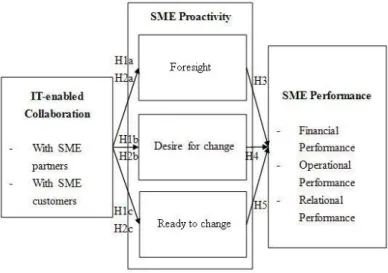
Based on the discussion in the literature review, we posit that proactivity is essential to the growth of an SME and that IT-enabled collaboration among SMEs has the potential to create proactivity. Hence, we integrate information from previous studies to develop our research model, as shown in Figure 2.
Figure 2. Research Framework
The research model illustrates two varieties of IT-enabled collaboration among SMEs: collaboration with business partners and collaboration with customers. In the last section, we defined proactivity as having three dimensions: foresight (focus on time in advance), desire for change (focus on willingness), and ready to change (focus on initiation and readiness). We propose that IT-enabled collaboration contributes to the development of proactivity. Furthermore, the three dimensions of proactivity also relate to SMEs’ performance. Three types of SME performance are considered in this study: financial, operational, and relational. In most of the previous literature, scholars have proposed financial performance measures, such as cost and profitability, as dimensions of organizational performance (Sink, 1985; Peel and Bridge, 1998; Omerzel and Antoncic, 2008). In addition to the traditional financial perspective, we argue that operational performance is another essential type of SME performance that consists of time savings, labor savings, and error reduction. Time savings has been considered both a source of competitive advantage and a basic measure of performance (Neely et al., 1995). For labor savings, Sink and Tuttle (1989) proposed productivity and effectiveness as performance criteria. Moreover, the risk reduction strategies that SMEs adopt are important for business operations (Kotey and Meredith, 1997; Shepherd et al., 2000). We suggest relational performance as a third type of SME performance that measures a company’s relationships with its cooperative partners (Vickery et al., 2004). Specifically, Stank, Goldsby, and Vickery (1999) found that creating strong relationships with important customers allows firms to achieve a sustainable advantage by tailoring offerings to the needs of their customers. Gwinner et al. (1998) further stressed
that well-developed relationships can have beneficial confidential, social, or special treatment aspects. The details of this model will be described in the following sections.
3.1 IT-enabled Collaboration
3.1.1 IT-enabled Collaboration with SMEs’ partners
For SMEs, IT-enabled collaboration with partners is a good way of gathering industrial information, scanning the business environment to identify new opportunities, and acquiring external knowledge resources (Laurie, 2001; Sawers et al., 2008). Wigand et al. (1997) noted that IT-enabled collaboration enhances networkability among partners so that companies can discover the most recent business trends through information sharing (Huisman and Smits, 2007) and take action before their competitors. Thus, we develop hypothesis H1a as follows:
H1a: IT-enabled collaboration with SME partners has a positive effect on the ‘foresight’ capability of SMEs.
At the same time, IT-enabled collaboration provides a common platform for accessing information and thus increases the opportunities for open discussion among participating firms (Moch et al., 2011). The exchange of ideas, experiences and practices in the open discussion provide a means for SMEs to obtain new ideas and ensure sufficient interactions to achieve innovative changes (Aldea-Partanen, 2006). As a result, we present the following hypothesis:
H1b: IT-enabled collaboration with SME partners has a positive effect on the ‘desire for change’ capability of an SME.
When companies collaborate with each other, the social linkages between them are characterized as a set of relations based on an exchange of resources as well as a means of enhancing new opportunities (Ulrich and Barney, 1984; Lechner and Dowling, 2003). Complementary resource exchange through collaboration creates a good foundation for change and innovation (Wincent et al., 2010). Moreover, IT makes communication among partners much easier and more efficient. Companies can either create a friendly environment in which change can occur or resolve environmental barriers (Cairncross, 2001) that may impede changes. Therefore, we propose Hypothesis 1c, as follows:
H1c: IT-enabled collaboration with SME partners has a positive effect on the ‘ready to change’ capability of SMEs.
3.1.2 IT-enabled Collaboration with SMEs’ customers
It has become increasingly difficult to meet the needs of diversified customers. Thus, it is important for companies to use strategic solutions, such as IT-enabled collaboration, to resolve this difficulty (Hammer and Champy, 1993; O'Neill and Sohal, 1999). By gathering customer profiles or through collaborative filtering, SMEs are capable of identifying the overwhelming number of existing and potential interests of their customers (Herlocker et al, 2004) so that they can predict business trends and innovate to achieve the best timing. Accordingly, Hypothesis 2a was developed, as follows: H2a: IT-enabled collaboration with SME customers has a positive effect on the ‘foresight’ capability of SMEs.
Moreover, to obtain optimal results from IT-enabled collaboration with customers, SMEs must predict their future resources and competences and prepare in advance to interact with customers rather than simply responding to customers’ requests. This foresight makes SMEs more willing to change. IT also creates an open communication channel that enables companies to exchange information with SMEs and customers so that new ideas are easily generated (Gibbert et al., 2002). Companies are therefore more willing to change to turn their ideas into realities. Hence, Hypothesis H2b is presented as follows:
H2b: IT-enabled collaboration with customers has a positive effect on the ‘desire for change’ capability of SMEs.
IT enables SMEs to accumulate and analyze customer data. When SMEs recognize customer shopping patterns, they may have a better idea of how to manage their brand and increase customer trust and loyalty (Feindt et al. 2002). Improved knowledge about customers guides firms in initiating change (Bates, 1991; Kenny and Fahy, 2011). During the process of collaborating with customers, firms can create additional relational resources and increase their competence in responding to customers’ needs (Forsström and Törnroos, 2005). SMEs are thus better able to take control of their circumstances and initiate changes. Consequently, we develop Hypothesis 2c as follows:
H2c: IT-enabled collaboration with SME customers has a positive effect on the ‘ready to change’ capability of SMEs.
3.2 SME Proactivity
3.2.1 Foresight
For an SME to be innovative, the company needs to search for new opportunities by tracking changes or conducting research over time (Arnold and Thuriaux, 1997) to identify opportunities for innovation. With market foresight, SMEs can improve performance through innovation and resource integration (Abro et al., 2011). For example, companies can enter into a new market before competitors and gain the greatest market share (Kim and Mauborgne, 2005); companies can improve the efficiency of the work process and thus decrease operating time in comparison with their competitors; and companies can improve their relationships with customers and suppliers through better knowledge of how to serve them. For these reasons, we develop Hypothesis 3 as follows:
H3: SMEs’ ‘foresight’ capability has a positive effect on their performance. 3.2.2 Desire for change
Because making changes is often costly and risky, SMEs are discouraged from initiating change by their limited resources and small number of external linkages (Bates, 1991; Coetsee and Visagie, 1995; Arnold and Thuriaux, 1997). For this reason, overcoming resistance to change and gaining a willingness to create change is usually an issue for SMEs (Coch and French, 1948; Vries, 2011). When SMEs’ desire for change or innovation increases through the development of a sense of urgency and increasing confidence (Vries, 2011), employees in these companies will be more ambitious when they encounter business hazards. When companies have a positive orientation toward their work, their sales revenue and working efficiency can grow. Relationships on SMEs’ supplier or customer side can also become stronger when open discussions are held among SMEs’ active workers (Brennan, 1997). Hypothesis 4 is therefore proposed as follows:
H4: SMEs’ ‘desire for change’ capability has a positive effect on their performance. 3.2.3 Ready to change
The ‘ready to change’ is necessary for companies to manage a dynamic business environment. When an SME prepares for a change or innovation, it needs to expand its resource and competence base with its partners. Collaborating with partners usually brings a firm more sales channels, more technological resources, and more brand images so that the company can influence its environment and easily initiate change. By initiating change, the company can create higher sales revenue by expanding channels, creating a more efficient operation with sufficient IT support, and strengthening linkages among customers and partners through loyalty building. Therefore, we suggest that SMEs will improve business performance by increasing their ‘ready to change’. Consequently, the last hypothesis of our research model, Hypothesis 5, is as follows:
IV. RESEARCH METHODOLOGY
4.1 Case Background: uVoyage
The uVoyage platform, built by the Service Science Research Center (SSRC) at National Chengchi University, is an IBSD2 developed to help SMEs deliver better service quality. It has two major features: (1) a business partner recommendation mechanism for SME network alliance formation and (2) a travel pattern recommendation mechanism to aid in customer tour planning. Through the uVoyage platform, SMEs are able to announce business operations information, organize their own resources, and analyze cooperative opportunities with potential SME partners. Customers are able to plan trips, share their comments with the public, and interact with SMEs by co-creating their customized trips. In summary, the uVoyage platform is a typical example of IT-enabled collaboration for both SME partners and their customers.
The platform was first introduced to the Mt. Pillow Leisure Agricultural Area in Yilan County, located in the northeast of Taiwan. In our research, we aim to delineate the effects of uVoyage with partners and customers on proactivity. We are also interested in understanding whether SMEs can enhance their performance after they have gained proactivity through cooperation via the uVoyage platform. A series of interviews were conducted in the field, and we will analyze these data to verify our research framework. We believe that the results of our research can help SMEs build better businesses.
4.2 Samples
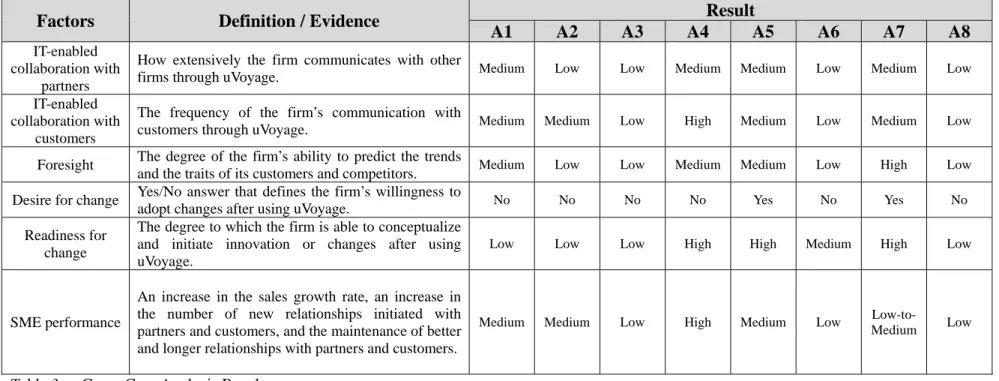
A multiple-case study is used to test our research framework developed in the last section. The Mt. Pillow Leisure Agricultural Area in Yilan County, where is located on the northern-east part of Taiwan, was selected as our research participant. Several firms were contacted; eight agreed to participate in the study with the assurance that all interview content would remain anonymous. The firms, which all belong to SMEs in this leisure agricultural area, include bed and breakfasts (B&B), farms, restaurants, and orchards. For identification purposes, we refer to the eight companies as firms A1 to A8. A summary description is presented in Table 2.
Firm
Kind Major Products & ServicesA1
B&B Accommodations Some homemade products
A2
Orchard Fruit Adoption of trees
DIY experience for children
A3
Restaurant Snack Food DIY experience
A4
B&B Accommodations Drama & commercial filming(CF) shooting
A5
B&B Accommodations DIY experience in backyard orchard
A6
B&B Accommodations The views at the top of Mt. Pillow
A7
Farm White champakA8
Farm Bamboo shoot dishes Bamboo shoot DIY experience Table 2. Description of the Organizations in the Sample
Firm A1 is a B&B that was built in 2003 in Yuanshan Township, Yilan County. The SME provides customers with comfortable accommodations and homemade products. It has two members, and for this study, the owner was interviewed. The owner of A1 has run her business very actively in the past, but recently, she has been focusing less on operations and more on her other responsibilities. In addition, her B&B is not yet an officially licensed business.
Firm A2 is an orchard that primarily cultivates pears. It offers customers many types of pears and fruits, the adoption of fruit trees, and “do it yourself (DIY)” activities. The host of A2 has seldom used IT tools for communication due to his lack of computer skills.
Firm A3 is a restaurant and snack factory owned and operated by the former host of a five-star hotel’s restaurant. He offers Chinese-themed snacks to his customers and also supplies nearby restaurants with meals. The DIY activities offered by A3 are also popular with customers. The owner recently considered expansion. Although the host spends most of his time making snacks, he expressed that he may concentrate more on collaboration at a later date.
Firm A4 is the most famous and popular B&B in our study because the Taiwanese celebrities stay here when in many Taiwanese trendy dramas and advertisements. It is also popular for its first-class facilities and beautiful views of Mt. Pillow.
Firm A5 is a B&B owned by an enthusiastic retired couple. The beautiful setting of the B&B, combined with its comfortable accommodations, helps it retain loyal customers. This couple viewed uVoyage as another Facebook, blog, and guest book to communicate with their customers and partners; they utilize feedback for business improvement.
Firm A6 is another B&B; it has outstanding views and is located at the top of Mt. Pillow. The host occasionally uses IT tools to interact with customers and partners; however, her lack of IT skills prevents her from more advanced collaboration using these platforms.
Firm A7 is a farm that primarily plants “white champak”, a type of flower belonging to the magnolia family, which has a pleasant smell. The farm sells the flowers and flower-related products, such as herbal tea. The original host of this farm had physical issues that made continuous operation difficult; therefore, the farm is now rented to an individual who was interviewed for this study. The new holder has struggled with promotion of the farm since he took control; he wish to utilize uVoyage with Facebook and blogs to interact with people to retain business.
Firm A8 is a famous farm offering bamboo shoot dishes and related DIY experiences. The primary host uses an official blog to communicate with customers. She does not consider using other platforms such as uVoyage for more advanced collaboration because the firm is currently successful.
V. RESEARCH ANALYSIS AND DISCUSSION
In this section we will analyze these cases according to the research framework. 5.1 Case Results5.1.1 IT-enabled collaboration
IT-enabled collaboration with partners. IT-enabled collaboration with partners is defined as the degree of SME interactions using IT platforms such as uVoyage. The case companies were categorized as having low, medium, or high rankings for IT-enabled collaboration if they had the following
respective traits: no interaction or low interaction with other SMEs using uVoyage; basic interactions with SMEs using IT platforms; or coordination with partners using uVoyage.
Through our interviews and analyses, it was determined that A2, A3, A6, and A8 do not interact with other SMEs through uVoyage, but they do have face-to-face interactions or communicate using phone calls. “We (SMEs) exchange information with our partners, for example, we talk about awkward customers. However, we always communicate face-to-face; we seldom go through the Internet,” stated the owner of A6. In contrast, the other four companies (A1, A4, A5 and A7) have basic interactions, such as leaving messages and sharing pictures with other SMEs via Facebook, to maintain relationships. For instance, “I sometimes interact with other SMEs on Facebook. I give them a ‘Like’ or leave messages, just like what we used to do with our friends,” stated the owner of A5. Based on our interviews, none of these scenarios achieves high levels of IT-enabled collaboration. IT-enabled collaboration with customers. To determine the co-creation of value through IT platforms, the frequency of each firm’s communication with customers using uVoyage was measured.
The first case, firm A1, had a special situation: the holder had changed her business approach. Previously, she had communicated with her customers diligently and actively. “In the past, I often interacted with customers. For example, I took some photos for my customers, uploaded these to my blog, and also emailed them,” the B&B holder said. She often communicated with customers using the firm’s guest book and sent greeting cards for Chinese New Year or other festivals. However, because of her personal situation, she no longer focuses on exploring new IT-enabled collaboration approach, such as uVoyage. This special case therefore received an average ranking.
The other three companies (A2, A5, and A7) showed similar characteristics that produce medium frequency interactions. They occasionally interact with their customers and feel that uVoyage work well. “Just like the guest book, uVoyage really works. If someone tells us that there are too many mosquitoes, I need to handle the situation, or if someone says that the floor is dirty, I will sweep immediately,” the holder of A7 said. Because of their medium frequency of interactions with customers using uVoyage, we ranked these three cases as medium.
Firms A3, A6, and A8 rarely use information technology to support their business operations and minimally utilize collaboration opportunities on IT-enabled platforms. In contrast, company A4 ranked at a high level for IT-enabled collaboration with customers due to its daily interactions using various platforms, including uVoyage. The owner of A4 regards the different platforms not only as a valuable way to promote his business but also as a way to help him learn more about his customers. This is a model example of utilizing information technology to communicate with customers.
5.1.2 Proactivity
Foresight. Instead of gazing into a crystal ball to just guess the future, the capability of foresight allows the organization to focus on possible future scenarios and then make decisions to create the best future for the company (Horton, 1999). To understand the level of foresight at each firm, we measured each firm’s ability to predict possible trends of both customers and competitors by examining its collaboration on IT-enabled platforms.
The three companies (A1, A4, and A5) that ranked as medium on foresight have the ability to examine industry trends and the traits of their potential customers. For example, the owner of A1 found that the introduction of smart phones and tablet personal computers has changed the behaviors of customers. She predicts that televisions will not be needed at hotels or B&Bs because of new information technologies. The owner of A4 simultaneously got the trend of watching trendy dramas online and hopes to translate this activity into profit for his organization by advertising that the dramas were filmed on site. “A vast number of people watch dramas on the Internet; however, people may not know that the dramas were filmed in my house,” he said.
competitors and business partners to see how they utilize IT-enabled collaboration. “They sometimes promote themselves by accident,” the holder of A7 commented. “For example, A1 is in our area. She often takes customers on outings, and if these are successful, I can plan similar outings in the future.” He further realizes that future trends concerning travel, as well as the potential to entice backpackers, may contribute to his future business opportunities owed to IT-enabled platforms. We ranked A7 as a company with a high market foresight capability.
After carefully evaluating the interviews, we ranked the rest of the cases at low levels for foresight capability. A2 and A6 have the capability to find potential traits in customers or partners, but not in the local market, and A3 and A8 indicate no interest in predicting the future through IT-enabled interactions.
Desire for change. To measure each firm’s desire for change, we asked all eight firms whether they were willing to adopt changes after utilizing IT-enabled collaborations. Only two companies, A5 and A7, responded positively. The other firms had no desire to make changes after using IT-enabled collaboration. For instance, the owner of A4 stated that “the information platform is just a convenient and accurate way to provide my information online for customer’s reference; therefore, I won’t change my business operations.” He views the information platform as a bridge to connect customers with the firm and to promote the firm to customers. A2 has received constructive criticism through IT-enabled collaboration, but the owner is unwilling to improve based on those comments. Moreover, A3 has a strong desire to change his business, and he has a succinct plan for the change; nevertheless, his high desire for change is derived from face-to-face contact and his knowledge of the industry rather than IT-enabled collaboration. Therefore, we regarded A3 as a company with no desire for change related to IT-enabled platforms.
Readiness for change. We define readiness for change as the degree to which the firm is ready to implement change or innovations after IT-enabled collaboration has been measured. A company with a high readiness to initiate change must be willing to use IT-enabled collaboration and initiate changes via IT-enabled platforms.
Three companies, A4, A5, and A7, ranked as having a high readiness for change. The owner of A4 uses the Internet daily to interact with customers and to analyze customer behavior patterns utilizing various platforms; he ranks high on the readiness to change scale. A5 and A7 also ranked high: both analyze IT-enabled collaboration when it occurs and then initiate changes based on their interactions.
A6 is the only firm that ranked as medium regarding readiness for change. The owner of A6 stated, “Unlike the others, I’ll understand when something enhances my business.” She has the ability to utilize IT-enabled collaborations and learn from the results; however, she is not adept at making changes within IT-enabled platforms. For this reason we gave the case a medium ranking.
The other cases, A1, A2, A3, and A8, rank as having a low readiness for change. They have similar characteristics and either have difficulty with using technology devices or have issues with understanding how to initiate change. Hence, their rankings of readiness for change were low.
5.1.3 SME performance
We assessed the SMEs' performance based on growth in income, relationships with customers, and relationships with partners. Accordingly, we ranked their performance as "Low", "Low-to-Medium", "Medium", or "High". The interviews revealed that A1 increased its income by selling its product and had better relationships with customers through interactions. A5 did not increase its income, but it has maintained good relationships with its partners and customers. The owner of A5 commented: “Through uVoyage, I recognize some SMEs in other areas, and we interact. Also, on uVoyage, customers ask me to recommend restaurants for the Chinese New Year; afterwards, they thank me because the ones I recommended are really good and cheap.”
A7 just started operating recently, so it only has good relationships with its partners. “I have a good relationship with some SMEs,” the holder of A7 said, “Though I am not currently connected to their friends, I do try to add them as friends on Facebook.”
The other companies are either low or high in their performance rating, representing two extremes. A4 has successfully reduced advertising costs, increased its income, and achieved an excellent relationship with customers and partners. “I use information technology to market my business for free. I also have 900 friends on Facebook, both SMEs and customers; most of them are active friends. I think this type of interaction is pretty good, not too commercial, but it unobtrusively promotes our B&B,” the owner of A4 remarked. Unlike A4, the remaining four firms did not achieve income growth or increase relationships with customers and partners. In summary, we ranked A4 at the highest level of performance; A1 and A5 at the medium level; A7 at the low-to-medium level; and A2, A3, A6 and A8 at the lowest level.
The result is summarized in Table 3. 5.2 Cross-Case Analysis Results
In this section, we will verify each proposed hypothesis by examining the relationships
among the eight cases. As presented in our research framework, the three capabilities of
proactivity, ‘foresight’, ‘desire for change’, and ‘readiness for change’, should be evaluated
using the two types of IT-enabled collaboration and the SMEs’ performance. Figure 5-1
represents the results. The linear lines in Figure 5-1 are derived from the levels of each
component using regression analysis.
We observed that with more IT-enabled collaborations with partners, the firm generates a
higher foresight capability. The relationship between the desire for change and IT-enabled
collaboration with partners can also be evaluated as positive, except in two special cases. The
two cases ranked at a medium level for IT-enabled collaboration with partners; however, their
‘desire for change’ capabilities were still ranked as low because of personal factors. The
owner of the first case, A1, said that she is too tired to run the business; in other words, the
firm faces a situation in which there is no willingness to change because of insufficient holder
motivation rather than because of the impact of IT-enabled collaboration. Another case, A4,
faces a similar situation; the owner resists his own belief on running business, so he is
unwilling to initiate change even if he receives significant information via IT-enabled
collaboration. The cooperation mechanism using IT can be further proven as enhancing the
‘readiness for change’ capability. The only case with a non-standard result, A1, presented no
willingness, no confidence, and no readiness to initiate change; therefore, the company ranked
low in the ‘readiness for change’ category even though it showed strong collaboration with its
partners.
IT-enabled collaboration with customers has a positive effect on generating ‘foresight’,
the ‘desire for change’, and ‘readiness for change’, with some exceptions. As previously
stated, the case of A1 involves a personal factor that inhibits both the willingness and the
readiness of the owner to effect change. Similarly, the strong resistance of the owner of A4
supports his unwillingness to change. One exception is A2, whose owner has low willingness
and low readiness to effect change. Although the owner of the firm occasionally collaborates
with his customers on the Internet, he has developed no new ideas from the interactions owing
to his low personal learning capability; he therefore lacks the two main capabilities of
proactivity.
can be observed that the three capabilities of proactivity have a positive impact on
performance, with some exceptions. The non-standard cases merit further examination. At a
medium level of market foresight and a low level of desire for change, A4, with its high
ranking on performance, is a special case. Its high frequency of communication with
customers and its effective promotion of advertisements, as well as the influence of
well-loved trendy dramas, distinguished its performance from the other companies in the
surrounding area; namely, the firm has the ability to improve its performance even without the
enhancements of foresight and the willingness to initiate change after IT-enabled
collaboration.
Contrary to A4, though A7 has a high market foresight ranking, it still needs to improve
its performance. The firm is in this situation because of timing issues. Once more partners and
customers notice that the holder of A7 has changed and is willing to collaborate with others,
more improvements on the performance of the firm may occur.
The last case to discuss, A1, was ranked as a medium performance, but its holder had no
‘desire for change’ and a low ‘readiness for change’ capability. The firm initially performed
well by maintaining connections with partners and by selling products using IT-enabled
platforms. Although A1 has no willingness or readiness to change, it still performs well.
In summary, the hypotheses we proposed in our research model are supported by the majority of the cases (Figure 3). A future survey is required for further justification.
Factors
Definition / Evidence
Result
A1
A2
A3
A4
A5
A6
A7
A8
IT-enabled collaboration with
partners
How extensively the firm communicates with other
firms through uVoyage. Medium Low Low Medium Medium Low Medium Low
IT-enabled collaboration with
customers
The frequency of the firm’s communication with
customers through uVoyage. Medium Medium Low High Medium Low Medium Low Foresight The degree of the firm’s ability to predict the trends
and the traits of its customers and competitors. Medium Low Low Medium Medium Low High Low Desire for change Yes/No answer that defines the firm’s willingness to
adopt changes after using uVoyage. No No No No Yes No Yes No
Readiness for change
The degree to which the firm is able to conceptualize and initiate innovation or changes after using uVoyage.
Low Low Low High High Medium High Low
SME performance
An increase in the sales growth rate, an increase in the number of new relationships initiated with partners and customers, and the maintenance of better and longer relationships with partners and customers.
Medium Medium Low High Medium Low
Low-to-Medium Low
5.3 Managerial Implications
The results shown in Figure 3 provide evidence that IT-enabled collaboration with partners and customers has a positive influence on the generation of proactivity, and each capability of proactivity can assist the firms in reaching improved performance. By achieving market foresight, the firm will be able to follow the trends and be well prepared to face environmental changes or to self-initiate new changes. With adequate willingness to initiate change, the company will be prepared to seek opportunities for business growth. Moreover, if the SME embraces a readiness to change, it may initiate change with little effort. After achieving proactivity, the firms will be ready to make changes instead of taking no action. Therefore, organizations hoping to achieve higher goals related to business performance should collaborate with customers and partners online to improve their proactivity, which will lead to enhanced business opportunities.
The content of interviews also provides some insights about necessary traits that IT-enabled collaboration platform builders need to take into account to help firms shape proactivity for firm performance. Except the need of instant interaction (e.g., clicking the ‘like’ button on facebook), convenient photo sharing, and easy-to-use guest book, the SMEs may hope to collect more information about the general economic situation in their industry and to make some simulations for their potential change initiations. That is to say, the IT-enabled collaboration platforms would not only a crystal ball which can predict the future, but also a clay ball which can change shape for any wants and can return to the original ball if its former shape is not pretty.
VI.
CONCLUSION
6.1 Summary
Researchers are seeking methods to assist SMEs in improving their performance by examining and exploring the path SMEs follow in their search for success. This dissertation discusses the
effectiveness of IT-enabled collaboration and proactivity. In our research framework, we proposed two dimensions of IT-enabled collaboration: (1) IT-enabled collaboration with partners and (2) IT-enabled collaboration with customers. Each dimension will directly influence proactivity, which includes three capabilities: (1) foresight, (2) the desire for change, and (3) readiness for change.
Eight SMEs in the Mt. Pillow Leisure Agricultural Area in Yilan County, located in the northeast of Taiwan, were carefully studied to test the proposed hypotheses in our research. We conducted face-to-face interviews in April and May of 2012 to gather useful information and thereby gain insight. After analyzing the cases, the hypotheses proved to be well validated, and the exceptional cases can be reasonably explained. In conclusion, IT-enabled collaboration can help SMEs improve proactivity, which will subsequently improve their business performance.
6.2 Limitations and Implications of Future Research
In our research, we found that some personal factors, such as a lack of motivation and the resistance to commitment, had potential negative influences on the relationship between proactivity and IT-enabled collaboration. Thus, some mediating factors could be studied in future research. Moreover, the research framework could be further verified by using a survey, and it could also be tested in other industries to generalize the results.
References
Abro, Q.M.M., Memon, N.A. and Arshdi, P.S. (2011). Dynamic Capabilities and Firm Performance: A Case of Two SMEs in Pakistan. Mehran University Research Journal of Engineering & Technology, 30(3), 521-530.
Aldea-Partanen, A. (2006). Triple Helix Partnerships in Rural North. In Proceedings of the 1st Nordic Innovation Research Conference—Finnkampen, Oulu, Finland, December 2006.
Allan, J. and Lawless, N. (2005). Learning through online collaboration by SME staff: A scoping investigation into likely team-role stressors. Education + Training, 47(8-9), 653-664.
Aragón-Correa, J.A., Hurtado-Torres, N., Sharma, S., García-Morales, V.J. (2008). Environmental strategy and performance in small firms: A resource-based perspective. Journal of Environmental Management, 86, 88-103.
Arnold, E. and Thuriaux, B. (1997). Developing Firm's Technological Capabilities, Technopolis, Brighton.
Ballantyne, D. (2004). Dialogue and Its Role in the Development of Relationship Specific Knowledge. Journal of Business and Industrial Marketing, 19(2), 114-123.
Bateman, T.S. and Crant, J.M. (1993). The proactive component of organizational-behavior: A measure and correlates. Journal of Organizational Behavior, 14, 103-118.
Bates, A. (1991). Interactivity as a Criterion for Media Selection in Distance Education. Never Too Far, 16, 5-9.
Bell, J., Crick, D., and Young, S. (2004). Small Firm Internationalization and Business Strategy. International Small Business Journal, 22(1), 23-56.
Berry, A. (1997). SME Competitiveness: The Power of Networking and Subcontracting, InterAmerican Development Bank, Washington, D.C.
Brennan, R. (1997). Buyer/supplier Partnering in British Industry: The Automotive and Telecommunications Sectors. Journal of Marketing Management, 13, 759-775.
Brunetto, Y. and Farr-Wharton, R. (2007). The Moderating Role of Trust in SME Owner/Managers’ Decision-Making about Collaboration. Journal of Small Business Management, 45(3), 362-387. Cairncross, F. (2001). The Death of Distance 2.0: How The Communications Revolution Will Change
Our Lives, Texere, London.
Camison, C. (1997). La Competitividad de la PYME Industrial Espanola: Estrategia y Competencias Distintivas. Civitas, Madrid.
Casals, F.E. (2011). The SME Co-operation Framework: A Multi-method Secondary Research Approach to SME Collaboration. In Proceeding of 2010 International Conference on E-business, Management and Economics, IPEDR, 3, p. 118-124.
Coch, L. and French, J.R.P. (1948). Overcoming Resistance to Change. Human Relations, 1, 512-532. Coetsee, J.E. and Visagie, J.C. (1995). SME's in South Africa: The Challenge of Change. Journal of
Small Business and Entrepreneurship, 12(1), 64-77.
Coopey, J. (1998). Learning to Trust and Trusting to Learn. Management Learning, 29(3), 365-382. Crant, J.M. (2000). Proactive Behavior in Organizations. Journal of Management, 26(3), 435-462. Doligalski, T. (2011). Internet-Based Customer Portfolio Building. Paper accepted for 10th
International Conference Marketing Trends, Paris, 20-22 January, 2011.
European Commission, DG Enterprise & Industry (2010). Annual Report on EU Small and Medium-sized Enterprises 2009, European Commission, Brussels, Belgium.
Feindt, S., Jeffcoate, J. and Chappell, C. (2002). Identifying Success Factors for Rapid Growth in SME E-commerce. Small Business Economics, 19(1), 51-62.
Findikoglu, M.N. (2011). Small- and Medium-sized IT Firms and Non-local Service Partnerships: An Assessment of Facilitators. Working paper, Available at SSRN: http://ssrn.com/abstract=1874067 or doi:10.2139/ssrn.1874067.
Forsström, B. and Törnroos, J.-Å. (2005). The Role of Interdependencies for Value Co-creation in Buyer-seller Partnerships in Business Markets. In Proceedings of 21st Annual IMP Conference, Rotterdam, September.
Frankl, V.E. (1959). Man's Search for Meaning: An Introduction to Logotherapy, Beacon Press, United States.
Gibbert, M., Leibold, M. and Probst, G. (2002). Five Styles of Customer Knowledge Management, And How Smart Companies Use Them to Create Value. European Management Journal, 20(5), 459-469.
Griffin, M.A., Neal, A. and Parker, S.K. (2007). A New Model of Work Role Performance: Positive Behavior in Uncertain and Interdependent Contexts. Academy of Management Journal, 50(2), 327-347.
Gwinner, K.P., Gremler, D.D. and Bitner, M.J. (1998). Relational Benefit in Services Industries: The Customer’s Perspective. Journal of the Academy of Marketing Science, 26(2), 101-114.
Hammer, M. and Champy, J. (1993). Reengineering the Corporation: A Manifesto for Business Revolution, Harper Business, New York.
Hannah, V. and Walsh, K. (2008). Interfirm Cooperation among Small Manufacturing Firms. International Small Business Journal, 26(3), 299-321.
Herlocker, J., Konstan, J.A., Terveen, L.G. and Riedl, J.T. (2004). Evaluating Collaborative Filtering Recommender Systems. ACM Transactions on Information Systems, 22(1), 5-53.
Hoffmann, W.H. and Schlosser, R. (2001). Success Factors of Strategic Alliances in Small and Medium-sized Enterprises—An Empirical Survey. Long Range Planning, 34(3), 357-381. Huisman, W. and Smits, M. (2007). Investing in Networkability to improve Supply Chain
Performance. In Proceedings of the 40th Hawaii International Conference on System Sciences (HICSS'07), Big Island, Hawaii, January 03- 06, 2007, p. 207.
Kantabutra, S. and Avery, G.C. (2003). Enhancing SME Performance Through Vision-based Leadership: An Empirical Study. In Proceedings of the 16th Annual Conference of Small Enterprise Association of Australia & New Zealand, Victoria, Australia.
Kenny, B. and Fahy, J. (2011). SMEs' Networking Capability and International Performance. In Interfirm Networks: Theory, Strategy, and Behavior (Advances in Business Marketing and Purchasing, vol. 17, Roger Baxter, Arch G. Woodside Ed.), Emerald Group Publishing Limited, pp.199-376.
Kim, W.C. and Mauborgne, R. (2005). Blue Ocean Strategy, Harvard Business School Press, Boston, US.
Knop, R. (2007). Success Factors of Strategic Networks of SME. In Proceedings of the International Conference on Economics and Management of Networks (EMNet), Rotterdam, the Netherlands. Kotey, B. and Meredith, G.G. (1997). Relationships among Owner/Manager Personal Values,
Business Strategies, and Enterprise Performance. Journal of Small Business Management, 35(2), 37-64.
Larsson, S. and Malmberg, A. (1999). Innovations, competitiveness and local embeddedness. Geografiska Annaler SeriesB: Human Geography, 81(1), 118.
Laurie, D.L. (2001). Venture Catalyst (1st Ed.), Perseus Publishing Services, Cambridge, MA. Lechner, C. and Dowling, M. (2003). Firm Networks: External Relationships as Sources for the
Growth and Competitiveness of Entrepreneurial Firms. Entrepreneurship and Regional Development, 15, 1-26.
Lewis, D.J. (1990). Partnership for Profit: Structuring and Managing Strategic Alliances, The Free Press, New York, NY.
Lusch, R.P. and Vargo, S.L. (2006). The Service Dominant Logic of Marketing: Dialog, Debate and Directions, M.I. Sharpe, Armonk, NY.
Malecki, E. (1991). Technology and Economic Development: The Dynamics of Local Regional and National Change, Longman.
Masurel, E. and Janszen, R. (1998). The Relationship between SME Cooperation and Market Concentration: Evidence from Small Retailers in the Netherlands. Journal of Small Business Management, 36(2), 68-73.
McNurlin, B., Sprague, R., and Bui, T. (2008). Information Systems Management. 8th Edition. Prentice Hall, New Jersey, US.
Merriam-Webster Online Dictionary (2012), Merriam-Webster Online. (Retrieved from http://www.merriam-webster.com/dictionary/proactive on Jan. 2012.)
Miller, G.A. (1995). WordNet: A Lexical Database for English. Communications of the ACM, 38(11), 39-41.
Moch, R., Merkel, A., Günther, L. and Müller, E. (2011). The Dimension of Innovation in SME Networks – A Case Study on Cloud Computing and Web 2.0 Technologies in a Textile
Manufacturing Network. International Journal of Innovation and Sustainable Development (IJISD), 5(2/3), 185-198.
Morrison, E.W. and Phelps, C.C. (1999). Taking Charge at Work: Extrarole Efforts to Initiate Workplace Change. Academy of Management Journal, 42, 403-419.
Neely, A., Gregory, M. and Platts, K. (1995). Performance Measurement System Design: A Literature Review and Research Agenda. International Journal of Operations & Production Management, 15(4), 80-116.
Ngugi, I.K., Johnsen, R.E. and Erdélyi, P. (2010). Relational capabilities for value co-creation and innovation in SMEs. Journal of Small Business and Enterprise Development, 17(2), 260-278. Nolan, A. (2002). Public Policy on Enterprise Clusters and Networks. Small Enterprise Development:
Policies for Sustainable Growth in South-east Europe, Kluwer Academic Publishers, Dordrecht. Novani, S. and Kijima, K. (2010). Value Co -Creation Model of Service Innovation: Symbiotic
Hypergame Analysis. In Proceedings of the 54th Meeting of the International Society for the Systems Sciences, Wilfrid Laurier University, Waterloo, ON, Canada, July 18-23, 2010.
Omerzel, D.G. and Antoncic, B. (2008). Critical Entrepreneur Knowledge Dimensions for the SME Performance. Industrial Management & Data Systems, 108(9), 1182-1199.
O'Neill, P. and Sohal, A.S. (1999). Business process reengineering a review of recent literature. Technovation, 19, 571-581.
Oxford University (1930). The Oxford English Dictionary, Oxford University Press, Oxford, UK. Page, R.M. and Page, T.S. (2002). Responsibility: Are We Proactive or Reactive. Fostering Emotional
Well-being in the Classroom (3rd Ed.), Jones and Baetlett Publishers, Canada, p.50-52. Parker, S.K. and Collins, C.G. (2010). Taking Stock: Integrating and Differentiating Multiple
Proactive Behaviors. Journal of Management, 36, 633-662.
Parker, S.K., Williams, H.M. and Turner, N. (2006). Modeling the Antecedents of Proactive Behavior at Work. Journal of Applied Psychology, 91(3), 636-652.
Peel, M.J. and Bridge, J. (1998). How Planning and Capital Budgeting Improve SME Performance. Long Range Planning, 31(6), 848-856.
Randmaa, M. (2011). Introducing Proactive Thinking in Value Alliance Concept. In Proceeding of 10th International Symposium “Topical Problems in the Field of Electrical and Power
Engineering”, Pärnu, Estonia.
Ritchie, B. and Brindley, C. (2000). Disintermediation, Disintegration and Risk in the SME Global Supply Chain. Management Decision, 38(8), 575-583.
Sawers, J.L., Pretorius, M.W. and Oerlemans, L.A.G. (2008). Safeguarding SMEs dynamic capabilities in technology innovative SME-large company partnerships in South Africa. Technovation, 28(4), 171-182.
Scott, S.G. and Bruce, R.A. (1994). Determinants of Innovative Behavior: A Path Model of Individual Innovation in the Workplace. Academy of Management Journal, 37, 580-607.
Shepherd, D.A., Douglas, E.J. and Shanley, M. (2000). New Venture Survival: Ignorance, External Shocks, and Risk Reduction Strategies. Journal of Business Venturing, 15(5-6), 393-410. Shrader, R.C. (2001). Collaboration and Performance in Foreign Markets: The Case of Young
High-Technology Manufacturing Firms. Academy of Management Journal, 44(1), 45-60. Sink, D.S. (1985). Productivity Management: Planning, Measurement and Evaluation, Control and
Improvement, John Wiley & Sons, New York, USA.
Sink, D.S. and Tuttle, T. (1989). Planning and Measurement in your Organisation of the Future, Industrial Engineering & Management Press, Norcross,GA.
Sorama, K., Katajamaki, A. and Varamaki, E. (2004). Cooperation between SMEs: Social Capital and Learning Perspective.
Stank, T.P., Goldsby, T.J. and Vickery, S.K. (1999). Effect of Service Supplier Performance on Satisfaction and Loyalty of Store Managers in the Fast Food Industry. Journal of Operations Management, 17(2), 429-447.
Street, C.T. and Cameron, A. (2007). External Relationships and the Small Business: A Review of Small Business Alliance and Network. Journal of Small Business Management, 45(2), 239-266.
Tantalo, C. (2011). Competing for Stakeholders: Three Essays on Business Sustainability, LUISS Guido Carli, Rome. (Retrieved from http://eprints.luiss.it/990/1/20110524-tantalo-tesi-update.pdf on Jan. 2012.)
Temtime, Z.T., Chinyoka, S.V. and Shunda, J.P.W. (2003). Towards Strategic Use of IT in SMEs: A Developing Country Perspective. Information Management and Computer Security, 11(5), 230-237.
Ulrich, D. and Barney, J.B. (1984). Perspectives in Organizations: Resource Dependence, Efficiency, and Population. Academy of Management Review, 9, 471-481.
Unsworth, K.L. and Parker, S. (2003). Proactivity and Innovation: Promoting a New Workforce for the New Workplace. The New Workplace: A Guide to the Human Impact of Modern Working Practices, John Wiley & Sons, Chichester, UK, p. 175-196.
Vickery, S.K., Droge, C., Stank, T.P., Goldsby, T.J. and Markland, R.E. (2004). The Performance Implications of Media Richness in a Business-to-Business Service Environment: Direct versus Indirect Effects. Management Science, 50, 1106-1119
Vries, M. F. R. K. de (2011). The Hedgehog Effect: The Secrets of Building High Performance Teams, John Wiley & Sons, San Francisco, CA, USA.
Wigand, R.T., Picot, A. and Reichwald, R. (1997). Information, Organization, and Management, Wiley & Sons, Chichester.
Wilby, J.M., Kijima, K., Ing, D. and Metcalf, G.S. (2010). Service Systems and Systems Sciences in the 21st Century. In Proceedings of INCOSE 20th International Symposium, Chicago, Illinois, July 12-15 2010.
Wincent, J., Anokhin, S. and Örtqvist, D. (2010). Does Network Board Capital Matter? A Study of Innovative Performance in Strategic SME Networks. Journal of Business Research, 63, 265-275. Zeng, S., Xie, X. and Tam, C. (2010). Relationship between Cooperation Networks and Innovation
出席國際學術會議心得報告
本人出席一場國際學術會議,並發表論文。其心得報告分述如下:國際資管年會—2013 服務科學研討會
計畫編號 100-2410-H-004 -028 -MY3 計畫名稱 意像為基礎的服務創新:於服務科學中的方法、模型與應用--建構以意像為基礎之服務創新成熟度模型:探索在創新過程中組織能力之演變 出國人員姓名 服務機關及職稱 張欣綠,國立政治大學資訊管理學系 會議時間地點 Milan, Italy. 會議名稱 中文:國際資管年會—2013 服務科學研討會英文:International Conference on Information Systems –Annual workshop of the SIG Service Science research community
發表論文題目 Applying Stakeholder Theory for Developing the Valuation Framework of
E-Health Service
一、
參加會議經過
This year, the workshop theme is “Delivering and Managing Services in Systems of Service Systems.” Five sessions were arranged in the workshop, focusing the topics covering IT service management, service systems on big data, digitized services, innovative BPO services, eHealth services, local social services, location-based services. Dr. John Leslie King gave the keynote speech. He is the professor from University of Michigan. In his speech “service science: where from and where to?” he defined the name and basic ideas of service science, introduced related books and journals, and summarized the challenge ahead.
Following the keynote speeches, my paper is presented on Session two.
The workshop is organized as a pre-ICIS (International Conference on Information Systems) workshop. ICIS welcome reception was arranged just after the closing of workshop on Sunday, December 15, 2013. ICIS’s paper sessions started at 830am the next day. The conference theme is “reshaping society through information systems.” On Monday morning, I attended the session “design society and sustainability.” Themistocleous from University of Piraeus was the chair. On Monday afternoon, the session that I attended was “eBusiness and mBusiness chaired by Youwei Wang from Fudan University, China. On Tuesday, I attended the session – Strategic information systems in the morning and social media and organizing in the afternoon. On Wednesday, I attended the session “technology and service management” in the morning.
Many interesting papers are discussed in the sessions that I have participated. In general, I categorize the topics into five groups and summarize the discussion results.
[Virtual Social Network]
Quinio and Marciniak propose a generic definition for virtual social networks. The authors identify the environment’s five essential dimensions. Their work provides a simple reference framework, which allows researchers compare the research work on the different environment and their varied theoretical approaches.
[Usage behavior in mobile app]
Chung quantifies how mobile app usage relates to the unique characteristics of behavioral orientations and content types. Using a large-scale dataset of individual content usage in a particular music mobile app, the author builds a simultaneous equation panel data model to examine dynamic interdependent usage of mobile app. The paper finds a positive temporal effect of self-oriented content usage on other-oriented content usage, and also a temporal interdependence between external and internal usage based on types of content. The author also finds that 4G communications standard increases content usage in this mobile app.
[Supply chain and firm performance]
Wei et al. examine how supply chain exploitation and exploration impact firm performance. Specifically, drawing upon the boundary spanning theory, they theorize how top management, as boundary spanners, and three types of information technology capabilities, as boundary objects, enable supply chain exploration and exploration. Their research hypotheses are tested using data collected from 157 firms in China. They found that both supply chain exploration and exploitation have significantly positive effects on firm performance. Also top management participation directly affects both supply chain exploitation and exploration.
[Social media usage]
Gonzalez et al. investigate an internal social media tool that was designed and implemented as part of a new hire program. An online survey was administered to IT new hires in a military financial service organization. While work related social media use did not prove to have a significant relationship with socialization or commitment, this study suggests that social related social media use is associated with knowledge of organizational culture, social acceptance, and affective commitment. In this study, two types of social media use, four indicators of socialization and three indicators of commitment were analyzed.
[IT outsoucing]
Bapna et al. use a dataset of large IT outsourcing contracts from the SCD database with 22,031 large IT outsourcing contracts from 1989-2009 to examine the antecedents of choice with respect to the form of outsourcing arrangements that firms have. Their results indicate that higher value projects are more likely to be single-sourced with subcontracting; however, a highly modularized project is more likely to be multi-sourced. Further, client and vendor experience dictate whether multi-sourcing or single-sourcing is chosen due to tradeoffs involved in benefits from
specialization in one case versus the cost of coordination in the other. Finally, as the IT