國
立
交
通
大
學
科 技 管 理 研 究 所
碩 士 論 文
國家創新政策與績效之比較:
以台灣和新加坡為例
A Comparative Policy/ Performance Study of
Taiwan and Singapore
研究生:吳亦泰
指導老師:林亭汝 副教授
National Chiao Tung University
Institution of Management of Technology
A Comparative Policy/ Performance Study of
Taiwan and Singapore
Student: Wu Yi Tai
Advisor: Grace Lin
May 2010
Hsinchu, Taiwan
CONTENTS
1. INTRODUCTION ... 1
2. INNOVATION POLICY EVOLUTION: TAIWAN AND SINGAPORE ... 3
2.1 TAIWAN ... 3
2.2 SINGAPORE ... 4
3. LITERATURE REVIEW ... 7
3.1 NATIONAL INNOVATION SYSTEMS ... 7
3.2 INNOVATION POLICY ... 7
3.3 THEORETICAL LITERATURE ON INNOVATION DYNAMICS:ECONOMIC GROWTH,NATIONAL COMPETITIVENESS AND GLOBAL NETWORKING ... 9
3.4 MEASURING NATIONAL INNOVATION PERFORMANCE ... 11
4. ASSESSING NATIONAL INNOVATION POLICY... 14
4.1 SUPPLY SIDE OF INNOVATION POLICY ...14
4.1.1 Taiwan ...15
4.1.2 Singapore ...16
4.2 ENVIRONMENTAL SIDE OF INNOVATION POLICY ...18
4.2.1 Taiwan ...18
4.2.2 Singapore ...19
4.3 DEMAND SIDE OF INNOVATION POLICY ...20
4.3.1 Taiwan ...21
4.3.2 Singapore ...22
5. NATIONAL INNOVATION PERFORMANCE COMPARISON: TAIWAN AND SINGAPORE ... 23 5.1 PATENTING ...23 5.2 CLUSTER STRENGTH ...26 5.3 R&DENGAGEMENT ...27 5.4 ECONOMIC PERFORMANCE ...28 5.5 INDUSTRIAL GROWTH ...30 5.6 EDUCATION EXPENDITURE ...31 5.7 INWARD FDI ...31
6. INTERACTION BETWEEN INNOVATION POLICY AND INNOVATION PERFORMANCE ... 34
6.1 HOW NATIONAL INNOVATION POLICY AFFECTS INNOVATION PERFORMANCE:TAIWAN AND SINGAPORE ...34
6.2 PERFORMANCE DIRECTS INNOVATION POLICY AS FEEDBACK:TAIWAN AND SINGAPORE ...36
7. CONCLUSION: POLICY AND PERFORMANCE IMPLICATIONS ... 38
8. POLICY SUGGESTIONS FOR TAIWAN AND SINGAPORE ... 41
8.1 TAIWAN ...41
8.2 SINGAPORE ...42
9. FUTURE RESEARCH ... 45
TABLES
Table 1 A More Complete Innovation Policy Analysis Model... 9
Table 2 Comparison of Supply-Side Policies between Taiwan and Singapore ... 14
Table 3. R&D Expenditure by Source of Funds ... 15
Table 4. Main Science Parks in Singapore ... 17
Table 5. Comparison of Environmental Side Policies between Taiwan and Singapore ... 18
Table 6. Comparison of Demand Side Policies between Singapore and Taiwan ... 20
Table 7. Number of ICT, nanotechnology and biotechnology patents application filed under the PCT ... 24
Table 8. R&D Expenditure by Source of Funds ... 25
Table 9. WEF Ranking of the Competitiveness of Industrial Clusters ... 26
Table 10. R&D Expenditure as a Percentage of GDP (Unit: %) ... 27
Table 11. Taiwan R&D Expenditure by Source of Funds (Unit: Million NT$) ... 27
Table 12. R&D expenditure of local and foreign private sector firms in the biomedical industry, Singapore (Unit: Million S$) ... 28
Table 13. GDP Growth Rates of Taiwan and Singapore, 2004-2010(forecast) ... 29
Table 14. Labor Productivity of Manufacturing (Unit: US $)... 29
Table 15. Government Education Expenditure as Percentage of total Expenditure ... 31
Table 16. Foreign Direct Investment, 2003-2008, Taiwan and Singapore (Unit: Million Dollars) 32 Table 17. Distribution of FDI by Industry, 2006-2007, Singapore (Stock as at Year-End) ... 32
FIGURES
Figure 1. Research Key Elements ... 2
Figure 2. Number of Triadic Patent Families ... 23
Figure 3. Share of countries in triadic patent families ... 25
Figure 4. Per capita GDP based on purchasing-power-parity (PPP), Taiwan and Singapore ... 30
Figure 5. Index of Industrial Production, Taiwan and Singapore, 2001–2009 ... 30
Figure 6. Source of FDI by Region, Singapore, 2007 ... 33
ACKNOWLEDGE
The research can be accomplished is mainly with the support from my advisor, Grace Lin. The research framework and schedule is done under her direction and monitor. The advice from PH.D candidate, Shen Yung Chi is also vital to the study. His prior related studies gave me a great help, and he also leads me overcome many obstacles on the study. Of the whole time in graduate school, my family is my greatest support. Without their kindly encouragement, I would never accomplish this work. Finally, I give my biggest thank to my closest friend and soul mate, Emily Kao. She always gives me strength to carry on reaching my goals.
ABSTRACT
This research aims to find how Taiwan and Singapore, respectively, have developed their national innovation policies as a whole, from an evolutionary perspective. Then we also review how national innovation performance should be assessed through different measures. This section will also discuss why patenting, cluster strength, R&D engagement, economic performance, industrial growth, education expenditures and inward FDI should be chosen as measures. Then this research presents a comparative analysis of innovation performance between Taiwan and Singapore. Finally, we point out how innovation performance directs innovation policy as feedback. Final part is devoted to drawing conclusions, policy implications, and suggestions
1 1. Introduction
As small countries within the “Asian Tiger” economies, Taiwan and Singapore both have been regarded as locations that have performed economic miracles. In recent decades, as economic activity in both Taiwan and Singapore has grown more knowledge intensive, greater attention is being given towards the economic role of innovation. Because the ability to innovate will play a more prominent role in driving future economic growth, the national governments of both Taiwan and Singapore have accelerated policy efforts aimed at strengthening their national innovation systems. These efforts include the introduction of broad measures to improve performance in areas like R&D, education, entrepreneurial activity and knowledge flows—all of which are key determinants for innovative activity (Merges & Nelson, 1990).
It is usually agreed that innovation is the key driver of economic performance. The innovation as a driver of growth theory is derived from the economic theory of creative destruction put forward by Joseph Schumpeter (1942); his theory states that in a capitalist society, long-term economic growth is generated by the creation of the new and the displacement of the old. As nations achieve higher levels of GDP per person, the main source of this change becomes innovation. Porter and Stern (2001) thus describe changes in advanced countries: “The challenges of a decade ago were to restructure lower costs and raise quality. Today, continued operational improvement is given in advanced countries. That advantage must come from the ability to create and then commercialize new products and processes, shifting the technological frontier as fast as their rivals can catch up.” In addition, statistical comparisons of economic performance among countries show that the intensity of national innovative activity is correlated with higher rates of standards of living and productivity growth (Furman et al., 2002).
Recognizing the relation between innovation and economic performance, we then wish to explore how actual innovation-related factors drive the competitiveness of these two small but relatively fast-growing economies separately. This research effort is devoted to the twofold task of assessing and analyzing Taiwan and Singapore’s innovation performance, highlighting their specific strengths and weaknesses and the effectiveness of their innovation policies in the specific economic and institutional context in which they operate. Among these, another core viewpoint anchored in this paper is concerning national innovation systems. The literature related to national innovation systems mainly emphasizes the active role played by government policy and specific institutions, for example, including the university system (Nelson & Rosenberg, 1994), the extent of intellectual policy protection (Merges & Nelson, 1990), and the evolution of the industrial R&D organization (Mowery, 1984).
The following denotes the organization of this research plan. We will also base on the outline to obtain the aimed results. That is, we have observed how Taiwan and Singapore, respectively, have developed their national innovation policies as a whole, from an evolutionary perspective. Then, this research should review the related theories including the endogenous growth theory, the diamond model, the national innovation systems approach, and the perspective of global production networks. This research should also reviews how national innovation performance should be assessed through different measures. This section will also discuss why patenting, cluster strength, R&D engagement, economic performance, industrial growth, education expenditures and inward FDI should be chosen as measures. Then this research should present a comparative analysis of innovation performance between Taiwan and Singapore. Next parts should then analyze how variations in national innovation policy account for differences of innovation performance and how innovation performance directs innovation policy as feedback. Final part is devoted to drawing conclusions, policy implications, and suggestions (Figure 1.).
2
Figure 1.
Research Key Elements
National Context Innovation Policy Innovation Performance Interaction: • Economic growth • National competitiveness • National innovation • Global networking
3
2. Innovation Policy Evolution: Taiwan and Singapore
2.1 Taiwan
During much of the 1950s, economic goals did not rank particularly high with the Taiwanese leadership. The government was preoccupied instead with the re-conquest of mainland China. By the end of the decade, it had become clear that the communist regime on the mainland was firmly entrenched. Taiwan’s party elders came to see that economic development could be a better guarantee of the party's survival (Wade, 1990). At this point, the government turned its energies to eliminating many investment-deterring distortions (such as multiple exchange rates and macroeconomic instability). Taiwan was well endowed with a highly skilled labor force but was capital poor, and it had a coordination problem that inhibited growth.
A major milestone early in Taiwan’s development was the Nineteen Point Reform Program instituted in 1960. This contained a range of subsidies for investment and signaled a major shift in government attitudes toward investment (Lin, 1973). The most important direct subsidies in Taiwan came in the form of tax incentives. The Statute for Encouragement of Investment (enacted in 1960 in conjunction with the nineteen-point program mentioned above) represented a “sweeping extension” (Lin, 1973) of the prevailing tax credit system for investment. Among other things, the maximum business income tax paid by enterprises was reduced and tax holidays on new investments were increased. These investment incentives were further expanded in 1965, when business income tax was reduced in all priority sectors listed in the investment law, and specified manufacturing sectors (basic metals, electrical machinery and electronics, machinery, transportation equipment, chemical fertilizers, petrochemicals, and natural gas pipelines) were given complete exemption from import duties on plant equipment.
Various policy measures have also been designed to enhance firms’ innovative activities, beginning first with the establishment of Hsinchu Science-based Industrial Park (HSIP) to provide an environment conducive to the development of the island’s high-tech industry. Among these, its ‘local industrial clustering’ which is often cited as the major source of Taiwan’s success is the main feature with especially the information industry, which has already been well-documented (Hobday, 1995; Kraemer et al., 1996; Kim and Tunzelmann, 1998). Continuous capability building allowed Taiwan to maintain its position as the dominant manufacturing base in the global PC industry during the 1990s in spite of rapidly rising labor costs (Saxenian, 2006). Recent developments, however, have called into question the extent to which local agglomeration can adequately encapsulate the dynamics of Taiwan’s information industry (Chen, 2004). Second, innovation alliances have been organized as a means of spreading the R&D risk between firms and securing first mover advantages. Third, the scope of the government-sponsored Industrial Technology Research Institute (ITRI) has been expanded to serve as a channel for technology transfer within the private sector; the majority of the budget for National Science and Technology Projects (NSTPs) has also been allocated to ITRI in an effort to boost the institute’s innovative capacity. Fourth, tax incentives have been made available to absorb some of the R&D costs of firms and to encourage them to engage in R&D activities. Finally, a venture capital industry has been established, with the growth of this sector having already helped to speed the overall development of the high-tech sector (Tsai and Wang, 2005).
The Taiwanese government undertook a more direct role in the direction of the economy, taking steps to ensure that private entrepreneurs would invest in certain areas. The government helped establish industries, including plastics, textiles, fibers, steel, and electronics. For example, Wade (1990) provides an account of how Taiwan’s plastics plant for PVC was built under government supervision and handed over to a private entrepreneur upon completion in 1957. More generally, it was common for the state to establish new upstream industries and then either hand
4
the factories over to selected private entrepreneurs (as happened in the case of glass, plastics, steel, and cement) or run them as public enterprises (Wade, 1990).
On the other hand, a major distinction in policy regarding Taiwan’s innovation development is in scale; Taiwanese production is marked by a large number of small and medium-sized firms (Park, 1990). In view of this, its capital market was at a very early stage of development little more than ten years ago; i.e., there was an inherent phenomenon of market failure (Tsai and Wang, 2005).
The advocacy for developing semiconductors in Taiwan started in the mid-1970s when several experts came back from the US to promote Large Scale Integration (Saxenian, 2006). In 1974, the publicly-owned Electronic Research and Service Organization (ERSO) was formed to bring in foreign technology and disseminate it to local firms. These and hundreds of other relatively unknown firms are also partners in the later success of the higher-profile companies like Taiwan Semiconductor Manufacturing Corporation (TSMC), Acer, and Quanta. These companies have developed their own capabilities by collaborating with customers and suppliers to develop new products or improve existing products (Saxenian, 2006). The adaptive capacity of Taiwan’s technology base derives from collaborations among local producers as well as from their long-distance partnerships. The fragmentation and localization of production in the Hsinchu region are keys to the flexibility, speed, and innovative learning-by-doing of its IC firms. Therefore, the growth and success of the semiconductor industry in Taiwan has been the result of the above (Saxenian, 2006).
However, other strategies were not successful. For example, a 1970s push by the Taiwanese government into the automotive industry via its public enterprises failed. When new opportunities arise, market failure can constrain their fruitful exploitation and, at firm level, such failure is seen as an entry barrier. Such is also the case in segments of the semiconductor and consumer electronics industries (Mody, 1991). Under such circumstances, government innovation policy measures can, to some extent, correct market failure problems and facilitate the pace of structural transformation. One example is the share of exports from the heavy chemical and technology-intensive industries, which was just 54.9% in 1986, but had grown to 80.6% by 2002. Such overall achievements demonstrate the effectiveness of the government’s innovation policy measures (Tsai and Wang, 2005). Recent years have also in fact witnessed a wave of establishments of R&D facilities in China by MNEs (Xue and Wang, 2001; Chen et al., 2002; Walsh, 2003), particularly in Beijing and Shanghai (Chen, 2004). Through the wave of direct investment into China, Taiwan has built formal corporate network interconnecting with China as well as diffusing technology and management knowledge (Ernst, 2008).
The basic philosophy underlying the Taiwanese government strategy is that an economy will undergo certain stages of development, and at each stage there are certain key industries (such as integrated steel mills, large shipyards, and petrochemical plants) that through various linkages will bring about development of the entire economy. This strategy also assumes that government officials know what those key industries are and what policy measures should be adopted to develop them (Hou, 1988). According to Rodrik (1994), the available evidence strongly suggests that proactive government policy was directly responsible for the “miracles” of the Asian Tiger economies of Korea and Taiwan as well as that of Singapore. The governments of these countries essentially solved a coordination problem that permitted their economies to take off. Context is important for understanding why government intervention was successful. It was the initial conditions of these countries that provided government policy with such a high payoff.
5
Singapore is an entrepôt city-state in the Venetian tradition that has maintained a strong commercial raison d’etre since its British imperial origins (Dent, 2003). Led by the People’s Action Party (PAP) Government, Singapore has one of the most impressive economic growth records among newly industrialized economies. Together with Taiwan, Hong Kong, and South Korea, Singapore is one of the four successful economies praised as “Four Asian Dragons”. During the last four decades, Singapore has pursued its successful economic development by attracting investment from leading multinationals through a combination of financial incentives, world-class infrastructure, a highly literate workforce and a business-friendly regulatory environment (Finegold et al., 2004).
The separation from Malaysia in 1965 caused Singapore to lose a common commodity market. Therefore, Singapore had to create necessary resources such as capital and expertise within and leverage FDI towards an export-oriented economy to facilitate its economic development from the 1960s to the 1980s (Lam, 2000). The resources created within and the technological capabilities transferred from multinational corporations (MNCs) in this phase built up a base for supporting the next phase of economic development and shift. After the 1980s, there was a sustained shift from learning to use technologies transferred by MNCs to learning to adapt and improve technologies acquired externally by local firms. From the late 1990s, Singapore has been capable of learning to create indigenous technology and commercialize it in the global market through new ventures (Koh & Wong, 2005).
Since the separation from Malaysia in 1965, Singapore is faced with a lack of natural resources and a small domestic market (Lam, 2000). In response, Singapore adopted a pro-business, pro-foreign investment, export-oriented economic policy combined with state-directed investments in strategic government-owned corporations (Yeung, 1998; Lam, 2000; Koh & Wong, 2005). Industry estates were developed through the Housing and Development Board (HDB). The Development Bank of Singapore (DBS) was created in 1968 to provide industrial financing. The Jurong Town Corporation (JTC) was set up in the same year to acquire, develop and manage development sites (Sullivan, 1991). In addition to create resources within, the state-owned enterprises were recognized as a lead factor in Singapore’s essentially economic development area, notably iron, steel, shipping (Neptune Orient Lines), airline (Singapore Airlines), telecommunications (Singapore Telecom) and trading (Intraco) in this period (Huff, 1995). These developments were major success factors for restructuring Singapore’s economic base from entrepôt trade to manufacturing (Lim & Ow, 1971).
Aside from creating resources from within, Singapore attracted foreign investment through heavy government intervention in the labor market (Chew & Chew, 1995). The Employment Act and the Industrial Relations Act were introduced in 1968 to tighten conditions pertaining to employment and to impose limits on negot iation over employment conditions (Chew & Lee, 1991). The National Wage Council (NWC) was established in 1971 to ease business-labor relations and to consolidate government control over labor issues (Ganesan, 1996). These measures established government control over unions and transferred bargaining power from workers to employers (Lim & Pang, 1986). With competitive labor cost, labor-intensive jobs created by MNCs allowed Singapore to end unemployment since 1973. Full employment enabled Singapore government to force a high level of domestic saving. The adequate domestic saving allowed the government to build excellent infrastructure (Huff, 1995). Huff (1995) points out that superb infrastructure facilities, fiscal incentives and low wages combined with Singapore’s location on the world’s major communication route explain the FDI in Singapore.
Since the full employment accomplished in the early 1970s, economic emphasis was then shifted to expand Singapore’s economic base through venturing into high technology, capital-intensive industries, and value-added services, i.e. transportation, logistics, telecom, and tourist services (Tan, 1996; Parayil, 005). Singapore entered a brief period of recession in the first
6
half of the 1980s as a result of high wages caused by over-regulation, high company tax rate, rising statutory charges, and a high Central Provident Fund contribution rate (Fong & Low, 1996). Singapore’s government responded to the economic downturn by introducing a number of corrective measures to reduce direct involvement in the economy and to switch to a new emphasis of managing the economy through partnership with business and labor in 1986. These measures contributed to productivity increases and a 30% drop in production costs (Lam, 2000). Singapore’s changing economic philosophy from direct intervention to developing partnerships with business and labor facilitated it to occupy the position of an international center of finance and business headquarters from the 1990s.
After the early stage of attracting FDI to facilitate Singapore’s economic growth from the 1960s to 1980s, the government introduced a series of formal science and technology plans from 1991 to establish its technological capabilities. The policy initiatives in the first 5-year National Technology Plan included the acceleration in the development of technology infrastructure, encouragement of private-sector R&D, and the development of technical manpower to support R&D. Nine key areas were identified for development; these were information technology and telecommunications; microelectronics and semiconductors; electronic systems; manufacturing technology; materials and chemicals technology; environmental technology; energy, water and resources; biotechnology; food and agrotechnology; and medical sciences (Koh & Wong, 2005).
To accelerate the development and strengthening of capabilities in basic research, the National Science and Technology Board (NSTB) funded the establishment of 13 research institutes in industry-specific areas. In the Second National Technology Plan, the Technopreneurship 21 (T21) initiative was announced in 1998 to foster high-tech start-ups. The T21 program led to liberalization in business regulations that were thought to stifle start-ups (Koh & Wong, 2005).
In the Third National Technology Plan for 2001-2005, the NSTB shifted to focus on promoting R&D manpower. Two research councils were set up; namely, the Bio-Medical Research Council (BMRC) to award research grants and develop R&D manpower in the life sciences, while the Science and Engineering Research Council (SERC) was set up to oversee research in selected scientific and technological fields (Koh & Wong, 2005).
After the 2000s, biomedical sciences have been regarded as the fourth pillar of economic growth in Singapore in addition to electronics, chemicals, and engineering (Koh & Wong, 2005; Parayil, 2005). The Singapore government’s intention is to become a world-class R&D center in the biomedical sciences to obtain competitive advantages in this research-intensive industry (Parayil, 2005).
7 3. Literature Review
3.1 National Innovation Systems
The National Innovation Systems (NIS) concept can be traced to the mid-1980s in the context of debates involved industrial policy in Europe. One of the notable antecedents of the concept of NIS is Christopher Freeman. Since then, an international body of literature documents the growing influence of the NIS approach (Sharif, 2006). Some international organizations, such as the Organization for Economic Cooperation and Development (OECD), the European Commission and the United Nations Conference on Trade and Development (UNCTAD), have absorbed or are beginning to use the NIS concept as an integral part of their analytical perspective (Lundvall et al., 2002; Sharif, 2006).
The concept of NIS can be perceived as a historically grown subsystem of the national economy in which various organizations and institutions interact with and influence one another in the carrying out innovative activity and generating innovation performance. The NIS approach implies that innovative activity encompasses the processes of research and development efforts input by private sectors and public sectors as well as the determinants influencing national technological capabilities, for instance, learning processes, incentive mechanisms or the availability of skilled labor (Nelson & Rosenberg, 1993; Balzat & Hanusch, 2004). Therefore, the NIS approach focuses on the analysis of nation-wide structures of innovation activities, their institutional determinants and economic effects (Balzat & Pyka, 2006).
Since the concept of NIS emerged, an increasing number of studies adopt this approach to reveal the structure and the main factors involved processes in highly industrialized countries and some smaller emerging economies (Nelson, 1993; Balzat & Hanusch, 2004). Lundvall et al. (2002) indicate that the concept of national innovation system provides a new perspective to examine a country’s innovation processes through different kinds of policy. A wide set of policies, including labor market policy, education policy, industrial policy, energy policy, environmental policy, and science and technology policy, affect a country’s competence building. Moreover, a systematic analysis on comparative studies of different national innovation system helps to obtain a critical understanding of the limits and the benefits of specific national policy strategies (Edquist and Lundvall, 1993; Lundvall et al., 2002).
3.2 Innovation Policy
Traditional innovation policy has often focused on promoting science and technological policies. These policy models have typically believed in the science push effect in the radical innovation process. The new innovation environment then sets new demands for regional innovation policies and strategies. Therefore, innovation cannot be seen as a property of science or of technology-based firms; it is the basis of competitiveness in all kinds of economic activities (Pekkarinen and Harmaajorpi, 2006). Besides, the nature of innovation varies significantly across sectors, and differences between countries in the sectoral composition of output and the position of domestic firms in international supply chains can lead to significant differences in national patterns of innovation (OECD, 2005). In view of these, assessing national innovation in a comprehensive mode is essential to country competitiveness enhancement. The following portrays how national innovation policy can be evaluated by various approaches.
System perspectives on innovation performance by many academics have examined the classification and role of innovation policies. One of the most comprehensive classification systems for innovation policy employment is that developed by Rothwell and Zegveld (1981),
8
who grouped innovation policy tools into supply side, demand side, and environmental side. Supply side tools are those that provide the basic resources for innovation, such as provision of financial, manpower and technology assistance, including educational institutions or universities, trained technicians, information networks, and technical advice. In addition, they include direct innovation by government-owned agencies and state industries and research directly supported by government funds such as research grants. Environmental side tools regulate the operating environment of firms and include means by which the government impacts the financial aspect of innovation. This classification also includes not only the legal environment in which firms operate but also the legal environment for innovation. Demand side tools have an effect on the stimulation of invention by the demand for new products and services created by public spending and public services. These also include the stimulation or suppression of innovation by regulation of demand from overseas and the ability of overseas competitors to operate in the national market.
In this research we will make use mainly of these policy analysis denotations originally derived from Rothwell and Zegveld (1981) as a guideline facilitating a more insightful national innovation policy assessment. The reason we chose this framework as an analysis base is that this system rests on the premise that understanding the linkages among the policy actors involved in innovation is the key to improving technology performance (Shyu and Chiu, 2002). Furthermore, it is more feasible and applicable than other indicator systems from the perspective of comparability and comprehensiveness.
However, on the other hand, based on what we have argued above, we find the policy field of promoting network and entrepreneurship on the supply side may be a missing link in the innovation policy assessment framework first proposed by Rothwell and Zegveld (1981). Frenken (2000) contends that successful innovation depends on complementary competencies in networks of producers, users, and governmental bodies, and networks have become understood as an important organizational form for coordinating the efforts of heterogeneous actors without restricting their individual goals. More specifically, technological incubators have assumed a growing role in R&D research and innovation management, and their importance has not escaped researchers’ attention (Lumpkin and Ireland, 1988; Mian, 1996). Science parks, like technology incubators, are property-based initiatives designed to provide a conductive environment in which high-tech businesses can be established and develop (Roper, 2000). Venture capital funds provide not only capital but also management assistance; once the enterprise has become a success, they sell off their holding in the company to make a profit. Support of it is rather beneficial for entrepreneurship promotion (Tsai and Wang, 2005). Importantly, inter-firm collaboration and inter-organizational learning are central to the innovation process (Roper, 2000).
Through the above discussions, to promote network and entrepreneurship, practice examples include establishing incubators and science parks, supporting start-ups, encouraging collaborations between firms, setting up venture capital associations, establishing grant-based measures to promote entrepreneurship, and so on. The revised innovation policy assessment model of general roles for each grouping is depicted in Table 1.
9
Table 1
A More Complete Innovation Policy Analysis Model
Grouping Policy tools Examples
Supply Side
Public Enterprise
Innovation by publicly owned industries, setting up of new industries, pioneering use of new techniques by public corporations, participation in private enterprise
Network and
Entrepreneurship
Supporting start-ups, establishing science parks and incubators, encouraging collaboration between firms and institutions, venture capital associations, measures to promote entrepreneurship
Scientific and technical
Research laboratories, support for research associations, learned societies, professional associations, research grants
Education General education, universities, technical education, apprenticeship schemes, continuing and further education, retraining
Information Information networks and centers, libraries, advisory and constancy services, databases, liaison services
Environmental Side
Financial Grants, loans, subsidies, financial sharing arrangements, provision of equipment, buildings, or services, loan guarantees, export credits, etc. Taxation Company, personal, indirect and payroll taxation, allowances
Legal and regulatory
Patents, environmental and health regulations, inspectorates, monopoly regulations
Political Planning, regional policies, honors or awards for innovation, encouragement of mergers or joint consortia, public consultation
Demand Side
Procurement Central or local government purchases and contracts, public corporations, R&D contracts, prototype purchases
Public Services Purchases, maintenance, supervision and innovation in health services, public building, construction, transport, telecommunications
Commercial Trade agreements, tariffs, currency regulations Overseas agent Defense sales organizations
Source: Adapted from (Shyu & Chiu, Innovation Policy for Developing Taiwan's Competitive Advantages, 2002) based on Rothwell and Zegveld 1981
3.3 Theoretical Literature on Innovation Dynamics: Economic Growth, National Competitiveness and Global Networking
Many researchers have supported the aspect that innovation is the key to economic growth as mentioned before. A series of studies on technical progress and economic growth can be traced to the work of Solow (1957), who estimates total factor productivity of US from 1909 to 1949. During the 1990s, there has been a rapidly growing literature on the relevance of national innovation policy and economic growth (Lundvall, 1992; Mjøset, 1992; Nelson, 1993; Humbert, 1993; Freeman, 1995). Also, several studies have demonstrated the link between innovation and economic performance. For example, Lewison (1991) reveals a link between scientific output against GDP for the regions of Italy over the period 1981-1986 and finds an “almost perfect
10
correlation of scientific output against regional GDP.” At a European level, a clear correlation between Innovation and economic activity and performance is indicated (Howells, 2005). Overall, national innovation policy enables innovation and stimulates economic growth (OECD, 2003). Based on this aspect, this study takes economic performance as one kind of innovation performance.
Innovation is the key to long-term economic growth according to many leading scholars such as Mensch (1979) and Freeman et al. (1982). The neo-Schumpeterian economic theory argues that economic recovery after periods of economic recession and depression, such as we have seen during the 1980s and early 1990s, is driven by new innovations (Simmie, 1998).
Since the importance of innovation in economic growth has been appreciated by Schumpeter (1939), theorists devote to draw the determinants of innovation in national level. Based on the endogenous growth theory, technological change which stimulates economic growth is treated endogenously (Ambramovitz, 1956; Solow, 1956). Romer (1990) further separates the rate of technological progress into two distinct drivers including the total human capital employed in research and the total existing stock of ideas or innovations (Kopf, 2007). Firstly, the share of the economy devoted to the ideas sector is a function of the R&D labor market which determines the number of ideas workers employed in ideas sector. Allocation of human resources to the ideas sector depends on R&D productivity and the private economic return to new ideas. Secondly, the productivity of new ideas generation is triggered by the existing stock of ideas discovered in the past (Furman et al., 2002).
While there is relatively broad agreement that the drivers mentioned by the endogenous growth theory are critical in explaining the realized level of economy-wide innovation, this theory is limited to emphasize the importance of the microeconomic environment in mediating the relationship between competition, innovation, and realized productivity growth (Furman et al., 2002). As emphasized by several scholars, it is important to recognize the innovation between clusters and specific institutions such as universities and government sponsored institutes, within given geographic areas (Porter, 1990; Nisoi, 1991; Carlsson & Stankiewicz, 1991; Audretsch & Stephan, 1996; Mowery & Nelson, 1999; Furman et al., 2002).
Based on the Marshallian cluster concept, Porter develops his competitive diamond model enumerating four sets of factors that are crucial to national competitive advantage and the rate of private sector innovation shaped by a nation’s industrial clusters (Porter, 1990; Furman et al., 2002; Martin & Sunley, 2003). The first set of factors is the extent to which the local competitive context is both intense and rewarding to successful innovators. This also depends on general innovation incentives such as IP protection as well as regulations affecting particular products, consistent pressure from intense local rivalry, and openness to international competition in the cluster (Sakakibara & Porter, 2000). The second set of factors is the availability of high quality and specialized innovation inputs. Cluster-specific R&D productivity depends on the availability of well trained R&D personnel. The third set of factors is the nature of domestic demand for cluster-level innovation. In sum, innovation is stimulated by local demand for advanced products and sophisticated, quality-sensitive local customers. With local customers’ demand for innovative goods, indigenous firms are encouraged to offer advanced technologies and to pursue innovations. The fourth set of factors in this model is the density and interconnection of vertically and horizontally related industries. These factors generate positive external effects from knowledge spillovers, transactional efficiencies when clusters are concentrated geographically (Porter, 1990; Furman et al., 2002).
Although both the endogenous growth theory and the diamond model incorporate the importance of technological change and industrial clusters, the roles of government policy and specific institutions still need to be emphasized further. The national innovation systems approach
11
implies that innovative activity encompasses the processes of research and development efforts input by private sectors and public sectors as well as the determinants influencing national technological capabilities, for instance, learning processes, incentive mechanisms or the availability of skilled labor (Nelson & Rosenberg, 1993; Balzat & Hanusch, 2004). Therefore, the national innovation systems approach focuses on the analysis of nation-wide structures of innovation activities, their institutional determinants and economic effects (Balzat & Pyka, 2006). The literature related to national innovation systems mainly emphasizes the active role played by government policy and specific institutions, for example, including the university system (Nelson & Rosenberg, 1994), the extent of intellectual policy protection (Merges & Nelson, 1990), and the evolution of the industrial R&D organization (Mowery, 1984).
However, competition now cuts across national borders. A firm’s position in one country is no longer independent from its position in other countries (Porter, 1990). Therefore, an important weakness of the national innovation systems approach is a neglect of the international dimension (Dunning, 1998; Ernst, 2002). In response to the raising global competition, global production networks have proliferated in global corporations (Borrus et al., 2000). These networks disseminate important knowledge to local suppliers in low-cost locations outside the industrial heartlands of North America, Western Europe and Japan, which provides opportunities for local capability formation. Multinational corporations embedded in global production networks then transfer knowledge through formal mechanisms such as FDI and foreign licensing (Reddy & Zhao, 1990). Particularly for small developing countries, the knowledge transferred from global production networks can compensate for initially weak national production and innovation systems (Ernst & Kim, 2002; Ernst, 2002).
3.4 Measuring National Innovation Performance
Assessment of innovation performance must cover a country’s ability not only to develop new products, processes, services, and systems, but also to diffuse such innovations throughout the economy—both those originating in the country of concern and in those developed abroad (OECD, 2005). That is, assessment of innovation performance will reveal the pattern of current strengths and weaknesses and perhaps give some idea of how this pattern may change in the future. However, policymaking also needs to take into account that the world may be changing and that it may continue to change in the future.
One source of change will be developments in science and technology (S&T). The main procedures for examining possible future changes in science and technology and their possible economic and social impact are foresight processes and technology assessment (OECD, 2005). Particular emphasis will need to be placed on where changes in S&T create new markets and opportunities for the country concerned and where they may threaten existing areas of commercial and economic strength. The underlying behavior of firms and other actors closely involved in the innovation process may also change. For example, changes are occurring in the organization and motivation of corporate research, which may require changes in the rationale and orientation of government support for this activity.
While R&D activity takes place in many countries, the development and commercialization of “new-to-the-world” technologies has been concentrated historically in relatively few countries. For example, during the 1970s and the early 1980s, two countries, the United States and Switzerland, maintained a per capita “international” patenting rate well in excess of all other advanced economies (Furman et al., 2002). As noted by Dosi et al. (2005), in order to explore in detail the European performance in technology and innovation vis-à-vis the U.S., one needs to distinguish between European investments in science and technology (i.e., inputs typically proxied
12
by R&D expenditures) with outputs (typically proxied by patents). In addition, according to Chang et al. (2006), the devotion of R&D funds and other policy-related factors influence technical innovation performance most. Therefore, the use of patent data and R&D funds should be in principle eligible for evaluating the rate of technological innovation as innovation performance. However, these are subject to several important (and well-known) limitations, including differences in the propensity to patent across different time periods, geographic regions, and technological areas (Furman et al., 2002). In addition, industry-funded R&D is usually found to be most significant, with government-funded R&D making a smaller contribution (Cameron, 1996).
As emphasized by Furman et al. (2002), a country’s innovative capacity depends on the more specific innovation environments present in a country’s industrial clusters. In addition, national innovative capacity depends on the strength of the linkages between the common innovation infrastructure and specific clusters. Baptista and Swann (1998) analyze whether firms located in strong industrial clusters or regions are more likely to innovate than firms outside these regions. The results show that a firm is considerably more likely to innovate if own-sector employment in its home region is strong. In the study of Cook et al. (2001), they find positive, large, and statistically significant clustering effects in the British broadcasting industry, both in the growth of the firm and in rates of surviving entry. Moreover, these effects are very similar to those observed in the computing, biotechnology, aerospace, and financial services industries. Hence, successful innovation and the increased productivity and prosperity that result are the output of the dynamic interplay of a variety of regional factors. Every cluster has a different set of assets, networks, and an underlying economic culture that determines its success in supporting innovative firms and people (Council on Competitiveness, 2005). In view of these, we conclude that aggregate cluster strengths should be seen as a measure of national innovation performance.
As noted before, many researches have supported the notion that innovation is the key to economic growth. A serious study of the literature on technical progress and growth can start with the work of Solow (1957), who derives estimates of U.S. total factor productivity between 1909 and 1949. His startling conclusion was that technical change (the whole of the so-called residual was attributed to technical change) was responsible for the majority of economic growth during the period. Overall, several core conditions enabling innovation and encouraging economic growth are as follows: strong standards and effective enforcement of intellectual property protection, vigorous competition and contestable markets, open trade and investment in a stable economic environment, a strong and sustainable fundamental research and development infrastructure, sound policies and mechanisms to promote the science–innovation interface, efficient and transparent regulatory systems, ethics and the rule of law, and a strong emphasis on education at all levels (OECD, 2003). Incorporating these, we reckon that economic productivity serves as one kind of innovation performance.
Education affects innovation productivity in several ways, too. First, as Grilliches (1990) analyzes and Acs et al. (2002) apply, scientists are output of the education production function. Therefore, a qualitative education system with science orientation will lead to a larger and improved pool of scientists. Second, the education and training system is responsible for the creation of highly skilled workforce pools. Third, according to Lundvall et al. (2002), education helps create a national pool of entrepreneurs who demand innovation, new products, and more efficient production methods to gain competitiveness. We therefore view education expenditures in relation to the GDP as a main indicator of national innovative efforts in this aspect.
Traditionally inward foreign direct investment (FDI) has been seen as a source of and as a contributor to innovation performance (Betz, 2003; Khalil, 2000). Mechanisms such as spillover and technology transfer have been used to explain this contribution. More specifically, Liu and Buck (2007) empirically investigate, using panel data analysis, the impact of different channels for
13
international technology spillover on the innovation performance of Chinese high-tech industries. Their research reports that learning by exporting (and importing) promotes innovation in Chinese indigenous firms. The findings also indicate that both international technology spillover sources and indigenous efforts jointly determine the innovation performance of Chinese high-tech sectors. Inward FDI can therefore, to a reasonable degree, measure innovation performance.
On the other hand, an indicator of innovation performance that both the OECD and EU make use of is academic research output in the form of published papers. However, there are problems with the use of this measure, as there is no consensus on which journals or citation databases should be included, and there is no clear link between the production of academic papers and the commercialization of such research. Hicks (1987) contends that co-citation analysis/bibliometric is inconsistent and fragile when used to track national participation in a specialty over time. Specifically, co-citation clusters only emerged some time after the field began, were inconsistent in their coverage over time, were subject to errors in citations, were underrepresented in experimental work, and were found to contain a significant subjective element. The OECD warns against making any comparisons between countries unless the data compared is from the same study, to ensure consistency. Furthermore, comparing citations across disciplines is likely to be misleading, given their different citation intensities (e.g., papers in medical research are much more cited than mathematical ones) (OECD, 2006). As a result, co-citation seems an improper approach to assessing academic output as innovation performance mainly because of its technical and methodological barriers.
14 4. Assessing National Innovation Policy
In line with policy evolution of these two countries in section 2, the following policy comparisons will be based on policies adopted in the history and current policies as well. That is a 40-year research period will be used for serial comparisons.
4.1 Supply Side of Innovation Policy
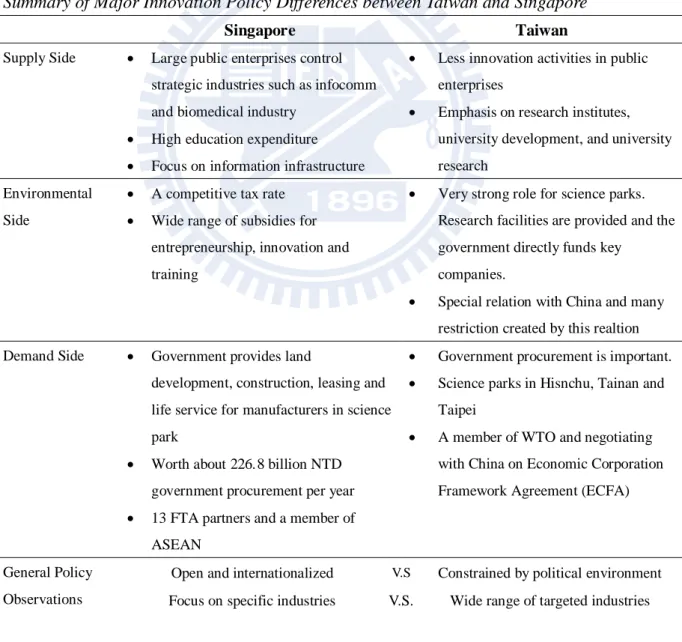
The main differences in supply-side innovation policy between Taiwan and Singapore are public enterprise and information policy (Table 2). Singapore has many sovereign funds that directly or indirectly control key industry, for the policy is still a debate in Taiwan. In information item, Singaporean government built iN2015 master plan while Taiwanese government also posts Intelligent Taiwan project under i-Taiwan 12 projects. Singaporean government plans to build information and communication industry (infocomm) as a major engine of economic growth and to be the lead country in the world that harnessing infocomm to add value to the economy and society. Taiwanese government emphasizes on creating a reliable infrastructure that benefit everyone on the island and create more competitiveness to the country. Besides, the Singapore Government provides more expenditure on R&D budget than Taiwan Government (See Table 3).
Table 2
Comparison of Supply-Side Policies between Taiwan and Singapore
Singapore Taiwan
Public Enterprise
• Several giant holdings companies • Commanding state-owned enterprises
involve directly or indirectly in technology and science
• Engaged in banking, investment, real estate, land, infocomm, biomedical and other advanced industries
• Five State-Owned Enterprises • Traditional manufacturer
• R&D activities that focus on product development and basic science research
Network and Entrepreneurship
• Listed in national economic plan • Social and cultural side reform • Innovation Voucher Scheme • Incubator Development Programme
• Innovation Alliances • Incubator Establishment • Setting up of VC Associations
Scientific and technical
• Four major clusters
• The Agency for Science, Technology and Research (A*STAR)
• Spearhead on biomedical and infocomm industry
• Industry and Research Conferences • Support of University Research • Establishment of Research Institutes • University Research Grants
Education
• Autonomy of universities
• Enhance entrepreneurship education in campus
• Government Training
• Development Plan for World Class Universities and Research Centers of Excellence Development
Information
• iN2015 master plan
• Infocomm Development Authority Of Singapore (IDA) develops policies to ensure the growth of an innovative and competitive Infocomm sector
• Enhance linkage between national institutes and businesses
• Intelligent Taiwan project within i-Taiwan 12 projects
15
Table 3.
R&D Expenditure by Source of Funds
2006 2007
Business Government
Other National
Source
Abroad Business Government
Other National Source Abroad Taiwan 67.2 31.4 1.4 0.0 68.8 29.9 1.3 0.0 Singapore 58.3 36.4 0.9 4.4 59.8 34.9 0.9 4.3
Source: National Science Council, Taiwan
4.1.1 Taiwan
In aspect of public enterprise, the five Taiwanese state-owned enterprises were established to meet strategic and tactical needs of the government. The mission of these state-owned businesses are to protect certain industries, by constructing of large scale business through direct operation of upstream, heavy industry which the private sector was unable or unwilling to undertake (Nolan & Wang, 1999). Taiwanese government is now trying to pick up their competitiveness by privatization (Council for Economic Planning and Development, Taiwan). But this has still yet to materialize.
In the item of entrepreneurship, Taiwanese government adopted the tool of incubator, FDI and deregulation to boost entrepreneurship (Wu & Huang, 2003). Since 1996, the Small and Medium Enterprise Administration (SMEA) of Taiwan has continued to promote the establishment of incubators through the use of financial support available from the Small and Medium Enterprise Development Fund for office equipment, personnel, and related costs. After five years of continuous effort, the SMEA has promoted 63 incubators and attracted around 900 firms to move into these incubators (Tsai and Wang, 2005). The inward FDI also helps to establish plenty SMEs in Taiwan. Those MNCs not only introduce advanced technology to the industry, but also create a center-satellite manufacturing model to shape a supply chain. Taiwan’s government promulgated several laws to encourage nationals to be involved in business affairs through investment, such as the Statute for Encouragement of Investment promulgated in 1960. In addition, the Statute for Establishment and Management of Export Processing Zones (1965) and the Statute for Establishment and Management of Science-Based Industrial Parks (1979) created the two most significant areas for Taiwan’s industrial development, Export Processing Zones (EPZ) and the Hsinchu Science-based Industrial Park (HSIP). Taiwan’s venture capital (VC) has made a considerable contribution to the growth of Small and Medium-Sized Enterprises (SMEs), particularly those in the emerging industries, and the government has set up many VC associations and offered financial support to help investors (Tsai and Wang, 2005). In addition,
According to the Taiwanese strategies and policies announced in 2007-2010, we can see the role of government as a direct provider (as opposed to facilitator) is emphasized. Examples are abundant: the establishment of Industrial Technology Research Institute (ITRI), Technological Information Center, and National Science Council (NSC), which conduct research on a large scale and undertake studies into the feasibility of industrializing new technology. In Taiwan, from the late 1980s through the early 1990s, in order to promote industrial upgrading, the government directed a considerable number of innovation alliances in the areas of notebook computers, high-definition televisions, fax and communications equipment, and so on, working through research institutions such as the ITRI. The most successful of these was the Notebook PC Joint Development Alliance (Tsai and Wang, 2005).
16
Higher education system in Taiwan has some problems like: rapid higher education expansion on the allocation, low education quality, shortage of funding and staff (Development Plan for
World Class Universities and Research Centers of Excellence, 2009). For solving these problems,
Taiwanese government constructs education such as “the Program to Move toward Top
Universities” and “Development Plan for World Class Universities and Research Centers of Excellence “. The plans are aimed to raise competitiveness of higher education and formulate
standards for teaching and research faculty and facilities with reference to world class universities. Taiwanese government is focused on providing the tools of innovation, i.e., technically educated students, government funded research, training, and information. One criticism of the approach by Shyu (2006), however, is that the needs of industry are not always served by the supply policy system; this is the result of the separation of education, industry, and government and to the political nature of such a government focused system.
4.1.2 Singapore
Public enterprises in Singapore, i.e. Government of Singapore Investment Corp (GIC), Temasek Holdings, are established by the government to control or monopoly several strategic industries. Over time, the statutory boards not only became major actors in the economy but also formed subsidiary companies to add flexibility to their own operations. These subsidiaries, i.e. Jurong Town Corp., have great contribution on attracting corporate investment by offering fund and the promise of cooperation from government departments and to ensure that the corporations transferred proprietary technology and training to Singapore.
In Singapore, entrepreneurship is listed as a strategic subjective of economic development. The policy makers aim at create a pro-entrepreneurship environment in Singapore, from social culture to education to business friendly environment, they seek an entrepreneurship-driven economy. There is no shortage of government’s aids on opening a new business. The “Startup EnterprisE Development Scheme (SEEDS)” in Singapore, a $50 million fund, was launched on 1st Oct 2001 with the aim of providing equity financing for start-ups in the seed stage of enterprise formation. The Innovation Voucher Scheme (IVS) connects public Knowledge Institutions (KI) with SMEs to encourage SMEs in adopting technology to develop their innovative ideas. The Incubator Development Program provides various financial or non-financial services that an entrepreneur may need.
Singapore government has already successfully built up Jurong Town Science Park by attracting inward FDI. The government creates an environment by establishing specialized infrastructure, a climate attractive to knowledge workers, and regulatory policies that protect IP and support risk-taking. In addition to excellent general infrastructure (efficient transportation, high speed internet network, a safe and clean city), Singapore has gone one step further by building more science parks (Tuas Biomedical Park, One-North Science Habitat), city within a city (the Biopolis), and clusters (Communication and Media) for being in the frontier of technology. They specifically caters to the unique research needs of advance technology and new business model to create value. Opening its first phase in June 2003, the Biopolis is a S$300 million project with 190 hectares near National University of Singapore. Besides having A*STAR’s biomedical research institutes as the anchor tenants, Biopolis is intended to attract biomedical MNCs, start-ups, and support services such as a cluster. Now there are four major clusters created under the Singapore Industry 21 Plan under the initiative of the Singapore Economic Development Board (See Table 4). Singapore’s specialized industrial parks are designed to facilitate the development of specific technological areas for the different industry
17
clusters. Singaporean government now strategically fosters specific industries such as biomedical, information and communication, media in these clusters.
Table 4.
Main Science Parks in Singapore
Location Provision
Singapore Science Park Local and multinational R&D organizations
Agro-Bio Park
Agro-biotechnology companies: involved in aquaculture, crop and livestock production, micropropagation and tissue culture, genetic engineering, animal vaccines
Tuas Pharma Zone Pharmaceutical, healthcare and biotechnology companies Jurong Island Petrochemical and chemical industries
Source: Singapore Economic Development Board
The country’s competitiveness is propped up by a strong focus on education, providing highly skilled individuals for the workforce (GCR, 2009-2010). Quality of higher education system and quality of math and science education is the best of the world in Singapore (GCR, 2009-2010). The National University of Singapore is not only the leading academic organization in higher education; it is also a decisive player in university-industry collaboration on applied R&D. It provides a campus location for regionally outstanding research institutes, such as the Institute for Systems Science, the Institute for Molecular and Cell Biology and the Institute for Microelectronics, pointing to a research focus on information and communication technology (ICT), microelectronics as well as life sciences. These institutes co-operate with multinational enterprises and international research partners, covering a range from contract research to mutual agreements of understanding (National University of Singapore, 1996). The second major academic player is Nanyang Technological University with research institutes like the Advanced Materials Research Centre and the Gintic Institute of Manufacturing Technology. Its strategic outlook of R&D activities exhibits an even more applied orientation, closer to the innovation segment of product improvement (Nanyang Technological University, 1996). This assessment holds also for Singapore’s four Polytechnics, which are engaged in the promotion of R&D activities on a minor scale (Ebner, 2004). “Singapore Education” program was officially launched in Aug 2003. This will be the umbrella under which Economic Development Board (EDB) will spearhead the promotion of Singapore as an Education Hub. The Singapore Quality Class (SQC) for Private Educational Organisations (PEOs) Award was also launched in Feb 2003 to provide quality assurance for PEOs.
These state universities are being given greater autonomy to be competitive in the fast-emerging educational services sector of Singapore. They are now adding—to their traditional roles of training scientific, engineering and managerial manpower—such new roles as forming and incubating university spin-off firms since its inception in 1992, while the Innovation and Technology Transfer Office (ITTO) at Nanyang Technological University (NTU) is currently incubating numerous high-tech start-ups.
Information and communication (Infocomm) is a very important industry for Singaporean government. The government has established the Ministry of Information, Communication and Arts (MICA) to develop a comprehensive infrastructure and manpower, then use infocomm factors toboost the economy. In the 10-year master of infocomm industry (iN2015), the city state aims to become “An intelligent nation, a global city, powered by infocomm”. The infrastructure
18
and manpower of infocomm will not only speed up economic growth, but also sets the businesses in Singapore apart from others. It will help to make ideas and creativity happen and builds brands to fostergrowth and expands and attract more global talent and expertise (iN2015). The government provides enterprises rich information content as well. Through public research service in JCT, IT database, library, consulting service, the enterprises can access the information they need.
4.2 Environmental Side of Innovation Policy
According to the latest Global Competitiveness Report (GCR) 2009-2010 published by WEF, Singapore’s institutional environment is ranked as the best the world. Singapore places 1st for the efficiency of its goods and labor markets and 2nd for its financial market sophistication, ensuring the proper allocation of these factors to their best use. Singapore also has world-class infrastructure (ranked 4th), leading the world in the quality of its roads, ports, and air transport facilities. Taiwan puts large efforts on environmental-side tool including financial subsidies, tax incentives and other regulatory aids. But in political tools, the government has much more disadvantage due to the tighten relationship with China (see Table 5).
Table 5.
Comparison of Environmental Side Policies between Taiwan and Singapore
Singapore Taiwan
Financial • Various Loan on Machinery, Factory, Working Capital, Venture Abroad • Grants for Incubators and Start-ups
• Loan Subsidies • Grants for Incubators
• Subsidies for Firms Located in Science Parks • Development Fund
• Research Facilities Taxation1 • Benefits for small-to-midsize companies
starting up
• Startups that meet certain qualifying conditions can claim for tax exemption under the Tax Exemption For Start-ups scheme
• Capital gains taxes are generally 0%
• R&D Equipment/Expenditure Tax Alleviation
• Tax Relief for Training
• Tax Incentives and EPZs for Attracting FDI
Legal and regulatory
• Strict IP Protection System • Centralized IP Management
• Patent and Copyright Acts
• Fair Trade Law Focusing on Preventing Cartel and Monopoly
Political • High Business Costs of Terrorism • Maintain balance of power • Independent foreign policy
• Visa Restrictions (negative effect) • Technology Export Restrictions (negative
effect)
4.2.1 Taiwan
In Taiwan, companies can be exempt from import duties on instruments and equipment for experiments in R&D. Equipment for R&D with a life of longer than two years can adopt two-year accelerated depreciation. Expenditures in R&D of 15–20% can be business income tax deductible (Shyu and Chiu, 2002). On the other hand, the Ministry of Economic Affairs also took action in promoting traditional industries’ technology capacity with “Rules of encouragement for the private sector’s development of new products” and the “Law governing development for directive
1
19
new products” (Shyu and Chiu, 2002). In addition, subsidy for R&D activities of high-tech companies located in the Science-based Industrial Park is offered by the Taiwanese government, which usually prepares an annual budget of relative expenses to support firms’ research projects (Tsai and Wang, 2005).
In Taiwan's case the changes undertaken were of a more substantial nature, addressing the weaknesses in patent enforcement and prosecution (based on US government criticism). It is also interesting to note the integration of the Taiwan Intellectual Property Office into the National Innovation System (NIS) administration structure. The above Taiwanese laws and regulations include the Patent Act, Integrated Circuit Layout, Copyright Act, Trade Secrets Act, and so on. As for market competition law, Singapore has no limitation on FDI and relies on it to stimulate economic growth. Although most of Taiwan’s companies are small and medium-sized enterprises as well, Taiwan’s competition law, the Fair Trade Law, does not emphasize mergers and acquisitions. The Fair Trade Law focuses on preventing cartels, monopolies, limited competition, and other behaviors hindering fair competition (Fair Trade Commission, 2000).
The political situation with China has resulted in visa restrictions for mainland Chinese engineers and researchers. Although few visa restrictions are in place for other nationalities, the restrictions are of particular significance as the two countries share the same language (a significant number of research labs in Taiwan use Chinese as their main form of communication), China is a major recipient of Taiwanese FDI, and to some extent their cultures are similar (Wu and Huang, 2003).
In a similar vein, the use of technology export restrictions against China reflects the current situation of Taiwan. These rules prevent the export of advanced technology to China and Chinese subsidies even for research purposes, and like the visa policy reduce access of Taiwanese companies to Chinese engineers. However, there is some evidence that this restriction is being circumvented.
4.2.2 Singapore
The first formal science and technology plan of Singapore was only implemented in 1991, which focuses more on investment environment establishment. In the early years of independence, Singapore’s strategy was to attract MNCs to the island state to produce for global export markets. A region or a nation’s regulatory and cultural regime may either attract or develop a strong and blooming industry. Hence, strong efforts were consistently made in the early post independence years to attract MNCs, invest in education and skill training, and encourage technology diffusion from MNCs to the local economy. Tax incentives were given for manufacturing companies that undertook R&D in Singapore.
Singapore is one of the most efficient financial markets in Asia (The first place in Hong Kong). The open and flexible financial environment has attracted plenty giant MNCs to set their office in Singapore, and the pro-business environment also gives supports to domestic SMEs. Browsing the website of Singapore government, one can find a various loan and subsidies programs that provided by the government, not mention the banks in Singapore. There are different conditions set for different kinds of SMEs, the government encourages entrepreneurship and innovative ideas with comfortable supports.
Singapore also has put in place a regulatory environment that is broadly supportive of innovation. For example, the Bioethics Advisory Committee was formed in 2001, at the time of the US stem cell controversy, to develop recommendations on the legal, ethical and social issues of human-biology research (Finegold, Wong and Cheah, 2004). This early and clear legal support