國 立 交 通 大 學
企業管理碩士學位學程
碩 士 論 文
團購商業模式分析-以 ihergo.com 為例
Group Buying Business Model Analysis:
A Case Study of ihergo.com
研 究 生:張宇超
指導教授:韓復華
II
National Chiao Tung University
Global MBA
Thesis
Group Buying Business Model Analysis:
A Case Study of ihergo.com
Student: Yu-Chao Chang
Advisor: Prof. Anthony F. Han
III
團購商業模式分析-以 ihergo.com 為例
Group Buying Business Model Analysis:
A Case Study of ihergo.com
研 究 生:張宇超
Student:
Yu-Chao Chang
指導教授:韓復華
Advisor:
Prof. Anthony F. Han
國 立 交 通 大 學
管理學院
全球企業管理碩士學位學程
碩 士 論 文
A Thesis
Submitted to Master Degree Program of Global Business Administration College of Management
National Chiao Tung University in partial Fulfillment of the Requirements
for the Degree of Master
in
Business Administration
June 2011
Hsinchu, Taiwan, Republic of China
i
Abstract
In the recent years, group buying has gradually become a trend in e-commerce field.
The original idea of group buying is to gain discount prices from retailers when a large
number of buyers could be formed, and now the same concept is widely adopted in many
websites worldwide. E-commerce market in Taiwan was also influenced by the global
phenomenon of group buying, having numerous new websites launched with the concept.
Among them, ihergo.com (愛合購) stood out and became the symbol of group buying in
Taiwan e-commerce market, offering three different services to the customers: group buying
platform, group buying agent, and B2C online shopping mall.
Hence, a case study of ihergo.com was stimulated in order to figure out its unique
business model and key success factors. By using the business model canvas introduced by
Osterwalder, Pigneur, and Clark (2010) and business model framework proposed by Rayport
and Jaworski (2001), an internal value complementary framework which makes mutual
reinforcement and multiplier effects on the value cluster and the resource system of
ihergo.com was identified. In addition, a practical two-sided platform different from
traditional thought which has inter-subsidy sides without charging one side a premium, and
the capability to inter-transform supplier relationship and customer relationship on the same
business platform was also discovered, suggesting a unique and valuable business model for
reference.
Key Words: Group buying, e-commerce, business model, two-sided platform, online community, online shopping mall, network effect.
ii
摘要
近年來,團購在電子商務領域逐漸形成一股趨勢。所謂團購,是指一群買家透過聯 合的方式組成團體,以便從販售業者方獲得價格折扣等好處。現在,這個概念已經被應 用在全球許多網站上。台灣的電子商務市場也受到了此波全球風潮的影響,許多以團購 作為主題的新興網站帄台如雨後春筍般成立。在此些網站當中,一舉提供團購帄台、團 購仲介,以及 B2C 線上商城三個不同服務的 ihergo.com(愛合購)脫穎而出,成為台灣 電子商務市場線上團購的象徵。 因為上述的原因,促使了 ihergo.com 的個案研究來釐清其獨特的商業模式和關鍵成 功因素。透過使用 Osterwalder、Pigneur,和 Clark (2010) 所提出的商業模式分析畫布, 以及 Rayport 和 Jaworski (2001) 所提出的商業模式架構,分析歸納出一個對價值群聚和 資源系統具有相互增強和加乘效應的內部價值互補架構。同時,亦從中發現了一個有別 於一般認知、具有雙邊交互補貼且沒有特定單邊溢價的雙邊帄台,以及將供應商關係與 顧客關係交互轉換的能力,說明了 ihergo.com 商業模式的獨特性和參考價值。 關鍵字:團購、電子商務、商業模式、雙邊帄台、線上社群、線上商城、網路效應。iii
Acknowledgement
The most instructive part of doing thesis is not the result but the whole journey. From
looking for a direction to positioning my own thoughts, I made many mistakes, got into dead
end many times, but eventually walked through the jungle and reached a small peaceful land.
It was a valuable and wonderful journey and would not have been possible unless the help
from many people.
My advisor, Professor Anthony F. Han, invested a huge amount of time and effort from
the initial to the final level. He not only guided me to build up the skeleton of my subject,
but also gave me some important suggestions, and pinpointed many critical defects. With
his support and encouragement, I should have confident to process the analysis and develop
the conclusion. I owe my deepest gratitude to him for his knowledge, patient, and
kindness.
I am grateful to Mr. Leo Liu, the co-founder of ihergo.com, for his time and sharing. It
was impossible to reach current understanding without his inside view and input. Not
many entrepreneurs have such open-mindedness and kindness as him, not to mention his
business view and vision.
I also offer my heartfelt thanks to all my friends, classmates, and family who supported
me in any respect during this time. They let me realize that although things are challenging,
there is always a way to get it done with people. Lastly, I would like to thanks my father,
Mr. Victor P. Chang, for his trust and support in all time, and my grandfather, Mr. Rui-chang
Chang, for his understanding and blessing.
Yu-Chao Chang
iv
Table of Contents
Abstract ... i Chinese Abstract ... ii Acknowledgement ... iii Table of Contents ... iv List of Tables ... viList of Figures ... vii
Chapter 1 Introduction ... 1
1.1 Motivation ... 1
1.2 Purpose ... 2
1.3 Framework and Methodology ... 2
Chapter 2 Literature Review ... 5
2.1 Competitive Strategy ... 5
2.2 E-Commerce ... 9
2.2.1 The Growth and Development of E-Commerce ... 10
2.2.2 Online Group Buying... 14
2.3 Business Model ... 17
2.3.1 Business Model Canvas... 19
2.3.2 Two-Sided Platforms ... 20
Chapter 3 Case Background of ihergo.com ... 22
3.1 Online Group Buying Development Worldwide ... 22
v
3.3 The Development of ihergo.com ... 31
3.3.1 Development Track ... 31
3.3.2 Company Status ... 34
3.3.3 Web Analysis ... 36
Chapter 4 Case Analysis of ihergo.com ... 38
4.1 Business Model Evolution ... 38
4.1.1 A Pure Group Forming Platform ... 39
4.1.2 Adopting Group Buying Agent Role ... 40
4.1.3 Introducing B2C Online Shopping Mall ... 42
4.2 Business Model Analysis ... 44
4.2.1 Value Cluster ... 44
4.2.2 Marketspace Offering ... 47
4.2.3 Resource System ... 58
4.2.4 Financial Model ... 61
4.3 Key Success Factors ... 62
Chapter 5 Conclusions... 66
5.1 Academic Implication ... 68
5.2 Managerial Implication ... 69
References ... 70
Appendix A The Interview with Co-founder Leo Liu ... 73
vi
List of Tables
Table 2-1: Three Generic Strategies ... 7
Table 2-2: Five Major Stages for Coalition Models ... 15
Table 2-3: Critical Issues When Designing a Coalition Protocols ... 16
Table 2-4: Business Model Framework by Rayport and Jaworski ... 18
Table 2-5: Examples of Two-Sided Platform in E-Commerce ... 21
Table 3-1: Summary of Online Group Buying Early Entrants ... 24
Table 3-2: Groupon-like websites in Taiwan, 2011 ... 29
Table 3-3: Company Profile of ihergo.com ... 34
Table 4-1: Table of ihergo’s Value Cluster ... 45
vii
List of Figures
Figure 1-1: Research Framework ... 3
Figure 1-2: Methodology ... 4
Figure 2-1: The Five Competitive Forces that Determine Industry Profitability ... 6
Figure 2-2: The Generic Value Chain ... 8
Figure 2-3: Worldwide E-Commerce Market Scale and Growth Rate ... 11
Figure 2-4: USA’s Online Shopping Market Scale and Growth Rate ... 11
Figure 2-5: China’s Online Shopping Market Scale and Growth Rate ... 12
Figure 2-6: Taiwan’s Online Shopping Market Scale and Growth Rate ... 13
Figure 2-7: The Layout of Business Model Canvas ... 19
Figure 3-1: A Typical Promotion of a Daily Product on Groupon ... 25
Figure 3-2: Number of Groupon-like Companies in USA in 2010 ... 26
Figure 3-3: Daily Deals of San Francisco on Yipit ... 27
Figure 3-4: The Usage Survey of Online Shopping Channels ... 30
Figure 3-5: Critical Events of ihergo.com ... 32
Figure 3-6: Platform Cash Flow of ihergo.com ... 35
Figure 3-7: Percent of Global Internet users Who Visit ihergo.com... 36
Figure 3-8: Audience Demographics for ihergo.com ... 37
Figure 4-1: Initial Business Model of ihergo: A Pure Group Forming Platform ... 39
Figure 4-2: Business Model of ihergo with Group Buying Agent Role ... 41
Figure 4-3: Current Business Model of ihergo ... 43
Figure 4-4: Business Scale Pyramid of Stores in Online shopping Mall ... 46
Figure 4-5: Flow Diagram Before Dahergo service ... 47
viii
Figure 4-7: Egg Diagram for Decision Process of Group Buying Users ... 53
Figure 4-8: Egg Diagram for Decision Process of Businesses ... 57
Figure 4-9: Resource System of ihergo.com ... 60
Figure 4-10: The Store Number of Major B2C Online Shopping Malls in Taiwan ... 63
Figure 5-1: Value Complementary Framework of ihergo.com ... 66
Figure A-1: Index Page of ihergo.com ... 77
Figure A-2: Dahergo Service of ihergo.com ... 78
Figure A-3: GoGoGo Service of ihergo.com ... 79
1
Chapter 1 Introduction
1.1 Motivation
Since the booming development of Internet in 1990s, the e-commerce gradually
transformed almost every business sector and altered the relationship between consumers
and firms. Unlike the other industries which suffered from the recession in 2009,
e-commerce sector has emerged diverse applications and kept showing its vigorous energy,
having an incredible 14.6% global market growth rate. And the market scale worldwide is
estimated at 951 billion USD in 2010 (Ministry of Economic Affairs, 2010).
In the recent decade, group buying has gradually become a trend in e-commerce field.
The original idea of group buying is to gain discount prices from retailers when a large
number of buyers could be formed, and now the same concept is widely adopted by many
websites worldwide (Cashmore, 2010). However, unlike the common e-commerce
businesses, the group buying e-commerce hasn’t got much attention yet in business research
because of its new risen background, being the initial motivation of this paper.
Meanwhile, e-commerce market in Taiwan was also influenced by the global
phenomenon of group buying, having numerous new websites launched with the concept in
recent years (Hsiao, 2010a, 2010b, 2011). However, not everyone has created amount of
users and reached the break-even point in finance (Hsieh, 2009). Among group buying
websites in Taiwan, ihergo.com stood out quickly and became the symbol of group buying in
local e-commerce market (Lin, 2010; Yue, 2009). Since it was founded, the company has
gone through several transforming processes to overcome the difficulties and strengthen its
revenue. It even started to offer group buying agent service and online shopping mall on
2
study of ihergo.com was stimulated in order to figure out the frame of its business model
and key success factors.
1.2 Purpose
The major purpose of this research is to provide a useful reference for strategic
alternatives of group buying e-commerce by analyzing the business model of ihergo.com.
Under that premise, further information is expected to be delivered in this paper:
1. The key success factors of ihergo.com
2. The practical group buying business model for Taiwan e-commerce market.
3. The evolving of a practical group buying business model.
4. The management strategies in relation to transforming the business model to generate
sustainable revenue and profit.
1.3 Framework and Methodology
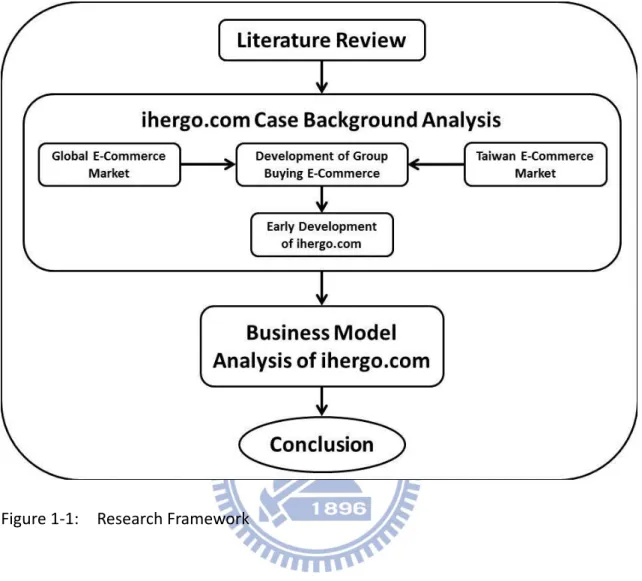
The Figure 1-1 shows the framework of this paper. Firstly, a literature review which
covers competitive strategy, e-commerce, and business model will be proceeded in order to
figure out related aspects of case study. Secondly, a case background analysis will take
place to understand the development of online group buying e-commerce in both global and
local aspects, to survey the early development and generalize the initial business model of
ihergo.com. Thirdly, a detailed and comprehensive analysis will be processed to inquiry the
business model transforming, indicate the changes and the impacts behind the business
model, and lastly clarify the key success factors. Finally, the analysis result and findings will
3
Figure 1-1: Research Framework
The Figure 1-2 illustrates the methodology of this paper. The data sources of this
research include primary data and secondary data. The primary data will be collected
through the personal interview with the founder and the users of ihergo.com. The
secondary data will be collected from market analysis reports, industry analysis reports,
whitepapers, web analysis data and yearbooks published by government or official
organizations. Two stages of analysis will be processed after data collection. The first
analysis concentrates at the business model evolution by using the business model canvas
(Osterwalder & Pigneur, 2009) to construct the skeleton. The second analysis accordingly
focuses on the current business model will be conducted with the framework proposed by
4
5
Chapter 2 Literature Review
According to the purpose of this paper, it is necessary to do the review on three topics:
competitive strategy, e-commerce, and business model. Starting from understanding the
core concept of competitive strategy, the review goes through the definition and the
function of strategic positioning, five forces framework, three generic strategies, and value
chain. Then a review on e-commerce will cover the definition, the growth and
development, and online group buying. Finally, the review on business model will focus on
the definition, the two-sided platform, and the analysis tool: business model canvas.
2.1 Competitive Strategy
Michael Porter (Porter, 2002) pointed out that strategy is the creation of a unique and
valuable position, involving a different set of activities. He also mentioned that strategic
positions emerge from three distinct sources, which are not mutually exclusive and often
overlap. The three distinct sources are:
1. Variety-based positioning
Positioning is based on producing a subset of an industry's products or services.
It is determined by the choice of product or service varieties rather than customer
segment, and makes economic sense when a company can best produce particular
products or services using distinctive sets of activities.
2. Needs-based positioning
6
customers. It comes closer to traditional thinking about targeting a segment of
customers, offering a tailored set of activities which can serve those needs best.
3. Access-based positioning
Positioning is based on segmenting customers who are accessible in different ways.
It is determined by the best configuration of activities to reach customer needs in
certain geography, scale, or other matters.
The competitive strategy is formed in order to establish a profitable and sustainable
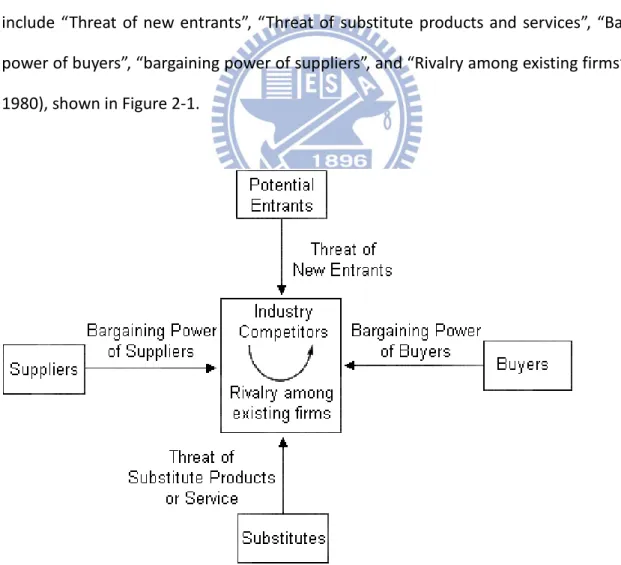
position against five major forces that determine industry competition. The five forces
include “Threat of new entrants”, “Threat of substitute products and services”, “Bargaining
power of buyers”, “bargaining power of suppliers”, and “Rivalry among existing firms” (Porter,
1980), shown in Figure 2-1.
Figure 2-1: The Five Competitive Forces that Determine Industry Profitability
7
The collective strength of these five competitive forces determines the ability of firms in
an industry to earn, on average, rates of return on investment in excess of the cost of capital.
Therefore, a firm can see through the complexity and pinpoint those factors that are critical
to competition in its industry, as well as to identity those strategic innovations that would
most improve the industry and its own profitability by five forces framework.
Positioning determines whether a firm's profitability is above or below the industry
average, and the fundamental basis of above-average performance in the long run is
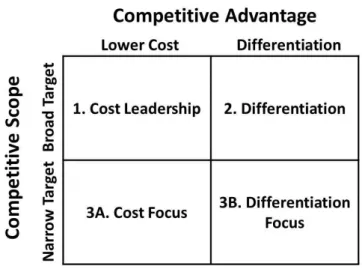
sustainable competitive advantage. Three generic competitive strategies could be leaded
by two basic types of competitive advantage which is combined with the scope of activities
(Porter, 1980). They are “Cost leadership”, “Differentiation”, and “Focus”. The cost
leadership and differentiation strategies seek competitive advantage in a broad range of
industry segments, while focus strategies aim at cost advantage (cost focus) or differentiation
(differentiation focus) in a narrow segment (see Figure 2-2). A firm must make a choice
about the type of competitive advantage and the scope it seeks to attain to achieve
competitive advantage.
Table 2-1: Three Generic Strategies
8
Michael Porter (Porter, 1998) introduced a basic tool, value chain, to diagnose and
enhance competitive advantage. Figure 2-3 illustrates that the value chain divides a firm
into the discrete activities it performs in designing, producing, marketing, and distributing its
product, and these activities are categorized into two major groups: the “primary activities”
and the “support activities”. All these activities link up together with external suppliers and
partners and deliver the value to customers. Because the overall strength and weakness of
a firm is determined by all the activities, a firm has to carefully combine, optimize, and align
these activities for implementation of competitive strategy.
Figure 2-2: The Generic Value Chain
9
2.2 E-Commerce
Electronic commerce (or e-commerce) can be formally defined as technology-mediated
exchanges between parties (individual, organizations, or both) as well as the electronically
based intra- or interorganizational activities that facilitates such exchanges (Rayport &
Jaworski, 2001). Four distinct categories of e-commerce can be identified:
1. Business-to-business (B2B)
Refers to the full spectrum of e-commerce that can occur between two organizations.
2. Business-to-consumer (B2C)
Refers to exchange between business and consumers.
3. Consumer-to-consumer (C2C)
Exchanges involve transactions between and among consumers.
4. Consumer-to-business (C2B)
Consumers can band together to form and present themselves as a buyer group to
business in such a relationship.
Different from a traditional brick-and-mortar business, the e-commerce business has
several unique characters and require further strategic discussion:
1. Core strategic decisions are technology-based
2. A real time competitive responsiveness
3. The store is always open
4. A technology-based customer interface
5. The customer controls the interaction
10
7. Network economics
8. Nontraditional performance metrics and emergent valuation models
The combination of these unique characters leads to value increases for both the
customer and the firm, forming a highly dynamic and strong competitive market space.
2.2.1 The Growth and Development of E-Commerce
After Dot-Com bubble in 2000, Internet companies started to seek more profitable and
stable revenue sources, and would like to put more attention on selling tangible products
(Tsan, 2010). On the other hand, online shopping became more and more popular
especially in regions which have high Internet usage rate. Although the online shopping
market in North America and European during 2008 to 2009 had lower growth rate due to
the global financial crisis in 2007, the overall market scale still had a stable increase because
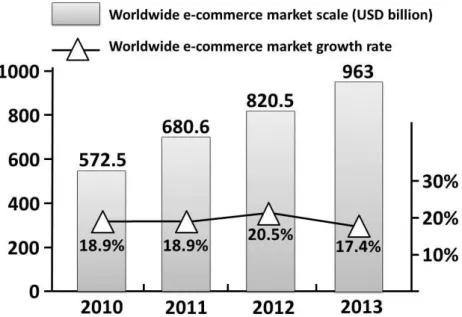
of the booming development in China. With the help of China market and the expected
recovering in North America and European, it is estimated that the global market scale and
growth rate of e-commerce would regain vigorousness in 2010 (see Figure 2-3 on next page).
In USA, The market scale of online shopping in 2011 is estimated at 191.7 billion USD
and is expected to reach 210 billion USD in 2012 (see Figure 2-4 on next page). It’s still the
largest online shopping market in the world although the annual growth rate is slowing down
due to the weak economy. Also, online shopping has become the major shopping channel
in USA and takes around 8% of total retail sales. The waiving of the consumption tax and
11
Figure 2-3: Worldwide E-Commerce Market Scale and Growth Rate
Source: J.P. Morgan Estimates (Rao, 2011)
Figure 2-4: USA’s Online Shopping Market Scale and Growth Rate
12
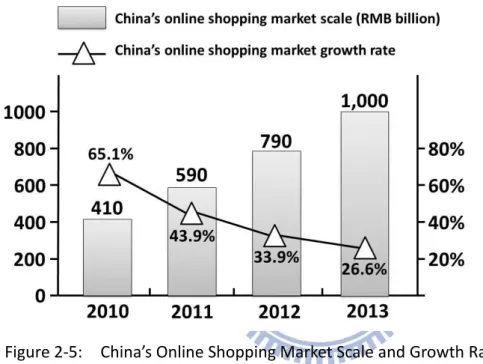
In Asia, China is going to surpass Japan to become the second largest online shopping
market in the world in 2013 with 1000 billion RMB market scale (see Figure 2-5). The
growing Internet usage rate, maturing network infrastructure, and developed online
transaction/credit systems in China provide valuable nutrient for its online shopping market,
motivating brick-and-mortar businesses to get online.
Figure 2-5: China’s Online Shopping Market Scale and Growth Rate
Source: E-Commerce Market Development Trend Analysis (Wang, 2010)
As for the online shopping market in Taiwan, the product and services categories of
online shopping keep increasing and diversifying due to the matured logistics and cash flow
system, high consumer acceptance, sustained dedication of existing players, and emerging of
new entrants. Taiwan’s online shopping market is estimated at 566 billion NTD in 2011 and
is expected to reach 691 billion NTD in 2012 (see Figure 2-6). According to the survey, 42%
of e-shops in Taiwan don’t have physical stores and 35.9% of e-shops are the extension of
existing physical stores, 11.6% of e-shops and physical stores are established simultaneously
13
Figure 2-6: Taiwan’s Online Shopping Market Scale and Growth Rate
Source: 2010 Taiwan E-Commerce Yearbook (Ministry of Economic Affairs, 2010)
Although the potential growth of the online shopping market is good, highly
competitive market causes the slow pace of making profit: over 50% of the stores have not
broken even yet. Many online shopping businesses therefore started to extend their
distribution channels outside the island, aiming to establishing a cross-boundary platform in
the region. Meanwhile, using mobile device to do the online shopping is the emerging
trend and some web platforms have offered simple and basic service for mobile users.
However, there is no any practical or matured mobile transaction solution in Taiwan
14
2.2.2 Online Group Buying
In recent years, the advent of e-commerce has led to the creation of many new and
interesting Internet-based selling models, and there are several opportunities for buyers to
form coalitions on Internet. By forming a coalition, buyers can advantageously negotiate
with sellers and purchase items at volume discount prices (Yamamoto & Sycara, 2001). A
coalition is a set of self-interested agents that agree to cooperate to execute a task or
achieve a goal (Tsvetovat, Sycara, Chen, & Ying, 2001). If the buyers with similar product or
service requirements can form a virtual coalition to bargain collectively with the sellers, it
can reduce the transaction cost of each side (Lai, 1999). A commonly accepted term to
describe such internet-based coalition of buyers is so called “online group buying”, and now
it refers to consumers use variant Internet platforms or tools to form up groups in order to
aggregate their purchasing power, reach certain economic scale in quantity or in value, and
obtain lower prices.
In terms of pricing aspect, group buying is a kind of dynamic pricing mechanisms.
Kauffman and Wang (2001) indicated that in bricks-and-mortar world, posted pricing
mechanisms have been the dominant pricing strategies, where retailers display the prices
they ask for the merchandise and consumers decide whether they would accept the prices or
not. In contrast, buyers are no longer left with this take-it-or-leave-it decision under
dynamic pricing mechanisms. They can actively negotiation with the sellers to reach a
satisfactory price.
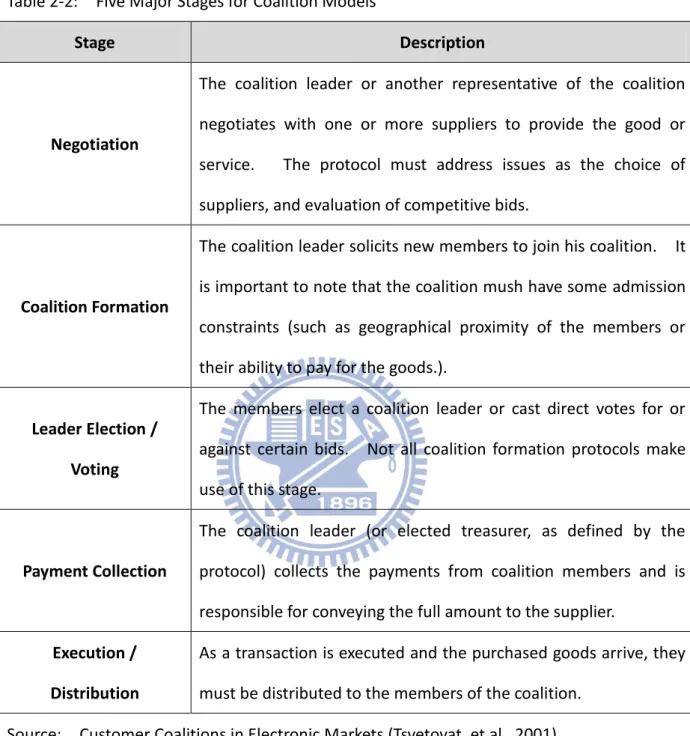
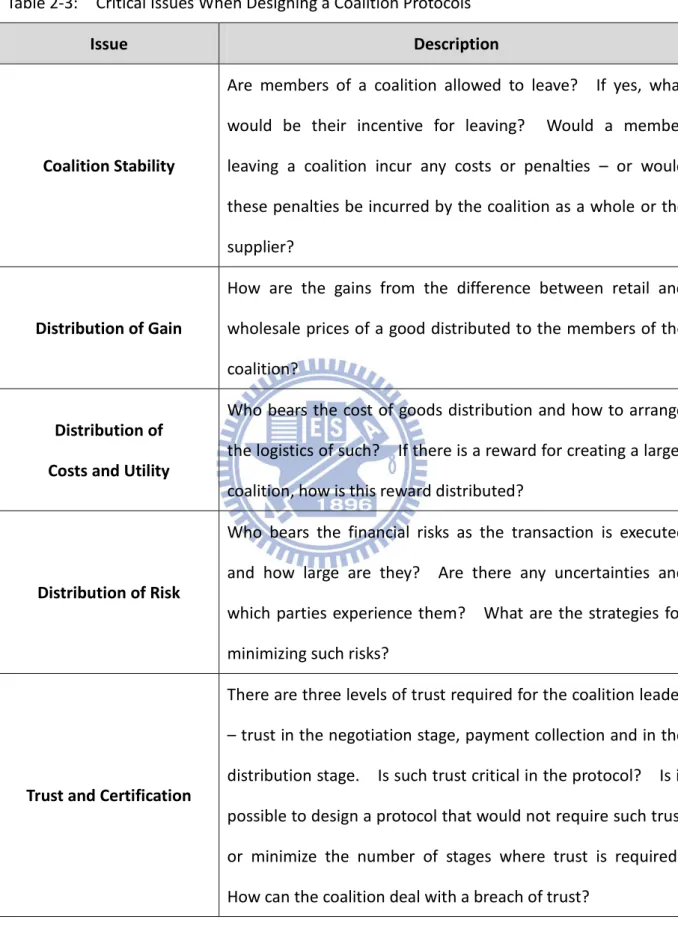
Tsvetovat, et al. (2001) categorized the general coalition model into five major stages (as
showed in Table 2-2), and also pointed out five issues have to be taken into account when
15
Table 2-2: Five Major Stages for Coalition Models
Stage Description
Negotiation
The coalition leader or another representative of the coalition
negotiates with one or more suppliers to provide the good or
service. The protocol must address issues as the choice of
suppliers, and evaluation of competitive bids.
Coalition Formation
The coalition leader solicits new members to join his coalition. It
is important to note that the coalition mush have some admission
constraints (such as geographical proximity of the members or
their ability to pay for the goods.).
Leader Election / Voting
The members elect a coalition leader or cast direct votes for or
against certain bids. Not all coalition formation protocols make
use of this stage.
Payment Collection
The coalition leader (or elected treasurer, as defined by the
protocol) collects the payments from coalition members and is
responsible for conveying the full amount to the supplier.
Execution / Distribution
As a transaction is executed and the purchased goods arrive, they
must be distributed to the members of the coalition.
16
Table 2-3: Critical Issues When Designing a Coalition Protocols
Issue Description
Coalition Stability
Are members of a coalition allowed to leave? If yes, what
would be their incentive for leaving? Would a member
leaving a coalition incur any costs or penalties – or would
these penalties be incurred by the coalition as a whole or the
supplier?
Distribution of Gain
How are the gains from the difference between retail and
wholesale prices of a good distributed to the members of the
coalition?
Distribution of Costs and Utility
Who bears the cost of goods distribution and how to arrange
the logistics of such? If there is a reward for creating a larger
coalition, how is this reward distributed?
Distribution of Risk
Who bears the financial risks as the transaction is executed
and how large are they? Are there any uncertainties and
which parties experience them? What are the strategies for
minimizing such risks?
Trust and Certification
There are three levels of trust required for the coalition leader
– trust in the negotiation stage, payment collection and in the
distribution stage. Is such trust critical in the protocol? Is it
possible to design a protocol that would not require such trust
or minimize the number of stages where trust is required?
How can the coalition deal with a breach of trust?
17
Besides, based on the order in which negotiation and coalition formation happen, most
coalition protocols can be divided into two classes: pre-negotiation and post-negotiation.
In the first scenario, pre-negotiated coalition, the coalition leader negotiates a deal with one
or more suppliers using an estimated coalition size or order volume, and then advertises the
creation of the coalition and waits for other members to join. If the estimation is wrong,
the coalition leader has to absorb the loss. In another scenario, post-negotiated coalition,
the group is formed first based on some admission criteria, and then a group leader
negotiates with suppliers to offer the resulting deal to the group. The group must be able
to trust its leader to negotiate on its behalf.
2.3 Business Model
A business model describes the rationale of how an organization creates, delivers, and
captures value (Osterwalder, Pigneur, & Clark, 2010), therefore designing a business model is
actually part of business strategy. In order to coupling with the new economy which rooted
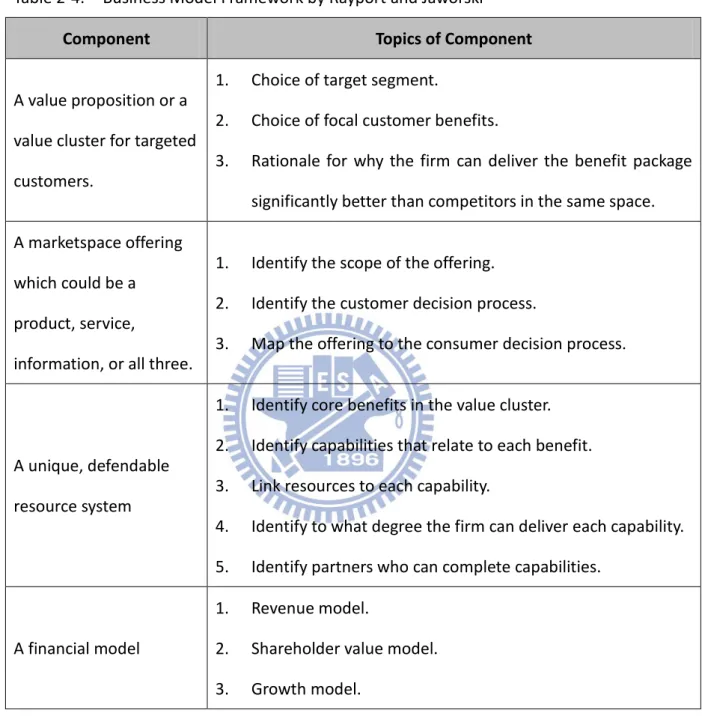
in ubiquitous electronic networks, Rayport and Jaworski (2001) proposed a process
framework composed of four components on the part of senior management, and each
component in the proposed process is fundamentally based around the benefits that matter
18
Table 2-4: Business Model Framework by Rayport and Jaworski
Component Topics of Component
A value proposition or a
value cluster for targeted
customers.
1. Choice of target segment.
2. Choice of focal customer benefits.
3. Rationale for why the firm can deliver the benefit package
significantly better than competitors in the same space.
A marketspace offering
which could be a
product, service,
information, or all three.
1. Identify the scope of the offering.
2. Identify the customer decision process.
3. Map the offering to the consumer decision process.
A unique, defendable
resource system
1. Identify core benefits in the value cluster.
2. Identify capabilities that relate to each benefit.
3. Link resources to each capability.
4. Identify to what degree the firm can deliver each capability.
5. Identify partners who can complete capabilities.
A financial model
1. Revenue model.
2. Shareholder value model.
3. Growth model.
19
2.3.1 Business Model Canvas
Business Model Canvas is a tool that uses nine basic building blocks to show the logic of
how a company intends to make money (as shown in Figure 2-7). The concept was
introduced by Osterwalder, Pigneur, and Clark (2010) and intent to become a shared
language of describing and manipulating business models.
Figure 2-7: The Layout of Business Model Canvas
Source: Business Model Generation (Osterwalder, et al., 2010)
These nine building blocks cover the four main areas of a business: customers, offer,
infrastructure, and financial viability, and provide a convenient method to screenshot a
business model in a single comprehensive view. The arrangement of nine building blocks
on the canvas reveals how does a firm build up its efficiency (the left side of the canvas) and
20
2.3.2 Two-Sided Platforms
Osterwalder, Pigneur, and Clark (2010) summarized that two-sided platforms (or
Multi-sided platforms) bring together two (or more) distinct but interdependent groups of
customers. Such platforms are of value to one group of customers only if the other groups
of customers are also present. The platform creates value by facilitating interactions
between the different groups, and grows in value to the extent that it attracts more users, a
phenomenon known as the network effect. Because of network effects, successful
two-sided platforms enjoy increasing returns to scale, and mature two-sided network
industries are usually dominated by a handful of large platforms.
Eisenmann, Parker, and Van Alstyne (2006) indicated that two-sided platforms typically
have a “subsidy side”, that is, a group of users who, when attracted in volume, are highly
valued by the “money side”, the other user group. The platform provider sets the prices for
that side below the level it would charge if it viewed the subsidy side as an independent
market. Conversely, the money side pays more than it would if it were viewed as an
independent market. A practical two-sided platform nowadays usually subsidizes quality-
and price-sensitive users and provides incentives for the prestigious users to participate
exclusively in the platform. Table 2-5 summarizes some examples of two sided platforms in
e-commerce field.
Evans, Hagiu, and Schmalensee (2006) pointed out that a platform could exist does not
mean that it necessarily will or that it will provide the only method for providing benefits to
customers, but generally reduces the transactions costs that members of different customer
21
Table 2-5: Examples of Two-Sided Platform in E-Commerce
Networked Market Side 1 Side 2 Platform Providers
Apps Store Users Providers Apple, Google, Microsoft
International Trade Buyers* Sellers Alibaba
Online Recruitment Job Seekers* Employers Monster, 104
Online Shopping Buyers* Sellers Yahoo!, Rakuten, Taobao
Web Auction Buyers* Sellers eBay, Yahoo!
Web Search Searchers* Advertisers Google, Yahoo!, Microsoft
* Denotes network’s subsidy side
22
Chapter 3 Case Background of ihergo.com
The only thing constant in business is change and the changing pace in terms of market,
consumer behavior, and all the other factors is even much faster in e-commerce sector. The
business models of group buying websites nowadays are dramatically different from those of
pioneering websites established years ago, and gradually transform into a common form.
However, a leading group buying website in Taiwan, ihergo.com, keeps evolving its business
model and eventually walks through its own way. This chapter summarizes the overall
development of online group buying, and then introduces the background and the
development of ihergo.com.
3.1 Online Group Buying Development Worldwide
Group buying is a common purchasing method that almost everyone has experience
about it. Before the Internet era, group buying usually happened between family members,
friends, and colleagues who are in the close geographic area because of the convenience to
form up a buying group. For example, students registered the same course would form up
a group to purchase textbooks, people in an event would form up a group to purchase
lunchboxes, and so on. When the order quantity reaches certain level, buyers would have
the bargain power to negotiate a better price or discount, and also share the distribution
cost. Now in the Internet era, online group buying refers to that consumers use variant
Internet platforms or tools to form up groups in order to aggregate their purchasing power,
reach certain economic scale in quantity or in value, and obtain lower prices. The
geographic boundary has been broken and a bigger, agile, and lively group buying
23
In the initial stage of Internet era, bulletin board system (BBS), online forum, discussion
board, and community become the major channels for people to form up buying group.
When a purchase motivation was generated from an initiator, he then posted the group
buying willing on one of online channel above to gather enough group members. Usually
the initiator would, on behalf of the group, negotiate the price with product provider or
simply place the order to let entire group benefit by lower logistics cost. Although the
group forming process was eased by a better communication way, certain critical issues, such
as payment collection, product distribution, and trust establishment still need to be handled
by people. There was no single website designed to serve in group buying concept until
1998. And since then the online group buying concept has been gradually accepted by
consumer and different business models tailored for it were continuously introduced.
Mercata, founded in 1998 is the very first website that adopted group buying concept
(Cook, 2009; Kawamoto, 2001). Its model is like the inverse auction of eBay, allowing
buyers to aggregate their purchase volumes and obtain lower prices by using a mechanism
they trademarked as a “PowerBuy” auction cycle. For products listed in PowerBuy auction
cycles, prices dropped in small decrements as more orders were placed (Kauffman & Wang,
2001). Dramatically, Mercata was closed in 2001 with only two years short life due to the
difficulty to rise up capital in a negative IPO market. Its appearance however disclosed the
potential of online group buying. Several group buying websites such as Mobshop,
Demand-Line, LetsBuyIt, eSwarm, and Pudgin that tried to succeed Mercata either failed,
giving up the group buying idea, or hardly accumulated enough users (Flynn, 2001). Table
3-1 summarizes the performance of these early entrants. For a while, it seemed that the
group buying concept was a dead end in e-commerce field until the emergence of
Groupon-like websites in 2008, which used a different group buying business model from
24
Table 3-1: Summary of Online Group Buying Early Entrants
Name URL Launched E-Commerce Type Performance
Mercata http://mercata.com 1998 B to C Closed in 2001. Mobshop
http://mobshop.com 1998 B to C
Dropped group buying
concept in 2001.
DemandLine http://demandline.com 1999 B to B Closed in 2001. LetsBuyIt http://letsbuyit.com 1999 B to C Closed in 2001.
eSwarm http://eswarm.com 2005 B to C Struggle to survive. Pudgin http://pudgin.com 2007 B to B Closed in 2009. Source: Summarized by this research.
The concept of Groupon (http://groupon.com) fits into the generalized definition of group buying because of its aggregate effect in terms of buyers. Its value proposition is
offering consumers great values by guaranteeing businesses a minimum number of
customers. Groupon actively seeks potential business partners and co-works a promotion
package on its website, charging them 30% to 50% commission (Boston, 2009). It provides
a single type of product for sale for a period of 24 hours and is localized to major geographic
markets worldwide. Groupon works as an assurance contract: if a certain number of people
sign up for the offer, then the deal becomes available to all (Cohen, 2009); if the
predetermined minimum is not met, no one gets the deal that day (Weiss, 2010). This
model significantly reduces the risk for both buyers and businesses because the deal is
settled only when both parties’ requirements are fulfilled, causing a win-win situation.
Specifically, Groupon focuses on small and local businesses which are looking for a way to
25
Small and local businesses usually advertise their promotion on local media, such as
newspapers, TV and radio channels, on which are hard to measure the media efficiency. So
even they have to pay high commission to Groupon, businesses gain significant media effect
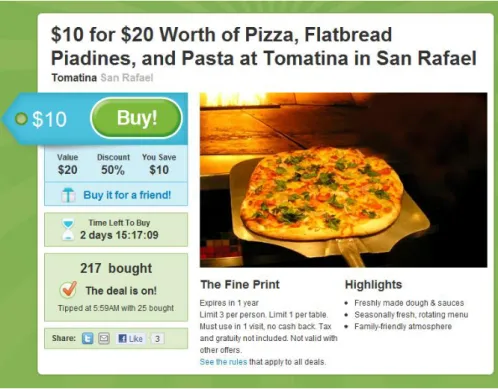
and extend their customer base, lifting up their overall sales. Figure 3-1 is a snapshot
demonstrating a typical daily deal on Groupon’s website. Information such as the discount,
the offering time, and the minimum numbers to trigger the deal, are clearly displayed on the
page to stimulate coalition forming process and purchase willing.
Figure 3-1: A Typical Promotion of a Daily Product on Groupon
Source: Groupon website (http://www.groupon.com), 2011.
Actually, Groupon is not the first one to produce this group buying model. Websites
such as BuyWithMe (http://buywithme.com), LivingSocial (http://livingsocial.com), and SocialBuy (http://socialbuy.com) are using the similar model but just base on different target customers, regions, product types. The reasons why Groupon has become the current
26
among of revenue, thus many followers from different regions tend to imitate and copy its
business model. Figure 3-2 shows that there are no less than 70 Groupon-like websites in
USA in 2010, and more were on the go. At the end of 2010, Groupon had grown to more
than 4,000 employees and expanded to 565 cities, up from about 120 employees and 30
cities in 2009. Some of the growth has been fueled by the mergers and acquisitions of
rivals in Europe and Asia (Hickins, 2011).
Figure 3-2: Number of Groupon-like Companies in USA in 2010
Source: Groupon Clones Pop Up Like Mushrooms In The United States, Too
(Wauters, 2010)
Because of the huge number of Groupon-like websites that offer a single type of
product for daily deal, consumers would find it’s inconvenient to browse all of them one by
one and search for their favor products and services. So the demand to have a summary
which includes all the daily deals from those Groupon-like websites was generated.
27
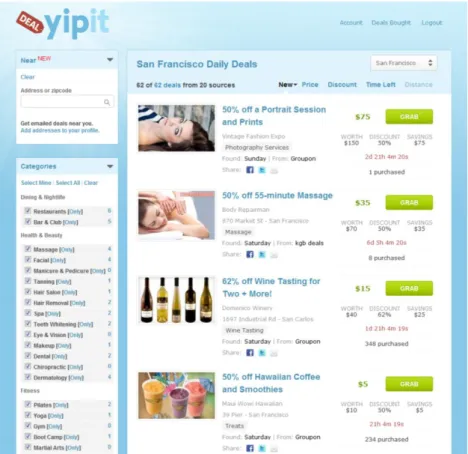
(http://dealery.com), and Yipit (http://yipit.com) all provide one-stop-shop services which distribute deal updates and digital coupons to consumers based on weekly top deals,
customized online feeds, or the user's current location. Their core business activities
basically are collecting group buying information from Groupon-like websites and put it into
an index page. They primarily profit from online advertisement with pay per click (PPC)
advertising model. Figure 3-3 is an index page on Yipit, listing popular daily deals offered
from different Groupon-like websites for San Francisco area.
Figure 3-3: Daily Deals of San Francisco on Yipit
28
3.2 Online Group Buying Development in Taiwan
In general, Taiwan e-commerce market follows USA e-commerce market closely. The
websites in USA which has successful and proven business model would usually be
duplicated in Taiwan with some extent of modification and localization. However, different
from the general cases, the study case of this research: ihergo.com, had appealed before the
latest trend coming from the USA e-commerce market and developed a unique business
model.
Before the launch of ihero.com, online group buying in Taiwan means using bulletin
board system (BBS), online forum, discussion board, and community to create buying pool to
gain the discount or save the logistics cost due to the effect of economic scale. In that case,
the initiation was usually triggered by consumers and the group forming process was purely
manual. The Buy-Together board on PPT (批踢踢, telnet://ptt.cc), a bulletin board system (BBS) operated by National Taiwan University, was the most popular online channel of online
group buying in Taiwan. A person who likes to purchase certain product would create a
new topic on Buy-Together board of PPT and naturally become the group leader, and then
the other people who want to join the group would simple reply that topic, indicating the
purchase quantity and contact information.
Because of the dedication on business-to-consumer (B2C) applications and the lacks of
proven cases, Taiwan e-commerce market didn’t have strong momentum in online group
buying when Mercata and the others early entrants first appealed in 1998, let alone they had
to survive from dot com bubble later. Until 2007, a group buying platform, ihergo.com, was
launched and was initially designed for group buying users. The friendly interface design
and web functions catered for both group buying initiators and members rapidly attracted
people from conventional online channels. Its initial business model and later evolvement
29
Further detailed of ihergo.com will be elaborated in the late content of this paper.
Table 3-2: Groupon-like websites in Taiwan, 2011
Name URL Background
123 Group Buying (123 團購網) http://123.com.tw
17life (17P 好康) http://17life.com Founded by PayEasy
17shopping (一起買團購網) http://17shopping.tw
52886 (愛台灣團購網) http://52886.com.tw
Buy917 (買揪一起) http://buy917.com
Gomai (Go 買) http://www.gomai.com.tw
GOMAJI (團購麻吉) http://gomaji.com Partners with PChome
Goodlife (好生活) http://www.goodlife.tw
Groupon Taiwan http://groupon.com.tw Founded by Groupon
IJO (愛揪團) http://ijo.com.tw
JIGOCITY (集購城) http://jigocity.com.tw
Joinme (開心購) http://joinme.tw
Joymary (揪美麗) http://joymary.yam.com Founded by Yam
Lashou Taiwan (拉手網) http://tw.lashou.com Founded by Lashou
Let’s Gou (Let’s 購) http://letsgou.com.tw
Source: Summarized by this research.
Although Taiwan e-commerce market didn’t favor online group buying concept at the
very beginning and acted as a late-adopter, the growing speed of online group buying is fast
and the consumer feedbacks toward the trend are rational positive. In 2010, suddenly
30
Besides those new entrants, some famous B2C platforms such as PayEasy, PChome, and
Yam(蕃薯藤), also entered this segment or partnered with an existing player. In addition,
Groupon from USA and Lashou from China also actively entered Taiwan e-commerce market.
Table 3-2 briefly summarizes current Groupon-like websites in Taiwan.
As for the consumer aspect, 22.3% of Taiwan Internet users in 2010 would use online
group buying when they do online shopping, which is twice the previous year according to
the survey conducted by Market Intelligence & Consulting Institute (MIC). Meanwhile, less
people would use consumer-to-consumer (C2C) platform or online auction to do online
shopping (See Figure 3-4).
Figure 3-4: The Usage Survey of Online Shopping Channels
Source: E-Commerce Market Development Trend Analysis (Wang, 2010) & Online
Shopping Behavior Analysis of Taiwan Internet Users (Huang, 2011)
Similar to the online group buying market in USA, websites like 50% Off Daily News (五
折日報, http://55555.tw), and Let’s Buy (Let’s 購!團購情報, http://eat104.com/17buy), provide one-stop-shop pages and play as pure information aggregators, making profit from
31
3.3 The Development of ihergo.com
ihergo.com (愛合購) was founded by two former IBM engineers, Leo Liu and Guo-jun
Chang, in 2007. Before they put the idea into full play, they noticed that almost every
popular online forum has group buying board and the Buy-Together board on PTT BBS has a
huge number of users and visitors. They observed that the major users and the visitors of
Buy-Together board are college students which only took a small portion of total population
in Taiwan (around 200 million people). Also, the primitive command line interface of BBS is
not friendly to general Internet users at all, which drives out a lot of potential online group
buying users. Therefore, they thought the total demand for online group buying should be
much bigger. Since there was no any website targeting on online group buying at the time
and the business potential in terms of the group buying demand and the number of Internet
users is big, they decided to enter the market and introduce ihergo.com.
3.3.1 Development Track
The beta version of ihergo.com was online in March 2007 and then it took 6 months for
technical adjustment. During this 6 months period, the engineers were modifying the
layout technology of website to let Internet search engine like Google easily crawl into. The
effort increases the total number of web pages of ihergo.com indexed in Google’s database
and shown on search result pages. It turned out to be a critical move and raised the visiting
number of ihergo.com. Eventually, the formal version of ihergo.com was launch in October
32
Figure 3-5: Critical Events of ihergo.com
Source: Summarized by this research.
At the initial stage, ihergo.com provides a tailored platform to ease the online group
forming process. Because of the friendly interface, comprehensive functions, and
completed online user guidance, it soon accumulated a lot of registered users and also drew
many from the other online group buying channels. However, the management of
ihergo.com didn’t establish a matured revenue model at the time although it had gathered a
huge amount of Internet users and high network traffic.
The first stable revenue source of ihergo.com comes from its new service, Dahergo (大
合購), which was introduced in January 2008. At the time, Groupon already proved its business model in USA, so the management of ihergo.com sensed the trend and then made
a copy on its platform with some extent of localization. They packaged the idea as joining a
33
Different from the daily deal on Groupon, ihergo.com didn’t limit its Dahergo service to a
single type of product for daily sale, but kept the time period flexible and adjusted it
according to different product types.
In October 2008, ihergo.com made a big decision to create a business-to-consumer (B2C)
online shopping mall on its existing group buying platform. It developed a convenient and
powerful administration system for businesses to update their shop content, interact with
customers, and manage online operation. Since then Internet users can purchase, call for a
buying group, or join a buying group on the same product demonstration page, which is
never seen on any e-commerce website before. In addition, ihergo.com was able to create
another stable revenue source by collecting online advertising fee from its online stores.
In June 2010, ihergo.com further introduced a new service called GoGoGo (衝店團) to
provide digital coupon solution. It not only attracted more service-oriented businesses to
open online store on its platform, but also stimulated group buying activities by simplifying
the payment and collection process for group buying users. Because of the sustainable
innovation and the unique online group buying model, ihergo.com was rewarded the Golden
Website Prize in E-21 e-commerce competition held by Institute for Information Industry (III)
34
3.3.2 Company Status
Table 3-3: Company Profile of ihergo.com
Basic Profile Founded 2006
Founders Leo Liu and Guo-jun Chang Headquarter Taipei, Taiwan
Capital 2 million (NTD) Employees 18 people
Company Structure
1. Engineering department
2. Visual design department
3. Marketing and communication department
Platform Related Data
Registered Members Over 300 thousand people Registered Stores Over 30 thousand stores
On-Shelf Items Over 274 thousand items Group Buying Clubs Over 8 thousand Clubs Average Buying Group Per Day Over 6 thousand groups
Financial Related Data Annual Platform Cash Flow Over 1.1 billion (NTD)
Annual Revenue Over 24 million (NTD)
35
Table 3-3 shows the company profile of ihergo.com. It started with only two
employees and kept that agile scale until the end of 2009, indicating how small human
resource are needed to start up a e-commerce business. With only 2 million NTD capital,
ihego.com gradually grows to a company with 18 employees and 3 departments in 2011.
The company is still relatively small, yet the network effect it has generated and the huge
number of members and stores are quite astonishing. Up to the present, ihergo.com has
more than 300 thousand registered members and over 30 thousand stores, ranked the no.1
group buying website in Taiwan in terms of total user number and platform cash flow.
ihergo.com has a remarkable growing record in terms of platform cash flow. According
to the data provided by ihergo.com, 1.1 billion NTD of cash flow (includes both group buying
and online shopping mall transactions) was created on its platform during year 2010, which
is almost double the number in previous year (See Figure 3-6).
Figure 3-6: Platform Cash Flow of ihergo.com
36
By continuously developing and cultivating its business model, ihergo.com attracts more
and more Internet users and small businesses, generating a big business momentum on its
platform. Now the annual profit of ihergo.com reaches 20 million NTD, which is ten times
more than its start-up capital.
3.3.3 Web Analysis
As a combination of group buying and online shopping mall platform, ihergo.com can
create network effect from both consumer side and business side, having massive incoming
network traffic. According to the data provided by Alexa (http://alexa.com), around 1% of global Internet users visit ihergo.com daily and the growing trend is stable upward (See
Figure 3-7). The network traffic of ihergo.com is also relatively stable and sustainable
comparing to the other group buying websites in Taiwan. For example, the daily reach
graph of a Groupon-like website is usually fluctuating because its daily deal product does not
always grab attention from Internet users.
Figure 3-7: Percent of Global Internet users Who Visit ihergo.com
37
From the audience demographics summarized by Alexa (See Figure 3-8), the major
Internet visitors to ihergo.com relative to the general Internet population are female, aged
from 25 years old to 54 years old, have annual income range from 30 thousand to 100
thousand USD, received college degree, and login ihergo.com at work place. And according
to the report published by Market Intelligence and Consulting Institute (MIC) in 2011, female,
aged from 20 years old to 39 years old, white-collar workers and students form up the major
part of group buying users in Taiwan (Huang, 2011). By cross-analyzing these two
demographics, a big overlapping area was discovered and is implies that the management of
ihergo.com did well on market positioning.
Figure 3-8: Audience Demographics for ihergo.com
38
Chapter 4 Case Analysis of ihergo.com
The analysis in this chapter consists of two parts: business model evolution and
business model analysis. The focus of the first part is on the evolving process of business
model and the strategic concerns along the time. By doing so, an overall picture can be
revealed and those critical activities can be identified in advance for the business model
analysis later. In order to clearly convey the idea, the business model canvas introduced by
Osterwalder, Pigneur, and Clark (2010) is adopted to illustrate the business models in
different important stages. The analysis in the second part is conducted with the business
model framework proposed by Rayport and Jaworski (2001). Finally, the key success factors
summarized from the analysis process will be given.
4.1 Business Model Evolution
A welcome application in e-commerce today could be suddenly abandoned due to the
introduction of new technology or the fickle consumer behavior, so it is crucial to be alert
and sharp. Especially for an e-commerce company, sometime it is necessary to modify or
even change existing business model to fit in the current market atmosphere in a good
timing. Successful companies usually can foresee the coming trend and be prepared in
advance, normal companies just react to the market changes, and those failures only act late
and sometime are struggle to survive. Thus this section analyzes the evolution process of
current business model of ihergo.com since its launch, and compares the external
environments and internal strategic concerns to identify its business performance and key
39
4.1.1 A Pure Group Forming Platform
The initial business model of ihergo.com is a pure group forming platform as the
business model canvas shown in Figure 4-1. From the time its launch to January 2008,
ihergo.com basically was no more than a group forming platform elaborated for group
buying users. Comparing to the conventional group forming channels, such as bulletin
board system (BBS), online forum, discussion board, and community, the friendly interface
and comprehensive web functions of ihergo.com not only ease and accelerate the group
forming process, but also help group buying users form up long term relationships with each
other for future repurchasing.
Figure 4-1: Initial Business Model of ihergo: A Pure Group Forming Platform
40
At this stage, ihergo.com only had single customer segment which is group buying users,
and its value proposition was to provide the group buying platform. Besides its core
function, group forming, it introduced some social functions such as online forum and group
buying clubs to increase platform stickiness and attract more group buying users from other
online channels. As a result, it created a strong online community and leveraged it to do
customer relationship management (CRM). Its key activities were operating and
maintaining the web platform, and kept improving web interface and functions, implying that
the research and development played the key role at the time.
One of the cofounders, Leo Liu, mentioned that ihergo.com concentrated on cultivating
user base, so establishing a revenue model actually was not their primary concern at the
time. They fully understood that if ihergo.com couldn’t accumulate a big user base, any
revenue model would be failed eventually, which is quite true in e-commerce business. In
addition, they have to do it quickly in case the appearance of new entrants. At last,
because of their concentration and dedication, and offering free membership service,
ihergo.com successfully had 12 thousand registered members in the first year.
4.1.2 Adopting Group Buying Agent Role
Once ihergo.com had accumulated a strong user base, the management of ihergo
started to seek their revenue source and the success of Groupon gave them a big hint.
Groupon works with local business partners and proposes a daily deal package for their
products or services, charging them 30% to 50% commission. This business model,
basically playing an agent role between businesses and consumers, was built on a safe
premise: the deal only becomes available if the predetermined minimum is met. It only
requires small resource and is not risky for both local businesses and web platform operator.
41
in January 2008, but customized it to better fit in the Taiwan e-commerce environment and
local consumer behavior. For example, ihergo.com didn’t keep the deal within a day, but
introduced a flexible selling mechanism, and it provided more than one type of products for
sale at the same time. Figure 4-2 shows the business model of ihergo.com after it
introduced Dahergo service.
Figure 4-2: Business Model of ihergo with Group Buying Agent Role
Source: Compiled by this research.
At this stage, the key activities are not only R&D but also market research to discover
potential products and service for Dahergo. The web system of ihergo.com was
comparatively mature and stable to its initial stage, so the management could put more
effort on building up the new service, Dahergo, and establish a marketing and
42
businesses fixed slotting fee and took 15% of sales revenue as commission. Since then a
two-sided platform was formed up on ihergo.com, targeting on two customer segments:
group buying users and small and local businesses. The outcome of Dagergo service turned
out to be positive and gave much confident to the management, stimulating its next
transforming.
4.1.3 Introducing B2C Online Shopping Mall
The two-sided business model established through Dahergo service had its limitation
because it could not efficiently create network effect. Although Dahergo can effectively
generate revenue, the service only can offer less than 10 promotions at the same time.
And due to the limited number of businesses that ihergo.com partner with in Dahergo
service, the network effect was trapped even though it had a huge group buying user base.
In order to break through this barrier, the management of ihergo.com decided to introduce
business-to-consumer (B2C) online shopping mall on the existing platform in October 2008,
substantiating the business side of its two-sided platform (See Figure 4-3).
In 2008, there were already three big online shopping malls: PChome, Yahoo! Kimo, and
Rakuten in Taiwan e-commerce market. Boldly introducing another online shopping mall
without clear positioning would be a dangerous move. The management of ihergo.com
found out that their business partners in Dahergo service usually don’t have any shop on
those three online shopping malls, and they all share some common characteristics, such as
low capital, small economic scale, and local oriented. Therefore they focused on this niche
market and introduced an online shopping mall tailored for small and local businesses. The
result that ihergo.com has gained an enormous network effect, successfully gathering a huge
43
Figure 4-3: Current Business Model of ihergo
Source: Compiled by this research.
To sustain this two-sided business model, ihergo.com strengthened its R&D and
marketing capabilities to deal with massive network traffic and huge customer base on both
consumer and business sides. The management also found out that it became easier to do
market research for Dahergo service, because they can discover potential partners by simply
doing data mining from their online shopping mall directly. Moreover, they have confirmed
that three major services of ihergo.com: group buying platform, online shopping mall, and
44
4.2 Business Model Analysis
To further discuss the advantages of ihergo’s current business model, the business
model framework proposed by Rayport and Jaworski (Rayport & Jaworski, 2001) that divides
the business model into four compoents, value cluster, marketspace offering, resource
system, and financial model, was adopted to conduct the analysis in this section.
4.2.1 Value Cluster
Construction of a value proposition/cluster requires management to specify three items:
(1) choice of target segment, (2) choice of focal customer benefits, and (3) rationale for why
the firm can deliver the benefit package significantly better than competitors in the same
space. Table 4-1 summarizes the tree items of ihergo’s value cluster.
ihergo.com has two target segments: group buying users and small & local businesses,
which together form up a two-sided platform. The first target segment, group buying users,
was pointed out when ihergo.com introduced its group buying platform. This segment
represents the consumers who have motivation to get involved online group buying activities,
and was basically divided into two roles: group buying leader and group buying member. In
the group buying process, the recognition of need could be initiated from either group
buying leader or group buying member, but the purchase is usually done by group buying