
台灣社會認同意識對於中國媒體在台觀感之影響 - 政大學術集成
72
0
0
全文
(2) . The Influence of Taiwanese Social Identity On Attitudes Toward Mainland Chinese Media. 政 治 大 Nicholas Vaky. 台灣社會認同意識對於中國媒體在台觀感之影響. 立. • 國. ㈻㊫學. National Chengchi University. •. Author’s Note. y. sit. io. n. al. er. [email protected]. Nat. Correspondence about this article can be directed to Nicholas Vaky. Email:. Ch. engchi. i n U. v.
(3) i . Abstract Taiwan and China, countries whose citizens share a common ancestry, do not share a common social-identity. Using “social identity theory” (Tajfel, 1978) as a basis, this study seeks to understand how Taiwanese citizens view media from Mainland China in contrast to media from their native country. Asking questions about viewing intention and focusing on film’s in the romance and sports genres, this study found that sports film’s posters caused Taiwanese. 治 政 Taiwan. Findings from the romance genre found no viewing 大 intention preferences but a stronger 立 participant’s to record a significant viewing preference for films from their own social group of. willingness to engage in information seeking behaviors when films were from Taiwan. These. • 國. ㈻㊫學. findings help strengthen social identity theory’s link to media research through showing that in-. •. groups prefer their own media to the media of out-groups.. n. er. io. sit. y. Nat. al. Ch. engchi. i n U. v.
(4) ii . 中文摘要 中國大陸和台灣雖然在文化上一脈相承,但是兩地在社會認同上並沒有達成共識。本論文 以Tajfel的「社會認同理論」為骨幹,試著去了解台灣人對於來自中國大陸的媒體與跟自 己本土產出的媒體有什麼不一樣的看法或觀感。利用設計電影海報來測試台灣民眾對於電 影的興趣與注目焦點所在,研究結果發現, 台灣人在運動類型的電影,對於本土產出的 作品有明顯的偏好,也就是較為認同自己本地的社會族群。但是在羅浪漫愛情類型的電影. 政 治 大. 就沒有相對強烈的本土偏好,但還是會積極去蒐集該類型電影的相關資訊。所以本研究藉. 立. 由證明同一個族群偏好自身的媒體產物,也強化了社會認同理論的概念。. •. • 國. ㈻㊫學. n. er. io. sit. y. Nat. al. Ch. engchi. i n U. v.
(5) iii Table of Contents I.. Introduction…………………………………………………………………………...6. II.. Literature Review……………………………………………………………............10 1. Self-Categorization, Social Identity Theory, and Taiwan …………………..10 2. Media Use …………………………………………………………………...13 3. Other Measures of a Social Identity Media Bias ……………….…………...17 4. Priming Self-Identification ………………………………………….............19. 治 政 大 ……………………...22 Controlling for Audience’s Movie Going Preferences 立. 5. Self-Identification Variance …………..……………………………..............20 6.. General Methodology ……………………………………………………….............28. ㈻㊫學. • 國. III.. 1. Procedure ……………………………………………………………………28. •. 2. Materials……………………………………………………………………..29 3. Manipulation Check………………………………………………………….31. y. Nat. io. sit. 4. Measurements…….………………………………………………….............31. n. al. er. 5. Priming..……………………………………………………………………..34. Ch. i n U. v. 6. Control for Genre Interest …………………………………………………...35. engchi. 7. Translation …………………………………………………………..............35 8. Experiment One and Two …………………………………………...............35 IV.. Experiment One: Sports Film ...……………………………………………..............37 1. Methodology ………………………………………………………………...37 2. Results ……………………………………………………………………….37 3. Discussion …………………………………………………………...............43. V.. Experiment Two: Romance film …………………………………………………….48.
(6) iv 1. Methodology ………………………………………………………………...48 2. Results …………………………………………………………….................48 3. Discussion …………………………………………………………...............52 VI.. Discussion and Conclusion …………..……………………………………………...56 1. Summary …………………………………………………………………….56 2. Genre Differences …………………………………………………………...56 3. Priming Effects ……………………………………………………...............57. 治 政 大 Industry and Marketing Implications ………………………………………..58 立. 4. Information Seeking Behavior Significance ………………………...............58 5.. 6. Theoretical Implications …………………………………………………….60. • 國. ㈻㊫學. 7. Limitations …………………………………………………………..............62 References …………………………………………………………………...............65. VIII.. Appendix A – Taiwanese Sport Film Poster ………………………………...............71. IX.. Appendix B - Chinese Sports Film Poster …………………………………………..72. X.. Appendix C - Taiwanese Romance Film Poster ……………..……………...............73. XI.. Appendix D - Chinese Romance Film Poster………………………………………..74. XII.. Appendix E - Questionnaire Translated in Both English and Chinese..……………..73. •. VII.. n. er. io. sit. y. Nat. al. Ch. engchi. i n U. v.
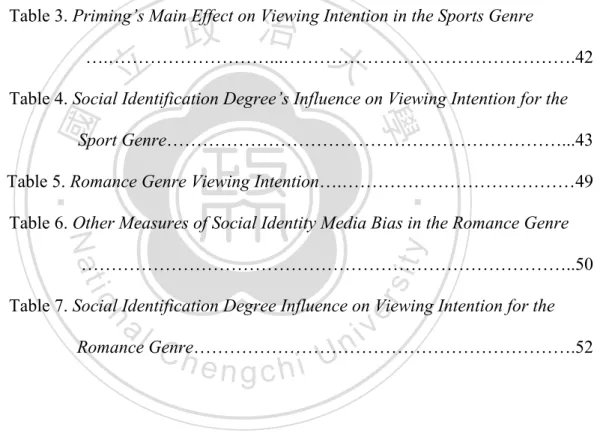
(7) v List of Figures and Tables I.. Figures Figure 1. Experimental Conditions …….…………………….…………………28 Tables Table 1. Sports Genre Viewing Intention ………………………………………39 Table 2. Other Measures of Social Identity Media Bias in the Sports Genre …..………………………....………………………………………...40. 治 政 大 ….………………………...………………………………………….42 立. Table 3. Priming’s Main Effect on Viewing Intention in the Sports Genre. Table 4. Social Identification Degree’s Influence on Viewing Intention for the. ㈻㊫學. • 國. Sport Genre…………………………………………………………...43. •. Table 5. Romance Genre Viewing Intention….…………………………………49 Table 6. Other Measures of Social Identity Media Bias in the Romance Genre. y. Nat. io. sit. ………………………………………………………………………..50. Table 7. Social Identification Degree Influence on Viewing Intention for the. n. al. er. II.. Ch. i n U. v. Romance Genre……………………………………………………….52. engchi.
(8) 6 Introduction Mainland China has always had a stated political agenda to unite with Taiwan. ChoonYin Sam, a scholar of economics and Asian studies, describes the Mainland Chinese position as being supremely interested in reunification and he points to their passing of an Anti-Secession Law in 2005 as proof of this assessment. The law stipulates within the second article that, “There is only one China in the World” (qtd. in Choon-Yin, 2010 p. 94). Hard power manifestations of this desire to take back the island would be in the impressive number of missiles China has. 治 政 大approach that China has taken. (“China May Up Missiles”, 2010). Yet, there is also a cultural 立 pointed at its neighbor, which the China Post has estimated reached the 1,900 mark in 2010. China seeks to emphasize the shared Chinese cultural heritage in the two regions as a. • 國. ㈻㊫學. justification for the reunification of the two states.. •. For China the idea of a Taiwanese identity is in conflict with its assertion of control over the region. Jacques de Lisle (2010) makes particular mention of this cultural component in. y. Nat. io. sit. China’s global soft power strategy, which seeks to insight a “sense of shared Chinese-ness . . . in. n. al. er. Taiwan despite the broad rise of a Taiwan identity” (p. 511). Cultivating shared cultural. Ch. i n U. v. experiences between the two regions is one way to subversively achieve the goal of bringing the. engchi. two countries closer together. Winning over the hearts and minds of the Taiwanese population would make any subsequent political policies with a reunification aim much easier to implement. Although the term “soft power” makes the process sound sinister, and there is no doubt China has a political motive, however cultural exchange is not necessarily malicious: reciprocal exchanges between governments has, on occasion, been found to promote trust (Rao, Pearce, and Xin, 2005). The exchange of culture between the two regions are encouraged on both sides, by politicians from both Taiwan and China, since it is a process that facilitates mutual.
(9) 7 understanding (Ko, 2010). The Mainland Affairs Council of Taiwan display principles of cultural exchange on its website, which it agreed upon in its 41st council meeting on January 31st, 1994, stating it hopes to: “promote the development of culture and art of the two sides through the exchange programs of cultural articles and the people of artistic attainments” (“Principles for Cross Strait Exchanges”, 1994). From a governmental standpoint, cultural exchange is, for the most part, welcomed by the government of Taiwan. Media imports, such as films that screen across Asia, are a particularly effective way to. 治 政 大 Beyond that they are elements contend, the unique perspective of the cultures that produce them. 立 propagate culture. Films are cultural products that contain, as Craig, Greene, and Douglas (2005). of popular culture enjoyed by almost everyone. The exporting of films along with encouraging. • 國. ㈻㊫學. co-productions is a way in which China is simultaneously able to push a cultural and economic. •. agenda, all with the hope that their cultural perspective reaches a large audience. Gao Zhihong (2009) puts forth that China has a stated goal in its national filmmaking. y. Nat. io. sit. policy to promote it’s national culture, and further, China wants to disseminate its films globally. n. al. er. with a Hollywood style industry that competes internationally. Gao goes on to outline how, from. Ch. i n U. v. a political policy standpoint, the films of China are extensions of the country’s political, cultural,. engchi. and economic goals. Gao takes a rather negative view of this goal, saying that the film policy in China has been “hijacked by the government to implement its political and ideological agenda” (p. 434). Since films are cultural products, implementing a political agenda through popular cultural is quite possible. The governments of China and Taiwan recognize this fact and have often used films to promote the culture of their respective nations. Yet how the people of Taiwan receive the cultural products of China is beyond the control of either government’s desire to promote exchanges. Taiwan and China have a long.
(10) 8 history of political tension; one Asian studies scholar Steven Goldstein characterizes it as 50 years of balancing between tension and peaceful stalemate creating a “status quo of deadlock”. There are certain issues such as Taiwan independence that the two sides will never find common ground on (Goldstein, 2002). Therefore, to separate political prejudices from any exchanges between the two countries, especially a cultural exchange such as a film, would seem to be a difficult task. The challenge to bring outside films into the Taiwan market has increased since, as of. 治 政 大 in 2007 with the film Cape film industry has seen record box office returns, a trend that began 立. recently, Taiwanese audiences have begun to develop a stronger taste for local films. The local. No. 7 (海角七號) bringing in NT$520 million and continued into 2010 with Monga (艋舺) and. • 國. ㈻㊫學. 2011 with You Are the Apple of My Eye (那些年,我們一起追的女孩) both yielding similarly. •. high returns (Chang, 2012). Much to the delight of the struggling Taiwan film industry, it seems. sit. y. Nat. that capitalizing on the local stories and cultural of Taiwan has resonated with audiences who. io. al. er. seem hungry for media material that they can relate to. These recent films do just that: drawing. n. on the shared experiences of the Taiwan cultural and contributing media representations that. i n C audience members from Taiwan can easily h eunderstand. ngchi U. v. If China seeks to successfully reach the Taiwanese audience, the question for China becomes: what types of films should they use in their soft power media campaigns directed at changing Taiwanese public opinion? How strong is the Taiwanese aversion to the Chinese Mainland? How strong is the Taiwanese preference toward local films? How willing are Taiwanese audience members to engage with their Mainland counterparts in an effort to understand the Mainland’s politics and culture? Being that recent trade agreements such as ECFA have encouraged trade and investment in all sectors of business and linked the economies.
(11) 9 of these two nations (Wren, 2012), it seems that they are destined to have further economic, political, and cultural relations in the future. These questions deserve serious consideration by those in the media cultural industries. Therefore, this study aims to shed some light on how Taiwanese audience members differ in their feelings about local films as opposed to those imported from China. This study will do so by conducting an experiment with Taiwanese college students, comparing their opinions toward different stimuli: variations of film posters. The implications of any prejudices recorded from. 治 政 Taiwanese audience members, but should also extend to any 大 media research seeking to 立. Taiwanese participant’s views of out-group media not only help those seeking to understand. understand how media is perceived when it passes between different social groups.. • 國. ㈻㊫學. This thesis’s chapters are organized as follows: 1) Introduction; 2) Literature Review,. •. outlining how Tajfel’s “social identity theory” (1978) and Turner’s “self-categorization theory” (1978) relate to media research and what this may mean for Taiwanese perceptions of Mainland. y. Nat. io. sit. Chinese media; 3) General Methodology, breaking down the experimental design of the study; 4). n. al. er. Experiment One, containing the methodology, results, and discussion for first experiment. Ch. i n U. v. conducted, which analyzed responses to a sports genre film stimulus; 4) Experiment Two,. engchi. containing the methodology, results, and discussion for the second experiment conducted, which analyzed responses to a romance genre film stimulus; and the 5) Discussion and Conclusion, which discusses the social and theoretical implications of this research..
(12) 10 Literature Review Self-Categorization, Social Identity Theory, and Taiwan Despite China’s assertion of control over the region, Taiwan is its own political entity. The country creates laws and governs itself. National pride is certainly present within many if not most of the citizens of Taiwan. Tony Yu and Diane Kwan (2008) outline how national identity is “a collective perception of self . . . the difference between ‘we’ (in-group) and ‘them’ (out-group)” (p. 35). The research of Li Mei Chin (2003), found that all Taiwanese participants. 治 政 had identification with China despite the fact that their traced大 lineage begins on the Mainland. In 立 who grew up and lived in Taiwan had strong identification with Taiwan but not all participants. fact Taiwanese group identity often defines itself separately from a Chinese group identity.. • 國. ㈻㊫學. Li’s hypothesis behind the research is based in part on Turner’s self-categorization theory. •. and in part on Tajfel’s social identity theory. These theories contributed to Li believing that people who incorporate the ethnicity of Taiwanese into their identity, subsequently identify less. y. Nat. io. sit. with a Chinese identity. Due to social identity theory and self-categorization theories previous. n. al. er. relevance in research involving Taiwan and Mainland China it would be worthwhile to look at. Ch. i n U. v. these theories and further apply them to research involving ethnic relations among the two regions.. engchi. Theory Origin. A major point Tajfel (1978) first made in regards to social identity theory is that in order to maintain a social group’s identity, the group needs to distinguish itself in a positive way. In-groups seek to leverage themselves over out-groups. If a given group currently feels superior in some respect they will try to maintain that superiority as a “legitimization of their self image” (p. 76). As applied to the case of Taiwan and China it should.
(13) 11 hold true that those who consider themselves Taiwanese will emphasis the positive attributes of the Taiwanese identity while comparatively taking an inferior view of the Chinese identity. By extension, the desire to view in-groups in a positive light creates the desire to assist in-group members over out-group members. In the much sighted original experiment of this phenomenon, arbitrary groups were created among subjects and they were instructed to hand out sums of money, being unable to award money to themselves subjects chose to give higher sums to their group members. In a follow up experiment, when presented with the option to maximize. 治 政 received more rewards than the out-group, even if it resulted大 in less money overall for their 立. the total amount given to everyone in the study subjects choose instead to insure that their group. group. The point wasn’t the net economic gain but rather subjects seemed to be concerned first. • 國. ㈻㊫學. and foremost with their group “winning” (Tajfel, Billig, Bundy, & Flament, 1971). The arbitrary. •. formation of the groups is noteworthy: with no real basis for identification with their group members, individuals are still inclined to see those with a similar social classification succeed. y. Nat. io. sit. over those considered different, even if the social classification is a contrived one.. n. al. er. Turner (1978) questioned as to why this rewarding of group members with no perceived. Ch. i n U. v. gain to oneself occurs. He hypothesized that the reward process was an attempt to differentiate. engchi. the groups, so members can experience a sense of pride over other groups. Since relations with other social groups are unavoidable, a social identity maintains a positive self-image through an individual’s evaluation and comparison to other groups, a process Turner called selfcategorization. Once self-categorization is established, a sense of social competition becomes a way to increase the social image of the group in relation to its rivals. Turner tested for this by changing the reward from a material item such as money to an arbitrary indication of superiority, points..
(14) 12 Inter-group discrimination was again found even when there were no perceived economic gains from the process. Social competition between groups highlights an important reason why some cases of discrimination would occur between separate groups and others would not. To assume all intergroup behavior is antagonistic, that a group must define itself through an inferior view of all other groups, is of course an over generalization; it is only in socially competitive situations that this occurs. Previous research analyzing black Americans feelings of group cohesion found it. 治 政 大 perhaps be that there is no need (Herring, Jankowski, & Brown, 1999). The reason for this could 立 was in general not correlated with feelings of animosity or anger against the white community. for the black community to differentiate itself from the white community, as the two are clearly. • 國. ㈻㊫學. separate. Tajfel and Turner’s understanding of inter-group discrimination was that the purpose. •. was to positively distance an in-group from an out-group. The need for this would commonly stem from a competitive or close relationship between the two groups such as an ambiguity of. io. sit. y. Nat. group categorizations.. n. al. er. Chinese identity. The Chinese community has this competitive relationship within itself,. Ch. i n U. v. as citizens of Hong Kong, Taiwan, and Mainland China all lay claim to the Chinese ethnicity.. engchi. Yet the social categories of these three identities are made apparent by their political differences and separate historical experiences. It is because of similarities, and the potential for confusion between the social categories of Hong Kong, China, and Taiwan that there is more of a need for these groups to establish clear differences. In interviews with Hong Kong Chinese, conducted by Ladegaard (2011), on their perceptions of other races, the stereotypical view of Mainlanders was by and large a negative one. Ladegaard attributed this to a desire to create a clear ‘we-they’ dichotomy as a result of the possibility of confusion between the two groups. Hong Kong.
(15) 13 Chinese reinforced their positive group identity by clearly pointing out the negative differences of Mainlanders, a group that otherwise could be considered similar to their own. The need for inter-group distinction would seem to be even more necessary in the relationship between Mainland China and Taiwan, which is locked in a political conflict that constantly requires Taiwan to assert its independence from the Mainland. It has been publically stated and understood for some time that the Chinese government has an aim to unite with Taiwan: a country that wants to be sovereign (Reinke, 2009 p. 748). From this position if there is. 治 政 大will need to establish positively those who choose to represent their identity as Taiwanese they 立. to be an independent Taiwan state it needs to establish its separation from the Mainland, and for. valued differences from their Mainland Chinese counterparts. Since the competitive relationship. • 國. ㈻㊫學. is a strong one, social identity and self-categorization theory would suggest that Taiwanese. •. identification would cause negative views of the Chinese identity and resistance to Chinese culture as a way of preserving a Taiwanese identity formation.. io. sit. y. Nat. Media Use. n. al. er. Uses and Gratification. The goal of this study is to relate social identity to how it would. Ch. i n U. v. affect media usage. This goal is best achieved with a uses and gratifications approach, which. engchi. suggests media is selected which appeals to our needs and wants. The original formations of the uses and gratifications theory rose out of a need to take into account the desires of the audience member and acknowledging them as active participants in their mass media use (Katz, Blumler, & Gurevitch, 1973-1974). Uses and gratifications has since been used in such research as tying participants moods to genre preferences in movies (Krcmar, Green, Banerjee, & Bagdasarov, 2008) and looking at how gender identity formation effects television viewing preferences (Dos Santos, Kotowski, & Harwood, 2007). The important point of a uses and gratifications approach,.
(16) 14 and why it is useful in understanding how social factors effect media use, is that it proposes that certain social and psychological processes affect media choices and individuals often select media to fulfill desires created through social conditions. Social Identity, Self-Categorization, and the Media. Applying social identity and selfcategorization theory, the media that would most gratify in-groups would be media that has positive portrayals of that social group and negative portrayals of out-group counterparts. Attending only to this media is often called selective exposure (Weaver, 2011; Cooks & Orbe,. 治 政 大 proposition: selectivity and social identity gratifications put forth this theoretical 立. 1993). Michael Slater (2007), when assessing the theoretical connection between media. •. • 國. ㈻㊫學. In general, those individuals who identify with a given set of religious, ideological, or lifestyle beliefs and values (i. e., a shared group or communal identity) will have certain preferred media outlets, and will selectively attend to content that reflects and shares the values of that social identity group. (p. 290). The simplest way to ensure exposure to favorable portrayals of ones in-group is to avoid the. y. Nat. n. al. er. io. in-groups are a safer bet.. sit. media of out-groups. Media outlets and sources that have proven to have friendly portrayals of. Ch. i n U. v. Slater’s model is a spiral that expands on a simple uses and gratifications approach.. engchi. Selection of certain media that favors the “in-group” will reinforce that social identity, contribute to stereotypes of it, and lead to stronger “in-group” identification through making that identification more salient. Slater’s spiral contends that often the social conditions, such as stereotypes, that contribute to certain media choices are reinforced through the media itself. Slater acknowledges that to measure both aspects of this spiral process would take years, as it is a process that occurs over time. This research will only focus on one end of the spiral of.
(17) 15 selectivity: that a social identity contributes to media choices. It is, however, worthwhile to keep in mind that media choices do in turn reinforce any given social identity. In seeking to understand how social identity effects media choices, it has been found viewers are often attracted to media that reinforces their identity beliefs, avoidance is often found when a given social groups encounters media related to out-groups. Knobloch-Westerwick and Hastall (2010) in their research found selective exposure applied to news stories. When certain participants saw positive stories about their social groups they were more willing to watch them.. 治 政 大measured audience members research more particular to entertainment media, Weaver (2011) 立. These participants had a low interest in general with news stories pertaining to out-groups. In. media choices based on the presence or absence of actors of different races. Consistent with. • 國. ㈻㊫學. social identity theory, the presences of a black leading actor had a negative impact on white. •. audience members desire to see films. Weaver supposed the race of the actors cued the audiences to content less relevant and less positive to their in-group. Abrams and Giles (2007) recorded that. y. Nat. io. sit. the more African Americans identified with black culture, the more they engaged in selective. n. al. er. avoidance of television, which predominately has negative or no portrayals at all of black. Ch. i n U. v. Americans. It seems that often, in order to preserve the self-conception of in-groups, media. engchi. representations created of and by out-groups are often avoided all together. In contrast, Krämer and Trepte (2006), found little to no evidence certain in-groups favor media from their home country. In a study conducted once with British and German and again with American and German nationals, most preferred to watch television shows from a foreign country rather than their home country. However, similar to the earlier example of Herring et al. (1999) finding that African American self-esteem is not dependent on animosity toward a white out-group, it is likely that no identity formation is at stake between the German.
(18) 16 and American identity or between the German and British identity. Krämer and Trepte (2006) supposed there may even be a curiosity about the out-group. For a Taiwanese audience member exposed to Chinese media, identity formation is at stake. The Taiwanese identity defines itself directly as being against the Chinese identity. Taiwanese people cannot deny that their ethnic roots began in Mainland China (Yu & Kwan, 2008) and therefore must work harder to justify the legitimacy of a Taiwanese ethnicity. One such manifestation of an effort to maintain their Taiwanese identity should be that Taiwanese. 治 政 大 Based on the literature, I, therefore, formulate the following hypotheses. 立. identification results in avoidance of and animosity toward Chinese media imported to the island.. H1a: In general Taiwanese participants will show less intention to view films when. • 國. ㈻㊫學. prompted by stimuli suggesting films are Mainland Chinese and more intention when. •. prompted by stimuli suggesting they are from Taiwan.. However it must be considered that seeing a film in a movie theater would potentially. y. Nat. io. sit. require a very different level of commitment and interest than seeing a film on television. As. n. al. er. Keane and Kim-Shyan (2005) contend, different mediums elicit different affects. There is often a. Ch. i n U. v. recorded difference in the viewing audiences between the movie-theater and DVD mediums. engchi. (Stanley, 2006), and the movie theater and television mediums (Robins, 2006). Therefore any hypothesis about viewing intention should be broken done into the various mediums of viewing films for greater clarity. Broken down into medium the viewing intention hypothesis would also contend that: H1b: Taiwanese participants will show less intention to view films in a movie theater when prompted by stimuli suggesting films are Mainland Chinese and more intention when prompted by stimuli suggesting they are from Taiwan..
(19) 17 In addition: H1c: Taiwanese participants will show less intention to view films on DVD when prompted by stimuli suggesting films are Mainland Chinese and more intention when prompted by stimuli suggesting they are from Taiwan. And finally: H1d: Taiwanese participants will show less intention to view films on television when prompted by stimuli suggesting films are Mainland Chinese and more intention when. 治 政 大 Other Measures of a Social Identity Media Bias 立 prompted by stimuli suggesting they are from Taiwan.. Other than expressed viewing intentions, a social identity bias could manifest itself in. • 國. ㈻㊫學. other ways. It should be considered that expressed viewing intention may not be an accurate way. •. to understand all participants perceptions of a given piece of media, as Nabi and Krcmar (2004) explain, viewing intention can often be impeded by “situational constraints” (p. 299). For. y. Nat. io. sit. example people may not intend to view films for monetary reasons even though they think they. n. al. er. may enjoy it. Therefore, there should be other attempts made to measure participant’s social identity media biases.. Ch. engchi. i n U. v. Perceptions. It would be useful to measure more basic enjoyment processes, which as Nabi and Krcmar assert, contribute to the more advanced behavior of intending to view a certain piece of media. Basic processes such as positive affect, identification, and learning have been found to be present in previous media research when an expressed viewing intention was not (Nabi & Tsay, 2006). In other studies positive feelings did translate to and were consistent with the participants viewing intention (Ye & Zhou, 2007). The point being that positive feelings of.
(20) 18 perceived enjoyment are the first step before a clear intention to view a given film is made. Therefore, the following hypothesis is proposed. H2: Taiwanese participants will display less positive perceptions towards the films when prompted by stimuli suggesting they are Mainland Chinese films and more positive perceptions of the films when prompted by stimuli suggesting they are Taiwanese films. This would occur due to Taiwanese participants’ desires to maintain more positive feelings of their in-group over their Mainland Chinese counterparts as a way of self-affirmation.. 治 政 大the films may be another. So viewing intention, a desire to seek out more information about 立. Information Seeking. Positive feelings are one reaction that may precede an expressed. while participants may not be entirely committed to seeing any films due to external factors, such. • 國. ㈻㊫學. as cost, they may be more willing to do research on one product over another before making a. •. decision.. Information seeking has been found in previous research to be a precursor to purchasing,. y. Nat. io. sit. including such actions as peer-to-peer deliberation, thorough review of all product information,. n. al. er. and the consulting of experts (Midgley, 1983). In the absence of viewing intention, information. Ch. i n U. v. seeking could certainly occur in a product that consumers are interested in but still unsure about,. engchi. yet this would only occur if participants were in fact open to the idea of purchasing the product. The act of information seeking would therefore, theoretically, be less likely in the event of a prejudice created by something irrelevant to quality, such as a social identity bias, which is more of a peripheral processing technique, less reliant on actual substance. Petty and Cacioppo (1986) explain that, information seeking is more of a commitment to the central processing route and is, therefore, indicative of high involvement because of a social identity based media bias:.
(21) 19 H3: Taiwanese participants will display less information seeking behaviors towards the films when prompted by stimuli suggesting they are Mainland Chinese films and more information seeking behaviors when prompted by stimuli suggesting they are Taiwanese films. Priming Self-Identification Priming, simply put, is the idea of making certain ideas more salient in the eyes of individuals in order to influence their opinions (Scheufele, 2000). Researchers often use priming. 治 政 大or personality traits can be more participant’s personality so the effects of those feelings, values, 立 in experiments to trigger, or make more salient, certain feelings, values, or aspects of a. easily measured. This can be done by having participants engage in certain activities such as. • 國. ㈻㊫學. reading articles or free writing on a specific subject connected to the emotions that researchers. •. wish to prime. The purpose of a prime is to often to see how it influences the “responses to an allegedly unrelated subsequent task” (Oyserman, 2008 p. 313), often in comparison to a control. y. Nat. io. sit. group that does not participant in the priming activity.. n. al. er. Forehand and Deshpande (2001) noted that although ethnic identity is a trait determined. Ch. i n U. v. by social and cultural experiences, it can be primed to be more salient in the minds of. engchi. individuals. Forehand and Deshpande (2001) found that priming ethnic identity in their experiment with simple words such as “Asia” or “Europe”, to remind participants of their ethnic identification, increased awareness and identification with their ethnic identity, and increased identification with a stimulus targeted at their ethnicity. Vincent Dru (2007) found that when ingroup and out-group identifications were primed, via answering questions on their opinions of in-group and out-group members, ethnic prejudice was increased. McGarty (2001) maintained that out-group prejudice and in-group cohesion only manifests itself in conditions where.
(22) 20 comparisons between groups are primed, such as asking participants how they would feel living in another country and how they feel about foreigners. McGarty (2001) cited that the absence of primes resulted in much less significant correlations between group identification and in-group biases. If this were indeed the case then it seems priming the identity of participants would be a necessity in any social identity research. For priming’s effect on viewing intention the following hypothesis is purposed: H4: Primed to consider their ethnic identity, Taiwanese participants will show less. 治 政 大suggesting they are from Taiwan. Chinese and more intention when prompted by stimuli 立 intention to view films when prompted by stimuli suggesting the films are Mainland. For priming’s effect on positive perceptions:. • 國. ㈻㊫學. H5: Primed to consider their ethnic identity, Taiwanese participants will display less. •. positive perceptions towards the films when prompted by stimuli suggesting they are Mainland Chinese films and more positive perceptions when prompted by stimuli. y. Nat. n. al. Ch. er. io. And for priming’s effect on information seeking behaviors:. sit. suggesting they are Taiwanese films.. i n U. v. H6: Primed to consider their ethnic identity, Taiwanese participants will display less. engchi. information seeking behaviors towards the films when prompted by stimuli suggesting they are Mainland Chinese films and more information seeking behaviors when prompted by stimuli suggesting they are Taiwanese films. Self-Identification Variance Despite the fact that the national identity of the government is certain, the cultural or social identity of Taiwanese citizens is, however, more confused. Due to shared cultural experiences, the perceived social identity of many Taiwanese citizens varies. People living in.
(23) 21 Taiwan may consider themselves as part of the “in-group” of Taiwanese but also part of the “ingroup” of Chinese, because of a shared history and experiences with both localities. This causes the national identity of Taiwan, as a whole, to be vague, due to the number of cultural allegiances citizens could legitimately lay claim to. The majority population is ethnically Han Chinese, originating from the Chinese Mainland; however living in Taiwan for generations obviously has produced in many citizens a closer identification with their new locality over their Chinese roots. It is still possible though that there is variance in how Taiwanese view their social identity, some. 治 政 大others, and this variance needs to may identify with their Taiwanese heritage with more zeal than 立 in Taiwan still may identify with his or her Chinese heritage more strongly than others and some. be accounted for.. • 國. ㈻㊫學. In previous ethnic identification research the population was often broken into three. •. groups, those who consider themselves wholly Chinese, wholly Taiwanese and those who consider themselves to be mixed, claiming both Taiwanese and Chinese identities (Li, 2003).. y. Nat. io. sit. The trend identified by the Election Survey Center at National Chengchi University in Taiwan,. n. al. er. shows the population of Taiwan identifying more and more as wholly “Taiwanese”, less and less. Ch. i n U. v. as “both Taiwanese and Chinese”, and barely identifying at all as “Chinese”. The latest survey. engchi. numbers put 54.2% of the population as identifying themselves as Taiwanese, 39% as both Taiwanese and Chinese, and 4.1% as Chinese (Election Studies Center, 2011). This marks a difference from only three years ago; the 2008 survey numbers put the identity classifications at a near even split with 44.7% identifying as both Chinese and Taiwanese and 43.7% identifying as Taiwanese, with 4.0% identifying as Chinese (Election Studies Center, 2011). If this trend continues it seems that more and more of the population will be part of a more clear “in-group” that considers its Chinese others, especially those on the opposite side of the Taiwan Strait, to be.
(24) 22 separate. For now, however, accounting for the variation on ethnic self-identification in Taiwan should give further insight into what contributes to the aversion or attraction to a given countries media. If participants feel within themselves a significant identification with their Chinese heritage it would be unlikely for them to need to distance themselves from China’s culture, it is more probable they would embrace it according to social identity and self-categorization theories. Conversely if participants feel within themselves a stronger identification with their. 治 政 and by way of contrast more attracted to films from Taiwan. 大 Therefore: 立. Taiwanese heritage than they would likely be the more adamantly opposed to the Chinese films. H7: The level of identification participants feel toward their Taiwanese heritage relative. • 國. ㈻㊫學. to their level of Chinese identification will influence attraction to the films: their level of. •. attraction to the Taiwanese and Chinese films aligning positively with their self-stated social identity level.. y. Nat. io. sit. Meaning the more social identification one feels toward Taiwan the more attracted they would. n. al. er. be to a Taiwanese film; conversely more identification with a Chinese identity would result in more attraction to the Chinese film.. Ch. engchi. i n U. v. Controlling for Audience’s Movie Going Preferences. The object of this study is to see if there is a noticeable basis toward a film made in Taiwan over a film made in China due to the participant’s identification as a citizen of Taiwan. This will be achieved by having no differences in any aspect of the film stimuli used, except certain visual cues that indicate either a Taiwanese or Chinese production location. However, the fact that movie preference varies amongst individuals is something that should be considered; of course the same film will inspire different reactions in different participants. The location of a.
(25) 23 film is likely a subtle bias that most people are likely not aware they have. More obvious biases such as only liking certain genres or a preference for a particular actor will more than probably have a big influence on the results. These preferences should therefore be controlled for as best they can. Audience Preferences. Determining what exactly draws audience members to see films is of course of much concern to marketing professionals, therefore much research has been done in order to determine what factors are most important when trying to entice audiences to see a. 治 政 大 Certainly no one study has 2005; Simonton, 2009; Fetscherin, 2010; Suárez-vázquez, 2011). 立. film (Litman, 1983; De Vany & Walls, 1999; Chang & Ki, 2005; Craig, Greene, & Douglas,. been able to perfectly understand what certain variables will make a film a surefire success. In. • 國. ㈻㊫學. fact De Vany and Walls (1999) determined the variance to be infinite, based on their statistics. •. there was no way to tell what factors made any given film successful. Craig, Greene, and Douglas (2005) also contended the possible variables that go into a film’s success are infinite.. y. Nat. motivators for an individual wanting to see a certain film.. n. al. Ch. er. io. sit. Still, a framework of variables has developed through these studies, all of which are possible. i n U. v. In an attempt to quantify what made a successful film, Litman (1983) broke down a. engchi. film‘s enticing components into four categories; testing whether genre, rating, the presence of stars, or the production cost of the film had an impact on revenue generated. Expanding on these variables Chang and Ki (2005) had a much longer list. The variables Change and Ki felt important were: whether the film was a sequel, the actors, the director, the budget, the genre, the MPAA rating, critic’s feedback, audience feedback, who the distributor is, the release date, and the number of screens on which the film is shown..
(26) 24 Chang and Ki’s variables looked at variables applicable to box office sales from the United States but Fetscherin (2010) also found similar variables in the context of an international film release, so the variables, do not simply apply to the context of films released in United States. Fetscherin’s (2010) research model measured: genre, MPPA rating, star power, director power, season, number of screens, distributor power, and audience review. In looking over previous research, Fetscherin (2010) isolated the most commonly tested variables that go into a film’s success.. 治 政 大 campaign for a film and sales as a dependent variable but rather only presenting a marketing 立. A good number of these variables will be irrelevant to this study. This study is not using. seeing what interest it generates in participants. Given the fact that we are not analyzing the. • 國. ㈻㊫學. economic success of the actual product, the relevant variables are only those that apply to the. •. marketing campaign itself, not the more logistical elements of a film’s release such as the number of theaters it is shown in, as these will not be evident in the shown stimulus. For this. y. Nat. io. sit. study the idea was to limit the presence of predictor variables shown in the stimulus that could be. n. al. er. of influence to participants in order for the results to be less muddled. Of Fetscherin’s (2010). Ch. i n U. v. variables the two that could still be found in created stimulus were genre and star power and these were considered and controlled for.. engchi. Star Power. The influence of star power on potential audience members was not relevant to this study due to the lack of any notable actors or actresses in the stimulus used. The stimulus has actor names on the poster but none of these names are of known actors. The names themselves may be of interest to participants, but this is unlikely. It was considered that the lack of known actors may have a negative impact on viewing motivation, as people are sometimes motivated to see films due to the presence of their favorite.
(27) 25 actor or actress, of which the stimulus has none. Many studies have wondered if the presence of a known and well-liked actor is responsible for high audience turn out to a given film. The conventional logic is of course that a big name star will increase ticket sales and some research has indeed found data to support this conclusion (Canterbery & Marvasti, 2001). Other studies, however, have actually found that the data does not support the claim, and that the success of a given film cannot be attributed to the presence of a big name star (De Vany & Walls, 1999; De Vany & Walls, 2004; Suárez-vázquez, 2011). Often, a superstar has been found to help the. 治 政 大stars in a film was not a the star. Suarez-Vaquez (2011), for example found that having 立. chances of a film’s success but no conclusive data can determine if this is due to the presence of. necessarily a quality indicator to potential viewers. The lack of stars in the stimulus should,. • 國. ㈻㊫學. therefore, cause no unbalanced increase in certain participants viewing motivations due to a. •. partiality to a particular movie star, nor should it have a negative effect on viewing motivations. y. Nat. due to a dislike of any particular actor.. er. io. sit. Genre. One of the most consistent factors found to have an effect on box office results is genre (Chang & Ki, 2005; Festcherin, 2010). Certain genres were found to be preferred over. n. al. Ch. i n U. v. others by audience members, in Chang and Ki’s (2005) experiment, for example, horror films. engchi. seemed to fair better at the box office than all other genres. Festcherin (2010), who was testing Bollywood films, found romance to be the most popular genre. Everyone has different genre preferences and different countries and cultures of course should have different general genre preferences. This makes the impact of genre on the desire of audience members to see films a complex matter and one that can clearly affect this experiment. Therefore in order to enhance the external validity of our experiment separate stimuli were created for two different film genres in order to see if there is a consistence preference of.
(28) 26 Taiwanese films over Mainland Chinese films across genres. For logistical reasons it was only possible to conduct this experiment with two separate genres, so the genres used were a matter of careful deliberation. In 2007, d'Astous, Colbert, and Nobert found, particular film genres are associated with the countries that produce them well and this connection between genre and country of origin was found to impact audience members viewing decisions. For example, individuals were found more willing to see a martial arts movie from Japan then they are from Spain. This makes. 治 政 大may have a reputation in the mind genres either associated with Taiwan or China. Either country 立 multiple genre conditions all the more important since it is possible that there are particular. of participants for producing a given genre well. The two genres selected: romance and sports. • 國. ㈻㊫學. were selected to specifically try and account for this bias. These genres were picked because they. •. were thought not to contain a particular bias, however if a bias amongst either genre exists,. y. Nat. producing the study twice in separate genres would allow the bias to be identified, which is, in. er. io. sit. itself, an interesting finding.. Romance. Taiwan’s most frequently produced genre is arguably romance, a little less. n. al. Ch. i n U. v. than half of the films produced in Taiwan in 2012 were romances (“Taiwan Film Archive”,. engchi. 2012). Mainland China also produced a large amount of romances in 2012 (“Chinese Film Archive”, 2012). China has a much larger film industry than Taiwan and therefore produces a wider variety of film genres and has high grosses across genres. It produces its fair share of romances that have grossed highly (“Weekly Box Office”, 2012). Taiwanese viewers seem to enjoy romances produced in their country and Chinese viewers seem to equally enjoy the romances their country produces. The fact that the romance genre is popular in both respective countries of origin means it was thought to yield higher viewing preference results. Romance.
(29) 27 was also thought to be a relatively popular film genre with university students who are the target demographic of this experiment. Sports. The sports genre was selected for being a relatively neutral genre; neutral in the sense that neither country is particularly famous for creating films in the sports genre. It is assumed that neither country has a clear association with the sports genre, as there are very few examples of sports movies coming out of either country in recent years (“Taiwan Film Archive”, 2012; “Chinese Film Archive”, 2012).. 治 政 makes the genre an interesting contrast to the romance genre.大 The nationalistic nature of sports is 立 Moreover, in contrast to a romantic film, sports films can be somewhat political which. also something that should be expected to insight in participant’s national pride as global. • 國. ㈻㊫學. sporting events are often framed in nationalistic terms especially amongst competing nations. •. (Gao, 2010). Therefore, it is expected a sports film stimulus would record high affect in terms of the social identity and self-categorization impact on the viewing motivations, positive. y. Nat. io. sit. perceptions, and information seeking behaviors of participants.. n. al. er. Control Questions. Although these genres were selected because they were thought to be. Ch. i n U. v. of interest to participants, every individual has their own genre preference. This was controlled. engchi. for in the pretest; participants were asked their interest level in either romance films or sports films, depending on which genre condition they were placed in. Controlling for participants self stated level of interested stimulus genre they view should ensure that the recorded results are in fact due to a social identity bias and not a genre bias..
(30) 28 General Methodology The proposed hypotheses were tested through an experimental research looking at Taiwanese participant’s responses to various film poster stimuli. Particular attention was paid to differences based on which experimental condition participants were placed in: either a Taiwanese or Chinese film poster condition. Procedure The experimental design was a 2 x 2 factorial design. This design was used to measure. 治 政 randomly placed into one of the four conditions. Conditions大 were separated by the difference in 立 the difference of participant’s viewing motivations between the groups. Participants were. stimulus location, as well as separated into both a self-identity prime condition and no self-. • 國. ㈻㊫學. identity prime condition. ANCOVA was then used to measure dependent variable differences. •. between groups. Participants in each condition received a pretest asking movie preferences, selfidentity, and demographic questions.. n. er. io. sit. y. Nat. al. i vChina Poster Poster Mainland n CTaiwan hengchi U. Pretest Self-Identity Prime. I. II. No Self-Identity Prime. III. IV. Figure. 1 Experimental Conditions.
(31) 29 . The 2 x 2 design illustrated in figure 1 shows participants have the possibility of being placed in one of four conditions: 1) the Taiwan poster and self-identity prime condition; 2) the Chinese poster and self-identity prime condition; 3) the Taiwan poster and no self-identity prime condition; or 4) the Chinese poster and no self-identity prime condition. Being placed in the Taiwanese poster conditions (conditions I and III) meant that participants were shown a film poster with a Taiwanese location manipulation, while being. 治 政 大 film poster with a Chinese location manipulation. 立. placed in the Chinese poster conditions (conditions II and IV) meant participants were shown a. The “self-identity prime” conditions (I and II) received self-identity questions in their. • 國. ㈻㊫學. pretest and were asked to write a short paragraph related to why they love Taiwan. Participants. •. then viewed the stimulus and were given posttest questions asking about viewing motivation, perceptions, and information seeking behaviors. The “no self-identity prime” conditions (III and. y. Nat. io. sit. IV) were not asked to write a paragraph and did not receive identity questions in their pre-test, as. n. al. er. the question itself was thought to be another possible prime to social identity.. Ch. i n U. v. Two experiments were conducted to understand how genre influenced participant’s. engchi. responses. The experiment was conducted once for the sports genre and once for the romance genre. Both experiments were identical, both containing the same four conditions. Materials This experiment based its findings on responses to separate stimuli. Various manipulations of posters of an imaginary film were put together especially for the purpose of this research. These original visual stimuli were used alongside descriptions of the films. This was done to increase the strength of the stimuli and for the purpose of external validity; visual.
(32) 30 advertisements coupled with descriptions are one of the many ways audience members are introduced to new films. Audience members often evaluate their viewing decisions based on a number of factors, visual advertisements and descriptions among them, and this research will contribute to understanding the cultural elements of that process. Four separate film posters were created for this study. Two different posters were created for each genre: a romance poster and a sports film poster. Within each genre there are both a Taiwanese and Chinese version of the poster. The only difference between posters is a small. 治 政 a billboard, every other aspect of the poster is identical. The 大 various manipulations of the film 立. location manipulation, i.e. different country flags in the background and different city names on. poster stimuli for the experiment are as follows: 1) a Taiwanese sports film manipulation; 2) a. • 國. ㈻㊫學. Chinese sports film manipulation; 3) a Taiwanese romance manipulation and; 4) a Chinese. •. romance manipulation (see appendices A, B, C and D).. For the sports posters the only change between location conditions was the flag in the. y. Nat. io. sit. background, which indicated country of origin. The romance posters had separate flags. n. al. er. indicating country of origin; additionally the city name on the train station in the background is. Ch. i n U. v. either Taipei or Beijing depending on the location condition. The film descriptions, for both. engchi. location conditions are again identical except for the city and country names, which are repeated periodically throughout the description; for the Taiwanese location manipulation, Taiwan and Taipei is repeated, China and Beijing are repeated for the Chinese manipulation. It was of supreme importance that in both genre posters the difference between the Chinese and Taiwanese manipulation was clear. Krämer’s (2006) method of tying a country identification to a particular television production was through simply stating the country of production at the end of a plot description. Krämer’s findings however did not prove any social.
(33) 31 identity avoidance based on country differences. Krämer supposed that attaching a simple mention of the country of production at the end of a plot description was too subtle of a cue that participants perhaps ignored. Krämer wondered if adding more specific localities in the description, such as recognizable city names, would increase the salience of the location prime. This change was made in our description of the films with repeated mentions of the city of Beijing and country of China in the film descriptions of the Chinese manipulations, and the repeated mentions of the city of Taipei and country of Taiwan in the Taiwanese manipulations.. 治 政 大 the location cues of this experiment sufficiently salient. 立. This coupled with the visual component of the experiment, the poster differences, should make. Manipulation Check. • 國. ㈻㊫學. A manipulation check with a small focus group of eight participants was run to confirm. •. the salience of the location primes. The participants were shown a poster and asked whether or not they were sufficient indications of the film’s country of origin, all eight participants correctly. y. Nat. n. al. er. io. Measurements. sit. identified the film poster’s intended location of origin.. Ch. i n U. v. Viewing Intention. The dependant variable of viewing motivations measured in the post-. engchi. test were measured with the questions: “How likely would you be to go see this film in the movie theater?”; “How likely would you be to rent and watch this film on DVD?”; and “How likely would you be to watch this film on TV, if it is aired?” All answers were measured on a 5-point scale from “very likely” to “not at all”. These measures are similar to the measures used by Weaver (2011), who found it necessary to separate viewing intention into different possible viewing mediums. Averaged together and called “General viewing intention”, the three questions have high reliability with a Cronbach’s Alpha (∝) of 0.843. The range of means for this scale is 3.
(34) 32 to 15. These questions were also individually measured because the responses to these questions were expected to differ in participants based on the medium of film viewing. Therefore the three questions that made up the scale were also separately measured as their own dependent variables, called “theater viewing”, “DVD viewing”, and “television viewing”. Perceptions. Positive and negative perceptions of the film were measured on a fivepoint scale of “strongly agree” to “strongly disagree”, questions measuring attitudes being as. 治 政 大 of this film are enticing.”; and this movie looks entertaining.” ; “The plot description and poster 立. follows: “I general I like this film as a whole.”; “Based on the poster and description the plot of. “Based on the poster and description of the plot I think this movie will be exciting.” In addition. • 國. ㈻㊫學. there was also a negative attitude variable, “Based on poster and description of the plot I think. •. this movie will be boring” which was reverse coded. The responses to these five questions were all averaged together to form a scale, which made up the dependent variable of “positive. y. Nat. er. io. sit. perceptions” (∝ = 0.818), with means ranging from 5 to 25.. Information Seeking. Information seeking was measured by the following questions:. n. al. Ch. i n U. v. “How likely would you be to seek out more information about this film (either on the news or on. engchi. the internet)?” “How likely would you be to discuss this film with friends?” “How likely would you be to watch a preview of this film?” “ How likely would you be to go find out what critics have to say about this film?” The responses to these questions were measured on a five-point scale. These four questions were then averaged together to form a scale of the dependent variable “information seeking” (∝ = 0.823) with means ranging from 4 to 20. Identity. The National Election Center at National Chengchi University (NCCU), which has conducted surveys on Taiwanese identity since 1992 presents three identity options for those.
(35) 33 surveyed to select, with a fourth “no response” option. The NCCU survey words its identity question this way: In our society, there are some people who call themselves ‘Taiwanese’ some who call themselves ‘Chinese’, and some who call themselves both. Do you consider yourself to be ‘Taiwanese’, ‘Chinese’, or both? (qtd. in Chou, 2011). The same wording from the NCCU survey was used in this experiment to prime participants, however it was slightly modified. For the purpose of making the data easier to analyze, the question in this experiment’s pre-test was made into a five-point scale and the question was. 治 政 大 ‘Chinese’, and some who people who call themselves ‘Taiwanese’ some who call themselves 立. broken into two parts. The wording for this study was as follows: “In our society, there are some. call themselves both. On a scale of 1 to 5 (1 being ‘Not Taiwanese’ and 5 being ‘Very. • 國. ㈻㊫學. Taiwanese’) How Taiwanese do you consider your self to be?” And, “On a scale of 1 to 5 (1. •. being ‘Not Chinese’ and 5 being ‘Very Chinese’) How Chinese do you consider yourself to be?” Contrary to initial expectations self-reported identity had very little variance in. y. Nat. io. sit. participants: 83 percent of respondents recorded that they were very Taiwanese, a five on the. n. al. er. Taiwanese identity scale, with only 11 percent recording a four and the remaining 6 percent. Ch. i n U. v. recording a three or lower. Conversely, Chinese identity levels indicated that around 66 percent. engchi. of those who answered felt they were a one or two, little to no feelings of Chinese identity and only around 13 percent of respondents recorded a four or five, high levels of Chinese identity. Participants therefore were by and large very connected to their Taiwanese identity with only some variance between them as to how Chinese they felt. To account for this low variance and create a more even distribution for analysis, level of Chinese identity was subtracted from level of Taiwanese identity creating a single variable with which to test hypothesis 7, how identity levels effects viewing intention. The new variable.
(36) 34 indicated the identity gap participants feel between their Taiwanese and Chinese heritage; a low gap, lower number on the scale, would indicate that participants feel as connected to their Chinese heritage as they do their Taiwanese heritage. A higher number would indicate the participants feel a very strong connection to their Taiwanese and a very low connection to their Chinese identity. In addition to looking at the main effect of the strength of “Taiwanese Identification” on viewing intention it will also be necessary, and more important in testing the hypothesis, to. 治 政 variable was therefore standardized with the location variable大 by Z-score. This new standardized 立. understand how this variable interacts with the different stimulus location conditions, the identity. identity variable was multiplied with the new standardized location variable to create an. • 國. ㈻㊫學. interaction term: “Taiwanese Identification and Location Interaction”.. •. It should also be noted that any analysis done to determine Chinese and Taiwanese identity and its interaction effects were only done with the responses from the priming. y. Nat. io. sit. conditions, which contained 107 participants in the sports genre experiment and 108 participants. n. al. er. in the romance genre experiment, because the identity questions were only included in the priming condition questionnaires. Priming. Ch. engchi. i n U. v. Previous method’s used to prime social identity has been to ask participants to write a short paragraph about a certain aspect of their identity. Yopyk and Prentice (2005) asked student athletes to either write about a past athletic achievement or a past academic achievement thereby priming the different aspects of their identity. Those primed with the athlete aspect of their identity did subsequently worse on a given math test. Priming students to feel more connected to their university has also been done through getting them to write about positive experiences they.
(37) 35 have had with other students (McLeish & Oxoby, 2011). Writing on a given aspect of a person’s identity is a way to achieve a high-level identity salience as it forces the participant to think in depth about their personal experiences as a member of a given group. Having participants write about something they love about Taiwan, coupled with asking them to identify their ethnicity, which in and of itself has been used in previous research as a social identity prime (Shih and Pittinsky, 1999), should be a way to trigger high Taiwanese identity salience amongst those in the prime condition. In this study, priming was done by asking. 治 政 大also only asked of participants you love about Taiwan”. Social identity salience questions were 立 participants this open-ended question: “Please write briefly (4 or 5 sentences) about something. in the prime condition as it was thought possible any social identity related questions would also. • 國. ㈻㊫學. prime participants.. •. Control for Genre Interest. The responses to the questions “On a scale of 1 to 5 how enjoyable do you find sports. y. Nat. io. sit. films?” and “On a scale of 1 to 5 how likely are you to go see a sports film?” were used as co-. n. al. er. variants to control for the level of genre interest participants may or may not have in sports films.. Ch. i n U. v. The responses to the questions “On a scale of 1 to 5 how enjoyable do you find romance films?”. engchi. and “On a scale of 1 to 5 how likely are you to go see a romance film?” were used as co-variants to control for the level of genre interest participants may or may not have in romance films Translation All questions were translated into Mandarin Chinese for the benefit of the Taiwanese participants (see appendix E). Experiments One and Two Breaking this study into multiple experiments was done to test how the results varied.
(38) 36 across different film genres. Experiment one was conducted with the sports genre stimuli. Experiment two was conducted with the romance genre stimuli. For the sake of clarity, each experiment section contains an explanation of the methodology, results, and a discussion of the findings related to that particular genre.. 立. 政 治 大. •. • 國. ㈻㊫學. n. er. io. sit. y. Nat. al. Ch. engchi. i n U. v.
(39) 37 Experiment One: Sports Film Both experiments are meant to test the same hypotheses. Experiment one will first test the hypotheses presented in relation to the sports film genre. Methodology Participants. Participants were 214 students recruited among classes at Shih Hsin University and National Chengchi University, two of the leading communication schools in Taiwan. Participants were 30 percent male (N = 64) and 70 percent female (N =150), between 26. 治 政 Procedure. The students were told during their class 大 times that they would be 立. and 18 years old (M age = 19.9).. participating in an experiment about Taiwanese students’ media viewing preferences. Any non-. • 國. ㈻㊫學. Taiwanese students in the class were identified at this point and excluded from the study. The. •. students were then randomly placed into one of the four conditions. The students took a pretest, either containing a self-identity prime or not and viewed either a Taiwan film poster or a. y. Nat. io. sit. Mainland Chinese film poster, all depending on which condition they were randomly placed into:. n. al. er. a 2 x 2 experiment design. The participants then recorded their viewing intentions and. Ch. i n U. v. perceptions about the film. In some cases the students were offered extra-credit for their participation.. engchi. Results Data Analysis. ANCOVA was first used to compare the conditions and test hypotheses 1 through 6. Interest in the sports film genre and likelihood of viewing a sports film, were used as co-variants to control for genre interest..
數據
相關文件
從小到大都在台中唸書,大學就讀 ○○ 大學國貿系,學習國際貿易方面的專業知識。後
為此,國立中正大學防制藥物濫用教育中心與台灣藥物濫用防治研究學會,在教育部學生事 務及特殊教育司之支持下,將於 2019 年 10 月
在南京條約的政治方面,在 條約割讓香港會令中國政治 影響力下降,因為英國在華 的勢力坐大,中國慢慢失去
第十條 香港特別行政區應當通 過學校、社會團體、媒體、網絡 等開展國家安全教育,提高香港 特別行政區居民的國家安全意識
中國佛教發展,在魏晉時期有一具有重大意義而又影響深遠的現象,就是觀
個人、社會及人文教育 |英國語文教育| 藝術音樂教育 | STEM 教育 全球意識與文化敏感度 |體驗學習| 接觸大自然
國際半導體展即將於 23 日登場,國際半導體產業協會(SEMI)全球行銷長暨台灣區總
國際半導體展即將於 23 日登場,國際半導體產業協會(SEMI)全球行銷長暨台灣區總
