I.
目錄
1. Introduction---2 2. Research Contribution ---2 3. Methodology and Results ---3-23 4. Academic Activities ---23-24 5. Publications list ---24-31 6. Appendix ---32-34
2
認知、心理、與文化因子的突現性複雜現象:
整合代理人基計算經濟學、實驗經濟學、與腦神
經經濟學之研究架構
結案報告
1. IntroductionThis final report is to summarize the findings of the above research project conducted between years 2009 and 2012. The objectives of this project are to construct the ESD (Experimental Subjects Database) system and to conduct human experiments and agent-based simulations according to the findings in the human experiments. The outcomes of ESD can be found in appendix 1. The results of human experiments and agent-based simulations are stated in the following sections. Section 2 categorizes our publications attributed to this project and the complete publication list can be found in Section 5. Section 3 elucidates the research methodology and findings and Section 4 records the academic activities we held to promote our research contributions.
2. Research Contribution
This project involves various topics. Therefore, we categorize our publications according to the topics as below:
(1) Double Auction[7][16][28][34][35][39][41][42][46][47][55][56][62[63][68] (2) Ultimatum Game [54]
(3) Beauty Contest Game [47][63]
(4) El Farol Experiment Problem Game [20][48][50] (5) Financial Market [5][6][9][10][11][12][13][14][17][18][19][24][26][27][29][32][38][40][43][44][45] [53][58][59][61][64][66] (6) Prediction Market [25][30][42][43][56] (7) Learning [16][22][28][35][69][70] (8) Culture [31][57][67] (9) Neuroeconomics [33] (10) Modular Economy [37][51][54][65]
3
3. Methodology and Results
In this section, we focus on the third year’s major research results1
. Given the nature of the project, two main methodologies are adopted: experimental and computational. The first methodology consist in designing and performing experiments with human subjects in the experimental laboratory in order to test some hypothesis regarding the subjects’ behavior, while the computational methodology consists in developing agent-based computational models of social and economic systems and in performing simulations to explore the model’s implications.
3.1 Experiments
3.1.1 Beauty Contest Game
According to the beauty contest experiment, we have learned that cognitive capacity is crucial in human strategic reasoning, in particular, p-beauty contest game. In concrete, high capacity subjects make more accurate prediction about average opinions not only in the novel environments but also in the later periods where learning involves. It turns out that high capacity subjects afford higher level of reasoning than low capacity subjects. We found that a cognitive hierarchy corresponds to a psychological invariant. We further adopt the Markov transition matrix to illustrate the level switching behavior. It gives us a visual description about the difference of learning dynamics displayed by high and low capacity subjects. Although we could roughly distinguish them from the level-switching Markov transition matrix, formalizing the learning behavior by an appropriate model is still crucial. The characterization of learning model could help us to apply direct comparison and statistical testing by the parameter estimates.
Among various learning models, we apply the experience-weighted attraction (EWA) model proposed by Camerer and Ho(1998, 1999). The EWA model combines the features of both belief-based models and choice reinforcement models, two seemly distinguished approaches, into a general framework. With specific configurations of parameter values, the EWA model becomes a belief-based model or a choice reinforcement model. The EWA model also fit the empirical data in various game experiments (Camerer and Ho, 1999; Camerer, Ho and Chong, 2002).
In order to investigate the effects of cognitive capacity on learning behavior, we calibrate the EWA model parametrically using the data of high and low capacity subjects separately. According to the score of working memory tests, the first third of subjects are defined as the high capacity group while the last third of subjects are defined as the low capacity group.
1
The details of our research results from year 2009 to 2011 can be found in the papers listed in Section 5.
4
The parameter estimates are shown in Table 1. We find that high capacity subjects are different from low memory capacity subjects regarding their learning parameters. They give more weight to forgone payoffs ( ), exhibit lower depreciation rate on experience or past attractions (ρ,Ф), and higher initial experience weight ( ). In addition, they also exhibit different distribution property of initial attraction ( ). In particular, the low capacity subjects symmetrically distributed with peak at
locating the interval , while the high capacity subjects asymmetrically distributed with peak at locating the interval , (see Figure 1, the values have been transformed to the relative weight).
5 Figure 1
The significant differences between the values of parameters provide us some implications. The parameter is the most important parameter in EWA (Camerer and Ho, 1999). On the one hand, reflects what choice reinforcement insists that only actual effects matter, and on the other hand, reflects the feature of belief-based model that actual and simulated effects are equally strong. Our results show that high capacity subjects give more weight on simulated effects as belief-based learner, while the less weight on simulated effects makes low capacity subjects more reinforcement-like. Note that reinforcement learning model is regarded as the behavior of agents with only minimal intelligent, that its opposite extreme is the super-rational agents (Stahl, 2000). In fact, we evidence the cognitive hierarchies revealed by the learning behaviors in beauty contest experiment. Combing the findings in novel environment where cognitive capacity produce different levels of reasoning, we suggest that, in a strategic environment, cognitive capacity would develop the cognitive hierarchies throughout the learning process.
3.1.2 Ultimatum Game
Usually, decision making problems could be viewed as choices among alternatives, and the traditional economic theories have told us that the rational subject should be free from the paradox of choice (Schwartz, 2003). However, tons of empirical studies have provided evidences for human’s boundary-rationality and decision conflict during multiple decision-making processes in our minds. Our main hypothesis assumes that the subjects could rationally evaluate the physical outcomes of matters independently, but might have problem rationally integrating their preferences’
6 structures.
We investigate individual's preference change in behavior within an ultimatum game (UG). The ultimatum game was first studied in G¨uth et al. (1982) in which two players are required to join. One player (the proposer) receives an amount of money provisionally and makes a proposal to the other player (the responder) regarding how to divide this money between them. If the responder accepts the proposed offer, the game is implemented and they share the money according to the proposal; otherwise, both players receive nothing. In investigating subjects’ behavior in ultimatum game, past studies mainly consider two theories: economic rationality which prompts the proposer to exploit his strategic advantage (at least to a moderate degree) and tells the responder to accept low offers; and equity theory which says that the proposer should demand an equitable share (equal to his cost share) and that the responder should reject non-equitable demands (Brandstätter & Königstein, 2001, p55). Players may consider both strategic aspects and equity aspects of the situation. Besides, we believe personal preference for different things should be included. As pointed out by Camerer (2003, p. 48), whether to accept an ultimatum offer requires no strategic thinking since it is simply a choice. Hence, players’ self-interest preferences rather than game-theoretic reasoning seem to be the culprit responsible for the failure of the prediction. (Fu, 2007)
Two types of bids are used in our experiments: one-shot and repeat 10 times. Different from other ultimatum game studies in which either cash or some token only is used as bids, each type of our experiments plays three treatments by the following order: cash in the first, chocolate in the second, and both in the third experiment. We limited the choices up to two comes from the human frontal function seems limited to driving the pursuit of two concurrent goals simultaneously (Charron & Koechlin, 2010). Although it is quite intuitive to see how people will do in decision making when facing multiple choices, past researches were seldom designed for this aim in the ultimate game. Thus, our study is a pioneer to understand the relative preferences between attribute values (i.e., cash and chocolate) in the ultimatum game.
In the one-shot experiment, we find that subjects propose different scenarios when they play with different materials in UG. Actually, proposers prefer to keep more money (see Table 2). The offer rate is significantly different between treatment 1 (money) and treatment 2 (chocolate). We observe 32.35% proposers
7 Table 2
share less money in treatment 3 (t3) than in treatment 1 (t1); and share equal or more chocolate in treatment 3 than in treatment 2 (t2). However, in this money-lover proposers’ group, only 45.45% proposers compensate more chocolate (in cash value) to responders. It could be a risky decision since that they not rationally integrate their personal and social preferences. Maybe that’s the reason why the reject rate is high in t3.
In repeat-game experiment (Table 3), the proposers would test the deadline of Table 3
responders, and the responders also try to fight for more profits. This could be the main reason why we have super high reject rate. Another interesting finding is that even proposers have some confident date about responders’ preference from t1 and t2, the proposers still hace different strategy in t3. You can see the beginning offer by proposers in t3 is quit simily to the offer in one-shot game, and the proposers’s following offers seems not refer the results of t1 and t2 (Table 4). On the other hand, the responders, comparing to t1, don’t change their accept deadline of money share in t3, even the proposers offer more chocolate.
Finally, we conclude the findings of our experiments. First, economic theory typically assumes that behavioral responses should be independent of the medium of exchange. But, we confirm the medium really matters. Second, even the proposers have some basic ideas about responders’ preference, they still try to manipulate their portfolio. Finally, preference and decision could be change when subjects play one-shot or repeat game, also be different when thy face single or multi objects. The results show that subjects’ offers are significantly different when the bids are considered separately
8
or together, and we conclude that bargainers' preferences are not always monotonic. Table 4
3.1.3 Double Auction
In this third and final year, we have concluded our analysis of the data gathered during eight double auction (DA) experimental sessions performed at the NCCU laboratory in the month of June 2010. The aim of the analysis was to gain a deeper understanding of the role that personality traits and cognitive skills (in particular, the subjects’ working memory) play in the subjects’ learning process. To this end, besides the DA experiments, we conducted a series of working memory tests and personality tests to gather individual data allowing us to assess the relationship between the subjects’ performances and their personal characteristics.
In the DA experiments, the subjects had to face sequentially four markets (that will be referred to as M1, M2, M3 and M4) with different structures (Figure 2). In each market, the DA was composed by 30 trading days, each of which was composed by 25 trading rounds. The human subjects were assigned the role of a buyer, participating in a double auction with a set of artificial players composed by three other buyers and four sellers. During the 25 rounds of each trading day, the players had the opportunity to exchange 4 tokens each.
9
M1 M2
M3
M4
Figure 2
The trading price for each token exchanged is the average between the highest bid and the lowest ask. During the 30-trading-day period the subjects had the chance to learn from their experiences and to discover new and more successful bidding strategies. We defined the subject’s strategies as the combinations of rounds at which the various tokens were bought (1-2-3-4, 1-2-3-5 and so on). We found that although the relatively high number of possible strategies (from 1-2-3-4 to 22-23-24-25) the subjects, in the different markets, separated into a few classes characterized by a few ‘focal’ strategies. This allowed us to compare the WMC scores and personality traits scores characterizing the various groups identified through the DA experiments. As an example, in Figure 3 we show the strategies adopted by subjects at the end of the experiment (the numbers in the cells express percentages).
From a general point of view the analysis of the experimental data showed that the subjects’ decision-making process and, in particular, the subjects’ performance in the DA experiments depend both on the subject’s characteristic and the particular market’s structure. In particular, our analysis showed that the WMC do matter to the DA experimental outcomes: in the M1, M3 and M4 markets (with a significance level of 5%) and in the M2 market (with a significance level of 10%) two or more classes of subjects were associated with significantly different WMT scores (See Table 5, 6, 7 and 8).
10 Figure 3
This is not to say, however, that the subjects with higher WMC were always associated with better performances: in fact, while in the M1 and the M4 markets the subjects who reached the best strategy were associated with WMT scores higher than those of other classes of subjects, in the M2 and M3 markets the class of the ‘optimal’ subjects was in fact associated with WMT scores lower than the ‘sub-optimal’ class-B subjects.
11 Table 6
Table 7
This means that, in some markets, having high WMC is not a necessary condition to reach the optimal strategy, as even subjects with low WMC can reach it, presumably by adopting simple heuristics that do not require high levels of cognitive skills. On the other hand, our analysis showed that there are classes of subjects (i.e., class B in the M1, M2 and M3 markets and class D in the M4 market) that, in spite of being characterized by high WMT scores, fail to reach the best strategy. This means that having high WMC is not a sufficient condition for having a good performance: other factors, such as the subjects’ personality traits, are also important. So, we can say that although the WMC seem to have, by and large, a positive effect on the subjects’
12
performances, its importance relative to other factors, such as the personal traits, seems to depend on the market’s structure. This result is consistent with previous works on the effect of the WMC on various performances’ indexes.
Table 8
As regards the effect of the personality traits on the DA outcomes, our analysis has shown that among all personality traits the hard-working attitude seems to be the trait most often associated with a good performance: in the M1, M2 and M3 markets, at least two classes have significantly different hard-working attitudes. Moreover, in the M1 and M3 markets, the class of subjects who reach the best strategy is associated with a hard-working attitude that is higher than that of another ‘sub-optimal’ class. If we consider the hard-working attitude to be equivalent to conscientiousness in the ‘Big Five’ Factors Model, our result is consistent with the findings of previous work focusing on the effect of personality traits on economic outcomes.
The relevance of other personality traits seems to be conditional on the structure of the market: the outgoing attitude (equivalent to extraversion in the ‘Big Five’ Factors Model) seem to be relevant in the M1 market (and in the M3 market with a significance level of 10%) while the easygoing attitude (personality type B, in
13
the Type A and Type B Personality Theory) seem to exert its effect on the M3 market’s outcomes and in the M2 and M4 markets, with a significance level of 10% (See Table 9, 10, 11, 12).
Table 9
Table 10
Finally, even though in this research we considered the working memory skills and the personality traits separately, they are likely to interact and to co-determine the subjects’ performances. In fact, the subject’s motivation results from a comparison of the effort they have to exert to solve a particular task and the experiment’s incentives, as they are perceived. Whereas the first factor depends on the subject’s cognitive
14
skills, the second factor depends on the subject’s personality. Table 11
Table 12
So, given a certain incentive’s structure, subjects with lower cognitive skills, that is, with a higher cost associated with the problem-solving activity, and with a less ‘competitive’ attitude, are less likely to exert the effort it takes to reach a good
15
performance. In other words, subjects with lower WMC need higher levels of incentives in order to engage in the decision-process required to obtain a good performance, compared to subjects with high WMC. In fact, we can think of the hard-working attitude, which our analysis showed to be the single most important personality trait, as a measure of the subjects’ responsiveness to incentives, with the subjects with a high score for this personality trait being the most responsive ones.
3.2 Simulations
3.2.1 Agent-Based Modular Economy
Using agent-based modular economy, we simulated a modular economy with duopolistic price competition that may also impact their respective innovation capacity and competitiveness. While at a macroscopic level a higher pricing strategy may not reduce firms' competitiveness, the risk associated with innovation itself is so high that one is hardly certain on what to expect next.
Constantly searching (e.g., R&D) is not the only key to survival in this modular economy. The complexity of R&D exhibits hierarchical rather than parallel style. Moreover, R&D is resource demanding, and hence profits accumulated earlier are crucial for further development. Therefore, the competitive dynamics can be path-dependent. Our simulation parameters are detailed in Table 13.
16 Table 13
In addition, Figure 2 shows that high-markup firm survives from the innovation-based economy because of making something consumer needs. Unlike low-markup firms, high-markup firms may retrieve more information from the product sales. Such information is useful in the invention of higher add-value goods for consumers and the maintenance of competency. In reality, high-markup firms may fail to establish high prices at initial stage in fear of losing market share; and consumers may suffer from low satisfaction.
Description Variables Range Value
Firms
Number of Firms Np [1, ∞) 2
Initial Working Capital K0 [0, ∞) 1000*B( N i , 0.5) Injection Capital per Period K [0, ∞) [0, 200000] Rate of Inventory Adjustment λ [0, 1] 80%
Markup Rate η [0, ∞) (1) 10% (2) 15% Rate of R&D γ RD [0, 1] 1% Retain Earnings RE [0, ∞) 500 Consumers Number of Consumers Nc [1, ∞) 100 Income of Consumer I [1, ∞) 10000 Investors Number of Investors Ni [1, ∞) 100
Initial Budget of Investors B0 [1, ∞) 1000 Probability of ZI Investment p zi [0, 1] 20%
Rate of Re-Investment γ I [0, 1] 80%
Simulation
Trading Rounds per Period R [1, ∞) 5
Number of Periods T [1, ∞) 5000
Footnote: (1), (2) represents firms 1 and firm 2. B( , ) is Binomal Distribution
17 0% 10% 20% 30% 40% 50% 60% 70% 80% 90% 100% 1 501 1001 1501 2001 2501 3001 3501 4001 4501 5001 mean median 0.5 Figure 2 y = -8E-07x2 + 0.0502x - 289.38 R2 = 0.5019 -1500 -1000 -500 0 500 1000 1500 2000 2500 0 10000 20000 30000 40000 50000 60000 Sales P ro fit of Lo w-M ar ku p F irm y = -4E-07x2 + 0.0413x - 142.4 R2 = 0.5343 -1500 -1000 -500 0 500 1000 1500 2000 2500 0 10000 20000 30000 40000 50000 60000 Sales P ro fit of Hi gh -M ar ku p F irm
90% Confidence Interval 90% Confidence Interval
Figure 3
In Figure 3, we plot 100 simulation results of the profit (in y-axis) and the sales (in x-axis), and estimate the profit function in terms of sales of both firms. The 90% confidence rectangle of both dimensions is also drawn. Obviously, half of the left rectangle is suffering loss, while the right rectangle is only about one third in loss. Their maximum loss is when they encounter zero market demand and all the production cost will not be recoverable. How long will a firm sustain the loss? It depends the size of retained earnings. Because firms' retained earnings is set to 500, the earlier loser may have at least kept 500 after dividend give. Moreover, the firm's 500 retained earnings will plus new capital from some investors (most of them are ZI
18
investors). However, If the firm continuously losses and have problem giving dividend to investors, the retained earnings is shrink and will become zero. This time the loser will only have few capitals from ZI investors. Therefore, the maximum loss of both firms is not far from 500. Nevertheless, the maximum profit and sales range is quite different for both firms. High-markup firm claims more victory.
High price can, in effect, enhance consumers' satisfaction. The resultant industry is highly concentrated, either dominated by the high-markup firm or the low-markup firm. The case that the two co-exist and divide the market is rare.
This study is intended to examine the role of pricing in innovation and competitiveness of firms. Two firms with opposing pricing strategies are placed in a market of duopolistic competition (Chen and Ni, 2003). Is the higher pricing firm doomed to failure? We used the markup rate as a proxy of pricing activity.
It should be noted that our study is not based on a standard duopolistic model, where products are homogeneous across firms. Although pricing is important, fundamental advantages in competition mainly come from the varieties and novelties of products (Dawid and Reimann, 2011). To increase product variety and to foster innovation, the idea of modularity is introduced to the innovation process so that the design of product can be defined with a hierarchical modular structure (Simon, 1962).
In reality, resources are limited, just like the number of consumers is fixed in our model. If a firm performs exceptionally well and draws most investor support this period, it may receive abundant capital injection and overproduce than the market demand in the following period. The loss will then transfer to our wise investors who decide to invest in the more successful firm. To avoid this curse, capital in our model may grow but it is not without limitation.
3.2.2 Agent-Based El Farol Bar Problem
The El Farol Bar problem, introduced by Arthur (1994) has over the years become the prototypical model of a system in which agents, competing for scarce resources, inductively adapt their belief-models (or hypotheses) to the aggregate environment they jointly create. The bar’s capacity is basically a resource subject to congestion, making the El Farol Bar problem a stylized version of the central problem in public economics represented by the efficient exploitation of common-pool resources. Real-world examples of this problem include the traffic congestion and the congestion of computer networks. The numerous works that have analyzed and extended along different lines the El Farol Bar problem show that perfect coordination, that is, the steady state where the aggregate bar’s attendance is always equal to the bar’s maximum capacity, is very hard to reach, at least under the common knowledge assumption. On the other hand, works where best-response behavior has been
19
replaced with reinforcement learning show that perfect coordination is possible and that it is, indeed, the long-run behavior to which the system asymptotically converges. However, it is an equilibrium characterized by complete segregation: the population split into a group of agents who always go (filling the bar up to its capacity at all times) and a group of agents who always stay at home. In this research, we sequentially introduce two modifications to the original setup, both of which represent a step towards the development of a ‘socially oriented’ version of the El Farol Bar problem. The first of these modifications concerns the structure of the agents’ interaction and is represented by the introduction of a social network connecting the agents and through which the agents can access the information regarding their neighbors’ choices and strategies. While in the original setup the agents base their decisions on global information, represented by the bar’s aggregate attendance, a feature that is likely to cause herding behavior, making it very difficult for them to coordinate their activities, we may wonder whether coordination will be improved if, instead, the agents make use of local information, represented by the attendance of their closest neighbors.
After having assessed the effect of this first modification, we introduced a second modification concerning the agents’ individual preferences. In the original El Farol Bar problem setup the agents did not care about their attendance frequency (that is, how often they were going to the bar): the only thing that mattered to them was to make the right choice, even if it implied staying all the time at home. In this research we assumed, instead, that the agents are characterized by minimum attendance
thresholds, satisfying levels below which the agent does not want to drop, no matter
what the forecasting performance of their predictors is. After having assessed the effect of different fixed thresholds (both with homogeneous and heterogeneous populations) we introduced social preferences, through the assumption that the agents’ minimum attendance threshold is represented by the average of their neighbors’ attendance frequencies (a decision-making process usually referred to as ’keep-up-with-the-Joneses’ behavior). Through a series of simulations, we have assessed the effect of these socially-grounded assumptions on the macro-dynamics of the El Farol Bar problem and on the kind of equilibria that the system reaches.
Our main findings are: a) the introduction of social networks (and local information) allows the system to always reach an equilibrium characterized by perfect coordination, that is, a state where the bar’s attendance is always equal to the bar’s capacity.
20 Figure 4
In Figure 4 is shown the dynamics of a typical run (the equilibrium is reached when always 60 people go to the bar, in this case just before period 5000); b) different network structures are characterized by different equilibria probability distributions. Figure 5 shows the distributions of the number of periods it takes the system to reach the equilibrium for two kinds of social networks: the circular network (left) and the von Neumann network (right).
Figure 5
c) the equilibria reached by the system are by no means restricted to the equilibrium to which the El Farol Bar problem with reinforcement learning has been shown to converge asymptotically, with a group of agents always going and another group always staying at home. Instead, with the introduction of social networks, many kinds of equilibria, with different numbers of classes, emerge. Figure 6 shows the relative dimensions of the basins of attraction of different equilibria, each of which is characterized by a number of classes indicated on the abscissa, both with the circular (CN) and the von Neumann (vNN) networks.
21 Figure 6
In particular, we observe the emergence of an equilibrium characterized by perfect coordination with perfect equality, that is, a state in which the bar attendance is always equal to its capacity and where all the agents go to the bar with the same frequency; d) in homogeneous populations, even very low minimum attendance thresholds make the perfect equality equilibrium the most likely outcome (See Figure 7, where perfect equality equilibrium is indicated with 1C).
22 Figure 8
Moreover, in heterogeneous populations, even the presence of a small minority of agents with social preferences, in a population where the majority of agents have no preferences regarding their attendance frequencies, is sufficient to lead the system to the perfect equality equilibrium (See Figure 8). The same dynamics is observed when a minority of agents try to ’keep-up-with-the-Joneses’ (See Figure 9).
23
4 Academic Activities
To exchange ideas and to promote ESD as well as the findings in this project, we held several seminars between 2009 and 2012 as listed below:
Herbert Simon Series
Topics
#18 Prof. Paul Glimcher (2009/12/7-9)
1. Animal and Human Models of Temporal Discounting Choice 2. The Neural Mechanisms of Value-based Decision Making 3. Reward prediction error and reinforcement learning in Decision
Making
http://www.aiecon.org/herbertsimon/series18/glimcher.html #19 “Behavioral Economics & Experimental Economics”
(2010/3/15-26)
Prof. Kumaraswamy (Vela) Velupillai
1. Reviving the Simon Tradition in Behavioural Economics 2. Behavioural Economics: Classical and Modern
Prof. Stephen Kinsella 1. Experimental Recipes
2. The 'Computable' in experimental economics
http://www.aiecon.org/herbertsimon/series19/schedule.htm
#21 Prof. Claudio Cioffi- Revilla (2011/5/10-13)
1. Computational Social Science (政治大學、淡江大學、東海大學各一 場)
http://www.aiecon.org/herbertsimon/series21/schedule.htm
#22 Prof. Sobei Hidenori Oda (2012/3/3)
1 .The Knobe Effect and the Fair Redistribution of Income: An
Experimental Economics Approach to Experimental Philosophy http://www.aiecon.org/herbertsimon/series22/schedule.htm
Workshop: CSS2010 Workshop on Computational Social Sciences
2010/11/2-3 http://www.aiecon.org/summer_school/2010/
Topics
Prof. Bin-Tzong Chie
1. Social Simulation and Experimental Design in NetLogo Prof. Chung-Ching Tai
1. z-Tree: Software-Based Implementation of Human Experiments Dr. Kuo-Chuan Shih
1. Introduction to ESD -- Experimental Subject Database Shareware Prof. Shu-Heng Chen
24 Prof. Herbert Dawid
1. Capturing Firm Behavior in Agent-Based Models: Wilderness of Bounded Rationality?
Prof. Akira Namatame
1. Systemic Risks as Cascading Failures in a Networked Society Prof. Carl Chiarella
1. Heterogeneity, Market Mechanisms, and Asset Price Dynamics Prof. Taisei Kaizoji
1. A behavioral model of currency crises
5 Publications list
Edited Books and Volumes
[1] Guest editor (with Sai-Ping Lee), International Review of Financial
Analysis, a special issue on Complexity and Non-Linearities in Financial
Markets: Perspectives from Econophysics, forthcoming. [EconLit, FLI] [2] Guest editor (with Dash Wu and David Olson), Information Sciences, a
special issue on Business Intelligence in Risk Management, forthcoming.
[SCI]
[3] Agent-Based Approaches in Economic and Social Complex Systems VIII,
Agent-Based Social Systems, Volume 8, (with Takao Terano, Ryuichi
Yamamoto), Springer, 2011.
[4] Multi-Agent Applications with Evolutionary Computation and Biologically
Inspired Technologies: Intelligent Techniques for Ubiquity and
Optimization (with Yasushi Kambayashi and Hiroshi Sato), IGI Global,
Hershey PA, USA, 2011
Referred Journal Articles
[5] “Social Networks, Social Interaction and Macroeconomic Dynamics: How Much Could Ernst Ising Help DSGE?” (with Chia-Ling Chang and Yi-Heng
Tseng), Research in International Business and Finance, [FLI], forthcoming. [6] “Interactions in DSGE Models: The Boltzmann–Gibbs Machine and Social Networks Approach” (with Chia-Ling Chang), Economics E-Journal , 6: 2012-26, 2012. [SSCI]
[7] “To Whom and Where the Hill Becomes Difficult to Climb: Effects of Cognitive Capacity and Personality in Experimental DA Markets” (with Umberto Gostoli, Chung-Ching Tai, Kuo-Chuan Shih), Advances in
25
[8] “Econophysics: Bridges over a Turbulent Current” (with Sai-Ping Li),
International Review of Financial Analysis. 23:1-10, 2012. [EconLit, FLI]
[9] “Market Fraction Hypothesis: A Proposed Test” (with Michael Kampouridis and Edward Tsang), International Review of Financial
Analysis . 23: 41-54, 2012. [EconLit, FLI]
[10] “Liquidity Cost of Market Orders in the Taiwan Stock Market: A Study based on an Order-Driven Agent-Based Artificial Stock Market” (with
Yi-Ping Huang, Min-Chin Hung, and Tina Yu), International Review of
Financial Analysis, 23:72-80, 2012. [EconLit, FLI]
[11] ”不同公司治理情境之股權評價:類神經模糊專家系統之應用”, (與高 惠松, 李建然聯合發表) ,管理與系統, 19(3):373-408, 2012. 【TSSCI】
[12] “Agent-Based Economic Models and Econometrics'' (with C.-L Chang, and Y.-R. Du), Knowledge Engineering Review, 27(2): 187-219, 2012. [SCI] [13] “Varieties of Agents in Agent-Based Computational Economics: A
Historical and an Interdisciplinary Perspective,” Journal of Economic
Dynamics and Control, 36(1):1-25, 2012 [SSCI].
[14] “Do the ASEAN Countries and Taiwan Form a Common Currency Area?” (with Jane Binner, Ke-Hung Lai, James L. Swofford, and Andrew
Mullineux), Journal of International Money and Finance, 30(7): 1429-1435, 2011. [SSCI, FLI]
[15] “Emergent Complexity in Agent-Based Computational Economics” (with Shu G Wang), Journal of Economic Surveys, 25(3): 527-546. 2011. [SSCI] [16] “Agents Learned, but Do We? Knowledge Discovery Using the
Agent-Based Double Auction Markets” (with Tina Yu), Frontiers of
Electrical and Electronic Engineering (FEE) in China, 6(1): 159-170. 2011
[17] “Reinforcement Learning in Experimental Asset Markets,” (with Yi-Lin Hsieh), Eastern Economic Journal, 37(1):109 – 133. 2011 [EconLit] [18] “On the Elasticity Puzzle: Would the Agent-Based Modeling Help?” (with
Shu G Wang) Advances and Applications in Statistical Sciences, 2(2): 375-391, 2010.
[19]“Corporate Governance and Equity Evaluation: Nonlinear Modeling via Neural Networks,” (with H.-S Kao and J.-Z Lee), International Research
Journal of Finance and Economics, 41: 68-92. 2010. [EconLit] Referred Chapters in Books
[20] “Agent-Based Modeling of the El Farol Bar Problem” (with Umberto Gostoli), in Alma Lilia García Almanza, Serafin Martinez-Jaramillo, Biliana Alexandrova-Kabadjova, and Edward Tsang (eds.) Simulation in
26
Computational Finance and Economics: Tools and Emerging Applications,
IGI Global, forthcoming.
[21] “Reasoning-Based Artificial Agents in Agent-Based Computational Economics” in Kazumi Nakamatsu and Lakhmi Jain (eds.), Handbook on
Reasoning-based Intelligent Systems, World Scientific, forthcoming.
[22] “Can Artificial Traders Learn and Err Like Human Traders? A New Direction for Computational Intelligence in Behavioral Finance,” (with Kuo-Chuan Shih and Chung-Ching Tai), in Michael Doumpos, Constantin Zopounidis, and Panos M. Pardalos (eds.), Financial Decision Making
Using Computational Intelligence, Springer Series on Optimization and Its
Applications, Volume70, pp.31-65, Springer, 2012.
[23] “Emergent Complexity in Agent-Based Computational Economics” (with Shu G. Wang), in Stefano Zambelli and Donald George (eds.),
Nonlinearity, Complexity and Randomness in Economics: Toward
Algorithmic Foundations for Economics, pp.131-150, Wiley-Blackwell,
2012.
[24] “The Market Fraction Hypothesis under Different GP Algorithms” (with Michael Kampouridis and Edward Tsang), in Alexander Yap (ed.),
Information Systems for Global Financial Markets: Emerging Developments and Effects, pp.37-54, IGI Global, 2012.
[25] “Agent-Based Modeling of the Prediction Markets for Political Elections” (with Tongkui Yu), in D. Villatoro, J. Sabater-Mir, and J.S. Sichman (Eds.):
Multi-Agent-Based Simulation XII, Lecture Notes in Artificial Intelligence (LNAI), Volume7124, pp.31-43, Springer, 2012.
[26] “Market Microstructure: A Self-Organizing Map Approach to Investigate Behavior Dynamics under an Evolutionary Environment” (with Michael Kampouridis and Edward Tsang), in A. Brabazon and M. O'Neill (eds.),
Natural Computing in Computational Finance, Volume 4, Studies in
Computational Intelligence, Volume380, pp.181-197, Springer, 2011. [27] “An Order-Driven Agent-Based Artificial Stock Market to Analyze
Liquidity Costs of Market Orders in the Taiwan Stock Market” (with Yi-Ping Huang, Min-Chin Hung, and Tina Yu), in A. Brabazon and M.
O'Neill (eds.), Natural Computing in Computational Finance, Volume 4, Studies in Computational Intelligence, Volume380, pp.163-179, Springer, 2011.
[28] “Is Genetic Programming ``Human-Competitive''? The Case of
Experimental Double Auction Markets” (with Kuo-Chuan Shih), In: H. Yin, W. Wang, V. Rayward-Smith (eds.), Intelligent Data Engineering and
27
Automated Learning-IDEAL 2011, Lecture Notes in Computer Science,
Volume6936, pp.116-126, Springer, 2011.
[29] “Market Microstructure: Can Dinosaurs Return? A Self-Organizing Map Approach under an Evolutionary Framework” (with Michael Kampouridis and Edward Tsang), in Di Chio C, Brabazon A, Di Caro G, Drechsler R, Farooq M, Grahl J, Greenfield G, Prins C, Romero J, Squillero G, Tarantino E, Tettamanzi A, Urquhart N, Sima Uyar A (eds.), Applications of
Evolutionary Computation, Lecture Note in Computer Science
Volume6625, pp.91-100,Springer, 2011,.
[30] “Prediction Markets: A Study on the Taiwan Experience” (with C.-Y. Tung, C.-C. Tai, B.-T. Chie, T.-C. Chou, and S. G. Wang), in Leighton Vaughan Williams (ed.), Prediction Markets: Theory and Applications, Routledge, 2011.,pp.137-156.
[31] “A Culture-Sensitive Agent in Kirman’s Ant Model” (with Wen-Ching Liou and Ting-Yu Chen), in John Salerno, Shanchieh Jay Yang, Dana Nau, and Sun-Ki Chai (eds), Social Computing, Behavioral-Cultural Modeling and
Prediction, Lecture Notes in Computer Science (LNCS), Volume.6589,
pp.341-348, Springer, 2011,.
[32] “Microstructure Dynamics and Agent-Based Financial Markets” (with Michael Kampouridis and Edward Tsang), in T. Bosse, A. Geller, and C.M. Jonker (Eds.): Multi-Agent-Based Simulation XI, Lecture Notes in Artificial
Intelligence (LNAI), Vol.6532, pp.121-135,Springer, 2011,.
[33] “Neuroeconomics: A Viewpoint from Agent-Based Computational Economics” (with S G Wang), in Shu-Heng Chen, Yasushi Kambayashi and Hiroshi Sato (eds.) Multi-Agent Applications with Evolutionary
Computation and Biologically Inspired Technologies: Intelligent Techniques for Ubiquity and Optimization, IGI Global, 2011. ,pp.35-49.
[34] “Bounded Rationality and Market Micro-Behaviors: Case Studies Based on Agent-Based Double Auction Markets” (with R.-J. Zeng, T. Yu and S G Wang), in Shu-Heng Chen, Yasushi Kambayashi and Hiroshi Sato (eds.)
Multi-Agent Applications with Evolutionary Computation and Biologically Inspired Technologies: Intelligent Techniques for Ubiquity and
Optimization, IGI Global, 2011. ,pp.78-94.
[35] “Social Simulation with Both Human Agents and Software Agents: An Investigation into the Impact of Cognitive Capacity to Their Learning Behavior” (with C.-C. Tai, T.-D. Wang and S G Wang), in Shu-Heng Chen, Yasushi Kambayashi and Hiroshi Sato (eds.) Multi-Agent Applications with
28
Intelligent Techniques for Ubiquity and Optimization, IGI Global, 2011.
, pp.95-117.
[36] “A Bibliometric Study of Agent Based Modeling Literature on SSCI Database” (with Yu-Hsiang Yang and Wen-Jen Yu), in Shu-Heng Chen, Takao Terano and Ryuichi Yamamoto (eds.), Agent-Based Approaches in
Economic and Social Complex Systems VIII, Agent-Based Social Systems,
Volume8(4), Springer, 2011,pp.189-198.
[37] “Social Interactions and Innovation: Simulation Based on an Agent-Based Modular Economy” (with Bin-Tzong Chie), in Marco LiCalzi, Lucia Milone and Paolo Pellizzari (eds.), Progress in Artificial Economics:
Computational and Agent-Based Models, Lecture Notes in Economics and Mathematical Systems, Volume645, pp.127-138,Springer, 2010,.
[38] “Testing the Dinosaur Hypothesis under Empirical Datasets" (with Michael Kampouridis and Edward Tsang), in Robert Schaefer, Carlos Cotta, Joanna Kolodziej, and Günter Rudolph (eds.): Parallel Problem Solving
from Nature, PPSN XI, Part II, Lecture Notes in Computer Science (LNCS),
Volume6239, pp.199-208,Springer, 2010,.
[39] “Does Cognitive Capacity Matter when Learning Using Genetic Programming in Double Auction Markets?” (with C.-C. Tai and Shu G Wang), in G Di Tosto and H Van Dyke Parunak (eds), Multi-Agent-Based
Simulation X, Lecture Notes in Artificial Intelligence (LNAI), Vol.5683,
pp.37-48,Springer, 2010,.
[40] “Elasticity puzzle: An inquiry into micro-macro relations” (with Ya-Chi Huang and Jen-Fu Wang), in Stefano Zambelli (ed.), Computable,
Constructive and Behavioural Economic Dynamics: Essays in Honour of Kumaraswamy (Vela) Velupillai , pp.377-415, Routledge, 2010.
[41] “The Agent-Based Double Auction Markets: 15 Years On.’’ (with C.-C. Tai), In K. Takadama, C. Cioffi-Revilla, and Guillaume Deffuant (eds),
Simulating Interacting Agents and Social Phenomena: The Second World Congress, pp.119-136,Springer, 2010,.
Referred Papers in Proceedings
[42] “Agent-based Model of the Political Election Prediction Market” (with Tongkui Yu), in Jordi Sabater, Daniel Villatoror and Jaime Sichman (eds.), Proceedings on Twelfth International Workshop on Multi-Agent-Based Simulation (MABS’2011), Taipei, Taiwan, May 2, 2011.
[43] “Investigating the Effect of Different GP Algorithms on the Non-Stationary Behavior of Financial Markets” (with Michael Kampouridis and Edward Tsang), in 2011 IEEE Proceedings on Computational Intelligence for
29
Financial Engineering (CIFEr’2011), Paris, France, April 11-15, 2011. [44] "Testing the Dinosaur Hypothesis Under Different GP Algorithms", in Proceedings of the 10th Annual Workshop on UK Computational Intelligence (UKCI’2010) Workshop, IEEE Xplore, University of Essex,, UK, September 8-10, 2010.
[45] “Microstructure Dynamics and Agent-Based Financial Markets” in Tibor Bosse, Armando Geller, Catholijn M. Jonker (eds.), Proceedings on
Eleventh International Workshop on Multi-Agent-Based Simulation (MABS’2010), Toronto, Canada, May 11, 2010.
[46] “The Decision-Making Process in a Double Auction Experiment: the Effect of Personality Traits and Working Memory,” (with Umberto Gostoli, Chung-Ching Tai and Kuo-Chuan Shih), 2011 ICABEEP/IAREP/SABE conference, Exeter, UK, July 12-16, 2011.
[47] “Intelligence and Level-k Reasoning in Beauty-Contest Experiments: An Integrated Analysis,” (with Lei-Xing Yang and Yeh-Rong Du), 2011 ICABEEP/IAREP/SABE conference, Exeter, UK, July 12-16, 2011. [48] “Human Factors in the El Farol Bar Experiment,” (with Chung-Chihg Tai and Umberto Gostoli), International Meeting of the Economic Science Association (ESA 2011), Chicago, USA, July 7-10, 2011
[49] “Social Norm, Costly Punishment and the Evolution to Cooperation,” (with Tongkui Yu and Honggang Li), 17th International Conference on
Computing in Economics and Finance (CEF 2011), San Francisco, USA, June 29-July 1, 2011
[50] “Bottom-Up Coordination in the El Farol Bar Problem: The Role of Local Information and Social Network’s Structure,” (with Umberto Gostoli), IEEE Congress on Evolutionary Computation (CEC 2011), New Orleans, USA, June 5-8, 2011.
[51] “Non-Price Competition in an Agent-Based Modular Economy,” (with Bin-Tzong Chie), 37th Eastern Economic Association Annual Conference, New York City, New York, Feb 25-27, 2011.
[52] “The role of costly punishment in promoting cooperation,” (with Tongkui Yu and Honggang Li), First Workshop on Quantitative Finance and Economics, International Christian University, Tokyo, Feb 21-23, 2011. [53] “Investor Behaviors and Firm Competition in a Modular Economy: An Agent-Based Modeling Approach,” (with Bin-Tzong Chie), Asia Pacific Economic Science Association Meeting 2011, Kuala Lumpur, Malaysia. February 10-13, 2011.
30
[54] “Decision and Behavior in Ultimatum Game with Multi
Targets,” (with Chia-Yang Lin and Lee-Xieng Yang), Asia Pacific Economic Science Association Meeting 2011, Kuala Lumpur,
Malaysia. February 10-13, 2011.
[55] “The Significance of Working Memory Capacity in Double Auction
Markets: Modeling, Simulation and Experiments,” (with Chung-Ching Tai, Lee-Xieng Yang and Kuo-Chuan Shih), SABE (Society for the
Advancement of Behavioral Economics) Poster Session at the 2011 Allied Social Sciences Association (ASSA) Meetings, Denver, Colorado, US, January 6-9, 2011.
[56] “Agent-based Model of the Political Election Prediction Market,” (with Tongkui Yu), in Jordi Sabater, Daniel Villatoror and Jaime Sichman (eds.), Proceedings on Twelfth International Workshop on Multi-Agent-Based
Simulation (MABS’2011), Taipei, Taiwan, May 2, 2011, pp. 117-128. [57] “A Culture-Sensitive Agent in Kirman’s Ant Model,” (with
Wen-Ching Liou and Ting-Yu Chen), in John Salerno, Shanchieh Jay Yang, Dana Nau, and Sun-Ki Chai (eds), Social Computing,
Behavioral-Cultural Modeling and Prediction, Lecture Notes in Computer Science (LNCS), Vol 6589, Springer, 2011, pp. 341-348.
[58] “Market Fraction Hypothesis: A Proposed Test,” (with Michael Kampouridis and Edward Tsang), Econophysics Colloquium 2010, Academic Sinica, Taipei, Taiwan, November 4-7, 2010.
[59] “Liquidity Cost of Market Orders in Taiwan Stock Market: A Study based on An Order-Driven Agent-Based Artificial Stock Market,” (with Yi-Ping
Huang and Min-Chin Hung), Econophysics Colloquium 2010, Academic Sinica, Taipei, Taiwan, November 4-7, 2010.
[60] “Testing the Dinosaur Hypothesis Under Different GP Algorithms,” (with Michael Kampouridis and Edward Tsang), 10th Annual Workshop on Computational Intelligence (UKCI 2010), University of Essex, Colchester, UK, September 8-10,2010.
[61] “Agent-Based Social Simulation: A Bibliometric Review,” (with Yu-Hsiang
Yang), 3rd World Congress on Social Simulation (WCSS2010), University of Kassel, Kassel, Germany, September 6-9, 2010.
[62] “Agent-Based Modeling of Cognitive Double Auction Market
Experiments,” (with Chung-Ching Tai and Lee-Xieng Yang), 3rd World Congress on Social Simulation (WCSS2010), University of Kassel, Kassel, Germany, September 6-9, 2010.
31
[63] “On the beauty contest experiments: Is intelligence relevant?” (with
Ye-Rong Du and Lee-Xieng Yang), International Association for Research Psychology (IAREP) and Society for the Advancement of Behavioral Economics (SABE) Joint Conference, Cologne, Germany, September 5-8, 2010.
[64] “The optimal allocation model of corporate governance based on
computational intelligence: Board composition and ownership structure to maximize the firm value,” (with Hui-Sung Kao and Jan-Zan Lee), 2010 American Accounting Association Annual Meeting (2010AAA), San Francisco,U.S.A., July 31- August 4, 2010.
[65] “Role of Pricing in an Innovation-Based Economy: Views from an Agent-Based Modular Economy,” (with Bin-Tzong Chie), Advances in Agent-Based Computational Economics (ADACE 2010), Bielefeld University, Germany, July 5-7, 2010.
[66] “Building firm value function based on computational intelligence: Applying Ohlson model and considering corporate governance,” (with Hui-Sung Kao and Jan-Zan Lee) 2010 Accounting & Finance Association of Australia and New Zealand (AFAANZ) Conference, Christchurch, New Zealand, July 4-6, 2010
[67] “What Do We Learn about Culture from Experimental Economics?” (with Shu G Wang), 8th Crossroads, Lingnan University, Hong Kong, June 17-21,2010
[68] “Agents Learned, but Do We? An Illustration Using the Agent-Based Double Auction Markets,” (with Tina Yu), Sino-foreign-interchange Workshop on Intelligence Science and Intelligent Data Engineering (IScIDE’2010), Harbin, China, June 3-5, 2010.
[69] “Artificial Economic Agents with Heterogeneous Cognitive Capacity and Their Economic Consequences: Study Based on Agent-Based
Double-Auction Market Simulations,” (with Tina Yu, and Shu G. Wang), The 36 Annual Conference of Eastern Economic Association, Loew’s Philadelphia, Philadelphia, USA, February26- 28, 2010.
[70] “Does Cognitive Capacity Matter in Double Auction Markets?”(with C.-C. Tai),Canada, MABS (Multi-Agent-Based Simulation ), May 10-142010.
32 Appendix 1 一. 受試者資料庫(ESD)及應用程式 1. ESD 根據本計畫之工作規劃,ESD 之相關設計與開發工作已屆完成, 此一資料庫內共包含 23 個資料表記錄,分為「受試者相關資料」、「實 驗舉行相關資料」、「受試者人格特質資料」、「受試者實驗決策資料」 四大類,至目前為止,ESD 已運行兩年餘,相關受試者及實驗資料與 日俱增,茲針對 ESD 的資料現況概略說明如下: (1) 受試者人數目前已增至 1681 人,其中性別分佈情形為男 46.12%與女 53.88%,其 中 95.27%為大學以上學歷之受試者。
(2) 目前已舉辦實驗共 107 場次,種類包含雙方喊價市場(Double Auction Markets)、 最後通碟遊戲(Ultimatum Game)、選美競賽(Beauty Contest)、資產市場(Asset Market)等。另開放實驗室提供校內外單位進行實驗,包含政治大學心理系的情 緒實驗與財政系的公共財與租稅公平實驗。 (3) 人格特質測驗目前包含五項測驗種類,而以工作記憶測驗與中研院楊國樞院士提 出的華人性格七向度問卷為主: A. 工作記憶測驗(Working Memory) 799 人 B. 台灣地區華人性格七向度 131 題短問卷 233 人
C. 馬基維利人格特質測驗(Machiavellian Personality Test) 121 人
D. 瑞文氏標準矩陣推理測驗(Raven's Standard Progressive Matrices Plus) 25 人 E. 認知反射測驗(Cognitive Reflection Test ) 20 人
2. 報名系統(http://eel.nccu.edu.tw)
此一系統已於第一年度大致完成(詳第一年度報告),並於第二年度完備其相 關功能及維護工作,其中包含受試者招募系統、通報系統、測試系統、實驗樣本 系統以及存檔系統等。
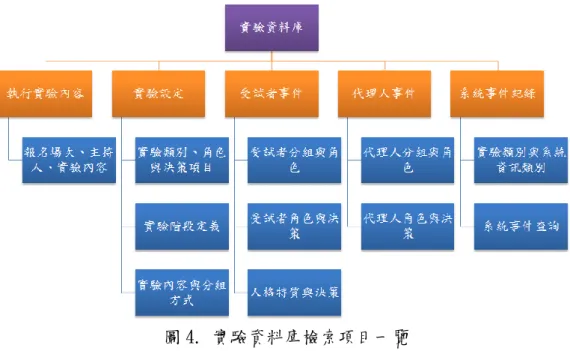
33 圖 1. 報名系統網站頁面 圖 2. 資料檢索系統頁面 3. 資料檢索系統(http://eel.nccu.edu.tw:8080) 為配合實驗相關資料之研究分析需求,另開發「資料檢索系統」以供實驗主 持人及本計畫成員查閱 ESD 內相關資料(檢索頁面請參見圖 2),目前提供 30 種 不同資訊的檢索查詢功能。檢索資料主要分為報名系統與實驗資料庫兩部分。在 報名系統的部分,我們可以進行受試者查詢,受試者人格特質查詢、實驗查詢、 實驗管理、帳號管理、受試者相關圖表(更細部的資料查詢請參考圖 3)。而在實 驗資料庫的部分,可以查詢執行實驗內容、實驗設定、受試者事件、代理人事件、 系統事件紀錄(更細部的資料查詢請參考圖 4)。 圖 3. 報名系統檢索項目一覽
34
圖 4. 實驗資料庫檢索項目一覽
前述二系統開發完成後均以共享軟體形式開放下載,並提供操作說明手冊,於 2010 Workshop on Computational Social Sciences 研討會中討論與分享,相關資訊 詳見 http://www.aiecon.org/summer_school/2010/。