
台北市國中生單字能力及性別在單字策略使用上的差異之研究 - 政大學術集成
175
0
0
全文
(2) Acknowledgements I would like to thank those who ever help me on the way to the accomplishment of the work. First of all, I would like to express the sincerest gratitude to my advisor, Samuel Sheu, who always gave me invaluable advices and offered constructive guidance with patience. Without his insightful suggestions and heartwarming encouragements, this work would never be completed. Secondly, I would like to thank my dearest colleagues in He-ping, Ajui, Jan, Annieting,. 治 政 大 brought me power to Wen-Hua and Linda. Whenever I felt down, their support always 立 ‧. ‧ 國. indeed.”. 學. continue. Their company proves the precious truth of the saying, “A friend in need is a friend. Moreover, my thanks also go to my dearest flat-mates and friends. When I was in a bad. sit. y. Nat. n. al. er. io. mood, their laughters were always the best medicine to my depression. When I was in. i n U. anxiety, their comfort always swept away all my worries.. Ch. engchi. v. Last but not least, the work must be dedicated to my beloved mom, Show-Ping Wu. She always teaches me to believe in myself and to do everything with perseverance. With her love, I am able to overcome all the challenges in my life, including the work.. iv.
(3) Table of Contents Acknowledgements ................................................................................................................. iv Table of Contents...................................................................................................................... v List of Tables........................................................................................................................... ix List of Figures ......................................................................................................................... xi Chinese Abstract..................................................................................................................... xii English Abstract .................................................................................................................... xiv Chapters 1.Introduction ........................................................................................................................... 1 1.1 Background and Motivation....................................................................................... 1 1.2 Purpose of the Study and Research Questions ........................................................... 4 1.3 Significance of the Study ........................................................................................... 5 1.4 Definitions of Terms................................................................................................... 6 1.4.1 Vocabulary Proficiency ................................................................................... 6 1.4.2 Vocabulary Learning Strategies....................................................................... 7 1.4.3 Gender ............................................................................................................. 7. 立. 政 治 大. ‧ 國. 學. ‧. 2. Literature Review ................................................................................................................. 8 2.0 Introduction ................................................................................................................ 8 2.1 Language Learning Strategies .................................................................................... 9 2.1.1 Definitions and Features of Language Learning Strategies ............................ 9 2.1.2 Classification of Language Learning Strategies............................................ 10 2.2 Vocabulary Learning Strategies................................................................................ 13 2.2.1 Vocabulary Learning ..................................................................................... 14 2.2.2 Definitions of Vocabulary Learning Strategies ............................................. 16 2.2.3 Classification of Vocabulary Learning Strategies ......................................... 17 2.2.4 Factors Influencing Strategy Choice ............................................................. 20 2.3 Studies on Proficiency and Gender Differences on Strategy Use ............................ 22 2.3.1 Language Proficiency and Language Learning Strategies ............................ 23 2.3.2 Vocabulary Proficiency and Vocabulary Learning Strategies ....................... 23 2.3.3 Gender and Language Learning Strategies.................................................... 25 2.3.4 Gender and Vocabulary Learning Strategies ................................................. 27 2.4 Studies on Vocabulary Learning Strategies in Taiwan ............................................. 29 2.4.1 Studies on College Students .......................................................................... 29 2.4.2 Studies on Senior High School Students ....................................................... 30 2.4.3 Studies on Junior High School Students ....................................................... 31 2.4.4 Studies on Elementary School Students ........................................................ 32. n. er. io. sit. y. Nat. al. Ch. engchi. v. i n U. v.
(4) 3. Methodology ...................................................................................................................... 34 3.1 Participants ............................................................................................................... 34 3.2 Instruments ............................................................................................................... 35 3.2.1 English Vocabulary Proficiency Test (EVPT) ............................................... 35 3.2.2 Vocabulary Learning Strategies Questionnaire (VLSQ) ............................... 36 3.2.3 Validity .......................................................................................................... 39 3.3 Procedures ................................................................................................................ 40 3.3.1 The Pilot Study .............................................................................................. 40 3.3.2 The Main Study ............................................................................................. 41 3.4 Data Analysis............................................................................................................ 41 4. Results ................................................................................................................................ 44 4.1 Vocabulary Level Differences of Vocabulary Strategy Use .................................... 44 4.1.1 Vocabulary Level and Use of Overall Strategy and Five Strategy Categories ................................................................................................................................ 45 4.1.2 Vocabulary Level and Individual Strategy Use ............................................ 46 4.1.2.1 Determination Strategies .................................................................... 47 4.1.2.2 Social Strategies ................................................................................. 48 4.1.2.3 Memory Strategies ............................................................................. 50 4.1.2.4 Cognitive Strategies ........................................................................... 53 4.1.2.5 Metacognitive Strategies .................................................................... 54 4.2 Use of Strategies by Male and Female Students ...................................................... 56 4.2.1 Use of Overall Strategy and Strategy Categories by Male and Female Students .................................................................................................................. 56 4.2.2 Use of Individual Strategies by Male and Female Students.......................... 57 4.2.2.1 Frequencies of Determination Strategies by Male and Female Students ........................................................................................................................ 58 4.2.2.2 Frequencies of Social Strategies by Male and Female Students ........ 59 4.2.2.3 Frequencies of Memory Strategies by Male and Female Students .... 60 4.2.2.4 Frequencies of Cognitive Strategies by Male and Female Students .. 62 4.2.2.5 Frequencies of Metacognitive Strategies by Male and Female Students ........................................................................................................................ 63 4.3 Gender Differences of Vocabulary Strategy Use ..................................................... 64 4.3.1 Comparison of Overall Strategy Use between Male and Female Students... 64 4.3.2 Comparison of Individual Strategy Use between Male and Female Students ................................................................................................................................ 65 4.3.2.1 Determination Strategies .................................................................... 66 4.3.2.2 Social Strategies ................................................................................. 66 4.3.2.3 Memory Strategies ............................................................................. 67 4.3.2.4 Cognitive Strategies ........................................................................... 70. 立. 政 治 大. ‧. ‧ 國. 學. n. er. io. sit. y. Nat. al. Ch. engchi. vi. i n U. v.
(5) 4.3.2.5 Metacognitive Strategies .................................................................... 70 4.3.3 Conclusion of Strategy Use between Gender................................................ 72 4.4 Vocabulary Strategy Use between Gender and Vocabulary Level .......................... 73 4.4.1 Overall Strategy Use and the Five Strategy Categories ................................ 73 4.4.2 Individual Strategies...................................................................................... 74 4.4.2.1 Determination Strategies .................................................................... 74 4.4.2.2 Social Strategies ................................................................................. 76 4.4.2.3 Memory Strategies ............................................................................. 77 4.4.2.4 Cognitive Strategies ........................................................................... 80 4.4.2.5 Metacognitive Strategies .................................................................... 81 4.4.2.6 Summary of Individual Strategies with Gender Differences ............. 83 4.5 Students’ Reflection on Strategy Use....................................................................... 86 4.5.1 Difficulties in Learning English Vocabulary ................................................. 86 4.5.2 Effectiveness of Vocabulary Learning Strategies .......................................... 87 4.5.2.1 Five Most Effective Strategies ........................................................... 87 4.5.2.2 Five Least Effective Strategies........................................................... 89 4.5.3 Vocabulary Learning Strategies Found by Students...................................... 92 4.5.4 Needs for Teachers’ Assistance ..................................................................... 93. 立. 政 治 大. ‧ 國. 學. ‧. 5. Discussion .......................................................................................................................... 95 5.1 Vocabulary Level Differences of Vocabulary Strategy Use .................................... 95 5.1.1 Vocabulary Level and the Use of Overall Strategy and the Five Strategy Categories............................................................................................................... 96 5.1.2 Vocabulary Level and Individual Strategy Use ............................................ 97 5.1.2.1 Determination Strategies .................................................................... 97 5.1.2.2 Social Strategies ................................................................................. 99 5.1.2.3 Memory Strategies ........................................................................... 100 5.1.2.4 Metacognitive Strategies .................................................................. 102 5.1.2.5 Cognitive Strategies ......................................................................... 103 5.1.3 Comparison between the Present Study and Cheng’s (2006) Study ........... 104 5.2 Use of Strategies by Male and Female Students .................................................... 105 5.2.1 Use of Overall Strategy and Strategy Categories by Male and Female Students ................................................................................................................ 106 5.2.2 Use of Individual Strategies by Male and Female Students........................ 107 5.2.2.1 Frequencies of Determination Strategies by Male and Female Students ...................................................................................................................... 107 5.2.2.2 Frequencies of Cognitive Strategies by Male and Female Students 109 5.2.2.3 Frequencies of Memory Strategies by Male and Female Students .. 111 5.2.2.4 Frequencies of Social Strategies by Male and Female Students ...... 113. n. er. io. sit. y. Nat. al. Ch. engchi. vii. i n U. v.
(6) 5.2.2.5 Frequencies of Metacognitive Strategies by Male and Female Students ...................................................................................................................... 115 5.3 Gender Differences of Vocabulary Strategy Use ................................................... 117 5.3.1 Gender Differences on the Use of Overall Strategy and Strategy Categories .............................................................................................................................. 117 5.3.1.1 Strategy Categories with Gender Differences .................................. 118 5.3.1.2 Strategy Categories without Gender Differences ............................. 119 5.3.2 Gender Differences on Individual Strategy Use.......................................... 120 5.3.2.1 Grouping Related Words .................................................................. 121 5.3.2.2 Writing Practice with Study Aids ..................................................... 122 5.3.2.3 Auditory Practice.............................................................................. 122 5.3.2.4 Study and Practice Meaning in a Group........................................... 123 5.3.2.5 Bilingualized Dictionary and Use New Word in Sentences ............. 124 5.3.2.6 Use Physical Action When Learning a Word ................................... 124 5.4 Vocabulary Strategy Use, Gender Differences and Vocabulary Level.................. 125 5.4.1 Overall Strategy Use and Cognitive Strategy Use ...................................... 125 5.4.2 Seventeen Individual Strategies .................................................................. 126 5.4.2.1 Gender Differences in Each Vocabulary Level................................ 126 5.4.2.2 Strategies with a Higher Significant Level....................................... 127 5.4.2.3 Strategies in Favor of Male Students ............................................... 129 5.5 Students’ Reflection on Strategy Use..................................................................... 130 5.5.1 Difficulties in Learning English Vocabulary ............................................... 131 5.5.2 Effectiveness of Vocabulary Learning Strategies ........................................ 133 5.5.3 Vocabulary Learning Strategies Found by Students.................................... 134 5.5.4 Needs for Teachers’ Assistance ................................................................... 135. 立. 政 治 大. ‧. ‧ 國. 學. n. er. io. sit. y. Nat. al. Ch. engchi. i n U. v. 6. Conclusion........................................................................................................................ 138 6.1 Summary of the Major Findings ............................................................................ 138 6.2 Pedagogical Implications ....................................................................................... 143 6.3 Limitations of the Present Study and Suggestions for Further Research ............... 144 References ............................................................................................................................ 146 APPENDIX A: Schmitt’s Taxonomy of Vocabulary Learning Strategies............................ 152 APPENDIX B: Vocabulary Learning Strategies Questionnaire........................................... 154 APPENDIX C: English Vocabulary Proficiency Test .......................................................... 159 APPENDIX D: List of Strategies Found by the Participants............................................... 161. viii.
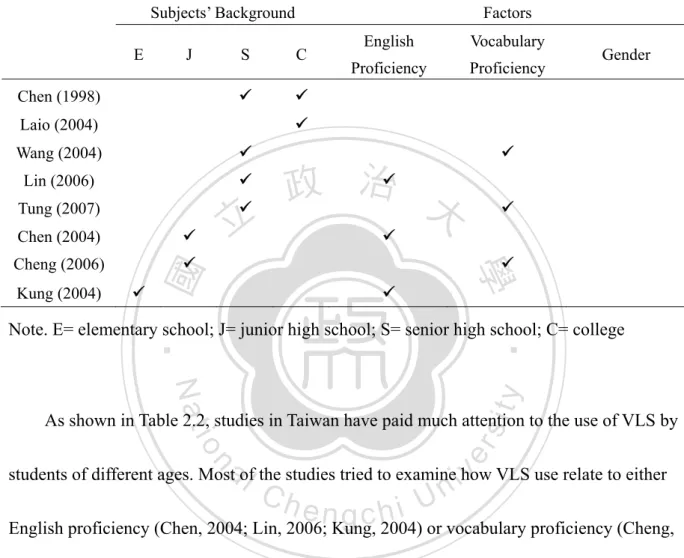
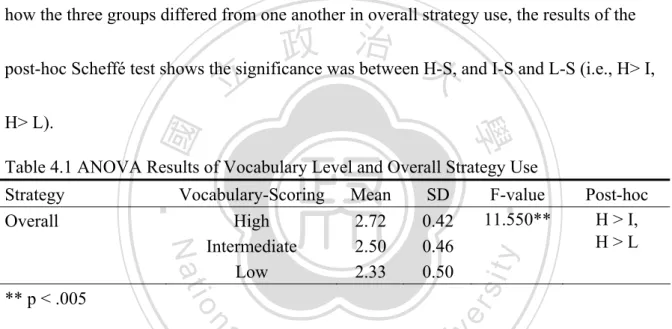
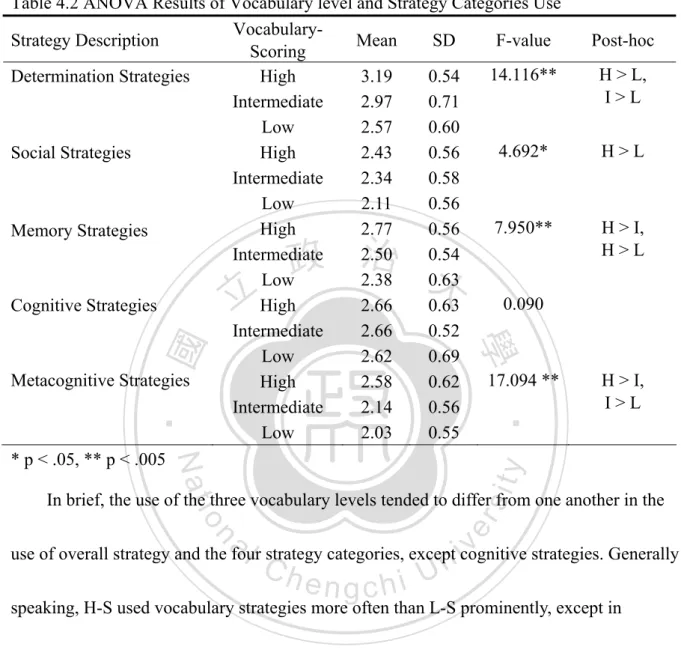
(7) List of Tables Table 2.1 Features of Language Learning Strategies ............................................................. 10 Table 2.2 Studies on Vocabulary Learning Strategies in Taiwan ........................................... 33 Table 3.1 The Distribution of Parts of Speech in EVPT ........................................................ 36 Table 3.2 The List of Unfamiliar Strategies ........................................................................... 38 Table 3.3 The List of New Strategies ..................................................................................... 38 Table 3.4 Reliabilities of EVPT and VLSQ ........................................................................... 40 Table 4.1 ANOVA Results of Vocabulary Level and Overall Strategy Use ........................... 45 Table 4.2 ANOVA Results of Vocabulary level and Strategy Categories Use ....................... 46 Table 4.3 ANOVA Results of Vocabulary Level and Determination Strategy Use ................ 47 Table 4.4 ANOVA Results of Vocabulary Level and Social Strategy Use ............................. 49 Table 4.5 ANOVA Results of Vocabulary Level and Memory Strategy Use ......................... 51 Table 4.6 ANOVA Results of Vocabulary Level and Cognitive Strategy Use ....................... 54 Table 4.7 ANOVA Results of Vocabulary Level and Metacognitive Strategy Use ................ 55 Table 4.8 Oxford’s Key to Understanding SILL Averages..................................................... 56 Table 4.9 Frequencies of Overall Strategy Use by Male and Female Students...................... 57 Table 4.10 t-Test Results of Gender Differences on Overall Strategy Use ............................ 65 Table 4.11 t-Test Results of Gender Differences on Strategy Categories .............................. 65 Table 4.12 t-Test Results of Gender Differences on Determination Strategies Use............... 66 Table 4.13 t-Test Results of Gender Differences on Social Strategies Use............................ 67 Table 4.14 t-Test Results of Gender Differences on Memory Strategy Use .......................... 68 Table 4.15 t-Test Results of Gender Differences on Cognitive Strategies Use ...................... 70 Table 4.16 t-Test Results of Gender Differences on Metacognitive Strategies Use............... 71 Table 4.17 Summary of Significance in Strategy Use between Gender................................. 72 Table 4.18 t-Test Results of Gender Differences on the Use of Overall Strategy among Three Scoring Groups....................................................................................................................... 73 Table 4.19 t-Test Results of Gender Differences on the Use of Strategy Categories among Three Scoring Groups ............................................................................................................ 74 Table 4.20 t-Test Results of Gender Differences on Determination Strategy Use among Three Vocabulary Levels .................................................................................................................. 75 Table 4.21 t-Test Results of Gender Differences on Social Strategy Use among Three Vocabulary Levels .................................................................................................................. 76 Table 4.22 t-Test Results of Gender Differences on Memory Strategy Use among Three Vocabulary Levels .................................................................................................................. 78 Table 4.23 t-Test Results of Gender Differences on Cognitive Strategy Use among Three Vocabulary Levels .................................................................................................................. 81 Table 4.24 t-Test Results of Gender Differences on Metacognitive Strategy Use among Three Vocabulary Levels .................................................................................................................. 82 Table 4.26 Summary of t-Test Results of Gender Differences on Individual Strategy Use. 立. 政 治 大. ‧. ‧ 國. 學. n. er. io. sit. y. Nat. al. Ch. engchi. ix. i n U. v.
(8) among Three Vocabulary Levels ............................................................................................ 84 Table 4.27 Learning Difficulties by Male and Female Students ............................................ 87 Table 4.28 Five Most Effective Strategies by Male and Female Students ............................. 88 Table 4.29 Five Least Effective Strategies by Male and Female Students............................. 90 Table 4.30 Strategies Found by Male and Female Students................................................... 93. 立. 政 治 大. ‧. ‧ 國. 學. n. er. io. sit. y. Nat. al. Ch. engchi. x. i n U. v.
(9) List of Figures Figure 4.1 Frequencies of Strategy Category Use by Male and Female Students ................. 57 Figure 4.2 Frequencies of Determination Strategies Use by Male and Female Students ...... 58 Figure 4.3 Frequencies of Social Strategy Use by Male and Female Students...................... 60 Figure 4.4 Frequencies of Memory Strategy Use by Male Students...................................... 61 Figure 4.5 Frequencies of Cognitive Strategy Use by Male and Female Students ................ 63 Figure 4.6 Frequencies of Metacognitive Strategy Use by Male and Female Students......... 64. 立. 政 治 大. ‧. ‧ 國. 學. n. er. io. sit. y. Nat. al. Ch. engchi. xi. i n U. v.
(10) 國立政治大學英國語文學系碩士在職專班. 碩士論文摘要. 論文名稱: 台北市國中生單字能力及性別在單字策略使用上的差異之研究 指導教授: 許炳煌博士 研究生: 張鐵鋼. 論文提要內容:. 政 治 大. 本研究主要探討台北市國中生的單字能力及性別差異是否影響其英語單字策略的. 立. 使用。主要目標欲(1)探究三組單字能力組別在單字策略使用上的差異;(2)探討男女生. ‧ 國. 學. 使用單字策略的頻率;(3)發現單字策略使用上的性別差異;(4)確認單字能力組別內,. ‧. 在單字策略使用上的性別差異;以及(5)從性別的角度來說明單字策略使用的規則。 共有來自台北市區一所國中的 203 位學生參與本研究。研究工具為單字策略使用. y. Nat. sit. 問卷及英語單字能力測驗。前者用來引出學生所認為的單字策略使用方式,而後者則. n. al. er. io. 是用來將學生依單字能力分成高中低三組。資料分析採用 SPSS 12.0 版本,分析工具包. i n U. v. 含描述性統計、單因子變異數分析、及獨立樣本 t 檢定。本研究結果指出:. Ch. engchi. (1) 單字能力越高的學生,傾向使用較多的單字策略,尤以決定策略、社會策略、記憶 策略、及後設認知策略最為顯著。 (2) 整體而言,男生及女生使用單字策略的頻率皆不高。男女生皆最常使用決定策略, 最少使用後設認知策略。 (3) 除在整體策略、決定策略、記憶策略、認知策略有顯著較高的使用頻率外,女生也 比男生較常使用與歸類相關單字、運用學習工具作手寫練習、及聽力練習等相關的單 一策略。 (4) 單字能力組別內,亦發現十七個單一策略具有顯著的性別差異。大部份策略顯示女 生運用的頻率較高。然而高分組男生使用聽英文廣播及想像單字畫面比高分組女生較 xii.
(11) 頻繁,且中間組別的男生較女生常使用分析字根字首。 (5) 對男女生而言,發音及意思是學習單字中最難的兩部份。雙方在有效的策略上有所 共識,但在無效果的策略上意見有些分歧。至於教師協助的需求方面,男生偏好動態 的單字練習,女生則較喜歡靜態的學業練習。 最後,本研究建議教師應該介紹學生更多元的單字策略,尤其是低成就的學生; 進行以策略為主的教學時,將性別差異納入考量;就單字能力及性別差異的交互關係, 進一步了解學生單字策略的偏好。. 立. 政 治 大. 關鍵字:單字能力、單字策略、性別. ‧. ‧ 國. 學. n. er. io. sit. y. Nat. al. Ch. engchi. xiii. i n U. v.
(12) Abstract This study investigated vocabulary proficiency and gender differences in English vocabulary learning strategies (VLS) used by junior high school students in Taipei. The goals were to (1) explore the differences in VLS use among three vocabulary scoring levels, (2) to investigate the frequencies use of VLS by male and female students, (3) to find out gender differences in VLS use, (4) to indentify gender difference in VLS use in terms of vocabulary scoring level, and (5) to illustrate the patterns of VLS use in gender perspectives.. 治 政 大school in Taipei City were A total of 203 junior high school students from an urban 立 ‧ 國. 學. involved in the study. A vocabulary learning strategy questionnaire (VLSQ) and an English vocabulary proficiency test (EVPT) were administered as instruments. The former was used. ‧. to elicit the self-report strategy use by the students and the latter was utilized to categorize. sit. y. Nat. n. al. er. io. the participants into three vocabulary levels. The data was analyzed by employing SPSS. i n U. v. version 12.0, including descriptive analysis, one-way analysis of variance, and independent t-Tests.. Ch. engchi. A summary of the results are as follows. (1) The higher vocabulary level students belonged to, the more VLS they tended to apply, especially determination strategies, social strategies, memory strategies and metacognitvie strategies. (2) Both male and female students could be regarded as moderate users of VLS. Both groups favored determination strategies the most and metacognitive strategies the least. (3) Besides a significantly more frequent use of overall strategies, determination strategies, memory strategies and cognitive xiv.
(13) strategies, female students also tended to use more often individual strategies concerning grouping related words together, writing practice with study aids and auditory practice. (4) Significances found in each scoring group seemed to favor female students in strategy use, except three strategies, analyzed affixes and roots by the Intermediate-Scoring group, listening to English broadcast and image word’s meanings by the High-Scoring group. (5) To both genders, the most difficult aspects in learning vocabulary are pronunciation and meanings. As for the effectiveness of VLS, male and female students had the same opinions. 治 政 大five. Besides, sharing some on the most five but thought slightly differently on the least 立 ‧ 國. 學. similar needs for teachers’ assistance, male students preferred dynamic vocabulary activities but female students favored academic vocabulary practice.. ‧. The findings suggest teachers should (1) introduce a variety of VLS to students,. sit. y. Nat. n. al. er. io. particularly those of lower levels, (2) take gender differences into consideration when. i n U. v. administering strategies-based instruction, and (3) be aware of students’ preferences of VLS. Ch. engchi. use with both gender and vocabulary level perspectives.. Keywords: vocabulary proficiency; vocabulary learning strategies; gender. xv.
(14) CHAPTER ONE INTRODUCTION This introductory chapter serves as an overview of the present study, including four sections. The first section offers the background and motivation of the study. The following section contains the purpose of the study and research questions. Section 1.3 illustrates the significance of the present study. The key terms in the present study are defined in the last section. 1.1 Background and Motivation. 立. 政 治 大. ‧ 國. 學. Languages are for communication. To communicate with others successfully, one needs to express her/his ideas clearly enough with the assistance of facial expressions, actions, or. ‧. words. Vocabulary, a primary factor in communication (Krashen & Terrel, 1983), is. sit. y. Nat. n. al. er. io. considered important by language teachers and learners. Language learners tend to seek. i n U. v. mastery of a language through acquiring as much lexicon as they could. However, learners. Ch. engchi. could be easily short of words in an authentic communication condition. Due to such a difficulty, applying proper language learning strategies (LLS) into vocabulary learning may enhance the vocabulary bank of a learner. In addition, it is also suggested that the use of LLS vary among different individuals because of their learning styles, experiences, personalities, motivation, language proficiency or even their born nature, gender (Oxford & Nyikos, 1989). Research has shown the importance of language learning strategies and learners’ differences in language learning. Cohen (1998) articulated that LLS are used by learners to 1.
(15) improve their knowledge and to help obtain a better understanding of the target language. Among them, vocabulary learning strategies (VLS), which stem from LLS, are often applied by learners to advance their word bank. Once learners’ lexicon size increases, their vocabulary ability will improve in using the language. In Taiwan, Chang (1990) found that professionals of high English proficiency apply learning strategies into their vocabulary learning. In other words, language learning techniques and strategies are helpful and personalized. While individual differences may be crucial factors in the choice of LLS,. 治 政 proficiency levels and gender differences are found to have大 “a profound effect on strategy 立 ‧ 國. 學. choice” (Oxford & Nyikos, 1989, p. 294). Moreover, Green and Oxford (1995) claimed that English proficiency and gender differences affect the strategy use. Thus, it seems that. ‧. vocabulary ability and gender influence learners’ choices of VLS, and both might play an. sit. y. Nat. n. al. er. io. important role in the success of vocabulary learning.. i n U. v. Recently, more research has been carried out into investigating the use of VLS by Asian. Ch. engchi. students. Gu and Johnson (1996) launched a study in Chinese students with a proficiency perspective and discovered that students with a larger word bank tend to apply VLS more often. Next, Schmitt (1997) investigated VLS used by Japanese students and found that age and maturity might sway strategy use. Gu (2002) carried out a study on the differences of EFL college students’ gender and their VLS in China. Results indicated that female students used more strategies than their male counterparts. However, as Rubin (1975) stated that strategy use differs in different cultural context, the result of studies on EFL contexts, such 2.
(16) as Japan and China, may not be properly applicable to Taiwanese situations. In Taiwan, researchers have put more focus on the relationship between vocabulary learning strategies and vocabulary ability. These researchers, who were also in-service teachers themselves, offered firsthand information of students from elementary schools, high schools and colleges (Chen, 1998; Chen, 2004; Cheng, 2006; Kung, 2004; Liao, 2004; Lin, 2006; Tung, 2007; Wang, 2004). Results from these research showed that students of various English levels differ in their choice of VLS.. 治 政 大interested in finding out a From the studies above, researchers and teachers seem 立 ‧ 國. 學. pattern of frequency use of VLS or possible influential factors on the choice of VLS. With their efforts, invaluable insights into strategies-based instruction have benefited teachers in. ‧. vocabulary teaching and learners in vocabulary learning.. sit. y. Nat. n. al. er. io. Though several studies in Taiwan have done much on VLS by students of different ages,. i n U. v. there is still paucity in literature to put an emphasis on the relationship between the use of. Ch. engchi. VLS and gender differences. Besides, the relationship among vocabulary proficiency, gender differences and the choice of VLS is still unknown. Therefore, more studies should be carried out by taking the two variables into account. Moreover, junior high school students in Taiwan are required to learn at least 1200 words, which is not an easy load for most students. According to Cheng (2006), learning the target vocabulary well is difficult due to the limited time of four class hours weekly. Consequently, it seems quite important for teachers to provide helpful guidance on 3.
(17) vocabulary acquisition after knowing how their young learners learn vocabulary based on students’ proficiency levels and gender differences. This also calls for more research into VLS with different perspectives. 1.2 Purpose of the Study and Research Questions As for the purposes of the study, the first goal is to indentify whether vocabulary proficiency may affect the choice of VLS among junior high school students in Taipei. If the answer is positive, further discussion will center on the differences of strategy use that. 治 政 大to find out the frequency of VLS vocabulary levels cause. The second purpose of the study is 立 ‧ 國. 學. use by male and female students. The third aim is to examine whether gender differences affect the use of VLS. If the differences exist, the research will further explore in what way. ‧. gender differences may influence the use of VLS. Then, another purpose is to investigate to. sit. y. Nat. n. al. er. io. what extent the vocabulary proficiency and gender differences would relate to the choices of. i n U. v. VLS. The last purpose tries to gather related information about strategy use by genders.. Ch. engchi. According to the purposes mentioned above, the present study intends to answer the following research questions: 1. Do junior high students of High-Scoring, Intermediate-Scoring and Low-Scoring vocabulary proficiency levels use vocabulary learning strategies differently? If they do, what would the differences of vocabulary learning strategy uses be? 2. What are the vocabulary learning strategy uses of male and female students in junior high school in Taipei? 4.
(18) 3. Are there any differences of the use of vocabulary learning strategies between genders of junior high school students in Taipei? If yes, what would the differences of vocabulary learning strategy uses be? 4. Will learners’ vocabulary proficiency relate to the choices of vocabulary learning strategies between genders? 5. What are students’ difficulties of vocabulary learning and reasons for using vocabulary learning strategy in a gender perspective? 1.3 Significance of the Study. 立. 政 治 大. ‧ 國. 學. The present study might offer some significances from two aspects based on the purposes above. First, given the fact that little research has been carried out to investigate. ‧. gender on the choice of VLS, the study aimed to examine the frequency of VLS use and. sit. y. Nat. n. al. er. io. significances of strategy use between male and female junior high school students. The. i n U. v. results have shown a higher frequency use by female students than by male students in. Ch. engchi. general. The findings of the present study could be helpful for in-service teachers to have a better understanding of the differences on VLS use between genders, consequently assisting teacher’s strategies-based instruction of vocabulary teaching. Besides, when taking vocabulary proficiency into consideration, the results showed that male students tended to use certain strategies significantly more often. For example, male students in the High-Scoring level were reported a more frequent use of listening to English broadcast, the finding of which suggests that teachers could encourage female students of 5.
(19) higher vocabulary proficiency to use strategies involving listening to authentic text like English broadcast. Therefore, gender differences in vocabulary levels on strategy use also bring insight to teachers who could directly help students of different levels and different genders on the use of VLS. 1.4 Definitions of Terms To offer a better understanding to readers, three important terms are defined as follows according to the purpose and the focus of the present study. 1.4.1 Vocabulary Proficiency. 立. 政 治 大. ‧ 國. 學. According to Nassaji (2004), vocabulary proficiency refers to two aspects, breadth and depth of vocabulary knowledge. After reviewing previous research (Meara, 1996; Nation,. ‧. 2001), he summarizes the breadth of vocabulary knowledge as “the quantity or number of. sit. y. Nat. n. al. er. io. words learners know at a particular level of language proficiency” (p. 389) and defines the. i n U. v. depth of vocabulary knowledge as “the quality of lexical knowledge, or how well the learner. Ch. engchi. knows a word” (p. 390). In the present study, the three vocabulary levels were categorized based on the size of students’ word bank, which is believed to be the breadth of vocabulary knowledge by researchers. Besides, since the participants involved are required to learn 1200 words according to Ministry of Education, Taiwan, an English vocabulary proficiency test was employed to assess how much words the participants has learnt and the results were treated as criteria of their vocabulary proficiency levels.. 6.
(20) 1.4.2 Vocabulary Learning Strategies It is never an easy task to define VLS (Nation, 2001); however, strategies in vocabulary learning involve the discovery of words’ meanings and consolidation of a word (Schmitt, 1997). Based on the features of VLS, Schmitt regards that VLS are applied by learners consciously to help the discovery of the meanings on their own or through interaction with others, enhance the retention of words through auditory and visual practice, and activate the production of target vocabulary. In the present study, VLS refers to those in Schmitt’s. 治 政 大 social strategies, taxonomy, including five main categories: determination strategies, 立 ‧. ‧ 國. 1.4.3 Gender. 學. memory strategies, cognitive strategies, and metacognitive strategies.. Sex, a biological term, divides people into male and female, while gender, a social term,. sit. y. Nat. n. al. er. io. distinguishes men from women with social attributes. The term, gender, is chosen in the. i n U. v. present study because the term, sex, seems to narrow the differences between males and. Ch. engchi. females by ignoring the influences of socialization. According to Nyikos (1990), males and females are required to learn “socially sanctioned gender-appropriate behaviors” (p. 273) and the socialized distinction between two genders is reinforced particularly in the daily language use. Therefore, the differences between male and female junior high students would be better illustrated with a gender perspective, instead of a biological one.. 7.
(21) CHAPTER TWO LITERATURE REVIEW 2.0 Introduction In the field of second language acquisition (SLA), researchers, teachers and learners have been working on how to help advance the outcome of language learning. Provided with different supporting values in the leading teaching methods, it is also observable that the focus of the classroom activities has also drifted from teacher-oriented to student-oriented. 治 政 大 has attracted more (Schmitt, 2010a). Consequently, how learners acquire a language 立 ‧ 國. 學. attention lately, especially those involving specific actions that learners would take to improve four basic skills and lexical knowledge of the target language.. ‧. The present study aims to survey different uses of vocabulary learning strategies (VLS). sit. y. Nat. n. al. er. io. from two perspectives: vocabulary proficiency and gender preferences. Before reviewing. i n U. v. VLS in detail, Section 2.1 offers a concise review of language learning strategies (LLS) first. Ch. engchi. because VLS could be regarded as a stem from LLS with the application of LLS into vocabulary learning (Oxford, 1990). Then, the following section displays a thorough review of VLS, which are the main focus of the study. Section 2.3 reviews related studies on the effect of influential factors, vocabulary proficiency and gender differences, on strategy use. The last section reviews former studies on VLS use in Taiwan.. 8.
(22) 2.1 Language Learning Strategies Learning strategies have drawn much attention from SLA investigators for decades and research has also shown that good language learners use more and individualized strategies. Rubin (1975) first indicated that, to excel in language learning, a good learner applies personalized learning techniques and participates more actively and creatively in the learning process, instead of relying only on a high degree of proficiency and motivation. In other words, learners may better their language ability through the adoption of special skills on. 治 政 language learning, i.e., language learning strategies (LLS).大 立 ‧ 國. 學. 2.1.1 Definitions and Features of Language Learning Strategies. LLS have been focused by researchers for decades since studies began to emphasize on. ‧. the way to improve learners’ language proficiency of all aspects. LLS have been viewed as. sit. y. Nat. n. al. er. io. “complex cognitive skills” (O’Malley & Chamot, 1990, p. 215) or “specific actions” (Oxford,. i n U. v. 1990, p. 8) that learners take consciously and semi-consciously to achieve “the explicit goal. Ch. engchi. of improving their knowledge and understanding of a target language” (Cohen & Dornyei, 2002, p. 178). They influence learners mentally and behaviorally in encoding the learning process intentionally (Wenstein & Mayer, 1986). That is, LLS are applied purposefully by a learner to refine language skills and broaden required knowledge for the language. Research results have shown that good language learners use specialized and personalized strategies with a higher frequency. With the help of LLS, learners might overcome obstacles they meet in language learning in an easier way. What makes LLS helpful in language learning could 9.
(23) be attributed to that LLS are techniques in rich of particular features. Table 2.1 below shows features of LLS concluded by Oxford (1990). Table 2.1 Features of Language Learning Strategies Language Learning Strategies 1. Contribute to the main goal, communicative competence. 2. Allow learners to become more self-directed. 3. Expand the role of teachers. 4. Are problem-oriented. 5. Are specific actions taken by the learner. 6. Involve many aspects of the learner, not just the cognitive.. 政 治 大. 7. Support learning both directly and indirectly. 8. Are not always observable. 9. Are often conscious.. 立. ‧ 國. 學. 10. Can be taught. 11. Are flexible.. ‧. 12. Are influenced by a variety of factors.. __________________________________________________________________________. sit. y. Nat. Source: Oxford (1990), p. 9. io. n. al. er. It is clear to see from the features of LLS above that language learners adopt LLS to. i n U. v. solve problems consciously and systematically for a certain purpose of improving the overall. Ch. engchi. ability of the target language. As a result, the application of LLS may play an important and positive part in the task of language learning. 2.1.2 Classification of Language Learning Strategies With the regard to the beneficial aspects that LLS seem to have, a closer look at the classification of LLS is necessary. Firstly, Rubin (1981) divided LLS into two classes based on the ways LLS directly or indirectly affect language learning. These two classes are direct strategies and indirect strategies, the ideas of which were borrowed by Oxford (1990) when 10.
(24) she intended to divide LLS into various categories. In another study, Bialystok (1978) not only recognized the importance of LLS on SLA but also proposed a classification of LLS, which she thought cognitive in nature and which she viewed as a mental process of language learning. Her classification of two categories, which were divided based on the requirements learners need on acquiring necessary knowledge, include formal strategies (linguistic form) and functional strategies (language use). The former category is comprised of formal practicing and monitoring, which involve. 治 政 大 knowledge intentionally. learning the L2 consciously or automatizing the acquired explicit 立 ‧ 國. 學. The latter category contains functional practicing and inferencing, which are meant to increase exposure to the target language through communication.. ‧. Next, O’Malley et al. (1985) proposed a classification with a theoretical anchorage on. sit. y. Nat. n. al. er. io. the cognitive theory of information-processing model by Brown and Palinscar (1982). After. i n U. v. interviews and observations at high school classrooms of English as a Foreign Language. Ch. engchi. (EFL) learners, they indentified two main strategies categories of LLS: metacognitive strategies and cognitive strategies, which concern different aspects of language learning. The former are related to all kinds of self-directed learning processes, such as planning, monitoring, and evaluating, whereas the latter are mainly about the manipulation of certain learning tasks by using materials. Later, based on the classification scheme, O’Malley and Chamot (1990) further presented another strategy category, social-affective strategies, which involves social interactions with others or affective control over learning tasks. The 11.
(25) classification cut a path for the following development on the classification of LLS by Oxford (1990). Based on the concept of the directness of LLS by Rubin (1981), Oxford also classified LLS into direct and indirect classes; the former consists of memory strategies, cognitive strategies, and compensation strategies, the latter includes metacognitive strategies, affective strategies, and social strategies. Among the six main strategy categories, Oxford further developed a complete taxonomy, Strategy Inventory of Language Learning (SILL), which. 治 政 大 offering an illustration of contains a large number of individual language learning strategies, 立 ‧ 國. 學. possible skills taken in language learning. As “perhaps the most comprehensive classification of language learning strategies to date” (Ellis, 1994, p. 539), she has offered a. ‧. good model for coming researchers who intend to explore the use of LLS by learners all over. sit. y. Nat. n. al. er. io. the world. As follows, here presents her classification of LLS and the definitions of each strategy categories (Oxford, 1990).. Ch. engchi. i n U. v. 1. “Direct strategies require mental process of the language” (p. 37). (1) Memory strategies, such as grouping or using imagery, have a highly specific function: helping students store and retrieve new information. (2) Cognitive strategies, such as summarizing or reasoning deductively, enable learners to understand and produce new language by many different means. (3) Compensation strategies, like guessing or using synonyms, allow learners to use the language despite their often large gaps in knowledge. 12.
(26) 2. “Indirect strategies are applicable to all four language skills” (p. 135). (1) Metacognitive strategies allow learners to control their own cognition─that is, to coordinate the learning process by using functions such as centering, arranging, planning and evaluating. (2) Affective strategies help to regulate emotions, motivations, and attitudes. (3) Social strategies are called indirect because they support and manage language learning without (in many instances) directly involving the target language.. 政 治 大. 立. ‧ 國. 學. According to her, LLS are considered both applicable to and effective in all four language skills, especially to vocabulary learning. Therefore, LLS not only positively. ‧. enhance language learning in general, but also could be successfully adopted into all. sit. y. Nat. al. n. learning.. er. io. subareas of language learning, one of which is the primary focus of the study, vocabulary. Ch. 2.2 Vocabulary Learning Strategies. engchi. i n U. v. Since decades ago, research has been carried out into investigation on LLS, pinpointing at the issue with various foci. For instance, researchers have emphasized on generating the definitions of LLS (O’Malley & Chamot, 1990; Oxford, 1990; Wenstein & Mayer, 1986), on proposing the classifications of LLS (Bialystok, 1978; O’Malley et al., 1985; O’Malley & Chamot, 1990; Oxford, 1990; Rubin, 1981), or on examining the relationship between language proficiency and LLS use (Green & Oxford, 1995; O’Malley et al., 1985; Oxford & 13.
(27) Nyikos, 1989). With a wider range of investigations on LLS from various perspectives, a growing body of literature seems interested in the application of LLS into vocabulary learning. 2.2.1 Vocabulary Learning Among all aspects of language learning, vocabulary learning has attracted much attention from learners, teachers and researchers. As McCarthy (1990) states: “No matter how well the student learns grammar, no matter how successfully the. 治 政 sounds of L2 are mastered, without words to express a大 wider range of meanings, 立 ‧ 國. 學. communication in an L2 just cannot happen in any meaningful way” (p. viii). Therefore, in order to communicate with others successfully, vocabulary is fundamental. ‧. in transmitting meaningful information required. Gass and Selinker (1994) even regard. sit. y. Nat. n. al. er. io. lexicon “the most component for learners” (p. 270); that is, vocabulary could be so. i n U. significant that learners could not underestimate the value of it.. Ch. engchi. v. Due to the importance of vocabulary in learning a language, much attention has been paid to the way a learner know a new word. Before that, it deserves more discussion on the factors that affect vocabulary acquisition. According to Hedge (2000), some factors that might affect vocabulary acquisition are to do with input, the properties of which include frequency, pronunciation and contextualization of a word. A word of higher frequency appears more often in the texts and increases learners’ exposure to it, therefore, causing less difficulty in acquiring the word, and vice versa. As for pronunciation, it gains a lot of 14.
(28) practice at the beginning level in order to correctly recognize the stress of the word, thus enhancing the comprehension of a listening passage. Another feature is contextualization, which involves putting an unknown word in a contextual text. This serves a way to help learners retain the unknown word through the information provided from the whole text. Hedge further suggests activities concerning contextualization could be strategies for vocabulary learning, which might reduce the difficulty of the word and enhance the acquisition of the word.. 治 政 大also presents possible affecting Besides the factors mentioned by Hedge, Laufer (1997) 立 ‧ 國. 學. factors which might cause difficulties of learning a new word, such as pronounceability, length and morphological complexity. The first factor, pronounceability, means to which. ‧. extent a second language learner could pronounce a word correctly. This also affects whether. sit. y. Nat. n. al. er. io. the learner could perceive, say and remember the word accurately. Another two factors,. i n U. v. length and morphological complexity, are closely related. It is commonly believed that a. Ch. engchi. longer word might be more difficult than a short word. However, a long word which could be divided into several parts based on the morphemes in it would not be as hard as a short word with irregular forms. In other word, length could cause difficulty but what really matters in the complexity of morphemes in the word. Being important in language learning but difficult in acquisition itself, vocabulary is suggested to be learned from meaning-focused input (i.e., listening and reading) and output (i.e., speaking and writing) by Nation and Meara (2002). They further recommend deliberate 15.
(29) vocabulary learning due to its higher effectiveness compared with indirect learning. According to them, learning vocabulary directly involves more exposure to the target language through four skills and requires training of strategy use in broadening vocabulary knowledge. Therefore, a more systematic application of learning strategies into vocabulary learning seems inevitable. 2.2.2 Definitions of Vocabulary Learning Strategies Research into vocabulary learning strategies (VLS) have been considered to stem from. 治 政 大 those of memory LLS because most LLS in Oxford’s (1990) classification, especially 立 ‧ 國. 學. strategies, are related to learning vocabulary (Pavičić, 2009). As stated by Ellis (1994) that it is likely to define VLS accurately, Jiménez Catalán (2003) tried to offer a complete. ‧. definition for VLS after reviewing Brown and Payne’s (1994) five processes of learning. n. al. er. io. sit. y. Nat. vocabulary:. i n U. v. “knowledge about the mechanisms (process, strategies) used to learn vocabulary. Ch. engchi. as well as specific actions or mental operations taken by learners to (a) find out the meaning of unknown words, (b) retain them in long-term memory, (c) recall them at will, and (d) use them in oral or written mode” (p. 56). In other words, when learners encounter unknown words in their learning, they tend to recall the information existed in their mind, or they might utilize some strategies to get for the meanings out. Thus, it is very important for learners to know what strategies they can use in vocabulary learning and to use them successfully, consequently improving overall 16.
(30) vocabulary bank in a more effective and systematic way. 2.2.3 Classification of Vocabulary Learning Strategies Since 1980, a number of studies have been carried on VLS. Many researchers have also devoted their efforts offering an appropriate classification of VLS. Among the early researchers on VLS, most of them tried to indentify certain beneficial individual strategies, such as memorization strategies (Cohen & Aphek, 1981), rote repetition strategies (O’Malley et al., 1985), or note-taking strategies (Ahmed, 1989), or strategies concerning guessing from. 治 政 大Skehan (1989) states that there the context (Huckin, Haynes & Coady, 1993). Nevertheless, 立 ‧ 國. 學. exist needs for a comprehensive taxonomy of VLS, which, according to Schmitt (1997), should include deeper cognitive processing of information and shallow strategies of rote. ‧. learning. Therefore, in the late nineties, more researchers started to offer a more. sit. y. Nat. n. al. er. io. comprehensive classification of VLS (Stoffer, 1995; Gu & Johnson, 1996; Schmitt, 1997).. i n U. v. Stoffer (1995) offered a complete classification, Vocabulary Learning Strategy Inventory. Ch. engchi. (VOLSI), which identifies nine major strategies as follows: 1. Strategies involving authentic language use 2. Strategies used for self-motivation 3. Strategies used to organize words 4. Strategies used to create mental linkages 5. Memory strategies 6. Strategies involving creative activities 17.
(31) 7. Strategies involving physical action 8. Strategies used to overcome anxiety 9. Auditory strategies As can be seen, Stoffer’s classification has included most related and essential strategy categories that directly involve vocabulary learning, such as memory strategies or grouping strategies. In another study on Chinese students, Gu & Johnson (1996) mainly aimed to find out. 治 政 大beliefs about vocabulary the frequency of VLS use with the examination on students’ 立 ‧ 國. 學. learning and the comparison between language learning outcomes and the use of VLS. After reviewing prior qualitative and quantitative studies (Ahmed, 1989; Gu, 1994; Oxford, 1990). ‧. and deleting redundant items found in their earlier two pilot studies, Gu and Johnson (1996). sit. y. Nat. n. al. er. io. proposed the Vocabulary Learning Questionnaire (VLQ, Version 3). Their classification includes seven major categories:. Ch. 1. Metacognitive regulation. engchi. 2. Guessing strategies 3. Dictionary strategies 4. Note-taking strategies 5. Memory strategies: rehearsal 6. Memory strategies: encoding 7. Activation strategies. 18. i n U. v.
(32) Slightly different from Stoffer’s, Gu and Johnson presented a more detailed classification which includes dictionary use for unknown words and note-taking strategies for review. Then, Schmitt (1997) conducted a further research into vocabulary in order to offer a valid classification of VLS. He collected lots of information from three main sources: earlier literature or references on vocabulary, self-reports of strategy use by Japanese students and teachers’ review on the list of VLS according to their teaching experiences. Based on Cook. 治 政 大 distinction and Oxford’s & Mayer’s (1986) and Nation’s (1990) Discovery/ Consolidation 立 ‧ 國. 學. (1990) classification on LLS, Schmitt (1997) grouped a wider taxonomy which divides vocabulary strategies into two major categories and six sub-categories:. ‧. 1. Strategies for the discovery of a new word’s meaning. sit. y. Nat. n. al. er. io. (1) Determination strategies (DET) are used by an individual when facing with. i n U. v. discovering a new word’s meaning without resource to another person’s expertise.. Ch. engchi. (2) Social strategies (SOC) use interaction with other people to find out a new word’s meaning. 2. Strategies for consolidating a word once it has been encountered (1) Social strategies (SOC) use interaction with other people to improve vocabulary learning. (2) Memory strategies (MEM) relate new material to existing knowledge. (3) Cognitive strategies (COG) exhibit the common function of manipulation or 19.
(33) transformation of the target language by the learner. (4) Meta-cognitive strategies (MET) involve a conscious overview of the learning process and making decisions about planning, monitoring, or evaluating the best way to study. Schmitt’s taxonomy also offered a list of individual VLS in more detail, concluding 58 strategy items in six sub-categories (see Appendix A). The present study has chosen Schmitt’s taxonomy as the main tool to elicit the participants’ frequency of strategy use due. 治 政 大 stems from Oxford’s to several reasons. First, Schmitt’s extensive list of VLS primarily 立 ‧ 國. 學. (1990) classification of LLS, which has been considered as a comprehensive one (Ellis, 1994). Besides, Schmitt himself conducted a research by using his taxonomy on Japanese. ‧. learners of all ages, including junior high school students like those in the current study. Also,. sit. y. Nat. n. al. er. io. Schmitt’s taxonomy has been adopted as the main tool for the inquiry of VLS use by learners. i n U. v. from different countries, such as Kudo’s (1999) Japanese learners and Chen’s (1998). Ch. engchi. Taiwanese participants. Last, according to Cheng (2006), most research into VLS in Taiwan was carried out based on Schmitt’s taxonomy; as a result, comparison could be better discussed across studies which adopt the same strategy classification scheme. 2.2.4 Factors Influencing Strategy Choice No matter which classification is chosen as the research tool, there exists another key issue on the research into VLS. As Rubin (1975) states, some important factors might affect the selection of strategies, such as students’ age and cultural differences. With the regard to 20.
(34) the factor, age, Schmitt (1997) found in his Japanese studies that the emphasis on spelling or form decreases when the learners mature. This indicates that the preference of strategy use seems to be under the influence of age, which reflects the maturity of one person. In addition, to call papers on whether strategy use is culturally different, Oxford (1996) edited a pile of studies in her book, one of which is Kaylani’s (1996). Her investigation compared the use of LLS by Spanish students and Jordanese students and found similarities on memory strategy use but differences on social strategy use. In another study by Jiménez Catalán (2003), the. 治 政 大 learners were in favor of results also revealed that not only Spanish learners but Japanese 立 ‧ 國. 學. certain strategies, such as dictionary use. Therefore, Jiménez Catalán concludes that some strategies might be universal for people from very different cultures.. ‧. Besides age and cultural factors, Oxford (1990) further adds other variables that. sit. y. Nat. n. al. er. io. influence strategy use: motivation, learning styles, and sex. Among the three factors,. i n U. v. motivation seems to have attracted much attention from researchers in the field of SLA.. Ch. engchi. Oxford (1990) assumes that the more highly language learners are motivated, the greater range of appropriate strategies they tend to apply. The claim is in line with Dörnyei’s (2001) assumption that motivation is one of significant variables on the choice of strategy use. However, it is believed that motivation is highly related to the outcomes of L2 learning. In other words, with a higher motivation, learners might outperform others on proficiency tests, resulting with a higher level of general language competence. Due to its close relationship with motivation, proficiency has been studied as an important variable when it comes to 21.
(35) strategy use (Green & Oxford, 1995; Oxford & Nyikos, 1989; Park, 1997). In addition to motivation, Oxford goes on stating, “ General learning style, such as field dependence-independence, analytic-global orientation, or the judging-perceiving mode, has a strong effect on the strategies that language learners use” (1990, p. 13). Her statement is supported by the findings in Oxford and Nyikos (1989) that learning style is one of the deciding factors that influence the choice of strategy use. As for gender differences, it is commonly believed that girls have better verbal ability than boys, stimulating some. 治 政 大learning (Green & Oxford, 1995; researchers to take the factor into consideration in language 立 ‧ 國. 學. Oxford & Erhman, 1989). The results reach an agreement that girls tend to have a greater use of overall strategies than do boys.. ‧. To explore deeper into strategy use and offer a substantial body of literature on strategy. sit. y. Nat. n. al. er. io. preferences, investigators have carried out more research into the field of language learning. i n U. v. from different perspectives based on their own interests. Among possible variables reviewed. Ch. engchi. above, proficiency and gender differences on the selection of strategy will be main foci in the current study. 2.3 Studies on Proficiency and Gender Differences on Strategy Use As stated in the former section, literature will firstly stress on reviewing the effect of proficiency on the strategy use. Next, studies on gender differences will be presented in the following sub-sections.. 22.
(36) 2.3.1 Language Proficiency and Language Learning Strategies General language proficiency, as an important factor on strategy use, has been studied since early 1970s. Rubin (1975) and Stern (1975) pioneered in investigating features of good language learners and found that they tend to pay more attention to their own learning with a more active attitude by adopting strategies concerning cognitive and metacognitive thinking. Being inspired by former researchers, Oxford (1995) researched on the effect of language proficiency on strategy use with her associate, Green. Believing that good language learners. 治 政 大 of practice opportunities”, seem to apply a large number of LLS, such as “ taking advantage 立 ‧ 國. 學. “willingly and accurately guessing,” or “consciously developing the L2 as a meaning system and a structure system” (p. 262), they found more successful learners seem to have a greater. ‧. use of LLS and use several LLS in combination properly. In another study on Korean college. sit. y. Nat. n. al. er. io. students, Park (1997) grouped learners according to the frequency use of LLS and their. i n U. v. performance on TOEFL test, aiming on the relationship between learners’ L2 proficiency and. Ch. engchi. the use of LLS. The results not only showed a high correlation between the two but also revealed that cognitive strategies and social strategies could be the most possible predicators of L2 proficiency. 2.3.2 Vocabulary Proficiency and Vocabulary Learning Strategies Strongly related to general English proficiency (Nation & Meara, 2002), vocabulary proficiency has been studied as a key variable in the choice of VLS since the late 1980s. During the last two decades, studies have been carried out by many researchers, several of 23.
(37) whose investigations involve English as a Second Language (ESL) or English as a Foreign Language (EFL) students (Ahmed, 1989; Gu & Johnson, 1996; Nassaji, 2006). An early study was carried out by Ahmed (1989) to investigate 300 good and poor language learners from Sudan on the application of strategies into learning lexis. The results showed that more successful learners adequately employed more strategies in vocabulary learning. Besides, less successful learners were not as aware of the importance of VLS as those more advanced ones.. 治 政 大focus on the relationship In the following decade, Gu and Johnson (1996) put their 立 ‧ 國. 學. between vocabulary size and the use of VLS. They expressed that the use of VLS is positively correlated to the learners’ English proficiency and vocabulary size after. ‧. investigating 850 EFL college students in China. The results also showed that both. sit. y. Nat. n. al. er. io. metacognitive strategies and cognitive strategies emerged positively correlated to vocabulary. i n U. v. size. However, participants in their study did not rely on strategies concerning memorization. Ch. engchi. skills as much as Asian students were expected to. Instead, they “reported using more meaning-oriented strategies than rote strategies in learning vocabulary” (p. 668). In other words, the use of metacognitive and cognitive strategies varies among Chinese learners of different vocabulary sizes. Also, the findings that repetitive strategies were not frequently used by Chinese learners were in line with Fan’s (1999) study in Hong Kong, but in disagreement with other studies on Asian participants (Schmitt, 1997; Chen, 1998).. 24.
(38) More recently, Nassaji (2006) carried out another investigation in ESL contexts in Canada on the relationship between participants’ vocabulary knowledge, their use of inferencing strategy and the ability to guess meanings from the contexts. The results indicated that students with higher lexical knowledge employ VLS in a more frequent and efficient way. In other words, the larger word size language learners have, the more frequently and successfully they apply VLS. The research findings agree with the results of the studies reviewed above (Ahmed, 1989; Gu & Johnson, 1996).. 治 政 Besides studies on the relationship between vocabulary大 proficiency and the use of VLS, 立 ‧ 國. 學. Jiménez Catalán (2003) suggests more research should be called to take another variable, gender differences, into consideration in the field of vocabulary acquisition. To trace back to. ‧. all previous studies in history, gender differences have been widely studied in biological,. sit. y. Nat. n. al. er. io. psychological and sociological perspectives since early 1900s. In 1970s, SLA researchers. i n U. v. started investigating the relationship between language and gender. A decade later, a time. Ch. engchi. when LLS reached their maturity, researchers sought to find out how gender differences might affect the choice of language learning strategies. Among all the researchers, Oxford and her colleagues have devoted their efforts on the investigation into gender differences on the use of LLS. 2.3.3 Gender and Language Learning Strategies Beginning a study on his Australian ESL students a year earlier before Oxford launched a series of investigations, Willing (1988) found gender differences on LLS but failed to 25.
(39) “clearly separate[d] women from men on the basis of any underlying sensory preferences” (Cited in Oxford, 1993, p. 549). Oxford and Nyikos (1989) next conducted a survey on 1200 university students and proved that gender differences did affect strategy use in a great deal. They found that female students used a more and wider range of strategies than their male peers. At the same year, Oxford investigated gender as a variable with Ehrman and claimed strongly that in overall “[w]omen definitely report more use of strategies than men” (1989, p. 8). Besides conducting research on the topic, Oxford (1993) also reviewed the results of. 治 政 two former studies and concluded that female significantly大 had a greater use of cognitive 立 ‧ 國. 學. strategies, social strategies and affective strategies than male, while no agreement was reached on whether significant differences existed or favored which sex in light of the use of. ‧. memory strategies or meta-cognitive strategies.. sit. y. Nat. n. al. er. io. Later, Green and Oxford (1995) also took a closer look at the relationship between. i n U. v. gender, L2 proficiency and learning strategies in another study, including 374 college. Ch. engchi. participants in Puerto Rico. The findings were consistent with those in the previous studies that women had a higher use of learning strategies than men on fourteen individual strategies, most of which were memory strategies, cognitive strategies and social strategies. On the contrary, men, compared with women, reported a greater use of watching TV or movies in English. Moreover, Kaylani (1996) carried out another study in Jordan, focusing on the effect of gender differences and motivation on LLS use. The results of 255 Jordanese high school 26.
(40) students showed that there were significant gender differences on the use of overall LLS. As for strategy categories, female students reported a significantly greater use of memory strategies, cognitive strategies and affective strategies. However, no significant gender differences were found on the use of meta-cognitive strategies and social strategies. She concluded several possible explanations for the results, some of which were different social status or career expectations of men and women, and the traditional culture of Muslim in Jordan.. 治 政 大patterns of strategy use between The findings above contributed to searching the possible 立 ‧ 國. 學. male and female, consequently setting up models for subsequent researchers to further discuss VLS use with a gender perspective.. ‧. 2.3.4 Gender and Vocabulary Learning Strategies. sit. y. Nat. n. al. er. io. Gu (2002) studied the relationship between gender differences and VLS. A total number. i n U. v. of 645 Chinese students from various academic majors in college participated in the. Ch. engchi. investigation of the use of VLS. The results showed that gender played a more important role than academic major. Besides, female students, who outperformed their male peers on the vocabulary tests, were found to use more metacognitive strategies and cognitive strategies significantly. Gu offered an explanation of the results with a Chinese social belief: Girls should do better than boys on language learning. To save their faces, female students spent more time studying English after school, therefore resulting with a more outstanding performance and a higher use of VLS by female participants. 27.
(41) Later in Spain, Jiménez Catalán (2003) conducted a study of 581 college level participants, focusing mainly on gender preferences on the use of VLS. Adopting Schmitt’s (1997) taxonomy, she suggested that female students adopted more discovery strategies and consolidating strategies than their male peers though both groups generally favored some same strategies, such as using a bilingual dictionary, using English-language media, and etc. Given that gender differences on general strategy use, she explained the reason might be due to the higher motivation and the more positive attitude to excel on language learning by. 治 政 大gender differences on memory female learners than by male learners. Besides, she found out 立 ‧ 國. 學. strategy use might suggest different learning styles and learning preferences by male and female learners. Her findings corroborated with the results of some previous research (Reid,. ‧. 1987; Oxford, 1994) that men tend to be visual and tactile style while women to be auditory. n. al. er. io. sit. y. Nat. style.. i n U. v. Though these studies above have concentrated on the effect of either vocabulary. Ch. engchi. proficiency or gender differences on the choice of VLS, it is unclear if the differences on the use of VLS were affected by both vocabulary proficiency and gender. In addition, as Wharton’s (2000) and Olivares-Cuhat’s (2002) implications, students of various cultural backgrounds might have distinctive preference for strategies. Previous research findings might not be applicable to Taiwan’s EFL context, and accordingly, it seems necessary to look at the studies on VLS in Taiwanese context.. 28.
(42) 2.4 Studies on Vocabulary Learning Strategies in Taiwan In Taiwan, many researchers have studied of VLS in an EFL context (Chen, 1998; Chen, 2004; Cheng, 2006; Kung, 2004; Liao, 2004; Lin, 2006; Tung, 2007; Wang, 2004). The participants involved in these studies ranged from elementary school students to college students. The foci were aimed from eliciting the frequency of strategy use to the effect of English proficiency or vocabulary proficiency on strategy use. The way these studies are reviewed here is based on the education background of the participants involved. 2.4.1 Studies on College Students. 立. 政 治 大. ‧ 國. 學. Chen (1998) researched on VLS used by 174 college students and 81 senior high school students. She aimed to compare the result of Taiwanese students with Japanese students. The. ‧. results showed that both group shared similarities and differences of strategy use. They. sit. y. Nat. n. al. er. io. favored the use of bilingual dictionary, regarded guessing from the context as a helpful one,. i n U. v. thought verbal and written repetition the most useful ones, and paid much attention to form and structure.. Ch. engchi. To further investigate the frequency of vocabulary learning strategy use, Liao (2004) adopted Schmitt’s (1997) taxonomy in her research, involving 625 college students. The results illustrated that determination strategies were utilized the most frequently by college students while metacognitive and social strategies were less adopted. As for individual strategies, her findings are inconsistent with those discovered in Chen’s (1998) study. As pioneer studies in researching the use of VLS, Chen and Liao have inspired the following 29.
數據

+7


Outline
Gender
Data Analysis
Comparison of Individual Strategy Use between Male and Female Students
Effectiveness of Vocabulary Learning Strategies
Needs for Teachers’ Assistance
Frequencies of Cognitive Strategies by Male and Female Students 109
Gender Differences on the Use of Overall Strategy and Strategy Categories
Gender Differences on Individual Strategy Use
Limitations of the Present Study and Suggestions for Further Research
相關文件
本研究將針對 TFT-LCD 產業研發單位主管與研發人員進行 探討,並就主管於研發人員對職能重視程度作差異性分析。因此
The study applies Discriminate Analysis to discuss the aspects of Junior high school students living Adjustment Scale and then develops a scale to be the standard of Junior
近年來,國內外已經有很多學術單位投入 3D 模型搜尋的研究,而且在網路 上也有好幾個系統提供人使用,例如台灣大學的 3D Model Retrieval
中華大學應用數學研究所 研 究 生:黃仁性 敬啟 指導教授:楊錦章 教授 中華民國九十六年..
本研究旨在使用 TI-Nspire CAS 計算機之輔助教學模式,融入基礎 統計學的應用,及研究如何使用 TI-Nspire CAS
The purposes of this research was to investigate relations among learning motivation, learning strategies and satisfaction for junior high school students, as well as to identify
Rebecca Oxford (1990) 將語言學習策略分為兩大類:直接性 學習策略 (directed language learning strategies) 及間接性學 習策略 (in-directed
關注事項 1 11 1: : :因應初中學生的學習能力差異擴大 : 因應初中學生的學習能力差異擴大 因應初中學生的學習能力差異擴大 因應初中學生的學習能力差異擴大, , , ,加強 加強
