發展顧客滿意與關係價值之研究:高
接觸服務業之證據
Development of Satisfaction with, and Value of
Relationship with Customers: Evidences from
High-Encounter Service Sectors
陳澤義 Tser Yieth Chen 國立東華大學國際企業學系 Department of International Business, National Dong Hwa University
張保隆 Pao Long Chang 逢甲大學
Feng Chia University 葉晶雯 Ching Wen Yeh 中華技術學院國際貿易學系 Department of International Trade, Chuna-hua Institute of Technology
Abstract: The gap between actual relationship development and required relationship development are considered, as an antecedent variable, of satisfaction with relationships and value of the customer-service personnel relationships at various periods in high-encounter services. The evidence reveals that at different periods of their relationship, customers have distinct relationship needs. The current gaps between expected relationship needs and the customers’ perceptions of relationship development actions are explored to increase the customers’ satisfaction with and evaluation of these relationships.
Keywords
:
Relationship Needs; Relationship Development Actions; Satisfaction with Relationship, Relationship Value.1. INTRODUCTION
customer satisfaction. The literature in this area focuses on the levels of satisfaction with, and the importance of, types of relationship development activity which are essentially based on existing service practices (Crosby, Evans and Cowles, 1990; Morgan and Hunt, 1994; Doney and Cannon, 1997; Gruen, Summers and Acito, 2000; Wulf, Schroder and Iacobucci, 2001). A customer’s relationship needs are rarely highlighted. Berry (1995) noted that the features of successful/ unsuccessful relationship marketing programs have not been effectively identified. Methods of exploring, deepening, and maintaining marketing relationships can be elucidated by identifying the variables that affect the success of a relationship (Wulf et al., 2001). This study presents the concept of relationship periods, associated with relationship needs and relationship development actions, and suggests ways to change the gap between relationship development actions and relationship needs. This paper argues that this gap is governed by satisfaction with relationship and relationship values. This article further considers the extent to which the period of the relationship moderates the link between ‘the gap between relationship needs and relationship development actions’ and relationship satisfaction. The authors recommend that service personnel should perform various relationship development actions for various customers in order to meet their various relationship needs to increase the satisfaction with his or her relationship. Additionally, a fitting matrix that relates various relationship needs (understanding, familiarity, and friendship) to various relationship development actions on three relationship periods - the beginning period, the enhancing period, and the maintaining period. Notably, the concept of a customer-orientated relationship development action herein differs greatly from the typical corporate-orientated relationship development actions or activities upon which businesses have traditionally been based (Wulf et
al., 2001). Relationship development action based on relationship needs would
better satisfy the expectations of customers, enabling service personnel to meet customer relationship needs and respond to relationship issues, increasing their own understanding of the provision of service.
2. THEORETICAL BACKGROUND AND
HYPOTHESES
2.1 R
ELATIONSHIP LEVELThe framework of relationship period used here is based on that of Kalakota and Robinson (1999), includes three relationship periods - beginning period, enhancing period, and maintaining period - since relationships are viewed as cyclical to guide services marketers in designing various strategies for marketing service to consumers on different relationship periods. Notably, the fourth relationship period - the dissolution period – is not considered because such termination of a person relationship is irrelevant. Such termination typically occurs when a friendship relationship between a customer and a member of the service personnel moves to a loving or intimate relationship. Such a relationship is very unstable and is beyond the scope of this article.
Beginning period includes the contacting of new customers. Service personnel meet new customers by promoting a product/service as offering increased convenience and innovation. On the beginning period of a relationship, a service provider must attract the attention of the consumers so that they form positive first impressions of the service provider (Perlman and Fehr, 1987). This stage includes the initial consideration of the product or service, which determines whether or not any future interaction will take place. The value proposition to the customer is the offer of a superior product backed by excellent service (Bettman, 1979; Dwyer et al., 1987; Celsi and Olson, 1988). Next, enhancing level is characterized by a shift from a simple acquaintance to a mode of deeper interaction, in which they begin to consider responses to each other. During the enhancing period, the customer will invariably begin to engage in adventurous behavior, and during the early stage will frequently engage in some self-disclosure to see whether a sympathetic or supportive response is received (Duck, 1994). If the subsequent interactive responses are perceived as satisfactory, then a repeat of similarly positive interactions in the future will be anticipated, supporting the development of an increasingly close customer/service personnel
relationship. The value proposition to the customer is an offer of greater convenience at low cost.
Finally, profitable customers are sought to maintain for life in the maintaining period. Maintenance involves the adaptability of a service. Customers have come this far in a relationship with a company tend to maintain their relationships even though many alternatives may be available to them; they are often increasingly reluctant to consider alternatives because they have already invested in the current relationship (Scanzoni, 1979).
2.2 R
ELATIONSHIP NEEDSEach relationship period has its own distinctive developmental goal. As a relationship mature, various relationship needs emerge and evolve. Notably, various customers’ needs changes with each level of interpersonal interaction. Celsi and Olson (1988) stated that customers on any given relationship period have unique focus, and distinct psychological needs. Thus, if relationship development actions meet the expectations of customers, their satisfaction will be increased. This section categorizes relationship needs into understanding, familiarity and friendship needs that correspond to various interaction relationship periods.
At the beginning period, the interest of consumers must be attracted to give them an initial impression of the service provider, which will determine whether any future interaction will take place (Celsi and Olson, 1988). Customers who visit a gourmet restaurant, for example, would not wish to have to find a table for themselves, nor would they want to be given only a menu itself. When served personally, customers feel that they are respected and understood, and the interpersonal distance between the parties in such a relationship is greatly reduced when the service personnel satisfy the consumers’ needs to be understood (Dwyer et al., 1987).
Based on the primary understanding gained on the beginning period, both customers and service personnel have an opportunity to extend conversation to other topics during the enhancing period -, for example, sharing details of their
work, family and hobbies (Stern, 1997). Customers share their opinions and life experiences with service personnel and enjoy adventurous (discourse about themselves) when they feel that the service personnel are willing to listen to, receive and praise them (Parr, 2000). Customers’ enjoyment of their conversation with service personnel meet their needs for familiarity, promoting an eagerness to enter an even more familiar and comfortable interpersonal environment.
During the maintaining period, customers and service personnel extend their friendship with references to a wider range of life experiences. When the relationship has developed in such a way, customers can enjoy their consumption experience in a truly friendly environment. They will feel comfortable in taking about broader and deeper topics and trust that such issues will remain ‘secrets’ between them (Perlman and Fehr, 1987). Friendship is characterized by shared trust and cooperation between parties, and friendship is the most important relationship need to a service organizations. Then, the first hypothesis is proposed:
H1:The profiles of the relationship needs at different relationship periods are different.
2.3 R
ELATIONSHIP DEVELOPMENT ACTIONSAt the beginning period, a service provider should focus on understanding -orientated relationship development actions, which are oriented towards understanding (including personal communication and the introduction to the service) to satisfy the customers’ needs to be understood. Personal communication is defined as a consumer’s activity of the extent to which a service provider interacts with his or her customers in a personal, warm and pleasant manner (Metcalf, Frear and Krishnan, 1992). Service orientation is also described as a consumer’s perception of the extent to which a service company keeps its customers informed of the products or services available to them by presentation and guidance (Anderson and Narus, 1990; Dwyer et al., 1987; Morgan and Hunt,
1994). Communication between customers and service providers is well known to increase the curiosity of the customer to the service company and the likelihood of orientated behavior which will ultimately lead to the generation of an understanding between the parties, thereby increasing the mutual predictability of the behavior of the two parties (Doney and Cannon, 1997; Smith and Barclay, 1997). The former is characterized as face-to-face communication within a context and the latter is characterized by a personal encounter with the introduction to the product and service itself. Service companies must therefore emphasize their style of service and the service positioning of the business to help customers to discriminate between service providers. Service personnel must actively respond to customers’ enquiries and engage in genuine and meaningful personal communication, greatly facilitating the customers’ searches by leading them to discover their similarities with a particular service provider. An effective service provider can enjoy fast progress by clarifying the roles of the provider and the customer in an ongoing process; encouraging feelings of trust, special status and closeness, and by disclosing their own experiences of products and services (Anderson and Narus, 1990). The perception of a higher degree of personal communication (and service introduction) will lead to a greater perceived willingness to increase a customer’s satisfaction with his relationship (Wulf et al., 2001).
On the enhancing period, service providers must concentrate on relationship development actions, which are familiarity-oriented (creative customization and preemptive treatment) to cater to their customers needs for familiarity. First, the degree of creative customization relates to a consumer’s perception of the extent to which a service company will go to offer specially designed services, styles, personal coupons, and other inducements (Peterson, 1995), or a combination of services tailored to meet the needs of its loyal customers. A customer who receives such treatment will already be familiar with the service personnel, and vice versa, such that the service provider is aware of that customer’s particular preferences, habits, interests, characteristics and sensitivities, revealed through an ongoing service relationship. Second, given that the amount of time and effort that service
personnel can invest in building service relationships is at a premium, preferential treatment is used here as a consumer’s perception of the extent to which service providers are prepared to go to treat them well, in particular, the extent to which they serve their regular customers better than other customers. Such service relationships can continue to develop if, as stated above, service providers show that they are willing to make an effort to adhere to their customers’ time schedules; however, ways always exist in which service providers can attempt to promote the development of the relationship. Hairdressers or beauticians, for example, sometimes offer additional opportunities to purchase particular products or they offer preferential access to services that are not available to other customers (Gwinner, Gremler and Bitner, 1998). The perception of a higher level of preferential treatment provided by the service personnel ultimately leads to a greater investment in the relationship (Wulf et
al., 2001).
On the maintaining period of the relationship, actions that will strengthen a friendship-oriented relationship (value-sharing and problem-solving) must be emphasized to satisfy a customer’s need for friendship. Value-sharing refers to the extent to which partners in a relationship share common beliefs about types of behavior, goals, and policies that are important (or less so), appropriate or inappropriate, right or wrong. Dwyer et al. (1987) claimed that shared values contribute to commitment and trust, and that customers and service personnel who share an extended period of high-contact service express their opinions directly because they have identified areas in which they share common values, thoughts, or opinions. This is a characteristic of communication that depends heavily on the willingness and capacity of service personnel to share beliefs and ideas that reveal the innermost aspects of them, particularly those that are typically hidden. Additionally, successful friendly relationships are those that leave space for the honest expression of feelings, which expression occurs when customers feel that doing so is safe and comfortable. Solving problem in the context of such relationships, depends on skills such as listening, and really understanding the problems in the customer’s daily life, taking initiative, identifying solutions and improvising (Sirdeshmukh, Singh and Sabol, 2002). Problem solving is
characterized cooperative, integrative, needs-focused behavior that is concerned with exchanging information. Levesque and McDouglas (2000) asserted that the problem-solving context involves unique exchanges within the context of relationships between consumers and service personnel. Naturally, problem solving can increase friendship by generating good feelings that flow from the capacity to solve problems. Consequently, the following hypotheses are proposed:
H2a:The profiles of the three types of relationship development actions differ.
H2b : On the beginning relationship period, service providers should concentrate on the understanding-oriented relationship development actions (interpersonal communication and introduction to service) to meet customers’ need to be understood.
H2c:On the enhancing relationship period, service providers should focus on inclusion-oriented relationship development actions (creative customization and preemptive treatment) to meet customers’ need for familiarity.
H2d:On the maintaining relationship period, service providers should focus on friendship-oriented relationship development actions (value sharing and problem solving) to meet customers’ need for friendship.
2.4 G
AP(BETWEEN RELATIONSHIP NEED AND
RELATIONSHIP ACTION)
ANDR
ELATIONSHIP SATISFACTIONCustomers’ satisfaction with a relationship is considered to be the most important outcome of buyer-seller relationships (Smith and Barclay, 1997). Relationship satisfaction can promote commitment to an organization and increase customers’ loyalty to the service company (Kelley and Davis, 1994; Birgelen, Wetzeis and Ruyter, 1997). Relationship satisfaction is defined herein as a consumer’s state due to an overall appraisal of his relationship with service
personnel. Additionally, relationship satisfaction is deemed to be a cumulative effect of a service relationship, unlike customer satisfaction with a specific transaction (Anderson, Fornell and Lehmann, 1994). A greater gap between relationship development actions and relationship needs corresponds to lower relationship satisfaction. Customers have their own individual relationship needs, and can be attracted by service providers who meet them. This fact implies that a personal relationship can impact a customer’s overall attitude toward a service company (Doney and Cannon, 1997), and this fact can be extrapolated to imply that a service company that makes an effort to satisfy the personal relationship needs of customers, will increase the commitment of its customers. Hence, the hypotheses on the relationship between the gap and satisfaction are proposed:
H3a:The three types of the relationship gaps are negatively causal influenced with relationship satisfaction.
H3b:Relationship levels may moderate the negative effect of the gap between relationship needs and relationship development actions on relationship satisfaction.
2.5
R
ELATIONSHIP SATISFACTION,
TRUST, AND
COMMITMENTTO
RELATIONSHIP
According to earlier research, relationship satisfaction is a positive affective state that result from appraising all aspects of a service relationship in relation to experienced or observed alternatives (Anderson and Narus, 1984; 1990). Consumer trust is indicated by an intention to exhibit a diverse range of behaviors that signal a motivation to maintain a relationship with a service provider (Zeithaml, Berry and Parasuraman, 1996). Morgan and Hunt (1994) defined relationship commitment as a consumer’s enduring desire to continue a relationship with a seller and to make an effort to maintain it. Commitment is usually accepted as an outcome of good relationships (Dwyer et al., 1987). Additionally, Morgan and Hunt (1994) verified the relationship among relationship satisfaction, trust and the cooperation intentions of retailers.
Garbarino and Johnson (1999) also showed the close association among relationship satisfaction, commitment to relationship, and loyalty, and the clear effect of relationship satisfaction on the loyalty of customers. Relationship satisfaction encourages trust and commitment to the relationship, and increases customers’ intentions to repurchase from the service company (Kelley and Davis, 1994; Birgelen et al., 1997). If such customers enjoy greater satisfaction, then they can be reasonably assumed subsequently to demonstrate stronger commitment and loyalty. Hence, the following hypothesis is proposed:
H4a : Increasing relationship satisfaction increases commitment to relationship.
H4b:Increasing relationship satisfaction increases trust.
2.6 R
ELATIONSHIP VALUE AND INTENTIONTO
REPURCHASERelationship value is defined as the benefits perceived by the customers minus the perceived cost of maintaining a current relationship with service personnel (Zeithaml, 1988). Relational benefits include intrinsic and extrinsic utility provided by the current relationship (Gwinner et al. 1998), and the associated costs include monetary and no monetary sacrifices that are required to maintain the relationship (Houston and Gassenheimer, 1987). Intention to repurchase is defined as a composite measure of a consumer’s disposition to repurchase (including frequency and amount spent) from a service company rather than other service companies. Practically, satisfaction generates value by providing the benefits of familiarity, comfort, and friendship, developed by suitable relationship development actions performed to meet the relationship needs. Satisfaction also reduces the uncertainty of the exchange (relationship costs) and helps the customer to establish reliable and consistent expectations (trust) of the service providers as part of ongoing relationship (Sirdeshmukh et al., 2002). In an empirical study, Sirdeshmukh et al. (2002) elucidated the mediating role of value in a trust-loyalty relationship. For example, Bolton and Drew (1991)
found that perceived service quality positively affected the service value in the telephone service industry. Kerin, Jain and Howard (1992) considered this similar service quality-value relationship for retail stores. Little research has addressed whether customers’ trust and relationship commitment affects value. Hence, the following hypothesis is proposed:
H5a:Trust positively influences relationship value.
H5b:Commitment to relationship positively influences relationship value. H5c:Relationship value positively influences intention to repurchase.
3. MEASUREMENTS AND SURVEY
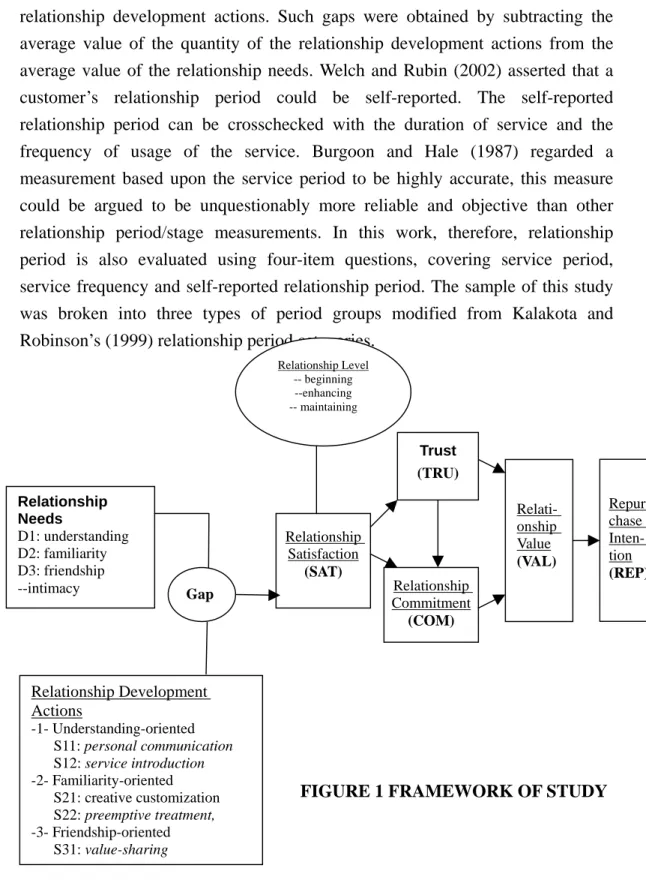
Figure 1 shows the framework of this study. A focus group was firstly organized, whose participants were asked open-ended questions about their own behavior with respect to a service. Then, direct questions were asked to obtain information on relationship needs and relationship development actions. Based on the study of Stern (1997), addressed individual relationship needs on three relationship periods, constructing twelve items to measure these relationship needs, and twelve-item questions were developed to quantify these relationship needs. Then, we propose three kinds of action in the form of relationship development actions, based on customers’ relationship needs; these are: understanding-oriented development actions, familiarity-oriented development actions, and friendship-oriented development actions. Wulf et al. (2001) and Sirdeshmukh et al. (2002), adjusted and revised the itemized issues and some detailed assessment indices, with the aim of associating these with relationship needs while taking into account the state of relationship development in high-contact services in Taipei. 18 items were developed to measure perceived relationship development actions.
The gap between relationship development actions and relationship needs was then measured as ‘the discrepancy between the relationship needs of customers and their of awareness of the relationship development actions currently performed by the service personnel. Such gaps were used to determine whether the relationship needs of the customer were being met by the service personnel’s
relationship development actions. Such gaps were obtained by subtracting the average value of the quantity of the relationship development actions from the average value of the relationship needs. Welch and Rubin (2002) asserted that a customer’s relationship period could be self-reported. The self-reported relationship period can be crosschecked with the duration of service and the frequency of usage of the service. Burgoon and Hale (1987) regarded a measurement based upon the service period to be highly accurate, this measure could be argued to be unquestionably more reliable and objective than other relationship period/stage measurements. In this work, therefore, relationship period is also evaluated using four-item questions, covering service period, service frequency and self-reported relationship period. The sample of this study was broken into three types of period groups modified from Kalakota and Robinson’s (1999) relationship period categories.
Relationship Needs D1: understanding D2: familiarity D3: friendship --intimacy Relationship Development Actions -1- Understanding-oriented S11: personal communication S12: service introduction -2- Familiarity-oriented S21: creative customization S22: preemptive treatment, -3- Friendship-oriented S31: value-sharing Gap Relationship Satisfaction (SAT) Relati- onship Value (VAL) Trust (TRU) Relationship Commitment (COM) Repur chase Inten- tion (REP)
FIGURE 1 FRAMEWORK OF STUDY
Relationship Level -- beginning --enhancing -- maintaining
Relationship satisfaction was measured using three items taken from Crosby et al. (1990) to represent both the emotional and physical components of relationship satisfaction. Trust was also measured using three items taken from Doney and Cannon (1997), and Garbarino and Johnson (1999) to represent both the internal and the external components of trust. Moreover, relationship commitment was measured using four items, which is proposed by Garbarino and Johnson (1999) to quantify both the computational and the emotional components of relationship commitment. Relationship value was again measured using four items developed by Sirdeshmukh et al. (2002) to measure both the monetary and the no monetary components of relationship value. Intention to repurchase measured using the four-item questions proposed by Morgan and Hunt (1994), and Doney and Cannon (1997) to elucidate various aspects of loyalty. Participants also complete a five-point Likert-type response scale in it.
The sample in this study was taken from customers of the high-encounter service industry in Taipei city. They included customers of beauty salons, insurance companies, commercial banks, hospitals and clinics, restaurants, hotels, computer repairing companies, and other institutions. Thirty-two subjects were pretested based on the industries. Intercepting customers at eight malls collected empirical data. Students from an urban university, Ming-chuan University, intercepted every third shopper in eight malls in Taipei. Samples were performed at shopping malls and subjects with various ages and, level of education, and of both genders, were involved. The students asked screener questions to select potential respondents by enquiring whether the subject had used service in a specific service category in the preceding week. Accordingly, the data collection yielded 982 completed questionnaires from those who agreed to participate and finished the interviews. Of these, 957 were usable and constituted the samples considered herein. In all, 957 usable questionnaires were obtained across the five categories. These included 307 for beauty salons, 238 for financial services,
156 for retailers, 138 for restaurants and hotels, and 118 for professional services.
4. EMPIRICAL RESULTS
4.1 D
ESCRIPTIVES
TATISTICS ANDANOVA A
NALYSISAs to the sample characteristics. Most respondents had a college degree or higher. In the entire sample, 43% of respondents were men and 57% were women. In all, no significant difference existed between the gap (relationship needs minus relationship development activities) of men and that of women (P = 0.215). Results also did not differ significantly with age, level of education, or annual household income. Also, samples for the five service industry categories did not significantly differ in terms of the sex, age, level of education, and annual household income.
The empirical results of this study included the means of the quantity of the three types of relationship needs - need for understanding, need for familiarity, and need for friendship - for customers at different periods of their relationship development. The overall mean of the quantity of relationship needs was 2.90; the value at the maintaining period (3.18) was larger than that of at the beginning period (2.90), and the enhancing period (2.64). Additionally, the results of the one-way ANOVA analysis of the repeated measurements indicated that a statistically significant relationship existed between relationship needs and relationship periods (F = 3.55, P = 0.014); that is, at different relationship periods, customers displayed different relationship needs, supporting hypothesis 1.
The mean values indicated that for customers at the maintaining period, friendship needs were more important than for those they at the beginning and enhancing relationship periods (2.82 < 2.90 < 3.13). Secondly, at different relationship periods, customers offered significantly different evaluations of the importance of their friendship needs (F = 27.79, P = 0.001). Additionally, for customers at the enhancing relationship period, familiarity
needs were more important than they for those at the beginning or maintaining relationship period (2.36 < 3.03 < 3.25). The means also indicated that for those customers at the beginning relationship period, understanding needs was more important than for those at the enhancing or maintaining relationship periods (2.48<2.74<3.45). Thirdly, at different relationship periods, customers offered significantly different perspectives of the significance of their friendship needs. Therefore, for those members of this group at the enhancing relationship period, friendship needs were much more important than they were for those at the beginning period (2.82<3.13), and were slightly more important than they had for those at the enhancing period (2.82<2.90).
Following the test to determine the simple effects of relationship need on relationship period, a further test of the simple main effects on the three kinds of relationship needs was conducted. The respective F-values between the value of relationship need and the viewpoint of those customers at the beginning, enhancing and maintaining relationship periods on the significance of the three kinds of relationship needs, which were 31.52, 18.74, 27.79, all reached the significance level (P-value = 0.001). This result indicates that those members of this group at the beginning, enhancing and maintaining relationship periods had markedly significantly different perspectives of the significance of at least two kinds of relationship needs. Thus, hypothesis 2a, 2b, 2c, 2d are supported.
Of the three kinds of relationship needs, the customers evaluated the significance of their need to be understood most highly (F = 31.52, P = 0.001), followed by friendship needs (F = 27.79), and familiarity needs (F = 18.74), probably because the former are associated with a principal demand in the process of served customers. In making efforts at their present relationship period, to satisfy their relationship needs, customers necessarily need strong familiarity and friendship. Once the customers have met their relationship goals during the present stage, they can assess their chances of developing their future relationship, achieving a breakthrough - namely, experiencing more familiarity and friendship.
4.2 O
VERALLM
ODELE
VALUATIONConstruct validity is demonstrated by considering evidence that each construct includes items that loading of at least 0.65 of their respective hypothesized components (relationship needs, relationship development actions, etc.) in a confirmatory factor analysis. The loadings of hypothesized factors were significant and high (nearly all factor loadings exceeded 0.65). Additionally, the overall goodness of fit supported unidimensionality (Steenkamp and van Trijp, 1991). The measurement model produced the following fit statistics: comparative fit index (CFI) = 0.97, normed fit index (NFI) = 0.97, nonnormed fit index (NNFI) = 0.97, goodness-of-fit index (GFI) = 0.91, adjusted goodness-of-fit index (AGFI) = 0.89 (exceeding 0.90; Steenkamp and van Trijp, 1991), root mean square error of approximation (RMSEA) = 0.06, and, standardized root mean residual (SRMR) = 0.05. The values for CFI, NNFI, RMSEA, and SRMR were acceptably close to the thresholds provided by Hu and Bentler (1999) - 0.95 for CFI, NFI and NNFI, 0.06 for RMSEA, and 0.08 for SRMR (Marsh, Balla and Hau, 1996)(see Table 1). Given that these overall goodness-of-fit indices were accurate and given the high consistency across the sample, the model was in no way re-specified. The measurement and structural models were then evaluated.
4.3 E
VALUATING M
EASUREMENTM
ODELThe quality of the measurements was assessed using a reliability analysis. The reliability of all items of a construct was jointly assessed by determining the composite reliability (Fornell and Larcker, 1981). A construct has good reliability, if its composite reliability exceeds 0.70 (Bagozzi and Yi, 1998). The internal consistency reliability (Cronbach’s alpha coefficient) of the measure of the three kinds of relationship needs was 0.854, 0.836, and 0.899, respectively; the six measured relationship development activities were 0.825 and 0.767 (understanding-oriented), 0.818 and 0.900 (familiarity-oriented), and 0.923 and 0.828 (friendship-oriented). Moreover, a summed averaged of the quantity of the four or three items of the survey
was calculate to determine the relationship satisfaction, trust, commitment to relationship, relationship value, and intention to repurchase, Cronbach’s alpha coefficients were estimated as 0.921, 0.839, 0.874, 0.892 and 0.865, respectively. All values suggested good reliabilities.
TABLE 1
CONVERGENT VALIDITY AND CONSTRUCT VALIDITY: CONFIRMATORY FACTOR ANALYSES OF RELATIONSHIP NEEDS
AND RELATIONSHIP DEVELOPMENT ACTIONS
Construct item Loading t-value R2
Relationship needs
Understanding 0.64 17.46** 0.59
Familiarity 0.88 11.68** 0.50
Friendship 0.63 14.07** 0.72
Relationship development actions
Personal communication 0.67 20.48** 0.44 Service introduction 0.74 20.06** 0.57 Creative customization 0.85 21.72** 0.70 Preemptive treatment 0.94 21.34** 0.67 Value-sharing 0.84 20.28** 0.58 Problem solving 0.85 19.71** 0.54 Goodness-of-fit statistics CFI
NFI and NNFI GFI and AGFI RMSEA and SRMR Chi-square (P-value) 0.97 0.97 0.91 0.06 909.71 --- 0.97 0.89 0.05 0.00
Notes: The goodness-of-fit statistics are estimated using the measurement model of relationship needs and relationship development actions. In one-tailed tests, for t-values of over 1.65 (*), p < 0.05; for t-values of over 2.33, p < 0.01 (**). Bagozzi and Yi (1988) asserted that various criteria should be applied to judge the goodness-of-fit of the structural model. Applying only one criterion (say, that GFI and/or AGFI should exceed 0.9) may be too conservative, since the number of the measurement items clearly affects the magnitude of GFI and AGFI. Similarly, the value of chi-square is sensitive to the number of sample size. A sample that is too large will yield a non-significant P-value because chi-square is estimated from the coefficient of variance / number of degrees of freedom (Bollen and Long, 1993).
The assessment of convergent validity was examined by performing a confirmatory factor analysis (CFA). All loadings in Table 1 were significant (p < 0.05) and nearly all R2 values exceeded 0.50 (Hildebrandt, 1987). The
convergent validity was then supported. With reference to the discriminant validity, whether correlations among latent constructs were significantly less than one was checked first. A series of nested confirmatory models were compared, such that the correlation coefficients between similar attributes/constructs exceeded those between different attributes/constructs. The coefficient of correlation among the relationship needs and relationship development actions ranged from 0.44 to 0.72, and constraining this correlation to unity invariably significantly changed the goodness-of-fit statistic. Whether all the inter-construct correlations (phi-values) were significantly below unity (Anderson and Gerbing, 1988) was further tested. The test yielded positive results in each case and the case for discriminant validity was concluded to be sufficiently strong.
4.4 E
VALUATING S
TRUCTURALM
ODELTable 2 shows that for each sample, all significant relationships between latent constructs were in the hypothesized direction, providing initial evidence of the proposed conceptual model, and supporting the mono-logical validity of the constructs. The gap between relationship needs and relationship development actions was the dominant antecedent of relationship satisfaction (H3a: β1 = 0.48).
Trust and relationship commitment, the commonly accepted consequences, both significantly affected relationship satisfaction. The former had a larger effect (H4a: β2 = 0.71), that the latter a smaller effect (H4b: β3 = 0.22). Trust was found to
affect relationship commitment (H4c: β4 = 0.78) positively. Thus, trust and
relationship commitment slightly but significantly affected relationship value (H5a: β5 = 0.21, H5b: β6 = 0.58). Also, as expected, relationship value was
positively related to the customer’s intention to repurchase (H5c: β7 = 0.63).
The moderating effects of splitting the samples into sub-samples according to the corresponding relationship period, to maintain within-group homogeneity and between-group heterogeneity, were also examined (Stone and Hollenbeck, 1989). Table 2 also presents three separate structural model estimates of the number of degrees of freedom, the chi-square value, and the change in chi-square value. The
chi-square of the equal model (base model) was significantly higher than that of a model in which one casual linkage was eliminated, implying that the moderator variable significantly affect that linkage. The differences between the chi-square values of the models show whether relationship period acted as a moderating variable between relationship satisfaction and gap, and the hypothesis H3b was valid.
TABLE 2
EMPIRICAL RESULTS FOR STRUCTURAL MODELS
Hypothesized path Estimate coefficient T value P-value H3a: Gaps Æ Relationship satisfaction β1 = 0.48 11.24 0.043** H4a: Relationship satisfaction Æ
Trust β2 = 0.71 10.73 0.065* H4b: Relationship satisfaction Æ Relationship commitment β3 = 0.22 3.52 0.061* H4c: Trust Æ Relationship commitment β4 = 0.78 25.02 0.031** H5a: Trust Æ Relationship value β5 = 0.21 7.62 0.027** H5b: Relationship commitment Æ Relationship value β6 = 0.58 16.02 0.032** H5c: Relationship value Æ Repurchase intention β7 = 0.63 17.15 0.037** H3b: Moderating effects on relationship period Degree of freedom χ2 ∆χ2 Equal model (base model)
Sub-sample model (beginning level) Sub-sample model (enhancing level) Sub-sample model (maintaining level)
200 199 199 199 984.82 805.79 919.87 964.08 ---- 179.03** 64.95** 20.74** Goodness-of-fit statistics
Chi-square (degree of freedom; P-value) GFI and AGFI
NFI and NNFI CFI RMSEA and SRMR 984.82 0.92 0.98 0.99 0.059 200 0.89 0.98 -- 0.038 0.000
1. In one-tailed tests, for t-values of over 1.65 (*), p < 0.05; for t-values of over 2.33, p < 0.01 (**).
2. Bagozzi and Yi (1988) argued that various criteria should be applied to judge the goodness-of-fit of the structural model. Applying only one criterion (say, that GFI and/or AGFI must exceed 0.9) may be too conservative to judge the model, since the number of measurement items clearly influences the magnitude of GFI and AGFI. Similarly, chi-square is sensitive to the number of samples. A sample size that is too large will yield a non-significant P-value because chi-square is estimated from coefficient of variance / number of degrees of freedom (Bollen and Long, 1993).
5. CONCLUSIONS REMARKS
This study proposed a casual relationship framework of the relationship needs, relationship development actions, relationship satisfaction, trust, relationship commitment, relationship value and intention to repurchase of high-encounter services. Various relationship periods of consumer-service personnel relationships were considered. The gap between relationship development actions and relationship needs was investigated, and was that relationship satisfaction. One of the contributions of this research is its emphasis of the factors affect a customer’s relationship satisfaction levels from the perspective of the gap between relationship needs and relationship development actions. With high encounter services towards promoting its competitiveness and emerging increasingly involved in high encounter. A study of the current gaps between expected relationship needs and perceived relationship development actions of customers, increased the relationship satisfaction of customers.
Estimates suggest that at different levels of their relationship, customers have distinct relationship needs. An effort should be made to address the current gaps between expected relationship needs and perceived relationship development actions of customers, to increase the relationship satisfaction and relationship value of customers. For customers of high-encounter services, three kinds of relationship needs are proposed – need to be understood at the beginning period, need for familiarity at the enhancing period, and need for friendship at the maintaining period. Additionally, empirical results indicate that the three kinds of gaps between relationship needs and relationship development actions are important antecedents of relationship satisfaction. Also, this study stated that a wider gap between relationship needs and relationship development actions yields a correspondingly lower relationship satisfaction level amongst customers. The interaction between relationship periods and the ‘gap between relationship needs and relationship development actions’ is found to impact relationship satisfaction. The effect on relationship satisfaction of the gap between relationship needs and relationship development actions varies with the relationship period of the
customers. As the gap widens, those at the enhancing period exhibit the least relationship satisfaction, whilst those at the maintaining period exhibit greater relationship satisfaction than those on all other relationship periods.
6. REFERENCES
Anderson, James C. and David W. Gerbing (1988), “Structural Equation Modelling in Practice: A Review and Recommended Two-step Approach,”
Psychological Bulletin, 103 (3), 411-423.
Anderson, James C. and James A. Narus (1984), “A Model of the Distributor’s Perspective of Distributor-Manufacturer Working Relationships,” Journal of
Marketing, 48 (Fall), 42-58 .
Anderson, James C. and James A. Narus (1990), “A Model of Distributor Firm and Manufacturer Firm Working Partnerships,” Journal of Marketing, 54 (1), 42-58 .
Anderson, Eugene W., Claes Fornell and Donald R. Lehmann (1994), “Customer Satisfaction, Market Share, and Profitability: Findings from Sweden,”
Journal of Marketing, 58 (July), 53-66.
Anderson, Eugene W., Claes Fornell and Roland T. Rust (1997), “Customer Satisfaction, Productivity, and Profitability: Differences Between Goods and Services,” Marketing Science, 16 (2), 129-145.
Bagozzi, Richard P. and Youjae Yi (1998), “On the Evaluation of Structural Equation Models,” Journal of the Academy of Marketing Science, 16 (Spring), 74-94.
Berry, L.L (1983), “Relationship Marketing,” in Berry, L.L., Shostack, G.L. and G. Upah (eds.), Emerging Perspectives on Services Marketing, Chicago IL: American Marketing Association, 25-28.
Berry, L.L. (1995), “Relationship Marketing of Services-growing Interest, Emerging Perspectives,” Journal of Academy of Marketing Science, 23 (4),
236-245 .
Bettman, James R. (1979), An Information Processing Theory of Consumer
Choice, Reading, MA: Addison-Wesley, Bowlby, John (1982), Attachment
and Loss: Vol.1, Attachment, 2nd ed., New York: Basic Books.
Birgelen, M.V., Wetzeis, M. and K.D. Ruyter (1997), “Commitment in Service Relationships: An Empirical Test of Its Antecedents and Consequences,” in the Proceedings of the 26th EMAC Conference, 3, 1255-1271.
Bollen, K.A. and J.S. Long (1993), Testing Structural Equation Models, San Francisco CA: Sage Publications.
Bolton, Ruth N. and J.H. Drew (1991), “A Longitudinal Analysis of the Impact of Service Changes on Customer Attitudes,” Journal of Marketing, 55 (Jan), 1-9.
Burgoon, J.K. and J.L. Hale (1987), “Validation and Measurement of the Fundamental Themes of Relational Communication,” Communication
Monograph, 54 (1), 19-41.
Celsi, Richard L. and Jerry C. Olson (1988), “The Role of Involvement in attention and Comprehension Processes,” Journal of Consumer Research, 15 (September), 210-224.
Cron, William L. (1984), “Industrial Salesperson Development: A Career Stage Perspective,” Journal of Marketing, 48 (Fall), 41-52.
Crosby, Lawrence A., Kenneth R. Evans and Deborah Cowles (1990), “Relationship Quality in Service Selling: An Interpersonal Influence Perspective,” Journal of Marketing, 54 (3), 68-81.
Doney, Patricia M. and Joseph P. Cannon (1997), “An Examination of the Nature of Trust in Buyer-Seller Relationship,” Journal of Marketing, 61 (April), 35-51.
Series on Close Relationships, Thousand Oaks: Sage.
Dwyer, F. Robert, Paul H. Schurr and Sejo Oh (1987), “Developing Buyer-Seller Relationships,” Journal of Marketing, 51 (April), 11-27.
Fornell, Claes and David F. Larcker (1981), “Evaluating Structural Equation Models with Unobservable Variables and Measurement Error,” Journal of
Marketing Research, 18 (3), 39-50.
Garbarino, Ellen and Mark S. Johnson (1999), “The Different Roles of Satisfaction, Trust, and Commitment in Customer Relationship,” Journal of
Marketing, 63 (April), 70-87.
Gruen, Thomas W., Summers, J.O. and F. Acito (2000), “Relationship Marketing Activities, Commitment and Membership Behaviors in Professional Associations,” Journal of Marketing, 64 (July), 34-49.
Gwinner, Kevin P., Dwayne D. Gremler and Mary Jo Bitner (1998), “Relational Benefits in Services Industries: The Customer’s Perspective,” Journal of the
Academy of Marketing Science, 26 (2), 101-114.
Hildebrandt, Lutz (1987), “Consumer Retail Satisfaction in Rural Areas: A Reanalysis of Survey Data,” Journal of Economic Psychology, 8 (1), 19-42. Kalakota, Ravi and Marcia Robinson (1999), E-business: Roadmap for Success,
Massachusetts: Addison Wesley Longman, Inc.
Kelley, Scott W. and Mark A. Davis (1994), “Antecedents to Customer Expectations for Service Recovery,” Journal of Academy of Marketing
Science, 22 (1), 52-61 .
Kerin, Roger A., Ambuj Jain, and Daniel J. Howard (1992), “Store Shopping Experience and Consumer Price-Quality-Value Perceptions,” Journal of
Retailing, 68 (Winter), 376-397.
Levesque, Terrence J. and Gordon H.G. McDougall (2000), “Service Problems and Recovery Strategies: An Experiment,” Canadian Journal of
Administrative Sciences, 17 (1), 20-37.
Marsh, Herbert, John Balla, and Kit-Tai Hau (1996), “An Evaluation of Incremental Fit Indices: A Clarification of Mathematical and Empirical Properties,” in Advanced Structural Equation Modelling: Issues and
Techniques, George Marcoulides and Randall Schumaker, eds. Marwah, NJ:
Lawrence Erlbaum Associates, 315-345.
Metcalf, Lynn E., Carl R. Frear and R. Krishnan (1992), “Buyer-seller Relationships: An Application of the IMP Interaction Model,” European
Journal of Marketing, 26 (2), 27-46.
Morgan, Robert M. and Shelby D. Hunt (1994), “The Commitment-Trust Theory of Relationship Marketing,” Journal of Marketing, 58 (July), 20-38.
Parasuraman, A., Zeithaml, V. A., and L.L. Berry (1985), “A Conceptual Model of Service Quality and Its Implications for Future Research,” Journal of
Marketing, 49 (Fall), 41-50.
Parasuraman, A., Zeithaml, V. A., and L.L. Berry (1988), “SERVQUAL: A Multiple-Item Scale for Measuring Consumer Perceptions of Service Quality,” Journal of Retailing, 64 (1), 12-40.
Parr, Patricia E. (2000), “The Family FIRO Model: Exploring Relationship Needs of At-risk Families,” American Journal of Family Therapy, 28 (3), 255-264. Perlman, Daniel and Beverly Fehr (1987), “The Development of Intimate
Relationships,” In Intimate Relationships: Development, Dynamics, and
Deterioration, Daniel Perlman and Steve Duck (eds.), Newbury Park: Sage
Publications, 1342.
Peterson, Robert A. (1995), “Relationship Marketing and the Consumer,” Journal
of Academy of Marketing Science, 23 (4), 278-281.
Scanzoni, John H. (1979), “Social Exchange and Behavioral Interdependence,” in Social Exchange in Developing Relationships, Robert Lee Burgess and Ted
L. Huston (eds.), New York: Academic Press.
Sirdeshmukh, Deepak, Jagdip Singh, and Barry Sabol (2002), “Consumer Trust, Value, and Loyalty in Relational Exchanges,” Journal of Marketing, 66 (1), 15-37 .
Smith, J. Brock and Donald W. Barclay (1997), “The Effects of Organizational Differences and Trust on the Effectiveness of Selling Partner Relationships,”
Journal of Marketing, 61 (1), 3-21 .
Steenkamp, Jan-Benedict E.M. and Hans C.M. van Trijp (1991), “The Use of LISREL in Validating Marketing Constructs,” International Journal of
Research in Marketing, 8 (4), 283-299.
Stern, Barbara B. (1997), “Advertising Intimacy: Relationship Marketing and the Services Consumer,” Journal of Advertising, 26 (4), 7-19.
Stone, Eugene F. and John R. Hollenbeck (1989), “Classifying Some Controversial Issues Surrounding Statistical Procedures for Detecting Moderating Variables: Empirical Evidence and Related Matters,” Journal of
Applied Psychology, 74 (1), 3-10.
Waring, E.M., Mary Pat Tillman, L. Frelick, Lila Russell, and G. Weisz (1980), “Concept of Intimacy in the General Population,” Journal of Nervous and
Mental Disease, 168 (August), 471-474.
Welch, S.A. and Rebecca B. Rubin (2002), “Development of Relationship Stage Measure,” Communication Quarterly, 50 (1), 24-34 .
Wulf, K.D., Schroder, G.O. and D. Iacobucci (2001), “Investments in Consumer Relationships: A Cross-country and Cross-industry Exploration,” Journal of
Marketing, 65 (Oct), 33-50.
Zeithaml, V.A. (1988), “Consumer Perceptions of Price, Quality, and Value: A Means-End Model and Synthesis of Evidence,” Journal of Marketing, 52 (July), 2-21.
Zeithaml, V.A., Berry, L.L. and A. Parasuraman (1996), “The Behavior Consequences of Service Quality,” Journal of Marketing, 60 (April), 31-46.