行政院國家科學委員會專題研究計畫 成果報告
企業電子化資訊系統採用因素之研究
研究成果報告(精簡版)
計 畫 類 別 : 個別型 計 畫 編 號 : NSC 98-2410-H-151-002- 執 行 期 間 : 98 年 08 月 01 日至 99 年 07 月 31 日 執 行 單 位 : 國立高雄應用科技大學資訊管理系 計 畫 主 持 人 : 張添香 共 同 主 持 人 : 傅新彬 計畫參與人員: 碩士班研究生-兼任助理人員:黃上軒 碩士班研究生-兼任助理人員:陳乙諒 碩士班研究生-兼任助理人員:蔡沅達 碩士班研究生-兼任助理人員:郭姿伶 碩士班研究生-兼任助理人員:沈瑞元 碩士班研究生-兼任助理人員:林美綺 博士班研究生-兼任助理人員:林聖緯 報 告 附 件 : 出席國際會議研究心得報告及發表論文 處 理 方 式 : 本計畫可公開查詢中 華 民 國 99 年 09 月 02 日
行政院國家科學委員會補助專題研究計畫
成 果 報 告
□期中進度報告
企業電子化資訊系統採用因素之研究
計畫類別:個別型計畫
□整合型計畫
計畫編號:NSC-98-2410-H-151-002-執行期間:2009 年 8 月 1 日至 2010 年 7 月 31 日
執行機構及系所:國立高雄應用科技大學資訊管理系
計畫主持人:張添香
共同主持人:傅新彬
計畫參與人員:林聖偉、郭姿伶、沈瑞元、林美綺、黃上軒、陳乙諒、蔡沅達
成果報告類型(依經費核定清單規定繳交):精簡報告 □完整報告
本計畫除繳交成果報告外,另須繳交以下出國心得報告:
□赴國外出差或研習心得報告
□赴大陸地區出差或研習心得報告
出席國際學術會議心得報告
□國際合作研究計畫國外研究報告
處理方式:
除列管計畫及下列情形者外,得立即公開查詢
□涉及專利或其他智慧財產權,□一年二年後可公開查詢
中
華
民
國 99 年 8 月 22 日
企業電子化資訊系統採用因素之研究
-以供應商自建之電子交易服務平台為例
A Study on Adoptive Factors of Information System of E-business –A Case of customers
ordering through suppliers’
self constructed e-platforms
摘要 網際網路的興起,許多企業透過電子化平台進行企業間之交易服務,藉以降低企業之交易成本與提升組 織作業效率。通常由顧客要求供應商在自建或指定之交易服務平台進行交易是較容易的,因為顧客擁有 採購權力,但是由供應商要求顧客在自建或指定之交易服務平台下單,除了是賣方市場或相當誘因的交 易條件外,通常顧客採用的意願不高,導致供應商要求顧客下單的電子交易服務平台之效益無法顯現。 為能更深入瞭解企業客戶採用電子交易服務平台下單時之考量因素,本研究透過相關文獻收集與專家學 者之訪談,歸納出企業採用電子交易平台之考量因素,再設計成AHP (analytic hierarchy process)兩兩相 較之問卷方式,以國內某知名紙器廠商創新服務平台之客戶(已採用)及潛在客戶(尚未採用)兩個客戶群 為對象進行意見之收集,再應用fuzzy analytic hierarchy process (fuzzy AHP)算出各因素之權重 (重要 性),找出兩個群體採用電子交易服務平台考量之關鍵因素,並進行兩個群體之差異分析,以提供供應 商研擬提升客戶使用電子交易服務平台策略時之參考。
關鍵詞:電子交易平台,採用因素分析,層級分析法,模糊層級分析法
ABSTRACT
With the rise of the Internet, many enterprises are now undertaking transactions through various e-platforms to reduce corporate transaction costs. Generally speaking, it is easier for customers to ask suppliers to conduct transactions on assigned transaction platforms since the customers have bargaining power. However, when suppliers ask customers to order products on assigned e-platforms, customers are usually not willing to do so unlessitissellers’marketorthesuppliersprovide enough incentives.Thus,thebenefitsofonlinetransactions undertaken viasuppliers’e-platforms may not always be realized. To investigate what influences the decision of customers to place their orders on e-platforms constructed by the suppliers, this study undertakes both a literature review and expert interviewsto develop afactortableforadopting thesuppliers’e-platform with a three-level hierarchical structure, and then designs a pair-wise comparison questionnaire in the analytic hierarchy process (AHP) format. This work collects the opinions of customers of a well-known, domestic paper company, some of whom have used its e-platform and some of whom have not used, and then calculates the weights of each factor by fuzzy AHP. Finally, this paper analyzes the degree of importance of each factor between customers, who have adopted and have not adopted the e-platform, and further provides some suggestions as references for suppliers as they develop strategies to increase customer acceptance of ordering through suppliers’self-constructed e-platforms.
Keywords: e-platform, impact factors analysis, analytic hierarchy process (AHP), fuzzy analytic hierarchy
1. MOTIVATION
The maturity and wide application of Internet technologies has lead to significant changes in organizational operations. Facing global competition and changes in the ways of conducting transactions, companies have to find ways to exploit these new technologies in order to strengthen their competitive advantages [10, 16, 37]. Thus, many companies have constructed e-platforms, including platforms for customer’orders,and procurementplatformsofthesuppliers. Previous studies on the factors related to the adoption of e-platformsfocused on procurementtransaction platformsfrom thecustomers’perspective. The factor analysis for this kind of work is relatively easy, since the customers have the procurement advantage and bargaining power, and can thus ask the suppliers conducted transactions on the customers' self-constructed e-platforms. In contrast, it is difficult for suppliers to demand that customers order products through thesupplier’self-constructed e-platform, unless it is a sellers' market or enough incentives to do so are provided. If one of these conditions is not existence, most customers would not be willing to use the supplier's e-platform, particularly for large-scale customers. Based on these reasons, the potential benefits of suppliers’self-constructed e-platform often can not be realized.
Most past research used regression analysis or structure equation model (SEM) approaches to discover the influential factors. However, these methods can not figure out the importance and priority of each factor. Consequently, the results of such studies cannot provide enough information, as a valuable reference for suppliers to allocate resources appropriately, to further improve the service quality of their e-platforms and to increase the intention of customer adoption.
Therefore, to discover the importance and priority of the factors that influence customer adoption of such e-platforms, literature review was conducted to collect factors which are believed to influence enterprises' decisions to undertake transactions on an e-platform. The factor table with three-level structure was developed. Based on factor table, a pair-wise comparison questionnaire in the analytic hierarchy process (AHP) format was designed and distributed to customers of a well-known, domestic paper company, some of which haveused thesuppliers’e-platform (existing customers), and some of which have not used (potential customers). After collecting the questionnaires, the weights of each factor were calculated by fuzzy AHP. Finally, this paper analyzes the degree of importance of each factor between existing customers and potential customers, and further provides some suggestions for suppliers to develop strategies to improve service quality and enhancecustomersatisfaction so asto increasethecustomers’willingnessto placeordersthrough the suppliers’self-constructed e-platforms.
2. LITERATURE REVIEW
In the Internet era, suppliers and customers are on longer independent entities. From the integration of supply chain management perspectives, both parties should value information system integration [21]. Currently, due to the different applications being used by suppliers and the rapid changes in information technology, there are six types of e-platforms in use among enterprises, such as e-MRO (maintenance, repair and operation), e-ERP (enterprise resource planning), e-sourcing, e-tendering, e-reverse auctioning, and e-informing [4]. Min and Galle [20] defined e-platforms as activities undertaken by companies online that enable purchasing products and services, paying transfer accounts, and general interaction between customers and suppliers in an e-commerce context. Presutti [28] argued that e-platforms can be viewed as technical plans to facilitate corporate procurement via the Internet. The use of an e-platform is intended to reinforce competitive advantages [14], as well as leading to the goal of a normalized product information system. Such
a system allows customers to search for product information and supports online procurement, this improving the effectiveness and efficiency of corporate operations [33]. Therefore, Pearcy et al. [27] consider the main benefit of procurement via an e-platform is that it can facilitate integration of the supply chain. Moreover, customers who adopt an e-platform can also reduce procurement costs [26].
A review of the past research also indicate that various studies have applied multivariate statistical analysis, such as regression analysis or SEM [2, 9], one-way analysis of variance [24], multiple regression analysis [9], as well as qualitative approaches, such as case studies [29, 36], to investigate the factors influencing e-platform adoption. Although using quantitative and qualitative approaches can uncover the factors that influence e-platform adoption, these still cannot figure out the importance and priority of each impact factor. Consequently, the results do not provide enough information to as a really valuable reference for suppliers. Thus, in this paper, in order to understand the priority of each factor, the fuzzy analytic hierarchy process (fuzzy AHP) is applied as a research method to analyze the factors that influence the customers'adoption ofsuppliers’e-platforms when they place their orders. The findings can provide more precise information to suppliers, who will then be able to allocate the optimal resources in order to improve the service quality of their e-platforms so as to encourage more widespread adoption.
3. RESEARCH METHOD
There are many factors that affect the customers'decision to adoptthesuppliers’e-platform. If suppliers can appreciate the degree of importance of any given factor, this will enable them to allocate the optimal resources to improve the service quality of the e-platform with cost saving. Therefore, this is a multi-criteria decision making (MCDM) problem, for which the analytic hierarchy process (AHP) [32] is the most commonly applied approach. However, AHP does not account for the fuzziness of human thoughts or the uncertainties of the environment. In addition, the weights of the decision makers referred to means that could not objectively reveal the situation.
Thus, Laarhoved and Pedrycz [18] proposed the fuzzy AHP, which involves the uncertain and multi-criteriaaspectsofsuch problems,aswellasexperts’opinions.When therearemany decision-making criteria and substitute plans, fuzzy AHP can avoid the subjectivity inherent in pair wise comparison and the subsequent inaccurate results. This study utilizes this process as the research approach, and based on a review of the literature review [6, 8], it generalizes the calculation of fuzzy AHP, as shown below:
(1) Construction of a hierarchical table
According to the topic, a factor hierarchy is constructed. The second hierarchical factor was a precise description of the previous one.
(2) Questionnaire design
The questionnaire design is a pairwise comparison of the factors in each hierarchy based on the hierarchical table from the literature review. We then transform the hierarchy structure into a pairwise comparison questionnaire in the fuzzy analytic hierarchy process format. People whose work involves making purchases from the paper industry were then selected as the sample group to fill out the questionnaires using a nine-point Likert scale.
(3) Construction of fuzzy numbers
While past research tended to have discrete answers in questionnaires, this study was based on interval answers and thus constructed fuzzy numbers from all the respondents’answerintervals.Themostcommon fuzzy numbers used were trapezoidal and triangular fuzzy numbers.
(4) Construction of the fuzzy positive reciprocal matrix
Based on the fuzzy numbers from the questionnaire results, a fuzzy positive reciprocal matrix was constructed. When there were n sub-criteria studied in one criterion, this study could establish an n × n fuzzy positive reciprocal matrix A.
(5) Consistency test
Before calculating the weights, this study Consistency Index (CI) and Consistency Ratio (CR) tests were conducted on the fuzzy weights of a Positive Reciprocal Matrix, that is, which showed as follows:
max
( ) ( 1)
CI n n and CRCI RIn100%
The consistency test was accomplished after confirming the fuzzy numbers through geometric means. Saaty [32] suggested that CR0.1 is an acceptable range, λmax is the maximized eigenvector of a pairwise comparison matrix, n is an attribute of the matrix, and RIn is a random index [1], with all these values shown in Table 1.
Table 1. Randomized index of RIn
n 3 4 5 6 7 8 9 10 11 12 13 14 15 16
n
RI 0.525 0.882 1.115 1.252 1.341 1.404 1.452 1.484 1.513 1.535 1.555 1.570 1.583 1.595
(6) Construction of start matrix (X matrix)
After the consistency tests, this study constructed a start matrix by using the previously established fuzzy positive reciprocal matrix.
(7) Defuzzification (α-cut)
Defuzzification was based on the α-cut proposed by Csutora and Buckley [8] to determine fuzzy weights.
(8) Normalization
This study normalized the fuzzy weight intervals, and after calculating the weights of all factors connected the local weights to acquire the global ones of the factors in each hierarchy.
4. DATA COLLECTION AND ANALYSIS
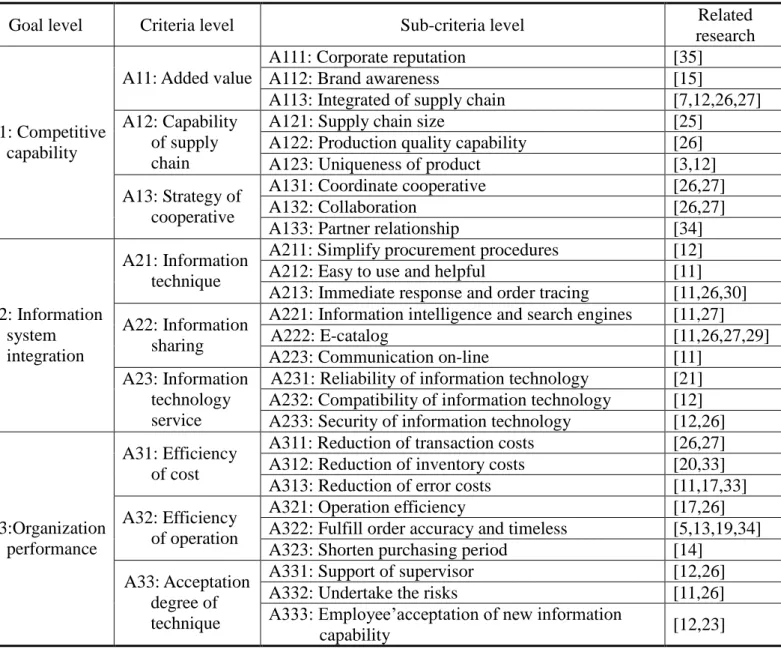
The samples in this study were all customers of a well-known domestic paper company which has constructed an e-platform. The samples were then divided into customers (i.e., customers who have adopted the e-platform to order) and potential customers (i.e., customers who have not adopted the e-platform to order yet). Data collection was based on the steps of the fuzzy AHP. First, an initial list of factors that influence companies in their decision whether or not to adopt the e-platform was generated based on an extensive literature review, and this information was then made into a three-level table of hierarchical factors, with goal, criteria and sub-criteria levels, as shown in Table 2.
Second, this study designed an AHP questionnaire of pairwise comparisons based on the hierarchy structure from the Table 2. Subsequently, this study asked business representatives of the paper corporate to invite customers to fill questionnaires. The respondents were asked to fill their desired answers in a 1 to 9 point scale, and a total of 13 questions. There were 50 questionnaires that were sent out, and a total of 26 valid questionnaires were returned. The valid response rate is 52%. Twenty of them are existing customers and six of them are potential customers. Before data analysis, logical examinations were performed to avoid related errors from the returned questionnaires when we conducted the data analysis. According to all theparticipants’
intervals, trapezoidaland triangularfuzzy numberswereconstructed as(α,β,γ,δ);α istheminimum response interval,β istheminimum common consensusinterval,γisthemaximum common consensusinterval,and δ is the maximum of all responses intervals.
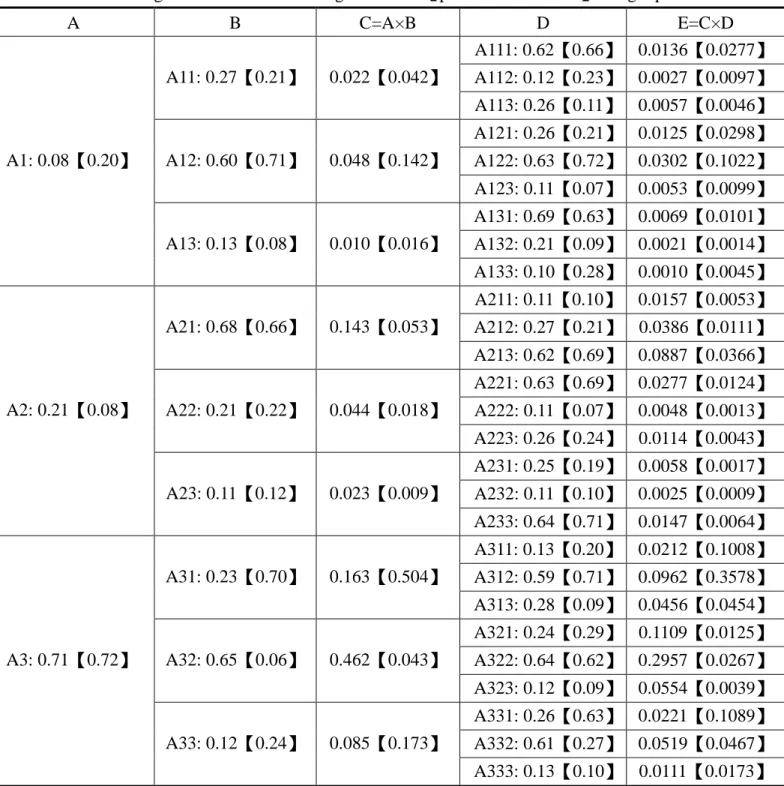
Finally, this study conducted data analysis based on Matlab in order to examine the consistency test and calculate the weights of each fuzzy internal. None of the results of the consistency ratio exceeded 0.1, which were all acceptable. The fuzzy weightswerethen defuzzified into explicitweightsby α-cut(α=0.5,λ=0.5), which was proposed by Csutora and Buckley [8], to obtain the relative weights for each factor, as shown in Table 3. Thisstudy thusanalyzed and compared the“existing customers,”who already usethee-platforms, and “potentialcustomers,”who do notusethee-platform yet.
Table 2. The critical determinant for customers adopt e-platform
Goal level Criteria level Sub-criteria level Related
research
A111: Corporate reputation [35]
A112: Brand awareness [15]
A11: Added value
A113: Integrated of supply chain [7,12,26,27]
A121: Supply chain size [25]
A122: Production quality capability [26] A12: Capability
of supply
chain A123: Uniqueness of product [3,12]
A131: Coordinate cooperative [26,27]
A132: Collaboration [26,27]
A1: Competitive capability
A13: Strategy of cooperative
A133: Partner relationship [34]
A211: Simplify procurement procedures [12] A212: Easy to use and helpful [11] A21: Information
technique
A213: Immediate response and order tracing [11,26,30] A221: Information intelligence and search engines [11,27]
A222: E-catalog [11,26,27,29]
A22: Information sharing
A223: Communication on-line [11]
A231: Reliability of information technology [21] A232: Compatibility of information technology [12] A2: Information
system integration
A23: Information technology
service A233: Security of information technology [12,26] A311: Reduction of transaction costs [26,27] A312: Reduction of inventory costs [20,33] A31: Efficiency
of cost
A313: Reduction of error costs [11,17,33]
A321: Operation efficiency [17,26]
A322: Fulfill order accuracy and timeless [5,13,19,34] A32: Efficiency
of operation
A323: Shorten purchasing period [14]
A331: Support of supervisor [12,26]
A332: Undertake the risks [11,26]
A3:Organization performance
A33: Acceptation degree of
technique A333:Employee’acceptation ofnew information
capability [12,23]
4. 1 Existing customers
From the Table 3, with regard to the goal level of adopted e-platforms users , the most important factor is to increase organizational performance (71%); in the criteria level, the most important factor is efficiency of operation (46.2%); and in the sub-criteria level, fulfill orders accurately and timeless (29.57%) is the most important factor. These results demonstrate that the most influentialfactorswith regard to customers’adopting e-platforms are those that make firms more reliable, effective and efficient, all of which can lead to better
organizational performance.
4. 2 Potential customers
As shown in Table 3, potential customers suggest that at the goal level, the most important factor is to increase organizational performance (72%); in the criteria level, the most important factor is efficiency of cost (50.4%); and in the sub-criteria level, the reduction of inventory cost (35.78%) is the most important factor. This demonstrates that if potential customers are to be persuaded to order products via e-platforms then they will do so because they believe that it can reduce inventory costs and improve internal production efficiency. Both of these factors are able to lower operational costs and thus increase sales and profits.
Table 3. Weights of factors for existing customers【potential customers】using e-platform
A B C=A×B D E=C×D A111: 0.62【0.66】 0.0136【0.0277】 A112: 0.12【0.23】 0.0027【0.0097】 A11: 0.27【0.21】 0.022【0.042】 A113: 0.26【0.11】 0.0057【0.0046】 A121: 0.26【0.21】 0.0125【0.0298】 A122: 0.63【0.72】 0.0302【0.1022】 A12: 0.60【0.71】 0.048【0.142】 A123: 0.11【0.07】 0.0053【0.0099】 A131: 0.69【0.63】 0.0069【0.0101】 A132: 0.21【0.09】 0.0021【0.0014】 A1: 0.08【0.20】 A13: 0.13【0.08】 0.010【0.016】 A133: 0.10【0.28】 0.0010【0.0045】 A211: 0.11【0.10】 0.0157【0.0053】 A212: 0.27【0.21】 0.0386【0.0111】 A21: 0.68【0.66】 0.143【0.053】 A213: 0.62【0.69】 0.0887【0.0366】 A221: 0.63【0.69】 0.0277【0.0124】 A222: 0.11【0.07】 0.0048【0.0013】 A22: 0.21【0.22】 0.044【0.018】 A223: 0.26【0.24】 0.0114【0.0043】 A231: 0.25【0.19】 0.0058【0.0017】 A232: 0.11【0.10】 0.0025【0.0009】 A2: 0.21【0.08】 A23: 0.11【0.12】 0.023【0.009】 A233: 0.64【0.71】 0.0147【0.0064】 A311: 0.13【0.20】 0.0212【0.1008】 A312: 0.59【0.71】 0.0962【0.3578】 A31: 0.23【0.70】 0.163【0.504】 A313: 0.28【0.09】 0.0456【0.0454】 A321: 0.24【0.29】 0.1109【0.0125】 A322: 0.64【0.62】 0.2957【0.0267】 A32: 0.65【0.06】 0.462【0.043】 A323: 0.12【0.09】 0.0554【0.0039】 A331: 0.26【0.63】 0.0221【0.1089】 A332: 0.61【0.27】 0.0519【0.0467】 A3: 0.71【0.72】 A33: 0.12【0.24】 0.085【0.173】 A333: 0.13【0.10】 0.0111【0.0173】 Note:A: initial weights of goal level; B: initial weights of criteria level; C: streamed weights of criteria level and goal level (C=A×B); D: initial weights of sub-criteria level; E: normalized weights of sub-criteria level (E=C×D)
4.3 Comparison analysis between two groups
According to Table 3, the two groups have similar ways of thinking with regard to the goal level. Both groups suggest that to increase organizational information system integration (potential customers 8%; existing customers 21%), and competitive capability (potential customers 20%; existing customers 8%). In addition, in the criteria level for potential customers, the factor of utility of cost (50.4%) is seen as most important; while for the existing customers it is efficiency of operations (46.2%). In the sub-criteria level, the potential customers emphasize the importance of the reduction of inventory costs (35.78%), while existing customers highlight fulfill orders accurately and timeless (29.57%) and efficiency of operations (11.09%).
Therefore, the reduction of inventory cost is the main factor for potential consumers. The reason is that most companies can not control their inventory levels which lead to increase related costs. On the other hand, fulfill orders accurately and timeless, and efficiency of operations are the main factors for existing customers concerned. Customers who have experiences of e-platform system will tend to select suppliers that have the ability to deliver rapidly and enhance the performance of production operation.
4.4 The analysis of critical factor paths for e-platform adoption
In order to allocate optimal resources with achieve both effectiveness and efficiency in a highly competitive environment. Therefore, we present the two paths of critical factors for suppliers who wish to develop their e-platform strategies for both existing and potential customers. Each path consists of critical factors which have higher weights in the hierarchy structure of the goal, criteria, and sub-criteria levels, i.e., the top four factors which have the accumulated weight of about 60%, as shown in Figures 1 and 2.According to Table 3, the critical factors path for e-platform adoption for existing customers includes two paths, as shown in Figure 1. The first path shows that if the e-platform has the ability of quick response and order tracking (8.87%) then the customer service quality (14.3%) can be enhanced. To enhance the customer service quality, the information system should be well integrated (21%). The other critical path is the path of organizational performance, which includes two sub-paths. The first sub-path is to reduction of inventory costs (9.62%) in the sub-criteria level and cost efficiency (23%) will be enhanced in the criteria level. The other sub-path is that if efficiency of operations (11.09%) and fulfilling orders accurately and timeless (29.57%) can be enhanced in the sub-criteria level, and than efficiency of operations (65%) can be enhanced in the criteria level. That is, these two sub-paths further can increase organizational performance (71%) in the goal level.
The critical factors path for e-platform adoption for potential consumers includes two paths, as shown in Figure 2. The first path is competitive capability, which means the enhancement of production quality capability (10.22%), reinforcing the capability of the supply chain (14.2%) and thus allowing potential customers to strengthen their competitive capability (20%). The other is the path of organizational performance, which includes two sub-paths. One is allowing the potential customers to reduce transaction costs (10.08%) and inventory costs (35.78%), and thus further upgrade cost efficiency (50.4%). The other is to have the support of supervisors (10.89%) and to increase potential customers’ degree of technology acceptance (17.3%). That is, these two sub-paths can enhance organizational performance (72%).
Generally speaking, except for the factor of organizational performance, the critical factor paths reveal significant differences between potential customers and existing customers. In addition, according to the weightsoffactorsforthe potentialcustomers’sub-criteria level in Table 3, the weights of the top four factors are more than 10%, with the accumulated weight in decision-making reaching 60%. Moreover, the influences from items 5 to item 11 are between 1%~4%, and the accumulated weight of the top 11 factors are more than
90%. The weights of items 12 to 17 are only between 0.9%~2%, and the accumulated weight of the top 17 factors is more than 95%, with the influence of the remaining 10 factors, from 18 to 27, are only 5%.
Goal level Criteria level Sub-criteria level
Figure 1. The critical success factors path of e-platform for existing customers Goal level Criteria level Sub-criteria level
Figure 2. The critical success factors path of e-platform for potential customers
On theotherhand,according to theweightaccumulation and distribution oftheexisting customers’ factors in the sub-criteria level, the weight of the top four factors is more than 9%, with the accumulated weight over 60%. The weights of items top four to 12 are between 3%~8%, and the accumulated weight of the top 12 factors is more than 90%. In addition, the weights of items 14 to 17 are between 0.1%~2%, and the accumulated weight of top 17 factors is more than 95%. Finally, the weights of the remaining 10 factors, from 18 to 27, are less than 5%. According to data analysis above, the relevant factors for e-platform adoption by customers, both existing customers and potential customers, have three stages, as described below:
Stage 1: Introduction of information application
This stage includes the main factors influencing customer adoption of an e-platform owned by the suppliers. In this stage, support of supervisors and product quality capability are the factors that impact e-platform adoption by potential customers. Meanwhile, fulfill orders accurately and timeless, efficiency of operations, and reduction of inventory costs are the main factors that influence the adoption of the supplier's e-platform by existing customers. The influence weight of this stage is more than 50%, the details of which demonstratethatthesuppliers’e-platforms must provide various incentives to satisfy different customers.
Stage 2: Increase growth of profits
The second stage refers to the increase of profits. In this stage, factors regarding potential customers include reduction of the transaction costs, undertake the risk, reduction of error costs, immediate response and ordertracking,thesupplier'ssize,reduction oferrorcosts,fulfillordersaccurately and timeless,employees’
A2 (21%) A21 (14.3%) A213 (8.87%) A321 (11.09%) A3 (71%) A322 (29.57%) A32 (65%) A31 (23%) A312 (9.62%) A1 (20%) A12 (14.2%) A122 (10.22%) A311 (10.08%) A3 (72%) A312 (35.78%) A31 (50.4%) A33 (17.3%) A331 (10.89%)
capability to accept new information, and efficiency of operations. The factors regarding existing customers at this stage include immediate response and order tracking, reduce of procurement period, undertake of risks, reduction of error costs, easy to use and helpful, product quality capability, information intelligence and search engine, support of high-rank supervisors, reduction of transaction costs, and supply chain size. In this stage, firms focus on profits to decrease the operational costs, increase operational efficiency, and enhance organizational performance.
Stage 3: Added-value to accelerate e-platform adoption
In this stage, increasing the services offered on the e-platform can help meet customer demands. According to the analytical results, the factors that influence potential customers and existing customers to adopt an e-platform are significantly different. This study, therefore, proposes the following suggestions for suppliers to conduct their self-constructed e-platforms:
The supplier should actively promote successful cases or trial products to attract potential customers and further create market opportunities. In addition, such as regular customer surveys, after-sales service and added-value services are necessary to upgrade the service quality of the e-platform. These are beneficial for supplier to maintain positive interactions and partner relationships.
The supplier should look for partners or strategic alliances, and further integrate professional services available from related information technology applications. The more integrate the function of e-platform by supplier, the more economic scale and corporate profits would be created for their customer by using the e-platform.
To maintain the e-platform's competitive advantages, the supplier must actively build its reputation and brand image with a focus on the reliability of the service in order to attract customers in a highly competitive market.
Work teams should be composed to offer professional consultation for potential customers who are assessing whether to adopt the e-platform. In addition to such consultations services, the supplier should provide educational training to stimulate customer demand.
The supplier should set up a website that combines static and dynamic connections to support existing and potential customers. Such a website should reinforce the interaction with customers and provide immediate customersupportto solveany problemsthatmay arisefrom using suppliers’e-platform.
The suppliers' e-platform probably can notmeetallthecustomers’demands,becausethereislikely to bea low level of customization. However, it would be advantageous for suppliers to try and work for dedicated customers and provide as many customized services as possible, in order to better meet their varied and specific needs.
5. CONCLUSIONS
Previous studies mostly focused on the customer-oriented procurement platforms, and seldom examined suppliers’self-constructed e-platforms. In order to understand the factors which affect customer adoption of suppliers’self-constructed e-platforms, this study investigated the importance and priority of each adoption factor by using fuzzy AHP.
The results of this study demonstrate that customers adopt e-platforms in order to improve organizational performance. The suppliers, therefore, can focus on this factor as a promotion strategy. In addition, to attract more potential customers, suppliers can promote successful cases of using the service and offer trial products. On the other hand, to retain customers who have adopted the e-platform, suppliers should reinforce the service's benefits to business efficiency and information service quality, such as by speeding up
the product delivery rate and offering immediate goods tracking, in order to encourage more and more customers to use the e-platform and thus obtain the benefits of economic scale over the entire supply chain.
Finally, e-platforms have the potential benefits to offer considerable cost savings, as well as to increase organizational performance for both suppliers and customers. To ease the adoption of such services, this study proposes three stages of development strategies to help suppliers to enhance the service quality of their self-constructed e-platforms and increase customer satisfaction and intention to use such online services.
REFERENCES
1. Aguarón, J. and J. M. Moreno-Jiménez,“The geometricconsistency index:approximated thresholds,” European Journal of Operational Research, 147, 137-145 (2003).
2. Angeles, R. and R. Nath, “Business-to-business e-procurement: Success factors and challenges to implementation,”Supply Chain Management: an International Journal, 12, 104-115 (2007).
3. Barratt, M. and K. Rosdahl, “Exploring business-to-business marketsites,” European Journal of Purchasing & Supply Management, 8, 111-122 (2002).
4. De Boer, L.,J.Harink and G.Heijboer, “A conceptualmodel for assessing the impact of electronic procurement,”European Journal of Purchasing & Supply Management, 8, 25-33 (2002)
5. Boyer,K.K.and G.T.M.Hult,“Buyerbehavioralintentionsforonlinepurchases:an examination of fulfillment method and buyer experiencelevel,”Journal of Operations Management, 24, 124-147 (2006). 6. Buckley,J.J.,“Fuzzy hierarchicalanalysis,”Fuzzy Sets and Systems, 17, 233-247 (1985).
7. Chopra, S., D. Dougan and G. Taylor, “B2B e-commerce opportunities,” Supply Chain Management Review, 5, 50-62 (2001).
8. Csutora,R.and J.J.Buckley,“Fuzzy hierarchicalanalysis:theLambda-Max method,”Fuzzy Set and Systems, 120, 181-195 (2001).
9. Dooley,K.and S.Purchase,“Factorsinfluencing e-procurementusage,”Journal of Public Procurement, 6, 28-45 (2006).
10. Dussart, C., “Internet: the one-plus-eight revolutions,” European Management Journal, 18, 386-397 (2000).
11. Garrido,M.J.,A.Gutierrez and R.S.Jose,“Organizational and economic consequences of business e-procurementintensity,” Technovation, 28, 615-629 (2008).
12. Harrigan, P. O., M. M. Boyd and E. Ramsey, “The development of e-procurement within the ICT manufacturing industry in Ireland, Management Decision, 46, 481-500 (2008).
13. Harrington,L.H.,“What3PLsbring to thee-tailing party?”Material handling Management, 55, 77-85 (2000).
14. Heywood, J. B., M. Barton and C. Heywood, E-procurement: Managing Successful E-procurement Implementations, Financial Times Prentice Hall, Harlow (2002).
15. Hirakubo,N.and M.Kublin,“Therelativeimportanceofsupplier selection criteria: the case of electronic componentsprocurementin Japan,”The Journal of Supply Chain Management, 34, 19-24 (1998).
16. Jiang, P., G. Zhou and Y. Liu, “ASP-driven e-service platform for web-based online manufacturing,” Integrated Manufacturing Systems, 13, 306-318 (2002).
17. Kalakota, R. and M. Robinson, E-business: Roadmap for Success, Addison-Wesley, Canada (2001). 18. Laarhoven,P.J.M.and W.Pedrycz,“A fuzzy extension ofSaaty'spriority theory,”Fuzzy Sets and
Systems, 11, 199-227 (1983).
Industrial Marketing Management, 33, 15-20 (2004).
20. Min,H.and W.P.Galle,“E-purchasing: profiles of adopters and non-adopters,”Industrial Marketing Management, 32, 227-233 (2003).
21. Monczka,R.M.,K.J.Petersen,R.B.Handfield and G.L.Ragatz,“Successfactorsin strategicsupplier alliances:thebuying company perspective,”Decision Sciences, 29, 553-573 (1998).
22. Monczka, R., R. Trent and R. Handfield, Purchasing and Supply Chain Management, South-Western, Cincinnati (2002).
23. Neef, D., E-Procurement from Strategy to Implementation, Financial Times Prentice Hall, Harlow (2001). 24. Ortega, B. H., J. J. Martinez and M. J. M. DeHoyos, “Differences between potential, new and experienced
e-customers: analysis of e-purchasing behavior,”18, 248-265 (2008).
25. Osmonbekov, T., D. Bello and D. Gilliland, “Adoption of electronic commerce tools in business procurement: enhanced buying center structure and processes,”Journal of Business & Industrial Marketing, 17, 151-166 (2002).
26. Pearcy,D.H.and L.C.Giunipero,“Using e-procurement applications to achieve integration: what role doesfirm sizeplay?”Supply Chain Management: an International Journal, 13, 26-34 (2008).
27. Pearcy,D.H.,D.B.Parkerand L.C.Giunipero,“Using electronic procurement to facilitate supply chain integration: an exploratory study of US-based firms,”American Journal of Business, 23, 23-35 (2008). 28. Presutti, W., “Supply management and e-procurement: creating value added in the supply chain,”
Industrial Marketing Management, 32, 219-38 (2003).
29. Puschmann, T. and R. Alt, “Successful use of e-procurement in supply chains,” Supply Chain Management: an International Journal, 10, 122-133 (2005).
30. Ricker, F.and R.Kalakota,“Orderfulfillment:thehidden key to e-commercesuccess,”Supply Chain Management Review, 11, 60-70 (1999).
31. Saaty,T.L.and J.P.Bennet,“A theory ofanalytichierarchiesapplied to politicalcandidacy,”Behavioral Sciences, 22, 237-245 (1977).
32. Saaty, T. L., The Analytic Hierarchy Process, McGraw- Hill, NY (1980).
33. Subramaniam, C. and M. J. Shaw, “The effects of process characteristics on the value of B2B e-procurement,”Information Technology and Management, 5, 161-180 (2004).
34. Vaidyanathan, G. and S. Devaraj, “The role of quality in e-procurement performance: an empirical analysis,”Journal of Operations Management, 26, 407-425 (2008).
35. Vergin,R.C.and M.W.Qoronfleh,“Corporatereputation and the stock market,”Business Horizons, 41, 19-26 (1998).
36. Walker, H. and C. Harland, “E-procurement in the United Nations: influences, issues and impact,” International Journal of Operations & Production Management, 28, 831-857 (2008).
37. Walsh,J.and S.Godfrey,“Theinternet:anew erain customerservice,”European Management Journal,
國科會補助專題研究計畫項下出席國際學術會議心得報告
日期:99 年 7 月 20 日一、參加會議經過
7 月 6 日下午報到,7 月 7 日發表論文,7 月 8 至 7 月 10 日參加其他主題之論文研
討。
二、與會心得
與其他領域學者交換意見,建立校際合作之管道。
三、考察參觀活動(無是項活動者略)
無
四、建議
無
五、攜回資料名稱及內容
研討會大會手冊及光碟各一份。
六、其他
計畫編號
NSC-98-2410-H-151-002-計畫名稱
企業電子化資訊系統採用因素之研究
出國人員
姓名
傅新彬
服務機構
及職稱
高雄第一科技大學行銷與流通管
理系教授
會議時間
99 年 7 月 7 日至
99 年 7 月 10 日
會議地點
馬來西亞檳城
會議名稱
(中文) 2010 創新與管理國際研討會
(英文) The 2010 International Conference on Innovation and
Management (IAM 2010)
發表論文
題目
(中文)影響半導體學院招生開班績效因素之研究
(英文)
The Study on Factors Influencing Recruitment and Training Performance: An AHP Analysis98 年度專題研究計畫研究成果彙整表
計畫主持人:張添香 計畫編號: 98-2410-H-151-002-計畫名稱:企業電子化資訊系統採用因素之研究 量化 成果項目 實際已達成 數(被接受 或已發表) 預期總達成 數(含實際已 達成數) 本計畫實 際貢獻百 分比 單位 備 註 ( 質 化 說 明:如 數 個 計 畫 共 同 成 果、成 果 列 為 該 期 刊 之 封 面 故 事 ... 等) 期刊論文 1 1 100% 研究報告/技術報告 0 0 100% 研討會論文 0 0 100% 篇 論文著作 專書 0 0 100% 申請中件數 0 0 100% 專利 已獲得件數 0 0 100% 件 件數 0 0 100% 件 技術移轉 權利金 0 0 100% 千元 碩士生 6 0 100% 博士生 1 0 100% 博士後研究員 0 0 100% 國內 參與計畫人力 (本國籍) 專任助理 0 0 100% 人次 期刊論文 0 0 100% 研究報告/技術報告 0 0 100% 研討會論文 1 1 100% 篇 論文著作 專書 0 0 100% 章/本 申請中件數 0 0 100% 專利 已獲得件數 0 0 100% 件 件數 0 0 100% 件 技術移轉 權利金 0 0 100% 千元 碩士生 0 0 100% 博士生 0 0 100% 博士後研究員 0 0 100% 國外 參與計畫人力 (外國籍) 專任助理 0 0 100% 人次其他成果