
應用模糊多準則決策分析與模糊集群方法探討綠色工程產業發展策略之研究
99
0
0
全文
(2) 應用模糊多準則決策分析與模糊集群方法探討綠色工程產業 發展策略之研究 Applying Fuzzy Multi-Criteria Decision Analysis with Fuzzy Classification to Explore the Development Strategy of Green Engineering Industry. 研 究 生:邱華凱. Student:Hua-Kai Chiou. 指導教授:曾國雄. Advisor:Gwo-Hshiung Tzeng. 國立交通大學 科技管理研究所 博士論文. A Dissertation Submitted to Institute of Management of Technology College of Management National Chiao Tung University in partial Fulfillment of the Requirements for the Degree of Doctor of Philosophy in Management of Technology May 2005 Hsinchu, Taiwan, Republic of China. 中華民國九十四年五月.
(3)
(4)
(5)
(6)
(7) 應用模糊多準則決策分析與模糊集群方法探討綠色工程 產業發展策略之研究 學生:邱華凱. 指導教授:曾國雄 教授. 國立交通大學科技管理研究所. 摘. 要. 自從 1987 年聯合國世界環境與發展委員會揭示「我們共同的未來」報告,強調人 類永續發展的概念,及至 1992 年聯合國環境規劃委員會通過了「二十一世紀議程」及 許多重要文件以來,「永續發展」已成為政府與企業追求生存與經營管理之新思維及努 力方向,以整合經濟、環境、社會及文化,追求滿足當代及未來世代的優質生活。 為了反應環境保護政策與法規之要求,如何設計符合永續發展之產品已為企業努力 之目標,國際上亦有許多的模式、方法及工具陸續被提出,例如「生態設計」 、 「永續性 產品與服務發展」等。根據過去的相關研究顯示,這些方法或模式確實能夠促進企業達 到追求永續發展之目標。本研究首先蒐集整理永續發展思維之演進,了解永續發展之產 品與服務的規劃流程,並介紹在進行永續性產品與服務發展過程中,應考慮那些構面及 擬訂那些評估準則。再者,這些衡量構面與評估準則間通常存在衝突及無法同時滿足之 特性,使得問題變得非常複雜,而多目標決策恰可提供適當且客觀評估的結果。 本論文以台灣水產加工業追求永續生存之綠色工程發展策略為實證案例,首先以模 糊層級分析法建立評估體系,再以模糊多準則決策方法進行發展策略之評估。考量實際 的多目標決策問題中,準則間經常存在非獨立性情況,本研究試圖將傳統分析層級程序 法之獨立性假設放寬,並提出非加法型模糊積分方法推導出評估策略之綜合效用值並據 以進行優勢排序。再者,考慮資源限制及方案策略間非互斥等因素,本研究進一步以模 糊集群分析求解最適化之策略組合,提供企業經營者策略擬定與資源配置之決策參考。. 關鍵字:永續發展、綠色工程、多目標決策、模糊理論、模糊積分、模糊集群分析、資 源配置. i.
(8) Applying Fuzzy Multi-Criteria Decision Analysis with Fuzzy Classification to Explore the Development Strategy of Green Engineering Industry Student: Hua-Kai Chiou. Advisor: Gwo-Hshiung Tzeng. Institute of Management of Technology, National Chiao Tung University. Abstract Since the World Commission on Environment and Development (WCED) published the so-called Brundtland Report “Our Common Future” in 1987 and the United Nations Environmental Planning Board (UNEP) presented “Agenda 21” in 1992, sustainable development has become an important part of international and national approaches to integrating economic, environmental, social and ethical considerations so that a good quality of life can be enjoyed by current and future generations for as long as possible. In response to the shift in environmental policy and law towards products, most of enterprises have focus on developing sustainable products. For some time, there are many concepts, approaches and tools have been proposed to help industries to meet this aim such as eco-design and sustainable product development. Past empirical researches indicated that these approaches and tools have successfully encouraged the sustainable products and services development for industry. In this study, we firstly survey the stream of sustainable development and recognize the planning process for sustainable products and services development. We also introduce the considered aspects with evaluated criteria in this planning process. In addition, for the reasons of incommensurability and conflicting within these aspects and criteria for sustainable development, the problems will become more complex. Multiple Criteria Decision Analysis (MCDA) can provide appropriately and objectively analysis results for dealing with these kinds of problem. In this empirical study, we firstly employ fuzzy AHP to establish hierarchy system for evaluating the sustainable development strategies of green engineering for fishing industry in Taiwan. Secondly, fuzzy multi-criteria decision analysis method was utilized to derive the. ii.
(9) final synthetic values of the proposed strategies and determine the preferred order according to these values. In order to conform to the situation of non-independence among evaluated criteria in real problem, we relax the required independence assumption of traditional Analytic Hierarchy Process (AHP) for evaluation. This paper applies λ fuzzy measure and non-additive fuzzy integral technique to derive the synthetic values of proposed strategies. Furthermore, considering the limitation on resources and seldom mutually exclusive among these proposed strategies, we introduce fuzzy classification to find the optimal strategy combination. These optimal strategy combinations can be provided the useful information in resources allocation for decision makers. Keywords: Sustainable Development, Green Engineering, Multi-Criteria Decision Analysis, Fuzzy Set Theory, Fuzzy Integral, Fuzzy Classification, Resource Allocation. iii.
(10) 誌. 謝. 從碩士學位的完成到博士學位的獲得,對我而言,是一段辛苦而漫長的路程,要感 謝的人真的很多。首先,若無恩師曾國雄教授的悉心指導與鼓勵,不可能有今天的我。 另口試期間承蒙元智大學管理學院院長古思明教授、遠自韓國來的黃興錫教授、交通大 學科技管理研究所的袁建中教授與洪志洋教授、元智大學國際企業學系的曾芳美教授、 大葉大學工業工程與科技管理學系的陳郁文教授、及海洋大學河海工程學系的蕭再安教 授等,給予我許多寶貴的意見,在此致上最深的謝意。 在博士學位進修期間,非常感謝所長洪志洋教授、袁建中教授、虞孝成教授、徐作 聖教授、劉尚志教授等在企業評價、財務管理、產業分析、科技政策、策略管理、技術 預測與評估、創投管理、科技管理與法律等相關領域之指導,讓我得以窺知科技管理全 貌,對於我未來在教學與研究的學術生涯,肯定是受益無窮。 除了對恩師曾國雄教授及所有在我進修期間對我多所提攜與指導的教授們深致謝 忱外,最要感謝的還有內人林銘琇及岳父、岳母的關懷與支持,愛兒聖淯、愛女榆庭的 陪伴,讓我精神奕奕、全力以赴。當然,生我、育我的媽媽及在天之靈的父親,更是我 最最希望要分享這份喜悅的親人。另外,同窗好友唐文漢兄、李宗偉兄、王建彬兄、李 鴻裕兄…,都曾給予我諸多輔助,在此一併致謝。 謹以此論文獻給所有關心我、幫助我的至親家人、師長、與諸位貴人。. 邱華凱 2005 年 5 月. iv.
(11) Contents 1. Introduction ……………………………………………………………………………1 1.1 Research Background 1.2 Research Purposes. …………………………………………………………….1. …………………………………………………………………3. 1.3 Framework and Research Methods ………………………………………………3 1.4 Organization of Dissertation ……………..……………………………………......4 2. Concept of Sustainable Development and Its Planning ……………………………6 2.1 Stream of Sustainable Development. ………………………………………………6. 2.2 Sustainable Development Planning ………………………………………………7 2.3 Development Sustainable Products and Service ………………………………….9 3. Fuzzy Multiple Criteria Decision Analysis for Evaluation. …………………………17. 3.1. An Overview of Multiple Criteria Decision Making. …………………….………17. 3.2. Fuzzy Analytic Hierarchy Process ……….………………………………………21. 3.3. Linguistic Variables in Fuzzy Decision Making Environment. 3.4 Fuzzy Measure and Fuzzy Integral for Synthetic Judgment. …..………………25 …………………..…28. 3.5 Defuzzification for Determining Preferred Order ………………………………31 3.6 Fuzzy Classification for Solving Optimal Strategy Combination. ……………..…32. 4. Empirical Study on Green Engineering Industry ……..……………………………39 4.1. Problem Background and Description. 4.2. Building Hierarchy System for Evaluation. 4.3. Determining the Fuzzy Criteria Weights. 4.4. Obtaining the Fuzzy Performance Score ………………………………………44. 4.5. Deriving the Synthetic Value and Preferred Order. 4.6. Fuzzy C-Means for Solving Optimal Strategic Combination ……………………50. 4.7. Discussions and Summary …………………………………………………………57. v. …………………………………………39 ………………………………………41. …………………………………………44. ………………………………45.
(12) 5. Conclusions and Recommendations 5.1. Conclusions. 5.2. Recommendations. …………………………………………..……60. ……………………………………………………………………60 ………………………………………………………………61. Appendix A Some Critical International Conventions for Sustainable Development …..63 Appendix B. Two Numerical Examples of Fuzzy Integral Technique …………………..64. Appendix C. Generalized Fuzzy Measures in Evidence Theory. References. ………………………...67. …………………………………………………………………………………70. Curriculum Vitae. …………………………………………………………………………79. vi.
(13) List of Tables Table 3.1 Linguistic Variable Expression in Fuzzy Five Level Scale …………………27 Table 4.1 Definition of Criteria and Strategies in Green Engineering Industry Table 4.2 Criteria Weights for Green Engineering Strategies Table 4.3. …………44. …………………………..46. Fuzzy Performance Score of Green Engineering Strategies. ………………47. Table 4.4 Defuzzified Values of Fuzzy Performance Score ……………………………48 Table 4.5 Defuzzified Synthetic Values with λ Fuzzy Measure. ………………………..50. Table 4.6 Cluster Center in Different Clustering Design ……………………………….54 Table 4.7 Grade of Membership in Different Clustering Design (λ = −1.0). …………..55. Table 4.8 Grade of Membership in Different Clustering Design (λ = 0). ……………..56. Table 4.9 Grade of Membership in Different Clustering Design (λ = 5.0). ……………57. Table 4.10 Definition of Widely Used Cluster-Validity Indices ………………………...58 Table 4.11 The Value of Cluster Validity Indices for Different Number of Clusters …...59. vii.
(14) List of Figures Figure 1.1 The Research Process and Overview of the Dissertation ……………………..5 Figure 2.1 Sustainable Product and Services Pyramid Figure 2.2 Product Life Cycle Stages. …………………………………..10. …………………………………………………..11. Figure 2.3 Sustainable Product and Service Development Process Summary Figure 2.4 Integrating Sustainable Concept into Product Developing Systems. ………….12 ………..14. Figure 2.5 Criteria for Optimizing Sustainability in Products and Services …………….15 Figure 3.1 Overview Conceptual Structure of MCDM. ………………………………….19. Figure 3.2 Development of Multiple Attribute Decision Making. ……………………….20. Figure 3.3 Hierarchical Analytic System Conceptual Diagram …………………………22 Figure 3.4 Membership Function of Triangular Fuzzy Number. ………………………...25. Figure 3.5 Membership Function for the Five Levels of Linguistics Variables Figure 3.6 Conceptual Diagram of Fuzzy Integral Figure 3.7 Processing Unlabeled Data. ………..27. ………………………………………30. …………………………………………………..34. Figure 4.1 Hierarchical System in Green Engineering Industry Figure 4.2 Non-additive Synthetic Value Assessing Process. ………………………...42. ……………………………48. Figure 4.3 Fuzzy Synthetic Values with respect to λ Fuzzy Measure …………………..49 Figure C-1 Generalized Fuzzy Measures in Evidence Theory. viii. ………………………….69.
(15) 1. INTRODUCTION Research background, purposes and methodology are described in this chapter. Additionally, the research process and the organization of this dissertation are introduced as followed.. 1.1 Research Background Sustainable development has become an important part of international and national approaches to integrating economic, environmental, social and ethical considerations so that a good quality of life can be enjoyed by current and future generations for as long as possible. The broad concept of sustainable development gained prominence after the publication of the so-called Brundtland Report ‘Our Common Future’ (WCED, 1987). At the Earth Summit meeting held in Rio de Janeiro in 1992 many national governments pledged them to making development sustainable by the early years of the new millennium. Sustainable development, as described by the Brundtland report, is “development that meets the needs of the present without compromising the ability of future generations to meet their own needs” (WCED, 1987). Although sustainable development is difficult to define using mathematical terms, many researchers recognize that it is a function of two major components, ecological and human (Pearce and Turner, 1990; Milon and Shogren, 1995; Rauch, 1998). That is, sustainable decision-making should have two simultaneous goals: (1) Achievement of human development to secure high standards of living; (2) Protection and improvement of the environment now and for the generations to come. Furthermore, since the Earth Summit in 1992, an increasing number of researchers and international organizations began to consider social sustainability, economic sustainability, community sustainability, and even cultural sustainability as parts of the human dimension of sustainable development (Hardoy et al., 1992; Pugh, 1996). Thus, sustainable development ought to have environmental, economic, political, social, and cultural dimensions simultaneously (Dunn et al., 1995). Over the last decade numerous governments have pledged themselves to make this concept operational in national and local planning. For instance, in 1996 UNEP proposed the structure and approaches of sustainable development index. The United States developed 10 goals and a related sustainable development index for their country in the same year. The United Kingdom declared 120 sustainable development indices for their country in 1992. 1.
(16) They then integrated these into 13 major indices to evaluate the performance of economic development, social investment, climate change, environmental quality and ecological conservation for their country in 1996 (Mendoza and Prabhu, 2000). The impact of sustainability on development of national and international policy has increased over the last decade. Sustainability is now a core element of government policies, of university research projects, and of corporate strategies (WRR, 1995; Mebratu, 1998). Sustainability does not represent the endpoint of a process; rather, it represents the process itself (Shearman, 1990; WRR, 1995). Sustainability implies an ongoing dynamic development, driven by human expectations about future opportunities, and is based on present economic, ecological and societal issues and information (Bossel, 1999). Research has produced numerous indicators of sustainable development so that it is possible to gain some insight into whether or not an area or region or nation is on a trajectory of sustainable development (Moffatt, 1996; Hanley et al., 1998). Amongst the measures developed to indicate sustainability have been economic measures such as genuine savings; ecological measures such as human appropriation of net primary production, ecological footprints and environmental space; and socio-political measures such as the index of sustainable economic welfare1 and the quality of life indicators2. These different measures can give different messages to policy makers and others interested in measuring sustainable development but, because of their essentially empirical approach, they are unable to inform policy makers about long-term changes to a nation owing to the changing exogenous or endogenous factors, and the consequent implications for the sustainability of its trajectory. One obvious way to explore these complex and long-term changes is to construct quantitative models of sustainable development. According to US EPA, Green engineering is defined as the design, commercialization, and use of processes and products, which are feasible and economical while (1)Reducing the 1. 2. The Index of Sustainable Economic Welfare (ISEW) is an economic indicator intended to replace the Gross domestic product. Rather than simply adding together all expenditure like Gross domestic product. Consumer expenditure is balanced by such factors as income distribution and cost associated with pollution and other economically unsustaining costs. The index is based on the ideas presented by Nordhaus and Tobin (1972) in their Measure of Economic Welfare. It was first coined in 1989 by Daly and Cobb. They later went on to add several other "costs" to the definition of ISEW. ISEW = personal consumption+non-defensive public expenditures-defensive private expenditures+capital formation+services from domestic labour-costs of environmental degradation- depreciation of natural capita. (http://www.absoluteastronomy.com/encyclopedia/I/In/Index_of_Sustainable_Economic_Welfare.htm) The Quality of Life Indicators are a contribution to the worldwide effort to develop comprehensive statistics of national well-being and to illustrate the dynamic state of our social, economic and environmental quality of life. The dimensions of life examined include: education, employment, energy, environment, health, human rights, income, infrastructure, national security, public safety, re-creation and shelter. (http://www.calvert-henderson.com/index.htm) 2.
(17) generation of pollution at the source; and (2)Minimizing the risk to human health and the environment3. Green Engineering. embraces the concept that decisions to protect human. health and the environment can have the greatest impact and cost effectiveness when applied early to the design and development phase of a process or product. More precisely, Green Engineering focuses on the design of materials, processes, systems, and devices with the objective of minimizing overall environmental impact (including energy utilization and waste production) throughout the entire life cycle of a product or process, from initial extraction of raw materials used in manufacture to ultimate disposal of materials that cannot be reused or recycled at the end of the useful life of a product (Allen and Shonnard, 2002) . In addition, decision-making in sustainable development issues generally involves complex and often ill-defined parameters with a high degree of uncertainty due to incomplete understanding of the underlying issues. The dynamics of any socio–environmental system cannot be described by traditional mathematics because of its inherent complexity and ambiguity. In addition, the concept of sustainability is polymorphous and fraught with subjectivity. It is therefore more appropriate to employ fuzzy set theory for its assessment. Fuzzy set theory are a mathematical concept proposed by Prof. L.A. Zadeh in 1965, which theory is a scientific tool that permits modeling a system without detailed mathematical descriptions using qualitative as well as quantitative data.. 1.2 Research Purposes According to background and motivation, the multidimensional nature of the concept is not unusual that no single model would be good enough to plan the sustainability of development. It all depends upon how the planners or policymakers understand and interpret the concept of sustainable development, and on the nature of the planning mechanism prevalent in a country. In this study, we propose non-additive fuzzy multi-criteria decision making method to evaluate the development strategy of green engineering industry. Fuzzy integral technique was utilized to derive the synthetic value in evaluating process, which approach is employed to cope with MCDM problems especially for situation of dependence among considered criteria. Furthermore, we introduce fuzzy c-means clustering to find the optimal strategy combination in order to maximize the effect of resource allocation. In addition, since clustering algorithms are unsupervised, irrespective of the clustering method, the final 3. http://www.epa.gov/oppt/greenengineering/index.html 3.
(18) partitions of data require some kind of validation in most applications. We further employ some well-konown cluster-validity functions to measure the effectiveness of the clustering algorithms.. 1.3 Framework and Research Methods The framework of this research is shown in Fig. 1.1. For evaluation of sustainable development issues using by multiple criteria decision making methods, we define the sustainable development evaluated criteria, considered aspects and feasible alternatives through brainstorming, scenario writing and discussing with experts in the first stage. After defining the evaluated criteria, aspects and feasible alternatives set, a hierarchy analytic frame was established. In the second stage, in order to identify the relationship among these evaluated criteria, we employ statistical factor analysis to extract some common factors. The other approachs to identify the relationship among criteria includes DEMATEL, ISM. In the third stage is to assess the weights of evaluated criteria utilizing geomeans to integrate the group judgment, which assessment base on fuzzy hierarchical analytic process. In the fourth stageis to calculate the performance score of feasible alternatives corresponding to criteria, and employ fuzzy integral to derive the synthetic values of within each common factor, and then use simple additive weighted method to aggregate the final synthetic value of individual alternative. Finally, determin the preferred order for all alternatives according to the final synthetic value. Furthermore, we introduce fuzzy c-means clustering for solving the optimized strategy combination of proposed strategies. Which is a popular fuzzy classification approach not only used to pattern recognition, but also be applied on industrial analysis. Finally, we also exploit Discriminant analysis and some widely used cluster validity indice to determine the best number of cluster.. 1.4 Organization of Dissertation The structure of this dissertation is showed in Fig. 1.1. The research motivation, background, purposes, framework and methodos are described in Chapter 1. We will describe the concept of sustainable development and its planning in Chapter 2. Here we introduce the stream of sustainable development, planning and some modeling. In order to identify the sustainable development evaluated criteria with its related dimension, assess the critical factors and evaluate the industrial strategies for sustainable development, we summarize some 4.
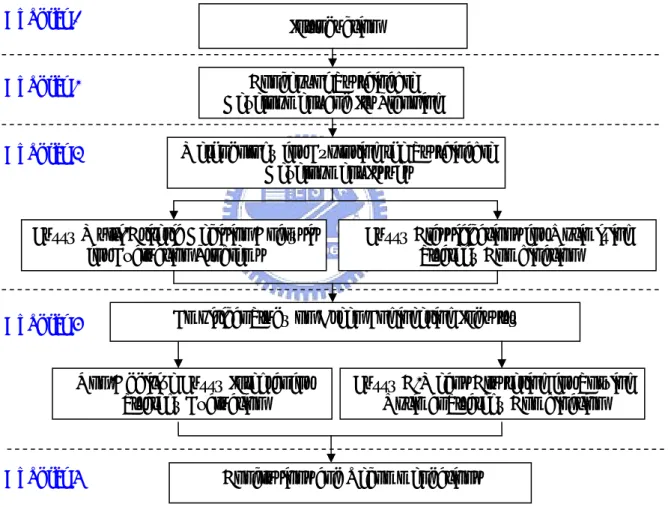
(19) important widely used concepts of fuzzy set theory and multiple criteria decision making methods in Chapter 3. The empirical study on green engineering industry for sustainable development will demonstrate in Chapter 4. In this chapter, fuzzy hierarchical analytic process was applied to assess the weight of considered criteria, and fuzzy integral with simple additive weighting method was then utilized to derive the synthetic value in evaluating process. Furthermore, fuzzy c-means clustering was employed to find the optimal strategy combination. Finally, some concluding remarks, recommendations and future research are given in Chapter 5.. Chapter 1. Introduction. Chapter 2. Concept of Sustainable Development and Its Planning. Chapter 3. Methodology for Exploring the Sustainable Development Issues. Fuzzy Multi-Criteria Decision Analysis for Evaluation Problems. Chapter 4. Fuzzy Classifications for Optimizing Strategy Combination. Empirical Study on Green Engineering Industry. Non-Additive Fuzzy Integral for Strategy Evaluation. Chapter 5. Fig. 1.1. Fuzzy C-Means Clustering for Solving Optimal Strategy Combination. Conclusions and Recommendations. The Research Process and Organization of the Dissertation. 5.
(20) 2. CONCEPT OF SUSTAINABLE DEVELOPMENT AND ITS PLANNING In this chapter we describe the streamline concept of sustainable development and its planning, assessment. We also review related methodology about developing sustainable products and service.. 2.1 Stream of Sustainable Development The World Commission on Environment and Development (WCED, 1987) defined sustainable development as “development that meets the needs of the present without compromising the ability of future generations to meet their own needs”. The fuller definition given by the Brundtland Commission is worth quoting: …Humanity has the ability to make development sustainable — to ensure that it meets the needs of the present without compromising the ability of future generations to meet their needs. The concept of sustainable development does imply limits — not absolute limits, but limitations imposed by the present state of technology and social organization on environmental resources, and by the ability of the biosphere to absorb the effects of human activities. But technology and social organization can be managed and improved to make way for a new era of economic growth … In the end, sustainable development is not a fixed state of harmony, but rather a process of change in which the exploitation of resources, the direction of investments, the orientation of technological development, and institutional change are made consistent with future as well as present needs... At the Earth Summit in 1992, nations extended the above definition and adopted a set of principles to guide future development. The Rio Declaration on Environment and Development defines the rights of people to development, and their responsibilities safeguard the common environment (World Resources Institute, 1986/1994/1995/1996/1997). The Brundtland Commission also laid special emphasis on the multidimensional aspects of sustainable development: There are many dimensions to Sustainability. First, it requires an elimination of poverty and deprivation. Second, it requires the conservation and enhancement of the resources base which alone can ensure that the elimination of poverty is. 6.
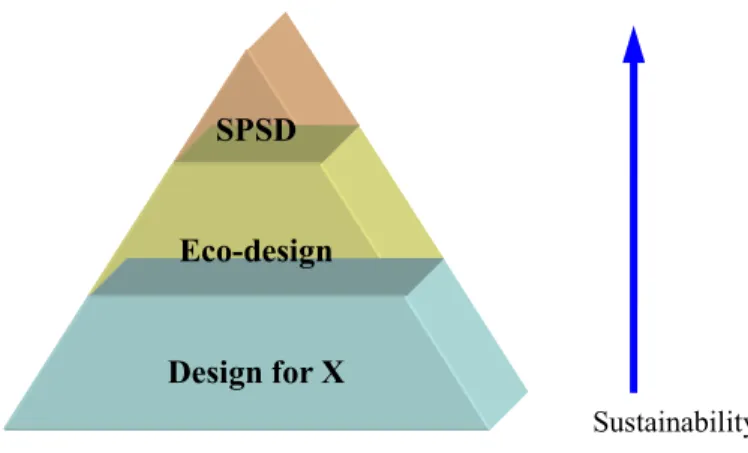
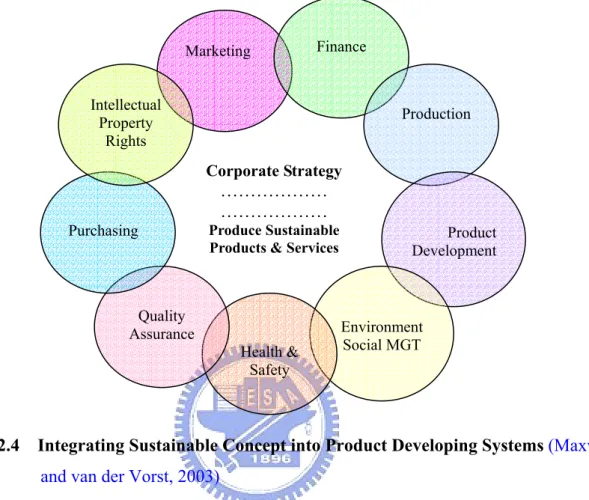
(21) permanent. Third, it requires a broadening of the concept of development so that it covers not only economic growth but also social and cultural development. Fourth, and most important, it requires the unification of economics and ecology in decision making at all levels (Pearce et al., 1989). The introduction of the concept of sustainable development sparked environmental debates and environmentalists became a dominant force in decision-making processes in many countries. Environmental protection bodies have been established with legal powers to approve or disapprove of development projects in a number of countries. Policymakers now have to take into consideration not only the size of GDP but also the quality of life, protection of the environment and preservation of natural resources for future generations. Environmental conditionality is also receiving increased attention from bilateral and international donor agencies, we summarize some important international conventions for sustainable development in Appendix A.. 2.2 Sustainable Development Planning For planning purposes, there are several core concepts that underpin sustainable development (Ghosh et al., 2000). First, indefinite population growth in an environment of limited resources cannot surely be sustained. The need for feeding an ever increasing population might lead to deforestation and salinity and the consequent disruption of the ecological system. As a matter of fact, population growth, combined with the demand for a higher and higher material standard for living, has been the single most important factor in the ecological crisis of the present age. The ecological system in which we live evolved slowly over millions of years. It derives its stability and predictability because of its diversity and complexity. In their desire to maintain an ever-increasing population size, human beings are simplifying the complex ecosystem and creating future uncertainties. Secondly, sustainable development must lead to intergenerational equity. The present generation must not overuse existing resources to adversely affect the potential material living standards of future generations (Siddique, 1997). In this context, it is important that every nation seeks to ensure that its use of renewable resources (such as agricultural methods and technology) is sustainable, and that its exploitation of nonrenewable resources (such as minerals, oil, gas and coal) is geared towards an efficient and optimum intertemporal use (Ghosh, 1977). Thirdly, sustainable development must ensure elimination of poverty and deprivation.. 7.
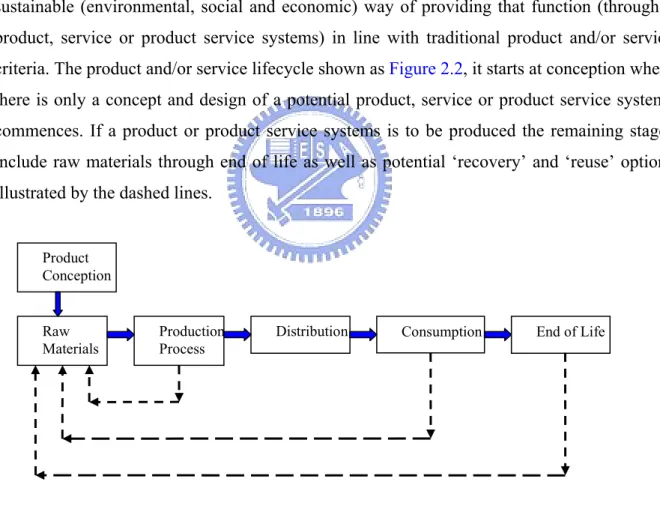
(22) This is very much linked to the distributional aspect of growth and development. If economic growth and development fail to reduce inequality and reduce poverty at national and international levels, sustainability of development will never be achieved. The World Summit for Social Development (1995) rightly observed: We are deeply convinced that economic development, social development, and environmental protection are interdependent and naturally reinforcing components of sustainable development, which is the framework for our efforts to achieve a higher quality of life for all people. Equitable social development recognizes that empowering the poor to utilize environmental resources sustainably is a necessary foundation for sustainable development. We also recognize that broad-based and sustained economic growth in the context of sustainable development is necessary to sustain social development and social justice. The above discussions highlight that sustainability of development is a broader concept that involves multiple criteria. It involves a pattern of economic development that would be compatible with a safe environment, biodiversity, ecological balance, intergenerational and international equity. Incorporation of sustainability into development planning is a precondition for achieving sustainable development. The question is how to incorporate sustainability in development planning? Literature on sustainable development planning is of recent origin, and modeling sustainable development planning depends on the objectives of the planners. In what follows, we present an overview of recent attempts by researchers to model sustainable development planning. Milne (1996) did a comprehensive review of sustainability and points out that “sustainability is about integrating social, economic and ecological values”. However, the author mentioned that there is less agreement in the literature on how sustainability might be operationalized. The author also develops a relationship between sustainability and decision making. Kelly (1998) takes a systems approach to identify information infrastructure to assess the courses of action for sustainable development projects. The author posits that a system approach identifies the key linkages among the sustainable indicators and thus helps in the better implementation of the development projects. Minns (1994) discusses the use of mathematical modeling tools for R&D investment decisions within a sustainable development climate. The author develops a concept called “technology impact profiling”, which includes various sustainable development indicators. Lesser and Zerbe (1995) discuss how a benefit–cost analysis tool can contribute to sustainable planning. The authors make the point that “values” to be used in benefit–cost analysis have to 8.
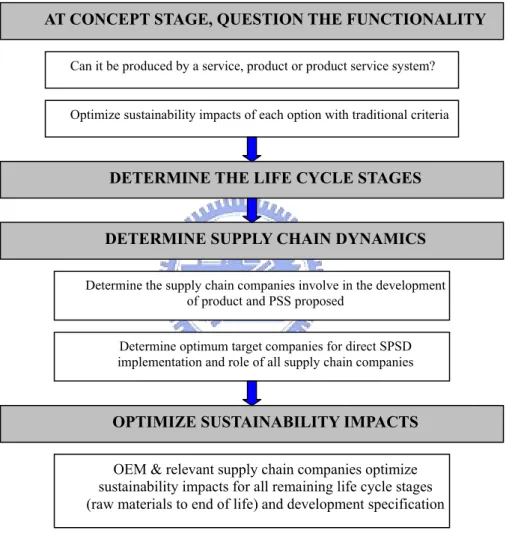
(23) be found based on preferences. Systematic thinking and the need for value trade-off in sustainable planning are highlighted by McDaniels (1994). The author reports an application in Canadian utility planning. Levy et al. (1995) employ the graph model for conflict resolution over groundwater in Cambridge, Ontario (Canada), and show that their model improves “strategic environmental planning by considering multiple participants, each of whom may have multiple objectives to fulfil with respect to a given dispute”. They also claim that by unifying the psychological, social and cultural approaches of risk analysis, management and perception, their model helps to promote a sustainable balance between economic growth and environmental protection. Herkert et al. (1996) argue that technological innovation plays a critical role in the process of sustainable development. They therefore devise an operational knowledge-based decision support tool in order to assist researchers and technology policymakers in structuring and making decisions in the light of sustainable development goals. Slesser and Moffit (1989) use systems dynamics in order to develop an operational model of sustainable development. Their dynamic model consists of several positive and negative feedback loops interconnected by flows of information, material, and energy to produce long-term scenarios of sustainable and nonsustainable development for the nation state. The authors assert that when applied, their dynamic model can maintain both economic development and ecological evolution within the one conceptual framework. It should be noted here that planning sustainable development requires special consideration of the environment since the two are interlinked. Environmental planning is a diverse activity, comprising multiple approaches, and based on a range of options for direct action and indirect influence (Selman, 1999). It involves a rational human activity aimed at taking decisions that optimise welfare, both presently and at some time in the future. The literature also suggests that sustainable development planning is typically undertaken by the highest level planning group of a nation, and interests of the group members play significant roles in shaping the final outcome of the sustainable development plans. The above discussions highlight three important issues of sustainable development planning. These are: (1) consideration of multiple criteria; (2) accommodation of group diversities and (3) the inclusion of group preferences.. 2.3 Sustainable Products and Services Development In response to the shift in environmental policy and law towards products, there are. 9.
(24) increasing legal, market and financial pressures on manufacturing industries to develop sustainable products. For some time, concepts, approaches and tools have been evolving to help industry meet this aim. These include eco-design and sustainable product development. There have been researching industry requirements for developing sustainable products and the ability of existing approaches and tools to meet these requirements. The research has identified a need for mainstream, pragmatic approaches to sustainable product development, as well as, to service development. In response, the sustainable product and service development (SPSD) method is being developed by many researchers in conjunction with industry and practitioners (Maxwell and van der Vorst, 2003). Sustainable product and service development is an evolution of existing sustainable product development approaches in that it incorporates services as well as products and all triple bottom line (TBL) elements. Sustainable product development approaches used in industry to date mainly focus on reducing the environmental impacts of products. This is known as eco-design or design for environment and is well established in research terms and is increasingly seen in innovative product manufacturing companies mainly in the form of eco-design (Gertsakis et al., 1997). There also design for ‘X’ approaches, which have subsets focused on specific areas, e.g. design for disassembly, design for recycling, etc. (Simon et al., 1998). While a number of terms have evolved for this, these approaches all focus to different extents on identifying and reducing or, where possible, eliminating the environmental impacts of a product throughout its life cycle. The sustainable product and service development pyramid is introduced to illustrate the evolution of the design for X (Figure 2.1), eco-design and sustainable product and service development approaches towards sustainability.. SPSD. Eco-design. Design for X Sustainability Product Development Approaches. Figure 2.1. Sustainable Product and Services Pyramid (Maxwell and van der Vorst, 2003) 10.
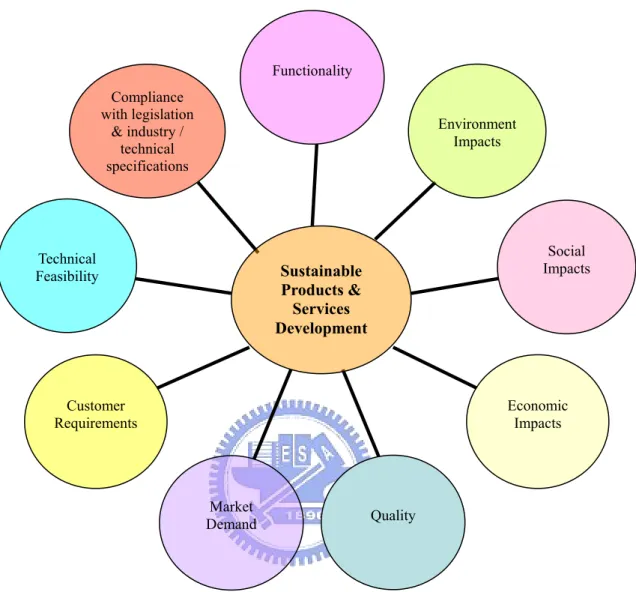
(25) A more sustainable result is likely to be achieved by incorporating the concepts at the top of the pyramid in the sustainable product and service development approach. If these are not incorporated, some of the environmental impacts of the product and/or service proposed may be minimized, but greater opportunities for producing a more sustainable product and/or service may not be realized. The sustainable product and service development method builds on these existing concepts. sustainable product and service development is proposed as a suitable term for the process as it clarifies that the approach is applicable to both products and services as well as incorporating the all-important product service systems (PSS) concept (Reiskin et al., 2000). Sustainable product and service development is about assessing the lifecycle of a function to be provided (from conception to end of life) and determining the optimum sustainable (environmental, social and economic) way of providing that function (through a product, service or product service systems) in line with traditional product and/or service criteria. The product and/or service lifecycle shown as Figure 2.2, it starts at conception where there is only a concept and design of a potential product, service or product service systems commences. If a product or product service systems is to be produced the remaining stages include raw materials through end of life as well as potential ‘recovery’ and ‘reuse’ options illustrated by the dashed lines.. Product Conception. Raw Materials. Figure 2.2. Production Process. Distribution. Consumption. End of Life. Product Life Cycle Stages (Maxwell and van der Vorst, 2003). Sustainable product and service development can also be applied to an existing product and/or service, but ideally at the concept stage before a commitment to producing a product has been made. With only a concept, greater opportunities for the development of a more sustainable solution may be realized especially regarding environment (Hanssen, 1997; Reiskin et al., 2000; Brezet and van Hemel, 1997). Figure 2.3 illustrates the main sustainable 11.
(26) product and service development process steps. Starting at the concept stage, one of the initial steps of sustainable product and service development is to consider how the functional requirement can be met—through a product, a service or some combination of a product service systems and optimizing the sustainability impacts of these options with traditional criteria. The use of sustainable product and service development may result in a product not being produced at all. This is in circumstances where it is more sustainable and feasible to meet the required functionality by the provision of a service.. AT CONCEPT STAGE, QUESTION THE FUNCTIONALITY Can it be produced by a service, product or product service system?. Optimize sustainability impacts of each option with traditional criteria. DETERMINE THE LIFE CYCLE STAGES. DETERMINE SUPPLY CHAIN DYNAMICS Determine the supply chain companies involve in the development of product and PSS proposed Determine optimum target companies for direct SPSD implementation and role of all supply chain companies. OPTIMIZE SUSTAINABILITY IMPACTS OEM & relevant supply chain companies optimize sustainability impacts for all remaining life cycle stages (raw materials to end of life) and development specification. Figure 2.3. Sustainable Product and Service Development Process (Maxwell and van der Vorst, 2003). In practice, complete replacement of a product by a service is difficult to achieve. Some combination of product service systems is a more likely possibility (van Hemel, 1998). Once it has been determined whether a product, service or product service systems to be developed, the next stage is to identify the lifecycle stages and associated supply chain as relevant. A key element of sustainable product and service development is that it focuses on the supply chain. 12.
(27) for the product and/or service rather than solely at an individual company level. The entire supply chain is assessed to determine the most effective target organization(s) in the chain for sustainable product and service development and how the supply chain management can be effectively utilized. Once this is determined, sustainable product and service development implementation can commence at the company level. The next step is to assess the environmental and then social impacts for each product or product service systems life cycle stage from raw materials to end of life. The opportunities for elimination or minimization of these are optimized with the remaining traditional product and service criteria. The specific environmental and social issues to be assessed vary dependant on the product and/or service. To ensure a comprehensive approach, a checklist of typical environmental and social impacts to be considered per lifecycle stage is used. Figure 2.4 illustrates a proposed structure for integrating sustainable development into product developing process. The requirement to produce sustainable products and/or services as relevant is integrated as one element of the existing corporate strategy. From here it is a core business criterion that can be incorporated into all other business functions for overall sustainability performance improvement. In particular, sustainable product and service development should be incorporated within the product development approaches used by the company. Other functions that traditionally feed into product development, e.g. quality, finance, purchasing, etc. will then be incorporated more easily with the sustainability criteria. Further, where a company operates a system to manage their environmental performance, e.g. environmental management system, sustainable product and service development should be imbedded within it. Some multinational corporations that have implemented ecodesign have integrated it into their company’s existing systems for managing their environmental performance. For example, Nike and IKEA have integrated eco-design into their TNS (The Natural Step) approach. Electrolux and Philips include eco-design in their Product Orientated Environmental Management System (POEMS) (Croner, 2000). Overall, by integrating sustainability in the corporate strategy it is set up as a core element necessary for improving business performance rather than a stand alone programme. The optimization of social, ethical and economic issues is not included in eco-design in its present form. If sustainability is the aim, just reducing the environmental impact of a product using an eco-design approach is not enough (Byggeth et al., 2000; van Weenen, 2000; Byggeth and Broman, 2000). In order to effectively integrate sustainability in product and service development, the environmentally superior products initiative uses this integrated 13.
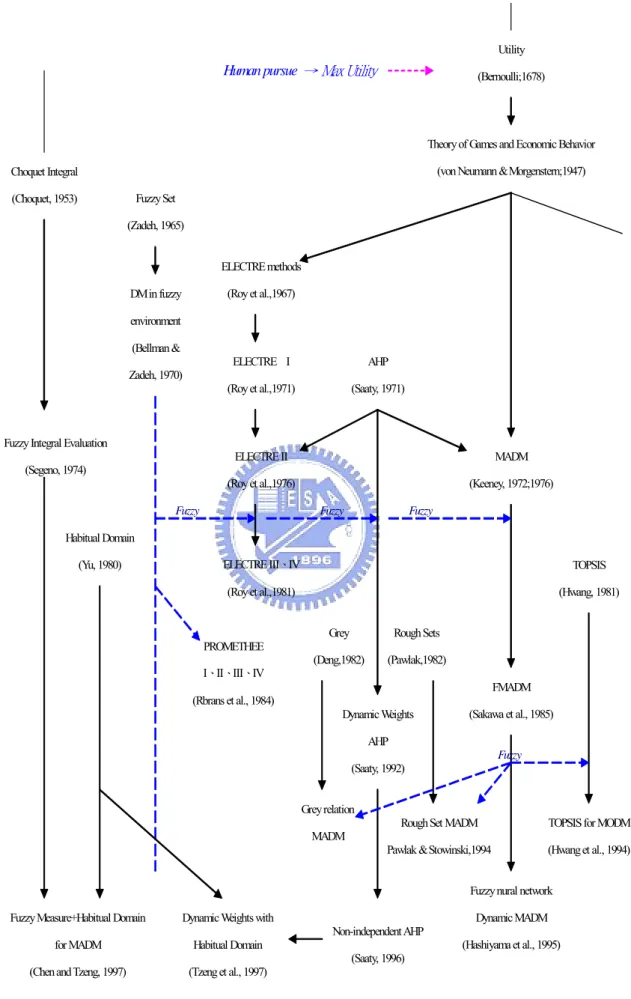
(28) approach and illustrates that optimizing environment with other traditional product criteria works on both an environmental as well as business level for companies.. Finance. Marketing Intellectual Property Rights. Production. Corporate Strategy. ……………… ……………… Purchasing. Produce Sustainable Products & Services. Quality Assurance Health & Safety. Figure 2.4. Product Development. Environment Social MGT. Integrating Sustainable Concept into Product Developing Systems (Maxwell and van der Vorst, 2003). An illustration of the proposed criteria to be optimized in developing sustainable products and services is presented in Figure 2.5. In addition to the traditional product criteria, e.g. economic, quality, market, customer requirements, technical feasibility and compliance issues, the following sustainability criteria have been incorporated: environmental impacts, social impacts and economic impacts. Further, in order to effectively optimize the environmental and social impacts the functionality criterion is included. The functionality and options for product service system are considered at the product conception phase. This incorporates dematerializations, whereby, the material and energy inputs into a product are reduced or replaced completely by an immaterial substitute for complete dematerialization. In reality, it is difficult to achieve complete dematerialization and still achieve the end product function. However, a combination of a product and service approach that reduces the product element is possible and has been achieved to environmental and commercial benefit by some companies. For example, in 2000, Xerox reduced their product material inputs by approximately 72,000 ton with an associated US$ 27 million 14.
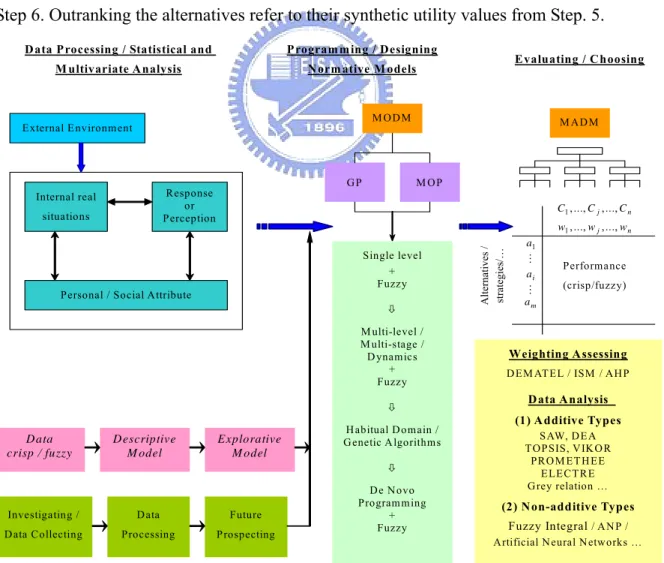
(29) savings (Xerox, 2001).. Functionality Compliance with legislation & industry / technical specifications. Environment Impacts. Technical Feasibility. Social Impacts. Sustainable Products & Services Development. Economic Impacts. Customer Requirements. Market Demand. Figure 2.5. Quality. Criteria for Optimizing Sustainability in Products and Services (Maxwell and van der Vorst, 2003). The product service system approach decouples volume (producing lots of products) from profitability and focuses on the functionality, i.e. producing less product and managing it better as a product service system. Value is based on functionality, not on materials content. The environmental benefits resultant from the product service system approach can include: (1) A reduction in the volume of products produced; (2) Increased dematerializations of product; (3) Reduced waste generation due to the reduced volume of products produced as well as the eco efficiencies introduced into the production process. There are also social impacts associated with product service system. For example the replacement of a product by a service can have implications in terms of employment for 15.
(30) company personnel at many lifecycle stages. To date, industry tends to implement an eco(re)design approach whereby they start with an existing product and reduce its environmental impacts (Charter and Tischner, 2001). With the exception of a minority of companies, the need for a product based on the functionality required and the options for product service system are not generally considered. Leaving this step out may result in the application of environmental improvement measures to a product which is inherently unsustainable, whereas the optimum sustainable solution would have been not to produce a product but say a service, or a combination of both in the first place (van Weenen, 2000; Brezet and van Hemel, 1997). Questioning the requirement for a product and consideration of alternative options to meet a functional requirement is an essential component of sustainable product and service development. This relates to assessing the functionality required and the options for realizing this through a product, a service or a product service system. Overall sustainability as well as business benefits were realized from the environmentally superior products projects. The reduced environmental impacts varied per product and/or service but included dematerializations through a product service system approach as well as a range of eco efficiencies, e.g. (1) reduced volume of raw materials; (2) eliminated and/or reduced hazardous raw materials usage; (3) reduced energy usage; (4) eliminated/reduced waste generation.. 16.
(31) 3. FUZZY MULTI-CRITERIA DECISION ANALYSIS FOR EVALUATION Since Zadeh originally proposed fuzzy set theory (1965), and Bellman and Zadeh (1970) subsequently described the decision-making methods in fuzzy environments, growth of applications of fuzzy set theory and relevant approaches cope with uncertain fuzzy problems. Basically, the elements of decision-making problems consist of goal/objective goal, criteria/factors, alternatives/actions, and so on. Usually, there have many criteria, either quantitative or qualitative or mixed, within processing of analytic and evaluating for decision-making problems. Moreover, it is not unusual for many conflicting criteria to be used, how to assess the importance. of listed criteria (weight) and how to aggregate which. parameters with performance of alternatives (or actions) is the important challenge for the decision maker. In the past, there are many approaches proposed to deal with multiple criteria decision-making problems. Through this chapter we will pay attention to the methods for decision making in fuzzy environment. We give the overview classification of multiple criteria decision making in fuzzy environment in Section 3.1. In the first part of this dissertation will focus on the application of fuzzy multiple criteria decision analysis. For data processing, we firstly introduce fuzzy hierarchical analytic process in section 3.2, some weighting measurements also briefly summarized in this Section. Considering the vagueness or uncertainty under decision making environment, linguistic variables and fuzzy measure will be discussed in Section 3.3. In order to aggregate the group decision in evaluating process, fuzzy integral for aggregating judgment will be described in Section 3.4. In order to determine the preferred order of considered alternatives, defuzzification of fuzzy synthetic judgment will discussed in Section 3.5. In the second part of this dissertation is to utilize fuzzy classification to solve the optimal strategy combination, which algorithm will introduce in Section 3.6. Finally, we will summarize some widely used cluster validity function for fuzzy classification, which validity indice could provide the useful information to determine the critical number of clusters.. 3.1 An Overview of Multiple Criteria Decision Making If we want to know how to achieve the goal or overall objective of target system, for. 17.
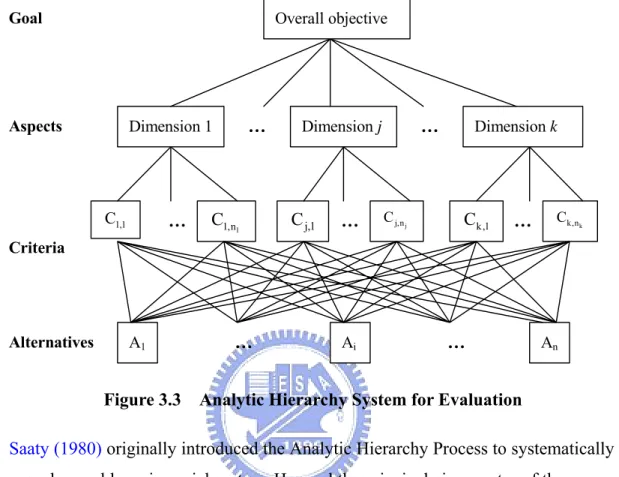
(32) example pursuing the maximum profit and/or minimum cost and/or more higher satisfactory quality of products in manufactory. The first part of our work is that need to figure out how many attributes or criteria and which how to dominate the way of the target system. On the other hand, we need to collect adequate data that reflect the behavior of attributes or criteria taking into account. The more work is to build a set of possible alternatives or strategies in order to guarantee that the goal will reach. Through the efforts as above, next step is to select appropriate method that helps us to evaluate and outrank the possible alternatives or strategies. This is the context of multi-criteria decision-making (MCDM) problems. Furthermore, because of the influence by different personal and social characteristic, the perceive values of decision makers to practical problems are diversified. Then, most of MCDM problems in real world take place in fuzzy environment, which consist of goals, aspects (or dimension), attribute (or criteria), and possible alternatives (or strategies). In addition, Hwang and Yoon (1981) suggest that the MCDM problems can classify into two categories (Figure 3.1): Multiple Attribute Decision Making (MADM), and Multiple Objective Decision Making (MODM). The former applied in evaluation facet, which usually associated with a limited number of predetermined alternatives. The later fitted in design/planning facet, which is to achieve the optimal goals by considering the various interactions within the given constrains. Base on the decision makers or participants may comes form different background, they may have greatly different habits or position, so it is very difficult to express identically those same situations by linguistic variables, this is the fuzzy nature of input/output data in decision-making problems. More precisely speaking, we can classify the MCDM problems in fuzzy environment into two categories to conform nature of fuzzy for real world problems, Fuzzy Multiple Attribute Decision Making (FMADM) and Fuzzy Multiple Objective Decision Making (FMODM). Since Bernoulli (1678) proposed the concept of utility function to reflect human persuading such as maximum satisfactory, and von Neumann and Morgenstern (1947) presented the theory of game and economic behavior model which expanded the studies on human being economic behavior for multiple attribute decision-making problems, from that moment on, more and more literature engaged in this field. On the other hand, Zadeh (1965) presented fuzzy sets theory, and Bellman and Zadeh (1970) were the precursors in applying fuzzy set theory to multiple attribute decision-making problems (see Figure 3.2). There have a great deal of literature and books in this field through last decades, such as Chen and Hwang (1992), Zimmerman (1985; 1987) are good source for fuzzy decision making studies. Since the last two decades, information technology progressing like bamboo shoots after 18.
(33) a spring rain, it push the data process more speedy and efficient. In this dissertation we interpret MADM in Multiple Criteria Decision Analysis (MCDA) to reflect this phenomenon. In addition, Fuzzy Multiple Criteria Decision Analysis (FMCDA) basically comprise two phases (Dubois and Prade, 1980), phase 1 is to aggregate the performance score with respect to each alternative/strategy, then in phase 2 is to rank all alternatives/strategies according to their synthetic value (or utility value) from phase 1. Here we summarize the hierarchical procedure of FMCDA as follows: Step1. Defining the nature of problem; Step 2. Building a hierarchy system for evaluating; Step 3. Selecting the appropriate evaluating method; Step 4. Determining the relative weights and performance score of each attribute with respect to each alternative, both which data may be in crisp and/or fuzzy. Step 5. Calculating the synthetic utility values, which are the aggregation value of relative weights and performance scores corresponding to alternatives; Step 6. Outranking the alternatives refer to their synthetic utility values from Step. 5. D ata Processing / Statistical and. Program m ing / Designing. M ultivariate A nalysis. N orm ative M odels. Evaluating / C hoosing. MODM. External E nvironment. GP. Response or Perception. situations. MOP. C1 , ..., C j , ..., C n w1 , ..., w j , ..., w n Single level + Fuzzy. Personal / Social Attribute. Ø M ulti-level / M ulti-stage / D ynamics + Fuzzy. a1. Alternatives / strategies/…. Internal real. M AD M. ai. D escriptive M odel. Weighting A ssessing D EM AT EL / ISM / AH P. D ata A nalysis (1) A dditive Types. H abitual D omain / G enetic A lgorithm s. Explorative M odel. SAW, D E A TOPSIS, VIK O R PRO M ET H EE ELECT RE G rey relation …. Ø. Investigating /. D ata. Future. D ata Collecting. Processing. Prospecting. Figure 3.1. D e N ovo Program m ing + Fuzzy. (2) N on-additive Types Fuzzy Integral / A N P / Artificial N eural N etworks …. Conceptual Structure of MCDM 19. (crisp/fuzzy). am. Ø. D ata crisp / fuzzy. Performance.
(34) Utility. Human pursue → Max Utility. (Bernoulli;1678). Theory of Games and Economic Behavior (von Neumann & Morgenstern;1947). Choquet Integral Fuzzy Set. (Choquet, 1953). (Zadeh, 1965). ELECTRE methods (Roy et al.,1967). DM in fuzzy environment (Bellman & Zadeh, 1970). ELECTRE I. AHP. (Roy et al.,1971). (Saaty, 1971). Fuzzy Integral Evaluation (Segeno, 1974). ELECTRE II. MADM. (Roy et al.,1976). (Keeney, 1972;1976). Fuzzy. Fuzzy. Fuzzy. Habitual Domain (Yu, 1980). ELECTRE III、IV. TOPSIS. (Roy et al.,1981). (Hwang, 1981). PROMETHEE I、II、III、IV. Grey. Rough Sets. (Deng,1982). (Pawlak,1982). FMADM. (Rbrans et al., 1984). Dynamic Weights. (Sakawa et al., 1985). AHP Fuzzy. (Saaty, 1992) Grey relation MADM. Rough Set MADM. TOPSIS for MODM. Pawlak & Stowinski,1994. (Hwang et al., 1994). Fuzzy nural network. Fuzzy Measure+Habitual Domain. Dynamic MADM. Dynamic Weights with. Non-independent AHP. for MADM. Habitual Domain. (Chen and Tzeng, 1997). (Tzeng et al., 1997). (Hashiyama et al., 1995). (Saaty, 1996). Figure 3.2 Development of Multiple Attribute Decision Making 20.
(35) 3.2 Fuzzy Analytic Hierarchy Process In real MCDM problems, it is necessary to divide the process into distinct stages. Firstly, based on a general problem statement, the various stakeholders are defined, typically including the decision-makers, various interest groups affected by the decision, experts in the appropriate fields, as well as planners and analysts responsible for the preparations and managing the process. The overall objective will be set up in this stage. Secondly, based on various points of view from stakeholders, the problems can be categorized into distinct aspects. Thirdly, defining alternatives/strategies and criteria, a discrete MCDM problem consisting of a finite set of alternatives/strategies can be evaluated in terms of multicriteria. Finally, choosing a suitable method to measure the criteria can help the evaluators and analysts to process the evaluating cases. 3.2.1. Building a hierarchical system for evaluation Analytic Hierarchy Process (AHP) is a popular technique often used to model subjective. decision-making processes based on multiple attributes (Saaty 1977; 1980). From that moment on, it is being widely used in corporate planning, portfolio selection, and benefit/cost analysis by government agencies for resource allocation purposes. And it is being used more widely on an international scale for planning infrastructure in developing countries and for evaluating natural resources for investment. When all the aspects for consideration have been set up, the final set of criteria should meet the following requirements (1)Completeness; (2)Operationality; (3)Nonredundancy; (4)Minimality (Keeney and Raiffa, 1976 ). In this study, we firstly establish a hierarchy system for analysis and evaluation through scenario writing and brainstorming. Phase 1 includes our overall objectives. Secondly, we consider related aspects for achieving goals in Phase 2. Thirdly, list considered in Phase 3. All considered criteria measured by evaluators, consisting of individuals with different viewpoints. Finally, the alternatives/strategies will listed in Phase 4 (Figure 3.3). 3.2.2. Determining the evaluated criteria weights Because the evaluation of criteria entails diverse and meanings, we cannot assume that. each evaluation criterion is of equal importance. There are many methods that can be employed to determine weights (Hwang and Yoon, 1981), such as the eigenvector method, weighted least square method, entropy method, AHP, DEMATEL (Gabus & Fontela, 1972, 1973; Tamura et al, 2002), as well as linear programming techniques for multidimension of 21.
(36) analysis preference (LINMAP). The selection of method depends on the nature of the problems to express the preference relation of perception from evaluators. In this section, we introduce a revised AHP method to assess the weights of criteria for our study. Goal. Overall objective. Aspects. …. Dimension 1. C1,1. …. C1,n1. …. Dimension j. C j,1. …. C j,n j. Dimension k. Ck,1. …. Ck,n k. Criteria. Alternatives. A1. …. Ai. …. An. Figure 3.3 Analytic Hierarchy System for Evaluation Saaty (1980) originally introduced the Analytic Hierarchy Process to systematically cope with complex problems in social system. He used the principal eigenvector of the comparison matrix to find the comparative weight among the criteria of the hierarchy systems. If we wish to compare a set of n criteria pairwise according to their relative importance (weights), then denote the criteria by C1 , C 2 ,..., C n and their weights by w1 , w2 ,..., wn . If w = ( w1 , w2 ,..., wn )T is given, the pairwise comparisons may be represented by matrix A of the following formulation: ( A − λmax I ) w = 0. (3.1). Eqs.(3.1) denotes that A is the positive reciprocal matrix of pairwise comparison values derived by intuitive judgment for ranking order. In order to derive the priority eigenvector, we must find the eigenvector w with respective λ max which satisfies Aw = λ max w . Saaty (1980) suggested the consistency index ( C.I. = ( λmax − n ) ( n − 1) ) to test the consistency of the intuitive judgment. In general, a value of C.I. is less than 0.1 is satisfactory (i.e. C.I. ≤ 0.1) . The procedure for AHP can be summarized in four steps, as follows: Step 1. Set up the decision system by decomposing the problem into a hierarchy of 22.
(37) interrelated elements. Step 2. Generate input data consisting of pairwise comparative judge of decision elements. Step 3. Synthesize the judgment and estimate the relative weight. Step 4. Determine the aggregating weights of the decision elements to arrive at a set of ratings for the alternatives/strategies. Besides Saaty’s method to aggregate the relative weights by participating evaluators, Buckley (1985b) proposed geometric mean method to calculate the final fuzzy weights for each fuzzy matrix. Given a m × m positive reciprocal matrix A = [aij ] is derived by 1/ m. ⎛ m ⎞ pairwise comparison from m participating evaluators, then ri = ⎜ ∏ aij ⎟ ⎝ j =1 ⎠. represents the. geometric mean of each raw. According to Saaty’s definition, λmax be the largest eigenvalue of A and the weights, wi as the components of the normalized eigenvector corresponding to λ max , where wi = ri (r1 + ⋅ ⋅ ⋅ + rm ) . Buckley (1985b) further considered a fuzzy positive reciprocal matrix A = [aij ] , extending the geometric mean method to the fuzzy geometric mean method and exploited which to find the final fuzzy weights of each criterion as follows ri = (ai1 ⊗ ai 2 ⊗. ⊗ aim )1/ m and wi = ri ⊗ ( r1 ⊕ r1 ⊕. ⊕ rm ). −1. (3.2). where ⊕ and ⊗ called additive and multiplicative operators of two fuzzy number, respectively. These arithemetic operations will describe in next section. 3.2.3 Driving the fuzzy performance score and fuzzy synthetic value. The evaluators choose a performance score for each participating company based on their subjective judgments. This way of estimating the achievement level of each criterion on each strategy can use the methods of fuzzy theory for treating the fuzzy environment. In evaluating process, after well define the criteria and their relationship, we have to determine the weights or measure of these criteria, and obtain then performance score of each alternative with respect to evaluated criteria. Furthermore, choose an suitable aggregateing operator to derive the synthetic value of these alternatives respectively, the final step is to assign the preferred order for all alternatives based on their synthetic values. In general case, we can employ triangular fuzzy number to express the aggregated fuzzy weights of j-th criterion as follows: wi = ( li ,mi ,ui ). (3.3) 23.
(38) where wi is derived by Eqs.(3.2). It can be assumed that evaluation expert k has his fuzzy performance score of Eijk for the criteria j under alternative i, and all the items to be evaluated is defined in feasible set S. Eijk = ( LEijk , MEijk ,UEijk ) , j ∈ S. (3.4). Each expert may has his different academic and business careers, so as his objective understanding on the linguistic variables. This study utilize the average number to integrate the fuzzy judgment values given by m experts. That is, Eij express the average fuzzy judgment given by the participated evaluators. Its triangular fuzzy number is shown below: Eij = ( LEij , MEij ,UEij ) , j ∈ S. (3.5). where. (. Eij = (1/ m ) ⊗ Eij1 ⊕. ⊕ Eijm. ). Specifically, Eij can be calculated by Buckley (1985a): ⎛ m ⎞ ⎛ m ⎞ ⎛ m ⎞ LEij = (1/ m ) × ⎜ ∑ LEijk ⎟ ; MEij = (1/ m ) × ⎜ ∑ MEijk ⎟ ; UEij = (1/ m ) × ⎜ ∑ UEijk ⎟ ⎝ k =1 ⎠ ⎝ k =1 ⎠ ⎝ k =1 ⎠ Moreover, the fuzzy synthetic matrix R can then be developed from both fuzzy weighting vector and fuzzy performance matrix as following:. R=w ⇔ E. (3.6). where. w = ( w1 ,. , wj ,. wn ) ; E = ⎡⎣ Eij ⎤⎦ t. “⇔” in Eqs.(3.6) indicates the aggregating operator of fuzzy weighting vector and fuzzy performance matrix. How to assess the measure of evaluated criteria is the critical process. In traditional evaluation methods such as Analytic Hierarchy Process, ELECTRE, PROMETHEE, TOPSIS, VIKOR and Grey Relation Analysis, assume definitely mutually independent between each pair criteria, and the simple additive weighted (SAW) method is appropriately to aggregate the synthetic value from criteria weights with performance scores. However, in most of MCDM problems, dependence or feedback may exist in evaluating structure. This independent relationship can not satisfy the nature of real situations. we can not employ SAW to derive the synthetic values if the relationship among these criteria are not independent, then the other aggregating tools is more suitable. For instance, fuzzy integral will provide 24.
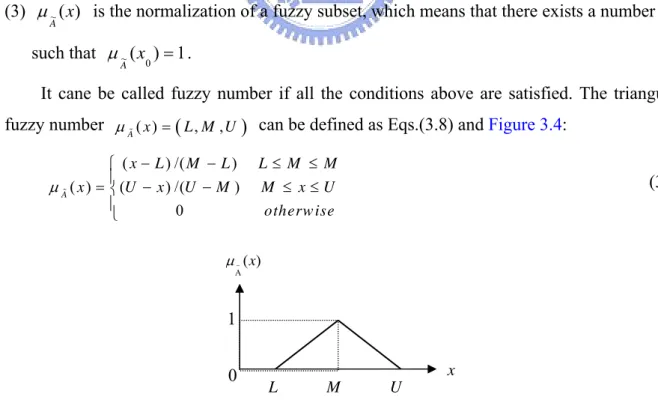
(39) appropriate estimate of synthetic values while in dependent situation; Analytic Network Process (ANP) can be applied to estimate the synthetic values while in the situation of feedback exists in considered dimension with its lower level of hierarch system, i.e. criteria. Finally, the final fuzzy synthetic judgment of individual alternative for j evaluated criteria can be illustrated as follows:. Ri = ( LRi , MRi ,URi ) ∀i. (3.7). where n. n. n. j =1. j =1. j =1. LRi = ∑ l j ⋅ LEij ; MRi = ∑ m j ⋅ MEij ; URi = ∑ u j ⋅ UEij. 3.3 Linguistic Variables in Fuzzy Decision Making Environment ~ According to Dubois and Prade (1978), a fuzzy number A is a fuzzy subset of a real number, and its membership function is µ ~ ( x) : R → [0,1] , where x represents the criteria, A. and is described by enshrined with the following characteristics: (1) µ ~ ( x) is a continuous mapping from R to the closed interval [0,1]. A. (2) µ ~ ( x) is a convex fuzzy subset. A. (3) µ ~ ( x) is the normalization of a fuzzy subset, which means that there exists a number x0 A. such that µ ~ ( x0 ) = 1 . A. It cane be called fuzzy number if all the conditions above are satisfied. The triangular fuzzy number µ A ( x ) = ( L , M , U ) can be defined as Eqs.(3.8) and Figure 3.4: ⎧ ( x − L ) /( M − L ) ⎪ µ A ( x ) = ⎨ (U − x ) /(U − M ) ⎪ 0 ⎩. L≤M ≤M. (3.8). M ≤ x≤U otherw ise. µ ( x) ~. Α. 1 0. x L. M. U. Figure 3.4 Membership Function of Triangular Fuzzy Number. 25.
(40) According to the extension principle of triangular fuzzy numbers put forward by Zadeh ~ (1975), the arithmetic operations of two triangular fuzzy numbers A = (a1 , a 2 , a3 ) and. ~ B = (b1 , b2 , b3 ) can be expressed as follows: (1) Addition of two fuzzy numbers ⊕ ( a1 , a 2 , a 3 ) ⊕ (b1 , b 2 , b3 ) = ( a1 + b1 , a 2 + b 2 , a 3 + b 3 ). (3.9). (2) Subtraction of two fuzzy numbers Θ. ( a1 , a 2 a 3 ) Θ (b1 , b2 , b3 ) = ( a1 − b3 , a 2 − b2 , a 3 − b1 ). (3.10). (3) Multiplication of two fuzzy numbers ⊗. ( a1 , a 2 , a 3 ) ⊗ ( b1 , b 2 , b3 ) ≅ ( a1b1 , a 2 b 2 , a 3 b3 ). (3.11). (4) Multiplication of any real number k and a fuzzy number. k. ( a1 , a 2 , a 3 ) = ( ka1 , ka 2 , ka 3 ). (3.12). (5) Division of two fuzzy numbers ∆ ( a 1 , a 2 , a 3 ) ∆ ( b1 , b 2 , b 3 ) ≅ ( a 1 / b 3 , a 2 / b 2 , a 3 / b1 ) w h e re b1 ≠ 0 , b 2 ≠ 0 , b 3 ≠ 0. (3.13). On the other hand, the concept of linguistic variables is fundamental within fuzzy set theory. In formally, a linguistic variable is a variable whose values are words or sentences rather than numbers. For instance, when we refer to environmental conditions, we may express our observations by statement like warm place or, clean and green place or, very wild and quite cute place, and so on. The state of being warm could be translated by the variable temperature, with values in a set such as the interval 0 − 50 o C . Alternatively, temperature. could be quantified using labels such as cold, warm, hot. Clearly, a precise numerical value such as 25 o C seems simpler than the ill-defined term warm. But the linguistic label warm is a choice of one out of three possible values, whereas 25 o C is a choice of one out of many, perhaps, in the entire 0 − 50 o C range. Linguistic characterizations are, in general, less specific than numerical, but it would certainly be much safer, unless one actually knew the exact temperature, to state that an environment temperature is warm than that is 25 o C . The statement could be strengthened if the underlying meaning of warm is conceived as around 25 o C . In this setting, whereas the numerical value 25 can be visualized as a point in a set, the linguistic value warm can be viewed as a collection of objects (temperatures) within a bounded region whose center is at 25. the situation with the state of being clean and green or very wild and quite cute is more complex, because the scale involved in their quantification is. quite subjective, and is not natural to translate them into numerical values. But they do. 26.
數據
+7
相關文件
目標 目標 策略 策略 策略 策略 成功準則 成功準則 成功準則 成功準則 評估方法 評估方法 評估方法 評估方法 時間 時間 時間 時間. 表 表
Key words: theory of the nature of the mind, the Buddha nature, one who possesses a gotra, non-resultant activity which is neither positive nor negative and is able
目標 策略 策略 策略 策略 成功準則 成功準則 成功準則 成功準則 評估方法 評估方法 評估方法 評估方法 時間表 時間表 時間表 時間表 負責人 負責人 負責人 負責人
Keywords: pattern classification, FRBCS, fuzzy GBML, fuzzy model, genetic algorithm... 第一章
The Prajñāpāramitā-hṛdaya-sūtra (般若波羅蜜多心經) is not one of the Vijñānavāda's texts, but Kuei-chi (窺基) in his PPHV (般若波羅蜜多心經 幽賛) explains its
Biases in Pricing Continuously Monitored Options with Monte Carlo (continued).. • If all of the sampled prices are below the barrier, this sample path pays max(S(t n ) −
蔣松原,1998,應用 應用 應用 應用模糊理論 模糊理論 模糊理論
本研究將針對 TFT-LCD 產業研發單位主管與研發人員進行 探討,並就主管於研發人員對職能重視程度作差異性分析。因此
