國 立 交 通 大 學
經營管理研究所
博 士 論 文
No. 132
台灣「公平貿易」商品購買意願架構之研究-
探討消費者倫理、網路資訊、及信任的角色
A Framework for Fair Trade Products Purchasing
Intention in Taiwan – The Roles of Consumer
Ethics, Online Information, and Trust
研 究 生:蕭君華
指導教授:楊 千 教授
台灣「公平貿易」商品購買意願架構之研究-
探討消費者倫理、網路資訊、及信任的角色
A Framework of Fair Trade Products Purchasing
Intention in Taiwan – The Roles of Consumer
Ethics, Online Information, and Trust
研 究 生:蕭君華
Student: Chun-Hua Hsiao
指導教授:楊 千 教授 Advisor: Chyan Yang
國 立 交 通 大 學
經 營 管 理 研 究 所
博 士 論 文
A Dissertation
Submitted to the Institute of Business and Management College of Management
National Chiao Tung University in Partial Fulfillment of the Requirements
for the Degree of Doctor of Philosophy
in
Business and Management June, 2010
Taipei, Taiwan, Republic of China
台灣公平貿易商品購買意願架構之研究-
探討消費者倫理、網路資訊、及信任的角色
研究生:蕭君華
指導教授:楊 千 教授
國立交通大學經營管理研究所博士班
摘
要
雖然國際公平貿易組織的存在已經超過四十年了,而且公平貿易商品的銷售近年 來在全球市場有大幅成長;但是在台灣,有關公平貿易的議題,無論在商業上還是學 術上,得到的關注並不多。本研究嘗試藉由提出一個公平貿易商品購買意願的模式, 來彌補這些不足之處。本文針對個人因素,如消費者倫理及態度對購買意願的影響進 行檢驗。其次,網路因素例如網路資訊、信任、及資訊分享也納入探討。 受試者為分別來自北、中、南三所大學的商學院學生,學生受邀瀏覽一個關於公 平貿易的網站。看完三分鐘的影片後,隨即填寫網路問卷,並經由網路收集問卷資料。 結果共有215 份填答完整的問卷,用以進行後續分析。研究結果發現,消費者倫理、 網路資訊對態度、和信任有正向的影響,而後兩者又對資訊分享及購買意願有影響, 除了信任對購買意願沒有顯著影響。此外,本研究也針對態度和信任的中介效果進行 調查。最後,對實務界和政府建議,及未來研究發展也納入討論。 關鍵詞:公平貿易、消費者倫理、網路資訊、信任A Framework of Fair Trade Products Purchasing
Intention in Taiwan – The Roles of Consumer Ethics,
Online Information, and Trust
Student: Chun-Hua Hsiao
Advisor: Dr. Chyan Yang
Institute of Business and Management
National Chiao Tung University
ABSTRACT
Although ―Fair Trade‖ organizations have existed for more than 40 years and its sales have increased remarkably recently in the global market, the issue of Fair Trade in both business and academia has received little attention in Taiwan. This study seeks to remedy this deficit by providing a framework of purchase intention on Fair Trade products. The effects of personal factors such as consumer ethics and attitude on purchase intention were investigated. Moreover, the roles of internet factors such as online information, trust, and information sharing are also examined.
Research subjects are business college students from three universities each located in north, central, and south Taiwan, respectively. Respondents were requested to visit a website related to FT information. After viewing a three-minute film, an online survey was presented and data was collected through internet. As a result, a total of 215 complete questionnaires were used for subsequent analyses. The finding of this study indicated that consumer ethics and online information had a positive effect on attitude and trust, which, in
turn, had an impact on both information sharing and purchase intention, except for the impact of trust on the latter. The mediation effect of attitude and trust were also put into investigation. Implications for practitioners and governments were discussed, and suggestions for future researches were offered.
致謝
碩士班畢業多年,一直安分守己,倒也自得其樂。某天突發奇想,想進入博士 班的世界遨遊,就這樣一頭栽進交大經管所就讀,一晃眼四年過去了。這篇博士論文 得以順利的完成,承蒙我的指導教授楊千老師,研究指導委員丁承老師、胡均立老師、 及林介鵬老師的寶貴意見,因此謹致上本人最深的謝意。另外,對我生命中其他的貴 人們,也致以最高的感恩。 首先要感謝的就是我的指導教授-楊千老師。楊老師是一位很有智慧、很有視野的學 者,總能在最關鍵的時刻、給予最關鍵的意見,不僅是在學術上,在生活及其他領域上,總 能領受到老師帶點幽默、又有智慧的言語,感謝 上帝給我一輩子的恩師。另外,感謝交大 的老師們,丁承老師、胡均立老師、金奉天老師等,非常感謝你們認真的教學態度,使我獲 益良多。 感謝我的同事劉顯仲博士,若不是他非常熱心的鼓勵我來報考,並且幫我買博士班簡 章,我可能不會來交大就讀博士班。其次,要感謝我的同學們,秀貴姐、薰瑤、少娟、娟娟 等,若是沒有你們和我一起修課的話,我在交大的生活,不會過的這麼快樂。特別是秀貴姐, 常常提醒我要交作業。另位,要感謝凱喻學長和耿杰學長,感謝他們對共引文方法的鑽研, 以及不吝於藏私,使我共引文的文章能夠順利刊登。 感謝我親愛的小組長夫婦-彭鏡禧院長及燕生姐,還有其他的小組姊妹瑛琇、德賢、文 靜、敏之等,在我讀博士班期間,對我的關懷及不斷付出的禱告,使我能順利的畢業。 感謝我親愛的家人,我的爸爸媽媽-蕭守冰及蕭陳英美,對我不求回報的愛,我的兩位 姊姊-秋萍及文穗,及弟弟明奇給我的支持,我可愛的侄女及姪子-鈴玲、人豪,雖然帶給 我不少麻煩,但也是我唸書期間,不可缺少的調劑品。 最後,最要感謝的就是我的 上帝。感謝主對我的帶領,讓我能遇到這麼多的良師、益 友,而且總能在我的研究遇到瓶頸時,很快的帶領我找到答案,並且給我一段充實又愉快的 博士班讀書生涯。 蕭君華 民國九十九年七月TABLE OF CONTENTS
摘 要 ... i
ABSTRACT ... ii
TABLE OF CONTENTS ... v
List of Tables ... vi
List of Figures ... vii
Chapter 1. Introduction ... 1
1.1. Research background ... 1
1.2. Research objectives ... 6
1.3. Research question ... 7
1.4. Research flow ... 8
Chapter 2. Literature Review ... 10
2.1. Theory of Reasoned Action and Theory of Planned Behavior ... 10
2.2. Consumer ethics ... 12
2.3. Online information ... 14
2.4. Trust ... 16
Chapter 3. Research Method ... 19
3.1. Research framework and hypotheses ... 19
3.2. Operational definitions of variables ... 25
3.3. Questionnaire design ... 28
3.4. Research subjects and data collection ... 30
3.5. Analysis method ... 30
Chapter 4. Data Analysis ... 32
4.1. Data description ... 32
4.2. Measurement model analysis ... 34
4.3. Structural model analysis ... 37
4.4. Testing for mediation ... 39
Chapter 5. Discussion ... 43
5.1. Conclusion ... 43
5.2. Managerial implications ... 45
5.3. Limitations and future research ... 47
Reference ... 49
Measure of constructs ... 58
List of Tables
Table 1.1 Sales in volume and retail value by product ... 4
Table 1.2 Sales in volume and retail value by nation ... 5
Table 3.1 Measurement items for consumer ethics construct ... 25
Table 3.2 Measurement items for online information construct ... 26
Table 3.3 Measurement items for attitude construct ... 27
Table 3.4 Measurement items for trust construct ... 27
Table 3.5 Measurement items for information sharing construct ... 27
Table 3.6 Measurement items for purchase intention construct ... 28
Table 4.1 Characteristics of the sample ... 33
Table 4.2 Standardized loadings and reliability ... 36
Table 4.3 Chi-square difference tests ... 36
Table 4.4 Means, standard deviations, and correlations ... 37
Table 4.5 Path coefficients and t values ... 38
Table 4.6 Analysis of mediation effects ... 40
Table 4.7 Analysis of indirect effects ... 41
List of Figures
Figure 1.1 Research flow ... 9
Figure 3.1 Proposed model ... 20
Figure 4.1 Result of the proposed model ... 38
Chapter 1. Introduction
1.1. Research background
Global corporate scandals such as Enron and Worldcom have led to an assessment of business ethics and corporate social responsibility (Kline, 2006). These events have also caused the interest of academic and business organizations to enhance marketing ethics. Early marketing ethics theories focused on ethical practices within the areas of marketing research, marketing management, sales, advertising and social marketing (Ferrell and Gresham, 1985; Hunt and Vitell, 2006). However, there was a lack of attention on the buyer side ethics, i.e., consumer ethics, a representative of both within business and marketing ethics (Bateman et al., 2002; Vitell et al., 2001).
Consumer ethics has been defined as the ―rightness as opposed to the wrongness of certain actions on the part of the buyer or potential buyer in consumer situations‖ (Dodge et al., 1996). Examples of unethical behaviors include credit misuse and abuse, purchase of illegal products, misuse of products, fraudulent merchandise returns or requests for warranty service, purchase of counterfeit products, and shoplifting (Fullerton and Punj, 1993). On the other hand, buying environmentally friendly and fairly traded products are two of the most typical examples of ethical buying behaviors (Shaw et al., 2005; Shaw and Newholm, 2002; Shaw and Shiu, 2002).
In essence, Fair Trade (FT) means buying products from producers in developing countries with ―fair price‖ (Bird and Hughes, 1997). The term ―fair price‖ means a price that is higher than would be the case in a free-market situation. It contains a social premium
middlemen who obtain most of the mark-up between producer and consumer. Therefore, Fair Trade can provide better trading conditions for producers and raise awareness among consumers to exercise their purchasing power by means of ethical consumption. In this way, Fair Trade ensures product trade under co-operative rather than competitive trading principles, promising a fair price and fair working conditions for producers (Bird and Hughes, 1997; Shaw and Shiu, 2003). The major goals of Fair Trade are as follows (Redfern and Snedker, 2002):
1. To improve the livelihoods and well-being of producers by improving market access, strengthening producer organizations, paying a better price and providing continuity in the trading relationship.
2. To promote development opportunities for disadvantaged producers, especially women and indigenous people, and to protect children from exploitation in the production process.
3. To raise awareness among consumers of the negative effects on producers of international trade so that they exercise their purchasing power positively.
4. To set an example of partnership in trade through dialogue, transparency and respect.
5. To campaign for changes in the rules and practice of conventional international trade.
6. To protect human rights by promoting social justice, sound environmental practices and economic security.
Global Fair Trade sales have soared over the past decade. It is the Fair Trade‘s new global strategy to emphasize the aim of empowering producers to improve their own lives. Therefore, marginalized farming communities throughout the world benefit from Fair Trade
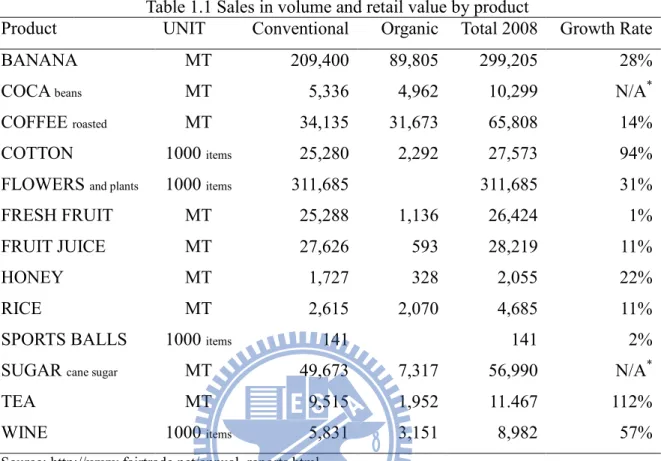
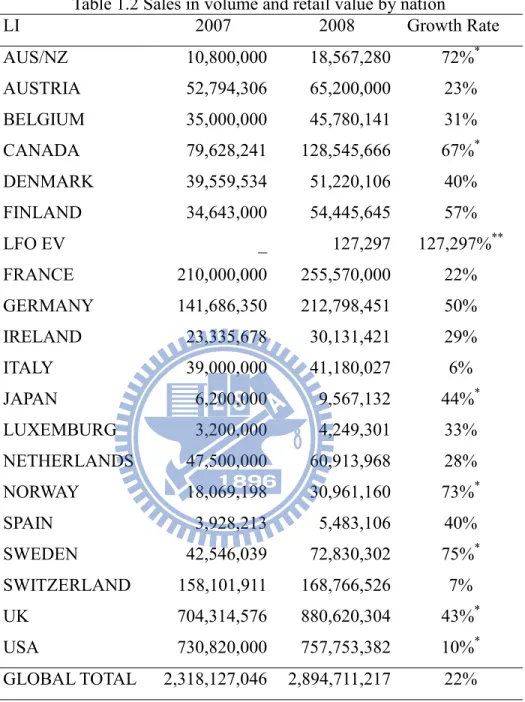
conditions. According to the 2008-09 annual report of Fairtrade Labelling Organizations International (FLO)1, there were 746 certified Fair Trade producers worldwide and over 6,000 Fair Trade certified products available to consumers by the end of 2008. For example, sales of bananas grew by 28% to almost 300,000 metric tons, sales of tea doubled, and sales of cotton almost doubled. More detailed items and figures are listed in Table 1.1. The sales grew at least 20% in many countries, seven of them outgrowing by 50% or more: Australia/New Zealand, Finland, Canada, Denmark, Norway, Sweden, and Germany (as seen in Table 1.2).
1 The Fairtrade Labelling Organizations International (FLO), created in 1997, is an
association of three producer networks and twenty national labeling initiatives that promote and market the Fair Trade Certification Mark in their countries. The FLO labeling system is the largest and most widely recognized standard-setting and certification body for labeled
Table 1.1 Sales in volume and retail value by product
Product UNIT Conventional Organic Total 2008 Growth Rate
BANANA MT 209,400 89,805 299,205 28%
COCA beans MT 5,336 4,962 10,299 N/A*
COFFEE roasted MT 34,135 31,673 65,808 14%
COTTON 1000 items 25,280 2,292 27,573 94%
FLOWERS and plants 1000 items 311,685 311,685 31%
FRESH FRUIT MT 25,288 1,136 26,424 1%
FRUIT JUICE MT 27,626 593 28,219 11%
HONEY MT 1,727 328 2,055 22%
RICE MT 2,615 2,070 4,685 11%
SPORTS BALLS 1000 items 141 141 2%
SUGAR cane sugar MT 49,673 7,317 56,990 N/A*
TEA MT 9,515 1,952 11.467 112%
WINE 1000 items 5,831 3,151 8,982 57%
Source: http://www.fairtrade.net/annual_reports.html
Table 1.2 Sales in volume and retail value by nation LI 2007 2008 Growth Rate AUS/NZ 10,800,000 18,567,280 72%* AUSTRIA 52,794,306 65,200,000 23% BELGIUM 35,000,000 45,780,141 31% CANADA 79,628,241 128,545,666 67%* DENMARK 39,559,534 51,220,106 40% FINLAND 34,643,000 54,445,645 57% LFO EV _ 127,297 127,297%** FRANCE 210,000,000 255,570,000 22% GERMANY 141,686,350 212,798,451 50% IRELAND 23,335,678 30,131,421 29% ITALY 39,000,000 41,180,027 6% JAPAN 6,200,000 9,567,132 44%* LUXEMBURG 3,200,000 4,249,301 33% NETHERLANDS 47,500,000 60,913,968 28% NORWAY 18,069,198 30,961,160 73%* SPAIN 3,928,213 5,483,106 40% SWEDEN 42,546,039 72,830,302 75%* SWITZERLAND 158,101,911 168,766,526 7% UK 704,314,576 880,620,304 43%* USA 730,820,000 757,753,382 10%* GLOBAL TOTAL 2,318,127,046 2,894,711,217 22% Source: http://www.fairtrade.net/annual_reports.html Unit: EUR
* These growth rates are based on the percentage increase as reported in the local currency, not on the value converted into Euros.
** Whole-sale value of all other countries.
phenomenon suggests a great potential for the development of FT movement in Taiwan. ökogreen (Eco-Green), the first shop licensed by FLO among the Chinese region in 2007, launched a website and blog to promote its core value (―Must Be Fair‖) and provide information regarding Fair Trade. Thus, by consulting the website, consumers can easily access information that might otherwise remain unknown to them.
Despite the substantial growth of the Fair Trade movement and of consumption around the world, there have been few studies on how consumers process their purchasing decisions regarding Fair Trade products. In Taiwan, neither are there many consumers aware of Fair Trade, nor are their purchase intentions toward Fair Trade commodities understood. It is the interest of this study to explore the influential factors of purchasing regarding FT. Also, the Internet has proven an effective communication mechanism on the transmission and reproduction of information. Therefore, the role of the Internet on information transmission is also investigated together with consumers‘ trust of the information source (i.e. website).
In sum, the aim of this study is to present a framework for purchase intention toward Fair Trade products in Taiwan. Implications for academic research and related industries in practice are also offered.
1.2. Research objectives
Fair Trade is having a growing impact on mainstream businesses, many of which are becoming increasingly concerned about ethical issues. So far, there has been little empirical research regarding Fair Trade consumption since it is an emerging field within the areas of marketing research. And even less is known about fair trade buying behavior in Taiwan and
its influential factors. This study seeks to help remedy this deficiency by exploring some individual factors affecting fair trade purchasing decisions such as consumer ethical beliefs and attitudes.
Moreover, the roles of online information and trust of information sources are also taken into account since the Internet has been regarded as an effective communication medium to obtain and spread information. So the purpose of this study is to examine the relationships among antecedents of consumers‘ purchase intention toward Fair Trade products in Taiwan. The research objectives of this study are as follows:
1. To identify the antecedents of consumers‘ purchase intention toward Fair Trade products in Taiwan;
2. To examine the relationships among the antecedents of purchase intention toward Fair Trade products.
1.3. Research question
This study attempts to explore what influential factors were taken into account when consumers consider the likelihood of purchasing Fair Trade commodities. Global sales of Fair Trade have soared in recent years, and the issue of Fair Trade has captured the interest of researchers within the fields of business and marketing. However, researchers have not yet solved the discrepancy between attitudes and behavior in which consumers‘ positive attitudes and willingness to pay a premium did not lead to actual buying behavior of ethical brands or products (MacGillivray, 2000).
In addition, the reproductive and disseminating ability of the Internet has been used in unethical ways in downloading and spreading unauthorized information, CDs, or films at
almost zero cost. Could this ability be applied successfully in promoting ethical behavior such as FT buying? Thus, this study presents the following questions:
1. What are the important personal factors that contribute to purchase intention toward Fair Trade commodities?
2. What are the related Internet factors in the consumers‘ purchase intention toward Fair Trade commodities, especially regarding the role of information and trust?
1.4. Research flow
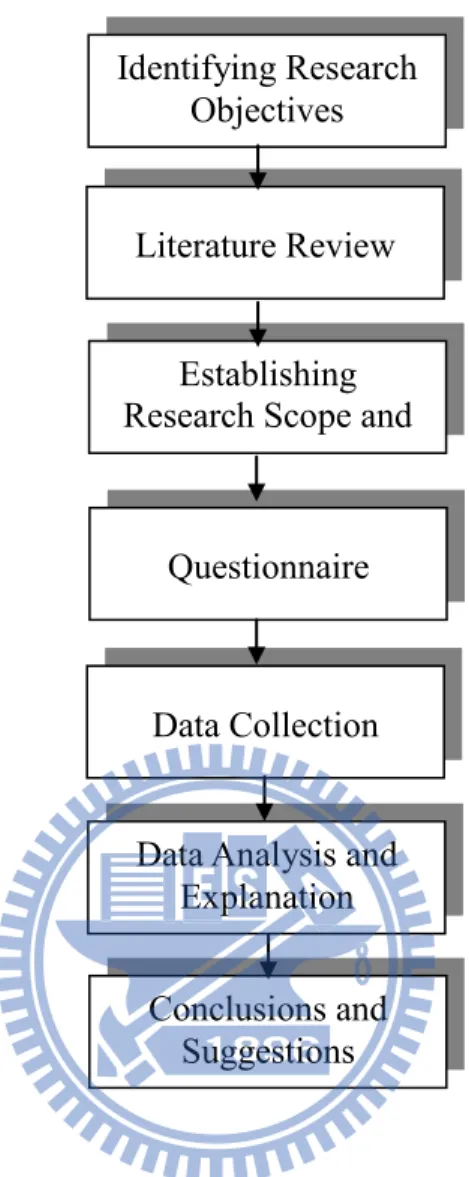
This study addresses two research questions. To answer them, a literature review of previous studies was conducted and hypotheses were developed. After an online survey was conducted, the research data was collected and compiled for the subsequent analysis. The research flow is presented in Figure 1.1.
Figure 1.1 Research flow Identifying Research
Objectives
Literature Review Establishing Research Scope and
Framework Questionnaire
Design Data Collection
Data Analysis and Explanation Conclusions and
Chapter 2. Literature Review
The purpose of this study is to examine the relationships among antecedents of consumers‘ purchase intention toward Fair Trade products in Taiwan. Thus, literature regarding individual factors (e.g., consumer ethics, attitude) and internet related factors (e.g., online information, trust) were depicted as follows.
2.1. Theory of Reasoned Action and Theory of Planned Behavior
Most currently proposed models of human behavior have originated from social psychology to better understand social behaviors. Among these models, the Fishbein and Ajzen theory of reasoned action (TRA) (Fishbein and Ajzen, 1975) and the theory of planned behavior (TPB) (Ajzen, 1991; Ajzen and Driver, 1991) are considered to be the most integrated models of social behaviors (Cooper and Croyle, 1984).
Both TRA and TPB are established attitude-behavior theories that are widely used in explaining and predicting human behavior across a variety of disciplines, such as social psychology, knowledge management, medical studies, and IT adoption. According to TRA, behavioral intention, an immediate predictor of behavior, is a function of attitude and subjective norm. TPB differs from TRA by adding a new construct, perceived behavioral control, which refers to an individual‘s control beliefs and is suggested to impact both behavioral intentions and behavior. At the core of TPB or TRA is the beliefs-attitudes- behavior logic, in which knowledge or beliefs lead to general attitudes that in turn lead to intentions and behavior (Shaw and Clarke, 1999; Shaw and Shiu, 2002, 2003; Vitell et al.,
2001).
TPB is one of the most prominent theoretical approaches applied to the domains of ethical consumer behavior, including consumer ethics (Fukukawa, 2002), ethical purchase (Shaw and Clarke, 1999; Shaw and Shiu, 2002, 2003), waste recycling (Chan, 1998), and green consumerism (Sparks and Shepherd, 1992). Among three antecedents of behavioral intention, attitudes clearly influence behavior as tested in several models of ethical consumption behavior (Shaw and Clarke, 1999; Ferrell and Gresham, 1985; Vitell et al., 2001). More specifically, Shaw and Shiu (2002) examined FT grocery buying intention among ethical consumers with TPB, indicating that attitude had a significant impact on buying intention. Generally speaking, most participants had a very positive attitude towards FT products (De Pelsmacker and Janssens, 2007). However, control beliefs and subjective norm were less relevant constructs for the modeling of fair trade grocery buying decisions (Shaw and Shiu, 2003), implying that TPB was inadequate for describing FT grocery purchasing.
Other research indicates that while applying TPB, a large part of the ethical consumer decision-making remains unexplained (Chatzidakis et al., 2007; Shaw et al., 2005). Therefore, in testing the models of ethical buying behavior, other potentially relevant variables such as knowledge or information with respect to FT are suggested (De Pelsmacker and Janssens, 2007; Maignan and Ferrell, 2004; Shaw et al., 2005).
The behavioral intentions here were defined as consumer intentions to engage in two specific behaviors-share FT information with others and purchase FT products. Each behavioral intention construct represents an individual‘s anticipation that she/he will behave in a specified way. Thus, one with behavioral intention volitionally intends to
follow the advice, purchase, and/or share information, unless something precludes such action (McKnight et al., 2002).
2.2. Consumer ethics
Ethical consumer behavior is broadly defined as the ―decision-making, purchases and other consumption experiences, which are affected by the consumer‘s ethical concerns‖ (Cooper-Martin and Holbrook, 1993). It can be categorized by ethical consumerism and consumer ethics. While ethical consumerism involves purchasing decisions related to moral issues such as ethical consumption (e.g., organic foods, genetically modified foods, and fair-trade products), environment, and animal well-being (Carrigan and Attalla, 2001; Creyer and Ross, 1997; Shaw and Clarke, 1999), consumer ethics represents the broader treatments of ethical consumer behavior, mostly focusing on the underlying dimensions of consumers‘ ethical judgments. It can be defined as the rightness or wrongness of certain actions on the part of the buyer or potential buyer in consumer situations (Dodge et al., 1996; Vitell and Muncy, 1992).
Research of consumer ethics includes ethically questionable consumer behavior (e.g., various kinds and degree of consumer dishonesty), consumer voting behavior (e.g., boycotting certain products and/or certain producers), and responsible consumer behavior (e.g., buying organic products or buying goods from good record companies for environmentalist reasons) (Vitell et al., 2001).
Among the most significant studies of consumer ethics, the Muncy-Vitell (1992) consumer ethics scale (CES) has been widely used by many distinct studies. Their research resulted in a four-dimensional solution for consumer ethical beliefs:
1. actively benefiting from illegal activities (e.g., returning damaged goods when the damage was your own fault),
2. passively benefiting (e.g., not saying anything when the waiter or waitress miscalculates a bill in your favor),
3. actively benefiting from deceptive (or questionable, but legal) practices (e.g., Using an expired coupon for merchandise),
4. no harm/no foul activities (e.g., ‗‗Burning‘‘ a CD rather than buying it).
In summary, respondents tended to believe that ―passively benefiting‖ is more ethical than ―actively benefiting from illegal activities‖, and is less ethical than ‗‗deceptive but legal‘‘, and far less ethical than ―no harm‖.
Recently, Vitell and Muncy (2005) modified the original scale and added a new that measures the consumer‘s desire to recycle products and ―doing good‖ named ―doing good/recycle.‖ One typical item from this new dimension is ―Purchasing something made of recycled materials even though it is more expensive.‖ This dimension has been tested in studies involving religiosity, money ethic, and attitude toward business (Vitell et al., 2007).
Recently, there is an increasing trend that ethical consumers link their buying behavior to the associated ethical problem (Shaw and Newholm, 2002; Tallontire et al., 2001). The Ethical Consumer Research Association (ECRA) suggested that consumer power can be exerted as a means of achieving specific desirable outcomes within the existing market system through consumers‘ ethical consumption behavior (Ethical Consumer, 1999). For example, results from a survey shows that 51% of the European population feel that they can make a difference in a company‘s behavior, and 68% have purchased a product from
found that Belgian consumers were willing to pay a price premium of 10% for fair trade coffee.
Among these ethical buying behaviors, environmentally friendly and fairly traded products are regarded as two typical examples of ethical consumption (Shaw et al., 2005; Shaw and Shiu, 2002). Concerning the well-being of workers and farmers in developing countries, Fair Trade is becoming increasingly important in the literature (De Pelsmacker et al., 2005; Shaw and Clarke, 1999). Herein, this study focuses on the ―doing good/recycle‖ dimension of consumer ethics in exploring the issue of Fair Trade consumption.
2.3. Online information
Research in business ethics has recognized the potential role that information plays on Rest‘s ethical decision making (awareness, judgment, intention, and behavior) (Ferrell and Gresham, 1985; Hunt and Vitell, 2006; Rest, 1986). In the initial stage of awareness, consumers‘ perceived knowledge or objective knowledge would affect how consumers gather and organize information, how much information is used in decision making, and how consumers evaluate products and services (Laroche et al., 2001). It is consistent with the logic of TRA or TPB that knowledge or beliefs lead to general attitudes which in turn lead to intentions and behavior (De Pelsmacker and Janssens, 2007; Hunt and Vitell, 2006; Shaw and Shiu, 2002).
In the studies of ethical buying behavior, knowledge of products or related information is recognized in its influence (Maignan and Ferrell, 2004; Shaw et al., 2005). For example, consumer knowledge and motivations work to mobilize organic consumption (Lockie et al., 2002; Nigh, 1997). Regarding the development of Fair Trade, Taiwan is in the initial stage. In general, most consumers lack relevant knowledge of and channels of access to the
sparsely located retail stores. To reduce overall concern and skepticism towards Fair Trade, it is necessary to provide consumers with Fair Trade information which would influence FT buying behavior directly (De Pelsmacker and Janssens, 2007; Shaw et al., 2005).
To solve the barrier between FT retailers and consumers, the Internet can serve as the most effective communication medium with its transformative power to enhance ethical and moral consumer behavior (e.g., researching environmentally friendly products). Three characteristics of the Internet — scope (e.g., reachability, speed, and availability to individuals), anonymity, and reproducibility — make it differ from other modes of distribution and communication (Johnson, 1997). Unfortunately, these distinct features of the Internet make it suffer from notorious unethical, immoral, or illegal activities, particularly in music and film piracy. These three distinct features may be interrelated. For example, an anonymous individual may download unauthorized music or films from a server on one side of the world and disseminate them to friends on the other side of the world easily at almost zero cost, especially with the emergence of peer-to-peer networks (Chatzidakis and Mitussis, 2007; Turnbull, 2001). However, we can look at the other side of the Internet; for example, its ability to increase consumers‘ ethical intent through effective transmission and proliferation.
Information sharing is a basic human activity that links people together and creates different kinds of relationships (Duncan and Moriarty, 1998). Within a certain group, people may share what they have acquired or created via different communication mechanisms (Gibbert and Krause, 2002). Consumers can translate their ethical concerns by means of promoting and sharing ethic consumption, buying environmentally friendly products, or boycotting products for their negative reputation (e.g., not buying products
made by child workers). In the Internet age, pass-along email or online communication mechanisms (e.g., chat rooms, bulletin boards, MSN) provides convenient platform for people with the ability to share their experiences, opinions, and knowledge with others on specific topics such as FT. In general, ethical consumers feel responsible toward society and would like to express their feelings and conceptions by means of sharing or purchase.
The sharing or comments referring to a product or company which is often called word of mouth or recommendation can be a very effective means to influence people on the adoption and use of products or services (Subramani and Rajagopalan, 2003). Accordingly, the Internet is expected to be an important means of communication to explore ethical issues such as organic and genetically modified food production, FT product consumption, animal welfare programs, and in the end, in the promotion of ethical consumption.
2.4. Trust
Trust is a critical factor in any relationship. It can be defined as a consumer‘s expectations or confidence about the motives and behaviors of a merchant or store (Doney and Cannon, 1997). Without trust, a relationship between consumers and sellers cannot develop, nor can the transaction process proceed. In other words, for any relationship to be sustainable, mutual trust is a prerequisite for individuals to take an action facing risky situation (Mayer et al., 1995; Solomon, 1992). As Williamson (1993) argued, trust is the best label for firms so as to minimize uncertainty and reduce risk in the customers‘ minds. Traditionally, it takes time for sellers to build trust in a long-term relationship with customers (Ganesan and Hess, 1997). However, McKnight et al. (1998) have shown that trust in initial relationships can be high, especially in the Internet setting.
Recently, many studies have explored the critical role of trust in helping consumers overcome the perceptions of risk in web-based interaction (Gefen et al., 2003; Mayer et al., 1995; Pavlou and Gefen, 2004). It is more difficult for consumers to assess the trustworthiness of e-vendors than that of brick-and-mortar vendors (Palmer et al., 2000). In e-commerce, the first contact between a consumer and an e-retailer is often through the website of the business. The e-retailer‘s website then influences a consumer‘s first impressions of the e-retailer. Shankar et al. (2002) suggest that the technology itself, mainly the Internet, can be considered an object of trust. Therefore, the online trust, or website trust for individuals towards a specific transactional or informational website can be defined as an attitude of confident expectation in an online situation of risk that one‘s vulnerabilities will not be exploited (Corritore et al., 2003; Bart et al., 2005; Jones et al., 2009). Initial trust formation is particularly important in the context of web-based commerce: when Web users (trustors) visit and explore a website for the first time, they rely on whatever information they have to make trust-related inferences about the website provider (or vendor) (McKnight et al., 2002). Cognition-based trust and institution-based trust are two significant factors related to initial trust (McKnight et al., 1998). Cognition-based trust posits that individuals build initial trust based on their instant cognition (e.g., information content) on first impressions of others, which is often regarded as an e-retailer‘s website in the context of e-commerce. Institution-based trust comprises the feelings of security given be institutions and structure. In an online context, it deals with perceptions of the Web environment to enhance the chances of a successful outcome (e.g., transaction) (Jones et al., 2009). McKnight et al. (2002) later developed and tested the initial trust building model (TBM). They found that there is a positive relationship between
e-retailer. This proposed that the quality and reputation of a website are influential in building Web users‘ trust (McKnight et al., 2002).
Previous studies also point out that the existence of trust would lead to greater knowledge exchange; i.e., giving useful information/knowledge and absorbing that of others (Dirks and Ferrin, 2001, Mayer et al., 1995; Nahapiet and Ghoshal, 1998). A recent survey indicates that most consumers perceive online opinions to be as trustworthy as brand websites (AC Nielson, 2007). In this way, individuals‘ perceived trustworthiness of a source affects the weight of the information obtained from that source.
Chapter 3. Research Method
Following literature review, research method is presented. For the purpose of this study, a conceptual framework based on previous researches is first introduced. This research method chapter includes research framework, hypotheses development, operational definition of variables, questionnaire design, research procedure, and analysis method.
3.1. Research framework and hypotheses
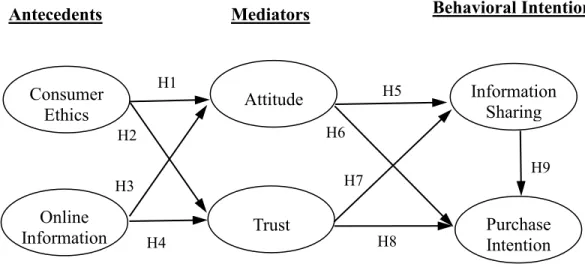
The present paper follows the logic of TPB: beliefs-attitudes-behavior, presenting that consumers‘ beliefs lead to attitude toward FT that in turn leads to FT purchase intentions. In addition, in consideration of the online context, online information regarding FT knowledge, trust attitude, and the willingness or intention to share FT information were also incorporated into the proposed model as seen in Figure 3.1.
Figure 3.1 Proposed model
Consumer ethics involves doing the right or morally correct thing (Dodge et al., 1996). It represents the broader treatments of ethical consumer behavior, including ethically questionable consumer behavior, consumer voting behavior, and responsible consumer behavior (Vitell et al., 2001). Among these ethical consumer behaviors, buying environmentally friendly and fairly traded products are the two most typical examples (Shaw and Shiu, 2002; Shaw and Newholm, 2002). The focal point of the present research is fair trade in which the theory of planned behavior (TPB) was applied by Shaw and Shiu (2002) to estimate fair trade grocery buying intention. In line with the beliefs-attitudes- behavior model, Ferrell and Gresham (1985) also proposed that ethical decision making is influenced by individuals‘ values. Thus, one‘s attitude toward FT is presumed to be influenced by one‘s ethical beliefs.
Cognition-based trust indicates that individuals build their trust based on their instant cognition (e.g., social backgrounds, sense of values, word of mouth) or first impressions of others (McKnight et al., 1998). This initial trust formation is particularly relevant in an IS
Online Information H1 H2 H4 H3 Consumer Ethics Attitude
Trust
H5 H8 H7 H9 H6 Information Sharing Purchase Intention
context. The context of e-commerce trust includes the on-line consumer‘s beliefs and expectancies about trust-related characteristics of the Internet merchant (McKnight and Chervany, 2002). Morgan and Hunt (1994) indicated that if individuals of virtual communities have a similar sense of cultural values, it is easier for them to build trust. One issue concerning the similar sense of values is the ethical component. McAlexander and Scammon (1988) pointed out that if customers perceive a service-provider as having certain ethical values, they will trust that service provider more. Since benevolence and honesty/integrity are important trusting beliefs which are closely related to ethical beliefs (McKnight et al., 2002), it is reasonable to hypothesize that consumers‘ ethical beliefs would dominate their trust toward the ethical contents (i.e., contents in FT website). Thus, the reasonable hypotheses are as follows:
Hypothesis 1: Consumer ethics positively influences attitude toward FT. Hypothesis 2: Consumer ethics positively influences trust.
According to the traditional knowledge–attitudes–behavior logic, amount of knowledge is associated with attitude–behavior consistency (De Pelsmacker and Janssens, 2007; Fabrigar et al., 2006). Kallgren and Wood (1986) assessed attitudes toward protecting the environment, finding that attitudes based on high amounts of knowledge were more predictive of environment-related behavior. Likewise, FT buying behavior is determined by the general attitude towards FT issues, which, in turn, is determined by the level of knowledge about that issue (De Pelsmacker and Janssens, 2007). Based on previous studies, it is expected that one‘s level of FT information or knowledge impacts his
Next, traditionally, it takes time to build a long-term relationship between buyer and seller (Ganesan and Hess, 1997). However, cognitive trust is knowledge-driven; i.e., the accumulated knowledge allows one to make predictions regarding the service provider‘s action with some level of confidence (Johnson and Grayson, 2005). In e-commerce, the user‘s trust of a website is affected not just by the website but also the shopping experience, including company information, branding, promotions, security, and customer service (Lohse and Spiller, 1998; Nielsen et al., 2000; Fogg et al., 2001). Bart et al. (2005) found a positive relationship between website characteristics (e.g., information on the website) and online trust. Thus, it is reasonable to assume that providing sufficient FT information via the Internet would lead to consumers‘ trust of the web source. Thus, this study proposes the following hypotheses:
Hypothesis 3: Online FT information positively influences attitude toward FT. Hypothesis 4: Online FT information positively influences trust.
The interest variable to a web-based retailer is consumers‘ behavior, especially their willingness to share information or referrals, or to transact via the Internet. However, it is difficult to simulate actual behavior in an experimental setting. Previous research has confirmed a strong correlation between behavioral intentions and actual behavior (Sheppard et al., 1988; Venkatesh and Davis, 2000). Numerous studies of technology acceptance have measured behavioral intentions but not behaviors (Agarwal and Prasad, 1998; Karahanna et al., 1999; Venkatesh, 2000). In addition, behavioral intentions are considered an adequate surrogate measure of actual behavior (Gibbons et al., 1998; Jones and Kavanagh, 1996). Therefore, this study measures behavioral intentions (i.e., willingness to share information
and purchase intention) instead of actual behaviors.
The attitude toward business is often related to an individual‘s ethical beliefs and has a decisive impact on subsequent behavioral intention (Vitell and Muncy, 1992). Prosocial attitude is found to facilitate information sharing, especially with online communication mechanisms or online social networks such as virtual communities (Constant et al., 1996).
Moreover, a consumer‘s willingness to purchase from an Internet retailer is contingent on the consumer‘s attitude towards that store, and sometimes also based on their environmental attitudes (Jarvenpaa et al., 2000; Schwepker and Cornwell, 1991). In the specific issue of Fair Trade, attitude is confirmed to have a significant impact on FT grocery buying intention (Shaw and Shiu, 2002). From the above literature, the reasonable assumption is as follows:
Hypothesis 5: Attitude toward FT positively influences the intention to share FT information.
Hypothesis 6: Attitude toward FT positively influences the intention to purchase FT products.
Traditionally, mutual trust prompts the relationship between the buyer and seller (Solomon, 1992). Today, in a virtual environment, the existence of trust between individuals would make them more willingness to participate in a shared activity such as information exchange (Dirks and Ferrin, 2001, Mayer et al., 1995; Nahapiet and Ghoshal, 1998). Some researchers suggest that knowledge or information transfer exists in strong trust ties, while others believe that it can occur even in weak ties. In this situation, the
(Levin and Cross, 2004). For example, multiple texts, sufficient information on the same topic, or ethical related issues would lead to the pertinence of trust (Kasper-Fuehrera and Ashkanasy, 2001). In addition, the perceived trustworthiness of a source can affect the weight in the reader‘s overall comprehension over that topic or issue (Braten et al., 2009).
With sufficient and quality information provided from a reliable source, the receivers‘ trust over that issue can be built. In the Internet context, the more trust individuals have in the websites, the more willing they will be to share their information with community members (Wu and Tsang, 2008). Some research even concludes that trust is one of the major antecedents of willingness to share information or make referral (Law, 2008).
Once the trust exists, people are more willing to give useful knowledge, information sharing, or recommendations (Garbarino and Johnson, 1999; Shankar et al., 2002). Thus, trust building is the basic solution for increasing both online sales and online information sharing (McKnight et al., 2002). This reasoning leads to the following hypotheses.
Hypothesis 7: Trust of a Fair Trade website positively influences the intention to share FT information.
Hypothesis 8: Trust of a Fair Trade website positively influences the intention to purchase FT products.
Previous research has showed that there is a discrepancy between attitude and ethical buying behavior (MacGillivary, 2000). It is confirmed from a survey that most people hold a positive attitude toward FT products but only a few would purchase them. Besides price concern, other possible explanations are the lack of availability of ethical products and the lack of information (Carrigan and Attalla, 2001). As mentioned earlier, one‘s processing of
information about an ethical issue can predict one‘s beliefs, attitudes, and behavior (Shaw and Shiu, 2002). Past research also shows that if people are highly involved with a certain website (i.e., perceiving relevance of the website based on their values or interests), they are more likely to process the product information actively, such as gathering or sharing information (Schlosser, 2003); in turn, this high level of involvement is likely to lead to purchase (Jiang et al., 2010). This leads to the hypothesis:
Hypothesis 9: Consumer‘s willingness to share FT information positively influences the purchase intention of FT products.
3.2. Operational definitions of variables
Based on the literature review in Chapter 2, the operational definitions of variables are depicted as follows:
1. Consumer ethics (CE)
Consumer ethical beliefs were operationalized using the new dimension of Vitell and Muncy consumer ethics scale (CES) (2005). This study focused consumer ethics on ―doing good/recycle‖ dimension. The operational definition of this construct is consumers‘ desire to recycle products and ―do good.‖ Four items were listed (see Table 3.3).
Table 3.1 Measurement items for consumer ethics construct
Measurement items for consumer ethics
CE1. Buying products labeled as ‗‗environmentally friendly‘‘ even if they don‘t work as well as competing products.
CE2. Purchasing something made of recycled materials even though it is more expensive.
CE3. Buying only from companies that have a strong record for protecting the environment.
CE4. Recycling materials such as cans, bottles, and newspapers. Source: Vitell and Muncy (2005)
2. Online information (OI)
Based on the study of De Pelsmacker and Janssens (2007), the operational definition of online information/knowledge is ―after receiving information via internet, consumers perceive what FT can do in helping farmers and workers in developing countries‖ (see Table 3.2).
Table 3.2 Measurement items for online information construct
Online Information
OI1.Fair trade aims at creating better trade conditions for farmers and workers in developing countries
OI2. Fair trade strives for paying more honest prices to producers in developing countries
OI3. Fair trade strives for sustainable development of excluded and/or disadvantaged producers in developing countries.
Source: De Pelsmacker and Janssens (2007)
3. Attitude (AT)
Based on the study of Taylor and Todd (1995), the operational definition of attitude is ―the degree to which consumers have a favorable or unfavorable evaluation or appraisal towards FT‖ (see Table 3.4).
Table 3.3 Measurement items for attitude construct
Measurement items for attitude
AT1. Buying FT products is a wise idea. AT2. I like the idea of buying FT products. AT3. Buying FT products would be pleasant. Source: adapted from Taylor and Todd (1995)
4. Trust
Based the previous studies (Garbarino and Johnson, 1999; McKnight et al., 2002), the operational definition of trust is ―consumers‘ perceived trustworthiness toward the contents in the FT website‖ (see Table 3.5).
Table 3.4 Measurement items for trust construct
Measurement items for trust
TR1. In general, the website is reliable.
TR2. The information provided by this website is trustworthy. TR3. This website provides professional information.
Source: adapted from Garbarino and Johnson (1999) and McKnight et al. (2002)
5. Information sharing intention (IS)
Based on previous studies (Liu et al., 2005; McKnight et al., 2002; Verhoef et al., 2002), the operational definition of information sharing is ―consumers‘ intention to share with others about the FT information or to make recommendation regarding to this FT Website‖ (see Table 3.6).
Table 3.5 Measurement items for information sharing construct
Measurement items for information sharing
friends.
IS2. I say positive things about fair trade products to persons I know.
IS3. I encourage my relatives and friends to do business with stores selling fair trade products.
IS4. I have positive things to say about this Website to my friends.
Source: adapted from Liu et al. (2005), McKnight et al. (2002), and Verhoef et al. (2002)
6. Purchase intention (PI)
Based on the studies of Lee and Lee (2009) and Jarvenpaa et al. (2000), the operational definition of purchase intention is ―consumers‘ willingness and likelihood to purchase FT products in the near future‖ (see Table 3.7).
Table 3.6 Measurement items for purchase intention construct
Measurement items for purchase intention
PI1. I have the intention of buying FT products. PI2. I think it is a good idea to buy FT products.
PI3. I will consider purchasing from these FT stores within 6 months.
PI4. I will consider purchasing from these FT stores‘ websites within 6 months. Source: adapted from Lee and Lee (2009); Jarvenpaa et al. (2000)
3.3. Questionnaire design
All the items with their corresponding constructs were developed based on the existing literature. Four items of consumer ethics were drawn on the dimension ―doing good/recycle‖ of the Muncy-Vitell consumer ethic scale (CES) (Vitell and Muncy, 2005). Three items of online information/knowledge were drawn from the fair trade knowledge construct from the study of De Pelsmacker and Janssens (2007). Three items of attitude
were adapted from the study of Taylor and Todd (1995). Three items of trust were adapted from previous studies (Garbarino and Johnson, 1999; McKnight et al., 2002). For the information construct, four items were adapted from information sharing or referral construct of previous studies (McKnight et al., 2002; Verhoef et al., 2002; Liu et al., 2005). Finally, for the consumer‘s purchase intention, four items were adapted from Lee and Lee (2009) and Jarvenpaa et al. (2000).
Backward translation was used to ensure consistency between the Chinese and the original English of the instrument (Reynolds et al., 1993). First, the items from the previous studies were translated from English into Chinese by two professors from a business school. Second, the scale items were repeatedly modified via pre-tests. The initial version of the survey instrument was then refined through a pre-test with 30 subjects. Based on the subjects‘ suggestions on any confusing items in the questionnaire, some items were moderately re-worded. The second pre-test with 71 subjects was then conducted and analyzed statistically by applying exploratory factor analysis. About 45% of them had never heard about FT, and 79% had never had the purchase experience. Cronbach‘s alpha values ranged from 0.61 (for consumer ethics) to 0.90 (for information sharing). Due to low item-to-total correlation (less than 0.5), four items each from consumer ethics and purchase intention, respectively, were temporarily retained but dropped from later analysis. Third, the Chinese version was translated back into English. Two versions were compared and any discrepancies were resolved.
The refined instrument, in the form of a self-reported questionnaire, was then used to collect the study‘s data. Appendix A lists individual scale items and their correspondent sources. All items were measured with Likert-type scale ranging from 1 (strongly disagree)
3.4. Research subjects and data collection
Participants were voluntarily recruited from among business undergraduate students of three universities in northern, central, and southern Taiwan. During the regular class time, each instructor from the three universities requested and encouraged students to visit a website regarding FT information made for this study. Extra credit was offered as an incentive to the students.
At the time of research, the colorful homepage of the website contained a three-minute film and was posted on a weblog. Its contents included: what FT is, what its mission is, and how FT combats poverty and empowers producers. Most of the contents are vivid photos accompanied with simple and short descriptions. In the end, a reminder was presented to encourage students: ―You can change this unfair situation: through purchase, not donation.‖ Then, in the end, a request appeared: ―Please fill out the online survey only by double clicking here.‖ After double clicking this sentence, students then accessed the online survey website and started to answer the questions. In all, 215 surveys were collected after one month.
3.5. Analysis method
In this study, we adopted the recommended two-step analytical procedures (Anderson and Gerbing, 1988; Hair et al., 1998). First, confirmatory factor analysis (CFA) using LISREL 8.51 was conducted to assess the reliability and validity of the measures, and then the structural relationships were examined. Anderson and Gerbing (1988) concluded that the two-step approach has some comparative advantages over the one-step approach after
employing a series of nested models and sequential chi-square difference tests. First, it allows the test of significance for all pattern coefficients. Second, it allows an assessment of whether any structural model would have acceptable fit. Third, one can make an asymptotically independent test of the substantive or theoretical model of interest. That is, the measurement model together with the structure model enables a comprehensive, confirmatory assessment of construct validity (Bentler, 1976).
Chapter 4. Data Analysis
This chapter revealed the descriptive statistics of the sample used in this study. Next, a confirmatory factor analysis (CFA) was performed to validate the critical factors of consumer ethical beliefs, online information, attitude, trust, intention to share FT information, and purchase intention. Then structural equation modeling was conducted to ascertain the relationships among the above-mentioned constructs. Finally, the hypothesis results were presented.
4.1. Data description
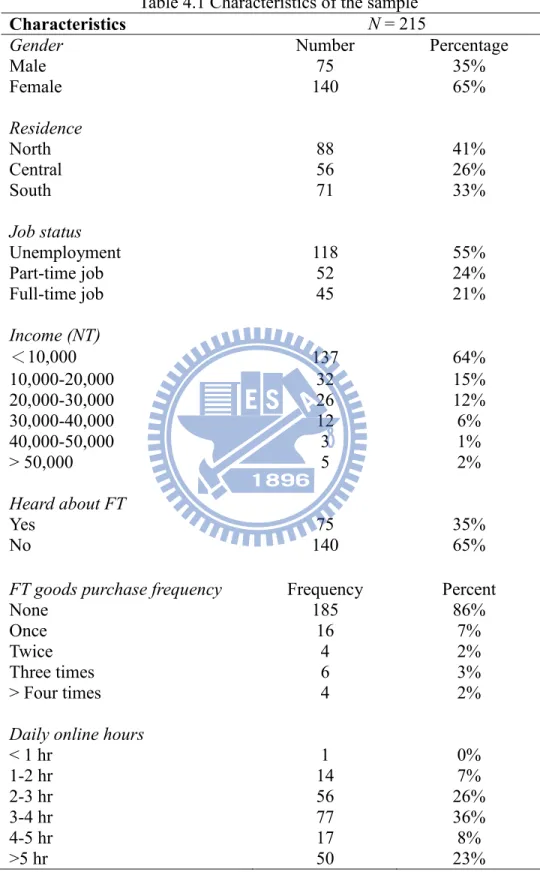
Data was collected through the Internet. A total of 234 students responded, of which 215 questionnaires were useful. The average age of the sample is 21.8 years (standard deviation 2.33). Among the subjects, 65% had never heard about what Fair Trade is; 86% had no purchase experience of FT products. The net monthly income of 64% of the sample was NT$10,000 or less. More detailed information is listed in Table 4.1.
Table 4.1 Characteristics of the sample
Characteristics N = 215
Gender Number Percentage
Male 75 35% Female 140 65% Residence North 88 41% Central 56 26% South 71 33% Job status Unemployment 118 55% Part-time job 52 24% Full-time job 45 21% Income (NT) <10,000 137 64% 10,000-20,000 32 15% 20,000-30,000 26 12% 30,000-40,000 12 6% 40,000-50,000 3 1% > 50,000 5 2% Heard about FT Yes 75 35% No 140 65%
FT goods purchase frequency Frequency Percent
None 185 86%
Once 16 7%
Twice 4 2%
Three times 6 3%
> Four times 4 2%
Daily online hours
< 1 hr 1 0% 1-2 hr 14 7% 2-3 hr 56 26% 3-4 hr 77 36% 4-5 hr 17 8% >5 hr 50 23%
4.2. Measurement model analysis
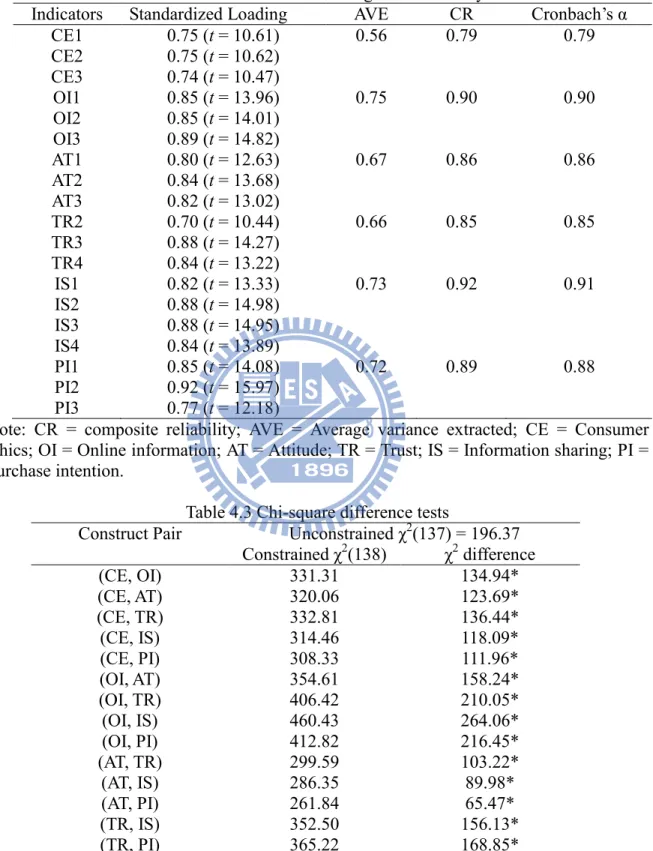
Confirmatory factor analysis on all items showed a satisfactory fit with chi square (χ2) of 196.37 (df =137, p < 0.001) and other fit indices: RMR = 0.024; RMSEA = 0.048; NFI = 0.92; NNFI = 0.96; CFI = 0.97; IFI = 0.97; GFI = 0.90. In addition, the reliabilities of the constructs (Cronbach‘s alpha values), ranging from 0.79 (for consumer ethics) to 0.91 (for information sharing), show an acceptable requirement of reliability for research instruments (listed in Table 4.2).
Convergent validity is assessed by how closely related two measures are with the same construct, and these two measures to some degree are akin to internal consistency between items of a measure (Viswanathan, 2005). In the current study, all factor loadings of items measuring the same construct are statistically significant at a level of 0.01 (the lowest t value is 10.44), suggesting that convergent validity is supported (Anderson and Gerbing, 1988). In addition, convergent validity is also assured by examining composite reliability (CR) and average variance extracted (AVE) from the measures (Hair et al., 1998). As shown in Table 4.2, the composite reliabilities (ranging from 0.79 to 0.90) and the average variances extracted (ranging from 0.56 to 0.75) all exceed the acceptable value of 0.50. Collectively, the above results suggest that convergent validity is successfully achieved.
Discriminant validity is obtained if the measure of a construct is not correlated with measures of other constructs to which it is not supposed to be related (Viswanathan, 2005). In this study, the discriminant validity of the instrument was conducted by a series of chi-square difference tests which allows for pairwise comparisons simultaneously (Anderson and Gerbing, 1988; O‘Reilly and Chatman, 1986). The critical value of the
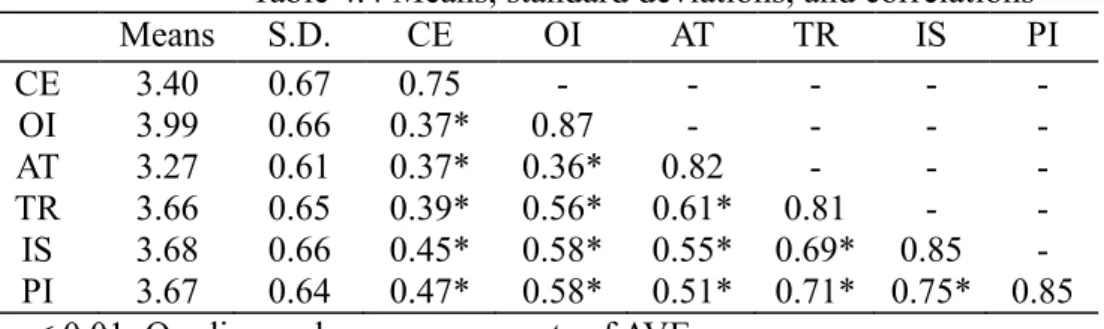
chi-square test based on the Bonferroni method under overall 0.01 levels is χ2(1, 0.01/15) = 11.58 (Bagozzi and Yi, 1988; Hatcher, 1994). Since the chi-square difference statistics for paired constructs all exceed 11.58 (see Table 4.3), discriminant validity is successfully accomplished. Table 4.4 shows means, standard deviation, and intercorrelations for all variables. The results demonstrated a significant positive correlation among behavioral intention and other constructs. Furthermore, the square roots of AVE were all greater than off-diagonal elements in the corresponding rows and columns. Therefore, it can be confirmed for proper discriminant validity.
Due to the nature of cross-sectional data collected at one time, there is a potential problem for the occurrence of common method variance (CMV). Thus, Harman‘s (1967) one-factor test is suggested (Podsakoff et al., 2003). If common method variance exits, then all items are constituted in a single general factor which accounted for the majority of the variance. In this study, all the items corresponding to seven factors were conducted in an exploratory factor analysis (EFA). The first emerging factor (information sharing) accounted for 17.54% of the variance explained, and all seven factors accounted for 79.70% of variance explained. As a result, there is no single factor emerging from the factor analysis. This indicates fewer concerns for common method variance.
In order to examine the relationships between independent variables and dependent variables, a further examination of hypotheses testing is needed.
Table 4.2 Standardized loadings and reliability
Indicators Standardized Loading AVE CR Cronbach‘s α
CE1 0.75 (t = 10.61) 0.56 0.79 0.79 CE2 0.75 (t = 10.62) CE3 0.74 (t = 10.47) OI1 0.85 (t = 13.96) 0.75 0.90 0.90 OI2 0.85 (t = 14.01) OI3 0.89 (t = 14.82) AT1 0.80 (t = 12.63) 0.67 0.86 0.86 AT2 0.84 (t = 13.68) AT3 0.82 (t = 13.02) TR2 0.70 (t = 10.44) 0.66 0.85 0.85 TR3 0.88 (t = 14.27) TR4 0.84 (t = 13.22) IS1 0.82 (t = 13.33) 0.73 0.92 0.91 IS2 0.88 (t = 14.98) IS3 0.88 (t = 14.95) IS4 0.84 (t = 13.89) PI1 0.85 (t = 14.08) 0.72 0.89 0.88 PI2 0.92 (t = 15.97) PI3 0.77 (t = 12.18)
Note: CR = composite reliability; AVE = Average variance extracted; CE = Consumer ethics; OI = Online information; AT = Attitude; TR = Trust; IS = Information sharing; PI = Purchase intention.
Table 4.3 Chi-square difference tests
Construct Pair Unconstrained χ2(137) = 196.37
Constrained χ2(138) χ2 difference (CE, OI) 331.31 134.94* (CE, AT) 320.06 123.69* (CE, TR) 332.81 136.44* (CE, IS) 314.46 118.09* (CE, PI) 308.33 111.96* (OI, AT) 354.61 158.24* (OI, TR) 406.42 210.05* (OI, IS) 460.43 264.06* (OI, PI) 412.82 216.45* (AT, TR) 299.59 103.22* (AT, IS) 286.35 89.98* (AT, PI) 261.84 65.47* (TR, IS) 352.50 156.13* (TR, PI) 365.22 168.85* (IS, PI) 294.33 97.96*
Table 4.4 Means, standard deviations, and correlations Means S.D. CE OI AT TR IS PI CE 3.40 0.67 0.75 - - - - - OI 3.99 0.66 0.37* 0.87 - - - - AT 3.27 0.61 0.37* 0.36* 0.82 - - - TR 3.66 0.65 0.39* 0.56* 0.61* 0.81 - - IS 3.68 0.66 0.45* 0.58* 0.55* 0.69* 0.85 - PI 3.67 0.64 0.47* 0.58* 0.51* 0.71* 0.75* 0.85
* p < 0.01; On-diagonals are square roots of AVE. 4.3. Structural model analysis
With an adequate measurement model, the technique of structured equation modeling is used to examine the causal structure of the proposed model in this study. The goodness-of-fit indices are as follows: χ2/df = 267/142 = 1.88; RMR = 0.041; RMSEA = 0.069; NFI = 0.90; NNFI = 0.94; CFI = 0.95; IFI = 0.95; GFI = 0.87. The results show an acceptable level, since previous research indicates that the SEM models seldom show excellent fits in all the indices, even for some leading journals such as JM, JMR, MISQ (Baumgartner and Homburg, 1996; Boudreau et al., 2001).
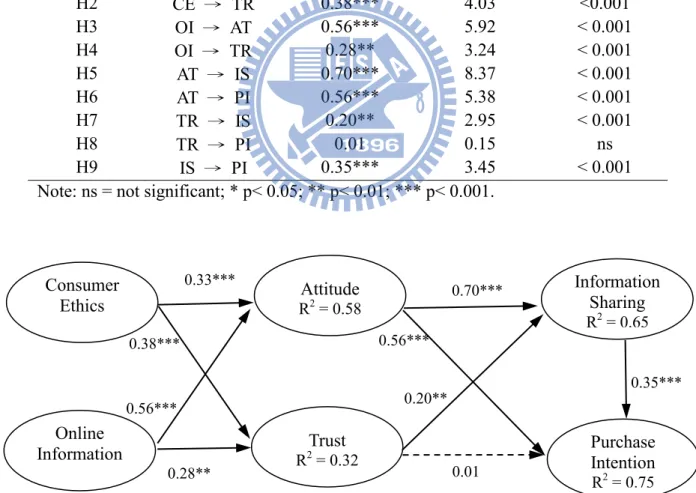
After examining the standardized path coefficients, all nine hypotheses were tested and most of them were statistically significant except for one path. Consumer ethics influenced both attitude and trust toward the FT website, thus confirming H1 and H2. The role of online information on the influence of attitude and trust were confirmed (H3 – H4 were supported). Attitude toward FT was adequate to explain the intention of information sharing and purchase intention, thus lending support to Hypotheses 5 – 6. Trust toward the FT website was able to predict the intention to share this FT with others; however, it failed to explain the FT purchase intention (H7 was supported, but not H8). The final hypothesis
dealt with the impact of information sharing on purchase intention, and the result was definitely confirmed (H9 was supported).
The present study also found that the proposed model accounted for 58% in attitude, and 32% in trust. As for the behavioral intention, all the variables were able to account for 65% and 75% of the variance explained for information sharing intention and purchase intention, respectively. Figure 4.1 and Table 4.5 present the research model and results as the arguments stated in all the hypotheses.
Table 4.5 Path coefficients and t values
Hypotheses Path Standardized
Coefficients t-value p-value H1 CE → AT 0.33*** 4.23 < 0.001 H2 CE → TR 0.38*** 4.03 <0.001 H3 OI → AT 0.56*** 5.92 < 0.001 H4 OI → TR 0.28** 3.24 < 0.001 H5 AT → IS 0.70*** 8.37 < 0.001 H6 AT → PI 0.56*** 5.38 < 0.001 H7 TR → IS 0.20** 2.95 < 0.001 H8 TR → PI 0.01 0.15 ns H9 IS → PI 0.35*** 3.45 < 0.001
Note: ns = not significant; * p< 0.05; ** p< 0.01; *** p< 0.001.
Figure 4.1 Result of the proposed model Online Information 0.33*** 0.38*** 0.28** 0.56*** Consumer Ethics RAttitude2 = 0.58
Trust
R2 = 0.32 0.70*** 0.01 0.20** 0.35*** 0.56*** Information Sharing R2 = 0.65 Purchase Intention R2 = 0.75 * p< 0.05; ** p< 0.01; *** p< 0.001.
4.4. Testing for mediation
At the core of TPB or TRA is the beliefs-attitudes-behavior logic, in which behaviors are influenced by attitude, which in turn, is influence by beliefs (Shaw and Clarke, 1999; Shaw and Shiu, 2002, 2003; Vitell et al., 2001). In addition, Bart et al. (2005) developed a conceptual model that links website and consumer characteristics, online trust, and behavioral intent. They found that online trust partially mediates the relationships between website and consumer characteristics and behavioral intent. Therefore, this study further examined the mediation effects of attitude and trust.
According to the logic of Baron and Kenny‘s (1986) general principles, mediation is suggested if the following conditions are met: a) The independent variable is a significant predictor of both the dependent variable and the mediator; b) the mediator is a significant predictor of the dependent variable; and c) the effects of the independent variable on the dependent variable are reduced when the mediating variable is added to the regression equation. Full mediation is indicated if the effect of the independent variable is no longer significant when the mediating variable is added, whereas partial mediation is suggested if the effect of the independent variable is reduced but remains significant.
The present research conducted mediation analysis following the procedures described in prior research (Mayer and Davis, 1999; Sapienza and Korsgaard,1996; Osmonbekov, 2010) that are based on Baron and Kenny‘s (1986) general principles. The results of three models are illustrated in Table 4.6. Since only nested models can be compared (Sapienza and Korsgaard, 1996), two comparisons were made – a) direct model vs. saturated model (chi-square difference is 69.1 with 5 degrees of freedom; p<0.001) and b) indirect model vs. saturated model (chi-square difference is 23.79 with 4 degrees of freedom; p<0.001). The result suggests that the saturated model provides a slightly better fit than the proposed
intentions but not between online information and behavioral intentions. The saturated mediation model is shown in Figure 4.2.
As shown in Table 4.6, consumer ethics has significant effects on both mediators and behavioral intentions in the direct model. However, its direct effects on behavioral intentions are not significant in the saturated model. It seems that the medicated effects of attitude and trust do exist between consumer ethics and both behavioral intentions. On the other hand, the direct path from online information to both mediators and behavioral intentions are not significant. This cannot support the mediation effects of attitude and trust between online information and both behavioral intentions.
Table 4.6 Analysis of mediation effects
Measure Direct model Indirect model Saturated model
χ2 312.31 267.00 243.21 Df 143 142 138 CE AT 0.82*** 0.33*** 0.30*** CE TR 0.79*** 0.38*** 0.37*** CE IS 0.78*** - 0.14 CE PI 0.75*** - 0.10 OI AT 0.11 0.56*** 0.52*** OI TR -0.1 0.28** 0.28** OI IS 0.13 - 0.21** OI PI 0.18 - 0.15 AT IS - 0.70*** 0.47*** AT PI - 0.56*** 0.39*** TR IS - 0.20** 0.17* TR PI - 0.01 -0.01 IS PI - 0.35*** 0.35*** χ2/df = 2.18 CFI = 0.93 NFI = 0.88 GFI = 0.85 RMSEA = 0.08 χ2/df = 1.88 CFI = 0.95 NFI = 0.90 GFI = 0.87 RMSEA = 0.069 χ2/df = 1.76 CFI = 0.95 NFI = 0.90 GFI = 0.88 RMSEA = 0.064 Note: * p< 0.05; ** p< 0.01; ** * p< 0.001.