
從經濟活動的角度探討戒嚴時期台灣語言結構的轉變 - 政大學術集成
139
0
0
全文
(2) Transformation of Taiwan Language Structure under Martial Law in terms of Economic Activities. 研究生:蘇豐文 指導老師: 卜道教授. Student: Su, Feng-wen Advisor: Dr. David Blundell. 國立政治大學. 治. 政 亞太研究英語碩士學位學程 大 碩士論文. 學. ‧ 國. 立. ‧. A Thesis. Nat. er. io. sit. y. Submitted to. International Master’s Program in Asia-Pacific Studies. al. n. iv n C U h eChengchi National n g c h i University. In Partial Fulfillment of the Requirement For the Degree of Master of Arts 中華民國九十九年六月 June 2010.
(3) ACKNOWLEDGEMENTS I would like to express my sincerest gratitude to those who had assisted me in writing this thesis. My deepest appreciation goes to my thesis advisor Dr. David Blundell for his advice and encouragement. I am also very grateful to my committee members, Dr. Whei-ming Chou, Dr. Jiunn-yih Chang, and Dr. Ann Heylen for their insightful suggestions and comments on this thesis. Special thanks also go to all the professors of International Master’s Program in Asia-Pacific Studies (IMAS) who have taught me so much about Taiwan. I am thankful for the useful information. 政 治 大 to thank my family and wife, Brenda Liu, for their love and support that enabled me 立. provided by my IMAS classmates and my colleague, Hilario Wu. Finally, I would like. ‧. ‧ 國. 學. to finish this thesis.. n. er. io. sit. y. Nat. al. Ch. engchi. i. i Un. v.
(4) ABSTRACT The main purpose of this thesis is to find out the economic factors that contributed to the successful promotion of Mandarin during martial law period, and serve as a reference for future language planning. Taiwan used to be ruled by Dutch, Koxinga, Qing dynasty, Japan, and the Republic of China (ROC) government. Thus, Taiwanese society gradually becomes multiethnic, multicultural, and, to my greatest concern, multilingual. Each ruling power had tried to impose different degrees of language policies on Taiwan, particularly Japan and the ROC government that were. 政 治 大. eager to establish an official language. Eventually, the successful popularization of. 立. Mandarin is overwhelming.. ‧ 國. 學. A number of theories and materials regarding the relationship between language and economy have been reviewed. First of all, it is argued that language could be. ‧. objectified and valued. Thus, different language varieties contain different values.. Nat. sit. y. Second, according to rational choice theory, people make choices that would. n. al. er. io. maximize their benefits. The implication is that people choose to learn a certain. i Un. v. language variety that benefits them most. Third, as an economy becomes more and. Ch. engchi. more advanced, linguistic diversity might be reduced.. The ethnolinguistic groups, language varieties, and language history of Taiwan are also discussed. There are four major ethnolinguistic groups in Taiwan: Hoklo, Hakka, aboriginal people, and Chinese Mainlanders. As for language varieties, Hoklo, Hakka, Mandarin, Taiwan Guoyu, and aboriginal languages are separately dealt with. The language history of Taiwan is divided into the evolution of spoken and written language of Taiwan. Then, the economic value of each language varieties in Taiwan during martial law period is assessed. The result is that Mandarin possessed the highest economic. ii.
(5) value. Besides, some features of economic development, such as structural change, the emergence of social classes, the desire to gain upward social mobility, expansion in education, and examination systems that favored Mandarin, also facilitated the spread of Mandarin. And through a comparison between the Japan-led and ROC-led island-wide language directives, this thesis argues that political factors alone could not sufficiently explain the successful promotion of an official language. Economic factors must be taken into account as well. Finally, some suggestions are proposed for the maintenance and revitalization of Hoklo, Hakka, and aboriginal languages.. 立. 政 治 大. ‧. ‧ 國. 學. n. er. io. sit. y. Nat. al. Ch. engchi. iii. i Un. v.
(6) TABLE OF COTENTS ACKNOWLEDGEMENTS. i. ABSTRACT. ii. TABLE OF CONTENTS. iv. LIST OF TABLES. viii. LIST OF FIGURES. x. CHAPTER ONE INTRODUCTION. 1. 1.1 Research Motivation. 1. 政 治 大 1.3 Significance of the Thesis 立 1.2 Purpose of the Thesis. 3. ‧ 國. 學. 1.4 Definitions of Terms. 3. 1.5 Research Scope. ‧. 9. y. 9. sit. 8. 10. 1.6 Research Method. Nat. 1.6.1 Historical Research. n. er. io. 1.6.2 Documentary Research. al. 4. 1.6.3 Comparative Research. Ch. engchi U. v ni. 10. 1.7 Organization of the Thesis. 11. 1.8 Limitations of the Thesis. 14. 1.8.1 Limitation on Research Scope. 14. 1.8.2 Limitation on Research Methods. 15. CHAPTER TWO LITERATURE REVIEW. 16. 2.1 Rational Choice Theory. 16. 2.2 Value System of Jean Baudrillard. 18. 2.3 Language and Economy. 20. 2.4 Forms of Capital. 25. iv.
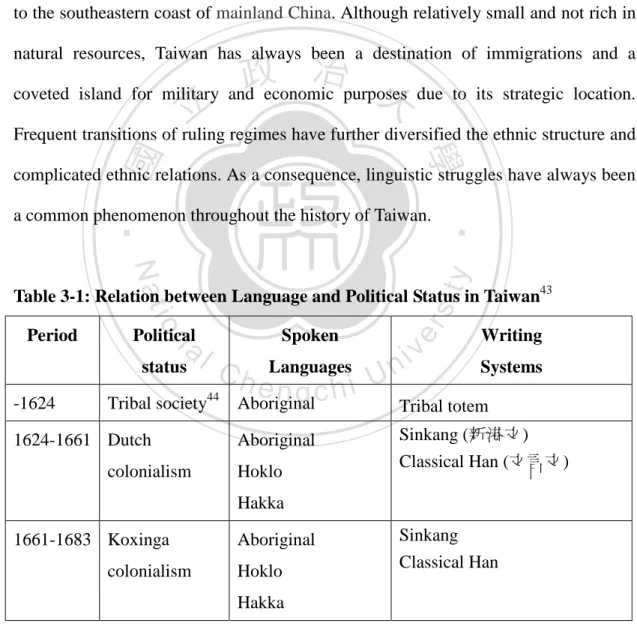
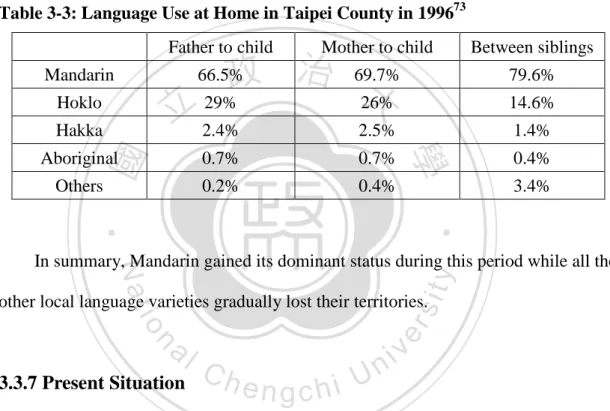
(7) 2.5 Linguistic Market and Linguistic Capital. 27. 2.6 Diglossia, Bilingualism, and Multilingualism. 29. 2.7 Language Attitude. 32. 2.8 Language Maintenance and Shift. 34. CHAPTER THREE ETHNOLINGUISTIC GROUPS, LANGUAGE VARIETIES, AND LANGUAGE HISTORY OF TAIWAN. 38. 3.1 Ethnolinguistic Groups in Taiwan. 39. 3.1.1 Aboriginal People. 40. 3.1.2 The Hoklo. 41. 3.1.3 The Hakka. 立. 政 治 大. 42. 3.1.4 The Chinese Mainlanders. 43. ‧ 國. 學. 3.2 Language Varieties in Taiwan. ‧. 3.2.1 Hoklo Language. 44 46. sit. y. Nat. 3.2.2 Hakka Language. 44. io. al. er. 3.2.3 Mandarin. n. 3.2.4 Taiwan Guoyu. Ch. n engchi U. 3.2.5 Aboriginal Languages. iv. 3.3 Evolution of Spoken Language of Taiwan. 47 48 49 49. 3.3.1 Before Seventeenth Century. 49. 3.3.2 European Colonial Period (1624-1661). 50. 3.3.3 Koxinga Period (1661-1683). 52. 3.3.4 Qing Dynasty Period (1683-1895). 52. 3.3.5 Japanese Rule Period (1895-1945). 53. 3.3.6 ROC Government Period (1945 to Present). 55. 3.3.7 Present Situation. 56. 3.4 Evolution of Written Language of Taiwan v. 58.
(8) CHAPTER FOUR VALUE ASSESSMENT ON LANGUAGE VARIETIES 4.1 Value Assessment on Language Varieties. 61 61. 4.1.1 Functional Value of Language Varieties. 61. 4.1.2 Exchange Value of Language Varieties. 65. 4.1.3 Symbolic Value of Language Varieties. 69. 4.1.4 Sign Value of Language Varieties. 73. 4.2 A Brief Conclusion of Section 4.1. 77. CHAPTER FIVE THE IMPACT OF ECONOMIC DEVELOPMENT ON LANGUAGE STRUCTURE. 79 治 政 5.1 Economic Development of Taiwan during 79 大Martial Law Period 立 5.1.1 A Brief Account of the Economic Development between 1950s and. ‧ 國. 學. 1980s. ‧. 5.1.2 Structural Change in Economy. 81 83. sit. y. Nat. 5.2 Impact of Economic Development on Society and Language Structure. 79. io. al. er. 5.2.1 Formation of the Five Social Classes. n. 5.2.2 Influence of Social Mobility on Language Use. Ch. n engchi U. iv. 5.2.3 Ethnic and Linguistic Dichotomy in Economic Organization. 83 85 88. 5.3 Education and Language Use. 90. 5.4 Promoting Mandarin through Examination System. 96. 5.5 A Comparison between the Japan-led and ROC-led Island-wide Language Directives. 99. 5.5.1 The Japan-led Island-wide Language Directive. 100. 5.5.2 The ROC-led Island-wide Language Directive. 101. 5.5.3 A comparison of the Two Island-wide Language Directives. 102. 5.5.3.1 Economic Development during Japanese Rule Period. 103. 5.5.3.2 An Economic Comparison. 105. vi.
(9) CHAPTER SIX CONCLUSION. 108. 6.1 Successful Promotion of Mandarin. 108. 6.2 Suggestions for Maintenance and Revitalization. 109. 6.2.1 Establishment of a Standardized and Modernized Writing System 109 6.2.2 Institutional Support. 110. 6.2.3 Intensification of Political and Economic Strength. 113. 6.3 Concluding Remark. 114. BIBLIOGRAPHY. 116. 立. 政 治 大. ‧. ‧ 國. 學. n. er. io. sit. y. Nat. al. Ch. engchi. vii. i Un. v.
(10) LIST OF TABLES Table 2-1. Characteristic Features of Diglossia. 30. Table 3-1. Relation between Language and Political Status in Taiwan. 38. Table 3-2. The Growing Percentage of Taiwanese Population Understanding Japanese (1905-1944). 54. Table 3-3. Language Use at Home in Taipei County in 1996. 56. Table 4-1. Assessment on Mandarin and Local Language Varieties during Martial Law Period. Table 4-3. Achievement. 66. Development of Hsiang-t’u Literature. 72. ‧. Table 4-5. 64. 學. Table 4-4. 政 治 大 Relationship among Language, Labor Market, and Occupational 立 Assessment on Mandarin, Hoklo, and Hakka in the 1950s. ‧ 國. Table 4-2. 62. Attitudes towards Languages among Different Ethnic Groups. Nat. Table 4-7. A Comparison of Diglossic Features between Mandarin and Local. 74. n. al. er. sit. y. Music Preferences in Taipei, Taichung, and Kaohsiung. io. Table 4-6. 74. Language Varieties. Ch. engchi U. v ni. 75. Table 4-8. Classes of Languages in Taiwan. 76. Table 4-9. Comparison of Language Value during Martial Law Period. 77. Table 5-1. Shares of Employment by Industry, 1952-1987 (%). 81. Table 5-2. Gross Domestic Product by Industry, 1952-1987 (%). 82. Table 5-3. Dominant Group and Language in Public and Private Sector during Martial Law Period. Table 5-4. Table 5-5. 89. Taiwan’s Economic Plans and Manpower Plans over Four Decades of Economic Development. 91. Number of Schools and Students. 92. viii.
(11) Table 5-6. Number of Schools by Level of Education. 93. Table 5-7. Number of Students by Level of Education. 94. Table 5-8. Percentage of Educational Attainment for People above Six in Taiwan in. Table 5-9. 1987. 95. Value Comparison of Mandarin and Japanese. 105. Table 5-10 Comparison of Economic Development. 立. 106. 政 治 大. ‧. ‧ 國. 學. n. er. io. sit. y. Nat. al. Ch. engchi. ix. i Un. v.
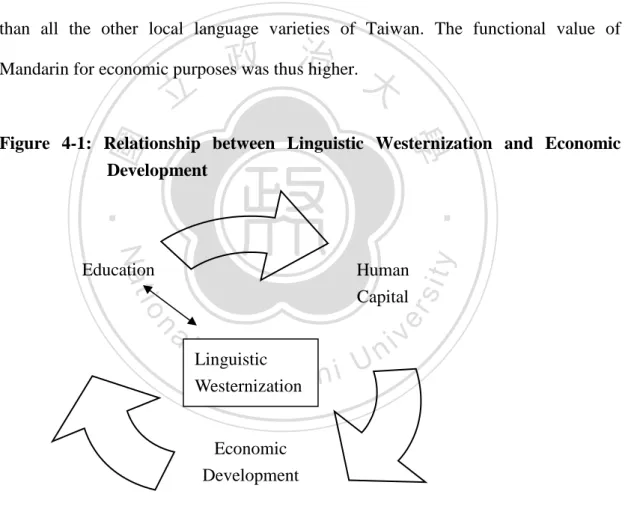
(12) LIST OF FIGURES Figure 1-1. Development of Chapters. 11. Figure 1-2. Relationship of Chapters Four and Five. 14. Figure 2-1. Interchangeability of Capitals. 27. Figure 2-2. Schema Representing the Formation of Attitudes. 34. Figure 2-3. Factors Affecting Language Maintenance. 36. Figure 4-1. Relationship between Linguistic Westernization and Economic Development. Figure 4-4. Fields not Possible without Mandarin. 68. 學. Figure 4-3. 政 治 大 Socioeconomic Competence 立. Relationship among Mandarin Competence, Education, and. ‧ 國. Figure 4-2. 63. Relationship among Speakers, Nationalism, Symbolic Value, and. ‧. Language Variety. Nat. 70. y. Mutual Influences among People’s Attitude, Sign Value of a Language. sit. Figure 4-5. 69. n. al. er. io. Variety, and the Benefits or Advantages Created by the Language Variety. Ch. engchi U. v ni. 73. Figure 5-1. The Five Social Classes and Upward Social Mobility. Figure 5-2. Relationship among Education, Economic Development, and Language Shift. 87. 96. Figure 5-3 Relationship between Examination System and Popularity in Mandarin 99. x.
(13) CHAPTER ONE INTRODUCTION 1.1 Research Motivation Language issues are multifaceted. It involves ethnic, cultural, political, and religious ideologies. John Packer (2002) said that language is the nature of the human species, and it is not only an important instrument for communication but also the carrier of identity, both of the individual and of group. Consequently, changes in language structure imply the rise or decline of a certain power.. 政 治 大. Throughout the history of Taiwan, the frequent transitions of ruling regimes have. 立. brought about multilingual phenomena. Taiwan has a legacy of rule by Dutch, 1. ‧ 國. 學. Koxinga,2 Qing dynasty, Japan, and currently the Republic of China (ROC). Each ruling power, more or less, had impacted the language structure to a certain degree.. ‧. Among them, the Japanese and ROC occupation had the most lasting influence.. y. Nat. io. sit. During these two periods, the foundation of economy and infrastructure was. n. al. er. consolidated; in the meantime, both of them tried to eradicate the Taiwanese identity. Ch. i Un. v. by way of assimilation policies, including various successful language policies. As far. engchi. as languages of Taiwan are concerned, these two periods are a catastrophe. Island-wide language directives led by the Japanese and ROC governments were both successful. If Japan had not been defeated in World War II, Taiwan would still have been ruled by Japan as a possible Japanese monolingual island. After the ROC authorities took over Taiwan, monolingual directives were given as the Japanese had done. The mother tongues of the island’s peoples were so strictly suppressed that the younger generations nowadays mostly communicate in the ROC directive language Mandarin, especially for the higher educated. 1 2. The Dutch occupied Taiwan in 1624 to 1662. Koxinga, a remnant force leader of Ming dynasty, defeated the Dutch and seized control of Taiwan. 1.
(14) The language structure of Taiwan has undergone a tremendous transformation. During Japanese colonial period (1895-1945), Hoklo and Japanese were the two most important island-wide languages. ROC rule of Taiwan from 1945 enforced Mandarin to become the dominant language all of a sudden. A number of studies have been conducted to elaborate this drastic change mostly from political perspectives. However, political explanations alone can not sufficiently provide a holistic answer. As a result, my thesis intends to explain this phenomenon from an economic perspective so that related research could be more complete and comprehensive.. 治 政 Do all the languages in the world contain the same 大 value? The answer is negative. 立 About 96% of the world’s languages are spoken by about 3% of the world’s ‧ 國. 學. population; by contrast, about 97% of the people in the world speak about 4% of the. ‧. world’s languages.3 Obviously, some languages have lost their competitiveness, and. sit. y. Nat. thus are endangered. The languages in Taiwan have experienced this loss.. io. er. The value and development of languages are intertwined with economic. al. development. A growing literature argues that commonality of language is associated. n. iv n C performance. on economic h e n gViews chi U. with better economic. growth are negatively. correlated with linguistic heterogeneity across developing countries. Manufacturing employment growth discourages linguistic heterogeneity. My opinion is that language learning and linguistic diversity ought to be taken as endogenous to the process of economic development. In other words, as a country becomes more advanced and industrialized, the number of languages in the country shall decline or a certain language might become more and more influential and dominant. Therefore, I am motivated to find out whether the transformation of language structure is intertwined 3. Bernard, H. Russell. 1996. Language Preservation and Publishing. In Nancy H. Hornberger (ed.): Indigenous Literacies in the Americas: Language Planning from the Bottom Up. Berlin: Mouton de Gruyter, p. 142. 2.
(15) with the process of economic development.. 1.2 Purpose of the Thesis This thesis aims to present an extended and systematic study on the changes in language structure from an economic perspective. Thus, the purpose is to achieve the following goals. 1. To provide an economic explanation on language development, and contribute to the integrity of related studies. 2. To understand why the availability of a certain language becomes an economic advantage.. 立. 政 治 大. 3. To evaluate the economic value of the languages in Taiwan, and analyze how it. ‧ 國. 學. affects the language structure.. sit. y. Nat. structure.. ‧. 4. To understand the impact of economic development on the transition of language. io. al. n. inequality.. 6. To elaborate the. Ch similarities. er. 5. To understand how the unequal distribution of languages affects economic. iv n in the eandn gdifferences chi U. two island-wide language. directives during Japanese and martial law periods respectively, and analyze the political and economic factors that led to the outcomes. 7. To serve as a reference for future language planning in Taiwan.. 1.3 Significance of the Thesis Most of the recent studies on language issues in Taiwan are mostly connected with mother tongue education, English instruction, language politics and rights, language planning and revitalization. Not many studies are related to economic and language development. 3.
(16) Since we now live in a highly globalized and mercantile world, economic forces behind languages play an influential role in determining language choice of the common people and thus the success of all language policies. For example, according to research conducted by Language Training and Testing Center (LTTC)4 in 2005, those in higher positions in banking professions in Taiwan are found to be more proficient in English, and therefore that ability is of great significance in relation to career development. A large number of relevant studies with similar conclusions could be easily found. As a result, people in Taiwan are in pursuit of fluent English abilities in an effort to increase competitiveness. And related English education policies hardly encounter any obstacles.. 立. 治 政 In a word, economic 大 forces. mainly drive current. English-learning trends. Without economic support, English would not have prevailed. ‧ 國. 學. and acquired such a powerful status.. ‧. The same pattern also applies to other language situations across time and space.. sit. y. Nat. As a consequence, to fully understand the changes in language structure of Taiwan,. io. er. we must not only focus on political factors, but economic forces as well.. al. To sum up, this study provides another perspective to analyze the language. n. iv n C Furthermore, better understanding h e nwith gchi U. structure of Taiwan.. of economic factors. behind languages, future language planning could be based on related researches since people in modern times are becoming more and more utilitarian.. 1.4 Definitions of Terms Language planning: Cooper (1989) states that language planning refers to deliberate efforts to influence the behavior of others with respect to the acquisition, structure, or functional allocation of their language codes. These efforts may involve graphization, standardization, 4. LTTC is located in Taipei, Taiwan. 4.
(17) modernization, and allocation of status or functions to particular language varieties (Tollefson, 1991). According to Reagan (2005), language planning has been divided into four types: status planning, corpus planning, acquisition planning, and attitude planning. Language policy:. It is sometimes synonymous with language planning. Corson (1990: 141) explains that language policy identifies the nation’s language needs across the range of communities and cultural groups that it contains; it surveys and examines the resources. 學. establishes strategies for managing and developing language resources as it relates all of these to the best interests of the. ‧. ‧ 國. 治 政 available; it identifies the role大 of language in general and 立 individual languages in particular in the life of the nation; it. sit. Language variety is often called dialect instead of language.. io. er. Language variety:. y. Nat. nation through the operation of some suitable planning agency.. al. However, to avoid political or ideological implications with. n. iv n C regard to which is referred to as a “dialect,” some h e nlanguage gchi U. sociolinguists prefer the neutral term language variety to dialect. The term language variety does not imply a particular status nor does it reflect the social status of its speakers. The operational definition of language variety in this thesis is any mode of language use perceived or identified as distinct by the speech community, regardless of the extent of its relationship with other language forms. Thus, a language variety can be anything from a local accent to a separate language (Karl-Eugen, 1994). Language attitude:. Language attitude is a predisposition to respond evaluatively to 5.
(18) perceptual or linguistic signs. It can be considered to measure social convention and the prestige of certain language varieties in speech communities. It also reflects an awareness of the status and prestige accorded to the speakers of the varieties (Karl-Eugen, 1994). Language shift:. A concise definition of language shift is given by Fasold (1984). It simply means that a community gives up a language completely in favor of another one. His definition implies that language shift is the long-term result of a community’s language. 治 政 choice. Language shift may ultimately 大 lead to language death. 立 Mother tongue has no standardized definition. It could mean the 學. language one acquires from birth, the language one identifies with the native speaker, or the language one knows best or uses most.. ‧. ‧ 國. Mother tongue:. sit. y. Nat. All in all, mother tongue provides a basis for sociolinguistic. io. er. identity. There are, as proposed by Tulasiewicz and Adams (1998),. al. three distinctive uses for mother tongue. Firstly, it is a language. n. iv n C spoken in private secondly, it is used as a regional h e nsettings; gchi U. language; thirdly, it is a language with national status and used in public occasions. National language: According to Holmes (1992), national language is a political, cultural, and social unit. It contains a symbolic function that not only represents the national unity, but also identifies the nation and unites the people of the nation. It has an ideological and emotional dimension that binds people together, and thus stands for the identity of a country, state, or territory. National language and official language are two separate concepts although they 6.
(19) might coincide in some aspects. Official language:. According to Holmes (1992), the functions of an official language are primarily based on utilitarian considerations instead of symbolic considerations. Mesthrie, Swann, Deumert, and Leap (2000) argue that an official language is designated as a legally appropriate language for political and cultural purposes. Usually, official languages are those with special legal status in a particular country, and are used in official settings such as court and parliament. To be an official language, it does not matter whether. 治 政 the language is widely spoken or 大not. For example, Maori 立 language possesses official status, but it is spoken by less than five ‧ 國. 學. percent of the New Zealand population; in the United States,. ‧. English is undoubtedly dominant, but it is not the official. y. sit. Lingua Franca is a functionally defined language employed over. io. er. Lingua franca:. Nat. language.. al. an extensive area by people speaking mutually unintelligible. n. iv n C languages for purposes. Holmes (1992) adds that h communicative engchi U. the most useful and widely adopted lingua franca, in certain cases, is the country’s official language or national language. For example, E Chen-chun mentions (2003) that about one hundred vernaculars were spoken in the former Soviet Union, and Russian was adopted as the lingua franca, at the same time being the country’s official language and national language; furthermore, there are more than one hundred languages spoken in the Philippines, and Filipino is not only the lingua franca but also the official and national language of the Philippines. 7.
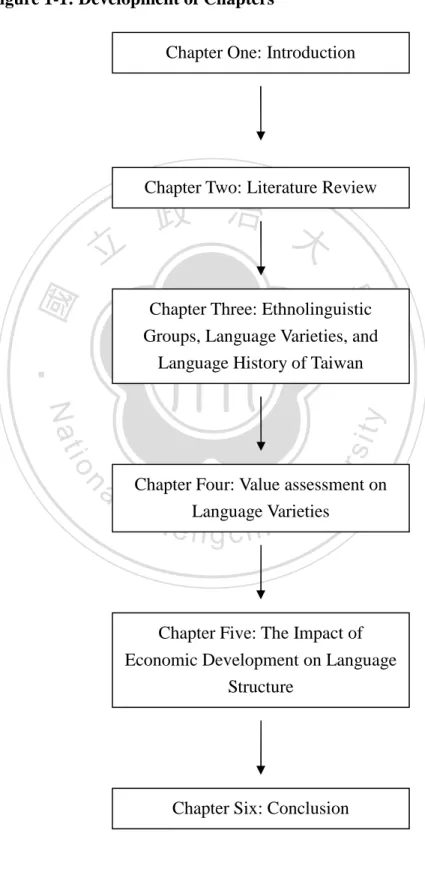
(20) 1.5 Research Scope The time frame of this thesis mainly focuses on martial law period, which is from 1949 to 1987. However, in order to gain a holistic understanding of Taiwan, some sections might extend into the Dutch era or even earlier and to present times as well. Martial law period was perhaps the darkest era for ordinary people from political, cultural, social, and linguistic perspectives; however, it was during this period that the economy of Taiwan started to take off. On the one hand, the people in Taiwan were severely suppressed in virtually every aspect of life, and in the meantime, with the support of the authoritarian government, Mandarin started to invade the society and. 治 政 occupy the dominant status; on the other hand, with 大 the strong involvement of the 立 state, the economic structure of Taiwan successfully transformed from labor intensive ‧ 國. 學. to capital intensive, and to nowadays technology intensive, making it possible to feed. ‧. and enrich millions of people in Taiwan. Hence, martial law period was a time of. sit. y. Nat. contradictions that deserve more researches from diverse angles.. io. er. The primary research target of this study is the transformation of language. al. structure. Taiwan is an immigrant society that is composed of various languages,. n. iv n C cultures, and ethnic groups. Colonial aside, during martial period there h e n glanguages chi U were three main categories of language varieties, namely Hoklo, Hakka, and aboriginal languages. Nonetheless, with the advent of colonial languages such as Mandarin and Japanese, the language structure was unfortunately disintegrated and reshuffled. To date, the Japanese language still carries a profound influence in Taiwan’s social, cultural, and commercial activities, not to mention Mandarin that has already on top of the language hierarchy. The economic development of Taiwan also plays an important role since this thesis tries to find out how the economic aspect is related to the changes in language structure. After World War II and decades of Japanese occupation, the economic 8.
(21) foundation of Taiwan suffered severe damage. But after a series of construction and recovery efforts, Taiwan had amazed the world with its economic miracle. This economic success by all means had had diverse impacts on the society and the transformation of language structure.. 1.6 Research Method This thesis intends to find out the economic reasons that account for the transformation of language structure during martial law period. Since the timeframe focuses on the past event, historical and documentary research methods are adopted to. 治 政 collect necessary materials. Furthermore, in chapter 大five, the Japan-led and ROC-led 立 island-wide language directives are compared to explore the underlying economic ‧ 國. 學. factors that explain why ROC-led island-wide language directives were more. ‧. effective. As a result, comparative research method is also adopted.. sit. y. Nat. io. al. er. 1.6.1 Historical Research. n. Historical research is the systematic analysis of related documentation or information in an effort. iv n C to find out accurate U description hen gchi. and explanation of a. phenomenon. It is a reflective process that discovers rather than generates data. In the past, it focused on the discovery and criticism of historical materials; recently, it puts emphasis on explaining the cause and effect of an event. This thesis adopts primary and secondary source materials to understand the cause and effect of the changes in language structure. Furthermore, I expect that the analytical process and result could be regarded as a means to elaborate current situation.. 9.
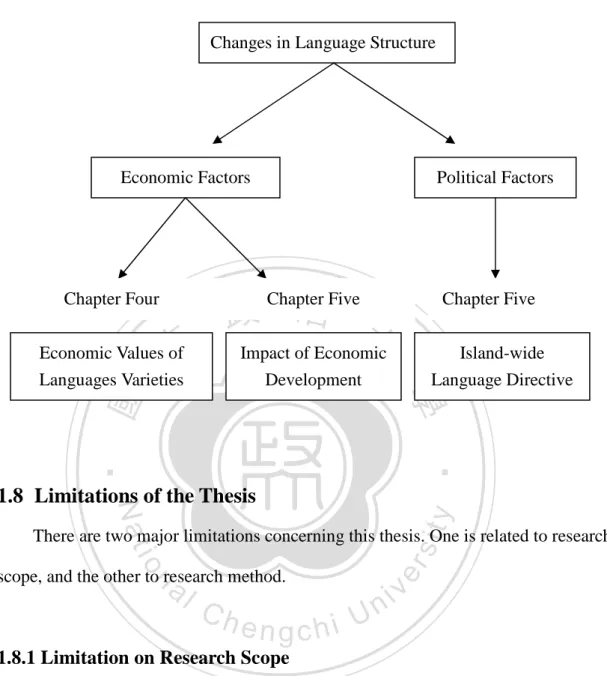
(22) 1.6.2 Documentary Research Documentary research refers to the analysis of texts and documents as source materials, such as government publications, official statistics, academic papers, etc. Analysis of texts and documents means to structurally and systematically use written materials created by an authoritative source to explore research questions. The materials needed by my thesis primarily are from publishing companies and libraries in the ROC at Academia Sinica, Ministry of Economic Affairs, Ministry of Education, Council of Indigenous Peoples, and Council for Hakka Affairs. Research studies include masters and doctoral theses, journal articles, conference papers, and. 治 政 government research reports, and so on. 大 立 ‧ 國. 學. 1.6.3 Comparative Research. ‧. Comparative research aims to discover some hidden information of the subjects. sit. y. Nat. being compared. In chapter five of this thesis, I am going to compare the two. io. er. island-wide language directives during Japanese colonial period and martial law. al. period respectively. A number of studies suggest that political factors were what bring. n. iv n C transformations in hlanguage structure; e n g c h i U however,. about the. through comparative. analysis, this thesis find out that economic forces were also influential. Relevant economic, political, historical, linguistic, educational, and societal materials will be widely collected and compared with a view to understanding the similarities and differences of the two island-wide language directives.. 10.
(23) 1.7 Organization of the Thesis Figure 1-1 shows the development of chapters of this thesis.. Figure 1-1: Development of Chapters Chapter One: Introduction. Chapter Two: Literature Review. 立. 政 治 大. ‧ 國. 學. ‧. Chapter Three: Ethnolinguistic Groups, Language Varieties, and Language History of Taiwan. n. er. io. sit. y. Nat. al. v. Chapter Four: Value assessment on Language Varieties. Ch. engchi. i Un. Chapter Five: The Impact of Economic Development on Language Structure. Chapter Six: Conclusion. 11.
(24) Based on Figure 1-1, the descriptions of the chapters are as follows. Chapter One elaborates the research motivation and purpose, significance of the thesis, definitions of terms, research scope and method, and organization as well as limitations of the thesis. Chapter Two introduces important literature, theories, and related studies in order to critically analyze the transformation in language structure during martial law period from economic perspective. In Chapter Three, ethnolinguistic groups, language varieties, and language history of Taiwan are presented. The discussion on ethnolinguistic groups is divided. 治 政 into four subsections that deal with groups popularly 大 known as aboriginal people, 立 Hoklo, Hakka and the Chinese Mainlanders. As for language varieties, this thesis ‧ 國. 學. deals with the origin, development, and distribution of five major language varieties,. sit. y. Nat. languages.. ‧. which are Hoklo, Hakka, Mandarin, Taiwan Guoyu (台灣國語), and aboriginal. io. er. Chapter Four analyzes economic values of each language variety in Taiwan.. al. n. Ostensibly, all languages are supposed to be equally important; however, the truth is just the opposite. With. iv n C stronghexternal intervention e n g c h i U and. influence, each language. variety has been given with different degrees of economic values so that the government or people naturally cling to the economically powerful language as a medium for communication. Thus, the alteration in language structure occurs. This chapter expounds this phenomenon that happened in Taiwan during martial law period. Chapter Five is further divided into two parts. The first part of chapter five clarifies the impact of economic development on language structure. The economic values of languages are intertwined with actual market forces and economic development. To reduce costs, a standardized production procedure is indispensable. 12.
(25) In this regard, the cost of an economy with more communication tools, including languages, would be much higher. Therefore, when a country becomes more advanced, the economic forces might intervene with the language structure and jeopardize the existence of those language varieties with lower economic value. In the second part of chapter five, the two island-wide language directives that happened in Japanese and martial law periods respectively are compared. The promotion of Japanese did not really penetrate the society. The common people found it unnecessary to speak Japanese in private occasions. On the contrary, the promotion of Mandarin was so successful that it became the lingua franca both in public and. 治 政 private domains. In addition to political involvement, 大 this chapter explains that 立 economic factors are also responsible for the distinct outcomes of the two island-wide ‧ 國. 學. language directives.. ‧. Chapter Six systematically concludes the findings of previous chapters and some. sit. y. Nat. suggestions are proposed for future language planning.. io. al. er. Chapter four and five are the main analytic chapters of this thesis. Their. n. relationship is displayed in Figure 1-2.. Ch. engchi. 13. i Un. v.
(26) Figure 1-2: Relationship of Chapters Four and Five Changes in Language Structure. Economic Factors. Chapter Four. 立. Chapter Five 政 治 大. Island-wide Language Directive. ‧. ‧ 國. Impact of Economic Development. Chapter Five. 學. Economic Values of Languages Varieties. Political Factors. sit. y. Nat. 1.8 Limitations of the Thesis. io. al. er. There are two major limitations concerning this thesis. One is related to research. n. scope, and the other to research method.. Ch. engchi. i Un. v. 1.8.1 Limitation on Research Scope The principal time frame is the martial period; however, some parts might cover from Dutch era and to present times. To collect materials related to such a long period of time would be difficult. In addition, included in this thesis is the overall language structure, which consists of a variety of languages with sophisticated and multifaceted characteristics; as a result, it would be no easy task to analyze each language variety but study them as a whole. Although the author has put a lot of time and efforts in doing research and analysis, it still requires more attention, dedication, and time to make this study closer more refined. 14.
(27) 1.8.2 Limitation on Research Methods Generally speaking, research method can be roughly divided into empirical and non-empirical research. Empirical research assumes that scientific procedures can be directly applied to the study of social and behavioral science; thus, methods that correspond to scientific principles such as questionnaires, tests, or surveys are usually adopted. Non-empirical research focuses on logical deduction that discovers truthfulness. In a nutshell, empirical research tries to find out practical knowledge while non-empirical research pursues inference of logics. The research methods adopted in this thesis are all non-empirical so that there is. 治 政 no analysis and operation on directly executed statistics 大 but only citation of existing 立 surveys with inference, and there might be no empirical procedures but the ‧ 國. 學. researcher’s non-empirical deduction. This study relies heavily on the collections of. ‧. written materials such as conference papers or government publications, which may. sit. y. Nat. be biased, incomplete, etc. Future researches on related fields could adopt some. io. er. empirical research methods to make it more persuasive and sound. This is the aspect. al. that needs improvement.. n. iv n C Furthermore, the collecting h process i U materials might be affected by e n g cof hnecessary. the researcher’s subjective judgment so that the real outcome of this study would perhaps be distorted. And the existing materials are usually of secondary sources; consequently, the examination on the reliability and validity of the materials poses a great challenge.. 15.
(28) CHAPTER TWO LITERATURE REVIEW 2.1 Rational Choice Theory The applications of rational choice theory can be found in various disciplines of social sciences such as economics, sociology, criminology, history, psychology, philosophy, and anthropology. Downs (1957) defines rational choice as proceeding towards goals with a minimal use of scarce resources and undertaking only those actions for which marginal return exceeds marginal cost.5. 政 治 大. Rational choice theory in a general sense helps us understand individual. 立. behaviors that are deemed to be seeking the best benefits. Jon Elster (1986) said that. ‧ 國. 學. rational choice theory tells us what we ought to do in order to achieve our aims as well as possible.6 Rational choice theory provides a framework for understanding. ‧. social and economic behaviors. It assumes that human behaviors are guided by. y. Nat. io. sit. instrumental reasons.. n. al. er. Stephen (2004: 87-107) argued that rational choice theory is not one theory but a. Ch. i Un. v. descriptive term for the description of any individual theories that apply a rational. engchi. choice approach. This approach assumes that rational choice is formulated with a view to achieving the most preferred outcome. Moreover, the behaviors or actions taken by the individuals are conditioned by social, cultural, or psychological limitations.7 Under the principles of rational choice theory, individuals are assumed to be motivated by their desires or goals. However, they do not make judgments without. 5. Downs, Anthony. 1957. An Economic Theory of Political Action in a Democracy. The Journal Political Economy, 65(2): 135-150. 6 Elster, Jon. 1986. Rational Choice. New York: New York University Press, p. 1. 7 Quackenbush, Stephen L. 2004. The Rationality of Rational Choice Theory. International Interactions, 30(2): 87-107. 16.
(29) external interferences. That is, people act under specific constraints and on the basis of the information that they are able to collect about the circumstances under which they are acting. When faced with a set of choices, people tend to make assessments according to personal rationality. That is, based on personal preferences and resources at hand, people make choices that best suit their subjective needs. As suggested by Camerer and Fehr (2006), individuals are assumed to choose those actions that best satisfy their preferences.8 As a result, rational choice is a balanced decision between aims and means. To sum up, individuals make decisions or take actions that would maximize. 治 政 the benefits and minimize the costs. 大 立 Consequently, it is always worth knowing that whether a specific action taken by ‧ 國. 學. an individual or institution is rational or not. In other words, it would be unwise to. ‧. think of actions taken by others as irrational when we just disagree with them.. sit. y. Nat. Rational choice theory suggests that we should look for reasons behind such. io. er. differences and disagreements. Although there might be some other theories that also. al. account for relevant phenomena, rational choice theory still deserves attention since. n. iv n C all human social behaviors contain, or less, rational elements. h emore ngchi U. Jon Elster (1986) further proposed that rational choice theory contains three elements in the choice situation. The first element refers to a feasible set of actions that are believed rationally to satisfy various constraints; another refers to the casual structure of the situation, which determines the outcomes of a certain course of action; the other is a subjective ranking of the feasible alternatives that come from a ranking of the outcomes to which they lead. 9 Thus, to take rational actions could be simplified as choosing the highest-ranked action in the feasible set. 8. Camerer, C. and E. Fehr. 2006. When Does ‘Economic Man’ Dominate Social Behavior? Science, 311: 7-52. 9 Elster, Jon. 1986. Rational Choice. New York: New York University Press, p. 4. 17.
(30) If we apply Jon Elster’s notion of rational choice theory to the language situation of Taiwan after taking the island from Japan by the ROC and United States (US) allied forces, we would first come out with sets of languages in the population that were Mandarin, Hoklo, Hakka, aboriginal languages, and Japanese. It was the unique political and economic structure that brought Mandarin to the top of the linguistic hierarchy, and thus people at that time naturally or forcibly chose Mandarin as major communicative tool based on their rationality. As a result, the spread of Mandarin became inevitable while the other language varieties were highly devaluated.. 治 政 2.2 Value System of Jean Baudrillard 大 立 In his first two books, Baudrillard was against the interpretation of consumer ‧ 國. 學. society as a linguistic system; nevertheless, he applied Saussure’s semiological theory. ‧. of language to his analysis of the system of commodities in his later work For a. io. er. all aspects of social life as a system of signs.10. sit. y. Nat. Critique of the Political Economy of the Sign. Thus, Baudrillard started interpreting. al. To supplement Marxist analysis of commodities in terms of use value and. n. iv n C exchange value, Baudrillard proposed that there are four ways of an object obtaining heng chi U value. They are: 1. a functional logic of use value; 2. an economic logic of exchange value; 3. a logic of symbolic exchange; 4. a logic of sign value. Baudrillard believed that the analysis of sign values uncovers the ways in which the dominant class instills its tastes, values, and privileges so as to achieve class domination.11 The term use can be best described as the handling of objects or, in this case, of languages, although all languages are quite similar from this perspective. For example,. 10. Kellner, Douglas.1989. Jean Baudrillard: From Marxism to Postmodernism and Beyond. Stanford: Stanford University Press, p. 21. 11 Baudrillard, Jean. 1981. For a Critique of the Political Economy of the Sign. St. Louis, MO: Telos Press, p.115. 18.
(31) a car runs. The functional logic of use value of a language variety refers to its instrumental purpose. There are a number of factors that influence the use value of a certain language variety such as its communicative usefulness, easiness of acquisition, scarcity and so on. Besides, use value may vary from one social context to another and from one ethnolinguistic group to another. Thus, to propose a general conclusion on the use value of languages, the more a language is used, the higher use value it generates.12 Exchange value of an object refers to its economic value. For instance, a car might be worth the salary earned by two years of hard work. Languages also contain. 治 政 exchange value. The evaluation of such value is 大 based on what motivates people to 立 learn or to use a certain language in an effort to achieve their objectives such as ‧ 國. 學. employment or enjoyment. Generally speaking, the number of speakers of a certain. ‧. language plays a very important role in determining its exchange value; nevertheless,. sit. y. Nat. it is not the conclusive factor. Sometimes, the political and economic powers behind. io. er. different linguistic groups are far more detrimental. For instance, although nowadays. al. there are not many English speakers in Taiwan, English still possesses very high. n. iv n C exchange value due to its strong and people in Taiwan are eager to heconomic e n g cpowers, hi U. learn English for the potential benefits that it brings. The exchange value of languages is based on a variety of determinants that should be analyzed as a whole. Symbolic value involves the subjective projection of an affective nature onto an object. For example, we might attribute a value to a certain object as a symbol of belonging, identity, amity, or animosity. And it is quite easy to associate symbolic value with languages. Mother tongues in the colonized countries always play the role that binds people together. Nationalism, in this case, is a symbol projected by. 12. It could mean the actual number of speakers or the frequency of using that language in a multilingual society. 19.
(32) languages. Besides, it is quite common that when people study abroad, they tend to get together with their compatriots so that they could communicate in the same language, which symbolizes a sense of belonging, security, and familiarity. Furthermore, there is no strong correlation between the vitality of a language and its symbolic value. On particular occasions, high symbolic value could be attributed to the dead or endangered languages which still enjoy a special position among powerful languages. The sign value of an object refers to the evaluations that are made according to its social prestige. Social prestige refers to the attitudes held towards the target object. 治 政 and the socioeconomic powers that it implies. For大 instance, a luxurious car not only 立 contains use value (a car runs) and exchange value (a car might be worth a five-year ‧ 國. 學. salary), but also has high sign value since the society usually holds a set of special. ‧. stereotypes towards particular car brands. When applying the notion of sign value to. sit. y. Nat. the analysis of language phenomena, numerous examples could offer an explanation.. io. er. The proliferation of English, Spanish or Portuguese in the once colonized countries. al. represents the success of physical powerfulness, economic control and political. n. iv n C manipulation. Pure linguistic factors play a very minor role. The developments h e nonly gchi U of those powerful colonizer languages might entail a variety of benefits, and thus high value, for their speakers.. 2.3 Language and Economy Economics is the social science that studies how scarcity and incentive influence or reconcile our choices. Scarcity refers to the condition when available resources are insufficient to satisfy wants; incentive refers to a reward or a penalty that encourages. 20.
(33) or discourages an action.13 In a multilingual society, scarcity might happen frequently since an individual’s mother tongue is not sufficient to satisfy the communicative needs. Especially under an authoritarian government, only the designated official language is able to satisfy the communicative, political, and economic needs in public spheres. Thus, incentives that encourage people to learn the designated official language arise. The transformation of Taiwan language structure under martial law was an example that explains this situation. The world can not function as usual without language. Language is an important. 治 政 cultural asset that facilitates the exchanges of大 both physical and non-physical 立 interactions. It is the medium of business; nevertheless, it sometimes could act as a ‧ 國. 學. barrier to trade. There is such a powerful and tight relation that it will not make. ‧. perfect sense to explain the changeable linguistic map of the world without referring. sit. y. Nat. to economic development.. io. er. The above statement draws attention to the study of language economics, which. al. tries to figure out how linguistic and economic variables influence one another. For. n. iv n C instance, it has been argued thathin most African countries, one has to gain knowledge engchi U of a former colonial language in order to achieve upward social mobility and better economic opportunities. From the perspective of language economics, linguistic products such as language varieties and accents are regarded as goods or commodities that contain a value based on the functions of markets. Some linguistic products may be in possession of higher market values when compared with others; thus, people tend to invest in the acquisition of a certain linguistic product to enjoy the underlying advantages. Furthermore, language planning efforts are most likely to succeed when. 13. Bade, Robin and Michael Parkin. 2004. Essential Foundations of Economics. Boston: Pearson Addison Wesley, pp. 2-3. 21.
(34) supported by economic or associated social incentives for the minority groups (Kamwangamalu, 2008). Alsagoff (2008) applied the concept of commodification, which requires the theory of political economics, to the analysis of languages. This concept regards languages as goods that can be objectified, evaluated, and exchanged for on the market. In other words, the value of a language depends on its correlation with some form of benefit or goods of worth to the society. For instance, economic value can be given to a particular language as long as it, directly or indirectly, generates advantages to its speakers or smoothes the economic functioning of a society.. 治 政 The notion of global language system, proposed 大 by de Swaan, is a sociological 立 classification of languages based on the non-haphazard connections between various ‧ 國. 學. language communities. Languages are classified into four categories, namely central. ‧. languages, supercentral languages, hypercentral languages, and peripheral languages.. sit. y. Nat. The speakers of peripheral languages, for the purpose of communication, tend to. io. er. acquire the same second language, which becomes central language to their region.. al. This inclination of language shift towards central language can be explained through. n. iv n C concepts of economics. According languages are hypercollective goods h etondeg Swaan, chi U that require an investment to learn. Languages are like social networks that provide connections into that specific language community. Thus, the acquisition of a (central) language is like an investment that brings potential economic opportunities.14 Language ability has been proven to be a detrimental form of human capital, and it is especially true in developing countries. If we assume that the acquisition of language can be achieved through individual choice and parents can decide which of the existing languages to pass on to their children, it would be quite possible that the selection of which language to acquire or to pass on might be determined by the 14. Spolsky, Bernard. 2004. Language Policy. Cambridge: Cambridge University Press, pp. 88-89. 22.
(35) potential economic incentives that the target language could bring. The economists that study immigrant labors have argued that ability in the receiving countries’ language earns returns in the labor market (Bleakley and Chin, 2004; Chiswick and Miller, 1995).15 Lankshear (1997) suggests that language has been economized in the sense that they are promoted, from individual to national level, for reasons of economic advantage. As a consequence, language is likely to be an integrated characteristic of economic development. Members of non-prestige social groups or linguistic minorities seem acutely aware of the fact that certain languages (non-prestige or minority languages) do not. 治 政 have a function in gaining upward social mobility. 大Spanish in America, French in 立 Canada, Moroccan-Arabic in Morocco, or Quechua in Peru therefore are not highly ‧ 國. 學. associated with academic schooling, economic success, etc. (Rene Appel and Pieter. ‧. Muysken, 1987: 20). sit. y. Nat. Pool (1972: 222) once made a short statement that linguistically highly. io. er. fragmented countries are economically poor. As in many developing countries,. al. n. linguistic fragmentation coincides with low economic growth. However, this does not mean that linguistically. iv n C highly countries h ehomogenous ngchi U. are economically rich, for. which it is not difficult to find examples.16 Practically speaking, Li Wei (2000) suggested that difficulties in communication within a country can act as an impediment to commerce and industry. It is assumed that multilingual countries are often faced with certain problems that monolingual states do not encounter although pure monolingual states can be hardly found. When the highly industrialized countries colonized the underdeveloped countries during the eighteenth and nineteenth 15. Although the conclusion is based on the analysis of immigrant society, the struggle of the people in the lower class in any societies is somewhat similar; thus, the generalization of the conclusion is credible. 16 Pool, Jonathan. 1972. National Development and Language Diversity. In Fishman, J.A. (ed.). Advances in the Sociology of Language, 2. Den Haag: Mouton, pp. 213-230. 23.
(36) centuries, one of the measures taken to tear down the obstacles in reaping economic surplus was to diminish communicative difficulties by way of various language policies that promoted the colonizers’ languages.17 Coulmas (1992: 25) suggested that a high level of socioeconomic development is not compatible with linguistic fragmentation. This perspective is in accordance with that of the language planners in the developed and industrialized countries, which shows a certain degree of monolingualism. Though in some advanced countries, several languages co-exist and enjoy official status, the governments tend to promote one certain language (or a few already widespread languages) and make it dominant,. 治 政 while downplaying the others to symbolic and大 cultural accessories 立 functional significance.. rather than. 18. ‧ 國. 學. Pattanayak (1996) brought up the idea that the co-existence of multiple. ‧. languages is perceived to be a threat to national cohesion, administrative integration. sit. y. Nat. and barriers to economic growth. Furthermore, the significant influence of. io. er. urbanization on languages was also emphasized by him. Simply speaking, in highly. al. n. industrialized and urbanized societies, the language of the rich becomes richer and the. i n 19 Cpoorer. language of the poor becomes U hengchi. v. The notion of linguistic instrumentalism was emphasized by Lionel wee (2008), who defined it as what justifies the existence of a language in a community based on its usefulness in achieving specific utilitarian objectives such as access to economic development or social mobility.20 Although it has been widely agreed that language possesses certain sentimental attachments that bring people together, the survival of an endangered language, according to linguistic instrumentalism, might rely more on 17. Wei, Li (ed.). 2000. The Bilingualism Reader. London: Routledge, pp. 3-25. Coulmas, Florian. 1992. Language and Economy. Cambridge, MA: Blackwell Publishers, p. 25 19 Coleman, Hywel and Lynne Cameron (ed.). 1996. Change and Language. British Association for Applied Linguistics: Multilingual Matters Ltd, pp. 143-152. 20 Tan, Peter. K. W. and Rani Rubdy (ed.). 2008. Language as Commodity. New York: Continuum International Publishing Group, p 32. 18. 24.
(37) its correlation with social mobility or potential economic advantage that comes with it. To sum up, there is no scientific evidence to show that multilingual countries are particularly disadvantaged compared to monolingual ones; nevertheless, it might be true that linguistic uniformity and economy reinforce each other. In other words, economic advancement leads to the reduction of linguistic diversity.21. 2.4 Forms of Capital Sarah Thornton (1995) once made a statement that what unifies Bourdieu’s. 治 政 forms of capital is that they are all to be found 大 in his own social world where the 立 participants have a high amount of “institutionalized cultural capital.” ‧ 國. 學. Bourdieu (1984) proposed that there are three forms of critical resources,. ‧. metaphorically described as ‘capital’. They are economic, social, and cultural capitals.. sit. y. Nat. Economic capital refers to command over flows of economic resources such as cash. io. er. and other forms of material wealth.. al. Social capital, according to Putnam (1993), consists of social networks and. n. iv n C associated norms that have an h effect on the productivity of the community. Besides, engchi U. Putnam also suggested that social capital has transformed from an individual possession into a collective attribute, which facilitates cooperation and mutual support within the community. Bourdieu (1986) defines social capital as “the aggregate of the actual or potential resources which are linked to possession of a durable network of more or less institutionalized relationships of mutual acquaintance and recognition.” Social capital, argued Grootaert (2001), also makes the other types of capital and their productive combination more efficient. Generally speaking, it refers to resources generated from connections within and between social networks that, if properly dealt 21. Wei, Li (ed.). 2000. The Bilingualism Reader. London: Routledge, pp. 12-13. 25.
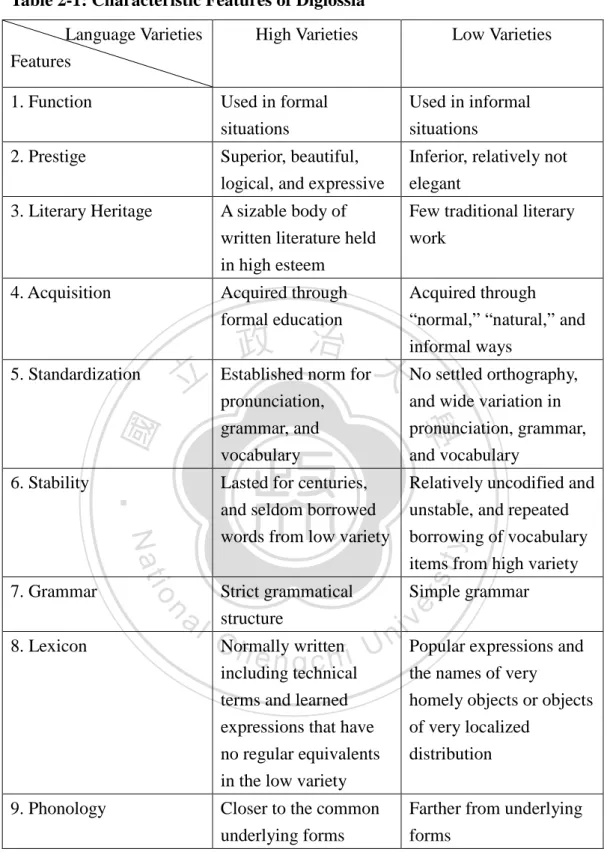
(38) with, provide individuals with advantages in pursuit of profits. Cultural capital is associated with Bourdieu, for whom it acts as a social relation within a system of exchange that includes the accumulated cultural knowledge that confers power and status (Phillipson et al, 2004). To further explain the educational achievements of children from different socioeconomic backgrounds, Bourdieu proposed the idea of cultural capital, which, broadly defined, refers to the intangible assets such as knowledge, skills, and education that a person has. Instead of regarding culture only as shared norms and values in a society, Bourdieu argued that it contains the properties of economic capital and is capable of generating profits. Cultural. 治 政 capital should be interpreted as a particular form大 of capital, not just a metaphorical 立 construction. The unequal distribution of cultural capital, according to Bourdieu, was ‧ 國. 學. essential in explaining the disparities in academic performances among school. ‧. children (Bourdieu and Passeron, 1979). The success at school is the specific profits. sit. y. Nat. that children can make on the school market. Cultural capital, proposed Bourdieu, can. io. er. be classified into three types: the embodied, the objectified, and the institutionalized. al. forms (Bourdieu, 1986). The embodied form refers to the competence, skills, etc.. n. iv n C acquired by the individual; thehobjectified form U e n g c h i is composed of the physical objects. that function in favor of the holders; the institutionalized form consists of institutional recognition that appears, for example, in the form of academic credentials, diplomas, or certificates. All the three capitals can be translated into assets or resources; thus, they not only mean solid things that economic capital represents such as money and property but also some sort of symbolic attribute. As Figure 2-1 shows, Dale (2004) expounded that these three forms of capitals are mutually interchangeable through a variety of. 26.
(39) social mechanisms.22 To conclude, the more possession of any of the capitals brings more opportunities, directly as economic capital or indirectly as social and cultural capitals, to individuals in pursuit of higher socioeconomic status.. Figure 2-1: Interchangeability of Capitals23 Cultural Capital. Economic Capital. 立. Social Capital. 政 治 大. ‧ 國. 學. 2.5 Linguistic Market and Linguistic Capital. The notion of linguistic market, according to Bourdieu (1993: 79), appears as. ‧. soon as someone produces an utterance for receivers capable of assessing it,. Nat. sit. y. evaluating it, and setting a price on it. The price that the products of a given. n. al. er. io. competence will receive on a given market depends on the laws of price formation. i Un. v. specific to that market. As far as the laws of price formation are concerned, Bourdieu. Ch. engchi. pointed out that the value of a given competence depends on the state of relationships within which the values set on the linguistic products of the various producers are defined. In real economic markets, different producers and products possess unequal values and status, and those with better background would naturally try to defend the privileges. This phenomenon also applies to linguistic market. The speakers of a certain privileged language rationally defend their own value as linguistic producers through the defense of a market for their own linguistic products.24 22. Phillipson, Chris, Graham Allan, and David Morgan (ed.). Social Networks and Social Exclusion: Sociological and Policy Perspectives. Burlington, VT: Ashgate, pp. 97-115. 23 This figure demonstrates the interchangeability of capitals, and is made by the author of the thesis. 24 Bourdieu, Pierre. 1993. Sociology in Question. London: SAGE Publications Ltd, pp.78-89. 27.
(40) The concept of linguistic markets encompasses a number of interrelated theories. In addition to the major linguistic market, there exist various small sociolinguistic markets, with which one might feel more closely associated and which might have more influence over individuals. Individual speakers are aware of the value of their language variety as well as that of other language varieties present in that linguistic market; thus, individuals rationally choose which language variety to know and which language variety to use under various situations since it is reasonable to assume that individuals adopt the most profitable behaviors to enhance their socioeconomic status. A speaker might try to fit into the major linguistic market either permanently or. 治 政 temporarily, and this phenomenon would lead to, 大 more or less, changes in linguistic 立 behaviors (this behavioral changes again might result in language shift). The factors ‧ 國. 學. that influence individual linguistic behaviors include the speakers’ desired social. ‧. identity, status and recognition.25. sit. y. Nat. Linguistic capital, which implies that there exist profits, can be understood as a. io. er. form of embodied cultural capital in that it represents a means of communication and. al. self-presentation acquired from one's surrounding culture (Bourdieu, 1990).. n. iv n C Linguistic capital is power over of linguistic price formation, the h ethenmechanisms gchi U power to make the laws of price formation operate to one’s advantage and to extract the specific surplus value (Bourdieu, 1993: 80). Linguistic capital can also exist in the institutionalized state, such as when certain languages are accorded recognition or dominant use by authorities. Furthermore, the accreditation of linguistic capital (e.g., which language is more valuable and which accent is more authentic) constitutes a site of symbolic struggle in institutional arenas as well as in daily linguistic. 25. Simmons, Margaret. 2003. Language Shift and Linguistic Markets in Barcelona. In Lotfi Sayahi (ed.). Selected Proceedings of the First Workshop on Spanish Sociolinguistics. Somerville, MA: Cascadilla Press, pp. 11-17. 28.
(41) exchanges.26 Furthermore, Bourdieu is concerned with the hegemony of certain linguistic codes that are linked to dominant class. In the advanced societies, where there are constrained linguistic markets, high linguistic capital brings high symbolic profits. Thus, dominant class membership is joined by other social bases for the acquisition of linguistic capital.27. 2.6 Diglossia, Bilingualism, and Multilingualism Diglossia, as elaborated by Ferguson (1959) in the journal Word, is a certain type. 治 政 of bilingualism in a given society in which one language 大 contains high prestige while 立 the other contains low prestige. The concept of diglossia has been extended to 28. ‧ 國. 學. include more than two language varieties that participate in such social context. The. ‧. term “polyglossia” has also been used to refer to cases where many language varieties. sit. y. Nat. coexist in a functional relationship (Suzanne, 2000). Karl-Eugen (1994: 46) defined. io. er. diglossia/polyglossia as the functional selection of two (diglossia) or more (polyglossia) language varieties for use in different social contexts.29. al. n. iv n C As the following Table shows, explained that diglossia contains nine h e nFerguson gchi U. characteristic features.. 26. Lan, Pei-chia. 2003. They Have More Money But I Speak Better English: Transnational Encounters Between Filipina Domestics and Taiwanese Employers. Identities: Global Studies in Culture and Power, 10(2): 135-136. 27 Fowler, Bridget. 1997. Pierre Bourdieu and Cultural Theory: Critical Investigation. London: SAGE Publications Ltd, p. 28. 28 Ferguson, Charles A. 1959. Diglossia. Word, 15: 325-340. 29 Feifel, Karl-Eugen. 1994. Language Attitudes in Taiwan - A Social Evaluation of Language in Social Change. Taipei: The Crane Publishing Co., Ltd, p. 46. 29.
(42) Table 2-1: Characteristic Features of Diglossia30 Language Varieties. High Varieties. Low Varieties. Features 1. Function. Used in formal situations. Used in informal situations. 2. Prestige. Superior, beautiful, logical, and expressive. Inferior, relatively not elegant. 3. Literary Heritage. A sizable body of written literature held in high esteem. Few traditional literary work. 4. Acquisition. Acquired through formal education. Acquired through “normal,” “natural,” and informal ways. pronunciation, grammar, and vocabulary. and wide variation in pronunciation, grammar, and vocabulary. Lasted for centuries, and seldom borrowed words from low variety. Relatively uncodified and unstable, and repeated borrowing of vocabulary items from high variety. Strict grammatical structure. Simple grammar. n. 8. Lexicon. 9. Phonology. y. sit. ‧ 國 io. al. ‧. Nat 7. Grammar. 學. 6. Stability. er. 立. 5. Standardization. 政 治 大 Established norm for No settled orthography,. iv n CNormally h e n gwritten i U Popular expressions and h c including technical the names of very terms and learned expressions that have no regular equivalents in the low variety. homely objects or objects of very localized distribution. Closer to the common underlying forms. Farther from underlying forms. According to Table 2-1, the high language variety in a diglossic society is often. 30. This table lists the main points of each feature, and is made by the author of the thesis. For details, please refer to Diglossia by Charles A. Ferguson in Wei, Li (ed.). 2000. The Bilingualism Reader. London: Routledge, pp. 65-73. 30.
(43) spoken in formal situations and learned in formal institutions. It has a sizable body of written literature with high esteem, an established grammatical, lexical, and phonological structure, and is considered more logical and elegant. On the other hand, the low language variety is usually spoken in informal occasions and acquired from daily life. It does not have long literary tradition, is loosely constructed, and has low social status. Diglossic societies are not only characterized by the stratification of language varieties, but also by restriction of access. To enter formal or official institutions such as government requires the knowledge of high language variety, whereas the low. 治 政 language variety is spoken mostly in informal or private 大 occasions such as family. 立 Li Wei (2000: 7) stated that the word “bilingual” primarily describes someone ‧ 國. 學. with the possession of two languages and it can also be taken to include the many. ‧. people in the world who have varying degrees of proficiency in and interchangeably. sit. y. Nat. use three, four or even more languages. Multilingualism, as the name suggests, mainly. io. er. refers to those in possession of more than two languages. Furthermore, it is worth our. al. attention that a multilingual speaker uses different languages for diversified purposes. n. iv n C and may not possess the same level in each language (Li Wei, 2000: 8). h eofnproficiency gchi U. Two types of multilingualism need further explanations. One is individual multilingualism, which merely refers to those who could speak two or more languages; the other is social multilingualism that depicts a speech community with the availability of different language varieties (Karl-Eugen, 1994: 45). Four models have been proposed to elucidate the relationships between bilingualism and diglossia: 1. neither bilingualism nor diglossia; 2. bilingualism without diglossia; 3. diglossia without bilingualism; 4. both diglossia and bilingualism. The first model, which is quite rare nowadays due to globalization, can be seen 31.
(44) only in the smallest and most isolated speech communities. The second model, which usually happens under circumstances of rapid social change, of great social unrest, and of widespread abandonment of prior norms before the consolidation of new ones, occurs when members of the speech community have access to two or more language varieties, but there is limited role differentiation and the languages are used indiscriminately. The third model, which is also rare, occurs when two or more speech communities are united politically, religiously and/or economically into a single functioning unit, notwithstanding the sociocultural cleavages that separate them. The fourth model, which is the most common and most stable one, appears wherever its. 治 政 speakers engage in a considerable range of roles, 大 wherever access to several roles is 立 encouraged or facilitated by powerful social institutions and political processes, and ‧ 國. 學. wherever the social roles are clearly differentiated (Karl-Eugen, 1994: 48-49; Fishman,. ‧. 1967: 29-38).. sit. y. Nat. io. er. 2.7 Language Attitude. al. An attitude is an individual perception that brings about certain behaviors, but it. n. iv n C is also influenced by collective Cacioppo and Petty (1982) stated that h ebehaviors. ngchi U. attitude is the summary of the evaluative nature of one’s belief.31 Sarnoff (1970) defined attitude in a more general sense as learned predispositions to react to an object or class of objects in a favorable or unfavorable way.32 Predictions of one’s behaviors are possible with better understanding of one’s attitude; however, this does not suggest that there is an absolute correlation between the two. In dealing with bilingualism, Baker emphasized the importance of attitude. According to Baker, attitudes are learned, not inherited, and is relatively stable. 31. Ryan, Ellen B. and Howard Giles (ed.). Attitudes towards Language Variation. London: Arnold, p. 189. 32 Jahoda, M. and N. Warren (ed.): Attitudes. Harmondsworth: Penguin, p. 279. 32.
(45) Nevertheless, individual experiences might affect the formation of attitudes; in other words, knowledge of the social implications that the speakers possess might influence the assessments of the quality and prestige of language varieties. Consequently, Baker argued that attitude change is an important notion in bilingualism. Besides, he also stated that attitudes are crucial in language growth or decay, restoration or destruction (Baker, 1988: 112- 115). As a consequence, a language attitude, according to Karl-Eugen (1994: 55), is a predisposition to respond evaluatively to perceptual or linguistic signs, and it is learned and relatively enduring. Ryan, Giles and Sebastian (1982: 7) defined language attitude in a broader sense. 立. 治 政 as any affective, 大 cognitive. or behavioral index of. evaluative reactions towards different language varieties or their speakers33. Fasold. ‧ 國. 學. (1984: 148) claimed that attitudes toward a language are often the reflection of. ‧. attitudes towards members of various ethnic groups. Edwards (1982: 20) suggested. sit. y. Nat. that people’s reactions to language varieties reveal much of their perception of the. io. er. speakers of these varieties. Language attitudes do not produce language behaviors. al. directly; rather, they act as intervening variables that determine language choice.. n. iv n C Different social, political, economic, cultural h e n gandc h i U would create different language attitudes towards language varieties and the speakers. Languages not only serve as a socially neutral instrument for the purpose of communication, but also represent the identities of a social or ethnic group. Rene Appel and Pieter Muysken (1987: 16) proposed that if there is a strong relation between language and identity, this relation should find its expression in the attitudes of individuals towards these languages and their users. Moreover, they further assumed that attitudes relating to social positions of different ethnic or social groups affect attitudes towards cultural institutions or patterns such as language, and then 33. Ryan, Ellen B. and Howard Giles (ed.). Attitudes towards Language Variation. London: Arnold, p. 7. 33.
(46) carry over to influence attitudes towards individual members of the groups. This assumption is demonstrated in Figure 2-2.34. Figure 2-2: Schema Representing the Formation of Attitudes Attitudes towards a social or ethnic group. Attitudes towards the language of that group. Attitudes towards individual speakers of that language. 政 治 大 2.8 Language Maintenance 立 and Shift. ‧ 國. 學. Giles, Bourhis, and Taylor (1977) have proposed three main factors, namely status, demographic, and institutional support to be combined into one general. ‧. category which they call “ethnolinguistic vitality.” According to Giles et al. (1977:. Nat. sit. y. 308), high ethnolinguistic vitality will lead minority language to maintenance or even. n. al. er. io. towards extended use, and low vitality will result in shift towards the majority or more prestigious language.. Ch. engchi. i Un. v. In the following discussion, the vitality model proposed by Giles et al. (1977) will be dealt with.35 The status factor can be divided into four types. 1.. Economic status: if a group of minority language speakers possess low economic status, it is highly likely that they would shift towards the use of the majority language.. 2.. Social status: social status refers to a group’s self-esteem and is intertwined with economic status. Those who consider themselves to. 34 35. Ibid.: 16. Ibid.: 33-38. 34.
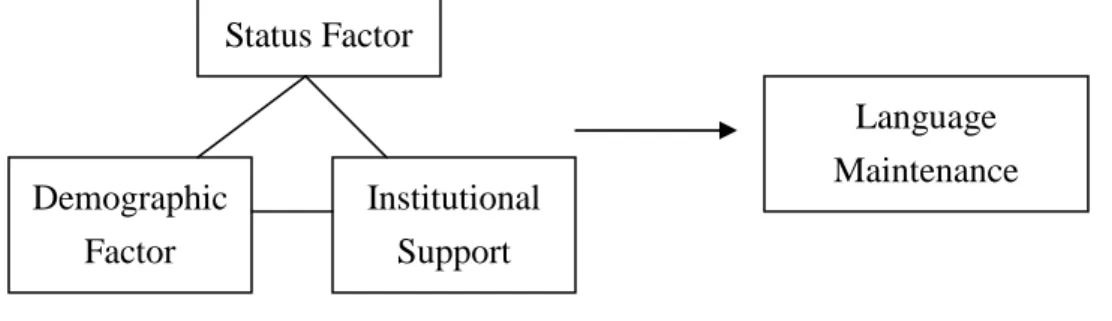
(47) have lower social status tend to shift towards using languages with higher social status. 3.. Sociohistorical status: this concept is regarded as a mobilizing symbol that inspires individual speakers to defend their memberships as an ethnolinguistic group.. 4.. Language status: this concept is determined by its exchange value and is closely associated with social status.. The demographic factor puts emphasis on the number of members of a linguistic group and their geographical distribution. The absolute number of speakers is. 治 政 undoubtedly important to the vitality and survival大 of a language. Furthermore, if the 立 speakers could concentrate in one particular area, the minority ethnolinguistic group ‧ 國. 學. might have better chances of maintaining their language.. ‧. The third factor formulated by Giles et al. (1977) is institutional support. It refers. sit. y. Nat. to the extent to which the language of a minority group is represented in the various. io. er. institutions of a nation, a region or a community. Mass media plays an important role. al. in language maintenance. TV and radio programs that use minority languages help. n. iv n C boost these languages, and sohdo newspapers and e n g c h i U books. Besides, mother tongue services provided by governmental sectors increase the usefulness of minority languages. Most important of all, language education should be formally introduced at schools. Although the aforementioned factors and sub-factors are discussed separately, they have strong correlations with one another. As Figure 2-3 shows, all the factors should be taken as a whole to be able to fully explain the phenomenon of language maintenance.. 35.
數據


+7

相關文件
Secondly, processing religious surveys and drawing up religious laws during early colonial period had made a legal position and standard for future Taiwan religions
目前台灣的觀光旅遊漸趨向不以量取勝,強調精緻、深度、探索的優質旅行,因此旅行
為此,我體會大師這本書,人間佛教佛陀本懷,即是要從本懷
畫分語言範疇(language categories),分析學者由於對語言的研究,發現
The classification theory of varieties usually reduced to the study of varieties of the following three types: varieties of general type, varieties with Kodaira dimension zero
檢視 檢視「 「 「 「輸出 輸出 輸出 輸出」 」 」 」視窗表示 視窗表示 視窗表示 視窗表示 程式碼沒有任何錯誤
事實上,就算不是經濟不景,由於現代化下都市生活的發展,經濟和社會情況轉變,對
經過小學四年級輔助課程四十多小時密集式的活動,組員有不同程度及層面的學習和參
