
Promoting a better understanding between secondary schools and tertiary institutions through an information literacy project
19
0
0
全文
(2) Note: The program described in this paper is supported by a grant provided by the Hong Kong University Grants Committee. INTRODUCTION Hong Kong’s first university, the University of Hong Kong founded in 1910, was the only university in Hong Kong for more than fifty years. It was not until 1963 that the second university, the Chinese University of Hong Kong, was founded. For a long time, only a few thousand privileged secondary school students were able to enter the two local universities. For example, in early 1980s, the First Year First Degree intake was a little more than two thousand (http://www.ugc.edu.hk/). It was not until after 1990 that Hong Kong saw a drastic increase in the inception of new universities and student enrollment. Within a ten-year period (1990-2000), five new universities were established; they are City University of Hong Kong, Hong Kong Polytechnic University, Hong Kong Science and Technology University, Hong Kong Baptist University, and Lingnan University. Currently all seven universities take in a total of approximately 14,500 new first-year students annually, which is less than 17% of the 1720 years age group in Hong Kong’s population. Since becoming a university student was a rarity among secondary school graduates in the past, as a general rule, secondary school students have not had a good understanding of university curriculum and requirements, not to mention knowledge about university student life and the campus environment. Similarly, secondary school teachers are quite uninformed to the many changes taking place in recent years at Hong Kong universities, such as credit-based curriculum and continuous assessments. As a result, many new students entering Hong Kong universities have had difficulties adjusting to the university environment. With the proliferation of universities in Hong Kong and the drastic increase of student numbers in 1990s, the problem of lack of understanding of university learning environment and expectation for secondary teachers and students becomes more acute. With this in mind, the Hong Kong University Grants Committee (UGC) launched an Interface Program to promote the interaction and mutual understanding between secondary and educational tertiary institutions in 1997. UGC is a non-statutory advisory committee responsible for advising the Government of the Hong Kong Special Administrative Region (SAR) on the development and funding needs of higher education institutions. In effect, UGC allocates funds and dictates both undergraduate and graduate intakes to all Hong Kong universities among others. Through a UGC funded interface project, “Creating a Better Mutual Understanding with Secondary Schools through Information Literacy Programs,” Lingnan University, Hong Kong, was able to conduct two programs to achieve the above goal. During 1998 to 2000, a number of workshops on information literacy were offered by Lingnan University to secondary school teachers and students. During this period of time, information literacy is also an important part of the Hong Kong SAR Government’s new education initiative. The interface project funded by the UGC grant was submitted by members of the Information Systems Department at Lingnan University to provide community services, an important aspect of the Lingnan University’s mission. The project comprised of two 2001資訊素養與終身學習社會國際研討會 地點:逢甲大學 時間:民國90年10月19~21日 第2頁.
(3) components, namely: (1) the secondary school teachers program and (2) the secondary school students program. The first component consists of teacher training on information literacy. In this component the teaching staff at Lingnan taught IT knowledge and skills to secondary school teachers. With this teacher training component, secondary school teachers gained not only insight on information literacy skills, but also a good understanding of tertiary institutions’ academic programs and expectations. The second component of the program dealt with the interactions between university students and secondary school students. Selected Lingnan University students were paired with secondary school students to work on carefully selected information-literacy projects. The university students acted as mentors and provided guidance to secondary school students. Through one-on-one interactions, secondary school students gained a better understanding of tertiary institutions’ academic programs, learning environment and expectations from mentors who are young enough for them to relate with. Based on post-program surveys, the objectives of the information literacy project appear to have been achieved. In the next section, a detailed project description is given. In subsequent sections, the effectiveness of both programs is evaluated. PROJECT DESCRIPTION In this section, project objectives are presented first. Expected outcomes based on project objectives are then defined. Subsequently, programs for both secondary school teachers and students are described. Project Objectives Based on the described purpose of the UGC Interface Program, the Lingnan information literacy project has the following six objectives. 1. To impart information literacy knowledge and skills to secondary school teachers. 2. To impart information literacy knowledge and skills to secondary school students so they may become better students and productive members of the society. 3. To prepare secondary school students for a more smooth transition into university life, and teach them how to function as productive members of the society. 4. To allow secondary school teachers and students to interact with tertiary institution teaching staff and students to gain better understanding of the tertiary institution curriculum, environment and expectations. 5. To allow tertiary institution teaching staff to interact with secondary school teachers to gain better understanding of the secondary school curriculum and environment. 6. To provide opportunities for tertiary institution students to interact with secondary school students for character development through the Big Brothers and Sisters program. Project Activities With the project objectives in mind, a number of workshops were offered under the secondary teachers program so that secondary school teachers would have the ability to use the basic PC skills such as word processing, spreadsheet, database and presentation software. In addition, the tertiary institutions’ library environment for teaching and learning, and various services provided by their Information Technology Services Centers were also 2001資訊素養與終身學習社會國際研討會 地點:逢甲大學 時間:民國90年10月19~21日 第3頁.
(4) introduced. For secondary students program, Big Brother/Sister sessions were offered to secondary school students so they would gain valuable insights on information literacy from working on projects interested to them. Through the interactions with teaching staff and students of Lingnan University, both secondary school teachers and students became knowledgeable on tertiary institution’s academic programs, learning environment and expectations. The project was started in September 1998 and a research assistant was hired shortly (jointly funded with another UGC grant). The preparatory activities conducted prior to the offering of the workshops are described below: • • • •. Hired a part-time research assistant to coordinate the operational aspects of the project. Developed the course materials based on the outline and test questions of the Information Literacy Program at Lingnan University. Recruited Lingnan students as big brothers/sisters, the process started in November of 1998, but the actual hiring took place in early December 1998. Compiled the list of high schools included in the project with schools contacted in early 1999.. The duration of the original project was to be from September 1998 to September 1999. With the approval from UGC, the workshop schedule was extended to the end of August 2000 because secondary school teachers are generally free only during summer breaks. Holidays and term breaks had prevented the continuous offering of workshops during the school year. A total of 7 workshops were offered to secondary school teachers, and a total of 22 Big Brothers/Sisters sessions were offered to secondary school students. All participants, including teachers and students, came from schools near Lingnan campus, such as Tuen Mun, Tin Shui Wai, and Yuen Long. Four modules were offered in the seven workshops for secondary school teachers. The four modules were: Module 1 Introduction to Information Technology; Module 2 Internet/WWW; Module 3 Intermediate PowerPoint; Module 4 Intermediate Excel & PowerPoint. A total of one hundred and twenty-six teachers from six secondary schools attended the workshops. In Module 1 Introduction to Information Technology, secondary school teachers learned PC basics and Microsoft Office suite. In Module 2, Internet/WWW, the most popular module, secondary school teachers learned how to design and develop Web pages. In Module 3 Intermediate PowerPoint, they learned how to design and use PowerPoint slides for teaching and making presentations. In Module 4 Intermediate Excel & PowerPoint, besides learning more on PowerPoint skills, they also learned how to use formulas, create and modify charts and use various software functions in processing student grades. A total of 198 secondary school students attended Big Brother/Sister sessions. In the Big Brother/Sister sessions, each secondary school student was paired with a Lingnan 2001資訊素養與終身學習社會國際研討會 地點:逢甲大學 時間:民國90年10月19~21日 第4頁.
(5) University student of the same gender. The secondary school student then worked on a project of his/her own choice under the guidance of the Lingnan student. For example, some students not only learned how to access World Wide Web in the projects but also learned how to develop Web pages. Some students were very interested in scanning and uploading images and others were interested in using PowerPoint for making presentations and learning Visual Basic programming. Table 1 presents some of the key figures for the two programs. Table 1. Information Literacy Project Items General. Program duration. 9-1998 to 82000 6 4 5. project description. No. of secondary schools participated No. of teaching staff No. of part-time assistants. Secondary school. No. of secondary school teachers (Some teachers attended more than one workshops) No. of workshops for teachers No. of modules in each workshop No. of usable post-program questionnaires. 7 4 78(61.9%). No. of secondary school students No. of sections for students No. of usable post-program questionnaires. 198 22 132 (66.7%). teachers program. Secondary school students program. 126. To assess the effectiveness of both teacher and student programs and to gain feedback for further improvement, in the last class of each round of teachers or students session, evaluation forms were given to participants to assess their understanding of information literacy knowledge and the university environment. Results of these evaluations are presented in the following sections. EVALUATION OF STUDENT PROGRAM Each student filled out an evaluation form at the end of the last class of each round of the Big Brother/Sister session. A total of 132 usable responses were collected from 198 participants with a response rate of 66.7%. Among those respondents, 50% were males and 50% were females. The distribution of the students’ Form years are: 8.3% Form 1, 7.6% Form 2, 15.2% Form 3, 24.2% Form 4, 17.4% Form 5, 25.8% Form 6, and 1.5% Form 7. For the majority of the questions, a five-point self-anchoring scale with 1=Strongly Disagree 2001資訊素養與終身學習社會國際研討會 地點:逢甲大學 時間:民國90年10月19~21日 第5頁.
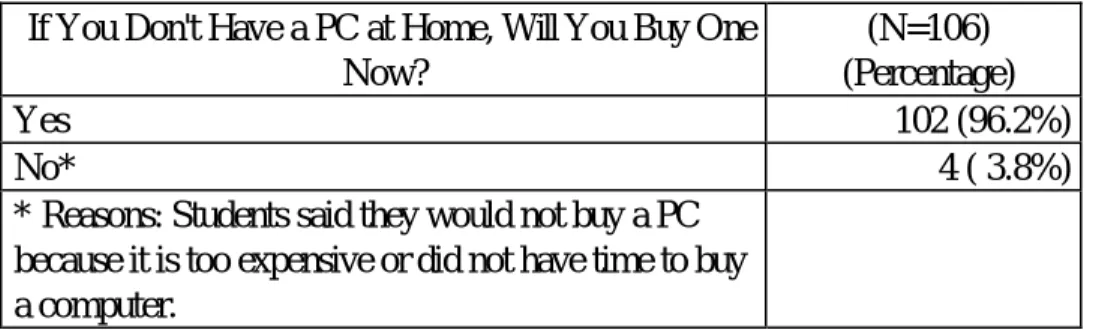
(6) and 5=Strongly Agree was used for respondents to assess the degree of agreement with the statement or question provided. Responses to the questions are summarized and described in Table 2. Table 2 shows that respondents were very satisfied with their big brother or sister's performance. Big brothers and sisters were very enthusiastic in secondary school students' view. It also shows that big brothers/sisters were knowledgeable in the IT field, helpful outside classes and willing to share views on university life with them. Table 2. Evaluation of the Big Brother/Sister's Performance Big Brother/Sister's Performance He/She was enthusiastic. He/She seemed knowledgeable in IT field. He/She was helpful outside of class. He/She explained concepts clearly. He/She was willing to tell about university life.. Mean (N=132) 4.5455 4.2737 4.1746 4.1443 4.1438. Standard Deviation 0.5562 0.7027 0.8895 0.7956 0.9734. When secondary school students were asked to compare themselves before and after the Information literacy program, they agreed that their general knowledge about IT and PC skills had increased (Table 3). Most of them also agreed that their interests in computers and IT had increased. However, they rated that the improvement in their awareness of the importance of IT in a society after completing the program not as high as their gain on the general knowledge on IT. It may be due to the nature of their computer projects, which tend to be more focused on detail and not on the big picture, such as the project’s relationship with the society or their role in a society. Table 3. Evaluation of IT Awareness IT Awareness Your general IT knowledge has increased. Your PC skills have increased. Your interests in computers and IT have increased. Your awareness of IT importance in the society has increased.. Mean Standard (N=132) Deviation 4.1741 0.7170 4.1366 0.6530 4.0234 0.7685 3.8185 0.4071. After attending the Program, 102 or 96.2% of the respondents would like to buy a PC if they did not already have one (Table 4). Only three respondents said that they would not buy one because PCs were too expensive. One said that he did not have time to buy one.. 2001資訊素養與終身學習社會國際研討會 地點:逢甲大學 時間:民國90年10月19~21日 第6頁.
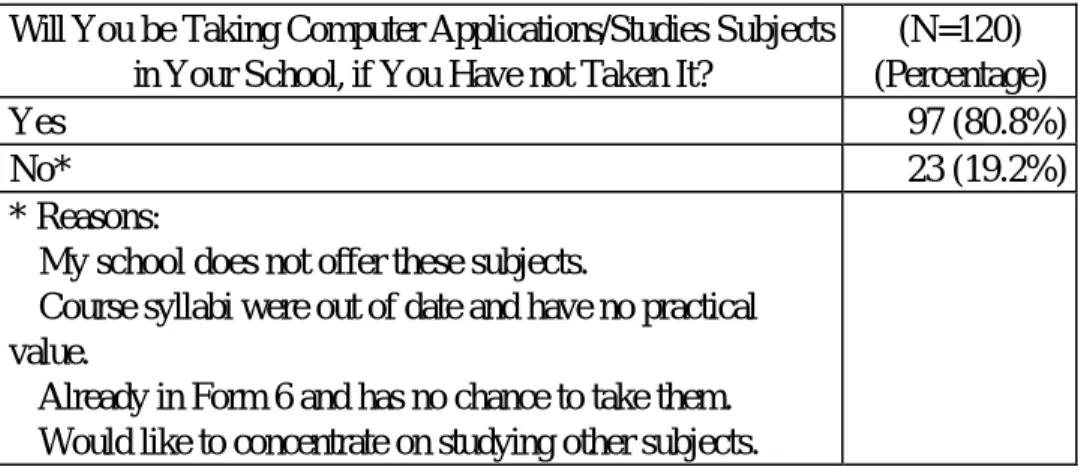
(7) Table 4. Intention to Buy a Home PC If You Don't Have a PC at Home, Will You Buy One Now? Yes No* * Reasons: Students said they would not buy a PC because it is too expensive or did not have time to buy a computer.. (N=106) (Percentage) 102 (96.2%) 4 ( 3.8%). Table 5 shows that 123 or 94.6% of the respondents would use their PCs at home more frequently after completing the program. Only seven respondents said “no” because they were using computers on a regular basis already. Table 5. Intention to Use Your Home PC More Often If You Have a PC at Home, Will You Use it More? Yes No* * Reason: They are already using computer on a regular basis.. (N=130) (Percentage) 123 (94.6%) 7 ( 5.4%). Table 6 shows that 97 or 80.8% of the respondents would like to take Computer Applications/Studies-related subjects in the secondary schools if they had not taken these subjects before. Some of the reasons that respondents did not plan to take these subjects were: their schools do not offer these subjects and the syllabi for the computer applications/studies were outdated. One of the respondents said that he was in Form 6, therefore, he has no chance to take these subjects. Another respondent said that he wanted to concentrate his time on studying other subjects.. 2001資訊素養與終身學習社會國際研討會 地點:逢甲大學 時間:民國90年10月19~21日 第7頁.
(8) Table 6. Intention to Take Computer-Related Courses Will You be Taking Computer Applications/Studies Subjects in Your School, if You Have not Taken It? Yes No* * Reasons: Ÿ My school does not offer these subjects. Ÿ Course syllabi were out of date and have no practical value. Ÿ Already in Form 6 and has no chance to take them. Ÿ Would like to concentrate on studying other subjects.. (N=120) (Percentage) 97 (80.8%) 23 (19.2%). Table 7 shows that 114 or 87.0% of the respondents were interested in an IT-related career after attending the Program. Of those who indicated otherwise, most of them said that he/she had already had other career plans. Some said that they are interested in using computers but do not have a good understanding about computer-related careers. Three said that they do not have sufficient knowledge to pursue careers in IT. One student said ITrelated careers are too complex and difficult for her. Another said IT-related careers are too competitive. One female student said that she was afraid of getting near-sightedness from using PCs. Table 7. Interest in an IT-Related Career Would You be Interested in an IT-Related Career? Yes No* * Reasons for “no”: Ÿ IT-related careers are too competitive. Ÿ Interested in using computers but know little about ITrelated careers. Ÿ Do not have sufficient IT knowledge to pursue a career in IT. Ÿ I have chosen another career. Ÿ I am afraid of getting near-sightedness.. (N=131) (Percentage) 114 (87.0%) 17 (13.0%). Table 8 shows the results of secondary school students’ self evaluation on their awareness of the university environment after completing the information literacy program. In general, ratings on the five aspects of the university awareness are not much higher than the midpoints. For example, the highest rated item was “positive view of the university” (3.9470). Based on the rating scale (1, strongly disagree and 5, strongly agree), secondary school students are only approaching to “agree with the statement” but definitely not strongly agree with the statement. The lowest rated item by students was “ academic program 2001資訊素養與終身學習社會國際研討會 地點:逢甲大學 時間:民國90年10月19~21日 第8頁.
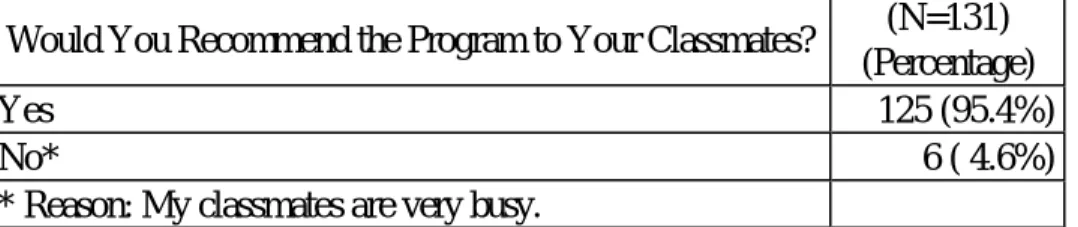
(9) understanding.” One of the possible reasons for this is the shortness of the program. Another possible reason is that they may have difficult relating to academic programs at the university level. Table 8. Evaluation of University Awareness University Awareness The Program increased your positive view of the university. The Program increased your interest to study in a university. Your general understanding of the university environment has increased. Your understanding of the university student life has increased. Your understanding of the university academic programs has increased.. Mean Standard (N=132) Deviation 3.9470 0.7811 3.9250. 0.8010. 3.7582. 0.8148. 3.7426. 0.8467. 3.4767. 0.8614. Table 9 shows that respondents were quite satisfied with the Program in general with a relatively average rating of 4.3112. Table 9. Evaluation of the Program Satisfaction Program Satisfaction How much do you like the Program?. Mean Standard (N=132) Deviation 4.3112 0.5659. Table 10 shows that 125, or 95.4%, of the respondents would recommend the Information Literacy Program to their classmates. Most respondents said that they had learned a lot from the program on IT knowledge, PC skills, and they also were able to learn more about university environment and student life. Some of them said that the Program is very practical and valuable. Those said that they would not recommend the program to their classmates said their friends were very busy people. Two respondents did not state any reasons for not wanting to recommend to their classmates.. 2001資訊素養與終身學習社會國際研討會 地點:逢甲大學 時間:民國90年10月19~21日 第9頁.
(10) Table 10. Recommending the Program to Others Would You Recommend the Program to Your Classmates? Yes No* * Reason: My classmates are very busy.. (N=131) (Percentage) 125 (95.4%) 6 ( 4.6%). Table 11 shows that 117, or 90%, of the respondents would continue to maintain contact with their big brothers/sisters. Of those said “yes,” most of them said they had already developed a good friendship with their big brothers/sisters during the Program; some also said that they learned a lot from their big brothers/sisters. Of those said “no”, one said it was because both of them were too busy; another could not be sure whether he would or would not; another said that her big sister did not know her well; and the others did not state any reason. Table 11. Maintaining Contact with Your Big Brother/Sister Will You Continue to Maintain Contact With Your Big Brother/Sister? Yes No* • Reasons: Ÿ We are very busy. Ÿ I don’t know for sure. Ÿ My big sister does not know me well.. (N=130) (Percentage) 117 (90%) 13 (10%). Table 12 shows that 84, or 61.4%, of the respondents would consider enrolling in Lingnan University. Of those who said “yes,” most of them said Lingnan campus is new, quiet, and with good facilities; some said Lingnan is near their homes; others said that they like Lingnan's campus life and tutors. Of those who said “no,” most of them said Lingnan does not offer the program he/she plans to study; one wants to study abroad. Some said that their academic records are not high enough for them to study at Lingnan. Others said that they have not yet decided to enroll in a university; one said Lingnan campus is too small.. 2001資訊素養與終身學習社會國際研討會 地點:逢甲大學 時間:民國90年10月19~21日 第10頁.
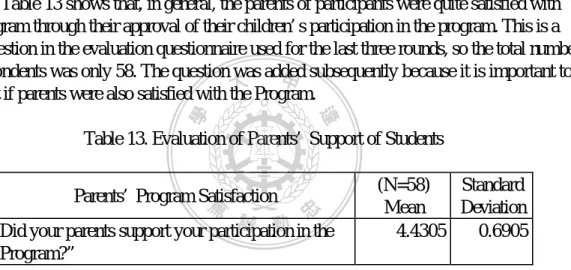
(11) Table 12. Interest in Attending Lingnan University Would You Consider Attending Lingnan University? Yes No* * Reasons: Ÿ Lingnan does not offer the program I want to study. Ÿ I will go abroad to do further study. Ÿ My grades are not good enough; it may prevent me from entering a university. Ÿ I do not have time to consider. Ÿ It depends on my friends’ interests. Ÿ Lingnan campus is too small.. (N=131) (Percentage) 84 (61.4%) 47 (35.9%). Table 13 shows that, in general, the parents of participants were quite satisfied with the Program through their approval of their children’s participation in the program. This is a new question in the evaluation questionnaire used for the last three rounds, so the total number of respondents was only 58. The question was added subsequently because it is important to find out if parents were also satisfied with the Program. Table 13. Evaluation of Parents’ Support of Students Parents’ Program Satisfaction Did your parents support your participation in the Program?”. (N=58) Standard Mean Deviation 4.4305 0.6905. EVALUATION OF THE SECONDARY SCHOOL TEACHERS PROGRAM For the teachers of the Interface Program, four modules with seven sections were offered to secondary school teachers between 21 June 1999 and 12 July 2000. In total, 126 teachers from seven secondary schools participated in the Program. Some secondary school teachers joined the Program for more than one module. Evaluations of the Program were conducted at the end of the last class. A total of 78 usable responses were collected from participants. Similar to student program evaluation, a five point self-anchoring scale (interval scale 1-5: 1=Strongly Disagree and 5=Strongly Agree) was also used for most of the questions unless specified otherwise. Table 14 shows that respondents considered the workshops quite useful with an average mean rating of 4.2546 (between agree and strongly agree). However, they rated the organization of the course and workload below 4 (just agreeing and not strongly agreeing with 2001資訊素養與終身學習社會國際研討會 地點:逢甲大學 時間:民國90年10月19~21日 第11頁.
(12) the statement). This implies that there is room for improvement, such as in areas of course materials and assignments preparation. Table 14. Evaluation of the Workshops The Course The course was useful. The course was well organized. The workload was reasonable.. Mean Standard (N=78) Deviation 4.2546 0.6878 3.9268 0.6793 3.8567 0.7256. Table 15 shows respondents were quite satisfied with workshop instructors and considered them enthusiastic and knowledgeable. It also shows that instructors were responsive to participants’ views and feedback. In general, respondents also agreed that instructors explained concepts clearly, structured the presentations well, and also gave clear instructions for assigned tasks. However, from the survey results, workshop teachers should improve in three aspects: (1) making the course more interesting; (2) encouraging critical thinking in students; and especially (3) encouraging students’ participation in discussion. Table 15. Evaluation of the Workshop Instructors Instructor’s Performance The instructor was enthusiastic. The instructor seemed knowledgeable in her/his field. The instructor was responsive to students' views and feedback. The instructor explained concepts clearly. The instructor was helpful outside of class. The instructor structured the presentation well. The instructor gave clear instructions for student tasks. The instructor made the subject matter interesting. The instructor encouraged students to think critically. The instructor encouraged students to participate in discussions.. Mean Standard (N=78) Deviation 4.5568 0.5718 4.4341 0.6210 4.2102 0.8075 4.1099 4.0791 4.0586 4.0586 3.8590 3.5401 3.5274. 0.6912 0.7440 0.7485 0.7989 0.7345 0.8005 0.8776. When respondents were asked with respect to the overall impression of the program, respondents stated that they were satisfied with the instructor’s performance and had learned a lot from the course (Table 16).. 2001資訊素養與終身學習社會國際研討會 地點:逢甲大學 時間:民國90年10月19~21日 第12頁.
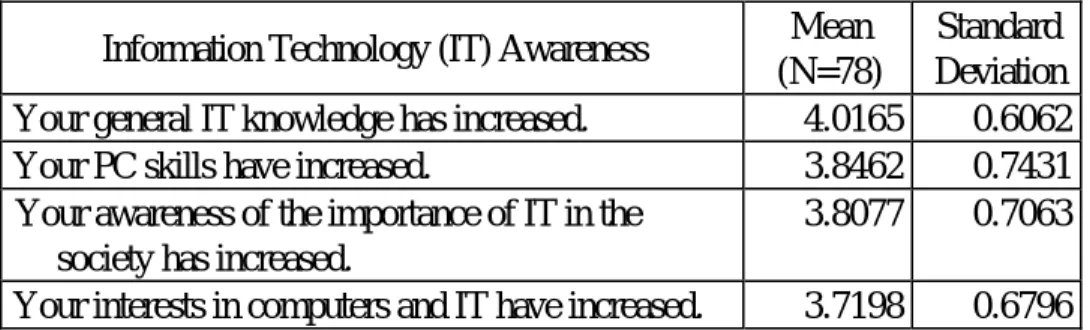
(13) Table 16. Overall Evaluation of Workshop Overall Impression Overall, I am satisfied with the instructors’ performance. Overall, I have learned a lot from the course.. Mean Standard (N=78) Deviation 4.3480 0.6742 4.0840. 0.8338. In general, respondents felt that the course was suitable for them, not too easy nor too difficult (Table 17, where 1 = Very Easy and 5 = Very Difficult). Table 17. Evaluation of the Course Level The Course Was Very Easy or Very Difficult? The course was:. Mean Standard (N=78) Deviation 3.1483 0.6211. In general, respondents viewed the course pace was reasonable, not too fast nor slow (Table 18, where 1 = Very Slow and 5 = Very Fast). Table 18. Evaluation of the Course Pace The Course Was Very Slow or Very Fast? The course pace was:. Mean (N=78) 3.1356. Standard Deviation 0.6521. Table 19 shows that respondents had moderate interest in this program before it started (A five-point scale was used with 1 = Very Low and 5 = Very High). Table 19. The Respondents’ Level of Interest Before the Workshop Very Low or Very High? My level of interest in this course before the start of the course was:. Mean Standard (N=78) Deviation 3.0840 0.8763. When respondents were asked to compare themselves before and after completing the Program with respect to the questions in Table 20, respondents agreed that their interest in IT, general knowledge of IT and PC skills have increased. The ratings are much higher than the level of interest before the staring of the course (Table 19). Comparing secondary school teachers to students, we found that the degree of increase in their awareness of the importance of IT in society is about the same (3.8077 and 3.8185). However, improvement in teachers’ interest in computers and IT is much less than students (3.7198 and 4.0234). One possible explanation could be that students are younger and more eager to learn. 2001資訊素養與終身學習社會國際研討會 地點:逢甲大學 時間:民國90年10月19~21日 第13頁.
(14) Table 20. Evaluation of IT Awareness Information Technology (IT) Awareness Your general IT knowledge has increased. Your PC skills have increased. Your awareness of the importance of IT in the society has increased. Your interests in computers and IT have increased.. Mean Standard (N=78) Deviation 4.0165 0.6062 3.8462 0.7431 3.8077 0.7063 3.7198. 0.6796. After attending the Program, 65, or 96.2% of the respondents stated they would buy a PC for home use if they did not already have one (Table 21). Only three respondents said that they would not buy a computer because PC was too expensive, not useful, or the school provides enough computers. It is interesting to note that the percentages of people who would like to buy a home computer (96.2%) are the same for both secondary school students and teachers. Table 21. Intention to Buy a Home PC If You Don't Have a PC at Home, Will You Buy One Now? Yes No* *Reasons: Ÿ It is too expensive. Ÿ It is not useful. Ÿ The school provides enough computers.. (N=68) (Percentage) 65 (5.6%) 3 (4.4%). Table 22 shows that after completing the Program, 73 or 96.6% of the respondents would use their PCs more often. Of the two respondents answered “no” to the question, one said she would use the PC only if necessary while the other said downloading software is time-consuming. Comparing to students, teachers have higher percentage of intention to use PCs more often (97.3% vs. 94.6%).. 2001資訊素養與終身學習社會國際研討會 地點:逢甲大學 時間:民國90年10月19~21日 第14頁.
(15) Table 22. Intention to Use Your PC More Often If You Have a PC at Home, Will You Use it More Often? Yes No* *Reasons: Ÿ Use PC only if necessary. Ÿ Downloading software is time-consuming.. (N=75) (Percentage) 73 (97.3%) 2 (2.7%). Table 23 shows that 73 or 95% of the respondents would be interested in using IT in teaching. The one that answered “no” said she had not decided yet. The other two respondents did not give any reasons for not interested in using IT in teaching. Table 23. Interested in Using IT in Teaching Will You be Interested in Using IT in Teaching? Yes No* *Reason: Ÿ Not decided yet.. (N=76) (Percentage) 73 (96.1%) 3 ( 3.9%). Table 24 shows that respondents agreed their image of the university has improved after completing the Information literacy Program. Comparing secondary school teachers with students, there are two interesting observations. First, their degrees of improvement on the university’s image are about the same (3.9168 vs. 3.9470). Second, we found that secondary teachers do not understand much about university students’ life while students do not understand much about university academic programs even after completing the information literacy program that introduced both. For example, teachers rated the degree of increase in understanding university student life the lowest (3.4209), while students rated the understanding of academic programs the lowest (3.4767).. 2001資訊素養與終身學習社會國際研討會 地點:逢甲大學 時間:民國90年10月19~21日 第15頁.
(16) Table 24. Evaluation of University Awareness Mean Standard (N=77) Deviation 3.9168 0.7790. University Awareness The program has increased your positive view of the university. Your general understanding of the university environment has increased. Your understanding of the university academic programs has increased. Your understanding of the university student life has increased.. 3.8145. 0.7802. 3.4570. 0.8138. 3.4209. 0.8374. Table 25 shows that, in general, respondents were satisfied with the Program. (A fivepoint scale was used with 1 = Very Poor and 5 = Very Good). Compared to students’ evaluation of the program, secondary school students were more satisfied with the program (4.3112 vs.4.0334). Possible reasons could be that students have a stronger preference for the closeness of the big brothers/sisters mode of teaching, and because of lower ratings by the secondary school teachers for course organization and workload. Table 25. Evaluation of the Program Satisfaction Program Satisfaction How much do you like the Program?. Mean Standard (N=77) Deviation 4.0334 0.7145. Table 26 shows that respondents liked learning IT knowledge the best. The interaction with university lecturers and tutors came the second. Understanding university life was ranked the third. This question was not included in student survey. Table 26. Preferred Aspects of the Program What Aspects of the Program Do You Like the Most? Learning IT knowledge. Interaction with university lecturers and tutors. Understanding university life. Note: Respondents could choose more than one option, thus the sum of the percentages is over 100%.. (N=78) (Percentage) 74 (94.8%) 23 (29.5%) 14 (17.9%). Table 27 shows that, 74 or 98.7% of the respondents would recommend the Program to their colleagues. Most of them said that the program could enhance colleagues’ IT 2001資訊素養與終身學習社會國際研討會 地點:逢甲大學 時間:民國90年10月19~21日 第16頁.
(17) knowledge, PC skills, and at the same time learn more about the university environment and student life. Some said the Program is very useful, practical, intensive, and can help them applying IT in teaching. Only one respondent said “no” because she felt that the workshop was not challenging enough and was too elementary. Compared to students, there was a higher percentage of teachers who would recommend this program to others (98.7% vs. 95.4%). Teachers might be more mature and confident in introducing good things to others if the program is worth the time and effort. Table 27. Recommending the Program to Others Would You Recommend the Program to Your Colleagues? Yes No* * The program was not challenging enough and too simple.. (N=75) (Percentage) 74 (98.7%) 1 ( 1.3%). ADDITIONAL COMMENTS OF RESPONDENTS Twenty-one respondents wrote comments and suggestions about the Program. Three of them expressed appreciation for workshop instructors’ enthusiasm and patience. They also praised the instructors’ presentation skills and were appreciative for their providing workshop participants plenty of in-class practices. They said that it was very good for Lingnan to offer such a program. One suggested that there should have been one or two assistants for each instructor to provide individual assistance (In the last two sections held in year 2000, an assistant was recruited for each class.) Five of the respondents suggested that more notes and handouts be distributed. Four of them (in 1999) pointed out the shortcomings of facilities, such as the older computing equipment in the PC lab, the poor quality of the overhead projectors, and the lack of sound systems for participants’ PCs (Subsequently Lingnan upgraded all the PCs in the teaching labs and equipped them with sound systems and web cams). Three respondents suggested more optional courses should be offered, such as Photoshop, advance MS FrontPage, Excel, and the like. One suggested that the University should assess the participants’ level of proficiency in IT before admitting them to a specific course. One commented that the pace of the workshop was a bit too slow and another said that the class duration was too long. One suggested that Lingnan University should offer the information literacy program again, and that it would be better for people to attend the workshops earlier in the day. Finally, one suggested that Lingnan and the Education Department should provide compulsory courses for secondary school teachers and headmasters because he felt teachers at his school did not have adequate knowledge and experience to teach computer courses.. 2001資訊素養與終身學習社會國際研討會 地點:逢甲大學 時間:民國90年10月19~21日 第17頁.
(18) SUMMARY With the funding of an Interface project from the Hong Kong University Grants Committee, Lingnan University was able to carry out an information literacy project to promote a better understanding between tertiary teaching staff/students and secondary teachers/students. The project consists of two programs, one for secondary school teachers and one for secondary school students. The one for teachers mainly consists of workshops on individual productivity tools while the one for students consists of pairing university students and secondary school students to work on IT-related projects. During the last period of each workshop/session, questionnaires were distributed to secondary school teachers and students attending the program for them to evaluate the effectiveness of the project with respect to its objectives. A summary of their evaluation follows. For the secondary school students program, one hundred and thirty-two (132) usable questionnaires were received out of a total 198 attendants (some students attended more than one workshop and a few were absent in the last lesson.) For most of the structured questions, a five-point self-anchoring scale with 1 = Strongly Disagree and 5 = Strongly Agree was used for students to respond to questions. There were four groups of questions in the questionnaire: (1) Big Brother/Sister’s Performance, (2) Evaluation of IT Awareness, (3) Evaluation of University Awareness, and (4) Evaluation of Program Satisfaction. Responses to all questions were quite positive. For example, the average response of secondary school students to the question “How much do you like the Program?” was 4.3112. And the average response to the question “Did your parents support you to participate in the Program?” was 4.4305. One hundred and seventeen (90%) students stated that they would continue to maintain contact with their big brothers/sisters. They also indicated that the Program indeed has increased their interest to study in a university and it also has improved their view of university (average responses for both were around 4.0). For the question “Would you recommend the Program to your classmates?” one hundred and twentyfive (95.4%) students responded “Yes.” Those who said “No’ stated that their classmates were too busy to attend workshops. For the secondary school teachers program, 78 out of a total of 126 questionnaires were received and analyzed (Some teachers filled more than one questionnaire because they attended more than one module, while some others did not attend the last session due to conflicts with their work schedule). Questions on the effectiveness of the workshops were grouped on 6 categories of (1) Evaluation of the Workshops; (2) Evaluation of the Instructors; (3) Overall Evaluation of the Program; (4) Evaluation of IT Awareness; (5) Evaluation of University Awareness; and (6) Evaluation of Program Satisfaction. The same 5point instrument was used.. 2001資訊素養與終身學習社會國際研討會 地點:逢甲大學 時間:民國90年10月19~21日 第18頁.
(19) Secondary school teachers’ evaluations on the program were quite positive. For example, the average response to the question “The course was useful.” was 4.2546. The average responses for questions on PC skills and IT knowledge were around 4.0. The average response to the question “Your general understanding of the university environment has increased” was 3.81. The item that has the least amount of improvement after completing the program was the understanding of university student life (mean of 3.4209). Thus, it appear that if the secondary school teachers’ understanding of university student life is an important goal of the information literacy program, then arrangement should be made to let secondary teachers to have more contact and interactions with university students. Finally, seventy-four out of 75 (98.7%) of secondary school teachers said that they would recommend the Program to their colleagues. Based on the evaluation results, the project has largely met its objective of promoting a better understanding between tertiary institution staff/students and secondary school teachers/students through Information Literacy programs. During the summers of 1999 and 2000, both the secondary school teachers and students programs were publicized in the media. Because of heightened news coverage, the Project coordinator received many telephone calls, especially from secondary school students, inquiring about the Program. Since interested students far exceeded the program capacity, many people had to be turned away. With the success of this Interface Project, another proposal along the same line was submitted to the UGC for the second funding phase of the Interface Program. Subsequently, this proposal was funded to start a new round of Information Literacy programs in 2001.. 2001資訊素養與終身學習社會國際研討會 地點:逢甲大學 時間:民國90年10月19~21日 第19頁.
(20)
數據


+7



相關文件
Problem Solving Skills through Creating the Makerspace in the Secondary English Language Classroom.. Collaborative Research and Development (“Seed”)
At the junior secondary level, schools are expected to offer a broad and balanced TE curriculum which nurtures students’ capability for understanding various
Information technology learning targets: A guideline for schools to organize teaching and learning activities to develop our students' capability in using IT. Hong
An information literate person is able to recognise that information processing skills and freedom of information access are pivotal to sustaining the development of a
(2011) The Project Approach In Early Years Provision : A Practical Guide To Promoting Children's Creativity And Critical Thinking Through Project
The growth of the Chinese bamboo: Coaching, teaching and learning in promoting reading literacy in Hong Kong primary schools – Hong Kong students in PIRLS 2011.
To facilitate data collection and input, this Bureau introduced an e-questionnaire for all local ordinary secondary day schools to report information on their
primary schools, secondary schools and special schools (with boarding section, if appropriate) in receipt of aid from the Government of the Hong Kong Special Administrative
