國
立
交
通
大
學
外國語文學系外國文學與語言學碩士班
碩
士
論
文
情緒的表達:中英文情緒動詞之語意比較
The Expression of Emotion:
A Frame Semantic Comparison in English and Mandarin
研 究 生:蘇芳瑩
指導教授:劉美君 教授
情緒的表達:中英文情緒動詞之語意比較
The Expression of Emotion:
A Frame Semantic Comparison in English and Mandarin
研 究 生:蘇芳瑩
指導教授:劉美君
Student:Fang-yin Su
Advisor:Mei-chun Liu
國 立 交 通 大 學 外國語文學系外國文學與語言學碩士班 碩 士 論 文 A ThesisSubmitted to Institute of Foreign Literatures and Linguistics College of Humanity and Social Science
National Chiao Tung University in partial Fulfillment of the Requirements
for the Degree of Master of Arts
June 2009
Hsinchu, Taiwan, Republic of China
i 情緒的表達:中英文情緒動詞之語意比較 研 究 生:蘇芳瑩 指導教授:劉美君 國立交通大學外國語文學系外國文學與語言學碩士班 摘要 本研究旨在瞭解並呈現中英文情緒表達的不同。先前對於英文中的情緒動詞,已有 Belletti & Rizzi (1988)、Grimshaw (1990)、Filip (1996)與 Nelson (1999)等人之研究,中文部 分有蔡美惠等(1996)與張麗麗等(2000)之研究,但是這些研究僅將焦點放在代表性的動 詞,卻無法將研究範圍含括至整組動詞,也因為如此,我們難以全面性地比較中文與英文 之情緒表達,便無法更進一步瞭解中英文的使用者是如何建構情緒的概念。 英文中像(1)、(2)的例句可以用來表達類似的情緒: (1) He frightens me. (他嚇到我了。) (2) I fear him. (我很怕他。) 縱使這兩句例子似乎要表達幾乎相同的情緒事件 ,例句中呈現的兩種不同及物構事 (transitive comstruction),刺激物(Stimulus)-動詞-情緒感知者(Experiencer) 構事與情緒感知 者-動詞-刺激物構事,乃是從兩種不同的心理途徑(mental path)來表達情緒。中文中可用嚇 到和怕來表達類似英文例句(1)和(2)的情緒。 (3) 他嚇到我了。 (4) 我很怕他。 具備相同的及物構事,例句(1)與(2) 似乎分別等同例句(3)和(4),但是擁有相同的構事是否 暗示著,使用英文與中文表達 fright 嚇到和 fear 怕時,心理途徑的構成是相同的呢?此 外,尚有類似的中英文例句可以有力證明此一假設 的正確性。 (5) I am happy. (我很開心。) (不及物情緒感知者-動詞構事) (6) 我很開心。(不及物情緒感知者-動詞構事)
(7) The book is interesting. (這本書很有趣。) (不及物構事) (8) 這本書很有趣。(不及物構事)
ii
然而,Wierzbicka 於 1991 年與 1992 年分別提出「emotion words reflect certain cultural models」與「emotion terms cannot be neatly matched with concepts in other languages or cultures」的說法,與例句(1)至(8)所呈現出來的構事相似程度似乎有所衝突,究竟中英 文又是如何使用情緒謂語(emotion predication)來表達該文化的特色?有鑑於此,本文以 Berkeley FrameNet 對於英文情緒謂語的分析與洪詩楣(2009)對於中文情緒動詞的分析為 本,採用框架語意理論(Frame semantics (Fillmore & Atkins, 1992))分析比較中英文的情緒謂 語,而能更加瞭解中英文是如何建構情緒的概念。
本文主要有三項發現。首先,情緒謂語可進一步表達動態與靜態,Van Voorst (1996) 認為英文中的心理動詞(psychological verbs)可以被視為「瞬(間達)成動詞 (Achievement verb)」表達動作,我們將中文的情緒動詞以 Van Voorst 提出之理論測試,發現在某些情緒 框架下的動詞的確表現得較為動態,有別於以往情緒動詞被普遍認為為一種靜態動詞的看 法。第二項發現在於我們能由框架元素 (frame element) 和構詞組合 (morphological make-up) 觀察到語言對於情緒表達上偏好的參與者,刺激物雖不為英文情緒框架中最常出現的框架 元素,但是卻是謂語詞彙中所嵌入的語意參與者,也因此我們可得知英文似乎偏好採用刺 激物的角度來表達情緒。另一方面,我們觀察到中文情緒框架中最常出現的框架元素為情 緒感知者,該元素也常被詞彙化、變成謂語中通性的名詞(generic noun),此特性也因此暗 指中文喜好情緒感知者作為其表達情緒的潛在主詞。最後一項發現即是有些與情緒為低關 聯性的英文情緒框架,如評斷 (Judgment) 框架也被列為該語言情緒框架的子框架之一,而
中文將情緒引動者 (Affecter) 此一新語意參與者運用至情緒範疇 (emotion domain) 中。此
外,還比較中英文表達相似情緒的框架,如英文悔恨 Contrition 框架與中文 Regret-Sorry 框架,會挑選不同的語意框架元素與不同的構事。經由比較中英文的情緒謂語後,最後得 到以上三項不同的發現使我們更能了解中英文情緒表達的雷同或相異之處。 簡言之,此論文比較中英文對於情緒的表達,除了能了解中英文使用者表達同一情 緒概念時的相同點與差異處,尚可使此二語言的學習者和教育者對於該語言情緒的概念有 更深入的認知並了解如何更精確地以其學習語言表達情緒。
iii
The Expression of Emotion: A Frame Semantic Comparison in English and Mandarin
Student: Fang-yin Su Advisor: Dr. Mei-chun Liu
Institute of Foreign Literatures and Linguistics National Chiao Tung University
ABSTRACT
This paper aims to show how English and Mandarin differ from each other on emotion predication. Although many studies have been done to investigate psych-verbs of English (Belletti & Rizzi, 1988; Grimshaw, 1990; Filip, 1996; Nelson, 1999) as well as those of Mandarin (Tsai et al. 1996; Chang et al. 2000), these studies mostly paid attention to the representational verbs and failed to investigate the whole set of verbs. Therefore, it is hard to compare these two languages so as to gain a better understanding of how English and Mandarin speakers conceptualize emotions.
In English, sentences like (1) and (2) can be used to express a similar event. (1) He frightens me.
(2) I fear him.
The different transitive Stimulus-Verb-Experiencer and Exeriencer-Verb-Stimulus constructions are used here to represent two mental paths of a person even if they seem to interpret the same psychological state. In Mandarin, similar emotion of (1) and (2) can be expressed through verbs like xiadao 嚇到 and pa 怕.
(3) 他 嚇到 我 了。
ta xiadao wo le
he frighten me PART. ‘He frightens me.’ (4) 我 很 怕 他。
wo hen pa ta
I very fear him ‘I fear him.’
With constructions alike, (1) and (2) may be equivalent to (3) and (4) respectively. However, does the similarity suggest English and Mandarin share the same psychological path when expressing fright and fear? More similar constructions shared in expressing emotions, like (5) and (6), may provide stronger support to such assumption.
(5) I am happy. (Intransitive Exeriencer-Verb construction) (6) 我 很 開心。(Intransitive Exeriencer-Verb construction)
iv I very happy
‘I am happy.’
Nonetheless, according to Wierzbicka (1991), she claimed “emotion words reflect certain cultural models;” moreover, “emotion terms cannot be neatly matched with concepts in other languages or cultures” (Wierzbicka, 1992). Hereof, how do emotion predications differ in English and Mandarin to carry cultural features if (1)-(6) exemplified a great resemblance in the surface construction? Adopting Berkeley FrameNet’s (http://www.icsi.berkeley.edu/ ~FrameNet/) analysis of English emotion expression as well as Hong’s (2009) analysis of Mandarin emotion verbs, we are able to compare the two languages from the perspective of Frame Semantics to obtain more details of how emotion is conceptualized in both languages.
There are three major findings of this paper. First, emotion predication can be further divided into stative and active interpretations in both languages. Van Voorst (1996) discovered that English psychological verbs can also denote an active state and be seen as achievement verbs. Applying the rules Van Voorst provided, we also tested Mandarin emotion verbs and found that some frames may imply an active state and become less stative than they have often been regarded. Second, frame elements and morphological make-ups in both languages provide information to show the preference of each language in terms of construing emotion sentences. Stimulus may not be the most frequent frame element in English emotion frames, but it has been the underlying subject incorporated in the lexicon, which serves as a piece of evidence to indicate that English favors to take the viewpoint of Stimulus as its fundamental perspective when expressing emotions. On the other hand, Experiencer occupies the position of a core element in almost every Mandarin emotion verb frames and it has been often lexicalized as the generic noun within Mandarin lemmas, which entails that Mandarin prefers Experiencer as its underlying subject. Third, English included frames which seem to be lowly related to emotions, e.g.
Judgment frame, into Emotions while Mandarin introduced an Affecter into its emotion domain.
Moreover, even frames expressing the similar emotion, such as Contrition frame in English and
Regret-Sorry frame in Mandarin, may differ in their selection of frame elements and their
constructions. All the findings allow us to see how English and Mandarin are different or alike in expressing emotions.
In brief, this paper compares English and Mandarin emotion expressions and shows the similarity and dissimilarity. It can also benefit English and Mandarin learners and educators who wish to understand better how these two languages conceptualize and express emotions.
v
ACKNOWLEDGEMENT
As the author of this thesis, I must thank my advisor, Prof. Meichun Liu, for her great help in teaching me and leading me into the world of functional syntax. I am aware that I am never the best student and neither the most hardworking one. I always think too big but finish too little. Prof. Liu has never given me up and always tries to understand me. Because of her, I am able to finish this thesis and well-prepared to face any forthcoming difficulties.
When I was accepted by Institute of Foreign Literatures and Linguistics, National Chiao Tung University, I was thrilled to be a graduate student because I would be able to discover more about linguistics. During the time in National Chiao Tung University, I have taken many courses in both National Chiao Tung University and National Tsing Hua University and the following teachers have taught me more besides their professional knowledge: Prof. Cheng-sheng Liu, Prof. Jo-Wang Lin, Prof. Hui-Chuan Hsu, Prof. Paul Portner, Prof. Meichun Liu, Prof. Ho-Hsien Pan, Prof. Sai-hua Kuo, and Prof. Yi-Ching Su. Moreover, I would like to give special thanks to Prof. Chin-fa Lien and Prof. Yi-Ching Wu for their generosity in giving me advices to better this thesis. Even after three years since my first day in ChiaoTung University, I am still the timid student who is eager to learn more from all the teachers I have met and will enjoy the days.
In addition to my respectful teachers, I also have to thank several people. First, I would like to thank Hsin-yi Su, my beloved sister, Weiyu Chen and Chia-yu Chung. They have been there for me since my senior year in college and shared my tears and laughter. They have taken good care of me in many ways. Not only them but also friends I made in Chiao Tung University, Chinwen Wu, Wenching Chang and Joanna Yeh have supported me during these days. They are the best treasure I found. Also, I am grateful to meet my classmates and Wenching Chang’s family. The Chang family treated me like their family and I am deeply appreciative of their friendliness. Moreover, I would like to thank my former roommates, Eve Kuo, EK Fong, and Grace Wu. They have guided me spiritually and I will remember the days we shared one room together. Of course, friends I met at summer school in Stanford University and in the summer programme in Copenhagen, Denmark as well as people I met at CSDL conference in Cleveland, Ohio have provided me many valuable suggestions for this thesis.
Furthermore, I would like to dedicate this thesis to Albert and Susan Tsao, my dearest uncle and aunt. Thank you for your belief in me. I have received so many gifts from you, including your kindness, consideration and blessings. I always feel the warmth whenever we talk and meet. You clear my doubts and solve my problems in life at your best. I really really appreciate you and your family.
Last, I want to thank Chungwei Lin who recently walked into my life, spared time helping me finish the thesis and is bringing me happiness with all his might. Thank you!
vi
Table of Contents
Chinese Abstract………..………... i
English Abstract…….………..……….. iii
Acknowledgement…..………... v
Table of Contents………... vi
List of Tables………...……….. viii
List of Figures………..………. x
Chapter 1 Introduction………... 1
1.1 Previous studies in emotion predication ………....………….... 3
1.1.1 Levin (1993) ……….………....………….... 3
1.1.2 Tsai et al. (1996) ………..…….…………....………….... 4
1.1.3 Chang et al. (2000)………....………….... 5
1.2 Aims of this thesis... ... ... 7
Chapter 2 Theoretical Framework and Methodology …... 8
2.1 Theoretical Framework: Frame semantics... 8
2.2 Methodology……….……… 9
Chapter 3 Emotion frames in English and Mandarin ………... 10
3.1 Emotion frames in English ………....…………... 10
3.1.1 Inheritance ..……….. ………....…………... 13 3.1.1.1 Emotions_by_stimulus frame……….……….. 13 3.1.2 Using of ………..……..………...……….….... 15 3.1.2.1 Contrition frame………..……. 15 3.1.2.2 Desiring frame………...….. 17 3.1.2.3 Emotion_active frame………. 18 3.1.2.4 Emotion_directed frame……….. 19 3.1.2.5 Emotion_heat frame………. 21 3.1.2.6 Experiencer_obj frame………. 22 3.1.2.7 Feeling frame………... 23 3.1.2.8 Forgiveness frame……… 24 3.1.2.9 Judgment frame……… 25 3.1.2.10 Predicament frame……….…… 26 3.1.3 Perspectivized on……….…………... 27 3.1.3.1 Experiencer_focus frame……….. 28 3.1.3.2 Stimulus_focus frame ……….. 30
3.2 Emotion frames in Mandarin... 33
3.2.1 Exp-Oriented………...….. 35
vii
3.2.1.2 Regret-Sorry frame……….…….. 39
3.2.2 Exp-Oriented with Target………...………….…….. 41
3.2.2.1 Content-Contented frame………. 42 3.2.2.2 Love-Hate frame……….. 44 3.2.2.3 Envy-Pity frame………... 46 3.2.2.4 Worry-Fear frame………. 48 3.2.3 Stimulus-Oriented………..………51 3.2.3.1 Stimulus-Attributive frame………... 51 3.2.4 Affect-Oriented………. 53 3.2.4.1 Attract-Comfort frame………. 54 3.2.4.2 Bother-Irritate frame……… 55
Chapter 4 Analysis and Comparison..………... 58
4.1 Semantics.………....…………... 58 4.1.1Situation……….. 58 4.1.2 Participants……… 63 4.2 Syntax... ... ... 69 4.2.1 English constructions……… 69 4.2.2 Mandarin constructions………. 75 4.3 Comparison... 82 4.3.1 Frame-naming………... 83
4.3.2 Similarity and Dissimilarity……….. 86
Chapter 5 Conclusion………... 100
References………... 103
Appendix I English emotion frame information..………... 106
viii
List of Tables
Table 1: The syntactic distribution of 高興 gaoxing ‘be happy’ and 快樂 kuaile ‘be glad’….. 4
Table 2: The syntactic behavior of 高興 gaoxing ‘be happy’ and 快樂 kuaile ‘be glad’……... 5
Table 3: List of core frame elements of Emotion_by_stimulus frame (FrameNet)………. 14
Table 4: List of core frame elements of Contrition frame (FrameNet)……….. 16
Table 5: List of core frame elements of Desiring frame (FrameNet)………. 17
Table 6: List of core frame elements of Emotion_active frame (FrameNet)………. 18
Table 7: List of core frame elements of Emotion_directed frame (FrameNet)……….. 20
Table 8: List of core frame elements of Emotion_heat frame (FrameNet)……… 21
Table 9: List of core frame elements of Experiencer_obj frame (FrameNet)……… 23
Table 10: List of core frame elements of Feeling frame (FrameNet)………. 24
Table 11: List of core frame elements of Forgiveness frame (FrameNet)……….. 25
Table 12: List of core frame elements of Judgment frame (FrameNet)………. 26
Table 13: List of core frame elements of Predicament frame (FrameNet)………. 27
Table 14: List of core frame elements of Experiencer_focus frame (FrameNet)………... 29
Table 15: List of core frame elements of Stimulus_focus frame (FrameNet)……… 31
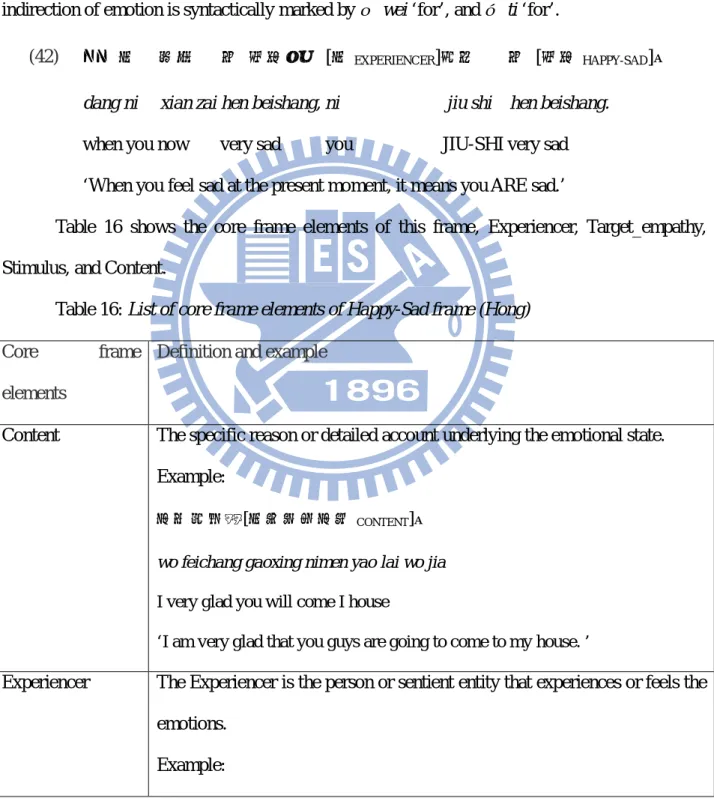
Table 16: List of core frame elements of Happy-Sad frame (Hong)……….. 37
Table 17: List of core frame elements of Regret-Sorry frame (Hong)………... 39
Table 18: List of core frame elements of Content-Contented frame (Hong)………. 43
Table 19: List of core frame elements of Love-Hate frame (Hong)………... 45
Table 20: List of core frame elements of Envy-Pity frame (Hong)……… 47
Table 21: List of core frame elements of Worry-Fear frame (Hong)………. 49
Table 22: List of core frame elements of Stimulus-Attributive frame (Hong)………... 52
Table 23: List of core frame elements of Attract-Comfort frame (Hong)……….. 54
Table 24: List of core frame elements of Bother-Irritate frame (Hong)………. 56
Table 25: Semantic situation type in English and Mandarin emotion frames……….... 63
Table 26: Core Frame Elements of English emotion frames……….. 64
Table 27: Distinct Frame Elements (FEs) of English emotion frames………... 65
Table 28: Core Frame Elements of Mandarin emotion frames……….. 66
Table 29: Foregrounded Frame Elements (FEs) of Mandarin emotion frames……….. 67
ix
Table 31: Derivational patterns for affect verbs focused on the Stimulus or the Experiencer
(Talmy 2000)……… 74
Table 32: Construction of different frames in Mandarin……… 80 Table 33: English and Mandarin emotion frames……….. 82 Table 34: Naming Categorization of English and Mandarin emotion frames……...………… 85 Table 35: Pairs of similar frames between English and Mandarin……… 86 Table 36: Core Frame Elements of Pair of Contrition and Regret-Sorry frames……….. 88 Table 37: Core Frame Elements of Pair of Emotion_active and Worry-Fear frames………… 89 Table 38: Core Frame Elements of Pair of Emotion_directed and Happy-Sad frames………. 91 Table 39: Core and Non-core Frame Elements of Emotion_directed frame……….. 92 Table 40: Core Frame Elements of Pair of Experiencer_obj and Attract-Comfort and
Bother-Irritate frames...………. 93
Table 41: Core Frame Elements of Pair of Experiencer_focus and Love-Hate, Envy-Pity and
Content-Contented frames………. 97
x
List of Figures
Figure 1. FrameNet’s categorization of emotion predication………. 12
Figure 2. The Relationship between Emotion_by_stimulus and Emotions……… 13
Figure 3. The ten frames of Using-of relation to Emotions……….. 15
Figure 4. The two frames of Perspectivized-on relation to Emotions……… 28
Figure 5. Categorization of Mandarin Emotion verbs………... 35
Figure 6. Conceptual schema of Emotion Archiframe in Mandarin……….. 36
Figure 7. Exp-Oriented frame and its basic frames (revised from Hong 2009)………. 36
Figure 8. Exp-Oriented with Target frame and its basic frames (revised from Hong 2009)….. 41
Figure 9. Stimulus-Oriented and its basic frame (revised from Hong 2009)………. 51
Figure 10. Affect-Oriented and its basic frames (revised from Hong 2009)……….. 53
Figure 11. The Relationship between Emotion_by_stimulus and Emotions………... 91
Figure 12. Conceptual schema with alternative mapping relations (Liu 2009)………. 94
Figure 13. Set relationship among Experiencer_focus, Emotion_active and Emotion_directed frames………... 96
Figure 14. A new hierarchy of English Emotions………... 96
Figure 15. Emotion Parameter………... 101
Figure 16. Emotion Parameter revised……….. 101
1 Chapter 1 Introduction
Emotion has always been an interesting topic in language studies for it involves interpreting and reading one’s mental behaviors. Look at the examples below.
(1) He frightens me. (2) I fear him.
(1) and (2) seem to express the same event while two different constructions are used. One is Stimulus-Verb-Experiencer transitive in (1). (2) is also a transitive construction with Experiencer-Verb-Stimulus. The two representative sentences present different mental path when an emotion occurs.
In Mandarin, similar sentence patterns can be exemplified by verbs, 嚇到 xiadao ‘frighten’ and 怕 pa ‘fear’.
(3) 他 嚇到 我 了。
ta xiadao wo le
he frighten me PART. ‘He frightens me.’ (4) 我 很 怕 他。
wo hen pa ta
I very fear him ‘I fear him.’
From (3), we see Stimulus-Verb-Experiencer transitive and (4), Experiencer-Verb-Stimulus transitive. Emotion can also be seen in intransitive construction, like (5) and (6).
2 (6) 我 很 開心。
wo hen kaixin
I very happy ‘I am happy.’
Throughout the history, how people’s psychological state affects their language performance has, too, been widely investigated through many linguistic approaches, including, to name a few, theta-theory (Belletti & Rizzi 1988), syntax-semantics interface (Filip 1996), and argument structures (Grimshaw 1990; Nelson 1999). Contrasts among languages have always been a fascinating topic in linguistics and many studies have done through exploring diverse topics in languages. For example, Kitis (2008) examined fear predicates in English and Modern Greek to see how fear acts as a motion verb and expresses one’s emotion.
Why is Emotion a better topic when comparing different languages? Since Wierzbicka (1992) argued that there are no universal emotion concepts, and that emotion terms cannot be neatly matched with concepts in other languages or cultures, Emotion serves to be a better perspective to examine contrasts when languages are to be compared. Besides, conceptual archetypes include the experience of perceiving, of thinking, and of feeling emotions in mental sphere (Langacker 1999). They are one of the bases for the basic grammatical constructs to have semantic characterizations. As a result, emotion is thus coded differently in different language groups if they may not, as Wierzbicka (1992) suggested, share neatly-matched emotion conceptual archetypes, which build up the foundation of one’s linguistic behavior earlier. Wierzbicka (2001) also pointed out that “emotion words reflect certain cultural models and in turn pass on values, preoccupations and frames of reference of the society.” With a specific look
3
into emotion predications of a language, the conceptual background of a language is thus to be understood better.
In this sense, this paper aims to show a thorough investigation and s detailed contrast of emotion in English and Mandarin in terms of semantic properties and syntactic behaviors. With this in mind, I here adopt Berkeley FrameNet Project (http://www.icsi.berkeley.edu/ ~FrameNet/) on English emotions and Hong’s (2009) detailed classification of Mandarin emotion verbs.
1.1 Previous studies in emotion predication
1.1.1
Emotion verbs are a sub-category of psych-verbs classified by Levin (1993) to denote psychological states. In her book, she also classified psych verbs in to four subclasses.
(7) Levin (1993)’s psych-verb classification
A. Amuse verbs: transitive verbs whose object is the experiencer and whose subject is the cause of the change.
B. Admire verb: transitive verbs with experiencer-subject.
C. Marvel verb: intransitive, experiencer as subject, express the stimulus/object of emotion in a PP headed by one of a variety of prepositions.
D. Appeal verb: the least in four subclasses; intransitive, taking the stimulus as subject and expressing the experience in a PP headed by one of a variety of prepositions.
She classified these verbs according to their syntactic behavior. She lined out some properties and alternations each verb group owns. For example, Amuse verbs contain Middle Alternation, PRO-Arb Object Alternation, Possessor Subject Possessor-Atribute Factoring Alternation, Extraposition of sentential complements, and more. Admire verbs also has Possessor Subject Possessor-Atribute Factoring Alternation as well as Attribute Object Possessor-Attribute
4
Factoring Alternation, Extraposition of Sentential Complements and so on. Some members of
Marvel verbs cam take Passive while all the members of this set are intransitive verbs that take an
Experiencer subject and the stimulus/object of emotion in a prepositional phrase. Last, Appeal verbs are the smallest group of the four and members in this class are intransitive verbs taking Stimulus as subject.
Levin shred light to us that not only syntactic properties but also semantic properties need to be taken into consideration.
1.1.2
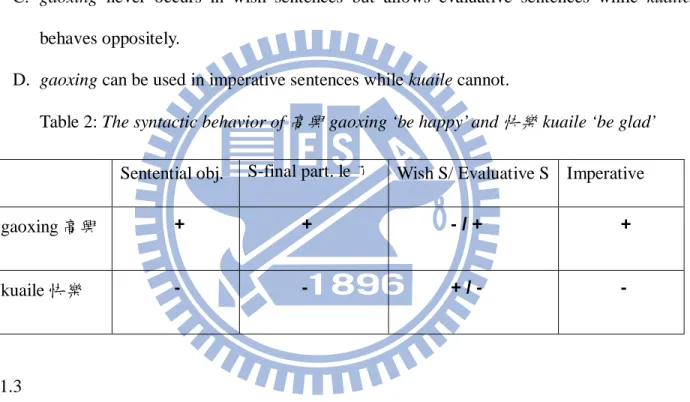
Tsai et al. (1996) showed that syntactic contrasts can be predicated from lexical semantics and emphasizes the importance of interactions between lexical semantic properties and syntactic behaviors. They explored the near-synonym pair of emotional state verbs, 高興 gaoxing ‘be happy’ and 快樂 kuaile ‘be glad’, and found that the two verbs can be distinguished from each other according to their syntactic distribution.
Table 1: The syntactic distribution of 高興 gaoxing ‘be happy’ and 快樂 kuaile ‘be glad’ Verb Function gaoxing 高興 (280) ‘be glad’ kuaile 快樂 (365) ‘be happy’ Predicate 224 (80%) 119 (32%) Complement 8 (3%) 17 (5%) Adverbial 47 (17%) 30 (8%) Adjective 116 (33%) Nominalized 1 (0.3%) 83 (23%)
5
They have also proposed that these syntactic contrasts can be specified by applying lexical features <±change of state> and <±control> and concluded that the two verbs are different in the following four aspects.
(8) The syntactic behavior of 高興 gaoxing ‘be happy’ and 快樂 kuaile ‘be glad’,
A. gaoxing takes sentential objects while kuaile cannot.
B. gaoxing can take the sentential final particle le 了 while kuaile cannot.
C. gaoxing never occurs in wish sentences but allows evaluative sentences while kuaile behaves oppositely.
D. gaoxing can be used in imperative sentences while kuaile cannot.
Table 2: The syntactic behavior of 高興 gaoxing ‘be happy’ and 快樂 kuaile ‘be glad’
1.1.3
Chang et al. (2000) elaborated Tasi et al.’s paper to extend the near-synonym pair to the whole emotion verb class. They classified Mandarin emotion verbs into seven categories, Happiness, Depression, Sadness, Regret, Anger, Fear, and Worry. Next, they proposed that for each semantic field, there are two covering terms that form a Covering Contrast Pair. By using five distributional criteria, they created bipartite classification of the verbs of emotion in which type A is similar to 高興 gaoxing ‘be glad’ while type B is similar to 快樂 kuaile ‘be happy’.
(9) Bipartite classification of emotion verbs
Sentential obj. S-final part. le 了 Wish S/ Evaluative S Imperative
gaoxing 高興 + + - / + +
6 A. Type A verbs:
a. Function mostly as predicate and are seldom used deverbally
b. Strict selectional restrictions on the head when they function as adjuncts c. Can appear in imperative or evaluative constructions
d. Can represent inchoative state
e. Can take causes or goals as their direct object B. Type B verbs:
a. Are the predominant choice in a deverbal context
b. Looser selectional restrictions on the head when they function as adjuncts c. Seldom used in imperative or evaluative constructions
d. Rarely represent inchoative state
e. Seldom take causes or goals as their direct object
Chang et al. generalized that type A verbs are preferred for indicate transition while type B verbs are preferred for homogeneity. Moreover, they came up with a semantic interpretation of the preferred sub-lexical structure, the morphological structures of these compound verbs, and argued that, with type B verbs all being VV compounds, VV compounds are preferred to represent homogeneous states as exemplified in the below.
(10) Morphological make-up of verbs of Type A and B
A. Type A: 高興 gaoxing ‘be glad’(non-VV), 難過 nanguo ‘sad’(non-VV) B. Type B: 快樂 kuaile ‘be happy’(VV), 痛苦 tongku ’suffering’(VV)
In summary, Levin (1993) grouped psych-verbs according to their transitivity, while Tsai et al (1996) and Chang et al (2000) studied both semantic and syntactic properties of Mandarin emotion verbs. The former may successfully comprise most verbs, but such categorization was
7
rather general. The latter two only provided a preliminary investigation of representative emotion verbs, leaving the rest emotion unstudied. When comparing the emotion verbs in different languages, it is hard to find equivalent data within languages we wish to account for. So, it can never be examined at the same time how languages present the same idea, or psychological state.
1.2 Aims of this thesis
Through comparing the English and Mandarin emotion verbs, we can obtain more details of how emotion is conceptualized in both languages. In English, the FrameNet project conducted by UC Berkeley has provided us a thorough investigation on emotion verbs. FrameNet divided English emotion verbs into 13 categories under semantic and syntactic features. Although it provided probably the most detailed analysis of English emotion verbs, the lack between semantic and syntactic connections opens up a gap in its analysis. On the other hand, Beth Levin in English Verbs (1993) showed us that for each verb class it contains an alternation as the basic element of classification. In Hong (2009), she adopted such idea and tried to find out unique alternations for each emotion frame. By exploring the differences in predicating ‘emotion’ in the two languages, Mandarin and English, this thesis will study the emotion predication by adopting lexical semantics (Fillmore and Atkins 1992) and Construction Grammar (Goldberg 1995). Emotion words are able to carry abundant cultural meanings, of which provides obligatory as well as optional semantic properties of these words anchoring in various frames. Nonetheless, the sentence patterns, i.e. constructions, according to Goldberg (1995), provide the form-meaning correspondence that exists independently of particular verbs.
Moreover, Chapter 2 provides the theoretical background adopted by this paper and explains the methodology. A clear introduction to emotion frames in English and in Mandarin will be presented in Chapter 3. Chapter 4 consists of analysis and contrast and conclusion is drawn in Chapter 5.
8
Chapter 2
Theoretical Framework and Methodology
2.1 Theoretical Framework: Frame semantics
Frame semantics, proposed by Fillmore and Atkins (1992), is a model of the semantics of understanding. For example, girls, boys in frame semantics suggest frames not just biological sexual discrimination but also different in attitudes and behaviors. Word concept in a lexical semantic level can only denote a sense, like the word scar may not just be a feature of one’s skin. In a frame-based semantics, scar can have a broader meaning as the process of healing. According to them, frame semantics identifies the semantic roles, i.e., frame elements, to provide an overall picture of the frame even if no naturally-occurring sentence possesses all the frame elements at the same time. A group of words build up the frame meaning instead of a mere word. Therefore, words within the same frame may arouse a shared concept. As well as semantic concept, syntactic construction is engaged in constructing a frame. Situated in different syntactic positions, an NP can be realized as different semantic roles.
In a cross-linguistic case, frame semantics can contribute more in interpreting a similar idea carried by words. For example, eat in English can take both human and non-human as its eater, while German has two words, essen and fressen for eat of which the former eater is a human but the latter is a nonhuman eater. Thus, fressen in its frame-semantic reading is related to animal-like, rudeness. (Croft & Cruse 2004) Such word can still be used to describe a human eater in German; however, it may lead to an insulting interpreting.
Overall, frame semantic helps to classify words that share similar semantic concept and participants. Fillmore further projected this approach to establish a well-organized web-based interface for user to look up lexical meanings and collocation patterns.
9
2.2 Methodology
Since there has been research done on the topic of psychological verbs in both English and Mandarin, it is important to decide the source data for comparison. Among all the studies, Berkeley FrameNet Project (http://framenet.icsi.berkeley.edu/) has done a thorough investigation on most English content words, including emotion predication. On the contrary, we rarely see a detailed and systematic investigation on Mandarin psychological predications as FrameNet. However, Hong (2009) examined most emotion verbs in Mandarin and provided a complete analysis. Thus, this paper uses FrameNet project and Hong (2009) as the representative studies of the two languages, and follows the next steps.
(11) Step 1: Present emotion predication categorizations in English and in Mandarin Step 2: Observe data
Step 3: Analyze data
Step 4: Compare frame-to-frame relations of English and Mandarin emotions
In this paper, Step 1 is as Chapter 3, which presents the description, core frame elements, examples and lexical units of each emotion frame. The core frame elements will be presented in a table with a definition and an explicative example. Step 2 to 4 are completed in Chapter 4. We observe the semantic, Situation type and Participants, and syntactic features of these frames. Then, we analyze our observation and try to conclude the similarity and dissimilarity of English and Mandarin emotion frames. Finally, we make a frame-to-frame comparison to understand what emotion expressions in Engilsh and Mandarin may share higher sameness or more differences. By doing so, we become clearer about English and Mandarin conceptualization of emotions.
10 Chapter 3
Emotion frames in English and Mandarin
In this chapter, I will present the categorization of both English and Mandarin emotion predication in FrameNet and Hong (2009) respectively. Both projects give a clear layer-relation to show child-frames. Although not only semantic properties but also syntactic behaviors are taken into consideration, morphological features also play an important role in classification.
3.1 Emotion frames in English
The top layer of emotion predication in FrameNet is Emotions. Emotions frame is defined that an Experiencer has a particular emotional State, describing a long-lasting emotion experience provoked by Stimulus, which can be categorized by a Topic. Besides, Emotions may exist in a particular Event of which the participants are Experiencers of the emotion, or be expressed through an Expressor, a body-part of gesture indicating the Experiencer's state to an external observer. These six core frame elements, Experiencer, State, Stimulus, Topic, Event, and Expressor, are shared by its child-frames. In the following paragraphs, child generation of Emotions is introduced in terms of definition, core frame elements and additional frame information.
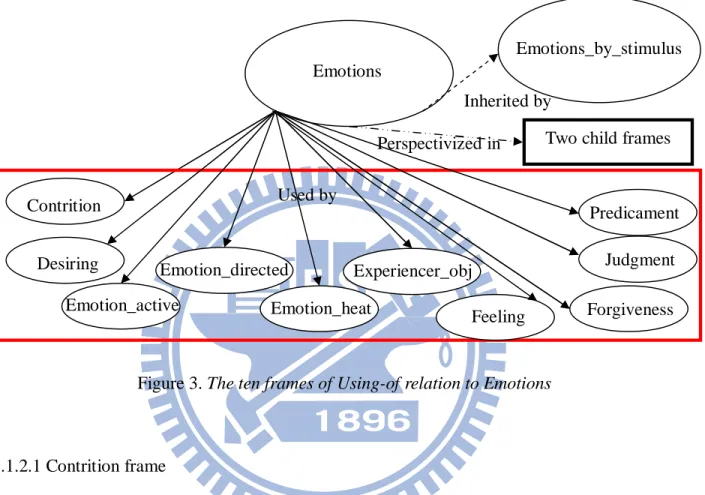
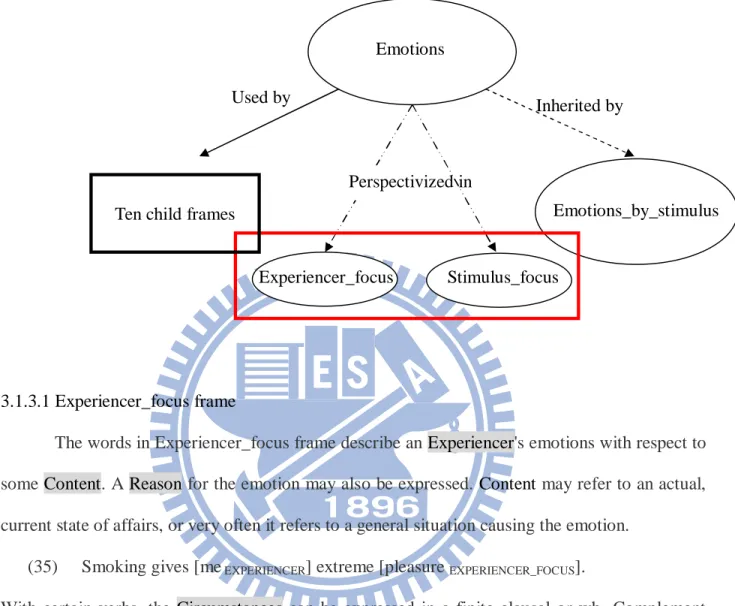
In the child generation of Emotions are 13 frames (as in Figure 1). Emotions is used by Contrition, Desiring, Emotion_active, Emotion_directed, Emotion_heat, Experiencer_obj, Feeling, Forgiveness, Judgment, and Predicament. They use Emotions as background, which means they describe emotional events or states. In addition to these ten frames, Emotions is inherited by Emotion_by_stimulus while perspectivizing in Experiencer_focus as well as in Stimulus_focus. Since inheritance is the strongest relation in FrameNet, it suggests the semantics of Emotions frame equal to or correspond to a specific fact of the child, Emotion_by_stimulus. Similar to the “using” relation, “perspectivie_on,” in fact, provides a refined relation between the
11
Emotions and Experiencer_focus and Stimulus_focus. Such relation normally implies two or more viewpoints from the originally neutral parent frame. The following paragraphs will introduce child frames of Emotions from Emotion_by_Stimulus frame, which is the most strongly related to the parent frame, then to frames of the relation, Using of, of which contains the most frames, and to the two frames of relation, Perspectivized in.
12 E m o ti o n s C o n tri ti o n D es iri n g E m o ti o n _ ac ti v e E m o ti o n s_ b y _ st im u lu s E m o ti o n _ d ire ct ed E m o ti o n _ h ea t E x p eri en ce r_ fo cu s E x p eri en ce r_ o b j F ee li n g F o rg iv en es s Ju d g m en t P re d ic am en t S ti m u lu s_ fo cu s In h eri te d b y P ers p ec ti v iz ed i n U se d b y F ig u re 2 . F ra m eN et ’s c a te g o ri za ti o n o f em o ti o n p re d ic at io n
13 3.1.1 Inheritance
3.1.1.1 Emotions_by_stimulus frame
The definition of this frame is that an Experiencer1, Expressor, Event, or State has an emotion as brought on by a Stimulus or Topic. It contains lexical units of glad, joyful, and jubilant. Below are some examples.
(12) The [joyful EMOTIONS_BY_STIMULUS] reunion took place on Sunday.
(13) The Polish-born Pope was driven past [jubilant EMOTIONS_BY_STIMULUS] [crowds
EXPERIENCER].
(14) [I EXPERIENCER] am [glad EMOTIONS_BY_STIMULUS] [about the sheep TOPIC].
This is the inherited frame from Emotions which inherit most features of the parent frame and
also has an identical correspondence to it. Figure 2 shows the relationship of
Emotion_by_stimulus and its parent frame. Frame elements of this frame are listed in table 3.
Figure 2. The Relationship between Emotion_by_stimulus and Emotions
1
Greyed words are the frame elements of the discussed frame. Emotions
Emotions_by_stimulus Inherited by
Perspectivized in Used by
Two child frames Ten child frames
14
Table 3: List of core frame elements of Emotion_by_stimulus frame (FrameNet) Core frame
elements
Definition and example
Event The Event is the occasion or happening that Experiencers in a certain emotional
state participate in.
Example: I am helping them to have the joyful [birth EVENT] they want.
Experiencer The Experiencer is the person or sentient entity that experiences or feels the
emotions.
Example: At Medicine Man's ragtime dance contest, a jubilant [girl EXPERIENCER]
drove the crowd wild.
Expressor The body part, gesture, or other expression of the Experiencer that reflects his or
her emotional state. They describe a presentation of the experience or emotion
denoted by the adjective or noun.
Example: He met me with a glad [face EXPRESSOR].
State The State is the abstract noun that describes a more lasting experience by the
Experiencer.
Example: Putin?s initiative caused joyful [excitement STATE] in Baku on Friday.
Stimulus The Stimulus is the person, event, or state of affairs that evokes the emotional
response in the Experiencer.
Example: [Putin?s STIMULUS] initiative caused joyful excitement in Baku on Friday.
Topic The Topic is the general area in which the emotion occurs. It indicates a range of
possible Stimulus.
15
3.1.2 Using of
Next, the ten frames of the relation, Using of, are introduced in alphabetical order. They
share the same child frame level as Emotion_by_stimulus frame (Figure 3).
Figure 3. The ten frames of Using-of relation to Emotions
3.1.2.1 Contrition frame
The definition is that an Experiencer feels bad about a choice, an Action, or a failure to doing something, which they now consider to have been a mistake or wrong. Experiencer may
show his or her emotional state in gestures or facial expressions, viz. an Expressor. The frame has
representative examples,
(15) [Smithers EXPERIENCER] did not [repent CONTRITION] [of his crime ACTION]
and
(16) It is God who rejoices at the [repentance CONTRITION] [of his sinner EXPERIENCER]. Emotions
Emotions_by_stimulus Inherited by
Perspectivized in Used by
Two child frames
Contrition Desiring Emotion_active Emotion_directed Emotion_heat Experiencer_obj Feeling Forgiveness Judgment Predicament
16
The lexical units contains contrite, contrition, guilt, guilty, penitence, penitent, remorse,
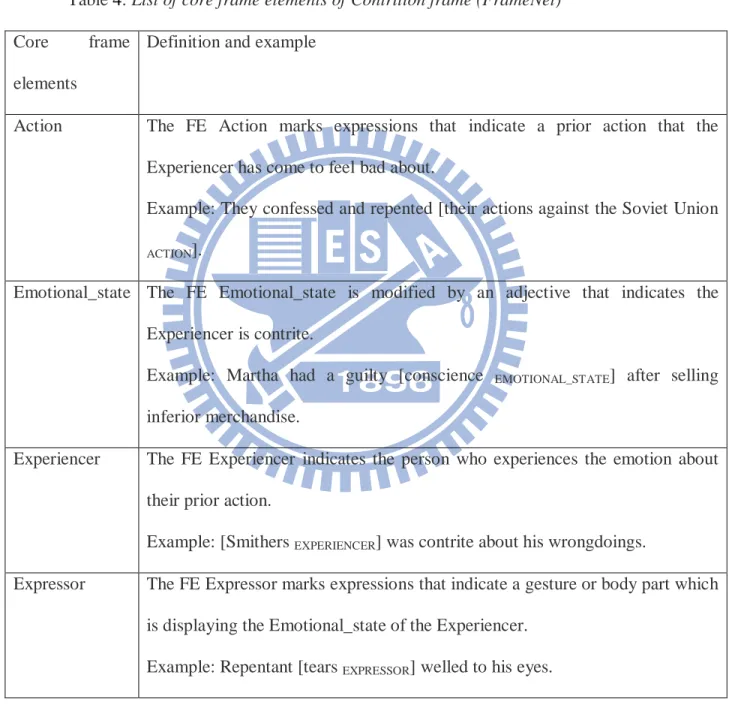
remorseful, remorseless, repent, repentance, repentant, rue, rueful, sorry, and unrepentant. Core
frame elements are not just the grayed words in definition, Experiencer, Action, Expressor, but also Emotional_state is the frame element (FE) that is included in this frame (see Table 4).
Table 4: List of core frame elements of Contrition frame (FrameNet) Core frame
elements
Definition and example
Action The FE Action marks expressions that indicate a prior action that the
Experiencer has come to feel bad about.
Example: They confessed and repented [their actions against the Soviet Union
ACTION].
Emotional_state The FE Emotional_state is modified by an adjective that indicates the
Experiencer is contrite.
Example: Martha had a guilty [conscience EMOTIONAL_STATE] after selling
inferior merchandise.
Experiencer The FE Experiencer indicates the person who experiences the emotion about
their prior action.
Example: [Smithers EXPERIENCER] was contrite about his wrongdoings.
Expressor The FE Expressor marks expressions that indicate a gesture or body part which
is displaying the Emotional_state of the Experiencer.
17 3.1.2.2 Desiring frame
This frame is defined that an Experiencer desires that an Event occurs. Sometimes, the Experiencer is an active participant in the Event of which the Event itself is often not mentioned,
but rather some Focal_participant which is involved subordinately. Generally, the lemmas in this frame imply that the Event has not yet happened, but that Experiencer believes that they would be
happier if it did. In some cases, the Time_of_Event, Purpose_of_Event, or the Location_of_Event
are mentioned without the clear mention of the Event.
(17) [I EXPERIENCER] only [wanted DESIRING] [one piece of candy FOCAL_PARTICIPANT].
(18) [The company EXPERIENCER]was [eager DESIRING] [for him FOCAL_PARTICIPANT] [to leave as
soon as possible EVENT].
(19) [Susan EXPERIENCER] really [wishes DESIRING] [that you 'd listen to her EVENT].
Lexical units in this frame are ache, ambition, aspiration, aspire, covet, covetous, crave, craving,
desire, desire (N), desired, desirous, dying, eager, fancy, feel_like, hanker, hankering, hope, hope, hunger, hunger, hungry, in_hopes_of, in_the_hope_of, interested, long, longing, lust, lust, pine, raring, spoiling, thirst, thirst, thirsty, urge, want, wants, will, will, wish (that), wish, wish, yearn, yearning, yen, and yen (N).
Table 5: List of core frame elements of Desiring frame (FrameNet) Core frame
elements
Definition and example
Event The change that the Experiencer would like to see.
Example: The company was eager for him [to leave as soon as possible
EVENT].
18
to occur.
Example: [The company EXPERIENCER] was eager for him to leave as soon as
possible..
Focal_participant This is the entity that the Experiencer wishes to be affected by some Event.
Example: The company was eager [for him FOCAL_PARTICIPANT] to leave as
soon as possible.
Location_of_Event The Location_of_Event is the place involved in the desired Event.
Example: I want that box [on top of the other one LOCATION_OF_EVENT ].
3.1.2.3 Emotion_active frame
Lexical units, agonize, fret, fuss, lose_sleep, obsess, obsession, and worry define this frame contains a subject Experiencer, but here the verbs are more 'active' in meaning as they
often occur in negative imperatives and occur with Topic expressions and can be used in the present progressive:
(20) Pat is still [worrying EMOTION_ACTIVE] [about the exam TOPIC].
Besides, this frame can be thought of as a blend of a basic emotion frame with Cogitation.
Table 6: List of core frame elements of Emotion_active frame (FrameNet) Core frame
elements
Definition and example
Experiencer The FE Experiencer indicates the one who is actively expressing emotion
over the Topic. It usually occurs as the subject of the verb.
Example: [Kim EXPERIENCER] worried about the phone bill.
19
with a Topic which usually occurs in a PP-Complement.
Example: Kim fretted [over the exam TOPIC].
3.1.2.4 Emotion_directed frame
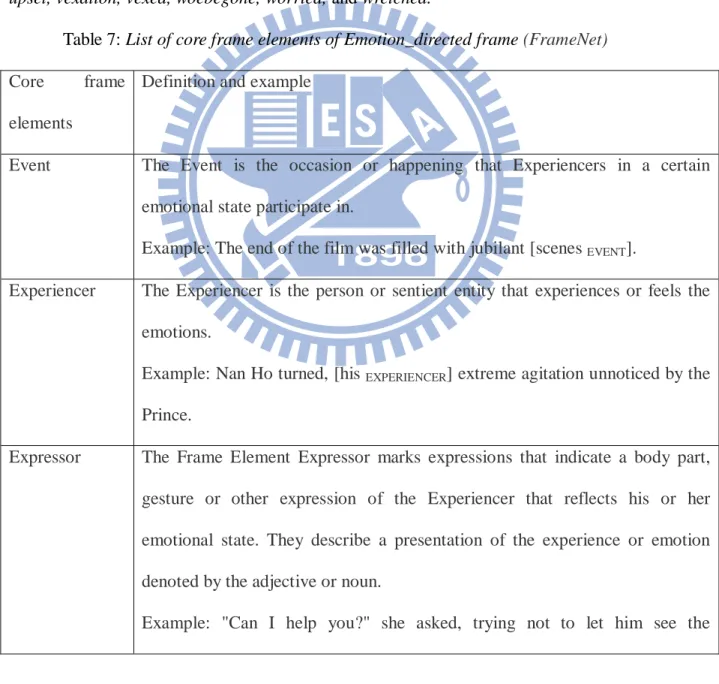
The adjectives and nouns, e.g., happy, sad anger, interest, in this frame describe an
Experiencer who is feeling or experiencing a particular emotional response to a Stimulus or about a Topic. The response occurs under a Circumstances or there can be a Reason that the Stimulus evokes the particular response in the Experiencer.
(21) Mr. Whiskers is [upset EMOTION_DIRECTED] [that there are no more cat treats STIMULUS].
(22) The [furious EMOTION_DIRECTED] parent stormed into the office.
This frame containing more than 150 lemmas is one of the few emotion frames with a massive number of lexical units. The lexical units are abashed, affronted, agitated, agitation, agonized,
agony, alarmed, all about, amused, amusement, anger, angry, anguish, anguished, annoyance, annoyed, anxious, appalled, ashamed, astonished, astonishment, astounded, baffled, bafflement, befuddled, bewildered, bewilderment, blue, bored, boredom, chagrin, chagrined, concern, concerned, contented, covetous, crestfallen, cross, dejected, dejection, delight, delighted, depressed, desolate, despair, despondency, despondent, devastated, disappointed, disappointment, discomfited, discomfiture, disconcerted, disconcertion, disconsolate, discouraged, discouragement, disgruntled, disgruntlement, disheartened, dismay, dismayed, disorientation, disoriented, displeased, displeasure, disquiet, disquieted, distress, distressed, downcast, downhearted, ecstatic, elated, elation, embarrassed, embarrassment, embittered, enraged, exasperated, exasperation, excited, excitement, exhilarated, exhilaration, fascinated, fed up, fed-up, flabbergasted, flummoxed, flustered, frightened, furious, fury, glee, gleeful, glum, glumness, gratification, gratified, grief-stricken, grief, happy, harried, heartbreak, heartbroken, horrified,
20
horror, humiliated, incensed, inconsolable, indignant, infuriated, interest, interested, into, irate, irked, irritated, jubilant, livid, low-spirited, lugubrious, mad, miffed, miserable, mortification, mortified, mournful, mourning, mystification, mystified, nervous, nettled, nonplussed, offended, overjoyed, overwrought, peeved, perplexed, perplexity, perturbed, petrified, pleased, puzzlement, rattled, relaxed, resentful, revolted, revulsion, riled, ruffled, sad, saddened, sadness, shocked, sickened, sore, sorrow, sorrowful, startled, stressed, stunned, stupefaction, stupefied, sympathetic, sympathize, sympathy, terror-stricken, thrilled, tormented, traumatised, unsettled, unsympathetic, upset, vexation, vexed, woebegone, worried, and wretched.
Table 7: List of core frame elements of Emotion_directed frame (FrameNet)
Core frame
elements
Definition and example
Event The Event is the occasion or happening that Experiencers in a certain
emotional state participate in.
Example: The end of the film was filled with jubilant [scenes EVENT].
Experiencer The Experiencer is the person or sentient entity that experiences or feels the
emotions.
Example: Nan Ho turned, [his EXPERIENCER] extreme agitation unnoticed by the
Prince.
Expressor The Frame Element Expressor marks expressions that indicate a body part,
gesture or other expression of the Experiencer that reflects his or her
emotional state. They describe a presentation of the experience or emotion
denoted by the adjective or noun.
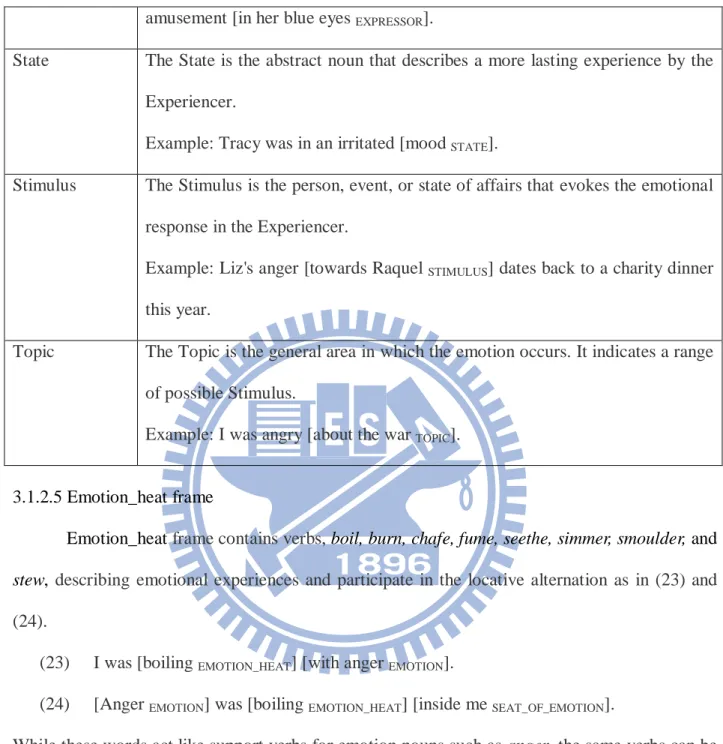
21
amusement [in her blue eyes EXPRESSOR].
State The State is the abstract noun that describes a more lasting experience by the
Experiencer.
Example: Tracy was in an irritated [mood STATE].
Stimulus The Stimulus is the person, event, or state of affairs that evokes the emotional
response in the Experiencer.
Example: Liz's anger [towards Raquel STIMULUS] dates back to a charity dinner
this year.
Topic The Topic is the general area in which the emotion occurs. It indicates a range
of possible Stimulus.
Example: I was angry [about the war TOPIC].
3.1.2.5 Emotion_heat frame
Emotion_heat frame contains verbs, boil, burn, chafe, fume, seethe, simmer, smoulder, and
stew, describing emotional experiences and participate in the locative alternation as in (23) and (24).
(23) I was [boiling EMOTION_HEAT] [with anger EMOTION].
(24) [Anger EMOTION] was [boiling EMOTION_HEAT] [inside me SEAT_OF_EMOTION].
While these words act like support verbs for emotion nouns such as anger, the same verbs can be
used in the absence of such nouns in (25).
(25) His remarks made me boil (inside).
Table 8: List of core frame elements of Emotion_heat frame (FrameNet) Core frame Definition and example
22
elements
Emotion The Emotion experienced (usually restricted to words such as anger, fury,
rage, passion) can occur as the External Argument or in a PP Complement.
Alternatively, there may be no expression of Emotion separate from the
target verb:
Example: [Rage EMOTION] boiled inside him.
Experiencer The Experiencer is the individual that experiences the Emotion.
Example: [Pat EXPERIENCER] seethed with rage.
Seat of emotion The words in this frame can occur with an overtly expressed Seat of the
Emotion. This frame element occurs as a PP Complement:
Example: Fury seethed [within her SEAT OF EMOTION].
3.1.2.6 Experiencer_obj frame
It contains the definition of that some phenomenon (the Stimulus) provokes a particular emotion in an Experiencer as in (26).
(26) [Nightmare on Elm Street STIMULUS] [scared EXPERIENCER_OBJ] [me EXPERIENCER] silly.
Lexical units in this frame are more than a hundred, and these lemmas are abash, aggravate,
aggrieve, alarm, amaze, anger, annoy, antagonize, astonish, astound, baffle, beguile, bewilder, bewitch, boggle, bore, calm, captivate, charm, cheer, comfort, conciliate, confuse, console, crush, dazzle, delight, demolish, depress, devastate, disappoint, discomfit, disconcert, discourage, dishearten, displease, distress, disturb, embarrass, embitter, enchant, enrage, entertain, enthrall, exasperate, excite, exhilarate, fascinate, faze, flabbergast, floor, flummox, fluster, frighten, frustrate, fulfill, gall, gladden, gratify, hearten, humiliate, impress, incense, infuriate, interest,
23
intimidate, intrigue, irk, irritate, madden, mollify, mortify, mystify, nettle, nonplus, offend, outrage, pacify, perplex, perturb, petrify, placate, please, puzzle, rankle, rattle, reassure, repel, revolt, rile, sadden, satisfy, scare, shake, shame, shock, shocker[N], sicken, sober, solace, soothe, spook, startle, stimulate, sting, stir, stun, stupefy, surprise[N], surprise, terrify, thrill, tickle, torment, traumatize, trouble[N], trouble, unnerve, unsettle, upset, vex, vexation[N], and wow.
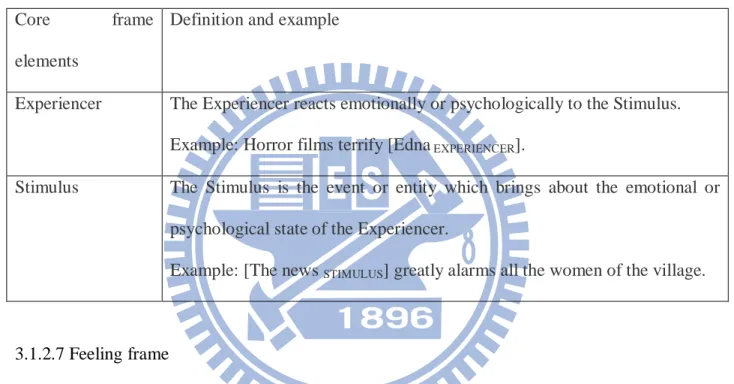
Table 9: List of core frame elements of Experiencer_obj frame (FrameNet) Core frame
elements
Definition and example
Experiencer The Experiencer reacts emotionally or psychologically to the Stimulus.
Example: Horror films terrify [Edna EXPERIENCER].
Stimulus The Stimulus is the event or entity which brings about the emotional or
psychological state of the Experiencer.
Example: [The news STIMULUS] greatly alarms all the women of the village.
3.1.2.7 Feeling frame
In this frame an Experiencer experiences an Emotion or is in an Emotional_state. An
Evaluation of the internal experiential state is also included.
(27) [John EXPERIENCER] [ feels FEELING] [ [anger towards his mother EMOTION].
(28) [Martha EXPERIENCER] [feels FEELING] [angry EMOTIONAL_STATE].
Inalienably possessed aspects of the Experiencer frequently stand in for the Experiencer.
(29) [Her heart EXPERIENCER] [felt FEELING] [angry EMOTIONAL_STATE].
24
Table 10: List of core frame elements of Feeling frame (FrameNet) Core frame
elements
Definition and example
Emotion The Emotion is the feeling that the Experiencer experiences.
Example: Patients experience [high anxiety levels EMOTION] at time of
admission to hospital.
Emotional_state The Emotional_state is the state the Experiencer is in.
Example: Her heart was galloping so fast that she felt [quite giddy with
happiness EMOTIONAL_STATE].
Evaluation The Evaluation is a negative or positive assessment of the Experiencer
regarding his or her Emotional_state.
Example:Max was feeling [worse than he'd ever felt in his life EVALUATION].
Experiencer The Experiencer experiences the Emotion or is in the Emotional_state.
Example: After two pints, [he EXPERIENCER] felt a bit better and Ted arrived.
3.1.2.8 Forgiveness frame
This frame is special for there exists no Experiencer not Stimulus frame elements. It is defined that a Judge refrains from imposing, or demanding a punishment for an Evaluee who has committed an Offense. This frame is exemplified in (30) and (31).
(30) [God JUDGE] [forgive FORGIVENESS] [repentant sinners EVALUEE].
(31) Won't [you JUDGE] [forgive FORGIVENESS] [me EVALUEE] for keeping it a secret?
Similar to Feeling frames, lexical units are few, containing only condone, excuse, forgive,
25
Table 11: List of core frame elements of Forgiveness frame (FrameNet) Core frame
elements
Definition and example
Evaluee The Evaluee is subject to the judgment of the Judge for having committed
the Offense.
Example:God forgives [repentant sinners EVALUEE].
Judge The Judge holds the Evaluee responsible for the Offense.
Example:Won't [you JUDGE] forgive me for keeping it a secret?
Offense The Offense is the illicit or unpleasant act committed by the Evaluee.
Example:Won't you forgive me [for keeping it a secret OFFENSE]?
3.1.2.9 Judgment frame
In Judgment frame, aCognizer makes a judgment about an Evaluee as in (32). (32) [She COGNIZER] [admired JUDGMENT] [Einstein EVALUEE] for his character.
The judgment may be positive (e.g. respect) or negative (e.g. condemn), as this
information is stored in the semantic types on the Lexical Units of this frame. A specific Reason
for the Cognizer's judgment and a capacity or Role in which the Evaluee is judged are included. The core frame elements are listed as below. Lexical Units are appreciate, appreciation,
appreciative, approbation, approving, blame, blame, boo, contempt, contemptuous, critical, damnation, deify, deplore, derisive, disapproval, disapprove, disapproving, disdain, disdain, disdainful, disrespect, esteem, esteem, exalt, exaltation, fault, fault, mock, mockery, prize, reprehensible, reproach, reproachful, respect, respect, revere, reverence, scorn, scorn, scornful, set store, stigma, stigmatize, stricture, uncritical, value, and vilification.
26
Table 12: List of core frame elements of Judgment frame (FrameNet) Core frame
elements
Definition and example
Cognizer The Cognizer makes the judgment. This role is typically expressed as the
External Argument (or in a by-PP in passives).
Example: [The boss COGNIZER] appreciates you for your diligence.
Evaluee Evaluee is the person or thing about whom/which a judgment is made. With
verbs this FE is typically expressed as Object:
Example:The boss appreciates [you EVALUEE] for your diligence.
Expressor Expressor is the body part or action by a body part that conveys the
judgment made by the Cognizer.
Example:She viewed him with an appreciative [gaze EXPRESSOR].
Reason Typically, there is a constituent expressing the REASON for the Judge's
judgment. It is usually a for-PP, e.g.
Example:I admire you [for your intellect REASON].
3.1.2.10 Predicament frame
An Experiencer in Predicament frame is in an undesirable Situation, whose Cause may also be expressed.
(33) [The insurers EXPERIENCER] [ended up in CAUSE] the [bind PREDICAMENT] [of having to pay
15 years' taxes SITUATION].
27
Lexical Units in Predicament frame are bind, fix, jam, mess, misfortune, pickle, pinch, plight,
predicament, problem, scrape, and trouble. The core frame elements of Predicament frame is
listed in Table 13.
Table 13: List of core frame elements of Predicament frame (FrameNet) Core frame
elements
Definition and example
Experiencer The Experiencer is in an undesirable Situation.
Example: [The insurers EXPERIENCER] ended up in a bind.
Situation This FE identifies the undesirable Situation the Experiencer is in.
Example:They found themselves in a quite [a fix SITUATION].
The previous 10 frames use Emotions as background, which describe emotional events or states. Among them, Emotion_directed has the most lemmas and the second goes to Experiencer_obj frame which contains less than 200 lemmas.
3.1.3 Perspectivized on
The following two frames are perspectivized emotion frames. They are the only frames in Emotions using perspectives. One frame focuses on the participant, Experiencer, and the other, Stimulus, which are the most dominant participants in Emotions. These two frames put their emphasized participant mostly in the position of syntactic subject. Similar to Emotion_by_stimulus frame and Using-of frames, the two Perspectivized-on frames are at the same hierarchy position as them, as exemplified in Figure 4.
28
Figure 4. The two frames of Perspectivized-on relation to Emotions
3.1.3.1 Experiencer_focus frame
The words in Experiencer_focus frame describe an Experiencer's emotions with respect to some Content. A Reason for the emotion may also be expressed. Content may refer to an actual, current state of affairs, or very often it refers to a general situation causing the emotion.
(35) Smoking gives [me EXPERIENCER] extreme [pleasure EXPERIENCER_FOCUS].
With certain verbs, the Circumstances can be expressed in a finite clausal or wh- Complement which may optionally be preceded by a Null NP Object:
(36) [I EXPERIENCER] [hate EXPERIENCER_FOCUS] it [when you do that CIRCUMSTANCES].
Table 14 has listed all the frame elements of this frame with examples. Lexical Units of this frame can take different grammatical forms, including verbs, adjectives, nouns, adjectival passives and adverbs and they are abhor, abhorrence, abominate, adoration, adore, afraid, agape,
antipathy, apprehensive, calm, comfort, compassion, delight, despair, desperation, despise, detest, detestation, dislike, dislike, dissatisfied, dread, dread, empathetic, empathize, empathy, enjoy,
Emotions
Emotions_by_stimulus Inherited by
Perspectivized in Used by
Ten child frames
29
enjoyment, envy, envy, fazed, fear, fear, fed up, feverish, feverishly, fond, freaked, frightened, fulfilled, fulfillment, grief-stricken, grieve, happily, hate, hatred, interested, intimidated, irritated, like, loathe, loathing, love, luxuriate, mourn, nervous, nettled, pity, pity, pleasure, regret, regret, relish, relish, resent, resentment, rue, rueful, satisfaction, satisfied, savour, scared, solace, taken, terrified, unfazed, upset, worked up, and worried.
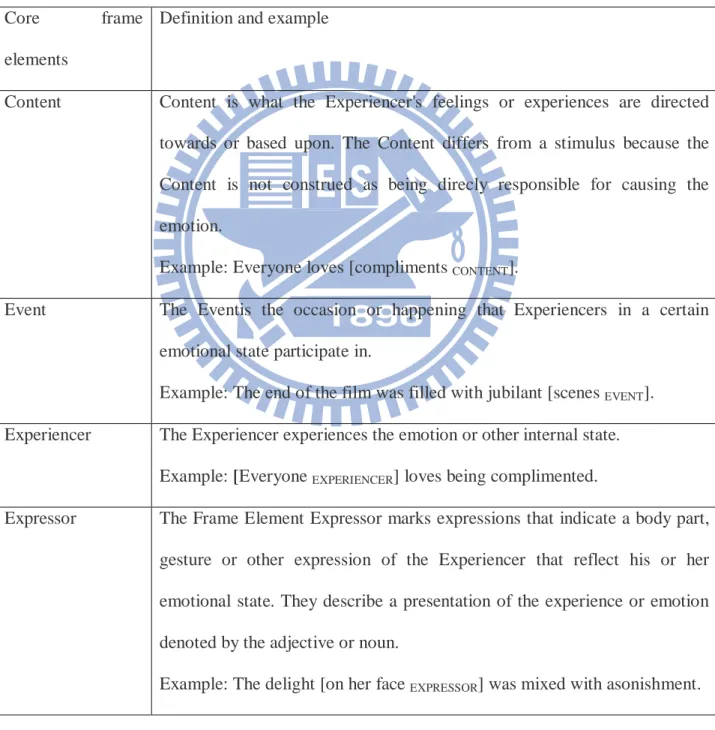
Table 14: List of core frame elements of Experiencer_focus frame (FrameNet) Core frame
elements
Definition and example
Content Content is what the Experiencer's feelings or experiences are directed
towards or based upon. The Content differs from a stimulus because the
Content is not construed as being direcly responsible for causing the
emotion.
Example:Everyone loves [compliments CONTENT].
Event The Eventis the occasion or happening that Experiencers in a certain
emotional state participate in.
Example:The end of the film was filled with jubilant [scenes EVENT].
Experiencer The Experiencer experiences the emotion or other internal state.
Example: [Everyone EXPERIENCER] loves being complimented.
Expressor The Frame Element Expressor marks expressions that indicate a body part,
gesture or other expression of the Experiencer that reflect his or her
emotional state. They describe a presentation of the experience or emotion
denoted by the adjective or noun.
30
State The State is the abstract noun that describes a more lasting experience by
the Experiencer.
Example:Tracy was in an irritated [mood STATE].
Topic The Topic is the area about which the Experiencer has the particular
experience.
Example:Mr. Whiskers was upset [about his cat treats TOPIC].
3.1.3.2 Stimulus_focus frame
In this frame either a Stimulus brings about a particular emotion or experience in the
Experiencer or saliently fails to bring about a particular experience. Some words indicate that the Stimulus is characterized by the experience it is likely to evoke in an Experiencer and the
Experiencer may rarely be present. There can be a Degree for the gradation of how Stimulus affects the Experiencer and the experience may occur under a Circumstances. In addition, a
Comparison_set is to which the Stimulus is compared and a Parameter indicates the area in which the Stimulus has its effect. Typical examples are as exemplified in (37) and (38).
(37) [That movie STIMULUS] was quite [fascinating STIMULUS_FOCUS].
(38) [The report STIMULUS] was very [alarming STIMULUS_FOCUS] [to me EXPERIENCER].
Lexical Units in this frame reached more than 170 words, and they are abominable, absorbing,
aggravating, aggravation, agonizing, agreeable, alarming, alienating, amazing, amusing, annoyance, annoying, appalling, astonishing, astounding, baffling, beguiling, bewildering, bewitching, blood-curdling, boring, bothersome, breathtaking, calming, captivating, charm_((count)), charm_((mass)), charming, cheering, chilling, comforting, comical, confusing, consoling, delight, delightful, depressing, devastating, disagreeable, disappointing, discomfiting, discomforting, disconcerting, discouraging, disgusting, disheartening, disillusioning, dismaying,
31
disorientating, displeasing, distasteful, distressing, disturbing, dreadful, droll, dull, earth-shattering, electrifying, embarrassing, embittering, empty, enchanting, encouraging, engrossing, enjoyable, enraging, entertaining, enthralling, exasperating, exciting, exhilarating, fascinating, formidable, frightening, fulfilling, full, funny, galling, ghastly, gratifying, gripping, hair-raising, harrowing, heart-rending, heart-stopping, heart-warming, heartbreaking, heartening, hilarious, humorous, impressive, infuriating, interesting, intimidating, intriguing, invigorating, irksome, irritating, jaw-dropping, jolly, maddening, mind-boggling, mind-numbing, mortifying, mystifying, nerve-racking, nice, offensive, pacifying, pathetic, perplexing, pitiful, placating, pleasant, pleasing, pleasurable, poignant, reassuring, recreation, relaxation, relaxing, repellent, revolting, rich, rousing, sad, saddening, satisfying, scary, shocking, sickening, side-splitting, sobering, solemn, soothing, spine-chilling, spine-tingling, startling, stimulating, stinging, stirring, stressful, striking, stupefying, surprising, suspenseful, tear-jerking, tedious, terrifying, thorny, thrilling, tiresome, tiring, tormenting, touching, traumatic, traumatising, troublesome, troubling, unexciting, unfulfilling, unfunny, unnerving, unpleasant, unpleasing, unsettling, uplifting, upsetting, vexation, vexatious, vexing, white-knuckle, worrisome, and worrying.
Table 15: List of core frame elements of Stimulus_focus frame (FrameNet) Core frame
elements
Definition and example
Stimulus The Stimulus is the object or event which brings about the emotion in the
Experiencer.
32
From the last two emotion frames in English, it can be seen that Experiencer_focus frame takes adjectival passives as its major lexical units while Stimulus_focus frame mostly take V-ing gerunds. A preference seems to be indicated while we do not go further in this chapter. This issue will be subject to discussion in 4.2.