科技部補助專題研究計畫成果報告
期末報告
故宮博物院的科技化服務創新--總計畫暨子計畫一:故宮
博物院的科技化服務之設計議題(第 3 年)
計 畫 類 別 : 整合型計畫
計 畫 編 號 : MOST 101-2420-H-004-005-MY3
執 行 期 間 : 103 年 01 月 01 日至 104 年 03 月 31 日
執 行 單 位 : 國立政治大學資訊管理學系
計 畫 主 持 人 : 蔡瑞煌
共 同 主 持 人 : 林國平
計畫參與人員: 碩士級-專任助理人員:段茜文
碩士級-專任助理人員:黃建銘
高中級-專任助理人員:謝宗道
大專生-兼任助理人員:李盈璇
大專生-兼任助理人員:蔡心雅
大專生-兼任助理人員:王翊寧
博士班研究生-兼任助理人員:許哲銓
博士後研究:張雯然
報 告 附 件 : 出席國際會議研究心得報告及發表論文
處 理 方 式 :
1.公開資訊:本計畫可公開查詢
2.「本研究」是否已有嚴重損及公共利益之發現:否
3.「本報告」是否建議提供政府單位施政參考:是,
中 華 民 國 104 年 03 月 12 日
中 文 摘 要 : 本研究利用國立故宮博物院的資訊科技化內容(IT-generated
content)作為個案,來檢視如何透過新知識創造模式來創造
新的合成知識。為了創造新的資訊科技化內容,故宮採取跨
產業聯盟策略:它形成一個學徒技師社群(community of
apprentices and artificers, CoA&A),每位成員都擔任學
徒與技師的角色。CoA&A 的實施讓古物專家與科技專家能更
加瞭解彼此,因而能共同獲取創造新資訊科技化內容所需要
的(隱性與顯性)知識。在每個新知識創造模式裡,有一種
「合成」的機制。合成係指兩個以上實體的結合,共同運作
來形成新的事物。換句話說,古物專家必須親身操作資訊科
技化內容的研發,以日後能親自創造相關的內容;而科技專
家必須在研發過程中,獲取豐富的古物知識。
中文關鍵詞: SECI 知識創造模式, 知識創造, 資訊科技
英 文 摘 要 : This study uses a case study of the IT-generated
content at the National Palace Museum in Taiwan (NPM)
to examine how new knowledge creation modes generate
new knowledge through synthesis. To create new
IT-generated content, the NPM adopts a cross-industry
alliance strategy; it forms a community of
apprentices and artificers (CoA&A), in which each
member acts as both an apprentice and an artificer.
The practices of the CoA&A allow both relic experts
and IT professionals to enhance their individual
understanding and thus together acquire the knowledge
(both tacit and explicit) needed to create the new
content. In each new knowledge creation mode, a
“synthesis" mechanism is identified. Synthesis is a
combination of two or more entities working together
to form something new. In other words, the relic
experts must be personally involved in the
development of the IT-generated content to create the
relevant content; and the IT professionals must
acquire the explicit rich relic knowledge during the
development process.
英文關鍵詞: SECI modes, Knowledge Creation, Information
Technologies
1
The Knowledge Creation Mode for Synthesized Knowledge
– A Case Study of the National Palace Museum
Abstract
This study uses a case study of the IT-generated content at the National Palace Museum in Taiwan (NPM) to examine how new knowledge creation modes generate new knowledge through synthesis. To create new IT-generated content, the NPM adopts a cross-industry alliance strategy; it forms a community of apprentices and artificers (CoA&A), in which each member acts as both an apprentice and an artificer. The practices of the CoA&A allow both relic experts and IT professionals to enhance their individual understanding and thus together acquire the knowledge (both tacit and explicit) needed to create the new content. In each new knowledge creation mode, a “synthesis” mechanism is identified. Synthesis is a combination of two or more entities working together to form something new. In other words, the relic experts must be personally involved in the development of the IT-generated content to create the relevant content; and the IT professionals must acquire the explicit rich relic knowledge during the development process.
Keywords: SECI modes, Knowledge Creation, Information Technologies (IT).
1. Museums, New Content, and Information Technologies
Using the case study of the National Palace Museum in Taiwan (NPM), which frequently produces new IT-generated content, this research investigates the conversion modes that are used to transform the knowledge of relics plus the knowledge of IT applications into the knowledge of IT-generated content. Hereafter, IT denotes the information technologies and any IT-generated content that is shared in digital form or results from any associated digital practice. We use “plus” when discussing the combination of knowledge of relics and knowledge of IT applications to clearly distinguish the two types of knowledge (i.e., relics and IT applications). The two types of knowledge are associated with the role, tasks, and responsibilities of the NPM and its external IT partners, respectively. The knowledge of IT-generated content is a synthesis, as it is “bred” from the integration of relevant relic knowledge with related IT application knowledge. The NPM is a suitable case study as it
2
is recognized as one of the traditional knowledge-based organizations with limited expertise in up-to-date IT.Museums are places and facilities specifically used for storing and exhibiting historical and natural objects, and educating audiences (Lewis 1992; Hooper-Greenhill 2007). The main functions of a museum are to collect objects, conserve the targeted objects, conduct/facilitate research on the objects it houses, and educate and entertain the public (International Council of Museums 2007). To this end, each museum needs to be able to preserve objects and to provide researchers with the required incentives and resources to further our knowledge about them. To educate and entertain the public, museums stage exhibitions. As museum researchers often work independently, their research results and exhibitions are often aimed at other experts, not the general public (Tsaih et al. 2014).
Recently, the functions and roles of museums have begun to change; before the 1980’s they were object-oriented, from the 1980’s to the 2000s they adopted an education focus, and today (after the 2000s) they are becoming very public-centered (Chang 2011). For instance, the International Council Of Museums (2007) has redefined the museum as follows:
A non-profit, permanent institution in the service of society and its development, open to the public, which acquires, conserves, researches, communicates and exhibits the tangible and intangible heritage of humanity and its environment for the purposes of education, study and enjoyment.
In other words, the functions of today’s museums have been broadened to become more public-centered, and consequently they must use a variety of means to attract and continue to entertain their visitors.
IT offers several alternative ways for the public to effectively access a museum’s knowledge (Marty 2007). For instance, there are digital collection projects that create digital databases and image repositories of museums’ collection. Using these resources, people can easily search for images on a museum’s website and thus achieve the museum’s education purpose. In addition, by incorporating various media into an online database, virtual museum services can use texts, pictures, multimedia, and 3D techniques to provide on-line tours of artifacts for the Internet visitors. Previous studies have
3
addressed such issues as the user-friendliness of museum websites (Cunliffe et al. 2001), the relationships between museums and their websites (Marty 2007), and the best practices for creating an online experience for museum visitors (Soren 2005; Lin et al. 2008). Facing the dynamic challenges of attracting and entertaining real and virtual visitors, museums must use IT efficiently to survive (Orna and Pettitt 2010). Previous studies have shown that IT can be a good vehicle for knowledge representation (replacing physical objects with digital presentation), can enhance access to knowledge, and can facilitate knowledge transfer. Even with modern tools such as IT, knowledge creation is inherently difficult, as those who have knowledge may not be conscious of what they know or how significant it is, or be able or willing to share it with others (Lee and Kelkar 2013).These discussions show that museums may possess abundant knowledge that does not attract the general public, because the museums do not understand their visitors’ interests (McLean 1994; Goulding 1999; Kotler et al. 2008). Some research provide in-depth descriptions and analyses of some relics, but these papers have limited circulation and may not be interesting or entertaining enough for the general public, especially for younger generations (Kotler & Kotler 2000; Mason & McCarthy 2006). Although people can use high-resolution pictures to examine the details of ancient relics, the complicated implicit knowledge embedded in these relics is still unavailable to the public. For this reason, the next stage of IT applications for museums should transform the traditional content into IT-generated content that catches the attention and interest of new generations and increases their awareness of temporary exhibitions. For these purposes, IT-generated content should deliver more complete, vivid, tele-presented, and appealing information about the relics to the museums’ visitors. Further, through IT-generated content, younger generations can truly enjoy the aesthetic pleasures and intellectual adventure of museum visits. Ultimately, these experiences can raise the aesthetic taste of a society.
To this end, as shown in Figure 1, the NPM and some other museums have developed and launched new IT-generated content. The IT application knowledge illustrated in the model shown in Figure 1 includes applications such as 3D animation, 3D virtual imagery, 3D photography, 3D interactive video display, RenderMan, Google Street View, augmented reality, holographic projection, 360 degree panoramic projection technology,
4
and motion sensing.
From the museum’s perspective, the new IT-generated content creates new types of knowledge for a new target market. From the academic perspective, this is interesting, as the (traditional) outreach strategies of museums, without up-to-date IT expertise, are unlikely to have the capability to regularly create the required new IT-generated content.Figure 1. Some of the IT-generated content that the NPM has developed.
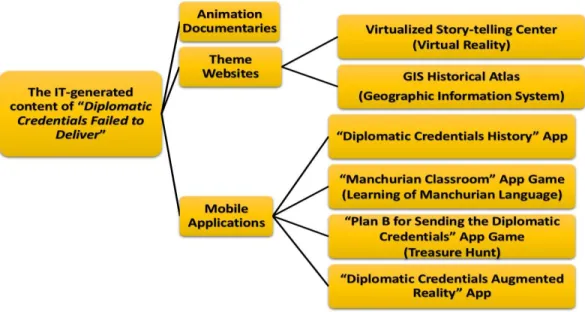
This study takes the NPM, one of the top museums in the world, as a study case to illustrate the development of IT-generated content. In recent years, the NPM has included IT-generated content in every special exhibition. For instance, in the recent exhibition Diplomatic Credentials Failed to Deliver (Exhibition dates: 2014/10/16 ~ 2015/01/11; Gallery: Exhibition Area I 103 in NPM), the NPM made the IT-generated content widely available online. Figure 2 outlines the IT-generated content1 created for the Diplomatic Credentials Failed to Deliver exhibition; Figure 3 presents some of the particular items, for illustration purpose. The IT applications used in the model shown in Figure 3 include virtual reality, geography information systems (GIS), app games, and animation.
5
Figure 2. IT-generated content created for the Diplomatic Credentials Failed to Deliver exhibition.Figure 3. Some IT-generated content from the Diplomatic Credentials Failed to Deliver exhibition.
The NPM has frequently used IT-generated content to promote digital learning, in promotional marketing, for cultural product creation, and/or to create interesting art exhibitions via new media (Tsaih et al. 2014). These products have received numerous
6
awards and favorable responses from the public (Tsaih et al. 2014). It seems that the NPM has maximized its ability to regularly create new IT-generated content.According to Orna and Pettitt (2010), a museum is an organization consisting of a great amount of knowledge that includes the collections themselves, documentation and publications, expertise in scholarship, conservation, exhibitions, interpretation and education, marketing, maintenance and the development of activities. Yet, only a few previous studies have considered the knowledge-creation modes that a traditional museum could use by combining knowledge of relics plus IT applications to create the knowledge of IT-generated content. This study bridges this gap. The findings are not only useful for the NPM, but can also benefit other (traditional) knowledge-based organizations that are contemplating a series of new IT-generated content.
2. Literature Review
Davenport et al. (1998) stated that knowledge is information combined with experience, context, interpretation, and reflection. Knowledge creation is generated by investing in learning-before-doing or learning-by-doing (Carrillo and Gaimon 2000). Argote et al. (2003) argued that knowledge creation may be stimulated by a lack of congruence, or parts that do not fit together.
Nonaka (1994) examined knowledge conversion within an organization and identified two kinds of knowledge resources involved in knowledge creation: tacit knowledge (intangible knowledge) and explicit knowledge (tangible knowledge). Tacit knowledge is difficult to formalize and communicate, whereas explicit knowledge can be easily expressed in words and numbers, and also codified and transmitted in a formal, symbolic language. Consequently, explicit knowledge is available in the form of ideas that can be communicated between people, although it may be modified by personal experience and interpretation. Nonaka (1994) derived the SECI knowledge creation modes, Socialization, Externalization, Combination, and Internalization to describe the various ways in which knowledge is created. The SECI approach allows planners to identify and communicate the knowledge resources shared by all of the stakeholders in the same organization.
Most organizations have a community of practice (CoP), and the creation of new knowledge and the establishment of a multiple community may involve learning from
7
this community’s successes and failures (Lave and Wenger 1991). For instance, observing the service technicians at Xerox company, Orr (1995; 1996) found that although they had duties in different areas and thus had no need to interact with one another; they mingled together while eating, playing cards, and chatting. By chatting and telling stories during these interactions, they shared their repair experiences and related problems, thereby learning from one another during these conversational/informational exchanges. The studies of Lave and Wenger (1991) and Brown and Duguid (1991) further explored how a CoP can be supported, the relationships between the members of a CoP, and how these relationships can support the generation of new knowledge.Orr (1995; 1996) stated that the activities of a CoP actually reveal a vivid picture of the divergence between espoused practice and actual practice. Espoused practices are the practices described in the organization’s manuals, training courses, and job descriptions. However, actual practices may deviate from formal job descriptions. People usually fulfill their duties and responsibilities while responding spontaneously to various situations.
Situated learning is learning that takes place while working. For instance, Lave and Wenger (1991) identified apprenticeships, where an employee learns skills “on the job,” as an example of situated learning. They also identified the acquisition of knowledge as a social process in which people participate in communal learning at different levels, depending on their level of authority or seniority in the group. Central to their notion of a CoP as a means of acquiring knowledge is the process by which a newcomer learns from the group. They termed this process Legitimate Peripheral Participation (LPP). LPP is both complex and composite, and although it may be regarded as an inseparable whole, it is helpful to consider the following three aspects—legitimation, peripherality, and participation—separately. Legitimation refers to the power and the authority relations in a community, and peripherality refers to an individual’s social rather than physical peripherality in relation to the community. This in turn is dependent on his or her history of participation in the group and the expectation of future participation in and interaction with the community. Furthermore, the same study argued that learning, understanding, and interpretation as developed and framed by a specific community, involve a great deal that is not explicit or explicable. In fact, this approach reduces the significance of summary knowledge and surface procedures and points to the importance of knowledge
8
filtered through a CoP. In other words, learning, comprehension, and interpretation may involve a substantial amount of non-explicit or interpretable content that also develops and shapes a critical community.In addition, teamwork may create new knowledge (i.e., solutions to problems, new products, etc.) through the integration of knowledge obtained from different team members (Carlile and Rebentisch 2003). Team members usually have some common goals or common purposes and it is often the case that a team is internally motivated (Hildreth and Kimble 2004). Choo et al. (2007) investigated two mechanisms of knowledge creation: method-driven and psychologically driven. The former mechanism directly influences learning behavior, whereas the latter may directly affect knowledge creation. Moreover, team members may build an agreed body of communal knowledge over time. Consequently, this “shared repertoire” of knowledge is the material trace of the team.
The knowledge creation process is very important for innovation as it supports the selection and implementation of new ideas, products, or services, and resolves unexpected problems (Swan and Newell 2000; Soo et al. 2002). Innovating is not always radical (Von Hippel 1998) and incremental improvements may occur continuously within an innovating community. Moreover, innovating is not simply a response to empirical observations of the environment. The source of innovation lies on the interface between an organization and its environment. The process of innovating involves actively constructing a conceptual framework, imposing it on the environment, and then reflecting on their interaction.
In summary, previous studies of knowledge creation have focused on stakeholders in a single organization. Furthermore, these previous studies have rarely examined how knowledge is converted from one type to another. For example, there have been no studies of the conversion modes that can transform the knowledge of relics plus IT applications into the synthesized knowledge found in IT-generated content. Finally, it is also notable that community boundaries affect knowledge creation, retention, and transfer. As a result, features of the external environment may affect the learning outcomes of a team (Argote et al. 2003).
9
3. Research MethodologyMay (2001) stated that the use of qualitative research methods may be adequate for a close and detailed examination and investigation of what is happening naturally in knowledge-centered organizations, businesses, and industries. Further, qualitative research methods can access “context” in an easy and flexible manner, while also seeking additional understanding and insight into social reality (Bryman 2004; Maxwell 2005). According to a study by Silverman (2006, p. 43), the advantage of qualitative research is “Its ability to study phenomena which are simply unavailable elsewhere,” that is, to study phenomena in their natural settings (Marshall and Rossman 2006).
This study is interpretative in nature, as it attempts to understand how new knowledge is synthesized by a CoA&A that is composed of heterogeneous professionals and encompasses the processes which cannot be foreseen in a particular setting. An interpretative research approach enabled us to consider all types of interactions among the members of the CoA&A and all of the knowledge creation modes that lead to new synthesized knowledge. In summary, the characteristics of NPM such as knowledge type, content, and acquisition process make a qualitative research approach the most suitable for this case study.
3.1. Research Setting
The NPM was selected as the case study for a number of reasons. First, it is one of the top museums worldwide and, due to the management’s interest in IT, it is at the forefront of content-generated knowledge development. As a result, this case study can benefit other similar organizations in the knowledge-oriented industry, particularly museums and other cultural organizations. Second, the NPM has been ranked as the seventh “most visited art museum in the world,” attracting more than four million visitors in 2013 (The Art Newspaper 2014). This means that the NPM has spent a substantial amount of time and effort in keeping itself attractive and interesting to the general public. Third, to maintain the public’s interest in its museum collections, the NPM produces a large amount of IT-generated content to encourage visitors’ participation (Tsaih et al. 2014). This practice actually expands the traditional museum space to include more on-line spaces to meet today’s challenges. To initiate and produce regular IT-generated content, the NPM needs to continually push various professionals to work in a more collaborative manner to produce new IT-generated content. To this end, this case study will be a useful
10
reference for other museums that wish to take similar actions in the future.3.2. Data Collection
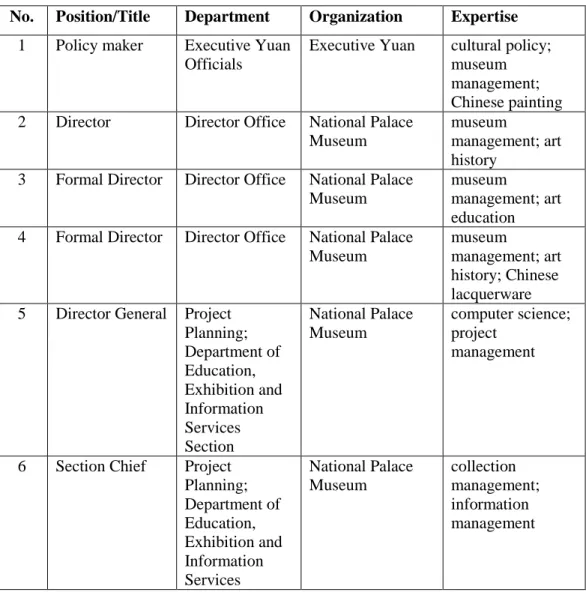
From the early spring 2012 to the winter of 2014, the research team collected extensive data related to the new IT-generated content at the NPM. Data collection included both document review/examination/categorization and semi-structured interviews with various professionals both in and outside the NPM, including experts in all of the subjects related to this field. The detailed information about the interviewees is provided in Table 1. Together, these data sources enabled us to triangulate our understanding of the knowledge creation processes/modes and equally importantly how these corresponding activities/steps have been implemented in the museum sector.
Table 1: List and Expertise Area of Interviewees
No. Position/Title Department Organization Expertise 1 Policy maker Executive Yuan
Officials
Executive Yuan cultural policy; museum management; Chinese painting 2 Director Director Office National Palace
Museum
museum
management; art history
3 Formal Director Director Office National Palace Museum
museum
management; art education 4 Formal Director Director Office National Palace
Museum
museum
management; art history; Chinese lacquerware 5 Director General Project
Planning; Department of Education, Exhibition and Information Services Section National Palace Museum computer science; project management
6 Section Chief Project Planning; Department of Education, Exhibition and Information Services National Palace Museum collection management; information management
11
7 Assistant Researcher Project Planning; Department of Education, Exhibition and Information Services National Palace Museum information management; digital collection 8 Assistant Researcher Project Planning; Department of Education, Exhibition and Information Services National Palace Museum information system analysis; information behavior 9 Assistant Curator Department of Rare Books and Historical Documents National Palace Museum art history; science history 10 Research Assistant Project Planning; Department of Education, Exhibition and Information Services National Palace Museum information management 11 Expert Former museum staff; Graduate Institute of Museum Studies Tainan National University of the Arts museum management; museum studies 12 Expert Graduate Institute of Museum Studies Tainan National University of the Artsfine arts; museum exhibition 13 Expert Former museum staff computer science; digital collection 14 Expert Former NPM staff museum marketing; museum management 15 Expert Former museum staff; Department of Arts Management and Cultural Policy National Taiwan University of Arts
fine arts; museum management; cultural policy
16 Expert Cultural & Creative
National Taipei University of
arts consumption; creative industries
12
Industries Management Education 17 Expert Former museum staff; Graduate Institute of Museum Studies Fu-Jen Catholic University museum education; museum communications 3.3. InterviewsThe research team conducted 17 interviews with various professionals involved with museum IT-generated content, as shown in Table 1. The interviewees were classified into two categories: professionals working at the NPM and other experts who work with the relevant museum practice. The interviewees at the NPM included current and former NPM directors, and professionals working in the Department of Education, Exhibition and Information Services, and Department of Rare Books and Historical Documents. The range of experts fully reflected the diversity in this subject area, and the sample included policy makers, academics in museum studies, and former NPM employees.
A semi-structured interview approach that used both broad and general questions was adopted. This approach was selected for this research because in this approach the
interview questions are normally specified, but the interviewer is freer to probe beyond the answers in a manner which would appear
prejudicial to aims of standardization and comparability (May, 2001, p. 97).
A semi-structured interview approach helps the researchers to develop relevant questions based on the interviewees’ original answers, and hence is able to get in-depth information and obtain more insights from the interviewees. In this study, the interviews were tailored to the interviewees’ schedule and convenience and thus ranged from single hour-long interviews to two hours of interviews over the period of study. A digital voice recorder was used (with the interviewee’s consent) so that the interview responses could be transcribed word-for-word; these transcripts were used to analyze data and resolve any omissions. Each interview was transcribed in Mandarin Chinese to avoid any confusion or misunderstanding. Given the time limitations, only the essential parts of the interviews were translated into English by a certified Chinese–English translator so that the data could be analyzed without losing integrity or affecting the creditability of the study. In addition, essential manipulation controls such as reviewing the purpose and scope of the
13
interview and the data collection procedures/policies with the interviewees and outlining the processes for information sharing and distribution were implemented to avoid any possible interferences and biases.The data were collected and analyzed with the aim of investigating the distinct features of the operations used to facilitate the production of new IT-generated content. The collected information was further studied to assess the knowledge conversion modes that transformed the knowledge of relics plus IT applications into the knowledge of IT-generated content.
4. Case Study of IT-Generated Content
The NPM frequently produces new IT-generated content, and hence this practice is becoming an essential capability. Therefore, this case study of IT-generated content at the NPM explored the knowledge conversion mode used to transform the knowledge of relics plus IT applications into the knowledge of IT-generated content.
One of the formal Directors of the NPM stated that:
The NPM needs to promote cross-industry alliances to maximize the influence of its relics. This task cannot be accomplished by the NPM experts alone. In contrast, some outside partners, such as movie directors, have the unique storytelling abilities that can quickly capture the attention of audiences. They also have a strong innovation capability and hence can promote the relics better in spotlight.
This statement typifies the characteristics of creative industries (Bilton 2007). Given the aforementioned objective and realization, the NPM has implemented a cross-industry alliance strategy for the development of IT-generated content. Specifically, for each new item of IT-generated content, the NPM organizes a dedicated team that includes project managers, relic experts, and external IT partners. The team acts like a CoP, and can be called a community of apprentices and artificers (CoA&A), as each member acts at different times as both an apprentice and an artificer.
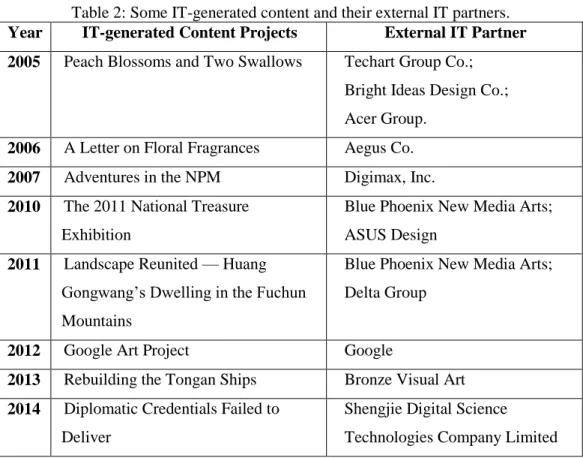
It is also notable that the CoA&A is the result of a cross-industry alliance and, as shown in Table 2, the external IT partner associated with each project varies. As a CoA&A involves various parties from internal and external organizations, it will encounter some challenges such as goal congruence, information sharing, capabilities building, and
14
resource commitment. Moreover, the NPM insists in infusing the cultural, artistic, and historical attributes of the relic into the IT-generated content. For this reason, the resultant content has a high density of relic knowledge and is thus quite different from the content that the IT experts have dealt with before. Therefore, to implement a CoA&A, the NPM developed an effective way to guide the collaborations between (internal) relic experts and (external) IT professionals to ensure the production of knowledge-dense new IT-generated content.Table 2: Some IT-generated content and their external IT partners. Year IT-generated Content Projects External IT Partner 2005 Peach Blossoms and Two Swallows Techart Group Co.;
Bright Ideas Design Co.; Acer Group.
2006 A Letter on Floral Fragrances Aegus Co. 2007 Adventures in the NPM Digimax, Inc. 2010 The 2011 National Treasure
Exhibition
Blue Phoenix New Media Arts; ASUS Design
2011 Landscape Reunited — Huang Gongwang’s Dwelling in the Fuchun Mountains
Blue Phoenix New Media Arts; Delta Group
2012 Google Art Project Google
2013 Rebuilding the Tongan Ships Bronze Visual Art 2014 Diplomatic Credentials Failed to
Deliver
Shengjie Digital Science Technologies Company Limited
5. Activities of the Community of Apprentices and Artificers
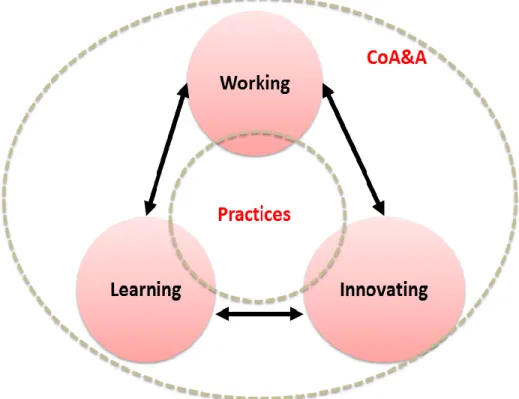
To enable the public to have a wonderful viewing experience when using the IT-enabled content, members of a CoA&A collect relevant information, study abstruse historical texts, conduct joint discussions and brainstorming sessions, and adopt up-to-date IT. As shown in Figure 4, we classified the activities of the CoA&As into the following three categories—working, learning, and innovating. To develop the creativity within each CoA&A, members may need to meet many times; the working, learning, and innovating must be interrelated, compatible, and complementary to generate a distinct conceptual
15
shift. Below, the activities of a CoA&A are illustrated to show how members of a CoA&A learn from working and then innovate while practicing what they have learnt.Figure 4: Activities of a CoA&A. 5.1. Working
To create new IT-generated content, a CoA&A must cope with the inconsistencies between prescriptive documentation and the unpredictable content that a CoA&A is compiling. In one in-depth interview, a member said that work in a CoA&A is similar to sophisticated non-canonical practice rather than to the espoused practice. We classified the work of members of a CoA&A according to Orr’s (1995; 1996) categories of narration, collaboration, and social construction.
Story telling is practiced a lot in most CoA&As. This practice of creating and exchanging stories has two important aspects: (1) telling stories helps to diagnose the state of troublesome content, and (2) the stories may also act as repositories of accumulated wisdom.
The second crucial skill for members of a CoA&A is collaboration, as new content is primarily produced collectively rather than through independent work. When faced with a difficult problem, members of a CoA&A need to work together and discuss/review
16
problems in groups. The accumulated insight is socially constructed and distributed. In this collaboration mode, learning and working are inseparable, as are individual learning and collective learning. For instance, one NPM project manager made the following observations,Take the animation “The Adventure in the NPM” as an example. The NPM has many relic researchers who can provide knowledge regarding relics, and the outside IT experts may possess the required knowledge about animation. During the production of the film, team members learn from each other the expertise and knowledge in discussions,
brainstorming, and finally, they achieved successfully an impressive result.
Throughout a work day, members of a CoA&A meet for coffee/meals and trade stories back and forth during these informal gatherings. Thus, the third important aspect of the practice is actually the social construction of knowledge, which encompasses the two previous aspects addressed earlier. First, members of a CoA&A construct a shared understanding of the bountiful conflicting and confusing information they have encountered. Overtime, the members weave a general consensus about “this content.” Through discussions and brainstorming sessions, they gradually build prototypes of new IT-generated content. Second, by telling a story, an individual member of a CoA&A may contribute to the construction and development of his or her own identity as a member of the CoA&A and reciprocally to the construction and development of the community that we might refer to as a “community of interpretation.” For instance, one IT professional stated that,
We utilized 3D technology to simulate and represent the prototype to tell the other team members about the developed concept of new
IT-generated content.
To create new IT-generated content, the working process runs continuously throughout the many cross-organizational meetings between the relic experts and IT professionals; the progression from incoherence to coherence is thus long but purposeful. Through this process, members of a CoA&A are also in a position to modify imperfect ideas and build/develop more insightful ones. By doing so, they increase their own understanding and add to their community’s collective knowledge.
In essence, to do their job, members of a CoA&A must learn to make better sense of the new content than their employer expects. For the members of a CoA&A, learning-in-working is an occupational necessity.
17
5.2. LearningThe learning that happens within a CoA&A is similar to LPP rather than the learning that happens in classrooms. Members of a CoA&A with a legitimate position on the periphery of a group of competent experts are important contributors. All members of a CoA&A also need legitimate access to even the peripheral communications; that is, they must send email, attend the formal and informal meetings, conduct the telephone conversations, and of course, tell stories.
Members of a CoA&A pick up invaluable “know how” data—not just information but also manners and technique—from being on the periphery of competent experts. For instance, one NPM project manager said,
With the prototype or practicing, all team members gradually
understood, learned, and even modified/adjusted the new IT-generated content during the conversion knowledge process.
According to the LPP model, a CoA&A is a site of not only learning but also innovation. In fact, all of the members of a CoA&A may play a crucial role, as each one can contribute to discussions, brainstorming, and even to the practices of the new content. Such interactive processes not only foster learning, they stimulate the creation of more innovative IT-generated content.
5.3. Innovating
According to one NPM project manager,
When filming a micro movie, we first locate some people with the same or similar views for discussion and communication and then little by little bring in all the required experts to form a group. The relic
researchers have the expertise on relics, while the project personnel may possess the creativity, and the IT experts have unique technical skills and technological considerations. So as there are different opinions or values, conflicts definitely occur. Nevertheless, this process enables each person to gain knowledge from different professional areas, and then stimulate more creative ideas.
Essentially, innovating in a CoA&A is conceived of as sense-making, congruence-seeking, and also content-building activity that is engaged in by all members. Members of a CoA&A simply “ignore precedencies, rules, and traditional expectations” and try to break conventional boundaries. Like story-telling, enacting is a process of interpretive sense-making with controlled changes. At the end of the process, members of a CoA&A
18
have broken the conventional boundaries of their existing knowledge.6. The Knowledge Creation Mode of a CoA&A
The NPM has used its CoA&A operation to integrate numerous novel IT techniques into its new IT-generated content; the aim is to teach the younger generations and even the whole world a better understanding of Chinese culture and its long history. Within the CoA&A operation, the knowledge creation process integrates/synthesizes the knowledge of relics and IT applications and creates the new knowledge presented in the IT-generated content. Each item of IT-generated content needs to integrate the explicit knowledge of the relevant historical relic, the explicit knowledge of the IT application being used, and the purpose of this content. If the NPM had the capacity to transform the knowledge of relics plus IT applications into the knowledge of IT-generated content, then the assistance of an external IT partner would not be needed. However, as discussed earlier, the NPM has insufficient expertise in IT applications, thus it needs cross-industry alliances. The development of IT-generated content therefore leads to new knowledge that is heterogeneous to the knowledge owned by the NPM and its IT partners. The process within which the new heterogeneous knowledge is created merits further investigation.
An NPM project manager stressed that
Before planning for the new IT-generated content, information, relevant literature/studies, and video introductions about up-to-date IT are collected; the initial ideas will be shared with the outside IT partners to see what and whether the potential IT-generated content can be realized. The outside IT partners can also come to us with a face-to-face
presentation of their own ideas to offer some other promising opportunities.
For IT professionals, it is difficult to produce the desired content without the explanations or descriptions provided by the relic experts; it is also true that the relic experts can encounter a similar problem. According to one NPM relic researcher,
For these experts within the NPM, the values and knowledge each person possessed may vary. For example, the relic researchers are the experts about the relics, but they may have limited knowledge of or know nothing about IT. So, for the team work, it is important for us to learn how to respect the expertise of others and thus understand in-depth and take advantage of their opinions and knowledge.
19
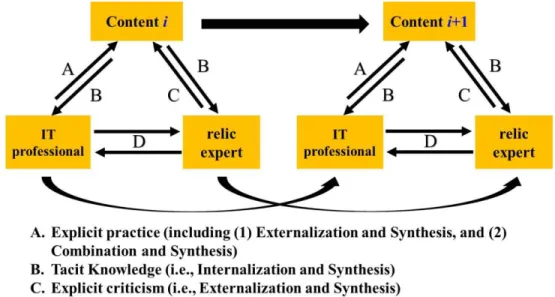
relics to the IT professionals through the formal or informal meetings, verbal conversations, and/or the sharing of textual descriptions.Nevertheless, having people from different fields and organizations work together inevitably leads to conflicts, disagreements, and negotiations. Through the social interactive process shown in Figure 5, a group can gradually increase their total understanding and will eventually form a body of collective knowledge about the new content. To this end, members of a CoA&A are in a position to modify previous content and build add new insightful content. For instance, one of the main characters in “The Adventure in the NPM,” a 3D animation film, is the personification of Ting Ware White Ceramic Pillow in the Shape of a Child. During this film production, the IT professionals used their imaginations and relevant IT techniques to create a character that other members of the CoA&A could review and provide feedback on. That is, explicit knowledge can only exist in the IT-generated content after the content is actually formalized
Figure 5. The activities within the CoA&A and their knowledge conversion process. Content i denotes the ith version of content.
The IT professionals use IT to mimic the appearance of relics, while the relic experts use stories to explain/document the true meaning of the relics to the IT professionals. These stories contain information about the appearance and importance of the relics, and give the IT professionals an in-depth understanding that can become part of the content. For
20
instance, an IT professional indicated,Based on the story-telling process and the relevant materials provided by the relic experts, a prototype of the IT-generated content is generated with the employment of appropriate IT.
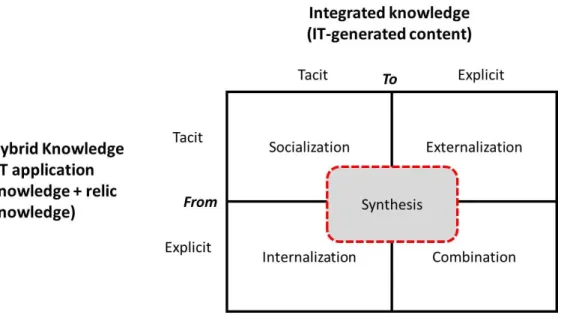
The process of creating a version of new IT-generated content can be referred to as a combination and synthesis process of knowledge conversion; the explicit hybrid knowledge of the IT and relic professionals is transformed into explicit integrated knowledge, as shown in the lower right corner of Figure 6. Note that, in some cases, it may be impossible for IT professionals to duplicate the external appearance or texture of a relic in the IT-generated content.
Figure 6. The knowledge creation mode for the IT-generated content.
After looking at demo videos and having face-to-face meetings with the IT professionals, the relic experts gain a better understanding of the effect of specific IT applications and can then communicate a clearer idea of the desired IT-generated content. During this process, the relic knowledge is released and gradually absorbed by the IT professionals, and is eventually transformed into their tacit knowledge of the IT-generated content. Meanwhile, the IT application knowledge is released and gradually absorbed by the relic experts, and transforms into their tacit knowledge of the IT-generated content. For instance, an NPM relic expert stated that,
It is important that the IT-generated content uses the appropriate IT. All of the team members continuously communicate, exchange, and interact; they discuss how the historical knowledge, IT, and relics can be better presented.
21
We refer to this process as socialization and synthesis; it is a form of knowledge conversion from the tacit knowledge of the IT application plus the relic to the tacit knowledge of the IT-generated content, as shown in the upper left corner of Figure 6.The relic experts may criticize the IT-generated content at hand. Then, with the formal and informal criticisms of present content from the relic experts, IT professionals modify the prototype to create new IT-generated content. During this process, the IT professionals absorb additional knowledge about the relic and the IT application and transform them into the explicit knowledge embedded in the IT-generated content. As one IT professional said,
Within the team work, not only the relic experts, but all of the members can offer suggestions and provide professional comments associated with the revised content. Through the communication process, we can create and modify the prototype of the IT-generated content accordingly.
This is an example of the externalization and synthesis of knowledge conversion; knowledge is converted from tacit hybrid knowledge to explicit integrated knowledge, as shown in the upper right corner of Figure 6.
A common method to convey tacit knowledge is metaphors. Metaphors use imagination or cultural knowledge to explain results with the aid of symbols or objects. For instance, an NPM relic expert said that
The connotation of relics is difficult for the IT professional to understand. We will collect relevant materials to help convey ideas to the IT
professionals, which can be used to facilitate the production of the IT-generated content.
The relic experts may use historical relics, symbols, or other objects to interpret the meaning of relics from their own perspectives. Thus, their relic knowledge is released and gradually absorbed by the IT professionals, and becomes their tacit knowledge. Meanwhile, the IT professionals may demonstrate their work to show the relic experts the specific effects that a particular IT application can provide. The IT application knowledge is absorbed by the relic experts and becomes their tacit knowledge; this is an example of the internalization and synthesis of knowledge conversion/transformation; knowledge is transformed from explicit hybrid knowledge to the tacit integrated knowledge of the IT-generated content, as shown in the lower left corner of Figure 6.
22
7. Conclusions7.1. Summary
In summary, this research uses a case study of IT-generated content for the NPM to identify the knowledge creation modes used to generate new synthesized knowledge. The NPM produces new IT-generated content to accomplish its desired objectives, including digital learning, promotional marketing, cultural product creation, and an interesting art exhibition via new media. Specifically, each new piece of IT-generated content needs to integrate the knowledge of the corresponding historical relics, the relevant IT applications, and the specific purposes of the new content. However, the NPM is a traditional type of knowledge organization with limited expertise in up-to-date IT. Consequently, to create new IT-generated content, the NPM has adopted a cross-industry alliance strategy based on CoA&A groups.
Through interviews and by reviewing relevant documents, this study has identified the following characteristics of the working, learning, and innovating activities of a CoA&A, all of which are interrelated, compatible, and also potentially complementary forces for enabling a distinct conceptual shift. The work of a CoA&A is like sophisticated non-canonical practice; learning within a CoA&A is closer to the legitimation, peripherality, and participation model than to the learning that happens in classrooms. Innovation in a CoA&A is conceived of as a series of sense-making, congruence-seeking, and content-building activities engaged in by all members. Such CoA&A mechanisms create a long but purposeful and smooth progression from incoherent knowledge to coherent knowledge.
This research contributes to our understanding of knowledge creation modes. When a knowledge creation process involves two distinct parties, there are two kinds of knowledge acquisition: (1) the relic experts in the NPM acquire the knowledge of the new IT-generated content and (2) the IT professionals from the external IT partners acquire the knowledge of the new IT-generated content. Through the social interactive process shown in Figure 5, both relic experts and IT professionals gradually enhance their own understanding and acquire the knowledge (both tacit and explicit) needed to produce the new content. Moreover, as shown in Figure 6, this study identifies a “synthesis” mechanism that involves in each SECI mode. Synthesis is a combination of two or more
23
entities that together form something new; alternately, it may mean the creation of something by artificial means.7.2. Lessons Learned and Implications According to one NPM relic expert,
The greatest difference may be that we as relic experts must participate actively in the team to manage all the relic-related work. That means not only learning about the up-to-date IT, but also taking the knowledge of how to apply it to new IT-generated contents into consideration.
Thus, the joint discussions and brainstorming sessions are needed to ensure that up-to-date IT is adopted in a way that develops the new narrative IT-generated content appropriately. If the relic experts merely contribute their relic knowledge and do not participate in the development of the IT-generated content, they obtain a good sense of how to use up-to-date IT to form new content, but they do not acquire any explicit knowledge of how to use the IT. In other words, the relic experts do not have the ability to actually create the relevant content by themselves and the NPM needs to figure out a way to preserve the explicit knowledge of IT-generated content. The IT professionals are in a similar situation; if they merely contribute their IT application expertise and do not acquire the explicit rich relic knowledge, they cannot actually create the relevant content by themselves in the future.
There are several existing challenges to this process: (1) the development and implementation of a good cross-industry alliance strategy, (2) the availability and participation of trustworthy partners, and (3) the complete and close monitoring of contract governance.
This study has implications for the managers of traditional knowledge organization such as the NPM, which do not have expertise in applying up-to-date IT to forming desirable new content. To form the new synthesized knowledge needed for IT-generated content, a manager needs to have some in-depth understanding of how a CoA&A operates. In addition, the content-rights agreements and creative-rights agreements must be carefully developed and examined. An organization’s managers must also develop an effective business model (e.g., knowledge sharing) to ensure the successful implementation/adoption of the new process. The experience of the CoA&A at the NPM
24
can be used to provide other traditional organizations with lessons on the possible applications of sophisticated technologies.References
Argote, L., McEvily, B., & Reagans, R. (2003). Managing knowledge in organizations: An integrative framework and review of emerging themes. Management Science, 49(4), 571-582.
Bilton, C. (2007). Management and Creativity: From Creative Industries to Creative Management. Oxford: Blackwell.
Brown, J. S., & Duguid, P. (1991). Organizational learning and communities-of-practice: Toward a unified view of working, learning, and innovation. Organization Science, 2(1), 40-57.
Bryman, A. (2004). Social Research Methods (2nd ed.). Oxford: Oxford University Press. Carlile, P. R., & Rebentisch, E. S. (2003). Into the black box: The knowledge
transformation cycle. Management Science, 49(9), 1180-1195.
Carrillo, J. E., & Gaimon, C. (2000). Improving manufacturing performance through process change and knowledge creation. Management Science, 46(2), 265-288. Chang, Y. (2011). The Constitution and Understanding of Marketing Functions in the
Museum Sector. (Unpublished Ph.D Thesis). King’s College London, University of London, London.
Choo, A. S., Linderman, K. W., & Schroeder, R. G. (2007). Method and psychological effects on learning behaviors and knowledge creation in quality improvement projects. Management Science, 53(3), 437-450.
Cunliffe, D., Kritou, E., & Tudhope, D. (2001). Usability evaluation for museum web sites. Museum Management and Curatorship, 19(3), 229-252.
Davenport, T. H., De Long, D. W., & Beers, M. C. (1998). Successful knowledge management projects. Sloan Management Review, 39(2), 43-57.
Goulding, C. (1999). Contemporary museum culture and consumer behaviour. Journal of Marketing Management, 15(7), 647-671.
Hildreth, P. M., & Kimble, C. (2004). Knowledge Networks: Innovation Through Communities of Practice. Hershey, PA, USA: IGI Global.
Hooper-Greenhill, E. (2007). Museums and Education: Purpose, Pedagogy, Performance. New York: Routledge.
25
Hume, M. (2011). How do we keep them coming?: Examining museum experiencesusing a services marketing paradigm. Journal of Nonprofit & Public Sector Marketing, 23(1), 71-94.
Hume, M., & Mills, M. (2011). Building the sustainable iMuseum: Is the virtual museum leaving our museums virtually empty? International Journal of Nonprofit and Voluntary Sector Marketing, 16(3), 275-289.
International Council of Museums (ICOM), (2007). Museum Definition. Retrieved 11/14/ 2014, from http://icom.museum/the-vision/museum-definition/.
Kotler, N., Philip Kotler & Wendy Kotler. (2008). Museum Marketing and Strategy: Designing Missions, Building Audiences, Generating Revenue and Resources (2nd ed.). San Francisco: Jossey-Bass/John Wiley & Sons.
Kotler, N. & Kotler, P. (2000). Can museums be all things to all people?: Missions, goals, and marketing's role. Museum Management and Curatorship, 18(3), 271-287. Lave, J., & Wenger, E. (1991). Situated Learning: Legitimate Peripheral Participation.
Cambridge: Cambridge University Press.
Lee, C. S., & Kelkar, R. S. (2013). ICT and knowledge management: perspectives from the SECI model. Electronic Library, 31(2), 226-243.
Lewis, G. (1992). Museums in Britain: A historical survey. In J. M. A. Thompson & D. A. Bassett (Eds.), The Manual of Curatorship (2nd ed., pp. 22). Oxford: Butterworth-Heinemann.
Lin, A. C., Gregor, S., & Huang, J. C. (2008). The hedonic experience of enjoyment and its relationship to informal learning: A study of museum websites. Paper presented at the International Conference on Infomration Systems (ICIS).
Lopez-Nicolas, C., & Meroño-Cerdán, Á . (2009). The impact of organizational culture on the use of ICT for knowledge management. Electronic Markets, 19(4), 211-219. Marshall, C. & Rossman, G. B. (2006). Designing qualitative research (4th ed.).
Thousand Oaks: Sage.
Marty, P. F. (2007). Museum websites and museum visitors: Before and after the museum visit. Museum Management and Curatorship, 22(4), 337-360. Mason, D. D. M. & McCarthy, C. (2006). 'The feeling of exclusion'" Young peoples'
perceptions of art galleries. Museum Management and Curatorship, 21(1), 20-31. Maxwell, J. A. (2005). Qualitative Research Design: An Interactive Approach: An
Interactive Approach (2nd ed.). Thousand Oak: Sage.
26
McLean, F. (1994). Services marketing: The case of museums. Service Industries Journal,14(2), 190-203.
Newspaper, T. A. (2014). Top 100 Art Museum Attendance. The Art Newspaper. Ng, J. J. M., & Li, K. X. (2003). Implications of ICT for knowledge management in
globalization. Information Management and Computer Security, 11(4), 167-174. Nonaka, I. (1994). A Dynamic Theory of Organizational Knowledge Creation.
Organization science, 5(1), 14-37.
Orna, E., & Pettitt, C. (2010). What is Information in the Museum Context? In R. Parry (Ed.), Museums In a Digital Age (pp. 28-38). London: Routledge.
Orr, J. E. (1995). Ethnography and Organizational Learning: In Pursuit of Learning at Work. In C. Zucchermaglio, S. Bagnara, & S. Stucky (Eds.), Organizational Learning and Technological Change (Vol. 141, pp. 47-60). Berlin Heidelberg: Springer.
Orr, J. E. (1996). Talking About Machines: An Ethnography of a Modern Job. Ithaca: Cornell University Press.
Silverman, D. (2006). Interpreting Qualitative Data: Methods for Analyzing Talk, Text and Interaction (3rd ed.). London: Sage.
Soo, C. W., Midgley, D., & Devinney, T. M. (2002). The Process of Knowledge Creation in Organizations. Available at SSRN: http://ssrn.com/abstract=376080.
Soren, B. J., & Canadian Heritage Information, N. (2005). Best practices in creating quality online experiences for museum users. Museum Management and Curatorship, 20(2), 131-148.
Swan, J., & Newell, S. (2000). Linking knowledge management and innovation. Paper presented at the European Conference on Information Systems (ECIS). Tsaih, R.-H., Lin, Q.-P. J., & Chang, Y. (2014). National Palace Museum and service
innovations. Emerald Emerging Markets Case Studies, 4(7), 1-24.
von Hippel, E. (1998). Economics of product development by users: The impact of “sticky” local information. Management Science, 44(5), 629-644.
1
科技部補助專題研究計畫出席國際學術會議心得報告
日期:2014 年 9 月 15 日一、參加會議經過
我於9月8日下午抵達名古屋,並於下午五點左右抵達會議會場報到。於9月9日上午
八點半,我們發表論文的場次被安排在 ISS Session A1;此Session共有3篇文章發表,
全員到齊。論文發表後,我們也一一回應聽眾之詢問。除了自己發表論文,我也在其他
的時段聽了數個論文發表以及認識一些新朋友。於9月10日上午,我也聽了數個論文發
表。我於9月10日下午從名古屋返國,於9月10日傍夜抵達台北。
二、與會心得
此International Conference on Information and Social Science是第二次舉辦
之會議,預期每年舉辦一次。大多數之與會學者主要來自亞洲各國;發表之論文水準普
計畫編號
101-2420-H-004-005-MY3
計畫名稱
故宮博物院的科技化服務創新─總計畫暨子計畫一:故宮博物院
的科技化服務之設計議題
出國人員姓名
蔡瑞煌
服務機構及
職稱
國立政治大學資訊管理學系
特聘教授
會議時間
2014 年 9 月 8 日至
2014 年 9 月 10 日
會議地點
日本名古屋
會議名稱
(中文)
(英文)
2014 International Conference on Information and
Social Science (ISS 2014)
發表題目
(中文)
(英文) The Adapted SECI model to innovative IT applications
in B&M organization
2