•‧
國
立立
政 治 大
㈻㊫學
•‧
N
a
tio
na
l C
h engchi U
ni
ve
rs
it
y
國立政治大學語言學研究所
博士學位論文
國語語者之英語詞彙重音習得:
錯誤驅動制約條件降級演算系統之擴充理論
MANDARIN SPEAKERS’ ACQUISITION OF ENGLISH
WORD STRESS:AN EXTENDED THEORY OF
ERROR-DRIVEN CONSTRAINT DEMOTION
ALGORITHM
指導教授:蕭
宇 超 博士
研究生:宋
凱 琳 撰
•‧
國
立立
政 治 大
㈻㊫學
•‧
N
a
tio
na
l C
h engchi U
ni
ve
rs
it
y
•‧
國
立立
政 治 大
㈻㊫學
•‧
N
a
tio
na
l C
h engchi U
ni
ve
rs
it
y
•‧
國
立立
政 治 大
㈻㊫學
•‧
N
a
tio
na
l C
h engchi U
ni
ve
rs
it
y
謝辭
這篇論文能夠完成,要感謝生命中的許多貴人。首先要特別感謝指導教授 蕭宇超博士八年多來的鼓勵與教誨,讓我在研究上能自我突破; 還要感謝口試 委員林蕙珊教授、吳瑾瑋教授、歐淑珍教授、劉秀雪教授細心審閱我的論文, 給予寶貴的意見與指導,讓我注意到研究上的盲點與瑕疵。感謝家人朋友們一 路上的支持與鼓勵, 讓我在每一次想放棄的時刻能再度勇敢堅強。最後感謝索 玫、小貝仔、天佑的陪伴,已經忘了這一路的辛酸。•‧
國
立立
政 治 大
㈻㊫學
•‧
N
a
tio
na
l C
h engchi U
ni
ve
rs
it
y
中文摘要
本文旨在研究國語語者在英語單純名詞(simplex nouns), 合成詞(complex words)
與複合名詞(compound nouns)的重音習得現象,根據錯誤驅動制約條件降級演算
系統(Error-Driven Constraint Demotion Algorithm),本文提出其擴充理論用於解釋
第二語言重音習得的動態演變過程。中介語語料設計主要為25 種音節形式組合 的雙音節單純名詞,三種後綴形式的合成詞,以及25 種音節形式的雙音節複合 名詞,受試者為20 位英文程度分別為低程度及高程度的英語學習者。研究結果 顯示,第二語言的重音習得主要分為兩階段,第一階段為中介語制約條件升級, 此時,在第一語及目標語排序較低或靜態的制約受到升級,稱為所謂中介語制約 (interlanguage constraint), 由於中介語制約提升至第一語及目標語的制約排序之 上,使得正確的目標語形式無法產生。在第二階段,目標語形式所違反的制約會 依序降級,直到目標語能成功產出為止。在單純名詞部份,低程度學習者受到中 介語制約ALLFTR, XV́O 的影響,傾向將重音指派在倒數第二音節及詞尾的 XVO 音節,高程度學習者的單純名詞語法雖與目標語有所差距,但已能擺脫中介語制 約ALLFTR, XV́O 的影響,將重音指派在正確的音節。在合成詞部分,中介語制 約ALLFTR, NON-FIN(σ) 使得低程度學習者傾向將重音指派在倒數第二音節,但 高程度學習者已建立類似目標語的合成詞並存音韻語法(Cophonology Grammar)。 複合名詞部分,受到中介語制約ALIGN (WD, FT) 的影響,低程度與高程度的學 習者都傾向將重音指派至每一個複合詞單字,造成字字重音的現象。本文所提出 的錯誤驅動制約條件降級演算系統之擴充理論(Extended Error-Driven Constraint Demotion Algorithm)經過證明可用於解釋第二語言習得的重音指派現象。
關鍵詞:錯誤驅動制約條件降級演算系統、第二語言習得、重音指派、中介 語、優選理論、並存音韻理論
•‧
國
立立
政 治 大
㈻㊫學
•‧
N
a
tio
na
l C
h engchi U
ni
ve
rs
it
y
Abstract
This study is aimed to investigate Mandarin-speaking English leaners’ stress assignment of simplex nouns, complex words, and compound nouns. Based on Error-Driven Constraint Demotion Algorithm, this study proposes its extended theory to account for the dynamic process of second language (L2) acquisition of stress assignment. The tokens were simplex nouns composed of 25 syllable types, compound words composed of three types of suffixes, and disyllabic compound nouns composed of 25 syllable types. The subjects were 20 high and low achievers of English respectively. The result shows that L2 stress assignment acquisition is divided into two stages. The first stage features interlanguage constraint promotion; lower ranked constraints in first language (L1) or L2 are promoted to the undominated position, which prevents the target form from being selected. In stage two, the target-disfavoring constraints undergo gradual and sequential error-driven demotion until the target form successfully surfaces. In terms of simplex nouns, low achievers were influenced by ALLFTR and XV́O, and tended to place the main stress on the
penultimate syllable and ultimate XVO. High achievers were able to stress simplex nouns accurately, which implies simplex cophonology has been established at high-achieving stage. As far as compound words are concerned, undominated interlanguage constraints, ALLFTR and NON-FIN(σ), mislead low achievers to place
stress on the penultimate syllable, while high achievers had no difficulty stressing complex words, suggesting that high achievers were equipped with the complex cophonology. As for compound nouns, under the influence of interlanguage constraint, ALIGN (WD, FT), low achievers tended to stress every compound element. The
extended Error-Driven Constraint Demotion Algorithm proposed in this study is proved able to account for L2 acquisition of stress assignment.
Keywords: Error-Driven Constraint Demotion Algorithm, second language
•‧
國
立立
政 治 大
㈻㊫學
•‧
N
a
tio
na
l C
h engchi U
ni
ve
rs
it
y
Table of Contents
Chinese Abstract ……… I English Abstract ……… II Table of Contents……….………. III List of Tables………. VI List of Figures……… VII CHAPTER I. INTRODUCTIONA. Why an L2 Learning Algorithm Necessary?... 1
B. Contribution and Outline………... 3
CHAPTER II. LITERATURE REVIEW AND BASIC RATIONALE OF THE PROPOSED ALGORITHM……… 4
A. Phonotactic Basics………... 4
1. Stress features and stress assignment………... 4
2. Degrees of stress………... 5
3. Placement of primary stress………. 6
4. Representation of stress……… 6
a. The grid………... 6
b. Feet………. 7
5. Stress related Constraints and Theories……….………... 8
a. Main constraint types in Optimality Theory……….. 8
b. Markedness and faithfulness constraints………... 8
c. Alignment Theory……… 10
d. Cophonology Theory………10
B. OT-Based Algorithms in Learning the Phonology of a Language……….. 11
1. Constraint Demotion……….. 11
2. Error-driven Constraint Demotion………. 13
3. Biased Constraint Demotion……….. 15
4. Gradual Learning Algorithm……….. 15
5. Error-driven Ranking Algorithms……….. 17
C. Theoretical Proposal of the Extended EDCD Algorithm……… 18
1. The initial state………... 18
2. Stage one……… 19
3. Stage two……….... 20
4. Operation of the extended EDCD……….. 22
5. The irreplaceability of extended EDCD algorithm………… 28
CHAPTER III. STRESS ASSIGNMENT OF ENGLISH SIMPLEX NOUNS…….31
A. Data Description………... 31
1. Participants………. 32
2. Test tokens………. 32
3. Data collection………34
•‧
國
立立
政 治 大
㈻㊫學
•‧
N
a
tio
na
l C
h engchi U
ni
ve
rs
it
y
1. Disyllabic simplex nouns………... 35
a. XVO-ending nouns……….. 35
b. XVN-ending nouns……….. 36
c. XVL-ending nouns……….. 37
d. XVV-ending nouns……….. 38
e. XV-ending nouns………. 39
2. Trisyllabic simplex nouns………...40
a. XVO-ending trisyllabic nouns…………... 40
b. XVN/L-ending trisyllabic nouns……….. 41
c. XV-ending trisyllabic nouns……… 41
C. Extended EDCD Analysis………... 42
1. XV-ending nouns……….. 48
2. XVN-ending nouns……… 57
3. XVL-ending nouns………. 60
4. XVO-ending nouns……… 64
5. XVO-ending trisyllabic simplex nouns……….. 68
D. Cophonology of Simplex Nouns ………. 69
E. Summary ………. 70
CHAPTER IV. STRESS ASSIGNMENT OF ENGLISH COMPLEX WORDS….. 71
A. Data Description………... 71 1. Test tokens………..72 2. Results……… 72 a. Stress-neutral suffixation…...……… 72 b. Stress-shifting suffixation…..………... 73 c. Stress-attracting suffixation…..……… 74
B. Extended EDCD Analysis……… 75
1. Stress-neutral suffixation………76
2. Stress-attracting suffixation………. .. 89
3. Stress-shifting suffixation……… .. 94
C. Cophonology of Complex Words ………... 101
D. Summary……….. 102
CHAPTER V. STRESS ASSIGNMENT OF ENGLISH COMPLEX WORDS…... 103
A. Data Description……….. .. 103 1. Participants………... . 103 2. Test tokens………... . 103 3. Results………... 105 a. ŃN………... 105 b. [ŃN]N……… . 108 c. N[ŃN]……….. 108 d. ŃŃ……….. . 109
B. Extended EDCD Analysis………... 110
1. ŃN………. 110
2. N[ŃN]……….. . 115
•‧
國
立立
政 治 大
㈻㊫學
•‧
N
a
tio
na
l C
h engchi U
ni
ve
rs
it
y
4. ŃŃ……….. 120C. Cophonology of Compound Nouns……….……… 122
D. Summary……….. 123
CHAPTER VI. THEORETICAL IMPLICATIONS………. 124
CHAPTER VII. CONCLUSION………... 133
•‧
國
立立
政 治 大
㈻㊫學
•‧
N
a
tio
na
l C
h engchi U
ni
ve
rs
it
y
List of Tables
Table 1. English and Chinese Stress……….8
Table 2. Participants’ Brief Biological and English Background ………... ..32
Table 3. Disyllabic Simplex Test Tokens………. ..33
Table 4. Trisyllabic Simplex Test Tokens………. ..33
Table 5. Sample of Data Calculation………...34
Table 6. L2 Learners’ Stress Assignment of XVO-Ending Simplex Nouns……. ..36
Table 7. L2 Learners’ Stress Assignment of XVN-Ending Simplex Nouns……. ..37
Table 8. L2 Learners’ Performance of XVL-Ending Simplex Nouns……….38
Table 9. L2 Learners’ Performance of XVV-Ending Simplex Nouns…………....38
Table 10. L2 Learners’ performance of XV-ending Simplex Nouns……….. ..39
Table 11 L2 Learners’ Stress Assignment of Trisyllabic XVO-Ending Nouns… ..40
Table 12 L2 Learners’ Stress Assignment of Non-XVO-Ending Nouns………... ..41
Table 13 L2 Learners’ Stress Assignment of XV(V)-Ending Nouns…………...42
Table 14. Trisyllabic Complex Word Tokens ……… ..72
Table 15. L2 Learners’ Stress Assignment on Nouns Attached to Stress-Neutral Suffixes……….... 73
Table 16. L2 Learners’ Stress Assignment on Nouns Attached to Monosyllabic Stress-Shifting suffixes ………...73
Table 17. L2 Learners’ Stress Assignment on Nouns Attached to Disyllabic Stress-Shifting suffixes ……… 74
Table 18. L2 Learners’ Stress Assignment on Nouns Attached to Stress-Attracting Suffixes……… 75
Table 19 English Compound Elements and Examples………. 103
Table 20 Two Word Compound Noun Tokens……….. 104
Table 21 Differences Between Single-Headed and Double Headed Stress…….. 106
Table 22 L2 Learners’ Stress Assignment in NN Compound Nouns……… 107
Table 23 L2 Learners’ Stress Assignment on [NN]N Compound Nouns………. 108
Table 24 L2 Learners’ Stress assignment on N[NN] compound nouns………… 109
•‧
國
立立
政 治 大
㈻㊫學
•‧
N
a
tio
na
l C
h engchi U
ni
ve
rs
it
y
List of Figures
Figure 1. According to the selection points in the strictness bands, Constraint 1
dominates constraint 2……… 15
Figure 2. According to the selection points in the strictness bands, Constraint 2 dominates constraint 1………... 16
Figure 3. The bidirectional model of extended EDCD……….. 22
Figure 4. Constraint domination in stage one………. 124
Figure 5. Early stage two: error-driven constraint demotion……….. 125
Figure 6. Mid stage two: error-driven constraint demotion……… 125
Figure 7. Late stage two: error-driven constraint demotion………... 125
Figure 8. The Extended EDCD Model………... 131
•‧
國
立立
政 治 大
㈻㊫學
•‧
N
a
tio
na
l C
h engchi U
ni
ve
rs
it
y
CHAPTER I
INTRODUCTION
For second language (L2) learners, L2 acquisition is difficult in several aspects. In terms of segments, L2 learners have to adapt to the sounds in L2 and establish a new sound inventory. In the prosody level, L2 learners need to grasp the phonetic cues of several prosodic factors to reach a near-native proficiency. Unlike first language (L1) acquisition, L2 acquisition takes a long and laborious process and foreign accent is fairly unlikely to be removed.
Based on elicitation data of Mandarin-accented English, the primary objective of the present study is to provide a comprehensive description and explanation for stress adaptation at two main stages. More importantly, an L2 learning algorithm will be proposed to account for the dynamic changes of interlanguage grammar and the interactions between Universal Grammar (UG) and L1 / L2 grammars. Below, I will first discuss the arguments in favor of an L2 learning algorithm. Finally, I will outline the contents of the study.
Why an L2 Learning Algorithm Necessary?
Former research has contributed a lot in L2 phonology. To provide a descriptive account of L2 phonology, some researchers focused on the adaptation of segments in L2 acquisition (Archibald & Scholten, 2005; James, 1988); some scholars were devoted to studies on prosodic features (Aoyama & Guion, 2007; Archibald, 1995, 1998a, 1998b; Beckman, 1986; Broselow & Park, 1995; Broselow, 1988; Flege & Bohn, 1989; Eckman, 1991; Guion & Pederson, 2007; Sereno &Wang, 2007). Theoretically, some scholars investigated the transfer of first language (L1) on L2 acquisition (Archibald, 1995, 1998a, 1998b; Flege & Bohn, 1989). Major (2008) concentrated on the influence of L1 on L2 learners’ production of sounds. Lado (1957) proposed Contrastive Analysis Hypothesis (CAH) and suggested that the more similar aspect L2 has with L1, the more easily the aspect will be acquired. Eckman’s (1997) Markedness Differential Hypothesis predicted that marked structures are acquired with more difficulty. Still some researchers turned their interest to the role of UG in L2 acquisition (Kager, 1999; Rice, 2007). They attributed the errors made by L2 learners to universal principles, claiming that unmarked structures are more easily perceived and are thus more learnable. With the establishment of Optimality Theory
•‧
國
立立
政 治 大
㈻㊫學
•‧
N
a
tio
na
l C
h engchi U
ni
ve
rs
it
y
(OT; Prince and Smolensky, 1993/2004), markedness has been furthered encoded by means of universal constraints. Under the framework of OT, marked or unmarked structures of the interlanguage are the results of a set of ranked constraints. Following OT, several researchers established different models or algorithms to depict L2 phonology with a dynamic view (Boersma & Hayes, 2001; Magri, 2012; Prince & Tesar, 1999; Tesar, 1995; Tesar & Smolensky, 1998, 2000)
Enlightened by the previous research on L1phonology algorithm, Error-driven Constraint Demotion (Tesar, 1995), this study aims to provide an L2 learning algorithm to account for the dynamic process of interlanguage grammar formation. Several theoretical issues are of special interest. First, it is well-known that UG and L1/L2 grammars are all determinant in L2 acquisition. However, how these three grammars interact and how pivotal they are at different stages of learning is not yet well defined. Particularly, the influence of UG and L1 on early L2 acquisition is debated. Whether early L2 acquisition is more controlled by UG or L1 grammar will be answered in the study. Second, constraint movements in L1/L2 acquisition phonology are controversial. In terms of moving direction, some scholars argued for demotion (Tesar, 1995; Tesar & Smolensky, 1998/2000), while some researchers claimed that both constraint promotion and demotion are performed in learning (Boersma & Hayes, 2001). As for constraint mobility, Tesar & Smolensky (1995, 1998/2000) argued that constraint demotion relies on a reference point and constraints ranked higher than the reference point can be demoted at a time, which suggests that higher ranked constraints are more mobile. Boersma & Hayes (2001) held that constraint free ranking is the principle in language learning, which allows interlanguage grammar formation more plasticity. In the study, the direction of constraint movement and constraint mobility will both be covered and solved in the proposed algorithm. Third, as far as UG is concerned, much evidence has proved that it is an important variable in L2 acquisition. Among the so many constraints in UG, what kind of constraints are more likely to participate in L2 acquisition? How do these constraints move to play a major part in L2 acquisition? These are also some theoretical aspects that this study wishes to explore. Fourth, in terms of the acquisition of English stress grammar, what are the factors causing L2 learners’ errors? Do speakers of quantity-insensitive languages like Chinese count syllable weight? If Yes, do they count syllable weight the same way as English speakers? If not, how do they
•‧
國
立立
政 治 大
㈻㊫學
•‧
N
a
tio
na
l C
h engchi U
ni
ve
rs
it
y
assign stress that is determined by syllable weight. These issues will be discussed in the study as well.
Contribution and Outline
A L2 phonology algorithm is crucial in that not only specific interlanguage phenomena can be provided with reasonable explanations, but the continuously refined interlanguage grammar can be depicted with a dynamic view.
There are seven chapters in this study. Chapter 2 reviews language acquisition algorithms and introduces the rationale of the proposed algorithm. In the main chapters, stress assignment data in Mandarin-accented English will be first described based on elicitation data, followed by an analysis under the proposed algorithm. Chapter 3 examines how English simplex nouns are assigned primary stress. This section will cover such issues as the influence of syllable types on stress assignment and syllable weight counting. The tendencies at lower and higher levels will then be accounted for under the proposed algorithm. Chapter 4 investigates complex word stress assignment according to three suffixes types. The focus of this section is how L2 learners at different levels master stress assignment that is morphophonologically determined and how different subgrammars coexist in the interlanguage grammar. A theoretical analysis under the proposed algorithm will also be provided based on the elicitation data. Chapter 5 targets on the stress assignment in English compound nouns. In this section, most tokens are composed of the same syllable type combinations as simplex noun tokens. The purpose is to investigate whether syllable types affect simplex and compound noun stress assignments to the same extent. Likewise, the proposed algorithm will be applied to account for learners’ forms at different stages and proves its explanatory power. Chapter 6 pinpoints the implications and significances of the study. The full stress grammar of Mandarin-accented English will be summarized. Chapter 7 concludes the whole study.
•‧
國
立立
政 治 大
㈻㊫學
•‧
N
a
tio
na
l C
h engchi U
ni
ve
rs
it
y
CHAPTER II
LITERATURE REVIEW AND THEORETICAL
PROPOSAL OF THE EXTENDED
ERROR-DRIVEN CONSTRAINT DEMOTION
ALGORITHM
The proposed extended Error-Driven Constraint Demotion (hereafter EDCD) algorithm is an Optimality Theory-based scheme for the L2 phonological acquisition of at both segmental and suprasegmental levels. Optimality Theory (Prince & Smolensky, 1993; McCarthy & Prince, 1993; OT henceforth) diverges from generative linguistics in the interpretation of cross-linguistic variation. The Principles and Parameters Theory assumes that all human languages are governed by universal principles and language variations are the results of different parameter settings. OT accepts the concept of Universal Grammar (UG), holding UG a set of universal constraints that are violable. Language-specific differences result from different constraint rankings in different languages. In OT, learnability involves both underlying forms and the overt forms. The learning of underlying forms starts from learners’ perception of overt forms as a string of sounds. Then, through the process of learning, learners have full structural descriptions of the underlying forms, such as /kætz/ in English, and the overt forms, such as [kæts] in English. After robust interpretive parsing, learners’ intermediate grammar is established. The existing grammar is then modified by iterative cycle of learning and interpretive parsing. The cyclic process does not stop until all the outputs are accurately selected by the grammar.
Phonotactic Basics
Stress features and stress assignment
Stress refers to the relative prominence of portions of an utterance (Liberman & Prince, 1977). In principle, a stressed syllable is realized with more air pushed out of the lungs. Therefore, compared with an unstressed syllable, a stressed syllable has greater respiratory energy. With the rise of energy, some prosodic features are salient from a listener’s point of view. First, when more air is pushed out of the lungs, the loudness of the sound is usually increased. Another indication of stress is the rise in
•‧
國
立立
政 治 大
㈻㊫學
•‧
N
a
tio
na
l C
h engchi U
ni
ve
rs
it
y
pitch, mainly because of laryngeal action. Finally, when a syllable is stressed, in some languages, it is detected that the stressed syllable has a longer vowel than that of an unstressed syllable.
The realization of stress vary cross-linguistically. For example, in English, stressed syllables are realized with greater amplitude, longer length. Vowel distinctions in stressed syllables can be better shown. While English is considered to stress a syllable with higher pitch, greater loudness, and longer duration, other languages, such as Spanish, do not reduce vowels in unstressed syllables. So to speak, the vowels are of equal length in both stressed and unstressed syllables. In Chinese, stressed syllables carry more tone distinctions than unstressed syllables. In Creek, stressed syllables are presented with high tones, and in Malayalam, stressed syllables carry low tones.
Ambiguous as the prosodic features of stress may seem, phonologically speaking, it is mostly agreed that prominence (Cruttenden, 2008; Davenport & Hannahs, 2010; Fudge, 1984; Roach, 2000 ; Giegerich, 2004) or salience (Halliday, 1970) is a cover term to represent the prosodic features of a stress syllable. To illustrate the idea of prominence with English word stress, a syllable is said to bear the primary stress when it is perceived to be more prominent than the other syllable(s) within a word. For instance, in a polysyllabic word like “calligraphy,” the second syllable, lli, carries the primary stress, also known as the main stress.
Degrees of stress
In stress languages, every word is required to be attached with a primary stress as a distinctive feature, yet stress placement is not limited to one syllable. Possibly for ease of articulation, to avoid a sequence of unstressed syllable, usually a stress of a relatively lower degree to the main stress is assigned to another syllable.
English serves as a good illustration of stress degrees. In English, there are three levels of stress, namely primary stress, secondary stress, and no stress. Ladefoged (2006) differs the primary stress from secondary stress with tonic accent, indicating that primary stress and secondary are both [+stress], while the former is [+tonic accent] and the latter is [-tonic accent]. When a syllable is unstressed, it is both [-stress] and [-tonic accent]. Like stressed syllables, unstressed syllables may be produced differently from one language to another. In some languages, unstressed syllables have reduced vowels. As a result, syllables are of unequal lengths,
•‧
國
立立
政 治 大
㈻㊫學
•‧
N
a
tio
na
l C
h engchi U
ni
ve
rs
it
y
depending on whether it is stressed or not. In contrast, in other languages, vowels in unstressed syllables are not reduced, which makes every syllable equally long. Cases like this are often found in syllable-timed languages, such as Spanish. However, it is also possible that both reduced and unreduced vowels coexist in one language. English is a notable example. Ladefoged illustrates the difference between an unreduced vowel in the final syllable and a reduced vowels in the final syllable with the examples in (1).
(1) Examples of reduced and unreduced vowels
a. unreduced vowel in the final syllable b. reduced vowel in the final syllable
multiply [ˋmʌltəәplaɪ] multiple [ˋmʌltəәpəәl]
regulate [ˋrɛgjəә͵let] regular [ˋrɛgjəәlɚ]
copulate [ˋkɑpjəә͵let] copula [ˋkɑpjəәləә]
circulate [ˋsɝkjəә͵let] circular [ˋsɝkjəәlɚ]
criticize [ˋkrɪtɪ͵saɪz] critical [ˋkrɪtɪkəәl]
minimize [ˋmɪnəә͵maɪz] minimal [ˋmɪnəәməәl]
Placement of primary stress
In some stress languages, the placement of lexical stress is so regular that the speakers can always predict the location of the main stress correctly even at the first encounter of a word. Czech, for example, has only the first syllable of a word stressed. In Polish, the lexical stress always lies on the penultimate syllable. However, in some languages, lexical stress is not necessarily predictable. Take English for example, although simplex nouns are often stressed word-initially, many exceptions are found to this rule. Moreover, it seems that no generalizations can be laid down for words belonging to other parts of speech. In fact, in a quantity(syllable weight)-sensitive language like English, syllable weight may outweigh a regular stress pattern. In this case, it is the weight-to-stress principle that determine the placement of the main stress rather than the fixed stress patter. By contrast, in quantity-insensitive languages, syllables types do not influence the placement of stress. Whether a syllable has a coda or carries a long vowel has no direct relation with the location of stress.
Representation of stress
The grid. There are two main ways to represent stress: the grid and feet.
•‧
國
立立
政 治 大
㈻㊫學
•‧
N
a
tio
na
l C
h engchi U
ni
ve
rs
it
y
shows greater prominence (Liberman and Prince, 1977; Prince, 1983) (2) Stress Grid line 3 : x line 2 : x x line 1 : x x x line 0 : x x x x x x a pa la chi co la
Feet. Feet are the basic metrical units represented by groups of syllables. In
some languages, feet are disyllabic in a Strong-Weak pattern or vice versa. In terms of poetic meter, feet are identified as trochaic and iambic; the former has a stressed syllable on the left, i.e. (s w) or (x .), while the latter has the stressed syllable on the right, i.e. (w s) or (. x).
Some theories combines the grid with feet (Idsardi, 1992; Hayes, 1995), as presented in (3).
(3) Grid combined with feet
line 3 : x
line 2 : (x x)
line 1 : (x x) (x )
line 0 : (x x) (x x) (x x) a pa la chi co la
Based on the introduction above, stress in English and Chinese can be summarized as in Table 1. First, English is stress-timed, which means that stressed syllables are pronounced with longer duration and secondary stressed syllables are of middle length, while unstressed syllables are the shortest. Chinese is syllable timed, meaning that every syllable in Chinese is pronounced with equal duration. In addition, English lexical stress is partially determined by syllable weight; heavy syllables are more likely to be assigned the primary stress. By contrast, Duanmu (2000) suggested that Chinese stress falls either on the left edge of a lexical word or on the final position of a phrase or a sentence, where a pause occurs. Besides, the realization of stress is different in English and Chinese. English stress can be distinguished by loudness, pitch, duration, and quality (Dalton & Seidlhofer 1994:34). In Chinese, stress is accompanied by tones with a larger swing in fundamental frequency
•‧
國
立立
政 治 大
㈻㊫學
•‧
N
a
tio
na
l C
h engchi U
ni
ve
rs
it
y
(Kochanski, Shih, & Jing, 2003). In English, Ladefoged (2006) stated that primary stress and secondary stress differ in the value of [tonic accent]. In Chinese, stress is divided into normal stress, weak stress, and contrastive stress (Chao, 1968). In English, vowel reduction often accompanies an unstressed syllables, while in Chinese, timing system is based on syllables rather than stress, and thus vowel reduction is not found.
Table 1
English and Chinese Stress
English Chinese
timing system stress-timing syllable-timing
quantity sensitivity quantity-sensitive quantity-insensitive
lexical stress patterns
less fixed left edge of a lexicon or
pause
stress features loudness / duration / pitch loudness / pitch
stress degree(s) 3
(primary/secondary/unstressed) 3
(normal/weak/contrastive)
vowel reduction Yes No
Stress-related Constraints and Theories
Main constraint types in Optimality Theory. The proposed algorithm is based
on the theoretical model of Optimality Theory (OT). Proposed by Price and Smolensky (1993), the theory’s rationale is that language forms are the resultants of constraint competition. The main components of the model include GEN, responsible for generating countless outputs, CON, providing various constraints, and EVAL, choosing the optimal candidate. As far as GEN is concerned, OT holds that no language-specific restrictions confines the generation of inputs, known as richness of the base. Any language-specific structural requirements on the output forms do not prevent certain inputs from being generated. Instead of resorting to the confinement on the inputs, OT argues that it is the effect of various constraints that contribute to the surface of various outputs. If CON can be seen as a way to deal with different language forms, what differentiates language A from language B is not the inputs but constraints they apply in different rankings.
•‧
國
立立
政 治 大
㈻㊫學
•‧
N
a
tio
na
l C
h engchi U
ni
ve
rs
it
y
That is, all the constraints applied in one language can be found in another language, either ranked higher or lower, or even inactivated. OT constraints are composed of two main types, including faithfulness constraints and markedness constraints. Faithfulness constraints targets on the identity between the inputs and outputs in certain aspect. Markedness constraints, on the other hand, aims at structural well-formedness. When faithfulness constraints override markedness constraints, outputs have to be observant to the input structure and any change for the well-formedness is thus prohibited. In contrast, when faithfulness constraints are dominated by markedness constraints, output forms are allowed to deviate from the input and achieve unmarkedness. Some main stress-related markedness and faithfulness constraints are listed in (4) for reference.
(4)
a. *CLASH (Prince & Smolensky 1993/2004)
Assign one violation mark for every pair of adjacent stressed syllables. b. *LAPSE (Prince & Smolensky 1993/2004)
Assign one violation mark for every pair of adjacent unstressed syllables c. FOOT-BINARITY (FT-BIN) (McCarthy & Prince 1986/1996, Prince 1983)
Assign one violation mark for every foot that does not contain at least two morae or syllables.
d. NON-FINALITY (foot) (Prince & Smolensky 1993/2004)
Assign one violation mark for every word-final syllable that belongs to a foot. e. NON-FINALITY (head(word)) (Prince & Smolensky 1993/2004)
Assign one violation mark for every word-final foot bearing main stress. f. NON-FINALITY (ˈσ) (Prince & Smolensky 1993/2004)
Assign one violation mark for every stressed word-final syllable. g. PARSE-SYLLABLE (PARSE-σ) (Prince & Smolensky 1993/2004)
Assign one violation mark for every unfooted syllable. h. IAMB (Prince & Smolensky 1993/2004)
Assign one violation mark for every foot whose head is not final. i. TROCHEE (Prince & Smolensky 1993/2004)
Assign one violation mark for every foot whose head is not initial. j. STRESS-TO-WEIGHT(SWP) (Prince & Smolensky 1993/2004)
•‧
國
立立
政 治 大
㈻㊫學
•‧
N
a
tio
na
l C
h engchi U
ni
ve
rs
it
y
k. WEIGHT-TO-STRESS(WSP) (Prince, 1990)
Assign one violation mark for every unstressed heavy syllable.
Constraints (4a) to (4k) are crucial for stress languages. The strata these constraints belong to different from languages. While these constraints all play a role in stress languages, to include all of them in the analyses may frustrate tableau reading. Hence, in the tableaux hereafter, only constraints concerning competitive candidates will be included. Constraints that are not included in the discussion are not necessarily ranked lower or inactive.
Alignment Theory. In standard metrical phonology, stresses at edges of words
are captured by a conspiracy of independent rules and principles. McCarthy and Prince (1993a,b) argued that alignments between phonological and morphological domain can be expressed directly in the general constraint format of Generalized Alignment(GA) in (5):
(5) Generalized Alignment
Align (Cat1, Edge1, Cat2, Edge2) =def
∀Cat1∃Cat2such that Edge1of Cat1and Edge2of Cat2coincide.
Where Cat1, Cat2∈ProsCat∪GramCat
Edge1, Edge2∈{Right, Left}
GramCat includes such morphological categories word, stem, root, etc, while ProsCat is like mora, syllable, foot, and other prosodic categories. The concept of ‘coinciding edges’ can be expressed in two different ways in (6).
(6) Expression of coinciding edges
a. ALIGN-WD-L: Align (PrWd, Left, Foot, Left)
b. ALL-FT-L: Align (Foot, Left, PrWd, Left)
(6a) targets on PrWd edge, and it is violated when the left edge of a PrWd edge does not coincide with any left foot edge. (6b) focuses on foot edge, and it is violated when the left edge of a foot does not coincide with any left PrWd edge.
In Optimality Theory, Generalized Alignment interacts with constraints at different rankings. When ranked lower, Generalized Alignment might be violated to obtain foot well-formedness or avoid stress clash. For example, for trisyllabic words, to satisfy the requirement of foot binarity, the expense might be ALIGN-WD-L in the
•‧
國
立立
政 治 大
㈻㊫學
•‧
N
a
tio
na
l C
h engchi U
ni
ve
rs
it
y
case of σ(σσ) and ALIGN-WD-R in the case of (σσ)σ.
Cophonology Theory. Morphologically conditioned phonology is applicable to
situation where a specific phonological pattern is imposed on a subset of morphological constructions, such as affix, reduplication, or compounding. Generally speaking, there are two main approaches to morphologically conditioned phonological patterns. In a single grammar theory, all phonological patterns are confined by the same set of constraint ranking. Variations in phonological patterns are captured by the application of constraints indexed with specific morphological condition. The second approach is multiple grammar theory, which allows the coexistence of different subgrammars triggered by different morphological factors. Cophonology (Orgun, 1996; Anttila, 1997, 2001; Inkelas, 1998; Inkelas & Zoll, 2007) belongs to the latter approach. In cophonology, a morphological construction may trigger an individual cophonology. More restrictive versions of cophonology are Stratal Theories, including Lexical Morphology and Phonology (Kiparsky, 1982; Mohanan, 1982) and the more modern Stratal OT (Kiparsky, 2006). In Stratal theories, between two strata (in Stratal OT; Kiparsky, 2006) and 4 or 5 strata (Kiparsky, 1984; Mohanan, 1986; Hargus, 1988) can exist in a language. Furthermore, Stratal Theories require the cophonologies to follow an extrinsic ordering. That is, phonologies are ordered by different levels. Level one phonology has to be applied prior to Level two phonology, etc.
OT-Based Algorithms in Learning the Phonology of a
Language
The focus of learnability in OT is how constraint ranking is determined. Different algorithms have been proposed to account for the result of interpretive parsing.
Constraint Demotion
Constraint Demotion (CD henceforth) assumes that the initial state of learning is a string of unranked constraints.
{C1, C2, C3………Cn}
Then, every overt form is analyzed and completed with a corresponding underlying form. CD regards overt forms as optimal candidates and at the same time generates suboptimal candidates for a contrast in the production-directed parsing. As (7) presents, every pair of contrast reveals the violations of constraints by winner and
•‧
國
立立
政 治 大
㈻㊫學
•‧
N
a
tio
na
l C
h engchi U
ni
ve
rs
it
y
loser. Next, as illustrated in (8), violations that both winner and loser have in common are disregarded, known as mark cancelation.
(7)
loser<winner marks(loser) marks(winner)
a<b C1, C2 C2, C3
(8)
loser<winner marks(loser) marks(winner)
a<b C1, C2 C2, C3
Learners have to weigh the remaining constraints and determine their rankings. To obtain the target outputs, loser-favoring constraints have to be demoted to a lower stratum than the winner-favoring constraints.
{C1, C2} >> {C3}
Constraint demotion is an iterative process and successive demotion may be necessary when the loser marks dominates more than one winner marks after cancellation, as shown in (9).
(9)
loser<winner marks(loser) marks(winner)
a<b C1, C2, C4 C3, C4, C5
To make sure that all loser-favoring constraints are dominated by winner-favoring constraints, first demotion undergoes by moving all the other constraint except the highest-ranked loser mark, i.e. C1, to a lower stratum below C1, as shown in (10):
(10) {C1} >> {C3, C5, C2, C4}
Next step is to ensure another loser rank, i.e. C2, is higher ranked than the winner marks. After second demotion, a new constraint ranking is created in (11). (11) {C1} >> {C2, C4}>>{C3, C5}
•‧
國
立立
政 治 大
㈻㊫學
•‧
N
a
tio
na
l C
h engchi U
ni
ve
rs
it
y
Error-driven Constraint Demotion
Following CD, another dynamic view of language acquisition, Error-Driven Constraint Demotion (Tesar, 1995; Tesar & Smolensky1998, 2000, EDCD henceforth) is proposed. EDCD differs from CD in two main aspects. Frist, EDCD assumes that an initial ranking of constraints has been formed before full structural description of the underlying form and the overt part. Second, every constraint demotion is triggered by the discrepancy between the optimal candidate of the learner’s grammar and the mark data that are going to be informative.
This model anchors the highest target-favoring constraint as the pivotal constraint and claims that an adult grammar can be achieved by continuously demoting all the constraints that favor the child’s forms over the adult’s. As illustrated in tableau (12), under the framework of EDCD, the pivotal constraint is Iambic, which is the highest target-favoring constraint. Here, stressed syllables are bold-faced and constrains are defined as (13) to (16).
(12) Before EDCD
|σσσσ| Trochaic Iambic FeetR FeetL
a./ (σσ)σσ/ * *!* ← b./(σσ)σσ/ *! ** c./σ(σσ)σ/ * *! * d./σ(σσ)σ/ *! * * → e./σσ(σσ)/ * ** f./σσ(σσ)/ *! **
(13) Trochaic (Prince & Smolensky, 1993)
Assign one violation for every foot whose head is not initial. (14) FeetR (McCarthy & Prince, 1993)
Assign one violation mark for every word whose right edge does not coincide with the right edge of the prosodic word.
(15) Iambic (Prince & Smolensky, 1993)
Assign one violation for every foot whose head is not final. (16) FeetL (McCarthy & Prince, 1993)
•‧
國
立立
政 治 大
㈻㊫學
•‧
N
a
tio
na
l C
h engchi U
ni
ve
rs
it
y
the left edge of the prosodic word.
The foot type in candidates (a), (c), and (e) are trochaic, while others are iambic. FeetR is a gradient constraint, which punishes candidates based on the distance between the right edge of the foot and the right edge of the word. Thus, candidates (a) and (b) are punished twice respectively, while candidate (c) and (e) are punished once.
EDCD initiates the first reconstruction of child grammar by demoting the constraint(s) above it that prefer the child form to the adult form, i.e. Trochaic, which yields a different constraint ranking in tableau (17). The new constraint ranking, which is considered more adult-like than that in tableau (12), selects candidate (f) to be the optimal choice, but the discrepancy between the optimal choice and the adult form, candidate (b), triggers another constraint demotion.
(17) After First EDCD
|σσσσ| Iambic Trochaic FeetR FeetL
a./ (σσ)σσ/ *! ** ← b./(σσ)σσ/ * *!* c./σ(σσ)σ/ *! * * d./σ(σσ)σ/ * *! * e./σσ(σσ)/ *! ** → f./σσ(σσ)/ * **
Like the first constraint demotion, the EDCD model anchors a pivotal constraint in tableau (18), (in this case, FeetL) and demotes all the constraints that prefer the child’s form to the adult’s form (in this case, FeetR). After second EDCD, the adult form and the child form agree and that means adult grammar is successfully established.
(18) After Second EDCD
|σσσσ| Iambic Trochaic FeetL FeetR
a./ (σσ)σσ/ *! **
→ b./(σσ)σσ/ * **
•‧
國
立立
政 治 大
㈻㊫學
•‧
N
a
tio
na
l C
h engchi U
ni
ve
rs
it
y
d./σ(σσ)σ/ * *! * e./σσ(σσ)/ *! ** f./σσ(σσ)/ * *!*Biased Constraint Demotion
Proposed by Prince & Tesar (1999), Biased Constraint Demotion (henceforth BCD) assumes that there is no initial hierarchy of constraints at the beginning. Learners’ grammar is constructed by placing all markedness constraints in a privileged position. A distinct difference between BCD and EDCD is that BCD allows constraint promotion, markedness ones in particular. As Prince & Tesar (1999: 13) state “Under BCD, the initial state is not arbitrary, nor does it require special stipulation.” BCD emphasizes two main principles: faithfulness delay and avoid the inactive. “Faithfulness delay” refers to the privilege and dominance of markedness constraints over faithfulness constraints. “Avoid the inactive” means that faithfulness constraints are added to the hierarchy only when it prefers some winner.
Gradual Learning Algorithm
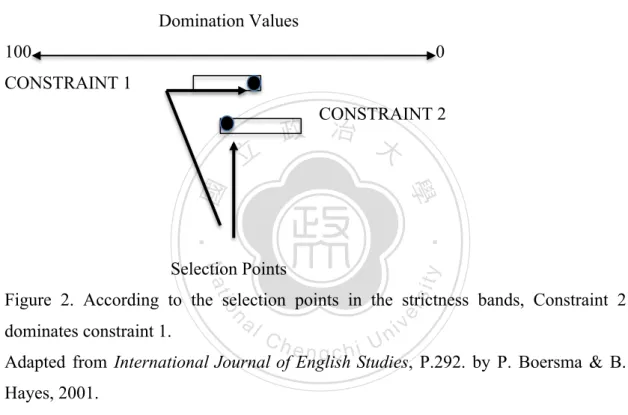
The Gradual Learning Algorithm (Boersma & Hayes, 2001, henceforth GLA) is based on the principle of constraint free ranking. In GLA, constraints are different in values and there is no exact dominance between two constraints. Hayes suggested that constraints should be represented as strictness bands, and the dominance should be determined by the selections within each band. As can be seen in Figure 1, constraint 1’s selection point is higher than that of constraint 2; thus, in this case, constraint 1 dominates constraint 2. Also, Figure 1 implies that, since the majority of constraint 1’s strictness band is higher than that of constraint 2, for most of the time, constraint 1 dominates constraint 2. The overlap of constraints 1 and 2 is where language variations occur.
Domination Values
100 0 CONSTRAINT 1
•‧
國
立立
政 治 大
㈻㊫學
•‧
N
a
tio
na
l C
h engchi U
ni
ve
rs
it
y
Selection PointsFigure 1. According to the selection points in the strictness bands, Constraint 1 dominates constraint 2.
Adapted from International Journal of English Studies, P.291. by P. Boersma & B. Hayes, 2001.
When selection points change, the dominance of constraints may reverse, as presented in Figure 2, where constraint 2 dominates constraint 1.
Domination Values
100 0 CONSTRAINT 1
CONSTRAINT 2
Selection Points
Figure 2. According to the selection points in the strictness bands, Constraint 2 dominates constraint 1.
Adapted from International Journal of English Studies, P.292. by P. Boersma & B. Hayes, 2001.
GLA allows great plasticity, especially at the initial stage of learning. In GLA’s initial state, all constraints are placed at the top of the scale with the full dominance value of 100. Similar to EDCD, GLA mechanism is motivated by the conflicts between the learner’s intermediate grammar and the learning data. However, in GLA, constraint demotion does not take place immediately after each conflict is found. Instead, conflicts only cause slight movement of the position in the strictness bands. Furthermore, strictness bands violated by the winner and the loser lead to different constraint movement. Strictness bands violated by the winner undergo demotion, while those violated by the loser are promoted.
GLA is especially prominent in dealing with free variations, which can be accounted for by the overlap of strictness bands. Moreover, the gradual movements of
•‧
國
立立
政 治 大
㈻㊫學
•‧
N
a
tio
na
l C
h engchi U
ni
ve
rs
it
y
constraints make the algorithm robust. Unlike EDCD, GLA can exhaust all possible constraint rankings by fine-tuning the selection points in the strictness bands.
Although GLA is able to cope with many erroneous data, the algorithm seems to deviate from the economy principle of languages. With countless selection point combination of two constraints, the dominance between two constraints is hard to determine, let alone a string of constraints. In addition, although the great plasticity of constraints may augment the explanation power of GLA, since almost all kinds of rankings are possible, on the negative side, uncertain location of selection points may frustrate the prediction of intermediate grammar construction, which also fails to reflect the principle of sequence in language acquisition.
Error-driven Ranking Algorithms
Magri (2012) proposed Error Driven Ranking Algorithms (EDRAs) to analyze interlanguage data from a computational perspective. EDRAs precisely defines the relationship among promotion amount and the number of constraints demoted and promoted via a set of re-ranking rules, known as calibration. In the general case, EDRAs claims that the promotion amount should be smaller than the number of constraints demoted divided by the number of constraints promoted, as shown in (19). (19) promotion amount < number of constraints demoted
number of constraints promoted
Generally speaking, the algorithms mentioned above focus on the acquisition of first language. However, the attempt to apply these models in L2acquisition may fail in theory and practice for the following reasons. First, the initial state of L2acquisition is more complicated than that of first language. Before learning a L2 language, L2 learners have been equipped with the knowledge of Universal Grammar (UG) and L1 grammar. A comprehensive account for the interactions among UG, L1 and L2 grammars is indispensable to a learning algorithm. In addition, L2acquisition differs from L1 acquisition in the result of learning. While a child can eventually reach full competence as adults in L1 acquisition, L2 learners are very unlikely to perform as well as a native speaker. L2outputs typically contain mistakes in forms. Even when L2 speakers are proficient in using second language, marks of imperfection such as accent still remain, also known as fossilization in L2 acquisition. With these typical phenomena in L2acquisition, a learning algorithm should also be able to predict and
•‧
國
立立
政 治 大
㈻㊫學
•‧
N
a
tio
na
l C
h engchi U
ni
ve
rs
it
y
reflect the learning sequence. Moreover, as Broselow and Xu (2004) argued, interlanguage grammar is independent of the grammar of the native language and the L2 language. It is very likely that not only L1 and L2 constraints but also other types of constraints contribute to the interlanguage grammar formation.
Theoretical Proposal of the Extended EDCD Algorithm
Enlightened by EDCD and BCD, the proposed algorithm argues that L2acquisition is based on L1 setting and undergoes a two-direction constraint movements.The initial state
In EDCD, Tesar & Smolensky (1998, 2000) assumed that acquisition starts from a provisional constraint ranking that is used to process overt forms and obtain full structural descriptions. In BCD, Prince & Tesar (1999) claimed that the initial state of acquisition is not arbitrary and special stipulation is not necessary, either. In L2 acquisition, Clahsen and Muysken (1989), Liceras et al. (1997), Tsimpli and Roussou (1991) argued that L2 learners are subject to UG principles. Epstein, Flynn and Martohardjono (1996) and Flynn (1987) agreed that L2 grammar can be attained without the adoption of L1 settings. Schwartz and Sprouse (1994) and White (1985) claimed that L1 settings prevail in the initial interlanguage grammar. Grass and Selinker (1992) argued that L2 learners tend to transfer constraints from L1 to L2. Inspired by White (1986), Schwartz and Sprouse (1994) proposed the Full Transfer/Full Access (FT/FA) hypothesis, claiming that “the initial state of L2 acquisition is the final state of L1 acquisition.” The FT/FA hypothesis has several implications. Frist of all, L1 and L2 acquisitions have different starting points. L1 acquisition starts from the unset UG, while L2 acquisition carries over the cognitive architecture of L1 to perceive stimuli of the L2 language. When encountering L2 input that cannot be generated by the L1 grammar, L1 grammar reconstruction occurs in order to assign a representation to the L2 data. FT/FA holds that grammar reconstruction is facilitated by the options of UG, referred to as the term “Full Access.” The processing time for grammar reconstruction varies and every change to the intermediate system creates a distinct interlanguage grammar. This study shares the same opinion of FT/FA. Theoretically speaking, Full Transfer suggests that the initial constraint ranking resembles that of L1 grammar. Full Access refers to the availability of all constraints in L1 and L2, including those inactivated or at the bottom.
•‧
國
立立
政 治 大
㈻㊫學
•‧
N
a
tio
na
l C
h engchi U
ni
ve
rs
it
y
Although the initial state is L1 setting, L1 constraints are not really adopted to process L2 stimuli. In fact, at the initial state, there has not been contact with the second language.
Stage one
Once L2 stimuli are exposed to, stage one is initiated. Instead of adopting L1 grammar to analyze a totally unfamiliar language, L2 learners are equipped with an independent interlanguage grammar to parse L2 tokens. In stage one, to override L1 grammar, one or more markedness constraints are promoted to the undominated position, known as interlanguage constraints. These interlanguage constraints are promoted in two conditions. First, they are lower ranked or even inactive in L1 and L2 grammars. In other words, their promotion is under the circumstances that the active constraints in L1 and L2 grammars alone fail to predict learners’ forms. Resorting to interlanguage constraints becomes an inevitable solution to processing the unique interlanguage forms. This also explains why some interlanguage forms are sharply distinct from L1 or L2 forms. Second, interlanguage constraints are promoted to simplify structures or reduce markedness. For example, as far as syllable structure is concerned, CV (open syllable) is less marked than CVC (closed syllable). In acquiring L2, an interlanguage constraint on CV might be promoted to override an L1 constraint on CVC, while an opposite situation is unlikely to happen. In the case of stress assignment, alignment constraint may serve to reduce structures. In fact, several studies have probed into the issue of emergence of the unmarked in the early stage of language learning (Broselow & Park, 1995; Broselow, Chen & Wang 1998) and found evidence of the emergence of the unmarked. Broselow, et al. (1998) studied the interlanguage production of obstruent coda by Mandarin-accented English learners and found that unmarked forms absent in L1 and L2 are preferred by the learners. The learner would epenthesize a vowel and replace a monosyllabic input with a disyllabic form. Interestingly, when the input is disyllabic, the obstruent coda would be deleted to form an unmarked monosyllabic output. Monahan (2001) studied English interlanguage with Brazilian Portuguese (henceforth BP) accent and discovered emergence of several inactive constraints like MAX-IO(OBS) in (20) in the English interlanguage.
(20) MAX-IO(OBS)
•‧
國
立立
政 治 大
㈻㊫學
•‧
N
a
tio
na
l C
h engchi U
ni
ve
rs
it
y
output.Together with an L1 constraint, *COMPLEX CODA, undominated MAX-IO(OBS) makes [plæ̃t] in (21) the optimal choice in the interlanguage.
(21) Interlanguage of BP-accented English
a. English b. BP Interlanguage English c. Gloss
[plæ̃nt] [plæ̃t] ‘plant’
[klæ̃n] [klæ̃] ‘clan’
[õnz] [õz] ‘owns’
[æ̃w̃ns] [æ̃w̃s] ‘ounce’
With the existence of L1 setting, these interlanguage markedness constraints have to be promoted on top of L1 constraints to the undominated position to take effect. At the same time, L2 constraints are activated and incorporated in the interlanguage grammar from the other end, resulting in a constraint ranking in the order in (22).
(22) Constraint ranking in Stage 1
interlanguage markedness constraints >> L1 constraints >> L2 constraints
The inclusion of interlanguage markedness constraints has several implications. First, L2acquisition is more complicated than L1 acquisition. In L1 acquisition, child grammar is similar to UG, and there are only two variables involved. In L2acquisition, there are three variables affecting what the resultants will be. Second, with the promotion to the undominated position, interlanguage constraints bring about tremendous influence on interlanguage grammar. Due to the dominance over L2 constraints, interlanguage constraints usually play a negative role in the construction of L2 grammar. Finally, it is expectable that the dominance of interlanguage constraint over L1 and L2 constraints would result in learner’s forms that are unique to L1 and L2 forms.
Stage two
In stage 2, interlanguage markedness constraints and L1 constraints undergo error-driven demotion. Constraint demotion continues in a rank by rank fashion. Error-driven demotion is an iterative process; it suspends when target forms can be predicted and resumes when target forms do not successfully surface. When there are
•‧
國
立立
政 治 大
㈻㊫學
•‧
N
a
tio
na
l C
h engchi U
ni
ve
rs
it
y
two or more constraints to be demoted, sequence is determined by a different way from EDCD. EDCD requires a pivotal constraint to be the reference point of demotion. However, it is not evident why higher-ranked constraint in child grammar has the priority over lower-ranked constraint to be demoted. EDCD seems to suggest that higher-ranked loser-favoring constraints are more mobile than lower-ranked ones, yet theoretical support of the privilege from ranking is not much. Unlike EDCD, the proposed algorithm does not resort to a pivotal constraint to partition the edge above which loser-favoring constraints should be demoted. Instead, in the proposed algorithm, the constraint demotion sequence depends on the frequencies of exposure to the corresponding forms. Take tableau (12) for example, whether FeetR is demoted prior to Trochaic is determined by the frequency ratio of FeetR to Trochaic. If FeetR is more often obeyed in the L2 language than Trochaic, FeetR should be easier to learn and demoted prior to Trochaic, and vice versa. The proposed sequence of constraint reranking can be supported by Pater’s study (2015) on child phonology. The study shows that Dutch children learn syllable structures in the sequence in (23):
(23) CV ! CVC ! V ! VC! {CVCC ! VCC ! CCV ! CCVC} CCVCC
!{CCV!CCVC!CVCC!VCC} !
Pater (2015) puts related constraints, like NoCoda, Onset, *Complex Onset, *Complex Coda, in numerical scale and has them gradually reranked. The result shows that different acquisition orders are predicted based on the frequencies of syllable types in different languages. Pater’s research enlightens the present study in the aspect of constraint reranking order. When there are two or more constraints to be demoted, it is the most frequently encountered relevant constraint to be demoted first. Take tableau (12) as an example, the order of Trochaic and Feet R demotion depends on their frequencies in L2. In L2, if alignment between foot and word on the right edge is more frequent than trochaic words, then the demotion of Trochaic is more likely to take place before the demotion of FeetR, and vice versa. It is true that obtaining statistic distribution of the corresponding forms might be time-consuming for analysis. A possible alternative solution is to look at the constraint ranking of the L2 language. When a constraint is ranked high, its corresponding forms are assumed to outnumber the others. With a more frequent encounter of the related data, each of which reinforces the status of the constraint, demoting an undominated constraint is
•‧
國
立立
政 治 大
㈻㊫學
•‧
N
a
tio
na
l C
h engchi U
ni
ve
rs
it
y
supposed to be more difficult. By contrast, demoting a violable constraint is easier. Since it is originally violable, playing down its role in the grammar is relatively simpler than that of the undominated constraints.
The two main stages of extended EDCD can be illustrated in Figure 3. Stage 1
interlanguage constraints Stage 2
non-L2 constraints
L2 constraints Figure 3. The bidirectional model of extended EDCD
Operation of the extended EDCD
I shall illustrate grammar formation in the bidirectional model with a similar case of EDCD in (12). Tableau (24) illustrates the initial state in the extended EDCD, where L2 setting is the only grammar that speakers possess. At this state, L2 stimuli are not encountered, and therefore L1 constraints are not applied to process any language forms.
(24) The original state
TrochaicL1 FeetRL1
Next, the exposure to L2 stimuli initiates the first stage, which features interlanguage markedness constraint promotion and L2 constraints inclusion. As can be seen in (25), ALIGN-HEAD represents the interlanguage markedness constraint,
which is directly promoted to the undominated position.
(25) ALIGN-HEAD (PrWd-R, Head(PrWd)-R) (hereafter ALIGN-HEAD
(word, head(word))
Align the right edge of the prosodic word with the right edge of the head of the prosodic word
As shown in (26), Trochaic and FeetR are L1 constraints; Iambic and FeetL are L2 constraints, which join interlanguage grammar from a lower rank. Each constraint is indicated with a subscript to show the grammar system that it belongs to, and it
•‧
國
立立
政 治 大
㈻㊫學
•‧
N
a
tio
na
l C
h engchi U
ni
ve
rs
it
y
does not imply any morphological category as indexed constraints do.
The penult in the input and outputs is a heavy syllable, which is indicated with two mora symbols. Syllables that are not indicated with mora symbols are light. The dominance of interlanguage constraint, ALIGN-HEAD, leads to the surface of
candidate (f). Candidate (f) is less marked than the target form candidate (b) in that the heavy penultimate syllable is stressed.
(26) stage one: interlanguage markedness constraint promotion and L2 constraint incorporation
/σσσµµσ/
IL L1 L2
ALIGH
HEADIL
TrochaicL1 FeetRL1 IambicL2 FeetLL2
a.[(σσ)σµµσ] *! ** * ← b.[(σσ)σµµσ] *! * ** c.[σ(σσµµ)σ] *! * * * d.[σ(σσµµ)σ] *! * * * e.[σσ(σµµσ)] *! * ** → f.[σσ(σµµσ)] * **
Next, to achieve greater resemblance of L2 grammar, error-driven constraint demotion is launched. The sequence of demotion is determined by constraint mobility; violable constraints in the L2 language is more mobile and should be demoted prior to high-ranked constraints. Provided that the constraint ranking in the L2 language is as follows. Constraints that are shaded in (27) are winner-disfavoring constraints to be demoted.
(27) Constraint ranking in the L2 language
Iambic >> Trochaic >> FeetL >> FeetR >> ALIGH HEAD
As lower ranked constraints are more easily to move due to less reinforcement, constraint demotion should follow the following order in (28).
(28) Constraint demotion order
ALIGH HEAD ! FeetR ! Trochaic
•‧
國
立立
政 治 大
㈻㊫學
•‧
N
a
tio
na
l C
h engchi U
ni
ve
rs
it
y
by one rank, uncrucially rank with Trochaic. ALIGH-HEAD punishes candidates whose
main stress does not lie on the ultimate syllable. Here, all candidates except candidate (f), incurs a violation of ALIGH-HEAD.
The evaluation shows that the actual output, candidate (b), loses to candidate (f) for one more violation of ALIGH-HEAD. Since the existing grammar fails to predict
the target form, the constraint reranking will continue by lowering ALIGH-HEAD by
one more rank.
(29) Stage 2A: error-driven constraint demotion of ALIGH-HEAD
/σσσµµσ/
ALIGH
HEADIL
TrochaicL1 FeetRL1 IambicL2 FeetLL2
a.[(σσ)σµµσ] * *!* * ← b.[(σσ)σµµσ] * *! ** c.[σ(σσµµ)σ] * *! * * d.[σ(σσµµ)σ] * *! * * e.[σσ(σµµσ)] * * ** → f.[σσ(σµµσ)] * **
In stage 2B in tableau (30), ALIGH-HEAD is demoted by one rank, uncrucially
ranked with FeetR. This time, candidate (e) beats candidate (f) by conforming to the undominated constraint, Trochaic. Since the target form is not successfully predict, the demotion of ALIGH-HEAD will continue with one more rank.
(30) Stage 2B: error-driven constraint demotion of ALIGH-HEAD
/σσσµµσ/
TrochaicL1 ALIGH HEADIL
FeetRL1 IambicL2 FeetLL2
a.[(σσ)σµµσ] * *!* * ← b.[(σσ)σµµσ] *! * ** c.[σ(σσµµ)σ] * *! * * d.[σ(σσµµ)σ] *! * * * → e.[σσ(σµµσ)] * * ** f.[σσ(σµµσ)] *! **
In tableaux (31) to (33), ALIGH HEAD is demoted rank by rank until it reaches