國
立
交
通
大
學
管理科學系
碩
士
論
文
顧客參與程度對服務結果歸因之影響:
自我效能之調節效果
The Impact of Customer Participation on Attribution of the Service
Outcomes: The Moderating Role of Self-Efficacy
研 究 生:莊淑涵
指導教授:張家齊 教授
顧客參與程度對服務結果歸因之影響:自我效能之調節效果
The Impact of Customer Participation on Attribution of the Service
Outcomes: The Moderating Role of Self-Efficacy
研 究 生:莊淑涵 Student: Shu-Han Chaung
指導教授:張家齊 博士 Advisor: Dr. Chia-Chi Chang
國 立 交 通 大 學
管 理 科 學 系 碩 士 班
碩 士 論 文
A Thesis
Submitted to Department of Management Science College of Management Science
National Chiao Tung University in partial Fulfillment of the Requirements
for the Degree of Master in Management Science
June 2009
Hsinchu, Taiwan, Republic of China
i
顧客參與程度對服務結果歸因之影響:自我效能之調節效果
學生: 莊淑涵 教授: 張家齊 博士 國立交通大學管理科學系碩士班中文摘要
理解消費者對於服務結果的歸因對於提供服務的廠商具有相當的重要性。先前文 獻提出兩種互斥的假設,試圖解釋顧客參與程度如何影響失敗結果的歸因。本研究認 為消費者自我效能的程度,對於顧客參與程度與服務結果歸因之間的關係,扮演著重 要的角色。 為了檢視自我效能的程度於之中的影響性,將本實驗設計成 2(顧客參與程 度)×2(自我效能)×2(服務結果) 的形式。實驗結果顯示,高自我效能的消費者於成功(失 敗)的服務結果下,隨著參與程度的增加,消費者對廠商的歸因程度減少(增加),而對 消費者本身的歸因程度增加(減少)。然而低自我效能的消費者於成功(失敗)的服務結果 下,隨著參與程度的增加,消費者對廠商的歸因程度增加(減少),而對消費者本身的歸 因程度增加(減少)。 關鍵字:參與度、自我效能、歸因ii
The Impact of Customer Participation on Attribution of Service Outcomes:
The Moderating Role of Self-Efficacy
Student: Chaung, Shu-Han Advisor: Dr. Chang, Chia-Chi
Department of Management Science
National Chiao Tung University
Abstract
It is crucial for firms to understand customers’ attribution of service outcome. In prior
literature, two competing hypotheses have been proposed to explain how customer
participation influences attribution of unsuccessful outcome. This study suggested that
customer self-efficacy played a role in affecting the relationship between customer
participation and attribution of service outcome. In order to examine how self-efficacy
influence the effects of customer participation on attribution of service outcome, a 2(customer participation)×2(self-efficacy)×2(service outcome) experimental design was
employed. The results showed that for high self-efficacy customers, a higher level of
customer participation will lead less (more) attribution to firm and more (less) attribution to
self for the successful (unsuccessful) outcome. However, for low-self-efficacy customers, a
higher level of customer participation will lead more (less) attribution to firm and more (less)
attribution to self for the successful (unsuccessful) outcome.
iii 誌謝 研究所兩年的時光,一下子就過去了,終於我的論文也在六月順利完成,這必須 要感謝許多人。首先,謝謝我的指導教授 張家齊博士,感謝老師在這一年來的指導, 帶領我認識消費者行為的學術領域,並細心且耐心的協助我完成論文,老師對於研究 認真執著的態度更是我值得學習的地方。 感謝我最親愛的家人,在我為學業煩惱的時候,能替我分擔解憂,也讓我在求學 的過程中,無後顧之憂,能全力以赴完成學業。 還要感謝曾提供研究建議的學長姐們,特別是佳誼學長,在我困頓時,總能適時 的提供相關文獻解答並給予許多建議,在我面臨問題時,也願意與我討論,一起研究 解決方案。 感謝張門的各位夥伴,小賴、信堯、大萱、惠敏、依璇和 Ruby,一起 Meeting 的 時光雖然漫長,但大家一起總能開心度過,不論是想題目、討論架構、趕進度、Meeting 後的舒壓晚餐,這都是我美好的研究生回憶;另外,還要感謝研究室的夥伴們,每次 的聚會、閒聊、遊戲,都讓我在煩悶的研究生涯中,增添不少開心的因子。 感謝彥華,能在我面臨研究困境與壓力時,耐心傾聽並陪伴左右,在我為問卷煩 惱時幫忙我,你總能理性的開導被感性沖昏頭的我,十分感謝! 莊淑涵 謹誌於 民國 98 年於新竹交大管科
iv
Table of contents
中文摘要 ... i Abstract... ii 致謝詞 ... iii Table of contents ... iv Table Index ... viFigure Index ... vii
Chapter 1 Introduction ...1
1.1 Research Motivation and Background ...1
1.2 Research Objectives ...2
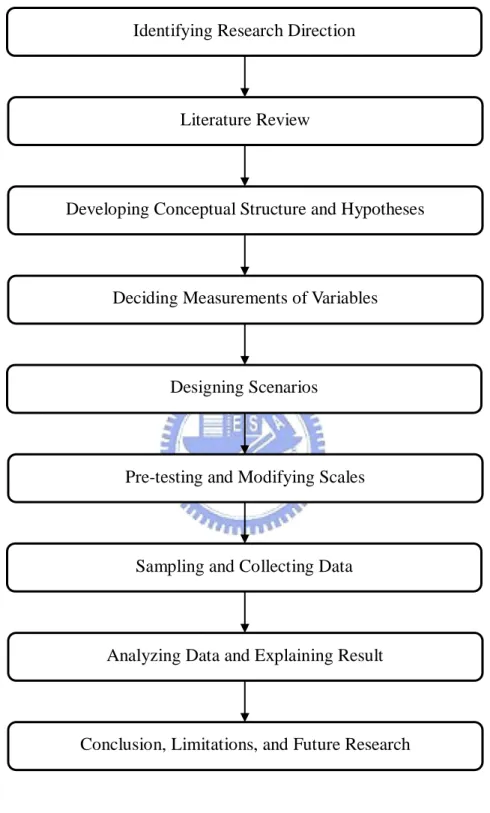
1.3 Organization of the Research ...3
Chapter2 Literature Review ...6
2.1 Customer Participation in Service ...6
2.2 Attribution Theory ...7
2.3 The impact of Customer Participation on Attribution of Service Outcomes ...8
2.3.1 Self-serving Bias Perspective ...9
2.3.2 Ego-centric Bias Perspective ...9
2.4 The Impact of Self-efficacy on Attribution of Service Outcomes ... 10
2.4.1 Successful Outcome ... 10
2.4.2 Unsuccessful Outcome ... 11
2.5 Hypothesis ... 13
2.6 Research Framework ... 15
Chapter 3 Research Methodology ... 16
3.1 Conceptual research framework ... 16
3.2 Designing scenario ... 17 3.3 Experiment Design ... 17 3.4 Measurement ... 18 3.4.1 Participation ... 18 3.4.2 Self-efficacy ... 19 3.4.3 Attribution to Firm ... 20 3.4.4 Attribution to Self... 20 3.5 Data Collection ... 20
3.6 Manipulation Check Items ... 21
3.7 Pilot Study ... 21
Chapter 4 Data Analysis and Results ... 23
v
4.2 Background of participants ... 25
4.3 Reliability Analysis ... 27
4.4 Analysis of Results ... 28
4.4.1 Customer attribution of firm for the successful outcome ... 28
4.4.2 Customer attribution of self for the successful outcome ... 30
4.4.3 Customer attribution of firm for the unsuccessful outcome ... 32
4.4.4 Customer attribution of self for the unsuccessful outcome ... 34
Chapter 5 Discussion and Future Research ... 37
5.1 Discussion ... 37
5.1.1 Participation, self-efficacy, and attribute to firm for the service outcome .... 37
5.1.2 Participation, self-efficacy, and attribute to self for the service outcome ... 38
5.2 Implications ... 38
5.3 Limitations and Future research ... 39
Reference ... 41
APPENDIX I ... 44
APPENDIX II ... 46
vi
Table Index
Table 1 Reliability Statistics of Attribution to firm and Attribution to self ... 22
Table 2 Reliability Statistics of Self-efficacy and Participation ... 24
Table 3 Manipulation Check of Self-efficacy ... 24
Table 4 Manipulation Check of Participation ... 24
Table 5 Experience of Participants ... 25
Table 6 Purpose of Participants to cram school ... 25
Table 7 Demographics of Participants... 26
Table 8 Reliability Analysis of Attribute to Firm and Attribute to Self ... 27
Table 9 Tests of self-efficacy and participation ... 29
Table 10 Tests of self-efficacy and participation ... 31
Table 11 Tests of self-efficacy and participation ... 33
Table 12 Tests of self-efficacy and participation ... 35
vii
Figure Index
Figure 1 Research Flow Chart ...5
Figure 2 the relationship between self-efficacy and attribution ... 12
Figure 3 Research Framework ... 15
Figure 4 Conceptual Research Frameworks ... 16
Figure 5 The interaction between participation and self-efficacy on attribution to firm ... 30
Figure 6 The interaction between participation and self-efficacy on attribution to self ... 32
Figure 7 The interaction between participation and self-efficacy on attribution to firm ... 34
1
Chapter 1 Introduction
1.1 Research Motivation and Background
All firms cannot avoid having service failure. Most previous studies focused on how
to provide appropriate service recovery for the failure to raise customers’ trust, loyalty
(Weun, 2004; Moore et al, 2005 ), satisfaction (Smith et al, 1999; Mattila and Cranage,
2005) and repurchase intentions (Wirtz et al, 2004; Spreng et al, 1995). Since Weiner
(1980) brought up the attribution theory, that service failure could be attributed to stability
(whether the failure was relatively temporary or fairly permanent), locus (whether the
failure was caused by customers themselves or by service provider) and controllabilit y
(whether the causes could be avoided or not).
As time goes by, customer participation becomes significant in the service processes.
According to the flow, co-production not only becomes more and more obvious in the
service but also is a popular topic in the research field. In customer participation and
service failure, there are two explanations and results can be found. One believed that
when customers participate more, they would attribute the failure to the provider after the
service failure. It can be explained by self-service bias that they will claim more
2
1973). Another insisted that if customers have high participation, they will blame
themselves more after facing service failure. Similar statements can be found in
ego-centric bias research (Ross and Sicoly, 1979) which suggested information such as
own input will enhance customer to accept responsibility for the outcome.
To clarify these two distinct results, we believe that there is a variable influencing the
attribution and making customers have distinct perceived responsibility level. In this study,
we attempt to discover the variance that will let customers with high participation have
distinct attribution after the service failure.
1.2 Research Objectives
The objective of this research is to discover why customers with high participation
attribute the failure in distinct ways. Some would blame themselves more than others after
facing service failure.
Many studies derived that self-efficacy was related to attributions and performance
on nearly all tasks (Bandura, 1986). It made customers’ internal attribution or external
attribution in distinct kind situations. Self-efficacy has a strong effect on successful or
failure situation. Customers with high self-efficacy tend to take the credit in success and
blame service provider in failure. Consequently, the higher the self-efficacy, the lower
perceived responsibility they have while service failure occurs. In successful outcome, it
3
attribute internally in success. Self-efficacy is the key making customers have distinct
attributions to the failure.
Based on statements above, the following research questions are established.
1. What are the relationships between high participation and self-efficacy for service
outcome?
2. Does self-efficacy moderate the relationship between participation and attribution for
successful and failure outcome?
3. Are there negative relations between attribution of firm and attribution of self?
1.3 Organization of the Research
This research included five chapters outlined as follows.
Chapter one introduces the motivation and background of the research, research
objectives and research structure.
Chapter two reviews the literatures related to this research. They are about
participation, attribution to the failure, self-efficacy and controllability. This chapter is
ended with the introduction of research hypotheses and establishment of research
framework.
Chapter three describes the experiment design, data collection, sample selection,
measurement, manipulation check, and pilot study.
4
analysis methods include Reliability Analysis, ANOVA, Independent-Sample T Test.
According to statistical analysis, we further explained some findings in this study.
Chapter five discusses the results and implications of this study, describing its
limitations, and provides suggestions for further research.
5
Conclusion, Limitations, and Future Research Analyzing Data and Explaining Result
Pre-testing and Modifying Scales
Sampling and Collecting Data Deciding Measurements of Variables
Designing Scenarios
Developing Conceptual Structure and Hypotheses Identifying Research Direction
Literature Review
6
Chapter2 Literature Review
2.1 Customer Participation in Service
In recent years, customized and co-production products became major issues in the
service market. Customers not only participate in the production but also play a
significant role during the procedure. The customer participation can be defined as the
degree that customer involving in the service or products (Dabholkar, 1990). Accordingly,
Meuter and Bitner (1998) distinguished three types of situations in the service and
products: firm production, joint production and customer production.
Firm production means that firm and its employees are in charge of all the
productions without customer participation. Joint production is that both customer and
firm participate in the production with their interaction. Customer production means that
the whole product is made by customer without firm and its employees. Based on this,
customer will have distinct degrees of perceived responsibility among three types of
service or product. This research only mentions about the situation of joint production.
Many researches pointed out that customer participation was related to customer
satisfaction. High participation increased customer satisfaction (Bateson, 1985; Cermak,
7
increasing satisfaction, customer participation could bring some benefits such as
enhancing provider economies and backward information flow (Kelley, Connelly and
Skinner, 1990; Lovelock and Young, 1979; Mills and Moburg, 1982).
Customer participation was categorized as physical and mental inputs (Cermak et al,
1994; Silpakit and Fisk, 1985). Ennew and Binks(1999) believed that participation
consisted of three dimensions: information sharing, responsible behavior and personal
interaction. Customers connected with firm to ensure that the products provided will
fulfill their needs, forming the procedure of information sharing. And through
participation, customers will regard themselves as one of the employees, and will take
part of the responsibility during the production. Finally, by personal interaction, customer
and firm may build up some relationships such as trust, support and commitment. As a
result, through these inputs and interaction, customers will increase their satisfaction from
their contributions of the successful product.
2.2 Attribution Theory
Attribution theory builds a set of major developments in causal attribution (Mizerski
et al. 1979). It showed a description of how people explain their experiences, what kind of
information they used in making causal inference and what they deal with information to
answer causal question (Kelley, 1973; Weiner, 1986).
8
stability that sorts the causal explanation as relatively fixed or tending to fluctuate.
Second is locus that the failure is result in internally or externally to the individuals. The
last one is controllability that means the degree of controllability by the individual being
further classified as controllable or uncontrollable. Therefore, most customers will
attribute service failure according to categories above and these would influence the
reaction after the failure.
2.3 The impact of Customer Participation on Attribution of Service Outcomes
In the relationship between customer participation and customer attribution, most
researches suggested that customers with high participation would be self-enhancing in
success. Nevertheless, in failure cases, there are two kinds of attribution. One will
attribute the failure externally to such as environment and firm (Yen et al., 2004), another
will attribute the failure themselves (Bendapudi & Leone, 2003). The situations will be
discussed in the following sections.
When service failure occurred, most customers will explain and attribute to
themselves (Heider, 1958). And for firms, it is crucial to understand customers’ attribution.
If firms could successfully predict how customer attribute, they could further perform
appropriate recovery to any kind of attribution (Dixon, Spiro and Jamil, 2001 ). Thus,
9
2.3.1 Self-serving Bias Perspective
Some researches insisted that highly participated customers would make external
attribution after service failure (Yen et al., 2004). When facing the failure outcomes,
customers with high participation may attribute to firm in order to maintain self-esteem.
The self-esteem maintaining phenomenon is formed by self-serving bias, hedonic bias and
motivational bias (Ross and Fletcher, 1985; Taylor and Brown, 1988). Self-serving bias is
the phenomenon pushing people take more credit in success and take less responsibility in
failure (Wolosin, Sherman and Till, 1973). Based on self-serving bias, customers with
high participation will decrease perceived responsibility after failure and attribute to the
firm.
2.3.2 Ego-centric Bias Perspective
Some research suggested that customer with high participation will blame
themselves after failure (Silpakit and Fisk, 1985). The reason is that they have to take part
of responsibility even failure outcomes due to their participation in the producing process.
This statement came from ego-centric bias theory (Ross and Sicoly, 1979). Ego-centric
bias took place when customers have more knowledge of their contributions to the effort.
After service failure, the information which contributed to production will enhance customers’ responsibility because that is easily recalled. In this situation, customers will
10 blame themselves for the failure outcome.
2.4 The Impact of Self-efficacy on Attribution of Service Outcomes
The self-concept of individuals can influence one’s behavior and one of the
self-concept is personal self-efficacy. Self-efficacy is defined as a personal task-specific faith such as “how well can one execute courses of action required to deal with prospective situations” (Bandura, 1982) and it may vary corresponding on the situation (Bandura, 1989). It reflects one’s self-confidence that means individual is capable of mobilizing the motivation, cognitive resources, and courses of action needed to fulfill
situational demands (Wood and Bandura, 1989).
2.4.1 Successful Outcome
In case of successful outcome, people with high and low self-efficacy would attribute
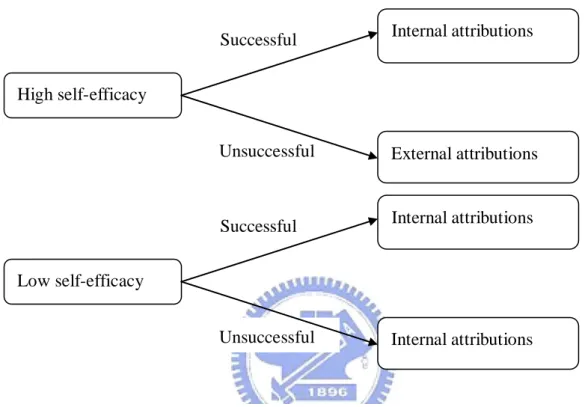
the outcome to themselves (Stajkovic and Sommer, 2000). Figure 2 summarized the
tendency of attribution for both high and low self-efficacy. High self-efficacy reflects a
strong belief that people can use their ability to produce positive results. Comprehensively,
they would attribute the successful out come to internal causes.
Low self-efficacy is defined as people’s conviction that they are less capable of
11
reflects people’s tendency to associate themselves more with successes than failures. In case of successful outcome, people are likely to perceive a positive relationship between
their behavior and successful outcome (Miller & Ross, 1975). As a result, customers with
low self-efficacy would also attribute the success to internal causes.
2.4.2 Unsuccessful Outcome
According to Stajkovic and Sommer (2000), when service failed, customers with
high self-efficacy would attribute the failure externally and customers with low
self-efficacy would attribute the failure internally. Figure 2 showed the tendency of
attribution for both high and low self-efficacy. High self-efficacy lead to perceptions of
successful task performance but not to failure ones (McAuley, Duncan, & McElroy, 1989)
which render unsuccessful outcome to be perceived as unexpected events and deflected to
causes beyond control. By attributing externally, people with high self-efficacy could deal
with and explain unexpected failure (Ross & Fletcher, 1985). Thus, individuals with high
self-efficacy would attribute the unsuccessful outcome to external causes.
Bandura (1986) suggested that people with low self-efficacy would regard the failed
event as internally determined because out of the weak convictions about their capabilities
to do the task. Thus, low self-efficacy would attribute the unsuccessful outcome to
12 High self-efficacy Internal attributions External attributions Successful Unsuccessful Low self-efficacy Internal attributions Internal attributions Successful Unsuccessful
13
2.5 Hypothesis
According to 2.4, self-efficacy is individuals’ confidence in their ability to organize
and execute a given course of action to eliminate obstacles or accomplish tasks (Bandura,
1986). It can be the major determinant of goal setting, activities, willingness to expend
effort and persistence (Stajkovic and Sommer, 2000). In successful outcomes, people with
high participation and high self-efficacy would attribute internally easily than low
participation. Therefore, they would attribute less to service provider. As for people with
low self-efficacy, although they would attribute the outcome externally, people with high
participation would more likely to attribute to service provider than low-participation ones.
There were two dependent variables: attribution of firm and attribution of self, would be
measured in this study.
H1a: When a service outcome is successful, for high self-efficacy customers, a
higher level of customer participation will lead (i) less attribution to firm; (ii) more
attribution to self for the successful outcome.
H1b: When a service outcome is successful, for low self-efficacy customers, a higher
level of customer participation will lead (i) less attribution to firm; (ii) more
attribution to self for the successful outcome.
14
In unsuccessful outcomes, base on statements above, self-efficacy is customers’
confidence in their ability to execute given courses of action to eliminate some obstacles
or accomplish some tasks (Bandura, 1986). In this way, self-efficacy and attribution to
firm may be related positively in perception of customers with high participation. When
customers have high participation, high self-efficacy will make them take less
responsibility and blame the firm more. However, customers with low self-efficacy would
take more responsibility and blame the firm less.
H2a: When a service outcome is unsuccessful, for high self-efficacy customers, a
higher level of customer participation will lead (i) more attribution to firm; (ii) less
attribution to self for the unsuccessful outcome.
H2b: When a service outcome is unsuccessful, for low self-efficacy customers, a
higher level of customer participation will lead (i) less attribution to firm; (ii) more
attribution to self for the unsuccessful outcome.
15
2.6 Research Framework
The major purpose of this research was to identify (1) whether the self-efficacy has
impact on customer participation and blaming the firms by influencing the perceived
responsibility of customers and (2) how did the outcome of service lead each level of
customer participation to blame the firms in distinct degree by perceived distinct
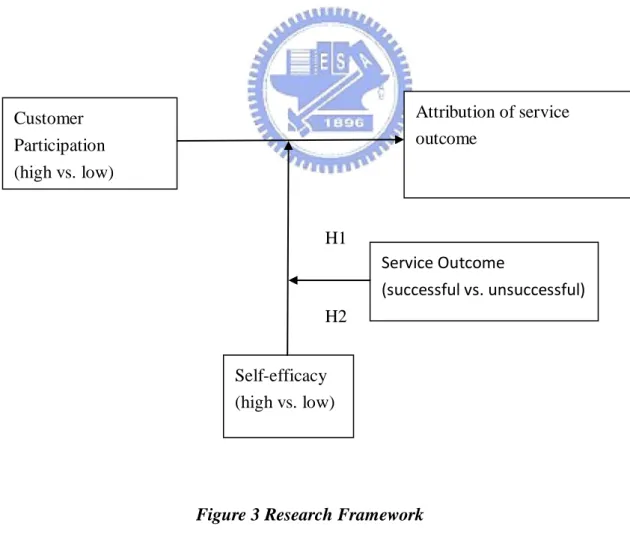
responsibility. The conceptual structure to the overall research is presented in figure 3
below. Customer Participation (high vs. low) Attribution of service outcome Self-efficacy (high vs. low) Service Outcome (successful vs. unsuccessful)
Figure 3 Research Framework
H1
16
Chapter 3 Research Methodology
3.1 Conceptual research framework
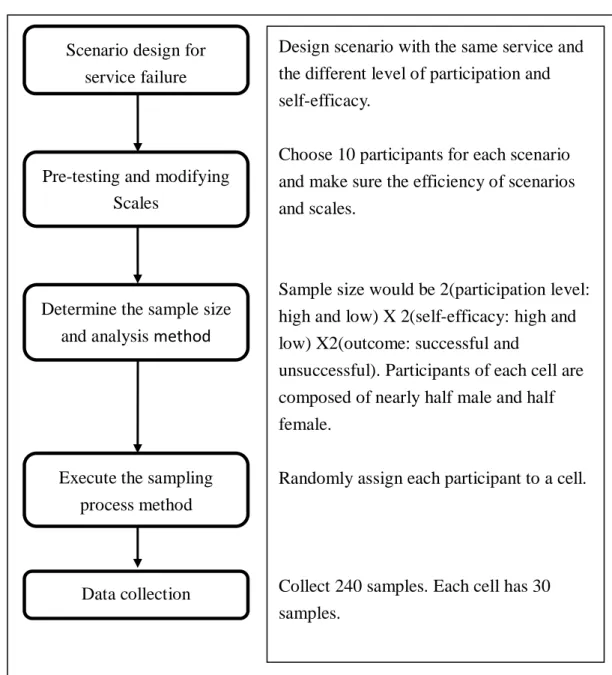
Design scenario with the same service and the different level of participation and self-efficacy.
Choose 10 participants for each scenario and make sure the efficiency of scenarios and scales.
Sample size would be 2(participation level: high and low) X 2(self-efficacy: high and low) X2(outcome: successful and
unsuccessful). Participants of each cell are composed of nearly half male and half female.
Randomly assign each participant to a cell.
Collect 240 samples. Each cell has 30 samples.
Scenario design for service failure
Pre-testing and modifying Scales
Determine the sample size and analysis method
Execute the sampling process method
Data collection
17
3.2 Designing scenario
The scenario used in this study was: an experience of English cram school. In that scenario, the service failure is defined as “You didn’t get a good grade and didn’t pass the test. “ The reasons why we choose the English cram school are as follow. First of all, Yen et al. (2004) showed that participation consists of information sharing, responsible
behavior and personal interaction. Using school for the scenario can fit that definition and
differentiate the level of participation easily. Second, self-efficacy has often been
investigated in educational studies, and it is easy to measure the level of self-efficacy.
Third, the experience of going to a cram school is familiar to people in Taiwan, and thus
participants could imagine such scenario easily. Although the scenario has some
deficiencies, we believed it was still appropriate for this research.
3.3 Experiment Design
A 2(participation level: high and low) x2(self-efficacy: high and low) x2(outcome:
successful and unsuccessful) between-subject factorial design matrix was used to test our
hypotheses: the impacts of attribution with distinct participation level, self-efficacy and
outcome. In this study, two levels of participation (high and low) were matched with two
levels of self-efficacy (high and low). Two conditions of outcome (successful and
18
total, there are eight scenarios in this study. Thirty participants were asked to participate in
each scenario independently, which meant the sample size would be 240 (30x8=240).
Participants were exposed to a written scenario describing a service in an English
cram school. Half of them have service failure and others have not, such scenarios are
attached as Appendix I. Participants were told that it was a study about consumer behavior
and were given a questionnaire. The questionnaire contained three major parts. The first
part included three examples in English and listed questions about (SE) self-efficacy, such
examples were attached as Appendix II. In second part, participants were asked to read the
scenarios carefully and imagine being in the scenarios. And it listed some questions about
(AtF) attributions to firm and (AtS) attribution to self. The third part contained questions
about (LoC) locus of control and demographic information, and such questionnaire is
attached as Appendix III.
3.4 Measurement
3.4.1 Participation
There are two participation levels in this study: high and low. The definition of participation level in this study is “the tendency of attendance and the effort of learning “. With higher level of participation, participants always attended classes and made preview,
19
be absented and did no preview, review or interaction with teacher. There were two items
constructed in this study. They are, “I have high level of participation for the class.” and “I didn’t have the sense of participation.” All of the items are verified on 7 points scales represented from “extremely agree” to “extremely disagree.”
3.4.2 Self-efficacy
There are two self-efficacy levels in this study: high and low. The definition of
self-efficacy level in this study is “the confidence of English test and comprehension of class”. With higher level of self-efficacy, participants would have confidence in passing the English test and believe that they can learn well in the class. As with lower level of
self-efficacy, participants did neither have confidence on passing the English test nor have
ability to learn. Participants would be asked to do all the questions and recorded the
number of correct answers. According to Mallin & Mayo (2006), there were some items
available for this study. They can be adapted in two parts. One of them measuring the confidence of passing the test, and the items were “I am confident to pass the English test”, “I can answer most of the questions with the same difficulty as the examples” and “ I believed I can get good grades in this English test.” Another category measured the comprehension of class, and the items were “I am able to learn English”, “I can comprehend the materials in class” and “I am more efficient than others in the class.” All
20
3.4.3 Attribution to Firm
In research by Maxham III and Netemeyer (2002), the level of attribution to firm
could be measured in three items: They were “Overall, the cram school should take that responsibility”, “the cram school make that outcome” and “For the outcome, I would blame/praise the cram school.” All of the items are verified on 7-points Likert-scale.
3.4.4 Attribution to Self
In Coe et al (1982), attribution to self can be measured in three items. All of the
items were verified on 7-points Likert-scale. They were “ For the outcome, that was my fault/credit”, “I should take responsibility” and “I would blame/praise myself.”
3.5 Data Collection
The data was gathered from 80 participants in the pilot study and 240 participants in
the main study. Data were collected via two major channels. First, the questionnaires were
delivered to students in the classes at National Chiao Tung University (NCTU) and
National Cheng Chi University (NCCU). The second channel was using the Internet to
distribute and collect questionnaires online. Eight questionnaires with distinct scenarios
were mixed and were given randomly to subjects. All participants were told about the
21
3.6 Manipulation Check Items
The reliability for the scenario descriptions can be measured by two-item with
Likert-scale. They are “The story reflects what might happen in the real world” and “I had
no difficulty imagining myself in the situation.” The mean is 5.19 (above 4) meaning that
the scenario is realistic. And one manipulation check was conducted to test whether the
participation was identified a high or low. Another manipulation check is conducted to test
whether the self-efficacy can be grouped into high or low. The scale items are mentioned
in 3.4.1 and 3.4.2 above. In addition, the results of the manipulations are reported in
chapter four.
3.7 Pilot Study
A pilot study was conducted to test the reliability of the questionnaire. It could
discover the limitations and misunderstandings in the experiment. Then, the limitations or
misunderstandings could be modified in the main study. After two failed and subsequent
modifications, the third trial of the pilot study was successful.
The pretest was made through giving 80 participants the experimental questionnaires,
and telling them the research was about consumer behavior. There were 41 male and 39
22
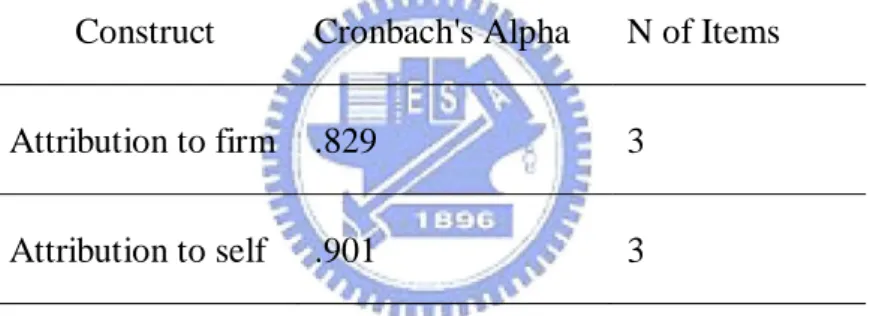
The reliability of scale for attribute to firm is 0.829 (Table 1) and the reliability of
scale for attribute to individual is 0.901 (Table 1). Both were higher than 0.7, and hence
there is a significant difference between high and low participation group (p<0.00). The
difference between the self-efficacy groups is significant as well (p<0.00).
Table 1 Reliability Statistics of Attribution to firm and Attribution to self
Construct Cronbach's Alpha N of Items
Attribution to firm .829 3
23
Chapter 4 Data Analysis and Results
This chapter contains the analysis and the results of the study, and simultaneously
provides the background of the respondents, the manipulation check, and the reliability of
the results. Since participants thought the situations described in the scenarios would
happen in real life, the following tests and discussions were meaningful. Some data
analysis methods such as ANOVA and Independent-Sample T Test are adopted to test the
hypotheses and using the tool of SPSS 15.0.
4.1 Manipulation check
The reliability of self-efficacy is 0.874 (table 2). The manipulation checks would be
tested by Independent-Sample T Test. There are both 120 participants in high and low
self-efficacy. The research results are presented in table 3, showing significant difference
between high and low self-efficacy (p<0.01). Therefore, the manipulation check is
successful.
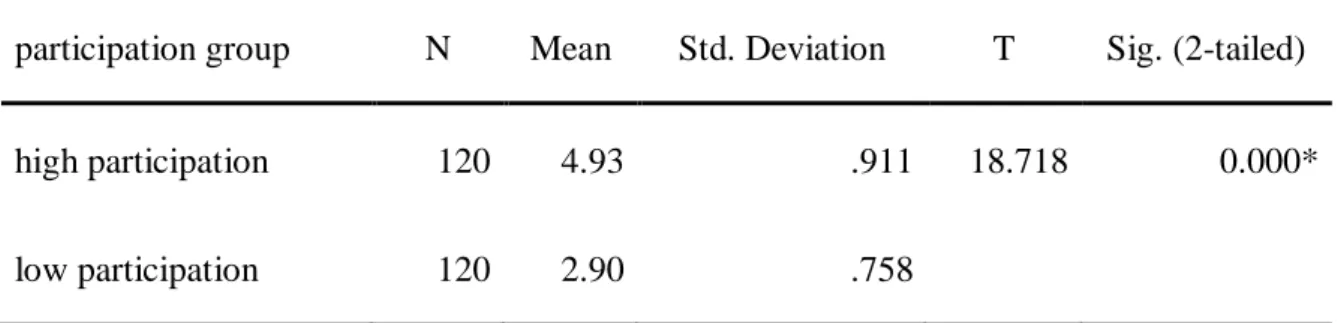
The reliability of participation is 0.797 (table 2). There are both 120 participants in
high and low participation. The results are showed in table 4. There are also significant
difference between high and low participation (p<0.01). And the manipulation check is
24
Table 2 Reliability Statistics of Self-efficacy and Participation
Construct Cronbach's Alpha N of Items
Self-efficacy .874 6
Participation .797 2
Table 3 Manipulation Check of Self-efficacy
self-efficacy group N Mean Std. Deviation T Sig. (2-tailed)
high self-efficacy 120 5.094 1.1195 14.923 0.000*
low self-efficacy 120 3.168 .8639
Table 4 Manipulation Check of Participation
participation group N Mean Std. Deviation T Sig. (2-tailed)
high participation 120 4.93 .911 18.718 0.000*
25
4.2 Background of participants
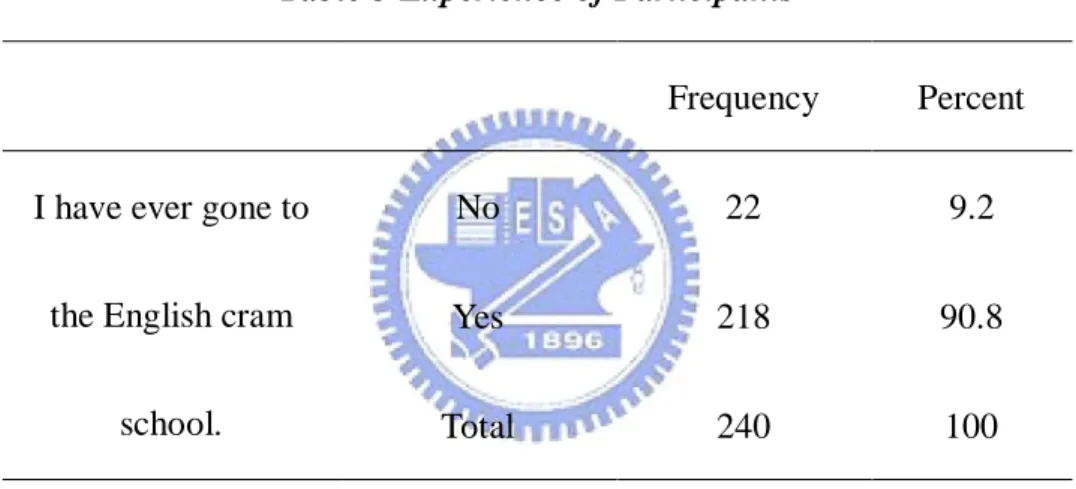
From the total 240 samples, 90.8% of them have the experience of going to English
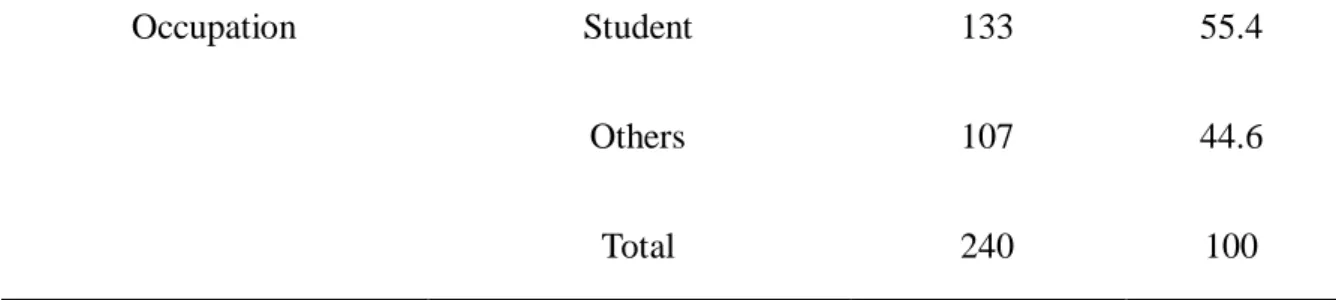
cram school (table 7) and only 22.1% go there for specific English test (table 8). 55.4%
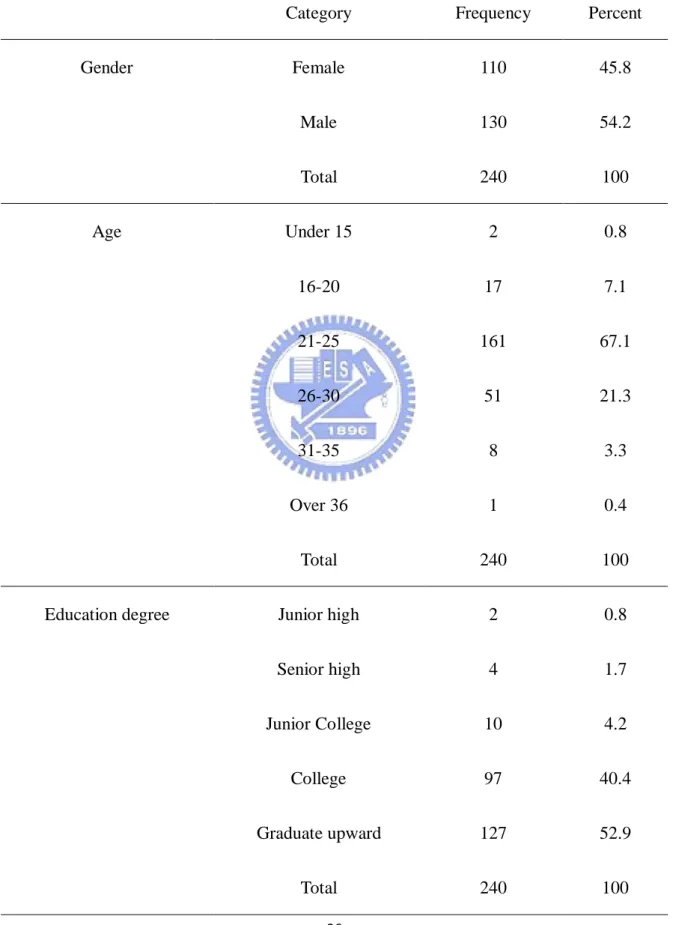
are students, 54.2% are male, 67.1% are 21 to 25 years old and 52.9% have master degree.
The demographics of participants were showed as follows (table 9).
Table 5 Experience of Participants
Frequency Percent
I have ever gone to
the English cram
school.
No 22 9.2
Yes 218 90.8
Total 240 100
Table 6 Purpose of Participants to cram school
Frequency Percent
I go to the cram
school for English
test.
No 187 77.9
Yes 53 22.1
26
Table 7 Demographics of Participants
Category Frequency Percent
Gender Female 110 45.8 Male 130 54.2 Total 240 100 Age Under 15 2 0.8 16-20 17 7.1 21-25 161 67.1 26-30 51 21.3 31-35 8 3.3 Over 36 1 0.4 Total 240 100
Education degree Junior high 2 0.8
Senior high 4 1.7
Junior College 10 4.2
College 97 40.4
Graduate upward 127 52.9
27
Occupation Student 133 55.4
Others 107 44.6
Total 240 100
4.3 Reliability Analysis
The reliability of attribution of firm and attribution of self would be examined at this
part. The reliability of the results is tested by Cronbach’s alpha. If it is above 0.7, that
means the scale of this study is reliable. Table 10 shows the reliability of these two
constructs. As result, this study is reliable.
Table 8 Reliability Analysis of Attribute to Firm and Attribute to Self
Construct Cronbach’s Alpha Number of item
Attribute to firm 0.829 3
28
4.4 Analysis of Results
4.4.1 Customer attribution of firm for the successful outcome
ANOVA was adopted to examine whether participation and self-efficacy would
influence the attribution to firm in successful outcomes. Hypotheses 1a and 1b suggested
that when a service outcome is successful, no matter high or low self-efficacy, higher
participation will lead less attribution to service provider.
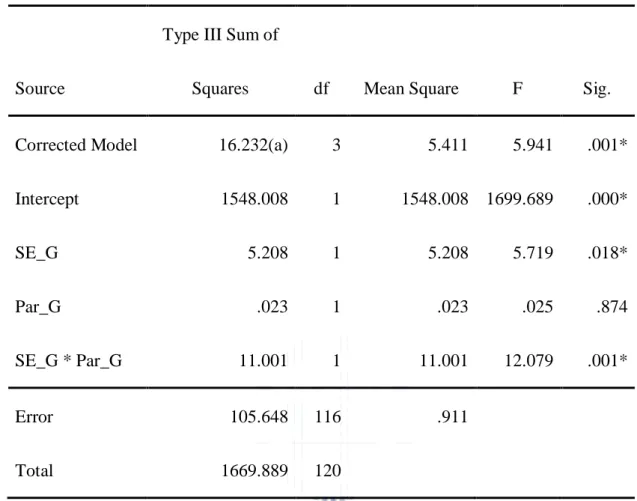
Table 11 indicated that self-efficacy and participation would have significant
interaction. And as in figure 5, in high participation, low self-efficacy would attribute for
the successful outcome to the firm more than low participation and high self-efficacy
would attribute the firm less. Thus, the Hypotheses 1a was supported but Hypotheses 1b
29
Table 9 Tests of self-efficacy and participation
Source
Type III Sum of
Squares df Mean Square F Sig.
Corrected Model 16.232(a) 3 5.411 5.941 .001*
Intercept 1548.008 1 1548.008 1699.689 .000* SE_G 5.208 1 5.208 5.719 .018* Par_G .023 1 .023 .025 .874 SE_G * Par_G 11.001 1 11.001 12.079 .001* Error 105.648 116 .911 Total 1669.889 120
Dependent Variable: attribute to firm
Note: Self-efficacy (SE_G)
30
4.4.2 Customer attribution of self for the successful outcome
As Hypotheses 1a and 1b, when the outcome is successful, high participation would
attribute the success to him/her self more no matter high or low self-efficacy. And
ANOVA was adopted to test these hypotheses.
Table 12 indicated that self-efficacy and participation did not have significant
interaction. As the figure 5, both high and low self-efficacy would take the credit in high
participation. Thus, both Hypotheses 1a and 1b were supported.
31
Table 10 Tests of self-efficacy and participation
Source
Type III Sum of
Squares df Mean Square F Sig.
Corrected Model 20.670(a) 3 6.890 5.998 .001*
Intercept 3141.633 1 3141.633 2734.892 .000* SE_G 17.633 1 17.633 15.350 .000* Par_G 2.904 1 2.904 2.528 .115 SE_G * Par_G .133 1 .133 .116 .734 Error 133.252 116 1.149 Total 3295.556 120
Dependent Variable: attribute to self
Note: Self-efficacy (SE_G)
32
4.4.3 Customer attribution of firm for the unsuccessful outcome
ANOVA was also used to examine whether participation and self-efficacy would
influence the attribution to firm in unsuccessful outcomes. Hypotheses 2a and 2b
suggested that when a service outcome is unsuccessful, people with higher participation
would blame the firm more if they possessed high self-efficacy and vice versa.
Table 13 showed that the interaction between self-efficacy and participation was
33
significant. And figure 6 indicated that with high participation and high self-efficacy,
customers would blame the firm more than with low self-efficacy. Therefore, both
Hypotheses 2a and 2b were supported.
Table 11 Tests of self-efficacy and participation
Source
Type III Sum of
Squares df Mean Square F Sig.
Corrected Model 44.069(a) 3 14.690 12.730 .000*
Intercept 1222.408 1 1222.408 1059.346 .000* SE_G 8.712 1 8.712 7.550 .007* Par_G 13.112 1 13.112 11.363 .001* SE_G * Par_G 22.245 1 22.245 19.278 .000* Error 133.856 116 1.154 Total 1400.333 120
Dependent Variable: attribute to firm
Note: Self-efficacy (SE_G)
34
4.4.4 Customer attribution of self for the unsuccessful outcome
As stated in Hypotheses 2a and 2b, when the outcome is unsuccessful, high
participation would attribute the failure less to him/her self in high self-efficacy and more
to him/her self in low self-efficacy. ANOVA was adopted to test these two hypotheses.
Table 14 indicated that self-efficacy and participation did not have significant
interaction. As the figure 7, both high and low self-efficacy would not blame themselves
in high participation. Thus, Hypotheses 2a was supported but 2b did not.
35
Table 12 Tests of self-efficacy and participation
Source
Type III Sum of
Squares df Mean Square F Sig.
Corrected Model 4.906(a) 3 1.635 1.821 .147 Intercept 3459.712 1 3459.712 3853.009 .000* SE_G .675 1 .675 .752 .388 Par_G 3.223 1 3.223 3.590 .061 SE_G * Par_G 1.008 1 1.008 1.123 .291 Error 104.159 116 .898 Total 3568.778 120
Dependent Variable: attribute to self
Note: Self-efficacy (SE_G)
36
37
Chapter 5 Discussion and Future Research
5.1 Discussion
Table 15 summarizes the results of hypotheses. H1a was supported and H1b was
partially supported. H1b was not supported when the dependent variable was attribution
to firm, but was supported when the dependent variable was attribution to self. H2a was
supported. H2b was partially supported. H2b was supported when the dependent variable
was attribution to firm, but was not supported when the dependent variable was
attribution to self. Details about each result of hypotheses were discussed as follows.
Table 13 Results of all hypotheses (summarized)
H1a: Supported H1b: Partially supported
H2a: Supported H2b: Partially supported
5.1.1 Participation, self-efficacy, and attribute to firm for the service outcome
The results of this study indicated that when outcome was successful, customers with
high self-efficacy would attribute less to firm in high participation than in low
38
attributed more to firm in high participation than in low. The reasons might be that those
people were not confident. Although the outcome was successful, they intended to
attribute such result to firm. Therefore, it gained a distinct result with hypotheses.
In the unsuccessful outcomes, the hypotheses was supported. For people with high
participation and high self-efficacy, they were confident in his/her ability so that the
outcome would be attributed externally. Customers might further blame the firm.
Customer with low self-efficacy would attribute the outcome internally for his/her high
participation and blame the firm less.
5.1.2 Participation, self-efficacy, and attribute to self for the service outcome
As a result, in successful outcomes, both customers with high and low self-efficacy
engaged in self-enhancing attribution that would take the credit and attribute the outcome
internally. And in unsuccessful outcomes, both customers with high and low self-efficacy
engaged in self-protective attribution that attributes the outcome externally and denies
responsibility for failure.
Summing up 5.1.1 and 5.1.2, attributions to firm and individuals are not always
reverse. They were elevated or decreased by the events independently.
5.2 Implications
39
When the public safety is well, people would take the credit regardless of their
self-efficacy. When the public safety is poor, people with high self-efficacy would lead
attribution to external but low self-efficacy wouldn't.
And this study indicated that those customers with high participation and low
self-efficacy would attribute service outcome more to firm when the service outcome is
successful. Firm should care those customers because they would have higher satisfaction,
repurchase intension and positive WOM after successful outcome.
This study also indicated that when a service outcome is unsuccessful, customers
with higher participation would blame more on firm for the outcome since they were high
self-efficacy type and blame less on firm for low self-efficacy types. When there was a
service failure, firm could make compensation more rapidly to those customers with high
participation and high self-efficacy in order to raise their satisfaction.
5.3 Limitations and Future research
The results of this study introduced some ideas to researchers and managers about
how customers make attributions, but still faced several limitations. First, 55.4 percent of
participants were students, whose perception might not be the same as other consumers
with distinct occupations. Seventy-five percent of participants were under 25 year old.
40
customers. To put this research into a more general sense, the data collection could cover
distinct age and occupation groups.
Second, this study was measured by questionnaires with established scenario. It was
convenient but not practically happened in the real world. To let the research more
understandable, the survey or field research can be used in the future research.
Third, the scenario used in this study was English cram school which belonged to
service industry. There were still many kinds of products and service that were not
verified in this study. In the future, they could be addressed in the further research.
Finally, the self-efficacy was adopted as moderating variable in this study and it
could really influence in that situation. There were some factors that also influenced the
attributions such as self-esteem. Those factors could also be addressed in future
41
Reference
Bandura, A. (1989), "Perceived Self-Efficacy in the Exercise of Personal Agency," The Psychologist: Bulletin of the British Psychological Society 10, 411-424.
Bendapudi, Neeli & Robert P. Leone (2003), "Psychological Implications of Customer Participation in Co-Production," Journal of Marketing, 67(1), 14-28.
Botti, Simon, & Ann McGill (2006), "When Choosing Is Not Deciding: The Effect of Perceived Responsibility on Satisfaction," Journal of Consumer Research, 33(2), 211-219.
Bouchamma, Yamina & Claire Lapointe (2008), "Success in Writing and Attributions of 16-Year-Old French-Speaking Students in Minority and Majority Environments," Alberta Journal of Educational Research, 54(2), 194-209.
Camgoz, Selin Metin, Oznur Ozkan Tektas & Irem Metin (2008), "Academic Attributional Style, Self-Efficacy and Gender: A Cross-Cultural Comparison," Social Behavior & Personality, 36(1), 97-114.
Cermak D.S.P., F.K. Mara, & R.A. Prince (1994), "Customer Participation in Service Specification and Delivery," Journal of Applied Business Research, 10(2), 90-98. Cermak, D.S.P., K.M. File, & R.A. Prince (1991), "Complaining and Praising in
Non-profit Exchanges: When Satisfaction Matters Less," Journal of Consumer Satisfaction, Dissatisfaction, and Complaining Behavior, 4, 180-187.
Chen, Gilad, Stanley M., & Eden, Dov (2001), "Validation of A New General Self-Efficacy Scale," Organizational Research Methods, 4(1), 62-83.
Dabholkar, Pratibha (1990), "How to Improve Perceived Service Quality by Improving Customer Participation," Development in Marketing Science, Academy of Marketing Science, 483-487.
Dabholkar, Pratibha A., & Richard P. Bagozzi (2002), "An Attitudinal Model of Technology Based Self Service: Moderating Effects of Consumer Traits and Situational Factors," Journal of the Academy of Marketing Science, 30(3), 184-201.
Dixon, Andrea L., & Maqbul Jamil (2001), "Successful and Unsuccessful Sales Calls: Measuring Salesperson Attributions and Behavioral Intentions," Journal of Marketing, 65(3), 64-78.
Dixon, Andrea L., Rosann L. Spiro, & Maqbul Jamil (2001), "Successful and Unsuccessful Sales Calls: Measuring Salesperson Attributions and Behavioral Intentions," Journal of Marketing, 65(3), 64-78.
Dixon, Andrea L., & Susan M.B. Schertzer (2005), "Bouncing Back: How Salesperson Optimism and Self-efficacy Influence Attributions and Behaviors Following
42
Failure," Journal of Personal Selling & Sales Management, 15(4), 361-369.
Ennew, C.T., & M.R. Binks (1999), "Impact of Participative Service Relationships on Quality, Satisfaction and Retention: An Exploratory Study," Journal of Business Research, 46(2), 121-132.
Erickson, Darin J., & Krull, Douglas S. (1999), "Distinguishing Judgments about What from Judgments about Why: Effects of Behavior Extremity on Correspondent Inferences and Causal Attributions," Basic and Applied Social Psychology, 21, 1-11.
Hedrick, Natalie, Michael Beverland, & Stella Minahan (2007), "An Exploration of Relational Customers' Response to Service Failure," Journal of Service Marketing, 21(1), 64-72.
Kelley, Scott W., James H. Donnelly Jr., & Steven J. Skinner (1990), "Customer Participation in Service Production and Delivery," Journal of Retailing, 66(3), 315-335.
Klein, J., & N. Dawar (2004), "Corporate Social Responsibility and Consumers' Attributions and Brand Evaluations in a Product–Harm Crisis," International Journal of Research in Marketing, 21(3), 203-217.
Mallin, Michael L., & Michael Mayo (2006), "Why Did I Lose? A Conservation of Resources View of Salesperson Failure Attributions," Journal of Personal Selling & Sales Management, 26(4), 345-357.
Mattila, A.S., & D. Cranage (2005), "The Impact of Choice on Fairness in the Context of Service Recovery," Journal of Service Marketing, 19, 271-279.
Mattila, Anna S., & Paul G. Patterson (2004), "The Impact of Culture on Consumers' Perceptions of Service Recovery Efforts," Journal of Retailing, 80(3), 196-206. Maxham, J. G. & Netemeyer, R. G. (2002), "Modeling Customer Perceptions of
Complaint Handling Over Time: The Effects of Perceived Justice on Satisfaction and Intent," Journal of Retailing, 78(4), 239-252.
Maxham, J. G. (2001), "Service Recovery's Influence on Consumer Satisfaction, Positive Word-of-Mouth, and Purchase Intentions," Journal of Business Research, 54(1), 11-24.
Maxham, J. G., & R. G. Netemeyer (2002), "A Longitudinal Study of Complaining Customers' Evaluations of Multiple Service Failures and Recovery Efforts," Journal of Marketing, 66(4), 57-71.
McAuley, E., T. E. Duncan, & M. McElroy (1989), "Self-Efficacy Cognitions and Causal Attributions for Motor Performance: An Exploratory Investigation," Journal of Genetic Psychology, 150, 65-73.
McCollough, Michael A., L. Berry Leonard, & S. Yadav Manjit (2000), "An Empirical Investigation of Customer Satisfaction after Service Failure and Recovery,"
43 Journal of Service Research, 3(2), 121-137.
Meuter, Matthew L., and Mary Jo Bitner (1998), "Self-Service Technologies: Extending Service Frameworks and Identifying Issues for Research," in AMA Winter Educators' Conference, Chicago: American Marketing Association, 12-19.
Mueller, Pallas & Major Brenda (1989), "Self-Blame, Self-Efficacy, and Adjustment to Abortion," Journal of Personality and Social Psychology, 57(6), 1059-1068.
Rachmana, S., Dana S. Thordarsona, Roz Shafranb & Sheila R. Woody (1995), "Perceived Responsibility: Structure and Significance," Behaviour Research and Therapy, 33(7), 779-784.
Silver, William S., Terence R. Mitchell, & Marilyn E. Gist (1995), "Responses to Successful and Unsuccessful Performance: The Moderating Effect of Self-Efficacy on the Relationship between Performance and Attributions," Organizational Behavior and Human Decision Processes, 62(3), 286-299.
Smith, Amy K., Ruth N. Bolton, & Janet Wagner (1999), "A Model of Customer Satisfaction with Service Encounters Involving Failure and Recovery," Journal of Marketing Research, 36(3), 356-372.
Stajkovic, Alexander D., & Steven M. Sommer (2000), "Self-Efficacy and Causal Attributions: Direct and Reciprocal Links," Journal of Applied Social Psychology, 30(4), 707-737.
Weun, Seungoog, Sharon E. Beatty, & Michael A. Fones (2004), "The Impact of Service Failure Severity on Service Recovery Evaluations and Post-Recovery Relationships," Journal of Service Marketing, 18, 133-146.
Wirtz, Jochen & Anna S. Mattila (2004), "Consumer Responses to Compensation, Speed of Recovery and Apology After a Service Failure," International Journal of Service Industry Management, 15(2), 150-166.
Wood, Robert E., & Albert Bandura (1989), "Impact of Conceptions of Ability on Self-Regulatory Mechanisms and Complex Decision Making," Journal of Personality and Social Psychology, 56 (3), 407-415.
Yale, Laura J., & Mary C. Gilly (1995), "Dyadic Perceptions in Personal Source Information Search," Journal of Business Research, 32(3), 225-237.
Yen, HsiuJu Rebecca, Kevin P. Gwinner, & Wanru Su (2004), "The Impact of Customer Participation and Service Expectation on Locus Attributions Following Service Failure," International Journal of Service Industry Management, 15(1), 7-26. Yi, Youjae, & Taeshik Gong (2008), "The Electronic Service Quality Model: The
Moderating Effect of Customer Self-Efficacy," Psychology & Marketing, 25(7), 587-601.
44
APPENDIX I
Scenarios in Chinese 情境 A 為了能順利通過大學畢業審查,你將參加上述的英文檢定考試並報名英語補習 班的課程。 課程期間,你每次都出席上課,認真做好預習及複習,也會主動問老師問題。 最後你參加考試,成績並不理想,沒有達到學校規定的標準。 情境 B 為了能順利通過大學畢業審查,你將參加上述的英文檢定考試並報名英語補習 班的課程。 課程期間,你常常缺席,並沒每次都預習及複習,也很少和老師互動。 最後你參加考試,成績並不理想,沒有達到學校規定的標準。45 情境 C 為了能順利通過大學畢業審查,你將參加上述的英文檢定考試並報名英語補習 班的課程。 課程期間,你每次都出席上課,認真做好預習及複習,也會主動問老師問題。 最後你參加考試,成績通過及格門檻。 情境 D 為了能順利通過大學畢業審查,你將參加上述的英文檢定考試並報名英語補習 班的課程。 課程期間,你常常缺席,並沒每次都預習及複習,也很少和老師互動。 最後你參加考試,成績通過及格門檻。
46
APPENDIX II
Examples of English test
High self-efficacy:
1. It's eight o'clock now. Sue in her bedroom. (A) study
(B) studies (C) studied
(D) is studying
2. After we ate the fried chicken, our fingers were oily, so we asked the waitress for more _______.
(A) napkins (B) packages (C) orders
(D) menus 3. Jack worked at the restaurant last year, but he doesn’t work there _______.
(A) again (B) anymore (C) anywhere
(D) anyway
47
Low self-efficacy:
1. There was an oddly _____ inflection to his speech, some said, a sense of merely going through the motions.
(A)roguish (B)lackadaisical (C)mellifluous (D)acerbic
(E)reserved 2. The two reputable hydro geologists drafted some highly optimistic projections-with
the ______that these were speculative and should of course be tested. (A)caveat
(B)analysis (C)hypothesis (D)précis
(E)imprimatur 3. Although Johnson's and Smith's initial fascination with the fortunes of those jockeying
for power in the law firm _____after a few months, the two paid sufficient attention to determine two their lunch partners should be.
(A)revived (B)emerged (C)intensified (D)flagged
(E)persisted
48
APPENDIX III
Taking Scenario A and high self-efficacy for example 您好: 非常感謝您撥冗回答以下問題,您的回答對我們的研究將有極大的幫助。 本研究目的在於了解消費者對服務的看法。我們會請您先讀一小段情境故事,再請 您針對故事情境回答問題。本問卷約六分鐘可以完成,採不記名方式,所有資料僅 供學術研究之用,絕不對外公開,請您安心作答。衷心感謝您的合作! 敬祝 健康快樂、萬事如意 國立交通大學管理科學研究所 指導教授:張家齊 博士 學生: 莊淑涵 敬上 這份問卷共有三個部分。在第一部份中,您會先閱讀三題英文檢定例題, 並請根據自己的感受回答幾個問題。第二部分是一段有關於英文檢定考試的情境, 在閱讀情境故事時,想像自己就是故事中的主角,我們將會詢問您一些跟情境故事 相關的問題,請您以故事主角的立場去回答這些問題。最後在第三部分中,請您留 下您的個人資訊。謝謝您! 第一部分—英文檢定例題
你所就讀的大學規定學生要取得畢業資格,必須通過某英文檢定。
以下是該英文檢定官方網站中所公布的三題英文例題。請您試著作答這
三個問題,您不一定需在問卷上寫下你的答案,我們將在題目最後公布
正確解答。
1. It's eight o'clock now. Sue in her bedroom. (A) study
(B) studies (C) studied
(D) is studying
2. After we ate the fried chicken, our fingers were oily, so we asked the waitress for more _______.
(A) napkins (B) packages (C) orders
49
(D) menus 3. Jack worked at the restaurant last year, but he doesn’t work there _______.
(A) again (B) anymore (C) anywhere (D) anyway 以上三題的答案是: 1.(D) 2.(A) 3.(B) 1. 針對上述例題,我答對了幾題? 1 2 3 請依照自己試答完上述英檢例題後的感受,回答下列問題。 非 常 不 同 意 不 同 意 有 點 不 同 意 沒 意 見 有 點 同 意 同 意 非 常 同 意 1 2 3 4 5 6 7 2. 我對通過上述英文檢定很有信心 3. 我能答對大部分與上述例題同等難度的試題 4. 我有信心在此英文檢定中得到好成績
為了通過此英文檢定,你思考是否參加補習班專為此英文檢定所開
設的課程。
請依照過去您參加英文補習的經驗,以及此次英檢的難度,回答下列問題。 1. 我覺得自己學習英文的能力很好 2. 我相信自己能吸收此英檢補習課程中老師所教授的 內容 3. 我相信自己參加此英檢補習課程的學習效果比其他 同學好50 第二部分—情境故事 在這個部分裡,您會讀到一段有關服務失敗的情境故事,在閱讀情境故事時, 請想像自己就是故事中的主角。
為了能順利通過大學畢業審查,你決定參加上述的英文檢定考試並
報名英語補習班的課程。
課程期間,你每次都出席上課,認真做好預習及複習,也會主動問
老師問題。最後你參加考試,成績並不理想,沒有達到學校規定的
標準。
請您逐一回答下列題目: 1. 對於考試的結果,我覺得補習班跟自己需要負責的比例是: 補習班 0% 10% 20% 30% 40% 50% 60% 70% 80% 90% 100% + 自己 0% 10% 20% 30% 40% 50% 60% 70% 80% 90% 100% + 運氣 0% 10% 20% 30% 40% 50% 60% 70% 80% 90% 100% =100% 非 常 不 同 意 不 同 意 有 點 不 同 意 沒 意 見 有 點 同 意 同 意 非 常 同 意 1 2 3 4 5 6 7 2. 對於考試成績不佳,我覺得補習班要負大部分責 任 3. 對於考試成績不佳,我覺得是補習班的錯誤 4. 對於考試成績不佳,我會責怪補習班 5. 對於考試成績不佳,我覺得是自己的錯 6. 對於考試成績不佳,自己應該要負責 7. 對於考試成績不佳,我會責怪自己 8. 我考試成績不佳,是因為運氣的關係 9. 我會向朋友抱怨這間補習班 10. 當我的朋友在尋找類似服務時,我會告訴他們不 要到這間補習班 11. 我會告訴親戚或朋友,不要到這家補習班補習 12. 我願意再來這間補習班上課51 13. 我會再來這間補習班上課的可能性很高 14. 下次如果我要補英文,我會選擇這間補習班。 15. 我對這間補習班所提供的服務感到滿意 16. 我感到高興我選擇了這間補習班 17. 對這間補習班我的正面經驗高於我的負面經驗 18. 我認為我參與課程程度高 19. 我覺得我在課程中沒有參與感 20. 故事中類似的情況是有可能發生的 21. 發生描述的故事是可能在真實世界中發生的 第三部分—個人資料 請根據您的個性與實際經驗來回答下列問題: 非 常 不 同 意 不 同 意 有 點 不 同 意 沒 意 見 有 點 同 意 同 意 非 常 同 意 1 2 3 4 5 6 7 1. 我相信自己種了什麼因,就會得到什麼果 2. 要讓下屬把事情做好,要看管理者的能力,和運 氣沒有關係 3. 我訂了計畫,都能確定我能使這些計畫成功 4. 請問您是否曾補過英文? 有 沒有 5. 請問您是否曾為了英文檢定而補習? 有 沒有 6. 請問您補習英文的經驗大約多久? 1 年以內 1~5 年 5~10 年 10~15 年 15~20 年 20 年以上 請提供您的個人基本資料 1. 性別 男 女 2. 年齡 15 以下 16~20 21~25 26~30 31~35 36~40 41~45 46~50 51 以上 3. 最高教育程度 國中或初中 高中、高職 專科 大學或學院 研究所以上 4. 請問您目前的職業 軍、公、教 資訊科技 工商、貿易 農林漁牧業 服務業 家管 學生 其他______________