L_--_
= - = - = - - - - _ •~
_ _mt
:.~ ~..
mDDEI
~ ~ ~
M
~-
~-&i- §;
r~ t~ f~LJWif
~FiT
~m
t±l * ErJ
*~ ~ffijif
~Q ' ~ ~;~2;f§ IUl if
~ftf f!
Me if
~ ~Ijr'§1 H
t~if
~,
'E]JiS M
~, *Ii
*~,
ft: I '
;fH~, m
f~ ,7\';
~,
~m '
~ ~,
~;.m ~71'&'±
~ t~ f~LJ ~if
~,
~if~mi5fl~o~=
FiT~ 0, - - - - _=iIIIlit-'--",/iA./filli\.
fJi!
W"jH
ibi@M'i
IIP.iYl • • · .1116
19IJ
~o' EI3 * $ IG ffi
IH~ &~M
~iI:m
,~f*
~iIi:S€H
t~*-
~ ~~:C* $ IG
~f''F
2
§th ft: fll!l Ii
~mill
~ ~h
§th~~.,~~~=~tl~.&~~~~~m'±~~®;~~~~.&~thm.~m~if~;%~~
fli~ 't~ffiIJ~'&~~@~~~l!!~~~fl~~mif~
;
t~ffiIH~/Ul!!~~'& l/ofi'lID~m~~if~;
fu;~IJ~71~mn~~~7\';~if~;~~tlrt'&**flifflm~~~~~~ErJlith.&m~
• •
~w~~;.mmif~o~~if~~~~tl*W~'if~~~~mmif~.~u.~m#.~'$~~
•
•
if~ffl~W
~ ~811'!ij
~, T;m
~Ij ~.if
if
~ t'~' §81
~M fr
*~0 i:i] ,jJ1
~ ~i§5l:
t~I'!ij
~.j!j' ~Mif
~Q ~ ~'1'1
;~IHitWif ~ ~f,~~it,~~
I
f''F
0 ft~tl ~~,
7\';~,& *~"&fi~if ~Q81~~~,
~ Bl.l~IJ 7'c;m~~81
*_'m~IUl~~#tl~~~Mif~ErJfliffl~'m~tl~~§;~~'~WU~~Mif~~m~~
*~JiH~~ ~~
,
~ogM~mJ3. f*§t;fH~iWi;.mi§;f§ ~~ ~f,~~it,~,
g ,*,~WA ~~'±ft:&fli;f§mi5-&i- '
~lit ii!,~lID
~f, ~Jg ~i'i ±~ t~ f~LJ ~-&i- 81 roo' 1m
0 lit7i- ' EI3 m
~ ~ ~Mif
~ ~ ~j-' ;§;
f~81
~~'1'1 ' no
~ ~ ~IJ.g.
;II
~~UM if~*JH~*/J\ErJ~~W
'
~Jl:Uttm%fl~~ttf*§t~;n81iWi*_*l.l-~m~;~mf~,
ft~~.g..~~m.~ErJ~~HU~~MErJ~~~~~#~~~,tlmoo~*w~§m'~A
• •
~U~~N 0
Ii1iH~.t~
,
mtm2¥~~
~
pg
~~§; f!
~if
~ I'!ij~ttl
mfh%'& §t
~l~;mA m nD {;
f@:f~r'§1 81
Ii
~ ~Mif
~ tEHif~1N
*-
81
~rn,m~3~®M~*MErJ~~'
• •
ErJ'±~~~,m~M.&m~~~&m~m~~~~m~~~M'~~3~§;W.~M,ft~~~o~~W~®=~~~.~AIi~~MM~ErJI'!ij~'~~2
ifQ~di~i,g:-&i-~pg.&~t~U~~M;!m81~*
(
~pgGVP' ~~FDA510k' 21CFR820 '
1-:1-.&~tMIS013485 ,CE mark)
,jJ1llr~:fIJ;.mi§if~Q~mM81,~~~LiTH~' f~~mth~pg'Jj~~Mif~81~il:m'
t~A
~~m [9~81F¥lHr'§1 ti~ ~U~~M if~§~#l'~.g.~ff~§t.'
~~:C~JiI
~~ff~~iI:m
$/G~.Ilfrr~~$mW&~~tlWM-~~aDJ ,~~.~o~~.~;n~'
• •
FDA§t~~~if~• •
W~i§Jiij~§c~;f§
U;!m3Z:f* ' 1-:1-.&
t!tW%~;f§ ~ 2;!*.Il..&f~. 0 ~II
I~~ff~~iI:m
$/Gtlm~~g~t~f~LJ
=815l:tifT ' tl
r'§1iLi*g~.& .g.~U~#l'=~~~ ,*,~'1181~<a~1iJa 0 ' j:~f~ ~ jf81~~HH;!mWif~&m~tlErJ~~'fflM~~~~~~.~m~~
• • • •
~V~~mjJ1M~%if~~m~--/Glli~*~~~Ag.HM~.~ma~"~~~~~~.~g*MU~~HM.·~~
:re:
~m ~ ~x ~;
*
~Ji. e~Mf
~.
l.§ffl
~iS8iJ
~ ~ ~ ~~"iiI
tZh M
~im
:f±
~ ~8nt
~ ~~ ~1§' ~~Em
7t
J
WH§
~~;
*
~Ji. e~ ~R
iM . rni 5i!
~;
1*
e~;I
H
t
0~HIll~*H~*~$ ~~~t5
(
*~±.ll:http://www.ksmd.o rg.tw/ ) 0_ N1
.
..
....
,..
..
.-
• l..., .... "**~~
EI3
M~~:¥; ~A
[::J=1'IWi±1:
no
.
7t!t£~~:¥;1te~~Bt.;tIltlHt.
tH~±l!!in: '
t±~*Wf~It
~~ ~1-;)'i±
rEJ
0:¥;
~A
~ ~ ~ f~1m:¥; 1 t
§t ~'I'~'11
~Ir-J
w.~W
.
"iiI tib§
~ g~ i~ ~ ~ ~~ ~.
~!it~Mfi~"~~.*=1'IWi~~ o ~~ · EI3M~~~~*.~~ · ~M~.~.~~*&U
*UrEJ
.
g.i~iHlle~m*W~It!m±~&*it~~~e~~:re:' 2004
-
20
10~~Inl.HMm±~~ft~~Effiffl·~~m~H.~~ ' ~~~~w§.·g~£~~~~~~~·w£**
m~~rEJ~:re:$~~£~ffl o U~.~*.·EI3Mft~~.HM§M.~:f±~~m~~~
~;~JJ~~
.
~ltt~'~.lU~~'~~r'iJ
U~iCmrEJ
Il'~ ~~ :ttiH~*~~~tt1JDfJtiiI ~~iCm 0rEJ
Il'~ ~~)1~jif.j
:*:
~W' m
i~ .:f-1~LjH
~iitW
f~A %J '
1-;)'hZ
Ii
~w.Hlt
hZ
~1 t
.ffi
;~IJi~H
o
g
~ w.~ilt
~ ~m
t~:m
CT
,
Mil
' PET~~£.~~~ ' %JI!hZJ'C~~lIJ..e~~~~Wi~~-g-.
ffi]U~iC~~1tHUIjf~Hfllj~~~UhZi~t~~~~a~~-g-
.
:t1Hg1J~~~~~1ie~~£ 0 ~-rilje~~~IIH~Ui£~DiiiJ~~~*m~~~~~~~Wla~.~~fi~-g-·~.mm-B~~~~.rt'~mH~~£
Jl~IJ~iiI1t§f~
.
~~HM~m~lil~a~-@ii!jJ.
~iH~~Jll;~I!$~~**JCf~t~.'
)1;f1T
,
i;Uj1;j~m~f.fta~*JC~t~n.
=1'fl~ MM~~ffl~1J.
ffi].§.iitiU1H#
~rEJ
.1te~@A
U
.
~~~ 0 5.2%
M.
2,5001~
2,000 -12
1,500 r ~ :7C 1,000 500 o . 1,915 2,016 1,643 1,729 1 ~0 r--1~5 1,5261
1
2004 2005 2006 2007 2008 2009 201 0 q:Allying with Fooyin for a B
er Fu ure
Creating Taiwan's Next Trillion-Dollar Industry
.
"Unpowered 5urgicaiiooiS Powered
Radiotherapy equipment
Physiotherapy equipment
surgical tools
Dialysis equipment
Structure of the Medical Devices Industry
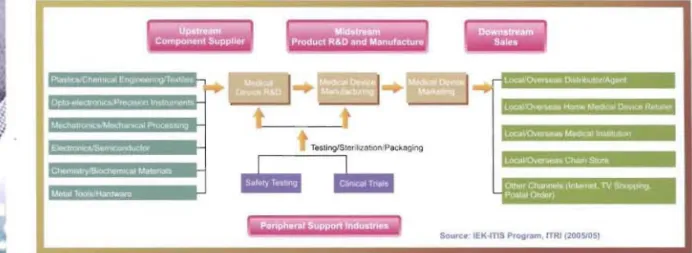
A medical device is a terminal product that integrates multiple technologies and industries. Related industries encompass everything from conventional industries to high tech industries, including plastics, textiles, chemical engineering, materials, machinery, opto-electronics, mechatronics, electronics, information & communications technology (ICT) and biotechnology. The industry is structured as shown in Figure 3.
SOl.lrc~ ' IEK·ms Program, ITRI (2005105)
Figure 3. Structure of the Medical Devices Industry
For example, at Fooyin University, the MIRDC's strategic development partner commissioned the MIRDC to build an automated circulatory Tumor cell chip-based analyzer that uses biotechnology for its sample processing and testing principles; the main body of the device, as well as its moving components, comes from the mechanical
industry; sensors, controllers and electrical circuits come from the electrical engineering
industry; the core controller hardware and I/O interface belong to the electronics industry;
the test signal acquisition system comes from the opto-electronics industry; and the
control program as well as the interactive/message transfer components intended for use with future long-distance home care belong to the ICT industry.
If classified according to the product production process, the upstream part of the
supply chain consists of critical component suppliers; the midstream consists of product
R&D and manufacturers; while the downstream consists of medical device marketing
companies. There are also peripheral support vendors that provide safety testing and clinical trials for medical devices. While Taiwan has reached developed nation status
when it comes to the manufacturing of electronics, opto-electronics and precision
instruments, many bottlenecks still remain in the application of these components within
medical devices. These bottlenecks tend to be due to the stricter regulation of medical devices, such as the requirement for clinical trials of components and materials. Human
biochemical reactions must also be taken into account, so these reactions represent
challenges for trans-disciplinary integration of technologies. Medical device products are
also characterized by low volume and high variety. Due to the relatively small size of the medical material industry in Taiwan, the economies of scale simply do not exist for many parts or raw materials. Even upstream electronic component manufacturers for electronic
medical devices that enjoy a development advantage in Taiwan have expressed limited
Assistance Platform for Medical Device Certification
Many businesses in conventional industries in Taiwan are very interested in upgrading or transforming their business to enter the medical devices industry due to its high additional value . But beyond the higher technical requirements, the complexities of regulations governing the validation of biological safety and efficacy in pre-clinical and clinical trials take a lot of time to understand. Some businesses become confused by the plethora of regulations and give up.
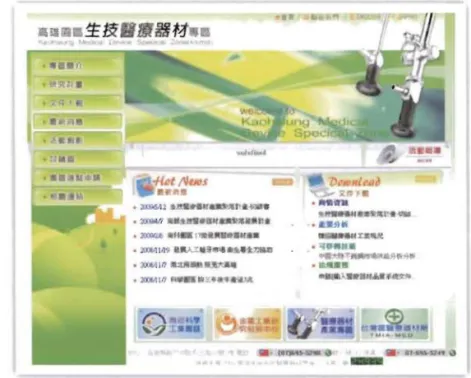
The Department of Industrial Technology (DOlT) Ministry of Economic Affairs' (MOEA) of wishes to support businesses interested in developing products that conform with domestic and Western medical device regulations (GMP in Taiwan, FDA 510K and 21 CFR820 in the United States, and IS013485 and CE Mark for the European Union) and successfully pass the pre market validation process. To this end, the DOlT has been actively supporting the development of the domestic medical device industry and, at the Kaohsiung Campus of the Southern Taiwan Science Park, launched a 4-year R&D project for a medical devices industry service platform. The MIRDC was commissioned to set up a "Single Support Window for Regulatory and Validation Process" and establish an expert consultant database for collating legislation related to FDA or CE product review and manufacturer registration . The database also serves as a repository for related legislation and standards from all around the world . With the support of DOlT, MIRDC has set up regular support windows at its Kaohsiung headquarters and Taipei office to provide free consultation services for medical device legislation and product validation process. This is expected to shorten the amount of time businesses must spend under complex and strict medical legislation so as to shorten their time to market. Currently, relevant personnel are also being trained to provide product validation services similar to those of the FDA or CEo In recent years, the MIRDC has been actively involved with medical device R&D and assisting many conventional businesses upgrade and enter the medical device industry. With its extensive research of European and American legislation, this consultation service will help businesses understand the regulatory constraints during the product design & development phase and avoid wasting resources. For more information, please consult the Special Zone website (URL: http://www.ksmd.org.tw).
~
..
"
.
• &Hili
•••u:.u
.
"'
.
..
.
.
• 2fOO1 1,19 ~":Smil_~ ...F _...IHhllli
• X(Mln .:UI _ .
.
....
... \IIItJUI,u
• ~lll na .~..."..
9 or Ilue. the
e
to up. of and ited :>re lent 'Ian Irm. 3nd tted s a t of ipei lion Ilex nel . In ing its elp ~ntFuture Prospects
The aging global population means that the socio economic status and social participation of the aging population are now higher than ever. This is particularly evident among the baby boomer generation. As a result of age or chronic illness, old people may become handicapped, so the demand for mobility aids has
continued to increase. At the same time, improvements in economic circumstances mean that the population's expectations of medical standards are on the increase as well. The
demand for medical care has therefore grown steadily. Figure 5 illustrates the output of
the global devices market from 2004 to 2010. Products such as medical cosmetics, home
nursing and care or even remote bio-monitoring are all areas where high growth rates
can be expected in the future. From an industry perspective, as Taiwan's medical devices
industries are mainly concentrated in home bio-monitoring products, future development
must be directed towards high-end hospital products in order to boost their overall added value. The two main categories in high-end hospital products are surgical implements and implants as well as medical imaging and biochemical testing instruments. Medical
imaging products, such as CT, MRI and PET, require trans-disciplinary integration of
medical, physics and optical expertise. The development of biochemical testing instruments for hospital use, on the other hand, requires the integration of biomedical and micro-electro-mechanical-system expertise. Another approach to development is to leverage home bio-monitoring products with Taiwan's advance in the ICT industry to set up a new business model. This will realize the goal of high added value for existing products and make devices a part of the overall service. The biometrics can also be
systematically collected , analyzed and collated into valuable statistical data that may not
only help with disease prevention but also offer a higher quality of personalized medical service . 5.2% 0 2,500 tJ) ::l c: 2,000 ~ 1,500 ~ 0 1.000 0 -~ 1.915 2.016 1~9
1
/E
0
n
~ 1f r 1~26 1.643 ...-
500 c: ::l 0•
L...L. L.J 2004 2005 2006 2007 2008 2009 2010SO\IfW' Ep.socom BUiinesJ; rnlOl1lae1"C8 (200S}; Ifl< , ITRI (2006,1 12)