國立交通大學
應用化學研究所
博士論文
含1,2,3-三氮唑液晶化合物及多苯環芳香族亞醯胺衍生
物之合成與分子自組裝及其在有機薄膜電晶體之研究
Synthesis and Self-assembled Nanostructures of
1,2,3-Triazole Liquid Crystals and Polycyclic Aromatic
Diimide Derivatives for the Organic Thin-Film
Transistors Application
研究生:何敏碩 Ming-Shou Ho
指導教授:許千樹 博士 Dr. Chain-Shu Hsu
含1,2,3-三氮唑液晶化合物及多苯環芳香族亞醯胺衍生物之合
成與分子自組裝及其在有機薄膜電晶體之研究
Synthesis and Self-assembled Nanostructures of 1,2,3-Triazole
Liquid Crystals and Polycyclic Aromatic Diimide Derivatives for
the Organic Thin-Film Transistors Application
研 究 生:何敏碩 Student:Ming-Shou Ho 指導教授:許千樹 博士 Advisor:Dr. Chain-Shu Hsu
國 立 交 通 大 學 應 用 化 學 系
博 士 論 文
A Thesis
Submitted to Institute of Applied Chemistry National Chiao Tung University in partial Fulfillment of the Requirements
for the Degree of Doctor of Philosophy
in
Applied Chemistry October 2009
Hsinchu, Taiwan, Republic of China
含1,2,3-三氮唑液晶化合物及多苯環芳香族亞醯胺衍生物之
合成與分子自組裝及其在有機薄膜電晶體之研究
學生: 何敏碩 指導教授: 許千樹 博士 國立交通大學 應用化學系 博士班 摘要 本論文主要是研究小分子和聚合物的分子自組裝。第一部分利用 click chemistry合成含1,2,3-三氮唑液晶化合物並探討其分子自組裝 奈米結構。第二個部分則合成多苯環芳香族亞醯胺衍生物並應用在溶 液製程傳電子有機薄膜電晶體上。 本 研 究 第 一 部 分 , 合 成 一 系 列 包 含4-[1,2,3]-triazolephenyl 4-alkoxybenzoate 液晶基團及β-D-galactopyranoside親水基醣類的新 穎掌性兩性液晶化合物。所有所合成的化合物皆具有chiral smectic A 液晶相,且這些小分子兩性化合物在水溶液中自組裝聚集,藉由增加 疏水尾端的碳鏈長度,其型態由平板狀到螺旋形態。另外利用click chemistry結合2-azidoethyl-2,3,4,6-tetraacetyl-β-D-galactopyranoside 及 1-biphenyl-acetylene 4-alkynyloxybenzoate的三個含醣乙炔單體也被合成,所得的單體利用WCl6-Ph4Sn聚合成側鏈液晶聚乙炔。所有的單體
與聚合物都具有chiral smectic A液晶相。單體在水溶液中自組裝也是 隨著增加疏水尾端的碳鏈長度,其型態由平板狀到螺旋形態。此外, 這些螺旋的結構可以在摩擦的PI配向膜上規則排列。在聚合物自組裝 方面,含醣液晶聚乙炔,成功於THF和甲醇的co-solvent 系統自組裝 形成helical cables的螺旋結構。 本研究第二部分主要致力於發展可溶性且在空氣中是穩定的傳 電子有機半導體。這系列合成由四個不同平面大小的苯環芳香族中心 核及四個含氟側鏈取代基所組成的二十個有機半導體,並探討不同中 心核大小,含氟側鏈取代基與柔軟鍊長短對電荷遷移率的影響。電晶 體採用 top contact/botton gate,有機半導體利用旋轉塗布成膜在利用
hexamethyldisilazane (HMDS)修飾的 SiO2/Si wafer 上,並於氮氣下與
一般大氣下量測其電晶體特性。P(1)、P(2)和 P(3)的電子遷移率分別 是4.71×10⁻⁹, 1.03×10⁻⁸, and 4.3×10⁻⁸ cm2V-1s-1 ,隨著柔軟鏈的增長, 電子遷移率增加。P(-)和 PCl(-)在氮氣下的最佳電子遷移率分別是
3.88×10⁻⁴ and 5.31×10⁻⁴ cm2V-1s-1。然而只有 PCl(-)在空氣中有較佳的
Synthesis and Self-assembled Nanostructures of 1,2,3-Triazole
Liquid Crystals and Polycyclic Aromatic Diimide Derivatives for
the Organic Thin-Film Transistors Application
Student: Ming-Shou Ho Adviser: Dr. Chain-Shu Hsu Institute of Applied Chemistry
National Chiao Tung University Abstract
The goal of this research is to study the self-assembly of small molecules and polymers. The first part of this study is focused on the synthesis and self-assembled nanostructures of 1,2,3-triazole liquid crystals via click chemistry. The second part is to study the synthesis of polycyclic aromatic diimide derivatives and their application on the solution-processed n-type organic thin-film transistors.
In the first part, a series of novel chiral amphiphilic liquid crystals, which contain 4-[1,2,3]-triazolephenyl 4-alkoxybenzoate mesogens and β-D-galactopyranoside end-group, were synthesized. All obtained compounds were exhibited a chiral smectic A phase. The self-assembling behavior of these liquid crystal amphiphiles in the solution, which exhibited high segregation strength for phase separation, was studied by electron microscopy. The morphological transformation of self-assembled chiral amphiphilic liquid crystals, from a platelet-like morphology to helical twists, was obtained by increasing the length of the hydrophobic alkyl tail. In addition, three kinds of chiral saccharide-containing liquid crystalline acetylenic monomers were prepared by click reaction between
2-azidoethyl-2,3,4,6-tetraacetyl-β-D-galactopyranoside and 1-biphenyl- acetylene 4-alkynyloxybenzoate. The obtained monomers were polymerized by WCl6-Ph4Sn to form three side-chain LC polyacetylenes.
All monomers and polymers show a chiral smectic A phase. Self-assembled hiearchical superstructures of the chiral saccaride-containing LCs and LCPs in solution state were studied. Due to the LC behavior, these molecules exhibit a high segregation strength for phase separation in dilute solution. The self-assembled morphology of LC monomers was dependent upon the alkynyloxy chain length. Increasing the alkynyloxy chain length caused the self-assembled morphology to change from a platelet-like texture (K6E) to helical twists morphology (K11E and K12E). Furthermore, the helical twist morphological structure can be aligned on rubbed polyimide layer to form two dimensional ordered helical patterns. In contrast to LC monomers, K11P was self-assembled into much more complicated morphologies, including nanospheres and helical nanofibers. These nanofibers are evolved from the helical cables ornamented with entwining nanofibers upon natural evaporation of the solution in a mixture with a THF/methanol ratio of 3:7.
The second part of the work is mainly devoted to the development of new soluble and air-stable n-ytpe semiconducting materials. The synthesis and comprehensive characterization of 20 organic semiconductors comprised of four different sizes of polycyclic aromatic cores and five different fluorinated substituents are described. The influences of the structural modifications of the fluorinated substituent, spacer and central core on the charge mobility were examined. Top contact/botton gate organic thin film transistor devices were constructed
by spin-coating process of these derivatives on SiO2/Si wafer that had
been pretreated with hexamethyldisilazane (HMDS). The electrical characterization of all devices was accomplished in a nitrogen atmosphere as well as in air. The mobilities of P(1), P(2) and P(3) were measured to be 4.71×10⁻⁹, 1.03×10⁻⁸, and 4.3×10⁻⁸ cm2V-1s-1, respectively. With longer spacer inserted between perylene core and fluorinated dendrons, the mobility is increased. The highest mobilities of P(-) and
PCl(-) are 3.88×10⁻⁴ and 5.31×10⁻⁴ cm2V-1s-1, respectively, as measured
in the glove-box. However, only PCl(-) shows good OTFT behavior and comparable mobility of 3.61×10⁻⁴ cm2V-1s-1 as measured in air. The result demonstrates that Cl4-PTCDA core (perylene with 4 chloro substituents) can serve as a good candidate for OTFT.
謝 誌
時光荏苒,隨著論文的付梓,最無憂的學生角色即將畫上句點。 本論文得以完成,完全承蒙恩師許千樹老師這些年來的細心指導與教 誨,不論在研究的方向、觀念的啟迪與科學態度上都給我深刻的啟 發,而在為人處事方面也讓我受益良多。尤其在投稿論文撰寫期間老 師不厭其煩地逐字逐句修改,耐心地指正,以及兩次到美國進行交換 研究,都在老師的教導與支持下圓滿完成,於此獻上最崇高的敬意與 謝意。承蒙口試委員鄭彥如老師、林宏洲老師、蘇安仲老師與陳文章 老師在百忙之中費心審查,論文口試期間老師的鼓勵與疏漏處的指 正,使得本論文更臻完備,在此也致上最深的謝意。此外論文研究感 謝清大何榮銘老師與林子楓同學,帶領我熟悉自組裝領域,也感謝 Prof. Percec 讓我進入最高學府-賓州大學,體驗嚴謹而充實的異國實 驗室生活,這段時間是我一生中最美好的回憶。 «春泥-瘐澄慶» 漫天的話語 紛亂落在耳際 你我沉默不回應 牽你的手 你卻哭紅了眼睛 路途漫長無止盡 多想提起勇氣 好好的呵護你 不讓你受委屈 苦也願意 那些痛的記憶 落在春的泥土裡 滋養了大地 開出下一個花季 風中你的淚滴 滴滴落在回憶裡 讓我們取名叫做珍惜 迷霧散盡 一切終於變清晰 愛與痛都成回憶 遺忘過去 繁花燦爛在天際 等待已有了結局 我會提起勇氣 好好地呵護你 不讓你受委屈 苦也願意 兩千多個埋頭苦幹的日子裡,酸甜苦澀點滴在心頭,所幸一直有貴人相助與幫忙,讓我有力量一直往前衝,朝夢想邁進。感謝上天能 給我機會,讓我在每一個階段認識不同的人,每一個人都是一本書, 讓我平淡的人生豐富許多。首先感謝小燕姐,當妳拿起話筒的時候, 我已經緊緊地接上實驗室的線,一直以來的照顧與叮嚀點滴在心頭。 晉彥學長的推薦則開啟我漫長的風城生活,學長在合成上的功力有目 共睹,實驗上的指導使我站在巨人的肩上,減少奮鬥好幾年。勝雄學 長亦師亦友,對事的認真與執著是我學習的榜樣,尤其元件上的鼎力 相助讓論文硬生生多了半本。小百學長,你一直是我心目中的學長, 因時差而促膝長談的清晨,畢生難忘。Robby 哥和小明學長是實驗室 的開心果,有你們的地方總是充滿歡笑。不告而別的阿慶,沒有你的 地方也是充滿歡樂,你也是實驗室唯一我可以開玩笑的學長。大楠哥 一大清早飛車送背包,讓糊塗的我在異鄉生活不致於因為缺筆電而更 加孤寂,多麼希望照顧我寢室的你可以跟我一起畢業啊! 同窗的同學,小孩、信嵐和湘盈縱使你們的離開,讓我流下走是 幸福還是留下是幸福的眼淚,你們的鼓勵造就今日的我。雖然你們黃 牛沒回來看我,但事業有成的你們不要忘記當初答應我要幫我留一個 位子。小施溝,你是我在這實驗室唯一的朋友,要不是你或許我早就 離開了,堅持現泡才能成就一杯好茶,牛只吃腳底下的草,縱使生不 逢時,堅持與信心,逆襲也可以逆轉勝。小毛哥的社交能力與堅持做
對的事,一直是我所望塵莫及的。群哥的認真負責,延續了許家班在 有機實驗大助教與霹靂博的香火。學弟光輝的貼心一直讓我很窩心, 謝謝你讓我共用你的實驗桌,讓無家可歸的我找到小小的容身之處, 雖然最後乞丐趕廟公侵占你的廟堂,你也是 come on 義氣相挺。與實 驗室學弟妹相處的時間雖然不長,但看見你們認真的態度,有長江後 浪推前浪,前浪死在沙灘上之感。大二有機實驗課的無心插柳,柳卻 成蔭,柳枝高大也有博士等級了,就看關燈策略是否能夠照亮另一棵 博士柳。走過交大六年的畢業季,有一些共事過的學長姐與學弟妹, 感謝曾經幫助與忠告過我的人,沒有你們也沒有今日的我。 特別感謝大學同學良湘,一起偷渡試片徹夜盯著螢幕尋找螺旋蹤 跡,也摸黑進入無塵室隨著電流起伏心情震盪,從頭到尾的友情贊助 成就了這本論文。感謝 Percec 實驗室的 Kla,讓我在美國無憂無慮地 享受做實驗的樂趣,一起比誰比較早來比較晚走,一半的論文就在彼 此的激勵下完成。也謝謝他鄉遇故知的小毛學長,讓我在異鄉有講國 語的機會,我們的因緣原來來自同一個 HSU 實驗室。 最後,謹將此論文獻給我最愛的父母與姊姊妹妹,因為你們無悔 的付出與呵護,我才能無後顧之憂,放手去追逐我的夢想,你們在背 後默默的支持,是我努力不懈的原動力,也謝謝欣怡的包容與體貼, 一路上有你們真好。
目
錄
中文摘要 ……….. i 英文摘要 ……….. iii 謝誌 ……….. vii 目錄 ……….. xi 合成目錄 ……….. xv 表目錄 ……….. xvii 圖目錄 ……….. xix
第一部份 Synthesis and self-assembled nanostructures of 1,2,3-triazole liquid crystals via click chemistry……… 1
第一章 緒論……….. 3 1-1 分子自組裝(Self-assembly of molecules)………... 3 1-1.1 分子自組裝簡介……….. 3 1-1.2 分子自組裝行為……….. 3 1-1.3 影響分子自組裝形成的因素……….. 5 1-2 典型的兩性化合物……….. 10 1-3 醣脂質(Glycolipids)兩性化合物的分子自組裝……… 12 1-4 團聯式共聚高分子(Block copolymers)……….. 17 1-4.1 團聯式共聚高分子簡介……….. 17 1-4.2 團聯式共聚高分子在塊材(bulk state)中的相行為…………... 18
1-4.2.1 Coil-coil block copolymers 之理論………. 18
1-4.2.2 Rod-coil block copolymers 之理論……….. 20
1-4.2.3 Rod-coil block oligomers之理論………. 23
1-4.3 團聯式共聚高分子在稀薄溶液中的相行為……….. 23
1-4.4 團聯式共聚高分子在薄膜中的相行為……….. 26
1-4.5 團聯式共聚高分子研究發展……….. 26
1-4.5.1 Coil-coil block copolymers……….. 26
1-4.5.2 Rod-coil block copolymers……….. 28
1-4.5.3 Rod-coil block oligomers………. 29
1-5 分子的掌性效應(Effect of molecular chirality) ……….... 32
1-6 三氮唑(Triazole) ………. 35 1-6.1 Click Chemistry 的定義………... 35 1-6.2 Click Chemistry 的反應機制………... 36 1-6.3 Click Chemistry 的應用………... 38 1-7 研究動機……….. 39 第二章 實驗……….. 41 2-1 試藥……….. 41 2-2 測試方法………... 41
2-3 化合物之合成………... 43
2-3.1 Synthesis of species A (A7~A12) ………... 44
2-3.2 Synthesis of carbohydrate-coated amphiphiles (species T) …… 46
2-3.3 Synthesis of species AE………... 58
2-3.4 Synthesis of carbohydrate-coated monomers……….. 63
2-3.5 Synthesis of carbohydrate-coated LC Polyacetylene…………... 69
2-4 分子自組裝實驗過程………... 71
第三章 結果與討論………..………. 77
3-1 Carbohydrate-coated amphiphiles (species T) ……… 77
3-1.1 分子設計與合成……….. 77 3-1.2 熱向型液晶之液晶相行為……….. 78 3-1.3 稀薄溶液中的相行為……….. 82 3-2 Carbohydrate-coated LC polyacetylene ……….. 84 3-2.1 分子設計與合成……….. 84 3-2.2 熱向型液晶之液晶相行為……….. 85 3-2.3 光學活性(Optical activity) ………. 86 3-2.4 稀薄溶液中的相行為……….. 88 第四章 結論………... 91 第五章 參考文獻………... 93
第二部份 Studies on the synthesis and application of polycyclic aromatic diimide derivatives on the solution-processed n-type organic thin-film transistors……….. 105 第六章 緒論……….. 107 6-1 前言……….. 107 6-2 有機薄膜電晶體元件結構……….. 109 6-3 有機薄膜電晶體操作原理……….. 112 6-4 有機半導體材料導電機制……….. 116 6-4.1 跳躍式理論(Hopping Model) ……… 118
6-4.2 MRT (Multiple Trapping and Release) model………. 119
6-5 有機半導體分子間堆疊對電荷遷移率的影響……….. 119 6-6 有機薄膜電晶體發展史……….. 122 6-6.1 p型傳電洞有機半導體……… 122 6-6.2 n型傳電子有機半導體材料……… 127 6-7 研究動機……….. 137 第七章 實驗………... 139 7-1 試藥………... 139 7-2 測試方法………. ………. 139 7-3 化合物之合成………. ………. 141 7-3.1 Synthesis of 5FE-3-NH2………. 141
7-3.2 Synthesis of (3,4,5)5FEG1-0-NH2………. 143
7-3.3 Synthesis of (3,4,5)5FEG1-1-NH2………. 145
7-3.4 Synthesis of (3,4,5)5FEG1-2-NH2………. 148
7-3.5 Synthesis of (3,4,5)5FEG1-3-NH2………. 152
7-3.6 General procedure for the synthesis of diimides……….. 154
7-3.7 Synthesis of species P……….. 155 7-3.8 Synthesis of species PCl……….. 156 7-3.9 Synthesis of species N………. 157 7-3.10 Synthesis of species B……….. 158 第八章 結果與討論……….. 165 8-1 分子設計……….. 165 8-2 分子合成……….. 168 8-3 電晶體特性與量測結果……….. 169 8-3.1 P 系列………... 171 8-3.2 PCl 系列………... 177 8-3.3 N 系列……….. 182 8-3.4 B 系列……….. 184 第九章 結論………... 187 第十章 參考文獻………... 189
合 成 目 錄
Scheme 1. Synthesis of carbohydrate-coated amphiphiles (species T)……. 72
Scheme 2. Synthesis of AE6 and AE11……… 73
Scheme 3. Synthesis of AE12………... 73
Scheme 4. Synthesis of carbohydrate-coated monomers……….. 74
Scheme 5. Synthesis of carbohydrate-coated LC polyacetylene…………... 75
Scheme 6. Synthesis of 5FE-3-NH2………. 159
Scheme 7. Synthesis of (3,4,5)5FEG1-0-NH2………. 159
Scheme 8. Synthesis of (3,4,5)5FEG1-1-NH2………. 160
Scheme 9. Synthesis of (3,4,5)5FEG1-2-NH2………. 161
Scheme 10. Synthesis of methyl 3-(3,4,5-trihydroxyphenyl)propionate (18). 162 Scheme 11. Synthesis of (3,4,5)5FEG1-3-NH2………. 162
表 目 錄
Table 1-1. Optical Activity of Monomer Solutionsa and Supramolecular Morphology of Hydrated N-Dodeca-5,7-diynyl Aldonamides
and N-Dodecylaldonamides. 15
Table 1-2. Four levels of chirality in different length scales. 33
Table 3-1. The transition temperatures and associated enthalpies data for
the chiral amphiphilic LC species T. 81
Table 3-2. Thermal properties of LC monomers and LC polyacetylenes. 85
Table 8-1. P(-) OTFTs data sheet. 171
Table 8-2. P(1) OTFTs data sheet. 175
Table 8-3. P(2) OTFTs data sheet. 176
Table 8-4. P(3) OTFTs data sheet. 176
Table 8-5. PCl(-) OTFTs data sheet. 178
Table 8-6. N(-) OTFTs data sheet. 182
圖 目 錄
Figure 1-1. The primary, secondary, and tertiary structure of a
self-assembled morphology………. 4
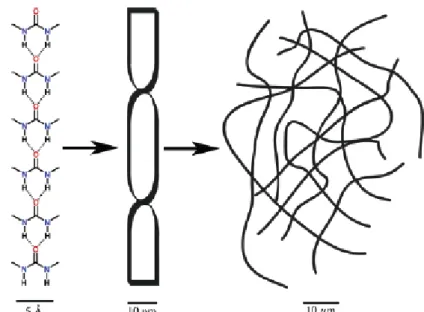
Figure 1-2. Impact on supramolecular structures of solvents………. 6
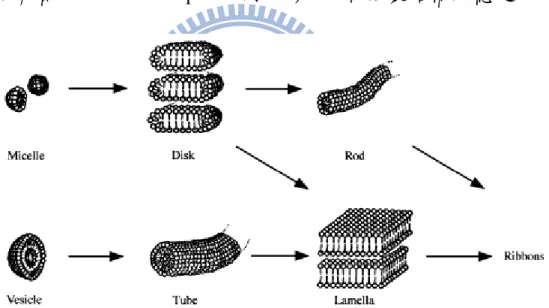
Figure 1-3. Schematic illustrations of possible morphology of amphiphilic
molecules in aqueous solution………. 8
Figure 1-4. Self-organization structures of block copolymers and
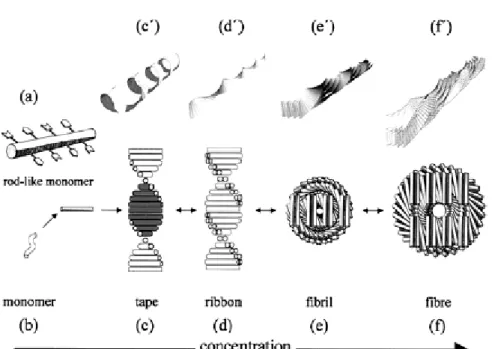
surfactants……… 9 Figure 1-5. Model of the hierarchical self-assembly of chiral rodlike
monomers………. 10
Figure 1-6. The divisions of an amphiphilic structure……… 11
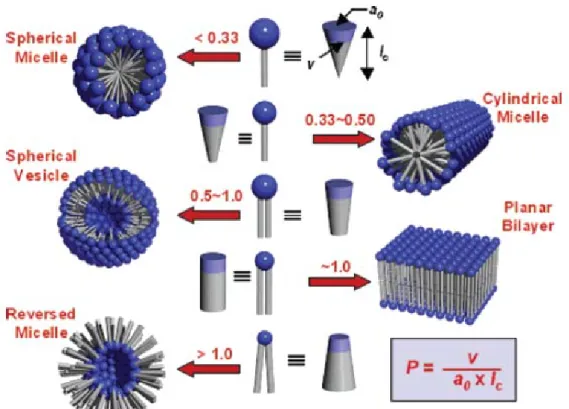
Figure 1-7. Various self-assembled morphologies depending on the critical
packing parameter (P) of each lipid………. 12
Figure 1-8. TEM images of one-dimensional, twisted (top), coiled
(middle), and tubular morphologies (bottom) self-assembled
from glycolipids 1 (middle and bottom) and glycolipids 2 (top). 13 Figure 1-9. a) Schematic illustrations of the self-assembled morphologies
of helical solid bilayers in high-axial-ratio nanostructures of glycolipids 1. b) Schematic representation of interdigitated
lamellar layers in the nanotubes………... 13
Figure 1-10. A) EF-TEM and SEM images of the self-assembled
morphologies from (a) G, (b and c) F, and (d and e) E. B) CD spectra of the self-assembled (a) G, (b) F, (c) E at 25.0 °C, (d)
F, and (e) E at 70.0 °C, respectively……… 14
Figure 1-11. (A and B) FE-SEM images of the xerogel prepared from the mixed gel of M and N (M/N = 1:1 w/w) in water-methanol (10:1 v/v). (C) A possible self-assembling model in the
bilayered chiral fiber from the mixed gel of M and N…………. 16
Figure 1-12. Schematic representation for the creation of silica structures
from the organogel state of M+N by sol-gel polymerization….. 16 Figure 1-13. (A and B) FE-SEM and (C and D) TEM images of the
double-helical silica nanotube obtained from the mixed gel of
M and N (1:1 w/w) after calcination, and (E) schematic
representation of the double-helical structure of the silica
nanotubes through SEM and TEM observations………. 17
Figure 1-14. (a) coil-coil diblock copolymers. (b) rod-coil diblock
copolymers (total molecular weight >20000 g/mol). (c) rod-coil diblock oligomers (total molecular weight <20000
g/mol)………... 17
Figure 1-15. Phase diagram for a structurally symmetric coil-coil block copolymer (hex = hexagonally packed cylinders, bcc =
Figure 1-16. Schematic representation of a monolayer puck………... 21 Figure 1-17. Phase diagram including the hockey puck and lamellae phases.
The phases are (I) bilayer lamellae, (II) monolayer lamellae, (III) bilayer hockey pucks, (IV) monolayer hockey pucks, and
(V) incomplete monolayer lamellae………. 23
Figure 1-18. Preparation of core-shell micelles via self-assembly of diblock
copolymer at the critical micelle concentration………... 24
Figure 1-19. Schematic representation of micelles depending on the relative
block lengths: (a) star micelle, (b) crew-cut micelle……… 25
Figure 1-20. The backscattered electron imaging (BEI) image of a fracture surface of a block copolymer/40% homopolymer blend film. White areas are polyisoprene stained with OsO4 and dark areas
are polystyrene. Arrows indicate defects where the
homopolymer tends to concentrate……….. 27
Figure 1-21. TEM image of a completely hydrolyzed PtBA-b-PCEMA
polymer film………. 27
Figure 1-22. TEM images for (a) zigzag lamellar morphology with frod =
0.90 and (b) arrowhead morphology with frod = 0.98…………... 28
Figure 1-23. Fluorescence photomicrographs of solution-cast micellar Þlms of PPQ10PS300 obtained by ambient air drying of different diblock solution concentrations in CS2: (A) 0.005 weight %, (B) 0.01 weight %, and (C) 0.5 weight %. Arrows in (B)
indicate regions of self-ordering……….. 29
Figure 1-24. Molecular structure of the rod-coil diblock copolymer
PPQmPSn and schematic illustration of its hierarchical
self-assembly into ordered microporous materials……….. 29
Figure 1-25. Schematic diagrams of (a) strip morphology with frod = 0.36
and (b) hexagonal superlattice with frod = 0.25……… 30
Figure 1-26. Schematic representation of supramolecular structures of rod-coil molecules O. (a) Smectic A, (b) bicontinuous cubic,
and (c) hexagonal columnar phases………. 30
Figure 1-27. Schematic representation for the organization of the hexagonal columnar and spherical micellar phases of rod-coil molecules
Pa-c……….. 31
Figure 1-28. Schematic diagram for the honeycomb-like layer formed by the
rod segments of rod-coil molecule Qb……… 31 Figure 1-29. Schematic drawing of four levels of chiralities and their
transferring process. The four levels of chiralities are configuration (a), conformation (b), phase (c), and object (d). The packing mechanism is the key for the higher-level chirality formation. Parallel packing of the helical chain could lead to a flat morphology while twist-packing will lead to a helical morphology. The handedness of the helicity depends on how
the molecules pack together………. 33 Figure 1-30. Schematic illustration that shows chiral molecular assembly, in
which molecules packed at a nonzero angle with respect to the
nearest neighbors………. 34 Figure 1-31. Possible formation mechanism of lipid ribbons based on chiral
molecular self-assembly………... 34
Figure 1-32. Proposed reaction mechanism of of copper(I) acetylides with
organic azides………... 37
Figure 1-33. Schematic representation (energy vs reaction coordinate) of the
reaction of copper(I) acetylides with organic azides…………... 38 Figure 1-34. Application of click chemistry for the parallel synthesis of
pharmacological test compounds………. 39
Figure 1-35. Schematic illustration of the “clicking-and-probing ligation”. Profluorophores (or “prelinkers”) containing azide or alkyne moieties are fluorescent inactive, which upon cycloaddition would lead to the formation of triazolyl units with enhanced
fluorescent emissions………... 39
Figure 1-36. Variation of helical twisting power in self-assembled
schiff-base chiral rod-coil amphiphiles……… 40
Figure 3-1. Polarized optical micrographs displayed by (a) T7, (b) T8, (c)
T9, (d) T10, (e) T11, and (f) T12……… 79
Figure 3-2. Differential scanning thermograms for the first heating and
cooling cycle for T12, scan rate 5 °C min-1………. 81
Figure 3-3. Melting (Tm,■) and isotropization (TSmA*,○) temperatures of
the chiral amphiphilic LC species T, as a function of the carbon
number of the alkyl group……… 82
Figure 3-4. FESEM (right) and TEM (left) micrographs of T10
self-assembled morphologies in THF/H2O solution……… 84
Figure 3-5. TEM micrographs of T11 (left) and T12 (right) self-assembled
morphologies in THF/H2O solution………. 84
Figure 3-6. Polarized optical microscopy of the fan-shaped textures exhibited by the carbohydrate-coated momoners: (a) LC-6, (b)
LC-11, and (c) LC-12 at 100 °C………. 86
Figure 3-7. Polarized optical micrographs displayed by the
carbohydrate-coated polymers: (a) K6P, (b) K11P, and (c)
K12P at 150 °C……… 86
Figure 3-8. Corresponding UV-vis spectra and CD results of monomers of species K (a) (b) and polymers of species K (c) (d) in THF. The spectral data below 250 nm are not taken because of the
interfering absorption………... 87
Figure 3-9. FESEM micrographs of the self-assembled morphology
exhibited by monomers (a) K6E, (b) K11E, and (c) K12E. The
Figure 3-10. TEM micrographs of K11E (left) and K12E (right)
self-assembled morphologies in THF/H2O solution……… 88
Figure 3-11. FESEM micrographs of the self-assembled morphologies exhibited by K11P in solution (a) primary stage, (b) intermediate stage, and (c) final stage. The bar represents 100 nm……… 89
Figure 6-1. Flexible active-matrix displays... 109
Figure 6-2. Sony's flexible OLED display……….. 109
Figure 6-3. Electronics based on organic transistors of Takao Someya Group………... 109
Figure 6-4. Device configuration of OTFT……… 110
F igure 6-5. Common OTFT device geometries……….. 111
Figure 6-6. Charge transport in top and bottom contact devices……… 112
Figure 6-7. P-type and n-type OTFT device………... 113
Figure 6-8. (a) Output and (b) transfer characteristic of a typical organic thin film transistor……… 114
Figure 6-9. Energy levels diagram of polaron and bipolaron………. 117
Figure 6-10. Hopping transport……… 118
Figure 6-11. Charge transport in different orientations: a) crystalline-good charge transport; b) amorphous-no charge transport; and, c) polycrystalline- grain boundaries interrupt the charge transport. 120 Figure 6-12. Herringbone (top) and π-stacking (bottom) arrangements, showing HOMO orbital interactions……… 120
Figure 6-13. Schematic illustration of (a) different molecular smectic arrangements (b) the layer structure of the conducting channel in an optimal OTFT. Red arrow indicates the preferred charge transport direction……… 121
Figure 6-14. The first attempt was made to fabricate an OTFT utilizing the polyacetylene/polysiloxane field defect………... 122
Figure 6-15. The schematic of stacked pentacene layer OTFT……… 124
Figure 6-16. 6,13-pentacenequinone concentration in pentacene in different stages of purification: (1)-as-received, (2)-single sublimation clean, (3)-double sublimation clean, (4)-crystal grown from untreated powder, (5)-crystal grown from doubly cleaned powder……….. 125
Figure 6-17. Chemical structures of common p-type organic semiconductors……… 126
Figure 6-18. Chemical structures of Pc2Lu and Pc2Tm……… 128
Figure 6-19. Chemical structures of TCNQ………. 128
Figure 6-20. Electron-transporting metallophthalocyanines... 130
Figure 6-21. Chemical structures of DFH-6T………... 130
Figure 6-22. Chemical structures of fluoroarene-thiophene 1, 2, and 3……... 131 Figure 6-23. Crystal structures of fluoroarene-thiophene compounds 1 (a), 2
(b), and 3 (c)………. 131
Figure 6-24. Chemical structures of DCMT and AFM topographic image of its thin film vacuum evaporated onto a SiO2 substrate………… 132
Figure 6-25. Chemical structures of NTCDA and NTCDI………... 133
Figure 6-26. Crystal packing diagram of fluorinated NTCDI showing the herringbone motif………. 134
Figure 6-27. Complementary inverter circuit configuration………. 135
Figure 6-28. Chemical structures of PTCDA and PTCDI……… 135
Figure 6-29. Chemical structures of DPP………. 136
Figure 6-30. Chemical structures of PTCDI-C8H……… 136
Figure 6-31. Chemical structures of PTCDI-C4F7………... 136
Figure 8-1. A chain of structural consequences. From top to bottom, specific chemical structures lead to spatial conformations,to self-assembly and finally to self-organization into supramolecular architectures.The basic dendron molecule used is shown in the middle………. 166
Figure 8-2. Schematic illustration of the self-assembly and co-assembly processes of fluorinated first-generation dendrons containing donor (D) and acceptor (A) groups……….. 167
Figure 8-3. Self-assembly mechanism of the fluorinated first-generation dendron containing a larger perylene diimide electron-accepting group……….. 167
Figure 8-4. Device configuration of OTFT in this study……… 169
Figure 8-5. 16 transistors on each substrate with different W/L……… 170
Figure 8-6. Id-Vd characteristics of P(-) device 10 without annealing……… 172
Figure 8-7. Id-√Id-Vg characteristics of P(-) device 10 without annealing…. 172 Figure 8-8. Id-Vd characteristics of P(-) device 10 after annealing………… 173
Figure 8-9. Id-√Id-Vg characteristics of P(-) device 10 after annealing…….. 173
Figure 8-10. Id-Vd characteristics of P(-) device 11 in air……… 174
Figure 8-11. Id-√Id-Vg characteristics of P(-) device 11 in air……….. 174
Figure 8-12. Id-Vd characteristics of PCl(-) device 10 without annealing…… 179
Figure 8-13. Id-√Id-Vg characteristics of PCl(-) device 10 without annealing. 179 Figure 8-14. Id-Vd characteristics of PCl(-) device 10 after annealing……… 180
Figure 8-15. Id-√Id-Vg characteristics of PCl(-) device 10 after annealing….. 180
Figure 8-16. Id-Vd characteristics of PCl(-) device 10 in air……… 181
Figure 8-17. Id-√Id-Vg characteristics of PCl(-) device 10 in air………. 181
Figure 8-18. Id-Vd characteristics of N(-) device 3 without annealing……….. 183
Figure 8-19. Id-√Id-Vg characteristics of N(-) device 3 without annealing…... 183
Figure 8-20. Id-Vd characteristics of N(-) device after annealing………. 184
Figure 8-21. Id-√Id-Vg characteristics of N(-) device after annealing………... 184
Figure 8-22. Id-Vd characteristics of B(-) device 11 without annealing……... 185
第一部分
Synthesis and Self-assembled Nanostructures of
1,2,3-Triazole Liquid Crystals via Click Chemistry
第一章 緒論
1-1 分子自組裝(Self-assembly of molecules)
1-1.1 分子自組裝簡介
自組裝(self-assembly)為系統之構成元素,在不受人為外力介入 下,自行聚集而組織成規則結構的現象[1],如分子的結晶及液晶分子 藉由棒狀分子的排斥體積效應排列成各種液晶相,都屬於自組裝現 象。自組裝的發生通常會將系統從一個無序(disordered)的狀態轉化成 一個有序(ordered)的狀態,可以發生在不同的尺度,例如分子首先聚 集成為奈米尺度的單元(例如界面活性劑分子自組裝成微胞),這些單 元間的作用力進而促使其在空間上做規則的排列,而使系統具有一種 有層次的超分子(supramolecular)結構。 自組裝普遍存在於自然界中,如生物體的細胞即是由各種生物分 子自組裝而成,分子自組裝的概念即是基於仿生學而發展出來。運用 各種分子的自組裝亦是建構奈米材料非常重要的方法,這種所謂的 「由下至上」(bottom-up)方法目前被廣泛應用在生物醫學、材料化學 和光電等相關奈米尺度的新科學領域[2]。1-1.2 分子自組裝行為
[3] 將 蛋 白 質 自 組 裝 後 的 超 分 子 結 構 , 由 小 到 大(nanometer to micrometer) 做 細 部 的 探 討 , 可 知 分 子 自 組 裝 主 要 可 以 分 為 一 級(primary)、二級(secondary)和三級(tertiary)三種結構(Figure 1-1)[4] 。
Figure 1-1. The primary, secondary, and tertiary structure of a self-assembled
morphology.
一級結構(angstrom to nanometer scale)定義為分子層級的彼此辨 識提升,非等方向性之一維或二維尺度的聚集。分子間經由氫鍵引 力、庫倫靜電力、凡得瓦力、離子鍵、兩性作用力(amphiphilic effects)、 分子極性或掌性(chirality)等非共價鍵的協同作用吸引聚集。氫鍵引力 在分子聚集的過程中原本是一種很普通的作用力,但是在水溶液的情 況下,它會失去其強度,除非分子間能以足夠緊密的方式連結[5]。相 反地,此時分子溶解或聚集平衡的趨勢即兩性作用力(親疏水效應)則 會在環境中扮演較重要的角色[6]。
二級結構(nanometer to micrometer scale)定義為受分子結構直接
影 響 所 聚 集 後 的 型 態(morphology) , 包 括 : 纖 維 (fibers) 、 微 胞
三級結構(micrometer to millimeter scale)是以獨立聚集作為基本 的結構單位,經過多次重複自組裝過程所生成的型態。從二級結構到 三級結構的過程主要是由這些二級結構間彼此的作用力所決定。
1-1.3 影響分子自組裝形成的因素
由生物的分子自組裝分析可知自組裝是由較弱且可逆的非共價 鍵相互作用力所驅動,如氫鍵、π-π 相互作用力等。而且自組裝之後 結構的穩定性和完整性,也是靠這些非共價鍵相互作用力來維持的。 因此,人為自組裝形成的關鍵是要理解和控制分子間非共價的連接, 以及克服自組裝過程中熱力學上的不利因素。下面概要介紹影響分子 自組裝形成的幾個主要因素。(a)分子識別(molecular recognition)
分子自組裝的中心是分子識別。分子識別可定義為供體及受體 (donor-acceptor) 選擇性結合並產生某種特定功能的過程。它包含兩 種識別,一是分子間幾何尺寸、形狀上的相互識別;另一是分子對氫 鍵、π-π 相互作用力等非共價鍵相互作用的識別。分子的結晶過程被 認為是分子識別中最準確和典型的實例,分子晶體是上百萬個分子通 過極準確的相互識別自我建構之自組裝結果。(b)溶劑
絕大多數對分子自組裝的研究都是在溶液中進行的,因此溶劑對自組裝的形成有著關鍵作用。溶劑的性質及結構上的微小變化可能會 導致自組裝結構重大改變,如Wuest 等人發現[29],若分子自組裝以氫 鍵為主要驅動力,則任何破壞氫鍵作用的溶劑同樣會破壞分子自組裝 能力。如Figure 1-2,化合物 dipyridones 在甲醇中僅以單體形式存在, 因為甲醇是一種質子活性溶劑,而在氯仿中,化合物 dipyridones 則 靠氫鍵作用形成高分子長鏈。
Figure 1-2. Impact on supramolecular structures of solvents.
(c)熱力學平衡
[30] 和所有自發過程一樣,自組裝的發生會使系統達到最低的 Gibbs free energy,自由能(G)與系統的能量(H)和熵(S)有關,亦即 G=H– TS, 系統能量越低或熵越大,該狀態的自由能就越低。系統能量與分子間 作用力有關,當分子因引力而進行規則排列,則系統能量降低。而熵 跟系統亂度有關,亂度越高,其熵越大。由於自組裝會將系統轉成一 個低亂度的有序排列,所以熵會下降。加上非共價鍵相互作用力比共 價鍵相互作用小的多,因而自組裝在多數情況下很不穩定。因此,對於人為誘發的分子自組裝,為了達到依靠大量的非共價鍵相互作用把 超分子結構穩定下來的目的,科學家提出了一些促進自組裝超分子穩 定化的方法。 (1)提高非共價鍵相互作用的強度。這可通過選擇合適的溶劑來達到, 例如,若分子間主要是疏水相互作用,那麼自組裝過程最好在水溶液 中進行。反之,氫鍵和靜電相互作用力在極性且非質子溶劑(polar aprotic solvent)中最強,如 CHCl3。但特定相互作用的大小並不僅僅依 賴於溶劑等環境條件,如氫鍵的強度還直接與質子 donor- acceptor 的 結構及其空間相對取向有關。 (2)把自組裝所形成的超分子聚集從溶劑中分離出來,避免它在溶劑中 解離為單獨的分子。 (3)增加自組裝分子濃度,促使自組裝過程進行到底。但過量的分子不 能擾亂或破壞自組裝的功能活性。
(d)分子建構單元(molecular building blocks)
在分子中設置功能基團(functional groups),可使不同的功能基團 如同磁鐵一樣相互吸引或排斥,整個過程就像堆積木一樣。分子的結 構對自組裝超分子聚集的結構有很大的影響,分子結構的微小變化可 能導致其參與形成自組裝結構上的重大變化,可以藉由改變分子的設 計,構造出形形色色有序的超分子自組裝結構。
兩性化合物(amphiphiles)因為其分子在化學上的可變化性,所以 提供在控制超分子結構生成上的許多條件。兩性分子的自組裝已大量 的被研究[7-8],各式各樣的型態也被觀察出來,包括微胞(micelles)、 囊胞(vesicles)、層狀(lamellae)等形態(Figure 1-3)。Kunitake 等人研究 可生成雙層結構(bilayer)的化合物與自組裝後型態之間的相對關係發 現,化合物的自組裝行為是依據分子上形成自組裝所必要的官能基與 其位置及位向來決定[9-10]。此外,對於以氫鍵為驅動力的自組裝過程, 若分子帶有質子donor - acceptor,則所形成的自組裝結構最穩定。
Figure 1-3. Schematic illustrations of possible morphology of amphiphilic
molecules in aqueous solution.
高分子鏈的尺寸約在數奈米至數十奈米之間,因此高分子相當適 合用作奈米材料的建構單元。高分子自組裝包含高分子結晶和團聯式 共聚高分子(block copolymers)。高分子結晶產生規則堆疊的奈米尺寸 晶體,而團聯式共聚高分子則產生各種長程規則性(long-range order)
的型態(Figure 1-4),如層狀排列結構(lamellae)、體心立方堆積之
圓 球(body-centered cubic packed spheres) 及 六 角 堆 積 之 圓 柱
(hexagonally packed cylinder)等[11-12]。
Figure 1-4. Self-organization structures of block copolymers and surfactants.
掌性效應(chiral effects)已經被論證為產生螺旋型態的重要驅動力
[13-19],至目前為止已經有許許多多不同的螺旋型態被觀察到[20-27]。
Boden 等 人 以 具 對 掌 性 的 棒 狀 (chiral rodlike) 兩 性 化 合 物 (Figure 1-5(a),黑色是疏水基,白色是親水基)來探討其形成螺旋型態的過程
[28]: 在溶液中,棒狀分子首先經由分子識別(donor-acceptor)自組裝成
一維的絲帶(tapes)型態,Figure 1-5(c),而分子的chirality導致tape產生 扭轉(twist),使得絲帶變成螺旋彎曲(helical curvature),Figure 1-5(c´)。
同時由於tape的兩邊具有不同的化學特性,對於不同溶劑會有不同的 喜好表現。這些tapes會因為疏水基的彼此吸引力進一步自組裝成緞帶 (ribbons),Figure 1-5(d),此時ribbon的兩邊具有相同的化學特性,導 致產生類似馬鞍彎曲(saddlelike curvature)的型態(Figure 1-5(d´))。隨著
濃 度 的 增 加 , 伴 隨 自 組 裝 成 纖 絲(fibrils) 之 後 纖 維 (fibers) (Figure
1-5(e、f)),其寬度由相互作用引力和扭曲的變形能(distortion energies) 兩者所共同決定。
Figure 1-5. Model of the hierarchical self-assembly of chiral rodlike
monomers.
1-2 典型的兩性化合物
典型的兩性化合物[31]包含一個極性親水端的頭(hydrophilic head)
與一支或兩支疏水端的尾鏈(hydrophobic tail)。親水端的頭通常是一 個具有極性或離子性的原子團,包含:羧酸、胺基酸、醣類、磷酸鹽
或四級銨鹽,同樣的在疏水端尾鏈上也有各式各樣的變化,例如:碳 鏈數目不同、長度或柔軟度變化(有無不飽和碳鏈或環化物)。在早期 的一些文獻,Kunitake 等人試著定義兩性化合物的結構與其自組裝所 形成的形態之間的相對關係[32],將兩性化合物分成四部份:具柔軟彈 性的尾鏈、剛性的區域、軟性的連接基和親水端的頭(Figure 1-6),而 且彼此間可以在合成上單獨控制其中的變化。藉由改變尾鏈或軟性連 接基的長度,自組裝結構可能因此而改變。Kunitake 等人認為柔軟彈 性的尾鏈、剛性的區域與親水端的頭是穩定自組裝結構的重要部份,
另外 rods 和 vesicles 亦或 bilayers 和 sheets 表面的彎曲度可以經由剛
性的部分來增強。
Figure 1-6. The divisions of an amphiphilic structure.
脂質(lipids)是兩性化合物的一種[33-34],分子的幾何結構及其在水
中較傾向形成何種自組裝型態,可由Israelachvili所提的臨界堆疊參數
P (the critical packing parameter: P = v/a0lc)來預測[35],其中v為疏水端
碳氫鏈的體積,a0為極性頭基所佔據的面積,而lc疏水基的臨界鏈長
Figure 1-7. Various self-assembled morphologies depending on the critical
packing parameter (P) of each lipid.
1-3 醣脂質(Glycolipids)兩性化合物的分子自組裝
醣脂質(glycolipids)兩性化合物的醣基分子(如glucose、galactose 或cyclic/noncyclic sugars等),富有旋光性質且相容於生物體的親水 端,其分子自組裝後所形成的特殊型態結構一直被廣泛地研究[36-38]。 其中以環狀糖(cyclic sugars)為親水端的兩性化合物已被證實可以在 水溶液中,形成具旋光性fibers或ribbons的超分子結構[39-47]。Shimizu 等人合成一系列醣脂質兩性化合物[48-49],藉由改變疏水端尾鏈的不飽 和雙鍵數目和變換不同自組裝溶液比例,來探討其對自組裝後所生成 之形態結構的影響。研究發現當改變疏水端尾鏈的不飽和雙鍵數目或混合不同分子比例,可以改變自組裝後所形成螺旋形態的螺距(Figure 1-8)。同時也發現glycolipid 1自組裝後的高度螺旋結構,隨著自組裝 時間的增長,慢慢變成管狀結構(Figure 1-9)。 a b c d glycolipid 1:a(5%) / b(50%) / c(16%) / d(29%) glycolipid 2:a
Figure 1-8. TEM images of one-dimensional, twisted (top), coiled (middle),
and tubular morphologies (bottom) self-assembled from glycolipids 1 (middle and bottom) and glycolipids 2 (top).
a) b)
Figure 1-9. a) Schematic illustrations of the self-assembled morphologies of
helical solid bilayers in high-axial-ratio nanostructures of glycolipids 1. b) Schematic representation of interdigitated lamellar layers in the nanotubes.
Shimizu等人亦發表具不同數目的反式雙鍵之苯基配醣體(phenyl
glucosides)兩性化合物[50]。由TEM/SEM可證實隨著反式雙鍵數目的增
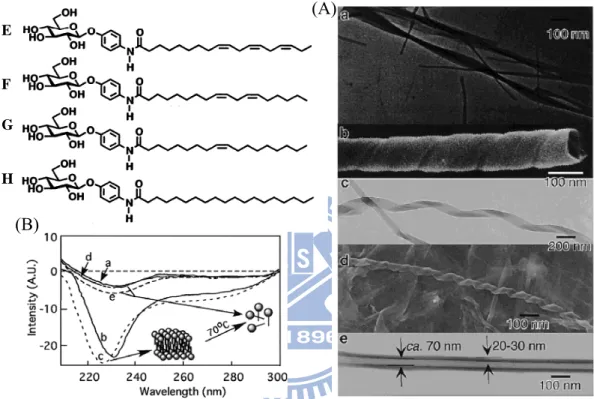
(F)至nanotubular結構(E),Figure 1-10(A)。此外,經由CD光譜可發現, 當自組裝溫度超過其相轉移溫度時,其原來吸收峰強度會減弱且往長 波長移動,此時分子自組裝成micelles或vesicles。然而,數小時之後, 隨著自組成nanotubular結構,CD訊號再一次變強,Figure 1-10(B)。 E F G H (B) (A)
Figure 1-10. A) EF-TEM and SEM images of the self-assembled morphologies
from (a) G, (b and c) F, and (d and e) E. B) CD spectra of the self-assembled (a)
G, (b) F, (c) E at 25.0 °C, (d) F, and (e) E at 70.0 °C, respectively.
Fuhrhop等人以鏈狀的N-gluconamides為親水基,在疏水基的碳鏈 上導入diyne,研究其對自組裝後所生成之形態結構的影響。化合物I 和K自組裝形成nanotube結構,而J和L則形成micellar rods[51]。 I:n = 1 J:n = 3 K:n = 5 L:n = 5
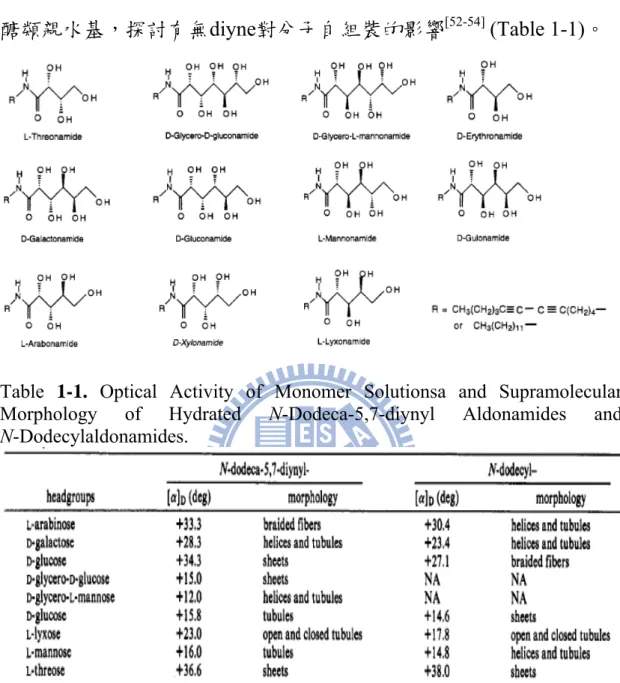
O’Brien等人合成一系列diacetylenic aldonamides,並且改變不同的
醣類親水基,探討有無diyne對分子自組裝的影響[52-54] (Table 1-1)。
Table 1-1. Optical Activity of Monomer Solutionsa and Supramolecular Morphology of Hydrated N-Dodeca-5,7-diynyl Aldonamides and
N-Dodecylaldonamides.
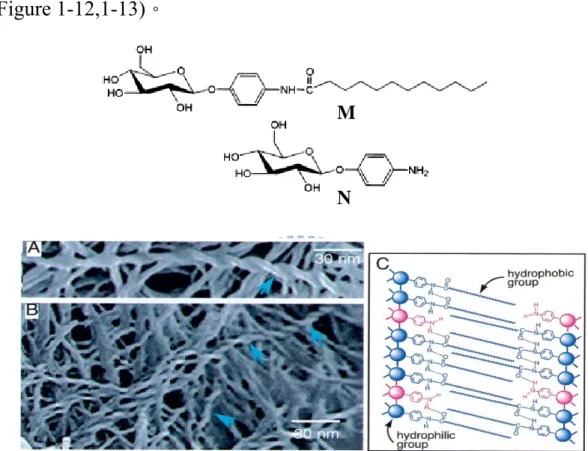
在自組裝應用方面,Shimizu等人利用p-dodecanoyl-aminophenyl-
β-D-glucopyranoside醣類化合物(M)在p-aminophenyl glucopyranoside
(N) 的存在下,可以自組裝產生溶膠凝膠態,而形成直徑3-25 nm的 雙股螺旋纖維,而長度可以達微米(Figure 1-11)。因為結構中混有化
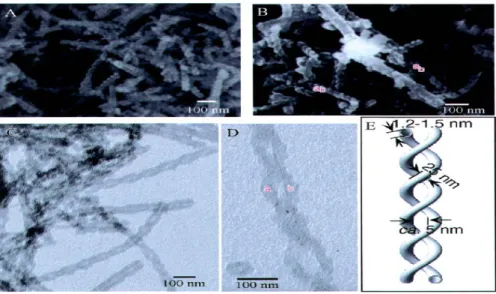
合物(M),其尾端的amino group是一個可以和tetraethoxysilane (TEOS) 反應的官能基,當加入TEOS於此ㄧ自組裝後的雙股螺旋形態上,可 以將有機分子自組裝後的雙股螺旋結構轉譯成Silica Nanotubes[55] (Figure 1-12,1-13)。 N M
Figure 1-11. (A and B) FE-SEM images of the xerogel prepared from the
mixed gel of M and N (M/N = 1:1 w/w) in water-methanol (10:1 v/v). (C) A possible self-assembling model in the bilayered chiral fiber from the mixed gel of M and N.
Figure 1-12. Schematic representation for the creation of silica structures from
Figure 1-13. (A and B) FE-SEM and (C and D) TEM images of the
double-helical silica nanotube obtained from the mixed gel of M and N (1:1 w/w) after calcination, and (E) schematic representation of the double-helical structure of the silica nanotubes through SEM and TEM observations.
1-4 團聯式共聚高分子(Block copolymers)
1-4.1 團聯式共聚高分子簡介
最簡單的團聯式共聚高分子為AB copolymer,僅由兩種單體所構 成,依其兩塊體間化學成分的不同,可分為coil-coil block copolymers (雙軟段塊式高分子)、rod-coil block copolymers (軟硬段塊式高分子) 及rod-coil block oligomers (軟硬段塊式寡分子),Figure 1-14。
Figure 1-14. (a) coil-coil diblock copolymers. (b) rod-coil diblock copolymers
(total molecular weight >20000 g/mol). (c) rod-coil diblock oligomers (total molecular weight <20000 g/mol).
Coil-coil block copolymers,其組成方式是在化學上將兩個原本不 相容且性質不同的兩個區塊高分子,以共價鍵的方式相連接而成(例 如poly(styrene)-b-poly(isoprene))。由於區塊間化學成分的不同,造成 彼此的不相容,因此產生微相分離(microphase separation)的現象,形 成穩定有序的自組裝奈米結構。
Rod-coil block copolymers/oligomers,其硬段(rod block)部分都以 芳香族多苯環結構組成,軟段(coil block)則可以選擇親水性或疏水性 軟段,此block copolymers亦有微相分離及自組裝的現象,其原因為: (1)軟段區塊與硬段區塊不相容導致兩區塊互相排斥, (2)硬段有一定的方向性, (3)堆疊之方式會被兩區塊所限制。 Block copolymers會有微相分離而自組裝成不同形貌,且具週期性 排列的奈米結構。而微相分離行為是因為高分子鏈段與鏈段間的組成 不同,加上熱力學狀態不同,造成相與相間的不互容性所致,但又因 為兩段不同的鏈段之間是以共價鍵連結,不致於會產生巨大的相分離 行為,因此形成多種不同的高分子相形態,block copolymers的相型態 與鏈段間的相容度、組成比例、溫度及分子量有關[56]。
1-4.2 團聯式共聚高分子在塊材(bulk state)中的相行為
[57]Coil-coil block copolymers的微相分離理論,主要由Meiser[58]研究 block copolymers的相行為(phase behavior)所提出來。控制coil-coil block copolymers的微相分離行為主要有三個因子:
(1)總聚合度(total degree of polymerization): N (=NA+NB),
(2) Flory-Huggins interaction parameter χ:由兩個區塊的聚合物之不互 容性量測而得,
(3)兩個區塊的體積分率(volume fraction): (fA及fB,fA=1- fB)。
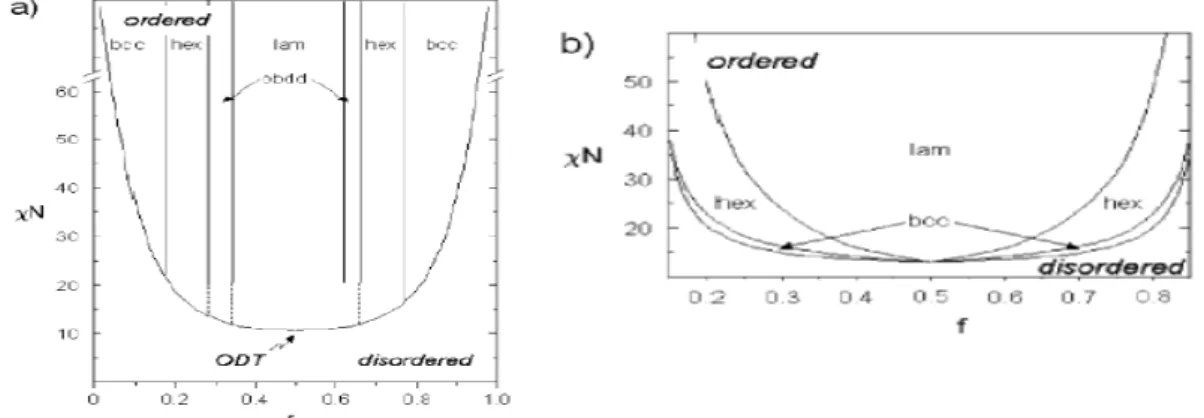
Flory-Huggins interaction parameter (χ)及總聚合度(N)的乘積 χN 是控制微相分離程度的因素,可以預測coil-coil block copolymers穩定 的微結構。依據N的不同,可以分為三個不同的區域: (Ι)弱分離區(weak-segregation),χN 10≦ , (II)中分離區(intermediate segregation),10<χN 50≦ , (III)強分離區(strong segregation),χN → ∞。 經過實驗證實,若 χN 位於強分離區,其相界線(phase boundaries)是 垂直線,藉由改變區塊的體積分率(f),可以使微相分離的形態有所轉 變。若 χN 位於中分離區,則其order-disorder transition (ODT)是很小 的(Figure 1-16 (a))。由Leibler的理論可知,其相界線並非是垂直線而
Figure 1-15. Phase diagram for a structurally symmetric coil-coil block
copolymer (hex = hexagonally packed cylinders, bcc = body-centered cubic, lam = lamellae).
1-4.2.2 Rod-coil block copolymers之理論
Rod-coil block copolymers的自組裝不僅是由相分離來決定,因為 其兼具有硬段區塊及團聯式共聚高分子的特性。在產生自組裝時,其
微 相 分 離 和 硬 段 區 塊 的 結 晶 堆 疊 是 互 相 競 爭 的 。Rod-coil block
copolymers兩區塊硬度的不對稱性若和coil-coil block copolymers相比 較,就會使得Flory-Huggins interaction parameter χ 增加。到目前為止 對於rod-coil block copolymers的相行為並沒有一個完整的理論,但近 年來,對於向列型及層列型液晶相(nematic and smectic mesophase) 已 經有理論和實驗上的研究。但儘管如此,仍然無法對於非層狀的形態 (non-lamellar morphologie)加以預測。
對於相行為理論,最先由Semenov和Vasilenco (SV)提出[60]。SV
最先考慮nematic和smectic A phase,這兩種相的硬段(rod)都垂直於相 層(lamellae)。隨後進一步研究smectic C,而其硬段部分是相層成一個
角度θ[61-62]。對於自由能的計算,SV引進四個因子: (1)混合的理想氣 體熵值(ideal gas entropy of mixing): 和軟硬段分子界面點的空間配置 有關,(2)硬段間立體障礙的相互作用力(steric interaction among rods):
以晶格堆疊模型(Flory lattice)方法所找出來,(3)軟段的伸展(coil
stretching): 在固定密度下所量出來的值,軟段的構形會被限制在結構 系統中,(4)軟硬段不互容的作用力(unfavorable rod-coil interactions): 由Flory-Huggins interaction parameter χ 所決定。若要將相圖計算且描 繪出來,必須得到三個參數,分別為軟段組成的體積分率f,乘積 χN
及特性軟段和硬段維度的分率ν。Rod-coil block copolymers的相圖的
形狀受ν所影響。
Williams和Fredrickson提出以冰上曲棍球用的橡皮原盤之膠體粒 子模型(Hockey puck micelle) ,來解釋rod-coil block copolymers的相 行為。此hockey puck micelle非層狀結構,其硬段以軸向堆積而形成
有限大小的圓柱碟狀,軟段則覆蓋於上面[63],Figure 1-16。
Williams和Fredrickson預測當軟段的分率很大(f > 0.9)時,此結構 才會穩定的存在。這種膠體粒子的好處是其軟段不利於伸展,由於 rod-coil block copolymers的軟段是接在硬段上,想要完全分離是不可 能的,所在硬段和軟段之間總有界面存在。一般而言,界面愈明顯則 軟 段 伸 展 所 受 到 的 限 制 愈 大 , 需 要 更 大 的 自 由 能 去 伸 展 。 在 Flory-Huggins interaction parameter χ 很大時,即使硬段軟段不互容性 愈大,可以將整個系統模擬為軟段鏈(coil chain)抓在硬段所形成的牆 壁上。在micelle puck中,硬段部分是假設可以擺脫相互間很強立體阻 礙的問題而排成一列,而軟段則是被假設形成一個半球狀的殼,其半 徑R是由硬段所形成的碟狀中心到殼層,軟段會在這半球狀的殼層中 強力的伸展。此模型也假設軟段鏈在這半球狀殼層中是以平直的軌道 以及固定的密度伸展,如果出了半球狀的殼層,則假設軟段鏈是由碟 狀中心所放射出去,這樣的模型只有一個自由參數R來減少自由能。 對於這種Hockey puck micelle模型的缺點是相對於lamellar多製造出 一個額外的表面,所以必須將所製造表面的表面能再加以考慮。 Williams和Fredrickson也遵循SV的方法,藉著由micelle puck模型和 lamellar結構的自由能相互比較,就得到micelle puck的相圖(Figure 1-17)。
Figure 1-17. Phase diagram including the hockey puck and lamellae phases.
The phases are (I) bilayer lamellae, (II) monolayer lamellae, (III) bilayer hockey pucks, (IV) monolayer hockey pucks, and (V) incomplete monolayer lamellae.
1-4.2.3 Rod-coil block oligomers之理論
Rod-coil block oligomers和rod-coil block copolymers的原理及性質 類似,也是由於軟段硬段硬度的不對稱和coil-coil block copolymers相 比,Flory-Huggins interaction parameter χ 增加。提高χ的結果,使得 微相分離以及自組裝現象發生,即使其分子量遠低於coil-coil block copolymers。由於這種分子的硬段部分是可以用一般化學合成方法合 成及純化,所以rod-coil block oligomers近年來大量的被研究。
1-4.3 團聯式共聚高分子在稀薄溶液中的相行為
[64]相較於bulk state的相行為,block copolymers在稀薄溶液中的相行 為除了受 χN 及 f 的影響之外,還深受外界環境的影響,如溶劑對 高分子的相親性,若所選用的溶劑對特定鏈段具有選擇的能力時, block copolymers會因為該鏈段具有較高的溶解度而較易展開此鏈
段,另一鏈段則會因為溶解度較差而捲曲。
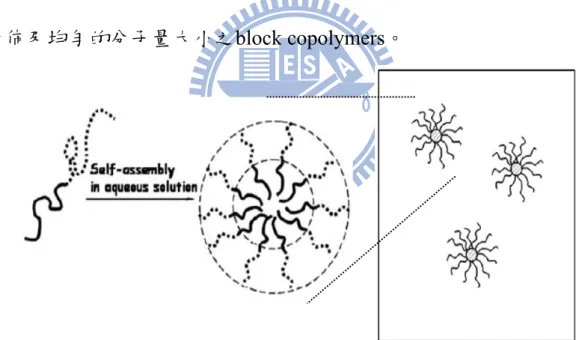
Amphiphilic block copolymers因其一端帶有hydrophilic chain,另一 端帶有hydrophobic chain兩種性質不同的官能基特性,在水溶液中, 疏水鏈段向內聚集,而親水鏈段向外伸展,彼此相互排斥,當濃度超 過臨界微胞濃度(CMC:critical micellar concentration)時,會形成均勻 分散的core-shell micelle:其核心(core)為疏水鏈段,因van der waals force而結合形成在內的疏水基;外層(shell)則為伸展的親水鏈段 (Figure 1-18)。一般而言,polymeric micelle發生在具有狹窄的分子量 分佈及均勻的分子量大小之block copolymers。
Figure 1-18. Preparation of core-shell micelles via self-assembly of diblock
copolymer at the critical micelle concentration.
若疏水鏈段的長度比親水鏈段長,在水溶液中形成的微胞型態通 稱 為crew-cut micelles[65-73]; 反 之 , 若 親 水 鏈 段 較 長 , 則 稱 為star micelles[74] (Figure 1-19)。
(a)
(b)
Figure 1-19. Schematic representation of micelles depending on the relative
block lengths: (a) star micelle, (b) crew-cut micelle.
crew-cut micelles為具有大的core及較小的shell,欲製備此類穩定 的微胞通常需先將block copolymer溶在一個對各鏈段皆可溶的溶劑 中(good solvent),再慢慢加入只選擇親水鏈段溶解的溶劑(selective solvent),此時疏水鏈段就會慢慢聚集而形成微胞的核心。移除原先 所含有的共溶劑(co-solvent) 便可用電子顯微鏡觀察微胞的型態。 crew-cut micelles型態的變化除了可以由改變選擇性溶劑的種類[75]
外,也可如同star micelles改變鏈段比例、濃度[76-77]來控制 micelles最
後自組裝所形成的型態。
總括來說,溶液中自組裝行為除了受高分子間的 χN 及 f 影響 外,結構穩定的自由能還受到內部核心鏈段(corn chain)與溶劑間的界 面張力(interfacial energy)、核心鏈段間的拉伸力(stretching)和外殼鏈 段(corona chain)間的相互排斥力(repulsion)所影響。利用這三個作用 力間的平衡,造成系統total free energy的下降,會趨向特定形態的微
胞構造,因此只要改變特定的條件,如溶液的條件(濃度、溫度、pH 值等)[78]、分子量或高分子鏈段的組成與幾何結構等[79-85],都會影響 到這些作用力的平衡,而形成各種不同形態的微胞。
1-4.4 團聯式共聚高分子在薄膜中的相行為
Block copolymers材料除了在塊材以及溶液中有自組裝的能力 外,在薄膜中亦具有自組裝成奈米級規則有序結構的能力。block copolymers薄膜的研究上,大面積化與以及方向性(orientation)是一個 很大的議題,最常探討的方式是以外加驅動力(driving force)來促使大 面積化與具方向性。一般而言,較常使用的方式有:外加電場(electricfield)[86]、 側 向 力 誘 導(shear force induced)[87]、 結 晶 方 向 誘 導
(crystallization induced)[88]與基材限制方向性誘導(substrate confined)[89] 等,目標皆在利用外來驅動力使層狀、柱狀或球狀薄膜具有一定的方 向性以增加其應用價值。
1-4.5 團聯式共聚高分子研究發展
1-4.5.1 Coil-coil block copolymers
Thomas 等 人 將 poly(styrene-b-isoprene) 摻 入 1:1( 重 量 ) 所 混 合 的 polystyrene和polyisoprene,將之成膜後,自組裝形成週期性的層狀形 態(lamellar morphology),於每一層的折射率(refractive index)都不同, 具有像光子晶體( photonic crystal )的性質,可將紫外光或可見光的某
固定的波長完全反射出來[90-91] (Figure 1-20)。
Figure 1-20. The backscattered electron imaging (BEI) image of a fracture
surface of a block copolymer/40% homopolymer blend film. White areas are polyisoprene stained with OsO4 and dark areas are polystyrene. Arrows indicate defects where the homopolymer tends to concentrate.
除了光學上的應用外,也可以應用於製造奈米孔洞材料上。 Liu等人以poly(tert-butylacrylate)-b-poly(2-cinnamoylethylmethacrylate) (PtBA-b-PCEMA)為材料,發現PtBA會深藏在PCEMA所形成的母體 中,自組裝成柱狀區域(cylindrical domain),若將tert-butyl團基水解, 則形成奈米孔洞薄膜(Figure 1-21),亦可調整PtBA的長度來調整孔洞 的大小[92]。
Figure 1-21. TEM image of a completely hydrolyzed PtBA-b-PCEMA
1-4.5.2 Rod-coil block copolymers
Ober與Thomas等人以陰離子聚合的方式,合成出以poly(hexyl isocyonate)為硬段,polystyrene為軟段的block copolymer,poly(hexyl isocyonate)的聚合度為900,polystyrene 聚合度為300,此種高分子具
有濃致型液晶(lyotropic liquid crystal)的性質[93-95]。若在穿透式電子顯
微鏡下觀察,則有拉鍊狀的型態(zigzag morphology),為具有高度層 列相的長程秩序(long-range order),Figure 1-22。
Figure 1-22. TEM images for (a) zigzag lamellar morphology with frod = 0.90 and (b) arrowhead morphology with frod = 0.98.
Jenekhe等人發表以polyphenylquinoline為硬段,polystyrene為軟段 的rod-coil block copolymer。其合成方式是以接在polystyrene的ketone methylene末端基與5-acetal-2-amino-benzophenone進行縮合反應而得
[96-97]。所合成出來的高分子,自組裝的排列非常規則,所堆疊成的形
態 有 中 空 球 狀(hollow sphere) 、 層 狀 (lamellar) 、 中 空 柱 狀 (hollow
與溶劑乾燥的速度(Figure 1-23, 1-24)。
Figure 1-23. Fluorescence photomicrographs of solution-cast micellar Þlms of
PPQ10PS300 obtained by ambient air drying of different diblock solution concentrations in CS2: (A) 0.005 weight %, (B) 0.01 weight %, and (C) 0.5 weight %. Arrows in (B) indicate regions of self-ordering.
Figure 1-24. Molecular structure of the rod-coil diblock copolymer PPQmPSn
and schematic illustration of its hierarchical self-assembly into ordered microporous materials.
1-4.5.3 Rod-coil block oligomers
Stupp等人發表以單一分佈( monodisperse)的polyisoprene為 軟
段,液晶基為硬段之rod-coil block oligomer,其硬段的長度為6 nm,
藉由改變軟段的長短來調控硬段的體積分率(frod),不同的硬段體積分
Figure 1-25. Schematic diagrams of (a) strip morphology with frod = 0.36 and (b) hexagonal superlattice with frod = 0.25.
Myongsoo Lee等人也做了許多以液晶基為硬段的rod-coil block oligomers。藉由改變不同軟段poly(ethylene oxide) 的長度,會使其自
組裝產生不同的液晶相排列[101-104](Figure 1-26, 1-28, 1-28)。
O
Figure 1-26. Schematic representation of supramolecular structures of rod-coil
molecules O. (a) Smectic A, (b) bicontinuous cubic, and (c) hexagonal columnar phases.
P
Figure 1-27. Schematic representation for the organization of the hexagonal
columnar and spherical micellar phases of rod-coil molecules Pa-c.
Q
Figure 1-28. Schematic diagram for the honeycomb-like layer formed by the
1-5 分子的掌性效應(Effect of molecular chirality)
分子藉由分子間的二次作用力,如立體障礙性(steric hindrance)、
親 疏 水 性(amphiphilic effect) 、 靜 電 力 (electrostatic force) 或 氫 鍵
(hydrogen bonding)等相互作用力,進而自組裝成不同尺寸層次等級之 型態結構[105]。其中螺旋超結構(helical superstructures)為生物體中最普 遍也是最令人感興趣的結構[106-108]。掌性(chirality)是形成螺旋體結構 主要原因之ㄧ,也是一種分子間二次作用力。具有掌性之分子或高分 子利用此二次作用力,自組裝成較大尺寸之螺旋體結構[109-110]。掌性 分子(chiral molecule)就像手掌以及腳一樣,不論如何旋轉,也無法使 左右兩手掌重疊而使之完全相同,這類型的分子互為具有不同的三維 立體結構鏡像異構物(enantiomer)。掌性分子可進一步自組裝成不同尺 寸等級之螺旋體型態,主要可分為四種等級結構[111-114],Figure 1-29。 Table 1-2摘要這四種等級的掌性及其尺度典型例子與研究方法。 第一級(1st level):configurational chirality(組態的掌性),與原子層 級的掌性中心(chiral center)有關,起源於不同化學基團利用化學鍵連 接在一個沒有鏡像對稱的原子上。 第二級(2nd level):conformational chirality(構形的掌性),歸因於不 同的分子螺旋構形的掌性。 第三級(3rd level):phase chirality(相的掌性),與螺旋狀的結構
(helical phase structures) 有 關 , 例 如 : wisted lamellar crystals 和 monodomains of chiral liquid crystalline (LC) phases等
第四級(4th level):object chirality(物體的掌性),為最高級掌性。 由第三級phase chirality所形成之螺旋狀結構聚集而成,為肉眼可見的 掌性物體,如同環帶球晶(banded spherulites)一般。 a b c d
Figure 1-29. Schematic drawing of four levels of chiralities and their
transferring process. The four levels of chiralities are configuration (a), conformation (b), phase (c), and object (d). The packing mechanism is the key for the higher-level chirality formation. Parallel packing of the helical chain could lead to a flat morphology while twist-packing will lead to a helical morphology. The handedness of the helicity depends on how the molecules pack together.
分子的掌性可以用來解釋分子堆疊(molecular packing)的情形。掌 性作用力(chiral interactions)會導致掌性分子與其鄰近分子以非零角
度(nonzero angle)的方式緊密堆疊[115],Figure 1-30。分子的掌性會誘
導整體自組裝分子具一個特別的方向性,在這種狀態下會使其扭轉而 產生螺旋的結構。
Figure 1-30. Schematic illustration that shows chiral molecular assembly, in
which molecules packed at a nonzero angle with respect to the nearest neighbors.
掌性自組裝(chiral self-assembly)會形成helically coiled ribbon,而 helical ribbon以兩種形式形成:一是螺距(pitch)變短而絲帶寬度不變
[116-117],Figure 1-31(a);另一種是絲帶寬度變寬而螺距不變[118],Figure
1-31(b)。而文獻中以後者較常出現。
Figure 1-31. Possible formation mechanism of lipid ribbons based on chiral
1-6 三氮唑(Triazole)
1960 年,R. Huisgen 對 1,3-dipolar[119]環化加成反應做了詳盡的研 究。Huisgen 1,3-dipolar 環化加成是放熱反應,其結合兩個不飽和的 反應物快速形成各式各樣的五元雜環。其中以疊氮化合物(azides) 和 炔類(alkynes)的環化加成反應形成三氮唑(triazole)最廣為利用,因為 反應幾乎沒有副產物產生。近年來 K. B. Sharpless 發展出的 clickchemistry 利用亞銅(copper(Ι))催化形成 triazole 反應,使得 1,3-dipolar 環化加成反應再度成為熱門領域,在製藥、高分子、生化等領域高度 被廣泛使用。
1-6.1 Click Chemistry 的定義
[120] 觀察自然法則,形成碳-雜原子鍵要比碳-碳鍵容易許多。因此跟隨 著自然的腳步,我們努力地藉由不同原子的連結(C-X-C),連接小單 元以創造物質,其目的是為了要發展出一套強有力又具有選擇性且標 準化,而不論是在小規模還是大規模的應用。我們稱這種基礎的方法叫click chemistry。K. B. Sharpless 定義 click chemistry 為:反應必須
是高產率及產生無害的副產物。除去的無害副產物只能用非管柱層析 (nonchromatographic)方法和立體特異性(stereospecific) 方法(但不一
定有鏡像選擇性enantioselective)。反應的過程特性包括簡單的反應條
反應物和試劑,不使用溶劑或者使用無害且被容易除去的溶劑(如: 水),以及可以簡單將產物分離的溶劑。如果需要進行純化的話,必
須用nonchromatographic 方法,如再結晶、蒸餾,而產物在生理的環
境下必須安定存在。
大於 20 kcal/mol 的熱力學穩定驅動力是 click reaction 的關鍵。這
樣的過程反應相當迅速且完全,會傾向於高選擇性的單一產物。形成 carbon-heteroatom 鍵的反應包含大部分常見的例子,包括以下化學轉
換的種類:(1)不飽合物種的環狀加成反應,尤其是 1,3-dipolar 的環化
加成反應, Diels-Alder 的反應亦歸於此類。(2)親核性取代化學,尤 其是親電子性雜環分子(strained heterocyclic electrophiles)的開環反 應,像是環氧類(epoxides)、環氮類(aziridines)、aziridiniumions 和 episulfoniumions。(3)Non-aldol 型的羰基化學,如形成尿素類(ureas), 硫尿類(thioureas)、芳香雜環類(aromatic heterocycle)、醯胺類(amide)、 oxime ether、hydrazones 的形成。(4)雙鍵或參鍵的碳-碳加成反應,尤 其是氧化反應,如環氧化(epoxidation)、二羥基化(dihydroxylation)、 環氮化(aziridiation)和 sulfenyl halide 的加成,與親核試劑(Nu-H)的 Michael 加成反應。
1-6.2 Click Chemistry 的反應機制
[120]和1,5 位置取代異構物(regioisomers) [Eq. (1)]。化學家努力去控制單
一位置取代異構物(regioisomers)產物,迄今已獲得解決[121]。
(1)
K. B. Sharpless 利用亞銅催化疊氮化合物和末端炔類,成功合成
出只有 1,4-取代的 1,2,3-triazoles[122]。其反應機制為亞銅先與炔基形
成copper(Ι) acetylide (I)[123-124],Figure 1-32。經由理論計算,協同環
化加成反應的能量要比逐步加成機制的能量高12-15 kcal/mol ,因此
推測環化反應會先生成包含亞銅的六元環中間產物 Ш[125],意即[2+
3] 環化加成 (B-direct:B-1→B-2→B-3) 。Figure 1-32 為亞銅催化之
環化加成反應[120]
Figure 1-32. Proposed reaction mechanism of of copper(I) acetylides with
organic azides.