Laser trapping dynamics of L-alanine depending on the laser
polarization
Ken-ichi Yuyama*
a, Kei Ishiguro
b, Teruki Sugiyama*
c, Hiroshi Masuhara
a,ba
Department of Applied Chemistry and Institute of Molecular Science, National Chiao Tung
University, Hsinchu 30010, Taiwan;
bGraduate School of Materials Science, Nara Institute of
Science and Technology, Ikoma 630-0192, Japan;
cInstrument Technology Research Center,
National Applied Research Laboratories, Hsinchu 30076, Taiwan
ABSTRACT
We successfully demonstrate crystallization and crystal rotation of L-alanine in D2O solution using a focused laser beam
of 1064 nm with right- or left-handed circularly polarization. Upon focusing each laser beam into a solution/air interface of the solution thin film, one single crystal is generally formed from the focal spot. The necessary time for the crystallization is systematically examined against polarization and power of the trapping laser. The significant difference in the average time is observed between two polarization directions at a relatively high laser power, where the left-handed circularly polarized laser takes 3 times longer than the right-left-handed one. On the other hand, the prepared crystal is stably trapped and rotated at the focal point by circularly polarized lasers after the crystallization, and the rotation direction is completely controlled by the polarization of the trapping laser. The mechanisms for the crystallization and the crystal rotation are discussed in terms of trapping force and rotation torque of circularly polarized lasers acting on the liquid-like clusters and its bulk crystal, respectively.
Keywords: laser trapping, circularly polarized laser, crystallization, crystal rotation, L-alanine
1. INTRODUCTION
The optical trapping of small particles was first demonstrated by Ashkin in 1970 using two laser beams propagating oppositely [1]. The simplest trapping technique using a tightly focused single laser beam was proposed, and the three-dimensional manipulation of the trapped particle was experimentally realized in 1986 [2]. Currently, this technique is well-known as “laser trapping” or “optical tweezers”, and has been widely used for trapping and manipulating a single sized object spatially in solution at room temperature without mechanical contact [3]. As with a micrometer-sized object, a focused laser beam can trap smaller objects with nanometer size such as nanoparticles, quantum dots, micelles, polymers, and molecular clusters at a focal spot [4–10]. They have much a smaller size compared to the focal spot with the volume of about 1μm3, so that plural particles, molecules, and clusters are simultaneously gathered, trapped,
and confined in the focal volume, eventually forming their assemblies. When the target molecules or clusters have relatively strong mutual interactions, their assembling can be extended to the outside of the focal spot through nucleation and subsequent spontaneous growth, namely, the bulk phenomena of liquid-liquid phase separation and crystallization are achieved [11–13].
In 2007, we for the first time successfully demonstrated crystallization of glycine by applying this single laser trapping technique to its supersaturated D2O solution, and have called this phenomenon “laser trapping crystallization” [14]. The
crystallization is realized just by focusing a continuous wave (CW) near-infrared (NIR) laser beam into a solution/air interface and is not induced by the laser irradiation into solution or at a solution/glass interface. This result suggests that crystallization requires not only high molecular concentration due to laser trapping of the liquid-like clusters but also high-ordered molecular alignment at the surface layer. Recently, we also demonstrated the selective fabrication of glycine crystal polymorph by changing laser polarization (linear or circular polarization), power, and solution concentration, and discussed the mechanism of this polymorphism in view of local concentration increase, temperature
, HWP Nd (À
I
Lens EMCCE ondor camer 3¡WO418ß@f ,=1064 nm) a verted microscop elevation, an notable resul The result pr polarized las In this work target compo crystallizatio crystal was r rotation direc trapping forc crystal. L-alanine (>9 respectively, elevation due be 22–24 and (NA=1.35, × dissolving L-down to room bottle with a was immedia microscope w Figure 1 show laser (Spectr coaxially wit confirming th magnification throughout t polarizing be quarter-wave and rotation illumination. nd molecular r lt is that radiat rompted us to er as a future p , for the crysta ound and demo on strongly deprotated by a ci ction was comp ce and rotation 99.0 %, Wako) without furthe e to light absor d 2 K/W in H2 ×100) [18]. An -alanine (0.165 m temperature highly hydrop ately and comp with a thermo-p ws a schematic ra Physics, J20 th the trapping he focal point n, NA 0.90), th the objective l eam splitter (P e plate (QWP) behaviors wer earrangement ion pressure w
aim the selec perspective. allization study onstrated the l pended on the l ircularly polar pletely control torque of circu 2 ) and D2O (99. er purification. rption by overt 2O and D2O, r n L-alanine/D2 5 g) in D2O (1. (23 °C). A sm philic surface, a pletely sealed b plate kept at 23 c illustration of 0-BL-106C, λ =
g laser was int of the He-Ne he laser was sw lens was tuned PBS). A right-and was irrad re directly obs Figure 1: depending on working on the ctive crystalliza y on a chiral a aser trapping c laser polarizati rized laser whi led by tuning t ularly polarized 2. EXPERIM 9 %, Cambridg We used D2O tone vibration b espectively, up 2O supersatura .0 g) at 60 °C mall amount (1 and the solution by a spigot to a
3 °C for the fur f an optical set = 1064 nm) w roduced to the laser at a solu witched off, and
d from 1.0 to - or left-hande iated into the s served by an E An experimenta these experim liquid-like clu ation of chiral amino acid un crystallization. on at a certain ile being kept the laser polari d lasers acting MENTAL SE ge Isotope Lab O, not H2O, as a bands of OH. A pon focusing a ated solution ( with vigorous 5 μL) of the s n thin film wit avoid solvent e rther laser trap tup in this expe was used as a la e inverted micr ution/air interfa d then the NIR 1.4 W by ad ed circularly p sample of L-al EMCCD video
al setup for the la
mental paramet usters strongly l compounds u nder radiation p . As a result, w laser power. I at the focal sp ization. These on the liquid-l ECTION boratories, Inc. a solvent in ord Actually, the te a 1064-nm lase 110 %) used shaking for 3 olution was po th 120–160 μm evaporation, an ping crystalliz eriment. A NIR aser trapping l roscope in ord ace of the thin R laser was swit djusting a half
polarized laser lanine/D2O sol
o camera (Flov
aser trapping sys
ters [15–17]. I depended on l using a right- o pressure, we s we found that It was also con pot after crysta
phenomena ar like clusters of ) were used as der to minimiz emperature ele er beam by a h in this experim hours, and the oured into a ha m thickness was nd was set on t ation experime R laser beam fr light source. A der to check th film through tched on. The p f-wave plate (H r beam was ch lution for 30 m vel, ADT-40C stem In that study, t laser polarizati or left handed selected L-alan the necessary nfirmed that the allization, and e discussed in f L-alanine and
a solute and a e the local tem evation was rep high NA objec
ment was prep en it was slowly and-made samp s prepared. The he stage of an ent. from a CW Nd3 A He-Ne laser he focal positio an objective le power of the N HWP) coupled hanged by adj minutes. Crysta C) under halog the most ion [17]. circular nine as a time for e formed that the terms of d its bulk a solvent, mperature ported to tive lens pared by y cooled ple glass e sample inverted 3+:YVO 4 adjusted on. After ens (60× NIR laser d with a justing a allization gen lamp
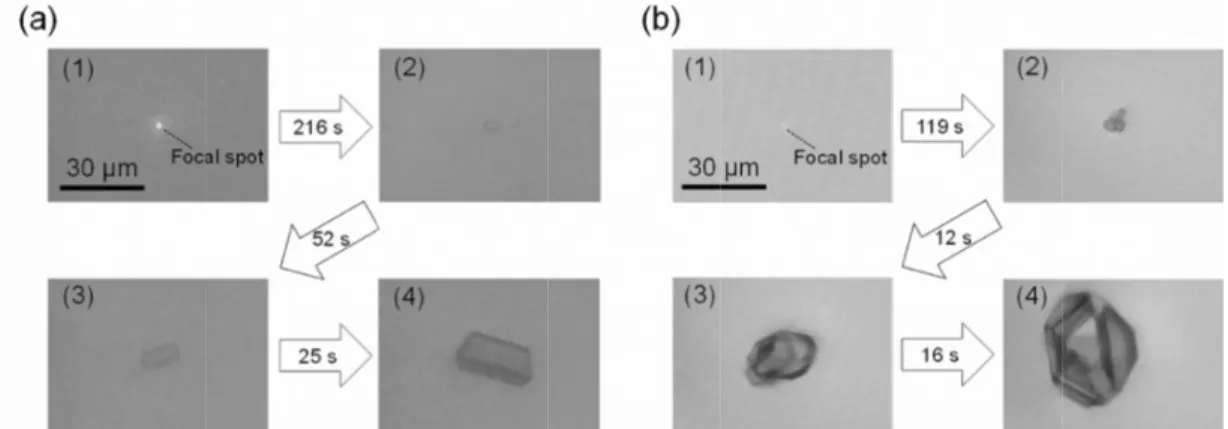
3-1. Laser tr Figure 2a sho starting irrad reflection of crystal with a further laser crystal grew migrated fro crystallizatio technique wa In most case observed at t focal spot, in explained by focal spot pri
Here we disc should be too are trapped s almost all of interactions clusters are t effective vol trapping is re a critical nuc the unsaturat the surround formed cryst 3-2. Crystall
Our laser tra unlike conve rapping crysta ows a represen diation of a ri the trapping la a visible size o irradiation at t up to the size om the spot. In on methods suc as always obse es, only one s the focal spot n spite that the y the assumptio ior to the next
Figure 2: Forma
cuss the magni o small to trap similarly in th f the molecules of hydrogen b trapped by radi lume and pola ealized. Thus, t cleus of L-alani ted solution. In ding solution is al immediately lization time d apping crystalli entional crystal 3 allization of L ntative example ght-handed cir aser at the solu of a few μm w the surface, wh of several tens n general, no ch as solvent ev
rved at the foc single crystal w
(Fig 2b). This e size of the nu on that the initi
nucleation. ation behaviors o itude of the op individual L-a he case of glyc s exist as zwitte bonds between iation pressure arizability incr the local conce ine is eventual n such a solutio s still below th y and complete depending on ization is spati llization metho . RESULT -alanine e of L-alanine rcularly polari ution/air interfa was observed at here it rapidly s μm at the foca
one can predi vaporation and cal spot within was formed at indicates that ucleus should b
ally generated
of (a) single crys
ptical trapping alanine molecu cine [19]. The erions. The mo n the zwitterion e in the focal v ease, stronger entration increa lly induced. Inc on, local super he saturation c ely dissolves as laser power a ially controlled ods such as so S AND DISC crystal generat ized laser beam ace was observ
t the focal poin y became large
al spot, it could ict where and d cooling of sol
10 minutes, na t the focal poi t the formation be much small crystal nucleu
stal and (b) poly
force working ules, so that it i
isoelectric po olecules are we
ns, and the liq volume, where trapping forc ases nonlinearl cidentally, this rsaturated area condition. Act s with the case
nd polarizatio
d and the cryst olvent evaporat
CUSSION
tion and growt m at 1.3 W, o ved (Fig. 2a (1)
nt (Fig. 2a (2)) r under the irr d not be trappe when crystall lution. On the o amely, crystalli
int (Fig. 2a), n of a single nu
ler than that of us rapidly grow crystal of L-alan g on L-alanine s reasonable to oint of alanine eakly linked w quid-like clust they would be e is generated ly with time at s crystallization a is transiently tually, after th of glycine [16 on tal formation a tion or solutio th at the focal s only a small s )). After 216 se ). The formed radiation (Fig. ed anymore wi lization takes other hand, the ization is contr while polycry ucleus takes pl f the focal spot ws due to the hi
nine under laser
molecule and o consider that is reported to ith each other ters are formed e fused with ea d, and as a res t the focal poin n behavior cou formed at/arou e trapping lase 6]. always takes p on cooling. Nam spot. Immediat spot ascribed ec-laser irradia crystal was tra 2a (3), (4)). W ith this laser po
place in conv e crystallization rolled spatiotem stallization wa lace dominantl t. This can be gh concentratio irradiation. d the cluster. T the liquid-like o be 6.107 [20 due to the elec d in the soluti ach other. That sult the effecti nt, and the form uld be observed und the focal s er is switched
place at the foc mely, we know tely after to weak ation, the apped by When the ower and ventional n by this mporally. as rarely ly in the possibly on at the The force e clusters ], where ctrostatic ion. The t is, their ive laser mation of d even in spot, and off, the cal point w where
700 600 500 400 300 200 100 0 1 Right-ha Left-hanc .0 1.1
Las
nded circular p led circular po 1.2er power 1
solarized laser larized laser1.3
1.4(W)
crystallizatio “crystallizati time in this s the experime average crys maximum an at each irrad Nevertheless same averag difference in time between polarized las difference w dependence significant di In our previo supersaturate trapping of t that the diffe the prospecti in Fig. 4. In which provid The former magnitude of alanine mole left-handed c increase in l higher laser time at 1.3 W on surely takes on time” in th study was defin ents was repeti stallization tim nd minimum tim diation conditios, the right- and ge time indepe n the crystalliza n the right- and er took about was confirmed of the averag ifference in the Fig ous studies on ed solution wa the liquid-like erence in the cr ive mechanism our assumptio des rapid crysta
laser trapping f the trapping ecule and its p circularly polar ocal concentra power. Consid W, the laser wi place. This fe is paper) syste ned as the time itively carried me against lase me. The crysta on, which supp
d left-handed c endent of the l ation process b d left-handed c 3 times longer to be statistica ge time was a e average time gure 3: Average laser trapping as well explain clusters and th rystallization t m for the differe
n, the laser tra allization time. g is based on force is determ precursor cluste rization of the ation of the cl dering that the ith right-hande
ature enables u ematically thro
e when the cry out for 10 sam er power of ea allization time a ports that crys circularly polar laser polarizat between two po circularly polar r time on avera ally-meaningfu gain observed between two p e crystallization t crystallization ned from the he accompanie time with each ent crystallizati apping of the c . Conversely, th the gradient d mined by size er possibly sho 1064 nm-trapp lusters, which e right-handed ed circularly po us to examine ugh direct obs stal with a visi mples under ea ach polarizatio at 1.0–1.2 W w stal nucleation rized lasers at ion. We consi olarization dire rized lasers wa age for the cry ul through a M d at 1.4 W. T
polarization dir
time against lase
n of glycine, th viewpoints of ed temperature h polarized lase
ion time based clusters increas he laser heatin dipole force o and polarizab ow the slight ping laser. The
would cause t circularly pola olarization sho
the necessary servation using ible size was o ach condition o on is shown in was scattered w is stochastic p each laser pow ider that, in th ections. On the as found at 1.3 ystallization com
Mann-Whitney Thus, only the
rections. er power of each e crystallizatio f the increase e elevation [15– er beam depen on the obtaine ses the supersa ng decreases the of the non-unif ility of targets difference in t e difference be the polarizatio arized laser be uld generate st
time for crysta g an EMCCD c observed at the of laser polariz n Fig. 3, whe within 10 minu process even u wer of 1.0–1.2 his power rang e other hand, a 3 W, where the mpared to the y’s U test. How
crystallization
h polarization.
on time and the in local conc –17]. In this w ds on these tw ed results, as sc aturation value e SS, suppressi form electrom s in Rayleigh a the polarizabil ecomes promin on dependence eam showed th tronger trappin allization (desc camera. Crysta focal spot. A zation and pow ere a bar indic utes as shown in
under laser irra W showed alm ge, there is al large differenc e left-handed c right-handed o wever, no pola n at 1.3 W sh e polymorph co centration due work, we also wo factors, and chematically ill (SS) at the fo ing the crystall magnetic field, approximation ity between ri nent with the n of the SS inc he rapid crysta ng force for th cribed as allization series of wer. The cates the n the bar adiation. most the lmost no ce in the ircularly one. The arization howed a ontrol in to laser consider propose lustrated cal spot, lization. and the [21]. L-ght- and nonlinear crease at allization e
liquid-like clusters temperature themselves. T overcome by rotation, resu The local SS SS between t Namely, the polarization effect at 1.4 directions sim laser irradiat makes us rem polarization vibrational m concentration 3-3. Rotation Another ama direction was the right- and of the right-h the crystal (F further irradi polarization angular mom of the transm conservation circular polar and increase th elevation due The heating eff y input vibratio ulting in the SS S in the focal v the right- and l efficient laser directions, res 4 W effectively
milarly in the c ion with each mind the diffe [22–24], sinc modes of L-alan n increase and Figure 4: T n of crystal by azing result in s completely c d left-handed p handed circular Fig. 5b). Incide iation kept the
can be explai mentum passes mitted light is d of angular mo rization of the he SS effectiv to photon ab ffect suddenly b onal energy (F S decrease. volume is repre left-handed circ trapping of th sulting in polar y decreases th case of laser irr circularly pola rent absorption e the photon nine molecule. temperature el he mechanism o y laser polariz this experimen ontrollable by polarized laser rly polarized l entally, the rota
crystal at a ce ned on the ba through a bire different from omentum [25–2 incident light, ely by their ef bsorption of 10 becomes prom Fig. 4b-2). The esented by the cularly polariz he clusters at 1 rization depen he local SS, w radiation at low arized laser be n coefficient a absorption fo . Thus, the cry levation and by of L-alanine crys zation nt is that the g laser polarizat beams at 1.0 W aser (Fig. 5a), ation stopped u ertain position asis of angular efringent object the initial one. 27]. Since the d the rotation di fficient laser tr 064 nm by ov inent above a c e temperature multiplication zed lasers show 1.3 W generate ndence of the a which compens wer power. In a am may give t at 1064 nm of or the tempera stallization tim y their polariza stallization depen grown crystal w tion. Figure 5 s W. The formed while the left-under the irrad n without rotati r momentum o t, the polarizat . Namely, rota direction of the irection of the o apping (Fig. 4 vertone vibrati certain laser po elevation lead n of these two c ws a bell-shaped es the large dif
average crystal sates the SS d addition to the the different te the trapping l ature elevation me is well expla ation dependen nding on laser p was rotated by shows the rotat d crystal was ro -handed one pr diation of the li ing. Such a cry of light. When ion of light is ating torque is e rotation torqu object is contro b-1). Next, we ional modes o ower where the ds to vigorous conflicting fac d curve agains fference in the llization time. difference betw e above mechan emperature elev laser between n is ascribed ained by two l nce.
ower and polariz
y further irradi tion behavior u otated clockwis rovided counte inearly polariz ystal rotation d n circularly po changed, and t given to the ob ue depends on ollable by tunin e should consid f L-alanine m e thermal dissip molecular mo ctors. The diffe t laser power ( local SS betw However, the ween two pola nism, we point
vation. This vi right- and left
to overtone b laser induced e
zation.
iation, and the under the irrad se under the irr erclockwise ro zed laser beam, depending on t olarized light the angular mo bject due to th angular mome ng the polariza der local molecules pation is otion and erence in (Fig. 4c). ween two e heating arization t out that iewpoint t circular bands of effects of rotation diation of radiation tation of , and the the laser carrying omentum he law of entum of ation.
ia) M
IE>
I
Figure 5: We successfu laser beam crystallizatio found the int rotated at the polarization o terms of trap crystal, respe Finally, we t The L-alanin crystallizatio clusters poss clusters by la time under c spontaneous The present w and to H. M. Education of [1] Ashkin, [2] Ashkin, for diele : CCD images of fully demonstra with right- o on between two teresting result e focal spot by of the trapping pping force and ectively. try to suggest a ne crystal grad on process fromibly always tak aser irradiation circular polariz resolution will work is partly (NSC 98-211 f Taiwan to H.M A., “Accelerat A., Dziedzic, J ectric particles, f crystal rotation ated crystalliza r left-handed o polarization d of the crystal r y further irradi g laser. These t d rotation torq a new perspec dually grows w m the nm-size kes place or th n possibly affec zed laser irradi
l be done, and
supported by N -M-009-001), M.
tion and trappin J. M., Bjorkho ” Opt. Lett. 11
n under the irrad
4. ation and cryst
circularly po directions and rotation under iation, and the two phenomen que of circularl tive on optical with rotation u ed liquid-like he rotation torq cts the associat iation. In futur the achieveme ACKNOW National Scien and MOE-ATU REF ng of particles olm, J. E. and C (5), 288–290 (
iation of (a) the beams.
SUMMARY tal rotation of larization. We found a signif the further irra e direction of r na of the crysta ly polarized la l rotation torqu under circular clusters to the que is at least g tion rate before re, laser trappin ent of optical re WLEDGEM nce Council of U Project (Nat FERENCES by radiation p Chu, S., “Obse (1986). right-handed an Y L-alanine in D e examined th ficant differenc adiation. The f rotation was co allization and t asers acting on
ue for the crys polarized lase e μm-sized bu given to the clu
e nucleation, le ng crystallizati esolution using MENT Taiwan to T. tional Chiao Tu ressure,” Phys ervation of a sin nd (b) the left-han D2O solution b he average tim ce of the time o formed crystal w ompletely cont the crystal rota the liquid-like stallization pro er irradiation. W ulk crystal, the
usters. The rot eading to the d ion for racemi g laser trapping S (NSC 100-2 ung University . Rev. Lett. 24 ngle-beam gra nded polarized l by a focused C me necessary only at 1.3 W.
was stably trap trollable by tu ation were disc e clusters and cess by laser t We imply that e rotation of th
tation of the liq different crysta c compounds g is expected. 113-M-492-00 y) from the Mi (4), 156–159 ( dient force opt
aser CW NIR for the We also pped and uning the cussed in the bulk trapping. t, on the he small quid-like allization showing 02-MY2) nistry of (1970). tical trap
[3] Ashkin, A., “Optical trapping and manipulation of neutral particles using lasers,” Proc. Natl. Acad. Sci. USA 94(10), 4853–4860 (1997).
[4] Tanaka, Y., Yoshikawa, H., Itoh, T. and Ishikawa, M., “Laser-induced self-assembly of silver nanoparticles via plasmonic interactions,” Opt. Express 17(21), 18760–18767 (2009).
[5] Hosokawa, C., Yoshikawa, H. and Masuhara, H., “Optical assembling dynamics of individual polymer nanospheres investigated by single-particle fluorescence detection,” Phys. Rev. E 70, 061410 1–7 (2004).
[6] Pan, L., Ishikawa, A. and Tami, N., “Detection of optical trapping of CdTe quantum dots by two-photon-induced luminescence,” Phys. Rev. B 75, 161305(R) 1–4 (2007).
[7] Hotta, J., Sasaki, K. and Masuhara, H., “A single droplet formation from swelled micelles by radiation pressure of a focused infrared laser beam,” J. Am. Chem. Soc. 118, 11968–11969 (1996).
[8] Singer, W., Nieminen, T. A., Heckenberg, N. R. and Rubinsztein-Dunlop, H., “Collecting single molecules with conventional optical tweezers,” Phys. Rev. E 75, 011916 1–5 (2007).
[9] Tanaka, Y., Yoshikawa, H. and Masuhara, H., “Two-photon fluorescence spectroscopy of individually trapped pseudoisocyanine J-aggregates in aqueous solution,” J. Phys. Chem. B 110, 17906–17911 (2006).
[10] Tsuboi, Y., Shoji, T. and Kitamura, N., “Optical trapping of amino acids in aqueous solutions,” J. Phys. Chem. C 114, 5589–5593 (2010).
[11] Masuhara, H., Sugiyama, T., Rungsimanon, T., Yuyama, K., Miura, A. and Tu, J., “Laser-trapping assembling dynamics of molecules and proteins at surface and interface,” Pure Appl. Chem. 83(4), 869–883 (2011).
[12] Yuyama, K., Rungimanon, T., Sugiyama, T. and Masuhara, H., “Formation, dissolution, and transfer dynamics of a millimeter-scale thin liquid droplet in glycine solution by laser trapping,” J. Phys. Chem. C 116, 6809–6816 (2012). [13] Sadakane, K., Kitahara, H., Seto, H. and Yoshikawa, K., “Rhythmic oscillation and dynamic instability of
micrometer-size phase separation under continuous photon flux,” Phys. Rev. E 78, 046214 1–4 (2008).
[14] Sugiyama, T., Adachi, T. and Masuhara, H., “Crystallization of glycine by photon pressure of a focused CW laser beam,” Chem. Lett. 36(12), 1480–1481 (2007).
[15] Rungsimanon, T., Yuyama, K., Sugiyama, T., Masuhara, H., Tohnai, N. and Miyata, M., “Control of crystal polymorph of glycine by photon pressure of a focused continuous wave near-infrared laser beam,” J. Phys. Chem. Lett. 1(3), 599–603 (2010).
[16] Rungsimanon, T., Yuyama, K., Sugiyama, T. and Masuhara, H. “Crystallization in unsaturated glycine/D2O solution
achieved by irradiating a focused continuous wave near infrared laser,” Cryst. Growth Des. 10, 4686–4688 (2010). [17] Yuyama, K., Rungsimanon, T., Sugiyama, T. and Masuhara, H. “Selective fabrication of α- and γ-polymorphs of
glycine by intense polarized continuous wave laser beams,” Cryst. Growth Des. 12, 2427–2434 (2012).
[18] Ito, S., Sugiyama, T., Toitani, N., Katayama, G. and Miyasaka, H., “Application of fluorescence correlation spectroscopy to the measurement of local temperature in solution under optical trapping condition,” J. Phys. Chem. B 111, 2365–2371 (2007).
[19] Erdemir, D., Lee, A. Y. and Myerson, A. S. “Nucleation of crystals from solution: classical and two-step models,” Acc. Chem. Res. 42, 621–629 (2009).
[20] Handbook of Chemistry and Physics 1st Student Edition, CRC Press, C-703 (1988).
[21] Harada, Y. and Asakura, T., “Radiation forces on a dielectric sphere in the Rayleigh scattering regime,” Opt. Commun. 124, 529–541 (1996).
[22] Diem, M., Polavarapu, P. L., Oboodi, M. and Nafie, L. A. “Vibrational circular dichroism in amino acids and peptides. 4. Vibrational analysis, assignments, and solution-phase Raman spectra of deuterated isotopomers of alanine,” J. Am. Chem. Soc. 104, 3329–3336 (1982).
[23] Freedman, T. B., Diem, M., Polavarapu, P. L. and Nafie, L. A. “Vibrational circular dichroism in amino acids and peptides. 6. Localized molecular orbital calculations of the carbon-hydrogen stretching vibrational circular dichroism in deuterated isotopomers of alanine,” J. Am. Chem. Soc. 104, 3343–3349 (1982).
[24] Freedman, T. B., Cao, X., Dukor, R. K. and Nafie, L. A. “Absolute configuration determination of chiral molecules in the solution state using vibrational circular dichroism,” Chirality 15, 743–758 (2003).
[25] Bishop, A. I., Nieminen, T. A., Heckenberg, N. R. and Rubinsztein-Dunlop, H. “Optical microrheology using rotating laser-trapped particles,” Phys. Rev. Lett. 92, 198104 1–4 (2004).
[26] Arita, Y., McKinley, A. W., Mazilu, M., Rubinsztein-Dunlop, H. and Dholakia, K., “Picoliter rheology of gaseous media using a rotating optically trapped birefringent microparticle,” Anal. Chem. 83, 8855–8858 (2011).
[27] Asavei, T., Parkin, S., Persson, M., Vogel, R. Funk, M., Loke, V., Nieminen, T., Rubinsztein-Dunlop, H. and Heckenberg, N., “Engineering optically driven micromachines,” Proc. SPIE 7038, 703816 1–7 (2008).