行政院國家科學委員會專題研究計畫 成果報告
多方策略聯盟與廠商績效之研究(第 2 年)
研究成果報告(完整版)
計 畫 類 別 : 個別型 計 畫 編 號 : NSC 98-2410-H-004-068-MY2 執 行 期 間 : 99 年 08 月 01 日至 100 年 07 月 31 日 執 行 單 位 : 國立政治大學企業管理學系 計 畫 主 持 人 : 黃國 計畫參與人員: 碩士班研究生-兼任助理人員:洪繼硯 碩士班研究生-兼任助理人員:許家鳳 碩士班研究生-兼任助理人員:王羚卉 大專生-兼任助理人員:曾慧玟 大專生-兼任助理人員:羅亦方 大專生-兼任助理人員:賴晏翎 大專生-兼任助理人員:林玟婷 報 告 附 件 : 出席國際會議研究心得報告及發表論文 處 理 方 式 : 本計畫涉及專利或其他智慧財產權,2 年後可公開查詢中 華 民 國 100 年 10 月 26 日
行政院國家科學委員會補助專題研究計畫
■ 成 果 報 告
□期中進度報告
多方策略聯盟與廠商績效之研究(2/2)
計畫類別:
個別型計畫 □整合型計畫
計畫編號:NSC 98-2410-H-004-068 –MY2
執行期間:98 年 8 月 1 日至 100 年 7 月 31 日
執行機構及系所:國立政治大學企業管理學系
計畫主持人:黃國峯 副教授
共同主持人:
計畫參與人員:
成果報告類型(依經費核定清單規定繳交):□精簡報告
完整報告
本計畫除繳交成果報告外,另須繳交以下出國心得報告:
□赴國外出差或研習心得報告
□赴大陸地區出差或研習心得報告
出席國際學術會議心得報告
□國際合作研究計畫國外研究報告
處理方式:
除列管計畫及下列情形者外,得立即公開查詢
□涉及專利或其他智慧財產權,□一年
二年後可公開查詢
中 華 民 國 100 年 9 月 30 日
行政院國家科學委員會補助專題研究計畫期末成果報告
多方策略聯盟與廠商績效之研究(2/2)
Multiple Strategic Alliances and Firm Performance
計畫編號:NSC 98-2410-H-004-068-MY2
執行期間:98 年 8 月 1 日至 100 年 7 月 31 日
計畫主持人:黃國峯副教授 國立政治大學企業管理學系
多方策略聯盟與廠商績效之研究(2/2)
黃國峯
國立政治大學 企業管理學系
Email: [email protected] Tel: (02)29393091 #81238 Fax : (02) 29398005 Address : 116 台北市文山區指南路二段 64 號 *For correspondence 本篇文章為本年度國科會專題研究計劃中正在投稿期刊文章之全文,欲引用請洽詢作者。Simultaneous Alliance, Sequential Alliance, and Firm Performance
Abstract
This paper extends prior alliance studies from an alliance project level to a firm level, and tests the influence of simultaneous alliances and sequential alliances on firm performance using data from 1,029 alliances in the global pharmaceutical industry. Our research suggests that simultaneously conducting multiple alliances may not generate better performance except for the firms with large size or for conducting inter-industry alliances. This paper contributes to the existing theory by examining the joint effect of simultaneous alliances and characteristics of alliances on a firm’s performance.
INTRODUCTION
Alliance is a most important strategic tool for firms to compete in the severe competition environment and fast changing technological development (Gulati, 1998; Hagedoorn, 1993). While alliances are widely used in business practices, researchers have produced evidence suggesting that many alliances do not perform as expected or even end up with a failure (Kogut, 1989). Thus, understanding the alliances becomes an important research issue in strategic management.
One of popular streams of alliance research mainly focus on the effect of alliance partner number on performance. Gulati (1995) regards that the two-party alliances can have better direct and frequent coordination whereas the multi-party alliances make the coordination channels more complicate and inefficient, which in turn leads to more conflicts among partners. Das and Teng (2002) also conclude that multi-party alliances are more complex in terms of organization and structure than dyadic-relation alliances. According to organizational learning theory, Chen (2003) asserts that the alliance performance will start to decrease if the number of alliance partners is over certain level. The multi-party alliance is difficult to manage not only because of the interest conflicts among partners (Shuen, 1994) but also because of alliance management capabilities (Dyer & Singh, 1998; Ireland, Hitt, & Vaidyanath, 2002).
However, the above studies mainly focus on multi-party alliances at an alliance base. None of these studies investigate whether multiple simultaneous alliances or sequential alliances taken by a firm have different impacts on firm performance. Thus, our research attempts to fill this research gap.
Ridder and Rusinowska (2008) distinguish multi-partner alliances into two types: simultaneous-joint alliances and sequential-joint alliances. Building on the current conceptual work that suggests alliance
experience accumulation can be obtained both from allying across a diverse set of partners and from repeatedly allying with the same partner over time (Hoang & Rothaermel, 2005), we extend this stream of research by outlining a concept of simultaneous alliance and sequential alliance based on the resource-based view and organizational learning theory. Simultaneous alliance refers that firms conduct multiple alliances at the same period of time while sequential alliance refers that firms conduct an individual alliance once for each time. Simultaneous alliance requires a better alliance management capability (Dyer & Singh, 1998; Ireland, Hitt, & Vaidyanath, 2002) to manage multiple alliances simultaneously, whereas sequential alliance allows firms to facilitate the alliance management capability. Our research suggests that simultaneously conducting multiple alliances may not generate better performance.
By examining 1,029 alliances in pharmaceutical companies globally in the biotechnology industry since 1980, this paper attempts to provide a different perspective of the relationship between simultaneous alliances and firm performance. From the theoretical perspective, the performance of simultaneous alliances and sequential alliances has yet been explored thoroughly. The findings of this study can extend the current literature regarding alliance formation and its performance. From the managerial perspective, using simultaneous alliances or sequential alliances may lead to different outcomes, which may provide insight into whether and how firms should establish an alliance management capability.
THEORY AND HYPOTHESESE
Simultaneous Alliances and Sequential Alliances
Mohr and Spekman (1994) regard alliances as a highly interdependent relationship among individual firms who share with the same goal and interests. Hitt, Ireland, and Hosskisson (1999) consider alliances as
seeking mutual benefits in R&D, manufacturing, or distribution, through collaborations with partners to integrate their core competences and resources. From the resource-based view of the firm (RBV), Das and Teng (2000) assert that a firm’s resource portfolio affects its alliance performance. Firms seek for complementary resources or assets (Harrison, Hitt, Hoskisson, & Ireland, 2001) or seek for knowledge acquisition or technology development in an alliance (Gilsing, Lemmens, and Duysters, 2007). However, will a firm benefit more when conducting multiple alliances? Prior studies show that firm performance is positively related the number of alliances but there is a diminishing marginal return with the increase of alliance number (Chen, 2003).
Although alliance experience is usually observed having a positive association with firm performance, this experience is implicitly assumed in the circumstance of subsequent alliances (see an example in Hoang and Rothaermel’s study in 2005). However, in practice, most firms conduct multiple alliances at the same time instead of one by one. From the perspective of the organizational learning school, firms do learn management capability from their previous experience of alliances (Levitt & March, 1988). Nevertheless, the question whether this accumulated alliance management capability can into transformed the capability of managing multiple alliances simultaneously is not fully investigated. Thus, our study first attempts to differentiate simultaneous alliance from sequential alliance, and examines whether they have different impacts on firm performance.
According to the resource dependency theory, firms seek for connections with external institutions possessing resources which are needed by these firms (Pfeffer & Salanick, 1978). However, with limited resources and capabilities of each firm, firms are constrained to acquire knowledge, process information,
and communicate with other units, particularly as conducting multiple external collaborative projects at the same time. From the perspective of transaction costs, Jones and Hill (1988) assert that transaction costs increase with the number of participated alliances, and the marginal costs are greater than marginal rewards for each added alliance. As a result, the more alliances involved by a firm at the same time, the worse performance the firm have due to diversified resources into different alliances. In contrast, firms can more easily concentrate their resources or capabilities on an alliance if the alliance only one in the period of time. Therefore, in this research, we propose:
Hypothesis 1: Firms conducting simultaneous alliances are inclined to have worse performance
than firms conducting sequential alliances.
Simultaneous Alliances and Inter/Intra-Industry Alliances
Alliance studies have mixed results regarding the effect of partner selection on performance. Wang and Wu (2004) find that intra-industry alliances have a positive impact on performance whereas inter-industry alliances are not significantly related to performance. Bergquist, Betwee, and Meuel (1995) assert that firms are inclined to work with more homogeneous firms in an alliance since higher familiarity with these firms in the same industry can reduce the information asymmetry among alliance partners. On the contrary, in inter-industry alliances, firms need to pay more attention and make greater efforts on understanding alliance partners because of lower familiarity with these partners which are in heterogeneous industries.
Chan, Kensinger, Keown, and Martin (1997) find that both intra-industry and inter-industry alliances have a positive impact on shareholders’ wealth. However, if alliance partners are belonged to the same industry, it may result exclusive effect due to competition orientation, which leads to a worse performance.
Similarly, if a firm conducts multiple intra-industry alliances simultaneously, the risk of spillover and competition orientation across multiple intra-industry alliances due to opportunistic behaviors from homogeneous alliance partners will prevent the contribution of alliances, which in turn leads to a worse performance. In contrast, if a firm conducts multiple inter-industry alliances simultaneously, the firm can absorb the complementary resources from inter-industry alliances. The higher resource complementarity in multiple inter-industry alliances can lead to greater trust (Dyer, 1997), making less risk of spillover or less competition, which in turn encourages inter-industry alliance partners to contribute the alliances and then leads to a better performance. Therefore, in this study, we propose the following hypothesis:
Hypothesis 2: The interaction effect of simultaneous alliances by inter-industry alliances is
positively associated with firm performance.
Simultaneous Alliances and Exploration/Exploitation Alliances
Levinthal and March (1993) suggest that there are two main stages of the innovation process: exploration and exploitation. Levinthal and March (1993) define exploration as ‘the pursuit of knowledge, of things that might come to be known,’ and exploitation as ‘the use and development of things already known.’ Based on Levinthal and March’s (1993) study, Rothaermel and Deeds (2004) shows the two stages of the innovation process: exploration for technology innovation and exploitation for new product development. R&D alliances in the exploration stage enable partners to share tacit knowledge and develop new knowledge whereas R&D alliances in the exploitation stage enable partners to leverage and integrate partners’ existing resources or capabilities via exchanges of explicit knowledge to develop new products (Rothaermel, 2001). Firms initiate exploration alliances to seek for new technology or knowledge from
external sources in the early stage of R&D process while other firms initiate exploitation alliances to share the risk of new production development (Rosenkopf & Nerkar, 2001). Rothaermel and Deeds (2004) propose that exploration alliances help firms to discover new opportunities by integrating their existing resources while exploitation alliances are highly dependent on the firms’ earlier exploration activities.
The outcome of exploration alliances is inclined to be highly uncertain. However, if a firm can conduct multiple exploration alliances simultaneously, it may increase its opportunity to acquire breakthrough technologies, and the payout is extreme high once it succeeds. On the contrary, although the outcome of exploitation alliances is more predictable, the payout is relatively low. This is because in exploitation alliances, some technologies are patented by other firms and the cost of using these technologies is high. As a result, we expect that firms can benefit more as conducting simultaneous exploration alliances.
Hypothesis 3: The interaction effect of simultaneous alliances by exploration alliances is
positively associated with firm performance.
Simultaneous Alliances and Business Functional Alliances
In addition to inter-or-intra industry alliances and exploration/exploitation alliances, different types of alliances in terms of business function may also affect a firm’s performance. It can be categorized into four types of alliances in terms of business function: R&D, licensing, manufacturing, and marketing.
Powell, Koput, Smith-Doerr, and Owen-Smith (1999) suggest that R&D alliance helps biotechnology firms to establish better positions in the networks, which in turn enhances revenues and patents. However, McCutchen and Swamidass (2004) assert that in the biopharmaceutical industry, the institutional environment for R&D investment is unfriendly and risky due to the fast changing technologies and highly
uncertain regulations regarding drugs. According to prior research, the failure rate of R&D alliance ranges from 15% to 60% (Dyer, Kale, and Singh, 2001; George and Farris, 1999; Walters, Peters, and Dess, 1994). As shown from the above studies, there is no conclusive result regarding the relationship between R&D alliances and firm performance.
Sampson (2007) asserts that the outcome of R&D collaborations is less successful than expected due to the impediments of knowledge sharing or transfer among partners, particularly for tacit knowledge. Since R&D alliances involve more tacit knowledge sharing and transfer, firms need to commit more resources to manage R&D alliances. If a firm conducts multiple R&D alliances simultaneously, the limited resources of the firm will constrain its capability of managing the multiple alliances, which in turn leads to a worse performance. Thus, this study expects the following hypothesis:
Hypothesis 4a: The interaction effect of simultaneous alliances by R&D alliances is negatively
associated with firm performance.
Licensing alliances refers that a firm sells its patents to another firm (Sohn, 2006). Unlike R&D alliances, licensing alliances is less risky and uncertain since the target of collaboration is clear and specific. McCutchen and Swamidass (2004) assert that in the licensing alliances, licensors can join alliances to acquire new market opportunities whereas licensees join alliances to reduce R&D time and to improve competitive position in the industry. Danzon, Nicholson and Pereira (2004) also suggest that firms can reduce R&D human resource costs via licensing. Moreover, compared to R&D alliances, licensing alliances require less resource to commit in the alliances, making firms easily to conduct multiple alliances simultaneously at the lower costs. More importantly, licensing means that firms get closer to
commercialization stage of products and more licensing alliances undertaking simultaneously refer to a higher possibility of firms to commercialize products, which in turn have a better performance. Therefore, we expect:
Hypothesis 4b: The interaction effect of simultaneous alliances by licensing alliances is
positively associated with firm performance.
Marketing alliances refer that partner firms share distributions, promotions, and branding in such collaborations. Most marketing alliances are taken place among distributors and manufacturers, which both of them can complement to each other. This implies that partners in marketing alliances have more similar goals of collaborations. However, Das, Sen, and Sengupta (2003) claim that the risk of marketing alliances is higher than technological alliances since the contributions of marketing alliances from which partners are difficult to measured and identified. Firms with multiple marketing alliances simultaneously attempt to seek for new market opportunities or new product segments. Thus, the more marketing alliances imply the more complementary markets or products possessed by the alliance firms, which in turn lead to better performance.
Hypothesis 4c: The interaction effect of simultaneous alliances by marketing alliances is
positively associated with firm performance.
Xu (2006) finds that there are not many manufacturing alliances in the pharmaceutical industry and that no abnormal returns are found in such the manufacturing alliances. This is because the success of pharmaceutical firms is highly determined by R&D and commercialization of drugs. Manufacturing alliances can hardly contribute to the success of alliances as much as R&D alliances or marketing alliances
do in the pharmaceutical industry (Xu, 2006). However, Varadarajan and Cunningham (1995) assert that manufacturing alliances can reduce costs for alliance partners by sharing production facilities or creating economies of scale. Moreover, firms can use partners’ production capacity as a buffer when they involve various types of drug productions. As a result, the more manufacturing alliances are undertaken, the more drugs are demanded of the firm and the lower manufacturing costs, which in turn lead to better firm performance. Thus, we can derive the following hypothesis:
Hypothesis 4d: The interaction effect of simultaneous alliances by manufacturing alliances is
positively associated with firm performance.
Simultaneous Alliances and Firm Size
McCutchen and Swamidass (2004) point that compared to small pharmaceutical firms, large pharmaceutical firms have the resource advantage of dealing with regulations, developing clinical test, conducting mass production, and establishing distributions. Prior studies suggest that firm size and alliance number have a positive relationship (Rothaermel, 2001; Rothaermel and Deeds, 2004). Xia and Roper (2008) find that firm size is correlated to number of exploration alliances in an inverse U-shape way. The above studies imply that with the increase of firm size, firms are capable of conducting multiple alliances simultaneously due to possession of more resources and capabilities, which allow firms to communicate multiple internal units and external partners more efficiently and effectively at the same period. Therefore, this study expects that larger firms are inclined to have better performance as conducting multiple alliances simultaneously.
associated with firm performance.
METHODS
Sample and Data
Creating a dyadic database, we identified all pharmaceutical companies active globally in biotechnology as of 1980 through studying SIC listings and a variety of industry publication. Our research used the US alliance database, Securities Data Company’s (SDC) section of Worldwide Mergers, Acquisitions, and Alliances to select our sample. The research scope of our sample firms is limited in the drugs industry, including medicinal chemicals and botanical products, pharmaceutical preparations, in vitro and in vivo diagnostic substances, and biological products except diagnostic substances. The SIC Codes of the above sectors were 2833, 2834, 2835, and 2836. We collected all collaborative biotechnology projects that these sample firms had initiated between 1994 and 2008 since a complete process of new drug development needs 12-15 years.
Variables and Measures
(1) Dependent variable: financial performance
Prior studies most used financial performance, such as returns on investment (Emden, Yaprak, & Cavusgil, 2003) or returns on equity (Rothaermel, 2001), to measure a firm’s success.
George, Zahra, and Wood (2002) employ sale to asset ratio to measure a firm’s financial performance since this proxy can explain a firm’s ability of revenue generation based on its total assets. Revenue generation is particularly important to a pharmaceutical firm because it provided needed cash inflow for the high R&D intensity firm. Thus, we used sale to asset ratio as our measure for firm performance in this
research. Sale to asset ratio was calculated net sales divided by total assets in the database of COMPUSTAT. Considering the possible lag between alliance activities and firm performance, we used a three-year average sale to asset ratio after the end of each alliance project as our proxy.
(2) Independent variable: sequential alliance/ simultaneous alliance
Based on our definition, simultaneous alliance means that a firm conducts multiple alliances at a period of time while sequential alliance means that a firm conducts an alliance once at a time. Thus, our independent variable was binary, with 0 indicating sequential alliance and 1 indicating simultaneous alliance.
We collected all alliances that these pharmaceutical firms had initiated between 1994 and 2008. These data were obtained from the part of ‘Participants in Venture/Alliance’ in the SDC database. We then identified simultaneous alliance and sequential alliance by our definition. However, the SDC database has one limitation that it only shows ‘alliance date announced’ but not ‘alliance date expired’, which makes us difficult to identify whether there was an overlap between two alliances at a period of time. To overcome this limitation, we estimated the length of an alliance by calculating the mean of 106 cases with ‘alliance expected length’ in the SDC database. The averaged expected length alliance was 4.69 years and therefore we used this 5-year period as our estimation of an alliance’s length.
In the SDC database, there were 1,030 cases in 315 firms with the SIC codes of 2833, 2834, 2835, and 2836 initiating alliances during the 15-year period between 1994 and 2008. We then distinguished simultaneous alliance from sequential alliance by checking whether there were two or more alliances conducted by a firm which overlapped in the same period of time. For instance, if a firm had initiated two
alliances in 1995 and 1998 respectively, then this firm would be identified as having simultaneous alliance since the first alliance was estimated to exist between 1995 and 2000 (estimated five-year length) while the second alliance estimated to exist between 1998 and 2003 (estimated five-year length). On the contrary, if a firm had initiated two alliances in 1995 and 2002 respectively, then this firm would be identified as having sequential alliance.
(3) Moderating variables
Intra-industry vs. inter-industry alliance. According to Wang and Wu (2004), intra-industry alliance
and inter-industry alliance may have different impact on firm performance. Thus, we investigated whether intra-or-inter industry alliances have the moderating effect on the relationship between simultaneous alliance and firm performance. This variable was binary, with 0 indicating intra-industry alliance if all partner firms in the alliance were with the SIC code of 2833, 2834, 2835, and 2836, and 1 indicating inter-industry alliance if one of partner firms in the alliance was not included within the SIC code of 2833, 2834, 2835, and 2836.
Exploration vs. exploitation alliance. Rothaermel and Deeds (2004) distinguish the alliance into
exploration alliance and exploitation alliance in their study on of pharmaceutical firms. According to their classification, exploration alliances focus on the upstream activities, such as basic research and drug discovery and development while exploitation alliances focus on the downstream activities, such as clinical trials, FDA regulatory process, or marketing and sales. Since these two types of alliances are different in nature, we attempted to investigate whether exploration/exploitation alliance have impact on the relationship between simultaneous alliance and firm performance.
Based on the ‘Deal Text’ and ‘Activity Description’ of alliances in the SDC database, we used the content analysis method to identify an alliance with the keywords such as research and development, discovery, target research, design, preclinical, efficacy, derivatives, formulation, and compound for exploration alliance, and clinical, Phase I, II, III, approval, NDA, registration, dosage, market and development, retail and wholesale, and commercialize for exploitation alliance. The variable was binary, with 0 indicating exploration alliance, and 1 indicating exploitation alliance.
Functional types of alliance. As discussed earlier, different functions of alliance also may have
different moderating effect on the relationship between alliance and performance. Thus, in this study, we included functional types of alliance as our moderators. In the part of ‘Activity Description’ in an alliance from the SDC database, there are four types of functions, including R&D, licensing, marketing and manufacturing. We constructed the functional type variable by creating binary dummies for the four aforementioned functions (i.e. R&D, licensing, marketing, and manufacturing). These four dummies were not exclusive, which means that firms might conduct alliances with two or more functions.
(4) Control variables
Firm age. Rothaermel and Deeds (2006) suggest that firm age have certain impact on firm
performance. Thus, we controlled this variable by calculating the length between the year of firm established and the year of alliance initiated.
Alliance experience. This variable was usually measured by alliance years. This variable demonstrates
a firm’s experience on initiating, managing, and exiting an alliance (Levitt & March, 1988). Rothaermel and Deeds (2006) further operationalize this construct by aggregating years for all past alliances. In this study,
we followed the approach suggested by Rothaermel and Deeds (2006) to measure alliance experience by aggregating years for all past alliances.
R&D intensity. Cohen and Levinthal (1990) advise that internal and external sources of innovations are
interdependent. Thus, a firm’s internal R&D investment determines its absorptive capacity, which includes the capabilities of acquiring, assimilating, transforming and exploiting knowledge (Zahra & George, 2002), and therefore fosters the firm’s coordination ability with external collaborators. Thus, to investigate the external alliance effect on firm performance, we needed to control this internal factor of absorptive capacity. Prior studies used R&D intensity to measure a firm’s absorptive capacity (Caloghirou, Kastelli, & Tsakanikas, 2004; Cohen & Levinthal, 1990; Gambardella, 1992; Hall & Bagchi-Sen, 2002). Thus, we also used R&D intensity to control the effect of absorptive capacity on dependent variable. This variable was measured by the logarithms of R&D intensity during the years of each alliance. The data was collected from the ‘Research and Development (XRD)’ in the COMPUSTAT database.
Firm size. Followed the suggestion by Deeds and Rothaermel (2003), firm size was measured by the
logarithms of employee number. We used ‘Participant Number of Employees’ in the SDC database and ‘Employees (EMP)’ in the COMPUSTAT database to collect these data.
RESULTS
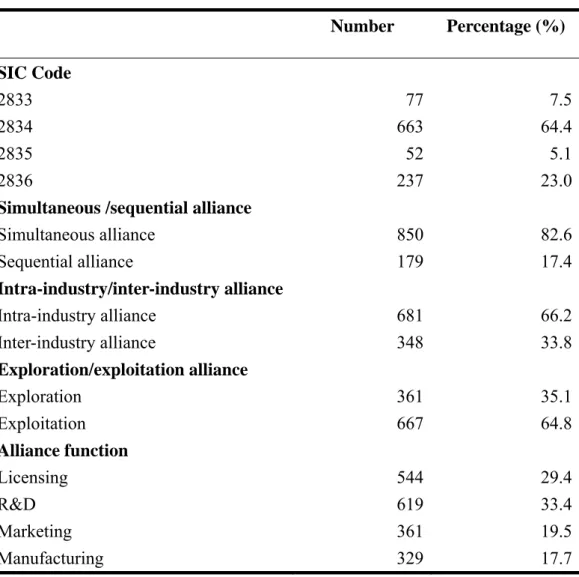
Table 1 shows the summary of sample distribution in terms of industry, simultaneous /sequential alliance, intra-industry/inter-industry alliance, exploration/exploitation alliance, and alliance functions. As can be seen, the drug-related industry (2834) accounts for the most cases (64.4%). Simultaneous alliance accounts for 82.6% while sequential alliance17.4% of cases. Moreover, intra-industry alliances account for
66.2% of cases while exploitation alliances account for 64.8% of cases. As for the alliance function, R&D, licensing, marketing and manufacturing alliances account for 33.4%, 29.4%, 19.5%, and 17.7% respectively.
--- INSERT TABLE 1 ABOUT HERE ---
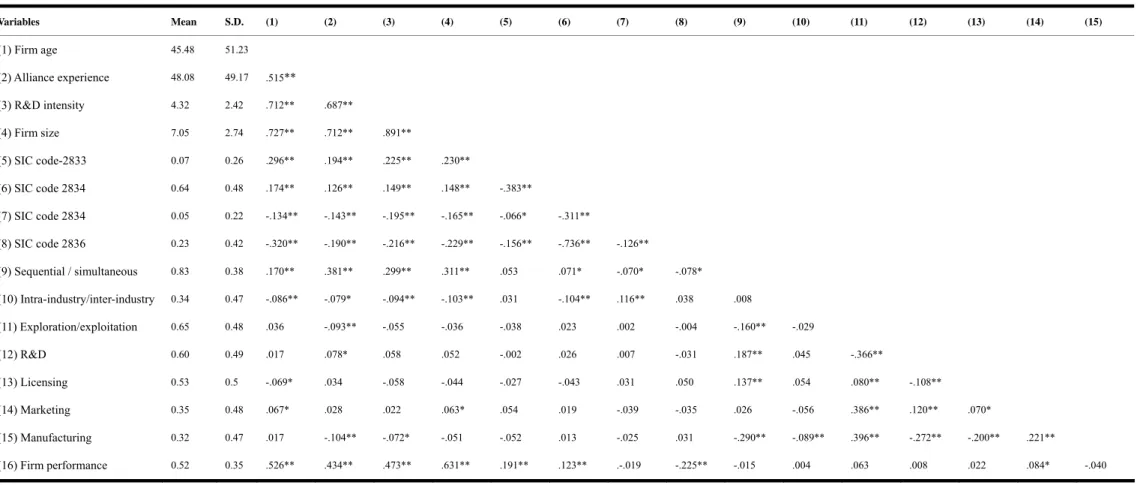
Table 2 shows the mean and correlation table of variables. As suggested, control variables such as firm age, alliance experience, R&D intensity, and firm size, had moderate a correlation with our dependent variable. Thus, we further used the variance inflation factor (VIF) values to assess multi-collinearity problem. Myers (1990) and Bowerman and O’Connell (1990) suggest that if the largest VIF is greater than 10 then there is cause for concerns of multicollinearity problem in the regression model. In our model, the VIF scores for all independent variables were less than 10, suggesting that our models have limited multicollinearity among independent variables, which should not significantly influence the stability of the parameter estimates.
--- INSERT TABLE 2 ABOUT HERE ---
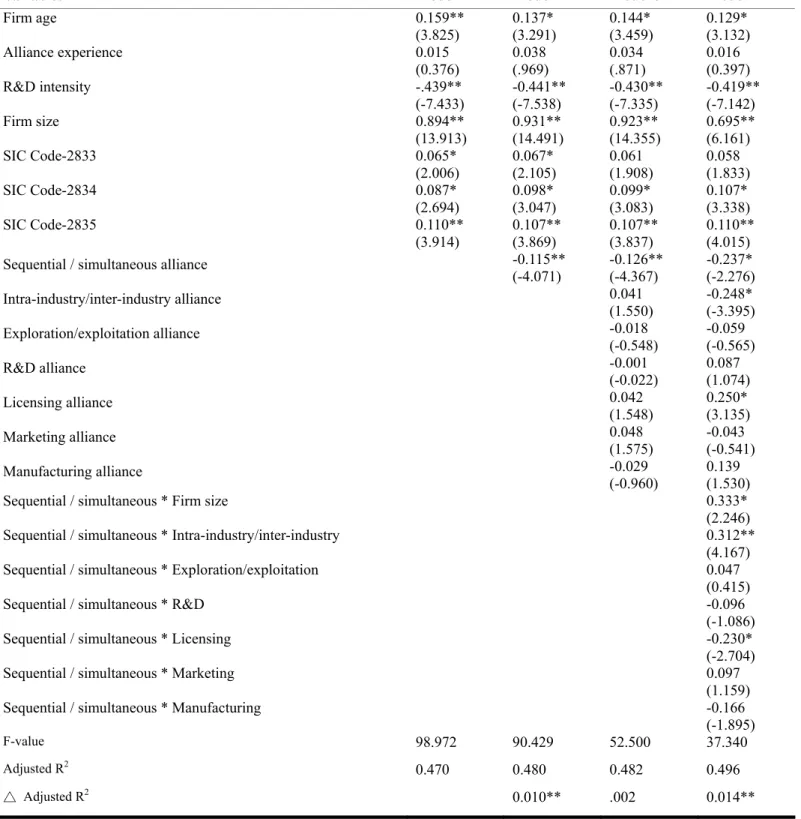
We used hierarchical regression models to test our developed hypotheses. Model 1, as a base model, is the first estimated through multiple regressions. The purpose of the base model is to establish a baseline against which added contribution of the independent and moderator variables can be assessed. Thus, the first model includes firm performance as the dependent variable as well as industry difference, firm age, alliance experience, R&D intensity, and firm size as the control variables. The purpose of the second model is to
sequential/simultaneous alliance is added as independent variable in the Model 2. ---
INSERT TABLE 3 ABOUT HERE ---
Table 3 shows the regression results of four models in this study. Model 1 explains 47.0% of the variance (adjusted R Square = 0.470) in the dependent variable. As predicted, firm age (b = 0.159, p < 0.01) and firm size (b = 0.894, p < 0.01) is positively associated with firm performance, suggesting that older and larger firms have better firm performance. However, R&D intensity is negatively correlated to firm performance (b = -0.439, p < 0.01), suggesting that higher R&D intensity may reduce a firm’s performance in terms of sale to asset ratio. Model 2, which includes sequential/simultaneous alliance as an independent variable, explains 48.0% of variance in firm performance and the adjusted R square is significant improved compared with Model 1 (Δ Adjusted R2= 0.010, p < 0.01). The simultaneous alliance is found negatively related to firm performance (b = -0.115, p<0.01), suggesting that comparing with sequential alliances, firms conducting simultaneous alliances are inclined to have worse performance, which supports our Hypothesis 1.
In order to further examine the moderating effects, this study uses regression model with interaction term. We multiplied sequential/simultaneous alliance by firm size, intra-industry/inter-industry alliance, exploration/exploitation alliance, and four functional alliances, and entered the multiplicative interaction items into the regression (shown as Model 4 in Table 3). Model 3 and Model 4 explains 48.2% and 49.6% of the variance (adjusted R Square = 0.482 & 0.496) in firm performance. The adjusted R square is not significantly improved in Model 3 (Δ adjusted R2= 0.002, p > 0.05) but significant improved in Model 4 (Δ
adjusted R2= 0.014, p < 0.01), suggesting that our regression model with interaction term has higher
explanation power for the dependent variable.
Model 3 shows that all added moderator variables do not significantly have direct correlation with firm performance. Model 4 shows that simultaneous alliance interacted by firm size and inter-industry alliance is positively correlated to firm performance (b = 0.333, p<0.01, and b = 0.312, p<0.01). However, simultaneous alliance interacted by licensing alliance is negatively correlated to firm performance (b = -0.230, p<0.05). The results suggest that simultaneous alliances can lead to better firm performance if firms are larger or conduct inter-industry alliances but lead to worse performance as firms conduct licensing alliances.
DISCUSSION
Capability of Managing Simultaneous Alliances
While prior alliance experience studies assert that there is a positive association between alliance experience and firm performance (Hoang and Rothaermel, 2005), the methods using to measure and to examine in these studies implicitly assume that alliances are undertaken sequentially. In business practice, most firms conduct multiple alliances at the same time instead of one by one. According to our research, only 17.4% out of 1,029 alliances are sequential alliances. From the perspective of the organizational learning school, firms do learn management capability from their previous experience of alliances. However, the question whether this management capability can manage multiple alliances simultaneously has not been fully investigated. Our research provides evidences for answering this research question.
performance than firms conducting sequential alliances. This suggests that as conducting multiple alliances simultaneously, firms may diverse their resources into several alliances and then lose their focus on core businesses, or may increase their transaction costs due to the increase of number of alliances (Jones and Hill, 1988). As a result, the simultaneous alliances lessen the effect of alliance on firm performance. Lichtenthaler and Lichtenthaler (2004) also assert that managing multiple alliances is different from managing a single alliance. For instance, the support of top managers on alliances is regarded as an important determinant of a successful single alliance. However, in the case of multiple alliances, firms need to consider more factors which affect the success for the multiple alliances, such as the priority of the alliances. The added benefits of each single alliance do not equal to the total benefits of multiple alliances since the effect of one alliance may be at the cost of another alliance, particularly when they are taken simultaneously. The findings in this research support this proposition that firms can not further improve performance as they conduct multiple alliances simultaneously. Firms can achieve better performance if they conduct alliance sequentially. This result suggests that although firms may be able to manage an alliance successfully, managing multiple alliances simultaneously is different from managing a single alliance. Firms should avoid conducting multiple alliances simultaneously if they do not have capabilities of managing a number of alliances at the same period of time.
Managing Various Types of Simultaneous Alliances
While some prior studies (Berg and Friedman, 1977; Berger and Ofek, 1995; Comment and Jarrel, 1995; Wang and Wu, 2004) find intra-industry alliances can enhance a firm’s value, Chan et al. (1997) asserts both intra-industry and inter-industry alliances can increase shareholders’ value of partner firms. Our
study extends the research by examining the effect of intra-industry or inter-industry alliances on firm performance in the situation of multiple simultaneous alliances. The findings show that firms can better benefit from conducting multiple inter-industry alliances simultaneously. One possible reason can be explained for this result. As conducting simultaneous alliances, partners in inter-industry alliances can better commit themselves into alliances because they seek for complementary resources. In contrast, partners in intra-industry alliances are more competitive-oriented and then lack of trust among alliance members, particularly as conducting multiple alliances simultaneously. As a result, firms conducting inter-industry alliances simultaneously have better performance.
As for four types of business function alliances, only conducting multiple licensing alliances simultaneously is significantly negative correlated to firm performance, which is not consistent with our hypothesis. The result suggests that joining too many licensing alliances at the same period of time will lead to the worse firm performance. From the perspective of licensees, joining too many licensing alliances simultaneously will signal to their partners that they are potential competitors in the future. As a result, it may lessen the trust among alliance partners, which lead to the worse performance of alliances. Moreover, from the perspective of licensors, though too many licensing alliances simultaneously can bring in licensing incomes, it accelerates the time span of the licensed technology development, which shortens the gap between the licensors and licensees. Thus, conducting many licensing alliances simultaneously will shorten the capitalization of technologies, which in turn leads to the worse firm performance.
Finally, while prior research suggests that larger firms have better alliance performance (Simonin, 1997), our research further finds that larger firms can better benefit from multiple simultaneous alliances.
This is because larger firms have more resources or more matured coordination capabilities to respond multi-units and multiple alliances. Therefore, larger firms can perform well as conducting multiple alliances simultaneously.
CONCLUSION
While prior alliances research mainly focus on the effect of multiple partners on performance in an alliance project level, the major contribution of this research attempts to investigate the effect of multiple alliances on performance in a firm level. Though prior studies conclude that multi-party alliances affect firm performance, none of these studies investigate whether multiple simultaneous alliances have impacts on firm performance. Thus, our research fills this research gap and finds that firms conducting simultaneous alliances have worse performance than firms conducting sequential alliances. However, if firms are larger or conducting inter-industry alliances, then they can benefit more from such simultaneous alliances. In contrast, conducting simultaneous licensing alliances will lead to a worse performance. Our study provides empirical evidences for linking strategic alliance, resource dependency, and organizational learning, and thus enriches the empirical and theoretical development of this important stream pf research.
From a practical perspective, our study indicates that firms are encouraged to conduct strategic alliance one by one. When top managers face several alliance opportunities, they should consider whether their firms large enough or have the capability of managing multiple alliances simultaneously. More importantly, if firms need to conduct a number of alliances simultaneously, it is better for these firms to conduct inter-industry alliances, which can complement the needed resources.
date of alliances, we can only estimate the duration of each the alliance by using the mean of all alliances, which makes our results vulnerable. Second, the measurement for firm performance in this study was used by financial performance instead of the number of new drugs. The reason why this study did not use the number of new drugs as the dependent variable is that this research investigates the effect of multiple alliances on firm performance in a firm level. While a firm conducts a number of alliances simultaneously, not all alliances are related to new drug development. Different alliances have different goals or motivations set by the firms. Thus, as we investigate the effect of multiple simultaneous alliances, a firm level measurement will be more applicable for this research. Finally, this study did not distinguish licensing alliances into licensor and licensee alliances since information is unavailable in the database. Future studies are suggested to distinguish the types of licensing alliance, which allows us to more exactly explain the findings.
TABLES
Table 1 Summary of Sample Distribution
Number Percentage (%) SIC Code 2833 77 7.5 2834 663 64.4 2835 52 5.1 2836 237 23.0
Simultaneous /sequential alliance
Simultaneous alliance Sequential alliance 850 179 82.6 17.4 Intra-industry/inter-industry alliance Intra-industry alliance Inter-industry alliance 681 348 66.2 33.8 Exploration/exploitation alliance Exploration Exploitation 361 667 35.1 64.8 Alliance function Licensing R&D Marketing Manufacturing 544 619 361 329 29.4 33.4 19.5 17.7
Table 2 Descriptive statistic and correlation table Variables Mean S.D. (1) (2) (3) (4) (5) (6) (7) (8) (9) (10) (11) (12) (13) (14) (15) (1) Firm age 45.48 51.23 (2) Alliance experience 48.08 49.17 .515** (3) R&D intensity 4.32 2.42 .712** .687** (4) Firm size 7.05 2.74 .727** .712** .891** (5) SIC code-2833 0.07 0.26 .296** .194** .225** .230** (6) SIC code 2834 0.64 0.48 .174** .126** .149** .148** -.383** (7) SIC code 2834 0.05 0.22 -.134** -.143** -.195** -.165** -.066* -.311** (8) SIC code 2836 0.23 0.42 -.320** -.190** -.216** -.229** -.156** -.736** -.126** (9) Sequential / simultaneous 0.83 0.38 .170** .381** .299** .311** .053 .071* -.070* -.078* (10) Intra-industry/inter-industry 0.34 0.47 -.086** -.079* -.094** -.103** .031 -.104** .116** .038 .008 (11) Exploration/exploitation 0.65 0.48 .036 -.093** -.055 -.036 -.038 .023 .002 -.004 -.160** -.029 (12) R&D 0.60 0.49 .017 .078* .058 .052 -.002 .026 .007 -.031 .187** .045 -.366** (13) Licensing 0.53 0.5 -.069* .034 -.058 -.044 -.027 -.043 .031 .050 .137** .054 .080** -.108** (14) Marketing 0.35 0.48 .067* .028 .022 .063* .054 .019 -.039 -.035 .026 -.056 .386** .120** .070* (15) Manufacturing 0.32 0.47 .017 -.104** -.072* -.051 -.052 .013 -.025 .031 -.290** -.089** .396** -.272** -.200** .221** (16) Firm performance 0.52 0.35 .526** .434** .473** .631** .191** .123** .-.019 -.225** -.015 .004 .063 .008 .022 .084* -.040 ** P < 0.01; * p < 0.05.
Table 3 Regression results
Variables Model 1 Model 2 Model 3 Model 4
Firm age 0.159** (3.825) 0.137* (3.291) 0.144* (3.459) 0.129* (3.132) Alliance experience 0.015 (0.376) 0.038 (.969) 0.034 (.871) 0.016 (0.397) R&D intensity -.439** (-7.433) -0.441** (-7.538) -0.430** (-7.335) -0.419** (-7.142) Firm size 0.894** (13.913) 0.931** (14.491) 0.923** (14.355) 0.695** (6.161) SIC Code-2833 0.065* (2.006) 0.067* (2.105) 0.061 (1.908) 0.058 (1.833) SIC Code-2834 0.087* (2.694) 0.098* (3.047) 0.099* (3.083) 0.107* (3.338) SIC Code-2835 0.110** (3.914) 0.107** (3.869) 0.107** (3.837) 0.110** (4.015) Sequential / simultaneous alliance -0.115**
(-4.071) -0.126** (-4.367) -0.237* (-2.276) Intra-industry/inter-industry alliance 0.041 (1.550) -0.248* (-3.395) Exploration/exploitation alliance -0.018 (-0.548) -0.059 (-0.565) R&D alliance -0.001 (-0.022) 0.087 (1.074) Licensing alliance 0.042 (1.548) 0.250* (3.135) Marketing alliance 0.048 (1.575) -0.043 (-0.541) Manufacturing alliance -0.029 (-0.960) 0.139 (1.530)
Sequential / simultaneous * Firm size 0.333* (2.246)
Sequential / simultaneous * Intra-industry/inter-industry 0.312** (4.167)
Sequential / simultaneous * Exploration/exploitation 0.047 (0.415)
Sequential / simultaneous * R&D -0.096 (-1.086)
Sequential / simultaneous * Licensing -0.230* (-2.704)
Sequential / simultaneous * Marketing 0.097 (1.159)
Sequential / simultaneous * Manufacturing -0.166 (-1.895)
F-value 98.972 90.429 52.500 37.340
Adjusted R2 0.470 0.480 0.482 0.496
△ Adjusted R2 0.010** .002 0.014**
REFERENCES
Berg, S.V. and Friedman, P. (1977). ‘Joint Ventures, Competition, and Technological Complementarities: Evidence from Chemicals’, Southern Economic Journal,43(3):1330-1338.
Berger, P.G. and Ofek, E. (1995). ‘Diversification’s Effect on Firm Value’, Journal of Financial Economics, 37(1):39-65.
Bergquist, W., Betwee, J. and Meuel, D. 1995. Building Strategic Relationships: How to Extend Your Organization’s Reach Through Partnerships, Alliances, and Joint Ventures, San Francisco, Jossey-Bass Publishers
Bowerman, B.L., & O’Connell R.T. 1990. Linear Statistical Models: An Applied Approach, 2nd edition, Duxbury, Belmont.
Caloghirou, Y., Kastelli, I., & Tsakanikas, A. 2004. Internal capabilities and external knowledge sources: complements or substitutes for innovative performance. Technovation 24: 29-39.
Chan, S.H., Kensinger, J.W., Keown, A.J., & Martin, J.D. 1997. Do Strategic Alliances Create Value? Journal of Financial Economics 46(2):199-221.
Chen, C. J. (2003). ‘The Effect of Environment and Partner Characteristics on the Choice of Alliance Forms’, International Journal of Project Management, 21(2): 115-125.
Cohen, W.M., & Levinthal, D.A. 1990. Absorptive capacity: A new perspective on learning an innovation.
Administrative Science Quarterly 35(1): 128-152.
Comment, R. and Jarrella, G.A. (1995). ‘Corporate Focus And Stock Returns’, Journal of Financial Economics,37(1):67-87.
Danzon, P.M., Nicholson, S. and Pereira, N.S.(2005). ‘Productivity in Pharmaceutical – Biotechnology R&D: The Role of Experience and Alliances’, Journal of Health Economics, 24(2):317-339.
Das, S., Sen, P.K. and Sengupta, S. (1998). Impact of Strategic Alliances on Form Valuation, Academic of Management Journal, 41(1): 27-41.
Das, T.K., & Teng, B. (2002). ‘Alliance Constellations: A Social Exchange Perspective’, Academy of Management Review, 27(3): 445-456.
Deeds, D.L. and Rothaermel, F.T. (2003). Honeymoons and Liabilities: The Relationship between Age and Performance in Research and Development Alliances, Journal of Product Innovation Management, 20: 468-484.
Dyer, J. H. 1997. Effective interfirm collaboration: How firms minimize transaction costs and maximize transaction value. Strategic Management Journal, 18: 553-556.
Dyer, J. H., & Singh, H. 1998. The relational view: Cooperative strategy and sources of interorganizational competitive advantage. Academy of Management Review, 23: 660-679.
Dyer, J.H., Kale, P. and Singh, H.(2001). ‘How to make strategic alliances work’, Sloan Management Review, 42 (4):37–43.
Emden, Z., Yaprak, A., Cavusgil, S.T. (2005). ‘Learning From Experience in International Alliances: Antecedents and Firm Performance Implications’, Journal of Business Research, 58(7): 883-892.
Gambardella, A. 1992. Competitive advantages from in-house scientific research: The US pharmaceutical industry in the 1980s. Research Policy 21: 391–407.
George, G., Zahra, S.A. and Wood, D.R. (2002). ‘The Effects of Business-University Alliances on Innovative Output and Financial Performance: A Study of Publicly Traded Biotechnology Companies’, Journal of business Venturing, 17(6): 557-570.
George, V.P. and Farris, G. (1999). ‘Performance of alliances: formative stages and changing organizational and environmental influences’, R&D Management,29(4): 379–389.
Gilsing, V.A. , Lemmens, C. E. A. V. and Duysters, G. (2007). ‘Strategic Alliance Networks and Innovation: A Deterministic and Voluntaristic View Combined’, Technology Analysis & Strategic Management, 19(2): 227-249.
in Alliances’, Academy of Management Journal, 38(1):85-112.
Gulati, R.(1998). ‘Alliances and Networks’, Strategic Management Journal, 19(3): 293-317.
Hagedoorn, J. 1993. Understanding the rationale of strategic technology partnering: Interorganizational modes of cooperation and sectoral differences. Strategic Management Journal, 14: 371-385.
Hall, L.A., & Bagchi-Sen, S. 2002. A study of R&D, innovation, and business performance in the Canadian biotechnology industry. Technovation 22: 231-244.
Harrison, J.S., Hitt, M.A., Hoskisson, R.E., & Ireland, D.R. (2001). ‘Resource Complementary in Business Combinations: Extending the Logic to Organizational Alliances’, Journal of Management, 27(6): 679-690.
Hitt, M.A., Ireland, D.R., & Hoskisson, R.E. (1999). ‘The International Environment: Resources, Capabilities, and Core Competencies’ in Strategic Management: Competitiveness and Globalization’, South-Western College Publishing
Hoang, H. & Rothaermel, F.T. (2005). The Effect of General and Partner-Specific Alliance Experience on Joint R&D Project Performance. Academy of Management Journal, 48(2), 332-345.
Hwang, P. and Burgers, W.P.(1997).’The Many Faces of Multi-Firm Alliances: Lessons For Managers’, California Management Review, 39(3): 101-117.
Ireland, R. D., Hitt, M. A., & Vaidyanath, D. 2002. Alliance management as a source of competitive advantage. Journal of Management, 28: 413-446.
Jones, G.R. & Hill, C.W.L. (1988). Transaction Cost Analysis of Strategy-Structure Choice, Strategic Management Journal, 9: 159-172
Kogut, B. 1989. The stability of joint ventures: Reciprocity and competitive rivalry. Journal of Industrial Economics, 38: 183-198.
Lichtenthaler, U. and Lichtenthaler,E. (2004).’ Alliance Functions: Implications of the International Multi-R&D-Alliance Perspective’, Technovation, 24(7): 541-552.
McCutchen Jr., W. W. and Swamidass, P. M.(2004). ‘R&D Risk-Taking in Strategic Alliances: New Explanations for R&D Alliances in the Biopharmaceutical Industry’, Management International Review, 44(1): 53-67
Mohr, J. & Spekman, R. (1994). ‘Characteristics of Partnership Success: Partnership Attributes, Communication Behavior, and Conflict Resolution Techniques’, Strategic Management Journal,15(2):135-152
Myers R. 1990. Classical and Modern Regression with Applications, 2nd edition, Duxbury, Boston.
Powell, W.W., Koput, K.W., Smith-Doerr, L. and Owen-Smith, J. (1999). ‘Network Position and Firm Performance: Organizational Returns to Collaboration in the Biotechnology Industry’, Networks in and Around Organizations. JAI Press, Greenich, CT.
Pfeffer, J. and Salancik, G. R. (1978). The External Control of 0rganization. New York: Harper and Row. de Ridder, A. and Rusinowska, A.(2008). ‘On Some Procedures of Forming a Multipartner Alliance’,
Journal of Economics & Management Strategy, 17(2), 443-487.
Rothaermel, F.T. (2001). ‘Complementary assets, strategic alliances, and the incumbent’s advantage: an empirical study of industry and firm effects in the biopharmaceutical industry’, Research Policy , 30(8):1235-1251.
Rothaermel, F.T. & Deeds, D.L. (2004). ‘Exploration And Exploitation Alliances in Biotechnology: System of New Product Development’, Strategic Management Journal, 25(3): 201-221
Rothaermel, F.T. & Deeds, D.L. (2006). ‘Alliance type, alliance experience and alliance management capability in high-technology ventures’, Journal of Business Venturing, 21(4): 429-460.
Shuen, A.A. (1994). Technology Sourcing and Learning Strategies in The Semiconductor Industry. Unpublished doctoral dissertation, University of California, Berkley.
Organization,’ Academy of Management Journal,40(5): 1150-1174.
Sohn, S.J.(2006). ‘Choosing the Partners in the Licensing Alliance’, Managerial & Decision Economics, 27(4): 251-260.
Varadarajan, P.R. and Cunnigham, M.H.(1995). ‘Strategic Alliance: A Synthesis of Conceptual Foundations’, Journal of the Academy of Marketing Science, 23(4):282-296.
Walters, B.A., Peters, S. and Dess, G.G.(1994). ‘Strategic alliances and joint ventures: making them work’, Business Horizons,37(4): 5–10.
Wang, Y.H. & Wu, C.T. (2004). The Share Price Responses and Determinants of Strategic Alliances in Taiwan’s High-Tech Industry: A Quantile Regression Approach, Review of Pacific Basin Financial Markets & Policies, 7(3): 355-378.
Xia, T. and Roper, S.(2008). ‘From Capability to Connectivity-Absorptive Capacity And Exploratory Alliances in Biopharmaceutical firms: A U.S.-Europe Comparison’, Technovation,28(11):776-785.
Xu, B.(2006). ‘Market Differential Evaluations of Strategic Alliances in the Pharmaceutical/ Biotechnology Industry’, Journal of High Technology Management Research,17(1):43-52.
Zahra, S.A., and George, G. 2002. Absorptive capacity: A review, reconceptualization, and extension.
行政院國家科學委員會補助國內專家學者出席國際學術會議報告
99 年 8 月 20 日 報告人姓名黃國峯
服務機構 及職稱 國立政治大學 企業管理學系 助理教授 時間 會議 地點 民國 99 年 8 月 6 日至 民國 99 年 8 月 10 日 加拿大 蒙特婁 本會核定 補助文號 98-2410-H-004-068-MY2 會議 名稱 (中文) 2010 年管理學會年會(英文) 2010 Academy of Management Annual Meeting 發表
論文 題目
1. (中文) 競爭不確定性、競爭不一致性、與競爭優勢
(英文) An Investigation for Competitive Uncertainty, Competitive Nonconformity, and Competitive Advantage
一、 參加會議經過
Academy of Management (AOM) 年會是管理學界最重要的學術會議,而 AOM 發行的期 刊 Academy of Management Review (AMR) 與 Academy of Management Journal (AMJ) 等,皆是 SSCI 期刊中的 First Tier 的期刊,因此在 AOM 發表的論文,將有機會與上述 期刊的編輯委員做直接的接觸與討論,進而可發表在 SSCI 等級的期刊上。
這是個人第三次參加 AOM 年會,今年在 Business Policy and Strategy Track 發表一篇論 文 “An Investigation for Competitive Uncertainty, Competitive Nonconformity, and Competitive Advantage”。國科會的補助計畫對個人在研究上一直有重要幫助,在此特別 感謝國科會的補助。在個人發表論文之場次中,本人得到許多其他學者的建設性 feedbacks,包括蔡文賓教授與 Professor Richard Priem 等等,讓本人與其他學者的研 究有機會充分的討論與整合,產生許多腦力的激蕩與火花,對於這篇論文之修改與日後 投稿期刊的修正有極大的幫助。 本次與會另一個目的,是希望多認識相關領域的學者,以及瞭解最新的研究方向與趨 勢,並利用與會時間,多認識相關期刊之編輯委員,所以,在與會的過程中,除了參加 數場相關研究的討論會外,並積極參與許多不同組織學會的 reception,以多認識與會的 其他學者,交換研究心得與經驗。
二、 與會心得
第三次參加 AOM 的年會,再次與大師們當面接觸,例如:陳時奮、陳明哲、蔡文賓、 Henry Minzberg 等,並聆聽最新的研究發展方向,這是非常難得的寶貴經驗。在策略管 理的領域中,有些與會學者持續強調 multi-theory 的整合與運用,可以看得出來愈來愈 多的學者注意理論與理論間的整合性之應用。 今年台灣在 AOM 的發表的人數達到 170 人,可見近年來國內學者參與國際學術研討會 的風氣亦盛,希望藉由這樣的良性競爭,讓台灣的管理學術研究也能漸漸與國際接軌。 而在這次的會場中,到處可見台灣來的學者,也可讓國際學者們有機會接觸並瞭解台灣 的研究現況,同時增加對台灣管理議題的討論機會。 在回程過境日本的旅程中,本人拜訪日本東京理科大學平尾毅教授,討論未來合作研究 之議題,平尾教授目前的研究計劃專注於半導體產業的群聚競爭力之研究,與本人研究 相近,我們試圖比較台灣與日本的半導體產業群聚效果,希望未來有機會做跨國之比較 研究。
三、 建議
藉由此次與會,認識許多其他不同國家的學者,經由彼此經驗的交流,瞭解國外的學術 研究機構與學校對研討會的重視程度,尤其像 AOM 這類的大型國際學術研討會之重視 程度,不論從對發表論文學者的補助,或是對發表文章的獎勵,都是國內學術環境仍須 努力的方向,而個人也因為榮獲 貴會部份經費的補助,得以成行,所以特別感謝國科 會提供國內學者這樣的獎勵補助,對於國內學術成就的國際化應有很大助益。四、 攜回資料名稱及內容
1. 大會議程一份。來源: Nicholas Argyres <[email protected]> 收信: [email protected]
日期: Mon, 12 Apr 2010 16:36:08 -0400
標題: 2010 Academy of Management Annual Meeting Paper Status Report
Dear Kuo-Feng Huang:
I am once again pleased to congratulate you on having your paper, "An Investigation for Competitive Uncertainty, Competitive Nonconformity, and Competitive Advantage", accepted for presentation in a Divisional Roundtable Paper session at the 2010 Academy of Management Meeting, August 6-10, in Montreal, Canada. Please read this entire letter as it includes important information about:
1. Scheduling details
2. Preparing for the session 3. Registering to attend
SCHEDULING DETAILS
Your paper will be included in a session titled, "Competitive Interaction ". This session is tentatively scheduled on Aug 9 2010 from 8:00AM to 9:30AM in the 515B room of the Le Palais Des Congres. All presenters in this session are expected to appear at this time. One of the conditions for having your paper accepted is your availability for the entire scholarly program from Monday to Tuesday, August 9-10, 2010. No changes will be made in the program schedule to accommodate your travel plans. If you are not able to attend, then you will have to either withdraw the paper or have a co-author present.
* NOTE: Scheduled times and locations may be subject to change. Please refer to the online program (opening in May), final printed program (given out onsite),
or program addendum (also given out onsite) for updated information.
PREPARING FOR THE SESSION
Prior to the Session:
If you have not done so, you can read the reviewers' comments for your paper by
logging into the submission system, http://submissions.aomonline.org. We hope
these comments will help you prepare the presentation. Also, please take a few moments and provide feedback to the reviewers.
ALL accepted papers will be made available online for only meeting registrants to view and download. We hope that this will lead to more interaction and discussion during the session. You will have the option to remove your paper from the online program if you do not want to participate. More information and instructions will be sent shortly regarding this. In the meantime, please still send copies of your paper to the facilitator of your session by June 1 so that he/she can prepare for the session. You can find contact information for your facilitator by visiting the online program to be available in May.
As an additional service you will be able to provide supplements to your paper. You will be able to provide a link to an online posting of a slide show, a PowerPoint presentation, or the audio or video recording of the presentation. More information and instructions will be sent shortly regarding this.
For the session:
Each session will be conducted in a roundtable setting. Presenters will provide a 5-7 minute overview of their paper. A general discussion led by a session facilitator will follow the presentations. With only 5-7 minutes to present, there is little time for embellishment. You should bear in mind that this format requires a different preparation than the traditional paper session.
Please use the limited time to talk about the following three items: 1. The paper's research problem and why it is interesting;
2. Statement of the paper's conclusion. Explain why it was reached and what is new that adds to our understanding. (Urge the audience to read the paper online for details);
3. State how specific ideas in at least one other paper in this session could inform future work that builds on your paper. Or alternatively, how specific ideas in your paper could inform the development of another paper in this session.
REGISTERING TO ATTEND
Please do not forget to register and book your housing for the meeting.
Registration and housing information is available on the annual meeting website at http://meetings.aomonline.org/2010/. Also if you are not yet a member of the Academy, I encourage you to become one by completing a membership application
available on the AOM web site, http://www.aomonline.org.
Congratulations once again on having your paper accepted for the 2010 Academy of Management Meeting in Montreal, Canada. Please contact me if you have any
questions.
Sincerely,
Nicholas Argyres
12711
An Investigation for Competitive Uncertainty, Competitive Nonconformity,
and Competitive Advantage
ABSTRACT
This paper, based on competitive dynamic theory, attempts to investigate how competitive
nonconformity (CNC) affects firm performance by integrating the micro level (firm
competitive behavior) and macro level (group competitive behavior). We introduce an
exogenous concept of competitive uncertainty, including competitive heterogeneity and
competitive turbulence, and examine how this competitive uncertainty moderates the
relationship between CNC and firm performance. Using the data of the commercial bank
industry in Taiwan, our results show that CNC is related to firm performance in a U-shaped
way. While competitive heterogeneity is positively correlated to firm performance,
competitive turbulence is negatively correlated to firm performance. Moreover, competitive
turbulence negatively moderates the relationship between CNC and firm performance.
Keywords: competitive nonconformity, competitive uncertainty, competitive heterogeneity,
-國科會補助專題研究計畫項下出席國際學術會議心得報告
日期:99年10月30日計畫編號
NSC98-2410-H-004-068 –MY2
計畫名稱
多方策略聯盟與廠商績效之研究(2/2)
出國人員
姓名
黃國峯
服務機構
及職稱
國立政治大學 企業管理學系 副教授會議時間
99 年 9 月 12 日至
99 年 9 月 15 日
會議地點
義大利 羅馬會議名稱
(中文) 2010 年策略管理學會年會(英文) 2010 Strategic Management Society International Conference
發表論文
題目
(中文) 同步策略聯盟、循序策略聯盟、與廠商績效之研究
(英文) Simultaneous Alliance, Sequential Alliance, and Firm Performance
一、參加會議經過
Strategic Management Society (SMS) 年會是策略管理學界最重要的學術會議,而 SMS 發行的期 刊 Strategic Management Journal (SMJ)是 SSCI 期刊中的 First Tier 的期刊,因此在 SMS 發表 的論文,將有機會與上述期刊的編輯委員做直接的接觸與討論,進而可發表在 SSCI 等級的期刊 上。
這是個人第二次參加 SMS 年會,今年在 Competitive Strategy Track 發表一篇論文
“Simultaneous Alliance, Sequential Alliance, and Firm Performance"。國科會的補助計 畫對個人在研究上一直有重要幫助,在此特別感謝國科會的補助。在個人發表論文之場次中,本 人得到許多其他學者的建設性 feedbacks,讓本人與其他學者的研究有機會充分的討論與整合, 產生許多腦力的激蕩與火花,對於這篇論文之修改與日後投稿期刊的修正有極大的幫助。 本次與會另一個目的,是希望多認識相關領域的學者,以及瞭解最新的研究方向與趨勢,並利用 與會時間,多認識相關期刊之編輯委員,所以,在與會的過程中,除了參加數場相關研究的討論 會外,並積極參與許多不同組織學會的 reception,以多認識與會的其他學者,交換研究心得與 經驗。
二、與會心得
展方向,這是非常難得的寶貴經驗。在策略管理的領域中,有些與會學者持續強調 multi-theory 的整合與運用,可以看得出來愈來愈多的學者注意理論與理論間的整合性之應用。 今年台灣在 SMS 的發表的人數不是很多,可能與 SMS 的註冊費較高有關,近年來國內學者參與國 際學術研討會的風氣亦盛,但由於經費關係,可能類似這樣的研討會參加的意願比較低,如此可 能有礙台灣的管理學術研究與國際接軌,無法讓國際學者們有機會接觸並瞭解台灣的研究現況, 實為可惜。
在去程過境英國的旅程中,本人拜訪英國 University of London, Royal Holloway 教授 Dynerson and Harindranath,討論未來合作研究之議題,兩位教授目前的研究計劃專注於中小企業之研究, 與本人部分研究相近,我們試圖比較台灣與英國的中小企業在群聚中的績效,希望未來有機會做 跨國之比較研究。
三、考察參觀活動(無是項活動者略)
四、建議
藉由此次與會,認識許多其他不同國家的學者,經由彼此經驗的交流,瞭解國外的學術研究機構 與學校對研討會的重視程度,尤其像 SMS 這類的大型國際學術研討會之重視程度,不論從對發表 論文學者的補助,或是對發表文章的獎勵,都是國內學術環境仍須努力的方向,而個人也因為榮 獲 貴會部份經費的補助,得以成行,所以特別感謝國科會提供國內學者這樣的獎勵補助,對於 國內學術成就的國際化應有很大助益。五、攜回資料名稱及內容
1. 大會議程一份。六、其他
Kuo-Feng Huang
National Chengchi University Dept: Business Administration No.64
Sec.2 Zhi-Nan Road Taipei 116 Taiwan
Your Submission, 2010-AC-0129, for the 2010 SMS Annual Conference, September 12-15, 2010 in Rome
Dear Kuo-Feng Huang,
Thank you for submitting to 2010 SMS Annual Conference in Rome with the theme "Strategic Management at the Crossroads". With over 1,100 submissions, the response to the Call for Proposals has been enormous. In our search for high quality research we were only able to accept a portion of the submitted proposals for the program. Almost 500 of your peers were involved in the double blind review process and spent significant time and effort helping us to make these difficult decisions. They deserve our deepest appreciation.
Congratulations, we are very happy to inform you that the following proposal you submitted has been recommended for inclusion into the conference program
2010-AC-0129 Simultaneous Alliance, Sequential Alliance, and Firm Performance Kuo-Feng Huang
Lei-Yu Wu Chieh Lun Chang
In order to confirm your commitment to present your proposal in Rome, you are invited to register as a presenter for the conference. A reduced Presenter Registration Fee is available to you until May 15, 2010. To take advantage of this reduced fee, your registration and payment has to be received by us before this date. If we have not heard from you by that date confirming your participation, we will not be able to hold the program slot for your proposal or the reduced registration fee.
Please visit rome.strategicmanagement.net for details on how to register, print invoices and receipts, and for additional information about session planning, presenter guidelines, and hotel information.
We advise you to make your travel arrangements as soon as possible. Due to the popular location of the conference, hotel rooms are limited. For more information on travel, please visit our conference website.
We are looking forward to seeing you in Rome! Program Co-Chairs,
Giambattista Dagnino Gianmario Verona
Rosario Faraci Maurizio Zollo
Simultaneous Alliance, Sequential Alliance, and Firm Performance
ABSTRACT
This paper extends prior alliance studies from an alliance project level to a firm level, and tests the influence of simultaneous alliances and sequential alliances on firm performance using data from 1,029 alliances in the global pharmaceutical industry. Our research suggests that simultaneously conducting multiple alliances may not generate better performance except for the firms with large size or for conducting inter-industry alliances. This paper contributes to the existing theory by examining the joint effect of simultaneous alliances and characteristics of alliances on a firm’s performance.