行政院國家科學委員會專題研究計畫 成果報告
子計畫一:視訊的智慧型高階處理(3/3)
計畫類別: 整合型計畫
計畫編號: NSC93-2213-E-002-100-
執行期間: 93 年 08 月 01 日至 94 年 07 月 31 日
執行單位: 國立臺灣大學電機工程學系暨研究所
計畫主持人: 貝蘇章
報告類型: 完整報告
報告附件: 出席國際會議研究心得報告及發表論文
處理方式: 本計畫可公開查詢
中 華 民 國 94 年 5 月 12 日
1
智慧型音視訊和傳輸技術及多媒體應用-子計畫一:
視訊的智慧型高階處理(III)
Intelligent High level Video Processing (III)
計畫編號:NSC-93-2213-E-002-100
執行期限:93 年 8 月 1 日至 94 年 7 月 31 日
主持人:貝蘇章
台灣大學電機系教授
摘要 將灰階影像轉換成半色調的二元影像,我們提出一 位元交換方法決定位元傳輸順序,可以順序累進重建其 半色調的二元影像,此法不僅可以得到高品質的影像重 建及維持較低的位元傳輸速率。 關鍵字: 順序累進編碼、半色調影像、無失真壓縮 ABSTRACTDithered images are the results of thresholding original gray-level images with dithering screens. After the preprocessing of bit-interleaving, this algorithm utilizes the characteristic of reordered image to determine the transmitting order and then progressively reconstructs the dithered image. Moreover, the dithered images are further compressed by lossy and lossless procedures. The experimental results demonstrate high-quality reconstructions while maintaining low transmitted bit rates.
Keyword: Progressive coding 、 halftone image 、 lossless compression
Introduction
Digital halftoning is a technique of converting multi-tone images into the 2-tone format [1]. Conventional halftoning methods include ordered dithering, error diffusion, and least-square methods. And the ordered-dithering method is known to be the most efficient and offers good visual quality.
Kollias and Anastassiou proposed a progressive coding scheme for error-diffused halftone images using a
distortion criterion [2]. M. Mese and P. P. Vaidyanathan proposed embedded multiresolution dot diffusion [3]. C. S. Lee and H. W. Park adopted inverse halftone and rehalftone for progressive coding of error diffused images [4]. In this paper, we present a novel
progressive coding scheme for dithered images. The performance of the algorithm is measured by PSNR, i.e., the peak signal power to the mean squared error (MSE) between the original dithered image and the reconstructed dithered image at every step.
Bit-interleaving: Fig. 1(a) is a dispersed-dot dithering screen. It is duplicated and tiled to be as the same size as the gray-tone image. Than, point-wise we compare the value of corresponding positions. If the value in the threshold matrix is larger than the pixel value of the gray-tone image, then a value 255 is encoded. Otherwise, a value 0 is encoded.
The dithered Lena image is shown in Fig. 1(c). The bit-interleaving [5] extracts and gathers all the pixels that map to the same threshold in Fig. 1(a) to form the image shown in Fig. 1(d), which composes 64 sub-images.
Progressive coding: The sub-images in two-dimensional image such as Fig. 1(d) can be rearranged from left to right, lower to upper into the form of a one-dimension sub-image sequence. Sub-images 1 to 8 are all white while sub-images 57 to
64 are all black. These sub-images need not be transmitted, because the receiver recognizes it when it receives an overhead bit stream of 64 bits. In this bit stream, the bit “1” represents an all-white sub-image in the interval (1, 32), and all-black in (33, 64). Fig. 1(d) shows that the sub-images in position “32” or “33” preserve a significant portion of the original image’s features. Here we first transmitted and reconstructed the sub-image 32.
The algorithm for the determination of the subsequent sub-images to be transmitted is described as follows. 1. Let
x
1,x
2, …,x
m represent the one-dimensionsub-images. (m=
n
2, here n= 8, m=64)2. Initialize flag(
x
1) = flag(x
2) = … = flag(x
m) = 0. 3. Set flag(x
upper) = flag(x
lower) =1. (x
lower representsthe sub-image before the sub-image that a black pixel first appears if counting from
x
1, wherex
upperrepresents the sub-image before the sub-image that the white pixel first appears if counting down from
m
x
. In the example, the 256×
256 Lena image,lower
x
=x
8,x
upper=x
57)4. Set flag(
x
middle) =1, herex
middle representsx
32 in this paper。5. Calculate the difference
D
ab of every two adjacent sub-imagesx
a,x
bsuch that flag(x
a) = flag(x
b) = 1, defineD
ab=D
ab(1)+D
ab(2), where ) 1 ( abD
=H(x
a,x
a+1)+H(x
a,x
a+2)+…+ H(x
a,x
c), ) 2 ( abD
=H(x
c+1,x
b)+H(x
c+2,x
b)+…+ H(x
b−1,x
b), a≤
c≤
b ) 1 ( abD
,D
ab(2) satisfy the conditionD
ab(1)≅
D
ab(2).(H(
x
a ,x
a+1 ) represents the hamming distance betweenx
a andx
a+1 ). Thenx
c is the nextsub-image to be transmitted, and set flag(
x
c) = 1. 6. The reconstructed left-side distance (LSD) andright-side distance (RSD), which satisfy the following conditions: H(
x
a ,x
a+1 )+H(x
a ,x
a+2 )+…+ H(x
a,x
c−LSD−1)≅
H(x
c−LSD,x
c)+H(x
c−LSD+1,x
c)+…+ H(x
c−1,x
c) H(x
c ,x
c+1 )+H(x
c ,x
c+2 )+…+ H(x
c,x
c+RSD)≅
H(x
c+RSD+1,x
b)+H(x
c+RSD+2,x
b)+…+ H(x
b−1,x
b)LSD and RSD are then represented by five bits and transmitted to the receiver as side information.
Lossy progressing and entropy coding: In some practical applications, perfect reconstruction may not be as important as the processing speed. Thus, it is of importance to analyze the trade-off between reconstruction errors and processing speed. Here in this section, we provide the overview of the algorithm for the improvement of processing speed with a lossy process, as follows:
1. Define a threshold
N
th, as the total number of pixels of which the values can be changed.2. Find the minimum minor pixel (black pixel in
1
x
~x
middle or white pixel inx
middle+1~x
m) number of the sub-image simultaneously searching up fromx
1and down form
x
64.3. Reverse a minor pixel value of the sub-image as given in Step 2 and then subtract 1 from
N
th. 4. Repeat Steps 2 and 3 untilN
th=0.Because of the low-pass characteristics of the human visual system (HVS), the best candidate of minor pixels to be reversed is chosen from the high-frequency region of a sub-image. We use the concept of sliding window, which only covers two pixels in a sub-image. If the value of the two pixels is different, it implies a high frequency region here, and the pixel with minority should be reversed.
3 and black in the upper half plane, as shown in Fig. 1(d), the coding gain is also improved by separating the Huffman coding process into the lower plane and upper plane.
Results: The results of progressive reconstruction are shown in Figs. 2 (b)-(h), corresponding to step 1 to step 7, which are the reconstructions from 1, 2, 4, 8, 16, 32, and 48 sub-images.
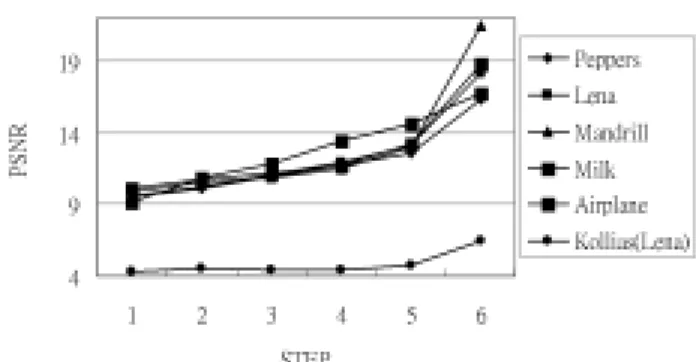
The images of Peppers, Mandrill, Milk, and Airplane were also used for the experiments for comparison purposes, and the experimental PSNR corresponding to the number of steps is shown in Fig. 3. The quality of the reconstructions showed notable improvement over the resultant images by the technique proposed by Kollias [2].
The average Huffman lossless compression bit rate is 0.34, while the resultant bit rate is 0.75 by Kollias [2]. The bit rates of the progressive lossy coding of the Lena image under 400, 800, 1200 pixels’ loss are 0.3, 0.29, and 0.26, as well as the PSNR are 22.14, 19.13, and 17.37, respectively.
References
[1] R. Ulichney, Digital Halftoning, MIT Press, Cambridge, Massachussetts, 1987.
[2] S. Kollias and D. Anastassiou, ”A progressive scheme for digital image halftoning, coding of halftones, and reconstruction,” IEEE Transactions on Selected Areas in Communications, vol. 10, pp. 944-951, 1992.
[3] M. Mese and P. P. Vaidyanathan, “Optimized halftoning using dot diffusion and methods for inverse halftoning,” IEEE Trans. On Image Processing, vol. 5, pp. 691-709, April 2000.
[4] C. S. Lee and H. Park, “Progressive coding of error diffused images,” ICIP, vol. 3, pp. 969-972, June 2002.
[5] C. N. Judice, “Data reduction of dither coded images
by bit interleaving,” Proc. Soc. Inform. Display, vol. IT-17(2), pp. 91-97, 1976.
Fig. 3. PSNR v.s. Reconstructed steps of five tested images.
Fig. 1. (a) 8
×
8 halftone screen (b)Original 256×
256 gray scaled Lena image. (c)Dithered image. (d) After bit-interleaving. (all printed at 150 dpi)(a) (b) (c) (d)
(e) (f) (g) (h)
Fig. 2 (a)Original 256