
企業倫理教育影響之跨文化比較: 比較台灣及美國商學院學生 - 政大學術集成
85
0
0
全文
(2) 國立政治大學國際傳播英語碩士學位學程 International Master’s Program in International Communication Studies College of Communication National Chengchi University. 碩士論文. Master’s Thesis. 立. 政 治 大. ‧ 國. 學. 企業倫理教育影響之跨文化比較:. ‧. 比較台灣及美國商學院學生. y. Nat. er. io. sit. A Cross-cultural Comparison of the Impact of Business Ethics. n. a l of Taiwanese and Teaching: A Comparison v American Business i n Ch engchi U Students. Student: Edward Cheng-Yu Lin 林政佑 Advisor: Professor Shiaw-Chian Fong 方孝謙教授. 中華民國 101 年 6 月 June 2012.
(3) 企業倫理教育影響之跨文化比較: 比較台灣及美國商學院學生 A Cross-cultural Comparison of the Impact of Business Ethics Teaching: A Comparison of Taiwanese and American Business Students 研究生:. 林政佑. 指導教授:方孝謙. 政 治 Advisor: 大Shiaw-Chian Fong. 學. ‧ 國. 立. Student: Edward Cheng-Yu Lin. 國立政治大學. ‧. 國際傳播英語碩士學位學程. Nat. n. sit er. io. al. y. 碩士論文. C h A Thesis U n i engchi. v. Submitted to International Master’s Program in International Communication Studies National Chengchi University In partial fulfillment of the Requirement For the degree of Master in International Communication Studies. 中華民國 101 年 6 月 June 2012.
(4) Acknowledgement. Time goes by fast and it is amazing when I came to realize how much and yet how little have I learned during these four years in the IMICS program at NCCU. Although some overseas adventure attempts, as well as, challenges from the family member’s health condition prolonged the possibility of graduating earlier, all of those excitement and hardship in my life during these four years can’t be a better reminder for me to be grateful for what I have owned so far. I’d like to firstly thank the IMICS program, including all the faculty and staff for their patience towards the students. This program is unique in Taiwan and has formed a great pool for. 政 治 大. talented students around the globe to gather and share knowledge. Because of this program, I have learned different aspects of the world, acquiring understanding not only confined in the field of communications, but also valuable experiences of growing with people of various nationalities.. 立. ‧ 國. 學. ‧. For my thesis, I’d like to thank my panel members Professor Chu Li, Professor E-E Chang, and my advisor- Professor Shiaw-Chian Fong. They are all my mentors who offered not only insightful and useful comments and suggestions for my master thesis, but also encouragement when I awfully needed it. Without them, this thesis wouldn’t have been possible.. er. io. sit. y. Nat. al. n. I’d also like to thank Professor George Puia at Saginaw Valley University in Michigan. Without his help and curiosity about my thesis topic, this cross-cultural research would be difficult. His help with collection of the surveys in the US has broadened this research’s scope and made it more interesting.. Ch. engchi. i Un. v. Although not directly related to my master thesis, I’d still like to thank Professor Tsung-Jen Shih from the IMICS program. His suggestions for this research later on helped me to produce a fine quality conference paper which was eventually accepted by a conference in New Zealand. He also led me to finish some more interesting research projects in my last year of the program after my master thesis. He is a good coach and good friend from whom I learned a lot. Last but not least, I’d like to thank my wife- Natalie, for her selfless support and patience for me especially when encountering occasional stress. Moreover, I’d like to thank my church friends and their prayers which strengthened my faith in completing this research.. I.
(5) Abstract The term ―global business‖ implies not only unprecedented integration of countries through trade, but also an amalgamation of cultural, social, and individual values which influences how corporate decisions should be made to fulfill expectations of shareholders and stakeholders. The objective of this research is to investigate how business ethics education impacts business students in consideration of differences in cultural and individual values. In pursuit of this goal, the author recruited two groups of senior Taiwanese business students and one group of senior business students from the U.S.A. and conducted a survey-based experiment to measure the influence of culture and business ethics training on the students’ business action decisions. Motivations for this research are twofold. First, much past research adopting solely Hofstede’s classic cultural model to compare. 政 治 大. international reception of business ethics has generalized a contradictory argument based on false cultural understanding; second, research associating a nation’s specific cultural characters with. 立. difficulty in pursuing business ethics has overlooked individuality in the face of questionable business. ‧ 國. 學. conduct.. The result at the cultural level comparison indicates that, except for behavior associated with. ‧. bribery, business ethics education indeed creates universal agreement across different business ethical. y. Nat. issues between the Taiwanese and American students. The consistency of their decisions and rationales. sit. towards questionable business actions suggests that future research should not correlate superficial. n. al. er. io. cultural characters with dissatisfying business ethics standards in certain countries. Rather, scholars. i Un. v. need to explore social or individual incentives to encourage business practitioners to think and act ethically.. Ch. engchi. On the other hand, the comparison of two groups of Taiwan students yielded a dissatisfying but inspiring result: the experience of receiving business education did not cause one group’s decisions to be more ethical than the other. The research’s expectation of business ethics education was not attained; however, this disappointment may encourage greater feedback from experienced business professionals for future efforts in business ethics teaching and research. A pedagogical approach which integrates business professionals may encourage more practical and applicable course design, as well as, facilitate genuine ethical business in an environment, such as Taiwan, where individuals are well-acquainted with the concept and practice of business ethics but encounter daily obstacles to their ability to opt for ethical actions.. II.
(6) Table of Content 1. Introduction ........................................................................................................................ 1 1.1Research Background ..................................................................................................... 1 1.1.1 Business Ethics as Foundation of Responsible Corporations. .......................... 1 1.2 Research Motivations and Problems .............................................................................. 3 1.2.1 First Research Problem: Conflicting Results of Business Ethics Studies Employing Hofstede’s Cultural Model. .................................................................... 3 1.2.2 Second Research Problem: Negligence of Overlapping Cultural and Individual. 政 治 大 1.3 Research Approach and Questions ................................................................................. 5 立. Variables .................................................................................................................. 4. ‧ 國. 學. 1.4 Research Contribution ................................................................................................... 6 2. Literature Review ................................................................................................................ 6. ‧. 2.1 Importance of Business Ethics Research on Chinese Culture ......................................... 7. sit. y. Nat. 2.2 Hofstede’s Cultural Tendency Model and Relevant Business Ethics Research................ 8. io. er. 2.2.1 Hofstede’s Evaluation of Taiwan and the USA ................................................ 8. al. iv n C U Categorizations. .................. 10 hConventional 2.2.3 Challenges to Hofstedes’ e n g c h iCultural n. 2.2.2 Impacts and Questions of Hofestede’s Cultural Traits on Business Ethics ........ 9. 2.3 Chinese Familism and Guanxism................................................................................. 11 2.3.1 Chinese Familism ......................................................................................... 12 2.3.2 Chinese Guanxism ........................................................................................ 12 2.3.3 Impacts of Familism and Guanxism on Business Ethics. ............................... 14 2.4 Culture-based Business Ethics Research from Amended Perspectives.......................... 16 2.4.1 Similarities Between Western and Chinese Business Ethics ........................... 16 2.4.2 Different Personal Values in the Face of Ethical Decisions ............................ 18 2.4.3 The Value of Business Ethics Training .......................................................... 21 2.4.4 Planned Behavior Theory. ............................................................................. 22 III.
(7) 3. Methodology ..................................................................................................................... 25 3.1 Research Framework and Design................................................................................. 25 3.2 Questionnaire .............................................................................................................. 26 3.3 Research Process ......................................................................................................... 26 3.3.1 Recruitment of Participants ........................................................................... 27 3.3.2 Distribution and Retrieval of the Questionnaires ........................................... 28 3.4 Two Levels of Comparison between Cultural and Individual Variables ........................ 29 3.4.1 Level One: Comparing Cultural Influence on Ethical Decisions .................... 29 3.4.2 Level Two: Comparing Business Ethics Training’s Influence on Ethical. 政 治 大. Decisions ............................................................................................................... 30. 立. 4. Data Analysis .................................................................................................................... 31. ‧ 國. 學. 4.1 Participants’ General Information ................................................................................ 31. ‧. 4.2 Missing Value and Replacement of Series Mean .......................................................... 33 4.3 Cultural Level Comparison of Ethical Scores and Reasoning ....................................... 33. y. Nat. er. io. sit. 4.4 Individual Level Comparison of Ethical Scores and Reasoning ................................... 40 4.5 Summary of Data Analysis and Hypotheses................................................................. 47. n. al. Ch. i Un. v. 5. Discussion and Suggestions for Future Research ............................................................... 50. engchi. References ............................................................................................................................ 52 Appendix A: Questionnaire of Ethical Dilemmas (English) ................................................... 64 Appendix B: Questionnaire of Ethical Dilemmas (Chinese) .................................................. 71. IV.
(8) List of Figures and Tables. Figures: Figure 1: Scores of individualism, power distance, uncertainty avoidance, and long-term orientation between USA and Taiwan .................................................................... 9 Figure 2: T Taiwanese Human Relations based on Relationship Closeness ........................ 14 Figure 3: Three levels of uniqueness in human mental programming ................................. 19 Figure 4: Planned Behavior Theory ................................................................................... 23. Tables:. 立. 政 治 大. Table 1: Comparisons between North American and East Asian Orientation to Interpersonal. ‧ 國. 學. Relationship Pattern ............................................................................................ 16 Table 2: Comparison of similar concept of human morality between Adam Smith,. ‧. Confucius and Mencius ...................................................................................... 17. y. Nat. sit. Table 3: Research Framework.......................................................................................... 25. n. al. er. io. Table 4: Overview of Participants’ Information ................................................................ 32. i Un. v. Table 5: Missing Values of Ethical Scores in 5 Vignettes ............................................... 33. Ch. engchi. Table 6.1: Comparison of Ethical Score Means between the US and TW Groups ............. 34 Table 6.2: Difference in Ethical Scores between the TW and US Groups ......................... 34 Table 6.3:No.1 Reason for Ethical Question No.1(TW/US) ............................................. 35 Table 6.4:Chi-Square Analysis of Reason for Ethical Question No.1 (TW/US) ................ 36 Table 6.5: No.1 Reason for Ethical Question No.2(TW/US) ............................................ 36 Table 6.6: Chi-Square Analysis of Reason for Ethical Question No.2 (TW/US) ............... 37 Table 6.7: No.1 Reason for Ethical Question No.3(TW/US) ............................................ 37 Table 6.8: Chi-Square Analysis of Reason for Ethical Question No.3 (TW/US) ............... 38 Table 6.9: No.1 Reason for Ethical Question No.4 (TW/US) ........................................... 38. V.
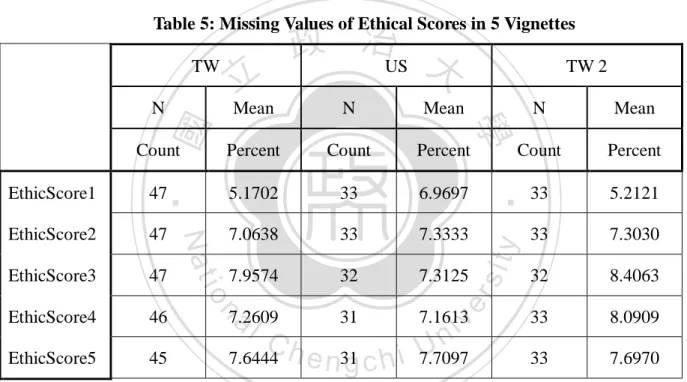
(9) Table 6.10: Chi-Square Analysis of Reason for Ethical Question No.4 (TW/US) ............. 39 Table 6.11: No.1 Reason for Ethical Question No.5 (TW/US) ......................................... 39 Table 6.12: Chi-Square Analysis of Reason for Ethical Question No.5 (TW/US) ............. 40 Table 7.1: Comparison of Ethical Score Means between the TW and TW2 Groups ........ 40 Table 7.2: Difference in Ethical Scores between the TW and TW2 Groups ...................... 41 Table 7.3: No.1 Reason for Ethical Question No.1 (TW/TW2) ........................................ 42 Table 7.4: Chi-Square Analysis of Reason for Ethical Question No.1 (TW/TW2) ............ 43 Table 7.5: No.1 Reason for Ethical Question No.2 (TW/TW2) ........................................ 43 Table 7.6: Chi-Square Analysis of Reason for Ethical Question No.2 (TW/TW2) ............ 44. 政 治 大. Table 7.7: No.1 Reason for Ethical Question No.3 (TW/TW2) ........................................ 44. 立. Table 7.8: Chi-Square Analysis of Reason for Ethical Question No.3 (TW/TW2) ............ 45. ‧ 國. 學. Table 7.9: No.1 Reason for Ethical Question No.4(TW/TW2) ......................................... 45. ‧. Table 7.10: Chi-Square Analysis of Reason for Ethical Question No.4 (TW/TW2) .......... 46 Table 7.11: No.1 Reason for Ethical Question No.5 (TW/TW2)……………………….... 46. y. Nat. Table 8: Summaries of Data Analysis and Hypotheses. n. al. Ch. engchi. VI. er. io. sit. Table 7.12: Chi-Square Analysis of Reason for Ethical Question No.5 (TW/TW2) .......... 47 ................................................. 48. i Un. v.
(10) 1. Introduction 1.1Research Background 1.1.1 Business Ethics as Foundation of Responsible Corporations. Joyner et al. (2002) define business ethics as a doctrine that concentrates on moral standards as they are applied to business policies, institutions, and behaviors (p.114). Business ethics is also a standard of behavioral conduct providing guidance for employees to deal with ethical questions that may be beyond their professional knowledge. Since the United Nations issued. 治 政 大ethical business, many its Global Compact and aroused a series of discussions about 立 corporations have internally promoted business ethics by establishing a code of conduct for ‧ 國. 學. the purposes of either cultivating employees’ skills to make critical judgments or. Nat. sit. y. ‧. demonstrating to society their rigid ethical values.. io. er. However, confusion may be caused by the relationship between business ethics and. al. Corporate Social Responsibility (CSR). That is, although business ethics and CSR overlap in. n. iv n C the formation of ethical businesses, high often depends on factors such as h CSR e n performance gchi U. managers’ discretion, monetary capability (e.g. philanthropic campaign, investment in public service), or different foci according to a company’s recognition. More specifically, the definition of high CSR performance is still ambiguous. Various international institutes have envisaged CSR as a corporate response to pressure from stakeholders1, responsibility for the society and environment2, or even sustainable development3; there still remains a lack in 1. The Forum Empresa Network, 2010 ―What is CSR?‖ http://www.empresa.org/sitio-2009/index.php?option=com_content&view=article&id=175&Itemid=313 (Date visited: February 9, 2010 ) 2 The Confederation of British Industry's, 2010. “What is corporate social responsibility” http://www.cbi.org.uk/ndbs/content.nsf/802737AED3E3420580256706005390AE/9D502144AC9F644380256F 58005BD16C (Date visited: February 9, 2010) The Committee of Economic Development ―Think Shift., evolution of CSR”. 1.
(11) international agreement on how standards should be imposed on corporations since CSR policies often vary due to the cultural differences (Maignan & Ralston, 2002; Preusse, 2008) .. On the other hand, internally, business ethics are considered clear conduct standards which exist within different business sectors, such as, finance, marketing and manufacturing, etc. Business ethics represent the responsibility that employees have to work in favor of their corporations. Meanwhile, as compared to CSR, business ethics is an external responsibility toward the public uncompromised by other corporate considerations.. 治 政 For instance, the Bhopal disaster in India and the scandals大 of the American company Enron 立 and the French bank Société Générale are all reminders that the damage caused by ‧ 國. 學. employees’ unethical decisions can be tremendously harmful to societies regardless of. ‧. corporations’ various campaigns to highlight their socially responsible personalities.. sit. y. Nat. Therefore, although business ethics and CSR both contain a sense of responsible business. io. er. behavior, in this article the value of business ethics is stressed as a fundamental and embedded impetus for employees to forge a genuinely ―socially responsible corporation‖. Put. al. n. iv n C simply, a company with high performance ethics is more likely to produce ethical h eofnbusiness gchi U behaviors.. Studying a fivefold increase in the number of stand-alone ethics courses of global top MBA programs4 from 1988 to 2007, Christensen et al (2007) also claim the importance of cultivating individuals’ values with respect to business ethics, which are not compelled by outside stakeholders nor imposed ethical conducts, but persistently by one’s values and http://thinkingshift.wordpress.com/2007/03/27/the-evolution-of-csr/ (Date visited: February 9, 2010) 3 The World Bank, 2007. “Sustainable development-DevComm CSR program” http://web.worldbank.org/WBSITE/EXTERNAL/TOPICS/EXTDEVCOMMENG/EXTDEVCOMSUSDEVT/0,,content. (date visited : February 9, 2010) 4 As rated by the Financial Times in their 2006 Global MBA rankings. 2.
(12) willing actions (Valentine & Fleischman, 2008; Collier & Esteban, 2007).. 1.2 Research Motivations and Problems If business ethics are expected to universally exist in corporations, then how do they interact with different cultural backgrounds and individual values? Do certain cultures or personal values facilitate ethical business values while others do quite the opposite? To answer these questions much past research has employed Hofstede’s cultural model to explain higher/lower ethical standards. On the other hand, others have taken a more individual angle considering differences in social status, education, and religion. What is missing in this area. 政 治 大 array of contradictory results in the study of cross-cultural business ethics research. The two 立. of research is a study considering both levels at the same time. This negligence has caused an. ‧ 國. 學. common contradictions are presented below.. 1.2.1 First Research Problem: Conflicting Results of Business Ethics Studies. ‧. Employing Hofstede’s Cultural Model.. sit. y. Nat. io. er. Much research utilizes Hofstede’s cultural tendencies model to explain different reactions to. al. ethical questions between Western and Chinese respondents. In spite of various sampling. n. iv n C from different nations, an evident contradiction U among the results of various h e n gcanc hbeiseen. studies. For example, Tsui and Windsor (2001) concluded participants from Australia have higher awareness and perceive greater importance of business ethics than their Chinese counterparts. Dunn and Shome (2009) found that Canadian participants find questionable corporate conduct less acceptable than Chinese participants. In contrast, however, Phau and Kea (2007) report that Chinese students (i.e. Hong Kong and Singapore) are more supportive of business ethics than their Australian counterparts. The result of research by Whitcomb et al. (1998) is that Chinese students demonstrate ethical values and make responsible business. 3.
(13) decisions similar to their American fellows despite differences in their reasoning5. Furthermore, mixed research results offered by McGee et al. (2008)6 are a further reminder that the disagreement of ethical values may be attributed to the variance of chosen subjects. Additionally, other researcher, such as, Baker & Viet, (1998) and Ahmed et al. (2003) also propose that the relationship between cultural traits and ethical attitudes should be examined in the context of regulatory and historical backgrounds. Obviously, using Hofstede’s cultural model has been a convenient research framework; but it is not sufficient for making generalizations about the tie between ethical values and culture.. 政 治 大. 1.2.2 Second Research Problem: Negligence of Overlapping Cultural and. 立. Individual Variables. ‧ 國. 學. In addition to the inconsistent results of culture-based business ethics research, a second contradiction can be found when one further subdivides subjects in either individualistic or. ‧. collectivistic culture. For instance, although many researchers have explained why some. y. Nat. sit. Chinese cultural characteristics, specifically unique interpersonal networks and. n. al. er. io. favor-returning traditions (guanxi 關係; ren-qing 人情), may hinder Chinese acceptance of. Ch. i Un. v. the idea of ethical business (Huang, 2000, Ho, 1998, Ang & Leong, 2000); others have. engchi. identified variables influencing the practice of high ethical standards for individuals in the same culture. High ethical standards have been linked to individuals who earn relatively higher incomes (Lam &Hung 2005), regularly practice religion (Lee et al., 2003; Phau & Kea, ibid), occupy managerial and NPO-related professions (Ebrahimi et al., 2005; Siu & Lam, 2009), and pursue certain collegiate majors (Du & Tang, 2005). Therefore, there is a need to reexamine the relationship between business ethics and cultures while taking individual differences into consideration. 5. In Whitcomb et al. (1998)’s research two exceptions are attributed to specific cultural and political factors. McGee et al. (2008) finds that both U.S. and Hong Kong participants significantly oppose tax evasion, the average score in the U.S group is rather higher because the large score variance in the Hong Kong group. 6. 4.
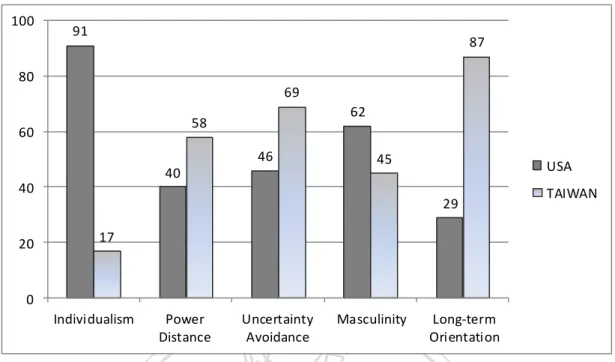
(14) 1.3 Research Approach and Questions This research selects business students from the USA and the ROC (herein after: Taiwan) as subjects representing two different sets of cultural values to conduct a comparison study of ethical dilemmas. Acknowledging that cultures can be further subdivided into many regions and the limitation of this research, Taiwanese students were chosen as research subjects due to the consideration that Taiwan receives less research attention compared to other Chinese culture holders. Nonetheless, Taiwan’s relatively early economic and democratic development is a distinct environment from Mainland China and could possibly nourish higher expectations of business ethics.. 立. 政 治 大. ‧ 國. 學. Chapter Three will introduce in more detail the methodology employed in this study. Using a survey questionnaire, the research firstly compared the ethical choices of American and. ‧. Taiwanese business students, including, their reasoning in a way that many past researchers. Nat. sit. y. have adopted when solely culture variables are considered. During the second phase, a third. n. al. er. io. group of business students was recruited. This group is comprised of Taiwanese students who. i Un. v. have completed at least one collegiate course in business ethics. Their responses were. Ch. engchi. compared to the previous group of Taiwanese students (those who have not participated in any business ethics training). The goal of this step is to investigate differences in responses to business ethics questions by Taiwanese respondents when the cultural variable is controlled and the variable of business ethics education is included. The results will help not only to ascertain the impact of business ethics courses, but also the need to highlight individual differences in ethical decision-making. This research project is concerned with three central research questions: (1) Do Taiwanese respondents respond to ethical dilemmas differently compared to their American counterparts when both have participated in ethics training?. 5.
(15) (2) Do Taiwanese respondents, who have completed the ethics training respond to ethical dilemmas differently compared to their Taiwanese counterparts who have not participated in ethics training? (3) Is there different reasoning between the three groups’ responses to different ethical dilemmas? How are the responses similar or different?. 1.4 Research Contribution By responding to these three questions, this research hopes to provide a case for more refined and careful cross-cultural research on business ethics. Taking Taiwanese business students. 政 治 大 culture and business ethics education will be compared. It is beyond doubt that Hofstede’s 立. who haven’t participated in ethics training as a control group, the salience of two variables:. ‧ 國. 學. cultural model is influential in many fields of social sciences; however, with regard to frequent confusion of cross-cultural business ethics research, the validity of applying. ‧. Hofstede’s model to explain individuals’ ethical decisions should be viewed through the. n. al. er. io. sit. y. Nat. lenses of individuals’ value differences.. i Un. v. The results of this research will improve future cross-cultural business ethics research by. Ch. engchi. encouraging the consideration of potentially influential individual factors. Finally, this research will be valuable for practitioners of business ethics working both in education and in international corporations.. 2. Literature Review Relevant previous research was considered throughout the duration of this research project. The comprehensive literature review that follows is organized into three parts: (1) a review of questionable business ethics research applying Hofstede’s cultural model, (2) a discussion of Chinese-specific cultural traits relating to business ethics, and (3) the necessity of focusing on individual values to conduct cross-cultural business ethics research.. 6.
(16) 2.1 Importance of Business Ethics Research on Chinese Culture In recent years, the whole world has been focusing on China’s economic rise and driven perhaps by a unique Confucian entrepreneurship. This unprecedented attention on China can be attributed to both positive and negative motivations. First, many have predicted that the age of Chinese people is approaching, and China will develop into superpower counterbalancing decades of American dominance in many societal aspects. Additionally, through the wide spread of the PRC–sponsored Confucius Institutes and the increasing number of international Chinese language students7, not only the Chinese authorities but also. 政 治 大 economy successfully weathered the 2008 American-led global subprime mortgage crisis and 立 Western counterparts are aware of inextricable Chinese frenzy. Moreover, after the Chinese. ‧ 國. 學. amazed the world with its state-controlled stable economy, many analysts and research institutes have become more critical of the legitimacy of total market liberalism, and seen the. ‧. silver lining in the rather conservative fashion of game-playing. In the perspective of world. Nat. sit. y. politics, the competition between the US and Russia in an earlier time has been replaced by. n. al. er. io. that between the US and China. However, this time the difference is not confined to political. i Un. v. ideologies, but also includes two cultural extremes and tendencies.. Ch. engchi. On the other hand, several negative reports on Chinese social scandals have attracted equally as much attention as its marvelous economic growth. These include the 2007 recalls of contaminated pet food and children’s toys which contained excessive amounts of lead. In 2008 the spotlight turned towards food scandals of poisonous infant formula and milk containing melamine, and human rights violations and military suppression in Xinjiang and Tibet during the Olympic Games. Despite the PRC’s booming modernization, these cases 7. Till 2000 October, there have been more than 30 learners of Chinese language and the Confucius Institutes has been established in over 282 countries. Chinese language program is taught in more than 2500 universities worldwide. data retrieved from: http://en.wikipedia.org/wiki/Confucius_Institute date: 2010/3/12. 7.
(17) have prompted many researchers to cast doubt on the coexistence of Chinese business ethics and market liberation policy. At the same time, the focus has also transferred to other Chinese culture holders such as Taiwan, Hong Kong, and Singapore.. However, to explain why irresponsible business behavior seems to be more often ignored in Chinese contexts, and how Chinese business ethics differs from the Western reasoning, many scholars have appealed to the fundamental distinction between individualistic and collectivistic cultures, as well as, other relevant cultural traits to correlate high/low business ethics evaluations with culture.. 政 治 大 2.2 Hofstede’s Cultural Tendency Model and Relevant Business Ethics 立. ‧ 國. 學. Research. According to Hofstede (1991, 2001), culture is derived, not inherent. Thus, it is a collective. ‧. phenomenon because it is shared among people who live within the same society (p.5).. y. Nat. io. sit. Hofstede depicted in detail how the interaction of people living in different cultural contexts. n. al. er. will be mostly influenced by factors such as (1) individualism/collectivism, (2) power. i Un. v. distance (3) avoidance of uncertainty, (4) masculinity-femininity, and (5) long/short –term. Ch. engchi. orientation. Although Hofstede clearly defined differences in the cultural personalities of the USA and Taiwan, it is debatable how these differences can be applied to predict business ethics performance.. 2.2.1 Hofstede’s Evaluation of Taiwan and the USA According to Hofstede’s 1991 study of 50 countries in three regions, the USA scores 91 on the individualism scale as the most individualistic country. In contrast, Taiwan scores 17 representing its collectivistic character. Additionally, the USA has lower degree of power distance and uncertainty avoidance than Taiwan, while the USA manifests a more masculine characteristic than Taiwan. (see Figure1) 8.
(18) 100. 91. 87. 80 69. 62. 58. 60. 46. 45. 40. USA. 40 29 20. TAIWAN. 17. 0. Individualism. Power Distance. Uncertainty Avoidance. Masculinity. Long-term Orientation. 政 治 大 Figure 1: Scores of individualism, power distance, uncertainty avoidance, and long-term 立 orientation between USA and Taiwan (Adopted and revised from Hofstede (1991, 2001). ‧ 國. 學. 2.2.2 Impacts and Questions of Hofestede’s Cultural Traits on Business Ethics. ‧. Although Hofstede clearly defined different cultural personalities between the USA and. sit. y. Nat. Taiwan, it is debatable how these cultural traits are applied to predict business ethics. io. er. performance. For Instance, Tsui and Windsor (2001) hold that high ethical reasoning is strongly compatible with ―high individualists (+), low power distance(-), and strong. al. n. iv n C uncertainty avoidance(+), and short-term These cultural traits will produce h eorientation(-).‖ ngchi U more equal relationships among people, personal steadiness, social justice, and individual security. On the contrary, in a theoretical paper based on review of literature concerning business ethics, Vitell et al. (1993) conclude that the higher acceptance of formal codes of ethics rather than informal norms is compatible with ―low individualists(-), high power distance(+), and high uncertainty avoidance(+)‖. Furthermore, although Vitell et al. agree with Tsui and Windsor that high uncertainty avoidance is beneficial to the establishment of moral values, high uncertainty avoidance is also considered more likely to produce avoidance of ethical problems.. 9.
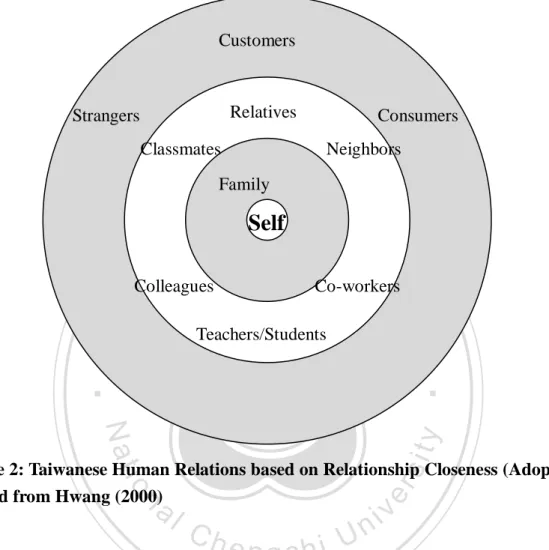
(19) The findings of these two studies demonstrate a curious dilemma: cultural traits’ contradictory influences on business ethics often exist simultaneously. For example, high individualism can be interpreted as respect of individual rights/self-interest. High power distance can be seen as respect for authority-regulated ethics /deterrent of social justice. And finally, high uncertainty avoidance could relate to individual security/ avoidance of ethical problems.. As a result, when considering the additional factor of high masculinity, which Vitell et al. note is also a factor causing individuals to ignore ethical problems, it is even more. 治 政 大either American or Taiwanese bewildering to apply Hofstede’s cultural spectrum to predict 立 subjects’ reactions to ethical problems. The reason is that each country seems to possess 8. ‧ 國. 學. conflicting cultural characters some of which would support others which would deter high. ‧. business ethics performance.. sit. y. Nat. 2.2.3 Challenges to Hofstedes’ Conventional Cultural Categorizations.. n. al. er. io. A decade after the initial publication of his cultural model, Hofstede included a new factor of. i Un. v. long/short-term orientation. This new cultural dimension acknowledges that there are several. Ch. engchi. cultural characteristics shared by both Chinese respondents and their Western counterparts, albeit with different emphases. Meanwhile, he stressed that doing research without bias is impossible– there will always be a researcher effect (Hofstede, 2001; p. 352). This inevitable variable reminds us of the need for careful examination of research constructed on Hofstede’s cultural theories.. When Yang (2001) discusses the appropriateness of applying Hosfstede’ bipolarized cultural dimensions, he argues that so-called collectivism may be a foreign comparison to Western 8. The factor of Masculinity /femininity is not treated in Tsui & Windsor’s study on ethical reasoning between Australian and Chinese students. 10.
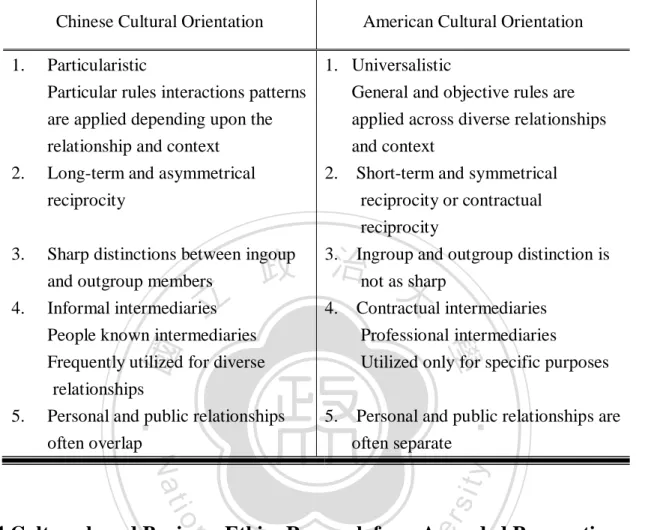
(20) individualism. Thus, when Western researchers witness unfamiliar cultural orientation in East Asia, they tend to compare those differences to their own cultural body and to reach conclusions based on the cultural illusion (p.143). Moreover, Yang further claims that if individualism and collectivism can be defined by a summarized table of explicit behaviors, then one may easily find many collectivists in an individualistic society and vice versa. Examples include Indians who are hard to distinguish as individualists or collectivists. This explains the inability to polarize cultures in such a way, because within given situations both beliefs can be accepted or rejected (Sinha and Tripathi, cited in Kim et al., 1994, Ho and Chiu, 1994).. 立. 政 治 大. Hofstede’s cultural model is influential in many social science research domains and a great. ‧ 國. 學. volume of publications have approved the validity of implementing his cultural dimensions to. ‧. relate differences in decision-making. However, if cultures vary within organizational but not. io. er. to consider other micro-level variables (Hofstede, 2001).. sit. y. Nat. necessarily national boundaries, then it is necessary for cross-cultural business ethics research. al. n. iv n C To sum up, cross-cultural business ethics which adopts Hofstede’s cultural model h eresearch ngchi U faces two disadvantages: (1) Frequently not all the cultural dimensions are applied to formulate a comprehensive explanation of a culture’s impacts on ethical decisions. (2) Even when the same cultural dimensions are studied, the interpretations of their impacts on ethical decisions differ.. 2.3 Chinese Familism and Guanxism Despite of the limitations and concerns of applying Hofstede’s polarized cultural viewpoint to evaluate business ethics, several researchers have distinguished Chinese collectivism from other similar cultures by attributing two social characteristics: Familism (family-orientation). 11.
(21) and Guanxism (interpersonal connections).. 2.3.1 Chinese Familism Different from other types of collective societies, Chinese collectivism is tightly connected to family. Chinese familism is rooted in its paternalistic social pattern. Because of traditional economical reliance on agriculture, family members are mandated to fulfill their jobs so that the family can be orderly and united. However, this is a specific type of in-group collectivism, instead of universal collectivism, which prioritizes a family’s prosperity, reputation and solidarity (Schwartz, 1990 cited in Yang, 2005). When a family’s interests conflict with. 政 治 大 sacrifice the latter to protect the family (Yang, 2005; Madsen, 2007). Moreover, facing people 立 interests of other social groups or non-family stakeholders, Chinese people often tend to. ‧ 國. 學. outside the group, Chinese people will adopt an interpersonal tactic to familize them and include them into their own social networks. This tactic also depends on people’s sentimental. ‧. proximity to each other. The process of familization is deemed useful for Chinese people to. Nat. sit. y. enlarge social networks. In this context, while people are given different social meanings and. n. al. er. io. roles, their importance and existence relies on their function relative to others. Thus,. i Un. v. interpersonal connections to key players are extremely helpful when they need favors from. Ch. engchi. others. However, sometimes help may not come directly from their already-constructed social network, but from other networks of their acquaintances. This Chinese social orientation is called Guanxism (關係).. 2.3.2 Chinese Guanxism Guanxism is a feature underlying Chinese society. It is defined as a unique interpersonal network on which people in the same interpersonal group can depend. This concept originates from Confucius’ humanism (jen), which teaches people should always treat others with warm human feeling and reciprocal favors. Similar to social roles assigned by a central power in an institution, Chinese people are thought to live in different interpersonal groups, and their. 12.
(22) existence is influenced by relationships with others (Ang & Leong, 2000). Within this sort of social pattern where the in-group harmony is important to all group members, people are categorized into various layers based on the interpersonal acquaintance and personal interests. After Fei, Xiao Tong(費孝通) proposed the concentric circles of Chinese guanxism in 1948, the mental model of Chinese people has been applied widely by many researchers in the social-psychology field (see figure 2). In the Guanxi network, the process of including and excluding people in an interpersonal network is dynamic. Because of constant changes during a person’s roles in life, he/she knows who to give favors and special attention when they are in need. Meanwhile, favors are expected to be returned through reciprocity by the in-group. 治 政 大on legal enforcement but on an members when he/she needs them. It is a mentality based not 立 implicit give-and-take etiquette. Through this mode of interpersonal interaction, people can ‧ 國. 學. expand their social influence while different interpersonal concentric circles overlap.. ‧. Individuals live within many different networks. For example, in Chinese society, although. y. Nat. adoption of children is not popular because of a family-oriented mentality, adoption of a. er. io. sit. godson or goddaughter (乾兒子, 乾女兒) is a common way to join two families. Without a. al. special religious ceremony, senior Chinese people can have their adopted children by mutual. n. iv n C agreement. Through the pseudo-kinshiphbetween people, U e n g c h i not only are nominal titles given, but people also become more interdependent on one other. Because of the intertwined. network that involves individuals from a variety of backgrounds, needs are quickly known by other parties, and the more interpersonal connections one has, the more possible he/she can resolve problems.. Familization is not limited to the god-child adoption; all types of social interactions can be opportunities to build their connections across different interpersonal networks. In addition, those interpersonal connections are kept by the traditional reciprocity with constant favors. As an Chinese idiom goes, ―When there is a Guanxi (connection) this is no Guanxi (problem), 13.
(23) when there is no Guanxi (connection) there is Guanxi (problem). ‖ (有關係就沒關係,沒關. 係就有關係) Through this traditional pun one can grasp the common Chinese mentality which easily confuses private and public interpersonal relations.. Customers. Relatives. Strangers Classmates. Consumers Neighbors. Family Members. 立. 政Self治 大 Co-workers. 學. ‧ 國. Colleagues. Teachers/Students. ‧ sit. y. Nat. al. er. io. Figure 2: Taiwanese Human Relations based on Relationship Closeness (Adopted and. n. revised from Hwang (2000). Ch. engchi. i Un. v. 2.3.3 Impacts of Familism and Guanxism on Business Ethics. Considering these cultural features of Chinese society, it is believed that Chinese particularistic society not only varies largely from American universalistic thought, but also influences people’s recognition and way of understanding public affairs.. To be clear, Yum (1988) argues that beside Chinese reciprocity, and in-/out-group distinctions, there are different roles of intermediaries in the Chinese and American societies (see table 1). According to Yum, intermediaries are contractual and tend to separate people as independent individuals in America. That is, either in family or public life, they are attributed with their 14.
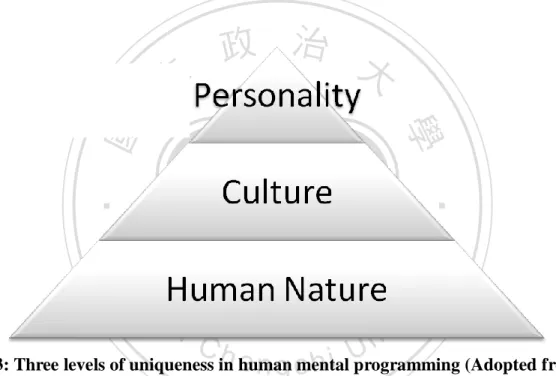
(24) own responsibility motivated largely by social justice and fairness. Using personal connections to attain desired goal, for them, may be frowned on as nepotism or a way to relinquish individual freedom (p.380). In contrast, Chinese informal intermediaries play a role in building connections with others as effective strategy to shorten the distance of relationship and create a sense of ―in-groupness‖ (familization) for their benefit, or to avoid laborious works, to smooth bureaucratic procedures or to gain competitiveness, even though unethical conducts may be involved in the process (Ang & Leong, 2000).. Consequently, due to the overlap of personal and public life in Chinese society, as well as,. 治 政 high peer pressure, the maintenance of business ethics for 大 an employee may be difficult once 立 interests of different parties conflict. Therefore, people in the Chinese culture have a tendency ‧ 國. 學. to protect and support in-group members, regardless if their actions are legitimate (Hwang,. ‧. 2003).. y. Nat. er. io. sit. As Li Kuo-Ting (李國鼎), a prestigious Taiwanese economist and politician, expressed in. al. 1981, in addition to Five Classic Rites, what Chinese society desperately needs is a sixth. n. iv n C ethic- self-group relation which enlightens on how to care for strangers, nature, and h epeople ngchi U groups.9. 9. Li Kuo Ting(李國鼎) was the former Mister of Ministry of Finance and Ministry of Economy Affairs in Taiwan. He promoted fair, stable and free model of economic development during 1960s to 1970s. He is addressed as the founder of Taiwanese development of high technology and key figure of Taiwan’s economic miracle and modernization data retrieved from http://zh.wikipedia.org/wiki/%E6%9D%8E%E5%9C%8B%E9%BC%8E date of retrieval: April 2, 2010. 15.
(25) Table 1: Comparisons between North American and East Asian Orientation to Interpersonal Relationship Pattern (Adopted from Yum (1988) The Impact of Confucianism on Interpersonal Relationships and Communication Patterns in East Asia) Chinese Cultural Orientation 1.. 2.. Particularistic Particular rules interactions patterns are applied depending upon the. 1. Universalistic General and objective rules are applied across diverse relationships. relationship and context Long-term and asymmetrical reciprocity. and context 2. Short-term and symmetrical reciprocity or contractual reciprocity 3. Ingroup and outgroup distinction is 政 治not as大sharp. Sharp distinctions between ingoup and outgroup members. 4.. Informal intermediaries People known intermediaries Frequently utilized for diverse. 4.. Contractual intermediaries Professional intermediaries Utilized only for specific purposes. relationships Personal and public relationships often overlap. 5.. Personal and public relationships are often separate. Nat. er. io. sit. y. ‧. ‧ 國. 立. 學. 3.. 5.. American Cultural Orientation. 2.4 Culture-based Business a Ethics Research from Amended Perspectives. n. iv l C n U under criticism because their h estudies In recent years, many culture-based social h i been n g chave definition of culture has been controversial (Triandis, 1995). Therefore, despite much criticism of Chinese culture and its incompatibility with business ethics, the following section will discuss similar ethics-endorsing traits between American and Chinese culture and the limitations of applying culture to predict different outcomes of business ethics.. 2.4.1 Similarities Between Western and Chinese Business Ethics Many similar moral conducts are shared by both Western and Chinese culture in the light of business ethics. For instance, Sun Chen(孫震) (2009) proclaims that the roots of Western and Chinese cultures do not differ largely in teaching people to sympathize with their neighbors. 16.
(26) and to pursue the common good instead of increasing social costs or risks. He contends that there is a great deal of agreement between Adam Smith’s market liberalism and Confucian and Mencius altruism. According to Sun, the virtues of justice and beneficence exist in both cultural bodies, and they serve as the cornerstone for developing business ethics. His portrayal of humans’ inherent tendency to favor benignity can be seen from the table shown below:. Table 2: comparison of similar concept of human morality between Adam Smith, Confucius and Mencius (Adopted from Sun Chen(孫震) (2009) 企業倫理與企業責任) Adam Smith. 立. Confucius 政 治 大 Wealth. Economic. prudence. Social value. Ethical. avalue l C h. n The virtue of beneficence. (人爵). Righteousness. Benevolence. (天爵). sit. io. fairness. Achievement. y. Nat. The virtue of. Altruism. (名). (義). er. Egoism. Reputation. ‧. ‧ 國. value. (利). 學. The virtue of. Mencius. i v(仁) Human benevolence n engchi U. Notably, Adam Smith corresponds to Confucius and Mencius to prioritize a higher level of other-centered altruism rather than personal well-being, though self-centered motivations encouraging people to pursue wealth and reputation are found in all three schools of philosophies.. The Western other-altruistic motivations are virtues of justice and beneficence which are similar to Chinese righteousness(義) and human benevolence (仁). Sun believes because of. 17.
(27) the quest for social sustainability, people are motivated to contribute to and care for others’ benefits to preserve fair and stable economic development. In addition, in both Adam Smith’s The Theory of Moral Sentiments (1759) and Mencius’s ―innate goodness of human nature‖. (性善論) a natural sympathy towards unfortunate people is considered universal and sufficient in explaining the ethical consensus between the two cultures (p.28 & 29).. Building on this concept, many business ethics researchers have found that Chinese culture nourishes business ethics (Lu et al., 1999; Shafer et al, 2007; Madsen 2007). In contrast, others challenge the cultural-based viewpoint and include finer individual and social factors,. 治 政 大 environment (Ahmed et al., such as historical background and political systems and regulatory 立 2003, Baker & Veit, 1998). ‧ 國. 學 ‧. Indeed, there is a great need to review the application of Hofstede’s cultural model to the. sit. y. Nat. issues of business ethics with regard to the ambiguity of Hofstede’s cultural attributes in. io. er. business and industry (Turner & Trompenaars, 2000). Moreover, a new research model. al. n. should include variables at both individual and social levels since people living in similar. C h(Lamond, 2008).U n i environment can’t be easily generalized engchi. v. 2.4.2 Different Personal Values in the Face of Ethical Decisions The literature reviewed above suggests the problem of applying culture as a basis to explain differing business ethics performance. Indeed, at the present time norms, values, and interests are pluralized and cultural backgrounds can be further subdivided around the world. Increased individual independence and choice urges a review of the relation between one’s individual and cultural values in relation to his/her ethical decisions.. The discussion of this relationship may be based on Hofstede’s model of uniqueness in. 18.
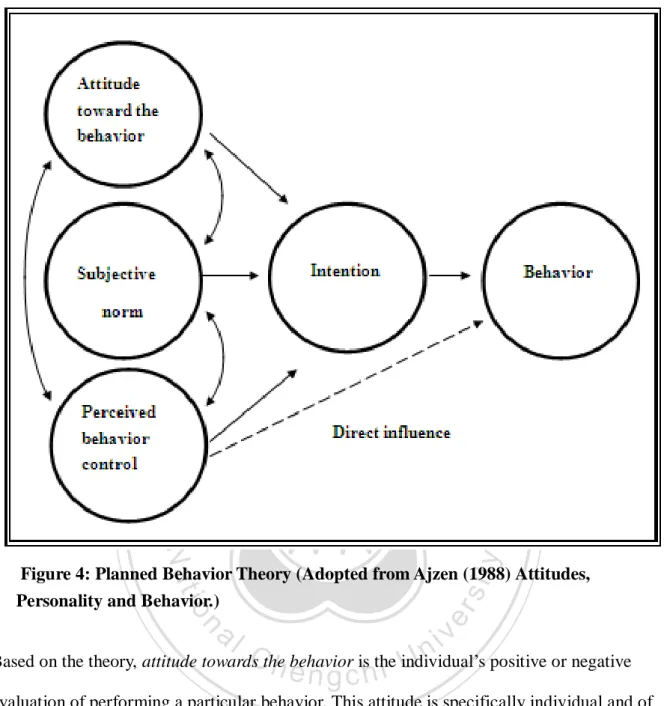
(28) human mental programming, which separates causes of behavioral differences into three levels: human nature, culture and personality (see figure 3). In this hierarchical model Hofstede defines human nature as: … what all human beings have in common; it represents the universal level in one’s mental software. It is inherited with one’s gene and the operating system will determine one’s physical and psychological functioning. The human ability to feel fear, anger, love, joy, sadness, the need to associate with others……..however, what one does with these feelings, how to express fear, joy, observations and so on, is modified by culture (p.5).. 立. 政 治 大. ‧. ‧ 國. 學. n. er. io. sit. y. Nat. al. Ch. engchi. i Un. v. Figure 3: Three levels of uniqueness in human mental programming (Adopted from Hofstede (1991) Cultures and Organizations) On the other hand, on the top of the triangle is personality. Hofstede defines persionality as: … a unique personal set of mental programs which (s)he does not share with any other human being. It is based upon traits which are partly inherited with the individuals’ unique set of genes and partly learned. ―Learned‖ means modified by the influence of collective programming (culture), as well as, by unique personal experience (p.6). Moreover, culture, which originates from one’s social environment can not only be separated from personality on the one hand, and from human nature on the other, but can also. 19.
(29) distinguish the members of one group or category of people from one another (p.5).. However, what cannot be easily resolved in Hofstede’s model and social scientists’ knowledge is where to draw the distinction between the three levels of social elements, or if the boundaries change as time passes.. Thus, Hofstede’s structure of mental programming as a person’s pattern of thinking, feeling, and potentially acting should be reconsidered in aspects of different social issues; especially because the sources of one’s mental software lie within the social environment in which an. be subjective according to their particular interests.. 學. ‧ 國. 治 政 individual grows up, as well as, collective life experiences大 (p.4). That which individuals 立 acquire from the environment may not be principles inherent in indigenous culture but may ‧. sit. y. Nat. In essence, in the past when the world economy and communication were less interdependent,. io. er. each society featured its own cultural uniqueness. For people living in different areas,. al. complying with social norms was natural and sometime more obligatory in certain societies. n. iv n C that in others. That is, societal cultures h used to be bound with e n g c h i U collective behavioral. phenomenon by which people’s individual values are overridden and simplified. Since personality is formed by one’s culture and learned experiences, at the present time defining a culture and its impacts on business ethics has become a controversial and challenging task. It is valuable to investigate how personal initiatives to make ethical decisions can be increased by different means. Supportive of this idea, empirical research conducted by Vitell &Paolillo (2004) claims that individual commitment to the organization, enforcement of code of ethics, and organizational culture are antecedents of the perceived role of ethics and social responsibility, rather than nationalities of the respondents.. 20.
(30) 2.4.3 The Value of Business Ethics Training Much research has proven individual differences such as incomes, religious practice and occupations will impact ethical decision-making (Lam &Hung 2005, Lee et al., 2003, Phau & Kea, 2007, Ebrahimi et al., 2005, Siu & Lam, 2009); however, compared to those social factors, the application of business ethics training as an important variable encompasses two vital values.. First, business ethics training is regarded as a prominent factor facilitating ethical decisions.. 政 治 大 professional ethics in many fields has been an international focus. Because of the tremendous 立 In recent years, due to many political and corporate scandals, the establishment of. ‧ 國. 學. social costs of corruption, bribery and financial crisis within both governmental and private sectors, the public has begun to doubt if professional ethics are equivalent with professional. ‧. training. Oftentimes these mistakes sprout from employees’ daily decisions in the office and. Nat. sit. y. result in irreversible damage to public benefits. It can provide both a theoretical and an. n. al. conflicting moral demands (Sims, 1994; p.152).. Ch. engchi. er. io. experiential framework that employees can apply in evaluating and choosing between. i Un. v. Second, ethics training can be widely taught in different disciplines in business schools. The requirement of ethical standards should not only be imposed on CEOs in industry; other professionals, such as, accountants, financial analysts, market planners, etc. all play vital roles in impeding unethical business behavior altogether in a company. Ethics training can serve the fundamental function to enlighten the employees-to-be on how to handle ethical dilemmas. Training encourages them to think critically and rationally when confronted with ethical problems and their behaviors are under scrutiny (Klenin, 1998). Although different types of occupations may require specific materials and hands-on knowledge, the training can. 21.
(31) be seen as an economical yet effective method to transmit ethical know-hows in a cross-disciplinary fashion.. Much research in the past has found a positive impact of business ethics training on ethical decision-making (Wu, 2003; Lau, 2009; Mayhew & Murphy, 2009). After relevant training, respondents often demonstrate higher ethical values than their counterparts from the same cultural background.. 2.4.4 Planned Behavior Theory.. 政 治 大 behavior theory. He concludes that, although there remain uncertain variables, most human 立 Higher ethical values after business ethics training can be explained by Ajzen’s planned. ‧ 國. 學. behavior can be predicted from intention. The concept is that a person’s intention to perform or not perform a behavior is the immediate determinant of that action (p.117). Before. ‧. intention is formed and thus triggers the consequential behavior, three factors are essential to. Nat. n. al. er. io. sit. y. influence in the process (see figure 4).. Ch. engchi. 22. i Un. v.
(32) 立. 政 治 大. ‧. ‧ 國. 學 y. Nat. sit. er. io. Figure 4: Planned Behavior Theory (Adopted from Ajzen (1988) Attitudes, Personality and Behavior.). al. n. iv n C Based on the theory, attitude towards the is the individual’s positive or negative h ebehavior ngchi U evaluation of performing a particular behavior. This attitude is specifically individual and of personal interest. The attitude depends on how valuable the person thinks of an objective. The more desirable the objective, the more likely the planned behavior will happen.. Second, subjective norms are normative considerations. Before performing a behavior, people will consider if it is positively or negative perceived by others. This mentality is based on social pressure concerning referents such as a person’s parents, spouse, close friends, coworkers, and those the behavior involves. Generally speaking, if a planned behavior gains more support from the people at stake, a person tends to take the action. 23.
(33) At last, perceived behavioral control is defined a special factor as it can also influence the two other variables, intention and behavior. It is likely that a person will not only to take into account some of the realistic constraints that exist, but also to personally reflect on relevant personal experience as impediments and obstacles. This factor concerns largely the control of information, skills, and abilities, whereas some variables such as emotions, compulsions and dependence on others are comparatively more unpredictable. To put it simply, the more resources and opportunities individuals possess, the fewer obstacles and impediments are imagined and the planned behavior is more likely to occur (p.135).. 治 政 大people’s intentions in the face of Therefore, many external and personal factors can influence 立 ethical dilemmas; people may consider interpersonal pressure and the behavioral ‧ 國. 學. inappropriateness restricted within a shared culture. However, what is essential is the. ‧. individual experience that increases desirability and interests of performing ethical decisions.. sit. y. Nat. io. er. The importance of enforcing ethical attitudes based on the planned behavior theory has been. al. supported by much previous research. For instance, after surveying professionals from five. n. iv n C accounting firms, Buchan (2005) concludes subjective norms will influence h e nthatgalthough chi U. their attitudes, there is no direct relationship between subjective norms and eventual ethical intentions compared to the significant influence of personal attitudes. He proposes that one should highlight the factors that can influence professionals’ attitudes towards ethical decisions. Meanwhile, Kurland (1996) also claims that the attitude of moral obligation will significantly relate to subsequent ethical intents.. 24.
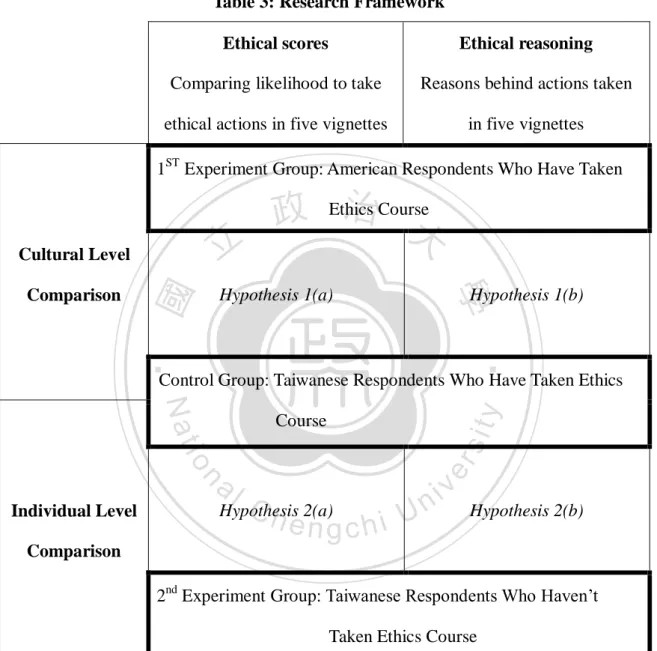
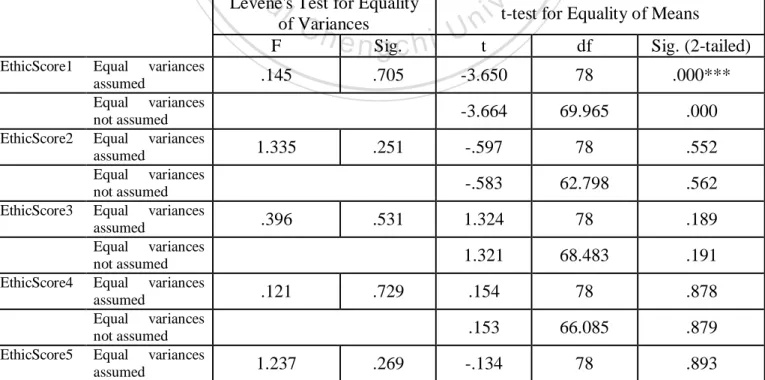
(34) 3. Methodology 3.1 Research Framework and Design. Table 3: Research Framework Ethical scores. Ethical reasoning. Comparing likelihood to take. Reasons behind actions taken. ethical actions in five vignettes. in five vignettes. 1ST Experiment Group: American Respondents Who Have Taken. 立. 學. Comparison. ‧ 國. Cultural Level. 治Course 政 Ethics 大. Hypothesis 1(a). Hypothesis 1(b). ‧. Nat. y. Control Group: Taiwanese Respondents Who Have Taken Ethics. n. er. io. al. sit. Course. Individual Level Comparison. Ch. Hypothesis 2(a). engchi. i Un. v. Hypothesis 2(b). 2nd Experiment Group: Taiwanese Respondents Who Haven’t Taken Ethics Course The goal of this research is to gather empirical evidence informing the debate over cultures’ impacts on business ethics while including individual traits as well as cultural differences as a more credible variable. To do this a self-administered questionnaire was distributed to three groups of students gathering data at two different levels(see Table 3).. 25.
(35) 3.2 Questionnaire The research methodology employed in this study is based on the questionnaire of ethical dilemmas invented by Fritzsche & Becker (1984) which was also adopted and revised by Whitcomb et al (1998) and other researchers. The questionnaire includes five vignettes which ask respondents to respond to different ethical dilemmas including: bribery, employee mobility among companies, pollution, and public safety problems. Respondents read the vignettes and were asked to express the likelihood of taking the action suggested by the questionnaire. The likelihood of action-taking was reported on a ten-point Likert scale. (0= definitely would not, 10=definitely would).. 政 治 大 (including an open-ended answer) to explain their choices. The different reasoning choices 立 can generally be categorized into (1) other-centered and (2) self-centered motivations. The Second, respondents were asked to select from five to six different reasoning options. ‧ 國. 學. definition of other-centered is altruistic, caring for the public and general good as to be responsible to the majority for stakeholders. Self-centered reasoning can be explained as. ‧. considering individuals’ or corporations’ own benefits as to be responsible for the. y. Nat. shareholders. In this section, if participants find more than one applicable reason, they are. sit. asked to rate different options in order of importance (from 1, 2, 3...). Different from other. er. io. ethical questionnaires which focus on daily-life decisions, the survey instrument emulates. al. n. iv n C U respondents. Additional questions about such as sex, age, religion, h respondents’ e n g c h ibackgrounds. business scenarios and aims to elicit practical actions taken by different groups of. the perceived difficulty of realizing religious belief, experience of volunteering public service, etc. were also included in the questionnaire. 3.3 Research Process This research recruited three groups of respondents to conduct a comparison research at the cultural and individual levels. At the cultural level of comparison, American and Taiwanese business school students who have taken business ethics course at college are compared in order to highlight the value and the function of business ethics education with regard to cultural difference. This is different from the research conducted by Whitcomb et al (1998). 26.
(36) which compared American and Chinese students who haven’t had the similar training. On the other hand, at the individual level the research compared the group of Taiwanese students who have participated in ethics course before with another group who haven’t. By doing this we can gain knowledge of the influence that business ethics education exerts on respondents from the same cultural context.. 3.3.1 Recruitment of Participants This research recruited three groups of respondents. Students from the U.S. and Taiwan were asked to complete the same questionnaire. The questionnaire was provided in Chinese to. 政 治 大. students in Taiwan and in English to students in the U.S.. 立. ‧ 國. 學. For the Taiwanese samples two groups of senior college students of the business school at National Chengchi University (NCCU) were recruited.. ‧. Nat. sit. y. First, a control group of 47senior business students who have completed a business ethics. n. al. er. io. course at NCCU was recruited. From a semester-long elective business ethics course, they. i Un. v. have acquired knowledge about the importance and practice of business ethics through. Ch. engchi. lectures, class discussion, and case studies. The course content aims to equip the students with independent thinking and problem-solving skills with regard to different roles and interest conflicts in real business settings. Specific ethical subjects of marketing, product safety, environmental concern, work ethics (employees’ rights, privacy, and whistle-blowing) are included.. For the first experimental group, 33 American senior business students from Saginaw Valley State University (SVSU) in Michigan were sampled. Respondents in this group have completed an elective business ethics course. The particular reason for selecting this school in. 27.
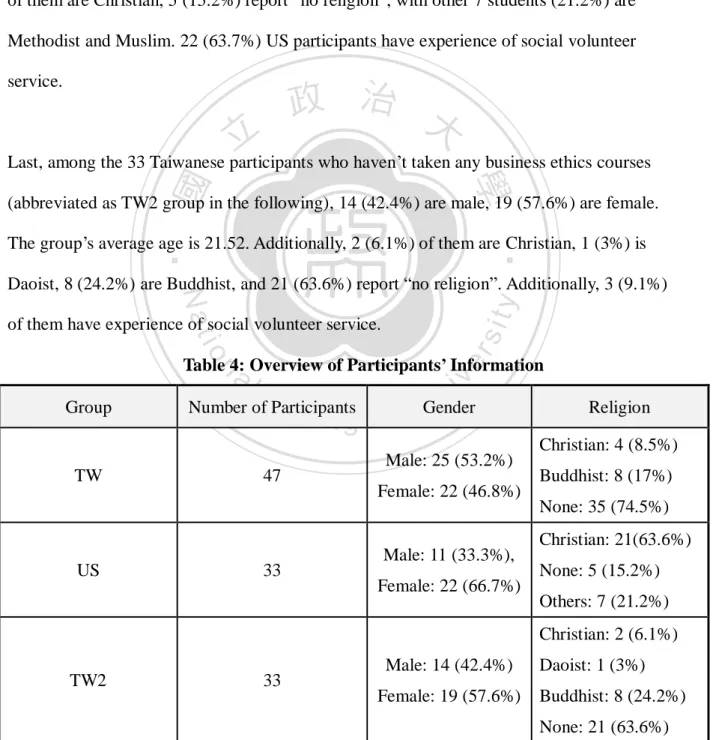
(37) Michigan is because of the author’s available connection to local faculty. Second, the course content of business ethics is highly similar to the one at NCCU concerning the issues of the free market, the nature of property, product liability, advertising, management versus employee rights, whistle-blowing, health and safety issues, affirmative action, comparable worth and the environment.. Finally, the second experimental group of a group of 33 senior business students from NCCU in Taiwan who haven’t taken a business ethics courses was recruited. These respondents were recruited from an elective consumer behavior course. Their qualification for participating in. 3.3.2 Distribution and Retrieval of the Questionnaires. 學. ‧ 國. 治 政 this comparison research was checked by the response to a大 self-report question asking their 立 prior experience of ethics education at school. ‧. Before distributing the questionnaires in USA and Taiwan, the original questionnaire was. Nat. sit. y. translated into Chinese and proof-read by another native Chinese speaker. Two pilot tests. n. al. er. io. were taken by two small groups of native speakers to ensure the wording and format were. i Un. v. comprehensible. The ultimate questionnaires were collected at three phases: first, for the. Ch. engchi. American samples, the author contacted in-person with a professor of international business at SVSU in August 2010. After discussion of the questionnaire content and the approach of ministering the questionnaire, the professor agreed to have his teaching assistant distribute the ethical questionnaires in one of his classes. Afterward, the completed questionnaires were sent by the assistant to Taiwan via airmail.. For the rest two groups of Taiwanese business students the author distributed and collected the questionnaires personally after gaining agreement from the course instructors. The finalization of these sets of questionnaires collections were completed in April, 2011.. 28.
(38) 3.4 Two Levels of Comparison between Cultural and Individual Variables The previous literature review substantively discussed the great need to investigate the influence of culture and ethics education on ethical decision-making all together. To fulfill this need, this research employed a two-level comparison to discuss (1) how cultural factors (based on Hofstede’s cultural predictions) affect the respondents’ ethical decisions. (2) How business ethics education (based on planned behavior theory) differentiates respondents’ decision-making from the others.. 3.4.1 Level One: Comparing Cultural Influence on Ethical Decisions. 政 治 大 Hofstede’s cultural model, as well as, the debates over the impacts of denounced Chinese 立 To respond to the continuous contradictory research business ethics results adopting. ‧ 國. 學. Guanxism on ethical decisions, this research first compared the American respondents with their Taiwanese counterparts who underwent ethical training. From the literature review we. ‧. have learned that cross-cultural business ethics research could be biased due to insufficient. Nat. sit. y. understanding of a cultural background from a nation to another (Hoivik, 2007). Another. n. al. er. io. reason is that culture is a dynamic concept which is challenging to conclude. Moreover, from. i Un. v. many advocates and opponents’ arguments, as well as, empirical result supporting that both. Ch. engchi. American and Chinese cultures will nourish the growth of business ethics, this research suggests that the ethical training American and Taiwanese respondents received will be likely to forge a convergence of universal values towards questionable business conducts. That is, the research expects to see similar ethical scores from five ethical dilemmas when culture is considered the major variable. To specify, if the ethical scores from the two groups parallel each other in all the five vignettes, it signals that ethical training would be a prominent variable and an applicable instrument on targeted participants despite of the existence of cultural variation. Thus, cultural traits such as high individualism and masculinity of the American respondents, versus, the high power distance and uncertainty avoidance of the. 29.
(39) Taiwanese respondents, should not affect the two groups of respondents’ responses significantly.. Moreover, it is intriguing to see if responses from the two groups of students will differ.. A. similar study done by Whitcomb et al (1998) demonstrates that although they had similar ethical scores from three out of five ethical dilemmas, none of the ethical reasoning was similar on each vignette between American and Chinese students. In consideration of the magnitude of business ethics education and following the previous hypothesis about similar ethical decisions, we propose that the two groups of respondents will all demonstrate. 治 政 大 other-centered reasoning for their decisions take in each vignette. 立 Therefore, hypothesis 1(a) and 1(b) are listed below: ‧ 國. 學. Hypothesis 1(a): There is no significant difference in ethical scores between the. ‧. Taiwanese students and the American students who have taken ethics courses.. sit. y. Nat. io. al. er. Hypothesis 1(b): The Taiwanese students and the American students who have taken. n. ethics courses will share universal reasoning for their decisions taken in each questionnaire vignette.. Ch. engchi. i Un. v. 3.4.2 Level Two: Comparing Business Ethics Training’s Influence on Ethical Decisions Second, at the individual level, this research compares the result of the Taiwanese students who have completed the ethics training to their Taiwanese fellows who haven’t participated in relevant training before. If ethics training is effective in increasing the likelihood of subsequent ethical decisions at the individual level (as predicted in planned behavior theory), then those who have been taught to act ethically when confronted by ethical dilemmas should have higher ethical scores in each situation compared to those who haven’t. Although it is rather bold to assume that the dominant influence of business ethics education over other 30.
(40) individual factors, this attempt will help to clarify the function and the limitation of relevant training in the future. Therefore, the research predicts that the independent variable of ethical training has a positive influence on the respondents’ decisions when the cultural factor is controlled.. Furthermore, in contrast to hypothesis 2(b), we propose that the Taiwanese respondents who have taken the business ethics course will demonstrate more other-centered reasoning than the Taiwanese students who have not in their actions taken in the five vignettes. Therefore, hypothesis 2(a) and 2(b) are presented:. 治 政 大taken the ethics course will have Hypothesis 2(a): The Taiwanese respondents who have 立 higher ethical scores than the Taiwanese respondents who have not taken any relevant ‧. ‧ 國. 學. course.. sit. y. Nat. Hypothesis 2(b): The Taiwanese respondents who have taken ethics course will express. io. al. er. more other-centered reasoning than the Taiwanese respondents who haven’t taken the. n. course for their decisions taken in each questionnaire vignette.. i Un. Ch. v. 4. Data e n Analysis gchi. In order to analyze the ethical scores and reasoning of the three groups, this research applies t-test and Chi-squared analysis using SPSS statistical software. The basic participants’ information is presented followed by a comparison of their ethical scores. Finally, the ethical reasoning choice frequency for all five vignettes is analyzed.. 4.1 Participants’ General Information The general information of the three groups of participants is summarized in Table 4. Of 47 Taiwanese participant who have completed the ethical course (abbreviated as TW group in the following), 25 (53.2%) are male and 22 (46.8%) are female with an average age. 31.
(41) of 20.6. 4 (8.5%) of them are Christian, 8 (17%) are Buddhist, and 35 (74.5%) report ―No Religion‖. Moreover, only 2 (4.3%) of the respondents have participated in social volunteer service before.. Of the 33 American participants (abbreviated as US group in the following), 11 are male (33.3%), 22 are female (66.7%). The average age of the group is 22.9. Moreover, 21(63.6%) of them are Christian, 5 (15.2%) report ―no religion‖, with other 7 students (21.2%) are Methodist and Muslim. 22 (63.7%) US participants have experience of social volunteer service.. 政 治 大. 立. Last, among the 33 Taiwanese participants who haven’t taken any business ethics courses. ‧ 國. 學. (abbreviated as TW2 group in the following), 14 (42.4%) are male, 19 (57.6%) are female.. ‧. The group’s average age is 21.52. Additionally, 2 (6.1%) of them are Christian, 1 (3%) is. io. er. of them have experience of social volunteer service.. sit. y. Nat. Daoist, 8 (24.2%) are Buddhist, and 21 (63.6%) report ―no religion‖. Additionally, 3 (9.1%). al. Table 4: Overview of Participants’ Information. n. iv n C Number of Participants h e n g c h i UGender. Group. TW. US. Male: 25 (53.2%). 47. Female: 22 (46.8%). Male: 11 (33.3%),. 33. Female: 22 (66.7%). Religion Christian: 4 (8.5%) Buddhist: 8 (17%) None: 35 (74.5%) Christian: 21(63.6%) None: 5 (15.2%) Others: 7 (21.2%) Christian: 2 (6.1%). TW2. Male: 14 (42.4%). 33. Female: 19 (57.6%). Daoist: 1 (3%) Buddhist: 8 (24.2%) None: 21 (63.6%). 32.
數據

+7
Outline
Introduction
Hofstede’s Evaluation of Taiwan and the USA
Challenges to Hofstedes’ Conventional Cultural Categorizations
Research Process
Participants’ General Information
Cultural Level Comparison of Ethical Scores and Reasoning
Individual Level Comparison of Ethical Scores and Reasoning
Summary of Data Analysis and Hypotheses
相關文件
本案件為乳癌標準化化學藥物治療與個人化化學治 療處方手術前化學治療療效比較之國內多中心研 究,於 2008 年 8 月 1 日由
C7 國立台中護理專科學校護理科 台中市 主任 C8 中臺科技大學老人照顧系 台中市 助理教授 C9 中山醫學大學公共衛生學系 台中市 助理教授 C10
為此,國立中正大學防制藥物濫用教育中心與台灣藥物濫用防治研究學會,在教育部學生事 務及特殊教育司之支持下,將於 2019 年 10 月
國立臺北教育大學教育經營與管理學系設有文教法律碩士班及原住民文
7S 強化並且複習英國國定數學能力指標 level 4 的內容、主要學習 level 5 的內 容、先備一些 level 6 的延伸內容。. 8S 完成並且深化 level
我國「國民教育」之實施早期為小學六年,57 學年度以後延伸為九年,民國 86
Thus, our future instruction may take advantages from both the Web-based instruction and the traditional way.. Keywords:Traditional Instruction、Web-based Instruction、Teaching media
本校為一科技大學,學生之來源大多屬技職體系之職業高中及專科學
