
規範導向與模擬思考:向上或向下的事前與反事實思考
80
0
0
全文
(2) 規範導向與模擬思考:向上或向下的事前與反事實思考 Regulatory Focus and Simulating Alternatives: Ups or Downs of Prefactual and Counterfactual Thinking 研 究 生:鄭佩怡. Student:Pei-Yi Cheng. 指導教授:馮正民 博士. Advisor:Dr. Cheng-Min Feng. 黃昱凱 博士. Dr. Yu-Kai Huang. 國 立 交 通 大 學 交 通 運 輸 研 究 所 碩 士 論 文. A Thesis Submitted to Institute of Traffic and Transportation College of Management National Chiao Tung University in partial Fulfillment of the Requirements for the Degree of Master of Science in Traffic and Transportation June 2010 Taipei, Taiwan, Republic of China. 中華民國九十九年六月.
(3) 規範導向與模擬思考:向上或向下的事前與反事實思考 學生:鄭佩怡. 指導教授:. 馮正民 博士 黃昱凱 博士. 國立交通大學交通運輸研究所碩士班. 摘要 在作購買決策前與經歷負面服務結果後,模擬可能的結果在消費者決策過程 中扮演重要的角色。儘管過去研究曾探討過影響事前與反事實思考的因素,但極 少研究關注規範導向理論對消費者心理模擬的影響。本研究聚焦於避害導向與趨 利導向的消費者,是否會將規範導向延伸應用在事前與反事實思考,同時是否會 影響消費者的後悔與滿意程度。由於規範導向伴隨的心理差異,當在作購買決策 的時候,避害導向的消費者會較容易有向上的事前思考。然而趨利導向的消費者 傾向有較多的向下的事前思考。而當服務結果是負面的時候,相較於趨利導向的 消費者,避害導向的消費者較容易模擬可能達成原先預期的替代方案,而較多的 有向上的反事實思考。同時,避害導向的消費者會比趨利導向的消費者覺得後悔 與較不滿意。本研究進行的兩個情境基礎的研究來檢驗所提出的理論。結果提供 研究人員與實務人員對服務接觸中,規範導向對事前思考、反事實思考、後悔及 滿意度的顯著影響有更進一步的了解。. 關鍵字:事前思考、反事實思考、規範導向理論、後悔、滿意度。. i.
(4) Regulatory Focus and Simulating Alternatives: Ups or Downs of Prefactual and Counterfactual Thinking. Student : Pei-Yi Cheng. Advisor :. Dr. Cheng-Min Feng Dr. Yu-Kai Huang. Institute of Traffic and Transportation, National Chiao Tung University Abstract For most consumers in service delivery processes, simulating alternative possible outcomes, both before making decisions and after the negative service outcomes, plays an important role in their decision making processes and evaluations. While abundant previous research has provided insights into factors influencing prefactual thinking and counterfactual thinking, few researchers have drawn regulatory focus theory to explain a variety of consumer mental simulation phenomena. This research focuses on whether the strategies of prevention-focused and promotion-focused consumers extend to the use and consequences of prefactual and counterfactual thinking, as well as on consumer regret and satisfaction after service failures. Due to the psychological differences from regulatory focus, we propose that, when making a purchase decision, a prevention-focused consumer's alternative expected performance outcome would more likely be in an upward direction. On the other hand, a promotion-focused consumer would engage in more downward prefactual thinking. Moreover, a prevention-focused consumer, when the service outcome is negative, is more likely to engage in upward counterfactual thinking to simulate possible alternatives to achieve his/her initial expectation than is a promotion-focused consumer. Also, a prevention-focused consumer is more regretful for the failure and less satisfied with the current service provider than would a promotion-focused consumer. We conduct two studies and scenario-based surveys to examine our theories. The results of our research provide researchers and practitioners richer insight into how regulatory focus could significantly influence the prefactual thinking, counterfactual thinking, regret, and satisfaction in service encounters. Keywords: Prefactual thinking, counterfactual thinking, regulatory focus theory, regret, satisfaction. ii.
(5) 誌謝 這是一場美麗的冒險旅程,好像才剛開始,卻驚覺已經過了一年,論文要畫 上句點了。從規畫時的 desirability,到執行時的 feasibility,都比不上旅途中的 variability。也正因為如此,寫下這年精彩又難忘的旅行日記,在我腦海。 馮正民老師跟黃昱凱老師的指導,是我的指北針,一路指引方向;陳光華老 師跟陳穏臻老師在計畫書與期中進度給予的寶貴意見,是中途的旅店,讓我暫時 停歇,整裝再出發;許鉅秉老師跟張宗勝老師的熱心關懷,是遠處明燈,在我徬 徨無措時給我勇氣向前;郭奕妏老師跟胡凱傑老師在口試時的細心指點,帶著我 回顧過去,也放眼未來,同時也象徵著終點的到來。謝謝所有老師們的提點。 好伙伴們:馮家班(千榆、泓均、秉宏、怡雯、文雅、怡珊學姊、律友學長、 Jacky 學長)、北交動物園(寶慧、志偉、邦政、雅丹、思豪、醫仲、政憲)、後 山朋友(松霈、莉文、怡伶、婉瑜、承穎、Waiting、和平學長、亭坊) 、老人 ceo (柏成、岱融、宗憲、玉棠、堃仁、衣服)、哲宇師父、問卷小天后文齡、讀書 會 Sam,你們的熱情參與,讓我覺得暴風雨過後總是會有陽光的。友維不時幫我 加開 GPS,陪我跌倒、陪我奔跑。還有老爹的笑容、老媽的鼓勵,你們是我的陽 光、空氣、水。謝謝你們,我愛你們。 另外,研究所第一年的累積是論文的基礎。感謝所上所有老師們,您們的專 業與認真態度深植我心。何姊這兩年來無微不至的照顧,與投稿時的協助,妳真 的是馮家最美麗稱職的保姆。讀書會的成員們,讓我看見學生生活外多元的世 界,與你們相處很開心。當然還有同學們、學長姊以及學弟妹的陪伴,祝福大家 都能有健康快樂的生活,朝著自己的目標前進吧! Sabrina Cheng 謹誌 九十九年七月於交通運輸研究所研究室 iii.
(6) Content 摘要................................................................................................................................. i Abstract ..........................................................................................................................ii 誌謝.............................................................................................................................. iii Content .......................................................................................................................... iv List of Figure................................................................................................................. vi List of Table .................................................................................................................. vi 1. Introduction ............................................................................................................ 1. 2.. 3.. 4.. 5.. 1.1 Statement of the Problem ........................................................................... 1 1.2 Research Purposes ..................................................................................... 4 Literature Review................................................................................................... 5 2.1 Regulatory Focus Theory ........................................................................... 5 2.1.1 What is regulatory focus theory? ................................................... 6 2.1.2 How regulatory focus influences consumers’ decision making processes? ...................................................................................................... 8 2.1.3 Why people have regulatory focus? ............................................. 13 2.2 Prefactual and Counterfactual Thinking .................................................. 15 2.2.1 What is the upward and downward prefactual and counterfactual thinking? …………………………………………………………………..16 2.2.2 How to activate counterfactual thinking? .................................... 18 2.2.3 Why people engage in different simulations? .............................. 19 Conceptual Model and Hypotheses ..................................................................... 22 3.1 Study 1: Regulatory Focus and Prefactual Thinking ............................... 22 3.2 Study 2: Regulatory Focus and Counterfactual thinking ......................... 24 Methodology ........................................................................................................ 26 4.1 Study 1: Regulatory Focus and Prefactual Thinking ............................... 26 4.1.1 Design .......................................................................................... 26 4.1.2 Subject and Procedure.................................................................. 28 4.1.3 Measures ...................................................................................... 28 4.2 Study 2: Regulatory Focus and Counterfactual Thinking ........................ 30 4.2.1 Design .......................................................................................... 30 4.2.2 Subject and Procedure.................................................................. 31 4.2.3 Measures ...................................................................................... 31 Results .................................................................................................................. 33 5.1 Study 1: Regulatory Focus and Prefactual Thinking ............................... 33 5.2. Study 2: Regulatory Focus and Counterfactual Thinking ........................ 36 iv.
(7) 6.. Discussion and Implication .................................................................................. 50 6.1 General Discussion .................................................................................. 50 6.2 Theoretical Contribution .......................................................................... 52 6.3 Managerial Implication ............................................................................ 54 6.4 Limitation and Future Research ............................................................... 56 REFERENCE ............................................................................................................... 58 Appendix A .................................................................................................................. 64 Appendix B .................................................................................................................. 65 Appendix C .................................................................................................................. 71. v.
(8) List of Figure Figure 1 Prospect Theory and Regulatory Focus Theory .............................................. 7 Figure 2 Literature on Prevention Focus ..................................................................... 10 Figure 3 Literature on Promotion Focus ...................................................................... 12 Figure 4 Prefactual Thinking in Study 1 ...................................................................... 35 Figure 5 Counterfactual Thinking in Study 2 .............................................................. 38 Figure 6 Regret in Study 2 ........................................................................................... 39 Figure 7 Satisfaction in Study 2 ................................................................................... 40. List of Table Table 1 Regulatory Focus Theory in Marketing .......................................................... 14 Table 2 Studies in Prefactual and Counterfactual Thinking ........................................ 21 Table 3 Descriptive Statistics in Study 1...................................................................... 34 Table 4 Results of Cronbach’s Alpha in Study 1 ......................................................... 34 Table 5 Descriptive Statistics in Study 2...................................................................... 37 Table 6 Results of Cronbach’s Alpha in Study 2 ......................................................... 37 Table 7 Analysis Results of Study 1............................................................................. 42 Table 8 Analysis Results of Study 2............................................................................. 42 Table 9 Gender Analysis in Prevention-Focused Scenario of Study 2 ........................ 43 Table 10 Gender Analysis in Promotion-Focused Scenario of Study 2 ....................... 43 Table 11 Income Analysis in Prevention-Focused Scenario of Study 2 ...................... 44 Table 12 Income Analysis in Promotion-Focused Scenario of Study 2 ....................... 44. vi.
(9) 1. Introduction. 1.1 Statement of the Problem. Purchase is substantially a form of resource exchange which is related to not only actual but also mental gain and loss. To realize people’s latent mental networks, behavioral economics has devoted to manifest the bounded rationality that the actual condition people make decisions instead of full rationality that the supposed condition people would try to seek optimization. Therefore, understanding consumers’ underlying psychological aspects lay groundwork for helping marketing researchers and practitioners to interpret concealed decision making processes and construct consumer behavioral patterns. The diversities of psychological aspect not only correspond to large variations of purchase actions in real marketplaces but also reveal the interests and value of related researches.. On the tendency of respect to human mental characteristics, regulatory focus theory has drawn a lot of attentions in both psychological and marketing studies and gave us an insight into what is the impact of perceptions of gain and loss frames on consumers’ decision making processes in the last decade. These studies confirm that subjective gain and loss standpoint truly correlate closely with consumers’ feelings and judgments while setting their goals, handling information, making purchasing decisions, and assessing their product or service providers. 1.
(10) On the other hand, simulation plays an important role in people’s lives. For example, a rainy day might trigger people to think of that “it seems that everyone will be late, so there is no hurry to get there” or “I have a chance to make a good impression on my boss,” and then adopt respective following actions. In fact, previous consumer researches find that simulating possible outcomes before and after services performed may leads consumers to make different purchase decisions and to generate different evaluations. The prefactual thinking (i.e., alternative preoutcome predictions) and counterfactual thinking (i.e., alternative postoutcome "what might have beens") illustrate silent mental networks would affect the decision making and behavior people displayed again.. Although compared to a decade ago, now we have already recognized abundant results of regulatory focus theory (e.g., Aaker and Lee, 2006; Higgins, 1997; Hong and Lee, 2008; Jain et al., 2006; Pham and Avnet, 2004; Wan et al., 2009) and factors influencing and influenced by prefactual thinking and counterfactual thinking (e.g., Bagozzi and Dholakia, 1999; Roese, 1994; Sanna, 1996) respectively, few researchers have looked into interaction effects of perceptions of loss and gain related to decisions and mental simulation on consumer decision making. Indeed, consumer mental simulation is significantly related to perceptions of gain or loss. Abundant anecdotic evidence and academic finding shows that consumers often spend a lot of their time and effort on anticipation and retrospection of potential gain and loss associated their decisions also. However, little is known about these important phenomena. This critical lack makes it difficult to draw the whole picture of the decision making process. of. prevention-focused. (i.e.,. perceptions 2. of. loss. frames). and.
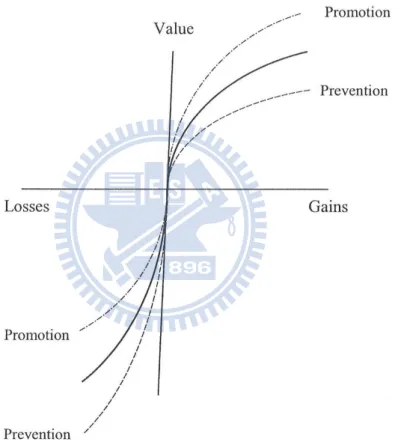
(11) promotion-focused (i.e., perceptions of gain frames) consumers. It also disables marketers from dealing with customers more appropriately, from turning dissatisfaction into satisfaction, and from establishing a significant and enduring customer bond.. 3.
(12) 1.2 Research Purposes. This research focuses on interaction effects of perceptions of loss and gain related to decisions and mental simulation on consumer decision making. We wonder whether the prevention-focused and promotion-focused frames extend to the use and consequences of prefactual and counterfactual thinking, as well as on consumer regret and satisfaction after negative service outcomes. Even though most of previous regulatory focus theory studies consider prepurchase and postpurchase consumer behavior, as we know, there is no findings directly point out the directions (i.e., upward and downward thinking) of prefactual thinking and counterfactual thinking that prevention-focused and promotion-focused consumers naturally and usually adopt.. Consequently, concentrating on individual differences, we attempt to bring to light what is the linkage between regulatory focus and prepurchase and postpurchase simulation? And what is the postpurchase evaluation of different regulatory focus? We wish this research can provider marketers and researchers with richer insight into the prevention-focused and promotion-focused consumers, and the clearer portrait while establishing relative strategies.. 4.
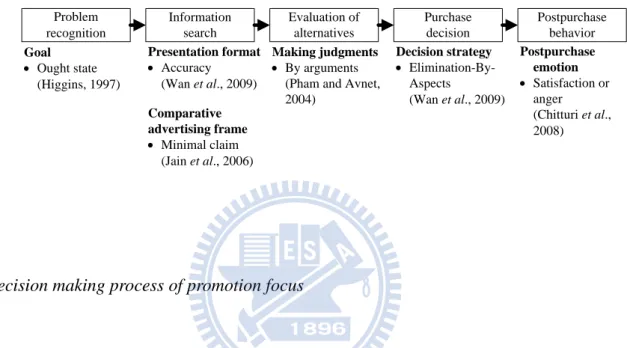
(13) 2. Literature Review. 2.1 Regulatory Focus Theory “May I help you?” We are familiar with the service scenes that service providers try to satisfy their consumers. Apparently, understanding consumers’ seeks and the differences in consumers’ decision making processes from problem recognition to postpurchase behavior is the primary issue service providers have to address first and last. For example, car salesmen may try to know which do consumers place more importance on, what kind of advertising claim consumers like, and how consumers response to desires or even undesired outcomes after they make the purchase decisions based on salesmen’ recommendations. Among abundant studies that looked into consumers’ seeks and extend to relative behaviors, regulatory focus theory (Higgins, 1997) deliberates the concept by considering people’s essential psychical activities of procuring pleasure and avoiding pain. Therefore, the focal points we discussed below are base on regulatory focus theory ranged over psychology and marketing.. 5.
(14) 2.1.1. What is regulatory focus theory?. Regulatory focus theory, characterization of hedonic principle with different motivational consequences, distinguishes between prevention and promotion focus. “Regulatory focus” infers that people tend to regulate themselves to reach desired end-states and are sensitive to different outcomes. Specifically, prevention-focused individuals tend to avoid pains by ensuring ought states (e.g. duties, obligations, and responsibilities) and are sensitive to presence/absence of negative outcomes, while promotion-focused individuals tend to gain pleasures by pursuing ideal states (e.g. hopes, wishes, and aspirations) and are sensitive to presence/absence of positive outcomes. For example, child who is trained to be alert for dangers and would be punished because of violation of caretaker’s instruction may regulate himself/herself to follow the instruction due to the fear of caretaker’s penalty, whereas child who is requested to behave in a good manner and would be hugged because of achievement of caretaker’s instruction may regulate himself/herself to follow the instruction due to the expectation of caretaker’s reward. In this case, security-related needs are regarded as prevention focus, whereas nurturance-related needs of children are regarded as promotion focus. In marketing, two women who are about the same age and searching for new cars may choose different cars, because the single and without children one concerns the cheerfulness of driving experience (ideal state), while the other one who has a child would give priority for safety (ought state).. From the point of view of prospect theory that demonstrates loss-aversion 6.
(15) principle, regulatory focus goal orientation moderates people’s preference for the status quo (Chernev, 2004). Prevention-focused individuals are more likely to center on minimizing negative outcomes, whereas promotion-focused individuals are more likely to center on maximizing positive outcomes. Consequently, prevention-focused individuals are more likely to highlight losses than promotion-focused individuals (see Figure 1).. Figure 1 Prospect Theory and Regulatory Focus Theory Source: Adapted from Chernev, A., “Goal Orientation and Consumer Preference for the Status Quo,” Journal of Consumer Research, Dec 2004, 558.. Since holding the attractions to marketing scholars in not only how consumer reach their goals but also how can service providers reach or even exceed consumers’ 7.
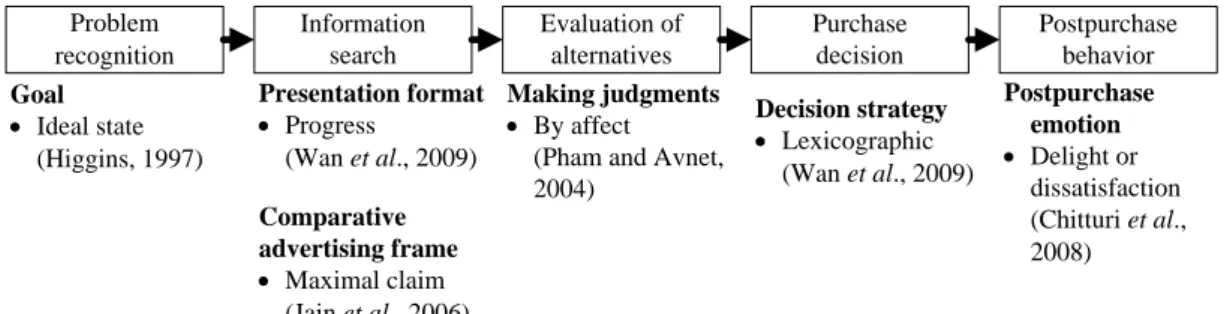
(16) expectation, the differences of people’ s seeks between prevention and promotion focus in consumers decision processes have be investigated. We discuss these findings as follows.. 2.1.2. How regulatory focus influences consumers’ decision making. processes?. Prevention-focused individuals are concerned with minimizing errors of commission (e.g. vigilance orientation), yet promotion-focused individuals are concerned with minimizing errors of omission (e.g. eagerness orientation) (Crowe and Higgins, 1997). For understanding consumers’ decision making processes, previous studies about prevention and promotion focus and regulatory fit are gathered respectively. (see Figure 2 and Figure 3). Decision making process of prevention focus. At problem recognition stage, ensuring ought states such as duties, obligations, and responsibilities and avoiding making mistakes of commission make prevention-focused individuals more unwilling to deviate from original condition. So once prevention-focused individuals face decision between stability and change, they will prefer to stay in the original conditions (Liberman et al., 1999). Also, the sensibility of negative outcomes of prevention-focused individuals corresponds to highlighting loss and nonloss and holding vigilance orientation in the following 8.
(17) decision making process.. While searching information, prevention-focused individuals favor accuracy presentation format, simultaneous presentation that enabled consumers to take all pieces of information into consideration, because they are more likely to maximize the accuracy of their decision outcomes (Louro et al., 2005; Wan et al., 2009). Moreover, minimal comparative advertising frame can be seen as a kind of guarantee of nonloss that consumers concerned, and has better persuasion effect on prevention-focused individuals than maximal one. (Jain et al., 2006). When evaluating alternatives, vigilance triggers people to be more reliant on external data (Bless et al., 1996), adopt safer and better predictive information (Hilton and Fein, 1989), and tend to engage in analytical processes (Friedman and Fӧ rster, 2000). Consequentially, prevention-focused individuals are more likely to make judgments by arguments (Pham and Avnet, 2004).. As making purchase decision, prevention-focused individuals are concerned with minimizing errors of commission and try to maximize the accuracy of the decision. Consequently, they would adopt accuracy decision strategy, such as equal weight and Elimination-By Aspects strategy (Wan et al., 2009).. Because prevention-focused individuals attempt to meet ought states and reduce the chance of loss, they would regard the end-states as must-met goals. Products that meet or exceed the expectation of prevention-focused individuals evoke satisfaction 9.
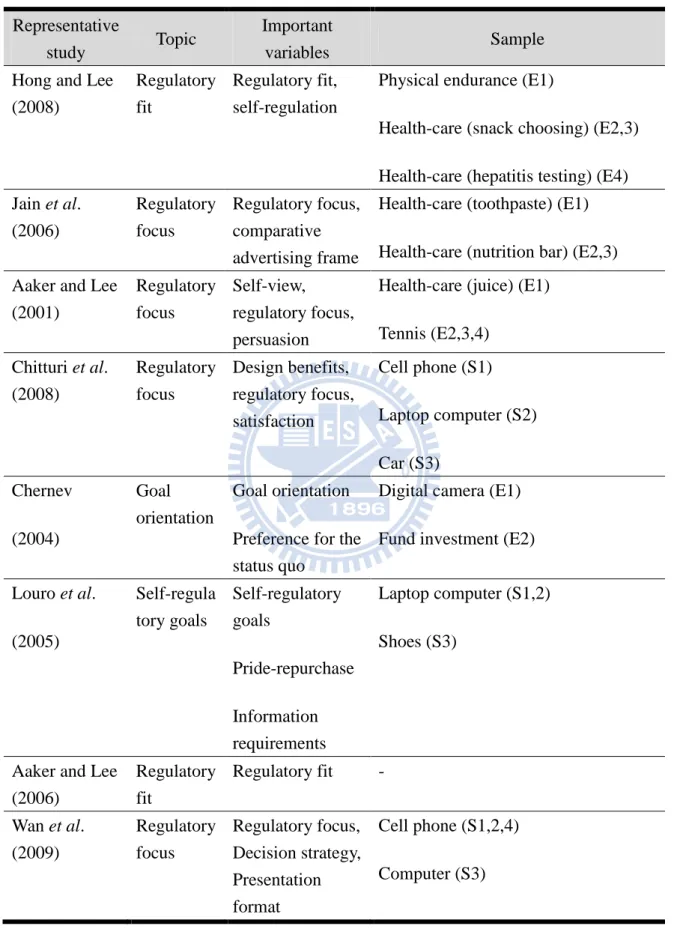
(18) on account of helping them to avoid pain. However, products that fail to meet the expectation evoke anger (Chitturi et al., 2008). Additionally, prevention-focused individuals are more likely to attribute failures to others.. Figure 2 Literature on Prevention Focus. Problem recognition Goal · Ought state (Higgins, 1997). Information Evaluation of search alternatives Presentation format Making judgments · Accuracy · By arguments (Pham and Avnet, (Wan et al., 2009) 2004) Comparative advertising frame · Minimal claim (Jain et al., 2006). Purchase decision Decision strategy · Elimination-ByAspects (Wan et al., 2009). Postpurchase behavior Postpurchase emotion · Satisfaction or anger (Chitturi et al., 2008). Decision making process of promotion focus. At problem recognition stage, pursuing ideal states such as hopes, wishes, and aspirations and avoiding making mistakes of omission make promotion-focused individuals more open to try something different. So once promotion-focused individuals face decision between stability and change, they will prefer to change the current conditions (Liberman et al., 1999). Also, the sensibility of positive outcomes of promotion-focused individuals corresponds to highlighting gain and nongain and holding eagerness orientation in the following decision making process.. While searching information, promotion-focused individuals favor progress presentation format, sequential presentation that consumers gain additional 10.
(19) information in sequence and perceive progress toward decision, because they are more likely to minimize the time they use in decision making (Louro et al., 2005; Wan et al., 2009). Moreover, maximal comparative advertising frame can be seen as a superiority claim of gain, and then has better persuasion effect on promotion-focused individuals than minimal one. (Jain et al., 2006). When evaluating alternatives, eagerness triggers people to be more reliant on internal inputs (Bless et al., 1996), encourage people to use heuristics, and utilize their creativity (Friedman and Fӧ rster, 2000). Consequentially, promotion-focused individuals are more likely to make judgments by affects (Pham and Avnet, 2004).. As making purchase decision, promotion-focused individuals are concerned with minimizing errors of omission and try to facilitate the progress of making decision. Consequently, they would adopt progress decision strategy, such as lexicographic strategy (Wan et al., 2009).. Because promotion-focused individuals attempt to fulfill ideal states and increase the chance of gain, they would regard the end-states as aspire-to-met goals. Products that meet or exceed the expectation of promotion-focused individuals enhance high-arousal feeling of excitement and cheerful associated with delight. However, products that fail to meet the expectation merely evoke low-arousal feelings of sadness and disappointment leading to dissatisfaction (Chitturi et al., 2008).. 11.
(20) Figure 3 Literature on Promotion Focus. Problem recognition Goal · Ideal state (Higgins, 1997). Information Evaluation of search alternatives Presentation format Making judgments · Progress · By affect (Pham and Avnet, (Wan et al., 2009) 2004) Comparative advertising frame · Maximal claim (Jain et al., 2006). Purchase decision Decision strategy · Lexicographic (Wan et al., 2009). Postpurchase behavior Postpurchase emotion · Delight or dissatisfaction (Chitturi et al., 2008). Regulatory fit. Match between the goal pursuit strategy and their goal orientation, namely regulatory fit, leads to “feel right” and strengthen their engagement (Aaker and Lee, 2006; Avnet and Higgins, 2006). Precisely, prevention-focused individuals experience regulatory fit when they involve in duties, obligations, and responsibilities, accuracy information presentation format, minimal comparative advertising frame, making judgments by argument, and accuracy decision strategy, but otherwise experience regulatory nonfit. In contrast, prevention-focused individuals experience regulatory fit when they involve in hopes, wishes, and aspirations, progress information presentation format, maximal comparative advertising frame, making judgments by affect, progress decision strategy, but otherwise experience regulatory nonfit. People who experienced regulatory fit have more positive attitude toward products, more confidence in their judgment strength, and higher value of products they assessed (Lee and Aaker, 2004).. 12.
(21) 2.1.3. Why people have regulatory focus?. The antecedences of regulatory focus can be divided into chronic and temporary. Chronic is the differences from person to person as their nature. Temporary is derived from situation induced orientation, such as self-view. People with a more accessible interdependent self-view are more likely to engage in prevention focus, while with a more accessible independent self-view are more likely to engage in promotion focus (Aaker and Lee, 2001). Although Hong and Lee (2008) indicate that while choosing fit strategy, the effect of people with their chronic regulatory focus is no better than those assigned to the temporary regulatory focus, the understanding of difference between chronic and temporary is still limited (see Table 1).. 13.
(22) Table 1 Regulatory Focus Theory in Marketing Representative study Hong and Lee (2008). Topic. Important variables. Regulatory Regulatory fit, fit self-regulation. Sample Physical endurance (E1) Health-care (snack choosing) (E2,3) Health-care (hepatitis testing) (E4). Jain et al. (2006) Aaker and Lee (2001) Chitturi et al. (2008). Regulatory Regulatory focus, focus comparative advertising frame. Health-care (toothpaste) (E1). Regulatory Self-view, focus regulatory focus, persuasion. Health-care (juice) (E1). Regulatory Design benefits, focus regulatory focus, satisfaction. Cell phone (S1). Health-care (nutrition bar) (E2,3). Tennis (E2,3,4). Laptop computer (S2) Car (S3). Chernev (2004) Louro et al.. Goal orientation. Goal orientation. Digital camera (E1). Preference for the Fund investment (E2) status quo Self-regula Self-regulatory tory goals goals. (2005). Laptop computer (S1,2) Shoes (S3). Pride-repurchase Information requirements Aaker and Lee (2006). Regulatory Regulatory fit fit. Wan et al. (2009). Regulatory Regulatory focus, Cell phone (S1,2,4) focus Decision strategy, Computer (S3) Presentation format 14. -.
(23) 2.2 Prefactual and Counterfactual Thinking. For most consumers in service delivery processes, simulating alternative possible outcomes, both before and after services performed, plays an important role in their decision making processes and evaluations. Prefactual thinking and counterfactual thinking, thoughts like “if only” or “what if” conditions, infer simulating alternative possible outcomes before and after the fact respectively. Prior studies have recognized additive versus subtractive and upward versus downward prefactual and counterfactual thinking, however, we concentrate on the directions of simulation, upward and downward, underlining the gap between actually happened state and simulated better or worse one (Markmen et al., 1993; Roese, 1994).. 15.
(24) 2.2.1. What is the upward and downward prefactual and. counterfactual thinking?. Referring to study 1 in Sanna’ s research (1996), asked students to image that they are preparing for an upcoming exam, what antecedents and consequences they could think of? “I wish I could have more time reading before the exam” and “if I can only take better class notes” before taking the exam, and “If I just paid more attention to Chapter 2, I would have did a lot better” and “I think that I would have gotten a better grade if I didn't have another exam that day” after knowing the grade demonstrate upward prefactual and counterfactual thinking that simulating better alternatives than reality. At the same time, “I could fail if I don’t get my final studying in” and “If I didn't like psychology so much, I'd probably do pretty bad” before taking the exam and “At least I passed... I didn't think this class would be so difficult” and “I'm happy with my grade because I know other people did worse than I did” after knowing the grade demonstrate downward prefactual and counterfactual thinking that simulating worse alternatives than reality.. Different. simulating. directions. have. different. functions.. Exactly,. upward. counterfactual thinking rises negative mood, while downward counterfactual thinking rises positive mood (Markmen et al., 1993; Roese, 1994). Previous researches also indicate that upward thinking can serve as the basis of future works, whereas downward thinking may enhance self-esteem (Markmen et al., 1993; Roese, 1994; Sanna, 1996; Sanna et al., 1999). The salient notion is the trade-off relationship 16.
(25) between preparation for the future and self-esteem enhancement. Upward thinking enables people to deal with future works but abandons the chance to feel better, in contrast, downward thinking allows people feel more satisfied but abstains from preparation for the future (Buunk et al., 1990; Markmen et al., 1993; Roese, 1994). Moreover, it appears that prefactual and counterfactual thinking are similar to social comparison in not only the direction of upward and downward, also the elicitation of coping with future and self-esteem enhance effects (e.g., Wood, 1989; Taylor et al., 1990).. However, researches centered on counterfactual thinking seem to be relatively plentiful when compared with studies of prefactual thinking. In fact, prefactual thinking is the extension of counterfactual thinking concept, but distinct from the activated timing, before or after events (e.g., Sanna, 1996). Then, the following we discuss how to activate these simulation, especially counterfactual thinking.. 17.
(26) 2.2.2. How to activate counterfactual thinking?. In general, people would not activate counterfactual thinking unreasonably. While experiencing negative events or perceiving the happened outcomes might be changed a lot if getting another chance, people would be easier to induce simulation of alternative possible outcomes (Markmen et al., 1993; Roese, 1994). Nevertheless, Sanna et al. (1999) indicate that negative and positive moods not only serve as consequence, but also act as antecedent of counterfactual thinking. According to “feelings-as-information” views (Martin et al., 1993), negative affect may signal existence of problems, while positive affect may reveal everything is fine. That is, negative mood corresponds to dissatisfaction in life, while positive mood corresponds to satisfaction (Schwarz and Clore, 1983). Both negative and positive moods can serve as information and activate counterfactual thinking when mood serve as a comparable anchor or people want to maintain the desired conditions.. 18.
(27) 2.2.3. Why people engage in different simulations?. Due to the commonness and the follow-up influences, several studies have tried to find the distinguishing simulation thinking features among different naturally personal characteristics or situational factors. We have a brief review of these findings as follows.. High self-esteem versus low self-esteem. People with different level of self-esteem may have different reactions to successes or failures (e.g., Brown and Dutton, 1995). Although both high self-esteem and low self-esteem people generate more downward than upward counterfactual thinking when response to positive moods, they have distinct counterfactual thinking directions when react to negative moods because high self-esteem people are more able to repair their moods. So while in negative moods, high self-esteem people generate more downward than upward counterfactual thinking, whereas low self-esteem people agree more upward than downward thinking. (Sanna et al., 1999). Defensive Pessimism versus Optimism. The differences in simulation alternatives may come from the distinct characteristics of defensive pessimists and optimists. That is, defensive pessimists set low expectations and enhance their motivation by anxiety, whereas optimists set high expectations and protect their self-esteem (Norem and Illingworth, 1993; Showers, 1992). Therefore, defensive pessimists engage in more upward prefactual thinking 19.
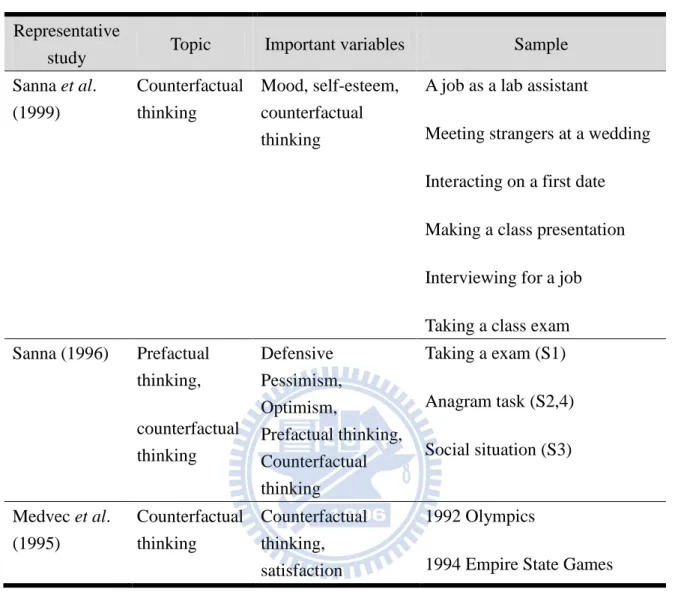
(28) than optimists do, whereas optimists engage in more downward prefactual thinking than defensive pessimists do in response to a course exam. While manipulate prefactual thinking directly, defensive pessimists still prefer upward prefactual thinking; however, optimists prefer no prefactuals. Once failures occurred, optimists generate downward counterfactual thinking after failures, but prefer not to engage in much counterfactual thinking as their preparatory strategy for the future when events are repeatable. In contrast, defensive pessimists usually prefer no counterfactual thinking after failures, yet use upward counterfactual thinking when they believe that they have the second chance to encounter the same situations (Sanna, 1996).. Bronze versus silver medalists at the 1992 Summer Olympics. Being one of the best in the world is a gain, or a loss? Every athlete is eager to win gold medal, but there is only one winner in athletic competition. Although gold, silver, and bronze medalists all represent the top in the world, they may have distinct mental simulation phenomena and satisfaction. Silver medalists are likely to focus on they almost win the gold medal, whereas bronze medalists are likely to concentrate on at least they occupy the third place and earn a medal rather than get nothing. That is, silver medalists tend to engage in upward counterfactual thinking, whereas bronze medalists prefer downward counterfactual thinking. Then, Silver medalists seem to be less satisfied with their performances than bronze medalists do (Medvec et al., 1995). (see Table 2). 20.
(29) Table 2 Studies in Prefactual and Counterfactual Thinking Representative study Sanna et al. (1999). Topic. Important variables. Counterfactual Mood, self-esteem, thinking counterfactual thinking. Sample A job as a lab assistant Meeting strangers at a wedding Interacting on a first date Making a class presentation Interviewing for a job Taking a class exam. Sanna (1996). Prefactual thinking, counterfactual thinking. Medvec et al. (1995). Defensive Pessimism, Optimism, Prefactual thinking, Counterfactual thinking. Counterfactual Counterfactual thinking thinking, satisfaction. 21. Taking a exam (S1) Anagram task (S2,4) Social situation (S3). 1992 Olympics 1994 Empire State Games.
(30) 3. Conceptual Model and Hypotheses. Due to the lack of understanding of how regulatory focus influences consumer mental simulation, the present research devotes to provide insight into how prevention and promotion focus arouse mental simulations (i.e., prefactual thinking and counterfactual thinking). We discuss the conceptual model and hypotheses as below.. 3.1 Study 1: Regulatory Focus and Prefactual Thinking. People may simulate possible better or worse alternatives before making decision based on their personal identities. According to regulatory focus theory, prevention-focused individuals are more sensitive to insuring “correct rejections” and prefer to stay in stable conditions, whereas promotion-focused individuals are primarily concerned with minimizing “errors of omission” and prefer to change. Additionally, Shah and Higgins (1997) proposed that, in expectancy-value model, prevention-focused individuals reach their goals because the increased value of the goals suggests the necessity they must have to do without respect to the ease or likelihood of goal attainment. That is, prevention-focused individuals are careful to maintain the original conditions until they have no choice but to seek safety solutions that ensure avoiding pains. Due to these psychological characteristics, we propose that prevention-focused individuals, when choosing a service provider, would engage in more preparatory upward prefactual thinking in order to avoid any opportunities to choose bad service providers and prepare for losses or nonlosses in following service 22.
(31) delivery processes. On the other hand, promotion-focused individuals are more likely to maximize the value and expectancy of the services and pursuit their goals as accomplishments. Namely, promotion-focused individuals are inclined to accept new or unfamiliar products and services as long as they have the chance to gain pleasures. So their alternative expected performance outcome would more likely be in a downward direction in order to avoid missing any opportunities to choose good service providers and enhance their self-esteem for pushing them to make purchase decisions. Therefore, we predict:. H1a:While simulating alternatives before making purchase decisions, prevention-focused consumers are more likely to engage in upward prefactual thinking than downward prefactual thinking.. H1b:While simulating alternatives before making purchase decisions, promotion-focused consumers are more likely to engage in downward prefactual thinking than upward prefactual thinking.. 23.
(32) 3.2 Study 2: Regulatory Focus and Counterfactual thinking. Service outcomes may be better than expected, worse than expected, or as expected. Although both good and bad moods can trigger counterfactual thinking, we are more interested in the consequences of negative outcomes because of the serious impacts such as negative word-of-mouth and even consumer switching (Keaveney, 1995).. Regulatory focus theory suggests that prevention-focused individuals more concentrate on oughts which they have to meet, whereas promotion-focused individuals usually hope to attain their ideals. Actual-ought discrepancies, failures to attain a minimal goal, should provide more intense pain than actual-ideal discrepancies, failure to attain a maximal goal (Strauman and Higgins, 1988). In other words, service failures more easily cause prevention-focused individuals to activate upward counterfactual thinking to simulate possible alternatives (e.g., other good service providers) to achieve their initial expectation for exhibiting deviation from ought states and enduring losses than promotion-focused individuals. In contrast, it is more easily for promotion-focused individuals to activate downward counterfactual thinking than prevention-focused individuals because of comparative slight impact of nongains.. H2a:After. experiencing. negative. outcomes. in. services,. prevention-focused consumers are more likely to engage in upward counterfactual thinking than downward counterfactual thinking. 24.
(33) H2b:After. experiencing. negative. outcomes. in. services,. promotion-focused consumers are more likely to engage in downward counterfactual thinking than upward counterfactual thinking.. Additionally, actual-ought discrepancies and actual-ideal discrepancies should bring different postpurchase evaluations. People failed to meet their oughts are more likely to engage in agitation emotions, such as feeling uneasy, threatened, or afraid, whereas people failed to attain their ideals are more likely to experience dejection emotions, such as disappointment, dissatisfaction, or sadness (Higgins, 1987). Then, prevention-focused individuals are more regretful for the failures and less satisfied with the current service providers than would promotion-focused individuals. Therefore, we hypothesize:. H3:. After. prevention-focused. experiencing consumers. negative would. outcomes. feel. more. in. services,. regretful. than. promotion-focused consumers do.. H4:. After. prevention-focused. experiencing consumers. promotion-focused consumers do.. 25. negative would. outcomes feel. less. in. services,. satisfied. than.
(34) 4. Methodology. 4.1 Study 1: Regulatory Focus and Prefactual Thinking. 4.1.1. Design. The goal of study 1 was to test our prefactual thinking predictions as H1a and H1b. We wanted the target product to be general and familiar to consumers. Given that bicycle is popular and prevalent (e.g., average 1.81 bicycles per household vs. average 1.44 motorcycles per household, Ministry of Transportation and Communications, 2009), so bicycle was chosen as the target product in present research... We manipulated temporary rather depended on chronic regulatory focus because different situations might lead different regulatory focus. Therefore, chronic regulatory focus was unsurely identical with participant real regulatory focus under our scenario. Referring to previous studies, the scenario used the phrase “avoid losing” and the word “cure” to evoke prevention and the word “gain” and “action” to evoke promotion (Dholakia et al., 2006; Louro et al., 2005). The first scenario was as follow:. According to survey of MOTC (Ministry of Transportation and Communications), there are more than 10 million bicycle riders in Taiwan last year. Bicycle is somewhere. 26.
(35) one of the most popular merchandise in Taiwan. In this trend, you intend to buy a bicycle.. Due to the flexible price of bicycle, you know that you might spend more [less] money on it. To avoid losing [succeed in gaining], you want to avoid paying extra money [take advantage of discount] while buying bicycle. And considering “there is no free lunch [fish or cut bait],” you tend to cure of errors to ensure avoiding losing [take action to ensure succeeding in gaining].. Then, the second scenario described a real marketplace condition that provides inducer for participants to activate prefactual thinking. The second scenario was as follow:. After surfing the network and reading magazine, you focused on a nice bicycle which has satisfying design, performance, and services. You decided to buy this bicycle, but were still thinking about the price.. You are now at Yi-ran bike shop. You see the bicycle that you want at a reduced price of NT$4,300, instead of its regular price of NT$5,000. That is, you can avoid paying an extra NT$700 [gain NT$700]. Meanwhile, you know that there is another bicycle shop nearby, they also have this bicycle. However, you have no idea about the price of the same bicycle there.. 27.
(36) 4.1.2. Subject and Procedure. We randomly assigned participants to prevention focus or promotion focus scenario. Participants were asked to imagine that they were in the situations. After reading the first scenario aimed to manipulate regulatory focus, participants completed manipulation checks to ensure the success. Then participants were asked to read the second scenario, and reported their prefactual thinking.. 4.1.3. Measures. Manipulation checks. Participants completed the six-item check on manipulation for regulatory focus (Roese et al., 1999): “Some situations involve pursuing something we want, whereas others involve trying to avoid something we don’t want. How would you describe this situation?” The left anchor of the 7-point scale expressed prevention focus relevance such as avoiding, and right anchor expressed promotion focus relevance such as pursuing.. Prefactual thinking.. Although majority of previous researches adopted open-ended. questions to activate prefactual thinking, the obscure frequency of each thought brought limitation in these studies. At the same time, as we know, it still lacked for general prefactual thinking scale. To measure this dependent variable, we conducted pretest (see Appendix A) by recruiting 30 graduate students to describe alternatives that were worse or better than what they expected will actually happen that might 28.
(37) affect the upcoming outcome of buying bicycle after reading the scenarios. Also, we referred to Counterfactual Thinking for Negative Events Scale (CTNES; Rye et al., 2008) that was designed to assess counterfactual thoughts in response to past negative events to form prefactual thinking measures on a ten-item, seven-point scale (1=” never” and 7= “very often”) (see Appendix B).. 29.
(38) 4.2 Study 2: Regulatory Focus and Counterfactual Thinking. 4.2.1. Design. This study examined whether regulatory focus can influence consumer counterfactual thinking after experiencing negative event. We focus on postpurchase mental simulation of prevention-focused and promotion-focused consumers, and continued to manipulate regulatory focus as in study 1. The first scenario was as follow:. Bicycle is somewhere one of the most popular merchandise in Taiwan. In this trend, you intend to buy a bicycle. To avoid losing [succeed in gaining], you want to avoid paying extra money [take advantage of discount] while buying bicycle.. Last week, you bought the bicycle that you want at a reduced price of NT$4,300, instead of its regular price of NT$5,000, because you wanted to avoid paying an extra NT$700 [gain NT$700].. After that, the second scenario described the negative event that consumer found it cheaper someplace else to elicit counterfactual thinking. The second scenario was as follow:. Last week, you bought the bicycle that you want at a reduced price of NT$4,300, instead of its regular price of NT$5,000, because you wanted to avoid paying an extra 30.
(39) NT$700 [gain NT$700]. However, now you find that the same bicycle is sold for $4,000 someplace else.. 4.2.2. Subject and Procedure. As in study 1, we randomly assigned participants to prevention focus or promotion focus scenario. Participants were asked to imagine that they were in the situations. After reading the first scenario, participants completed manipulation checks. Then participants were asked to read the second scenario, and reported their counterfactual thinking.. 4.2.3. Measures. Manipulation checks. Participants completed the manipulation check on regulatory focus as in study 1.. Counterfactual thinking.. Counterfactual thinking was assess by Counterfactual. Thinking for Negative Events Scale on a ten-item, seven-point scale (1=” never” and 7= “very often”).. Regret. Regret was measured on a five-item, seven-point scale (Creyer and Ross, 1999; Oliver, 1997; Tsiros, 1998).. 31.
(40) Satisfaction. Satisfaction was measured on a five-item, seven-point scale (Fornell, 1992; Oliver, 1977, 1997; Tsiros, 1998) (see Appendix C).. 32.
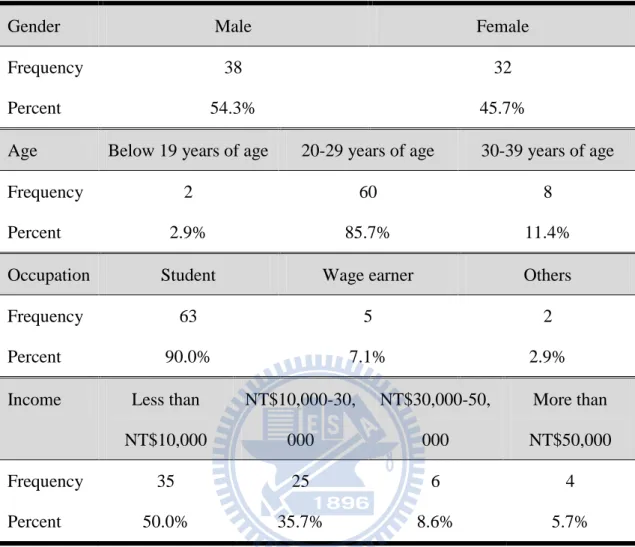
(41) 5. Results. 5.1 Study 1: Regulatory Focus and Prefactual Thinking. From a total of 70 questionnaires of study 1, none of them contained unanswered questions. All of these questionnaires are usable consisting of 38 male and 32 female. Participants’ ages ranged from below 19 years of age to 39 years of age, with 85.7% between ages 20 and 29. Furthermore, 90% of participants are students and 7.1% of them are wage earners. (see Table 3). All Cronbach’s alphas of each construct in study 1 were over the threshold value 0.70, suggesting acceptable internal consistency of multiple items for each construct (see Table 4).. 33.
(42) Table 3 Descriptive Statistics in Study 1. Gender. Male. Female. 38. 32. 54.3%. 45.7%. Frequency Percent Age. Below 19 years of age. 20-29 years of age. 30-39 years of age. 2. 60. 8. 2.9%. 85.7%. 11.4%. Occupation. Student. Wage earner. Others. Frequency. 63. 5. 2. 90.0%. 7.1%. 2.9%. Frequency Percent. Percent Income. Frequency Percent. Less than. NT$10,000-30,. NT$30,000-50,. More than. NT$10,000. 000. 000. NT$50,000. 35. 25. 6. 4. 50.0%. 35.7%. 8.6%. 5.7%. Table 4 Results of Cronbach’s Alpha in Study 1. Construct. Cronbach’s Alpha. RF. 0.930. Pup. 0.713. Pdown. 0.756. Manipulation checks.. We use SPSS 12.0 software to conduct manipulation check.. The manipulation regarding regulatory focus was found to be effective, in that the 34.
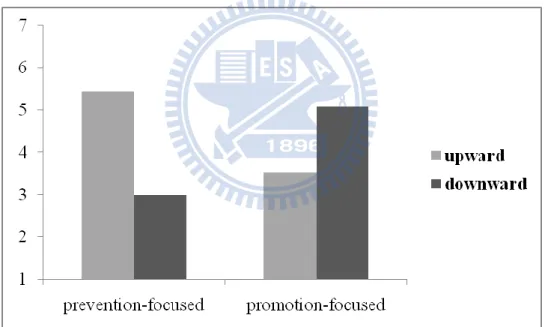
(43) prevention situations were indeed seen to reflect greater prevention orientation (Mprevention = 2.35) than did the promotion situations (Mpromotion = 5.58), t = 17.082, p=0.000.. Prefactual thinking.. Participants’ prefactual mental simulations were analyzed using. paired-t-test. Prevention-focused consumers generate more upward prefactual thinking (Mupward = 5.43) than downward (Mdownward = 3.00), t = 11.859, p=0.000. And promotion-focused consumers generate more downward prefactual thinking (Mdownward = 5.08) than upward (Mupward = 3.52), t = -7.643, p=0.000 (see Figure 4). Therefore, hypotheses H1a and H1b are significantly supported.. Figure 4 Prefactual Thinking in Study 1. 35.
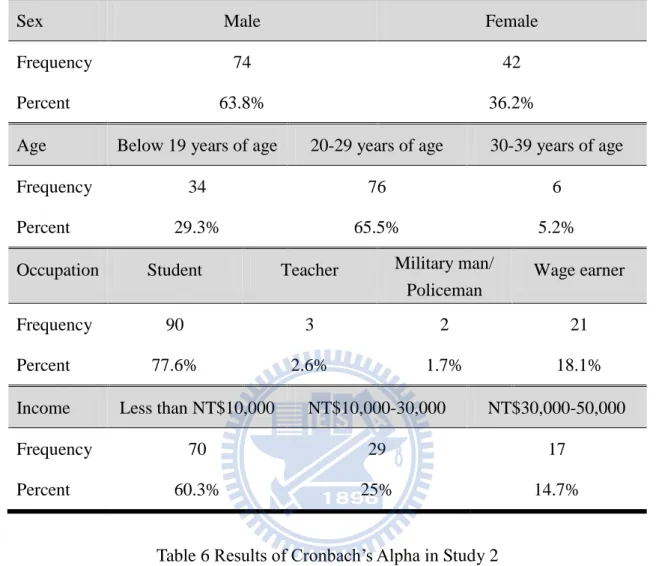
(44) 5.2 Study 2: Regulatory Focus and Counterfactual Thinking. From a total of 116 questionnaires of study 2, none of them contained unanswered questions. All of these questionnaires are usable consisting of 74 male and 42 female. Participants’ ages ranged from below 19 years of age to 39 years of age, with 65.5% between ages 20 and 29. Furthermore, 77.6% of participants are students and 2.6% of them are teachers. (see Table 5). All Cronbach’s alphas of each construct in study 1 were over the value 0.90, suggesting good internal consistency of multiple items for each construct (see Table 6).. 36.
(45) Table 5 Descriptive Statistics in Study 2. Sex. Male. Female. 74. 42. 63.8%. 36.2%. Frequency Percent Age. Below 19 years of age. 20-29 years of age. 30-39 years of age. 34. 76. 6. 29.3%. 65.5%. 5.2%. Frequency Percent Occupation. Student. Teacher. Military man/ Policeman. Wage earner. Frequency. 90. 3. 2. 21. 77.6%. 2.6%. 1.7%. 18.1%. Percent Income Frequency Percent. Less than NT$10,000. NT$10,000-30,000. NT$30,000-50,000. 70. 29. 17. 60.3%. 25%. 14.7%. Table 6 Results of Cronbach’s Alpha in Study 2. Construct. Cronbach’s Alpha. RF. 0.936. Pup. 0.917. Pdown. 0.912. Reg. 0.917. Sat. 0.918. 37.
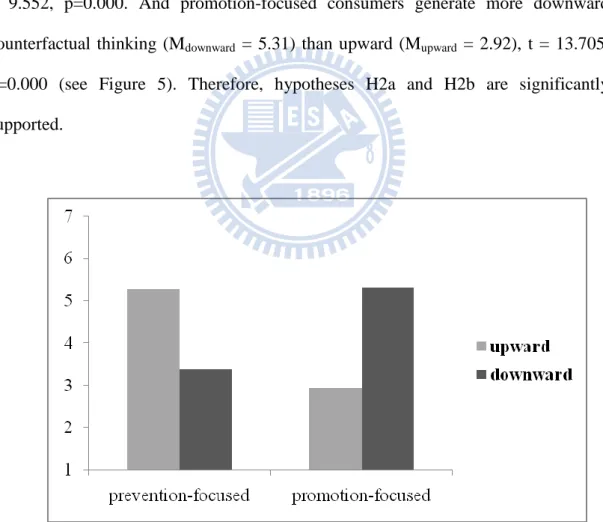
(46) Manipulation checks.. Participants who were exposed to the prevention scenario felt. that the situation was closer to the prevention focus relevance anchor (Mprevention = 2.14) while those who saw the promotion scenario perceived the situation to be closer to promotion focus relevance anchor (Mpromotion = 5.57), t = -26.877, p=0.000. The manipulation was found to be successful.. Counterfactual thinking.. We used paired t-test to examine the impact of regulatory. focus on the counterfactual thinking. Prevention-focused consumers generate more upward counterfactual thinking (Mupward = 5.27) than downward (Mdownward = 3.38), t = 9.552, p=0.000. And promotion-focused consumers generate more downward counterfactual thinking (Mdownward = 5.31) than upward (Mupward = 2.92), t = 13.705, p=0.000 (see Figure 5). Therefore, hypotheses H2a and H2b are significantly supported.. Figure 5 Counterfactual Thinking in Study 2 38.
(47) Regret.. We utilized independent sample t-test to examine that whether regulatory. focus extends to regret after negative service outcomes. Prevention-focused consumers (MReg_prevention = 5.26) are more regretful than promotion-focused consumers (MReg_promontion = 3.23) do, t = 11.035, p=0.000 (see Figure 6). Consequently, hypotheses H3 is significantly supported.. Figure 6 Regret in Study 2. Satisfaction.. We examine that whether regulatory focus extends to satisfaction after. negative service outcomes by using independent sample t-test. Prevention-focused consumers (MSat_prevention = 2.95) are more satisfied than promotion-focused consumers (MSat_promontion = 4.54) do, t = 11.368, p=0.000 (see Figure 7). Therefore, hypotheses H4 is significantly supported.. 39.
(48) Figure 7 Satisfaction in Study 2. Analysis of other variables. In order to uncover whether other variables in current research, that is, people’s demographic characteristics, have an impact on their simulation thinking directions, regret, and satisfaction, we try to center on the suspicious variables, gender and incomes, by utilizing independent sample t-test. Study 1 and study 2 pointed out that regulatory focus played an important role in prefactual thinking, counterfactual thinking, regret, and satisfaction before purchase and after negative service outcome (see Table 7 and 8). Considering sample size, data in study 2 was chosen to be rehandled. The results showed that gender had no significant impact on counterfactual thinking, regret, and satisfaction (see Table 9 and 10). Although occupation can be seen as a possible variable in consumer behavior researches, income was chosen to be rehandled here rather students versus other occupations because the current diverse student sample which consists of undergraduate students, graduate students, Ph. D 40.
(49) students, and EMBA students. The results showed that participants with less than NT$10,000 income per month felt less satisfied than participants with more than NT$10,000 income per month in prevention-focused condition. However, participants with less than NT$10,000 income per month engaged in more downward counterfactual thinking than participants with more than NT$10,000 income per month in promotion-focused condition (see Table 11 and 12). Consequently, gender and incomes had no or comparative little impacts on simulation thinking, regret, and satisfaction.. 41.
(50) Table 7 Analysis Results of Study 1 Variables Manipulation. Manipulation check. Pup. Pdown. Prevention. Promotion. Prevention. Promotion. Prevention. Promotion. N Mean. 35 2.35. 35 5.58. 35 5.43. 35 3.52. 35 3.00. 35 5.08. Std. Deviation Std. Error Mean. 0.84 0.14. 0.73 0.12. 0.64 0.11. 0,97 0.16. 1.07 0.18. 0.82 0.14. Sig. T. 0.149 17.082. -. -. Table 8 Analysis Results of Study 2 Variables Manipulation N Mean Std. Deviation Std. Error Mean. Manipulation check. Cup. Cdown. Reg. Sat. Prevention. Promotion. Prevention. Promotion. Prevention. Promotion. Prevention. Promotion. Prevention. Promotion. 58 2.14 0.64 0.08. 58 5.57 0.73 0.10. 58 5.27 0.85 0.11. 58 2.92 0.93 0.12. 58 3.38 1.16 0.15. 58 5.31 0.91 0.12. 58 5.26 0.91 1.06. 58 3.23 1.06 0.14. 58 2.95 0.75 0.10. 58 4.54 0.76 0.10. Sig.. 0.102. -. -. 0.136. 0.907. T. 26.877. -. -. 11.035. 11.368. 42.
(51) Table 9 Gender Analysis in Prevention-Focused Scenario of Study 2 Variables. Manipulation check. Cup. Cdown. Reg. Sat. Gender. Male. Female. Male. Female. Male. Female. Male. Female. Male. Female. N Mean. 37 2.16. 21 2.10. 37 5.42. 21 5.00. 37 3.25. 21 3.59. 37 5.34. 21 5.10. 37 2.76. 21 2.96. Std. Deviation Std. Error Mean. 0.64 0.11. 0.64 0.14. 0.87 0.14. 0.76 0.17. 1.15 0.19. 1.18 0.26. 0.81 0.13. 1.07 0.23. 0.84 0.14. 0. 91 0.20. Sig. T. 0.787 0.327. 0.548 1.837. 0.757 1.059. 0.499 0.944. 0.803 0.853. Table 10 Gender Analysis in Promotion-Focused Scenario of Study 2 Variables. Manipulation check. Cup. Cdown. Reg. Sat. Gender. Male. Female. Male. Female. Male. Female. Male. Female. Male. Female. N Mean Std. Deviation Std. Error Mean. 37 5.56 0.75 0.12. 21 5.60 0.73 0.16. 37 2.87 0.88 0.14. 21 3.02 1.03 0.23. 37 5.42 0.90 0.15. 21 5.13 0.93 0.20. 37 3.18 1.14 0.19. 21 3.30 0.94 0.20. 37 4.60 0.96 0.16. 21 4.50 0.82 0.18. Sig.. 0.664. 0.314. 0.424. 0.351. 0.288. T. 0.214. 0.583. 1.136. 0.414. 0.405. 43.
(52) Table 11 Income Analysis in Prevention-Focused Scenario of Study 2 Variables Income N Mean Std. Deviation Std. Error Mean. Manipulation check. Cup. Cdown. Reg. Sat. Less than. More than. Less than. More than. Less than. More than. Less than. More than. Less than. More than. NT$10,000. NT$10,000. NT$10,000. NT$10,000. NT$10,000. NT$10,000. NT$10,000. NT$10,000. NT$10,000. NT$10,000. 35. 23. 35. 23. 35. 23. 35. 23. 35. 23. 2.16 0.59 0.10. 2.10 0.71 0.15. 5.18 0.88 0.15. 5.40 0.80 0.17. 3.22 1.08 0.18. 3.61 1.27 0.27. 5.18 0.95 0.16. 5.37 0.86 0.18. 2.61 0.71 0.12. 3.18 0.97 0.20. Sig. T. 0.416 0.356. 0.856 0.981. 0.448 1.240. 0.994 0.800. 0.168 2.632. Table 12 Income Analysis in Promotion-Focused Scenario of Study 2 Variables Income N Mean Std. Deviation Std. Error Mean Sig. T. Manipulation check. Cup. Cdown. Reg. S. Less than. More than. Less than. More than. Less than. More than. Less than. More than. Less than. More than. NT$10,000. NT$10,000. NT$10,000. NT$10,000. NT$10,000. NT$10,000. NT$10,000. NT$10,000. NT$10,000. NT$10,000. 35 5.69 0.71 0.12. 23 5.39 0.75 0.16. 35 2.83 0.77 0.13. 23 3.07 1.13 0.24. 35 5.60 0.68 0.11. 23 4.88 1.06 0.22. 35 3.04 1.00 0.17. 23 3.51 1.11 0.23. 35 4.69 0.87 0.15. 23 4.37 0.94 0.20. 0.642 1.540. 0.041 0.966. 0.054 3.167 44. 0.726 1.688. 0.769 1.334.
(53) 6. Discussion and Implication. 6.1 General Discussion. Prospect theory illustrates how individuals evaluate losses and gains in realistic world instead of in the assumption of full rationality. Regulatory focus theory further describes that the sensitivity of gains and losses would be different from person to person. That is, prevention-focused individuals are more sensitive to losses, and adopt loss/nonloss frame, whereas promotion-focused individuals are more sensitive to gains, and adopt gain/nongain frame. Although previous researches have already recognized abundant results of regulatory focus theory, findings of mental simulation of regulatory focus are still rare. Therefore, current research tries to provide an insight into what is the impact of perceptions of gain and loss frames on consumers’ mental simulation and evaluation after buying.. The two studies reported in this research provided converging evidence that regulatory focus actually influenced prefactual and counterfactual thinking and postpurchase evaluation. In study 1, prevention-focused consumers engaged in more upward prefactual thinking, whereas promotion-focused consumers engaged in more downward prefactual thinking before making decision of purchasing a bicycle. Study 2 demonstrated that prevention-focused consumers were more likely to elicit upward counterfactual thinking, whereas promotion-focused consumers were more likely to elicit downward counterfactual thinking after finding that the same bicycle was 50.
(54) cheaper someplace else. Moreover, study 2 also indicated that after experiencing negative events, prevention-focused consumers were less satisfied and more regretful than promotion- focused consumers did.. 51.
(55) 6.2 Theoretical Contribution. Regulatory Focus and Prefactual Thinking. Building on the work of Higgins (1997), Shah and Higgins (1997), Crowe and Higgins (1997), and Chernev (2004), we proposed that prevention-focused consumers engaged in more upward than downward prefactual thinking to minimize errors of commission and ensure avoid pains, whereas promotion-focused consumers engaged in more downward than upward prefactual thinking related to the tendency to minimize errors of omission and maximize the value and expectancy of the products or services while seeking pleasures. The results of current research were consistent with our predictions and reflected common marketplace circumstance that consumers might face wide choices among alternatives, and usually not be capable of or willing to ask for optimization because of resource limitation but activate their mental preoutcome predictions.. The observed impact of regulatory focus on prefactual thinking documents that prevention and promotion focus system significantly influences prepurchase mental decision making process, as suggested by previous researches (e.g., Hong and Lee, 2008; Jain et al., 2006; Wan et al., 2009). To the best of our knowledge, this is the first research to center on the correspondence between regulatory focus (prevention focus and promotion focus) and prefactual thinking (upward and downward).. 52.
(56) Regulatory Focus and Counterfactual Thinking. The current research contributes to extant literature on different fronts. First, Roese et al. (1999) suggested that while failing, prevention-focused individuals were more likely to generate subtractive counterfactual thinking because they concerned about commissions that threaten the status quo, and promotion-focused individuals were more likely to generate additive counterfactual thinking because they concerned about acquisition of the desired goals. The current research expands the understanding of regulatory focus based on the notion that both upward and additive counterfactual thinking induce relatively greater success-facilitating intentions and behaviors than downward or subtractive counterfactual thinking (Roese and Olson, 1997).. Second, in study 2, we examined the postpurchase evaluation. The finding also advances the literature by testing consumer regret and satisfaction hypothesis (as H3 and H4) to obtain influence of regulatory focus on consumer perceptions after negative outcomes in services.. Combined, all of these findings made a valuable theoretical contribution by giving an insight into the influence of regulatory focus on simulation thinking, regret, and satisfaction in decision making process in our research.. 53.
(57) 6.3 Managerial Implication. Prepurchase and Regulatory Focus. The findings from the current research have applications in everyday consumer settings. As highlighted by the current research, prevention-focus consumers differ greatly from promotion-focused consumers in preoutcome simulation. Service providers should understand consumers’ regulatory focus so that they can employ effective and efficient marketing tactics to promotion service quality and purchase probability. For example, before making final purchase decision, prevention-focused consumers tend to be vigilant and simulate better alternatives although the existing alternative might already be attractive. Service providers can use guarantees (McConnell et al., 2000) or exposure potential consumers to minimal claim advertising (Jain et al., 2006) to enhance persuasion effect and reduce upward prefactual thinking generation. In contrast, progress presentation format (Wan et al., 2009) and maximal claim advertising are adequate solutions to emphasize gains that facilitates promotion-focuses consumers to engage in more downward prefactual thinking as their nature.. Postpurchase and Regulatory Focus. It is a common belief that negative outcomes in service lead consumers to resent the buying and imply service providers might need to adopt some recover strategies. 54.
(58) However, how to acquire consumer perceptions of negative outcomes is a vital problem managers have to cope with first because the perceptions of severity of negative outcomes might differ from person to person. At the same time, because of budget and time constraints, managers are often compelled to find the most dissatisfied consumers out and recognize the order of priority of recovery so that stop these consumers from spreading negative word of mouth or switching. The current research suggest that practitioners can try to more concentrate their attention on prevention-focused consumers than on promotion-focused consumers due to more downward counterfactual thinking generation and better repair ability of promotion-focus consumers (Arnold and Reynolds, 2009).. 55.
(59) 6.4 Limitation and Future Research. Although this research reports several important findings, it is not without limitations. We discuss the limitation and possible points of view for future research as follow:. Sampling. Although students seem to be major real-life consumers of bicycles, the student sample somewhat limits the generalizability of the results. Therefore, future research should use other sample methodologies to dispel the doubts of the appropriateness of convenience samples which were widely discussed in marketing researchers and still have divergent positions until today (e.g., Ferber, 1977).. Other possible variables influencing simulation. This research proposes the influences of regulatory focus on simulations and evaluations. The findings provide an insight into the importance of simulation thinking while making purchase decisions and after experiencing negative outcomes in services, also identify the impact on regret and satisfaction. Future Research can investigate other possible variables which can also influence consumers’ prefactual and counterfactual thinking. For example, whether information asymmetry or time pressure influences consumer simulation thinking both before and after buying?. 56.
(60) Intertemporal choices. Previous Research suggested that regulatory focus might be derived temporarily. For example, people with a more accessible interdependent self-view are more likely to engage in prevention focus, while with a more accessible independent self-view are more likely to engage in promotion focus (Aaker and Lee, 2001). Therefore, future research can investigate whether consumers’ regulatory foci shift over time in the decision making processes? By addressing this important question, marketers and practitioners can get a better understanding of consumer behavior.. 57.
(61) REFERENCE. Aaker, J.A. and Lee, A. Y. (2001), ””I” Seek Pleasures and “We” Avoid Pains: The Role of Self-Regulatory Goals in Information Processing and Persuasion,” Journal of Consumer Research, 28(1), 33-49. Aaker, J.A. and Lee, A. Y. (2006), “Understanding Regulatory Fit,” Journal of Marketing Research, 28(February), 15-19. Arnold, M. J. and Reynolds, K. E. (2009), “Affect and Retail Shopping Behavior: Understanding the Role of Mood Regulation and Regulatory Focus,” Journal of Retailing, 85(3), 308-320. Avnet, T. and Higgins, E. T. (2006), “How Regulatory Fit Affects Value in Consumer Choices and Opinions,” Journal of Marketing Research, 43(February), 1-10. Bagozzi, R. P. and Dholakia, U. (1999), “Goal Setting and Goal Striving in Consumer Behavior,” Journal of Marketing, 61(Special Issue), 19-32. Bless, H., Clore, G. L., Schwarz, N., Golisano, V., Rabe, C. and Wӧ lk, M. (1996), “Mood and the Use of Scripts: Does a Happy Mood Really Lead to Mindlessness?” Journal of Personality and Social Psychology, 71(October), 665-679. Brown, J. D. and Dutton, K. A. (1995), “The Thrill of Victory, the Complexity of Defeat: Self-Esteem and People's Emotional Reactions to Success and Failure,” Journal of Personality and Social Psychology, 68(4), 712-722. Buunk, B. P., Collins, R. L., Taylor, S. E., VanYperen, N. W. and Dakof, G. A. (1990), “The Affective Consequences of Social Comparisons: Either Direction Has Its Ups and Downs,” Journal of Personality and Social Psychology, 59(6), 1238-1249. Chernev, A. (2004), “Goal Orientation and Consumer Preference for the Status Quo,” Journal of Consumer Research, 31(December), 557-565. Chitturi, R., Raghunathan, R. and Mahajan, V. (2008), “Delight by Design: The Role 58.
(62) of Hedonic Versus Utilitarian Benefits,” Journal of Marketing, 72(May), 48-63. Creyer, E.H., and Ross, W.T. (1999), “The Development and Use of A Regret Experience Measure to Examine the Effects of Outcome Feedback on Regret and Subsequent Choice,” Marketing Letters, 10(4), 373-386. Crowe, E. and Higgins, E. T. (1997), “Regulatory Focus and Strategic Inclinations: Promotion and Prevention in Decision-Making,” Organizational Behavior and Human Decision Processes, 69(2), 117-132. Dholakia,U. M., Gopinath, M., Bagozzi R. P., and Nataraajan, R. (2006), “ The Role of Regulatory Focus in the Experience and Self-Control of Desire for Temptations,” Journal of Consumer Psychology, 16(2), 163-175. Ferber, R. (1977), “Research by Convenience,” Journal of Consumer Research, 4(1), 57-58. Fornell, C. (1992), “A National Customer Satisfaction Barometer: the Swedish Experience,” Journal of Marketing, 56(1), 6-21. Fornell, C., and Larcker, D.F. (1981), “Evaluating Structural Equation Models with Unobservable Variables and Measurement Error,” Journal of Marketing Research, 18(February), 39-50. Friedman, R. S. and Fӧ rster, J. (2000), “The Effects of Approach and Avoidance Motor Actions on Elements of Creative Insight,” Journal of Personality and Social Psychology, 79(October), 477-492. Higgins, E. T. (1987), “Self-Discrepancy: A Theory Relating Self and Affect,” Psychological Review, 94(3), 319-340. Higgins, E. T. (1997), “Beyond Pleasure and Pain,” America Psychologist, 52(December), 1280-1300. Hilton, J. L. and Fein, S. (1989), “The Role of Typical Diagnosticity in Stereotype-Based Judgments,” Journal of Personality and Social Psychology, 57 (August), 201-211. Hong, J. and Lee, A. Y. (2008), “Be Fit and Be Strong: Mastering Self-Regulation 59.
(63) through Regulatory Fit,” Journal of Consumer Research, 34(February), 682-695. Inman, J. J., Dyer, J. S., and Jia, J. (1997), “A Generalized Utility Model of Disappointment and Regret Effects on Post-choice Valuation,” Marketing Science, 16(2), 97-111. Jain, S. P., Agrawal, N. and Maheswaran, D. (2006), “When More May Be Less: The Effects of Regulatory Focus on Responses to Different Comparative Frames,” Journal of Consumer Research, 33(1), 91-98. Keaveney, S. M. (1995), “Customer Switching Behavior in Service Industries: An Exploratory Study,” Journal of Marketing, 59(April), 71-82. Lee, A. Y. and Aaker, J.A. (2004), “Bringing the Frame into Focus: The Influence of Regulatory Fit on Processing Fluency and Persuasion,” Journal of Personality and Social Psychology, 86(2), 205-218. Liberman, N., Idson, L. C., Camacho, C. J. and Higgins, E. T. (1999), “Promotion and Prevention Choices between Stability and Change,” Journal of Personality and Social Psychology, 77(6), 1135-1145. Louro, M. J., Pieters, R. and Zeelenberg, M. (2005), “Negative Returns on Positive Emotions: The Influence of Pride and Self-Regulatory Goals on Repurchase Decisions,” Journal of Consumer Research, 31(March), 833-840. Markman, K. D., Gavanski, I., Sherman, S. J. and McMullen, M. N. (1993), “The Mental Simulation of Better and Worse Possible Worlds,” Journal of Experimental Social Psychology, 29(1), 87-109. Martin, L. L., Ward, D. W., Achee, J. W. and Wyer, R. S. (1993), “Mood as Input: People Have to Interpret The Motivational Implications of Their Moods,” Journal of Personality and Social Psychology, 64(3), 317-326. McConnell, A.R., and Niedermeier, K. E., Leibold, J. M., El-Alayli, A. G., Chin, P. P., and Kuiper, N. M. (2000), “What If I Find It Cheaper Someplace Else?: Role of Prefactual Thinking and Anticipated Regret in Consumer Behavior,” Psychology and Marketing, 17(4), 281-298. 60.
數據
+7

相關文件
事業成功與生活品質 追求物質還是人際和諧 長期與短期導向
According to the historical view, even though the structure of the idea of Hua-Yen Buddhism is very complicated, indeed, we still believe that we can also find out the
substance) is matter that has distinct properties and a composition that does not vary from sample
Department of Mathematics, National Taiwan Normal University,
初中聆聽範 疇的學與教 策略-
並藉由適當工具與資訊,去描述、模擬、解釋與 預測各種現象,發揮數學思維方式的特長,做出
1 After computing if D is linear separable, we shall know w ∗ and then there is no need to use PLA.. Noise and Error Algorithmic Error Measure. Choice of
• 課程由現代的普遍取向轉向後現代的多元 取向,從根據學界所預訂的學科知識,轉
