研究報告
臺灣高雄市旗山區薑黃生收集系機能性成分之探討
謝凱勛
1、吳永培
2、林素汝
1,*
1國立屏東科技大學農園生產系
2行政院農委會農業試驗所嘉義分所
摘要
薑黃(Curcuma longa L.)係薑科薑黃屬的
根莖植物,原產於亞洲南部的熱帶性草本植
物,自古即是重要的香料作物,近年來更因
醫藥的應用廣受中西方重視。其中,以薑黃
素成分含量最受重視,惟目前薑黃在臺灣並
無栽培品種的育成,薑黃相關產品因材料來
源混亂,致使其產量、薑黃素含量與抗氧化
活性表現等參差不齊。基此,本試驗材料以
2008 年 2 月自臺灣高雄市旗山區蒐集 500 個
薑黃芽體,經產量試驗選拔產量表現優良之
薑黃收集系,並比較抗氧化與活性成分的差
異,期由此選出高產且富含保健功效之收集
系供臺灣栽培利用。2011 年產量試驗選拔得
到
10 個高產量薑黃收集系,此 10 個收集系
之總酚與
curcumin 含量上並無顯著差異;但
於 類 薑 黃 素
(demethoxycurcumin 及 bis-
demethoxycurcumin)、類黃酮與 DPPH 自
由 基 清 除 力 存 在 顯 著 性 差 異 , 其 中 以
CNY09、CNY15 與 CNY19 等三個收集系表
現較佳。
10 個收集系於 2012 年再經產量試驗
選拔出
5 個收集系,5 個收集系在總酚、類黃
酮、DPPH 自由基清除力及類薑黃素上有顯
著差異存在。就整體活性成分表現而言,以
CNY15 與 CNY19 表現最佳,尤其兩收集系
在
DPPH 自由基清除力與標準品 BHA 無顯
著差異,顯示兩收集系具有較高產量及活性
成分,具有發展成優良保健作物之潛力。
關鍵詞︰薑黃、機能性成分、類薑黃素、
DPPH
自由基清除力。
Investigation of the Functional
Compositions of Turmeric Collected
from Cishan District of Kaohsiung
City, Taiwan
Kai-Hsun Hsieh
1, Yong-Pei Wu
2and
Su-Ju Lin
1,*
1 Department of Plant Industry, National
Pingtung University of Science & Technology, Neipu, Pingtung 91201, Taiwan ROC
2 Chiayi Agricultural Experiment Station, Taiwan
Agricultural Research Institute, Chiayi 60044, Taiwan ROC
ABSTRACT
Turmeric (Curcuma longa L.) is a member of ginger family, Zingiberaceae, a tuber herb originated from the tropical area of South Asia and an important spice since ancient times. Recently, turmeric has been widely brought attention to Chinese and Western because of its curcumin applied to medicine. However, there is no cultivated variety of turmeric in Taiwan, and raw materials made of turmeric products in marketplace are mingled, leading to varied yields, curcumin contents, and antioxidant activities. We gathered 500 turmeric buds from Cishan District of Kaohsiung City, Taiwan in February 2008. The elite lines of turmeric were collected based on the results of cultivation and the yield trails, and then their antioxidant activities and functional ingredients were assessed consequently. The collected lines of higher yields with enriched health benefits and functions may be suitable for mass production in Taiwan. Ten collected lines were selected after the assessment of the first yield trails in 2011. These ten collected lines had
* 通信作者, [email protected] 投稿日期:2014 年 7 月 28 日 接受日期:2014 年 9 月 30 日
作物、環境與生物資訊 11:158-168 (2014)
Crop, Environment & Bioinformatics 11:158-168 (2014) 189 Chung-Cheng Rd., Wufeng, Taichung 41362, Taiwan ROC
no significant difference in total phenolic compounds and curcumin contents but varied significantly in contents of demethoxycurcumin, bis-demethoxycurcumin and flavonoid and in DPPH scavenging activity. Furthermore, three collected lines, CNY09, CNY15 and CNY19, exhibited higher values of those mentioned activities than the rest of collected lines. Five out of the ten collected lines were further selected after the yield trials in 2012 and were shown significant differences in contents of total phenolics, flavonoids and curcuminoids and in DPPH scavenging activity. Out of these five selected lines, CNY15 and CNY19 had the highest mentioned components and DPPH scavenging activity, but not butylated hydroxyanisole (BHA). As a result, CNY15 and CNY19 are potential lines to be developed for cultivars possessing high yield and functional ingredients.
Key words: Curcuma longa L., Turmeric, Functional ingredients, Curcuminoids, DPPH scavenging activity.
前言
薑黃(Curcuma longa L.)為薑科薑黃屬的
根莖植物,原產於亞洲南部的熱帶性草本植
物,係工業與香料上重要作物之一,具有特
殊化學與物理等特性。薑黃活性成分由幾個
單萜與倍半萜化合物組成,如
zingiberene、
ar-turmerone
與
turmerone 等
(Apisariyakul et al. 1995),主要活性為驅
風 、 抗 脹 氣 、 抗 真 菌 與 抗 血 小 板 劑
(Lee
2006)。在治療各種疾病上,包括膽道疾病、
厭食、咳嗽、糖尿病的傷口、肝臟疾病、風
濕 病 與 鼻 竇 炎 等 皆 有 報 導
(Ammon et al.
1992) 。 薑 黃 根 莖 主 要 的 抗 氧 化 合 物 為
curcuminoids [curcumin (1,7-bis (4-hydro-
xy-3-methoxyfenil)-1,6-heptadiene-3,5-dio
ne)]、demethoxy-curcumin 及 bisdemeth-
oxy-curcumin 等三種。其曝露於光線下容易
分解(Schieffer 2002),在高溫下也容易氧化
(Buescher and Yang 2000)。由 Das and Das
(2002)研究顯示,curcumin 是一種有效的單
態 氧 猝 滅 劑
(quencher of singlet oxygen
species)。而脂質過氧化下,curcumin 也能
誘導產生酶,產生親電子相關物質,進而預
防癌症與發炎反應發生(Piper et al. 1998)。根
莖 也 含 有
diarylheptane 的 衍 生 物
(curcumin、demethoxycurcumin、bisde me-
thoxycurcumin 和 dihydrocurcumin)與 精 油
成 分
[ 倍 半 萜 如 薑 黃 酮 (turmerone)] 、
curlone 、 α-turmerone 、 β-turmerone 、
bisacumol 、 zingiberene 、 curcumenone 、
curcumenol 、 procurcumenol 、 dehydro-
curdione and germacrone-13-al (Fatihanim
et al. 2009)。許多研究顯示,curcuminoids
有許多藥理與生物效用,如抗氧化、抗炎、
抗腫瘤與抗癌(Jayaprakasha et al. 2005)。另
於人類免疫缺陷病毒(HIV) (Srimal 1997)、血
液循環問題、肝臟疾病與皮膚病治療上也有
效果(Osawa et al. 1995, Semwal et al. 1997)。
臺灣目前並無主要栽培的薑黃品種,市
面上販售的薑黃材料因品種混亂,產量、薑
黃素含量與抗氧化能力參差不齊,致使薑黃
無法成為臺灣重要經濟作物。本研究利用臺
灣高雄旗山區之薑黃收集系,先以產量試驗
表現選拔出高產量之收集系,再由抗氧化能
力、活性成分及類薑黃素含量等差異,選拔
出 具 有 高 產 量 與 活 性 成 分 表 現 優 良 之 收 集
系,期以未來應用於選育可供經濟栽培或機
能性食品開發利用之薑黃新品種。
材料與方法
一、植物材料
本試驗材料以
2009 年高雄市旗山區蒐集
之
500 個薑黃根莖芽體為基礎,經根莖單芽
繁殖後,先依根莖體積以目視方式選拔出
100
個 根 莖 體 積 較 大 者 , 繼 續 進 行 營 養 繁 殖 栽
培。經
2 年栽培選拔後,選出 20 個收集系為
試驗材料;其後以
20 收集系為材料,分別於
三個年進行第一、第二及第三次產量試驗,
同時以第二次及第三次產量試驗收穫之根莖
進行抗氧化與活成成分分析。
66.75, 388 6 67.36, 1748 8 69.52, 29335 5 71.07, 125570 9 71.36, 70445 5 71.63, 259207 8 72.77, 4222 2 73.20, 1080 1 73.68, 739 1 73.95, 1011 2 65 66 67 68 69 70 71 72 73 74 75 76 77
Retention Time (min) 0.00 0.05 0.10 0.15 0.20 0.25 0.30 0.35
1
2
3
五、抗氧化與活性成分分析
1. 總酚含量(total phenolic content)分析
根據 Taga et al. (1984)方法加以修改。
取薑黃萃取液
1 mL 以 95%乙醇稀釋至 20 mL
後,取
1 mL 稀釋液加入 5 mL 超純水,再加
入
0.5 mL Folin-ciocalteus reagent (Merck)
試劑混合避光靜置反應
5 min,加入 20%
Na
2CO
3(Merck) 0.5 mL 混合避光靜置反應 2
h,以分光光度計波長 750 nm 下測定其吸光
值。以沒食子酸(gallic acid, GAE, Sigma)為
標準品,檢量線濃度為
0、20、40、60、80
與
100 μL mL
-1。
2. 類黃酮含量(total flavonoids content)分析
依據 Wang et al. (2008)方法加以修改。
取薑黃萃取液
1 mL,以 95%乙醇稀釋至 20
mL 後,取 0.2 mL 稀釋液加入 1.14 mL 95%
乙醇,再加入
60 μL 5% NaNO
2,混合避光
反 應
6 min 。 續 加 入 600 μL 10% Al
(NO
3)
3·9H
2O,混合避光反應 6 min。其後加
入
2 mL 1 N NaOH,混合避光反應 15 min
後,以分光光度計波長
510 nm 下測定其吸光
值。以檞皮苷(quercitrin; QUE)為標準品,檢
量線濃度為
0、20、40、60、80 與 100 μL mL
-1。
3. DPPH 自由基清除力分析
α, α-diphenyl-β-picrylhydrazyl (DPPH)
自由基清除能力,依
Shimada et al. (1992)方
法修飾測定。取薑黃萃取液
1 mL,以 95%乙
醇稀釋至
20 mL 後,取 500 μL 之薑黃稀釋液
加 入
1.5 mL 的 乙 醇 , 各 取 標 準 品 BHA
(butylate hydroxyanisole, Sigma)與抗壞血
酸(vitamin C, J. T. Baker) 0.1 g,分別溶於
100 mL 超純水。加入 1 mL 新鮮配置之 DPPH
乙醇溶液,濃度為
0.005 g 100 mL
-1,避光靜置
1 hr 後,以分光光度計於 517 nm 下測其吸光
值,並計算樣品之
Scavenging effect (%)。
Scavenging activity (%) =
(A517 nm Blank A517 Sample)/
(A517 nm Blank) ×100。
六、
資料分析
利用
SAS (statistical analysis system)統
計軟體之分析調查,計算薑黃產量、活性指
標成分及自由基清除能力分析之平均值、標
準差,進行變異數分析
(ANOVA)分析。以 F
值判定是否達到顯著差異水準,如有顯著差
異,再進行以α = 0.05 最小顯著性差異測驗
(least significant difference; LSD),比較平均
值之差異性。
結果
一、薑黃收集系間之產量試驗分析
本試驗第一次產量試驗結果如
Table 1
所示。20 個薑黃收集系之根莖產量存在顯著
差 異 ,
20 個 收 集 系 每 公 頃 產 量 表 現 介 於
2720-7944 kg , 其 中 CNY01 、 CNY08 、
CNY09、CNY010、CNY 12、CNY 14、CNY
15、CNY16、CNY19 及 CNY20 等 10 個收
集系產量相對較高,因此選拔此
10 個收集系
再進行第二次產量試驗。第二次產量試驗結
果顯示,10 個收集系每公頃之根莖產量介於
4,7607,720 kg , 以 CNY10 、 CNY15 、
CNY16、CNY19 及 CNY20 等 5 個收集系根
莖產量相對較高,而以
5 個收集系進行第三
次產量試驗。根據試驗結果,5 個收集系每公
頃根莖產量介於
4,700-7,570 kg,收集系間之
根莖產量差異不顯著。
二、
2011 第二次產量試驗薑黃收集系類
薑黃素分析
以第二次產量試驗
10 個薑黃收集系根莖
為材料,進一步探討各收集系在活性成分之
差異,分析結果如
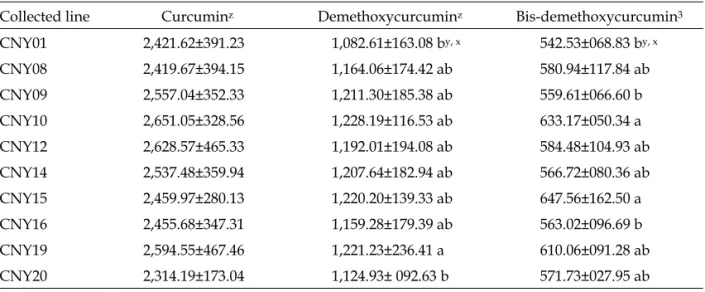
Table 2 所示。在 curcumin
分析中,10 個收集系間之根莖的萃取物之活
性 成 分 含 量 並 無 顯 著 差 異
(F = 0.86, P =
0.5622),其中 curcumin 含量介於 2314.192
651.05 μg g
-1。以相對含量來看,CNY10 之
含量(2,651.05 μg g
-1)最高,其次為 CNY12 與
CNY19 (2,628.57 與 2,594.55 μg g
-1)。
162 Crop, Environment & Bioinformatics, Vol. 11, September 2014
Table 1. The results of the first, second and third yield trials for the collected lines of Curcuma longa L. Collected line First yield trial
Rhizome weight (kg ha-1)z
Second yield trial Rhizome weight
(kg ha-1)
Third yield trial Rhizome weight (kg ha-1) CNY 01 5,760 ab 5756 CNY 02 3,820 ab CNY 03 2,720 b CNY 04 4,130 ab CNY 05 4,510 ab CNY 06 4,930 ab CNY 07 5,270 ab CNY 08 7,130 a 5,230 CNY 09 7,350 a 4,760 CNY 10 5,660 ab 7,720 5,820 CNY 11 5,470 ab CNY 12 5,860 ab 4,830 CNY 13 5,890 ab CNY 14 5,910 ab 5,800 CNY 15 7,500 a 7,180 7,570 CNY 16 6,940 a 5,990 4,700 CNY 17 4,790 ab CNY 18 3,820 ab CNY 19 6,440 ab 5,970 7,540 CNY 20 7,940 a 6,200 5,760
z Mean in the same column followed by different letters are significantly different at 5% level by LSD test.
Table 2. The curcuminoids content in the rhizome of the 10 collected lines of Curcuma longa L. in 2011. Collected line Curcuminz Demethoxycurcuminz Bis-demethoxycurcumin3
CNY01 2,421.62±391.23 1,082.61±163.08 by, x 542.53±068.83 by, x CNY08 2,419.67±394.15 1,164.06±174.42 ab 580.94±117.84 ab CNY09 2,557.04±352.33 1,211.30±185.38 ab 559.61±066.60 b CNY10 2,651.05±328.56 1,228.19±116.53 ab 633.17±050.34 a CNY12 2,628.57±465.33 1,192.01±194.08 ab 584.48±104.93 ab CNY14 2,537.48±359.94 1,207.64±182.94 ab 566.72±080.36 ab CNY15 2,459.97±280.13 1,220.20±139.33 ab 647.56±162.50 a CNY16 2,455.68±347.31 1,159.28±179.39 ab 563.02±096.69 b CNY19 2,594.55±467.46 1,221.23±236.41 a 610.06±091.28 ab CNY20 2,314.19±173.04 1,124.93± 092.63 b 571.73±027.95 ab
z Values are expressed in μg g-1 DW ± SD., y Letter are ynew = x4.31574.
在
10 個收集系 demethoxycurcumin 含
量的分析中,其分析平均數經變數轉換(y
new= x
4.31574),於分析資料符合變方分析之常態
分布要求後,再以
ANOVA 檢定收集系間之
差異。結果顯示,收集系含量間存在顯著差
異,其結果如
Table 2 所示。10 個收集系的
demethoxycurcumin 含 量 介 於 1,221.23-
1,082.61 μg g
-1, 而 在
10 個 收 集 系 中 以
CNY19 之 含 量 1,221.23 μg g
-1最 高 , 且
CNY19 與 CNY01、CNY20 (1,124.93 μg g
-1)
間有顯著差異存在,但與
CNY08、CNY09、
CNY10、CNY12、CNY14、CNY15 及 CNY16
則無顯著差異。
10
個
薑
黃
收
集
系
之
bis-demethoxycurcumin 含 量 介 於 647.17-
542.53 μg g
-1,其含量分析值之平均數經變數
轉換後(y
new= x
4.31574)後進行 ANOVA 檢定,
結果顯示收集系在
bis-demethoxycurcumin
含 量 間 存 在 顯 著 差 異 。
10 個 收 集 系 中 以
CNY15 含量(647.56 μg g
-1)、CNY10 (633.17
μg g
-1)及 CNY19 (610.06 μg g
-1)含量較高,且
CNY15 與 CNY01、CNY09、CNY16 間有顯
著差異,但與
CNY08、CNY12、CNY14、
CNY19 與 CNY20 間並無顯著差異存在。
三、
2011 年薑黃收集系之活性成分與抗
氧化分析
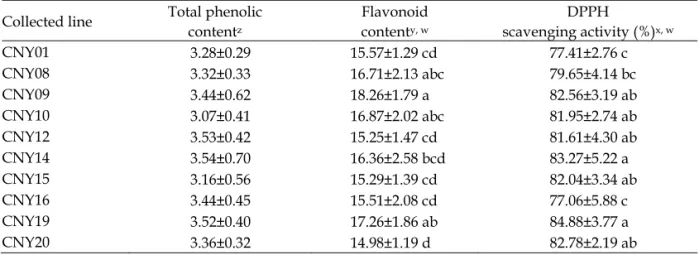
Table 3 為 2011 年經第二次產量試驗 10
個 薑 黃 收 集 系 之 根 莖 總 酚 含 量 、 類 黃 酮 與
DPPH 自由基清除力的測定結果。
1. 總酚含量分析
10 個薑黃收集系的總酚含量分析結果顯
示收集系間含量並無顯著差異。10 個收集系
總 酚 含 量 介 於
3.543.07 mg g
-1, 又 以
CNY14 、 CNY12 與 CNY19 的 總 酚 含 量
(3.54、3.53 與 3.52 mg g
-1)相對較高。
2. 類黃酮含量分析
10 個薑黃收集系類黃酮含量分析結果顯
示 收 集 系 間 存 在 顯 著 差 異
(F = 3.38, P =
0.0013),結果如 Table 3 所示。其 10 個收集
系類黃酮含量介於
18.2614.98 mg g
-1,其中
以
CNY09 之類黃酮含量 18.26 mg g
-1最高,
並與
CNY01、CNY12、CNY14、CNY15、
CNY16 與 CNY20 有 顯 著 差 異 , 但 與
CNY08、CNY10 及 CNY19 間之類黃酮含量
並無顯著差異。
3. DPPH 自由基清除力
10 薑黃收集系在 DPPH 自由基清除力
上有顯著差異存在 (F = 4.16, P < 0.0002),結
Table 3. The total phenolic content, flavonoid content and DPPH scavenging activity among the 10 collected lines of Curcuma longa L. in 2011.
Collected line Total phenolic contentz Flavonoid contenty, w DPPH scavenging activity (%)x, w CNY01 3.28±0.29 15.57±1.29 cd 77.41±2.76 c CNY08 3.32±0.33 16.71±2.13 abc 79.65±4.14 bc CNY09 3.44±0.62 18.26±1.79 a 82.56±3.19 ab CNY10 3.07±0.41 16.87±2.02 abc 81.95±2.74 ab CNY12 3.53±0.42 15.25±1.47 cd 81.61±4.30 ab CNY14 3.54±0.70 16.36±2.58 bcd 83.27±5.22 a CNY15 3.16±0.56 15.29±1.39 cd 82.04±3.34 ab CNY16 3.44±0.45 15.51±2.08 cd 77.06±5.88 c CNY19 3.52±0.40 17.26±1.86 ab 84.88±3.77 a CNY20 3.36±0.32 14.98±1.19 d 82.78±2.19 ab
z Values are expressed in gallic acid mg g-1 DW ± SD. y Values are expressed in quercetin mg g-1 DW ± SD. x Values are expressed in DPPH scavenging activity (%) ± SD.
164 Crop, Environment & Bioinformatics, Vol. 11, September 2014
果如
Table 3 所示,10 個薑黃收集系 DPPH
自 由 基 清 除 力 介 於
77.0684.88%,其中以
CNY19 (84.88%) 與 CNY14 的 清 除 力
(83.27%)的清除力最高,且與 CNY01、CNY09
及
CNY06 的清除力有顯著差異,但是與
CNY09 、 CNY10 、 CNY12 、 CNY15 與
CNY20 的 DPPH 自由基清除力則無顯著
差 異 存 在 。
4. 收集系與標準品(BHA 與 Vit. C)之 DPPH
自由基清除力之比較
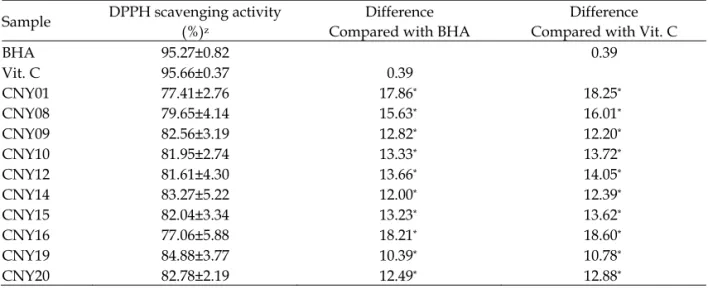
Table 4 為 10 個薑黃收集系與兩種標準
品(BHA 與 Vit. C)在 DPPH 自由基清除力差
異之比較結果。由表中可以得知
BHA 與 Vit.
C 兩者間的 DPPH 自由基清除力並無顯著差
異,清除力為
95%,而兩種標準品與 10 個薑
黃收集系各別相比較下,
2011 年 10 個薑黃收
集 系 與 標 準 品 有 顯 著 差 異
(F = 10.59, P
<0.0001),又以標準品的清除力較佳,但 10
個 收 集 系 清除 力 仍 達
77%以上,當中又以
CNY19 (84.88%)與標準品最為接近。
四、
2012 年第三次產量試驗薑黃收集系
類薑黃素分析
以 2012 年第三次產量試驗 5 個薑黃收
集系根莖為材料探討各收集系在活性成分之
差 異 , 試 驗 結 果 如 表
Table 5 所 示 , 在
curcumin 含量中 5 個收集系之根莖萃取物之
活性成分含量在收集系間存在顯著差異(F =
5.45, P = 0.0011),在 5 個收集系中,以 CNY19
的
curcumin 含量 4,128.72 μg g
-1與
CNY15
的
curcumin 含量 4,162.19 μg g
-1較高,且與
CNY10 、 CNY16 及 CNY20 (3,437.94 、
3,082.72 及 3,553.62 μg g
-1) 有顯著差異,但
是
CNY19 與 CNY15 間並無顯著差異。而在
demethoxycurcumin 含量分析中,5 個收集
系 間 之 含 量 亦 存 在 顯 著 差 異 。 其 中 以
CNY20、CNY19 與 CNY15 含量(1,457.93、
1,371.46 與 1,335.03 μg g
-1)較高,且與 CNY10
及
CNY16 的含量(1,110.28 與 889.88 μg g
-1)
有顯著差異,但三者間並無顯著差異。
CNY10
的
demethoxycurcumin 含量較 CNY16 含量
高 , 且 有 顯 著 差 異 。 至 於 在
bis-demetho-
xycurcumin 含量的分析中,結果同樣顯示 5
個收集系間之含量存在顯著差異(F = 3.26, P
= 0.0197),其中以 CNY15 與 CNY19 的含量
(667.83 及 660.40 μg g
-1)較 CNY10 及 CNY16
含量(522.36 與 478.17 μg g
-1)高,且有顯著差
異,但與
CNY20 的含量(632.21 μg g
-1)無顯
著差異。
Table 4. The DPPH scavenging activity for BHA and Vit. C among the 10 collected lines of Curcuma longa L. in 2011.
Sample DPPH scavenging activity (%)z
Difference Compared with BHA
Difference Compared with Vit. C
BHA 95.27±0.82 0.39 Vit. C 95.66±0.37 0.39 CNY01 77.41±2.76 17.86* 18.25* CNY08 79.65±4.14 15.63* 16.01* CNY09 82.56±3.19 12.82* 12.20* CNY10 81.95±2.74 13.33* 13.72* CNY12 81.61±4.30 13.66* 14.05* CNY14 83.27±5.22 12.00* 12.39* CNY15 82.04±3.34 13.23* 13.62* CNY16 77.06±5.88 18.21* 18.60* CNY19 84.88±3.77 10.39* 10.78* CNY20 82.78±2.19 12.49* 12.88*
z Values are expressed in DPPH scavenging activity (%) ± SD.
五、
2012 年薑黃收集系之活性成分與抗
氧化分析
Table 6 經第三次產量試驗 5 個薑黃收集
系之根莖進行總酚、類黃酮及
DPPH 自由基
清除力的測定結果。
1. 總酚含量分析
5 個薑黃收集系在根莖之總酚含量上存
在顯著性差異(F = 1.18, P = 0.3166),結果如
Table 6 所示,其中以 CNY19 與 CNY15 的
含量 (6.00 與 5.97 mg g
-1)含量較高,並與
CNY10、CNY16 與 CNY20 的含量(5.17、5.25
及
5.44 mg g
-1)有顯著差異存在,但 CNY19
與
CNY15 兩者間的含量並無顯著差異。
2. 類黃酮含量分析
5 個收集系在根莖類黃酮含量上亦分析
存在顯著差異(F = 3.38, P = 0.0013),結果如
Table 6 所示,以 CNY19 與 CNY15 的含量
(25.50 與 24.91 mg g
-1)較高,且與 CNY10 及
CNY20 之含量(22.27 和 21.15 mg g
-1)有顯著差
異存在,但
CNY19 和 CNY15 與 CNY16 (24.39
mg g
-1)間之類黃酮含量並無顯著差異。
3. DPPH 自由基清除力
5 個薑黃收集系在 DPPH 自由基清除力
上 亦 發 現 存 在 顯 著 差 異
(F = 5.06, P =
0.0019),如 Table 6 所示,以 CNY19 與 CNY15
的清除力(92.21 和 92.16%)較高,且與 CNY16
及
CNY10 的清除力(90.36 與 88.83%)有顯著
差異,但與
CNY20 的清除力(91.05%)並無顯
著差異。
4. 收集系與標準品(BHA 與 Vit. C)之 DPPH
自由基清除力分析
Table 7 為 5 個薑黃收集系與兩種標準
品(BHA 及 Vit. C)之 DPPH 自由基清除力分
析比較結果。收集系與兩種標準品間在清除
力上存在顯著差異(F = 8.74, P < 0.0001),其
中
CNY19 與 CNY15 之 DPPH 自由基清除力
與標準品
BHA 並無顯著差異,顯示 2 個收集
系之清除力與標準品
BHA 的自由基清除力
相當。
Table 5. The curcuminoids content in the rhizome of 5 collected lines of Curcuma longa L. in 2012.
Collected linez Curcumin Demethoxycurcumin Bis-demethoxycurcumin
CNY10 3,437.94±625.75 b 1,110.28±161.75 b 522.36±117.68 bc CNY15 4,162.19±720.23 a 1,335.03±201.79 a 667.83±086.34 a CNY16 3,082.72±874.76 b 889.88±252.31 c 478.17±131.57 c CNY19 4,182.74±466.41 a 1,371.46±176.75 a 660.40±098.40 a CNY20 3,553.62±455.16 b 1,457.93±156.57 a 632.21±257.22 ab
z The values of curcuminoids are expressed in μg g-1 DW ± SD.
Mean with the same letter followed in the same column are not significantly different at 5% level.
Table 6. The differences among the collected lines in total phenolic content, flavonoid content and DPPH scavenging activity in 2012.
Collected line Total phenolic contentz, 4 Flavonoid contenty, w DPPH
scavenging activity (%)x, w CNY10 5.17±0.49 b 22.27±2.22 bc 88.83±3.35 c CNY15 5.97±0.50 a 24.91±2.29 a 92.16±0.53 a CNY16 5.25±0.49 b 24.39±3.20 ab 90.36±1.42 bc CNY19 6.00±0.61 a 25.50±1.93 a 92.21±1.46 a CNY20 5.44±0.44 b 21.15±4.09 c 91.05±1.59 ab
z Values are expressed in gallic acid mg g-1 DW ± SD. y Values are expressed in quercetin mg g-1 DW ± SD. x Values are expressed in DPPH scavenging activity (%) ± SD.
166 Crop, Environment & Bioinformatics, Vol. 11, September 2014
討論
經由試驗結果顯示,薑黃雖為無性繁殖
作物,但經過長時間不同地點之環境因素,
造成個體上所產生之變異被保留於薑黃族群
中。如本試驗中抗氧化活性與類薑黃素分析
結果,發現不同收集系間確實有差異產生,
其中在
2011 年第一次、第二次及第三次產量
試驗中,其根莖產量每公頃介於
2,720-7,720
kg,顯示收集系間的根莖產量潛能差異相當
大。而對照
Chiu et al. (1993)以薑黃大黃種所
進行之生長發育調查結果,其薑黃每公頃產
量介於
5,000-7,000 kg,與本試驗的結果相
近。顯示本試驗薑黃產量試驗結果具有相當
的準確性,尤其在
3 年的產量試驗中,CNY15
每公頃之根莖產量均達
7,180 kg 以上,是最
具高產潛能之薑黃收集系。
在
10 個收集系抗氧化試驗中,其類薑黃
素 之
demethoxycurcumin 與 bis-deme-
thoxycurcumin 含量有顯著差異存在,尤其
以
CNY19 與 CNY15 有最佳的含量表現。而
類黃酮的分析中,
CNY19 雖不是含量最多
者,但與含量最高者
CNY09 並無顯著差異。
由此可知,在類黃酮含量上,
CNY19 存在良
好的活性,而在
DPPH 自由基清除力部分,
同樣也以
CNY19 的清除力較佳,而 CNY15
與
CNY19 在清除力上並無顯著差異,顯見此
2 者 似 有 具 有 較 佳 的 抗 氧 化 潛 力 。 而 就
curcumin 與總酚含量來看,在 10 個薑黃收
集系間並未存在顯著的差異;但就類薑黃素
含 量 而 言 ,
10 個 收 集 系 之 curcumin 、
demethoxycurcumin 與 bis-demethoxy-
curcumin 3 項 含 量 合 併 之 總 含 量 介 於
4,010-4510 ug g
-1,與
Kao et al. (2007)之薑黃
素分析結果
0.280.43%相近,故顯示 10 個薑
黃收集系在類薑黃素含量上已達一定水準,
並以
CNY10、CNY15 及 CNY19 等 3 個收集
系之總含量分別為
4,510、4,330、4,430 ug g
-1最高,即最具有生產利用價值。又將
10 個收
集系類薑黃素含量搭配第二次產量試驗之根
莖產量,進一步換算出
10 個收集系之每公頃
類薑黃素總生產量,結果發現以
CNY10 之每
公頃可生產
34,840 g 最高,而 CNY15 可生產
31,056 g 居次,而 CNY19 可生產 26,405 g 又
次之,而以
CNY09 可生產 20,610 g 最低。因
此,根據每公頃之類薑黃素生產量來看,結
果仍以
CNY10、CNY15 及 CNY19 等 3 個收
集系是最具商業生產潛力之收集系。
在
10 個薑黃收集系中,CNY15 與 CNY19
收集系在第二次產量試驗中之各營養保健成分
含量相對較高,此與第三次產量試驗
5 個薑黃
收集系抗氧化與活性分析試驗結論相似。而在
類薑黃素之
curcumin、demethoxycurcumin
與
bis-demethoxycurcumin,總酚、類黃酮
與
DPPH 自由基清除力等項目上,其仍以
CNY19 及 CNY15 的表現最佳,尤其兩個收
集系在
DPPH 自由基清除力與標準品 BHA
相比較下,其
DPPH 自由基清除力上與標準
品
BHA 並無顯著差異。因此,此二收集系在
未來清除
DPPH 自由基清除力的利用上,其
運用潛力十分值得期待。又
Lee and Choung
(2011) 檢測市售 16 種不同固態食品之類薑
黃素為
352.08 μg g
-1,與本試驗結果相比
較,本試驗
10 個薑黃收集系之類薑黃素含量
為
4,010.856,214.6μg g
-1,本試驗材料在類
薑黃素含量上較學者調查之市售
16 種食品高
出許多,顯示各薑黃收集系已具有發展成優
良的保健作物的潛力。
從兩年抗氧化與活性成分的分析中,其
結果發現以第
2 年(2012)試驗之表現較高,究
其原因可能是
2011 年因溫度較高,造成 10
個收集系在
curcumin 與總酚含量無顯著差
異,且含量較
2012 年低之故。Hossain et al.
(2009) 指出相對光強度會影響薑黃生長、產
量 與 薑 黃 素 含 量 之 影 響 , 且 在 相 對 光 強 度
59%以上,薑黃素的含量有顯著的增加,但
若相對光強度
73%以上便無顯著差異。顯示
光線強度會影響薑黃素之合成,太過於減少
相 對 光 強 度 會 與 薑 黃 素 累 積 有 拮 抗 效 果 。
Buescher and Yang (2000) 報告亦指出類薑
黃 素
(curcuminoids 、 curcumin 、
demethoxycurcumin 與 bis-demethoxy-
curcumin) , 其 曝 露 於 光 線 下 容 易 分 解
(Schieffer 2002),在高溫下容易氧化。由此
可知,薑黃根莖中抗氧化能力與活性成分會
隨氣候變化、栽培環境與栽培模式不同而有
差異,而本試驗中薑黃抗氧化與活性成分在
不同年度出現不同差異,其原因可能係環境
因素不同所造成。
本試驗
20 個薑黃收集系之根莖產量、類薑
黃素與抗氧化活性等試驗結果顯示各收集系之
薑黃根莖產量具有很大差異,且萃取物具有強
的抗氧化能力,尤其在
demethoxycurcumin
含量、bis-demethoxycurcumin 含量、類黃
酮含量與
DPPH 自由基清除力上,薑黃收集
系間均存在顯著差異,並以
CNY15 與 CNY19
具有優良抗氧化能力之潛力。而試驗結果也
顯示,高雄市旗山區之薑黃存在相當程度的
遺傳變異,此由
Hsieh et al. (2014)指出 20 個
收集系之
ISSR 分子標誌具有分子層次上之
遺傳變異可以印證之。而由於高雄市旗山區
之薑黃不論在產量、抗氧化能力、活性成分
含量及
DNA 分子層次上均存在變異,故可
利 用 育 種 手 段 進 行 薑 黃 收 集 系 之 純 化 與 選
拔,經此選育出薑黃新品種。本試驗中篩選
得到之
CNY15、CNY19 2 收集系,其根莖產
量、抗氧化能力及活性成分含量等表現均相
當優良,未來有進一步選育成新品種潛力。
期能於未來提供臺灣商業栽培利用,使在地
薑黃的商業生產利用規模可以進一步擴大與
提升,從而降低國內薑黃產業栽培上種原混
亂的現象。
引用文獻
Ammon HPT, MI Anazodo, H Safayhi, BN Dhawan, RC Srimal (1992) Curcumin: a potent inhibitor of leukotriene B4 formation in rat peritoneal polymorph nuclear neutrophils (PMNL). Planta Med. 58:26.
Apisariyakul A, N Vanittanakorn, D Buddhasuk (1995) Antifungal activity of turmeric oil extracted from Curcuma longa L. (Zingiberaceae). J. Ethnopharmacol. 49:163
169.
Bartley JP, AL Jacobs (2000) Effects of drying on flavour compounds in Australian ‐ grown ginger (Zingiber officinale). Sci. Food Agric. 80:209215.
Buescher R, L Yang (2000) Turmeric. p.205-226. In: Natural Food Colorants. GJ Lauro, FJ Francis (Eds.) Science and Technology. Marcel Dekker, NY.
Chiu SM, HY Lu, HI Liu (1993) The growth and development of turmeric (Curcuma aromatica Salisb.) plants. Ⅱ . Effects of N and K fertilization on plant growth and rhizome yield and quality. (in Chinese with English abstract) J. Agric. Res. China 42:370379.
Cohen S, E Raveh, Y Li, A Grava, EE Goldschmidt (2005) Physiological responses of leaves, tree growth and fruit yield of grapefruit trees under relative shade screens. Sci. Hort. 107:2535. Das KC, CK Das (2002) Curcumin
(diferuloylmethane), a singlet oxygen (1O2)
quencher. Biochem. Biophys. Res. Commun. 295:6266.
Ding S, K An, C Zhao, Y Li, Y Guo, Z Wang (2012) Effect of drying methods on volatiles of Chinese ginger (Zingiber officinale Roscoe). Food Bioprod. Process 90:515524.
Fatihanim MN, S Mohamed, NA Idris, R Ismail (2009) Antioxidative properties of curcuma
longa leaf extract in accelerated oxidation and
deep frying studies. J. Amer. Oil Chem. Soc. 86:141147.
Gounder DK, J Lingamallu (2012) Comparison of chemical composition and antioxidant potential of volatile oil from fresh, dried and cured turmeric (Curcuma longa) rhizomes. Ind. Crops Prod. 38:124131.
Hossain MA, H Akamine, Y Ishimine, R Teruya, Y Aniya (2009) Effects of relative light intensity on the growth, yield and curcumin content of turmeric (Curcuma longa L.) in Okinawa, Japan. Plant Prod. Sci. 12:2936.
Hsieh KH, SJ Lin, YP Wu (2014) Genetic diversity of Zingiberaceae Crop. J. Taiwan Agric. Res. 63:235248.
Hu MF, SJ Tsai, IF Chang, SY Liu (2003) Effect of combined chichen compost and chemical fertilizer application on yield and quality of tuemeric (Curcuma longa L.). (in Chinese with English abstract) J. Agric. China. 52:334340. Hubert MJR (1991) Spices and condiments I.
p.427-428. In: Volatile Compounds in Foods and Beverages. H Maarse (Ed.) Marcel Dekker, New York.
168 Crop, Environment & Bioinformatics, Vol. 11, September 2014
Jayaprakasha GK, LJM Rao, KK Sakariah (2005) Chemical and biological activities of C. longa. Trends Food Sci. Tech. 16:533548.
Joscelyne VL, MO Downey, M Mazza, SEP Bastian (2007) Partial shading of cabernet sauvignon and shiraz vines altered wine color and mouthfeel attributes, but increased exposure had little impact. J. Agric. Food Chem. 55:10888-10896.
Kao RL, JZ Yu, C Cheng, YC Lee, CL Chu, TF Hsieh, MF Hu (2007) Effect of fertilizer treatments on rhizome yield and curcumin content of turmeric. (in Chinese with English abstract) J. Taiwan Agric. Res. 56:165175. Lachnicht D, PB Brevard, TL Wagner, CE DeMars
(2002) Dietary oxygen radical absorbance capacity as a predictor of bone mineral density. Nutr. Res. 22:13891399.
Lee HS (2006) Antiplatelet property of Curcuma
longa L. rhizome derived ar-turmerone.
Bioresour. Technol. 97:13721376.
Lee JH, MG Choung (2011) Determination of curcuminoid colouring principles in commercial foods by HPLC. Food Chem. 124:12171222.
Liew SP, FL Hong, JC Peng, YS Li (2008) Effects of different drying methods on Cinnamomum
osmophloeum kaneh leaf and antioxidant activity.
(in Chinese with English abstract) J. Agric. Assoc. Taiwan. 9:361379.
Masuda T, T Maekawa, K Hidaka, H Bando, Y Takeda, H Yamaguchi (2001) Chemical studies on antioxidant mechanism of curcumin: analysis of oxidative coupling products from curcumin and linoleate. J. Agric. Food Chem. 49:25392547.
Middleton E, C Kandaswami, TC Theoharides (2000) The effects of plant flavonoids on mammalian cells: Implications for inflammations, heart disease, and cancer. Pharmacol. Rev. 52:673751.
Miquel J, A Bernd, JM Sempere, RA Diaz-Alperi (2002) The curcuma antioxidants: pharmacological effects and prospects future clinical use: a review. Arch. Gerontol. Geriat. 34:3746.
Naczk M, F Shahidi (2004) Extraction and analysis of phenolic in food. J. Chromatogr. A. 1054:95 111.
Osawa T, Y Sugiyama, M Inayoshi, S Kawakishi (1995) Antioxidative activity of tetrahydrocurcuminoids. Biosci. Biotechnol.
Biochem. 59:16091612.
Piper JT, SS Singhal, SM Salameh, RT Torman, YC Awasthi, S Awasthi (1998) Mechanisms of anticarcinogenic properties of curcumin: the effect of curcumin on glutathione linked detoxification enzymes in rat liver. Intl. J. Biochem. Cell Biol. 30:445456.
Premavalli KS (2005) Ginger as a spice and flavorant. p.509525. In: Ginger The Genus Zingiber. PN Ravindran, KN Babu (Eds.) CRC Press, Boca Raton, FL, USA.
Rice Evans CA, NJ Miller, G Paganga (1996) Structure antioxidant activity relationships of flavonoids and phenolic acids. Free Radical Bio. Med. 20:933956.
Schieffer GW (2002) Pressurized liquid extraction of curcuminoids and curcuminoid degradation products from turmeric (C. Longa) with subsequent HPLC assays. J. Liq. Chromatogr. Relat. Technol. 25:30333044.
Semwal AD, GK Sharma, SS Arya (1997) Antioxygenic activity of turmeric (Curcuma
longa) in sunflower oil and ghee. J. Food Sci.
Tech. 34:6769.
Shimada K, K Fujikawa, K Yahara, T Nakamura (1992) Antioxidative properties of xanthan on the antioxidantion of soybean oil in cyclodextrin emulsion. J. Agric. Food Chem. 40:945948.
Singh G, IPS Kapoor, P Singh, CSD Heluani, MPD Lampasona (2010) Comparative study of chemical composition and antioxidant activity of fresh and dry rhizomes of turmeric (Curcuma
longa Linn.). Food Chem. Toxicol. 48:
10261031.
Srimal RC (1997) Turmeric: A brief review of medical properties. Fitoterapia 68:483493. Taga MS, EE Miller, DE Pratt (1984) China seeds
as a source of natural lipid antioxidants. J. Amer. Oil Chem. Soc. 61:928931.
Tilak JC, M Banerjee, H Mohan, TPA Devasagayam1 (2004) Antioxidant availability of turmeric in relation to its medicinal and culinary uses. Phytother. Res. 18:798804. Wang YC, YC Chuang, HW Hsu (2008) The
flavonoid, carotenoid and pectin content in peels of citrus cultivated in Taiwan. Food Chem. 106:277284.
Zaeoung S, P Anuchit, K Niwat (2005) Cytotoxic and free radical scavenging activities of Zingiberaceous rhizomes. Songklanakarin J. Sci. Technol. 7:799812.