國立交通大學
外國文學與語言學研究所
碩 士 論 文
從漢語「感官
-認知-言談」到
「情態」及「操控」動詞:
以框架理論為本之語意研究
Semantic Extension from Perception-Cognition-Utterance to
Modality and Manipulation Verbs in Mandarin:
a Frame-based Account
研 究 生: 謝璦羽
指導教授: 劉美君 教授
從漢語「感官
-認知-言談」到
「情態」及「操控」動詞:
以框架理論為本之語意研究
Semantic Extension from Perception-Cognition-Utterance to
Modality and Manipulation Verbs in Mandarin:
a Frame-based Account
研
究 生:謝璦羽 Student: Ai-Yu Hsieh
指導教授:劉美君
Advisor: Mei-Chun Liu
國立交通大學
外國文學與語言學研究所
碩士論文
A Thesis
Submitted to Graduate Institute of Foreign Literatures and Linguistics College of Humanity and Social Science
National Chiao Tung University in partial Fulfillment of the Requirements
for the Degree of Master of Arts
June 2008
Hsinchu, Taiwan, Republic of China
中
華 民 國 九十七 年 六 月
從漢語「感官-認知-言談」到「情態」及「操控」動詞: 以框架理論為本之語意研究 學生:謝璦羽 指導教授:劉美君 國立交通大學外國文學與語言學研究所 摘 要 本篇論文旨在探討漢語「感官-認知-言談動詞」向「情態動詞」和「操控動 詞」之語意延伸及其背後之認知語意機制。Givón (1993b)曾針對此議題作跨語言 之探討並提出「事件整合等級」(如下圖所示)以呈現此三類動詞所展現出與其後 補語間的語意聯繫和句法互動關係。
P-C-U verbs modality verbs
manipulation verbs WEAKEST BOND………STRONGEST BOND 然而,在事件整合等級中有四個層面尚待釐清。 第一,為何Givón 視感官動詞、認知動詞和言談動詞為一整體? 第二,感官、認知和言談動詞到情態動詞和操控動詞的語意延伸是否採取相同的 語法手段?認知和語意上的動機又各為何? 第三,就事件整合而言,感官、認知和言談動詞在語意延伸中所展現的認識情態 確定性與操控性是否有語意強弱之區別? 第四,情態動詞和操控動詞的平行以及重疊關係如何呈現?
為了釐清上述問題,此研究以Fillmore and Atkins (1992)提出之「框架語義」 (Frame Semantics)為主要理論基礎,輔以隱喻以及推論作為各框架間之延伸機 制,將動詞語意角色、「構式語法」(Construciton, Goldberg et al. 1995, 2006)與「主 觀化理論」(Theory of Subjectivity, Tragott 1999)對於語意延伸之影響套用於「概 念合成理論」(Conceptual Blending Theory, Fauconnier et al. 1985, 1994, 1997, 2002) 之四維空間模型,將此三類動詞之參與者角色、語法表現、事件結構、共現特徵 及語意信息等納入考量,針對三類動詞間之語意延伸作整合分析。觀察對象以自
然產生的語料庫(中研院平衡語料庫和台大口語語料庫)為本,並引述文獻例證及
本研究主要有四點發現: 第一點,感官-認知-言談動詞在語料庫中呈現之因果關聯以及共現結果為三 者在語法和語意的相似性上提供了適當的詮釋。宏觀地說,人必須藉由對於外在 世界的客觀感受以提供心理認知的刺激,最後藉由語言傳達內在的心理感受、想 法和意向。 第二點,感官-認知-言談動詞並非透過相同之機制向情態和操控動詞延伸。 感官動詞的延伸方式主要是透過隱喻、虛化成帶有嘗試貌之動詞後綴 (VV-看),以及與‘起來’複合以表達說話者根據外在證據對於事物所持之觀點及判斷。 認知動詞則是透過說話者(即認知者)的態度和觀點上與認識情態產生互動,並透 過X CAUSE Y (lai/qiu) DO Z 之構式(即兼語式)之構式語意使得意願動詞產生操 控動詞之致使意圖和作用。另外,言談動詞透過語法化歷程,從言談標記延伸至 附著於心理動詞之後、句首以及句末之認識情態標記,用以加強說話者對於一命 題之觀點或是標示與預期相反之態度。甚者,由於言談動詞在說話者和聽話者的 互動之中本身即具有行事語力,因此溝通事件為許多操控動詞(如建議、威脅)提 供了隱含的前提,換言之,許多操控動詞必須透過溝通事件才能實現其致使行為。 第三點,由感官、認知和言談動詞延伸而來的情態和操控動詞在表達認識情 態之確定性及操控性上的語意強弱呈現不同程度之階段性變化。就認識情態之確 定性和操控性而言,「感官動詞」弱於「認知動詞」弱於「言談動詞」。在話語意 義的層次,由位於上層語意之「看」、「想」、「說」在說話者和聽話者之語境互動 中可以觀察出此趨勢,而在句子意義的層次上,較下層之動詞如「盼望」、「想要」、 「叫」、和「要」亦是如此。 第四點,情態動詞和操控動詞之重疊和互動可由「想」和「要」之複合得到 解釋。「想要」融合了兩類動詞之語意特性和語法表現,產生框架聚合(frame
convergence, Liu& Hsieh 2008)並體現為語意角色之強制結合(role coercion)。
總的來說,本研究試圖探討感官-認知-言談動詞之語意延伸機制和程度上的
異同,以及同組之動詞如何產生系統性的語意延伸。再者,在框架語意的架構下,
不同層次(話語意義和句子意義)中產生的語意延伸必須以不同的方式和在不同
Semantic Extension from Perception-Cognition-Utterance to Modality and Manipulation Verbs in Mandarin:
a Frame-based Account
Student: Ai-Yu Hsieh Advisor: Dr. Mei-Chun Liu Graduate Institute of Foreign Literatures and Linguistics
National Chiao Tung University
Abstract
This paper explores the cognitive-semantic motivations of the semantic extension from P-C-U to modality and manipulation verbs in Mandarin Chinese. The issue was tackled cross-linguistically by Givón (1993b) who proposes the event-integration scale (cf. the figure below) which displays the different correlations between semantic bonds and syntactic patterns resulting from the different semantic properties of the three verb classes.
P-C-U verbs modality verbs
manipulation verbs WEAKEST BOND………STRONGEST BOND
However, given that P-C-U is not differentiated and Modality and Manipulation overlap in the scale, four aspects concerning the topic remain unexplored:
1) Why do perception, cognition and utterance verbs form a group?
2) Do P-C-U verbs extend to the other verb classes by the same mechanisms? 3) Do P-C-U verbs behave the same in their degree of event integration? 4) How are modality and manipulation related and in what way they overlap?
In attempt to answer the four questions, this paper offers possible accounts for the extensions among the three verb classes based on the observation of semantic properties, basic syntactic patterns and lexical, aspectual collocations of the three verb classes at issue by integrating Frame Semantics, Construction Grammar and the theory of Subjectivity into the four-space model of Conceptual Blending.
There are four major findings in this study:
1) The collocational sequences of cause-effect relations can account for the semantic motivations underlying the grammatical symmetry and the interrelations among P-C-U verbs since one perceives the world via his or her perception and conveys their mental content by means of language.
2) The extensions of P-C-U verbs to the other two verb classes are operated by different mechanisms. Verbs of perception extend to the other two by metaphor and undergo grammaticalization resulting in the predicate V-qilai expressing the personal judgment or inference of the perceiver relying on external phenomenon as the evidence or the verbal affix VV-kan /V-kankan which suggest ‘attempting’ aspect. Verbs of cognition interact with epistemic modality within the attitudes and perspectives held by cognizer and extend their meanings from volition to intended manipulation via the causative construction X CAUSE Y (lai/qiu) DO Z. As for utterance verb, such as shuo, it functions as an epistemic marker which attaches to mental verb or occupies the sentence-initial and sentence-final position to intensify the perspective or the counter-expectation toward a proposition. Furthermore, utterance verbs exert the illocutionary force in the communication events and thus offer a prerequisite for various manipulation verbs such as suggest and threaten. 3) The extended meanings from P-C-U to modality and manipulation exhibit different
degree on expressing epistemic certainty and the force of manipulation (perception < cognition < utterance). This is held true for both kan, xiang and shuo at the utterance meaning level in a speaker-hearer interacting scenario and other verbs such as panwang, xiang, xiangyao, jiao, and yao at the level of sentence meaning. 4) The interaction between modality and manipulation verbs can be exhibited by the
combination and blending of xiang-yao by the operation of Conceptual Blending with frame convergence and role coercion.
In sum, this paper attempts to clarify the distinctions among P-C-U verbs in their degree and mechanisms of semantic extension and how other members of the same verb class extended to another systematically. Further, the representations of utterance and sentence meaning are construed and tackled with in different scopes within the infrastructure of Frame Semantics. The study ultimately provides a unified framework in analyzing and representing semantic extensions.
致謝 念研究所對我而言像是打了一場仗。在這場戰爭中,我深入前線、分身乏術、 痛失戰友,自己也傷痕累累、瀕臨驗退邊緣,所幸還有眾多不離不棄的長官、一 群生死與共的同袍、以及永遠在戰場外守候我平安歸來、隨時隨地接納我的親人 和朋友們。感謝長官們給予我的磨練,帶領我逐漸學習如何退敵防守,一次又一 次地在我身陷槍林彈雨時將我拖回安全的堡壘;感謝戰友們掩護我、替我上膛, 甚至是擋子彈;感謝親友們當我的避風港,在我傷重時替我療傷、壓力大時陪我 暴走、流淚時為我遞上面紙…沒有你們,甭提光榮退役,也許我早已戰死沙場。 誠摯地感謝孕育了我七年的交大外文系。感謝潘荷仙老師讓我進入語音實驗 室工讀,讓我學習處事態度和培養責任感;感謝劉辰生老師不厭其煩的指導,讓 我明白自己學習上的問題和努力的不足;感謝林若望老師幽默的教學,雖然邏輯 語意好比無字天書一樣深奧,但我已盡力重組大腦;感謝許慧娟老師提供我研究 客語語誤的機會,讓我重新思考並檢視被自己遺忘許久的母語;感謝兩位口試委 員:清華大學的連金發老師以及新竹教育大學的鄭縈老師給予此篇論文寶貴的意 見和協助。連老師做學問的態度和兼容並蓄的胸懷是我的楷模,鄭縈老師處理問 題的果決與細心、鼓勵學生以及為學生著想的心意值得我仿效;感謝我的指導教 授劉美君老師,我不是一個很聰明的學生,感謝您相信我的能力願意託付我重要 的研究工作、感謝您總是在我迷途時教導我解決問題的方式和邏輯,感謝您總是 關心我的生活,感謝您為了研究和我一起挑燈夜戰…;感謝每一位曾經教導我的 師長,沒有你們,就沒有今日的我;感謝語言組的學長學姐(Peter, 嘉軒, 悅 菽…)、同學(小佑、靜玉、孟純、小八、曉台…)和學弟妹(喵、詩楣、Lululu、謦 瑜、縉雯、佳霖…)、杜鵑窩三人小組的老大佳音和正妹版主子玲、率真的室友 兼「台灣的席琳狄翁」惠瑜、貼心的怡吟、Emily、旅櫻、和可愛的家教學生 Annie; 感謝永遠支持我的男友孟勳和老弟佑駿;感謝苗栗家扶中心、生態社…。對於那 些我沒有提及的,你們若不在紙上,仍在我的心上。 最後,這篇論文謹獻給我在天上的媽媽胡玉珍、外公胡雲標和外婆胡陳桂香。
Table of Contents
Chinese Abstract……… i-ii English Abstract………. iii-iv Acknowledgement………. v Table of Contents……….. vi-vii List of Tables……… viii List of Figures.……….. ix-x Chapter 1 Introduction………... 1-24
1.1 The Background………... 1-2 1.2 The Issue: Interrelationships among P-C-U, Modality and
Manipulation Verbs... ... ... ... 2-20 1.2.1 Three Major Classes of Complement-taking Verb: P-C-U,
Modality and Manipulation Verbs………..……... 2-7 1.2.2 The Event-integration Scale of Givón ………... 7-20 1.3 Theoretical Foundations………..………..………. 20-21 1.4 Scope and Goal………... 21-23 1.5 Organization of the Thesis…………...………... 23-24 Chapter 2 Literature Review………... 25-48
2.1 Theoretical Persuasions concerning the Semantic Extension among
Different Senses of the Polysemy.……... 25-31 2.1.1 Frame Semantics……… 25-27 2.1.2 Construction Grammar……….………..… 27-28 2.1.3 Subjectivity…………..……….………..… 28-29 2.1.4 Conceptual Blending..……….………..….. 29-31 2.2 Classification of P-C-U, Manipulation and Modality Verbs in
English………. 31-41
2.2.1 Classification of P-C-U Verbs in English…...……… 31-36 2.2.2 Classification of Manipulation Verbs in English…...…………. 36-37 2.2.3 Classification of Modality Verbs in English and Chinese..…… 37-41 2.3 Previous Studies with respect to Semantic Extension from P-C-U
Verbs to Manipulation and Modality verbs……….. 42-47 2.3.1 Extension from P-C-U to Modality………. 42-45 2.3.2 Extension from P-C-U to Manipulation……... 46 2.3.3 Extension from Modality to Manipulation………….…………. 46-47 2.4 Summary……….………. 48
Chapter 3 The Database and the Methodology………. 49-52 3.1 The Database…………... 49-50 3.2 Method of Analysis…... 50-52 Chapter 4 Findings and Analysis………... 53-99 4.1 Prototypical P-C-U Verbs: Kan, Xiang and Shuo……….…... 54-74
4.1.1 The Polysemous Kan……….. 54-64 4.1.2 The Polysemous Xiang………..………. 65-69 4.1.3 The Polysemous Shuo………..……….….. 70-74 4.2 Utterance Meanings Yielded by Kan, Xiang and Shuo……… 74-82 4.3 Interaction between Modality and Manipulation: the combination of
xiang and yao………..……. 82-88 4.4 Semantic Extension from Other P-C-U Verbs to Modality Verbs in
Mandarin... 88-93 4.5 Semantic Extension from Other P-C-U Verbs to Manipulation Verbs
in Mandarin... 93-98 4.6 Concluding Remarks.…... 98-99 Chapter 5Conclusion……...…... 100-104 5.1 Summary..………..………..… 100-103 5.2 Questions for Future Research... 104 References………. 105-110 Website Resources………….……… 111
Appendix I: The Frame-to-frame Relations in FrameNet…...………... 112 Appendix II: English and Chinese equivalent Lemmas Belonging to P-C-U
List of Tables
Table 1: Semantic and Syntactic Definitions of P-C-U, Modality and Manipulation Verbs
3 Table 2: Semantic Scale and Syntax of Complement Clause in English 5 Table 3: Corresponding Classification of P-C-U Verbs of Noonan, Givón,
Levin and FrameNet
33 Table 4: Corresponding Classification of Manipulation Verbs of Noonan,
Givón, Levin and FrameNet
36 Table 5: Comparisons among Classification of Modality Verbs of Noonan,
Givón, Levin, FrameNet and Bybee et al. in English
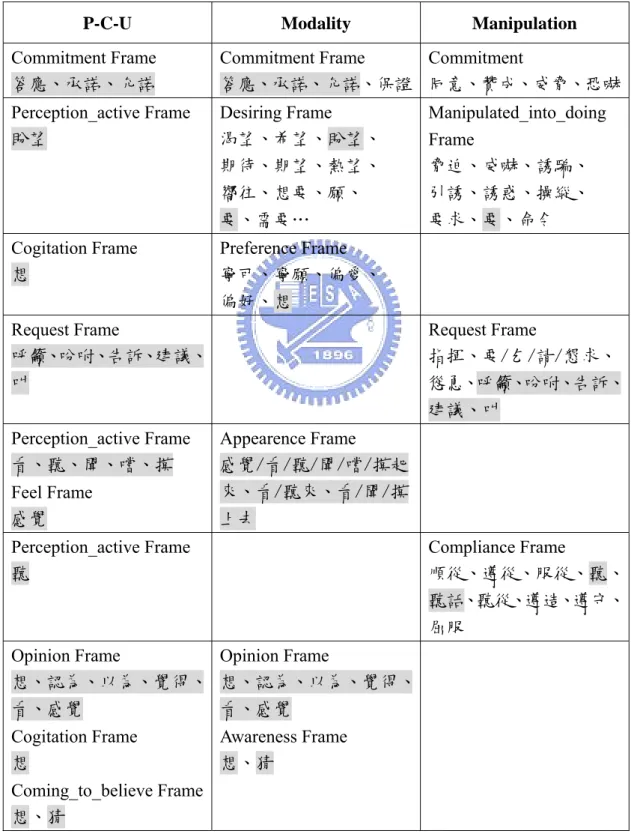
39 Table 6: Classification of Mandarin Modals 40 Table 7: Overlapping Frames among P-C-U, Modality and Manipulation
Verbs
41
Table 8: Perception Related Verbs 51
Table 9: Semantic Frames of Polysemous Kan 55 Table 10: Semantic Frames Extended from Kan 58
Table 11: Semantic Frames of Polysemous Xiang 65 Table 12: Semantic Frames of Polysemous Shuo 71 Table 13: Verbs Extending from P-C-U to Modality 89
Table 14: Verbs Extending from P-C-U to Manipulation 93 Table 15: Senses and Semantic Frames of Polysemous Ting 94 Table 16: Senses and Semantic Frames of Polysemous Jiao 96 Table 17: P-C-U Verbs Attached with Modality Affix 104
List of Figures
Figure 1: Overview of the Event-integration Scale 7 Figure 2: the Overlap part and Frames among Perception, Modality and
Manipulation
22 Figure 3: the Overlap Part and Frames among Cognition, Modality and
Manipulation
22 Figure 4: the Overlap Part and Frames among Utterance, Modality and
Manipulation
23 Figure 5: the Overlap Part and Frames between Modality and Manipulation 23
Figure 6: Conceptual Blending 30
Figure 7: Conceptual Schema of Perception-related Frame 34 Figure 8: Conceptual Schema of Cognition-realted Frame 35 Figure 9: Conceptual Schema of Cognition-related Frame 36
Figure 10: Model of Grammaticalization Paths of Shou 44
Figure 11: Extended Path of Kan 54
Figure 12: Inheritance and Gradation of Semantic Roles in Kan ‘to look, look after and guard’
56
Figure 13: Metaphorical Extension from Kan1 ‘to look’ to Kan9 ‘to suppose’
and Kan10 ‘to guess’
57
Figure 14: Conceptual Blending of Kan and Qilai 59 Figure 15: Grammaticalization Path of Kan 63 Figure 16: Semantic Frames of Polysemous Xiang under Emotion, Cognition
and Modality Domain
66 Figure 17: Relations and Inheritance of Frame Elements among Cogitation and
Preference and Manipulate_into doing Frame
69 Figure 18: Semantic Frames of Polysemous Shuo under Communication
Frame
70 Figure 19: Conceptual Correlation among P-C-U Verbs 82 Figure 20: An Attested Semantic Path of Xiang and Yao 83 Figure 21: Semantic Blending of Xiang-yao 85 Figure 22: Frame Convergence 1 with Role Coercion 85 Figure 23: Frame Convergence 2 with Role Coercion 86
Figure 24: Semantic Polarity of Xiang, Yao and Xiangyao 88 Figure 25: Metaphorical Extension from Panwang ‘to look forward to’ to
Panwang ‘to hope’
91 Figure 26: Relations and evolvement of frame elements and syntactic patterns
among Communication_noise Frame, Request Frame and Manipulation_into_doing Frame
97
Figure 27: Mechanisms of the Extensions from Perception to Modality and Manipulation
101 Figure 28: Mechanisms of the Extensions from Cognition to Modality and
Manipulation
101 Figure 29: Mechanisms of the Extensions from Utterance to Modality and
Manipulation
Chapter 1
Introduction
1.1. The BackgroundLexical polysemy, the ambiguity of an individual word that can be used in different contexts to express two or more different meanings, has long been an interesting area to researchers of various theoretical persuasions, such as Lexical Semantics, Frame Semantics, Construction Grammar, Cognitive linguistics and Pragmatics. Despite the controversy towards polysemy, the consensus on its heterogeneous phenomenon is reached. According to Pustejovsky and Boguraev (1996), there are at least three crucial factors which cause lexical ambiguity, namely, contrastive ambiguity, complementary ambiguity (logical polysemy) and sense extensions. Contrastive ambiguity contributes to the appearance of homonymy(such as bank in ‘river bank’ and ‘financial bank’) and vagueness, for instance, news in ‘I read the news’(news as press communiqué) and ‘I heard the news’(news as the information) , while logical polysemy is endowed with the meaning which is predictable from logics (e.g. ‘Mary began a book’ can be interpreted as ‘Mary began writing a book’ or ‘Mary began reading a book’). The focus of this study, however, is to investigate meaning extensions of polysemy as well as the cognitive operation and pragmatic properties behind them.
Previous studies concerning polysemy mainly emphasize the disambiguation among different senses (Huang, Ahrens and Chuang 2003, Hsu 2006, and many others). Other works pertaining to the semantic extension of polysemy examine either the process of grammaticalization of individual words chronologically (cf. Traugott 1982, Shen 1994, Chang 2000, Liu 2000, Lien 2001, Lai 2003, Wu 2003) or the subtle distinctions between near-synonym sets by mapping conceptual and syntactic structures within the scope of one language or dialect (see Tsai et al. 1999, Huang et
al. 2000, Liu 2002 and many others). Following the theoretical foundations laid by previous studies mentioned above, this current study attempts to utilize a unified framework capable of accounting for systematic semantic extensions from a group of verbs to another, i.e. the semantic extensions from Perception-Cognition-Utterance to modality and manipulation verbs, in Mandarin. The extensions were first examined systematically by Givón (1980, 1990a, b, 1993a, b), which will be illustrated in 1.2 later. By observing a group of conceptually and syntactically relevant verbs, we may explore their systematic semantic extensions to other verb classes. This is supposedly induced by verbal semantics, cognitive operation and the pragmatic properties of polysemous verbs. The extensions among senses of polysemy may offer a sound explanation of the fact that lexical polysemy is a universal and cross-linguistic phenomenon resulting from economic principle of language learnability.
1.2. The Issue: Interrelationships among P-C-U, Modality and Manipulation Verbs
The definitions of the three target verb classes shall be firstly clarified in Section 1.2.1 before discussing the interrelationships among P-C-U, Modality and Manipulation verbs shown in Section 1.2.2.
1.2.1 Three Major Classes of Complement-taking Verb: P-C-U, Modality and Manipulation Verbs
To demonstrate the correlations between a verb and its complement, Givón roughly classifies three classes of complement-taking verb1. The three classes of
1 According to Givón (1984a and 1993a), verbs with verbal complements also include ‘verbs with
clausal subjects (such as shock and astonish which take a dummy pronoun it as its subject)’ and ‘information verbs (such as inform and announce which can take both a dative direct object and a verbal complement of the type taken by P-C-U verbs)’.
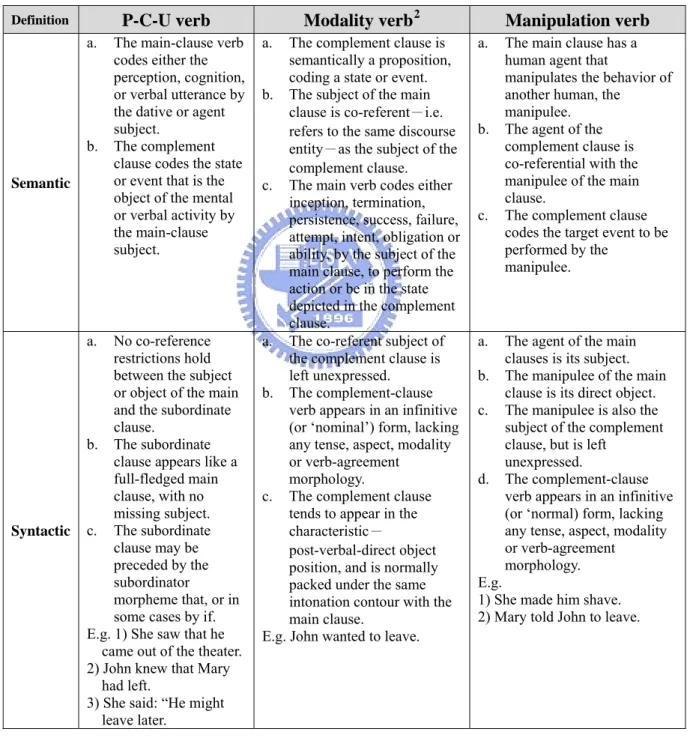
complement-taking verbs, P-C-U verbs (Perception, Cognition and Utterance Verb), modality verbs and manipulation verbs are defined semantically and syntactically by Givón (1993b), as listed in Table 1 below.
Table 1: Semantic and Syntactic Definitions of P-C-U, Modality and Manipulation Verbs (generalized from Givón 1993b)
Definition P-C-U verb Modality verb2 Manipulation verb
Semantic
a. The main-clause verb codes either the perception, cognition, or verbal utterance by the dative or agent subject.
b. The complement clause codes the state or event that is the object of the mental or verbal activity by the main-clause subject.
a. The complement clause is semantically a proposition, coding a state or event. b. The subject of the main
clause is co-referent-i.e. refers to the same discourse entity-as the subject of the complement clause. c. The main verb codes either
inception, termination, persistence, success, failure, attempt, intent, obligation or ability, by the subject of the main clause, to perform the action or be in the state depicted in the complement clause.
a. The main clause has a human agent that
manipulates the behavior of another human, the
manipulee. b. The agent of the
complement clause is co-referential with the manipulee of the main clause.
c. The complement clause codes the target event to be performed by the
manipulee.
Syntactic
a. No co-reference restrictions hold between the subject or object of the main and the subordinate clause.
b. The subordinate clause appears like a full-fledged main clause, with no missing subject. c. The subordinate clause may be preceded by the subordinator morpheme that, or in some cases by if. E.g. 1) She saw that he
came out of the theater. 2) John knew that Mary
had left.
3) She said: “He might leave later.
a. The co-referent subject of the complement clause is left unexpressed. b. The complement-clause
verb appears in an infinitive (or ‘nominal’) form, lacking any tense, aspect, modality or verb-agreement
morphology.
c. The complement clause tends to appear in the characteristic-
post-verbal-direct object position, and is normally packed under the same intonation contour with the main clause.
E.g. John wanted to leave.
a. The agent of the main clauses is its subject. b. The manipulee of the main
clause is its direct object. c. The manipulee is also the subject of the complement clause, but is left
unexpressed.
d. The complement-clause verb appears in an infinitive (or ‘normal) form, lacking any tense, aspect, modality or verb-agreement
morphology. E.g.
1) She made him shave. 2) Mary told John to leave.
2 Givón (1993b)’s definition of Modality verb include the commonly known ‘desiderative’ verbs. In
addition, examples of ‘epistemic’ and ‘deontic’ modality can be found in his book as well; for instance, ‘Mary wished that he would leave’ codes epistemic uncertainty (Givón 1993b:19).
The three classes seem isolated from one another at the first glance. However, some verbs can be labeled as two or more verb classes which denote different syntactic patterns and meanings. Such multiple memberships, observed by Givón (1993a), are often systematic. Take tell for example, it may act like an utterance verb as in ‘She told me a story’ or a manipulation verb (more specifically non-implicative verb) as in ‘She told him to stop’.
In order to explore how the three verb classes overlap, we need to probe into the semantic bond between the verb and its complement and the manner it is coded in syntactic structure.
The pairing of form and meaning in grammar has always been the conviction of Functional Linguistics. In order to specify the isomorphism between the semantic and syntactic dimensions of complementation, Givón (1993b:2) makes a prediction:
“The stronger the semantic bond is between the two events, the more extensive will be the syntactic integration of the two propositions into a single clause”.
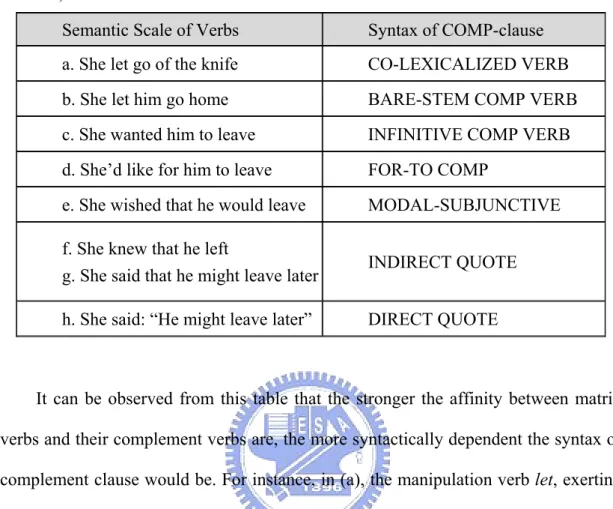
On the one hand, the semantic bond, based on Givón’s analysis, subjects to the semantic properties of a verb and its connection with the complement, such as implicativity, co-temporality, referential cohesion and the subject’s control over the object. On the other hand, the syntactic integration has to do with the types of syntax of complementation clause ranging from quotation (direct/indirect), modal-subjunctive, for-to COMP, infinitive COMP verb, bare-stem COMP verb, to co-lexicalized verb. The prediction is manifested in the degree of integration of complement clauses with their main predicate as illustrated in the English complementation shown in Table 2 in the next page.
Table 2: Semantic Scale and Syntax of Complement Clause in English (Givón 1993b:6)
Semantic Scale of Verbs Syntax of COMP-clause a. She let go of the knife CO-LEXICALIZED VERB b. She let him go home BARE-STEM COMP VERB c. She wanted him to leave INFINITIVE COMP VERB d. She’d like for him to leave FOR-TO COMP
e. She wished that he would leave MODAL-SUBJUNCTIVE f. She knew that he left
g. She said that he might leave later INDIRECT QUOTE h. She said: “He might leave later” DIRECT QUOTE
It can be observed from this table that the stronger the affinity between matrix verbs and their complement verbs are, the more syntactically dependent the syntax of complement clause would be. For instance, in (a), the manipulation verb let, exerting strongest binding force over its complement verb go, incurs the predicate-raising and thus forms a co-lexicalized verb let-go; whereas in (b), the subject she exerts a less strong binding force on the animate object him since the manipulator has to compete with the resistance of the manipulee. The two verbs let and go are accordingly syntactically separated rather than co-lexicalized. Comparatively, in (c), the complement of want is coded as infinitive clause and shows more syntactic independence from the verb with weaker binding force owing to the fact that the manipulation of the manipulator was performed but not necessarily successful. Hence, Givón further divided manipulation verbs into two types by: implicative verbs (e.g. make, have, cause, etc) and non-implicative verbs (e.g. tell, allow, want, etc) which can be translate into successful (a-b) and unsuccessful manipulation (c-e) respectively. Jumping to (f-h), the prototypical Perception-Cognition-Utterance verbs (P-C-U)
verbs like see, know and say display the weakest binding relations with their complement clauses because, instead of exerting the subject’s influence on the object, their complements codes the state or event that is the object of the mental or verbal activity. Their complement structures are coded as finite clauses and thus the most syntactically independent ones. As a result, in (h), the tense of the verbs in the main and complement clause is not necessarily co-temporal (for instance, she said: “He will leave later.”) This indicates the remotest distance between the matrix verb and its complement.
However, for sentence (d) and (e), the semantic categories of their matrix verbs would like and wish could be vague. Above we have seen the example of successful intented causation (a-b), attempted manipulation (c), and the prototypical use of P-C-U verbs (f-h). Sentence (d) and (e), in fact, codes the transition between preference (even weaker manipulation) and epistemic modality (which creates an interface to P-C-U verbs). To embody the even weaker manipulation, the FOR-TO complement is used in (d) whereas in (e) the manipulative force is getting even weaker since the possibility of the intended event is marked by the modal-subjunctive mood. In addition to sentence (d) and (e), Givón takes two other examples to illustrate the transition between modality and P-C-U verbs:
(1) She wished that he had arrived on time. (2) She hoped that he did arrive on time.
Sentence (1) and sentence (2) codes counter-factual epistemic anxiety, which is termed ‘evaluative modality of preferenc’ by Givón3, and epistemic modality uncertainty respectively. Semantically, the implications of sentence (1) and sentence
(2) are ‘she wished that he had arrived on time, but she knew he hadn’t.’ and ‘She hoped that he did arrive on time, and she guessed he probably did.’
In sum, the more independent of the main verb the complementation is, the less integral the events will be; the semantic bond between the verb and the complementation is thus looser. Furthermore, the boundaries between manipulation verbs and modality verbs, modality verbs and P-C-U verbs are difficult to be clearly cut since the extensions are shown in the graded transition semantically and syntactically. Hence, this makes their overlaps interesting and worthy to be explored. The transitions of the three target verb classes is posited by Givón (1990b, 1993b) with an overview of the event-integration scale, shown as Figure 1 in the following section.
1.2.2 The Event-integration Scale of Givón (1993b)
By proposing the above tuning-fork shaped event-integration scale (cf. Figure 1), Givón attempts to show the different correlations between semantic bonds and syntactic patterns resulting from the different semantic properties of the three verb classes. The syntactic-semantic mappings confirm the predication mentioned earlier.
Figure 1: Overview of the Event-integration Scale (Givón 1993b)
The scale is a continuum, suggested by Givón, whereby modality verbs and manipulation verbs run in parallel from the top toward the middle, exhibiting roughly
P-C-U verbs modality verbs
manipulation verbs WEAKEST BOND………STRONGEST BOND
the same semantic and syntactic properties. At the point around the middle, those two classes cease and P-C-U verbs take over, occupying the bottom of the scale.
Examples of multiple memberships among P-C-U, manipulation and modality verbs are illustrated by the different usages of suggest (Givón 1993b):
(3) P-C-U + strong manipulation: subjunctive complement I suggest you leave right away.
(4) P-C-U + weak manipulation: subjunctive complement She suggested that John leave right away.
(5) P-C-U + deontic modality: modal complement She suggested that John should leave right away.
(6) P-C-U + epistemic modality: modal complement She suggested that John may have left right away.
(7) P-C-U: indicative complement
She suggested that John had left earlier.
The different complement types of Suggest denote the semantic extension from manipulative speech act to weaker manipulation (stronger preference), then modality and indicative. The prototypical P-C-U verbs kan, xiang and shuo display similar gradation.
(8) P-C-U + Weak manipulation: imperative complement
a. 我看你還是找別人吧! (Sinica) wo kan ni haishi zhao bieren ba
I see you had better look for others SFP4 ‘I suggest you had better look for others!’
4 Abbreviations used in this paper are listed below. CL.: classifier, DE: modifier marker, SFP:
b. 我想你馬上到我身邊來,可你做不到, (Google) wo xiang ni mashang dao wo shen bian lai ,ke ni zuobudao
I think you right away reach I body side come , but you do-NEG-achieve
‘I want you come to my side right away, but you can’t make it.’ c. 我說你阿~老了就別跑那麼快咩~ (Google)
wo shuo ni a~lao le jiu bie pao name kuai mie I say you SFP~old PERF JIU NEG run so fast SFP
‘I suggest that since you are so old, don’t run so fast.’ (9) P-C-U + Weak manipulation: subjunctive complement
a. 我看借給他們點兒吧,大八月節的。 (Liu 1986)
wo kan jie gei tamen dianer ba, dabayuejie de
I see lend give they a little SFP, moon festival DE ‘I suggest that (we) lend them some (money) since it’s moon festival.’ b. 甲:我決定報考北大了。
乙:你的成績不大突出,我想還是報低一點的學校吧。(Liu 1986) jia:wo jueding baokao beida le
yi:ni de chengji bu da tuchu ,wo xiang haishi bao di yidiande xuexiao ba
A: I decide register for an exam PKU PERF
B: your grades Neg too outstanding,I think had better register lower a little DE school SFP
‘A: I decided to register for the entrance exam of PKU.’
‘B: Your grades are not good enough. I suggest that you had better register for an entrance exam of a lower level school.’
c. 我說咱們明天就走,好嗎? (Liu 1986) wo shuo zanmen mingtian jiu zou, hao ma? I say we tomorrow JIU leave, good SPF ‘I suggest that we leave tomorrow. Is that okay?’
(10) P-C-U + Deontic modality: modal complement
a. 我想/看/說你也該回旅館了。 (Liu 1986) wo xiang/kan/shuo ni ye gai hui luguan le I think/see/say you also should return hotel PERF ‘I consider that you should return to the hotel as well.’
b. 我想/看/說一個人要有點良心。 (Liu 1986) wo xiang/kan/shuo yigeren yao you dian liangxin I think/see/say one should have a little conscience ‘I consider that one should be consionable.’
(11) P-C-U + Epistemic modality: modal complement
a. 我想/看/說,這一定是謠言。 (Liu 1986) wo xiang/kan/shuo, zhe yiding shi yaoyan
I think/see/say, this must COP rumor ‘I consider that this must be a rumor.’
(12) P-C-U: indirect quote
a. 我在想你說的有道理。 (Google) wo zai xiang ni shuo de youdaoli
I PROG think you say DE reasonable ‘I am thinking that what you said was reasonable.’
b. 昨天我看到你騎著腳踏車, (Sinica) zuotian wo kan-dao ni qi-zhe jiaotache yesterday I see-achieve you ride-PROG bicycle ‘Yesterday I saw you riding a bike.’
c. 他對我說他和他女朋友分手了, (Sinica) ta dui wo shuo ta he ta nupengyou fenshou le he DUI I say he and he girlfriend break up PERF ‘He told me that he broke up with his girlfriend.’
The meanings of kan, xiang and shuo in examples (8-11) are departed from their prototypical uses (12 a-c). In (8), the tree verbs take imperative complements and thus induce the weaker manipulative speech act in the speaker-hearer interaction.
In (9), the tree verbs take subjunctive complements and impose the weaker manipulation, more specifically suggestion (9 a-b) and invitation (9 c). In (10) and (11), the three verbs take a deontic and epistemic modal complement respectively and suggest the speaker’s preference. Finally, in (12), the tense in the complements of the three verbs are incoherent with the matrix verbs and therefore indicating their least control over the event.
However, not every verb in P-C-U class can display the graded meaning transition to both modality and manipulation. Some verbs (14-16) overlap the uses of modality while other verbs (17-19) cover the function of manipulation and still the other verbs transit from modality to manipulation (13). English examples are given below.
(13) Modality <--> Manipulation:
a. Modality: I want to leave. (Google) b. Manipulation I want him to leave. (Google)
(14) Perception <--> Modality:
Perception: a. I feel cold! (Google) b. I feel the house shake a lot. (Google) c. I saw Floyd leave. (Noonan 1985)
modality:
(epistemic) d. I feel that you were wrong in this statement. (Google) (epistemic) e. You are wrong, I feel.
(deontic) f. I feel like to take a break. (Google) (epistemic) g. I saw that Flyd left. (Noonan 1985)
(15) Cognition <--> Modality:
Cognition: a. I was thinking about getting two sets of overalls. (BNC) b. I've been…thinking about what we should do in future. (BNC) Modality: a. I think she’s there. (Givón 1993b) b. She’s there, I think.
(16) Utterance <--> Modality:
Utterance: a. He promised, “I will go with you.” (Google) b. I promise you it won't happen again. (BNC) Modality: c. I promise to be there for you. (Google)
(17) Perception <--> Manipulation: (BNC) a. Perception: They listen to the music.
b. Manipulation: He didn't listen to any of the people.
(18) Cognition <--> Manipulation: (Givón 1993b) a. Cognition: I expect that you should be done by noon, if everything goes on schedule.
b. Manipulatoin I expect you to be done by noon, so get on with it!
(19) Utterance <--> Manipulation: (Givón 1993b) Utterance: a. She told him a story.
b. She told him that his timing was a bit off. Manipulation: c. She told him to bug off.
Some Chinese examples are found complying with the transitions mentioned above. (20) Modality <--> Manipulation: Modality: (deontic) a. 我想要幫助他。 (Sinica) wo xiangyao bangzhu ta I want help he ‘I want to help him.’
b. 我想要他可以一直開朗的生活著。 (Google) wo xiangyao ta keyi yizhi kailang de shenghuo zhe
I want he can always happily live ASP
‘I want him to be able to live happily all the time.’ Manipulation: c. 我想要你帶它回家。 (Google)
wo xiangyao ni dai ta hui jia I want you take it return home ‘I want you to take it home.’
(21) Perception <--> Modality:
Perception: a. 我覺得冷, (Sinica) wo juede leng
I feel cold ‘I feel cold.’
b. 昨天我看到你騎著腳踏車。 (Sinica) zuotian wo kan-dao ni qi-zhe jiaotache
yesterday I see-achieve you ride-ASP bicycle ‘Yesterday I saw you riding a bike.’
c. 雖然他坐著,但我看得出他很高, (Google) suiran ta zuo zhe ,dan wo kan-de-chu ta hen gao
although he sit ASP,but I see-DE-out he very tall ‘Although he sits, I can recognize that he is very tall.’ Modality: d. 我覺得這,…這是一個很不錯的領導方式.
(Liu & Chiang 2006) [wo juede] zhe,..zhe shi yige hen bucuo de lingdao fangshi
I feel this this is one-CL3 very not-bad DE guide way
‘I feel (that) this is a good style of leadership.’
e. 這個東西我覺得很好耶,_ (Liu & Chiang 2006) zhege dongxi [wo juede] hen hao ye.
this-CL thing I feel very good SFP ‘This thing, I feel, is quite good.’
f. 他整個房子啊,_還有規劃都非常的…,比日本,_...還要
漂亮ㄟ,…我覺得 (Liu & Chiang 2006)
ta zheng-ge fangzi a, _ haiyou guihua dou feichang de,..bi Riben_,..haiyao biaoliange...[wo juede] it whole house SPE and design both very DE more Japan more beautiful PART I feel
‘That house, and also the design, are both very.., even more beautiful than (the ones in) Japan, I felt.’ g. 我看問題不大。 (Sinica)
wo kan wenti bu da I see problem NEG big ‘I don’t think it’s a big problem.’
h. 牠的卵看起來是橙紅色球形, (Sinica) tade luan kanqilai shi chenghong se qiu xing
its egg see-QILAI COP orange-red color ball shape ‘The color of its egg looks orange and red and the shape
of it looks like a ball. ’
i. 這樣的想法看起來是對的。 (Google) zheyangde xiangfa kan-qilai shi dui de
such thoughts see-QILAI COP correct DE ‘Such thoughts seem to be correct. ’ (22) Cognition <--> Modality:
Cognition: a. 他一直在想這件事。 (Google) ta yi zhi zai xiang zhe jian shi
he always ASP think this CL matter
‘He has been always thinking about this matter.’
b. 我想著該如何處置這些垃圾, (Google)
wo xiang zhe gai ruhe chuzhi zhexie lese I think ASP should how deal with these trash ‘I am thinking how to deal with the trash.’ Modality:
(epistemic) a. 我想你也該回旅館了。 (Liu 1986) wo xiang ni ye gai hui luguan le
I think you also should return hotel ASP
‘I consider that you should return to the hotel as well.’ (epistemic) b. 講不出來的話,用寫的可能效果更好,我想。 (Sinica)
jiang-bu-chulai dehua ,yong xie de keneng xiaoguo geng hao ,wo xiang
speak-NEG-out if, use write DE might effect more good,I think
‘If you can’t put it into words, it might be better to write it down, I think.’
(deontic) c. 我想吃泡麵。 (Google) wo xiang chi paomian
I want eat instant noodles ‘I want to eat instant noodles.’ (23) Utterance <--> Modality:
Utterance: a. 他對母親說:媽,我還得睡一會兒, (Sinica) ta dui muqin shuo:ma,wo hai de shui yihuie he facing mother say: mom,I still have to sleep a while ‘He told his mother: mom, I still need to sleep for a
while. ’
b. …我…,就答應了他一聲:“好,我聽你的!(Google) …wo…,jiu daying le ta yisheng :“hao,wo ting ni de !”
…I…JIU answer he one-CL: “good,I listen yours.’ ‘…I…then anwer him: okay, I listen to your words.’ Modality: (deontic)
c. 我答應會準時到達。 (Google)
wo daying hui zhunshi daoda I promise will on time arrive ‘I promise that I will arrive on time.’
d. 他答應爸爸三年就回來, (Sinica) ta daying baba san nian jiu huilai he promise father three year JIU come back ‘He promised his father that he will come back in three
years.’
(24) Perception <--> Modality:
a. Perception: 他聽著外面的蟲聲, (Sinica) ta ting zhe waimian de chong sheng
he listen ASP outside GEN insect sound
b. Manipulation: 他很聽媽媽的話。 (Google) ta hen ting mama de hua
he very listen mother GEN words ‘He is very obedient to his mom.’ (25) Cognition <--> Manipulation:
Cognition: a. 他一直在想這件事。 (Google) ta yi zhi zai xiang zhe jian shi
he always ASP think this CL matter
‘He has been always thinking about this matter.’
b. 我想著該如何處置這些垃圾, (Google)
wo xiang zhe gai ruhe chuzhi zhexie lese I think ASP should how deal with these trash ‘I am thinking how to deal with the trash.’
Manipulatoin a. 他生病了,我很想他去看病。 (Google) ta shengbing le,wo hen xiang ta qu kanbing
he sick ASP,I very think he go see the doctor ‘He is sick. I want him to see the doctor very much.’ b. 我很想你來看我﹐可以嗎﹖ (Google)
wo hen xiang ni lai kan wo﹐keyi ma I very think you come see me, can INTR ‘I want you to come to see me, can you?’
c. 我想你做個溫柔、可愛、聽話的好姑娘, (Sinica) wo xiang ni zuo ge wenrou, keai, tinghua de hao guniang
I think you DO CL tender, cute, obedient GEN good girl
‘I want you to be a tender, cute, obedient and good girl.’
(26) Utterance <--> Manipulation:
Utterance: a. 我叫著:媽媽!小白呢? (Sinica) wo jiao zhe:mama! xiaobai ne
I cry ASP: mom! Xiaobai INTR ‘I cry out: Mom! Where is Xiaobai?’
Manipulation: b. 他媽媽叫他去買紅糖, (Google) ta mama jiao ta qu mai hong tang
he mother call he go buy red sugar ‘His mother asks him to buy black sugar.’
The above examples has proved that Mandarin Chinese exhibits similar multiple memberships among P-C-U verbs, manipulation verbs and modality verbs.
By providing examples from English and many other languages such as Spanish, Finnish, Hebrew, Persian, Ute, Bemba, etc. (Givón 1973, 1980, 1984, 1990a, b, 1993a, b), Givón generalizes four coding-means which are most likely used in the syntax of complementation as the evidence for iconicity mapping between form and function of the grammar. The four coding-means are list as follows: co-lexicalization (so called ‘predicate-raising’) (27), case-marking (28 i-iii), verb-form (29 i-iii) and physical separation (subordinator, (30) or physical pause, (31))
Co-lexicalization:
(27) Mary let-go of his arm. Case-marking:
(28) a. She let-go of him. (GEN) b. She told him to go. (DO)
c. She wished that he would go. (SUBJ) Verb-form:
b. She told him to leave. (INFINITIVE) c. She wished that he would leave. (MODAL) Physical separation:
i. subordinator that
(30) She said that he might go. ii. intonational break
(31) She said: “He’s gone”.
By observing cross-linguistic phenomenon and providing semantic accounts for the surface syntactic coding, Givón properly and systematically makes some generalizations and predications about the semantic and syntactic pairing of complementation overall. However, none of the linguistic corpora reviewed in Givón’s studies belongs to the Sino-Tibetan language family which is analytic (characterized by ideographic) rather than synthetic (characterized by alphabetic writing system). This distinction accordingly contributes to the different morpho-syntactic coding of Mandarin; for instance, in Mandarin, the semantic relations between the subject and the verb are not shown by morphological changes of, for example, dative and accusative due to the lack of a case-marking system. Givón (1990b:516) himself further states that individual languages may make differential use of particular coding means and display differential coding density along a semantic continuum. Hence, it would be interesting and crucial to find out in what ways Mandarin P-C-U verbs extend their meanings to the Modality and Manipulation verbs.
As observed by Givón (1993), multiple memberships among the three classes are often systematic and may possibly result in grammaticalization (Bybee & Pagliuca 1985, 1987, Li and Thompson 1974) (cf. the co-lexicalization, or compunding, of
example 27). Since semantic extension of verbs may possibly lead to grammaticalization, the grammaticalizational paths of the relevant extended senses of the verbs at issue will be discussed in this paper.
Moreover, given that P-C-U verbs are not differentiated and Modality and Manipulation overlap in the scale, four aspects concerning this topic remain unexplored:
1) Why do perception, cognition and utterance verbs form a group?
2) Do P-C-U verbs extend to the other verb classes by the same mechanisms? 3) Do P-C-U verbs behave the same in their degree of event integration? 4) How are modality and manipulation related and in what way they overlap?
Therefore, this current study intends to tackle the four questions above and attempts to account for the cognitive and pragmatic motivations which may cause the semantic extension among the three classes of complement-taking verbs with the most appropriate theoretical frameworks which are listed below.
1.3. Theoretical Foundations
In order to answer the questions above, this study integrates three theoretical foundations, which are found applicable in dealing with the issues of semantic extensions among P-C-U verbs, manipulation verbs and modality verbs in Mandarin, into the four-space model of Conceptual Blending (Fauconnier 1985, 1997, Fauconnier and Turner 2002). The three theoretical foundations are: Frame Semantics (Fillmore 1968, 1976, Fillmore & Atkins 1992), Construction Grammar (Fillmore, Kay & Connor 1988, Fillmore & Kay 1993, Jackendoff 1997, Goldberg 1995, 2006), and the theory of Subjectivity (Traugott 1999, Shen 2001).
Frame Semantics will be taken as the major framework for the consideration of argument structure. With the contribution of Construction Grammar, the dynamic meaning coerced by the construction can be accounted for. Pragmatics influences, the theory of subjectivity in particular, play an important role on the semantic change induced in intra- and inter-personal interactions. The model of Conceptual Blending combines the metal spaces of ‘frame’, ‘subjectivity’ and ‘the meaning coerced by construction’ into the new mental space, i.e. the blend, which is the representation of the extended or newly-coined meaning. More detailed discussions with respect to the four theoretical foundations will be given in 2.1.
1.4. Scope and Goal
The range of semantic extension in this paper covers two levels:
y Level 1: meaning depending on context which is accompanied by sentence collocation and verbal complement
y Level 2: meaning shifted within the polysemous lexical verb and meaning coerced by construction itself5
Level 1 concerns the utterance (contextual) meaning, defined as ‘a sentence-context pairing’ which requires the pragmatic inference based on speaker-intentions and the general expectations about how language is normally conventionalized while level 2 deals with the sentence (abstract) meaning, commonly known as lexical meaning or de-contextualized meaning, which concerned with the
5 The definition of level 2 of meanings confirm to the claim of Givón (1990b530) that the overlap-or
graded transition-at the mid-portion of the scale is not confined to lexical verbs, but it also shows up in the syntactic form of the complement.
meaning of a word and phrase in the dictionary and the overall meaning of the constructions (cf. Levinson 1995, Thomas 1995 for the discussion of utterance meaning and sentence meaning.)
As for extension of lexical meanings, among the heterogeneous phenomenon of polysemy, this study focuses on the semantic extension, with respect to the relatedness of polysemy, rather than other aspects such as contrastive ambiguity and complementary ambiguity.
The scope of verb types tackled in this paper is in fact the overlap part among the P-C-U, modality and manipulation exhibited in the following figures (2-4). The criteria for defining the overlaps will be discussed in Section 2.2.
Figure 2: the Overlap Part and Frames among Perception, Modality and Manipulation
Figure 3: the Overlap Part and Frames among Cognition, Modality and Manipulation Perception_active Frame
Perception
epistemic modality Opinion, Awareness Frame
Apperance Frame
i. weakest manipulation Guarding Frame ii. V 看看/VV 看 as precative use
Cogitating Frame
Cognition
i. epistemic modality Opinion Frame, Coming_to believe Frame ii. deontic modality/volition verbs Preference Frame
volition Æ stronger preference Desire Frame
/weaker manipulation
Figure 4: the Overlap Part and Frames among Utterance, Modality and Manipulation
Figure 5: the Overlap Part and Frames between Modality and Manipulation
The goal of this paper is to investigate the semantic extension and the motivations which may cause the semantic extension among the three classes of complement-taking verbs, namely ‘ P-C-U verbs’, ‘manipulation verbs’ and ‘modality verbs‘ in Mandarin Chinese(the classification and criteria will be provided in 2.2).
1.5. Organization of the Thesis
This paper is organized as follows. Chapter one introduces the issues which motivate the author to explore the relevant phenomenon of the transition from P-C-U to Modality and manipulation verbs in Mandarin as well as the questions remain unsolved in terms of the event-integration scale. Chapter two defines the scope of the three target verb classes in this study and reviews the literature related to semantic extension as well as the studies relevant to the multi-membership among the three
Utterance
Statement Frame Committment Frame
Request Frame
i. epistemic modality as epistemic marker
ii. deontic modality/commissive verbs Commitment Frame
weak or stronger manipulation
/advisory or directive verbs Request Frame
deontic modality
Preference Frame Desire Frame
target verb classes. The theories discussed in this chapter serve as the theoretical background and analytic framework of the present research. Chapter three describes the database and the methodology. Then, chapter four presents the findings. Based on the findings, the analyses and accounts of the data and will be given in chapter five. Finally, chapter six concludes the paper and suggests the possible topics for future research.
Chapter 2
Literature Review
This chapter reviews previous studies focusing on topics concerning the semantic extensions among ‘P-C-U’, manipulation and modality verbs as a foundation of the research. A considerable number of studies have been dedicated to the semantic extensions of polysemy in general from a number of theoretical perspectives. Among those theoretical persuasions, four of them are singled out and introduced in section 2.1. Next, since the verbs in question are not always referred to as ‘P-C-U’, ‘Manipulation’ and ‘Modality’ or the sub-categoriztions remain discrepant in the literature, section 2.2 briefly compares the classifications made in the previous studies and confines the scope as the overlapping area among the three target verbs in this paper. Section 2.3 reviews the previous studies regarding semantic extension from P-C-U verbs to manipulation and modality verbs in Mandarin and other languages. Finally, section 2.4 summarizes the chapter.
2.1 Theoretical Persuasions concerning the Semantic Extension among Different Senses of the Polysemy
In the recent trends of studies on semantic extensions concerning polysemy, there are four widely discussed approaches: Frame Semantics, Construction Grammar, the theory of Subjectivity operating with inference and Conceptual Blending. Some brief introduction and correlations among the three approaches are given below.
2.1.1 Frame Semantics
Frames refer to a structured background of experiences or beliefs, constituting a conceptual prerequisite for understanding the meaning of a word (Fillmore and Atkins 1992). In the infrastructure of FrameNet (http://framenet.icsi.berkeley.edu/), which is
constructed by University of Berkeley providing a frame-based analysis of the English lexicon based on the theory of Frame Semantics (cf. Fillmore 1968, 1976, Fillmore & Atkins 1992), polysemous6 words are put into different frames which highlight different frame elements, that is, participant role or arguments. The relations among the frames, and thus word senses, are not connected to one another directly, but are associated with the amount of shared frame elements and with the manner in which each frame highlights particular frame elements. For instance, if A frame inherits most of the core frame elements from B frame, the relation between A and B is called Inheritance. In addition to Inheritance, there are seven other frame-to-frame relations in FrameNet (Ruppenhofer et al. 2006:8, 103-111), namely using, perspective_on, subframe, precedes, inchoative_of, causative_of and see_also (cf. Appendix I). Following the observation of Liu and Chiang (2008), semantic inheritance exists from top to bottom in the hierarchical structure. To account for multiple inheritances of a frame from other source frames, e.g., a given micro-frame may inherit features from a number of basic, larger-scope frames, the inheritance relation could be realized as syntactically revealed specifications of frame attributes (role-internal specifications of frame elements). For instance, the Suggest Frame is inherited by Statement Frame and Request Frame since the Speaker makes a suggestion and intends the Addressee to perform certain action by following the suggestion. Hence, the complement of the verb suggest is given the tag of frame element ‘Message+act’ to mark the attribute of its semantic role. The ‘inheritance’ relation discussed above will be the most relevant to account for the sense relatedness, background prerequisites and semantic extensions from one frame to another.
6 The relations of polysemous word corresponding to different frames is then named as ‘One sense,
The Frame Semantics provides sound semantic background for the analysis of the argument structure of verbs; however, in order to show a uniform representation for the meanings of words, sentences, and texts, Construction Grammar was later developed by Fillmore and his colleagues (Fillmore 1976:28). Petruck (1996) claimed that the connections between Frame Semantics and Construction Grammar go beyond the matter of representations. In Construction Grammar, the semantic frame associated with a lexical item provides some semantic information required for the sentence interpretation. As with lexical items and texts, semantic descriptions and explanations of grammatical constructions often depend on frames for background information about the scene schematized by the construction. The relations between the two complementary theories bring us to the section of Construction Grammar.
2.1.2 Construction Grammar
Construction Grammar (CG) (Fillmore, Kay & Connor 1988, Fillmore & Kay 1993, Jackendoff 1997, Goldberg 1995, 2006) is in fact partially derived from Frame Semantics. CG differs from other semantic theories in that in addition to word meanings, it emphasizes the meaning derived from the syntactic pattern, i.e. construction, itself. Constructions which are defined as form-meaning correspondences that exist independently of particular verbs carry meaning themselves, independently of the words in the sentence. Take the intransitive verbs sneeze and bake for instance, they are coerced to become transitive verbs due to the placement in the following construction (34-35):
(32) He sneezed the napkin off the table. Æ CAUSE Y to MOVE Z by sneezing (33) She baked him a cake. ÆINTENDS TO CAUSE Y to HAVE Z by baking
The advantage of CG is that it can be applied to account for the dynamic or temporary meaning (Huang et al 2003) coerced by the construction itself. However, as what Fillmore, Kay and O’Connor (1988) had mentioned, Construction Grammar aims at accounting for pragmatic knowledge besides the knowledge of words, grammatical rules and semantic interpretation. To grasp the pragmatic knowledge, according to Sacks, Schegloff, Jefferson (1974) and Sacks (1992), pragmatic methods, especially conversation Analysis ought to be emphasized. There will be more description concerning the data collection in chapter 3.
2.1.3 Subjectivity
To deal with the issues of grammaticalization and semantic change, five pragmatic mechanisms are often utilized: metaphor, inference (or the conventionalization of implicature), generalization, harmony, and absorption of contextual meaning (Bybee, Perkins and Pagliuca 1994). Those five mechanisms are neither arbitrary nor exclusive. They may occur in different stages during the process of meaning development or when some or one of them is in operation. Among the five mechanisms, ‘inference’ has drawn my special attention due to its correlation with the notion of subjectification, proposed by Traugott (1999), which operates with ‘subjectivity.’ Traugott suggests that subjectification is able to account for the overall tendency for meanings to become more subjective with the passage of time: propositional > textual > interpersonal (expressive). Tragott (1999) proposes three semantic-pragmatic tendencies, listed below:
1) Semantic-pragmatic tendency 1:
Meanings based in the external described situation > meanings based in the internal (evaluative/perceptual/cognitive) situation.
Spatial > temporal, e.g. going to future
2) Semantic-pragmatic tendency 2:
Meanings based in the described external or internal situation > meanings based in the texture situation
e.g. the emergence of connectives such as since. 3) Semantic-pragmatic tendency 3:
Meanings tend to become increasingly situated in the speaker’s subjective belief state/ attitude towards the situation:
e.g. may (ability > permission > possibility)
Among the three semantic-pragmatic tendencies Tragott proposes, the third one, which demonstrates the development of epistemic modality by the grammaticalization of may, is most relevant to the focus of this study and found adequate for explaining the cognitive mechanism behind the semantic extension of the target classes of verbs.
2.1.4 Conceptual Blending
The theory of Conceptual Blending (Fauconnier 1985, 1994, 1997, Fauconnier and Turner 2002) is at work in many areas of cognition and action, including metaphor, and conceptual change. It is suggested by this theory that meaning is not understood compositionally but by the formal expression promoting hearer and reader to assemble and develop mental spaces operating by conceptual blending.
The mental space can be understood as a frame, a socio-cultural scenario or a skeletal conceptual structure set up by grammatical constructions, i.e. the meaning coerced by the construction itself. Mental spaces can be introduced either by grammatical expression (so-called space-builder) or by means of pragmatic information projected onto the input. In oral languages, based on Pascual 2002, in addition to meaning carried by construction, space-builders may take on a variety of grammatical forms, such as: i) subject verb complexes (e.g. Ursula wants, Sally believes, The child thought); ii) prepositional phrases (e.g. in her dream, in cold
climates, behind bars); iii) adverbials (e.g. perhaps, actually, theoretically); iv) conjunctions (e.g. if, when, because); and v) some morphemes such as evidential particles (e.g. -la in Haviland 1987, 1996).
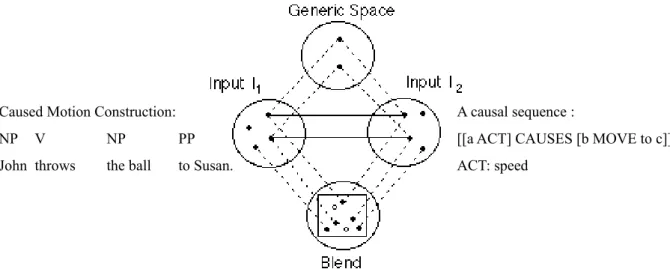
These input either open up a new mental space, corresponding to the ‘frame convergence’ which is accompanied with role coercion that allows the different frame elements in the same position get transferred and conflated into a new role (Liu & Hsieh 2008) or shift the focus to some existing ones, i.e. the semantic extension to another mental space. Figure 6 below illustrates how blending operates.
Figure 6: Conceptual Blending (Fauconnier 1997)
In Conceptual Blending Theory, the four-space model is typically made use of. The four spaces are: two ‘input’ spaces, a ‘generic’ space, and the ‘blend’ space. Blending is generally described as involving two input mental spaces that, according to a given structure mapping, will generate a third one, called Blend. For instance, as shown in Figure 6, the Input I1, carrrying the space builder, the caused motion
construction, fuses with the Input I2, carrying the frame of causal sequence to yield a
new space, i.e. the blend, leading to the transitive use of a prototypical intransitive Junior sped the car around the Christmas tree.
Caused Motion Construction: NP V NP PP John throws the ball to Susan.
A causal sequence :
[[a ACT] CAUSES [b MOVE to c]] ACT: speed
verb speed in the caused motion construction. It’s noticeable that the new blend maintains partial structure from the both inputs and adds emergent structure of its own. This is compatible with the analysis of multiple inheritances of frames suggested by Liu & Chiang (2008). Therefore, the four-space model of Conceptual Blending theory is adequate for integrating the above three theoretical foundations, i.e. Frame Semantics, Construction Grammar and the theory of subjectivity. The space-builders, such as metaphorical extension, inference and the grammatical coding means (e.g. affix) can be incorporated into the model as the link between each mental space.
In summary, the four approaches shed light on different aspects of polysemy and sense extension and may adequately account for some facets of the surface syntactic coding of verbs. Hence, in this study, Frame Semantics will be taken as the major framework for the consideration of argument structure. With the contribution of Construction Grammar, the dynamic meaning coerced by a construction can be accounted for. Finally, the four-space model of Conceptual Blending will be applied to incorporate the inputs of meanings from frames and construction and the space-builders, such as the inference induced by subjectification and metaphor as a possible cognitive base for explaining the semantic extension among the target verb classes.
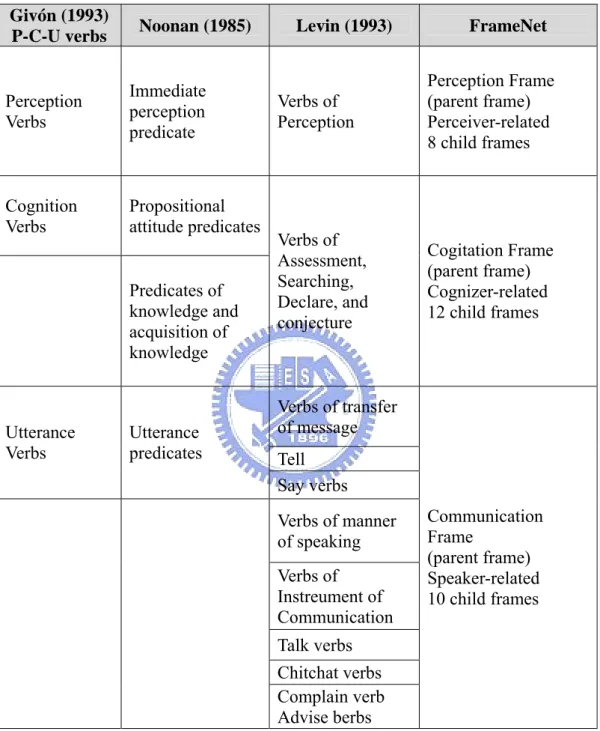
2.2 Classification of P-C-U, Manipulation and Modality Verbs in English 2.2.1 Classification of P-C-U Verbs in English
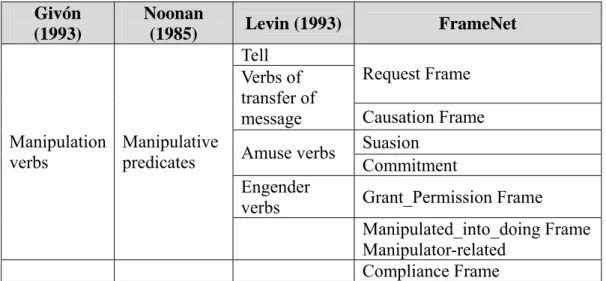
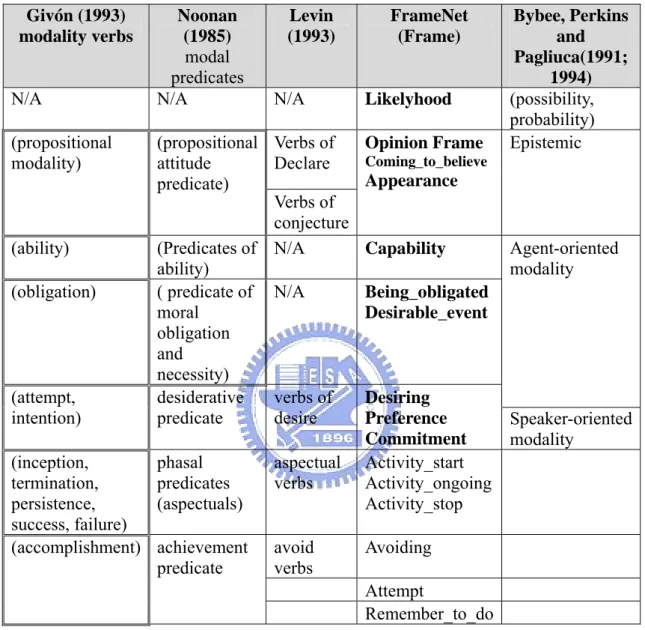
Table 3 below summarizes the corresponding classification of P-C-U verbs by Noonan, Givón, Levin and FrameNet. The categories they classified seem to be parallel except for Noonan (1985) further divided the Cognition verbs into two sub-categories. The two subcategories he divided into are in fact so-called factive and semi-factive predicates. The semi-factive predicate was single out since it emphasizes