Possibility of vortex lattice structural phase transition in the superconducting pnictide
Ba(Fe
0.925Co
0.075)
2As
2R. Kopeliansky, A. Shaulov, B. Ya. Shapiro, and Y. Yeshurun
Department of Physics, Institute for Superconductivity, Bar-Ilan University, Ramat-Gan, Israel
B. Rosenstein
Electrophysics Department, National Chiao Tung University, Hsinchu, Taiwan, Republic of China
J. J. Tu
Department of Physics, City College of New York, CUNY, New York, New York 10031, USA
L. J. Li, G. H. Cao, and Z. A. Xu
Department of Physics, Zhejiang University, Hangzhou 310027, China
共Received 10 December 2009; revised manuscript received 25 January 2010; published 10 March 2010兲 We present magnetic measurements in a single crystal of the newly discovered superconducting iron-pnictide Ba共Fe0.925Co0.075兲2As2. The magnetization loops exhibit a second magnetization peak共SMP兲 similar to that observed in most high-temperature superconductors共HTSs兲. Magnetic relaxation measurements reveal a minimum in the normalized relaxation rate, S = d ln M/d ln t, located in between the SMP onset and the peak fields. The SMP in HTSs is commonly associated with the vortex order-disorder phase transition. However, in Ba共Fe0.925Co0.075兲2As2the onset and peak fields, as well as the minimum point in S, exhibit strong temperature dependence down to low temperatures, excluding the possibility for such a transition. We suggest that the SMP in Ba共Fe0.925Co0.075兲2As2is associated with a vortex structural phase transition from rhombic to square lattice taking place at field and temperatures corresponding to the minimum point of S. A theoretical fit to the transition line, based on a recent theoretical model for vortex structural phase transition, shows good agreement with the experimental results.
DOI:10.1103/PhysRevB.81.092504 PACS number共s兲: 74.25.Ha, 74.25.Op, 74.25.Dw
I. INTRODUCTION
The magnetization curves in the “122” Co-doped pnictides Ba共Fe1−xCox兲2As2 exhibit an anomalous second
magnetization peak1–5共SMP兲 similar to that observed in the
superconducting cuprates.6–11In the latter, this anomaly has
been commonly interpreted as indicating a vortex order-disorder phase transition. Such a transition is theoretically characterized by a weak temperature dependence of the transition line in the low temperature region, far below the transition temperature, Tc,12 as commonly observed
in the cuprates, e.g., YBa2Cu3O7−␦, Bi2Sr2CaCu2O8−␦, and
Nd1.85Ce0.15CuO4−␦.9–11An exceptional behavior, however, is
revealed in the high-Tc superconductor La2−xSrxCuO4 with x = 0.126 and similar doping.13This material exhibits a broad
SMP with characteristics that are strongly temperature de-pendent down to low temperatures. The SMP in La2−xSrxCuO4 was associated with a structural vortex phase
transition, from a rhomb to square lattice, caused by softening of the “squash” vortex lattice elastic modulus
csq= 2共c11+ c12兲−c66.14
In this Brief Report we present magnetic measurements in Ba共Fe0.925Co0.075兲2As2single crystal confirming the results of
Prozorov et al.1and Shen et al.4who interpreted the SMP as
signifying a crossover from elastic to plastic vortex creep.8
We note, however, that such a crossover in the vortex dy-namics may accompany a thermodynamic phase transition in the vortex lattice as is the case, for example, in YBaCu2O7−␦.8,9As the SMP has been so far associated with
vortex phase transition, it is natural to attempt such an inter-pretation also in Ba共Fe1−xCox兲2As2. We point to striking
similarities between the magnetic behavior of this pnictide and the high-Tcsuperconductor La2−xSrxCuO4. In particular,
similar to La2−xSrxCuO4, the SMP in this pnictide exhibits
strong temperature dependence down to low temperatures. We, therefore, propose a similar interpretation of the SMP in Ba共Fe0.925Co0.075兲2As2, i.e., a structural vortex phase
transi-tion from rhomb to square lattice, showing that the measured transition line can be well fitted to the theoretical predictions.14
II. EXPERIMENTAL
A parallelepiped shaped single crystal of Ba共Fe0.925Co0.075兲2As2, with dimensions 2.4⫻1⫻0.19 mm3
and Tc⬃25 K, was grown by the self-flux method.15
Mag-netization measurements, as a function of field, temperature, and time, were performed using a commercial superconduct-ing quantum interference device共SQUID兲 共Quantum Design MPMS-5S兲. All measurements were done after zero-field cooling the sample to the measured temperature and then applying external magnetic field parallel to the crystallo-graphic c axis.
III. RESULTS
Figure 1 exhibits magnetization loops measured in Ba共Fe0.925Co0.075兲2As2 at various temperatures between 19.5
PHYSICAL REVIEW B 81, 092504共2010兲
and 23 K. A broad SMP is apparent at all temperatures. The arrows in the figure point to three characteristic fields: Hon,
the onset of the SMP, Hpeak, the peak field, and Hirr, the
irreversibility field. At lower temperatures共not shown in the figure兲, only the onset of the SMP is observed as the peak is shifted beyond the measured field range.
Relaxation measurements at constant temperature and field reveal logarithmic increase in the magnetization with time. The field dependence of the normalized relaxation rate,
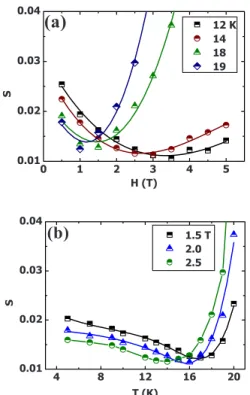
S = d ln共M兲/d ln共t兲, is shown in Fig.2共a兲for several tempera-tures. One notices a decrease in S to a minimum point in each curve which is interpreted in the following as indicating softening of the vortex lattice giving rise to enhanced pin-ning and slower relaxation.
A typical temperature dependence of the normalized re-laxation rate is shown in Fig. 2共b兲 for several fields. In the cuprates, S usually increases monotonically with
temperature.16,17 In Ba共Fe
0.925Co0.075兲2As2, however, S de-creases as temperature inde-creases, reaching a minimum point
at Tm and then increases sharply. This figure indicates that
softening of the vortex matter, and the consequent enhanced pinning, is also achieved on warming the crystal. As we show below, the minima in Tmvs H and Hmvs T coincide in
the field-temperature diagram suggesting that this behavior is associated with a thermodynamic transition.
In Fig. 3 we plot the characteristic fields Hirr, Hpeak, Hm,
Hon, and Tmin the field-temperature plane. We note that Hm
and Tmare located approximately halfway between the onset
and the peak of the broad SMP. The most significant obser-vation depicted in Fig. 3 is the strong concave-shaped de-crease with temperature of the characteristic fields associated with the SMP.
IV. DISCUSSION
The lines in Fig.3describing the temperature dependence of the characteristic fields associated with the SMP resemble the behavior of the melting line18 or the depinning line.19
However, neither of these is a valid interpretation, since the magnetization is strongly irreversible well above these lines. The common interpretation of the SMP as signifying an order-disorder vortex phase transition10–12 is also excluded,
as in this case the transition line must show weak tempera-ture dependence at low temperatempera-tures. In the following we suggest that, similar to La2−xSrxCuO4,14 the SMP in
Ba共Fe0.925Co0.075兲2As2 signifies a structural vortex phase
transition from a rhomb lattice at low fields to a square lat-tice above a transition field, Hspt. The scenario of a structural vortex phase transition in La2−xSrxCuO4 has been supported
by the small angle neutron-scattering experiments of Gilardi
et al.20 showing a crossover from triangular to square
coor-dination of the vortex structure with increasing magnetic field. The square structure originates from the fourfold sym-metry of the intervortex interaction, which in the case of La2−xSrxCuO4 is provided by a d-wave order parameter.20
Vortex-vortex interaction with fourfold symmetry may also be found in s-wave superconductors with fourfold symmetry
0 1 2 3 4 5 6 -0.2 0.0 0.2 Hirr Hpeak Hon M (emu / g ) H (T) 19.5 K 20.5 21.5 22 22.5 23
FIG. 1.共Color online兲 Magnetization loops at the indicated tem-peratures. Arrows point to three characteristic features of the loop.
0 1 2 3 4 5 0.01 0.02 0.03 0.04
(a)
S H (T) 12 K 14 18 19 4 8 12 16 20 0.01 0.02 0.03 0.04(b)
1.5 T 2.0 2.5 S T (K)FIG. 2. 共Color online兲 共a兲 Normalized relaxation rate S vs H at the indicated temperatures.共b兲 S vs T at the indicated fields. Solid lines are guides for the eyes.
5 10 15 20 25 30 0 1 2 3 4 5 H (T ) T (K) Hirr Hpeak Tm Hm Theory Hon
FIG. 3. 共Color online兲 H-T plot of the characteristic fields for Ba共Fe0.925Co0.075兲2As2: Hon 共circles兲, Hm 共full stars兲, Hpeak 共squares兲, Hirr 共triangles兲, and the characteristic temperature Tm 共hollow stars兲. Hmvs T and Tmvs H form a line that is well fitted to Eq. 共1兲 共solid line兲 that describes rhomb-to-square structural
phase transition.
BRIEF REPORTS PHYSICAL REVIEW B 81, 092504共2010兲
in the Fermi velocity, as is the case in the pnictides.21 The
anisotropic interaction with fourfold symmetry may induce a rhombic rather than hexagonal Abrikosov lattice, which eventually may transform into a square vortex lattice when the distance between vortices is sufficiently small. We note that rhomb to square structural vortex phase transition was identified also in the borocarbides22,23 exhibiting s-wave
symmetry in the gap24 but fourfold symmetry in the Fermi
velocity.22
Thermal fluctuations on a mesoscopic scale assist in breaking the rhomb symmetry reducing Hspt as temperature
increases. On approaching the structural phase transition, the elastic squash modulus, csq= 2共c11+ c12兲−c66, is vanishing,14
enabling vortices to be located at pinning sites. This vortex state with enhanced pinning is characterized by increase in the critical current, Jc, and slower magnetic relaxation, S,
around Hspt. When the increase in Jcis large enough
com-pared to its natural decrease with field, it is borne out in the experiment as a second magnetization peak and a minimum in the normalized relaxation rate.
The square to rhomb structural phase transition line was calculated by minimizing the free energy for the square lat-tice with respect to the variational parameters, the elastic moduli c11, c66, and csq, yielding14
Hspt= A共兲T0共兲 − T
C−1T , C =
432 Lz0
2 , 共1兲
where A and T0⬍Tc are constants depending on the
Ginzburg-Landau parameter and the anisotropy parameter
characterizing the deviations of the vortex-vortex interac-tions potential from rotational symmetry. is the London penetration depth,0is the flux quanta, and Lzis a numerical
parameter that defines the effective superconducting layer width in which thermal fluctuations are considered.
We suggest that the line in Fig. 3defined by Hmand Tm,
which is located in between Honand Hpeakof the broad SMP,
signifies a structural vortex phase transition line in Ba共Fe0.925Co0.075兲2As2. The solid line in Fig.3 is a theoreti-cal fit to these points based on Eq.共1兲, using A, T0, andas
fitting parameters. This fit yields T0= 23 K⬃0.92Tc and
= 0.95. As shown in Ref.14, the anisotropy parameter,, can be calculated from the fitting parameters A and T0. This cal-culation yields= 0.04. It is interesting to note that the val-ues of T0/Tc,, and found for Ba共Fe0.925Co0.075兲2As2 are
similar to that reported for La2−xSrxCuO4 共Ref. 14兲 共0.95,
0.03, and 0.9, respectively兲. By passing we note that La2−xSrxCuO4 and Ba共Fe0.925Co0.075兲2As2 also have similar
transition temperatures, Tc 共30 and 25 K, respectively兲 and
Ginzburg-Landau parameter 共75 and 65, respectively兲. We also note that unlike the behavior in the borocarbides, the slope of the transition line in La2−xSrxCuO4 and
Ba共Fe0.925Co0.075兲2As2 is negative consistent with the ther-modynamic expectation that the more symmetric phase oc-curs at higher temperature. The positive slope of the transi-tion line in the borocarbides has been attributed to strong
disorder.14 In addition, the behavior of the transition line in
La2−xSrxCuO4 and Ba共Fe0.925Co0.075兲2As2 is probably more
affected by thermal fluctuations on a mesoscopic scale that are much stronger in high-Tcsuperconductors.
Recent small angle neutron-scattering,25
Bitter-decoration,25 and scanning tunneling microscopy26 studies of the vortex matter were performed on similar Ba共Fe1−xCox兲2As2 pnictides. These studies seem to imply
that the structure of the vortex lattice depends on the external magnetic field; while Ref. 25 reported a hexagonal vortex lattice for relatively low fields共⬃4 mT兲, the data of Ref.26, measured at relatively high fields共⬃9 T兲, show a disordered lattice. The latter observation does not contradict our sce-nario of rhomb to square vortex structural phase transition which is expected only in perfect, clean crystals. In crystals with defects, softening of the vortex lattice associated with the structural phase transition allows better pinning and thus leads to a disordered state rather than an ordered square lat-tice. Our pnictide crystal as well as the one measured in Ref. 26 are probably less clean than the La2−xSrxCuO4 crystal in
which the high field square lattice was observed.20 This is
reflected in the relatively low critical current measured in La2−xSrxCuO4—less than 105 A/cm2at 4.2 K at all fields27
while in our pnictide crystal Jcexceeds 106 A/cm2 at low
fields. The high field vortex phase in our sample is most probably also disordered, as reflected by the increase in the relaxation rate above the transition. However, as argued above, the underlying mechanism creating this disorder state is not an order-disorder transition but softening of the vortex lattice associated with a structural phase transition. More systematic studies of the vortex lattice structure in cleaner crystals are necessary to conclusively decide whether a rhomb to square structural phase transition takes place in Ba共Fe1−xCox兲2As2.
V. SUMMARY AND CONCLUSION
We interpret the anomalous slowing down of the vortex dynamics in Ba共Fe0.925Co0.075兲2As2as signifying softening of the vortex lattice on approaching a structural vortex phase transition. We support this interpretation by 共i兲 eliminating possibilities of order-disorder, melting, and depinning lines; 共ii兲 pointing to similarities between the pnictides and La2−xSrxCuO4 crystals in which such a transition was
pre-dicted theoretically and confirmed experimentally; 共iii兲 showing a theoretical fit to the experimental transition line for the pnictides crystal based on a theory for structural phase transition. A direct experimental evidence for this in-terpretation is a challenge for future neutron-scattering ex-periments in clean crystals.
ACKNOWLEDGMENTS
This work was partially supported by the Israel Science Foundation 共ISF兲 共Grant No. 499/07兲 and by the National Science Foundation of China and the National Basic Re-search Program of China共Grant No. 2006CB601003兲.
BRIEF REPORTS PHYSICAL REVIEW B 81, 092504共2010兲
1R. Prozorov, N. Ni, M. A. Tanatar, V. G. Kogan, R. T. Gordon, C. Martin, E. C. Blomberg, P. Prommapan, J. Q. Yan, S. L. Bud’ko, and P. C. Canfield, Phys. Rev. B 78, 224506共2008兲. 2R. Prozorov, M. A. Tanatar, E. C. Blomberg, P. Prommapan, R.
T. Gordon, N. Ni, S. L. Bud’ko, and P. C. Canfield, Physica C
469, 667共2009兲.
3Y. Nakajima, T. Taen, and T. Tamegai, J. Phys. Soc. Jpn. 78, 023702共2009兲.
4B. Shen, P. Cheng, Z. Wang, L. Fang, C. Ren, L. Shan, and H.-H. Wen, Phys. Rev. B 81, 014503共2010兲.
5A. Yamamoto, J. Jaroszynski, C. Tarantini, L. Balicas, J. Jiang, A. Gurevich, D. C. Larbalestier, R. Jin, A. S. Sefat, M. A. McGuire, B. C. Sales, D. K. Christen, and D. Mandrus, Appl. Phys. Lett. 94, 062511共2009兲.
6M. Daeumling, J. M. Seutjens, and D. C. Laralestier, Nature 共London兲 346, 332 共1990兲.
7L. Krusin-Elbaum, L. Civale, V. M. Vinokur, and F. Holtzberg, Phys. Rev. Lett. 69, 2280共1992兲.
8Y. Abulafia, A. Shaulov, Y. Wolfus, R. Prozorov, L. Burlachkov, Y. Yeshurun, D. Majer, E. Zeldov, H. Wühl, V. B. Geshkenbein, and V. M. Vinokur, Phys. Rev. Lett. 77, 1596共1996兲.
9K. Deligiannis, P. A. J. de Groot, M. Oussena, S. Pinfold, R. Langan, R. Gagnon, and L. Taillefer, Phys. Rev. Lett. 79, 2121 共1997兲; D. Giller, A. Shaulov, Y. Yeshurun, and J. Giapintzakis, Phys. Rev. B 60, 106 共1999兲; T. Nishizaki, T. Naito, and N. Kobayashi, ibid. 58, 11169共1998兲.
10B. Khaykovich, E. Zeldov, D. Majer, T. W. Li, P. H. Kes, and M. Konczykowski, Phys. Rev. Lett. 76, 2555共1996兲.
11D. Giller, A. Shaulov, R. Prozorov, Y. Abulafia, Y. Wolfus, L. Burlachkov, Y. Yeshurun, E. Zeldov, V. M. Vinokur, J. L. Peng, and R. L. Greene, Phys. Rev. Lett. 79, 2542共1997兲.
12D. Ertas and D. R. Nelson, Physica C 272, 79共1996兲; T. Giama-rchi and P. Le Doussal, Phys. Rev. B 55, 6577共1997兲; V. Vi-nokur, B. Khaykovich, E. Zeldov, M. Konczykowski, R. A. Doyle, and P. H. Kes, Physica C 295, 209共1998兲; C. J. Olson, G. T. Zimányi, A. B. Kolton, and N. Grønbech-Jensen, Phys. Rev. Lett. 85, 5416共2000兲.
13Y. Radzyner, A. Shaulov, Y. Yeshurun, I. Felner, K. Kishio, and J. Shimoyama, Phys. Rev. B 65, 100503共R兲 共2002兲.
14B. Rosenstein, B. Y. Shapiro, I. Shapiro, Y. Bruckental, A. Shau-lov, and Y. Yeshurun, Phys. Rev. B 72, 144512共2005兲. 15A. S. Sefat, R. Jin, M. A. McGuire, B. C. Sales, D. J. Singh, and
D. Mandrus, Phys. Rev. Lett. 101, 117004共2008兲.
16I. A. Campbell, L. Fruchter, and R. Cabanel, Phys. Rev. Lett. 64, 1561共1990兲; L. Civale, A. D. Marwick, M. W. McElfresh, T. K. Worthington, A. P. Malozemoff, F. H. Holtzberg, J. R. Thomp-son, and M. A. Kirk, ibid. 65, 1164 共1990兲; L. Fruchter, C. Aguillon, I. A. Campbell, and B. Keszei, Phys. Rev. B 42, 2627 共1990兲.
17Y. Yeshurun, A. P. Malozemoff, and A. Shaulov, Rev. Mod. Phys. 68, 911共1996兲.
18E. Zeldov, D. Majer, M. Konczykowski, V. B. Geshkenbein, V. M. Vinokur, and H. Shtrikman, Nature 共London兲 375, 373 共1995兲.
19C. D. Dewhurst and R. A. Doyle, Phys. Rev. B 56, 10832 共1997兲; Y. Matsuda, M. B. Gaifullin, K.-I. Kumagai, M. Kosugi, and K. Hirata, Phys. Rev. Lett. 78, 1972共1997兲; D. T. Fuchs, E. Zeldov, T. Tamegai, S. Ooi, M. Rappaport, and H. Shtrikman,
ibid. 80, 4971共1998兲.
20R. Gilardi, J. Mesot, A. Drew, U. Divakar, S. L. Lee, E. M. Forgan, O. Zaharko, K. Conder, V. K. Aswal, C. D. Dewhurst, R. Cubitt, N. Momono, and M. Oda, Phys. Rev. Lett. 88, 217003共2002兲.
21H. Ding, P. Richard, K. Nakayama, T. Sugawara, T. Arakane, Y. Sekiba, A. Takayama, S. Souma, T. Sato, T. Takahashi, Z. Wang, X. Dai, Z. Fang, G. F. Chen, J. L. Luo, and N. L. Wang, Euro-phys. Lett. 83, 47001共2008兲.
22N. Nakai, P. Miranović, M. Ichioka, and K. Machida, Phys. Rev. Lett. 89, 237004共2002兲.
23M. R. Eskildsen, P. L. Gammel, B. P. Barber, U. Yaron, A. P. Ramirez, D. A. Huse, D. J. Bishop, C. Bolle, C. M. Lieber, S. Oxx, S. Sridhar, N. H. Andersen, K. Mortensen, and P. C. Can-field, Phys. Rev. Lett. 78, 1968共1997兲.
24D. Jaiswal-Nagar, D. Pal, M. R. Eskildsen, P. C. Canfield, H. Takeya, S. Ramakrishnan, and A. K. Grove, Pramana, J. Phys.
66, 113共2006兲.
25M. R. Eskildsen, L. Y. Vinnikov, T. D. Blasius, I. S. Veshchunov, T. M. Artemova, J. M. Densmore, C. D. Dewhurst, N. Ni, A. Kreyssig, S. L. Bud’ko, P. C. Canfield, and A. I. Goldman, Phys. Rev. B 79, 100501共R兲 共2009兲.
26Y. Yin, M. Zech, T. L. Williams, X. F. Wang, G. Wu, X. H. Chen, and J. E. Hoffman, Phys. Rev. Lett. 102, 097002共2009兲. 27Y. Radzyner, Ph.D. thesis, Bar-Ilan University, 2002.
BRIEF REPORTS PHYSICAL REVIEW B 81, 092504共2010兲