國立交通大學
博 士 論 文
數位化綠建築:
結合數位科技及永續設計的新設計過程
Digital-Green Architecture:
A new design process that integrates digital technology and sustainable concepts
研 究 生:李芝瑜
指導教授:劉育東
中 華 民 國 一 零 二 年 六 月
數位化綠建築: 結合數位科技及永續設計的新設計過程
Digital-Green Architecture:A new design process that integrates digital technology and sustainable concepts
A Dissertation
Submitted to Department of Civil Engineering College of Engineering
National Chiao Tung University in partial Fulfillment of the Requirements
for the Degree of Doctor
In Architecture
June 2013
Hsinchu, Taiwan, Republic of China
研 究 生: 李芝瑜
Student : Jeanne Lee指導教授: 劉育東
Advisor : Yu-Tung Liu國 立 交 通 大 學
土 木 工 程 學 系
中文摘要
隨著數位科技的蓬勃發展與技術應用的日益普及,這個時代所追求的
建築不再侷限於外在形體,不論是數位建築或綠建築的發展進程,都
朝向數位軟體與資訊科技的運用,期許以數位整合多面相的趨勢前
進。然而,當數位建築過於傾向技術層面的設計方法時,建築師所追
求的不應僅是建築技術或形體上的突破,更大的考驗則在深入探討新
設計過程的同時,得以了解數位建築真正的重要性。因此,本論文提
出數位綠建築(Digital-Green Architecture)的新觀點,思索在數位與節
能功能並進的年代,如何融合數位化技術與節能功能於設計的思考及
過程,藉由「數位綠建築」重新詮釋數位建築的設計思考模式,進而
系統化的結合數位與節能的元素,發展新的數位綠建築理論(Theory of
Digital-Green Architecture)。在數位科技與發展節能需求並重的設計
中,經由設計過程(Design Process)、設計媒材(Design Media)與設
計結果(Design Outcome)三項設計架構的分析,將所衍生數位綠構築
的元素特徵,加以歸納為十二個結合數位與永續設計的新構築因子,
藉以探討新的數位綠建築理論與設計過程的變化。
Abstract
The trend of digital freeform in association with high-tech technology and the awareness of sustainable issues have propelled the development of architecture to a new level by comprehensively merging digital architecture and green concepts during the design process. There are several critical phenomena of digital-yet-green tectonics (so called the Digital-Green) evolving due to broad applications in the design process, design media and design outcomes. Based on preliminary thinking of Digital-Green architecture, twelve factors are generated through the structure of the design process, design media and design outcomes. The factors are employed to analyse ten chosen projects, wherein the digital and sustainable concerns are portrayed for a comprehensive overview. From this, a more systematic framework is suggested for integrating digital and sustainable elements and processes to explore a new approach for understanding the new needs in the era of Digital-Green Architecture. The design process is no longer a result of a parallel development between new sustainable thinking and digital tectonics but a comprehensive fusion of both. This new approach may elevate the design process from a bilateral stream to a unified level where the impact of streamlining sustains digital and sustainable development in the future stage of architecture.
誌謝
感謝我的指導教授Aleppo的辛苦教導,也感謝您在這6年中,就算再忙
碌都還是很有耐心的指導我!
感謝畢業口試委員們給我的寶貴建議!!
最後要感謝在天上的祖母和外婆、我的公婆、我的父母、我的先生和
家人們對我的鼓勵、支持與容忍! 我終於畢業了!
目錄
1.
Introduction
1
(緒論)
1.1 Introduction 研究背景 11.2 Problem Statement and Objective 研究問題與研究目的 2
1.3 Methodology and Steps 研究方法與步驟 4
2.
Previous Work
9
(先前研究摘要)
2.1 The Transition from Classical to Digital Architecture 從古典時期到數位時期的轉變 9
2.2
Green Concept and Sustainability 綠建築的設計發展
193.
Selection of Cases & Analysis Framework
29
(案例選擇 &架構分析)
3.1 Selection of Cases 案例選擇 293.2
Analysis Framework 架構分析
374.
Case Analysis
44
(案列研究)
5.
Conclusion:
Modeling the Design Process of Digital-Green
Architecture
129
(結論: 建構新數位綠建築的設計過程操作流程)
References
134
圖目錄
Figure 3-1. View of Swiss Re Headquarters 32
Figure 3-2. View of Chesa Futura 32
Figure 3-3. Physical Models of Carbon Tower 33
Figure 3-4. View of BMW WELT Munich 34
Figure 3-5. View of Whitney Water Purification Facilities and Park 34
Figure 3-6. View of Zaragoza Bridge Pavilion 35
Figure 3-7. View of CSET Building 36
Figure 3-8. View of Japan Pavilion 2010 37
Figure 3-9. View of Haesley Nine Bridges 38
Figure 3-10. View of IBG and Tax offices 39
Figure 3-11. Design Relationship (Liu, 2003) 41
Figure 3-12. New Digital-Green Design Relationship 41
Figure 4-1. Early Facade Sketches 46
Figure 4-2. Wind Patterns around the Aerodynamic Form 47
Figure 4-3. Triangular Glass Panels and Light Wells 48
Figure 4-4. Swiss Re Headquarters under Construction 49
Figure 4-5. FLUENT Software Simulation 49
Figure 4-6. The Parametric Nodes of the Tower's Computer Model 50
Figure 4-7. The ‘Diagrid’ Steel Structure 51
Figure 4-8. The Flat Triangular Glass Panels 51
Figure 4-10. Key Parameters 53
Figure 4-11. The Parametric Computer Model 54
Figure 4-12. (a) Tepee-style Entrance (b) View of London from an Atrium Balcony 54
Figure 4-13. Early Facade Sketches 55
Figure 4-14. The Parametric Computer Models 56
Figure 4-15. Doubled-glazed Windows 57
Figure 4-16. The Computational CNC Timber Processing Machine 57
Figure 4-17. Parametric Computer Models 58
Figure 4-18. View of Steel Piloti 59
Figure 4-19. The Structural Elements 59
Figure 4-20. Prefabricated Timber Frame with Shingle Cladding 60
Figure 4-21. Parametric Computer Models 61
Figure 4-22. Wind Patterns around the Round Form 62
Figure 4-23. South and North Elevations 63
Figure 4-24. Section 64
Figure 4-25. Traditional Weaving Technique vs. Digital Weaving Technology 65 Figure 4-28. The Continuous Interweaving Structure 66
Figure 4-29. FLUENT Software Simulation 67
Figure 4-30. The Circulation on the Exterior 67
Figure 4-31. Thin Carbon are Stranded into Cables 68
Figure 4-32. Carbon-Fiber 69
Figure 4-34. Spiral Geometry 70
Figure 4-35. Tensile Material 71
Figure 4-36. View of the Entrance 72
Figure 4-37. Umberto Boccioni’s Sculpture 73
Figure 4-38. Computer Algorithms 74
Figure 4-39. The Triangular Lattice Prefabricated Steel Frame 74
Figure 4-40. The Roof Structure 75
Figure 4-41. The Parametric Computer Models 76
Figure 4-42. The Framework of the Steel Structure 76
Figure 4-43. The Continuous, Overhanging, Tornado-like Roof 77
Figure 4-44. The Glass-and-Metal Mesh 78
Figure 4-45. The Double Cone Structure 79
Figure 4-46. Section 79
Figure 4-47. The Double Cone’s Hollow Steel Structure 80
Figure 4-48. The Semi-transparent Glass Façade and the Bridge 81
Figure 4-49. Early Conceptual Sketches 82
Figure 4-50. The Computational Surface of the Convex Arcs 83
Figure 4-51. The Underground Water Purification Structure 83
Figure 4-52. Steel Structure 84
Figure 4-53. The Computational Surface of the Convex Arcs 85
Figure 4-54. The Sloped Park Helps Filter Storm Water 85
Figure 4-55. (a) The Installation of Extensive Concrete Walls Serves as a Thermal Mass (b) The Flat-lock Stainless Steel Panels 86
Figure 4-57. The Computational Surface of the Convex Arcs 87 Figure 4-58. The 360-foot Stainless Steel, Inverted Drop-shape Building 88 Figure 4-59. The Roof Functions as the Cistern for Water Recycling 88 Figure 4-60. Green Roof and a Separated, Grey Water System 89 Figure 4-61. The Theme of “Water, a Unique Research” 90 Figure 4-62. The Geometry of the Perforated Exterior Shell 91 Figure 4-63. The Intersecting Truss Elements 92 Figure 4-64. One of the Greatest Construction Challenges of the Entire Expo 92 Figure 4-65. The Parametric Computer Model 93 Figure 4-66. The Shimmer Effect of the Shiny, Fish-scale Patterns 94 Figure 4-67. The Foundation Piles of Bridge Pavilion 95 Figure 4-68. The Glass Fibre Reinforced Concrete (GRC) 96 Figure 4-69. The Arch Structure 97 Figure 4-70. The Horizontal, Curved Decks of the Warped Geometry 97 Figure 4-71. The Interior Space of Pods 97 Figure 4-72. The Exhibition Zones 98 Figure 4-73. Early Conceptual Sketches 99 Figure 4-74. The Computational Fluid Dynamics (CFD) simulations 100 Figure 4-75. The Folded Curtain Wall 100 Figure 4-76. The Folded Curtain Wall 101 Figure 4-77. The Parametric Computer Model 101 Figure 4-78. The Dynamic Bending Gesture of the Design 102 Figure 4-79. The Concrete Staircases Function as the Structure 103
Figure 4-80. The Decorative Screen-Printed Pattern 104 Figure 4-81. The Curtain Wall for the Penetration of Natural Daylight 104 Figure 4-82. The Semi-basement Floor Areas 105 Figure 4-83. The Self-reliant System and Self-sustaining Ecology 106 Figure 4-84. The Underground Energy System 107 Figure 4-85. The Shape of Silkworm Larva 107 Figure 4-86. Interior Space 108 Figure 4-87. Organic Photovoltaic Cell 109 Figure 4-88. The Steel Frame Structure 109 Figure 4-89. The Eco-tubes 110
Figure 4-90. The Eco-tubes 111
Figure 4-91. Section through Double-layer ETFE Pillows 111 Figure 4-92. ETFE Pillows Perform like a Greenhouse Enclosure 112 Figure 4-93. The ETFE Double-layer Pillow Membrane Envelope 113 Figure 4-94. The Lower Part with Semi-openness 113 Figure 4-95. The Energy System of Photo-catalyst 114 Figure 4-96. The ETFE Surfaces have 115 Figure 4-97. The Summer Pillow of Korea 116
Figure 4-98. Sections 116
Figure 4-99. The Timber Structure 117 Figure 4-100. The Roof Construction 118 Figure 4-101. The Curved Surface of the Roof 118 Figure 4-102. The Parametric Computer Modeling 119
Figure 4-103. The Hexagonal Grid Components 119 Figure 4-104. The Computational CNC Timber Processing Machine 120 Figure 4-105. Front Elevation 120 Figure 4-106. The Mesh Geometry in Triangle and Hexagonal Shapes 121 Figure 4-107. The Roof Construction of Hexagonal Gridshell 122 Figure 4-108. The Transparent Curtain Wall 122
Figure 4-109. Section 123
Figure 4-110. The Large Public City Garden in Front of the Office Complex 124 Figure 4-111. The Fin-shape Terrace Functions as a Tool of Wind Control 125 Figure 4-112. The Horizontal Fins around the Building 125 Figure 4-113. The Aerodynamic Form and Fins for Wind Control 126 Figure 4-114. High-performance Façade 127 Figure 4-115. The Structural Grid and the Architectural Recyclability 127 Figure 4-116. The Transparent Façade 128 Figure 4-117. The Corner-less Fluid Form 128 Figure 4-118. Circulation Diagram 129 Figure 4-119. Concrete Core Temperature Control 130 Figure 4-120. The urban garden at the ground level 130 Figure 5-1. The Digital-Green Design Process 132
表目錄
TABLE 1. Selected Case Studies 8 TABLE 2. Digital-Green Design Factors 132
Chapter 1 I n t r o d u c t i o n
1.1 Introduction
Digital technology has made free-form designs in architecture possible through computer-aided design media. These technological developments have raised the bar, enriching the field with extraordinary knowledge and potentialities, and are making the building of the impossible much more possible (Mitchell 1990). As architecture has made the leap into the digital age, new technologies have also transformed the way architects and researchers approach sustainability and other environmental issues. Therefore, these parallel developments suggest that a new theory is necessary to explore the relationship between sustainability and architecture in the digital age.
With the advanced technological capacity to compute, calculate, and simulate, contemporary architecture should no longer be directed only towards aesthetic and functional aspects, but should also consider habitability, self-sufficiency, and sustainability (McDonough 2002; Koleravic 2004). The development of the green concept has advanced from linear focus on energy saving to “non-linearity” (Deleuze 1987; De Landa 2000; Koleravic 2004). It is important that buildings are redesigned to be more sufficient and self-organized, with the capacity to generate renewable energy. Traditional architectural methods are changing in conjunction with the invention of new technologies and the concern about sustainable issues. The integration of
CAD/CAM technologies and concepts of sufficient/sustainable buildings is no longer only a vague discussion but an important part of the progression of values in architecture (Emery 2002). Therefore, the emerging digital design process must accommodate energy-saving and environmental concerns, as researchers and digital architects attempt to integrate sustainable innovation into contemporary architecture. Integrating an understanding of classical, digital and sustainable historical backgrounds, a more systematic framework is needed to integrate all of these elements into a comprehensive design process.
1.2 Problem Statement and Objective
When using digital CAD/CAM technologies, Rapid Prototyping (RP) and Computer Numeric Control (CNC), architects and researchers recognize the need for a new digital design process to increase efficiency (Mitchell 1998; Ryder et al. 2002; Burry 2002; Kolarevic 2003; Sass 2004; Schodek et al. 2005; Dritsa 2004; Lim 2004; Lee 2005). The traditional stages of the design process— including schematic design, design development, detail design, and construction—have evolved into a new structure with the use of the digital design process. This evolution suggests four new stages in the design process, including computational concept design (topological space, isomorphic surfaces, motion kinematics and dynamics, keyshape animation, parametric design, and genetic algorithms), analysis, manufacture, and assembly method (Kolarevic 2000).
The distinctive features of this dissertation are to re-organize the design process such that digital and sustainable factors are incorporated in a comprehensive fashion. It is time to rethink how the marriage between digitalization and green concepts can reshape the existing process of digital architecture. The question is whether the free forms reveal not only buildings applying higher technology but also sustain the needs of green innovation. Could the merger of digitalization and green concepts unlock the potential of both cutting-edge design and sustainable characteristics? How are the new digital and green elements acquired from the old classical elements? How can the classical factors, sustainable factors, and digital factors function together with new digital-green factors? The digital free forms are created by these technology initiatives and are combined with new, sustainable materials to generate new approaches in design. How do the new design approaches differ from the classical ones? Are the old factors still useful in the new framework? How does the evolution of technology and design fit with the theories of the past? Further, how does this new design process influence the adoption of new construction methods?
The relationship between the preliminary theory of digital-green architecture and its new design process are an important consideration. The goal is to explore the possible ways of merging digitalization and sustainability from the existing digital/sustainable buildings and possible developments in the future, to fulfil the dual purposes of architectural aesthetic and energy-efficient functions. What is more significant is to respond to the environmental needs of sustainability by the introduction of a new design process. Through the
discussion of “digital and sustainable architecture,” architects must re-evaluate the new structure of the design process to address the broader sustainable needs of the structures. This exploration could elevate the design process from a micro to a macro level. Perhaps architects can focus on a comprehensive fusion of new design processes and the overall interactions of digital technology and sustainable thinking. Planning would go beyond simply applying green building standards; rather, new design processes would use the expressions of free-form designs and digital technology to merge developments in both areas with the new sustainable movement. The purpose of this dissertation is to develop a perspective that moves from the idea of the design of a digital sustainable object to an extensive design process that integrates both digital technologies and green issues. Such a shift in perspective will emphasize the broad range of issues in the design process that intimately bond digital architectural manipulation and sustainable expressions.
1.3 Methodology and Steps
The main purpose of this research is to determine whether digital free-form design, integrated with new technologies and ecological concerns, may contribute to the sustainable needs of a New Digital-Green design process. To explore this question, a four-step approach to research will be used. These steps include:
1) Select ten cases for a comprehensive evaluation of factors used in the new design process;
2) Construct a framework to analyze the logic and characteristics of factors used in the digital-green design process;
3) Analyze the cases based on the framework designed to examine the digital-green design process; and
4) Incorporate the elements of general, sustainable, digital, and preliminarily digital-sustainable architecture in order to devise a new model for the Digital-Green design process.
1.3.1 Step One: Selection of Cases
Ten projects were selected for both their digital and green possibilities in the new architectural conceptualization. The ten cases were selected based on several criteria.
1) Projects were selected from a variety of countries in Asia, the Middle East, North America, and Europe, with varying site conditions and weather patterns. This variety presents different concerns and challenges in terms of the design and construction processes when integrating digital technologies and sustainable issues.
2) The structures embrace different architectural scales, from a small-scale private residence to a large public pavilion. The ten cases include three office buildings, one factory building, two showrooms/mixed-use buildings,
one educational building, and one bridge construction. With the wide range of building types, the features of digital and green emergence have been revealed and processed.
3) Cases are architectural projects from a targeted time period; in this case, from 1999 to 2011. With the improvement of technologies and the increasing level of sustainable issues, the focus during these years has been on the digital and sustainable applications in architecture.
4) The chosen architects are sophisticated in experimenting with designing digital architecture with elements of sustainability. Award-winning designers and architects experienced in the digital design process with sustainable thinking are included.
By analysing the design processes that involve digital manipulation and sustainable design thinking, the examination of the ten cases aims to explore various characteristics of digital-green architecture. Using these ten projects, the relationship between digital technologies and sustainable characteristics plus the logic of design processes are explained with broader applications.
TABLE 1. Selected Case Studies
Case # Project Name Architect(s) Location Year
Case 1 Swiss Re Headquarters Foster and Partners London 1999
Case 2 Chesa Futura Foster and Partners Switzerland 2004
Case 3 Carbon Tower Peter Testa and Ove Arup Dubai 2005
Case 4 BMW WELT Munich COOP Himmelb(L)au Germany 2007
Case 5 Silver Drop Steven Holl Connecticut 2007
Case 6 Zaragoza Bridge Pavilion Zaha Hadid Spain 2008
Case 7 CSET Building Mario Cucinella Architects Ningbo, China 2009
Case 8 Japan Pavilion Yutaka Hikosaka Shanghai 2010
Case 9 Nine Bridges Shigeru Ban South Korea 2010
1.3.2 Step Two: Analysing Framework
The preliminary structure of digital or sustainable architecture might be insufficient for the needs of digital-green design process. Therefore, it is necessary to apply new factors to analyze the effectiveness of integration of both digital technology and sustainable concepts in the new design process. In addition, it is important to determine whether classic factors can be further extended or can coexist in the new design process. The use of computers and CAD/CAM technology in the design process transformed the expression of digital architecture into a combination of digital and sustainable operations. A comparison of these two sets of factors can be analyzed to determine which will support the foundation for a new design process.
1.3.3 Step Three: Case Analysis
The third step is designed to portray the characteristics of the ten selected projects through the review of twelve Digital-Green factors. The ten projects, with both digital and sustainable factors, will be reviewed chronologically from 1999 to 2011. It is anticipated that by employing the new Digital–Green factors to review the selected projects, the digital and energy-efficiency related issues will be systematically analyzed. Throughout this time period, the importance of technology sophistication and the concerns of sustainability have increased. As a result of the analysis and discussion of these ten projects from the perspective of the new systemic framework, the relationship between digital technologies and
sustainable features will be identified and used to extend current theory to a new logic of Digital-Green design processes.
1.3.4 Step Four: Modeling the Design Process of Digital-Green
Architecture
Based on the analysis of the previous design processes and the information gained from the case-study factors, the process of merging digital technology and green aspects will be initiated within the design process. To maximize the capacity of a dynamic digital design process, the features of computational design media and digital graphics (such as topological surface, isomorphic field, kinetic skeleton, field of forces, parametric model, genetic algorithm) will allow architects to shape the form freely and create a more functional skin/envelope. As a result, the elements of conceptual design, computational concept, and envelope study will provide possibilities for unexpected new forms and sustainable influences in the new Digital-Green design process. Such a process can help designers to merge both digital and sustainable aspects during the design process.
Chapter 2 Previous Work
2.1 The Transition from Classical to Digital Architecture
2.1.1 Conventional Techniques
The development of design processes, as well as the transition of styles throughout history, has been influenced both by changes in design media and social needs (Liu 2003). In ancient Egypt, drawings with plans, elevations, sections, and details demonstrate that a basic design process had already been established. The Greeks later designed mechanical tools, such as cranes and pulleys, to be used in hoisting heavy rocks, allowing for significant temple designs for religious purposes and the classical beauty of asymmetry (Goldberg 1983). The Romans adopted this classical architectural style from the Greeks, adding new architectural features designed to meet social needs. For instance, the invention of a concrete-making technique was useful to address the issues of increasing population density of the cities and the wealth of the citizens. This new solution provided fast and firm production of building materials, while allowing a wider vault span. As a result, interior space was expanded and Roman architecture achieved a new look (Lancaster 2005). The Medieval architects adopted three styles as a primary form for subsequent development—the Greek cross or Latin cross plan, the style of Roman basilica, and the Byzantine dome style. New forms and styles, such as cross-shaped windows and crenulated walls, were developed and used in much of the secular architecture. These inventions
were not only for decorative purposes, but also for defence, which was critical for the war time in the Medieval Period (Braun 1951; Fletch 1996). Due to the rapid growth of trading and the growing association in medieval towns, regional influence was demonstrated through the wealth and pride of the towns. The lofty and structural characteristics of Gothic Architecture during the late Medieval Period were the preferred style for cathedral designs. However, the most significant motivation for this climax of vertical skeleton constructions was to get closer to God. Therefore, innovations and new construction techniques for the pointed arch, the ribbed vault, and the flying buttress, were also developed for meeting this purpose (Crook 2002).
2.1.2 The Era of Crafting
The 14th century was a time of world exploration. During this time, book printing developed, trade expanded, and a thirst for knowledge and education increased. In addition, architecture became a matter of theoretical analysis rather than simply a question of practice (Panofsky 1960). Designers expanded their exploration of space from two-dimensional to three-dimensional aspects. For example, Brunelleschi (1550) was the first to combine technical drawings with physical models when studying buildings. Furthermore, Buonarroti (1560) used models to study three-dimensional design space. With the revival of the scientific spirit during the Renaissance, architects showed a strong interest in exploring empirical evidence and mathematics. The style of this period revived aspects of Greek and Roman elements for inspiration, while focusing on symmetry, geometric balance and regulation of the various parts of the structures. The
classical style of the Greek and Roman periods was re-analyzed and integrated with new understandings and construction methods to serve the new purposes (Booth 1996).
Similar to the architecture of the Renaissance, Baroque architecture used logic and mathematics to incorporate geometric relationships into the design process, creating variety in structure and scale. The influence of the wealthy and powerful Catholic Church also played a leading role to encourage the bold expression of lighting emotions to show the religious force to improve enthusiastic piety. Motivated by new religious orders, bold and irregular shapes in design allowed more expression through the use of shape, color, and varying levels of light and shade, such as curving facades and distinctive oval ceiling style with the result of larger open spaces (Toman 2008).
2.1.3 New Materiality and Machine-Based Manufacturing
In the 18th century, the Industrial Revolution brought about tremendous changes in agriculture, mining, manufacturing and transportation. The invention of machine-based manufacturing also marked a turning point for the design process and architectural style. Developments in iron-making and the use of refined coal led to improved roads, railways and canals for trade expansion. In addition, the development of durable metal machine tools not only increased the production capacity in manufacturing, but also provided new materials for architectural structural design thanks to the new iron-making technology. In the 1740s, the production of raw steel led to the development of steam engines and railways, allowing for industrial growth, and urban development for the growing population
(Hudson 1996). Building materials such as brick and stone gave way to the newly invented materials such as steel, iron and glass. Architectural projects emphasized the use of these new building materials, as well as new construction methods involving the prefabrication of the structural parts, allowing for the rapid development of skyscrapers and large scale architecture (Crossman 1906). This transformation affected both style and design, allowing for greater creativity of external appearance and the increased load-bearing capacity—a major breakthrough in the area of structural constraints.
2.1.4 New Societal Needs and High-rise Buildings
With the reformation of industrial architecture, Morris (1870s) suggested that form and function should be integrated without distinction in order to meet the changing architectural style of new materials and technologies. The use of architectural elements, such as larger windows and thinner interior walls, not only allowed designers to have taller buildings but also provided a floor plan that was freer and more open. Therefore, weight-bearing steel constructions such as the famous Eiffel Tower (1890) and the first modern skyscraper (in Chicago) were born. This change in design style demonstrates how the needs of a society are met when design and technology are integrated. Some researchers have addressed the explorations based upon the changes of design theory mentioned above (Scully 1988). Around this time, Sullivan (1891) addressed the changes with the phrase “form follows function” to stress the importance of practical uses over aesthetics. Later, Eugene Viollet-le-Duc (1892) presented the idea of
structural rationalism, particularly the process of mixing the classic elements with new materials and structural ideas.
During the Art Nouveau period, a new design style combined the classical form of architecture with the traditional style of decorative arts. The use of modern materials like wrought iron technology expressed a fresh and freer form during the Modern Movement. This integration led Morris (1867), as the functionalist wing of modern architecture, to pursue artistic potential and functionality to make everyday objects into art. Voysey’s free plans and L-shaped design were declared one of the most influential works in the Modern Movement. His dictum, “fitness for purpose,” and the ambition to pursue simplicity echo Sullivan’s “form follows function” (1898). Gaudi (1910) presented his own sculptural style of the curvilinear expression from the merger of decorative arts in the Arts and Crafts movement. He used special model studies during his design process to bring innovation to his design process, resulting in the use of hanging small filled sacks upside-down from the ceiling. The use of industrial materials like concrete and glass also helped to his attain the outline of his project, Sagrada Famila.
2.1.5 Functional Aesthetics and Modern Movement
Gropius (1910) began his own architectural practice with Meyer and was instrumental in designing a shoe factory that promoted friendly working conditions for the employees. Then in 1913, he became the master of an arts and crafts academy in Weimar, which he transformed into the Bauhaus school.
Gropius’ work at the school and his writing influenced other modernist architects, including Le Corbusier, whose International Style emphasized the simplification of form, the disaffirmation of ornament, and the use of modern materials—like glass, steel and concrete. He also proposed the five points of architecture and the Domino system of the open floor plan as the prototypical housing solution in most of his design processes. Through the pursuit of functional aesthetic and asymmetric balance, Le Corbusier (1923) coined the phrase “a house was a machine for living,” which was one of the major theories in Modern architecture. Similarly, Mies (1929) stated his aphorisms—such as “less is more” and “God is in the details”—through his use of extreme simplicity in the design process. The trend toward simplified forms, functionality, and the technologies of mass-production led to a more systematic design process. Giedion (1920) encouraged the idea of “irrational-organic,” using modern elements, transparency, and flexibility.
With the development of reinforced concrete for use in shell construction in 1920, Maillart suggested the idea of eliminating all linear elements by using flexible materials to make use of surface tension. Instead of using the old technologies of heavy arches and buttresses for structural support, lightness and flexibility of form—such as the large-scale, thin-shell construction or stressed-skin types—became the new standard of design and construction. The study of mechanical development, based on structural engineering, became one of the most important concerns in developing harmony with the new needs of industry. The flowing form of curved shells built from prefabricated elements of heavy
material—as seen in Eero Saarinen’s (1950) approach to J.F.K International Airport or Jorn Utzon’s (1957) Sydney Opera House—show how construction methods support the organic forms of these structural designs.
2.1.6 Digital Forerunners and New Construction Methods
In the 1960s, computer-aided design (CAD) and computer-aided manufacturing (CAM) technologies were introduced to the aircraft and automobile industries (Hull and Jacobs 1992). While the processes and production methods of shipbuilding technology are similar to the building industry, some digital forerunners such as Buckminster Fuller started to connect the production methods from industry. His Dymaxion House helped the development of building skills on framing and cladding techniques for digital manufacturing, which was also known as energy-efficient and low cost for such a "radically strong and light tensegrity structure" (Buckminster 1983). This prototype was famous not only for its round structure, but also for its use of natural winds for cooling and air circulation (Buckminster 1983). The wedge-shaped metal aluminum on the roof of the Dymaxion house later inspired Frank Gehry’s Guggenheim Museum in Bilbao. Furthermore, Fuller’s ‘blobby’ and formlessness design came to be popular during the 1960s and early 1970s (Zellner 2001; Koleravic 2004).
In the 1960s, Peter Cook, Warren Chalk, Ron Herron, Dennis Crompton, Michael Webb and David Greene formed an avant-garde architectural group called Archigram (Cook and Webb 1999; Sadler 2005). The development of new construction methods during the Late Modern movement allowed new spatial
forms to emerge. With the use of new materials and modern technology, the interrelationship of material, joints, detail and structure were the prime focus (Giedion 1967). With the idea of “high tech, light weight, and infra-structural approach,” works by the Archigram Group included Renzo Piano’s High tech 'Pompidou centre' 1971. Early Norman Foster works, designs by Richard Rogers, and early works of Future Systems reflected the inspirations for the blending of high tech technology and the initial stage of digital architecture (Cook and Webb 1999; Sadler 2005). This approach brought about eclectic styles, rather than rectilinear designs, leading the design process to more organic forms since the1980s.
2.1.7 Three-Dimensional Design Thinking
A successful architectural project relies on a carefully considered design process. Lawson (1990) suggested that various design processes can be addressed based on the different methods. The process of design could be transformed into different factors during different periods by the changes of style, the inventions of new technology, and the change of society concerns (Lawson 1990). As the complexity of design content and new technologies emerged through the decades, the need for an efficient design process became necessary. Some digital pioneers tended towards less “machine aesthetic” design. In subsequent development, the architecture evolution and improved computer-aided technology have generated freeform design options. Such techniques were known as 3D surface construction and Numerical Control (NC) programming of the mathematical description work on curves.
This methodology of integrating CAD/CAM was applied to produce more efficient manufacturing processes not only in the industrial field, but also in different manufacturing areas. This was especially explicit in the architecture industry a decade ago by Streich (1991). Peter Zellner’s Hybrid space shows that “today’s experimental architects are deploying novel ‘hard’ (manufacturing and material) and ‘soft’ (digital) technologies to engender an architecture of incorporation and conjunction, to test the radical generative and creative potential made possible through computer application” (1997). Concept Modeling technologies and the continuing development of Rapid Prototyping technologies can offer designers the opportunity to conduct their design processes in a faster and more affordable way. For example, Ryder demonstrated the applicability of Layered Manufacturing (LM) technology in the field of architecture (Ryder 2002).
2.1.8 CAD/CAM Technologies and Digital Design Thinking
Based on the framework of algorithmic structure for designs hypothesized by Stiny and March, Wang and Duarte brought in the methods of Rapid prototyping and manufacturing generating the possibility of mass-produced architectural designs in 2002. By using cutting-edge 3D graphics technology, geometrically complex designs can be easily introduced with a few basic shapes and rules on using ‘shape grammars’ to create new designs (Stiny and March 1981; Wang and Duarte 2002). By manipulating the computer modeling platform, Greg Lynn (1995) redefined the term 'blob architecture' to the public with the concept of a “more fluid logic of connectivity,” which is involved with the mathematical knowledge such as nonuniform rational B-Splines, NURB, freeform surfaces, and
the digitalized sculpting forms (Lynn 1993). Koleravic (2003) later defined the term Digital Fabrication to offer the understanding of ‘architectural design and production processes and their material and economic constraints’. That manifested together with manufacturing advances in the architectural applications of the latest digital design and fabrication technologies. With the advancement of digital fabrication through developmental history, Mitchell (1999) indicated that one of the advantages of digital production was to support the derivation of complex processes by CAD/CAM fabrication. Thus, the complex computer-aided calculations in design process not only broadened the range of flexible appearance by digital fabrication but also reconnected the relationship between conception and production. The new digital processes of production re-generated the possibilities of construction and the functions of computability (Kolarevic 2003).
With the transition from classical to digital architecture, the development of design processes and style were affected by the innovation of design technologies, the invention of new materials, and societal needs (Liu 2003). While the engagement of computer technology and new digital processes of production had directly generated architectural conception in the digital period, the design process needed to integrate with the new factors were based on green concerns and transformed to fit both digital and green design processes (Kolarevic 2006).
2.2 Green Concept and Sustainability
2.2.1 Early Thinking about Sustainability
According to Carson (1962), Bender (1970), Yeang (1995) and McLennan (2006), the beginning of green thinking in design process can be traced back to ancient times. The green concepts have been summed up as four evolutionary stages through history: the biological beginning, the ingenious beginning, the industrial, and the modern sustainable design movement (McLennan 2006). As early as the ancient Egypt, Greek and Roman periods, Plato had already pointed out the demand of sustainable practices for maintaining the environment in the light of human activities (Columella 1948; Strabo 1949; Van Zon 2002). In the 19th Century, John Stuart Mill (1848) promoted an idea similar to the contemporary term “sustainable development,” but only discussed the need for remedial solutions of human impact on the natural environment (Mill 1883; Wines 1932; Lowenthal 1958). Up until then, most sustainable concerns were focused on pursuing comfort for one’s living environment. During this period, Clausius (1850) mentioned the link between nature and society related to energy waste and the use of renewable material. Later, Haeckel (1866) coined the term “ecology” to define the relationship of the organism with the comprehensive science related to the environment. Similarly, Thoreau (1856) anticipated the findings of ecology and environmental history as the source of environmentalism in the modern days. While the sustainable concerns were mostly developed on the theoretical concept for environmentally sensitive architecture during the 1850s, many large buildings included ingenious systems for ventilating the space without the use of
electrical or mechanical equipment. For example, Joseph Paxton’s Crystal Palace introduced not only a modern glass structure as part of the design approach, but also provided a roof ventilator for comfort and sustainability issues (Roth 1993). To provide ventilation for a long -pan space, Giuseppe Mengoni (1877) contrived a useful solution (later referred to as a labyrinth) for air-circulation (Gissen 2009). The Flatiron Building (1903) had deep-set windows to avoid the solar exposure (Gissen 2009). There were more examples with similar passive strategies during this ingenious period. However, the green system advocated in these decades was mostly related to philosophical issues of environmental degradation or concerns with passive technique for interior comforts rather than the focus of specific design elements.
2.2.2 Sustainable Movement after the Industrial Revolution
After the Industrial Revolution, Le Corbusier and other well known modernists, such as Walter Gropius and Mies Van der Rohe, advocated the employment of modern materials, new technology, and industrial forms in Modern architectures period. In 1926, Le Corbusier introduced his five points with the concepts of “free plan” and “free façade,” which bring in the advantage of maximum ventilation and light to the interior (Corbusier 1923). The progress of production techniques, the increased transparency in glass structure, and the thinking of glass is greener constitute the New Architecture thinking of the Modern Movement. Moreover, the modern technologies invented through the centuries also encouraged the new aspect of green concepts (McLennan 2004). While architects moved away from passive strategies such as operable windows or external sunshades under the
exploration of air-conditioning, there were also new forms and concepts developed that reflected the new language of technologies (McDonough 2003). By expressing both modern and sustainable characteristics in his design process, Frank Lloyd Wright (1937) was the first to address the role of Organic Architecture as one of the important green concepts during the Modern Movement. Other architects, such as Antoni Gaudi, Louis Sullivan, John Lautner, and Claude Bragdon, intended to translate the organic design approaches as the relationship between natural surroundings and the unified organism of the building itself included in the design process (Van Zon 2002, McLennan 2004). However, while those forerunners pursued these green ideas, most Modernists were more concerned with how buildings were put together rather than how to incorporate sustainable beliefs. Therefore, although the green influences emerged in the period of the Modern Movement (1920s - 1940s), the application of the green concept in architecture was mostly engaged with technical systems of passive solar design, bioclimatic design, bio-regionalism and so forth (Vale 1991).
2.2.3 Modern Movement and Sustainable Design Thinking
In response to the oil crisis of 1973, the issue of sustainability emerged as an important matter in society. Social awareness of the Green Architecture Revolution was inspired by Rachael Carson’s book Silent Spring, in response to the widespread public concerns about the environmental problems of the 1960s (McLennan 2006). One of the most prevailing green concepts during this period was developed with the Earthwork Movement of the 1970s. Peter Noever (1971)
introduced a new perspective of evolutionary design processes by examining the possibility of living spaces built completely underground with earth-sheltered roofs. As new technologies offered possibilities for green designs during this movement, Wells (1981) advocated the idea of underground architecture to step up the integration of landscape and architecture. Ambasz (1981) proposed the concept of Green Town by responding the Architectural Modern Movement of The house in the Garden in a more extensive way (Wells 1981, Wines 2000). In the ACROS Building, Emilio Ambasz presented his environmental architecture by integrating vegetation and terrain into buildings in order to maintain natural resources.
2.2.4 Organic Forms and Green Concepts
Reflecting a similar interest in combining technological advances with nature and organic forms, architects such as Jersey Devil, Ushida-Findlay, James Cutler, Arthur Quarmby, and Peter Vetsch extended the concept of borrowing nature’s organic forms and integrating them with the developments in sustainable technology (Crosbie 1985; Wagner 1994). Jersey Devil (1970) presented his project Snail House, merging the use of sustainable technology with curvature expression. The curved window strip and the central thermal mass chimney reflected to the heating and natural ventilation by matching the solar arc from east to west (Crosbie 1985; Stitt 1999). In his project, Soft and Hairy House, Ushida-Findlay (1994) integrated the modern concept of “inside out” and sustainable programs. The organic form not only suggested the fluid continuity, but the extensive roof garden also maintained a steady interior temperature,
among its green features. The flowing volumes of the Nine Houses by Peter Vetsch (1993) expressed his environmental intentions with the perspective of earth-friendly technology; the flowing organic appearance could represent both contemporary design-centered architecture as well as green design principles with ecological consciousness. The earth-centric philosophy has been an approach similar to Wells’s aspect of underground architecture, which became a progressively more prevalent way to respond to the green concept during this period (Wells 1981, Wines 2000).
2.2.5 Curvature Expression and Sustainable Technologies
Around the same time, the architectural impact of the oil crisis also led architects and theorists to focus on function-oriented green concepts for environmental purposes. The passive strategies were, again, rediscovered, such as the innovative potentials which coincided with the Environmental Movement to address the major concerns of the oil and ecological crises in the 1960s and 1970s (Carson 1962; McDonough 2003). Responsive to social-ecological awareness, Buckminster Fuller (1950) was known as an early pioneer in sustainable design and was the first to develop prefabricated mass-produced houses. The movement toward renewable energy such as solar or wind-derived electricity was a new theory in his period. His famous geodesic dome with a complex network of triangles forming a high-efficiency light weight structure was based upon the concepts of the Modern Movement that focused on low-cost mass production and using fewer materials. Its efficient ventilation system and the great use of recycled material inspired many digital and green designers such
as William McDonough across generations (McDonough 2003). Some architects began to use advanced technologies to create solutions to the problem of energy shortage, such as the double-skin wall technique for ventilation, solar panels on the roof, and thermal labyrinths for pre-cooling systems. One of the pivotal buildings in the origins of Green Architecture, Foster and Partner’s Willis Faber and Dumas Headquarters (1975), was constructed using mirrored windows which provided the functions of reducing heat gain, while providing large amounts of daylight in the space. This energy-efficient building features the combination of advanced technology and passive techniques (Pawley 1999; Melet 1999; Weston 2004). The term “sustainability” had finally been created by the United Nations’ World Commission on Environment and Development in 1987 and was widely applied to various fields. Diverse green architectural theories gradually prevailed, such as Bruce Goff’s concept with connections to Wright’s “organic simplicity,” “bio-functional eco-architecture,” and Walter Segal’s “small is beautiful” with the idea of self-build housing. The theorists started to generate technological innovations in architectural thought and practices related to green issues and sustainability (Fuller 1969; Segal 1983; Holzman and Goff 1998).
2.2.6 Ecological Modernization
At this time, diverse groups of architects and designers reflected varying perspectives on green issues. For example, some architects believed that sustainability or green architecture might diminish aesthetics and digital appearance. This type of design-centered thinking can be observed in Frank
Gehry’s Bilboa Guggenheim Museum, where tremendous sense and contributions from digital architecture are found. However, using non-renewable resources like titanium for cladding shows a lack of consideration for ecological issues. Furthermore, Simon Guy and Graham Farmer (2001) presented “the logics of the six competing logics” of sustainable architecture. One of the six logics, named The Ecotechnic Logic, suggested that “science and technology can provide the solutions to environmental problems” (Farmer 2002; Guy 2002).
The term “ecological modernization” indicates the possibility of overcoming the environmental crisis without leaving the path of modernisation (Spaargaren 1992). Architects such as Renzo Piano, Steven Holl, Norman Foster, Glenn Murcutt, Kenneth Yeang, and Herzog & de Meuron started to experiment on building self-sufficient green architecture, combining design thinking with the development and progress of digital materials and technologies. By the 1990s, architects had re-generated sustainability from the environmental movement in the 1970s. The visible design processes for environmentally progressive architecture included the effective use of recycled materials, advances of green-conscious construction techniques, and concern for urbanism (McDonough 2002; Braungart 2002; Gissen 2003). At the Challenge of Sustainability Conference in 1993, Cooper reinterpreted the green concept and focused on true sustainability instead of environmental performance (Guy 2005; Moore 2005). Within the sustainable architecture movement, Haggard presented the idea of a transition from “a period of deterioration of the natural environment to a more humane and natural environment.” Haggard also pointedly insisted that the term “sustainable
architecture” should also represent “the social and cultural shift in the world order, patterns and styles of living.” (Haggard 1980; Haggard 1995)
2.2.7 Intelligent Materials and Sustainable Technologies
While people focused on the new trend of large scale architectures or skyscrapers using the technologies of the last century, the negative effects of wasting energy and materials in large buildings became an increasing concern. Battle mentioned about the evolution of the building envelope with the advances of renewable energy systems in large-scale building (1980). Similarly, Wines (1999) proposed a shift in the way skyscrapers were envisioned, from a sculptural aspect to the conceptual individuality of a vertical garden. Braungart (2002) promoted dematerialization, a term referring to the use of recycled materials for construction practices, and described how the new design process might change the appearance of architecture when integrating intelligent materials with new technologies (McDonough 2003). Since the re-analysis of a sustainable design process was provided through essays and critics, architects of some of the great large-scaled buildings have infused their designs with more environmentally sensitive components. Hellmuth, Obata and Kassabaum (HOK)’s Edificio Malecon (1999) and Skidmore, Owings & Merrill (SOM)’s Manulife Financial (2003) demonstrate how consideration of the shape of the building can work with solutions needed for sustainability. In other projects, such as T.R. Hamzah and Yeang’s EDITT Tower (1998) or MVRDV’s Dutch Pavillion (2000), architects incorporate the multi-level greenery or other living organisms into buildings in order to mitigate the structure’s impact on its surroundings. Other
projects, including Shigeru Ban’s Japan Pavilion (2000), Nicholas Grimshaw’s Eden Project (2001), and Peter Testa’s Carbon Skyscraper (2002) incorporate the green design process by exploring environmental friendly materials or inventing new materials through technologies for new ways of construction. Furthermore, Adriaan Beukers (2005) promotes thinking about the trinity logic of material, shape, and process in his book Lightness. He suggests that lightweight materials or new composite materials could waste less energy during construction (Beuker 2005; Hinte 2005). With new technologies and inventions, the approach to design must respond to the new technologies and new design thinking (McLennan 2006). Therefore, the development of the green concept has been advanced from a linear focus on energy saving to a non-linear perspective based on diverse green factors. Such a focus leads to redesigning buildings to be more self-sufficient and self-organized, while generating their own renewable energy (Van Zon 2002).
2.2.8 Integration of Digitalization and Sustainability
The development of new technologies, such as computational fluid dynamics (CFD), acoustic wave propagation simulation systems, digital models of buildings, and CAD/CAM technologies not only help compute curved forms, but also “alter the geometry in response to optimizing a particular performance criteria” (i.e., acoustic, thermal) (Kolarevic 2004). The form of the building can be automatically adjusted by computing and simulating airflows, transfers of heat mass, phase changes, deformation of building structure, and so forth. Thomas Leeser’s Helix Hotel demonstrates his approach to green designs through the
use of amorphous shapes and the high-tech systems. This project expresses not only a unique flowing appearance, but also makes a contribution to sustainability through a curved wall that functions for the adjustment of indoor ventilation. The use of new material also has capabilities for wind harnessing.
As Branko Kolarevic suggested, “Foster’s performative approach to the design of the GLA building could imply a significant shift in how ‘blobby’ forms are perceived. The sinuous, highly curvilinear forms could become not only an expression of new aesthetics, or a particular cultural and socio-economic moment born out of the digital revolution, but also an optimal formal expression for the new ecological consciousness that calls for sustainable building” (2004). Successfully designed green projects concerned with the development of innovative materials, functionality, and green design concepts will help move contemporary green architecture from a microcosmic to macrocosmic perspective (Van Zon 2002).
Chapter 3 S e l e c t i o n o f
C a s e s & A n a l y s i s F r a m e w o r k
3.1 Selection of Cases
Case 1: Swiss Re Headquarters
Swiss Re Headquarters is a commercial building designed by Foster and Partners in London, a winner of the Pritzker Prize in 1999. It is also an award-winning architecture recognized by the Royal Institute of British Architecture (RIBA). The Swiss Re Tower, a 591-foot building, stands in the financial district of London. With its glass dome and aerodynamic form, the shape of the tower not only minimizes wind flow of the building, but also consumes half the energy of office buildings of its kind. Foster promotes energy-saving, double glazing and introduces the shaft system to provide passive solar heating to the building. Known as the first eco-friendly office building in London, the tower is constructed with innovative and technological concepts where the structure stiffness is increased, allowing column-free design, more natural light, and better ventilation. The continuous, triangulated, perimeter structure is also generated by its radial plan for building reinforcements (Abel 2004). The key design strategy of this project is based on a careful balance of sustainability and digital technologies, which coincide with the challenge of a new generation of skyscrapers for the early stage of the digital age (Wells 2005).
Figure 3-1. View of Swiss Re Headquarters
Case 2: Chesa Futura
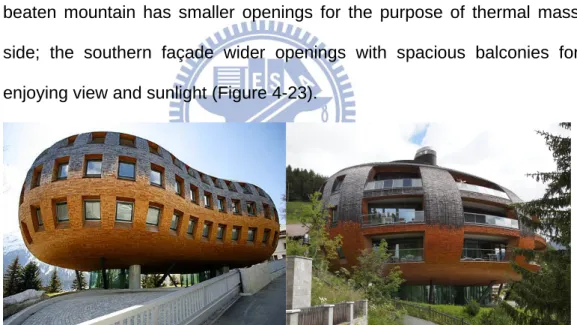
The Chesa Futura was designed by Norman Foster in 2004 in the Engadin Valley, Switzerland. Located along a slope, 1800 meters above sea level, the blob-form apartment is not only a combination of high-tech construction methods and traditional workmanship, but also environmentally-sensitive with the use of timber materials. The three-story building consists of six residential apartments and two stories for underground parking plus storage and planting, which accommodate the sloping site and the severe weather conditions through its sustainable timber superstructure and copper roof. With the conceptually simple yet complicated high-tech timber construction, Foster has struck a shingle-cladding shell by means of digital computation to arch a modern shape and to fulfil the purpose of environmental sustainability.
Figure 3-2. View of Chesa Futura
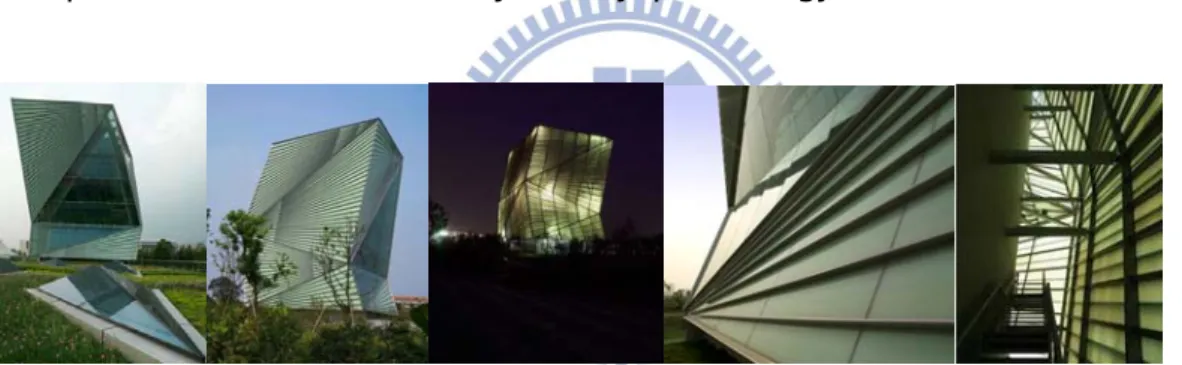
The Carbon Tower is an experimental project of a forty-story prototype skyscraper, designed by Peter Testa and Devyn Weiser from Emergent Design Group at MIT in 2005. The construction is known for its combination of new materials and computer intelligence, which generated the mass customization for its unique characteristics - the lightest and strongest building of its type. Although the tower has never been built, the evolution of composite materials, carbon fiber, Kevlar and fiberglass, are an innovation of deign thinking, which makes the construction technology of the high-rise building tangible and accessible. Replacing traditional construction techniques, the application of computer modeling tools has fostered the transformation of the building industry in the 2000s and allows cutting-edge experiments with new sustainable materials for more efficient energy saving (Knecht 2004).
Figure 3-3. Physical Models of Carbon Tower
Case 4: BMW WELT Munich
BMW Headquarters is a multi-functional BMW exhibition center, designed by architects Coop Himmelb[l]au in Munich, Germany (2007). This project was the winner of the BMW design competition not only because of its freeform façade, but its sustainable ventilation systems for intensive gas exhausting and release during car delivery. The building of BMW Welt Munich presents a computational
design that burnishes its luxury brand and exhibits the complexities of digital appearance, while precisely carrying out the sustainable details of the project.
Figure 3-4. View of BMW WELT Munich
Case 5: Whitney water purification facility and park
The Whitney water purification facility and park in Connecticut, also known as Silver Drop, was designed by Steven Holl in 2005. This project was honored by the Van Alen Institute International Projects in Public Architecture in 2001, AIA NY Honor Award in 2005, and AIA Environment Top Ten Green Projects in 2007. The construction plan features both water treatment facilities and a public park. In contrast to the complicated digital freeform of contemporary architectures, the water treatment facilities were built in a simple, curvilinear form and its roof garden is humbly integrated in harmony with the landscape of the public park. The environmental aspect of the complex design is to preserve and expand the existing wetland area where the site is located. The project also addresses the importance of water resources for sustainable development in general.
Figure 3-5. View ofWhitney Water Purification Facilities and Park
Zaragoza Bridge Pavilion was designed for the Zaragoza Expo 2009 by Zaha Hadid Architects. The Pavilion functioned as the exhibition halls and pedestrian bridge to cross the River Ebro. As the entrance of Expo 2008, the Zaragoza Bridge Pavilion connects the diamond shaped sections by four structural objects. The slightly curved shape of the Bridge Pavilion with the triangular truss pockets designed not only contains the space-frame structure for the pathway but also offers the spatial enclosures for exhibition halls. The bridge design maintains traditional nature and also involves technical innovations in digital technology of construction. The shark scales, shapes on the bridge surface, serve as sustainable, weather coping devices. The transformation of architectural form makes use of computing and energy-saving concepts, which makes possible a stiffer structure than the traditional ones. The complex structure of the Zaragoza Bridge Pavilion challenges cutting-edge construction techniques and technologies through which the engineering elements of the bridge and architectural elements of the pavilion are merged into one building typology (Hadid 2008). While bridge design is usually concerned more with structural engineering and function, the trend of freeform and sustainability in architecture is also presented in the design of the Zaragoza Bridge Pavilion.
Figure 3-6. View of Zaragoza Bridge Pavilion
The Centre for Sustainable Energy Technologies (CSET) was designed by Mario Cucinella Architects in 2009, and is the MIPIM Green Building Award winner. This new research centre, at the University of Nottingham Ningbo, is located in China, the world's second largest energy consumer. The purpose of this centre is for numbers of research laboratories to investigate sustainable technologies such as wind, solar power, and photovoltaic energy. The success of the building suggests a combination of digital freeform and innovative energy system has become an unstoppable trend in the sustainable development of architecture design. It also serves as a demonstration of sustainable construction techniques and promises an environmentally friendly, plus energy-efficient future.
Figure 3-7. View of CSET Building
Case 8: Japan Pavilion 2010
The Japan Pavilion is an energy efficient architecture with inflated lightweight structure, designed for the Shanghai Expo 2010 by Yuntaka Hikosaka. Thelarge- size building composes a large membrane roof with the materials of steel-framed ETFE film on the surface for sustainable purposes.Considering the air pollution and high temperature in Shanghai, the Pavilion’s Eco-Tube system showcases a new energy-efficient cooling technology as an experiment of downsizing
environmental loads in a building (Hikosaka 2011). The inflated structure, with the energy system of innovative ETFE pillow membrane, could be applied to any location and benefit in any kind of weather. Due to the light-weight and vertical structure, the Eco Tube becomes a protocol of low-energy consumption in construction (Nanami 2011).
Figure 3-8. View of Japan Pavilion 2010
Case 9: Haesley Nine Bridges
The Haesley Nine Bridges Golf Club House on Jeju Island, completed by Shigeru Ban in 2010, is a 16,000-square meter facility that consists of a main building, VIP lobby area, and private suites structure. The roof measures 36x72 meters over the main building, which is supported by timber columns and a glass curtain wall. Taking advantage of advanced technology in wooden weaving technique, Shigeru Ban highlights the prefabricated construction of Nine Bridges with advanced technology and the innovative aspects of reducing energy consumption by its structural timber structure. With a simplified assembly process for a wooden grid shell structure, the approach of modular components carries out the uniqueness of digital and yet sustainable features in its woven structure. The perforations on the tree-like columns and roof act as a solar screen for an efficient, passive, cooling system. Based on the advanced
technology for the elaborative timber structural simulation and calculation, the building brings the concept of freeform structure, digital techniques and sustainability in one.
Figure 3-9. View of Haesley Nine Bridges
Case 10: IBG and Tax offices
Awarded with the Dutch Building Prize, the project was designed by UN Studio, from 2007 to 2011, in the Netherlands. The IBG and Tax offices are a ninety-two meter high, massive office complex, designed for the Dutch federal tax services and college students’ grant system. The technical aerodynamic freeform façade and skeletal structure are constructed with ecological concerns and sustainability. Simulating airplane wings or a whale’s curving-top rib, the aluminium fin-shaped terraces provide sun shading, wind regulation, daylight penetration and fabrication to the building. This computational design of the building aims to apply its digital freeform innovation to environmental principles, which present an intelligent approach toward energy saving (Dumiak 2011). The success is made possible by its digital design process, the computerized construction techniques, and the innovation of sustainability.
Figure 3-10. View of IBG and Tax offices
3.2 Analysis Framework
In the original design process, five classic factors—detail/joint, material, object, structure, and construction—are categorized based on the classic theory of tectonics (Semper 1951; Botticher 1852; Sekler 1965; Frascari 1983; Gregotti 1983; Frascari 1983; Moneo 1988; Vallhonrat 1988; Frampton 1995 and Gao 2004). Other essential factors such as light, color, sound, temperature, ventilation, and material were suggested by Unwin, (2003) stressing the dialogue between architecture and the environment. In addition, Deplazes (2006) summarized four factors based on construction techniques—1) material, 2) boundary (such as transparent or translucent surface), 3) structure of tectonic (or non-tectonic), and 4) figuration. After rethinking the classic factors, Lim (2005) initiated a set of seven factors—namely: joint, detail, material, object, structure, construction and interaction (Semper 1951; Botticher 1852; Sekler 1965; Frascari 1983; Gregotti 1983; Frascari 1983; Moneo 1988; Vallhonrat 1988; Frampton 1995; Gao 2004; Liu and Lim 2005). With the digital design process and new methods of assembly, some of the classic factors were insufficient to merge with digital ones. To meet contemporary needs, these factors were reorganized to be more effective. Gao (2004) proposed five digital factors including concept, manipulation, construction,
form, and space, with four additional factors—motion, information, generation, and fabrication—suggested by Liu and Lim (2005).
By merging the digital design manipulation technique with green thinking, the new method of design process is different from the original expression of digital architectural manipulation. According to the HOK Guidebook to
Sustainable Design (Mendler, Odell and Lazrus 2006), the new perspective of
sustainable design factors were proposed as site, water efficiency, energy, materials, and environmental quality such as acoustics. Another set of sustainable factors suggested by Chan (2007) are site specificity, connection with habitat (namely environmental interface), conservation of resources, and the use of building materials. In addition, Ali and Armstrong (2008) concluded that site context, environment, structure, materials, energy, water are the principal factors in the contemporary sustainable design.
In considering the operation of sustainable factors, this study addresses the key areas of structure, building form (envelope), electrical power, technical principles (ventilation, heating, cooling, lighting, etc.), environment (water, waste, energy, noise), site (microclimate, green space) and material (Trotter 1892; Olgyay 1973; Hancock 1992; Fanchiotti 1995; Mak 1996). However, this analysis is not specifically concerned with purely sustainable mechanical issues, but rather addresses the new design process that integrates digital technology and sustainability.
An emerging concept of design framework was proposed by Liu in 2003. In the design process, the design outcome could vary due to different design