國 立 交 通 大 學
資訊管理研究所
博士論文
建立知識流程觀模式協助群體知識支援
Establishing Knowledge-Flow View Model for
Collaborative Knowledge Support
研究生: 林志偉
指導教授: 劉敦仁 博士
國 立 交 通 大 學
資訊管理研究所
博士論文
建立知識流程觀模式協助群體知識支援
Establishing Knowledge-Flow View Model for
Collaborative Knowledge Support
研究生: 林志偉
研究指導委員會: 李瑞庭 博士
許秉瑜 博士
陳安斌 博士
楊千 博士
指導教授: 劉敦仁 博士
中華民國ㄧOㄧ年六月
建立知識流程觀模式協助群體知識支援
Establishing Knowledge-Flow View Model for
Collaborative Knowledge Support
研究生 :林志偉
Student:Chih-Wei Lin
指導教授:劉敦仁
Advisor:Dr. Duen-Ren Liu
國立交通大學
資訊管理研究所
博士論文
A Dissertation
Submitted to Institute of Information Management
College of Management
National Chiao Tung University
in Partial Fulfillment of the Requirements
for the Degree of
Doctor of Philosophy
in
Information Management
June 2012
Hsinchu, Taiwan, Republic of China
i
建立知識流程觀模式協助群體知識支援
研究生: 林志偉 指導教授: 劉敦仁 博士 國立交通大學資訊管理研究所摘要
在知識密集的工作環境中,有效地提供工作者所需的知識文件,以協助其工作執 行,是知識管理領域中的重要議題。從知識需求的角度分析,知識流代表個別與群體 知識工作者在執行工作時,其知識需求與知識參考行為的脈絡。組織運用知識流,可 有系統的將工作者的知識需求作精確的表示,亦可有效地藉此運作組織的知識支援體 系。然而,在群體合作的環境下,不同工作者依其任務特性或扮演角色的不同,常有 不同的知識需求。目前已知的知識流研究,大多只提供單一知識流讓工作者參考,並 未考量知識流在團隊合作中的適用性。 本研究提出『知識流程觀』模式,以有效改善知識流研究之不足。此一知識流程 觀模式,以知識流為基礎,將工作特性及個別角色納入考量,使不同的工作者對同一 知識流可有不同的虛擬知識流來滿足其知識需求。 首先,以知識本體論作為知識流中知識節點抽象化的基礎,來建構基礎知識流, 從而系統性的表達工作者的知識需求。 在基礎知識流之上,本研究建構知識流程觀模式並進行理論探討。知識流程觀主 要是將基礎知識流中的部分知識節點,依照工作特性的知識需求,進行知識概念的歸 納抽象化,以產生虛擬知識節點,並進而產生符合工作者知識需求的虛擬知識流。 為了探討工作者在不同角色時的知識需求,本研究亦提出,『以角色為基礎的知 識流程觀』模式,利用角色與知識節點的相關度來產生虛擬知識節點,及分析角色所 需知識概念層級與工作應有知識概念層級來推算角色知識需求。ii
知識流程觀與虛擬知識流是一個創新概念與理論模式,不但可擴展知識流的研究 理論,對於組織的知識管理,特別是合作型知識支援的推展具有創新與實務的貢獻。 關鍵詞:知識流、知識流程觀、虛擬知識流程、合作型知識支援、知識管理
iii
Establishing Knowledge-Flow View Model for Collaborative
Knowledge Support
Student: Chih-Wei Lin Advisor: Dr. Duen-Ren Liu
Institute of Information Management National Chiao Tung University
Abstract
In knowledge-intensive working environments, workers need task-relevant knowledge and documents to support their task performance. Thus, how to effectively fulfill workers’ knowledge-needs is an important issue in realizing knowledge management in organizations. From a knowledge-needs perspective, a knowledge flow (KF) represents a flow of individual’s or group members’ knowledge-needs and referencing behavior of codified knowledge in conducting tasks. The flow has been utilized to facilitate organizational knowledge support by illustrating workers’ knowledge-needs systematically and precisely. However, conventional knowledge-flow models cannot work well in cooperative teams, which team members usually have diverse knowledge-needs in terms of task functions and roles. The reason is that those conventional models only provide one single view to all participants and do not reflect individual knowledge-needs in teams.
Hence, the novel concepts and theoretical model of knowledge flow view (KFV) are proposed in this dissertation. The KFV model builds virtual knowledge flows derived from a base KF to provide abstracted knowledge to serve different workers’ knowledge-needs from task function and role perspectives.
This dissertation uses domain ontology as the base of knowledge node abstraction. Hence, base knowledge flows are built to represent workers’ knowledge-needs systematically. Based on the base knowledge flows, a theoretical model of KFV is investigated and developed for discovering virtual knowledge nodes and virtual knowledge
iv
flows. The KFV model abstracts the knowledge nodes of partial base knowledge flow to generate virtual knowledge nodes according to task functions, through knowledge concept induction and generalization.
In addition, this dissertation proposes a role-based KFV model to investigate different knowledge-needs of distinct roles. The model exploits the relevance degrees between roles and knowledge nodes to derive virtual knowledge nodes and analyzes roles’ required knowledge concept level and operation required knowledge concept level to derive knowledge concepts of virtual knowledge nodes.
The models of KFV and the concept of virtual knowledge flow are innovative, which extends the scope of knowledge flow research and enhances the efficiency of cooperative knowledge support in organizations.
Keyword: knowledge flow, knowledge-flow view, virtual knowledge flow, cooperative
v
To my lovely family:
Dad & Mom June, my dear wife
vi
Acknowledgement
This dissertation would not have been possible without the guidance and the support of several individuals who in one way or another contributed and extended their valuable assistance in the preparation and completion of this study.
First of all, I would like to express my sincere appreciation to my advisor, Dr. Duen-Ren Liu, for his generous encouragement and constructive inspiration to my PhD study. Special thanks are also given to Professor Anthony J.T. Lee, Professor Ping-Yu Hsu, Professor An-Pin Chen, and Professor Chyan Yang for providing comments to improve my dissertation and serving on my dissertation committee.
Members of Database and Information System Lab also deserve my sincerest thanks, their friendship and assistance has meant more to me than I could ever express.
Special thanks go to my managers and colleagues in tsmc: Ted Sun, T. W. Kuo, Joseph Liao, Roger Lin, Ken Chen, Frank Sung and R. M. Wang for their understanding and inspiration when I was a part-time PhD student.
Last, but not the least, I wish to extend my special and sincere thanks to my parents, my wife, June and my children, Steven and Selina, for their love during my study.
Jacky C. W. Lin 2012. 6. 30
vii
Table of Contents
摘要 ... i
Abstract ... iii
Acknowledgement ... vi
Table of Contents ... vii
List of Figures ... ix List of Definitions ... xi Chapter 1 Introduction ... 1 1.1 Motivation ... 1 1.2 Goals ... 2 1.3 Approaches ... 3 1.4 Contributions ... 5 1.5 Organization ... 6
Chapter 2 Related work ... 8
2.1 Knowledge management and knowledge support ... 8
2.2 Knowledge flow ... 9
2.3 Knowledge-based planning ... 10
2.4 Ontology ... 11
2.5 Process and process-view ... 12
Chapter 3 Base knowledge flow model ... 14
3.1 A motivation example of base knowledge flow... 14
3.2 Define base knowledge flow model ... 15
3.3 Discussion ... 20
Chapter 4 Knowledge-flow view model ... 22
4.1 Virtual knowledge flow: abstracted form of base knowledge flow ... 22
4.2 The formal framework of the knowledge-flow view (KFV) model ... 25
4.3 An order-preserving approach for deriving a knowledge- flow view ... 28
viii
4.4.1 Discovering the minimum expanding knowledge node set ... 29
4.4.2 Discovering virtual dependencies ... 33
4.4.3 Deriving knowledge concepts of a virtual knowledge node... 33
4.5 Case illustration and analysis ... 35
4.6 Discussion ... 41
Chapter 5 Role-based knowledge-flow view model ... 43
5.1 Concepts of role-based virtual knowledge flows ... 43
5.2 A role-based framework... 45
5.2.1 Construction of role-operation relevance profile... 48
5.2.2 Evaluation of role-knowledge node relevance ... 49
5.3 Procedures for deriving role-based virtual knowledge flows ... 49
5.3.1 Identifying role-based virtual knowledge nodes ... 49
5.3.2 Deriving Knowledge Concepts of Virtual Knowledge Nodes ... 51
5.4 Designing a role-based KFV system ... 54
5.5 Case illustration and analysis ... 57
5.6 Discussion ... 61
Chapter 6 Conclusions ... 63
6.1 Summary ... 63
6.2 Limitations and future work ... 64
ix
List of Figures
Figure 1. Research framework. ... 6
Figure 2. Mobile phone development process. ... 14
Figure 3. Base KF of the mobile phone development process. ... 15
Figure 4. Domain ontology of mobile phone development. ... 17
Figure 5. Domain ontology with lattice structure ... 19
Figure 6. A virtual KF for project managers. ... 23
Figure 7. Illustrative examples of base KF and virtual KF. ... 25
Figure 8. Knowledge-flow view model. ... 28
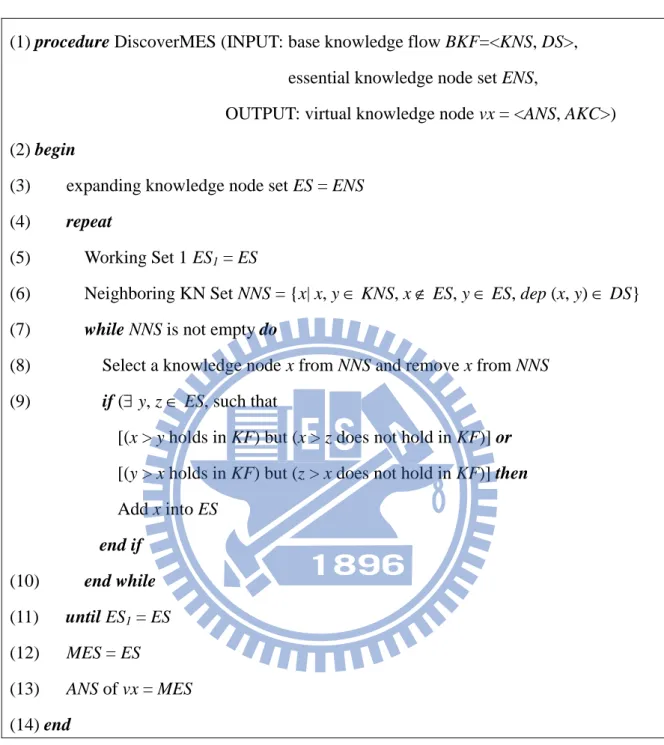
Figure 9. Procedure for discovering the minimum expanding knowledge node set, MES.. 32
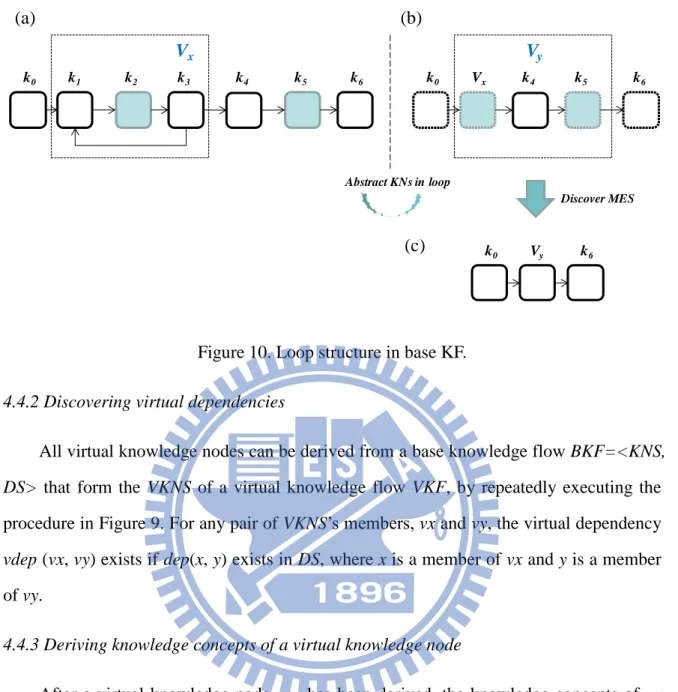
Figure 10. Loop structure in base KF. ... 33
Figure 11. Procedure for deriving knowledge concepts of a virtual knowledge node. ... 35
Figure 12. Base KF for sourcing planners (nodes k2 and k4 are essential KNs). ... 37
Figure 13. A virtual KN, vk1, obtained after applying order-preserving approach. ... 38
Figure 14. A partial domain ontology of mobile phone development. ... 38
Figure 15. Knowledge concepts of vk1 after applying the minimum generalization policy.39 Figure 16. Knowledge concepts of vk1 after removing implied knowledge concept. ... 40
Figure 17. Partial domain ontology with knowledge categories and concept levels. ... 46
Figure 18. A role-based framework with examples. ... 48
Figure 19. Procedure for identifying role-based virtual KNs. ... 51
Figure 20. Illustration example of deriving knowledge concepts for a virtual KN. ... 53
Figure 21. System architecture of the role-based KFV system. ... 54
x
Figure 23. An ontology prototype... 57
Figure 24. Relevance degrees between role r and base knowledge nodes. ... 58
Figure 25. Virtual KNs and their relevance degrees when TH=0.4. ... 59
Figure 26. Partial knowledge categories of Marketing and Hardware Design. ... 60
Figure 27. Information of sourcing department manager role... 61
xi
List of Definitions
Definition 1: Domain ontology ... 16
Definition 2: Base knowledge node... 19
Definition 3: Dependency ... 19
Definition 4: Base knowledge flow ... 19
Definition 5: Neighboring ... 19
Definition 6: Path ... 20
Definition 7: Ordering relation ... 20
Definition 8: Concealing criteria ... 25
Definition 9: Virtual knowledge node ... 26
Definition 10: Virtual dependency ... 27
Definition 11: Virtual knowledge flow ... 27
Definition 12: Virtual path ... 27
Definition 13: Virtual ordering relation ... 27
Definition 14: Essential knowledge node ... 30
Definition 15: Minimum expanding knowledge node set, MES ... 30
Definition 16: Implied concept ... 35
Definition 17: Concept level, CL ... 44
Definition 18: Base knowledge node profile ... 46
Definition 19: Role-operation relevance profile ... 46
Definition 20: Operation required knowledge concept profile ... 46
Definition 21: Role-operation knowledge requirement degree profile ... 47
1
Chapter 1 Introduction
1.1 Motivation
In a knowledge-based organization, knowledge workers need to acquire a variety of knowledge (information) about their tasks [14]. Therefore, many organizations have built knowledge support platforms to assist workers in meeting their knowledge-needs. These platforms help workers to identify and share knowledge in order to speed up organization innovation and improve employee productivity [11, 25]. Studies on formulating knowledge-needs and streamlining knowledge provision are becoming more prevalent as the value of knowledge support keeps increasing [2, 38, 43, 49, 62-63].
The fast pace of technology evolution and the short cycle time for solving problems in current knowledge intensive environments has led to an emphasis on teamwork [16, 22]. For example, R&D activities often consist of many knowledge-intensive tasks that must be completed within a limited time period. These tasks are usually conducted through cross-function collaboration. By integrating the expertise and perspectives of various individuals, teams can quickly respond to interdisciplinary problems and enhance decision quality, thus providing a holistic solution. However, due to their individual task functions and roles, many team members have different knowledge-needs; as a result, they may expend considerable effort in seeking and synthesizing knowledge to obtain the required task-relevant knowledge [47, 65]. Reducing this expenditure of effort is one of the main challenges of collaborative knowledge support.
By mapping knowledge flows, organizations can provide task-relevant knowledge to workers that help them fulfill their knowledge-needs quickly and effectively [28]. A knowledge flow (KF) represents the flow of an individual’s or group members’ knowledge-needs and the referencing sequence of codified knowledge in conducting organizational tasks. Knowledge flows are an emerging topic of investigation in the knowledge management research field, and several studies have built knowledge flow models to illustrate knowledge sharing among knowledge workers [25, 29, 33, 40, 42,
2
69-72]. For example, researchers in scientific fields who propose new ideas through content publishing form a knowledge flow in science [71]. The known ideas in one paper inspire new ideas for other researchers, and the established relationships or links generate a citation chain. Some studies have addressed knowledge sharing by defining the process in which knowledge is transferred from one team member to another [69-70, 72]. Other researchers have focused on discovering knowledge flows by analyzing workers’ knowledge-needs; the results have contributed to knowledge sharing in which the codified knowledge becomes available for recommendations to workers [28]. The shortcoming of these studies, however, is that the conventional models provide the same knowledge support to all team members; in other words, they do not consider the individual knowledge-needs that arise in a collaborative environment.
This dissertation proposes a novel knowledge-flow view (KFV) concept to consider workers’ knowledge-needs from different aspects, and demonstrates the benefits a cooperative team can receive while adopting them. The novel KFV models not only re-innovate conventional knowledge flow models but also enhance the efficiency of knowledge flow usage, as well as the effectiveness of knowledge sharing and knowledge support in teamwork environments.
1.2 Goals
Driven by the motivation, the dissertation aims to develop the models of knowledge-flow view to facilitate collaborative knowledge support, which fulfills teammates’ knowledge-needs from various aspects. Major goals of this work are listed below.
-Theoretically model base knowledge flows by adopting domain ontology to formulate knowledge-needs precisely.
-Develop an essential knowledge-flow view (KFV) model to derive virtual knowledge flows from a base knowledge flow in terms of task functions.
3
addressing the relationships among roles, operations and knowledge requirements.
-Supply team participants with knowledge at required granularity to support task performance and team communication.
1.3 Approaches
This work extends previous knowledge flow research by exploring how to enhance conventional knowledge flow models to satisfy workers’ different knowledge-needs in teamwork environments. The challenges in a collaborative team are considerable and they pose many barriers to knowledge flows [31, 48]. Two of these barriers are low effectiveness and poor communication. Team members require different conceptual levels of knowledge to perform tasks and communicate with each other. For example, workers need specific knowledge to perform their tasks and general knowledge to communicate with other workers whose tasks or roles differ from their own. Effectively making collaborative knowledge provision at both specific level and general level is the key to team performance and productivities.
To formulate knowledge-needs precisely and model knowledge flows formally, this work first proposes a base knowledge flow (BKF) model which adopts domain ontology to describe knowledge-needs by the composition of knowledge concepts. According to the BKF model, a knowledge flow designer (KF designer) may either consult domain experts or investigate workers’ document access logs to identify participants’ knowledge-needs. Thus, the collection of knowledge-needs and the order of referencing sequences would be used to construct base knowledge flows, which represent the knowledge-needs of participants by knowledge concepts.
In addition, since the BKF model does not consider personalized requirements and provides only one single view of a base knowledge flow, this would impact the effectiveness of knowledge provision while applying it in collaborative environments. Therefore, by considering the different conceptual levels of knowledge in illustrating individual knowledge-needs, this work establishes an essential knowledge-flow view (KFV)
4
model that aims to generalize knowledge concepts and derive virtual knowledge flows mainly from a task function perspective; as such, the essential KFV model would be capable of serving individuals’ knowledge-needs. A similar concept exists in database management systems, where administrators generate virtual database views from a base table to serve different purposes. A virtual knowledge flow (virtual KF) is derived dynamically from a base knowledge flow (base KF) according to the essential model which is employed to abstract knowledge concepts. The novel essential KFV model uses an order-preserving approach and a knowledge concept generalization mechanism to abstract some base knowledge nodes in a base KF, thus generating virtual knowledge nodes that correspond to the individual knowledge-needs of different workers [34].
Last, in real practice, tasks are often assigned to dedicated roles to ensure quality and security. Therefore, if a task involves teamwork, workers’ knowledge-needs will vary, depending on the roles they play [30]. For example, in a computer manufacturing company, a role of engineering is responsible for product development and another role of marketing designs strategies to launch and promotes new products. In this scenario, the engineering role needs a specific level of technical knowledge, but the marketing role only needs a general level of such technical knowledge to communicate with engineers. Thus, a role-based knowledge-flow view (r-KFV) model is required in the context, which includes the aspect of roles to apply knowledge management applications in teams [27]. The r-KFV model analyzes the conceptual levels of knowledge required by workers based on their roles, and develops role-based knowledge flow abstraction methods that generate virtual knowledge nodes to provide the appropriate level of knowledge for each role.
To investigate the feasibility of the proposed BKF and KFV models, a preliminary analysis was conducted. A case of mobile phone development and system design-related documents were illustrated and provided to several professionals to ask for their opinions about the feasibility of the proposed models from a practical perspective. Overall, there was general agreement with the feasibility of the KFV models. The agreement, to some extent, validates the feasibility of the approaches.
5
In summary, this work addresses an important extension of knowledge flow research. It considers a phenomenon that workers in teams usually have different knowledge-needs for task execution and team communication in terms of roles and task functions. The concept of knowledge-flow view and related models are proposed to support such knowledge-needs in teamwork environments.
1.4 Contributions
For a new discipline or a new research topic, theoretical papers are required to explore the basic theory by illustrating term definitions and establishing relationships between concepts [13, 19]. Thus, in order to explore the new topic – knowledge-flow view, this work is targeted as a theoretical research to establish BKF model, essential KFV model and r-KFV model for extending knowledge flow research in cooperative teams for organizational knowledge support.
This dissertation contributes to knowledge management development, first by showing how a knowledge flow can address knowledge-needs. The previous studies are lacking in illustrating knowledge flows in terms of workers’ knowledge-needs. The proposed BKF model fills this gap and helps researchers to obtain a clear view of knowledge flow research.
Additionally, this study investigates the shortage of knowledge support in collaborative teams because the workers in a team usually have different knowledge-needs according to their task functions. The essential KFV model is proposed to address the shortage. According to the essential KFV model, KF designers generate virtual knowledge flows that conceal confidential or detailed information base on workers’ task functions. Through an order-preserving approach and a knowledge concept generalization mechanism, the virtual knowledge flows not only comply with organizational information security policy but also reflect the granularity of knowledge-needs. Thus, the essential KFV model can advance the applicability of knowledge flow research to cooperative knowledge support environments.
6
The r-KFV model examines workers’ knowledge-needs in terms of their roles. The role represents a duty or a job position with the authority and responsibility to perform certain jobs within a team. So, it is essential to conduct knowledge provision in teams from a roles perspective. The r-KFV model design a kernel approach to derive role-based virtual knowledge flows from a base knowledge flow in role and operation perspectives. Based on role-operation knowledge requirement, the r-KFV model accurately illustrates roles’ knowledge-needs and effectively facilitates knowledge concept abstraction. It is an originative study of roles to address an important extension of knowledge flow research.
This work facilitates collaboration in teams by effective knowledge support. The innovative concept of knowledge-flow view and the proposed theoretical models can enhance the scope of knowledge flow research. In addition, this work also improves the efficiency of knowledge flowing, as well as the effectiveness of knowledge sharing and knowledge support in organizations.
1.5 Organization
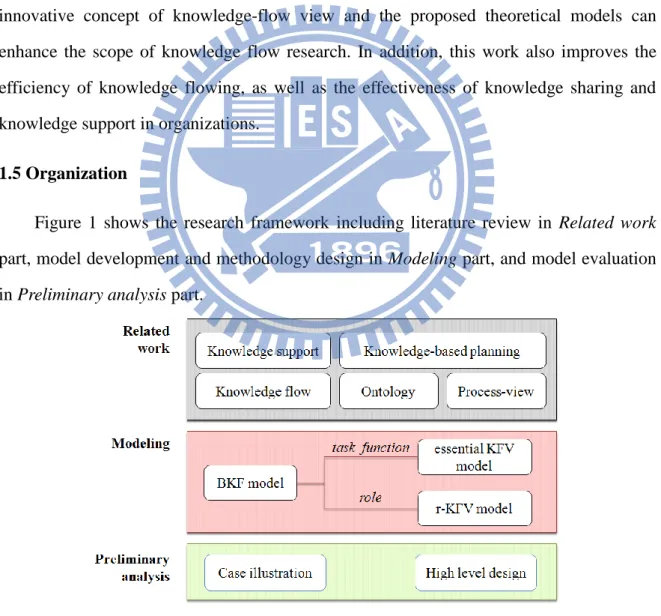
Figure 1 shows the research framework including literature review in Related work part, model development and methodology design in Modeling part, and model evaluation in Preliminary analysis part.
Figure 1. Research framework.
7
related work. Chapter 3 builds a formal base knowledge flow (BKF) model. Chapter 4 defines and analyzes an essential knowledge-flow view (KFV) model. The algorithms to generalize knowledge concepts and derive virtual knowledge flows are described. Chapter 5 discusses the concepts of role-based knowledge-flow view (r-KFV) model and the methods of generating role-based virtual knowledge flows. Conclusions and future work are made in Chapter 6.
8
Chapter 2 Related work
This chapter provides a brief summary of related research: knowledge management and knowledge support, knowledge flow, knowledge-based planning, ontology, process and process-view.
2.1 Knowledge management and knowledge support
Knowledge is one of the key assets to ensure sustained competitive advantage in the highly technological and global environment of modern organizations [21, 32, 50, 59]. To achieve success in this environment, workers need to effectively apply knowledge to conduct knowledge-intensive operations and management activities [9, 38, 70].
Knowledge management (KM) supplies the principles of creation, organization, transfer and application of the knowledge within organizations [26] and is recognized as a crucial practice for enabling organizations to survive in a knowledge economy era [64]. One purpose of KM is to support workers in fulfilling their knowledge-needs, by bridging the gap between workers’ knowledge and the requirements of tasks [2, 58, 63]. Studies have shown that precise and timely knowledge support is an important mechanism for increasing both productivity and work effectiveness [28, 38].
In a task-based business environment, tasks are conducted in work processes. The effective provision of task-relevant knowledge and context information is crucial to increasing workers’ productivity. To meet this provision, integration solutions of information retrieval (IR) and workflow management systems (WfMS) have been developed. These solutions proactively deliver task-relevant knowledge according to the context of tasks [1, 43]. For example, the KnowMore system derives task profiles from process definitions that facilitate knowledge provision [1]. The Flow-Wiki system was developed by a wiki-based approach for agilely managing workflows and effectively providing relevant information to participators [24]. In this way, process participants can obtain knowledge that pertains to task profiles and/or the execution context of the current process.
9
Liu et al. [62-63] proposed a task-based K-support system that provides knowledge to adaptively meet a worker’s dynamic information needs by analyzing his/her access behavior and relevance feedback on documents. Furthermore, because of the nature of teamwork, a collaborative mechanism is essential for establishing knowledge management systems [4, 67].
2.2 Knowledge flow
Knowledge flow research focuses on how knowledge flows transmit, share and accumulate knowledge in a team. In a workflow situation, working knowledge may flow among workers, while process knowledge may flow among various tasks [70, 72-73]. Thus, the knowledge flow reflects the level of knowledge cooperation between workers or processes, and influences the effectiveness of teamwork or workflow.
To fulfill workers’ knowledge-needs, knowledge flows provide links among knowledge sources. Through knowledge flows, workers can effectively obtain knowledge from these sources to execute tasks [25]. Knowledge flows illustrate the sequence of knowledge-needs and/or the order of referring documents when workers perform tasks. Knowledge flows can facilitate knowledge sharing and reuse in both business and research environments. For example, Zhuge [70] illustrated a knowledge flow within a software development team of a distributed organization. Here, the knowledge flow carried and gathered knowledge from one team member to another for sequential knowledge sharing. Similar knowledge sharing can take place in a citation chain where knowledge is transferred among scientific researches. In this context, the citation chain of papers is a knowledge flow that disseminates knowledge among scientists and inspires new ideas [71].
Several knowledge flow models have been built in recent researches. Luo et al. [40] modeled a Textual Knowledge Flow (TKF) from a semantic link network. The purpose of the TKF was to recommend proper browsing paths to users after evaluating their interests and inputs. Lai and Liu [28] constructed a time-ordering knowledge flow model to illustrate the sequence of workers’ knowledge referencing behaviors. In this model,
10
workers obtained proper knowledge to fulfill their knowledge-needs through the knowledge flows discovered in document access logs. Kim et al. [25] proposed a knowledge flow model using a process-oriented approach to capture, store and transfer knowledge. Zhang et al. [66] used Petri-Net to model a knowledge flow. In this model, a knowledge node was used to generate, learn, process, understand, synthesize and deliver knowledge based on four types of flow relations: creation, merging, replication and broadcasting. Zhao and Dai [68] integrated business processes and knowledge flows and divided knowledge flows into sequence, distribution, combination and self-reflection patterns based on RAD (role-activity-diagram) model. Finally, Anjewierden et al. [5] suggested that the referencing sequence in weblogs may be regarded as a knowledge flow and can be described as a sender-message-receiver model.
2.3 Knowledge-based planning
Both knowledge flow and knowledge-based planning prompt similar ideas about embedding knowledge while building models. Knowledge-based planning is a planning methodology used to identify a sequence of tasks executed by one or more agents under given initial conditions and resource constrains to achieve final goals [6]. The methodology involves knowledge acquisition, knowledge validation and knowledge maintenance of planning domains, and adopts appropriate knowledge-based planning tools to build planning models [6]. For example, R-Moreno et al. [46] successfully utilized a planning and scheduling system as well as a workflow modeling tool to plan a telephone installation workflow model. The workflow modeling tool was used to acquire relevant knowledge, such as initial conditions, resource constrains and final goals; then the planning and scheduling system was used to convert the knowledge into planning standard expressions. A knowledge-based planning system can also be employed to manage the result of planned tasks for the purpose of fulfilling other tasks’ preconditions. Chow et al. [12], for example, proposed a strategic knowledge-based planning system (SKPS) that combined knowledge rules with mathematical models to formulate co-loading shipment plans. Through SKPS, shipment planners could acquire, validate and maintain knowledge
11
of the shipment domain, and thus build a co-loading shipment planning model so that executors could utilize the knowledge in the model to perform tasks efficiently.
As the above examples demonstrate, knowledge-based planning focuses on building planning models for problem solving or task execution. Knowledge flow research contributes to the building of knowledge flow models for corresponding task execution plans (or workflow processes) that support knowledge provision, sharing and transferring [28, 70]. Knowledge flows can be either derived by mining workers’ access logs [28] or specified by KF designers according to their experience in executing the corresponding workflow process [69, 72]. Besides these two methods of deriving knowledge flows, knowledge-based planning tools can complement knowledge flow research by helping designers build the appropriate knowledge flows that correspond to task execution plans.
2.4 Ontology
Ontology is a widely accepted approach for capturing and representing knowledge possessed by an organization [44, 54]. It is a conceptualization mechanism that defines knowledge concepts in a specific domain and constructs a hierarchical structure to describe their inter-relationships [18]. Ontology can promote a common understanding throughout a whole organization to facilitate knowledge storage, retrieval and synthesis [45]. For example, the common terminologies and knowledge concepts in ontology can improve the problem-solving capability and efficiency within a supply chain [7]. Another example of ontology pertains to the knowledge concepts derived from Wikipedia articles and categories, which can be used to predict the contents of documents [55].Weng and Chang [60] proposed a research document recommendation system which exploited ontology to construct user profiles, and utilized the profiles to illustrate researchers’ interests. Afacan and Demirkan [3] developed an ontology-based universal design support system to support designers in the conceptual design phase; it adopts ontologies to process and represent required knowledge. As the above examples illustrate, ontology is a versatile paradigm that can be applied in many domains.
12
Building ontology is an evolving process and involves many techniques and tools to facilitate the whole process. Obviously, the construction process would include an evaluation and feedback mechanism to gradually improve ontology quality and obtain common understanding in organizations [29, 45, 56]. For example, Uschold and King [57] proposed a skeletal methodology to build an enterprise ontology; it comprises four phases: scoping, building, evaluating and documenting. Du et al. [15] designed a six-phase process that includes the preparation, transformation, clustering, recognition, refinement and revision for extracting ontology from unstructured HTML pages. Therefore, involving users in the evaluation or refinement phase is essential for gradually adjusting the quality of ontology. Many ontology-building tools, such as Protégé, OntoEdit and SNet-Builder, can effectively support the ontology construction process to serve predefined purposes and meet users’ requirements [10, 44].
2.5 Process and process-view
Recently, business process modeling has been rapidly applied to streamline business administration and to facilitate cooperation among enterprises. Business process modeling refers to the design, analysis and execution of business processes [20]. Its goals are to describe a set of activities that can be performed in sequence, and to allocate resources and arrange jobs optimally by analyzing the organizational and technical environments [61]. By employing appropriate modeling tools, business process modeling can provide pre-defined templates that allow enterprises to enact their business processes in an effective and efficient manner.
In an industrial environment, processes describe the flows of business operations. Workflow management systems are definition and execution tools that support these operations [45]. In practice, participants involved in a workflow need a flexible workflow model capable of providing appropriate process information [2, 36]. Because of the increasing complexity of business processes and the variety of participants, it is beneficial for organizations to define virtual processes with different views of the workflow [8, 17, 36, 52]. Liu and Shen [36] presented a novel concept of process abstraction: the process-view.
13
A process-view is an abstracted process derived from a base process to provide generalized process information. The process-view is generated by an order-preserving approach, which ensures that the original order of the activities in the base process is preserved. Under the process-view concept, a WfMS can provide various views of a process for different participants within an organization or cross organizations [37]. Shen and Liu [53] proposed a role-based approach to discover role-relevant process views for different workflow participants. The role-based approach generates process view automatically, based on the relevance degrees between roles and tasks. This work adopts similar ideas to generate virtual knowledge flows from a base knowledge flow, while retaining the knowledge referencing order.
14 Hardware Design Major Parts Identification Verification Business Analysis Application Design Parts Sourcing Industrial Design Platform Setup Commercialization
Chapter 3 Base knowledge flow model
In cooperative working environments, a base knowledge flow (base KF) represents the flow of team members’ knowledge-needs and the referencing sequence of codified knowledge that workers need while conducting business processes or research tasks. To formulate knowledge-needs precisely and model knowledge flows formally, this chapter illustrates a base knowledge flow (BKF) model which adopts domain ontology to describe knowledge-needs by a composition of knowledge concepts.
3.1 A motivation example of base knowledge flow
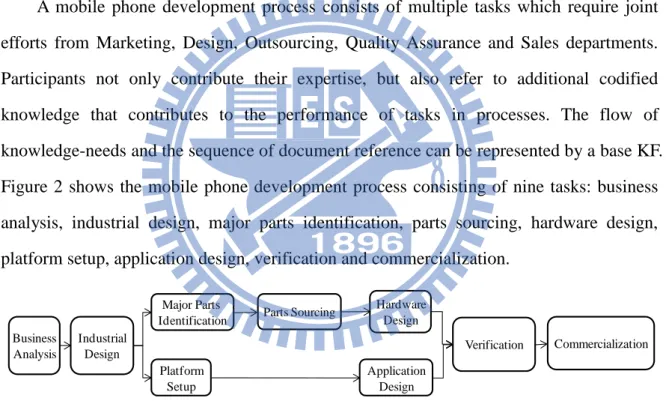
A mobile phone development process consists of multiple tasks which require joint efforts from Marketing, Design, Outsourcing, Quality Assurance and Sales departments. Participants not only contribute their expertise, but also refer to additional codified knowledge that contributes to the performance of tasks in processes. The flow of knowledge-needs and the sequence of document reference can be represented by a base KF. Figure 2 shows the mobile phone development process consisting of nine tasks: business analysis, industrial design, major parts identification, parts sourcing, hardware design, platform setup, application design, verification and commercialization.
Figure 2. Mobile phone development process.
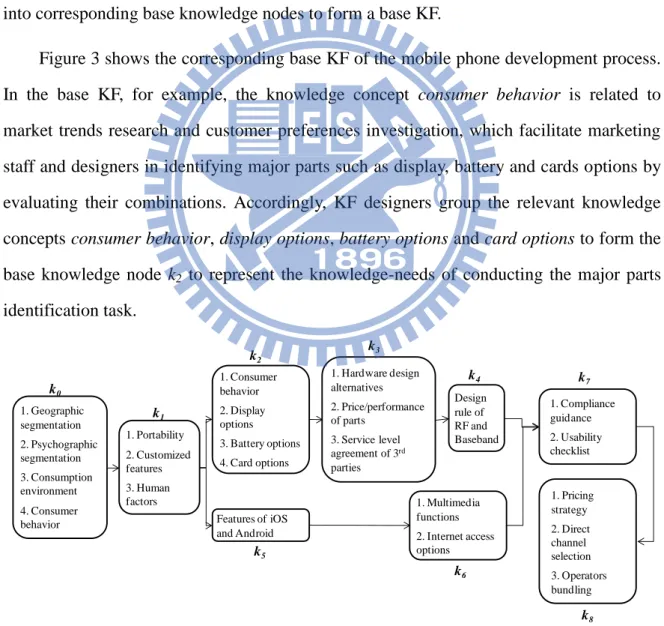
In the above process, team members may have the knowledge-needs of marketing segmentation and consumer analysis while conducting the business analysis task. The knowledge concepts relevant to the knowledge-needs include: geographic segmentation, psychographic segmentation, consumption environment, and consumer behavior. Knowledge flow designers (KF designers) put these knowledge concepts into a base knowledge node to represent the knowledge-needs of the business analysis task. In
15 k3 Design rule of RF and Baseband 1. Consumer behavior 2. Display options 3. Battery options 4. Card options 1. Compliance guidance 2. Usability checklist 1. Geographic segmentation 2. Psychographic segmentation 3. Consumption environment 4. Consumer behavior 1. Multimedia functions 2. Internet access options 1. Hardware design alternatives 2. Price/performance of parts 3. Service level agreement of 3rd parties 1. Portability 2. Customized features 3. Human factors Features of iOS and Android 1. Pricing strategy 2. Direct channel selection 3. Operators bundling k0 k1 k2 k4 k5 k6 k7 k8
addition, the team members may also have the knowledge-needs of accessing two related knowledge concepts: compliance guidance and usability checklist, while performing the verification task [23]. The knowledge of how to build base KFs is derived from structured interviews and workshops [25], system event logs [28], as well as the content of tasks. For example, in investigating the whole business process, KF designers rely on their experience [69, 72], interviews of domain experts [25], and/or the analyses of workers’ document access logs [28, 33] to collect knowledge-needs on a task-by-task basis. These knowledge-needs are illustrated by knowledge concepts which are identified by domain ontology. By using domain ontology, KF designers group relevant knowledge concepts into corresponding base knowledge nodes to form a base KF.
Figure 3 shows the corresponding base KF of the mobile phone development process. In the base KF, for example, the knowledge concept consumer behavior is related to market trends research and customer preferences investigation, which facilitate marketing staff and designers in identifying major parts such as display, battery and cards options by evaluating their combinations. Accordingly, KF designers group the relevant knowledge concepts consumer behavior, display options, battery options and card options to form the base knowledge node k2 to represent the knowledge-needs of conducting the major parts
identification task.
Figure 3. Base KF of the mobile phone development process.
16
This section formally defines domain ontology and base KF for the purpose of building a theoretical BKF model. Definition 1 models domain ontology, which is the infrastructure for sharing knowledge concepts throughout the whole organization. Definition 2 – Definition 7 formulate the BKF model.
Definition 1: Domain ontology
Ontology is constructed to define knowledge concepts and their hierarchical relationships in a domain.
Ontology is defined as O = <C, HR>, where C is a set of knowledge concepts derived from a specific domain. HR is a set of hierarchical relations which define the parent-child relationships among knowledge concepts in C, and HR is formally expressed by HR = {hr | hr C × C}.
For two knowledge concepts, x and y, if x has a downward link to y (or y has an upward link to x) in an ontology, then x is the parent concept of y and y is the child concept of x. Two semantic relations, Generalization and Specialization, are used to describe the relative conceptual level of two knowledge concepts. Relations between the parent concept x and the child concept y are formally expressed by Specialization (x) = {y | y is a child concept of x} and Generalization(y) = {x | x is a parent concept of y}.
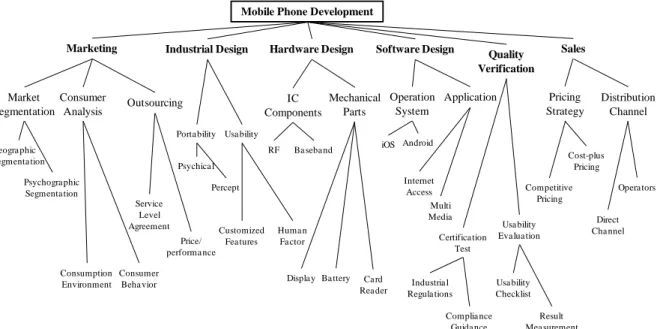
Figure 4 shows an example of the domain ontology in the mobile phone development domain. The root of the ontology is mobile phone development. It represents the most general knowledge concept, as indicated also by R&D strategy and the product development guideline. Six subconcepts, marketing, industrial design, hardware design, software design, quality verification and sales appear under mobile phone development. Likewise, market segmentation, consumer analysis and outsourcing are the subconcepts of marketing. Hence, Specialization (marketing) = {market segmentation, consumer analysis, outsourcing} and Generalization (market segmentation) = {marketing}.
17 Pricing Strategy Distribution Channel Consumer Beha vior Consumption Environment Usa bility Porta bility RF Ba seba nd Displa y Ca rd Rea der Ba ttery Internet Access Multi Media Marketing
Mobile Phone Development
Industrial Design Hardware Design Software Design
Consumer Analysis Sales Psychica l Percept Customized Fea tures Huma n Fa ctor IC Components Mechanical Parts Operation System iOS Android Application Outsourcing Service Level Agreement Price/ performa nce Psychogra phic Segmenta tion Market Segmentation Geogra phic Segmenta tion Competitive Pricing Cost-plus Pricing Direct Cha nnel Opera tors Quality Verification Certifica tion Test Usa bility Eva lua tion
Complia nce Guida nce Industria l Regula tions Result Mea surement Usa bility Checklist
Figure 4. Domain ontology of mobile phone development.
In existing research [29, 39, 41, 51, 54], the relations of ontologies are designated as: is-a, part-of, subclass, synonym or related-to. The meanings of these relations pertain to the design purpose of ontologies and the characteristics of knowledge concepts. In this work, ontology is designed to represent knowledge concepts and their hierarchical relationships in a domain. The use of ontology facilitates the abstraction of knowledge concepts based on their conceptual levels, which are required for building virtual knowledge flows. Two semantic relations, Generalization and Specialization, are used to describe the relative conceptual levels of two knowledge concepts without distinguishing between the meanings of relations such as is-a, subclass, synonym or related-to. According to the Generalization relation, child (specific) knowledge concepts can be abstracted to parent (general) knowledge concepts. For example, the knowledge concept operation system contains knowledge about categories and functions of APIs. Knowledge concept iOS contains knowledge of detailed specifications of Apple iOS’s APIs. Thus, these two knowledge concepts are related and on different conceptual levels. The knowledge concept operation system comprises more general knowledge than does knowledge concept iOS. Thus, knowledge concept operation system is on a higher conceptual level than knowledge concept iOS. The same relation exists between knowledge concepts operation system and Android. As shown in Figure 4, knowledge concepts iOS and Android have upward links to
18
knowledge concept operation system. The relations among them can be expressed as Generalization (iOS) = {operation system} and Specialization (operation system) = {iOS, Android …}.
Based on domain ontology, KF designers can formulate workers’ knowledge-needs by using combinations of knowledge concepts on different conceptual levels. For example, workers with knowledge-needs about market segmentation might identify and divide potential consumers into groups according to their characteristics, behavior and location. In this example, knowledge-needs can be represented either by the knowledge concept market segmentation or by two knowledge concepts, geographic segmentation and psychographic segmentation. The knowledge concept market segmentation is a general concept. As such, it is used to describe the purpose of segmentation or to introduce the guideline of selecting one segmentation alternative among others. By contrast, the knowledge concepts, geographic segmentation and psychographic segmentation, are specific concepts that describe detailed knowledge pertaining to the steps used in analysis or the segmentation criteria. Market segmentation is the parent (general) concept of geographic segmentation and psychographic segmentation, whereas geographic segmentation and psychographic segmentation are the child (specific) concepts of market segmentation.
As this example shows, workers’ knowledge-needs can be expressed as a combination of knowledge concepts in domain ontology, where the conceptual levels of these knowledge concepts can be identified by their positions in the ontology. By grouping knowledge concepts at the proper conceptual levels, KF designers can use domain ontology as a reference base to identify workers’ knowledge-needs. Furthermore, domain ontology can facilitate the abstraction of knowledge concepts, which are required for generating virtual knowledge flows.
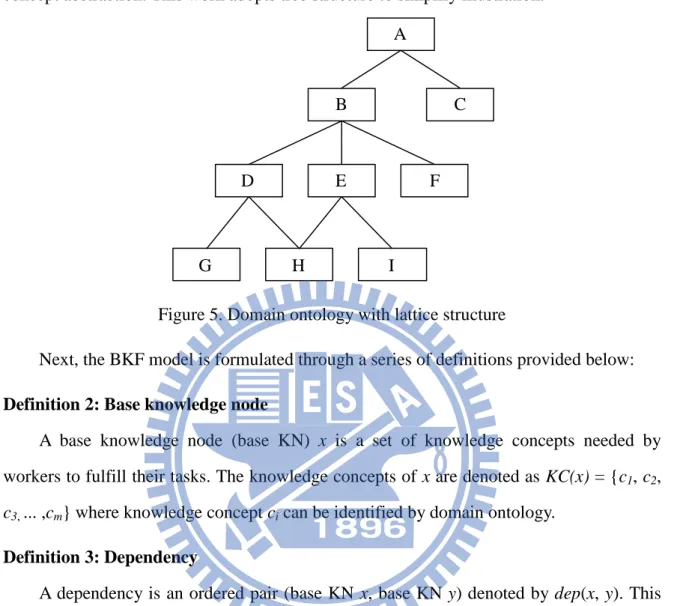
It is notable that the structure of domain ontology could be a tree as shown in Figure 4 or a lattice as shown in Figure 5. In Figure 5, the concept H has two parent concepts D and E. The semantic relations, Generalization and Specification, can be applied in the lattice structure: Generalization (H) = {D, E} and Specification (D) = {G, H}. Hence, domain
19
ontology with either tree structure or lattice structure can be properly used for knowledge concept abstraction. This work adopts tree structure to simplify illustration.
Figure 5. Domain ontology with lattice structure
Next, the BKF model is formulated through a series of definitions provided below:
Definition 2: Base knowledge node
A base knowledge node (base KN) x is a set of knowledge concepts needed by workers to fulfill their tasks. The knowledge concepts of x are denoted as KC(x) = {c1, c2,
c3, ... ,cm} where knowledge concept ci can be identified by domain ontology.
Definition 3: Dependency
A dependency is an ordered pair (base KN x, base KN y) denoted by dep(x, y). This notation indicates that after knowledge concepts in x have been referenced, workers can start to reference the knowledge concepts in y. In dep(x, y), x is called the preceding node and y is called the succeeding node.
Definition 4: Base knowledge flow
A base knowledge flow (base KF) is a 2-tuples <KNS, DS>, where KNS is a nonempty set, and its members are base KNs in the base KF. DS is a nonempty set, and its members are dependencies.
Definition 5: Neighboring
Two base KNs are neighboring if a dependency between them exists in DS.
A
B C
D E F
H
20
Definition 6: Path
Given a base knowledge flow BKF=<KNS, DS>, a path is defined to include a starting base KN k0, intermediate base KNs k1, k2, …, kn-1, an ending base KN kn and a set of
dependencies, dep(ki-1 , ki) DS, for i =1,2,…n. The path from k0 to kn isdenoted by k0
→ kn.
Definition 7: Ordering relation
Given a base knowledge flow BKF=<KNS, DS> and two base KNs x, y KNS, x has
a higher order than y if a path x → y exists. The ordering relation is denoted as x > y.
3.3 Discussion
In the motivation example, KF designers derive the base KF’s knowledge dependencies from the process level dependencies because it is a more intuitive and easier way for team members to understand. Nevertheless, KF designers can apply different ways to set the knowledge dependencies from other perspectives. Generally speaking, the knowledge dependencies in a base KF indicate the referencing sequence of knowledge (information) in task performance, which may occur in a distributed software development team [69], an academic research project [28] or a web exploration [5]. So, knowledge dependencies do not always relate to process level dependencies. In practice, KF designers are responsible for setting knowledge dependencies based on the characteristics of applications and act as consultants to provide KF and facilitate knowledge provision to teams. Actually, project team takes major responsibility to conduct tasks and deliver results.
This chapter contributes to the research of knowledge flow, first by showing how a knowledge flow can address knowledge-needs. In previous literature, models that formally illustrate a knowledge flow and corresponding knowledge-needs of workers together are lacking. The proposed BKF model fills this gap by including three initiatives: (1) it adopts domain ontology to describe knowledge-needs by a composition of knowledge concepts; (2) it derives base KNs from the activities in processes to visually display
21
workers’ knowledge-needs; and (3) it defines flow dependencies as the sequence of an individual’s or group members’ knowledge-needs and/or the order of referencing codified documents. The flow dependencies, to some degree, can help workers set the priority of information accessing and get latest information. The BKF model can help organizations assess their current practices of knowledge sharing and knowledge reuse to gain insights into the required knowledge concepts and build appropriate knowledge flows. It also paves the way for researchers to obtain a clear view of knowledge flow research.
22
Chapter 4 Knowledge-flow view model
Views in database management system are virtual tables generated from either base tables or previously defined views to serve different purposes. Similarly, views of knowledge flow are derived from either base knowledge flows or other knowledge-flow views, and are considered virtual knowledge flows. That is, a virtual knowledge flow (virtual KF) is an abstracted knowledge flow generated from a base knowledge flow (base KF), and is used to reveal abstracted knowledge. The base KFs and the base knowledge flow (BKF) model have been introduced in previous chapter. Furthermore, this chapter presents a knowledge-flow view (KFV) model to build virtual KFs by abstracting base knowledge nodes (base KNs) in a base KF. The KFV model generates corresponding virtual knowledge nodes (virtual KNs) through an order-preserving approach and a knowledge concept generalization mechanism. The virtual KFs not only fulfill workers’ different knowledge-needs but also facilitate knowledge support in teamwork.
4.1 Virtual knowledge flow: abstracted form of base knowledge flow
By knowing what other members know, a team is able to gain better decision quality and communicate more effectively [47]. Therefore, team members not only need specific knowledge to conduct their tasks, but also require general knowledge about tasks performed by other members to facilitate their communication. For example, in the mobile phone development process, marketing staff members refer to specific geographic segmentation documents to identify possible consumer groups, and gather specific knowledge of consumer behavior to determine the acceptance level of a new mobile phone. In addition, they need general knowledge related to industrial design, hardware design, software design, quality verification and sales to communicate with members outside their departments through the use of common terminology. The knowledge support of both specific and general knowledge pertaining to different tasks can assist marketing staff members to complete their business analysis task and increase the communication quality of the team. However, since conventional knowledge flow models provide only a single
23
1. Market segmentation 2. Consumer analysis
1. Industrial design overview 2. Hardware design overview 3. Software design overview
1. Quality verification overview 2. Sales overview
3. Distribution channel evaluation
vk1 vk2 vk3
Virtual knowledge flow Base knowledge flow
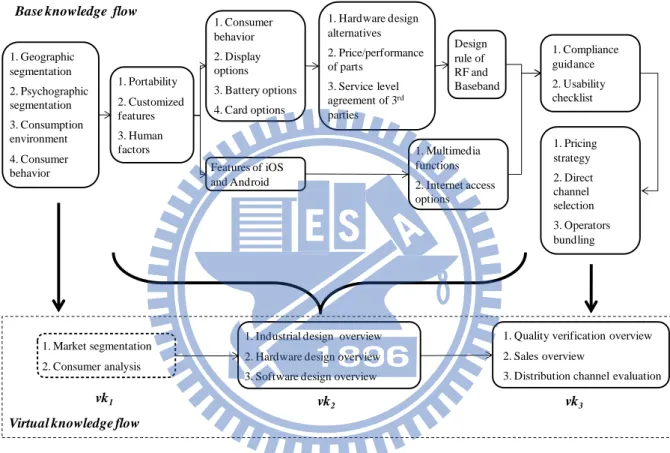
Design rule of RF and Baseband 1. Consumer behavior 2. Display options 3. Battery options 4. Card options 1. Compliance guidance 2. Usability checklist 1. Geographic segmentation 2. Psychographic segmentation 3. Consumption environment 4. Consumer behavior 1. Multimedia functions 2. Internet access options 1. Hardware design alternatives 2. Price/performance of parts 3. Service level agreement of 3rd parties 1. Portability 2. Customized features 3. Human factors Features of iOS and Android 1. Pricing strategy 2. Direct channel selection 3. Operators bundling
view of a knowledge flow and do not consider personalized requirements, they are not applicable in such environments. In fact, project managers do not need specific and detailed knowledge about business analysis, industrial design, hardware design and other tasks. They only need general knowledge of these tasks to help them make decisions and communicate with other team members. Figure 6 shows a virtual KF with general knowledge concepts that can meet project managers’ knowledge-needs.
Figure 6. A virtual KF for project managers.
The virtual KF in Figure 6 includes three virtual KNs: vk1, vk2 and vk3, which
represent the knowledge-needs of project managers in the mobile phone development process. The virtual KN vk1 consists of two general knowledge concepts: market
segmentation and consumer analysis, which project managers require to oversee the business analysis task. These two general knowledge concepts are abstracted from four specific knowledge concepts: geographic segmentation, psychographic segmentation, consumption environment, and consumer behavior. In node vk2, which represents product
24
such as industrial design overview, hardware design overview and software design overview are more helpful to project managers in communicating with product designers than the concepts from which they are abstracted. Finally, the general knowledge concepts in node vk3 are advantageous to project managers in overseeing verification and
commercialization tasks; hence, the virtual KF in Figure 6 appropriately formulates the knowledge-needs of project managers in the development process, and illustrates corresponding knowledge concepts at the proper conceptual levels.
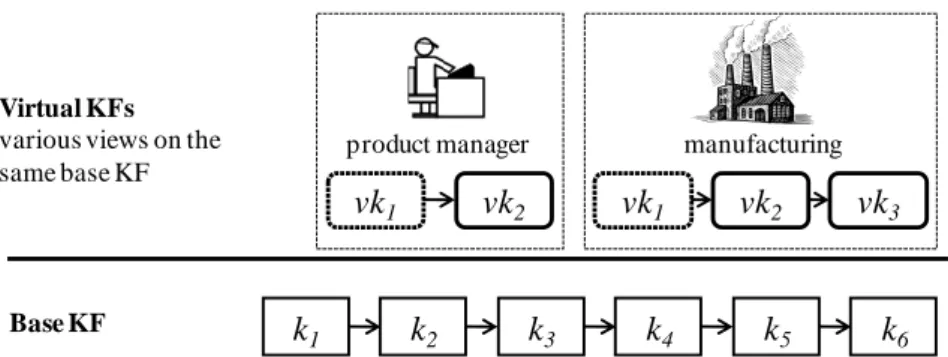
The relationship between base KF and virtual KF can now be described: virtual KFs are the abstracted forms of a base KF. Since virtual KFs are abstractions, different virtual KFs can be generated based on individual participants’ knowledge-needs and organization policies. By providing different virtual KFs that hide all or some of the detailed information in a base KF, organizations can be better equipped to enforce policies and fulfill workers’ requirements properly. Figure 7 shows an example of mapping a base KF to multiple virtual KFs. While product managers do not need to have detailed knowledge of all the knowledge concepts in the base KF, they must have general marketing knowledge to understand marketing trends and to increase communication effectiveness within a team. To serve product managers’ knowledge-needs, knowledge flow designers (KF designers) can abstract marketing-related knowledge nodes and generalize knowledge concepts in those nodes to hide detailed marketing information. A possible virtual KF for product managers is as follows: base KNs k1 and k2 are abstracted to virtual KN vk1, and k3, k4, k5
and k6 are abstracted to vk2. In addition, manufacturers have their own virtual KF which
contains specific manufacturing knowledge (represented by vk2), general knowledge of
marketing and design (represented by vk1), as well as general knowledge of sales and post
service (represented by vk3). As this illustrative analysis shows, a base KF can be
abstracted to multiple virtual KFs by considering different knowledge-needs and organization policies. In this way, workers can obtain proper virtual KFs that help them acquire the knowledge support they need in collaborative environments.
25
k2 k4
k1 k3 k5 k6
Base KF Virtual KFs
various views on the same base KF vk1 vk2 product manager vk1 vk2 manufacturing vk3
Figure 7. Illustrative examples of base KF and virtual KF.
4.2 The formal framework of the knowledge-flow view (KFV) model
Definition 8 to Definition 13 describes the properties and basic terms that constitute the theoretical framework of the KFV model.
Definition 8: Concealing criteria
A concealing criterion is a 3-tuples <worker w, knowledge node kn, boolean of abstraction Y/N >, which states whether the knowledge concepts of a knowledge node kn are too specific or confidential for a worker w’s task functions. If the answer is yes, the boolean of abstraction is set to Y, and the knowledge concepts of kn are abstracted. On the other hand, if the knowledge concepts of kn are appropriate for w’s task functions and need not be abstracted, the boolean of abstraction is set to N.
The concealing criteria are defined by KF designers to comply with company’s information security control rules and fulfill team members’ need-to-know requirements. KF designers can refer to their experience or utilize experts’ knowledge to discover what base KNs should be abstracted if the knowledge concepts in the base KNs are too specific or confidential for workers to perform their task functions properly.
Two scenarios illustrate how KF designers define concealing criteria when deriving virtual KFs from a base KF for a sourcing planner (denoted as p for short). The sourcing planner oversees the management of outsourced parts, including: surveying reliable suppliers, evaluating price/performance of parts and negotiating service level agreements with suppliers. The base KF (shown in Figure 3) includes two base KNs, k2 and k4, which
26
task and hardware design task, respectively. In the first scenario, the concealing criterion is made by KF designers, based on information security control rules. In order to sustain competitive advantage, many companies enforce information security policies to protect precious intellectual properties, such as hardware design specifications, from unauthorized access. Only work-related employees can access such specific knowledge or information. The sourcing planner’s tasks are not directly related to hardware design tasks, so p is not allowed to access the knowledge concept design rule of RF and Baseband which is one type of hardware design specification. Because the knowledge concept design rule of RF and Baseband is included in k4 and p is not allowed to access it, KF designers define a
concealing criterion <p, k4, Y> while deriving virtual KFs for p. The concealing criterion
<p, k4, Y> indicates that k4’s knowledge concept design rule of RF and Baseband needs to
be abstracted to a general knowledge concept, IC components, based on the domain ontology (as shown in Figure 4). The concealing criterion not only protects the specific knowledge concept design rule of RF and Baseband from unauthorized access, but also provides general knowledge concept IC components for p to effectively communicate with other team members.
In another scenario, the concealing criterion is made in terms of workers’
need-to-know requirements. Supposing that the knowledge concepts consumer behavior, display options, battery options and card options in k2 are too specific for p to conduct
his/her tasks. Consequently, KF designers define a concealing criterion <p, k2, Y> to reflect
p’s knowledge-needs when deriving virtual KFs for p. The concealing criterion <p, k2, Y>
indicates that k2’s knowledge concepts need to be abstracted to the general knowledge
concepts consumer analysis and mechanical parts, respectively, based on the domain ontology (as shown in Figure 4). The two scenarios show that the knowledge for defining concealing criteria is practical and context-dependent, depending on the consideration of security as well as the knowledge-needs of the participants.
Definition 9: Virtual knowledge node
27
as corresponding knowledge concepts. The knowledge concepts of a virtual KN are abstracted from the knowledge concepts of the corresponding base KNs. A virtual KN vx is a 2-tuples <ANS, AKC>, where ANS (Abstracted Knowledge Node Set) is a nonempty set and its members are base KNs or previously defined virtual KNs. AKC (Abstracted Knowledge Concept Set) is a nonempty set and its members are knowledge concepts defined in domain ontology.
The knowledge concepts of vx are denoted as AKC (vx) = {c1, c2, c3, ... ,cq} where
knowledge concept ci can be identified in domain ontology.
Definition 10: Virtual dependency
Given BKF=<KNS, DS> and two virtual KNs, vx and vy, a virtual dependency vdep(vx, vy) from vx to vy exists if dep (x, y) is in DS, where xis a member of vx and y is a member of vy. A virtual dependency is used to connect two virtual KNs, vx and vy.
Definition 11: Virtual knowledge flow
A virtual KF is a 2-tuples, VKF = <VKNS, VDS>, where VKNS is a nonempty set and its members are virtual KNs, and VDS is a nonempty set and its members are virtual dependencies.
Definition 12: Virtual path
Given a virtual knowledge flow VKF=<VKNS, VDS>, a virtual path in VKF, extending from vk0 to vkn, is a sequence of virtual knowledge nodes vk0, vk1, vk2, ... , vkn
VKNS, such that vdep (vki-1 , vki) VDS for i = 1, 2,…, n. The virtual path from vk0 to vkn is
denoted as vk0 →vkn.
Definition 13: Virtual ordering relation
Given a virtual knowledge flow VKF=<VKNS, VDS> and two virtual knowledge nodes: vx and vy VKNS, vx has a higher order than vy if a virtual path vx → vy exists. The virtual ordering relation is denoted as vx > vy.
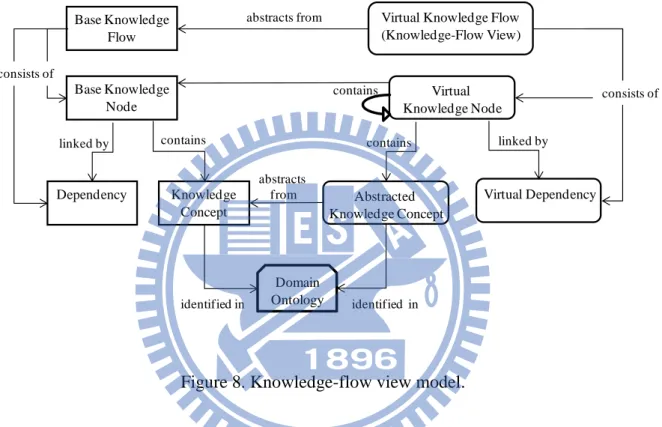
Figure 8 illustrates the relationship between the components of the novel model. As the figure shows, a virtual knowledge flow is an abstraction from a base knowledge flow.
28 Base Knowledge Flow Base Knowledge Node Dependency Knowledge Concept
Virtual Knowledge Flow (Knowledge-Flow View) Virtual Knowledge Node Abstracted Knowledge Concept Virtual Dependency linked by consists of contains consists of linked by contains Domain Ontology identified in identified in abstracts from contains abstracts from
The abstraction relationships exist in major components. Virtual knowledge nodes are abstracted from base knowledge nodes; thus, a virtual knowledge node contains generalized knowledge concepts that are abstracted from the knowledge concepts in corresponding base knowledge nodes. Both the abstracted knowledge concepts and the concepts from which they are abstracted can be identified in the domain ontology.
Figure 8. Knowledge-flow view model.
4.3 An order-preserving approach for deriving a knowledge- flow view
Liu et al. [36] presented an order-preserving approach to the generation of virtual processes from a base process in workflow environments. The approach is designed to ensure that the original ordering relation of activities in a base process is preserved in virtual processes. This paper adopts the order-preserving approach for the purpose of generating virtual KFs from a base KF, that retain their knowledge referencing order in the base KF. A legal virtual knowledge node must follow three basic rules to preserve the ordering property in a virtual KF. The basic rules are membership, atomicity and ordering preservation.