The Differences in Application of
Community Resources:
A Study of Novice and Experienced
Resource Room Teachers’ Growth
Wang, Wen-Ling Yeh, Bi-Chun Tseng, Shu-Hsien
Abstract
Current curriculum reform in Taiwan calls for a new look at using community resources. Generally, resource room teachers have greater need for community resources and personnel support in order to make necessary curriculum modifications to meet children’s special needs. There is little information on what factors influence teachers’ application of community resources to resource room teaching. Therefore, this study investigated whether novice and experienced resource room teachers exhibited differences in competencies to use community resources. The barriers to implementing community resources were also explored between experienced and novice resource room teachers. Participants included 215 resource room teachers from Tauyuan county, Hsinchu city and county, and Miaoli county. The instrument was a questionnaire developed by the researcher. The results appeared that participants’ competencies and frequencies of use of community resources were impacted by teaching experience, while their needs and barriers were not impacted by time. Some educational implications derived from this study were pointed out by the researcher.
Keywords: community resources, experienced teacher, novice teacher, resource room
Wang, Wen-Ling: Associate Professor, Department of Special Education, Chung Yuan Christian University
Yeh, Bi-Chun: Teacher, Chungshiao Junior High School
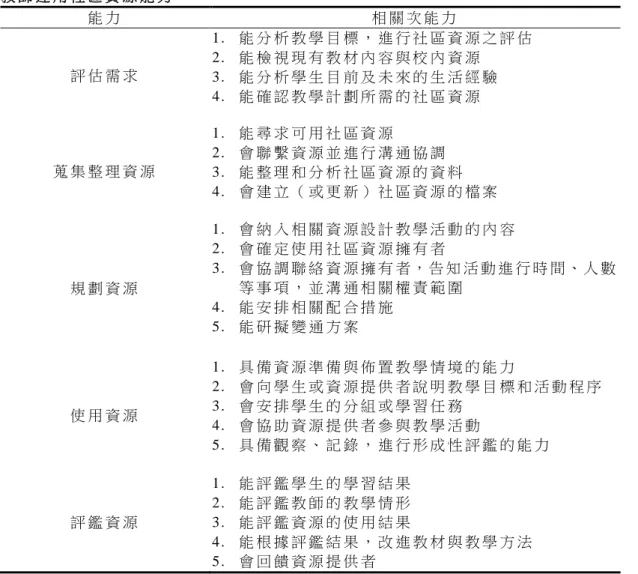
表 1 教 師 運 用 社 區 資 源 能 力 能 力 相 關 次 能 力 評 估 需 求 1 . 能 分 析 教 學 目 標 , 進 行 社 區 資 源 之 評 估 2 . 能 檢 視 現 有 教 材 內 容 與 校 內 資 源 3 . 能 分 析 學 生 目 前 及 未 來 的 生 活 經 驗 4 . 能 確 認 教 學 計 劃 所 需 的 社 區 資 源 蒐 集 整 理 資 源 1 . 能 尋 求 可 用 社 區 資 源 2 . 會 聯 繫 資 源 並 進 行 溝 通 協 調 3 . 能 整 理 和 分 析 社 區 資 源 的 資 料 4 . 會 建 立 ( 或 更 新 ) 社 區 資 源 的 檔 案 規 劃 資 源 1 . 會 納 入 相 關 資 源 設 計 教 學 活 動 的 內 容 2 . 會 確 定 使 用 社 區 資 源 擁 有 者 3 . 會 協 調 聯 絡 資 源 擁 有 者 , 告 知 活 動 進 行 時 間 、 人 數 等 事 項 , 並 溝 通 相 關 權 責 範 圍 4 . 能 安 排 相 關 配 合 措 施 5 . 能 研 擬 變 通 方 案 使 用 資 源 1 . 具 備 資 源 準 備 與 佈 置 教 學 情 境 的 能 力 2 . 會 向 學 生 或 資 源 提 供 者 說 明 教 學 目 標 和 活 動 程 序 3 . 會 安 排 學 生 的 分 組 或 學 習 任 務 4 . 會 協 助 資 源 提 供 者 參 與 教 學 活 動 5 . 具 備 觀 察 、 記 錄 , 進 行 形 成 性 評 鑑 的 能 力 評 鑑 資 源 1 . 能 評 鑑 學 生 的 學 習 結 果 2 . 能 評 鑑 教 師 的 教 學 情 形 3 . 能 評 鑑 資 源 的 使 用 結 果 4 . 能 根 據 評 鑑 結 果 , 改 進 教 材 與 教 學 方 法 5 . 會 回 饋 資 源 提 供 者
的「 自 然 地 理 環 境 」以 及 人 為 的「 消 費 購 物 場 所 」、「 休 閒 娛 樂 場 所 」、 「 社 區 機 關 場 所 」 以 及 「 古 蹟 」 等 地 方 環 境 ; 在 組 織 資 源 方 面 , 包 含 「 社 區 家 長 團 體 」、「 政 府 公 家 機 構 」等;而 財 力 資 源 的 來 源 多 為「 家 長 會 贊 助 」 、 「 活 動 盈 餘 」 ; 事 件 資 源 則 以 「 生 活 偶 發 事 件 」 、 「 當 地 節 慶 活 動 」 、 「 歷 史 事 蹟 」 及 「 社 區 藝 文 事 件 」 等 為 常 用 資 源 ( 李 幸 潔 , 2003; 李 雅 婷 , 2006; 徐 薇 , 1999; 陳 華 彰 , 2006; 曾 兆 興 , 2004; 廖 銘 凱 , 2006; 簡 宗 堯 , 2006) 。 相 關 研 究 結 果 顯 示 , 多 數 教 師 皆 能 認 同 運 用 社 區 資 源 於 教 學 的 方 式 , 因 其 具 備 有 拓 展 學 習 領 域 、 培 養 社 區 意 識 與 鄉 土 情 懷 、 課 程 與 實 際 生 活 得 以 產 生 連 結 以 及 統 整 生 活 相 關 經 驗 等 價 值 性 ( e.g., Agran, Snow, & Swaner, 1999 ; Smith, 2007) 。 而 就 特 殊 教 育 領 域 而 言 , 無 論 是 運 用 社 區 資 源 亦 或 社 區 本 位 教 學 , 尚 包 含 能 協 助 學 生 培 養 良 好 的 生 活 技 能 、 增 進 社 交 技 巧 、 能 有 更 佳 的 適 應 力 , 進 而 擁 有 更 好 的 生 活 品 質 等 益 處( Robert, 1997;Walker et al., 2010;Westling & Fleck, 1991)。 通 常 家 長 參 與 學 校 事 務 是 學 校 和 社 區 合 作 的 第 一 步 , 文 獻 指 出 家 長 主 動 參 與 學 校 活 動 , 並 協 助 學 生 參 與 社 區 活 動 , 能 有 助 於 家 長 與 學 生 的 互 動( Kombarakaran, 2002),而 家 長 配 合 學 校 協 助 學 生 課 業 方 面,有 助 於 學 生 在 上 課 出 席 、 標 準 化 測 驗 與 學 校 成 績 、 學 分 數 以 及 行 為 的 進 步 ( Henderson & Mapp, 2002; Walker, Hoover-Dempsey, Whetsel, & Green, 2004)。若 社 區 能 成 立 課 後 學 習 方 案 時( afterschool programs ), 則 對 於 學 生 的 上 課 出 席 、 成 績 和 生 涯 探 索 皆 具 正 面 成 效 ( Yonezawa, Thornton, & Stringfield, 1998 ) 。 與 社 區 合 作 的 益 處 尚 包 括 提 供 師 傅 ( mentor) , 贊 助 作 業 諮 詢 專 線 ( homework hotline) , 提 供 志 工 以 及 家 教 , 提 供 作 業 所 需 物 品 與 教 學 材 料 , 協 助 交 通 運 輸 和 作 業 完 成 的 獎 勵( Epstein, 1995)。然 而,以 上 的 合 作 皆 需 詳 加 規 劃 才 能 對 學 習 有 所 助 益 ( Epstein, Sanders, Simon, Salinas, Jansorn, & Van Voorhis, 2002 ; Patterson & Horwood, 1995) 。
四 、 資 深教 師與 新 手 教師 之研 究 發 現
本 研 究 依 據 文 獻 與 Berliner (1988) 針 對 教 師 專 業 成 長 發 展 階 段 別 , 將 教 學 年 資 未 滿 三 年 之 生 手 及 初 任 教 師 定 義 為 本 研 究 之 新 手 教 師 , 而 教 學 年 資 在 五 年 以 上 之 幹 練 及 專 家 教 師 定 義 為 資 深 教 師 。 資 深 及 新 手 教 師 在 教 學 歷 程 上 的 比 較 研 究 中 , 顯 示 兩 者 無 論 在 教 學 行 為 或 思 考 歷 程 上,皆 具 有 差 異 性( 吳 青 蓉、張 景 媛, 1997;林 進 財,1999; 張 俊 紳 , 2000; Craven, 2003; Solmon & Lee, 1991) 。 茲 敘 述 如 下 :在 教 學 前 計 畫 階 段 , 資 深 教 師 較 能 以 多 元 策 略 瞭 解 學 生 起 點 能 力 , 在 參 考 及 彙 整 多 方 訊 息 後 始 形 成 教 學 計 畫 , 且 認 為 教 學 計 畫 僅 提 供 教 學 參 考 , 而 在 教 材 的 準 備 上 , 資 深 教 師 認 為 本 身 即 應 具 備 發 展 教 材 的 能 力 ; 相 較 之 下 , 新 手 教 師 雖 然 同 樣 重 視 教 學 計 畫 的 擬 定 , 但 觀 點 較 為 窄 化 且 教 材 偏 向 依 賴 課 本 ( 林 進 財 , 1999 ; Craven, 2003 ; Livingston & Borko, 1989; Westerman, 1991) 。
教 學 中 , 資 深 教 師 多 將 知 識 予 以 統 整 , 並 能 將 新 的 課 程 與 學 生 舊 有 經 驗 做 結 合 , 也 較 能 以 符 合 學 生 程 度 的 方 式 進 行 教 學 活 動 , 當 學 生 有 問 題 時 較 能 立 即 變 換 不 同 的 教 學 方 式 , 並 據 以 彈 性 調 整 後 續 課 程 , 此 外 資 深 教 師 因 訂 定 明 確 的 教 學 規 範 , 而 能 有 效 進 行 教 學 活 動 , 也 因 較 能 預 見 學 生 的 學 習 狀 況 , 因 此 能 善 用 教 學 策 略 以 提 升 學 生 的 學 習 興 趣 , 且 發 問 技 巧 和 次 數 也 優 於 新 手 教 師 ; 反 之 新 手 教 師 在 教 學 時 課 程 結 構 較 鬆 散 , 且 新 手 教 師 較 難 體 會 學 生 的 學 習 困 難 原 因 , 在 面 對 課 堂 突 發 狀 況 時 , 亦 缺 乏 調 整 計 畫 以 及 應 變 的 能 力 ; 縱 使 新 手 教 師 具 有 新 的 教 學 策 略 , 也 較 難 以 應 用 在 實 際 教 學 中 ( 林 進 財 , 1999; 吳 青 蓉 、 張 景 媛 , 1997 ; 張 景 媛 , 1997 ; Abdal-Haqq, 1998 ; Agee, 1997 ; Cochran-Smith & Lytle, 1993;Livingston & Borko, 1989;Meyer, 2004; Stofflett & Stoddart, 1994; Westerman, 1991) 。
三 、 資 料處 理與 分 析
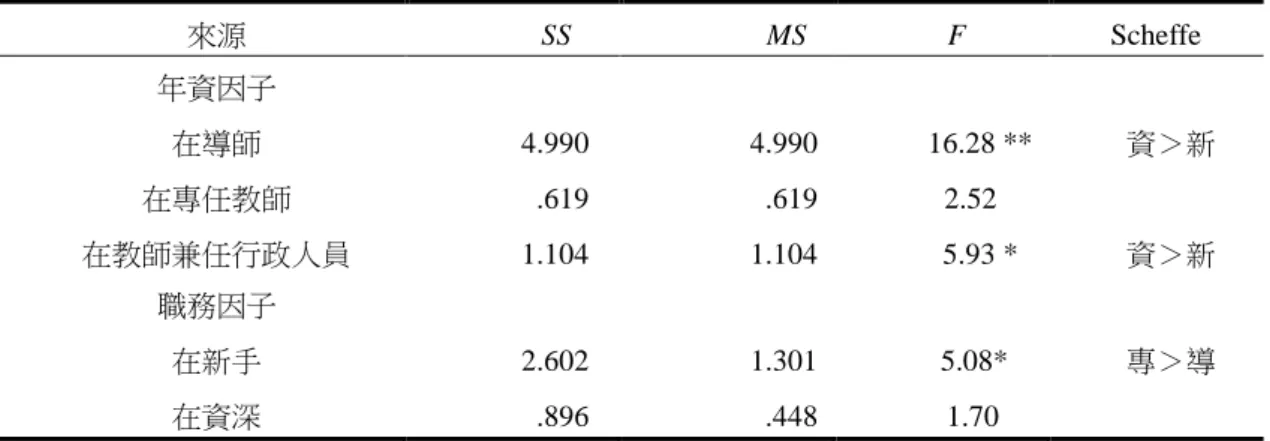
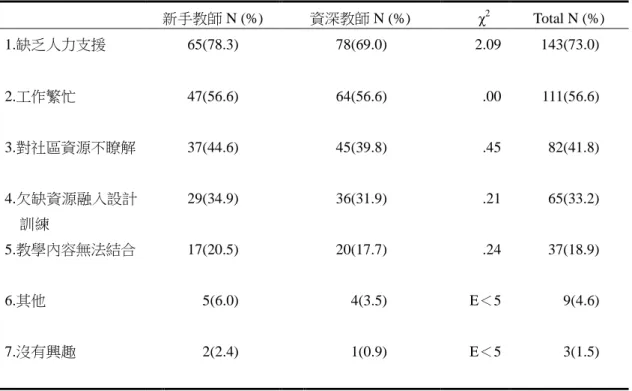
以 次 數 分 配 與 百 分 比 分 析 , 調 查 國 中 資 源 班 教 師 使 用 社 區 資 源 的 需 求 及 頻 率 。 並 進 一 步 使 用 卡 方 考 驗 , 分 析 不 同 背 景 變 項 之 教 師 需 求 及 頻 率 是 否 有 顯 著 差 異 。 以 單 因 子 多 變 量 變 異 數 分 析 ( one-way MANOVA) 考 驗 資 深 及 新 手 教 師 在 教 學 整 體 層 面 運 用 社 區 資 源 之 能 力 差 異 。 結 果 達 顯 著 則 進 一 步 以 單 因 子 變 異 數 分 析 各 層 面 上 的 差 異 情 形 。 接 著 以 二 因 子 變 異 數 分 析 ( two-way ANOVA) 檢 定 不 同 背 景 變 項 下 之 資 深 及 新 手 教 師 , 各 自 在 教 學 前 、 教 學 中 以 及 教 學 後 , 運 用 社 區 資 源 的 能 力 差 異 , 以 瞭 解 不 同 背 景 變 項 之 資 深 及 新 手 教 師 是 否 具 有 交 互 作 用 。 並 繼 以 單 因 子 變 異 數 分 析 以 及 Scheffe法 事 後 比 較 , 考 驗 各 層 面 上 的 差 異 情 形 。 在 探 析 國 中 資 源 班 資 深 及 新 手 教 師 在 教 學 上 運 用 社 區 資 源 所 遭 遇 問 題 上 : 以 次 數 分 配 與 百 分 比 分 析 , 瞭 解 教 師 運 用 社 區 資 源 所 遭 遇 的 問 題 為 何 。 然 後 使 用 卡 方 考 驗 分 析 資 深 及 新 手 教 師 , 運 用 社 區 資 源 教 學 所 遭 遇 的 問 題 是 否 有 顯 著 差 異 。肆、研究結果與討論
一 、 桃 竹苗 縣市 國 中 資源 班教 師 運 用社 區資 源 之 現
況 : 需 求與 頻率
彙 整 社 區 資 源 需 求 的 整 體 意 見 , 依 照 勾 選 人 數 比 例 的 高 低 排 序 為:需 要( 153人,71.2%)、不 太 需 要( 46人,21.4%)、非 常 需 要( 15 人 , 7.0%)、 非 常 不 需 要( 1人 , 0.5%)。 合 計「 非 常 需 要 」以 及「 需 要 」的 比 例 達 78.2%,顯 示 多 數 的 國 中 資 源 班 教 師 在 教 學 上 確 實 有 運 用 社 區 資 源 的 需 求,此 結 果 與 國 內 外 研 究 相 當 一 致( 例 如:徐 薇,1999; Agran, Snow, & Swaner, 1999 ; Robert, 1997; Smith, 2007; Westling & Fleck, 1991) 。用 社 區 資 源 。 而 研 究 者 統 整 的 社 區 資 源 運 用 於 資 源 班 教 學 的 內 涵 與 能 力 ( 見 文 獻 探 討 ) , 亦 可 提 供 相 關 單 位 作 為 進 行 這 類 課 程 的 參 考 , 以 協 助 資 源 班 教 師 縮 短 新 手 過 渡 至 專 家 教 師 的 成 長 週 期 。
全 國碩 博士 論文 資訊 網。 (系統編號092NTNU1205001) 游家政( 1997)。社區資源在教學上的運 用。國 教 園 地,59/60,63-69。 游 淑 燕( 1993) 。專家 與 生手 教學 表現 之比 較 研究 及其 對師 範教 育 課 程 與 教學 的啟 示。 嘉義師院學報 , 7,207-241。 鈕文英( 2003)。融 合教育的 理念與作法。高雄:高 師 大 特 殊 教 育 中 心 。 馮莉雅( 2001)。國中教師教 學效能評鑑之研究( 未 出 版 之 博士 論 文 )。 國 立高 雄師 範大 學, 高雄 市。 黃明忠 ( 2006)。 桃 園 縣 國民 小學 教 師運用 社 區資 源與 教 學效能 關 係之 研 究 ( 未出 版 之碩士論文 ) 。 國 立 臺灣師 範教育 大學, 臺北市。 黃政 傑(1997)。 教學原理 。臺北市:師大書 苑。 黃 馨 慧、 王文 伶、 花敬 凱 ( 2006)。 國民中 小 學資 源班 資深 與新 手 教 師 課 程設 計知 能調 查研 究──以桃園縣為例。東臺灣特殊教育學報,8, 215-235。 廖銘凱 ( 2006)。 桃 園 縣 國民 小學 啟 智班教 師 運用 社區 資 源教學 之 調查 研 究 ( 未出 版 之碩士論文 ) 。 國 立 臺北教 育大學 , 臺 北市。 劉 秋 木( 1994) 。教學 技 術。 載於 國立 編譯 館 (主 編) , 課 程教 材 教 法 通 論 ( 頁197-202)。臺北:正中書局。 盧秀琴、柯琳耀、洪 榮昭( 2009)。運用 社區資源實施 5Why鷹架式提問 教 學活 動。 教 育實 踐與 研 究 , 22,1-32。 簡宗堯 ( 2006)。 金 門 縣 國小 教師 對 學校運 用 社區 資源 意 見之研 究 (未 出 版 之 碩 士論 文 ) 。 國立臺 灣 師範大 學, 臺北市。 簡 茂 發( 1999) 。中小 學 教師 專業 態度 量表 初 探。 「 中 小 學教師 素 質 與 評量研討 會」發表之論文 ,高雄市國立高雄師範大學。 簡茂發、李虎雄、黃 常司、彭森明、吳清 山、吳 明 清、毛 連 塭、林 來 發 、 黃 瑞 榮 、 張敏 雪 ( 1997) 。 中 小學 教 師應具 備 的 基 本素 質 。 教育 研 究 資訊 , 5, 1-13。
Abdal-Haqq, I. (1998). Professional development schools: Weighing the evidence. Thousand Oaks, CA: Corwin Press.
Adelson, B. (1984). When novices surpass experts: The difficulty of a task may increase with expertise. Journal of Experimental Psychology: Learning,
Memory, and Cognition, 10, 438-495.
Research, 29, 397-431.
Agran, M., Snow, K., & Swaner, J. (1999). A survey of secondary level teachers’ opinions on community-based instruction and inclusive education. The Journal
of Association for Persons with Severe Handicaps, 24, 58-62.
Alexander, P. E. (1991). The outdoor classroom. Experiencing nature in the
elementary curriculum. Indianapolis, IN: State Department of Education. (ERIC
Document Reproduction Service No. ED338508 ).
Armstrong, T. (2000). Multiple intelligences in the classroom (2nd ed.). Alexandria, VA: Association for Supervision and Curriculum Development.
Babione, & Shea. (2005). Special education mentoring within the context of rural schools. Rural Special Education Quarterly, 24, 3-10.
Berliner, D. C. (1988). The development of expertise in pedagogy. Charles W. Haunt Memorial Lecture presented at the Annual Meeting of the American Association of College for Teacher Education, New Orleans, LA.
Berliner, D. C. (2001). Learning about and learning from expert teachers.
International Journal of Educational Research, 35, 463-482.
Billingsley, B., Israel, M., & Smith, S. (2011). Supporting new special education teachers: How online resources and web2.0 technologies can help. Teaching
Exceptional Children, 43, 20-29.
Burns, M., & Ysseldyke, J. (2009). Reported prevalence of evidence-based instructional practices in special education. The Journal of Special Education,
43, 3-11.
Campbell, L., Cambell, B., & Dickinson, D. (2004). Teaching and learning through
multiple intelligence (3rd ed.). Boston, MA: Allyn & Bacon.
Cochran-Smith, M., & Lytle, S. (1993). Inside/outside: Teacher research and
knowledge. New York, NY: Teachers College Press.
Craven, J.A. (2003). Representation in teaching: Inferences from research of expert and novice teachers. Educational Psychologist, 38, 235-247.
Cutlip, S., Center, A., & Broom, G. (2005). Effective public relations. Englewood Cliffs, NJ: Prentice Hall.
Eisenhower Southwest Consortium for the Improvement of Mathematics & Science Teaching (1996). Using community resources to enhance mathematics & science education. Classroom Compass, 3, 1-10.
Environmental Education & Training Environmental Partnership (1998). Using community resources in environmental education. EETAP Resource Library,
34.
Epstein, J. L. (1995). School/family/community partnerships: Caring for the children we share. Phi Delta Kappan, 76, 701-712.
Epstein, J. L., Sanders, M. G., Simon, B. S., Salinas, K. C., Jansorn, N. R., & Van Voorhis, F. L. (2002). School, family, and community partnerships: your
handbook for action. Thousand Oaks, CA: Corwin Press.
Etringer, B., Hillerbrand, E., & Claiborn, C. (1995). The transition from novice to expert counselor. Counselor Education and Supervision, 35, 4-17.
Fulwider, N. A. (1994). Assisting regular education classroom teachers of
elementary learning disabled students through collaboration. New York, NY:
Nova Southeastern University. (ERIC Document Reproduction Service No. ED 373498)
Gonder, P. O. (1981). Exchanging school and community resources. In D. Davies, (Ed.), Community and their schools. New York, NY: McGraw-Hill.
Hattie, J. (2003). Teachers make a difference: What is the research evidence? Melbourne, Australia: Australian Council for Educational Research.
Henderson, A., & Mapp, K. (2002). Key findings from a new wave of evidence: The
impact of school, family and community connections on student achievement.
Austin, TX: Southwest Educational Development Laboratory.
Hiatt-Michael, D. B. (2006). Reflections and directions on research related to family-community involvement in schooling. School Community Journal, 16, 7-30.
Kilcrease, M. W. (1989). “Ready, Set, Go!” A model community resource plan for
rural schools. (ERIC Document Reproduction Service No. ED 315247)
Kombarakaran, F. A. (2002). Effects of social capital and adolescent extracurricular activities on school truancy. (Doctoral Dissertation, The Ohio State University, 2002). Dissertation Abstracts International, 63, 2694a.
Kretlow, A. G., & Blatz, S. L. (2011). The ABCs of evidence-based practice for teachers. Teaching Exceptional Children, 43, 8-19.
Livingston, C., & Borko, H. (1989). Expert-novice differences in teaching: A cognitive analysis and implications for teacher education. Journal of Teacher
Education, 40, 36-42.
Marlatt, E. (2004). Practical knowledge storage among preservice, novice, and experienced educators of students who are deaf and hard-of-hearing.
Exceptional Children, 70, 201-214.
Meyer, H. (2004). Novice and expert teachers’ conceptions of learners’ prior knowledge. Science Education, 88, 970-983.
Mitchell, A., & Arnold, M. (2004). Behavior management skills as predictors of retention among south Texas special educators. Journal of Instructional
Psychology, 31, 214-219.
Osborn, N. A. (1994). Using community resources-workshop resource manual. Ann Arbor, MI: University of Michigan Press.
Otis-Wilborn, A., Winn, J., Griffin, C., & Kilgore, K. (2005). Beginning special educators’ forays into general education. Teacher Education and Special
Education, 28, 143-152.
Patterson, B., & Horwood, B. (1995). Community involvement in education. In B. Horwood (Ed.), Experience and curriculum (pp. 51-67). Association for Experiential Education. (ERIC Document Reproduction Service No. ED 398026).
Peters, R. O. (1991). ECO/Social studies and community-centered learning: The 21st
century social studies curriculum. (ERIC Document Reproduction Service No.
ED 365602).
Polloway, E. A., & Patton, J. R. (1993). Strategies for teaching learners with special
needs (5th ed.). New York, NY: Macmillan.
Robert, R. (1997). Perceptions of special education teachers in Ohio of
Paper presented at the Annual Convention of the Council for Exceptional Children. (ERIC Document Reproduction Service No. ED 408760)
Schoenfeld, A. H., & Herrman, D. J. (1982). Problem perception and knowledge structure in expertise and novice mathematical problem solvers. Journal of
Experimental Psychology: Learning, Memory, and Cognition, 8, 484-494.
Smith, M. (2007). Improving community involvement and citizenship among
elementary school students through service learning experiences. Unpublished
master’s thesis, University of Phoenix, AZ. (ERIC Document Reproduction Service No. ED 497403)
Solmon, M. A., & Lee, A. M. (1991). A contrast of planning behaviors between expert and novice adapted physical education teachers. Adapted Physical
Activity Quarterly, 8, 115-127.
Sternberg, R. J., & Horvath, J. A. (1995). A prototype view of expert teaching.
Educational Researcher, 24, 9-17.
Stofflett, R., & Stoddart, T. (1994). The ability to understand and use conceptual change pedagogy as a function of prior content learning experience. Journal of
Research in Science Teaching, 31, 31-51.
Stough, L. M., & Palmer, D. J. (2001, April). Teacher reflection: How effective
special educators differ from novices. Paper presented at the Annual Meeting of
the Council for Exceptional Children, Kansas City, MO.
Tsui, A. (2009). Distinctive qualities of expert teachers. Teachers & Teaching, 15, 421-439.
Tyson, L., & Silverman, S. (1994, April). An analysis of statewide teacher appraisal
scores across four years. Paper presented at the Annual Meeting of the
American Educational Research Association, New Orleans. (ERIC Document Reproduction Service No. ED 370968)
Veir, C. (1990). A comparison of the teacher appraisal systems in Georgia and
Texas. (ERIC Document Reproduction Service No. ED 328968).
Veir, C. (1991). A comparison of teacher appraisal systems: The developmental
teacher evaluation kit and the Texas Teacher Appraisal System. (ERIC
Document Reproduction Service No. ED 332333).
literature on community-based instruction across grade levels. Education and
Training in Autism and Developmental Disabilities, 45, 242-267.
Walker, J. M. T., Hoover-Dempsey, K. V., Whetsel, D. R., & Green, C. L. (2004).
Parental involvement in homework: A review of current research and its implications for teachers, after school program staff, and parent leaders.
Cambridge, MA: Harvard Family Research Project.
Westerman, D. A. (1991). Expert and novice teacher decision making. Journal of
Teacher Education, 42, 292-306.
Westling, D. L., & Fleck, L. (1991). Teachers’ views of community instruction.
Teacher Education and Special Education, 14, 127-134.
Williams, D., & Coles, L. (2007). Teachers’ approaches to finding and using research evidence: An information literacy perspective. Educational Research,
49, 185-206.
Yonezawa, S., Thornton, T., & Stringfield, S. (1998). Dunbar-Hopkins healthy
partnership phase II evaluation: Preliminary report-year one. Baltimore, MD:
Center for Social Organization of Schools.
Ziegler, W. (2001). Putting your community into school learning. Education Digest,