碩士論文
Department of Foreign Languages and Literatures College of Liberal Arts
National Taiwan University Master’s Thesis
跨閱記憶,重劃連結:
在 3‧11 災難後閱讀露絲‧尾關《時光的彼岸》
Unframing Memories, Remapping Connections:
Reading Ruth Ozeki’s A Tale for the Time Being After the 3.11 Disasters
鍾定瑤 Teng-io Chung
指導教授:柏逸嘉 博士 Advisor: Guy Beauregard, Ph.D.
中華民國 106 年 7 月
July 2017
i
The completion of this thesis would not have been possible without the steadfast support and encouragement of numerous individuals to whom I am greatly indebted.
My gratitude goes to my supervisor, Professor Guy Beauregard. His mentorship is what guided me through my M.A. studies at National Taiwan University. I thank him for
introducing me to the body of scholarly works, emerging fields, and historical and
sociopolitical issues that have become the backbone of my thesis. Of particular importance, however, are his intellectual support, insights, patience, and generosity, all of which I have relied on as a source of strength to go through the long process of thesis writing.
I am grateful to Professor Chih-ming Wang and Professor Hsiu-chuan Lee for serving on my thesis defense committee. They have generously provided me with challenging questions, comments, and suggestions that have enabled me to locate the blind spots of my thesis, further clarify my research objectives, and sharpen my argument. I cannot thank them enough for their intellectual contributions to my project.
My appreciation also goes to all those who have contributed to the development of my thesis at different stages and in different ways. I am grateful to the faculty members I have met in the Department of Foreign Languages and Literatures at National Taiwan University. I thank Professor Hui-chuan Chang and Professor Hsiao-hung Chang, in particular, for drawing my attention respectively to the discursive trope of post-apocalyptic hope and the history of sociopolitical upheaval in Japan during the 1960s and 1970s. I am also thankful to Professor Mayumo Inoue from Hitotsubashi University; his partner, Kaori Nakasone; and his comrades, including Kiyoko Sakata, Chikako Yamashiro, Keisuke Mori, and many others, for unframing my views on Okinawa with their critical and artistic insights. My special thanks goes to Arasaki-san and Shigema-san, local residents in Okinawa, for generously driving me all the
ii
new perspectives with which to trace the colonial past of Okinawa, a history that I need to put more effort to learn.
I thank my classmates, whose wit, humor, and kindness have made my life as a graduate student at National Taiwan University enjoyable. I valued the companionship of Allen Chen, Debbie Tsai, Pei-wun Liao, Rex Liao, Diana Huang, Chih-chien Hsieh, Shao- hung Teng, Kun Xian Shen, and most importantly, Yana Ya-chu Chang. I also want to offer thanks to the people who have helped me work through the turbulent moments of my life during these years: Professor Li-min Yang, my mentor from National Chengchi University, for her kindness and wisdom; Lawrence Yu and Jhen-nien Chen for their presence and support; and Takahiro Yamakami and his family for their love and care.
Finally, I owe my deepest gratitude to my family members. I thank my father for his unquestioning support all these years, and my sister for her encouragement, love, and care. As for my late mother, I am thankful for her bravery, endurance, and perhaps forgiveness for my many failings as a daughter. Although she could not witness the successful completion of my M.A. studies in Taiwan, I wish my accomplishment—however little it may be—could make her proud.
iii
This thesis investigates how transpacific war memories can be unframed and
connections remapped in the aftermath of the 3.11 disasters—the earthquake, tsunami, and nuclear disaster that struck Japan on March 11, 2011. Chapter One takes as a point of engagement the rise of a post-3.11 discourse of “hope” to examine the tactics the Japanese and American governments have employed to render their transpacific military alliance justifiable. It investigates how other forms of knowledge, including those developed in Asian American studies, might unsettle such a discourse and the popular imaginaries of a
“benevolent America.” Chapter Two explores how transpacific connections can be remapped by focusing on Ruth Ozeki’s novel A Tale for the Time Being, a key literary text representing the 3.11 disasters and its transpacific consequences. It analyzes the interwoven imperial pasts and presents of Japan, the United States, and Canada represented in A Tale to argue that Ozeki’s novel can open up an alternative space for its readers to reimagine the ways lives across the Pacific can come into contact with each other. Chapter Three concludes this thesis and asks: how might a reading of A Tale intervene in dominant ways of perceiving, knowing, or imagining how Taiwan is related to its others? By drawing attention to a historic
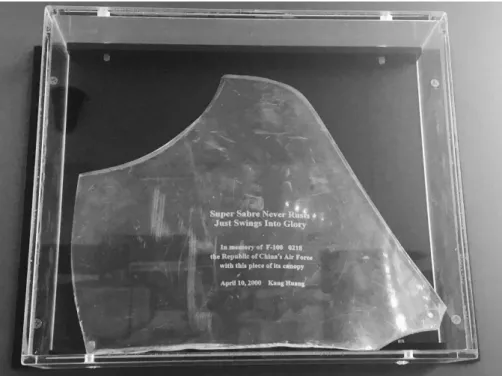
preservation campaign at National Taiwan University that centered on a retired U.S. military aircraft, it invites the variously positioned readers of A Tale in Taiwan and elsewhere to reflect upon how war memories can be unframed and connections remapped, starting from where they are.
Keywords: Ruth Ozeki’s A Tale for the Time Being, 3.11 disasters, Asian American studies, transpacific connections, war memories
iv
本論文旨在探討在 2011 年 3 月 11 日重創日本的地震、海潚,及核災以後,跨太平洋 戰爭記憶與連結如何被跨閱及重劃的可能。本論文分為三個章節。第一章以隨著3‧
11災難興起的「希望」的論述作為起點,闡明日本及美國政府用以合理化其跨太平洋 軍事結盟的策略,並進一步討論包含亞美研究在內的知識生產如何擾亂該論述的運作 及大眾對於「仁慈的美國」(benevolent America) 的想像。第二章聚焦於露絲‧尾關
(Ruth Ozeki) 的《時光的彼岸》 (A Tale for the Time Being),作為一本描述 3‧11災難及其跨太平洋的影響的小說,如何透過細膩地刻劃日本、美國及加拿大相 互纏綿的帝國歷史及其延續,促使讀者重新認識各種生命跨越太平洋彼此接觸的另類 可能。第三章總結此論文並試圖探究在台灣閱讀《時光的彼岸》的涵意:此一閱讀如 何能夠介入主流社會對台灣與他者關係的認知、理解及想像?本章透過討論曾於國立 臺灣大學發生的退役美國軍機保存事件,邀請在台灣或他處《時光的彼岸》的讀者,
從自身處境出發,重新審視戰爭記憶及連結如何被跨閱及重劃的各種可能。
關鍵字: 露絲‧尾關《時光的彼岸》、3‧11災難、亞美研究、跨太平洋連結、
戰爭記憶
v
Acknowledgements………i
Abstract……….iii
Chinese Abstract………...iv
Chapter One: Unframing Transpacific War Memories………...….1
I. An Alliance of Hope………...1
II. 3.11 and U.S. Militarism………5
III. The United States: A Benevolent Empire………...8
IV. Demilitarization and Asian American Critique………12
V. Chapter Breakdown....………..19
Chapter Two: Remapping Transpacific Connections……….22
I. “A Message in a Bottle”.………..22
II. “Assumptions Suck” ………...25
III. “Please Don’t Forget”.……….29
IV. “In America It’s Different”.……….35
V. “We Live in a Bully Culture”.……….44
VI. “Not Knowing is Hard”.………..53
Chapter Three: Remembering Cold War Amnesia………56
Works Cited………....65
Chapter One
Unframing Transpacific War Memories
The frame does not simply exhibit reality, but actively participates in a strategy of containment, selectively producing and enforcing what will count as reality. . . . And so, when the frame jettisons certain versions of war, it is busily making a rubbish heap whose animate debris provides the potential resources for resistance.
—Judith Butler, Frames of War: When is Life Grievable?
I. An Alliance of Hope
On April 29, 2015, during his visit to the United States a few months before the world marked the 70th anniversary of the end of World War II, Japan’s Prime Minister Shinzō Abe addressed a joint meeting in the U.S. Congress. In a speech entitled “Toward an Alliance of Hope,” Abe openly celebrated the United States’ contribution in rebuilding postwar Japan into a peaceful nation.1 Seeking to assure his addressees that Japan will continue to serve as an important ally to the United States for years to come, Abe argued that Japan will not only follow America’s leadership in promoting and sustaining a liberal economic order in Asia and the Pacific. More importantly, Japan will support the U.S. military “rebalancing” in the region. When illustrating how an expanding U.S. military infrastructure can be beneficial to countries across the Pacific, Abe referred to an example from one of the most devastating events in his nation’s postwar history: the earthquake, tsunami, and nuclear crisis that
occurred in Japan's northeastern Tōhoku region on March 11, 2011, commonly referred to as the “3.11” disasters.2 Invoking Carole King’s 1971 song, “You’ve Got a Friend,” that says,
“When you’re down and troubled . . . close your eyes and think of me, and I’ll be there to brighten up even your darkest night,” Abe argued that Japan could not have easily overcome
1 Abe’s full speech is available at the website of Prime Minister of Japan and his Cabinet; see http://japan.kantei.go.jp/.
2 For details about the reasons that Japan’s triple disasters are referred to as the “3.11 disasters,” see Geilhorn and Iwata-Weickgenannt.
its “darkest night” without Operation Tomodachi, a joint rescue operation conducted by Japan’s Self Defense Force and the U.S. military in response to the 3.11 disasters. In a rather triumphant note, Abe concluded his speech by arguing that “the finest asset the U.S. has to give to the world was hope, is hope, will be, and must always be hope . . . Let the two of us, America and Japan, join our hands together and do our best to make the world a better, a much better, place to live.”
I begin my thesis with Abe’s address to the U.S. Congress because it exemplifies what I will call a discourse of “hope” that is characterized by a celebratory tone, dramatic content, and portrayal of the United States as a “benevolent savior.”3 Proliferating in the wake of Japan’s 3.11 disasters, such a discourse has served as a convenient device for the
governments of Japan and the United States to render their transpacific alliance, which is imperialist and militarist in nature, acceptable, justifiable, and even desirable in the eyes of its people. In this M.A. thesis, this discourse of “hope” dramatizing the benevolence of America serves as a starting point from which I will investigate issues related to U.S.
militarism/nuclearism, how they are framed and made known, and the transpacific interconnectedness they evoked. Central to this investigation will be specific tactics of selective remembrance that the United States has effectively deployed to conceal the acts of imperial violence it has committed. Chapter One of my thesis will explore how, given the ubiquity and centrality of the pro-American discourses of “hope” in the aftermath of Japan’s 3.11 disasters, the task of exposing the necropolitical nature of the U.S. empire seems to have become increasingly difficult. In the face of such difficulties, how might other forms of knowledge and narration intervene in popular imaginaries that have firmly positioned the
3 It is worth noting that the deployment of “hope” as a trope to reaffirm the benevolence of America was also a dominant rhetorical feature of then U.S. President Barack Obama’s pre-presidential discourse. For example, in his now-famous keynote address, “The Audacity of Hope,” delivered at the Democratic National Convention in 2004, he asked his audience to actively participate in a “politics of hope” which might bring into being the many promises of America, identified as “a magical place,” a “tolerant” and “generous” nation, and “a beacon of freedom and opportunity.” For an in-depth analysis of Obama’s rhetoric of “hope,” see Ferrara; and Leeman.
United States as a helpful, benevolent, and friendly power? Is it possible to engage with the 3.11 disasters in other ways that might open up new possibilities for remembering,
reimagining, and remapping interconnectedness between lives across the Pacific, ones that are not imperialist and militarist in nature?
To tackle these questions, this thesis will address in Chapter Two Ruth Ozeki’s award- winning novel, A Tale for the Time Being (2013).4 A Tale dramatizes a Canada-based
Japanese American novelist’s attempt to locate, contact, or even save a Japanese schoolgirl, a potential victim of Japan’s 3.11 disasters. The schoolgirl’s diary, alongside other artifacts including a wristwatch and a stack of letters, were believed to be part of the tsunami debris that has crossed the Pacific Ocean, arriving at the west coast of Canada from disaster-stricken Japan. Rather than seeking to deliver stories related only to Japan’s disasters, however, Ozeki has represented in her novel a diverse set of histories whose violent consequences and
legacies have affected lives across the Pacific. This thesis will offer a close reading of A Tale that focuses on Ozeki’s representation of transpacific histories of violence, histories that involve the imperial pasts and presents of Japan, the United States, and Canada. In so doing, I seek to examine the ways Ozeki’s novel can encourage readers to reimagine and remap an alternative form of interconnectedness between both human and non-human lives across the Pacific, one that is qualitatively different from the transpacific alliance of “hope” that the governments of Japan and the United States have envisioned and attempted to materialize. I will argue that by opening space for an alternative imaginary of the transpacific, Ozeki’s novel can contribute to the unsettling of what Judith Butler has called the “frames” of war.
In examining the ways in which contemporary wars, including the U.S. War on Terror, have become “easier, or more difficult to wage,” Butler draws attention to the issue of
4 The awards that A Tale for the Time Being has received include, to name but a few, the Los Angeles Times Book Prize for Fiction (2013), the Independent Booksellers Book Award (2013), and the Asian/Pacific American Award for Literature (2014). It was also shortlisted for the Man Booker Prize (2013), and longlisted for the International IMPAC Dublin Award (2015).
framing, that is, the epistemological conditions under which “it becomes possible to
apprehend a life or set of lives as precarious, and those that make it less possible, or indeed impossible” (2). For Butler, to take into consideration how wars are waged and the effective means to oppose wars means, on the one hand, to engage with questions about whose lives can be conceived as more grievable than others, whose lives matters, or indeed are countable as a life. On the other hand, it also entails a critical inquiry into the normative schemes whose operations produce “certain subjects as ‘recognizable’ persons and . . . make others decidedly more difficult to recognize” (6). In locating the possibility to resist the epistemological and normative conditions under which the perception of precariousness and definition of life are regulated, Butler has directed focus to what remains “outside” of the frame. In particular, she argues that:
to call the frame into question is to show that the frame never quite contained the scene it was meant to limn, that something was already outside, which made the very sense of the inside possible, recognizable. The frame never quite determined precisely what it is we see, think, recognize, and apprehend. Something exceeds the frame that
troubles our sense of reality; in other words, something occurs that does not conform to our established understanding of things. (9)
This thesis argues that Ozeki’s novel exhibits what Butler has observed as the inevitable failure of the “frame” that seeks to contain what can be seen or apprehended. By bringing to the fore an alternative form of transpacific interconnectedness illuminated in a post-3.11 world, A Tale encourages readers to imagine what lies “outside” of the discursive frames through which the governments of Japan and the United States have attempted to regulate knowledge and imaginaries related to the 3.11 disasters and its transpacific consequences.
Foregrounding the significance of reading the interwoven narratives of precarious lives implicated in Ozeki’s novel, my thesis seeks to contribute to the unframing of imperialist ways of knowing.
II. 3.11 and U.S. Militarism
To examine the ways by which the 3.11 disasters have served as an opportunity for Japan and the United States to further their transpacific militarist agenda, it is necessary to inquire into the discourses surrounding Operation Tomodachi, a rescue operation launched in response to the disasters and named after the Japanese word for “friend.” According to one U.S. Congressional Research Service Report, at the peak of Operation Tomodachi, the U.S.
Department of Defense mobilized approximately 24,000 U.S. military personnel, 189 aircraft, and 24 navy vessels stationed in Japan and throughout Asia and the Pacific to cooperate with Japan’s Self Defense Force to search for victims, deliver relief supplies, clear debris, and restore critical infrastructures in disaster-affected areas (Feickert and Chanlett-Avery 1).
Labelled as “the single largest humanitarian relief effort in American history” (Biden), Operation Tomodachi was greatly appreciated by the Japanese government for its life-saving contributions. Japan’s then Defense Minister Toshimi Kitazawa, for example, remarked that
“[t]he entire Japanese people are deeply moved and encouraged by scenes of U.S. military members working hard in support of relief efforts” (Daniel). Then Prime Minister Naoto Kan also argued that many Japanese, including himself, “were enormously encouraged” by then U.S. President Barack Obama’s affirmative remarks that the relationship between the United States and Japan is “unshakeable” in times of crisis. Sharing similar themes and narrative tactics, these official narratives have not only helped cultivate pro-American sentiments among Japanese citizens in the immediate aftermath of the triple disasters.5 More importantly, they have also set up the discursive frames delimiting the possible ways of retelling and making sense of the massive military assistance that the United States has offered to Japan.
Various scholars from Japan and elsewhere have raised critical concerns over the discursive limits governing how memories and meanings about Operation Tomodachi have
5 See Samuels; and Kersten.
been produced and circulated. For instance, Asaho Mizushima argues that the “emotional episodes” and “heartwarming stor[ies]” about U.S. military relief efforts have generated feelings of gratitude among Japanese, making them hesitant to discuss the assistance they received “from the view of global political dynamics.” In particular, what remained to be openly discussed, Mizushima observes, was how the United States has used Operation Tomodachi as an opportunity to strengthen its military ties with Japan, regardless of the lingering controversies over its extensive military presence in Okinawa, Japan’s
southernmost territory where most of the U.S. military facilities in Japan are located.6 Along a similar vein, Annie Isabel Fukushima et al. have pointed out that U.S. disaster relief
missions such as Operation Tomodachi have “showcased the U.S. military’s ‘helpfulness,’
legitimized its presence and softened its image.” In turn, these imaginings portraying the U.S. military as friendly and helpful have constituted the rise of what might be called
“disaster militarism”—“a pattern of rhetoric, beliefs and practices [that] the military should be the primary responder to large-scale disaster.” According to this logic of “disaster militarism,” the United States is able to justify the necessity to preserve or even expand its current military infrastructure stretching across Asia and the Pacific, given the fact that its troops have been the “first and fastest” to contain disastrous consequences of natural calamities (Fukushima et al.).
The vast overseas U.S. military installations and bases hosted by the United States’
allied countries such as Japan, South Korea, and the Philippines, and by its incorporated and unincorporated territories such as Hawai‘i and Guam have helped shape what Chalmers
6 Mizushima argues that controversies surrounding U.S. militarization in Okinawa have at times destabilized the bilateral military alliance between the United States and Japan prior to March 11, 2011. He observes that after Kevin Maher, then director of the U.S. State Department’s Office of Japan Affairs, disparaged Okinawan residents who have been subsidized by the Japanese government for the military use of their land as “masters of manipulation and extortion” (qtd. in Mizushima), the Okinawa Prefectural Assembly demanded an apology from the United States on March 8, 2011. By drawing attention to this diplomatic incident, Mizushima seeks to explain that the United States’ timely mobilization of military troops and facilities to help the disaster-stricken people of Japan during Operation Tomodachi helped to shift public perceptions about the massive U.S. military presence in Okinawa.
Johnson has called the U.S. “empire of bases” (23). Within the reach of this empire, conflicts or natural calamities can be quickly contained and managed. Operation Tomodachi in fact has only been one of the many disaster relief operations that have provided the United States with opportunities to showcase its military’s friendliness and helpfulness. Among other disasters that the U.S. military was involved include, to name but a few, the Indonesia earthquake response in 2006, the Solomon Islands tsunami response in 2007, and the Kumamoto earthquake relief response in Japan in 2016.7 Although as Fukushima et al.
observe, disaster relief is by no means the primary function of the U.S. military, the justificatory logic of “disaster militarism” has proven useful for the United States to normalize its massive military presence in Asia and the Pacific.
U.S. overseas military bases, as Catherine Lutz observes, are “the literal and symbolic anchors, and the most visible centerpieces of the U.S. military presence overseas” (24).
Nevertheless, their lethal functions to kill and wage wars are oftentimes obscured by the logic of “disaster militarism,” or what I would suggest, discourses of “hope” that highlight the life-saving capacities of the U.S. military. Building on the discursive tradition that portrays U.S. overseas military bases as sites of rescue and protection rather than that of destruction, Hillary Clinton, then U.S. Secretary of State, called for a further expansion of the existing U.S. military structure in Asia and the Pacific in her now-famous 2011 article,
“America’s Pacific Century.” When justifying the necessity for the United States to “pivot”
its military assets from Iraq and Afghanistan to Asia and the Pacific, Clinton argued that
“Asia’s remarkable economic growth over the past decade and its potential for continued growth in the future depend on the security and stability that has long been guaranteed by the U.S. military, including more than 50,000 American servicemen and servicewomen serving in Japan and South Korea.” Securing prospects for economic development,
7 For critical concern over the U.S. and Japanese governments’ military appropriations of the Kumamoto earthquake that struck southern Japan on April 16, 2016, see Nikaido.
however, was not the only goal that motivated the United States to further its military presence in the region. Added to the list of reasons that support the U.S. military “pivot”
were the militarized promises of “hope”—manifested in the form of regional security and life sustenance—that the United States has sought to offer to the peoples of Asia and the Pacific. As Clinton observed, the “challenges” facing the “rapidly changing region” of Asia and the Pacific—“from territorial and maritime disputes to new threats of freedom of navigation to the heightened impact of natural disasters—require that the United States pursue a more geographically distributed, operationally resilient, and politically sustainable force posture.” While Clinton’s article attempted to highlight the U.S. military’s capacity to not only save lives but also secure regional stability and promote economic growth in Asia and the Pacific, what it failed to mention is a long history of crimes and civilian assaults involving rapes, abductions, accidents, and environmental contamination perpetuated by the U.S. troops against the diverse population of peoples living in close proximity to the United States’ overseas military bases.8
III. The United States: A Benevolent Empire
In studying the stakes involved in producing memories about U.S. imperial violence, Lisa Yoneyama has observed that the United States has deployed “an imperialist myth of
‘liberation’ and rehabilitation” to render its violence as justifiable and necessary means for its targeted enemies’ “recovery” (“Traveling Memories” 58-59). She explains that according to this myth, “the enemy population’s liberation from the barbaric and the backward and its successful rehabilitation into an assimilated ally” can be viewed as an anticipated “outcome of the U.S. military interventions” (59). Celebrating the positive outcomes of U.S. military activities, the “imperialist myth of ‘liberation’ and rehabilitation” has at the same time made
8 For an account of the past and ongoing history of U.S. military violence in Okinawa, one of the most militarized sites in the Asia-Pacific region, see Tanji.
the violence and atrocities the United States perpetuated difficult to be addressed and redressed. As Yoneyama makes clear, instead of seeing its military violence, colonial takeover, and occupation as crimes, the United States has chosen to articulate them as its
“gifts for the liberated” (80).9 Here, the tropes of rescue, rehabilitation, as well as debt are useful for the United States to depict itself as a benevolent “liberator” while hailing the peoples injured by its violence as “the liberated” and “the indebted”—people who should be grateful for the help they received. In this sense, Yoneyama argues, “[t]he injured and violated bodies of the liberated do not require redress according to this discourse of indebtedness, for their liberation has already served as payment/reparation that supposedly precedes the U.S. violence inflicted upon them” (81).
Yoneyama’s notion of “the imperialist myth of liberation and rehabilitation” is not only helpful to illustrate how in dominant American war memories, the U.S. war against Japan is remembered as a “good war,” one that has “not only liberated Asians, including Japanese themselves, from Japan’s military fanaticism, but also rehabilitated them into free and prosperous citizens” (59). I would suggest that the myth that Yoneyama conceptualized can also be used to examine how the United States has enunciated the necropolitical
violence of its military regime as “gifts” of prosperity and security to the peoples of Asia and the Pacific. As such, the myth effectively produces a form of forgetfulness that allows the United States to overlook its responsibilities to account for its crimes. To put it
differently, while the U.S. postwar and Cold War establishment of military bases in Asia and the Pacific have exacerbated the unlivable living conditions for some, the assumed deaths and forms of dispossession this establishment has produced, however, have been justified by the United States understood narrowly as a benevolent power trying to maximize access of life and a better future for its selectively liberated or rehabilitated subjects.
9 For a further investigation on how the United States exercises its power and violence upon its subjects, especially the figure of refugees, in the act of gift-giving, see Nguyen.
Resonating with Yoneyama’s discussion of the “imperialist myth” that enables the United States to make sense of its violence, Muto Ichiyo’s critical observations about the formation of “benevolent America” draws attention to the development of nuclear industry in postwar Japan—a historical condition through which the nuclear disaster in Fukushima was made possible. Having witnessed the destructive effects of the nuclear crisis in Japan since 2011, Muto seeks to question what caused Japan—a nation twice devastated by atomic bombs during World War II—to embrace nuclear energy in its postwar era. Importantly, he attempts to foreground a genealogy that maps the interconnections between atomic bombs and nuclear power plants. He does so by drawing attention to the “peaceful use of nuclear power” campaign that the governments of the United States and Japan have mutually pushed forward in the wake of a wave of anti-nuclear protests starting from the 1950s. He observes that in the immediate postwar period when the memories of U.S. violence, aggression, and victimization of the two atomic-bombed cities—Hiroshima and Nagasaki—were still dominantly remembered by the people of Japan, the United States has sought to turn its image from a “victimizer” to that of a “benefactor” (210). One way the United States has chosen to achieve its self-refashioning goal was to “overwhelm Hiroshima” with the
knowledge that “the more murderous the atom as bomb, the more benevolent it should be in its peaceful use” (177). As Muto points out, within the dominant discourse of the “peaceful use of nuclear energy” campaign, the concrete bodily sufferings of hibakusha—victims exposed to the radioactive contamination of the U.S. atomic bombings—need to be
channeled into an abstract idea of “atomic bomb experience” in order to be connected to the equally abstract notion of peace (177). By mobilizing such abstract notions of wartime suffering and peace, the United States, Muto contends, was able to refashion atomic energy as something that could bring about a bright and prosperous future for the war-devastated people of Japan, thereby foreclosing any meaningful discussion of its wartime
responsibilities (178).10
The dominant stories that celebrate the United States as a benevolent power willing to share its nuclear technology to enable the economic growth of postwar Japan have
marginalized, if not effaced, not only the memories of the sufferings of individual hibakusha but also those of other populations exploited by the U.S. nuclear and military activities in Asia and the Pacific. As Yu-fang Cho points out, while “the United States managed
antinuclear protests in Japan […] through the introduction of nuclear energy as a technology of economic development (and thus for ‘life’), turning the necropolitical violence of nuclear bombings into biopolitical regulation,” its nuclear regime has drastically reordered “uneven access to life and death” among differently racialized groups subjected to its imperial
governance (10).11 Following Muto’s focus on the event that brought forward a wave of anti- nuclear protests in Japan during the 1950s—namely, the 1954 Lucky Dragon incident, otherwise known as the Bikini Atoll incident during which a Japanese tuna fishing boat operating in the Pacific was exposed to the nuclear fallout from the United States’ Castle Bravo nuclear testing in the Bikini Atoll—Cho examines how the similarly contaminated bodies of Japanese and Indigenous people of the Marshall Islands have received different treatment from the United States (9). While the United States chose to deploy the “peaceful use of nuclear power” campaign to recast nuclear power as a source of cheap and clean energy that could support the substantial growth of Japan’s postwar economy, the differently racialized Pacific Islanders, by contrast, were excluded from the promises of a better life.
Subjugated to the “necropolitical violence” of U.S. nuclearism across Asia and the Pacific, Indigenous Pacific Islanders were forcefully deprived of their means of living, displaced and relocated from their homeland—which was turned into a site for extensive U.S. nuclear
10 On this point, see also Yoneyama’s Hiroshima Traces: Time, Space, and the Dialectics of Memory for a discussion of how the victims of the U.S. atomic bombings of Hiroshima and Nagasaki include not only Japanese nationals but also other colonized subjects of the Japanese empire, such as ethnic Koreans (152).
11 On biological and necropolitical violence, see Mbembe.
testing—and subjected to radiation and medical experimentation (10).12
In their introduction to Perilous Memories: The Asia-Pacific War(s), T. Fujitani, Geoffrey M. White, and Lisa Yoneyama have observed that the “marginality and silence” of certain memories of war are “linked necessarily to the centrality, volume, visibility, and audibility of more dominant stories” and that “in some cases, the dominant stories obtain the force they do in popular imagination precisely because of their ability to simplify and
transform troublesome or dissonant memories” (4). Read within the context of Japan’s 3.11 disasters, Fujitani, White, and Yoneyama’s critical insights shed light on how dominant narratives and imaginings of hope that depict America as a benevolent power gain discursive centrality by simplifying or obfuscating the troublesome memories of U.S. military violence that have been unevenly shared among peoples in Asia and the Pacific. Such an uneven remembrance and forgetfulness of America’s violence, or “popular inattention” towards the violent “scenes of militarized imperial action”—which include, to name but a few, the United States’ ongoing colonial rule of Guam, its militarist pressure over the Philippines and South Korea, and its extensive military presence in Japan—has however, as Cynthia Enloe argues,
“greased” the “wheels of militarization” and made U.S. imperialist activities in Asia, the Pacific, and elsewhere easier to sustain (viii). Against a backdrop where the discursive centrality and marginality of certain stories could possibly affect the speed of U.S. global military expansion, directing our critical attention towards unsettling memories, histories, or bodies of knowledge which might unframe dominant ways of imagining the United States as a non-violent, benevolent, and friendly power is arguably more urgent than ever.
IV. Demilitarization and Asian American Critique
Recent scholarly efforts have attempted to address and shed light on the dissonant
12 See Teaiwa for a detailed discussion of how the invention of bikini, a swimming suit designed by French fashion designer Louis Réard in 1946, has marginalized the memories of U.S. military aggressions in the Bikini Atoll in the Marshall Islands (18-26).
memories of U.S. military violence and injustice shared unevenly among the peoples of Asia and the Pacific. In their important anthology, Militarized Currents: Toward a Decolonized Future in Asia and the Pacific, Setsu Shigematsu and Keith L. Camacho have called for a critical study that pays attention to the interconnectedness between U.S. and Japanese
imperialisms and “analyzes militarization as an extension of colonialism and its gendered and racialized processes from the late-twentieth to the twenty first century” (xv). They have foregrounded the metaphor of “current” to signal “how militarization operates across
temporal and spatial boundaries, as contemporary military technologies are informed by past and projected imperialist imperatives” (xv).13 In drawing attention to the interwoven
histories of U.S. and Japanese imperialist expansion as an important site of critique,
Shigematsu and Camacho seek to address the lacuna of forms of area studies that have not yet attended to the permeating military violence perpetuated by the U.S. and Japanese empires (xxvi). With its wide-ranging investigation of how Asians, Pacific Islanders, and Asian Americans are differentially affected by these empires, the kind of critical study that Shigematsu and Camacho call for and have exemplified in their own works seeks to bring forward a transdisciplinary and transregional collaboration among scholars engaging with the problematics of U.S. and Japanese militarization in Asia and the Pacific (xv).
Amidst the emergence of the proposed (but now apparently defunct) Trans-Pacific Partnership (TPP)—a massive free trade agreement that was to have involved participants from more than ten countries from both sides of the Pacific—Viet Thanh Nguyen and Janet Hoskins have seen an urgent need to produce critical knowledge about the “transpacific,” one that offers a different imagination of the Pacific than the TPP.14 Viewing the Pacific as a site
13 For a keyword entry on militarization that builds on Shigematsu and Camacho’s understanding of the term, see Kim’s “Militarization.”
14 For a keyword entry on the transpacific that resonates with Nguyen and Hoskins’ understanding of the term, see Suzuki. See also Mok and Bahng’s introduction to the February 2017 issue of Journal of Asian American Studies for a discussion of how even when the TPP has now become defunct, and that the “Obama-Clinton vision of ‘America’s Pacific Century’ comes to a close, it remains a crucial moment to interrogate what competing projections of the Asian Century might now come into the frame” (4).
of “critical engagements” or a “contact zone” whose history is defined by “collaborations, alliances, and friendships between subjugated, minoritized, and marginalized peoples” rather than of capitalist exploitation or imperial fantasies that serve the interest of European,
American, or Asian powers, they suggest that a critical transpacific studies might introduce “a different kind of transpacific partnership, this time between academics on both sides of the Pacific and in the Pacific” (4). Similar to the project of Shigematsu and Camacho, this new critical project—or academic partnership—springs from Nguyen and Hoskins’ discontent with existing forms of disciplinary knowledge. One of the disciplines that they are critical of is Asian American studies. They suggest that while this body of knowledge has always paid attention to the experience of immigrants, in its attempt to “claim America,” it has been reluctant to acknowledge “the importance of Asia or countries of origin” (19). While in recent years, Asian American studies has increasingly turned its attention “overseas” and focused on a “transpacific examination of the immigration experience,” it has still been dependent on American or European languages and points of view to interpret the cultural expressions of immigrants, refugees, or exiles (19-20). Nguyen and Hoskins argue that because of such dependence, Asian American studies “might already be biased or flawed from the beginning by assumptions that placed certain topics or questions out of the intellectual or linguistic frame” (20). Without a transpacific framework that attends to perspectives from Asia and the Pacific, they argue, Asian American studies could become complicit with the “intellectual imperialism” of U.S.-based studies that privilege American experiences over the experiences of others (20).
While, as Nguyen and Hoskins suggest, an Asian American studies that prioritizes European and Anglo-American languages and perspectives might indeed be inadequate to produce counterhegemonic knowledge about the “transpacific,” intellectual endeavors have been made to address the shortcomings of the field from within. In Imagine Otherwise: On Asian Americanist Critique, Kandice Chuh has offered a critical reconsideration of the
coherence and object(ives) of Asian American studies by drawing theoretical insights from poststructuralist theories. She acknowledges that while it might be seemingly contradictory to engage Asian American studies, an interdisciplinary field that emerged out of sociopolitical movements during the 1960s and 1970s, with the apparently Eurocentric philosophical tradition of poststructuralism which “makes difficult immediate political intervention by means of its destabilization of subjectivity itself,” the maintenance of a “deconstructive attitude” within the field may nevertheless be a productive way to rethink how Asian
American critique can remain a “politicized tool for social justice” (4-6). As Chuh explains, poststructuralist thinking both undermines the “knowability of ‘knowledge’” as well as “the authority of the ‘knowing’ subject, whose grounds of action are consequently called into question” and destabilizes the very “repressive/constructive orders of knowledge” from which subjectivity is constructed (5). Her attempt to place Asian American studies within this tradition is not to cast doubt over the field’s critical and political effort to demand social justice from the U.S. nation-state which refuses to recognize Asian American subjects as its proper citizens worthy of legal protection. Rather, it is to keep “contingency, irresolution, and nonequivalence in the foreground of this discourse” (8) so that “Asian American” can serve as a critical tool that challenges the very regulatory mechanism that governs the conditions of justice and renders certain subjects knowable to the state. Chuh contends that the purpose of Asian American studies “has been and continues to be pursuit of this (im)possibility, the pursuit of an as yet unrealized state of justice by tracing, arguing, and critiquing, and by alternatively imagining the conditions that inscribe its (im)possibility” (8). As a political project for “justice,” Asian American studies endlessly searches out “the knowledge and material apparatuses that extinguish some (Other) life ways and that hoard economic and social opportunities only for some” (8).
Echoing Chuh’s concern that Asian American studies does not only attend to Asian Americans’ struggle for political and social justice within the U.S. nation-state, but also
serves as a deconstructive critique that calls into question the very juridical and
epistemological conditions from which justice and subjectivity are made possible and known, Jodi Kim argues that Asian American critique and cultural politics cannot be contained simply in what is oftentimes dismissed as “the unsophisticated or exhausted identity politics of the ‘minority’ subject” (Ends of Empire 7). By conceptualizing Asian American critique as an “unsettling hermeneutic,” Kim explores how Asian American cultural productions could defamiliarize and destabilize the Cold War epistemologies of the United States and offer a critique of the U.S. empire in Asia (5). She explains that the Cold War should not be merely understood as a historical event or epoch that might have ended after the collapse of the Soviet Union. Instead, it “exceeds and outlives its historical eventness” and “continues to enjoy a persisting recursiveness when seen as a structure of feeling, a knowledge project, and a hermeneutics for interpreting developments in the ‘post’-Cold War conjuncture” (3). This
“protracted afterlife” of the Cold War can be discerned during the U.S. War on Terror when the Manichaean logics as well as the Cold War rhetorics of fear were deployed to construct a binary opposition between the “good” and the “evil empire” (4). As an “unsettling
hermeneutic,” Asian American critique can help to disturb and unsettle “the dominant Manichaean lens through which the Cold War is made sense of and in turn generates
meaning” (5). It may also generate “a new interpretive practice or analytic for reading Asian American cultural productions, and the very formation of contemporary ‘Asian America(n),’
in new ways” (5). As Kim makes clear, rather than aiming to explain or generate totalizing knowledge about the Asian American experience under the Cold War, this new interpretive practice seeks to situate Asian American cultural forms “as the site where knowledge and meaning are at once constituted and unraveled, where the officially unknowable reckons at once with the already known and the impossibility of knowing” (6). To put it differently, Kim’s critical project suggests that Asian American culture does not aim to render totally visible and knowable what official epistemological projects effaced, but engages with a
“politics of refusal” that can critically “account for” the “gendered racial imperialist history, culture, and production of knowledge” of the U.S. empire in Asia (6-7).
The call for expanding the object(ives) of Asian American studies has been similarly articulated in Chih-ming Wang’s editorial introduction to a special issue of Inter-Asia
Cultural Studies, entitled “Asian American Studies in Asia.” Whereas Kim has introduced the legacies of U.S. imperialist wars in Asia as a productive site of critique for Asian American studies, the articles included in this special issue have pushed this effort further to foreground
“the politics of location in receiving, analyzing, and reorienting Asian American studies through Asia as a geo-historical nexus and interactive plurality” (Wang, “Editorial Introduction” 165). In clarifying how Asia can serve as a site to reorient Asian American studies, Wang points out that “Asia” should not be merely understood as a fixed geographical entity or cultural and racial marker that binds Asian American and their experiences or cultural productions to a “putative continent of origin” (165). It instead exists as an ever- shifting, heterogeneous, and complex plurality and functions as a critical site from which “the interconnected histories and memories of war, displacement, and movement between nations and across oceans” can be examined (165-66). In this sense, resituating “Asian America” to the pluralistic critical locus of “Asia” might bring into light an “inter-Asian and transpacific perspective” to the understanding of the field as a project that can challenge hegemonic Eurocentric or Anglocentric visions of the world (195).15
15 As members of the Summer Institute in Asian American Studies (SIASS) project, a multi-campus collaborative project that aimed to advance Asian American Studies in Taiwan and elsewhere in Asia, Hsiu- chuan Lee and Chih-ming Wang (along with other members of the collective) have contributed critical insights into reconsidering what resituating Asian American Studies in Asia might imply. In particular, Lee’s essay, “Re- engaging ‘Asia,’” has examined how “the foregrounding of Asia might not simply enrich Asian American Studies with Asian intellectual contributions or Asian Americans’ transpacific trajectories but might also enable us to consider new strategies and visions to comprehend ‘Asia’” (47). In a similar vein, in “Asian American Critical Work in a Transpacific and Inter-Asia Nexus,” Wang suggests that the aim of scholars contributing to the SIASS project “was not to replicate the work that is being done in North America; instead, [they] wished to articulate and activate Asian American critical work in, with, through, and beyond Asia, and to highlight the geocultural pluralities of Asia in transpacific and inter-Asian conversations about Asian America” (63).
Kuan-Hsing Chen’s theorization of “Asia as method” has contributed important critical insights for Wang and other scholars engaging in “Asian American Studies in Asia” to work against the grain of dominant epistemologies produced from European or Anglo-American hegemonic points of view. As Chen observes, “the historical processes of imperialization, colonization, and the cold war have become mutually entangled structures, which have shaped and conditioned both intellectual and popular knowledge production” (212). In this context, “Asia as method” works to transform these existing conditions of knowledge production from which imperialism exercises its power and suppresses deimperialization movements. Chen contends that by shifting their points of reference from the United States or Europe and deploying the idea of Asia as an “imaginary anchoring point,” societies in Asia might be able to learn from each other new ways to deal with similar problems, transform pervious perceptions of their selves, rebuild their subjectivities, and develop an alternative understanding of world history (212). Drawing on Wang Hui’s essay “Imagining Asia: A Genealogical Analysis,” Chen nevertheless notes that the idea of Asia is itself loaded with anxieties. Asia is, in Wang’s account, both “colonial” and “anticolonial”; “nationalist” and
“internationalist”; an invention of Europe, but itself shaped the self-understanding of Europe;
and “tightly connected to the question of the nation-state, and overlapping with the
perspective of the empire” (qtd. in Chen 215). Given these contradictions and anxieties over the meanings of Asia, Chen argues that “Asia as method recognizes the need to keep a critical distance from uninterrogated notions of Asia [and] sees Asia as a product of history, and realizes that Asia has been an active participant in historical processes” (215).
The inter-Asia referencing method that Chen proposes has enabled scholars engaging with “Asian American Studies in Asia” to reflect on how reorienting and resituating Asian American studies in the heterogeneous, conflicting, and ever-shifting cultural site of Asia can both generate a critique of U.S. racism and imperialism as well as a “self-critique” among Asian Americans, Asians, and Pacific Islanders (Wang, “Editorial Introduction” 171). As one
of the scholars contributing to this inter-Asia and inter-Pacific dialogue, Candace Fujikane has sought to further reorient the field from the referencing point of Hawai‘i. While
Indigenous peoples from Pacific Islands such as Hawai‘i have struggled to deimperialize their lands from the dominance of U.S. imperialism, they also need to tackle the settler practices of Asian Americans who have immigrated to these islands. In tracing the settler colonial
histories of how Asian American settlers on Pacific Islands have been complicit with the broader structure of the U.S. settler states and participated in “obscuring the conditions of U.S. occupation, colonialism, and imperialism,” Fujikane urges Asian American settlers to be self-reflective and liberate themselves from their positions as “agents in a settler colonial system of violence” (192). By introducing a critique of Asian American settler colonialism as a “mode of self-reflexive inquiry” to the field, Fujikane argues that “Asian American critique must engage in Asia and the Pacific as method […], which means reorienting ourselves in more expansive ways toward Asia and the Pacific in order to work toward a decolonized, deimperialized future” (192). By attending to the interlocking histories of racism, settler colonialism, imperialism, and globalization from different local sites of knowledge, Asian American critique, as Fujikane asserts, “can be part of a decolonizing and deimperializing force in Asia and the Pacific” (193).
V. Chapter Breakdown
In this chapter, I began by taking into consideration what I have called a discourse of
“hope” that has proliferated in the wake of Japan’s 3.11 disasters. Constituted mainly of government statements from American and Japanese officials who celebrated the effectiveness of Operation Tomodachi, this discourse of “hope,” as I have argued, has contributed to an establishment of discursive norms that delimit the possible ways of discussing a persisting U.S. military presence in Asia and the Pacific. Annie Isabel
Fukushima et al.’s discussion of “the logic of disaster militarism” has been particularly useful
for me to understand the discursive tactics the United States employed to justify its long- standing military presence in the region. From an investigation of the proliferation of
discourses of “hope” after the 3.11 disasters in Japan, I have turned to examine the historical formation of the U.S. “benevolent” empire by drawing upon the work of scholars including Lisa Yoneyama, Muto Ichiyo, and Yu-fang Cho. Investigating the complex histories of U.S.
militarism/nuclearism in Asia and the Pacific, I have attempted to expose the stakes involved in producing knowledge about the necropolitical violence of “benevolent America.” Next, I have drawn attention to recent scholarly efforts seeking to address the histories of violence and injustice perpetuated by the U.S. empire. Drawing upon the work of scholars including that of Setsu Shigematsu and Keith L. Camacho, Viet Thanh Nguyen and Janet Hoskins, Kandice Chuh, Jodi Kim, Chih-ming Wang, Kuan-Hsing Chen, and Candace Fujikane, I have attempted to elucidate how Asian American studies in Asia can potentially serve as a political and intellectual project for justice, a project that might call for an end of imperialism in Asia and the Pacific.
Chapter Two will build upon this existing scholarship by focusing on Ruth Ozeki’s novel A Tale from the Time Being. In A Tale, alongside descriptions of the life-threatening dangers posed by the nuclear crisis in Fukushima, Ozeki fills pages of her novel with unsettling and oftentimes poignant narratives of social exclusion, forced displacement, and violent dispossession. I will read these descriptions and narratives against the grain of the discourses of“hope” that I have identified earlier in Chapter One. In so doing, I hope to explore the possible ways Ozeki’s fictional representation of violence and dispossession can challenge taken-for-granted assumptions of what war and peace respectively mean. Before proceeding with my reading of A Tale, however, I will first draw upon existing scholarship about the transpacific connections that Ozeki has attempted to make visible or has arguably ignored in her novel. Building on this existing scholarship, my reading will place critical emphasis on what may arguably be viewed as marginal information that Ozeki has offered to
her readers in A Tale—Okinawa’s wartime history, multicultural (in)tolerance of immigrants in the United States, and Canada’s settler colonial violence to Indigenous communities. By developing a reading that focuses on apparently minute details in A Tale, I hope to explore the possible ways Ozeki’s text can enable readers to remap alternative forms of
interconnectedness between lives that have been differentially injured and intimately connected by imperial powers from both sides of the Pacific.
Chapter Three will summarize the issues discussed in my thesis and examine the potential significance of reading A Tale in Taiwan. If Ozeki’s novel enables its readers to develop an analytical stance over the popular imaginaries of America’s imperial benevolence, what kind of critical reflection can it potentially facilitate here in Taiwan? In order to
foreground Taiwan’s entanglements with the complex network of transpacific exchanges, contacts, and encounters that Ozeki makes visible for her readers in A Tale, I will turn to investigate a historic preservation campaign at National Taiwan University, one whose participants and the very artifact in need of protection—a retired U.S. military aircraft—
stirred troubling memories of war, displacement, and dispossession of lives across Asia and the Pacific. In drawing attention to this particular campaign, I seek to examine the stakes involved in producing knowledge about Taiwan’s militarized relationships with the U.S.
empire. Given the difficult transpacific histories of violence entangling Taiwan, how, if at all, can we begin to address Taiwan’s contribution to the militarized displacement of peoples in Asia and the Pacific? This chapter will try to elucidate how a reading of A Tale in Taiwan might bring forward a critical reconsideration of Taiwan’s role in enabling, or unsettling, the United States’ imperial arrangements in Asia and the Pacific.
Chapter Two
Remapping Transpacific Connections
Ruins are vestiges bequeathed to us that are at once liabilities endured from the past and assets for the future, both repressive and emancipatory. It is then left to each one of us to fathom the debris, but without instrumentalizating them.
—Lisa Yoneyama, Cold War Ruins: Transpacific Critique of American Justice and Japanese War Crimes
I. “A Message in a Bottle”
When a 40-meter-high tsunami wave hit Japan’s northeastern coast on March 11, 2011, it generated an estimated 25 million tons of wreckage that would be dragged into the Pacific Ocean. While Japanese authorities believed that approximately 70% of it has sunk right to the seabed, floating materials weighing as much as 1.5 million tons were found drifting along Pacific Ocean currents, heading towards North America. As of 2015, 64 items washed ashore on the coasts of Hawai‘i, Alaska, Washington, Oregon, California, and British Columbia had been officially identified as tsunami debris, some of which were able to be eventually
returned to their owners. Stories focusing on Japan’s tsunami debris and its journey across the Pacific have in fact provided a point of departure for artists and filmmakers to address and examine the transpacific implications of the 3.11 disasters. For instance, Jave Yoshimoto, a Chinese-Japanese-American artist, has created a scroll painting called “Vultures of Fragments Past” (2012) which imagines Godzilla, Japan’s renowned fictional radioactive monster, and a cluster of confirmed tsunami debris—a fishing vessel, a football, and a Harley-Davidson motorcycle—arriving at the end of their journey (tabi no owari), with landmarks of Seattle including an orca whale, the Space Needle, and Mount Rainier in sight.16 Preoccupied with an urgent sense to “know the story behind” the debris, Toronto-based filmmakers Nicolina
16 For a glimpse of “Vultures of Fragments Past,” see Yoshimoto’s official website:
https://www.javeyoshimoto.com/.
Lanni and John Choi decided to work on a feature length documentary entitled Lost & Found (2015), capturing the relentless efforts of those who have dedicated themselves to returning items found on North America’s shores to their “rightful owners in Japan.”17 Sharing a similar interest with Lanni and Choi, Vancouver-based filmmaker John Bolton produced a short documentary named Debris (2015), featuring Peter Clackson, a beachcomber and a self- trained environmental artist based in Tofino, British Columbia, whose artistic projects involve building a memorial of Japan’s 3.11 disasters using materials from the tsunami debris that he collected.18
Tsunami debris washing up on North America’s shores has not only served as a major source of creative inspiration for artists and filmmakers including Yoshimoto, Lanni and Choi, Bolton, Clackson and others; it has also allowed writers such as Ruth Ozeki to realize, in her words, the “many different ways we are connected, and interconnected, especially on the Pacific Rim,” prompting her to write a novel that could interrogate the transpacific connections of lives touched by unprecedented disasters (McMartin). Published in 2013, a time when the amount of debris arriving at North America was expected to peak, Ozeki’s A Tale for the Time Being narrates the imaginative encounter of characters whose lives would not have come into each other’s contact had a plastic freezer bag and its contents failed to escape from “the orbit of the Pacific Gyre” (13) and reached the shore of Cortes Island, British Columbia. Inside the freezer bag was a Hello Kitty lunchbox containing an antique kamikaze wristwatch, a stack of handwritten letters, and the diary of Naoko Yasutani (also known as Nao), a sixteen-year-old Japanese schoolgirl who suffers from intense loneliness, depression, and bullying—both online and at school. Ozeki created a fictional version of herself named Ruth to pick up this freezer bag, ponder its origin, and explore every possible means to contact Nao, a potential victim of Japan’s disasters. Through Ruth’s investigation,
17 For further information about Lost & Found, see its official website: http://www.lostandfoundthefilm.ca/.
18 At the time of writing, a trailer of Debris can be seen at: https://www.nfb.ca/film/debris/clip/debris_clip/.
stories relating to the history of Japanese and American wartime competition and postwar complicity in which Nao and her family members are entangled come to the surface, creating confusion, frustration, and bringing forward the difficulty of what Ozeki’s novel calls “not knowing” (400). In imagining transpacific crossings and connections between Asia and America illuminated in a post-3.11 world, Ozeki’s text tactically weaves together the threads of diverse historical moments—from wars, conflicts, disasters, and more.
In its initial reception, A Tale was identified by numerous reviewers as a variation of a
“message in a bottle” story (Sethi; Hendry; Fisher), one that places narrative emphasis on desperate characters who seek help in times of crisis by sending their last message off into a vast body of water. This comparison is echoed by a book trailer of A Tale that Viking Books released online, a trailer that encourages its viewers to find out “what happens when the right book falls into the right readers’ hand.”19 Taking a cue from this analogy, my analysis in this chapter will place particular emphasis on the secret diaries of Nao and her great-uncle, Haruki #1, the messages in a Hello Kitty Lunchbox, and ask: what kind of responses are they demanding from their readers? What happens when they travel out of the historical contexts from which they are produced and arrive elsewhere—in Ruth’s hands, and in the hands of Ozeki’s readers? In trying to arrive at workable answers for these questions, this chapter will attempt to read Nao and Haruki #1’s “messages” as an invitation for readers to revisit ghostly and living memories of violence and suffering—linked to, if not determined by, the workings of empires that continue to jeopardize human and non-human lives from dispersed but interconnected locations. In so doing, this chapter seeks to demonstrate how A Tale can potentially open up imaginative space for readers to challenge what I have called discourses of “hope” that have served as useful tools for the United States and Japan to render justifiable their transpacific imperial projects.
19 At the time of writing, a trailer for the Viking Books edition can be found at:
https://www.youtube.com/watch?v=kAPeWSHdEWg.
II. “Assumptions Suck”
When reviewing A Tale, Julia Denholm has observed that “[w]ith the post-earthquake, post-tsunami effects still being so strongly felt on the west coast [of North America in 2014], the book seemed very appropriate.” What makes Ozeki’s novel an “appropriate” text to read in times of ongoing disaster, however, is not only its explicit references to Japan’s
earthquake, tsunami, nuclear meltdown, and their transpacific consequences. As other reviewers such as David L. Ulin pointed out, “what’s compelling about A Tale for the Time Being . . . is that it uses . . . uncertainty to push below surface, to make a series of unexpected links.” In other words, “Ozeki wants us to think about the boundary . . . between what we know and what we project.” In her posthumanist reading of A Tale, Michelle N. Huang echoes some of Ulin’s observations about the “unexpected links” that Ozeki makes to complicate what we “know” and “project.” Drawing attention to the Great Pacific Garbage Patch that A Tale represents, Huang seeks to examine “Asian American racial formation in unexpected locations and contexts, ones thought of as peripheral to the field of Asian American studies” (96). Among the scenes in A Tale that Huang calls attention to is one where the Pacific Ocean “interrupt[s]” the shore of Whaletown on Cortes Island, allowing Nao’s lunchbox to reach Ruth (101). While initially appearing as “someone’s garbage” that is not unlike the list of worthless objects—“fishing lines, floats, beer cans, plastic toys,
tampons, Nike sneakers” and even “severed feet”—tossed back and forth by waves, Nao’s lunchbox demands Ruth’s attention as it not only brings to the fore the destructiveness of Japan’s 3.11 disasters whose effects were felt through the Pacific; more importantly, it also helps draw attention to the “jettisoned histories of disregard and violent erasure” (99) that constituted part of the past of Ruth’s community. One prominent example of such resurfacing of “jettisoned histories” can be taken from the naming of “Jap Ranch,” an old homestead nearby the place where Nao’s lunchbox washed ashore. As Huang observes, with its
nickname which signifies American aggression and hostility towards Japanese, “Jap Ranch”
serves as reminder of “the violence and trauma of Japanese American incarceration during World War II” which should not be forgotten in our putatively “postrace” society (100). For Huang, a critical focus on the garbage and oceanic interruptions represented in A Tale
reaffirms “the importance of reading for race in deracinated locales” (101), a task that should remain central to the field of Asian American studies.
In a similar vein, Guy Beauregard has advanced a reading of A Tale that foregrounds some of the epistemological challenges that Ozeki poses to her readers, namely, “the limits of which lives various readers of this text can presume to know” (105). As Beauregard contends, these limits are manifested through the supposedly “remote” sites of dispossession that Ozeki represents—both briefly and at length. One explicit example can be drawn from the scene that Huang has also placed critical emphasis on: when the racialized history of “Jap Ranch” is discussed among the novel’s characters. Beauregard observes that “[b]y evoking the state- directed dispossession of racialized subjects on Cortes Island (in this case, an unnamed
‘Japanese family’) who were forcibly relocated and forced to sell their home, this [scene]
points our attention to figures who are no longer present in [Ruth’s] community” (101).
While Ozeki’s readers are able to trace the disappearance of the “subjects racialized as Japanese” from Cortes Island thanks to Ruth’s “stubborn refusal” to let these lives disappear (101), there are other moments of dispossession in A Tale that are less easy to know.
Encapsulated in a scene that depicts the confrontation of two characters—a marine biologist and environmental activist called Callie, and a former WWII bomber pilot who was stationed at an airbase in the Aleutians and who once used whales for target practice—these lesser known moments include human ecological violence against whales, figures that are no longer present in the European settlement of Whaletown, as well as the forced removal of
Indigenous Aleut people from their ancestral home, the Aleutian Islands, by the Japanese and American governments for military purposes (102). Significantly, these stories of
dispossession pose challenges to readers who presume to know which lives Ozeki’s novel has