科技部補助專題研究計畫成果報告
期末報告
建立區域住宅價格模型(RHPM)以推估地方空間價格差異分析
計 畫 類 別 : 個別型計畫
計 畫 編 號 : MOST
107-2410-H-006-083-執 行 期 間 : 107年08月01日至108年07月31日
執 行 單 位 : 國立成功大學都巿計劃學系(所)
計 畫 主 持 人 : 陳彥仲
計畫參與人員: 碩士班研究生-兼任助理:段必文
碩士班研究生-兼任助理:管彥婷
碩士班研究生-兼任助理:鄭宇鈞
報 告 附 件 : 出席國際學術會議心得報告
中 華 民 國 108 年 10 月 16 日
中 文 摘 要 : 區域的非均質發展造成了住宅市場實質環境條件的差異,又不同的
區域之住宅需求與住宅投資條件各有差異,其差異顯現在區域住宅
價格的分佈上。本研究綜合台灣現制六大都會城市,包括新北市、
台北市、桃園市、台中市、台南市及高雄市之住宅價格及空間追蹤
資料,建立區域住宅價格模型(Regional Housing Price Model, 簡
稱RHPM),以同時考量空間異質性、空間外溢效果、地區性因素與總
體性因素。並用以探討影響臺灣縣市地區住宅價格之因素,與鄰近
縣市間如何交互影響。透過區域住宅價格模型之建立及實證分析
,將可進一步了解臺灣不同區域房價外溢效果之方向性,並釐清區
域發展差異對縣市地區之住宅市場的運作機制與特性。
中 文 關 鍵 詞 : 房價、外溢效果、追蹤資料、台灣
英 文 摘 要 : Following the economic booming in Taiwan since 1950’s, the
housing prices increase in a fast pace, especially in the
capital city area such as Taipei and New Taipei area in
northern region of Taiwan. However, there is an immense
difference of rising degree by regions from north to south.
The heterogeneity of regional spatial development forms the
differences of housing environment attributes and results
in different housing price distribution for local regions.
The price differences also related to the motivation
difference from housing consumption to housing investment.
In this study, we select six metro-city regions in Taiwan,
including New Taipei, Taipei, Taoyuan, Taichung, Tainan,
and Kaohsiung as the empirical areas to construct the
so-called the Regional Housing Price Model (RHPM). The RHPM
will be constructed empirically in Taiwan area to take into
account of the spatial heterogeneity, spatial spillover
effects, local environment attributes by metro-city
regions, and the Taiwan macro-economic factors as well. We
investigate how national and regional elements impact on
regional housing market by using spatial panel data model.
Different from the past studies, this paper considers both
spatial heterogeneity and dependency simultaneously.
We found from the empirical study that the spatial
spillover effect is positive in the northern region,
negative in the central region, but insignificant in the
southern region of Taiwan. It also shows that the three
regions were in distinct stage of development, causing the
characteristic of regional housing market to present
differently.
Examining the Regional Spatial Spillover Effect of
Housing Price in Taiwan –An application of Housing
Panel Data
Yen-Jong Chen
1, Pi-Wen Tuan
2, Yung-Han Liang
31 Department of Urban Planning, National Cheng Kung University, Taiwan, e-mail: [email protected]. 2 Department of Urban Planning, National Cheng Kung University, Taiwan, e-mail: [email protected]
3 Department of Urban Planning, National Cheng Kung University, Taiwan, e-mail: [email protected]
Abstract: Following the economic booming in Taiwan since 1950’s, the housing prices increase in a fast pace, especially in the capital city area such as Taipei and New Taipei area in northern region of Taiwan. However, there is an immense difference of rising degree by regions from north to south. The heterogeneity of regional spatial development forms the differences of housing environment attributes and results in different housing price distribution for local regions. The price differences also related to the motivation difference from housing consumption to housing investment. In this study, we select six metro-city regions in Taiwan, including New Taipei, Taipei, Taoyuan, Taichung, Tainan, and Kaohsiung as the empirical areas to construct the so-called the Regional Housing Price Model (RHPM). The RHPM will be constructed empirically in Taiwan area to take into account of the spatial heterogeneity, spatial spillover effects, local environment attributes by metro-city regions, and the Taiwan macro-economic factors as well. We investigate how national and regional elements impact on regional housing market by using spatial panel data model. Different from the past studies, this paper considers both spatial heterogeneity and dependency simultaneously.
We found from the empirical study that the spatial spillover effect is positive in the northern region, negative in the central region, but insignificant in the southern region of Taiwan. It also shows that the three regions were in distinct stage of development, causing the characteristic of regional housing market to present differently.
Introduction
As seen in Figure 1, The housing price in Taiwan kept increasing in recent years, however the rising of regional housing price is inconsistency. Each housing market has different condition due to the unbalanced development of regions. Taking closer to it, we will discover there is an unbalanced issue in Taiwan. Besides being partial to the construction of western half of Taiwan, government of various periods make development focus region move from south to north (In western half of Taiwan, it can be divided into northern, central and southern regions). In general, unbalanced problem in Taiwan becomes worse and worse, northern region takes role of stronger development core, while central and southern regions are relatively periphery in current situation.
Following upper statements, the regional housing market failure may happen because that the differences of built environment, population, public service and so on, making the mechanism of housing market differs from region to region. The characteristic of regional development plays an important role in housing market, including not only the national and regional factors, but also spatial heterogeneity and spatial dependency.
Previous studies have shown that the national and regional factors have impact on regional housing price. Besides, by the use of panel data (combination of cross-sectional data and time series data, the structural differences(time-invariant) among regional housing market which may causing bias can be controlled. However, the problem of spatial dependency still remains. Instead of operating independently, regional housing market are interlinked, which should be considered in countries or areas where regions are strongly connected to each other. This paper was concerned with the construction of a housing price model that captures not only spatial heterogeneity but spatial dependency.
Spatial panel data can be seen as an extension of panel data with spatial units. By using spatial panel data, the problem of spatial heterogeneity and spatial dependency can be considered at one single model. This study developed a regional housing market model based on previous study, then extended it to spatial panel model to consider not only national and regional factors, but also estimated the spatial spillover effect in northern, central and southern region in Taiwan, with the data in which the spatial units are 19 cities and counties in Taiwan from 2002 to 2014.
The results showed that the three regions were in different stage of regional development, causing the different characteristic of regional housing market. Northern region, where facing the problem of extravagant housing prices, the demand of housing investment affected housing price more than housing consumption. The spillover effect in northern region was positive, meaning that the cities and counties in northern region will affect adjacent cities and counties. The demand of housing investment in central region was not significant, and the spillover effect was negative. The results might due to the reason that the central region is less developed than northern region. In southern region, the elasticity of demand for Housing consumption is the largest in all regions. The spillover effect was insignificant, meaning that there is no spatial interaction in the cities and counties in southern region.
Figure 1 – Average trend of median housing prices in Taiwan counties
Literature Review
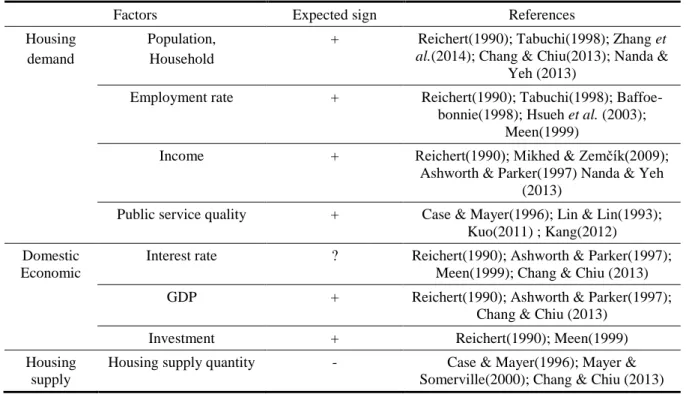
In the past, many researches have proved that there were numerous factors which may affect housing price. In terms of supply and demand, if demand of housing is higher than supply relatively, the HP will become higher. Take household as cardinal number, let it be multiplied by income and we will get the result of residential demand (DiPasquale & Wheaton, 1994). A supply and demand equilibrium model was established. The model assumes that HP will reflect changes in national and regional factors differ from regions. Residential demand is regional factors such as new house quality, population, income, employment rate, loan value ratio, etc. With nine regions in the United States as the empirical regions, it is found that the increase in the population or household quantity in six regions will increase the demand for housing, which in turn will increase housing prices (Reichert ,1990).
From the point of housing purchase decision-making, the employment rate and income of the employment market in different regions are distinct. If the employment rate is high, it will have a positive impact on regional housing prices (Reichert,1990; Tabuchi, 1998; Baffoe-bonnie, 1998; Hsueh et al., 2003). In addition, in terms of the maximum utility of housing, public finances and other consumer goods in the region, a model bases on that theoretical basis was established. Then access the cross-sectional data analysis and found that public finances in schools and other areas are one of the factors affecting population migration, which in turn affects housing demand and regional housing prices.
In theory, if interest rates are low, funds tend to flow into the real estate market or other financial markets to fight inflation, so interest rates represent the opportunity cost of investing in the residential market, and the impact on regional housing prices is negative (Reichert, 1990), but interest rates may also change in the same direction with regional housing prices (Ashworth & Parker, 1997; Meen, 1999), similar to the Pigou effect concept proposed by Pigou (1943), that is, if people’s actual property increase (for example, due to rising interest rates or falling prices) will stimulate demand for consumer spending, causing suppliers to produce more goods, increase employment opportunities, etc., which is a positive cycle. This concept can explain why interest rate and housing price have same direction. The phenomenon, as the interest rate rises, increases the actual property of people, stimulating the consumption demand of the house, and the Pigou effect appears between the two. In addition, the rapid growth of housing prices can reduce the cost of residential capital, so the rate of change in housing prices is also a factor affecting investment demand (Reichert, 1990).
The cost of building a house is also a decisive factor in the supply of housing. Due to limited land resources and geographical differences in regions, the supply of regional housing is limited, and the results of different regional planning controls also make regional housings have inconsistent supply (Case & Mayer, 1996; Mayer & Somerville, 2000), the elasticity of housing supply has been reduced due to strict planning controls, which in turn has caused residential prices to rise.
Table 1 – Factors affecting HP from literature review
Factors Expected sign References Housing
demand
Population, Household
+ Reichert(1990); Tabuchi(1998); Zhang et
al.(2014); Chang & Chiu(2013); Nanda &
Yeh (2013)
Employment rate + Reichert(1990); Tabuchi(1998); Baffoe-bonnie(1998); Hsueh et al. (2003);
Meen(1999)
Income + Reichert(1990); Mikhed & Zemčík(2009); Ashworth & Parker(1997) Nanda & Yeh
(2013)
Public service quality + Case & Mayer(1996); Lin & Lin(1993); Kuo(2011) ; Kang(2012) Domestic
Economic
Interest rate ? Reichert(1990); Ashworth & Parker(1997); Meen(1999); Chang & Chiu (2013) GDP + Reichert(1990); Ashworth & Parker(1997);
Chang & Chiu (2013) Investment + Reichert(1990); Meen(1999) Housing
supply
Housing supply quantity - Case & Mayer(1996); Mayer & Somerville(2000); Chang & Chiu (2013)
The interaction of the regional housing market is derived from the population and capital flows between the regions, and the characteristics and reasons of the flows can be examined by the interactions triggered by economic activities between different regions of the regional economic system.
Friedmann (1966) divided the regional development into a four-stage Core-Periphery model, as seen in figure 2. In the initial stage of regional development, that is, the first stage, the regions have no relationship and independent development. Later, some regions grow relatively fast due to external factors, and regional development has entered the second stage. Compared with other slower growing regions, the faster growing core area becomes the dominant spatial structure. The resources of other periphery areas have been diluted cause the absorbency from core area, making the core area increasingly strengthened. Periphery area is declining, that is, the absorbing effect is greater than the extension effect, until the resources in the core area overflow to the periphery area, which makes the periphery area stimulated and begins to develop. At this time, the extension effect is greater than the absorbing effect, which is the third stage of spatial structure evolution. In the fourth stage, the region became a multi-core zone, and resources were closely intertwined with each other, and the economic system was integrated.
In the same way, regional housing prices are affected by their own regional factors and overall factors, or because the regions are not closed, population movements and information, resources are circulated between regions, etc., causing regional housing markets to interact with each other to generate extension and absorbing effect.
Figure 2 – Friedmann’s Core-Periphery theory – model of 4 stages
Reference: Friedmann, J. (1966). Regional Development Policy: A Case Study of Venezuela: M.I.T. Press.
Spatial heterogeneity is unique and complicated characteristic of region. It will affect the housing demand and housing price, and it might be ignored because it is hard to be observed, quantified or only works in specific area. Previous relevant research noticed the existence of spatial heterogeneity, often expressed by the assumption that housing prices in different regions are affected by the same factor. Reichert (1990) established a regional housing price model based on regional housing demand and housing supply, and classified the United States into six regions for empirical analysis. It was found that the effects of overall economic factors and regional factors on regional housing prices were not consistent. Hsiao (1986) proposed to use panel data to solve the problem of bias caused by individual heterogeneity (such as region, person, company, etc.), to exclude the influence of heterogeneity on the explanatory variables, and to exploit the characteristics that heterogeneity does not change with time. After superimposing the cross-section data of different periods, it becomes the comprehensive time-space panel data, and controls the influence of the individual effects on the explained variables. Although the reason for heterogeneity is still can't be identified, the influence of other factors on the explained variables is no longer biased by the heterogeneity.
At present, some studies in Taiwan have explored the reason of regional housing price differences. Kuo (2011) used housing price ratios of each two houses in the six metropolitan areas of Taiwan as explanatory variables, with eight indicators within economic and social aspects, and access the panel data explores the relationship between residential price differences and socio-economic development gaps, and finds that employment opportunities have the greatest impact on regional price differences, followed by public expenditures. Although panel data allows the inclusion of individual heterogeneity, if the individual is a spatial unit, there is another obvious problem, that is, the spatial units are non-closed and may interact with each other. Although the previous researches considered the spatial heterogeneity and apply the panel data, due to the study of regional housing prices, the assumption that the regions are independent of each other is unlikely to be established in reality. There are often populations, industrial resources flowing between adjacent regions, and regional residential markets change simultaneously. Therefore, this study intends to introduce the concept of spatial econometrics, further expand the panel data into spatial panel data, and incorporate the possibility of spatial dependence into the model.
Empirical Approach
To consider both spatial heterogeneity and spatial dependency, this study modified a housing price model based on an investment decision model referred to Meen (1999) with fixed effect and spatial spillover effect. For city 𝑖 in time period 𝑡 , the 7 independent variables were interest rate (𝐼𝑅𝐴𝑇𝐸) , the number of household (𝐻𝐻) , income(𝐼𝑁𝐶) , the unemployment rate (𝑈𝐸𝑅) , the amount of housing supply (𝐻𝑆) , capital gain (𝐶𝑃) , and amenities(𝐴𝑀𝑇). 𝛾𝑖 represented spatial time-invariant heterogeneity in city 𝑖. λ is spatial spillover effect, if it is
significant index, it can prove that there is the impact the housing price in contiguity city 𝑗 have on city 𝑖.
𝐻𝑃
𝑖𝑡= 𝛾
1𝑖+ λ ∑
𝑁𝑗=1𝑤
𝑖𝑗𝐻𝑃
𝑗𝑡+ 𝛾
2𝐼𝑅𝐴𝑇𝐸
𝑡+𝛾
3𝐻𝐻
𝑖𝑡+ 𝛾
4𝐼𝑁𝐶
𝑖𝑡+ 𝛾
5𝑈𝐸𝑅
𝑖𝑡+ 𝛾
6𝐻𝑆
𝑖𝑡+
𝛾
7𝐶𝑃
𝑖𝑡+ 𝛾
8𝐴𝑀𝑇
𝑖𝑡+ 𝜀
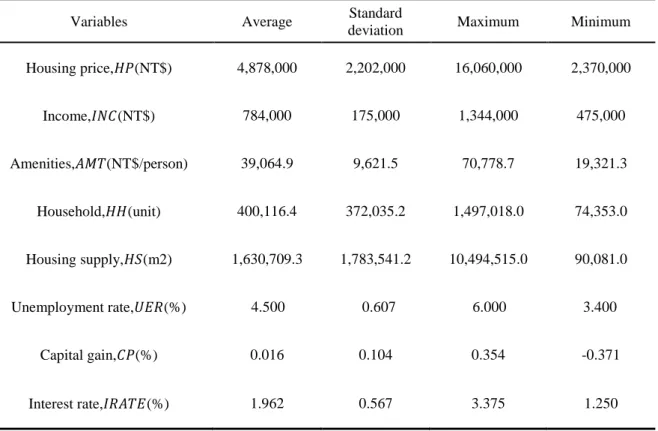
𝑖𝑡 (1) The data included 19 cities and counties (6 metropolitan municipalities, 3 provincial cities and 10 counties) in Taiwan from 2002 to 2014. The data was collected from Construction and Planning Agency Ministry of the Interior and National Development Council.Table 2 – Narrative statistics of variables
Variables Average Standard
deviation Maximum Minimum
Housing price,𝐻𝑃(NT$) 4,878,000 2,202,000 16,060,000 2,370,000 Income,𝐼𝑁𝐶(NT$) 784,000 175,000 1,344,000 475,000 Amenities,𝐴𝑀𝑇(NT$/person) 39,064.9 9,621.5 70,778.7 19,321.3 Household,𝐻𝐻(unit) 400,116.4 372,035.2 1,497,018.0 74,353.0 Housing supply,𝐻𝑆(m2) 1,630,709.3 1,783,541.2 10,494,515.0 90,081.0 Unemployment rate,𝑈𝐸𝑅(%) 4.500 0.607 6.000 3.400 Capital gain,𝐶𝑃(%) 0.016 0.104 0.354 -0.371 Interest rate,𝐼𝑅𝐴𝑇𝐸(%) 1.962 0.567 3.375 1.250
Results and Discussion
After empirical test, the final model is as followed:
𝑙𝑛 (𝐻𝑃
𝑖𝑡) = 𝛾
1𝑖+ λ ∑
𝑁𝑗=1𝑤
𝑖𝑗𝑙𝑛 (𝐻𝑃
𝑗𝑡) + 𝛾
2𝑙𝑛 (𝐻𝐻
𝑖𝑡𝐼𝑁𝐶
𝑖𝑡) + 𝛾
3𝑙𝑛 (𝐻𝑆
𝑖𝑡𝐻𝐻
𝑖𝑡) + 𝛾
4𝐶𝑃
𝑖𝑡+
𝛾
5𝑙𝑛 (𝐼𝑅𝐴𝑇𝐸
𝑖𝑡) + 𝛾
6𝑙𝑛 (𝐴𝑀𝑇
𝑖𝑡)+𝜀
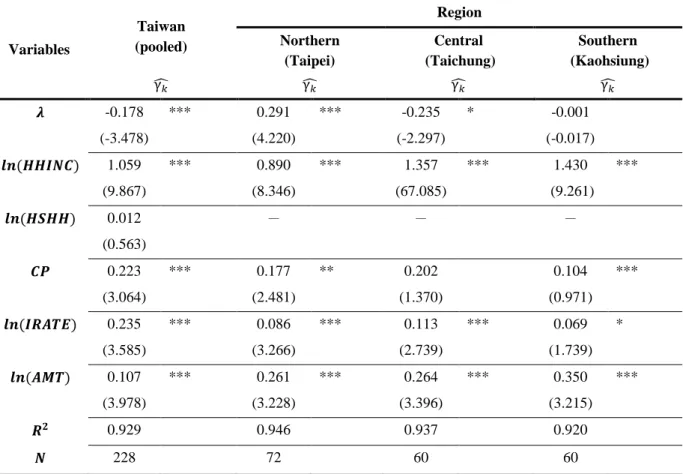
𝑖𝑡 (2)As seen in Table 3, the results show that the spatial spillover effect of housing prices in Taiwan's counties and cities is significantly negative. It means that if one county’s housing price increases, the adjacent counties’ housing prices will decrease. It is inferred that on average, the absorbing effect of Taiwan's county and city housing markets is stronger than the extension effect. Because the high price of the county or the city means that they are more attractive, which stimulates the concentration of housing demand. Capital also flows into the more attractive counties and cities from the areas which has relatively weaker attractiveness. The gap in attractiveness is increasing, the number of high housing prices continues to increase, and those with low housing prices continue to decline, making the effect of space spillover negative.
The key factor affecting the housing prices in Taiwan's counties and cities is the capital gain rate (CP). Considering the definition of the variables in this study, the capital gain rate is calculated by deducting the last year's housing price from the current year's housing price, then divided by the last year's housing price. If the current housing price changes by 1% compared with the previous period, it will increase the current housing price by 22.3%. This conclusion is similar to the conclusion that Reichert (1990) uses the United States as an empirical region.
The income scale of the area (HHINC) has a significant positive impact on the housing prices of the county. The variable is defined as the average disposable income per household multiplied by the number of households, which represents the sum of the income of each household in the area. If the income scale increases by 1%, the average housing price in Taiwan will rise by 1.059%, and the degree of change between the two is equivalent. The amenities (AMT) measures the quality of public services. The model results are in line with expectations. It positively affects housing prices. It is inferred that people will measure the quality of public services in area when they choose their place of residence. In the case of a city with better public services, there are naturally more people willing to move to the city.
Moreover, the rise in interest rates (IRATE) will lead to an increase in housing prices in the region. This conclusion conflicts with the assumption that deposits and residential market investments are substitutes. However, the model results show that the higher the interest rate, the higher the housing price in the region. This conclusion supports the theory of the Pigou effect, which increases the actual wealth of people due to rising interest rates, stimulating housing demand and increasing housing prices.
Table 3 – HP models by regions Variables Taiwan (pooled) Region Northern (Taipei) Central (Taichung) Southern (Kaohsiung) γ̂ 𝑘 γ̂ 𝑘 γ̂ 𝑘 γ̂ 𝑘 𝝀 -0.178 *** 0.291 *** -0.235 * -0.001 (-3.478) (4.220) (-2.297) (-0.017) 𝒍𝒏(𝑯𝑯𝑰𝑵𝑪) 1.059 *** 0.890 *** 1.357 *** 1.430 *** (9.867) (8.346) (67.085) (9.261) 𝒍𝒏(𝑯𝑺𝑯𝑯) 0.012 - - - (0.563) 𝑪𝑷 0.223 *** 0.177 ** 0.202 0.104 *** (3.064) (2.481) (1.370) (0.971) 𝒍𝒏 (𝑰𝑹𝑨𝑻𝑬) 0.235 *** 0.086 *** 0.113 *** 0.069 * (3.585) (3.266) (2.739) (1.739) 𝒍𝒏(𝑨𝑴𝑻) 0.107 *** 0.261 *** 0.264 *** 0.350 *** (3.978) (3.228) (3.396) (3.215) 𝑹𝟐 0.929 0.946 0.937 0.920 𝑵 228 72 60 60 Note: *P<.1, **P<.05, ***P<.01,
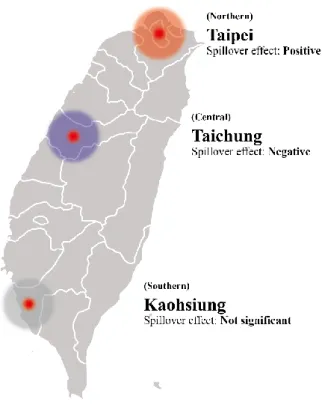
In the three major regions of north, central and south, only northern and central region have significant spillover effect index. Northern area is positive, while central area is negative. As seen in figure 3, there is a schematic diagram to show the spillover effect result of this empirical study. In this figure, red color means increasing housing price, blue color means decreasing housing price and gray color means no change of housing price. In terms of northern area, if core city’s (Taipei City) housing price is on the rise, adjacent regions’ (New Taipei City which covered by red) housing price increase, too. The spatial spillover effect of northern region has a value λ of 0.291, which means that if the price of one city in northern area increases by 1%, the housing price of the neighboring counties in northern area will rise by 0.297%. However, central area has negative index, it means that if core city’s (Taichung City) housing price is on the rise, but adjacent regions’ (Nantou County, Changhua County and Miaoli County which covered by blue) housing price decrease. If the price of one city in central area increases by 1%, the housing price of the neighboring counties in central area will fall by 0.235%. On the other hand, southern area has insignificant spillover effect index. It indicates that there is no spillover effect happening. In summary, the result of spillover effect shows that the three regions were in different stage of regional development, causing the different characteristic of regional housing market.
Figure 3 – Spillover effect of housing price in Taiwan
According to Friedmann’s Core-Periphery theory, the development current situation of northern region from housing market which belongs to 3rd or 4th stage. In addition, the capital gain rate (CP) of northern region has a significant positive impact on housing price. If CP increases by 1 unit, housing price will rise up by 17.7%. It means that the demand of housing investment affects housing price more than housing consumption.
The demand of housing investment in central region is not significant, and the spillover effect is negative. The results may due to the reason that the central region is less developed than northern region, and central region may absorb resources from neighboring regions. It belongs to 2nd stage of Friedmann’s Core-Periphery theory.
In southern region, it is inferred that although southern region developed earlier, but economic development and resources were weaker than northern and central region in late period. Development of region still belongs to 1st stage of Friedmann’s Core-Periphery theory. Moreover, compare to the other two regions, the income scale (HHINC), amenities (AMT) have biggest effect among three regions, while capital gain rate (CP) has least effect. It means that household of southern region will be stimulated by increase of actual property. And southern region also has least Pigou effect.
Conclusion
The cities and counties in Taiwan not only have specific characteristic, but also spatial interaction due to the convenient transport facilities and high density population. This study combines panel data model and spatial model to consider both spatial heterogeneity and dependency. The results show that there are structural differences in regional housing market. Through literature review, the differences of regional development are the main reason.
The study limitation
First, this study can only collect data from 2002 to 2014. The number of samples is not sufficient enough to consider more independent variables and discover more phenomenon in housing market, such as the relationships between real estate cycle and the characteristic of regional housing market. Second, this study assumes that the housing price will reflect the changes of the dependent variables in the same period, but it may take times to reflect the changes in reality. Finally, in the model, the interest rate and capital gain are hypothesis to have impact on housing price without considering the possibilities that housing price may also influence interest rate and capital gain.
The study contribution
To investigate the regional differences of housing price in Taiwan, this study combined panel data model and spatial model to consider spatial heterogeneity and dependency simultaneously, finding out that not only the impact of the key factors but also the spatial spillover effect on housing price differed from region to region.
References
Li, S. J., 2009. A Study on the Determinants of Land Prices for Taiwan's Local Jurisdictions-An Application of
Spatial Econometrics. Thesis of Shih Hsin University, Taipei, Taiwan.
Hua, C. C., C. O. Chang, 1997. Housing Fluctuation Patterns Between Transaction Price & Volume. Journal of
housing studies, Ch.5, pp. 1-15.
Kang, Z. W., 2012. The Empirical of Regional Disparities and Housing Price: Evidenced from Taiwan. Thesis of National Sun Yat-sen University, Kaohsiung, Taiwan.
Chang, T. H., C. L. Chiu, 2013. The Influence of Real Estate Transaction Price from Comparison with Urban and Country Area. Journal of National Taipei College of Business, Vol.23, pp. 45-64.
Kuo, J. W., 2011. The Relationship Between Urban Development and Housing Price in Metropolitan Areas. Thesis of National Chengchi University, Taipei, Taiwan.
Hsueh, L. M., C. W. Li, H. P. Tseng, 2013. The Population Migration in Taiwan, and Its Causal Relationship with Labor Market and Housing Market. City and Planning, Vol. 30(1), pp. 37-62.
Anselin, L., 2003. Spatial Externalities, Spatial Multipliers, And Spatial Econometrics. International Regional
Science Review, Vol. 26(2), pp. 153-166.
Anselin, L.,2013. Spatial econometrics: methods and models (Vol. 4): Springer Science & Business Media. Anselin, L., Gallo, J. L., & Jayet, H., 2008. Spatial Panel Econometrics. In L. Mátyás & P. Sevestre (Eds.), The
Econometrics of Panel Data. 625-660.
Ashworth, J., & Parker, S. C.,1997. Modelling regional house prices in the UK. Scottish Journal of Political
Economy, 44(3), 225-246.
Baffoe-Bonnie, J., 1998. The Dynamic Impact of Macroeconomic Aggregates on Housing Prices and Stock of Houses: A National and Regional Analysis. The Journal of Real Estate Finance and Economics, 17(2), 179-197. Baltagi, B. H., 2008. A companion to theoretical econometrics, John Wiley & Sons.
Bramley, G., & Watkins, D., 2014. Housebuilding, demographic change and affordability as outcomes of local planning decisions: Exploring interactions using a sub-regional model of housing markets in England. Progress
in Planning.
Case, A. C.,1991. Spatial Patterns in Household Demand. Econometrica, 59(4), 953-965.
Case, K. E., & Mayer, C. J., 1996. Housing price dynamics within a metropolitan area. Regional Science and
Urban Economics, 26(3–4), 387-407.
Chen, P. F., Chien, M. S., & Lee, C. C., 2011. Dynamic modeling of regional house price diffusion in Taiwan.
Journal of Housing Economics, 20(4), 315-332.
Croissant, Y., & Millo, G., 2008. Panel data econometrics in R: The plm package. Journal of Statistical
Software, 27(2), 1-43.
DiPasquale, D., & Wheaton, W. C., 1994. Housing Market Dynamics and the Future of Housing Prices. Journal
of Urban Economics, 35(1), 1-27.
Elhorst, J. P., 2003. Specification and Estimation of Spatial Panel Data Models. International Regional Science
Review, 26(3), 244-268.
Elhorst, J. P., 2014. Spatial Econometrics, Springer-Verlag Berlin Heidelberg.
Fotheringham, A. S., 1981. Spatial structure and distance-decay parameters. Annals of the Association of
American Geographers, 71(3), 425-436.
Friedmann, J., 1966. Regional Development Policy: A Case Study of Venezuela, M.I.T. Press.
Gray, D., 2012. District House Price Movements in England and Wales 1997-2007: An Exploratory Spatial Data Analysis Approach. Urban Studies, 49(7), 1411-1434. doi:10.1177/0042098011417020
Hirschman, A. O., 1958. The Strategy of Economic Development. New Haven, Conn.: Yale University Press Hsiao, C., 2003. Analysis of panel data (2 ed.). Cambridge, United Kingdom: Cambridge University Press. Hsiao, C., 2007. Panel data analysis—advantages and challenges. TEST, 16(1), 1-22.
Jones, C., & Leishman, C., 2006. Spatial dynamics of the housing market: An interurban perspective. Urban
Studies, 43(7), 1041-1059.
Jud, G. D., & Winkler, D., 2002. The dynamics of metropolitan housing prices. Journal of Real Estate
Research, 23(1/2), 29-47.
Kuethe, T. H., & Pede, V. O., 2011. Regional Housing Price Cycles: A Spatio-temporal Analysis Using US State-level Data. Regional Studies, 45(5), 563-574.
Lee, C. C., & Chien, M. S., 2011. Empirical Modelling of Regional House Prices and the Ripple Effect. Urban
Studies, 48(10), 2029-2047.
Liu, C. L., Luo, Z. Q., Ma, L., & Picken, D., 2008. Identify House Price Diffusion Patterns Among Australian State Capital Cities. International Journal of Strategic Property Management, 12(4), 237-250.
Lu, G. Y., & Wong, D. W., 2008. An adaptive inverse-distance weighting spatial interpolation technique.
Computers & Geosciences, 34(9), 1044-1055.
Mátyás, L., & Sevestre, P., 2008. The econometrics of panel data: fundamentals and recent developments in
theory and practice (Vol. 46): Springer Science & Business Media.
Meen, G., 1999. Regional House Prices and the Ripple Effect: A New Interpretation. Housing Studies, 14(6), 733-753.
Miao, H., Ramchander, S., & Simpson, M. W., 2011. Return and Volatility Transmission in US Housing Markets. Real Estate Economics, Real Estate Economics, 39(4), 701-741.
Mikhed, V., & Zemčík, P., 2009. Do house prices reflect fundamentals? Aggregate and panel data evidence.
Journal of Housing Economics, 18(2), 140-149.
Millo, G., & Piras, G., 2012. splm: Spatial panel data models in R. Journal of Statistical Software, 47(1), 1-38. Montagnoli, A., & Nagayasu, J., 2015. UK house price convergence clubs and spillovers. Journal of Housing
Economics, 30, 50-58.
Nanda, A., & Yeh, J. H., 2014. Spatio-temporal diffusion of residential land prices across Taipei regions.
SpringerPlus, 3, 15.
Nurkse, R., 1954. Problems of capital formation in underdeveloped countries. Indian Economic Review (Vol. 2), 1, 80-85.
Oikarinen, E., Peltola, R., & Valtonen, E., 2015. Regional variation in the elasticity of supply of housing, and its determinants: The case of a small sparsely populated country. Regional Science and Urban Economics, 50, 18-30.
Reichert, A., 1990. The impact of interest rates, income, and employment upon regional housing prices. The
Journal of Real Estate Finance and Economics, 3(4), 373-391.
Richardson, H., 1976. Growth pole spillovers: the dynamics of backwash and spread. Regional Studies: The
Journal of the Regional Studies Association, 10(1), 1-9.
Rosenstein-Rodan, P. N., 1943. Problems of industrialisation of eastern and south-eastern Europe. The economic
journal, 53(210/211), 202-211.
Tsai, I. C., 2015. Spillover Effect between the Regional and the National Housing Markets in the UK. Regional
Studies, 49(12), 1957-1976. doi:10.1080/00343404.2014.883599
van Dijk, B., Franses, P. H., Paap, R., & van Dijk, D., 2011. Modelling regional house prices. Applied
Economics, 43(17), 2097-2110. doi:10.1080/00036840903085089
Wooldridge, J. M., 2009. Introductory Econometrics-A Modern Approach (Hsu, A. C., Trans. 4 ed.): Cengage Learning Asia Pte Ltd.
Yunus, N., & Swanson, P. E. (2013). A Closer Look at the U.S. Housing Market: Modeling Relationships among Regions. Real Estate Economics, 41(3), 542-568.
Zhang, T., Gerlowski, D., & Ford, D. (2014). Housing price variability: national and local impacts. Applied
1
出席國際會議報告
2019 世界華人不動產年會上海會議
陳彥仲
2019.07.18
一、
參加會議過程
7/11 (四) 啟程(台南- 台北- 上海),受邀參加上海財經大學
王紅衛校長晚宴。
7/12 (五) 上午赴上海同濟大學城市規劃學院,與規劃系師
生進行專題講座。主題為”空间规划、绿能及智慧城市”
(Spatial Planning, Green Energy, and Smart Connected City )。
下午參加 GCREC 的理事會,並參訪「中鷹 黑森林」社區,
理事晚宴。
7/13 (六) 大會開幕式,主旨演講(Keynote speech),專題論
壇及論文研討場次。大會歡迎晚宴。
7/14 (日) 專題論壇及論文研討場次。大會閉幕晚宴及頒發
最佳論文獎。
7/15 (一) 赴上海師範大學商學院,進行專題論壇。主題為
「房地产市场监测-台湾经验谈」。會後回程 : 上海 –高雄
– 台南。
2
二、
與會心得與建議
1. 大會主旨演講為黃奇帆先生,是中國國際交流協會副理事長。
深入剖析了大陸房地產的當前現象,並預判未來發展。黃先
生提到大陸過去數十年來房地產快速地翻倍成長,主要有以
下因素:城市人口擴大、城市舊城區改造(更新)、建結構改造、
人均居住需求提升。過去四十年,房地產蓬勃發展,可視為”
全民造房”時期! 預判未來情勢,房產建設將集中於各省省
會城市,如鄭州之於河南省,並竹縣形成超級大都會區(人口
大於 1,000 萬人),如上海。黃先生思考邏輯清晰,表達及論
述結構明確,尤其全程不看稿又能引用合理數據的講演功力,
令人印象深刻,甚是佩服!
2. 本人擔任 B07 場次(Urban Economics and Management II)主持人,
併發表論文” The Modified Alonso’s Housing Price Function
under the Consideration of Environment Externalities-- An Empirical
Case Study of Kaohsiung LRT “ ,同時擔任另一篇論文的評論
人。與會的報告人及評論人主要來自台灣、新加坡及大陸。會
場討論熱烈,尤其可以感受大陸新一代年輕學者崛起的速度,
無論在論文質量或英文表達能力與會場對話,皆已大幅提升。
台灣的學界,尤其新進研究人員,應該有所警惕。
3
3. 大會安排參訪「中鷹 黑森林」社區。該社區為高端科技建築
的新形態社區。引進三層玻璃隔離的氣密窗,完全阻隔室內
與室外環境。無論戶外陰晴、風雨、下雪,室內採用被動能源
設計,依使用者設定,永保恆溫、恆濕。可以節省室內環境空
調能源。同時採大面積落地窗設計,室內明亮。但缺點是室內
外環境差異大,進出需有更多的調適。同時照價為鄰近一班
建築成本的兩倍,非一般市民所能負擔。然而,此類高端科技
建築,在大陸,尤其上海,則是日益增見。
4. 上海市南京路監控系統,大幅改善交通秩序。尤其在國際門
面的外灘及行人徒步區,有了監控技術並進行人臉辨識。對
於違規行為,如跨越行車道,則立即舉發。並給予記點或其他
處罰。同時也及時發布於公共告示屏幕。對於違規行為有立
即警示作用,達到秩序整頓的立即效果。然而,在台灣,此種
立即公開(公告)的處分方式,或仍有涉及個資爭議,仍須從長
計議。
三、
攜回資料
1. 大會手冊。內含會議議程,論壇主題介紹,會場資訊。
4
四、
活動照片
圖 1 上海同濟大學城市規劃學院講座 圖 2 講座海報 圖 3 GCREC 2019 大會會場 圖 4 GCREC 2019 大會開幕式 圖 5 B07 論文研討場次(一) 圖 6 B07 論文研討場次(二) 圖 7 上海市南京路監控系統 圖 8 監控及顯示系統5
6
五、
論文發表
The Modified Alonso’s Housing Price Function under the Consideration of Environment Externalities
-- An Empirical Case Study of Kaohsiung LRT
Yen-Jong, Chen 1 Chao-hong, Lu2
Abstract
Since the launching of Kaohsiung Mass Rapid Transit (MRT) in 2008, the city commuting and resident behavior have been significantly changed. The Kaohsiung Light Rail Transit (LRT) plan also been announced in 2011 and finished the the first stage construction and start for running in 2016. The running of the LRT system brings the boom of the city development in the South Kaohsiung area and also the changes of the spatial distribution of housing/land price. However, different from the A-type right-of-way of the MRT system, the B-type LRT runs the rail cart on the ground streets. That interferes with other ground traffic and also might have environment confliction to the buildings along the both sides of LRT line. The interference includes the traffic noise, community safety, landscape design, and so on. Based on the housing price distribution near the Kaohsiung LRT constructed area, we observed that the housing price increases in the nearby distance from the LRT line and turn to decrease in a further distance away from the LRT line. To explain this, we re-derived the Alonso(1964)’s model of location theory on the bid-price function by taking into the consideration of the externality of environment cost and benefit. In this study, we collected the real housing transaction data from the Department of Land Administration, Ministry of Interior. The sample size is 6,766 covering the time interval from 2008 to 2015. We constructed the hedonic housing price function, and explained the different distribution of housing prices resulted from the cross-effects of the LRT environment externalities from both positive and negative sides. A modified model so called “Kaohsiung Light Rail Transit (KSLRT)” model, is derived in this article.
Keywords: LRT, Housing price, Spatial distribution, Kaohsiung (KSLRT), Bid-price function, Alonso(1964)
1 Correspondent Author, Professor, Department of Urban Planning, National Cheng Kung University,
Taiwan. Email:[email protected]
2 Assistant Researcher, Research Center for Energy Technology and Strategy, National Cheng Kung
University, Taiwan. Email:[email protected]
已註解 [cl1]:
已註解 [cl3]: 已註解 [cl2]:
8