胚胎及發育生物學
Embryogenesis, Developmental Biology and Stem Cell
中山大學
中山大學
生物科學系
生物學中最有趣的是甚麼問題??
生物多樣性
生物多樣性
與
生命現象
生命現象
3Genetics and Evolution
•
Variation
Variation
in the DNA sequence makes it possible for species to
in the DNA sequence makes it possible for species to
evolve over time.
•
Organisms with similar DNA sequences are descended from a
common ancestor
.
4
生物為何那樣多樣性?
化繁為簡(小處著手)
生物學中最有趣的是甚麼問題??
生物多樣性
與
生命現象
生命現象
7解剖(胚胎)學/ 個體生物(生理)學 細胞生物學 染色體/DNA
生命現象的研究
胚胎學上古老的爭論
解剖(胚胎)學/ 個體生物(生理)學 - 細胞生物學- 染色體/DNA 遺傳學Preformation theory (先成說)
胚胎的各部份是一開始就存在?Epigenesis theory (漸成說)
胚胎學上古老的爭論
Epigenesis theory (漸成說)
還是在發育過程中逐漸形成的?An homunculus in the head of each sperm (1694)
生物學中最有趣的是甚麼問題??
生物多樣性 與 生命現象
生物化學 動 (低-高) 植 (低-高) 微生 病毒 生物化學 解剖(胚胎)型態 生理 細胞生物 病毒 生物-環境 細胞生物 分子生物 發育生物 9胚胎發育及幹細胞
胚胎發育及幹細胞
vein ISV CVP S胚胎
幹細胞
複製/再生
幹細胞
Outline
Outline
1.
胚胎學 (embryology) vs. 發育生物學 (developmental biology)
2
模式生物 (
d l
i
)
2.
模式生物 (model organisms)
3.
動物發育的主要階段
4.
發育過程之機制
5.
組織再生與幹細胞
胚胎學 (Embryology) : The development of an embryo from the fertilized egg
發育生物學 (Developmental Biology) is to understand how multicellular organism develop
偏重述敘的科學, 探討如何形成個體正確及完整形態的各個步驟。
着重於分子和细胞生物學層次上的胚胎學。
何謂發育生物學?
何謂發育生物學?
‧發育生物學(developmental biology) 源自於胚胎學
p
gy
(embryology)
‧胚胎學:探討受精卵到出生的過程
胚胎學:探討受精卵到出生的過程
(
A Body-Building Plan)‧發育生物學包含:
胚胎學
+
個體生長、器官及組織受損的修復與再
生、 老化、疾病的發生與治療等
胚胎學上古老的爭論
Preformation theory (先成說)
胚胎學上古老的爭論
Preformation theory (先成說)
Epigenesis theory (漸成說)
Epigenesis theory (漸成說)
胚胎的各部份是 開始就存在?
胚胎的各部份是一開始就存在?
還是在發育過程中逐漸形成的?
An homunculus in the head of each sperm (1694)
Malpighi’s description of the chick embryo. (1673)
顯微鏡的發明
細胞學說的確立 (1820-1880)
基因概念的形成 (1900)
基因概念的形成 (1900)
發育的三要素:
1. 生長/分裂 growth/cleavage
g
g
Increase in cell number Increase in cell size
2. 分化 Differentiation
The fate of daughter cells
3. 形態發生 Morphogenesis
發育的三要素:
發育的三要素:
1. 生長/分裂 growth/cleavage
g
g
Increase in cell number Increase in cell size
2. 分化 Differentiation
The fate of daughter cells
3. 形態發生 Morphogenesis
發育生物學的 (研究)中心主題
細胞如何分化成特定種類?
發育生物學的 (研究)中心主題:
細胞如何分化成特定種類?
細胞如何移動到特定位置?
如何控制這些細胞發育成為不同類型的細胞組織?
細胞如何分化成特定種類?What happen if genetic control goes wrong in
pp
g
g
g
limb development?
1. 了解動物胚胎的發育(分子機制)
l
d
d
d d
germ layers: ectoderm, mesoderm, endoderm
organogenesis
2. 了解發育生物學的研究發展及重要性
母體-胎兒保健 預防新生兒缺陷
3 發育生物學的相關應用
母體 胎兒保健, 預防新生兒缺陷
3. 發育生物學的相關應用
a.幹細胞 b.複製及器官再生 c.細胞凋零 d.老化 e. 癌症與疾病
Model organisms to study developmental biology
模式生物
模式生物
– nematode (C. elegans) – fruit fly (D. melanogaster )
線蟲 果蠅
fruit fly (D. melanogaster ) – sea urchins
– South African Frog (X. laevis) – Zebrafish (D. Renio) 果蠅 海膽 ( ) – chick – mouse
– plant (A. thaliana)
Universal mechanisms of animal development
通用機制
小腦 通用機制
Drosophila with mutant
alleles of the eyeless Mouse embryos with wild-type (L) and mutant (R) alleles of the Pax-6 gene
Fig. Homologous proteins functioning interchangeably in the development of mice and flies.
y
人類不利於作發育 疾病模式之原因
人類不利於作發育, 疾病模式之原因:
• 1.壽命長。
.壽命長
• 2.再生時間緩慢。
• 3.子代少。
極度異質性
• 4.極度異質性。
• 5.無法長期控制飼養方式及社經生活。
• 6 定量資料如飲食、飼養方面缺乏。
• 6.定量資料如飲食、飼養方面缺乏。
• 7.道德上的問題。
Comparative anatomy and Embryology provide clues to animal phylogeny M “Porifera” 刺胞 演化樹: 比較解剖學 ANCESTRAL COLONIAL FLAGELLATE etazoa Eum e Cnidaria Ctenophora 刺胞 e tazoa Deuter o Ectoprocta Brachiopoda B o stomia Echinodermata Ch d (後口) 棘皮 sea urchin notochord 脊索 B ilateria P Chordata Platyhelminthes 脊索 (後口) 扁型 mammal ascidians vertebrate 脊椎(骨) P rotosto m Rotifera Mollusca 扁型 輪型 軟體 m ia Annelida (原口) 軟體 環節 Arthropoda Nematoda 節肢 insect worm
nematode (Caenorhabditis elegans)
3d線蟲
15hr 3d 50h 50hrZygote
0
First cell division
rs) Nervous system, t ki Muscula-ture, gonads Germ line (future t ) Outer skin, nervous system ation (hou
ABa ABp EMS P2 P3
P4 outer skin, muscula-ture gametes) Musculature fter fertiliz Hatching 10 Ti m e a Intestine Hatching Mouth Intestine E V l Anus Eggs Vulva 1.2 mm ANTERIOR POSTERIOR
Zygote
0
First cell division
rs) Nervous system, t ki Muscula-ture, gonads ation (hou
ABa ABp EMS P2 P3
Germ line (future t ) Outer skin, nervous system P4 Pharynx Intestine outer skin, muscula-ture fter fertiliz gametes) Musculature Hatching 10 Ti m e a Hatching Intestine Vulva Epidermis Somatic gonad Mouth Intestine E V l Anus g Eggs Vulva 1.2 mm ANTERIOR POSTERIOR
fruit fly (Drosophila melanogaster )
果蠅
~10d 5d 3hr 12-24hrBody plan: To build a body
bicoid (前後) (頭尾) nanos torso hunchback (頭胸腹) hunchback Kruppel knirp 7 (頭胸腹) giant even-skipped fushi tarazu 14 (區域/節) hairy engrailed h d h (小區域/節也 要分前後) hedgehog frizzled patched UltrabithoraxAdult fruit fly
Fruit fly embryo (10 hours) Fly Fly chromosome Mouse Homeobox genes Mouse chromosomes Mouse embryo (12 days) Adult mouse
Adult fruit fly
Fruit fly embryo (10 hours) Fly Fly chromosome Mouse Homeobox genes Mouse chromosomes Mouse embryo (12 days) Adult mouse
模式生物
模式生物
– nematode (Caenorhabditis elegans)
nematode (Caenorhabditis elegans)
– fruit fly (Drosophila melanogaster )
–
sea urchins
sea urchins
海膽
– South African Frog (Xenopus laevis)
– Zebrafish (Danio Renio)
海膽
Zebrafish (Danio Renio)
– chick
– mouse
mouse
– plant (Arabidopsis thaliana)
Sea urchin
經典的動物發育研究材料之一 radically symmetrical adult Fertilization Cleavage CleavageThree germ layers /gastrulation
bilaterally symmetrical free-swimming larva
The sea-urchin embryo develops into a free-swimming larva The sea-urchin embryo develops into a free-swimming larva
Development of the sea urchin embryo.
symmetric animal-vegetalasymmetricasymmetric hollow
骨棒(中胚層)
初級間質 gut invaginate
二級間質
Blue: prospective ectoderm
Yellow: endoderm
模式生物
模式生物
– nematode (Caenorhabditis elegans)
nematode (Caenorhabditis elegans)
– fruit fly (Drosophila melanogaster )
– sea urchins
無脊椎
sea urchins
– South African Frog (Xenopus laevis)
– Zebrafish (Danio Renio)
無脊椎
Zebrafish (Danio Renio)
– chick
– mouse
mouse
– plant (Arabidopsis thaliana)
Zebrafish (Danio Renio)
3mo
24hr heart beat 24hr heart beat
模式生物
模式生物
– nematode (Caenorhabditis elegans)
nematode (Caenorhabditis elegans)
– fruit fly (Drosophila melanogaster )
– sea urchins
sea urchins
– South African Frog (Xenopus laevis)
– Zebrafish (Danio Renio)
Zebrafish (Danio Renio)
– chick
– mouse
mouse
– plant (Arabidopsis thaliana)
Part 3 Life cycle of the chicken
2 layers
Bi d d l bl h th d diff t f f i i t t
extra-embryonic structures
Birds and mammals resemble each other and different from frog in some important features of early development
Fig. 47-11
Dorsal Fertilized egg
Anterior Primitive streak
Anterior Right Left Embryo Yolk streak Ventral Posterior Primitive streak Yolk Epiblast Primitive streak Future ectoderm Epiblast ectoderm Endoderm Migrating cells Hypoblast Blastocoel (mesoderm) YOLK
The extra-embryonic structure and circulation of the chick embruyo 羊膜 4 days 絨毛膜 絨毛膜 尿囊
Amnion and amniotic cavity provide mechanical protection Chorion maintain shell
具羊膜 (與哺乳類像)
Chorion maintain shell
Allantois bridge for oxygen and waste
Vitelline vein take nutrient form yolk to embryo Umbilical vein take oxygen to embryo
mouse
缺點?模式生物(動物)的特性
模式生物(動物)的特性
1.
與人類有相似處 (功能相似, 有基因保留性)
2.
易培養 (經費少, 空間小, 生長周期短, 繁殖快, 子代多)
3
易於實驗操作 (體外受精 胚體透明 容易進行基因操控)
3.
易於實驗操作 (體外受精, 胚體透明, 容易進行基因操控)
4.
資料多 (基因已解碼)
Primate
Primate
黑猩猩: HIV, HBV,
Behavior, Learning
,
g
O tline
Outline
1.
胚胎學 (embryology) vs. 發育生物學 (developmental biology)
2.
模式生物 (model organisms)
2.
模式生物 (model organisms)
3.
動物發育的主要階段
4.
發育過程之機制
5
組織再生與幹細胞
5.
組織再生與幹細胞
動物發育的主要階段
動物發育的主要階段
所有動物皆一樣?
所有動物皆一樣?
動物發育的主要過程
動物發育的主要過程
1.受精 (Fertilization)
2.卵裂 (Cleavage)
3.原腸化 (Gastrulation)
cell division creates a hollow ball of cells called a blastulacells are rearranged into a three layered gastrula
4.神經 (Neurulation)
cells are rearranged into a three-layered gastrula
5.器官生成 (Organogenesis)
th th l i t t d t i i t
6.個體生成 (Growth)
Fertilization
F tili
ti
b i
th h
l id
l i f
d
• Fertilization brings the haploid nuclei of sperm and
egg together, forming a diploid zygote
• The sperm’s contact with the egg’s surface
initiates metabolic reactions in the egg that trigger
the onset of embryonic development
含酵素以分解卵表面膠質層 含酵素以分解卵表面膠質層
The acrosomal and cortical reactions during sea urchin fertilization
Sperm plasma Acrosomal Sperm nucleus membrane Fertilization Basal body (centriole) Sperm Acrosomal process Actin filament envelope Sperm head Fused plasma membranes Cortical granule Sperm-binding AcrosomeJelly coat Vitelline layer
Egg plasma Hydrolytic enzymes membranes Perivitelline space p g
動物發育的主要過程
動物發育的主要過程
1 受精 (F tili ti )
1.受精 (Fertilization)
2.卵裂 (Cleavage)
3 原腸化 (G t l ti )
3.原腸化 (Gastrulation)
4.神經 (Neurulation)
5 器官生成 (O
i )
5.器官生成 (Organogenesis)
6.個體生成 (Growth)
Cleavage
blastocoel(囊胚腔)Cleavage in a frog embryo
Animal
l
8-cell
stage
pole
Vegetal
l
pole
Cleavage in a frog embryo
Blastocoel
Blastula
(cross
(cross
section)
0.25 mm 0.25 mm
Cleavage in a frog embryo
0.25 mm 0.25 mm
Blastocoel
Animal pole
4
2
ll
Zygote
8
Vegetal
Blastula
(cross
section)
4-cell
stage
forming
2-cell
stage
forming
Zygote
8-cell
stage
pole
)
g
g
Right
Dorsal
The body axes and their
establishment in an amphibian
Posterior Anteriorestablishment in an amphibian
體軸 Left 體軸 前/後軸(A/P axis) 背/腹軸(D/V axis) 左/右軸(L/R axis)(a) The three axes of the fully developed embryo Ventral ( ) Pigmented cortex First cleavage Animal pole Animal hemisphere Point of sperm nucleus Future dorsal side nucleus entry Gray crescent Vegetal hemisphere Vegetal pole
(b) Establishing the axes Vegetal pole
Fig. 47-23b Experimental egg Control egg EXPERIMENT Experimental egg (side view) Gray Control egg (dorsal view) Gray crescent G ay crescent Thread Thread RESULTS RESULTS Normal Belly piece Normal
動物發育的主要過程
動物發育的主要過程
1 受精 (F tili ti )
1.受精 (Fertilization)
2.卵裂 (Cleavage)
3 原腸化 (G t l ti )
3.原腸化 (Gastrulation)
4.神經 (Neurulation)
5 器官生成 (O
i )
5.器官生成 (Organogenesis)
6.個體生成 (Growth)
大量細胞轉移
胚層生成
胚層生成
體軸建立
Gastrulation in a sea urchin embryo
原腸化 原腸化外胚層
Future ectoderm Future endoderm Future mesoderm A h t中胚層
內胚層
Blastocoel Archenteron Blastopore Blastocoel Blastocoel Archenteron Animal pole Filopodia pulling archenteron tip Mouth Ectoderm Mesenchyme cells Vegetal plate Vegetall Digestive tube (endoderm) Mouth Mesenchyme (mesoderm forms future skeleton) Blastopore Mesenchyme cells plate pole 50 µm skeleton) Anus (from blastopore)SURFACE VIEW Animal pole
CROSS SECTION
Gastrulation in the frog
Blastocoel
Dorsal lip of
blasto-Dorsal lip
– Cells of the dorsal lip originate in the gray crescent and
Vegetal pole Early
gastrula
Blastopore
pore Dorsal lip of blastopore
in the gray crescent and
invaginate to create the archenteron
Cells continue to move by
Blastocoel
shrinking Archenteron
– Cells continue to move by
involution
– These cells become the
d d d d
endoderm and mesoderm
– The blastopore encircles a
yolk plug when gastrulation is
l t d
Ectoderm Mesoderm
completed
– ectoderm, endoderm, and
mesoderm Key Blastocoel remnant Archenteron Mesoderm Endoderm Future ectoderm Key Future endoderm
Future mesoderm Late gastrula
Blastopore
Mammal (human)
Maternal blood l Endometrial epithelium (uterine lining)Inner cell mass
Uterus vessel Trophoblast Blastocoel 羊膜 Amnion Chorion Ectoderm 絨毛膜 羊膜 Yolk sac Mesoderm Endoderm Extraembryonic mesoderm Allantois 尿囊 尿囊
動物發育的主要過程
動物發育的主要過程
1 受精 (F tili ti )
1.受精 (Fertilization)
2.卵裂 (Cleavage)
3 原腸化 (G t l ti )
3.原腸化 (Gastrulation)
4.神經 (Neurulation)
5 器官生成 (O
i )
5.器官生成 (Organogenesis)
6.個體生成 (Growth)
Neural folds Tail bud N l l Somites Eye
neurulation
(神經管的生成) Neural fold Neural plate 1 SEM Neural fold Neural plate Neural tube Notochord 1 mm 1 mm SEM Neural crest cells 神經板 Neural crest cells Notochord Coelom Somite 脊索 Neural crest cells Outer layer of ectoderm Mesoderm Ectoderm Endoderm (c) Somites Archenteron (digestive cavity) 神經脊細胞 Neural tube cells Archenteron(a) Neural plate formation
動物發育的主要過程
動物發育的主要過程
1 受精 (F tili ti )
1.受精 (Fertilization)
2.卵裂 (Cleavage)
3 原腸化 (G t l ti )
3.原腸化 (Gastrulation)
4.神經 (Neurulation)
5 器官生成 (O
i )
5.器官生成 (Organogenesis)
6.個體生成 (Growth)
ECTODERM MESODERM ENDODERM
外胚層
中胚層
內胚層
ECTODERM MESODERM ENDODERM
Epidermis of skin and its derivatives (including sweat glands hair follicles)
Notochord Skeletal system Muscular system Epithelial lining of digestive tract Epithelial lining of glands, hair follicles)
Epithelial lining of mouth and anus
Cornea and lens of eye
Muscular system Muscular layer of
stomach and intestine Excretory system
Epithelial lining of respiratory system
Lining of urethra, urinary bladder, and reproductive Nervous system
Sensory receptors in epidermis
Adrenal medulla
Circulatory and lymphatic systems
Reproductive system (except germ cells)
system Liver Pancreas Thymus Tooth enamel
Epithelium of pineal and pituitary glands
( p g )
Dermis of skin
Lining of body cavity Adrenal cortex
y
Thyroid and parathyroid glands
Germ Layers:
外
Ectoderm,
Mesoderm,
Endoderm
外胚層
中胚層
Endoderm
內胚層
Organogenesis
Limb Limb Expression of
thalidomide
「沙利竇邁」 在1997年,統計發現人類的新生兒中有2%的是畸形,這些缺陷的產生,有些是來自基因,另外的大 宗,可能來自環境因子抑制了發育的過程。以1961年Lenz和Mcbride發現為例,他們證明一種用來鎮定孕婦 憂鬱的藥(thalidomide),會使新生兒四肢發育不全。Nowack(1965)研究發現,這藥物會在懷孕初期的20~36 憂鬱的藥(thalidomide),會使新生兒四肢發育不全。Nowack(1965)研究發現,這藥物會在懷孕初期的20~36 天左右,對四肢的發育產生抑制的作用,當時藥物包括台灣的遠東地區都有販售,因此可看見現年約 40~50歲世代,有許多這樣的例子出現,造成許多悲劇與社會的成本,Branching morphogenesis
g
p
g
of lung
g
mediated by FGF10 and Shh signaling
kidney
後腎母細胞 後腎母細胞
輸尿管
Blood vessels
S h
ti
f h
h
t d
l
t
Schematic of human heart development
Ventricle (心室) 主 肺 Atrium (心房) 僧帽瓣 尖瓣 Looping and partitioning 三尖瓣 Left side: Pitx2
BMP Nkx2.5 Transcription factor Retinoic acid
GATA
(7 activating regions and 3 repressor regions)
GATA
Organ handedness in vertebrates
In the mouse, the iv gene controls the handedness of internal organs.
In iv mutants, organ handedness is random and some individuals show, g
heterotaxis where normal and inverted organs are found in one animal.
Heterotaxis (內臟易位): The organs of inverted normal and asymmerty are present in the same animal
Normal iv mutant
The condition, situs inversus, found in 1 in 10,000 people, is a mirror reversal of the 'handedness' of the internal organs
of the handedness of the internal organs.
器官轉位
Situs inversus causes the positions of the heart and lungs to be mirrored.
心臟偏左, 肺葉左二,右三葉, 腹腔右邊的器官是肝臟, 膽囊, 兩邊都是右邊的臟器 器官整個左右相反 腹腔右邊的器官是肝臟, 膽囊, 腹腔左側的器官是脾臟, 胃
The condition, situs inversus, found in 1 in 10,000 people, is a mirror reversal of the 'handedness' of the internal organs
of the handedness of the internal organs.
Situs inversus causes the positions of the heart and lungs to be mirrored.
心臟偏左, 肺葉左二,右三葉, 腹腔右邊的器官是肝臟, 膽囊, 兩邊都是右邊的臟器 器官整個左右相反 腹腔右邊的器官是肝臟, 膽囊, 腹腔左側的器官是脾臟, 胃
動物發育的主要過程
動物發育的主要過程
1.受精 (Fertilization)
卵裂
2.卵裂 (Cleavage)
3.原腸化 (Gastrulation)
神經
4.神經 (Neurulation)
5.器官生成 (Organogenesis)
個體生成
h
6.個體生成 (Growth)
Pattern/ hair, spots, stripe
?
?
Outline
Outline
1.
胚胎學 (embryology) vs. 發育生物學 (developmental biology)
2
模式生物 (
d l
i
)
2.
模式生物 (model organisms)
3.
動物發育的主要階段
4.
發育過程之機制
5.
組織再生與幹細胞
發育過程包括
Pattern formation
(body plan)Morphogenesis (型態)
Morphogenesis (型態)
Cell differentiation (分化)
Growth (生長)
4
發育過程之機制
體軸 前/後軸(A/P axis) 背/腹軸(D/V axis)Growth (生長)
4.
發育過程之機制
2 C ll f t d t
i
ti
細胞命運決定
1. Differential gene expression/signaling (基因表現)
左/右軸(L/R axis)
2. Cell fate determination 細胞命運決定
3. Induction 誘導
4 Pattern formation
4. Pattern formation
a. Positional information
b. Lateral inhibition
5. Asymmetric division (不對稱分化)
4.1. Differential gene expression causes
cell differentiation
cell differentiation
Representative cell types of a vertebrate
人類有100億cells, 250種不同類型的細胞 線蟲952 cells.
Gene expression and protein synthesis
p
p
y
In the early development of Drosophila at least 60 genes are In the early development of Drosophila, at least 60 genes are directly involved in pattern formation to form segments.
In C. elegant, at least 50 genes are needed to specify vulva (reproductive structure). About 9% of the genes (1722/ 20,000) are involved in development.
Development of the sea urchin embryo.
symmetric animal-vegetalasymmetricasymmetric hollow
骨棒(中胚層)
初級間質 gut invaginate
二級間質
Blue: prospective ectoderm
Yellow: endoderm
Study (tracking) gene expression in embryos
SOX10
4.2. Cell fate determination
Cell transplantation
earlier stage: not determined
2. Cell fate determination
Cell-linage analysis Principles of Development 4e Wolpert/Tickle Copyright © 2011 by Oxford University Press4. 2. Cell fate determination
3. Induction
One group of cells could determine the development of neighboring cellsp g gSpemann and Mangold experiment
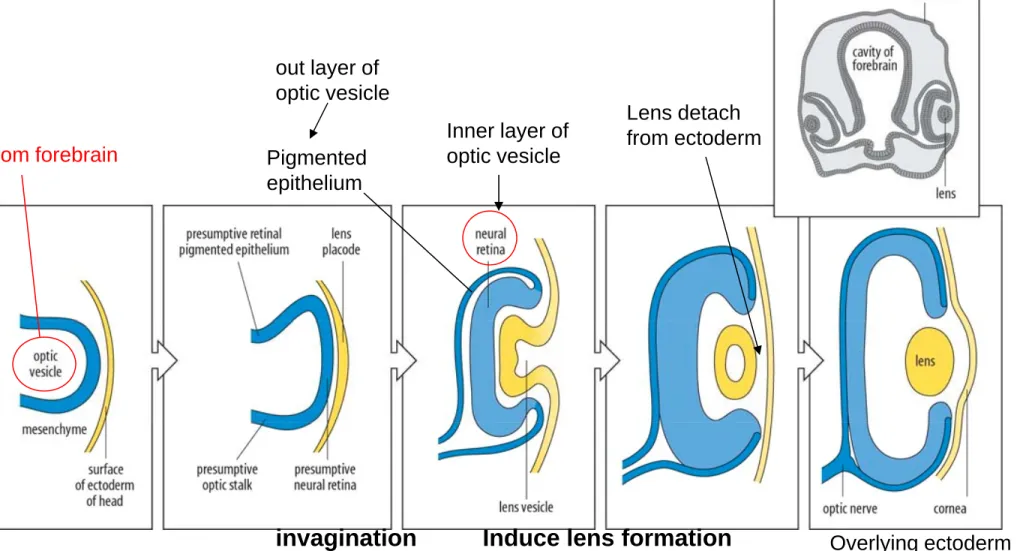
The vertebrate eye develops from the neural
tube and the ectoderm of the head
tube and the ectoderm of the head
out layer of optic vesicle Lens detach Inner layer of optic vesicle Pigmented epithelium from forebrain Lens detach from ectoderm
Fig. The main stages in the development of the vertebrate eyes
invagination Induce lens formation Overlying ectoderm form cornea
4. Pattern formation
4. Pattern formation
a Positional information
cell-cell communicationa. Positional information
cell cell communicationMorphogen (生長因子) Morphogen gradient a b b Set >a : Blue
Synpolydactyly (SPD), caused by
mutations in HOXD 13 is characterized
Mutations that affect antero-posterior patterning can cause mutations in HOXD 13, is characterized
by extra fingers and toes and bone abnormalities in the hands and feet
posterior patterning can cause polydactyly. With preaxial
polydactyly has mutations in the
SHH gene SHH gene
4. Pattern formation (spacing patterns)
( p
g p
)
b. Lateral inhibition
5. Asymmetric division
Cytoplasmic determinant
germline cell marker (green)
Cell nuclear (blue) Cell nuclear (blue)
Outline
Outline
1.
胚胎學 (embryology) vs. 發育生物學 (developmental biology)
2
模式生物 (
d l
i
)
2.
模式生物 (model organisms)
3.
動物發育的主要階段
4.
發育過程之機制
The capacity for regeneration in urodele amphibians (newt)( )
(1) Dorsal crest, (2) limbs, (3,4) retina and lens, (5) jaw, and tail
Principles of Development 4e
Wolpert/Tickle Copyright © 2011 by Oxford
幹細胞
幹細胞
1.甚麼是幹細胞
2.幹細胞來源
a. 成體幹細胞 (adult stem cell):
(
)
骨髓,成體週邊血 (取得極為困難)
b 胚胎幹細胞 (embryonic stem cell):
b. 胚胎幹細胞 (embryonic stem cell):
胚胎,臍帶血 (取得容易)
3 幹細胞之運用 (複製 組織再生)
3. 幹細胞之運用 (複製, 組織再生)
4. 幹細胞研究之道德探討
What Are Stem Cells?
• Stem cells share two basic characteristics that make
them distinctive from other cell types : self-renewal and
differentiation into specialized cell types
human embryonic stem cells (hESCs)
幹細胞來源之一
胚胎幹細胞
human embryonic stem cells (hESCs)
Cell differentiation (細胞分化)
How to control the cell differentiation? differential expression of gene?
Can differentiated cells reverse to ES cells? 返老還童?
Promoter—coding region
SCNT iPS
S
omatic
C
ell
N
uclear
T
ransfer (
體細胞核移殖)
複製動物
SCNT
複製動物
•1997年2月27日英國Roslin
研究所科學家於Nature雜
誌上首先發表複製羊桃莉
(Dolly)複製成功
Nature 385: 810 Nature 385: 810Somatic cell nuclear transplantation (SCNT)
by John Gurdon山中伸彌「誘導式多能性幹細胞」
iPS (induced pluripotent stem cells)
複製人與器官複製
2n n病
inner cell 代理孕母 體外培養 2n 幹細胞 inner cell massX
(分裂) 生命之開始 合法?合理? 幹細胞 (分化) 命之 始 (法律定義) 合法?合理?組織工程(Tissue Engineering)
• 皮膚移植(燒燙傷、美容) • 器官再造
– 1997 Dr. Charles Vacanti (University of Massachusetts)( y )
利用小鼠製造人工義耳: 以可吸收性聚合物製造耳朵形狀,以牛 膠原細胞包覆, 埋放到裸鼠皮下,生長成人形耳朵 – 其他可能應用:膀胱、軟骨、血管…等 Principles of Development 4e Wolpert/Tickle Copyright © 2011 by Oxford University Press
• Scientists working in regenerative medicine are also optimistic about their
regenerative medicine (再生醫學)
• Scientists working in regenerative medicine are also optimistic about their
ability to produce viable organs from stem cells
• Sheets of skin and other organs such as the urinary bladder have been
created in vitro created in vitro Principles of Development 4e Wolpert/Tickle Copyright © 2011 by Oxford University Press