Organic light-emitting devices based on a highly robust osmium(II) complex
Tswen-Hsin Liu and Chin H. Chen
Citation: Journal of Applied Physics 100, 094508 (2006); doi: 10.1063/1.2372570
View online: http://dx.doi.org/10.1063/1.2372570
View Table of Contents: http://scitation.aip.org/content/aip/journal/jap/100/9?ver=pdfcov Published by the AIP Publishing
Articles you may be interested in
Integrated optical model for organic light-emitting devices J. Appl. Phys. 109, 083114 (2011); 10.1063/1.3576114
Highly efficient red organic light-emitting devices based on a fluorene-triphenylamine host doped with an Os(II) phosphor
Appl. Phys. Lett. 92, 233303 (2008); 10.1063/1.2943155
Very high-efficiency organic light-emitting diodes based on cyclometallated rhenium (I) complex Appl. Phys. Lett. 92, 083302 (2008); 10.1063/1.2888767
Highly efficient and stable sky blue organic light-emitting devices Appl. Phys. Lett. 89, 121913 (2006); 10.1063/1.2356903
Microcavity two-unit tandem organic light-emitting devices having a high efficiency Appl. Phys. Lett. 88, 111106 (2006); 10.1063/1.2185077
Organic light-emitting devices based on a highly robust
osmium
„II… complex
Tswen-Hsin Liua兲 and Chin H. Chen
Department of Photonics, Institute of Electro-Optical Engineering, National Chiao Tung University, Hsinchu 300, Taiwan, Republic of China and AU Optronics Corporation, Hsinchu 300, Taiwan, Republic of China
共Received 20 June 2006; accepted 21 August 2006; published online 14 November 2006兲
An osmium共II兲 complex, Os共fptz兲2共PPh2Me兲2 关fptz=3-trifluoromethyl-5-共2-pyridyl兲-1,2,4-triazole, PPh2Me= methyl-diphenyl-phosphan兴, when doped in a 4,4
⬘
-N , N⬘
-dicarbazolebiphenyl host as a phosphorescent red emitter in organic light-emitting devices, has the unusual property of resisting concentration quenching and sustaining its external quantum efficiency 共EQE兲 共8%–9%兲 over a wide range of doping concentration 共20%–40%兲. Single-crystal x-ray diffraction evidence is presented that the difference in doping behaviors can be linked to the octahedral configuration of Os共fptz兲2共PPh2Me兲2, which could prevent the undesirable molecular aggregation from occurring at high concentration, thus delaying the onset of quenching. Accordingly, the high doping concentration of Os共fptz兲2共PPh2Me兲2leads to a significant suppression of luminescence quenching at high brightness/current and achieves a “flat” EQE versus brightness response owing to the increase in the emission sites in the emission layer. © 2006 American Institute of Physics. 关DOI:10.1063/1.2372570兴I. INTRODUCTION
One of the key developments in the advance of modern organic light-emitting device共OLED兲 technology is the dis-covery of electrophosphorescence, which lifts the upper limit of the internal quantum efficiency of the usual fluorescent dopant-based devices from 25% to nearly 100%.1 Phospho-rescence is inherently a slower and less efficient process than singlet transitions responsible for fluorescence due to the fact that the emission from a triplet state does not conserve spin. But triplet states constitute the majority of electrogenerated excited states 共⬃75%兲, so the successful utilization of the triplet manifold to produce light should undoubtedly increase the overall luminance. In compounds containing heavy-metal complexes, the decay of a triplet state becomes weakly al-lowed due to strong spin-orbit coupling that leads to singlet-triplet state mixing which removes the spin-forbidden nature of the radiative relaxation of the triplet state. In such cases, the decay of the triplet state may still be very slow, but phosphorescence is generated.
The utilization of phosphorescent materials in OLEDs is found by doping the phosphorescent material into a charge transport host material.2 However, one of the significant is-sues in current doped phosphorescent light-emitting devices 共PHOLEDs兲 is the decrease of quantum efficiency with in-creasing current. Since the total spin is conserved, two ex-cited triplet excitons may combine to form an exex-cited singlet exciton and a ground-state singlet exciton. Consequently, the process would destroy at least one triplet exciton, which is known as the triplet-triplet annihilation.3 In general, the current-induced efficiency drop in PHOLEDs occurs owing to the long phosphorescent exciton lifetime of
phosphores-cent materials that causes saturation of emission sites. The triplet-triplet annihilation then happens between triplet exci-tons of hosts, which results in significant electroluminescent energy loss. This phenomenon will tend to be more serious when more current is injected and more triplet excitons of hosts are generated.
Triplet-triplet saturation and annihilation can be mini-mized if the phosphorescent lifetime of dopants is short enough. It would be even better if the dopants possess large steric hindrance to suppress concentration quenching owing to aggregation of dye molecules. As a result, a larger amount of dopant could exist in the luminescent matrix. If both con-ditions mentioned above were met, then the sufficient triplet excitons of the host could effectively transfer their excited energy to light via fast relaxation process instead of going through the nonradiation pathways. Based on these two con-cerns, most phosphorescent dopants of commercial impor-tance are designed not only to be ligand-chelated heavy-metal complexes to increase spin state mixing, but also possess large steric hindrance to minimum bimolecular inter-action. For example, it was found that the red triplet phos-phor, bis共2-共2
⬘
-benzo关4,5-a兴 thienyl兲pyridinato-N,C3⬘
兲 iri-dium共acetylactonate兲 共Btp2Ir共acac兲兲 共Ref. 4兲 with a short phosphorescence lifetime 共⬃4s兲 and a spherical structure leads to a significant improvement in external quantum effi-ciency 共EQE兲 reaching 2.5% at high current density of 100 mA/ cm2 as the doping concentration was⬃7%.Although most of the high efficiency phosphorescent materials under development were focused on Ir共III兲 central metal, other complexes based on Os共II兲 central metal were also considered potential candidates, which, in general, pos-sess a shorter triplet-state exciton lifetime 共⬉a few micro-seconds兲 due to the enhancement of the heavy-metal atom participating in the lowest excited triplet manifolds.5–7
More-a兲Author to whom correspondence should be addressed; electronic mail:
0021-8979/2006/100共9兲/094508/4/$23.00 100, 094508-1 © 2006 American Institute of Physics
over, in terms of molecular design, the phosphorescent dop-ant based on Os共II兲 central metal has the merit of larger steric hindrance, which allows higher dopant concentration to be used in the emission layer. In this study, we conducted the fabrication of OLEDs that contain an Os共II兲 complex, Os共fptz兲2共PPh2Me兲2 关fptz=3-trifluoromethyl-5-共2-pyridyl兲-1,2,4-triazole, PPh2Me= methyl-diphenyl-phosphane兴, with an octahedral configuration as the emitting material. A device based on the red Os共fptz兲2共PPh2Me兲2is expected to alleviate the triplet-triplet annihilation often encountered in PHOLEDs, which greatly improves the luminance efficiency over a wide range of drive current conditions.
II. RESULTS AND DISCUSSION
A. Structure analysis of Os„fptz…2„PPh2Me…2
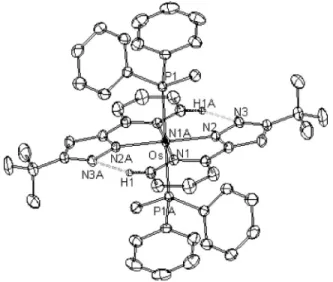
The synthesis, structure, purity, and chemical properties of the red dopant used in this study has been verified and disclosed in other publication.8 As depicted in Fig. 1, the molecular frame reveals an octahedral configuration where two chelating fptz ligands establish a nearly planar OsN4 basal arrangement, together with two PPh2Me ligands lo-cated at the axial depositions. The Os atom is lolo-cated at a crystallographic center of inversion, which constructs a C2 symmetry. On the other hand, the observed exciton lifetimes of Os共fptz兲2共PPh2Me兲2are 0.96s in degassed CH2Cl2 and 0.18s in solid state.8 It is notable that the radiative life-times of Os共fptz兲2共PPh2Me兲2 are considerably shorter than those of most reported red emitting Ir共III兲 complexes, imply-ing that the OLED devices fabricated using Os共fptz兲2共PPh2Me兲2 should be beneficial in reducing triplet-triplet annihilation at high current/brightness and increasing quantum efficiency.
B. OLED performance with neat Os„fptz…2„PPh2Me…2 as the emission layer
The essential electroluminescent 共EL兲 properties of Os共fptz兲2共PPh2Me兲2 were investigated in the device fabricated with the structure shown in the inset of Fig. 2: Indium tin oxide 共ITO兲 共75 nm兲/copper phthalocyanine 共CuPc兲 共15 nm兲/1,4-bis关N-共1-naphthyl兲-N
⬘
-phenylamino兴bi-phenyl-4 , 4⬘
diamine 共NPB兲 共60 nm兲/Os共fppz兲2共PPh2Me兲2 共40 nm兲/aluminum共III兲bis共2-methyl-8-quinolinolato兲-4-phenylphenolato 共BAlq兲 共15 nm兲/aluminum共III兲tris-8-hy-droxyquinolinolato 共Alq3兲 共20 nm兲/LiF 共1 nm兲/Al 共200 nm兲. This device was fabricated using conventional vacuum deposition in a 5.0⫻10−5Pa vacuum on a pre-cleaned glass substrate coated with ITO. ITO was used as the transparent anode with a sheet resistance of 10⍀/square. The CuPc, NPB, BAlq, and Alq3 were used as the hole in-jection, hole transport, hole blocking material, and electron transport material, respectively.The device exhibited red emission with the Commission Internationale d’Eclairage 共CIE兲 coordinates of x=0.65 and y = 0.34. A maximum luminous efficiency of 3.1 cd/ A and an external quantum efficiency共EQE兲 of 3.4% were obtained at 1 mA/ cm2 共4.3 V兲 while the emission layer was composed of pure Os共fptz兲2共PPh2Me兲2. The emission color and the EL spectrum did not change as the applied voltage was varied. As shown in Fig. 2, the EL spectrum of the device 共max = 628 nm兲 is in agreement with that observed for the photo-luminescence of Os共fptz兲2共PPh2Me兲2 in solution.8
The current-voltage-luminance characteristics of the de-vice are shown in Fig. 3and the plot of EQE versus bright-ness is shown in the inset. It is noteworthy that luminance loss due to triplet-triplet annihilation in PHOLEDs has been suppressed apparently in this device. Up to 6000 nits 共 ⬃200 mA/cm2兲, the EQE drop is less than 5%, which is rarely seen in conventional phosphorescent devices. Al-though the mechanism behind the “flat” EQE response is not fully understood, it is clear that the capability in allowing high phosphorescent dopant concentration as well as short triplet radiative lifetime owing to the proper molecular
de-FIG. 1. Oak Ridge Thermal Ellipsoid Plot Program共ORTEP兲 diagram of the Os共II兲 complex with a special emphasis on the intramolecular hydrogen bonding. N共3兲 and N共3A兲 formed intramolecular hydrogen bonds with H共1A兲 and H共1兲, respectively, that establishes a planar six-ringed basal ar-rangement, together with two PPh2Me ligands located at the axial deposi-tions to construct an octahedral configuration.
FIG. 2. Electroluminescence spectrum of the OLED device without doping Os共fptz兲2共PPh2Me兲2in host. Inset: multilayer configuration of the device.
094508-2 T.-H. Liu and C. H. Chen J. Appl. Phys. 100, 094508共2006兲
sign would increase emission sites, which is expected to sup-press the efficiency loss at high brightness/current in PHOLEDs.
C. OLEDs performance with Os„fptz…2„PPh2Me…2
as the dopant material
The EL properties of Os共fptz兲2共PPh2Me兲2-doped devices were investigated in the devices: ITO 共75 nm兲/CuPc 共15 nm兲/NPB 共60 nm兲/CBP:x%Os共fptz兲2共PPh2Me兲2 共40 nm兲/BAlq 共15 nm兲/Alq3 共20 nm兲/LiF 共1 nm兲/Al 共200 nm兲. The doping concentration of Os共fptz兲2共PPh2Me兲2 ranges from 4% to 50%. It is apparent from Fig.4that when Os共fptz兲2共PPh2Me兲2is doped in CBP, it resists concentration quenching as well as sustains its EQE over a wide range of doping concentrations. The device EQE is within 8%–9% when the doping concentration ranges from 20% to 40%, which indicates a broad doping concentration window. The subsequent decline of EQE is mild and reaches 6.7% under 50% doping concentration. Such high doping concentration in CBP without showing the concentration quenching effect is rarely seen. This has proved that the octahedral structure of Os共fptz兲2共PPh2Me兲2works better than the ordinary spheri-cal structure of phosphorescent dopant in minimizing the dye-dye bimolecular interaction at high concentration that leads to quenching of the luminance.
From the direct photoionization measurements 共Riken AC-2兲 and UV absorption measurement,9
the highest occu-pied molecule orbital共HOMO兲/lowest unoccupied molecule orbital共LUMO兲 of Os共fptz兲2共PPh2Me兲2is 5.3/ 3.3 eV which is in between that of CBP 共5.5/2.0 eV兲. This suggests that Os共fptz兲2共PPh2Me兲2molecules may act as carrier traps under low Os共fptz兲2共PPh2Me兲2 doping concentration. When an electric field is applied, the carriers will be driven forward and forced to undergo the trapping-detrapping mechanism, which is a power consuming behavior. As a result, the driv-ing voltage is higher. However, as the dopdriv-ing concentration of Os共fptz兲2共PPh2Me兲2 is increased, the driving voltage de-clines共also see in Fig.4兲, which indicates that the
probabil-ity for undergoing the power consuming trapping-detrapping mechanism is reduced. We attribute this to the improved overlapping of Os共fptz兲2共PPh2Me兲2orbitals, which allows the carriers to hop directly over Os共fptz兲2共PPh2Me兲2 mol-ecules.
D. Suppression of triplet-triplet annihilation
To further prove that the triplet-triplet annihilation phe-nomenon will be suppressed as the doping concentration 共emission site兲 is increased, we compare the EQE of all de-vices driven from 2 – 200 mA/ cm2 with different doping concentrations and normalized by the EQE under 2 mA/ cm2. In Fig.5, it is obvious that the highest EQE of most devices occurred at the lowest current density of 2 mA/ cm2and the EQE declined with the increase in current density. However, the decrease in EQE is suppressed by the increase of Os共fptz兲2共PPh2Me兲2 doping concentration. It is, therefore, clear that the capability in allowing high phospho-rescent dopant concentration as well as short triplet radiative lifetime owing to the proper molecular design would in-crease emission sites, which is expected to suppress the effi-ciency loss at high brightness/current in phosphorescent OLEDs.
III. SUMMARY
In this study, electroluminescent properties of an emis-sive Os共II兲 complex with an octahedral configuration have been studied. We fabricated OLEDs based on
FIG. 3. Current-voltage-luminance characteristics of the device shown in the inset of Fig.2. Inset: the plot of luminescence efficiency vs brightness for the device without doping in host.
FIG. 4. External quantum efficiency and driving voltage dependency on Os共fptz兲2共PPh2Me兲2concentration in CBP of the doped devices.
FIG. 5. External quantum efficiency decay with increasing injected current vs O共fptz兲2共PPh2Me兲2doping concentration.
Os共fptz兲2共PPh2Me兲2 phosphor with a multilayer configura-tion of ITO/ CuPc/ NPB/ CBP: x % Os共fptz兲2共PPh2Me兲2/ BAlq / Alq3/ LiF / Al demonstrated red emission with CIE co-ordinates of x = 0.65, y = 0.34, a maximum external quantum efficiency of 9%. Owing to its sterically hindered structure, Os共fptz兲2共PPh2Me兲2has the property of resistance to concen-tration quenching and the sustaining of its EQE over a wide range of doping concentration in CBP. The device also suc-cessfully suppressed the problem of luminescence quenching at high brightness/current and achieved a flat EQE versus brightness response while the emission layer was composed of neat Os共fptz兲2共PPh2Me兲2.
ACKNOWLEDGMENTS
The authors thank Yung-Liang Tung and Yun Chi for generously supplying the phosphorescent material used in this study and Pei-Chi Wu, Shih-Feng Hsu, and Chi-Hung
Liao for discussion and their valuable help. This work was supported by the Ministry of Education under a Grant from the PPAEU 共Grant No. 91-E-FA04-2-4-B兲 and the National Science Council of Taiwan, Republic of China.
1M. A. Baldo, D. F. O’Brien, Y. You, A. Shoustikov, S. Sibley, M. E.
Thompson, and S. R. Forrest, Nature共London兲 395, 151 共1998兲.
2M. A. Baldo, M. E. Thompson, and S. R. Forrest, Pure Appl. Chem. 71,
2095共1999兲.
3C. Adachi, M. A. Baldo, and S. R. Forrest, J. Appl. Phys. 87, 8049共2000兲. 4C. Adachi, M. A. Baldo, S. R. Forrest, S. Lamansky, M. E. Thompson,
and R. C. Kwong, Appl. Phys. Lett. 78, 1622共2001兲.
5X. Jiang, A. K.-Y. Jen, B. Carlson, and L. R. Dalton, Appl. Phys. Lett. 80,
713共2002兲.
6S. Bernhard, X. Gao, G. G. Malliaras, and H. D. Abruna, Adv. Mater.
共Weinheim, Ger.兲 14, 433 共2002兲.
7X. Jiang, A. K. Y. Jen, B. Carlson, and L. R. Dalton, Appl. Phys. Lett. 81,
3125共2002兲.
8Y.-L. Tung et al., Organometallics 23, 3745共2004兲.
9We used AC2 to measure the HOMO of the organic materials first. Then
we got the energy gap共Eg兲 by UV absorption. The LUMO was obtained indirectly from the HOMO and the Eg.
094508-4 T.-H. Liu and C. H. Chen J. Appl. Phys. 100, 094508共2006兲