
韻尾類比訓練對國小六年級學生英文讀字能力之成效研究 - 政大學術集成
115
0
0
全文
(2) The Effects of Rime Analogy Training on Word Reading for EFL Sixth Graders. 立. 政 治 大. ‧ 國. 學. A Master Thesis Presented to Department of English,. ‧. National Chengchi University. n. er. io. sit. y. Nat. al. Ch. engchi. i n U. v. In Partial Fulfillment of the Requirements for the Degree of Master of Arts by Shiu-yu Huang July, 2010.
(3) To Yuen-mei Yin 獻給我的恩師殷允美教授. 立. 政 治 大. ‧. ‧ 國. 學. n. er. io. sit. y. Nat. al. Ch. engchi. iii. i n U. v.
(4) Acknowledgements I’m most grateful to my advisor, Prof. Yuen-mei Yin for her continuous help from the very beginning to the completion of my thesis work. She is like an engineer to me. She guided me to “map out” a thesis blueprint and make it come true bit by bit. I felt a sense of achievement every time I completed a task from my thesis timetable. She is also my. 政 治 大. mentor for telling me where to improve in my life. I was energized by her. 立. encouragements and positive thinking when I experienced difficulties in. ‧ 國. 學. writing the thesis.. I also wish to express my gratitude to the committee members, Prof.. ‧. Ming-chung Yu and Dr. Chieh-yue Yeh for valuable comments from the. y. Nat. proposal stage to the oral defense stage.. io. sit. In addition, my thanks are due to all of my professors at National. er. Chengchi University: Dr. Ping-huang Sheu, Prof. Chee-yi Lin, Dr.. n. a. iv. l C Thomas J. Sellari, Prof. Chien-ching Mo, Prof. Po-ying Lin, Dr. n. hengchi U. Hsueh-ying Yu, and Dr. Pat Chih-ping Ssutu. Their teachings and guidance are beneficial to my thesis work at many levels. Moreover, my heartfelt appreciation goes to my school sisters: Ya-chen Wu, Yun-chia Chiou, and Chen-ping Chang. With their constant guidance, I have avoided several mistakes and saved a lot of time. Special gratitude is also extended to the participants and colleagues in my school. I could not have completed the study without their participation and assistance. Finally, I would like to thank my family for supporting me in many ways so I could write my thesis more smoothly. iv.
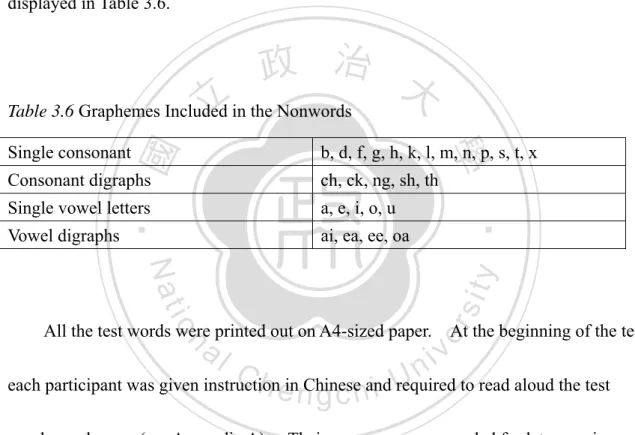
(5) TABLE OF CONTENTS. Acknowledgements……….….………………………………………………......... iv. Chinese Abstract ……………………..…………………………………..……...... xi. English Abstract …………..…….……………………………………………….... xii. Chapter One: Introduction…………………………………………………….…... 1. Background and Motivation…..……………………………………………... 1. Purpose of the Study……………………………………………………..….. 2. Definitions of Terms…………………………………………………….….... 4. Organization of the Thesis……………..…………………………..………... 6. Chapter Two: Literature Review……………………………………….………….. 8. 政 治 大 The Relation Between Analogy and Rime………………………..……........ 立 Onset and Rime…………………………………………..………………….. 學. ‧ 國. 8 9. Importance of Onset-rime Awareness…………….…….………………. 12. Onset-rime Awareness and Reading Strategies………………..…………. 14. Rime Analogy………………………………...……………………….……. Clue Words in Rime Analogy………............……………………….…….. 15. Importance of Rime Analogy in Reading……………….………………... 16. er. io. sit. Nat. 15. y. 10. ‧. Onset-rime Awareness……………………………….……………………. al. Rime Analogy and Reading Levels…….……………….……………….... 17 21. Chapter Three: Methodology….……………………………..…………..……....... 26. Research Design….………………………..………………..………………. 26. The Pilot Study……………………………………………………………. 26. The Revision…………………..………………….………………..……... 28. The Formal Study…...…………………………………………….………. 32. Participants……………………………..…………………….…………….... 34. Instruments……………………………..…………………….…………….... 36. Testing Materials…………………………..……………….……………... 36. Standardized English Word Recognition Test……………..………........ 36. Generalization Test……………………..…………….……………….... 37. n. v i n Related Studies in a Taiwanese C h Context….………………..……………….. U i e h n c g Rime Analogy and Attitudes….…………………..………………………. v. 19.
(6) Questionnaire on Attitudes Toward Reading English Words……..……. 39. Interview……………………………..……………….………………... 40. Teaching Materials and Training…………..…………….……………....... 42. Teaching Materials.…………………..........…………….……………... 42. Training.……………………..........………….……………………….... 44. Data Analysis …………………………………………….............................. 46. Chapter Four: Results and Discussion…………………………………………….. 48. Decoding Skills ……………………………………..……….….…………... 48. Comparisons Between the Two Groups……………………...….………... 48. Questionnaire on Attitudes Toward Reading English Words ……………...... 53. Comparisons Between the Two Groups ………………………...………... 53. 治 政 大 Interview………………………………………………………...…….……. 立 Difficulties…………………………………………………….……....….. 55. Perceptions of Training Duration...……………………….……....………. 62. Perceptions of Teacher’s Teaching Method………….………...……....... 63. Comparisons Within Each Group ……………….………………....…….. 學. ‧ 國. 59 59. 66. Main Findings…………..………………………………………………….... 66. y. Nat. 68. sit. ‧. Chapter Five: Conclusions……………..…………………………………………. Pedagogical Implications…………………...……………………...……....... 71. er. io. Limitations of the Study and Suggestions for Future Research……..……… References………………………..……………………………………………....... al. n. v i Appendixes……………………………………………………………………….. n Ch e nTest…………..………………………….... gchi U Appendix A Generalization Appendix B. Questionnaire on Attitudes Toward Reading English Words……………………………………………………... Appendix C. Letter of Approval for Parents……………………..……... Appendix D-1. Class A’s Scores on the Standardized English Word Recognition Test……………………………...………….... Appendix D-2. 76 82 82 83 84 85. Class B’s Scores on the Standardized English Word Recognition Test………………………………………....... 86. Appendix E. List of Test Words and Clue Words……………….…….…. 87. Appendix F-1. Teaching Schedule for the Formal Study (Experimental Group)…………………………………………………….. vi. 88.
(7) Appendix F-2. Teaching Schedule for the Formal Study (Control Group)... 89. Appendix G. Training Words for Both Groups………………...…............ 90. Appendix H-1. Lesson Plan for the Experimental Group...…....…………... 91. Appendix H-2. Lesson Plan for the Control Group...…....……………........ 93. Appendix I-1. Experimental Group’s Pre-and Post-training Scores on the Generalization Test………………………………………... Appendix I-2. 95. Control Group’s Pre-and Post-training Scores on the Generalization Test………………………………………... Appendix J-1. 96. Experimental Group’s Pre-and Post-training Scores on the Questionnaire…………………………………….... Appendix J-2. Control Group’s Pre-and Post-training Scores on the. Appendix K-1. 治 政 Transcription of Participants’大 Interviews 立 (Experimental Group)…..…………………………………. Appendix K-2. Transcription of Participants’ Interviews. Questionnaire……………………………………………... ‧ 國. 學. (Control Group) …………………………………………... ‧. n. er. io. sit. y. Nat. al. Ch. engchi. vii. i n U. v. 97 98 99 101.
(8) LIST OF TABLES Table 3.1 Descriptive Statistics on the Generalization Pre-and Post-test………. 28. Table 3.2 Modifications of the Research Design……………………………….. 31. Table 3.3 Results of the Standardized English Word Recognition Test Between Groups……………………………………………………………….. 35. Table 3.4 Results of the Generalization Pre-test Between Groups…................... 35. Table 3.5 Gender and Number of Students in Both Groups.................................. 36. Table 3.6 Graphemes Included in the Nonwords......................…........................ 38. Table 3.7 Subscales of the Questionnaire......................…................................... 40. Table 3.8 Design of the Interview Questions.................…................................... 41. Table 3.9. 44. Table 4.1. 治 Digraphs Included in政 the Teaching Materials....................................... 大 Between-group 立Results of the Generalization Post-test........................ 49. ‧ 國. 學. Table 4.2 Descriptive Statistics on the Generalization Test of the Bottom Three Participants in Both Groups…………………………………………. 52. ‧. Table 4.3 Between-groups Results of Pre-training Questionnaire on Attitudes Toward Reading English Words……………………………………... 54. sit. y. Nat. Table 4.4 Between-groups Result of Post-training Questionnaire on Attitudes Toward Reading English Words…...……………………………….... 54. io. er. Table 4.5 Descriptive Statistics on the Attitudinal Changes of the Bottom. n. al. Table 4.6. i n U. v. Three Participants in Both Groups…………………………………... 55. English Words……………………………………………………….. 56. C h Group’s Attitudes toward Reading Results of the Experimental engchi. Table 4.7 Result of Control Group’s Attitudes toward Reading English Words. 56. Table 4.8 Results of the Experimental Group’s Attitudes toward Reading English Words by 4 Subscales……………………………………… Table 4.9. 57. Results of the Experimental Group’s Attitudes toward Reading English Words by Q 3,8,10 of Subscale PR…………………………. 58. Table 4.10 Difficulties of the Six Participants in the Experimental Group……... 60. Table 4.11 Difficulties of the Six Participants in the Control Group………….... 61. Table 4.12 Participants’ Perceptions of Training Duration……..………………. 62. Table 4.13 Participants’ Perceptions of Teacher’s Teaching Method.…………... 63. viii.
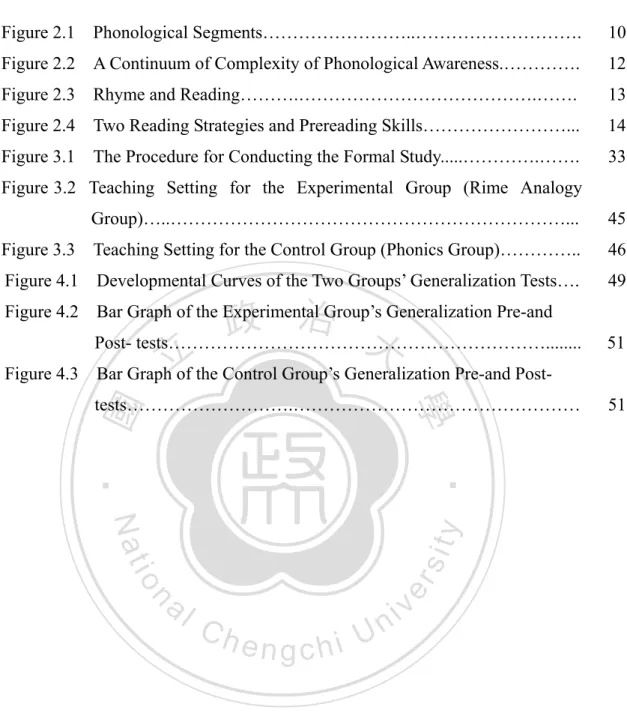
(9) LIST OF FIGURES Figure 2.1 Phonological Segments……………………..……………………….. 10. Figure 2.2 A Continuum of Complexity of Phonological Awareness.………….. 12. Figure 2.3 Rhyme and Reading……….………………………………….…….. 13. Figure 2.4 Two Reading Strategies and Prereading Skills…………………….... 14. Figure 3.1 The Procedure for Conducting the Formal Study.....………….…….. 33. Figure 3.2 Teaching Setting for the Experimental Group (Rime Analogy Group)…..………………………………………………………….... 45. Figure 3.3 Teaching Setting for the Control Group (Phonics Group)…………... 46. Figure 4.1 Developmental Curves of the Two Groups’ Generalization Tests….. 49. 治 政 大 Post- tests………………………………………………………........ Bar Graph立 of the Control Group’s Generalization Pre-and Post-. 51. tests……………………….…………………………………………. 51. Figure 4.2 Bar Graph of the Experimental Group’s Generalization Pre-and. 學. ‧. ‧ 國. io. sit. y. Nat. n. al. er. Figure 4.3. Ch. engchi. ix. i n U. v.
(10) 國立政治大學英國語文學系碩士在職專班 碩士論文提要 論文名稱:韻尾類比訓練對國小六年級學生英文讀字能力之成效研究 指導教授:殷允美 博士 研究生:黃秀玉 論文提要內容: 本研究旨在探討韻尾類比訓練對國小六年級學生英文讀字能力、讀字態度之. 政 治 大. 影響及其學習困難。研究分兩階段進行:第一階段為小規模之預試研究,第二階. 立. 段則為正式實驗。預試研究後,研究者在教法、試題做修正改進,並經由了解學. ‧ 國. 學. 生之思考過程及學習困難後,再進一步設計更完整之訪談。 在正式實驗中,對象為桃園縣某國小二個六年級班級,並從二班各挑出 25. ‧. 人做為實驗組及對照組。實驗組施以韻尾類比策略訓練,教材來源為學生二至五. y. Nat. 年級之教科書字彙以做為類比策略運用之基礎。對照組雖使用相同之教材,但教. io. sit. 法則僅限於字母與音的對應關係。實驗時間為每週 20 分鐘(每週兩節英語之前. n. al. er. 10 分鐘),持續十週。兩組學生在教學前後各施以讀字測驗及唸讀英文字態度問. i n U. v. 卷調查,訓練後則二組各選 6 名做為訪談對象以進一步了解他們的學習困難。. Ch. engchi. 結果發現,二組學生在讀字能力上並無顯著差別,但在讀字態度上只有實驗 組有顯著正向改變。比較二組學習困難則發現對照組之困難較為複雜。此外,實 驗組之低程度學生在接受類比訓練後,在讀字能力及讀字態度上相較於對照組之 低程度學生有非常明顯之進步。 以上研究結果顯示,韻尾類比策略訓練可以提升國小六年級學生英文認字能 力亦能正向改變學生之讀字態度,尤其對低程度學生更為有效。最後根據本研究 之結果及學生之學習困難提出教學建議,供未來國小英語教師英文讀字教學時之 參考。 關鍵詞:韻尾類比;類比法;字母拼讀;提示字;韻尾識覺;解碼技巧;解碼策 略;讀字;低程度學生;學習態度; 字母與音的對應關係. x.
(11) ABSTRACT The purpose of this study is to explore the effects of rime analogy training on sixth graders with respect to their decoding skills, attitudinal changes towards reading English words, and perceived difficulties with word reading. The present study comprised 2 phases: the first being a small-scale pilot study, the second a formal study. The pilot functioned as a preparatory work for the formal study. In the pilot, the testing materials, instruments, and activities of the training were tested and revised to be more suitable for the formal study. From the students’ responses, the researcher. 政 治 大. obtained some insights about their thinking process and learning difficulties and this. 立. allowed for designing a more complete interview for the formal study.. ‧ 國. 學. In the formal study, there was an experimental group and a control group, each comprised of 25 sixth graders from two classes in one elementary school in Tao Yuan. ‧. county. The experimental group received rime analogy training. The teaching materials were selected from the participants’ textbooks word bank, from the second. y. Nat. grade to the fifth grade, as a basis for making analogy. The control group was taught. io. sit. with the same materials but received phonics instruction that focused only on. n. al. er. grapheme-phoneme correspondences rules. Both groups received two 10-minute. i n U. v. training sessions a week for 10 weeks, and were administered the same pre-and. Ch. engchi. post-test (generalization test) to assess decoding skills, and a pre-and post-training questionnaire on attitudes toward reading English words. After the training, six participants from each group were further interviewed to understand their thinking process and perceived difficulties. The findings are as follows. In terms of the decoding skills, the post generalization test showed that no significant statistical difference was found between the two groups. In light of the attitudinal changes, only within-group comparisons of the experimental group were significantly different. In view of perceived difficulties, the interviews revealed that the difficulties in the control group were more complicated than those in the experimental group. The most noteworthy finding is that the lowest-proficiency participants in the experimental group not only outperformed their counterparts in the control group in decoding skills, but also demonstrated far xi.
(12) more positive attitudinal changes after the training. The findings provide supporting evidence for the value of rime analogy training in promoting students’ decoding abilities and positively changing students’ learning attitudes. The nature of students’ perceived difficulties is also discussed, in respect of which several pedagogical implications and suggestions for future studies are outlined. Key Words: rime analogy, analogy, phonics, clue words, rime awareness, decoding. 政 治 大 learning attitudes, grapheme-phoneme correspondences 立. skills, decoding strategies, word reading, low proficiency students,. ‧. ‧ 國. 學. n. er. io. sit. y. Nat. al. Ch. engchi. xii. i n U. v.
(13) CHAPTER 1 INTRODUCTION. Background and Motivation Over the past ten years, English education has gained more and more importance in Taiwan.. Since the year 2001, English teaching has been formally included in the. 政 治 大. elementary school curriculum (MOE, 2001). In 2006, the Ministry of Education (MOE). 立. further stipulated that elementary school graduates should at least be able to use 300. ‧ 國. 學. words orally and spell 180 English words to communicate (MOE, 2006).. To facilitate. ‧. students reading aloud, phonics, instruction to teach sound-spelling relationships to. Nat. io. sit. y. decode words, was included in the elementary school curriculum by MOE (2006).. er. However, phonics instruction, which focuses more on small unit grapheme-phoneme. al. n. v i n C h correspondences, correspondences (i.e., spelling-to-sound e n g c h i U e.g., t-/t/) at the elementary school level in Taiwan seems to confront two obstacles.. One is that elementary school. students were found to have difficulties learning grapheme-phoneme correspondence rules, and some even did not know the letters representing the sounds (Lin, 1999). Furthermore, some students felt bored after repetitive practice of the rules (Lin, 2000). Another is that readers were prone to form the habit of paying attention to every grapheme in the word (e.g., “c”, “oa”, “t” in coat) under the instruction that emphasized. 1.
(14) 2. on small units (Christensen & Bowey, 2005). Therefore, when a student does not know the sound of any small unit in a word, he or she might lose interest in sounding out the word, or even give up. 1. Gradually, the more words they can not read out, the more. likely it is their confidence is lowered.. In the long run, students will lose their. willingness to learn English (Chang &Wu, 2008). To overcome the above limitations of phonics instruction, rime analogy (RA) which. 政 治 大. centers on larger units (e.g., eak in beak) can supplement phonics instruction in Taiwan. 立. First, instead of tackling sound-spelling correspondences rules, rime. 學. ‧ 國. for two reasons.. analogy is used to generalize the pronunciation of a new word from a known word To illustrate, the new word dish is learned based on the. ‧. (Goswami & Bryant, 1990).. Nat. io. sit. y. familiar word fish which shares the same rime: ish. As long as learners know d is. er. pronounced /d/, they can easily draw an analogy from fish to pronounce dish.. al. n. v i n Ch the pronunciations of rimes in RA are quite predictable e n g c h i U(Adam, 1990).. Second,. In other words,. the rules of rimes are simple and clear to learn. 2 Purpose of the Study The purpose of the study was developed based on the theoretical frameworks and the researcher’s own personal teaching experience.. 1. It is noted that for EFL students, learning phonics is harder than English-speaking students, so the result of losing interest or giving up on sounding out the word is expected, based on Christensen and Bowey’s (2005) findings and the researchers’ teaching experience. 2 I am grateful to Prof. Yin for pointing out another point that the learning of RA is much easier than the learning of grapheme-sound correspondences which are more abstract and difficult to acquire..
(15) 3. In theory, evidence supporting the use of RA can be found in studies which looked into the effects of RA on native English-speaking children (Bruck & Treiman, 1992; Goswami, 1999, Walton & Walton, 2002; Wang & Gaffney, 1998). However, most studies have researched short-term “individual” training in RA so the long term effects are still worth exploring. In Taiwan, related studies (Chang & Wu, 2008; Chen, 2004; Ma, 2007) have also. 政 治 大But the role of RA in helping. examined the effects of rime analogy in word reading.. 立. Taiwanese elementary school students’ word reading is not fully clear because findings in. ‧ 國. 學. attitudinal changes and learning difficulties were only focused on students who received Since phonics instruction is the proposed word reading instruction by. ‧. RA training.. Nat. al. er. io. approaches as part of the investigation.. sit. y. MOE in Taiwan, it is also important that comparing the effects of the RA and phonics. n. v i n Ctaught In practice, the researcher has graders the use of analogy for 3 years. h e nsixth gchi U. When teaching phonics, the researcher often found that many students, after encountering some difficulties in reading words, would become so frustrated that they even wanted to give up.. But with the help of rime analogy in class, their attitudes would improve and. their word reading problem would be solved when guided by RA strategy. In brief, the purpose of the present study was to explore the effects of rime analogy training on sixth graders’ word reading skills (i.e., decoding skills).. Furthermore,.
(16) 4. participants will be divided into two groups: one group receiving RA training while the other, phonics training, to compare the effects of the two approaches and to provide English teachers with a more comprehensive view of RA training in Taiwan.. For these. two aims, two research questions are addressed as follows. 1. Is rime analogy training effective in promoting EFL sixth graders’ decoding skills? 2. After the instruction, are there any differences between the two groups’ attitudes toward. 政 治 大. reading English words and perceived difficulties?. 立. Based on the a number of research on RA (Bruck & Treiman, 1992; Farrington-Flint. ‧ 國. 學. & Wood, 2007; Goswami, 1995; Savage, 1997; Wang & Gaffney, 1998; Wood, 2002) and. ‧. related studies in Taiwan (Chang & Wu, 2008; Chen, 2004; Ma, 2007), two hypotheses. Nat. io. sit. y. were examined in answering the two questions. Firstly, after receiving RA training,. er. students will be able to read English words more effectively than students receiving only. al. n. v i n Cmoreover, Secondly and attitudes to reading words will h e n gstudents’ chi U. phonics training.. change positively and their perceived difficulties could be identified after the RA training. An experimental study was conducted to examine these hypotheses. Definitions of Terms Some important terms appearing in the paper are defined as follows. Phonics Instruction Phonics instruction involves spelling and sound correspondences (Blevins, 1998)..
(17) 5. In phonics instruction, there are two major approaches, the synthetic and the analytic approaches (Blevins, 1998). In 1999, Cunningham proposed a third approach, the analogic approach (cited in Hsu, 2004).. In the synthetic approach, children learn by. identifying letters, blending words, and reading context. In the analytic approach, children are taught to deduce sound-symbol relationships from known words to learn new words.. The third approach, the analogic approach, requires children to identify the rime. 政 治 大. patterns from words they have learned, to apply to new words.. 立. The present study takes. 學. correspondences rules only. Decoding Skills. ‧. ‧ 國. a narrow definition of phonics instruction, referring to grapheme-phoneme. Nat. io. sit. y. Decoding skills are the ability to map spelling onto sounds (Blevins, 1998).. er. Studies indicate that decoding skills can foster learners’ word recognition skills and. al. n. v i n C1998). reading comprehension (Blevins, skills in this present study mean the h e n Decoding gchi U ability to sound out English words and are measured by reading out nonwords in the test, without reference to the meaning. Clue Words In this present study, clue words refer to analogous words that share rime units with training words and test words (e.g., beak-peak).. The purpose of using clue words is to. help readers to associate the identical rime with novel words. Plenty of studies have.
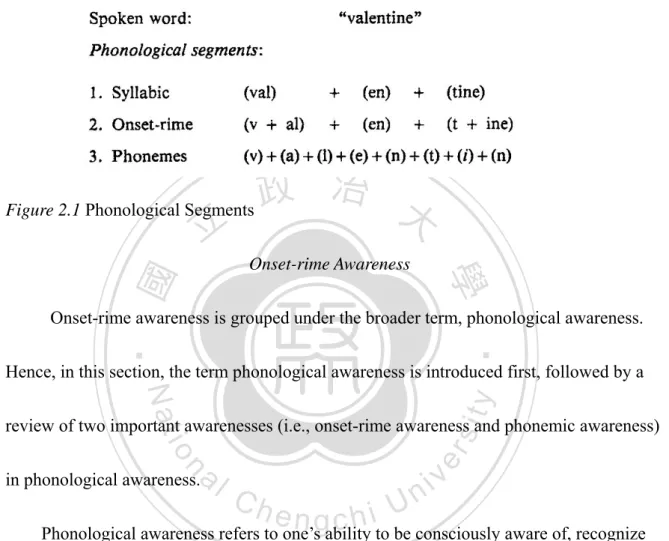
(18) 6. shown that clue words play a crucial role in applying analogy (Bruck & Treiman, 1992; Farrington-Flint & Wood, 2007; Goswami, 1995; Savage, 1997; Wang & Gaffney, 1998; Wood, 2002).. In this present study, clue words are defined as words participants have. been taught in school. All of the clue words were vocabulary in their current or previous textbooks. Rime Analogy. 政 治 大. Rime analogy refers to a reading strategy utilizing a known rime unit to generalize. 立. the pronunciation to a new word sharing the same spelling pattern (Wood, 2002).. For. ‧ 國. 學. example, a new word moat can be pronounced by relating the familiar word boat that has In the present study, the rime analogy approach is adapted from the. ‧. the same rime oat.. Nat. sit. n. al. er. io. 1990).. y. clue word technique developed by Goswami (1986, 1988, cited in Goswami & Bryant,. i n C Organization U h e n g cof hthei Thesis. v. The structure of the present study is as follows. The thesis comprises five chapters. The first chapter describes the motivation, purpose of the study, research questions, and definitions of some key terms of the thesis.. In chapter 2, the effects of rime analogy and. related studies in Taiwan will be reviewed. Chapter 3 elaborates the research design, including the pilot study, the formal study, participants’ selection, instrumental tools of testing and teaching materials, and data analysis. Chapter 4 illustrates the results in.
(19) 7. terms of participants’ decoding abilities, attitudinal changes and perceived difficulties after the training.. Lastly, chapter 5 presents the main findings, followed by pedagogical. implications, limitations, and suggestions for the future studies.. 立. 政 治 大. ‧. ‧ 國. 學. n. er. io. sit. y. Nat. al. Ch. engchi. i n U. v.
(20) CHAPTER 2 LITERATURE REVIEW. In chapter 2, theoretical accounts and related studies about rime analogy are reviewed in four sections. An overview of the relationship between analogy and the natural speech unit, rime, is provided first.. The following two sections continue the. 政 治 大. review of related research on the rime unit and the analogy respectively. Namely,. 立. section 2 discusses onset and rime: onset–rime awareness and its relation with reading. ‧ 國. 學. strategies. Section 3 focuses on rime analogy: clue words in rime analogy, importance. ‧. of rime analogy, and reading levels with rime analogy. The fourth part summarizes. Nat. io. sit. y. related studies in a Taiwanese context and reviews studies on attitudinal changes toward. n. al. er. English or word reading. At the end of this chapter, concluding remarks will outline the need of the present study.. Ch. engchi. i n U. v. The Relation Between Analogy and Rime Many researchers have been interested in knowing what processes beginning readers might undergo to identify words when they learn to read (Brown & Deavers, 1999; Bruck & Treiman, 1992; Ehri & Robins, 1992; Savage, 1997). In one of these studies, Bruck and Treiman (1992) pointed out that there are at least three ways in which children might read a new word.. One is to take contextual guesses.. 8. Another is to read by applying.
(21) 9. grapheme-phoneme correspondence rules, similarly to the phonics approach (Savage, 1997). The last way is to read by analogy. For a given CVC pattern (consonant-vowel-consonant), analogies can be made in three ways: VC (i.e. rime /-ot / in goat-coat), CV (i.e., /go-/ in goat-goes) or V (i.e., /-o-/ in goat-loan).. Among the three,. rime (VC) analogy was found to be more effective than the other two types of analogy (Goswami, 1999).. Thus, the following section focuses on a review of VC (rime) unit. and related concepts.. 立. 政 治 大 Onset and Rime. ‧ 國. 學. Onset and rime are two parts that make up one syllable. A rime is the vowel and. ‧. everything succeeding it, whereas the onset is the consonant, consonant blend, or digraph The importance of onset and rime has been. io. sit. y. Nat. that precedes the rime (Blevins, 1998).. al. er. addressed in studies showing that onset-rime division is easier (Kirtley, Bryant, MacLean. n. v i n Ch & Bradley, 1989) and more distinguishable other units (Trieman, 1985, cited in Ehri e n gthan chi U & Robbins, 1992).. Moreover, it was found that rimes were the basis for reading and. spelling by analogy (Johnston, 1999). Phonologically speaking, onset and rime are larger phonological units, as opposed to the smaller units, which are referred to as phonemes in one syllable. Take the word flat for instance. The onset of flat is fl and the rime is at.. In two-syllable words such as. pancake the onsets are p and c, and the rimes are an and ake. To illustrate further,.
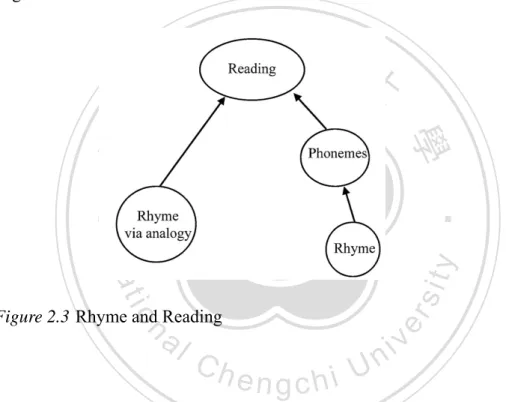
(22) 10. Figure 2.1 provides an example underlying the phonological segments at the syllabic, onset-rime, and phonemes levels (taken from Goswami, 1995).. 治 政 Figure 2.1 Phonological Segments 大 立 ‧ 國. 學. Onset-rime Awareness. Onset-rime awareness is grouped under the broader term, phonological awareness.. ‧. Hence, in this section, the term phonological awareness is introduced first, followed by a. sit. y. Nat. io. n. al. er. review of two important awarenesses (i.e., onset-rime awareness and phonemic awareness) in phonological awareness.. Ch. engchi. i n U. v. Phonological awareness refers to one’s ability to be consciously aware of, recognize or manipulate phonological units (Chard & Dickson, 1999).. According to Walton. (1995), within words, there are at least four sound units related to phonological awareness: syllables, onsets, rimes, and phonemes.. In other words, phonological awareness can. take different forms: syllable awareness, phonemic awareness, and onset-rime awareness. Phonological awareness has been shown to play an important role in reading development (Adams, 1990; Goswami & Bryant, 1990; Muter, Hulme, Snowling, & Taylor, 1997) and.
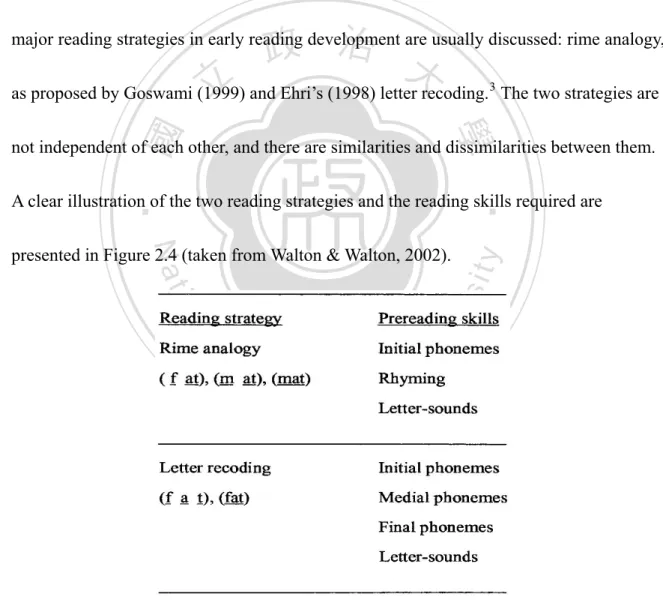
(23) 11. can serve to discriminate good readers from poor readers. Onset-rime awareness is the ability to judge that, in a single syllable, there are two intra-syllabic units: onset and rime (Goswami & Bryant, 1990). cash can be identified as /k/-/$N/, two different segments.. For example, the word. Measures of such awareness. were oddity task (Bradley & Bryant, 1983, cited in Goswami & Bryant, 1990), and rhyme detection (Hulme, Snowling, & Taylor, 1997).. 政 治 大. Phonemic awareness is defined as a reader’s ability to be aware of the smallest. 立. units, phonemes, in spoken words (Chard & Dickson, 1999). For instance, the word. ‧ 國. 學. cash can be identified as /k/-/$/-/N/: three different phonemes.. Phonemic awareness is. ‧. usually assessed by five levels: rhyme, oddity tasks, oral blending, oral segmentation, and. Nat. io. sit. y. phonemic manipulation (Blevins, 1998).. al. er. Taken together, from a developmental perspective, phonological awareness is a. n. v i n C h(Chard & Dickson,U1999). continuum from simple to complex engchi. As illustrated in Figure.. 2.2, the abilities to blend and segment onset-rime units (onset-rime awareness) emerge later in a child’s phonological development.. In comparison, the ability to manipulate. phonemes (phonemic awareness) develops even later and involves the most complex skills..
(24) 12. Figure. 2.2 A Continuum of Complexity of Phonological Awareness (taken from Chard & Dickson, 1999). 立. 政 治 大. ‧ 國. 學. Importance of Onset-rime Awareness. The importance of onset-rime awareness for reading development in English was first. ‧. supported by Bradley and Bryant (1978, 1983, cited in Goswami, 1999), showing. sit. y. Nat. io. n. al. er. onset-rime awareness plays a crucial part in children’s later reading progress in reading.. i n U. v. Especially, a closer examination on onset-rime awareness and analogy in reading was. Ch. engchi. conducted by Goswami & Mead (1992). Their hypothesis was that onset-rime awareness would have a stronger link with analogy than other factors of syllable awareness and phonological awareness.. By conducting on forty-four 6 to 7 year-old. English-speaking children in a series of analogy sessions and phonological sessions, their hypothesis was supported. That is, children’s division of words at onset-rime level was connected to their awareness of rime spelling patterns, hence fostered the development of reading..
(25) 13. Studies also show that onset-rime awareness not only benefited the development of phonemic awareness (Goswami, 1999), but also has direct contribution to reading when associating the same end spelling pattern with new words (i.e., the use of analogy) (Bryant, MacLean, Bradley, & Crossland, 1990; Wood, 2000).. To illustrate, Figure 2.3. (taken from Goswami, 1999) shows the relationship between rhyme, phonemes, and reading.. 立. 政 治 大. ‧. ‧ 國. 學. io. sit. y. Nat. n. al. er. Figure 2.3 Rhyme and Reading. Ch. engchi. i n U. v. As shown in the figure, Goswami (1999) asserted that the awareness of rhyme contributes to reading in two ways: the left route indicates that rhyme awareness could encourage the use of analogy strategy while the right one showed that onset-rime awareness would aid oneself to develop better phonemic awareness. In brief, in either path, rhyme awareness has positive impacts on reading development.. Therefore, the. following offers the review of relationship between onset-rime awareness and reading.
(26) 14. strategies. Onset-rime Awareness and Reading Strategies In the research field of early reading development, plenty of studies have examined the relationship between phonological skills and the use of reading strategies (Christensen & Bowey, 2005; Deavers, Solity, & Kerfoot, 2000; Farrington-Flint & Wood, 2007; Roberts & McDougall, 2003; Walton, Walton, & Felton, 2001).. Among them, two. 政 治 大. major reading strategies in early reading development are usually discussed: rime analogy,. 立. as proposed by Goswami (1999) and Ehri’s (1998) letter recoding. 3 The two strategies are. ‧ 國. 學. not independent of each other, and there are similarities and dissimilarities between them.. ‧. A clear illustration of the two reading strategies and the reading skills required are. Nat. n. al. er. io. sit. y. presented in Figure 2.4 (taken from Walton & Walton, 2002).. Ch. engchi. i n U. v. Figure 2.4 Two Reading Strategies and Prereading Skills. 3. Ehri and Robbins state, “Beginning readers might phonologically recode words by translating letters into sounds and blending the sounds. This is also referred to as decoding words.” (Ehri & Robbins, 1992, p. 13).
(27) 15. The first strategy, rime analogy, involves larger phonological units, onset and rime (e.g., m and at in mat). Children need to know the sounds of onset and rime (i.e., onset-rime awareness), and letter sounds, rhyming skills to read out words. The second strategy, letter recoding strategy, requires children to identify the letter sound of each phoneme (i.e., phonemic awareness).. In Taiwan, phonics sections in the textbooks. usually start with learning the letter name and sound, which corresponds to learning the this strategy is more similar 政 治 Hence, 大. individual phoneme in the letter recoding strategy.. 立. to beginning phonics instruction in Taiwan at the elementary level.. ‧ 國. 學. Comparing the two strategies, the letter recoding strategy seemed to be more. ‧. complicated, because a reader needs to know each phoneme and also to blend and Thus, researchers like Goswami and. io. sit. y. Nat. segment the phonemes to sound out a word.. n. al. er. Bryant (1990) proposed the use of rime analogy to help children in reading.. C h Rime Analogy U n i engchi. v. Reading by rime analogy (RA) refers to a reading strategy generalizing the pronunciation of a known rime to the pronunciation of a new word sharing the same spelling segment (Wood, 2002).. For example, a new word coat can be pronounced by. relating the familiar word goat that has the same rime oat. Clue Words in Rime Analogy As shown in the example, the crucial factor governing the application of analogy.
(28) 16. hinges on relational knowledge, referred to as “clue words”. A series of studies have been developed by Goswami using the “clue word task” on 5-7 year old children in England (Goswami, 1999).. The task was held individually to test whether the child. could use analogies spontaneously. In this task, the child was given two words. was the clue word (e.g., goat) and the other was the test word (e.g., coat).. One. Then, the. child was encouraged to use the clue word to help him or her read the test word. Results. 政 治 大. showed that children benefited from this strategy in reading English words.. 立. In another study of the clue word task, Bruck and Treiman (1992) proposed a more. ‧ 國. 學. detailed one-on-one clue word training and analogy training. Their study aimed to find. ‧. out the relationship of different spelling units (i.e., CV, V and VC in CVC structure) in the The procedure started with clue. io. sit. y. Nat. same analogy training of 39 Canadian first graders.. al. er. word training, immediately followed by analogy training where the child was asked to. n. v i n read aloud the target word (e.g.,C lid) word (e.g., hid) in sight. hwith e ntheg clue chi U. Next, with. the absence of the clue words, the child was given a retention test of the target words and a generalization test of 20 nonwords derived from the clue words. Results demonstrated that the VC group learned faster than the VC and V groups. Importance of Rime Analogy in Reading A body of research supports the use of rime analogy in reading (Bruck & Treiman, 1992; Ehri & Robbins, 1992; Gaskins, Gaskins & Gaskins, 1991; Goswami, 1999;.
(29) 17. Savage, 1997; Walton & Walton, 2002; Wang & Gaffney, 1998).. Particularly, the. importance of rime analogy can be specifically discussed in terms of the big unit: rime. To begin with, the pronunciations of rimes are more stable and predictable compared with the pronunciation rules of small units (Adam, 1990).. In other words, the rules of. rimes are simpler and clearer to learn (Chang &Wu, 2008; Su, 2004).. For instance, all. of the 90 words that end with ight have the same pronunciation of /A0t/ (Goswami, 2005).. 政 治 大. Moreover, rime in RA has utility and generality in learning words: RA is applicable to. 立. many words of common rime spelling patterns (e.g., goat-coat, boat, moat) and a large. ‧ 國. 學. number of words can be generated from a relatively small number of rimes (Adams, It was also noted that by using rime analogy, readers only need to replace the. ‧. 1990).. Nat. sit. Further, readers may avoid converting every letter to its sound. er. io. (Wang & Gaffney, 1998).. y. onset of the new words to read words out, which will not take the reader a lot of effort. al. n. v i n Ch (i.e., grapheme-phoneme correspondence), sometimes involves a lot of effort (Ehri, e n gwhich chi U 1991, Frith, 1985; cited in Ma, 2007). Rime Analogy and Reading Levels Another aspect that intrigued researchers in the field of reading development is the appropriate reading level a reader must have to be capable of drawing analogies. Different viewpoints on the availability of rime analogy are presented as follows. Some researchers, like Ehri & Robbins (1992), assert that some decoding skills (e.g.,.
(30) 18. letter name and letter sound knowledge) are pre-requisite for making analogies. In their study, they hypothesize that knowledge of sound-symbol association would help link the connection between the familiar print word and the sound of the word in memory.. After. a series of procedures (i.e., pre-tests, a word training task, transfer task, and spelling task) were administered to English-speaking kindergartners and the first graders, the results indicated that beginners could read by analogy, but they were also required to have some phonological decoding abilities.. 立. 政 治 大. Others (Walton, 1995; Goswami, 1990) claimed that children, aged around 5-7,. ‧ 國. 學. could make analogies when analogous clue words were offered.. Walton (1995). ‧. conducted an experiment on 66 English-speaking prereaders (averagely aged 5 years 8 After two to four 5-minute. io. sit. y. Nat. months) to see if young readers could read by analogy.. al. er. training sessions for two days, statistical evidence showed that children were ready to. n. v i n Cfact read by analogy, regardless of the they were only at a prereading stage. h ethat ng chi U. Still others (Bowey & Hansen, 1994; Bowey & Underwood, 1996; Coltheart & Leahy, 1992) highlighted their findings on the relation of vocabulary size to analogy making.. In one of these studies, Bowey and Underwood (1996) investigated the effects. of orthographic rime usage in nonword reading with different levels by conducting Experiment 1 on second to fourth graders and Experiment 2 on second graders in Brisbane, Australia.. They concluded that one’s ability to make analogy depends on.
(31) 19. one’s vocabulary size. To summarize the availability of rime analogy with different reading levels, some researchers support that children, aged 5-7, can utilize analogy and some found that rime analogy making was related to one’s vocabulary size. Therefore, it is worthwhile to explore if participants in the present study, aged around 12, could benefit from rime analogy.. 政 治 大. Related Studies in a Taiwanese EFL Context. 立. analogy training from different angles.. 學. ‧ 國. In Taiwan, various studies have been conducted to explore the effects of rime For example, some studies examined the. ‧. appropriate units (i.e., CV, V, or VC) and reading levels in RA for EFL children. Others conducted. io. sit. y. Nat. studies investigated the effects of RA in remedial programs.. Some. al. er. experiments to see if the design of the training was effective in promoting Taiwanese. n. v i n students’ word reading skills or C attitudes. h e n gIncthehfirst i Upart of this section, several related studies are revealed, coupled with their findings or suggestions. In the second part of this section, studies that looked into the relationship of analogy and attitudinal changes are presented. Su (2004) investigated the effects of onset-rime based phonics instruction on phonemic awareness and oral reading in an elementary school. Participants consisted of four classes of fourth graders as the experimental group and two classes of fourth graders.
(32) 20. as the control group.. The experimental group was taught by onset-rime based phonics. instruction with phonemic awareness activities, while the control group was only taught with phonics in their textbooks.. After a series of two 15-20 mini-lessons a week, for 17. weeks, phonemic awareness post-tests and oral reading post-tests revealed that onset-rime based phonics instruction was more effective. Lee (2004) conducted a study of onset and rime phonics instruction on EFL. 治 were defined as second graders 政EFL beginners 大. beginners’ oral reading and spelling.. 立. who had just begun learning English for the first year of study.. There was an. ‧ 國. 學. experimental group and a control group, each made up of two classes.. The control. ‧. group received phoneme-based instruction. In the experimental group, participants were. Nat. sit. io. The result showed that the experimental group did not outperform the. al. v i n C hshe pointed out that Due to this finding, e n g c h i U EFL beginning readers need a n. control group.. er. like h-it, s-it).. y. taught with onset-rime based instruction (e.g., blending the rimes with different onsets. bigger word bank to utilize onset-rime analogy. Ma (2007) reinvestigated the effects of different types of analogy based on Bruck and Treiman’s (1992) experiment and looked into whether different reading levels affected their word reading performance. Ninety-four fourth grade EFL learners, aged around 10, were divided into three groups (i.e., CV, V and VC groups) and were further matched for high and low reading levels in each group.. All of the participants received.
(33) 21. the same training procedure: clue word training, analogy training, a retention test, and a generalization test, but the target words used for analogy training were different in the three groups.. The training and testing were conducted one-on-one.. experiment took around a month to finish.. The whole. The results showed that the three groups had. similar performance in the generalization test. Furthermore, no significant effect was found in different reading levels.. From these results, she suggested that students’. 政 治 大. rhyming skills could be enhanced by adding more tasks or activities such as nursery. 立. than English-speaking children.. 學. ‧ 國. rhyme teaching, because EFL children seemed to exhibit weaker onset-rime awareness. ‧. In another study, Kuo (2007) designed an orthographic analogy program to examine. Nat. io. sit. y. the effects of the program for seventh grade underachievers on English word recognition.. al. er. A total of 26 students from a junior high school in Taiwan were equally divided into an. n. v i n Cgroup. experimental group and a control experimental group, 22 sets of h e n Ing the chi U. phonograms (i.e., word families such as cat, hat, and fat) were taught in the 40-minute period for 15 times while in the control group, those words were taught with phonics rules (i.e., letter sound and name, correspondence and the rule of silent “e”). Results indicated that the experimental group outperformed the control group. Rime Analogy and Attitudes In addition to the above studies that focused on the effects of onset-rime based.
(34) 22. instruction or analogy training in word reading, there were a number of Taiwanese studies focused on word recognition training and attitudes toward learning English, and more specifically, studies on attitudinal change towards word reading. Chen (2003) examined the effects of phonological decoding training on English word recognition skills and confidence for 22 fifth graders in Taiwan.. Those students. were assigned equally to an experimental group and a control group. The former group. 政 治 大. received a 15-20 minute training in phonemes, blending, and segmentation twice a week,. 立. The results found that this group outperformed the control group, which. 學. ‧ 國. for 8 weeks.. received only vocabulary and conversation instruction with no phonics. The. ‧. experimental group’s confidence on word recognition, measured by a questionnaire based. Nat. sit er. io. instruction.. y. on the Reader Self-Perception Scale (Henk & Melnick, 1995), was also higher after the. al. n. v i n Ch Hsu (2003) examined the effectiveness i U instructions for 25 sessions e n gofc3hdifferent. (two 15-minute sessions a week).. The study aimed to improve fifth graders’ English. learning attitudes, and foster their abilities in phonemic awareness, word recognition, and spelling.. There were 3 groups that separately received the instruction in phonics, K. K.. phonetic symbols, and instructions combining the two.. In Hsu’s study, the interview. was designed to further understand participants’ thoughts and perceived difficulties that were not revealed from the questionnaire.. All the test and questionnaire results showed.
(35) 23. no significant difference among the three groups.. However, some interviewees reflected. that the teacher taught too fast and that it was too confusing, which was interpreted by Hsu as a result of whole class teaching. Hsu suggested extending the training duration and reviewing the teaching materials with students more frequently. Chen (2004) conducted action research on 10 second-grade junior high school underachievers to look into their decoding performance and attitudinal changes towards. 治 plan involved instruction in 政The remedial 大. learning English and English words.. 立. onset-rime analogy and phonemic awareness. The results revealed that onset-rime. ‧ 國. 學. analogy not only enhanced participants’ decoding skills, but also positively promoted. ‧. participants’ motivation, confidence, and fondness for learning English.. Nat. io. sit. y. Chang and Wu (2008) investigated the effect of an analogy-based phonics approach. al. v i n There were two classesCofhsixth graders participating e n g c h i U in the study. n. weeks.. er. on participants’ decoding abilities and their attitudes towards the phonics approach, for 10 One was the. experimental group (i.e., analogy-based phonics group) taught by the researcher with the help of clue words and a word wall. The other group (i.e., the phonics group) was the control group, taught by the participants’ English teacher. The results of the questionnaire and interview were positive, but the study only focused on the experimental group’s attitudinal changes. To sum up the studies reviewed in this chapter, although there is a considerable.
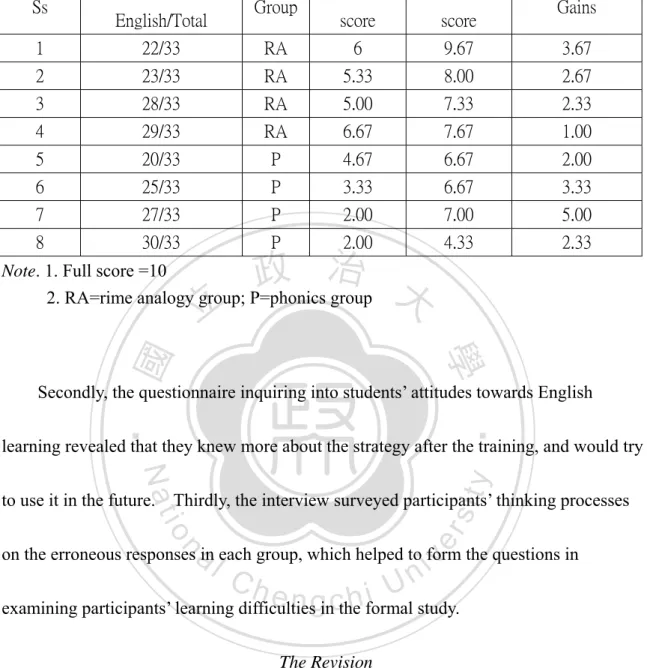
(36) 24. amount of research investigating English-speaking children’s use of RA in word reading, comparatively little research has been done to examine if RA is still effective for students’ decoding abilities in an EFL context, and the attitudinal changes of students toward word reading.. Based on the previous research, some insights and directions for improvement. are as follows. Firstly, although a number of related studies on RA obtained participants’ responses. 政 治 大. one-on-one and immediately, no long term effects of RA were confirmed (Bruck &. 立. Treiman, 1992; Deavers & Kerfoot, 2000; Ma, 2007).. ‧ 國. 學. Secondly, the findings based on individual training may not apply to whole-class That is, the effects of RA training on a whole class remain to be tested.. ‧. training.. Nat. n. al. Therefore, caution should be taken in. designing whole-class training.. Ch. engchi. er. io. been a challenge for school teachers (Wu, 2007).. sit. y. Especially in a Taiwanese context, mixed levels of student ability in one class have long. i n U. v. In the meantime, it is equally important to know individuals’ perceived difficulties. However, the previous studies did not focus on comparing rime analogy training with phonics training to provide the whole picture of the role of RA, especially in the Taiwanese context, where phonics instruction is the decoding strategy officially proposed by MOE.. To fill the gap, the present study obtains a more comprehensive perspective. by obtaining information not only from the participants receiving analogy training but.
(37) 25. also from participants receiving phonics training. Thirdly, studies on native English-speaking children aged 5-7 were reported to have benefited from rime analogy.. In comparison, second and fourth graders, aged 8-10, in. Lee’s (2004) and Ma’s (2007) studies, were indicated as too young to make rime analogy. Sixth graders 4 might be a more appropriate grade level in a Taiwanese context for analogy training.. 政 治 大. In conclusion, it is worthwhile to explore whether studies of native English readers. 立. and suggestions from related studies in Taiwan.. 學. ‧ 國. can be generalized to readers in a Taiwanese context, with consideration to the findings Consequently, the present study was. ‧. designed to evaluate the effects of a 10-week rime analogy training in English word. sit. n. al. er. io. 4. y. Nat. reading for EFL 6th graders in Taiwan.. Ch. engchi. i n U. v. Note that although Chang and Wu (2008) have also experimented on analogy-based phonics approach for Taiwanese sixth graders, their experimental design (e.g., instruments and training procedure) was different from the present study..
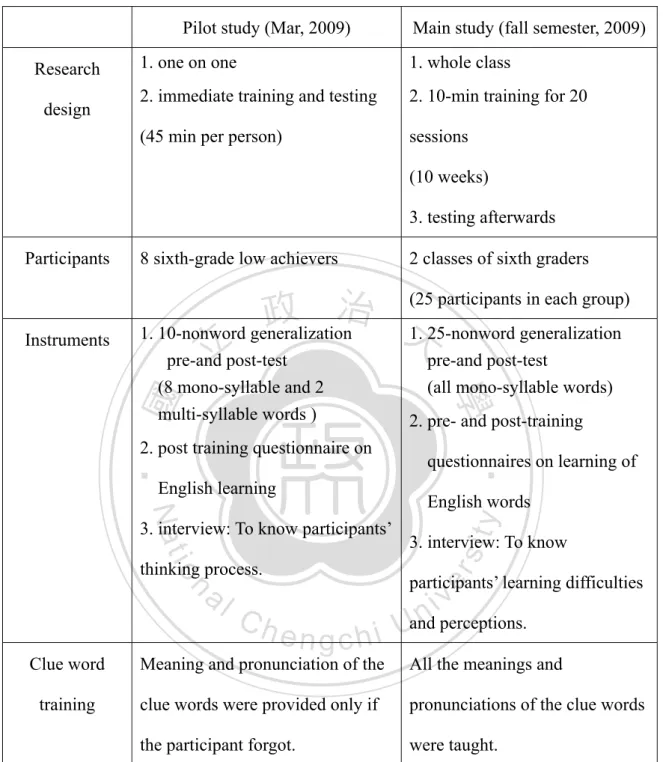
(38) CHAPTER 3 METHODOLOGY. This chapter presents the methodology adopted in treating the research questions. Four sections are included.. Section 1 illustrates the research design, inclusive of the. pilot study and the formal study.. Then, section 2 characterizes the participants and. sampling techniques.. 政 治 大. Section 3 describes the instruments of testing and teaching. 立. 學. ‧ 國. materials respectively and the final section outlines the methods of data analysis. Research Design. ‧. The present study comprised 2 phases: a small-scale pilot study held in March in. Nat. sit. io. These are discussed in the following sections.. n. al. er. semester of 2009.. y. 2009 to test the feasibility of the training, and a formal study carried out during the fall. C h The Pilot Study U n i engchi. v. The pilot study served two purposes. The first purpose was to test the feasibility of rime analogy training for sixth graders.. During the process, the testing materials,. instruments, and activities of the training were examined and adjusted, based on the test results and participants’ responses. Secondly, the researcher attempted to evaluate the effects of the training on the English word reading ability of the students and the effects on their learning attitudes.. 26.
(39) 27. In March 2009, eight sixth graders from an elementary school in Tao Yuan County were selected, based on their past English examination scores and their class rank. 5. The. 8 participants were further assigned to a rime analogy group and a phonics group by their class rank (see Table 3.1). The pilot study was conducted individually and lasted about 45 minutes on each participant.. The procedure began with a 10-nonword test. (generalization test) as the pre-test. The 10 nonwords consisted of 8 mono-syllablic. 政 治 大. words and 2 multi-syllablic words. Then, the participants received an approximately. 立. 15-minute training 6 , which was based on Bruck & Treiman’s (1992) and Ma’s (2007). ‧ 國. 學. experimental work.. After the training, the same 10-nonword test was given as a. ‧. post-test, followed by an interview to probe their thinking process on the erroneous. Nat. al. The preliminary results were as follows.. er. io. questionnaire about English learning.. sit. y. responses in the nonword test. Finally, both groups were asked to fill out a. n. v i n C 8hparticipants in theUpilot study, the data collected from Firstly, since there were only engchi. the generalization pre- and post-test was analyzed descriptively. Improvements after the training were shown but were not distinctive between the rime analogy group and the phonics group. 5. The pilot study primarily looked into the effects of rime analogy on underachievers. According to the Hand in Hand project of the MOE, criteria for students in a remedial program are the lowest-ranked 35% in rural schools. Since the participants were from one rural school in Tao Yuan County, the researcher thus selected participants below 33%. 6 Both groups received clue word training and a training-transfer task. In the formal training, the meaning and sounds of the clue words were offered only if the participants forgot. In the latter task, the procedure was similar to the one in the formal study (see step 2 in the presentation and practice part of Appendix H-1and H-2), except that both groups in the pilot were only taught with one practice word for each clue word trained..
(40) 28. Table 3.1 Descriptive Statistics on the Generalization Pre-and Post-test. Ss. Class rank in English/Total. Group. Pre-test score. Post-test. 1. 22/33. RA. 6. 9.67. 3.67. 2. 23/33. RA. 5.33. 8.00. 2.67. 3. 28/33. RA. 5.00. 7.33. 2.33. 4. 29/33. RA. 6.67. 7.67. 1.00. 5. 20/33. P. 4.67. 6.67. 2.00. 6. 25/33. P. 3.33. 6.67. 3.33. 7. 27/33. P. 2.00. 7.00. 5.00. 8. 30/33. P. 2.00. 4.33. 2.33. score. 政 治 大. Gains. Note. 1. Full score =10 2. RA=rime analogy group; P=phonics group. 立. ‧ 國. 學. Secondly, the questionnaire inquiring into students’ attitudes towards English. ‧. learning revealed that they knew more about the strategy after the training, and would try. y. Nat. al. er. io. sit. to use it in the future. Thirdly, the interview surveyed participants’ thinking processes. v. n. on the erroneous responses in each group, which helped to form the questions in. Ch. engchi. i n U. examining participants’ learning difficulties in the formal study. The Revision Although the test results and participants’ responses were positive, the pilot study still left some room for improvement. To begin with, the participants in the pilot study demonstrated that they could apply the strategy during the training.. However, whether. children could still utilize the strategy after the training remained to be tested. 7. 7. One. I’m grateful to Dr. Sheu, P. H. for pointing out the importance of looking into long term effects, rather.
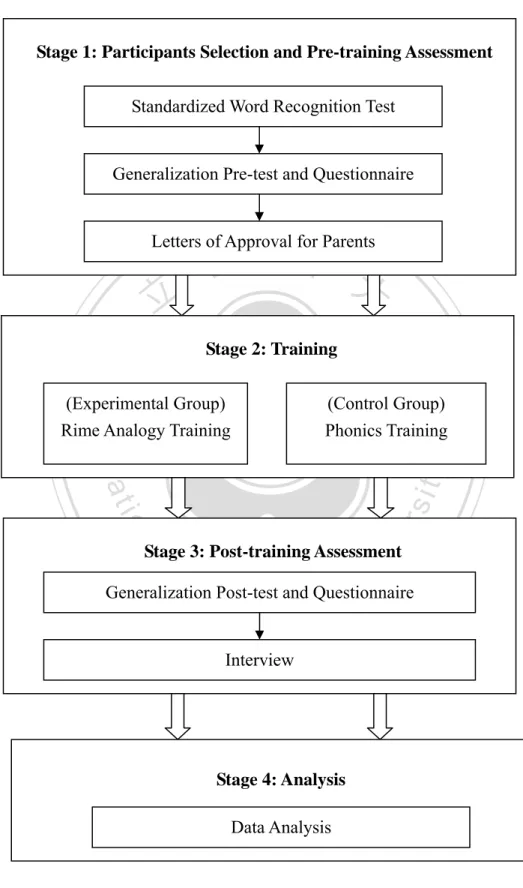
(41) 29. study reported that most studies so far revealed only short term effects, and it was possible that children might not benefit from this strategy in the long term (Deavers & Kerfoot, 2000).. As a result, the researcher prolonged the training span from 45 minutes. to a 10-minute training for 20 sessions over a total of 10 weeks.. Accordingly, more. practice with different clue words was added, from the original 10 clue words to 20 clue words.. Additionally, since it was hoped that the whole class could also benefit from the. 政 治 大. training in the long term, the researcher expanded the size of participants from the lower. 立. 33% to a whole class.. ‧ 國. 學. In terms of the instrument, since the training time in the pilot was short, and since. ‧. most participants had difficulty with reading out the multi-syllabic words in the. Nat. io. sit. y. generalization test, only monosyllabic words were adopted in the formal study. For the. n. al. to be too broad and general. learning of English words.. er. questionnaire part, the original focus of the questionnaire on English learning was found. v i n Cahconsequence, the formal As e n g c h i U study focused only on the. In the interview part, besides investigating participants’. thinking process, the interview in the formal study also looked into participants’ learning difficulties and perceptions. 8 In view of the training design, since the training in the pilot was administered. than short-term effects as in the 45-minute training and testing of the pilot study. 8 The researcher would like to thank one proposal reviewer for the suggestion of looking into participants’ thinking processes and perceptions to raise the significance of the present study..
(42) 30. individually, the meaning and pronunciation of the clue words were provided 9 by the researcher if the participants forgot. But in the formal study, all the meanings and pronunciations of the clue words were refreshed by showing the whole class the source of the clue words from the textbooks. The complete modifications of the research design are illustrated in Table 3.2.. 立. 政 治 大. ‧. ‧ 國. 學. n. er. io. sit. y. Nat. al. 9. Ch. engchi. i n U. v. All of the participants’ clue word memories were efficiently brought back by providing them with the clue words from the textbooks in their previous or current grades. A few of them could even be refreshed with the clue words at the sight of the cover of the textbooks. Moreover, after the pilot, the researcher informally tested all the 8 participants on the clue words and found that they could still remember some of the sounds or meanings of the clue words within two weeks. Therefore, the clue word training method, with the aid of showing students their source, was maintained in the formal study. The researcher learned this effective training from a pre-pilot, held in February, 2009. The procedure of the pre-pilot was similar to the pilot, but the clue word training and test word design were improved after the pre-pilot..
(43) 31. Table 3.2 Modifications of the Research Design Pilot study (Mar, 2009) Research design. Main study (fall semester, 2009). 1. one on one. 1. whole class. 2. immediate training and testing. 2. 10-min training for 20. (45 min per person). sessions (10 weeks) 3. testing afterwards 2 classes of sixth graders. 治 (25 participants in each group) 政 大 1. 10-nonword generalization 1. 25-nonword generalization 立post-test pre-and pre-and post-test ‧ 國. English learning. Nat. 3. interview: To know. er. io. thinking process.. participants’ learning difficulties. n. Ch. questionnaires on learning of English words. 3. interview: To know participants’. al. 2. pre- and post-training. ‧. 2. post training questionnaire on. (all mono-syllable words). 學. (8 mono-syllable and 2 multi-syllable words ). y. Instruments. 8 sixth-grade low achievers. sit. Participants. engchi. iv n Uand perceptions.. Clue word. Meaning and pronunciation of the. All the meanings and. training. clue words were provided only if. pronunciations of the clue words. the participant forgot.. were taught..
(44) 32. The Formal Study The procedure of the formal study was divided into four stages—participants selection and pre-training assessment; training; assessing participants’ decoding skills, attitudinal changes and perceived difficulties; data analysis. The participants were two sixth grade classes from a public elementary school in Tao Yuan County.. At first,. participants were administered a standardized English word recognition test (p. 36) and. 政 治 大. their scores were computed by independent-samples t-test to make sure the two group. 立. were homogeneous in overall English proficiency level.. To further ensure the two. ‧ 國. 學. groups were at the same level in decoding abilities before training, a nonword reading test. ‧. was administered (i.e., generalization pre-test, p.37, see also Appendix A), and an. Nat. io. sit. y. independent-samples t-test was executed to check homogeneity of the two groups. After. al. v i n Casked Then, both groups were questionnaires (p.39, see also h e nto gfillcouth the i U n. groups.. er. this process, the two classes were randomly assigned into the control or the experimental. Appendix B).. Letter of approval for parents were given at the end of this stage. (Appendix C).. In the second stage, 10 weeks of training was conducted for both groups:. the experimental group receiving rime analogy training while the control group receiving phonics training.. In the third stage, after the completion of the training, the. generalization post-test and questionnaire were implemented again for both groups, followed by interviews for some participants in both groups. Finally, data from the.
(45) 33. generalization test, the questionnaire and interviews were analyzed. The procedure is presented in Figure 3.1.. Stage 1: Participants Selection and Pre-training Assessment Standardized Word Recognition Test. Generalization Pre-test and Questionnaire. Letters of Approval for Parents. 學. ‧ 國. 立. 政 治 大. Stage 2: Training. (Control Group) Phonics Training. ‧. (Experimental Group) Rime Analogy Training. n. er. io. sit. y. Nat. al. i n U. v. Stage 3: Post-training Assessment. Ch. engchi. Generalization Post-test and Questionnaire. Interview. Stage 4: Analysis Data Analysis. Figure 3.1 The Procedure for Conducting the Formal Study.
(46) 34. Participants Participants in the main study were two 10 classes, each composed of approximately thirty sixth graders, aged around 12, in a public elementary school in Tao Yuan County. They had taken formal English classes once a week from the second grade to the fourth grade, and twice a week in fifth grade. The rules of digraphs, long vowels and consonant blends had not been formally introduced in the phonics section of their. 政 治 大. textbooks by the end of the fifth grade.. 立. To ensure the two classes were of the same overall English proficiency level, a. ‧ 國. 學. standardized English word recognition test 11 was administered one on one by the. Nat. y. The test scores of the two classes are listed in Appendixes D-1 and D-2.. The. io. sit. study. 12. ‧. researcher and two other English teachers of the participants’ school before the formal. n. al. er. statistical results summarized in Table 3.3 indicate that the proficiency levels of the two. i n C classes could be considered similarh(t = 0.094, p > .05). engchi U. 10. v. The researcher only taught three classes of sixth graders. Based on the three classes’ past overall English performances (i.e., listening, reading, and writing abilities) in school, two similar classes were selected as participants. 11 Although the test mainly assesses examinee’s reading and speaking skills, to assess their overall proficiency level, other language skills were checked earlier by their overall English performances in school (see the previous footnote). 12 To make sure there was no learning effect during the screening process, the process was completed within two weeks. I’m indebted to Wu, Y. C. (2007) for calling to my attention that administering the test after school might raise a safety problem. Considering the feasibility of conducting the test at school, the researcher asked two colleagues (English teachers) for assistance to speed up the process. I’m grateful for their generous help..
(47) 35. Table 3.3 Results of the Standardized English Word Recognition Test Between Groups Group. Mean. SD. t. p. Class A (N=29). 47.10. 55.56. 0.094. 0.925. Class B (N=30). 45.87. 45.10. Note. Total scores =200. Next, the two classes were given the one-on-one generalization pre-test. To avoid ceiling or flooring effects, 4 students from class A and 5 students from class B were excluded from the study based on their generalization pre-test scores.. Moreover, 治 政 大 statistical results revealed the two classes were at the same level of decoding abilities (t = 立. ‧ 國. 學. -0.273, p > .05) (see Table 3.4).. ‧ y. SD. 29.16. 23.45. a30.92 l C h. n. Control. io. Experimental. Mean. Note. Total score =75. 22.03. sit. Group (N =25/group). t. p. -0.273. 0.786. er. Nat. Table 3.4 Results of the Generalization Pre-test Between Groups. n U engchi. iv. Finally, the two groups were randomly assigned to an experimental (RA) group and a control (phonics) group. distributed (see Table 3.5).. The numbers of males and females are basically equally.
數據
+7


Outline
相關文件
Therefore, the purpose of this study is to propose a model, named as the Interhub Heterogeneous Fleet Routing Problem (IHFRP), to deal with the route design
Abstract - The main purpose of this study is applying TRIZ theory to construct the Green Supply Chain management (GSCM) strategies for the international tourist hotel.. Based on
The purpose of this study was to investigate if providing consumers with a general dietary guidance or impose a cash punishment policy on customers for not finishing their food on
Based on the above concept, the purpose of this study was to explore the local residents’ perceptions and attitudes towards tourism development, whom have little or no
Based on a sample of 98 sixth-grade students from a primary school in Changhua County, this study applies the K-means cluster analysis to explore the index factors of the
The purpose of this study is to analyze the status of the emerging fraudulent crime and to conduct a survey research through empirical questionnaires, based on
The purpose of this study was to explore the effects of learning organization culture on teachers’ study and teaching potency in Public Elementary Schools.. The research tool of
This study not only investigated the difference of the character-belief of the sixth graders between the experimental group and the control group but also
