行政院國家科學委員會專題研究計畫 成果報告
台灣附近地區紅色精靈特性與分佈之研究
計畫類別: 個別型計畫 計畫編號: NSC91-2111-M-006-002- 執行期間: 91 年 08 月 01 日至 92 年 10 月 31 日 執行單位: 國立成功大學物理學系(所) 計畫主持人: 蘇漢宗 計畫參與人員: 許瑞榮、陳炳志、王雲慶、陳人豪、陳若心 報告類型: 精簡報告 報告附件: 出席國際會議研究心得報告及發表論文 處理方式: 本計畫可公開查詢中 華 民 國 93 年 2 月 6 日
行政院國家科學委員會補助專題研究計畫成果報告
台灣附近地區紅色精靈特性與分佈之研究
The characteristics and distribution of sprites around Taiwan
計畫類別:個別型計畫
計畫編號:NSC
91-2111-M-006-002
執行期間:91 年 08 月 01 日至 92 年 10 月 31 日
計畫主持人:蘇漢宗
共同主持人:許瑞榮
計畫參與人員: 王雲慶、陳炳志、陳若心、陳人豪
成果報告類型(依經費核定清單規定繳交):■精簡報告 □完整報告
本成果報告包括以下應繳交之附件:
□赴國外出差或研習心得報告一份
□赴大陸地區出差或研習心得報告一份
■出席國際學術會議心得報告及發表之論文各一份
□國際合作研究計畫國外研究報告書一份
處理方式:除產學合作研究計畫、提升產業技術及人才培育研究計畫、
列管計畫及下列情形者外,得立即公開查詢
□涉及專利或其他智慧財產權,□一年□二年後可公開查詢
執行單位:
成功大學物理學系
中 華 民 國 93 年 1 月 26 日
中文摘要: 據 Su et al [2002]和 Hsu et al [2003] 兩篇文章,海洋型紅色精靈通常是單根出現,這和大陸 型紅色精靈的特性有很大的差異。在本計畫中,工作目標之一是進一步細究海洋型紅精靈 的特性。2003 年的觀測數據顯示,前面所發現海洋/陸地特性的差異性得到了更進一步的證 實。此外,從三色低光度相機影像,我們合成出高解析的彩色紅色精靈影像。而從紅色及 藍色波段影像,我們也描繪出海洋型紅色精靈內部的電子能量分佈,並比較了不同事件之 間的差異。取背景恆星為標準高度尺標,我們更定出海洋型紅色精靈的高度超過 5 MR。變 化低光度相機的增益,海洋型紅色精靈內部的亮度分佈也得以繪出。 關鍵詞:紅色精靈、短暫發光事件、短暫發光現象,大氣電學、地面觀測 Abstract:
As reported in Su et al [2002] and Hsu et al [2003], ocean sprites tend to appear in single column, which is in sharp contrast to the clustering land sprites. In the 2003 Taiwan transient luminous events (TLEs) campaign, one of the scientific goals was to study ocean sprites in detail. The recorded images confirmed the ocean/land morphological disparity as reported before. Three ICCD cameras deployed in this campaign were equipped with R, G, B filters to obtain high spatial resolution and tri-color optical images. From the red/blue band images, spatial electron energy distributions of ocean sprites are deduced. We have also compared energy distribution in various types of ocean sprites. Using background stars as standard luminous gauges, optical brightness of some ocean sprites was estimated to exceed 5 MR. With unfiltered ICCD images obtained at different gain level, spatial brightness distribution of ocean sprites could also be mapped.
Keywords: sprites, transient luminous events, transient luminous phenomena, TLEs, atmospheric electricity, ground observation of TLEs
Introduction
Most of ground campaigns on upper atmospheric TLEs are carried out in the US High Plain. Ocean TLEs are rarely studied. Morphological difference between ocean and land sprites was first demonstrated in 2001, with ocean sprites tending to occur in single column whereas land sprites often appearing in cluster. In the summer of 2003, we performed further study of ocean TLEs near Taiwan, with aims to confirm previous findings and to explore new characteristics of ocean events. Using a multiple ICCD cameras system, we obtained filtered and unfiltered images of TLEs. From the recorded data, morphological evolution, true color images, spatial electron energy distribution, and brightness of sprites were obtained.
Instrumentations and observation site
NTSC ICCD cameras: five of them, all lab-calibrated and 20 mm or 50 mm lens equipped ICCDs.
WATEC N100 ICCDs: three of them are R, G, B filtered and two of them were unfiltered but with different gain-setting.
Lens : Sigma 20mm/f1.8 (FOV~18.5 H x 13.8 V degrees) or Nikon 50mm/f1.4 ( FOV ~7.4 H x 5.7 V degrees).
Recorder :SONY DCR-PC5 DV recorder Filters : lab-calibrated R, G, B KENKO filters
All the events report here were recorded at Kenting in the summer of 2003.
Results
Statistics of 2003 Taiwan TLEs Campaign
Occurrence probability of sprites =(58.5%+7.8%+0.5%)=65.7%.
Occurrence probability of elves = (25.4%+5.2%+0.5%)=31.1%. Higher than that was observed in America,(13% in 97’and >3% in 98’& 99’- Armstrong, 2000), but less than the ratio was observed in Japan winter campaigns (Takahashi et. al., 2003).
Occurrence probability of sprite halo =(7.8%+2.6%+5.2%+0.5%)=16.1%. Less than that was observed in America, (Miyasato, et. al., 2002).
Contrasty of ocean/land TLEs
By the location of their parent thunderstorms, TLEs are categorized into ocean, ocean/land (from storms that straddled ocean and land) and land events.
Ocean and land sprites
Ocean sprites-- single column/clusters = 40/26 ~ 1.5 Ocean/land sprites -- single column/clusters = 26/32 ~ 0.8
Land sprites -- single column/clusters = 1/4 =0.25 (insufficient samples) Ocean and land elves
The average occurrence probability of elves for convective ocean systems, 54/123=43.9%, is about five times that of the ocean/land systems (6/65=9.2%).
Ocean and land sprite halo
The average occurrence probability of sprite halo in convective ocean system is 24/123=19.5%, which is much higher than that of the ocean/land systems (5/65=7.7%).
Reconstruction of true color images
combination ICCD R/G/B filtered images. Samples of true color images of sprites are showed at right. Please note that tendrils of sprites are red in these images owing to blue emission are preferably extinguished by atmosphere.
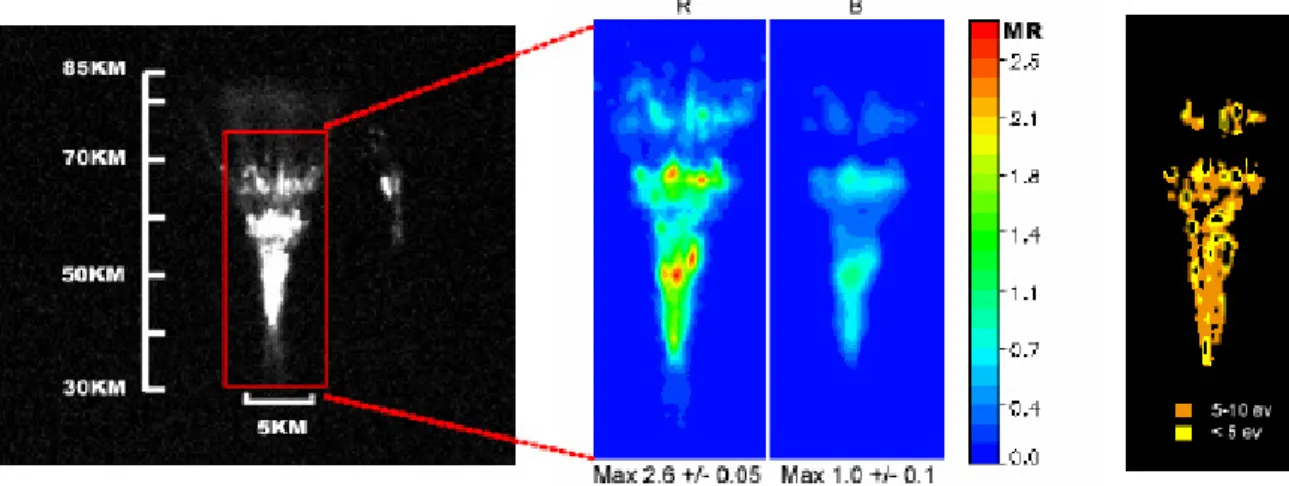
Spatial electron energy distribution in sprites
Following a method reported by Miyasato et al. [ JASTP 65(4), 573, 2003 ], the intensity ratio of blue to red emission in sprites can be estimated theoretically as a function of electron energy basing on the following assumptions and procedure:
•Emission is due to electron collisions with the nitrogen molecul es.
•Visible emission comes from N2 first positive band system, N2 second positive band system, N2+ first negative band system, and N2 + Menial band system.
•Electron kinematic energy obeys Maxwell-Boltzmann distribution. • Effect of atmosphere scatter is corrected using MODTRAN model.
Figure caption: Electron energy distribution in a ocean sprite.
Summary
Our results confirmed the morphological disparity on the occurrence probability of single column and clustering sprites in ocean systems. For ocean thunderstorms, the single column sprites outnumber the clustering sprites by a 3 to 2 ratio. However, for
thunderstorms located over land/ocean boundary or over land, the ratio rapidly dropped below one. Color images of sprites were constructed from the red/blue ICCD data. The color of sprites was predominately red viewing from ground due to atmospheric
extinguishing of blue emission. The spatial energy distribution of sprites was successfully mapped. Finally, the brightness of some ocean sprites is estimated to exceed 5 MR by using the star in field as calibration sources.
成果自評
本年度的計畫成功地達成並超越計畫書中設定的目標。我們的成果在高空短暫發光和大氣 電學研究領域裡,相當地獨特。因為位在台灣的成大團隊,是世界上唯一可以同時探索海 上型及陸地型紅色精靈及其他高空短暫發光現象的研究群。本計畫的部份內容已發表成一 篇期刊論文 [Hsu et at., 2003],而在2003年AGU秋季大會,我們更發表經仔細分析後的完 整成果 [Kuo et al, 2003],這部份的成果將集結成一篇JGR論文。
參考文獻
Su et al., GRL, 29(4), doi 10.1029/2001GL013737, 2002. Hsu et al., JASTP, 65(4), p561-564, 2003.
Takahashi et al., JASTP, 65(4), p.551, 2003. Miyasato, et al., GRL, 29, 2033, 2002.
Miyasato et al., JASTP 65(4), 573, 2003.