• 沒有找到結果。

Structurally characterized arabinogalactan from Anoectochilus formosanus as an immuno-modulator against CT26 colon cancer in BALB/c mice

N/A
N/A
Protected

Academic year: 2021

Share "Structurally characterized arabinogalactan from Anoectochilus formosanus as an immuno-modulator against CT26 colon cancer in BALB/c mice"

Copied!
28
0
0

加載中.... (立即查看全文)

全文

(1)

Structurally xharacterized arabinogalactan from Anoectochilus formosanus as an immune-modulator against CT26 colon cancer in BALB/c mice

Li-Chan Yang

a

, Chang-Chi Hsieh

b

, Ting-Jang Lu

a

, Wen-Chuan Lin

c,

*

a

Institute of Food Science and Technology, National Taiwan University, Taipei, Taiwan.

b

Department of Animal Science and Biotechnology, Tunghai University, Taichung, Taiwan

c

School of Medicine, Graduate Institute of Basic Medical Science, China Medical University, Taichung, Taiwan

*Corresponding author: School of Medicine, China Medical University, No. 91 Hsueh

Shih Road, Taichung, Taiwan, R.O.C. Tel +886 4 22053366; fax +886 4 22053764

e-mail address: [email protected] (W.C. Lin)

(2)

Summary

BACKGROUND AND PURPOSE

Anoectochilus formosanus, a well-known medicinal orchid, has been used for cancer treatment in Asia for a long time, but the mechanism remains unclear. In this study, the innate immuno-modulatory effects and anti-cancer action of arabinogalactan (AG), a derivative of A. formosanus, were investigated.

EXPERIMENTAL APPROACH

The innate immuno-modulatory effects of AG were determined in vitro using RAW 264.7 cells for microarray analysis, and in vivo using BALB/c mice administrated with AG at 5 and 15 mg/kg intra-peritoneally for 3 wks. The anti-cancer activity of AG was evaluated by CT26 colon cancer-bearing BALB/c mice.

KEY RESULTS

The microarray analysis demonstrated that AG significantly induced the expression of cytokines, chemokines, and co-stimulatory receptors, such as IL-1α, CXCL2, and CD69. An intraperitoneal injection of AG in mice increased the spleen weight. The treatment of mitogen, LPS significantly stimulated splenocyte proliferation in AG treated groups. The AG treatment also promoted splenocyte cytotoxicity against YAC-1 cells and increased the percentage of CD3

+

CD8

+

cytotoxic T cells in innate immunity test. Our experiments revealed that AG significantly decreased both tumour size and tumour weight. Besides, AG increased the percentage of DC, CD3

+

CD8

+

T cells, CD49b

+

CD3

-

NK cells among splenocytes, and cytotoxicity activity in tumour- bearing mice. In addition, the immunohistochemistry of the tumour demonstrated that the AG treatments increased the tumour-filtrating NK and cytotoxic T-cell.

CONCLUSIONS AND IMPLICATIONS

These results demonstrated that AG, a polysaccharide derived from a plant source, has

(3)

potent innate immuno-modulatory and anti-cancer activity. AG may therefore be used for cancer immunotherapy.

KEYWORDS

Anoectochilus formosanus, Anti-cancer, Arabinogalactan, Immuno-modulator,

Polysaccharide

(4)

Introduction

Polysaccharides have been used as complementary and alternative medicines (CAMs) to treat tumours in Asian countries. It was recently reported that almost 50%

of people in the United Stated with cancer use both conventional and CAM (Lu et al., 2011). Plant-based sources and micro-organisms have been critical in the development of cancer drugs, such as Taxol, Camptothecin, and Krestin (Hsiang et al., 1985; Ren et al., 2012; Wani et al., 1971). These commercial cancer drugs were originally derived from phytomedicine. Recently, a Phase III clinical colorectal cancer trial of a β-glucan derived from yeast was performed in the United States. Krestin, a polysaccharide derived from mushrooms, was approved as a prescription drug for the treatment of gastric cancer in Japan (Sullivan et al., 2006). These polysaccharides were presumably designed for immune potentiating and immunotherapy (Lu et al., 2011).

A. formosanus is mostly cultivated in Asia, and is a popular traditional medicine for the treatment of cancer (Shyur et al., 2004). The aqueous extract of A. formosanus has been reported to generate anti-tumour and splenocyte proliferation activities in mice when administrated orally (Tseng et al., 2006). In addition, extracts of A. formosanus have been reported to induce apoptosis in human MCF-7 breast cancer cells (Shyur et al., 2004). However, the anti-tumour mechanism and compounds of A. formosanus remain unclear.

The objective of this study was to determine whether the purified arabinogalactan

from A. formosanus could stimulate the innate immune response in mice to assess the

anti-tumour activity of AG in a CT26-bearing mouse model of colon cancer, and to

identify the anti-tumour immunity of AG.

(5)

Methods

Arabinogalactan preparation

Purified arabinogalactan (AG) with an average molecular weight of 29 kDa, was isolated from A. formosanus tissue cultured on the Yu-Jung farm (Puli, Taiwan). The plant tissue cultivation technology of A. formosanus has become popular. Previous research has described the preparation process and identified AG as a Type II arabinogalactan with β-(1→3, 1→6) galactan backbone (Yang et al., 2012). AG was precipitated by adding ethanol into aqueous extract of A. formosanus and then treated with a total dietary fibre kit (Megazyme, Ireland) to obtain indigestible polysaccharide. The indigestible polysaccharide was fractionated by anion-exchange chromatography on a column of DEAE 650M, and eluted with a 20 mM tris buffer, followed by a sodium chloride gradient (0-0.3 M) to collect the AG. The A.

formosanus AG used in this study was pharmaceutical grade AG with a purity of >

99%, protein, and the nuclear acid contamination in the AG was negligible (absorbance at 280 and 260 nm wavelengths was close to zero). The monosaccharide composition of AG was arabinose, galactose, glucose, and mannose in a ratio of 22.4:56.5:15.4:5.4 (Yang et al., 2012).

An endotoxin assay was performed using a ToxinSensorTM chromogenic LAL endotoxin assay kit (GenScript, NJ, USA) to ensure that the AG was not contaminated with lipopolysaccharide (LPS). The endotoxin assay results showed that the endotoxin contents of 100 μg/mL AG were less than 0.01 EU/mL.

Cell culture and microarray analysis

(6)

Murine macrophages RAW 264.7, murine YAC-1 and murine colon cancer cells CT26 were obtained from the Food Industry Research and Development Institute (Hsinchu, Taiwan), and were cultured in Dulbecco's modified Eagle's medium (DMEM, Invitrogen, USA), and supplemented with 10% (v/v) foetal bovine serum (FBS, Gibco, USA), 100 μg/mL of streptomycin, and 100 U/mL penicillin (Gibco, USA) at 37 °C in a humidified atmosphere containing 5% CO

2

.

RAW 264.7 cells were harvested 6 h after stimulation with AG (at 100 μg/mL).

Total RNA was isolated from the cells using a TRIzol kit (Invitrogen, USA)

according to the manufacturer’s instructions. Equal amounts of total RNA were

pooled from 3 independent samples. The RNA quantity and purity were assessed

using NanoDrop ND-1000. Pass criteria absorbance ratios were established as

A260/A280 ≥ 1.8, and A260/A230 ≥ 1.5 indicating acceptable RNA purity. An

Agilent RNA 6000 nano assay kit was used to determine the renewable identification

number (RIN) values and RNA integrity. The pass criteria for the RIN value was

established at ≥ 6, indicating acceptable RNA integrity. Gel electrophoresis was used

to evaluate gDNA contamination. The target was prepared using an Eberwine-based

amplification method with an Amino Allyl MessageAmp II aRNA Amplification Kit

(Ambion, AM1753) to generate amino-allyl antisense RNA (aa-aRNA). Labelled

aRNA coupled with NHS-CyDye was prepared and purified before hybridization. The

purified coupled aRNA was quantified using NanoDrop ND-1000. Labelled aRNA

was hybridized to the Mouse OneArray

®

MOA 2.0 GeneChip (OneArray, Hsinchu,

Taiwan). All procedures followed the Phalanx Hybridization Protocol. Normalized

intensities were obtained through median scaling performed on a data set without

flagged or control data. Statistical analysis was performed on technical replicates to

assess reproducibility based on the Pearson correlation coefficient. Furthermore, data

(7)

were analysed by performing a pair-wise ratio calculation that included conducting probe filtering, normalization, pair-wise comparison, and error-weighted modelling based on sample groups. A statistically significant set of differentially expressed genes was established at log2 |Fold change| ≥ 1 and P <0.05.

Animals

Eight-week old male BALB/c mice were obtained from the National Laboratory Animal Centre (Taipei, Taiwan). The experimental animals received adequate care and humane treatment, and all the animal experimental protocols, as stipulated in the institutional guidelines of the China Medical University for the use of laboratory animals, were followed. The animals were housed in an air-conditioned room (21–24

°C) and received humane care under 12 h of light (8:00 a.m. – 8:00 p.m.), and were allowed free access to food pellets and water throughout the study.

Innate immuno-modulatory of AG in BALB/c mice

Twenty-four BALB/c male mice were intraperitoneally injected on a daily basis with AG (5, 15 mg/kg) or saline for 3 wks. Each group contained 8 mice. The body weight of each animal was measured once a week until the final day of treatment.

Finally, the animals were euthanized using CO

2

. Their spleens were removed and weighed under sterile conditions, and then used for the splenocytes preparation.

Tumour suppression by AG in CT26 bearing mice

CT26 carcinoma cells (1 × 10

6

cells/ mouse) were subcutaneously inoculated into the BALB/c mice on Day 0, and were subsequently randomly separated into groups.

From Day 2, the mice received daily intraperitoneal injections with AG (5, 15 mg/kg)

(8)

or saline. After Day 2, the mice in the positive control group received intraperitoneal injections with 25 mg/kg of 5-Fluorouracil (5-FU, Pharmachemie BV, Haarlem, Nederland) every second day. From the onset of the anti-tumour experiment, the body weight of the mice was measured every 3 days, and tumours were measured every 3 days starting from Day 7. The tumour sizes were calculated based on the following formula: volume (cm

3

) = 0.5 × A × B

2

, where A was the longest length and B was the shortest length of the tumour (Tomayko et al., 1989). The mice were euthanized using CO

2

anaesthesia on Day 21. The spleens and tumours were immediately removed and weighed. Tumours were placed in a 10% neutral formaldehyde buffer to attain immunohistochemistry stains.

Flow cytometry analyses of splenocytes

Splenocytes were prepared from innate and tumour bearing mice using the method described by Harding et al (2001). The spleens were aseptically removed, and placed in cold Roswell Park Memorial Institute (RPMI) 1640 medium (Gibco, NY, USA).

The spleens were then teased apart and passed through a nylon mesh (BD Falcon, CA,

USA). The spleen cell suspensions were hemolysed by 0.1 and 2 M HBSS to lyse the

red blood cells, and 5 mL RPMI 1640 medium containing 10% FBS, 2 mM L-

glutamine (Gibco), 100 μM 2- 2-mercaptoethanol (Gibco), 1.0 mM sodium pyruvate

(Gibco), and gentamycin (Gibco) was then added. The single spleen cell suspensions

were centrifuged at 4 °C, 300 × g for 10 min for collection. The cell viability of

splenocytes was counted using the FACSCalibur™ flow cytometer (Becton-

Dickinson, CA, USA) with a propidium iodide (PI) /RNAase (Invitrogen) stain. All

antibodies used for the flow cytometry analyses were purchased from eBioscience

(CA, USA). The cells (5×10

5

cells/25 μL) from the splenocytes were stained with 10

(9)

μL of FITC-labelled anti-mouse CD4, PE-labelled CD8, PE-Cy5-labeled anti-mouse CD3, PE-Cy5 anti-mouse CD3e, FITC-labelled anti-mouse CD49b, PE-labelled NK- T, FITC-labelled anti-mouse CD14, PE-labelled CD11c, PE-Cy5-labeled CD137, FITC-labelled CD86, PE-Cy5-labelled MHCII at 4°C for 30 min in the dark. After incubation, unlabelled antibodies were washed with 3 mL PBS containing 0.05%

sodium azide and then re-suspended in a 200 μL FACS buffer containing 2.0 % FBS and 0.05% sodium azide (Sigma-Aldrich, MO, USA). Cells were then analysed with FACscan and the data were analysed with CellQuest software (BD Biosciences). The results of flow cytometry were presented as percentages of positive fluorescent cells.

Measurements of splenocytes proliferation from AG treated mice

Splenocytes were isolated from the BALB/c mice and were administrated with saline or AG (5, 15 mg/kg). The splenocytes were seeded into a 96-well plate at 5 × 10

6

cell/mL in a 100 μL of RPMI 1640 medium. Thereafter, the splenocytes were stimulated with a Con A (5 ug/mL), LPS (10 ug/mL), or RPMI 1640 medium in a final volume of 200 uL. After 48 h of incubation, the measurement of the splenocytes proliferation was determined with MTS assay (Wang et al., 2010), and the plate was subsequently read at 492 nm using a TRAID LT ELISA reader. The cell viability percentage was calculated using the following formula:

cell viability percentage = (OD sample/OD control) × 100

Cytotoxic activity of splenocytes against YAC-1 cell

Splenocytes (Effector-E) were harvested from the mice in both an innate immune

experiment and an anti-tumour experiment. The splenocyte cytotoxicity assays were

performed using a modification of a method previously described (Kimura et al.,

(10)

2004). YAC-1 (Target-T) cell line was incubated with BCECF-AM (Molecular Probe) at 37 °C for 30 min with gentle agitation. BCECF-AM labelled YAC-1 cells were washed twice with RPMI-1640 medium for cytocoxicity assays. The splenocytes and BCECF-AM labelled YAC-1 cells were placed in V-bottom 96-well plates at the ratio of effector (E): target (T) of 25 : 1; 50 : 1, and 100 : 1 and incubated for 4 h;

next, these cell mixtures were centrifuged at 410×g for 10 min. The total fluorescence intensity of BCECF labelled YAC-1 cells (Target-T) was determined after adding 1.0

% Triton X-100 for lysing. The fluorescence intensity of the supernatant was measured using a TRAID LT ELISA reader (Dynex technology, VA, USA) with excitation at 485 nm and emission at 535 nm. The splenocytes cytotoxicity activity was calculated as follows: percent specific cytotoxicity = (fluorescence intensity of target cell treated with splenocytes that was isolated from the experimental group fluorescence intensity of spontaneous release of target cells)/ (total fluorescence intensity of target fluorescence intensity of spontaneous release of target cells)×100.

Immunohistochemical analysis

The formalin-fixed CT26 tumours were paraffin-embedded, and tumour sections were analysed using hematoxylin-eosin staining, and were immune-stained with anti-mouse CD8 (Abbiotech, CA), anti-Asialo GM1 (Wako, Osaka, Japan), or anti-mouse PCNA (SantaCluz, CA) antibody for cytotoxic T cell, NK, or PCNA stain, repectively. The immunohistochemical stain using the methods described by Goldstein and Simon (Goldstein et al., 2008).

Statistical analysis

(11)

The results are expressed in this paper as means ± standard deviation (S.D.). All experimental data were analyzed using one-way analysis of variance with the Dunnett’s test. Values of P < 0.05 were considered statistically significant.

Results

Characteristic gene expression profiles of AG-treated murine RAW 264.7 macrophage cells

DNA microarray analysis was performed to investigate the effects of AG on cell physiology using murine RAW 264.7 cell line as the model. After 6 h of AG stimulation, 534 genes exhibited significant expression, and 478 genes demonstrated significantly lower levels of expression (Fig. 1A). A summary of the cytokine genes (Fig. 1B), chemokine genes (Fig. 1C), and co-stimulatory receptor genes (Fig. 1D) that were differentially up-regulated in the AG treated cells compared with untreated cells is provided in Fig. 1A to Fig. 1D. The AG stimulation demonstrated strong immuno-modulatory properties to the RAW 264.7 cells. The gene profiling analysis revealed the modulation of several genes including cytokines (e.g., IL-1α, IL-1β, IL-6, TNF-α, IFN-β1 and G-CSF), chemokines (e.g., CCL3, CCL4, CCRL2, CXCL2 and CXCL10), as well as several co-stimulatory molecules (e.g., CD14, CD40, CD69, CD82, CD83 and CD274).

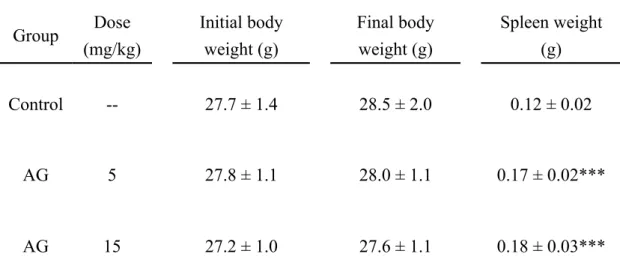
Effects of AG on body weight and spleen weight of mice in innate immunity experiment

Table 1 indicates the initial and final body weight of the mice in the innate immunity

experiment. No variance in body weight was initially evident between the groups of

(12)

mice. The body weight of the AG group (15 mg/kg) decreased slightly compared to the control after 3 wks of administration. However, the body weight of both AG- treated groups demonstrated no significant difference from the control group. The spleen plays a major role in the immune system (Blalock, 1984), and compared to the control group, the spleen weight of the AG-treated groups increased markedly after AG administration (5 and 15 mg/kg) (Table 1).

Measurements of splenocytes proliferation from AG-treated mice in innate immunity experiment

The effect of AG on splenocyte proliferation with and without mitogens (LPS or ConA) is demonstrated in Fig. 2A. The splenocyte proliferation without mitogen stimulation was significantly higher in both the AG-treated groups (5 and 15 mg/kg) compared to control group. In the presence of ConA and LPS, the proliferation of splenocytes increased significantly compared to the treatments without mitogen.

Compared with normal mice, the proliferation of splenocytes stimulated with LPS increased significantly in the mice administrated with AG (5 and 15 mg/kg) in a dose- dependent manner. However, no evidence of differences between the ConA-induced splenocyte proliferation was found among the groups.

NK cytotoxicity in AG-treated mice in innate immunity experiment

Fig. 2B illustrates the splenocyte cytotoxicity activities against the YAC-1 cell of mice after 3 wks of treatment. No difference in splenocyte cytotoxicity existed among the groups at an E/T ratio of 25. At an E/T ratio of 50, the cytotoxicity of the saline- treated mice, and the AG low-dose (5 mg/kg) treated splenocytes were similar.

However, the AG low dose (5 mg/kg) treated splenocytes increased the cytotoxicity at

(13)

a high ratio of effecters (E/T=100). By contrast, mice treated with a high dose of AG (15 mg/kg) significantly demonstrated enhanced splenocyte cytotoxicity at both E/T ratios of 50 and 100. Based on this result, AG was found to enhance splenocytes cytotoxicity against YAC-1 in vivo.

Flow cytometry data of innate immune mice

The AG treatments (5 and 15 mg/kg) significantly stimulated the percentage of CD3

+

CD8

+

Tc among total splenocytes in a dose-dependent manner (Fig. 2C). For the ratio of Tc in splenocytes, the AG-treated groups had 13.9% (5 mg/kg) and 26.6% (15 mg/kg) greater than control group. The percentage of CD3

+

CD4

+

Th cells was not influenced by the AG ( ± % in saline group; ± in at 5 mg/kg; % in at 15 mg/kg).

Both AG treatments (5 and 15 mg/kg) induced the percentage of mature DC (CD86

+

MHCII

high

) in each sample slightly (Fig. 2D).

Effects of AG on body weight, spleen weight and tumour growth of CT26-bearing mice

The initial body weight of the mice was 22-24g and no variance existed among

groups. After receiving treatment for 3 wks, the body weight of CT26-bearing mice

significantly decreased in the 5-FU treated group compared to the saline-treated

group. However, the AG treatment did not influence the body weight of the AG-

treated mice compared to the saline-treated group (Table 2). The weight of the spleens

of mice bearing CT26 tumours significantly increased by 54% compared to the

control group. The spleen weight of CT26-bearing mice administrated with AG (15

mg/kg) was 1.25 times higher than the saline-treated group. However, 5-FU treatment

introduced a 57.0% decrease in spleen weight, a significant difference from the spleen

(14)

weight of the saline-treated groups (Table 2). Fig. 3 demonstrates changes of tumour sizes from Day 10 to Day 20. Both AG (15 mg/kg) and 5-FU treatments significantly inhibited the growth of implanted CT26 tumours. Administration of AG and 5-FU for 3 wk led to a 61.7% (AG-15 mg/kg) and 69.8% (5-FU) decrease in the tumour size.

Flow cytometry data of CT26 bearing mice

The immuno-modulation of AG was tested using flow cytometry analyses of splenic cells isolated from CT26-bearing mice. Fig. 4A indicates that among all the splenocytes, the DC cells (CD11c

+

) increased significantly after AG treatments. No significant difference in the number of CD11c

+

cells was evident between the control and CT26 bearing group. The result of the CD11c

+

CD137

+

expression of DC was similar to the percentage of CD11c

+

expression in the splenic cells. The intraperitoneal AG injection treatments of the CT26 bearing mice not only significantly increased the percentage of CD11c

+

DC, but also the number of CD11c

+

CD137

+

DC. The expressions of CD11c

+

and CD11c

+

CD137

+

splenocytes in the CT26 bearing mice were not influenced by 5-FU compared to the saline group.

The percentages of CD3

+

CD8

+

and CD3

+

CD4

+

splenic cells are indicated in Fig.

4B. The presence of CT26 tumour did not influence the percentage of CD3

+

CD8

+

Tc

and CD3

+

CD4

+

Th compared to the control group. AG treatment administered to

CT26 bearing mice significantly increased the percentage of CD3

+

CD8

+

Tc of total

splenocytes compared to the saline group. Although the percentage of CD3

+

CD4

+

Th

cells increased with AG treatment, no significant difference compared to the saline

group was observed (17.1 ± 0.5% in CT26 saline group; 17.7 ± 0.6% in CT26-AG at

5 mg/kg; 17.8 ± 0.5% in CT26-AG at 15 mg/kg). A 5-FU treatment administered to

(15)

CT26-bearing mice slightly decreased the number of CD3

+

CD8

+

cells, and demonstrated no significant difference from the saline group.

Fig. 4C illustrates the percentage of CD49b

+

CD3e

-

cells of the total splenocytes in the control and CT26-bearing mice groups. The bearing of CT26 tumours did not change the percentage of CD49b

+

CD3e

-

cells compared to the control group. AG treatments stimulated the number of NK cells in CT26-bearing mice in a dose- dependent manner, but only a high dose of AG (15 m/kg) demonstrated significant increases compared to the CT26-saline group (19.4% increase in AG 15 mg/kg than saline group). However, 5-FU down-regulated the number of CD49b

+

CD3e- splenocytes.

Splenocytes cytotoxicity in CT26-bearing mice

The splenocyte cytotoxic activities against the YAC-1 cell in the CT26-bearing mice and the control group are indicated in Fig. 4D. CT26 bearing-saline demonstrated no difference in splenocyte cytotoxicity from the control group, but AG treatments in CT26-bearing mice stimulated the cytotoxicity activity in a dose- dependent manner among E/T ratios at 25, 50, and 100. The splenocyte cytotoxicities in the 5-FU treated CT26-bearing mice were lower than in the saline-treated mice without significant variance among any of the E/T ratios.

Immunohistochemistry stain on tumour

The number of infiltrate NK- and Tc-positive cells in the implantation tumour was increased by AG treatment in a dose-dependent manner, as demonstrated in Fig. 5.

These findings indicate that the immune function of the tumour may be stimulated by

the administration of AG (5 and 15 mg/kg, i.p.). Furthermore, the number of PCNA-

(16)

positive cells was widespread in the CT26 tumour slices, and AG significantly reduced the number of PCNA-positive cells in the tumour (Fig. 5).

Discussion and Conclusions

In this study, we demonstrated the immune-stimulating activity of AG in vivo, as well as in vitro. In addition, AG treatments demonstrated potential immuno-modulatory in innate and tumour-bearing mice. Finally, the anti-tumour effects generated by AG treatments may be through both Tc and NK activities.

DNA microarray analysis was performed to investigate the differential effects of

AG treatments. AG stimulation provided strong immuno-modulatory properties to

RAW 264.7 cells. Among the up-regulated gene expression, IL-1α, TNF-α, CD69 and

CD83 were related to anti-tumour activities. IL-1α is a member of the IL-1 cytokine

family, and is responsible for the pathogenesis of chronic inflammatory disease

(O'Neill, 1995). Active macrophage, neutrophils, epithelial cells and endothelial cells

are the major cells to produce IL-1α. TNF-α is a multifunctional cytokine and acts in

anti-tumour activity, immune modulation, inflammation and hematopoiesis (van

Horssen et al., 2006). In addition, TNF-α is used in clinical trials as an anti-tumour

agent (van Horssen et al., 2006). AG up-regulated the expression of CD69, known as

an activator molecule, and a differentiation antigen on T and B cells, macrophages,

neutrophils, eosinophils and NK cells (Borrego et al., 1999). Borrego et al (Borrego et

al., 1999) demonstrated that CD69 is a stimulatory receptor for natural killer cells, and

that it mediated NK cytotoxicity. The microarray analysis of AG indicated that AG

was a potent immuno-modulator and may affect the functions of macrophage, T

lymphocytes, and NK. CD83 is expressed at the surface of most DC and up-regulated

(17)

together with co-stimulatory molecules, such as CD80, and CD86 during the maturation of DC (Fujimoto et al., 2006). CD83 is not only a marker for DC maturation but is also an essential molecule for CD4

+

T cell generation, and is one of the most important regulatory molecules in the immune system (Fujimoto et al., 2006). CD83 has been reported to have the ability to potentiate anti-tumour immunity in mice-implanted melanoma (Scholler et al., 2002).

Polysaccharides isolated from plants or microorganisms are used as complementary and alternative medicine in Asian countries. Recently, numerous studies have demonstrated that polysaccharides are potent immuno-modulators that can stimulate innate immune in vivo and in vitro (Tzianabos, 2000). In this study, we demonstrated that intraperitoneal injections of AG could stimulate potent innate immunity in BALB/c mice. The AG treatments significantly increased the spleen weight of mice.

However, the body weight of the mice was not affected by AG. After 3 wks of AG

treatment the level of AST, APT and total bilirubin was not influenced (data not

shown), indicating that AG did not cause any obvious toxicity in mice. The spleen

plays a central role in regulating the immune system (Tarantino et al., 2011). The

immune function of the spleen modulates the immune system through phagocytosis,

cytotoxicity, and also through T cell-mediated immunity and B cell-mediated humoral

immunity (Tarantino et al., 2011) . Our results indicated that AG treatments improved

the effect of splenocytes proliferation, which was successively promoted in a dose-

response manner. The splenocyte proliferation activity was induced by AG co-treated

with LPS, rather than with ConA. Both cellular and humoral immunity were included

in this immune response, influenced T cells and B cells respectively, and played a

substantial role in the host defence system. The host defence immunity is linked with

body responses, such as tumours, inflammation, and fever (Liu et al., 2012). The

(18)

ability to develop an effective T and B cell immunity can be regarded as a stimulation of the lymphocyte proliferation response (Liu et al., 2012). Our results indicated that AG co-treated with LPS stimulated splenocyte proliferation and demonstrated that AG could significantly increase the activate potential of B cells, and enhance the humoral immunity.

In this study, we demonstrated that AG enhanced the cytotoxicity of splenic NK cells against YAC-1 cells in both innate immune mice and tumour bearing mice. NK cells play a central role in the immune defence system. The immunotherapy of cancer was dependent on the activation of NK cells (Kim et al., 2007). Therefore, the results suggested that splenic NK cells were activated by AG treatment and had beneficial anticancer effects. Numerous polysaccharides isolated from plants and mushrooms have been demonstrated to enhance NK cytotoxicity. Hauer and Anderer (1993) demonstrated that the arabinogalactan from larch could enhance NK cytotoxicity, not by initiating it directly, but through the cytokine network. In addition, a mushroom derived from β-glucan Krestin has been reported to inhibit tumour growth through its stimulation of CD8

+

T cells and NK cells (Lu et al., 2011). A polysaccharide derived from the mushroom Grifola frondosa appears to be a NK cell stimulator that responds to the anti-tumour immunity (Kodama et al., 2005). We also measured the population of CD49b

+

CD3

-

NK cells among splenocytes in tumour-bearing mice, and found that NK cells significantly increase in number with AG treatment. An IHC study also replicated the results and managed to AG increase the presence of NK cells in tumour.

AG treatment made the NK cell filtration in tumours visible. Their results suggested that the anti-tumour effects of AG included increasing the number of NK cells and promoting cytotoxicity.

Lucas et al. (2007) reported that NK cell priming needs the presence of CD11

chigh

(19)

DC. DC can also trigger antibody and NK cell responses, which may contribute to tumour immunity. In this study, we found that the population of CD11c

+

DC among splenocytes was up-regulated by AG in an innate immunity experiment with tumour- bearing mice. DCs are major antigen-presenting cells that stimulate innate and adaptive immunity (Meylan et al., 2006). Anti-tumour immunity originates from DCs, and is central to tumour antigen presentation, and T-cell activation (Grivennikov et al., 2010). The TNF receptor family member CD137 plays a role in inducing

immature DC to mature DC (Kwajah et al., 2010). In addition, CD137 ligand promotes the maturation of immature DC, resulting in an induced expression of MHC Class II, cytokines, and the ability of DC to migrate (Kwajah et al., 2010). In our results, AG increased the percentage of CD11c

+

CD137

+

DC in tumour-bearing mice.

The mature DC loaded tumour-antigen had to generate protective T-cell responses including the production of CD8

+

Tc cells with cytotoxic potential (Mellman et al., 2011). Yeast-derived β-glucans have been reported to have an anti-tumour function by activating DC and macrophages (Qi et al., 2011). Masuda et al (2013) reported that Grifola frondosa derived β-glucan can induce DC maturation, and has a therapeutic

anti-tumour response. The expression of CD11c

+

CD137

+

DC could be included in anti-tumour responses in this study.

CD8

+

cytotoxic T cells also play an important role in anti-tumour immunity

(Mellman et al., 2011). Clinicopathological studies have demonstrated a strong

association between prolonged patient survival and the presence of intra-tumoural

CD3

+

or CD8

+

Tc cells (Mellman et al., 2011). In this study, AG treatments not only

increased the number of CD3

+

CD8

+

T cells, but also generated the polarizing of Tc in

both innate and tumour bearing mice. Tc is cytotoxic to allogenic cells, such as

tumour cells or infected cells (Hariharan et al., 1995). The presence of tumour-

(20)

filtrating lymphocytes has been found to correlate with improved survival in epithelial ovarian cancer (Zhang et al., 2003). In addition, Sato et al (2005) reported that CD8

+

tumour-filtrating lymphocytes were associated with the prognosis of ovarian cancer.

The IHC data indicated that more CD8

+

filtrating lymphocytes were observed in AG- treated mice. The immune modulation of AG, such as NK, DC and Tc activations, responded to the inhibition of tumour weight size by AG.

The polysaccharide is regarded as an adjuvant in anti-tumour immunity. Qi et al (2011) demonstrated that yeast-derived β-glucan activated augmented anti-tumour monoclonal antibody-mediated therapeutic efficacy, and was effective at prolonging survival rate and reducing tumour size. The ideal adjuvant or adjuvant combination is expected to trigger the maturation of DC to a state where DC can facilitate the generation of tumour-reactive, CD8

+

cytotoxic T cells (Mellman et al., 2011). The anti-tumour immunity of AG fitted the characters as an ideal anti-tumour adjuvant.

In this study, we demonstrated that AG purified from A. formosanus is capable of stimulating innate immune and anti-tumour immunity. The mechanisms of AG reactions on DC, NK and Tc are currently being studied, but it is clear that AG has the potential to be developed into an immunotherapeutic drug, or to be used in adjuvant therapy in future.

Acknowledgement

This study was supported by grants from the National Science Council of the Republic of China (NSC102-2320-B-039-031-MY2)

Conflicts of interest

The authors state no conflict of interest.

(21)

References

Blalock JE (1984). The immune system as a sensory organ. J Immunol 132: 1067- 1070.

Borrego F, Robertson MJ, Ritz J, Pena J, Solana R (1999). CD69 is a stimulatory receptor for natural killer cell and its cytotoxic effect is blocked by CD94 inhibitory receptor. Immunology 97: 159-165.

Fujimoto Y, Tedder TF (2006). CD83: a regulatory molecule of the immune system with great potential for therapeutic application. J Med Dent Sci 53: 85-91.

Goldstein M, Watkins S (2008). Immunohistochemistry. Curr Protoc Mol Biol Chapter 14: Unit 14.6.

Grivennikov SI, Greten FR, Karin M (2010). Immunity, inflammation, and cancer.

Cell 140: 883-899.

Harding CV (2001). Choosing and preparing antigen-presenting cells. Curr Protoc Immunol Chapter 16: Unit 16.1.

Hariharan K, Braslawsky G, Black A, Raychaudhuri S, Hanna N (1995). The induction of cytotoxic T cells and tumor regression by soluble antigen formulation.

Cancer Res 55: 3486-3489.

Hauer J, Anderer FA (1993). Mechanism of stimulation of human natural killer cytotoxicity by arabinogalactan from Larix occidentalis. Cancer Immunol Immunother 36: 237-244.

Hsiang YH, Hertzberg R, Hecht S, Liu LF (1985). Camptothecin induces protein- linked DNA breaks via mammalian DNA topoisomerase I. J Biol Chem 260: 14873- 14878.

Kim HY, Kim JH, Yang SB, Hong SG, Lee SA, Hwang SJ, Shin KS, Suh HJ, Park

MH (2007). A polysaccharide extracted from rice bran fermented with Lentinus

edodes enhances natural killer cell activity and exhibits anticancer effects. J Med

Food 10: 25-31.

(22)

Kimura Y, Sumiyoshi M (2004). Effects of various Eleutherococcus senticosus cortex on swimming time, natural killer activity and corticosterone level in forced swimming stressed mice. J Ethnopharmacol 95: 447-453.

Kodama N, Asakawa A, Inui A, Masuda Y, Nanba H (2005). Enhancement of cytotoxicity of NK cells by D-Fraction, a polysaccharide from Grifola frondosa.

Oncol Rep 13: 497-502.

Kwajah MMS, Schwarz H (2010). CD137 ligand signaling induces human monocyte to dendritic cell differentiation. Eur J Immunol 40: 1938-1949.

Liu H, Fan Y, Wang W, Liu N, Zhang H, Zhu Z, Liu A (2012). Polysaccharides from Lycium barbarum leaves: isolation, characterization and splenocyte proliferation activity. Int J Biol Macromol 51: 417-422.

Lu H, Yang Y, Gad E, Wenner CA, Chang A, Larson ER, Dang Y, Martzen M, Standish LJ, Disis ML (2011). Polysaccharide krestin is a novel TLR2 agonist that mediates inhibition of tumor growth via stimulation of CD8 T cells and NK cells. Clin Cancer Res 17: 67-76.

Lucas M, Schachterle W, Oberle K, Aichele P, Diefenbach A (2007). Dendritic cells prime natural killer cells by trans-presenting interleukin 15. Immunity 26: 503-517.

Masuda Y, Inoue H, Ohta H, Miyake A, Konishi M, Nanba H (2013). Oral administration of soluble beta-glucans extracted from Grifola frondosa induces systemic antitumor immune response and decreases immunosuppression in tumor- bearing mice. Int J Cancer 133: 108-119.

Mellman I, Coukos G, Dranoff G (2011). Cancer immunotherapy comes of age.

Nature 480: 480-489.

Meylan E, Tschopp, J, Karin, M (2006). Intracellular pattern recognition receptors in the host response. Nature 442: 39-44.

O'Neill LA (1995). Interleukin-1 signal transduction. Int J Clin Lab Res 25: 169-177.

Qi C, Cai Y, Gunn L, Ding C, Li B, Kloecker G, Qian K, Vasilakos J, Saijo S,

(23)

Iwakura Y, Yannelli JR, Yan J (2011). Differential pathways regulating innate and adaptive antitumor immune responses by particulate and soluble yeast-derived beta- glucans. Blood 117: 6825-6836.

Ren L, Perera C, Hemar Y (2012). Antitumor activity of mushroom polysaccharides:

a review. Food Funct 3: 1118-1130.

Sato E, Olson SH, Ahn J, Bundy B, Nishikawa H, Qian F, Jungbluth AA, Frosina D, Gnjatic S, Ambrosone C, Kepner J, Odunsi T, Ritter G, Lele S, Chen YT, Ohtani H, Old LJ, Odunsi K (2005). Intraepithelial CD8+ tumor-infiltrating lymphocytes and a high CD8+/regulatory T cell ratio are associated with favorable prognosis in ovarian cancer. Proc Natl Acad Sci U S A 102: 18538-18543.

Scholler N, Hayden-Ledbetter M, Dahlin A, Hellstrom I, Hellstrom KE, Ledbetter JA (2002). Cutting edge: CD83 regulates the development of cellular immunity. Journal of Immunology 168: 2599-2602.

Shyur LF, Chen CH, Lo CP, Wang SY, Kang PL, Sun SJ, Chang CA, Tzeng CM, Yang NS (2004). Induction of apoptosis in MCF-7 human breast cancer cells by phytochemicals from Anoectochilus formosanus. J Biomed Sci 11: 928-939.

Sullivan R, Smith JE, Rowan NJ (2006). Medicinal mushrooms and cancer therapy:

translating a traditional practice into Western medicine. Perspect Biol Med 49: 159- 170.

Tarantino G, Savastano S, Capone D, Colao A (2011). Spleen: A new role for an old player? World J Gastroenterol 17: 3776-3784.

Tomayko MM, Reynolds CP (1989). Determination of subcutaneous tumor size in athymic (nude) mice. Cancer Chemother Pharmacol 24: 148-154.

Tseng CC, Shang HF, Wang LF, Su B, Hsu CC, Kao HY, Cheng KT (2006).

Antitumor and immunostimulating effects of Anoectochilus formosanus Hayata.

Phytomedicine 13: 366-370.

Tzianabos AO (2000). Polysaccharide immunomodulators as therapeutic agents:

Structural aspects and biologic function. Clin Microbiol Rev 13: 523-533.

(24)

van Horssen R, Ten Hagen TL, Eggermont AM (2006). TNF-alpha in cancer treatment: molecular insights, antitumor effects, and clinical utility. Oncologist 11:

397-408.

Wang P, Henning SM, Heber D (2010). Limitations of MTT and MTS-based assays for measurement of antiproliferative activity of green tea polyphenols. PLoS One 5:

e10202.

Wani MC, Taylor HL, Wall ME, Coggon P, McPhail AT (1971). Plant antitumor agents. VI. The isolation and structure of taxol, a novel antileukemic and antitumor agent from Taxus brevifolia. J Am Chem Soc 93: 2325-2327.

Yang LC, Lin WC, Lu TJ (2012). Characterization and Prebiotic Activity of Aqueous Extract and Indigestible Polysaccharide from Anoectochilus formosanus. J Agric Food Chem 60: 8590-8599.

Zhang L, Conejo-Garcia JR, Katsaros D, Gimotty PA, Massobrio M, Regnani G, Makrigiannakis A, Gray H, Schlienger K, Liebman MN, Rubin SC, Coukos G (2003).

Intratumoral T cells, recurrence, and survival in epithelial ovarian cancer. N Engl J

Med 348: 203-213.

(25)

Figure legends

Fig. 1. Microarray analysis of AG on murine RAW264.7 cells (A) The volcano plot of normalized data of AG treated samples compared to untreated samples. Standard selection criteria to identify differentially expressed genes are established at |Fold change| ≧ 1 and P-value< 0.05. List of significant changed (B) cytokine, (C) chemokines and (D) co-stimulatory receptor genes in RAW264.7 cells with AG treatment compared to control . The changes of listed genes were more than 2-fold to control.

Fig. 2. Innate immunity effects of AG in BALB/c mice. (A) proliferation of

splenocytes induced by mitogen, Con A or LPS (B) Splenic NK cytotoxicity against YAC-1 cells in AG-treated mice (C) percentage of CD3

+

CD8

+

cells among total splenocytes from AG-treated or control mice (D) percentage of

CD11c

+

CD86

+

MHCII

high

DC among total splenocytes from AG-treated or control mice. All values were mean ± SD (n=8). Values were significantly different compared with the control group by Dunnett’s test: * P< 0.05, **P< 0.01 and ***

P<0.001.

Fig. 3. Intraperitoneal injection of AG and 5-FU inhibit the growth of implanted CT26 tumours in BALB/c mice. Tumour growth curve was shown and tumour volume was scored every 3 days from day 7 to day 20.

Fig. 4. Effects of AG and 5-FU in CT26-bearing mice (A) percentage of CD3

-

CD11c

+

DC(gray bar, left y-axis) and CD3

-

CD11

+

CD137

+

DC (black bar, right y-axis) among

total splenocytes from CT26-bearing mice (B) percentage of CD3

+

CD8

+

cells among

(26)

total splenocytes from CT26-bearing mice (C) percentage of CD49b

+

CD3

-

NK among total splenocytes from CT26 bearing (D) Splenic NK cytotoxicity against YAC-1 cells in CT26-bearing mice. All values were mean ± SD (n=8). Values were

significantly different compared with the control group by Dunnett’s test: * P< 0.05,

**P< 0.01 and *** P<0.001.

(27)

Table 1. Innate immunity effects of AG on body weight, spleen weight in BALB/c mice

Group Dose (mg/kg)

Initial body weight (g)

Final body weight (g)

Spleen weight (g)

Control -- 27.7 ± 1.4 28.5 ± 2.0 0.12 ± 0.02

AG 5 27.8 ± 1.1 28.0 ± 1.1 0.17 ± 0.02***

AG 15 27.2 ± 1.0 27.6 ± 1.1 0.18 ± 0.03***

Values were significantly different compared with the control group by Dunnett’s

test: *** P < 0.001.

(28)

Table 2. Anti-tumour effects of AG on body weight, spleen weight and tumour weight in CT26-bearing mice

Treatments Dose

(mg/kg)

Final body weight (g)

Spleen weight (g)

Tumour weight (g) Control

-- -- 24.5 ± 1.0 0.10 ± 0.01 --

CT26 bearing + Saline 26.5 ± 1.2 0.16 ± 0.05

#

1.18 ± 0.23

+ AG 5 25.3 ± 1.1 0.17 ± 1.1 0.63 ± 0.29***

15 26.6 ± 1.5 0.21 ± 0.04* 0.49 ± 0.16***

+ 5-FU 25 20.7 ± 1.9*** 0.09 ± 0.01** 0.44 ± 0.25***

Values were significantly different compared with the control group by Dunnett’s test:

#

P < 0.05.

Values were significantly different compared with the CT26 bearing-saline group by

Dunnett’s test: *P < 0.05, **P < 0.01, ***P < 0.001.

數據

Table 1. Innate immunity effects of AG on body weight, spleen weight in BALB/c  mice  Group Dose (mg/kg) Initial bodyweight (g) Final bodyweight (g) Spleen weight(g) Control -- 27.7 ± 1.4 28.5 ± 2.0 0.12 ± 0.02 AG 5 27.8 ± 1.1 28.0 ± 1.1 0.17 ± 0.02*** AG
Table 2.  Anti-tumour effects of AG on body weight, spleen weight and tumour  weight in CT26-bearing mice

參考文獻

相關文件

jobs

•In a stable structure the total strength of the bonds reaching an anion from all surrounding cations should be equal to the charge of the anion.. Pauling’ s rule-

Table 7: Resident population born outside Macao by total years of residence in Macao c (2001 ). Total

A total of 380 MICE (Meetings, Incentives, Conventions &amp; Exhibitions) events were held in various venues in the fourth quarter of 2010, up by 1% year-on-year; the average

In the fourth quarter of 2018, total spending of visitors from Mainland China amounted to MOP14.72 billion, down marginally by 0.3% year- on-year; spending of Guangdong

In the fourth quarter of 2012, per-capita spending and total spending of visitors are extrapolated from about 41,000 effective questionnaires of the Visitor Expenditure

In the first quarter of 2012, total spending and per-capita spending of visitors were extrapolated from 43,000 effective questionnaires collected from the Visitor Expenditure

1.5 In addition, EMB organised a total of 58 forums and briefings (45 on COS and 13 on special education) to explain the proposals in detail and to collect feedback from