
Abraham Academic Academy 國際語言學院企業計劃 - 政大學術集成
289
0
0
全文
(2) Abraham Academic Academy 國際語言學院企業計劃 Abraham Academic Academy Business Plan. 研究生:蔣友文. Student: John Vatougios. 指導教授:何小台. Advisor: Chester Ho. 國立政治大學. 學. ‧ 國. 立. 政 治 大. ‧. 商學院國際經營管理英語碩士學位學程 碩士論文. er. io. sit. y. Nat. A Thesis. n. a to International MBA Program Submitted iv l C n U NationalhChengchi University engchi. in partial fulfillment of the Requirements for the degree of Master in Business Administration. 中華民國一○二年五月 May 2013.
(3) Dedication To my parents, Beverly and Gerry Vatougios, for teaching me most of what I know, and involving me in every aspect of their entrepreneurial lives,. 政 治 大 To my friends and立 family who taught me how to navigate the ‧. ‧ 國. 學. lines that exists between our professional and personal worlds,. To the Physics Department at Simon Fraser University for. y. Nat. problem solving skills,. n. al. er. io. sit. developing my objective personality, analytical mind and. Ch. engchi. i n U. v. To the IMBA program at National ChengChi University for taking me to the next level of business awareness and preparing me for my future endeavors,. To my Advisor Chester Ho. for taking me under his wing and putting together the pieces of what I learned.. i.
(4) TABLE OF CONTENTS 1.. 2.. EXECUTIVE SUMMARY ................................................................................................ 1 1.1.. Executive Overview ................................................................................................... 1. 1.2.. The Abrahamic View on Education ........................................................................... 3. Company Description ......................................................................................................... 5 2.1.. Company Overview .................................................................................................... 5. 2.2.. Expansion Plans.......................................................................................................... 7. 政 治 大. 2.2.1. Organic Growth Model ........................................................................................... 7. 立. 2.2.2. Aggressive Growth Model.................................................................................... 10 Beliefs ....................................................................................................................... 11. ‧ 國. 學. 2.3.. 2.3.1. Vision ................................................................................................................... 11. ‧. 2.3.2. Mission ................................................................................................................. 11 2.3.3. Values ................................................................................................................... 12. Nat. sit. y. 2.3.4. Holistic Values (Family) ...................................................................................... 12. er. io. 2.3.5. Value System (by Age: Stage of Student Development) ..................................... 13 2.3.6. Individual Values (Inherent) ................................................................................. 13. n. al. Ch. i n U. v. 2.3.7. Self-Actualization Values (Develop).................................................................... 13 2.4.. engchi. Management ............................................................................................................. 13. 2.4.1. John Vatougios ..................................................................................................... 13 2.4.2. Jenny Lai .............................................................................................................. 14 2.4.3. General Strategy ................................................................................................... 14 3.. Market Analysis ................................................................................................................ 15 3.1.. SWOT Analysis ........................................................................................................ 15. 3.1.1. Strengths ............................................................................................................... 15 3.1.2. Weaknesses ........................................................................................................... 16 3.1.3. Opportunities ........................................................................................................ 16 3.1.4. Threats .................................................................................................................. 17. ii.
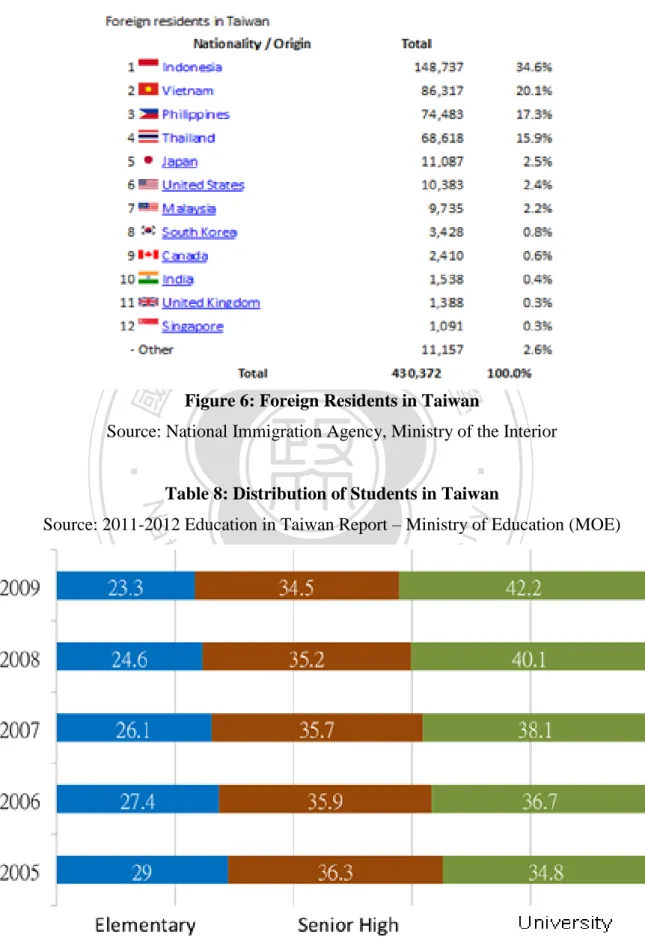
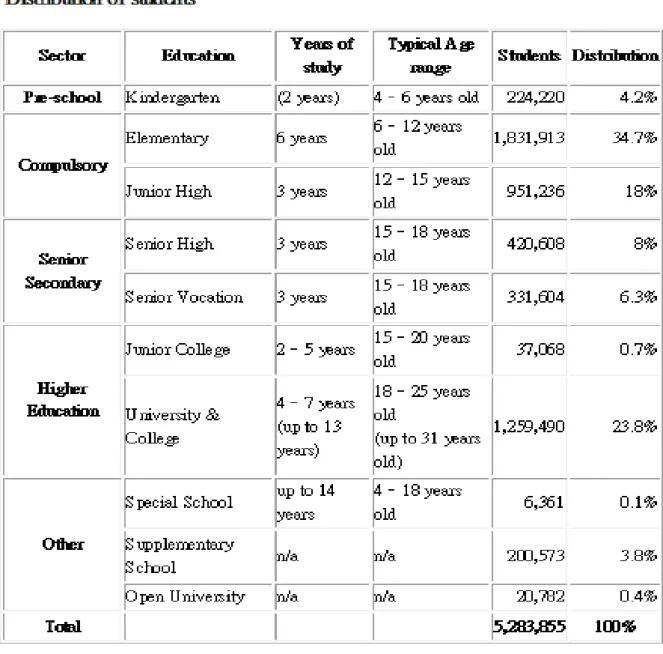
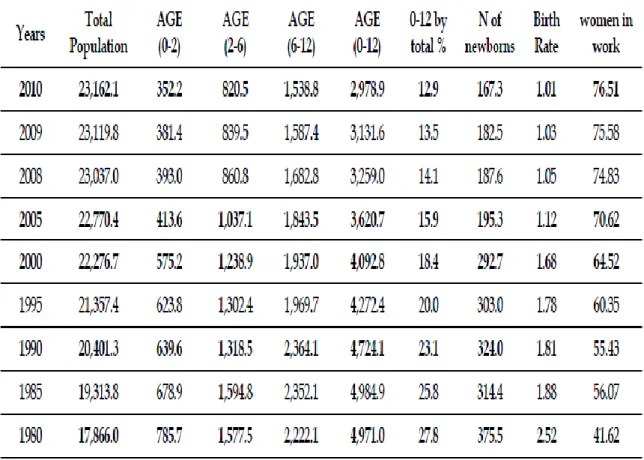
(5) 3.2.. PEST Analysis .......................................................................................................... 18. 3.2.1. Political Factors .................................................................................................... 18 3.2.2. Economic Factors ................................................................................................. 26 3.2.3. Sociocultural Factors ............................................................................................ 34 3.2.4. Technological Factors........................................................................................... 40 3.3.. Potter 5 Forces .......................................................................................................... 42. 3.3.1. Bargaining Power of Suppliers (None) ................................................................ 42 3.3.2. Bargaining Power of Customers (Medium-High) ................................................ 42 3.3.3. Threat of New Entrants (Low) ............................................................................. 43. 政 治 大 Competitive Rivalry within Industry (High) ........................................................ 45 立. 3.3.4. Threat of Substitutes (Low) .................................................................................. 44 3.3.5.. Marketing Plan ................................................................................................................. 48. ‧ 國. 4.1.. 學. Positioning by Product User ..................................................................................... 48. ‧. 4.1.1. General Customer Demographic Positioning ....................................................... 48 4.1.1.1. Target Market Positioning (Parents and Financial Providers)...................... 49. y. Nat. sit. 4.1.1.2. End User Positioning (Junior and Senior High School Students) ................ 50. io. 4.1.2. General Franchisee Demographic Positioning ..................................................... 51. er. 4.. al. v i n The Entrepreneur ............................................................... 54 C and h ethen Industry i h gc U n. 4.1.2.1. Involvement and Conformity........................................................................ 52 4.1.2.2. 4.2.. Positioning by Competitor ........................................................................................ 56. 4.2.1. Understanding the Competition ............................................................................ 57 4.2.2. Additional Competitive Knowledge ..................................................................... 59 4.2.3. Competitive Product Space .................................................................................. 60 4.3.. Positioning by Product Attributes and Benefits ....................................................... 64. 4.3.1. Attribute Branding Concept.................................................................................. 64 4.3.2. Additional Attributes & Benefits .......................................................................... 65 4.4.. Positioning by Cultural Symbols .............................................................................. 67. 4.4.1. Internationalization (International Ground/Usage) .............................................. 68 4.4.2. Bridge (Middle Ground/Understanding) .............................................................. 70. iii.
(6) 4.4.3. Localization (Local Ground/Usage) ..................................................................... 72 4.5.. Positioning by Use or Application ........................................................................... 74. 4.5.1. Primary Stage ....................................................................................................... 74 4.5.2. Secondary Stage ................................................................................................... 75 4.6.. Positioning by Product Class .................................................................................... 76. 4.6.1. High Class (Quality and Value)............................................................................ 76 4.6.1.1. Quality (Institution Wing) ............................................................................ 76 4.6.1.2. Value (Business Wing) ................................................................................. 77 4.6.2. Institution .............................................................................................................. 78. 政 治 大. 4.6.3. Curriculum (Practical and Visionary) .................................................................. 78 4.7.. 立. Positioning by Price/Quality..................................................................................... 80. ‧ 國. 學. 4.7.1. Abraham Academic Academy School's Curriculum ............................................ 81 4.7.2. Specific Branch School's Program Offerings ....................................................... 83. ‧. 4.7.3. Merchandise Sold ................................................................................................. 85 4.7.3.1. Customer Use ............................................................................................... 85. Nat. sit. y. 4.7.3.2. In-House Use ................................................................................................ 86. io. er. 4.7.3.3. Additional Programs ..................................................................................... 86. al. v i n 4.8.1. Primary Product/Service 87 C h(Education) ................................................................... U i e h n c g......................................................................... 4.8.1.1. Education (Wants & Needs) 87 The Four-P's (Product, Place, Price, Promotion) ...................................................... 87. n. 4.8.. 4.8.1.2. Education (Product Problems) ...................................................................... 88 4.8.1.3. Education (Features to Meet Needs/Fix Problems) ...................................... 91 4.8.1.4. Secondary Products/Services (Other) ........................................................... 92 4.8.2. Place ..................................................................................................................... 94 4.8.2.1. General.......................................................................................................... 94 4.8.2.2. Examples ...................................................................................................... 95 4.8.3. Price ...................................................................................................................... 96 4.8.3.1. Price Strategy................................................................................................ 96 4.8.3.2. Price Consistency ......................................................................................... 97 4.8.3.3. Price Monitoring ........................................................................................... 98. iv.
(7) 4.8.3.4.. Price Discount .............................................................................................. 99. 4.8.4. Promotion ........................................................................................................... 100 Business Model/Plan ...................................................................................................... 103 5.1.. General Overview ................................................................................................... 103. 5.1.1. Background ......................................................................................................... 103 5.1.2. Overview ............................................................................................................ 104 5.2.. Key Performance Indicators ................................................................................... 110. 5.2.1. Key Activities ..................................................................................................... 110. 政 治 大 Weekly Schedule ........................................................................................ 111 立 Special Activities ........................................................................................ 128. 5.2.1.1. Overview .................................................................................................... 110 5.2.1.2. 5.2.1.3.. 學. ‧ 國. 5.2.2. Key Resources .................................................................................................... 141 5.2.2.1. Premises ...................................................................................................... 141. ‧. 5.2.2.2. Premises Layout (Infrastructure Breakdown)............................................. 142 5.2.2.3. Facilities and Amenities Structure .............................................................. 144. y. Nat. sit. 5.2.2.4. Personnel .................................................................................................... 168. io. 5.2.3. Key Partners ....................................................................................................... 169. er. 5.. al. v i n Local AssistantC Caregivers ......................................................................... 170 hengchi U Overseas Native English Speaking Teachers (NEST) ................................ 171 n. 5.2.3.1. Overseas Low-Cost Caregivers .................................................................. 169 5.2.3.2. 5.2.3.3.. 5.2.3.4. Training and Quality Control ..................................................................... 173 5.2.3.5. Durable Equipment and Materials Procurement ........................................ 174 5.2.3.6.. Educational Materials Procurement............................................................ 176. 5.2.3.7. Consultation and Student Services (Focus on Overseas Programs) ........... 176 5.2.3.8. Web and Cloud Service Providers .............................................................. 178 5.2.3.9. Legal and Business Services ...................................................................... 179 5.2.3.10. Accounting Services ................................................................................... 179 5.3.. Customer Relations ................................................................................................ 179. 5.4.. Value Proposition ................................................................................................... 182. v.
(8) 5.5.. Expansion Model Plans .......................................................................................... 184. 5.5.1. Organic: Next School Level Expansion Model .................................................. 184 5.5.2. Organic: Same School Level Expansion Model ................................................. 185 5.5.3. Organic: Consultation and Student Services ...................................................... 186 5.5.4. Aggressive: Merge and Acquisition Expansion Model ...................................... 188 6.. Financial Analysis .......................................................................................................... 191 6.1.. Cost Structure ......................................................................................................... 191. 6.1.1. Premises .............................................................................................................. 191. 治 政 Personnel ............................................................................................................ 195 大 立 Supply ................................................................................................................. 199. 6.1.2. Facilities and Amenities Infrastructure............................................................... 193 6.1.3.. 學. ‧ 國. 6.1.4. 6.2.. Capital Financing and Investment .......................................................................... 203. 6.3.. Revenue Generation ............................................................................................... 207. ‧. 6.3.1. Pricing................................................................................................................. 207. y. sit. Financial Statements ............................................................................................... 235. io. er. 6.4.. Nat. 6.3.2. Revenues Forecast .............................................................................................. 221. 6.4.1. Pro-forma Income Statement .............................................................................. 235. n. al. i n U. v. 6.4.2. Pro-forma Balance Sheet .................................................................................... 240. Ch. engchi. 6.4.3. Pro-forma Cash-Flow Statement ........................................................................ 244 6.4.4. Risks to Mitigate ................................................................................................. 248 7.. References ...................................................................................................................... 251. 8.. Appendix ........................................................................................................................ 256. vi.
(9) LIST OF FIGURES Figure 1: Taiwan Current Education System ........................................................................... 21 Figure 2: Taiwan's Exports and Imports by Key Industry: ....................................................... 28 Figure 3: Taiwan’s Major Import and Export Trading Partners ............................................... 29 Figure 4: Taiwan’s Major Export and Export Trading Partners ............................................... 30 Figure 5: Population Demographics ......................................................................................... 34 Figure 6: Foreign Residents in Taiwan..................................................................................... 36 Figure 7: Education Trend in Taiwan – Highest Level of Education Obtained by a Student .. 37 Figure 8: Population Pyramid for Taiwan (November 2012) with Census Data that Supports a. 政 治 大 Figure 9: Abraham Academic Academy Competitive Product Space ..................................... 61 立 Maturing Society with an Upward Shift in Age Range Trend ......................................... 39. Figure 10: Maslow’s Hierarchy ................................................................................................ 90. ‧ 國. 學. Figure 11: Full-Time Kindergarten Schedule (Generic) ........................................................ 114 Figure 12: Part-Time Morning Kindergarten Schedule (Generic) ......................................... 115. ‧. Figure 13: Part-Time Afternoon Kindergarten Schedule (Generic) ....................................... 116. y. Nat. Figure 14: Late-Night Evening Kindergarten Schedule (Generic) ......................................... 117. sit. Figure 15: Future Elementary School Program Schedule (Generic) ...................................... 118. er. io. Figure 16: English-Only Schedule Example .......................................................................... 120. al. n. v i n C h ................................................................................. Figure 18: Bilingual Schedule Example 122 engchi U Figure 19: Bilingual Schedule Example Details..................................................................... 123 Figure 17: English-Only Schedule Example Details .............................................................. 121. Figure 20: Chinese Schedule Example ................................................................................... 124 Figure 21: Chinese Schedule Example Details: ..................................................................... 125 Figure 22: Daycare Schedule Example Details ...................................................................... 126 Figure 23: The Science Curriculum Schedule for semester 1 and 2 ...................................... 133 Figure 24: The Physical Education Curriculum Schedule for semester 1 and 2 .................... 137 Figure 25: Classroom Furniture & Equipment Description ................................................... 145 Figure 26: Front of Office Furniture & Equipment Description ............................................ 148 Figure 27: Back of Office Furniture & Equipment Description ............................................. 151 Figure 28: Playground Furniture & Equipment Description .................................................. 154 Figure 29: Kitchen Furniture & Equipment Description ........................................................ 157. vii.
(10) Figure 30: Theater Furniture & Equipment Description ........................................................ 163 Figure 31: Common Room Furniture & Equipment Description ........................................... 165 Figure 32: Sleeping Room Furniture & Equipment Description ............................................ 166 Figure 33: General Furniture & Equipment Description ........................................................ 167 Figure 34: The Total Semester Cost Competitive Pricing Landscape for Various Programs (Assume English-Only Programs Unless Otherwise Stated) ......................................... 208 Figure 35: Full-Time Pricing Scheme for Abraham Academic Academy Programs ............. 210 Figure 36: Part-Time Pricing Scheme for Abraham Academic Academy Programs ............. 215 Figure 37: Customization Pricing Scheme for Abraham Academic Academy Programs ...... 220. 治 政 大 275 Materials and Items for Business Use ............................................................................ 立. Figure 38: Examples of Abraham Academic Academy Corporate Identity, Marketing. ‧. ‧ 國. 學. n. er. io. sit. y. Nat. al. Ch. engchi. viii. i n U. v.
(11) LIST OF TABLES Table 1: Summary of Education at All Levels in the Current School System ......................... 22 Table 2: The Increase of Overseas Students in Taiwan............................................................ 23 Table 3: Impact of the ECEC Act: ........................................................................................... 24 Table 4: Number of Students per Teacher at All Levels .......................................................... 25 Table 5: General Demographic Information ............................................................................ 27 Table 6: The top 26 Companies in Taiwan’s According to Wealth, Size and Interest ............ 31 Table 7: Ratio of Educational Expenditure to GDP ................................................................. 32 Table 8: Distribution of Students in Taiwan ............................................................................ 36. 政 治 大 Table 10: Population Structure ................................................................................................. 40 立 Table 9: A View of Distribution by Gross Enrollment Rate .................................................... 38. Table 11: Number of Kindergarten, Language and Cram Schools in Taiwan ......................... 46. ‧ 國. 學. Table 12: Potential Real-Estate Rental Rates for the Kindergarten ....................................... 192 Table 13: Potential Real-Estate Prices for the Kindergarten .................................................. 192. ‧. Table 14: Stage 1: Kindergarten Infrastructure Budget Summary ......................................... 194. y. Nat. Table 15: Initial Labor Costs .................................................................................................. 197. sit. Table 16: Full Capacity Labor Costs ...................................................................................... 198. er. io. Table 17: Kindergarten Operating Costs without Enrollment Considerations ....................... 200. al. n. v i n C h Operating CostsUwith Enrollment Considerations.. 202 Table 19: Following Year Kindergarten engchi Table 18: Initial Year Kindergarten Operating Costs with Enrollment Considerations......... 201. Table 20: Perpetuity Kindergarten Operating Costs with Enrollment Considerations .......... 203 Table 21: Abraham Academic Academy Fundraising Timetable .......................................... 204 Table 22: Abraham Academic Academy Initial Bank Loan Amortization Schedule ............ 206 Table 23: Abraham Academic Academy Expected Scenario Revenues Forecast.................. 223 Table 24: Abraham Academic Academy Pessimistic Scenario Revenues Forecast .............. 226 Table 25: Abraham Academic Academy Optimistic Scenario Revenues Forecast................ 229 Table 26: Abraham Academic Academy Breakeven Scenario Revenues Forecast ............... 232 Table 27: Year 1 Monthly Income Statement ........................................................................ 236 Table 28: Year 2 Monthly Income Statement ........................................................................ 237 Table 29: Year 3 Monthly Income Statement ........................................................................ 238 Table 30: 5 Year Income Statement Summary....................................................................... 239. ix.
(12) Table 31: Year 1 Monthly Balance Sheet Statement .............................................................. 240 Table 32: Year 2 Monthly Balance Sheet Statement .............................................................. 241 Table 33: Year 3 Monthly Balance Sheet Statement .............................................................. 242 Table 34: 5 Year Balance Sheet Statement Summary ............................................................ 243 Table 35: Year 1 Monthly Cash Flow Sheet Statement ......................................................... 244 Table 36: Year 2 Monthly Cash Flow Sheet .......................................................................... 245 Table 37: Year 3 Monthly Cash Flow Sheet .......................................................................... 246 Table 38: 5 Year Cash Flow Sheet Statement Summary........................................................ 247 Table 39: Competitive Pricing Table. The Price Scheme Used by Various Industry. 治 政 大 260 Table 40: Bankrupt and Foreclosed Schools for Sale ............................................................ 立 Table 41: Real Estate Research (Rent). Various Prices of a Variety of Different Potential Competitors .................................................................................................................... 256. ‧ 國. 學. School Site Listings in Taiwan ....................................................................................... 263 Table 42: Real Estate Research (Own). Various Prices of a Variety of Different Potential. ‧. School Site Listings in Taiwan ....................................................................................... 266 Table 43: List of Curriculum Exhibits.................................................................................... 267. n. er. io. sit. y. Nat. al. Ch. engchi. x. i n U. v.
(13) 1. EXECUTIVE SUMMARY 1.1.. Executive Overview. The intention of this business plan is to outline the creation of an internationally recognized education institute through its franchise of a world class set of chain schools that specializes in both supplementing a host country's national curriculum (cram school) and providing foreign language courses (language center).. The consumer-side of this education institute will focus on the provision of its curricula,. 政 治 大 development of kindergarten, 立elementary, and middle schools and junior and senior level high. programs, products and services to pre-university ages and levels (PK-Grade 12) through the. ‧ 國. 學. schools. The franchiser-side of the business will focus on the provision of everything needed by a school to ensure that a franchisee can be customer centric with the consumer-side running at optimum efficiency and the lowest possible cost structure.. ‧ y. Nat. Abraham Academic Academy is the Brand name of this education institution. It will function. io. sit. as the head-office and be responsible for the franchising obligations; franchising, curriculum. n. al. er. and network development; and consultation, customer relation and student services. v i n C Abraham h e n gAcademic c h i UAcademy. development. All businesses and schools that operate within the franchise will adopt a portion of the name. For example,. Kindergarten, Abraham’s. Elementary Language Academy, Abraham Academic Academy Junior High School, Abraham’s Senior High Language Academy, Abraham Academic Academy Consultation Services and Abraham’s Student Services.. Abraham Academic Academy plans to own and operate some of its own schools as well as sell franchises. In terms of the chain's local growth and expansion plans, Abraham Academic Academy has organic and aggressive models that are interlaced. A point of interest is the Abraham Academic Academy view on education in this chain school era, which explains their focus on acquiring bankrupt and struggling schools and bringing into the brand small, local, independently run schools with the promise of a brighter tomorrow through our network.. 1.
(14) Local for Abraham Academic Academy means Taiwan. We are going to begin our focus on Asia by starting operations in Taiwan. Our flagship school is to be located in a suburb of Taipei and will initially consist of kindergarten and elementary grade (1-6) school programs.. The local curriculum of a specific school will be based on the public and private schools that exist in the vicinity of that Abraham Academic Academy school, which the majority of our students are expected to attend. Initially, our language program will only focus on the English language and its curriculum will parallel the Western K-12 systems used in Canada, America,. 治 政 大 baccalaureate program. European education system encompassed in the international 立. and Australia. Our language curriculum will also embrace elements of the British and. ‧ 國. 學. By having our language program focus on the Western K-12 system, we are in essence providing a service that is only available in a few of the elite schools in a Non-native English. ‧. speaking country. The current vision of English as a second language (ESL) that is embraced by most language schools is very limited to a recreational sense of the language and is. Nat. sit. y. missing two important and practical applications that are crucial to a student’s development.. al. er. io. First, to support a student, who in the future might make the transition to an overseas school. n. through the provision of important knowledge already taught to local students there. Second,. Ch. i n U. v. to provide a unique international view of the world to a student through subject matter that is. engchi. neglected in both non-native English speaking national curricula and standard language school programs.. Internationally, Abraham Academic Academy plans to expand from its base of operations in Taiwan by proceeding to China. From China we plan to begin going south into Vietnam and north into South Korea. By this time we expect to bring the Chinese Language into our language schools curricula. The world already recognizes that China will be an economic powerhouse by 2030, and trends already exhibit that Chinese language acquisition will become important in the future. Our intention is to utilize the schools in our network in Taiwan and China to obtain Chinese teachers and managers. We will provide our Chinese. 2.
(15) teachers with an exchange program and groom managers to either own or temporarily run schools in the new countries while implementing the Chinese language programs there.. For the purposes of this business plan we intend to go over the long-term aspects of building the Abraham Academic Academy franchise, but focus on the immediate short-term opening of the kindergarten school.. 1.2.. The Abrahamic View on Education. Education has always been a crucial factor behind a society's development. Those in the know. 政 治 大 allow them to flourish in the real world, which is why education has become synonymous 立 with a better living. and those with skills have always been better off and can be found occupying positions that. ‧ 國. 學. However, today's free market society has changed the role of education in two ways. First, our. ‧. raised standards of living have brought higher education down to the masses causing education to become a basic necessity for life. This can be seen through the proliferation of. y. Nat. sit. educational material in both the public and private sectors and the rising minimum. er. io. requirements of a standardized educational system. Education has become a mass produced. al. v i n education is subject to greater differentiation and price premiums. Ch engchi U n. commodity, but unlike the water in your glass and the meat and potatoes on your plate,. Secondly, today's free market society has not only brought about an international pressure to globally standardize education, but has brought about the requirement of a standardized language for communicative purposes. The world is flatter as many nations are part of the supply chain that makes our free markets work and technology has made the world smaller by bringing disparate resources together in a more timely fashion. It is the mobility of our human resources in this global village together with their knowledge and skills that has developed the need for a universal means of communication. For a long time English has been recognized as the international language and for some time still English will remain reinforcing the need for language schools. Abraham Academic Academy is English ready and is geared to be ready for the emergence of other languages as they become important.. 3.
(16) Abraham Academic Academy believes it is better to supplement than provide the standardized education of a nation. Abraham Academic Academy believes that the supplementation is a larger market as competition is relative and every student in every country, school, and grade feels the pressure to improve. Another supplementation model benefit is the smaller initial infrastructure requirements and less bureaucratic red-tape, which translates into lower costs and fewer demands and compliance issues.. We believe there are many advantages in focusing on the language portion of our model in. 治 政 大are the international schools, which prestige as the best local schools in a non-western country 立 are generally known for their English Language programs. Second, by the adoption of the selling our education systems in the international community. First, our schools gain in. ‧ 國. 學. highly regarded western K-12 curriculum, we are put into a class of only a select few. Third, many students want to be educated overseas and are concerned over making the difficult. ‧. transition that we aid in. Fourth, the provision of a western style education conducted locally brings diversity and can broaden a student's mind without the need for going abroad. Fifth, the. y. Nat. sit. educational variety that Abraham Academic Academy brings to the classroom beyond the. al. er. io. recreational and redundant curriculum currently in widespread use. Lastly, in regards to the. n. emergence of other international languages, Chinese is quickly becoming accepted as the next. Ch. i n U. v. language on the horizon. With our focus in Asia, our short-term goal is to bring English to. engchi. Asia, but our long-term goal is to develop Chinese programs for the rest of the world.. 4.
(17) 2. Company Description 2.1.. Company Overview. Abraham Academic Academy is a limited liability company (LLC) that represents the core brand of a service-orientated business chain of businesses. Abraham Academic Academy is an education service provider.. 政 治 大 school, after-school and intersession 立 programs both locally and abroad. Abraham Academic. Abraham Academic Academy has schools that provide supplementary, extra-curricular, pre-. ‧ 國. 學. Academy aids students with their studies under a countries national curriculum, supplements it with additional courses (cram school) and provides students with an intensive English language segment (language school). Any of the Abraham Academies can be operated by a. ‧. franchisee, an affiliate, or the corporation itself. The company's revenues come from the rent,. io. sit. y. Nat. royalties and fees paid by the franchisees, as well as sales in and of company-operated schools.. er. The following is a list of some of the names that can be used by our trademarked schools and. al. n. v i n C Academy (Abraham Abraham's Kindergarten Language h e n g c h i U Academic Academy Kindergarten),. companies that will exist within the Abraham Academic Academy franchise group:. Abraham's Elementary Language Academy (Abraham Academic Academy Elementary School), Abraham's Middle-School Language Academy (Abraham Academic Academy Middle School), Abraham’s High-School Language Academy (Abraham Academic Academy Junior High School and Abraham Academic Academy Senior High School), Abraham Academic Academy Language Institute, Abraham’s International Language Center, Abraham Academic Academy Travel Center, Abraham’s Student Services Center and Abraham’s Education Consulting Incorporated.. Abraham Academic Academy’s most prominent feature is its Americanized K-12 English Language curriculum that focuses on western style learning and an American way of life for. 5.
(18) the privileged. Other prominent, attractive features of Abraham Academic Academy are its network, support, marketing ability, flexible and convenient pedagogical schedules, and consultation, customer relations and student services wings of the business.. The company will be incorporated by the end of 2013 with plans of opening its first school by 2015. This school will be our flagship school and it will be located in Taiwan within the Taipei county limits. Abraham Academic Academy will initially be headquartered in Taiwan with its offices temporarily sharing the flagship kindergarten school’s facilities until the school’s enrollment numbers reach maximum capacity. At which time, alternate arrangements. 治 政 大 5 years after the school opens to the public (~2019). 立. will be made for the franchising headquarters. This is expected to take place approximately 3-. ‧ 國. 學. To begin Abraham Academic Academy will focus its attention on the implementation of its Kindergarten. All remaining effort will be invested in developing its franchising network,. ‧. services and curriculum that will be used by our future academies. Abraham Academic Academy's plans for growth are discussed below in section 2.2 Expansion Plans.. sit. y. Nat. al. er. io. Abraham's Kindergarten Language Academy is a Bilingual Kindergarten (English and. n. Chinese). These two departments (Chinese and English) will offer parents a wide range of. Ch. i n U. v. flexible program schedule times (part-and full-time) and types (English-Only, Chinese-Only,. engchi. or bilingual curriculum and daycare services). Other important school offerings will be its parent days, field trips, outings, community involvement, inter-school competitions, interchain events, theater activities, and graduation and Christmas performances.. Abraham Academic Academy’s Flagship Kindergarten will be a local Taiwanese school with between a 661-1,322 square-meter (between 200 and 400 ping) facility that has between 2530 rooms of various sizes, which will serve a variety of purposes from office, kitchen and storage space to bath-, play- and classrooms. The company will employ 35 employees from managers and teachers to assistants and janitors to help smoothly operate Abraham Academic Academy's franchise head-office and kindergarten in order to facilitate our brand's development and support our Taiwanese students’ academic and language abilities.. 6.
(19) It is the intention of the founders, Mr. John Vatougios and Mrs. Jenny Lai, to grow this academy into a leading language and cram school provider that offers an exceptional educational experience. Abraham Academic Academy initially will serve the students and parents of Taiwan, but has the ambition to expand its services beyond its Taiwanese borders and to proceed into other countries.. 2.2.. Expansion Plans. 2.2.1. Organic Growth Model. 政 治 大 that we must first establish a set of corporate owned schools to serve as the franchising model 立 that we intend to sell. Therefore, Abraham Academic Academy will begin building its. Before Abraham Academic Academy can commence its franchising operations, we believe. ‧ 國. 學. education franchise through the implementation of its kindergarten program at its corporate flagship school. Once the kindergarten is up and running smoothly the first order of growth. ‧. will be to expand the curriculum at that same school to include elementary school grades 1-4. y. Nat. (or 1-6, depending on the facility's size). The reason for this same facility expansion falls. sit. under the effective and efficient usage reasons that our model boasts about. The same facility. er. io. described in our plans can be used to operate both a kindergarten and an elementary program.. al. v i n C hgrades and the introduction necessary to support the additional of a new rotating schedule to engchi U n. The only difference would be an incremental increase in staff, equipment and supplies. shuffle them around.. The reason that we do not want implement both schools simultaneously is the potential risk to our brand’s image. This risk explains our desire to grow organically and our kindergarten can serve as the model to portray some of our organic growth elements. For example, a new staff using a new curriculum in a new environment would be stretched too thin trying to implement a more complicated, longer day schedule and could inadvertently affect the quality of our teachings and offerings. During this initial stage we want our staff to become familiar with the Abrahamic way, trained and prepared for the future and confident in the application of our business model. Abraham Academic Academy is more worried about the long-term harm than short-term good. Our plan is to grow organically and sequentially in terms of duplicating. 7.
(20) existing same school models (same ages/levels) and developing the next school level model (higher ages/levels) once the root school has worked out all the bugs and is operating smoothly. The 8 reasons for undergoing organic growth that follow are based on intuition and experience and form the basis for the establishment of our kindergarten before our elementary school:. 1. Cost Associated With a Customer. There are significant costs associated with acquiring new customers and losing dissatisfied customers through switching. Customers are more skeptical and judgmental of a school. 治 政 if you lose them you lose all their friends. This 大 is important to us since most of our 立 marketing initially will be grassroots oriented involving word of mouth. We want to without a history and reputation. You only get one shot at impressing a new customer and. ‧ 國. 學. ensure that our customers are happy and satisfied, so their friends and family will follow.. ‧. 2. Curriculum.. The running of both schools simultaneously would be too time demanding. It would. y. Nat. sit. prevent us from developing new curriculum and from thoroughly testing and. al. er. io. experimenting on the existing curriculum in order to improve/modify it. It is simply just. n. not good enough to get by and teach as a sound curriculum is important for all future. Ch. schools and members that will join our franchise.. engchi. i n U. v. 3. Low Initial Enrollment Rate. It may not be worthwhile and even dangerous to hire extra staff, buy extra equipment and procure unnecessary supplies needed for the smooth operation of the combined school. Especially, since we expect a low initial rate of enrollment. It may be better to utilize what we have rather than to go out on a limb.. 4. Staffing Considerations. It is easier and cheaper to find staff to fill positions in a kindergarten (lower aged level school) and teach its required curriculum than in an elementary school (higher aged level school). Generally, by training and developing a lower aged school staff, we can promote. 8.
(21) those most capable and qualified to the next higher aged level school when that school is ready to be opened, thus reducing the strain on filling the new positions and beginning anew at another school. It is also easier for our staff to develop and modify a lower aged level school's curriculum. There are many transferrable benefits and fundamental skills that are more easily learned from developing a lower aged level curriculum first, which can be applied to a higher aged level curriculum later.. 5. Self-Sustaining. By growing in this fashion our kindergarten students will become our elementary school. 治 政 on... This decreases the student recruitment pressure大 faced by a newly opened school. 立. students. Our elementary school students will become our middle school students, and so. ‧ 國. 學. 6. Market Exists.. Taiwanese parents require daycare services and place a high level of importance on early. ‧. childhood education, especially with regards to learning languages. Taiwanese beliefs coincide with research that supports language acquisition at an early age in terms of speed. sit. n. al. er. io. 7. Developed Tastes. y. Nat. and fluidity.. Ch. i n U. v. In addition, a first time parent will not have defined and sophisticated tastes with regards. engchi. to the education market. A kindergarten usually represents the first school that a parent will be associated with. Parents that have a child already in the system will have developed preferences and prejudices. It will be easier to recruit and appease these parents and then keep them in our franchise.. 8. Relocating Staff. We intend to fill new and empty positions through a staff relocation program. We will want to use existing people from an old school to set up a new school and to train the new people there. By building a solidly qualified staff at one school first, we can then target specific people and groom them for relocation purposes. Key personnel can be moved around based on their qualifications or potential. They can be used at a higher level school. 9.
(22) where positions are harder to fill, at a new school that needs an experienced person or at an existing school that is struggling. Key employees can be enticed by perks, benefits, or promotions. This is especially applicable in Taiwan due to a wage stagnation issue and limited opportunities for promotion in the industry.. 2.2.2. Aggressive Growth Model While an organic growth model is the best and safest way for a business to develop it is too slow for our purposes as dictated by market conditions. Thus, Abraham Academic Academy has developed expansion plans that intertwine the safety of an organic model with the speed. 政 治 大 to further refine and improve upon our aggressive growth model techniques so as to minimize 立 risk and maximize growth. In time, as a strong and stable foundation establishes, we will be and efficiency of a more aggressive one. As Abraham Academic Academy develops we plan. ‧ 國. 學. increasing our growth rate expectations and leaning towards our aggressive model.. ‧. The aggressive growth model is based on utilizing the existing infrastructure that does not have to be fully developed by Abraham Academic Academy. This option is primarily. y. Nat. sit. available to us because of the worldwide consolidation of the supplemental educational. al. er. io. market that is currently underway. In this model, we would buy up bankrupt businesses, buy. n. out underperforming businesses, or try to bring in to the Abrahamic fold existing businesses. Ch. i n U. that are in operation and have the potential to do better.. engchi. v. The first strategy merely requires the usage of cash for the purchasing of potential schools to be exploited, whereas the merging of schools and the bringing of operational schools into the Abraham Academic Academy franchise will require more work. For this second situation, we use fear and exploit the facts and numbers that exist to reinforce our position, offer solutions to the problems they have and describe how joining will alleviate their pressures. It is through this market awareness and a modified franchise structure that we may entice members to join. Our model has both financial and regulatory benefits and exceptions for entrepreneurs with existing schools in operation depending on the years that a particular school has been in operation together with its potential for growth with our guidance.. 10.
(23) 2.3.. Beliefs. The belief system used at Abraham Academic Academy is built into our core though our programs and curricula and made blatantly apparent throughout our schools on walls and in classrooms. The instilment of our values and beliefs into our students and employees is a fundamental goal that is progressive. We have matched specific values with the different stages of our students’ development. Our beliefs begin with our vision and mission statements that reside in our value system.. 2.3.1. Vision. 政 治 大 knowledge society and we want to be that provider of a brighter future for our students. We 立 want to help shape and develop the young promising minds of tomorrow through the. We believe that a higher education makes a crucial contribution towards a world-class. ‧ 國. 學. instilment of our exceptional educational programs and curriculum.. ‧. We want to see our students functioning well both locally and internationally. Students who. y. Nat. are grateful and happy with their educational choices that made them confident and ready for. er. io. sit. whatever tomorrow shall bring.. al. v i n that opened their parents’ minds C to h explore understandU and appreciate the beauty of the world engchi with all its differences. n. We want to provide our students’ children with the same life-lasting multicultural experience. 2.3.2. Mission To provide real life opportunities by providing better educational opportunities. To create a world class curriculum that is both applicable and transferable to our students’ future. To build a localized curriculum that exceeds a countries national standards so as to provide our students opportunities though their own excellence and to build an international K-12 language program that opens the minds of our students and creates a well-rounded and worldly student that is ready to go wherever he or she desires.. 11.
(24) We want to build a happy and copasetic company culture via a bridge between our cultures by teaching western and local philosophies that are positive and mutually respectful. Philosophies those are conducive to a fun, safe and stimulating environment where the children can explore the different ways to be educated through the different English and Chinese environments. Through these philosophies, nurturing and the provision of opportunities for advancement through our network of schools both local and abroad we want to attract, train and keep the best employees.. To build a network of company-wide resources those are invaluable to a consumer and. 治 政 customer and the education provided. To build schools大 that specialize in a specific localized 立 trait that can be added to Abraham Academic Academy’s repertoire and to have those schools indispensable to a successful school’s operation, which will allow a school to focus on the. ‧ 國. 學. reach out to the community, people and businesses, and harness or help create additional local resources and services necessary to make our schools an indispensable asset in our parents. sit. y. Nat. 2.3.3. Values. ‧. and students lives.. al. er. io. Abraham Academic Academy believes that education is more than just making the grade,. n. which is why our value system begins with the values that are taught at home. Parents not. Ch. i n U. v. only want their children to learn the academic material covered in a textbook, but to develop. engchi. the social graces needed in today’s society by mature and responsible adults. Abraham Academic Academy then organizes its values according to a student's stage of development and into two tiers that focus on the important elements of an individual's success. The first tier focuses on the values that an individual needs to be successful, with the second tier focusing on those needed for their self-actualization.. 2.3.4. Holistic Values (Family) Family values, behavior, manners, and etiquette are central to the holistic values that Abraham Academic Academy deems important. We want to help the parents of our students in raising perfect little children by focusing on the respect of elders and the importance of family. Other important values deal with the expected behavior, manners and etiquette of. 12.
(25) people in society. Short situational lessons are used to teach students what to do and how to act in a variety of contexts both in and out of school.. 2.3.5. Value System (by Age: Stage of Student Development) • Kindergarten:. Foster nurturing, safe and guided environment.. • Elementary:. Recognition of the importance of learning through fun, creativity and self-guided exploration.. • Middle school:. Success through empowerment.. • High school:. Leadership through ethics and competition.. 政 治 大 2.3.6. Individual Values (Inherent) 立 • Creativity & Multicultural. ‧ 國. 學. • Happiness & Peace of Mind • Trust & Respect. ‧. • Safety & Risk. • Integrity & Honesty. n. Ch. • Empowerment & Auto-Didacticism • Leadership & Engagement. engchi. er. io. al. • Intelligence & Competence. sit. y. Nat. 2.3.7. Self-Actualization Values (Develop). i n U. v. • Morals & Ethics • Due Diligence & Critical Thinking. 2.4.. Management. 2.4.1. John Vatougios CEO and Chief of the English Section, he is a Candidate for a Master in Education from Simon Fraser University in Vancouver and an IMBA Candidate at National Chengchi University in Taiwan, he has a Bachelor of Applied Physics from Simon Fraser University. John has more than 10 years of teaching experience, 6 of them in Taiwan. He is going to be in. 13.
(26) charge of the daily operations, the strategic planning for the curriculum, the training of foreign employment and general education in the English Section.. When the company grows beyond a point John Vatougios is willing to step aside as CEO if it is in the company's best interest. However, he wants to be groomed; he wants to be placed on the board and still be part of the decision making process.. 2.4.2. Jenny Lai CFO and Chief of the Chinese Section, she has a Bachelor of Business Administration from. 政 治 大 Taiwan Normal University (ShiDa) and a Taiwanese teaching certificate. She has more than 立 20 years of teaching experience in Taiwan. She is going to be in charge of public relations, the National University of Singapore (NUS), a Bachelor of Education from the National. ‧ 國. 學. finance and accounting, training of local employment and education in the Chinese Section.. ‧. 2.4.3. General Strategy. It is our intention to recruit a management team from the professional pool that exists within a. y. Nat. sit. school's host country and employed at other schools. We will lure qualified managers away. al. er. io. initially by providing them with the opportunity to become a future owner of a branch school. v. n. and/or with the promise of a partial stake of ownership in Abraham Academic Academy.. Ch. engchi. 14. i n U.
(27) 3. Market Analysis 3.1.. SWOT Analysis. 3.1.1. Strengths •. Program options/flexibility.. •. Schedule option/flexibility.. •. Pricing option/flexibility.. •. Original source of structured information (curriculum, methodology, resources).. •. Superior curriculum (local = national standard, international = K-12).. •. Superior teaching practices, methodology, and access to educational resources.. •. Western education expertise (curriculum, management, experience, contacts): John. 立. 政 治 大. Taiwanese education expertise (curriculum, management, experience, contacts): Jenny Lai.. ‧. Business Sense: Local know-how (public relations, government loop holes, low cost. Nat. structure).. y. •. ‧ 國. •. 學. Vatougios.. •. Access to western teachers (local and international recruiting agency).. •. Public Relations Sense: Consumer appeal (in touch with consumer needs) (extra-. n. al. er. sit. Business Sense: Marketing strength and local grassroots knowledge and know-how.. io. •. Ch. engchi. i n U. v. curricular activities/events/programs, extended hours of service and private services). •. Competitively price compared with other foreign language schools.. •. Knowledge and Experience with the workings multiple branch school system.. •. Knowledge and Experience with acquiring/turning around/selling off bankrupt businesses.. •. Willingness/experience working with small businesses and entrepreneurs.. •. Cost effective history.. •. Not dependent on curriculum providers (externally developed curriculum packages can be costly and cheap curriculum can cause inconsistencies/mismatching problems).. 15.
(28) •. Direct contact with customers (target market and end users): company run schools provide downstream reliable information to our franchising office in order to refine and adjust our offerings.. •. Ability to add and diversify brand (can encompass anything educational related).. •. Act globally think local strategy: our business model allows for short term local adaptation with the long term standardizing expectations.. 3.1.2. Weaknesses •. No brand exposure/recognition, no established school reputation.. •. No franchising experience, chain experience.. •. Competitive experience (have not competed against a chain directly).. •. The customized K-12 curriculum is not tested.. •. Sub scale: Lacking of economies of scale (higher costs).. •. Unfocussed: Initially scope too large (efforts vs. results; undertaking schools,. Nat. y. ‧. ‧ 國. •. 學. •. 政 治 大 No Size/Market Share: starting from scratch. 立 No team: Must develop team and culture.. sit. curriculum, franchise, network). •. No blue ocean, no un-replicable defining trait.. n. al. 3.1.3. Opportunities. Ch. engchi. er. Need to develop some core principles (we're good at schools and curriculum only).. io. •. i n U. v. •. Mature market, stable prices (no price wars).. •. Market contraction/consolidation (our model is for this era; to build empire through fear mongering; partnerships for a better tomorrow).. •. Customer loyalty/relationships: every customer has the potential to grow with us for 15 years (PK-12).. •. Cultural beliefs (Taiwanese parents to educate their young from birth, foreign language acquisition is important).. •. Reasonable prices/lower investment costs (many good buys and finds in Taiwan: many bankrupt business, liquidated items, 2nd hand markets: good quality toys, books, playground, and educational material).. 16.
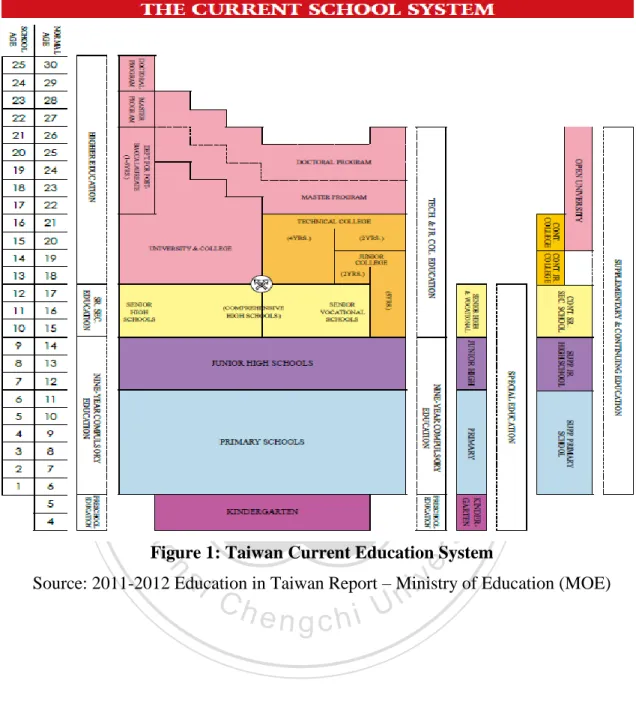
(29) •. Market Segment: Our primary competition will be American style schools; this is our high-end product and specialty.. •. Ability to grow/add/diversify B2B (upstream: franchise resource and service network) and/or B2C (downstream: company owned schools).. •. Most schools don't have a standardized special trait (Our K-12 customized curriculum, or localized specific school specialty).. •. No international players competing in the market; no international company selling an international product (specialty).. •. Mature market with established high margins.. •. National policies favor educational development (low restrictions/enforcement, high freedom).. 立. Nation has an oversupply of domestic teachers (much greater than demand in most. 學. ‧ 國. •. 政 治 大. urban areas). •. Abundant supply of foreign teachers (Taiwan is becoming a hotspot for travelers and. labor).. y. Nat. Playing catch-up (clear and decisive; up we can see the market impartially and learn. sit. •. ‧. Taiwan's most liberal foreign employment policies apply to teachers and low-cost. er. al. Professional/expert K-12 educational people could endorse the curriculum (through. n. •. io. from mistakes).. university connections).. Ch. engchi. i n U. v. •. Exposure through key partner network.. •. Starting with kindergarten gives room to play and improve.. •. Transferable skills to other emerging markets (success in Taiwan's developed market will help with China and Vietnam expansion).. •. Stable costs: stable inflation, low costs of materials, labor.. •. Economic recovery: expected increased family expenditure on education.. 3.1.4. Threats •. Established market with established competitors (both chain and sole-proprietor).. •. Financially backed competition starting to focus on specific aspects/markets (compared to us: spread thin and beginning).. 17.
(30) •. Red ocean competition (have to beat competitors; chains can afford to go head to head; price wars).. •. High switching costs: Not easy to attract/steal students from other schools.. •. Late mover disadvantage (the age of the Chain School has already begun).. •. Market growth: stagnant demand and low population growth (high kindergarten registration rate and low birth rate in Taiwan) means the only way to increase revenues is by gaining market share.. •. Our school is a new concept in the market and there is the risk of misunderstanding and lack of marketability.. • •. 治 政 大in non-urban areas. Hard to provide foreign teachers to employ schools 立 Might be deemed an Outsider (not on home turf: favoritism, political and social ties, High foreign employment turnover rate (hard to keep foreign English teachers).. 學. ‧ 國. •. national pride).. Highly regulated and difficult foreign visa and arc policies/regulations.. •. Cheap new entrants may emerge: competitor underpricing through lower costs of a. ‧. •. specific niche market.. Nat. •. Consumers finicky/judgmental.. •. Espionage/copycat: competition primarily followers and consider cost first (brand. er. n. al. Ch. development new concept).. 3.2.. sit. y. Fast growth model dependent on entrepreneurial willingness/support.. io. •. engchi. i n U. v. PEST Analysis. 3.2.1. Political Factors Taiwan: •. If the Modern Era of Taiwan begins with Martial Law under control of Sino-centric hegemonic government from 1949 to 1987, then modern day Taiwan begins in 1987 with its democratization, pluralism and liberalization initiatives.. •. Taiwan is a third wave democracy that is 30 years strong.. •. Taiwan is considered to be a highly regulated, protected, and closed country with respects to protecting industries from international competition.. •. Taiwan is undergoing a liberalization process, partly in favor of WTO admittance. 18.
(31) •. Employment laws: in favor of employers.. •. Politically stable.. •. Tax policy:. A) Corporate tax rate; low in Asia, a decrease from 25% to 17%. B) Optional tonnage tax system (as of 2011), enterprises can choose to use the regular tax system or the new tonnage tax system. C) Personal income tax varies between 5% and 40%, in general (most people) tax is between 15% and 20%. D) VAT tax is 5%. E) Securities transaction tax is 0.3%, 0.1% on shared issued by. 治 政 Trade restrictions and tariffs: simple structure大 (due to WTO standards for entry). 立 Taiwan offers reciprocal tariff rates. No countries are embargoed (Taiwan historically companies and corporate and financial bonds respectively.. 學. ‧ 國. •. follows the lead of others), but imports from China are under restriction. •. Trade restrictions and tariffs: Taiwan used to impose many trade barriers and. ‧. restrictive laws to protect its local economy, but has since (liberalized) reduced or removed a significant number of trade barriers due to international pressure.. y. Nat. Protection of intellectual property and piracy: significant improvement (expected to. sit. •. er. io. meet WTO standards). •. Minimum import/export controls, minor inspection and declaration fees.. •. Government policy historically backs local industry growth with potential. Good. n. al. Ch. engchi. i n U. v. example is the government support of the technology industry. Pro: Government development and methodology of venture capital in Taiwan, science and technology parks, investment tax incentives. Con: Government revision of investment policies and government politically-based economic policies (China). •. Government intervention: occurs. It does take place in the private sector. Either in doing/forming businesses or preventing businesses from taking action and not always for the best interests of the nation/people (either their own or business interests).. •. Freedom of speech: moderate. It is allowed, but forms of censorship exist/imposed.. •. Transparency: medium-low (good for Asia, falls short of western standards).. 19.
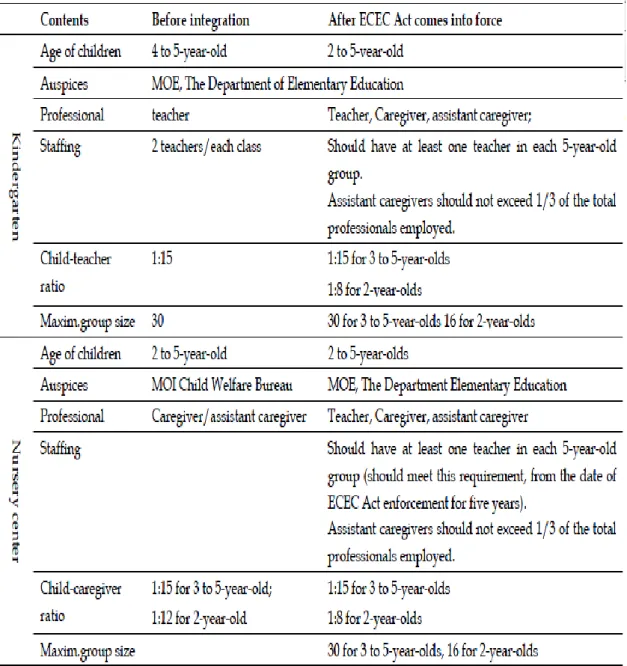
(32) •. Political scandals/corruption charges: medium-low (good for Asia, falls short of western standards).. Education: •. Education has always been an enormous political and social concern for Taiwan; the political landscape of Taiwan changed the strategic importance of education from being restricted and government operated to a free system that embraced both public and private equity.. •. Political-educational strategic importance was deemed necessary to remove Japanese. 政 治 大 international sentiments for the security of Taiwan. 立 Previous education system (prior to 1987) was based on the Chinese 1922 educational and Mainland influences and create a society based on National and western. 學. ‧ 國. •. system (adopted), but it focused on Taiwanese nationalism with strong Chinaorientation. It also included western efficiency, logic and capitalism ideals. The first major educational reform movement began in 1960 and was based on. ‧. •. western educational ideals (Theory of human capital, theory of modernization and. y. Nat. al. er. Taiwan's second educational movement in the 1990s and 2000s tried to prioritize. io. •. sit. competency-based education).. n. reasoning over mere facts, create a market mechanism (funding and privatization),. Ch. i n U. v. reduce the emphasis on central control and standardized testing. •. engchi. Two chief components of change in this second educational movement were the "Education Basic Law Act" and "Nine-year Integrated Curricula", which made education compulsory in Taiwan, is from 6 to 15 years old (9 years), and is expected extension to 18 years old by 2014. It also focused on kindergarten and Preschool education, from 2 to 6 years is not considered compulsory in Taiwan.. 20.
(33) 立. 政 治 大. ‧. ‧ 國. 學. io. sit. y. Nat. n. al. er. Figure 1: Taiwan Current Education System. i n U. v. Source: 2011-2012 Education in Taiwan Report – Ministry of Education (MOE). Ch. engchi. 21.
(34) Table 1: Summary of Education at All Levels in the Current School System Source: 2011-2012 Education in Taiwan Report – Ministry of Education (MOE). 立. 政 治 大. ‧. ‧ 國. 學. n. al. er. io. sit. y. Nat. •. Ch. i n U. v. Of extreme political importance to language and cram schools in this second. engchi. educational movement were the measures taken for promoting "educational internationalization", which brought about the importance of language acquisition through the inclusion of English courses in primary schools and the "schemes of basic competency tests" that promoted competition for high school and university admittance. •. A side effect of the government's "educational internationalization" efforts that helps language and cram schools is the ability to attract foreigners needed to fill teacher positions. This was done by making Taiwan more attractive to foreign students and exchange students through instituting systems of transfer of credits between universities, creating inter-university and international programs, enhancing budget for inviting foreign visiting scholars and assisting students to study abroad, etc.. 22.
(35) Table 2: The Increase of Overseas Students in Taiwan Source: 2011-2012 Education in Taiwan Report – Ministry of Education (MOE). 立. 政 治 大. ‧. ‧ 國. 學 er. io. sit. y. Nat. al. n. v i n C hand Care Act” passed A recent “Early Education e n g c h i U in 2011 that took effect in 2012. •. called for a loosening of regulations in the field of early education and childhood as. described by the 1981 "Preschool Education Act". The following are the main changes in the Act:. 23.
(36) Table 3: Impact of the ECEC Act: Source: Child Care Friendly Policies and Integration of ECEC in Taiwan - International Journal of Child Care and Education Policy 2011, Vol.5, No.2, 1-19. 立. 政 治 大. ‧. ‧ 國. 學. n. er. io. sit. y. Nat. al. Ch. engchi. 24. i n U. v.
(37) Table 4: Number of Students per Teacher at All Levels Source: 2011-2012 Education in Taiwan Report – Ministry of Education (MOE). 立. 政 治 大. ‧. ‧ 國. 學. al. er. io. sit. y. Nat. Education is now western orientated (no political or religious affiliations) with free. n. •. Ch. i n U. v. market principals and competition to promote quality assurance (under government. engchi. guidance). The aim is to conform to international standards to make exchange (personnel and intellectual) easier. Government no longer appoints (all chief) educational positions (left to councils and governing bodies), teaching is now a profession and freedom exists for curriculum development and implementation within the framework. •. One side-effect of privatizing education (seen in Taiwan) is that the entrepreneurial spirit often chooses money and the bottom line over doing the right thing. Education is a pure subject and can be poisoned by business sense.. 25.
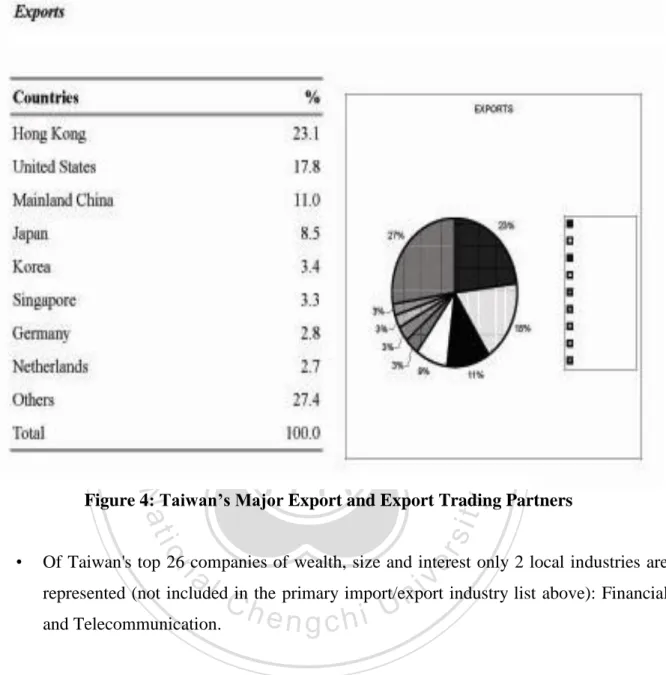
(38) 3.2.2. Economic Factors Taiwan: •. Taiwan is characterized as a newly industrialized economy. Its outlook is stable and has a double A credit (domestic and foreign) rating with Standard & Poor's.. •. Taiwan operates with a substantial trade surplus and is the 4th largest foreign reserve holder.. •. Taiwan GDP: $470 Billion in 2012 (PPP: $890 Billion in 2012) with 3.59% expected growth for 2013.. •. Taiwan Informal Economy $61.6 Billion USD, 19.6% GNP (in 2000). •. Economic breakup by sector in GDP is: tertiary (69.2%), secondary (29.2%), and. 立. primary (1.6%).. Taiwan suffers from a lack of diplomatic relations with its trading partners (and the. 學. ‧ 國. •. 政 治 大. rest of the world).. The NTD dollar floats; it is not peg to the U.S dollar (market value).. •. Exchange rate determined by the market, except in times of excess volatility and. ‧. •. disorderly moments then it is artificially controlled by the government (Taiwan is. y. Nat. er. Inflation is low; 1.93% in 2012 and is expected to drop to 1.37% in 2013. The. io. •. sit. sensitive to exchange rate due to reliance on import/export).. al. v i n growing 1.25%. The rise C mainly affects food and clothing products and is expected to hengchi U be low due to falling international commodity prices and the 2012 fuel and electricity n. Consumer Price Index (CPI) in early 2013 has averaged 2.05% with core inflation. and price hikes. •. Low interest rates and loose monetary environment; Taiwan's financial sector is fragmented. Low interest rates with TAIBOR around 0.9%. A good indicator of cheap funding available for businesses.. •. Taiwan utilities are artificially low; subsidized by the government.. •. Taiwan's unemployment rate is low; in 2012 was around 4.18%, which is down and decreasing from 2009 peak of more than 6%.. •. Customer Purchasing Power is considered low.. •. Taiwan is primarily an export orientated economy with the key industry being machinery and electronic equipment (60.1% exports, 51.5% imports).. 26.
(39) Taiwan's economy has shifted from labor-intensive industries to knowledge-based and capital-intensive industries.. Table 5: General Demographic Information Source: 2011-2012 Education in Taiwan Report – Ministry of Education (MOE). 立. 政 治 大. 學 ‧. ‧ 國 io. sit. y. Nat. n. al. er. •. Ch. engchi. 27. i n U. v.
(40) 立. 政 治 大. ‧. ‧ 國. 學. n. er. io. sit. y. Nat. al. Ch. engchi. i n U. v. Figure 2: Taiwan's Exports and Imports by Key Industry: Source: Shay & Company – Doing Business in Taiwan 2010, Demographic and statistics report pg. 16. 28.
(41) •. Investment opportunities in Taiwan, prime industries for potential investment are: A) Semi-Conductors B) Opto-Electronics C) Precision Machinery and Instrumentation D) Metals E) Computers and Communication Equipment F) Electrical Products G) Aviation and Automotive H) Biomedical and Pharmaceuticals. 立. 政 治 大. ‧. ‧ 國. 學. n. er. io. sit. y. Nat. al. Ch. engchi. i n U. v. Figure 3: Taiwan’s Major Import and Export Trading Partners Source: Shay & Company – Doing Business in Taiwan 2010, Demographic and statistics report pg. 14. 29.
(42) 立. 政 治 大. ‧. ‧ 國. 學. Nat. sit er. io. Of Taiwan's top 26 companies of wealth, size and interest only 2 local industries are. al. n. •. y. Figure 4: Taiwan’s Major Export and Export Trading Partners. Ch. i n U. v. represented (not included in the primary import/export industry list above): Financial and Telecommunication.. engchi. 30.
(43) Table 6: The top 26 Companies in Taiwan’s According to Wealth, Size and Interest. 立. ‧ 國. 學. The past decade has seen a hollowing out of Taiwan's manufacturing industries both. ‧. •. 政 治 大. by foreign direct investments and local enterprises on the move to China. This has. sit. y. Nat. changed the economic landscape of the country; slowed Taiwan's movement up the. io. •. er. value added ladder stagnating economic areas in order to compete. Taiwan's size of 20 million is too small to be self-supportive in the global economy. n. al. i n U. v. (compared to Indonesia and South Korea). Explaining the lack of MNC and primarily. Ch. engchi. SME nature of the island attributing the hollowing out. •. OVERALL: Taiwan’s economic situation has been stable in the recent years (GDP growth of 10.72% in 2010, 4.04% in 2011, and 3.85 in 2012 and forecasted growth of 3.59% in 2013). However, affected by the unstable situation in Europe and the United States and the negative data about the Chinese prospects.. Education: •. The government fully endorses educational reform and backs it commitment through funding.. •. Education expenditure: 5.84% of GDP (2011), which is roughly $802 billion NTD ($27 billion USD).. 31.
數據

+7


相關文件
Middle school transition stress: Links with academic performance, motivation, and school experience.. Self-Concept
Recommended Approach for Setting Regulatory Risk-Based Capital Requirements for Variable Annuities and Similar Products with Guarantees (Excluding Index Guarantees), American Academy
• elearning pilot scheme (Four True Light Schools): WIFI construction, iPad procurement, elearning school visit and teacher training, English starts the elearning lesson.. 2012 •
maintenance and repair works should be carried out by school and her maintenance agent(s) to rectify defect(s) as identified in routine and regular inspections. Examples of works
Conversations Learning Journal Chart: Change & Strategic Thinking Date
A system is said to be in stable equilibrium if, when displaced from equilibrium, it experiences a net force or torque in a direction opposite to the direction of the displacement..
Kolb (2005), “Learning styles and learning spaces: Enhancing experiential learning in higher education”, Academy of Management Learning & Education,
The academic achievement of math of high-grade elementary school students is significant related to their SES and the self-concept in math, but is non-related to their
