Magnetoelectronic and optical properties of carbon nanotubes
F. L. Shyu,1C. P. Chang,2 R. B. Chen,3 C. W. Chiu,4 and M. F. Lin4 1Department of Physics, Chinese Military Academy, Kaohsiung, Taiwan 830, The Republic of China
2Center for General Education, Tainan Woman’s College of Art and Technology, Tainan, Taiwan 71002, The Republic of China 3Department of Electrical Engineering, Cheng Shiu Institute Technology, Kaohsiung, Taiwan 842, The Republic of China
4Department of Physics, National Cheng Kung University, Tainan, Taiwan 701, The Republic of China 共Received 23 July 2002; published 17 January 2003兲
Magnetoelectronic and optical properties of carbon nanotubes are, respectively, studied within the s p3 tight-binding model and the gradient approximation. They strongly depend on the magnitude and the direction of the magnetic field, the nanotube geometry共radius and chiral angle兲, and the Zeeman splitting. The magnetic field would lead to the change of energy gap, the destruction of state degeneracy, and the coupling of different angular momenta. Hence there are magnetic-field-dependent absorption frequencies and more absorption peaks. The types of carbon nanotubes predominate in the band structure and thus the range of absorption frequencies and the number of absorption peaks. The Zeeman splitting makes the semiconductor-metal tran-sition occur at lower magnetic flux. It metalizes armchair carbon nanotubes in the presence of the perpendicular magnetic field. However, it does not affect the optical excitations except for metallic carbon nanotubes. DOI: 10.1103/PhysRevB.67.045405 PACS number共s兲: 78.66.⫺w, 73.20.Mf
I. INTRODUCTION
Carbon nanotubes have prompted a lot of studies since their discovery by Iijima1 in 1991, such as electronic structures2–16 and optical properties.17–29A single-wall car-bon nanotube is a rolled-up graphite sheet,6 the structure of which is thus fully specified by a two-dimensional共2D兲 lat-tice vector Rx⫽ma1⫹na2, where a1 and a2 are primitive lattice vectors of a graphite sheet. The radius and the chiral angle of a 共m, n兲 carbon nanotube are, respectively, Rd
⫽兩Rx兩/2⫽b
冑
3(m2⫹mn⫹n2)/2 and ⫽tan⫺1关⫺)n/(2m⫹n)兴. b⫽1.42 Å is the C-C bond length. A
car-bon nanotube is a semiconductor or a metal, which depends on both radius and chirality.2– 8 The electronic structure is strongly affected by the magnetic field.10–16The optical ex-citations directly reflect its characteristics. In this work, the
s p3 tight-binding model with the curvature effects is utilized to calculate the magnetoelectronic structure. Furthermore, the magneto-optical properties are studied by means of evaluating the optical-absorption function. The dependence on the nanotube geometry (Rd and兲, the direction and the magnitude of the magnetic field, and the Zeeman splitting are investigated.
There are three types of carbon nanotubes according to their energy gaps (Eg’s).5– 6,8 –9A共m, n兲 carbon nanotube is
共I兲 a gapless metal for m⫽n, 共II兲 a narrow-gap
semiconduc-tor for m⫽n and 2m⫹n⫽3I 共I is an integer兲, and 共III兲 a moderate-gap semiconductor for 2m⫹n⫽3I. Energy gaps are, respectively, inversely proportional to Rd2 and Rd for type-II and type-III carbon nanotubes. From the s p3 (2 pz)
8 tight-binding model,9 energy gaps of type-II carbon nano-tubes are given by the approximate relation Eg ⯝5␥0b2cos 3/16Rd
2
(3␥0b2cos 3/16Rd 2
; ⫺␥0 is the nearest-neighbor resonance integral of 2 pz orbitals兲. This model includes the curvature effects, the misorientation of
p orbitals, as well as the mixing of p and s p2 orbitals. The predicted energy gaps are successful for understanding
the experimental measurements of the low-frequency optical-absorption spectra (⬍0.1␥0).
20
Each carbon nano-tube has many 1D parabolic subbands except that the sub-bands nearest to the Fermi level (EF⫽0) in an armchair 共m,
m兲 nanotube are linear. That is to say, all subbands have
divergent density of states 共DOS兲 in 1/
冑
E form except thefinite DOS of the linear subbands. The 1D van Hove singu-larities共vHs兲 in the DOS would play an important role on the optical-absorption spectra.
Electronic structures in the presence of the magnetic field are studied within the effective-mass approximation10 and the tight-binding model.11–18The magnetic field would affect energy dispersions and energy gaps. Furthermore, it leads to the oscillatory behavior. Electronic structures exhibit the pe-riodical Aharonov-Bohm 共AB兲 oscillations with a period
0⫽hc/e, if the magnetic field is parallel to the nanotube axis and the Zeeman splitting is neglected. The AB effect can be identified in the magnetophysical properties, e.g., magnetoresistance.17–18Only 2 pz orbitals are taken into ac-count in the above-mentioned studies. The s p3tight-binding model, with the curvature effects and the Zeeman splitting, can reveal more detailed electronic properties.
There have been some experimental studies on the optical excitation spectra.19–25 These measurements show that the absorption spectra exhibit rich absorption peaks, owing to the 1D vHs. Such prominent peaks are determined by radius and chiral angle. For example, the first absorption peak, re-spectively, occurs at 10–20 meV 共Ref. 22兲 and 0.5–0.7 eV
共Refs. 20–21 and 23–25兲 for type-II and type-III carbon
nanotubes with Rd⬃6 – 7 Å. The theoretical studies are mainly focused on the -electronic optical excitations.26 –32 They could explain the experimental results, such as the first absorption peak9,31–32 and the special absorption peak at 2␥0.31–32 The magneto-optical-absorption spectra are pre-dicted to exhibit the periodical AB oscillations and depend on the direction of electric polarization and magnetic field.26 –27
We use the s p3tight-binding model to calculate the
netoenergy bands and the gradient approximation33to evalu-ate the magneto-optical-absorption function. Comparison with the previous studies10–16;26 –27 is also made. Our study shows that electronic properties are very sensitive to changes in the magnitude and the direction of the magnetic field, the nanotube geometry共radius and chiral angle兲, and the Zeeman splitting. The magnetic field would induce the change of en-ergy gap, the destruction of state degeneracy, and the cou-pling of different angular momenta. Such effects are directly reflected in the optical excitations. There are magnetic-field-dependent absorption frequencies and more absorption peaks. The low-energy electronic structures are mainly deter-mined by the types of carbon nanotubes, and so do the range of absorption frequencies and the number of absorption peaks. The Zeeman splitting could reduce the energy gap and destroy the periodicity of the AB oscillations. It thoroughly metalizes armchair carbon nanotubes when the magnetic field is perpendicular to the nanotube axis. On the other hand, the Zeeman splitting hardly affects the optical excita-tions except for metallic carbon nanotubes.
This paper is organized as follows. The magnetoelectronic structures are calculated from the s p3 tight-binding model. The magnetic-field-dependent energy gap is studied in Sec. II. The gradient approximation33 is used to evaluate the optical-absorption function. The calculated magneto-optical spectra are discussed in Sec. III. Finally, Sec. IV contains the concluding remarks.
II. MAGNETOELECTRONIC PROPERTIES
We first see the s p3tight-binding model in the absence of the magnetic field. The number of carbon atoms in a primi-tive unit cell is Nu⫽4
冑
(m2⫹mn⫹n2)( p2⫹pq⫹q2)/3. 共p,q兲 corresponds to the primitive vector perpendicular to the
vector of共m, n兲. As a result of the periodical boundary con-dition along the azimuthal direction, band structures without the magnetic field only involve two independent atoms, A and B. The calculations of band structure are similar to those done for a graphite sheet. The Hamiltonian is described by a 8⫻8 Hermitian matrix. According to A atom and B atom, it can be decomposed into four block matrices:
HAi,A j共k兲⫽HBi,B j共k兲⫽Ei␦i j,
HAi,B j⫽
兺
l⫽1,2,3 hi j共l兲exp关ik•共rl⫺rA兲兴, HBi,A j⫽兺
l⬘⫽1,2,3 hi j共l⬘兲exp关ik•共rl⬘⫺rB兲兴. 共1兲 Each block matrix is a 4⫻4 matrix. i represents the basis states of s and p orbitals. rA and rB are, respectively, posi-tional vectors for the A atom and the B atom. The nearest-neighbor atom is at rl. The cylindrical coordinates (r,⌽,z) are convenient in taking into account the curvature effects. rA⫽(Rd,0,0) and rl⫽(Rd,⌽l,zl). ⌽l’s and zl’s for the three nearest-neighbor atoms are ⌽1⫽⫺b cos(/6⫺)/Rd,⌽2⫽b cos(/6⫹)/Rd, ⌽3⫽b cos(/2⫺)/Rd, z1
⫽⫺b sin(/6⫺), z2⫽⫺b cos(/3⫺), and z3⫽b cos(),
respectively. Similar results are obtained for rB and rl⬘. The matrix elements hi j(l)’s in Eq.共1兲 are given by
hrr共l兲⫽Vp pcos⌽l⫹4共Vp p⫺Vp p兲sin4共⌽l/2兲Rd 2 /b2, hr共l兲⌽⫽Vp psin⌽l⫺4共Vp p ⫺Vp p兲sin3共⌽l/2兲cos共⌽l/2兲Rd 2 /b2, h⌽⌽共l兲 ⫽Vp pcos⌽l⫺共Vp p⫺Vp p兲sin2共⌽ l兲Rd 2/b2, hrz共l兲⫽⫺2共Vp p⫺Vp p兲sin2共⌽ l/2兲Rdzl/b2, h⌽z共l兲⫽⫺共Vp p⫺Vp p兲sin共⌽l兲Rdzl/b2, hzz共l兲⫽Vp p⫺共Vp p⫺Vp p兲zl 2 /b2, hsr共l兲⫽⫺2Vs psin2共⌽l/2兲Rd/b, hs共l兲⌽⫽Vs psin共⌽l兲Rd/b, hsz共l兲⫽Vs pzl/b, h共l兲ss⫽Vss. 共2兲 hz(l)⌽⫽h⌽z(l), h⌽r(l)⫽⫺hr(l)⌽, hzr(l)⫽⫺hrz(l), hrs(l)⫽hsr(l), h⌽s(l) ⫽⫺hs⌽ (l); h zs (l)⫽⫺h sz
(l). The suffixes s, r, ⌽, and z are, re-spectively, s, p( pz), p1, and p2. hrr (l) (hr⌽ (l) and hrz (l) ) is related to the misorientation of p orbitals 共the mixing of
p and s p2 orbitals兲.9The tight-binding parameters are as follows.7 The s orbital energy is Es⫽⫺7.3 eV below the triply degenerate p orbitals taken as the zero of energy (Ep
⫽0). The Slater-Koster hopping parameters for the
nearest-neighboring pairs are Vss⫽⫺4.30 eV, Vs p⫽4.98 eV,
Vp p⫽6.38 eV, and Vp p⫽⫺2.66 eV (⫽⫺␥0). Electronic states are characterized by the angular momentum J (⫽kxRd⫽1,2,...Nu/2) and the longitudinal wave vector kz (⫺⭐kzRz⭐). The discrete J’s come from the periodical boundary condition. Rz⫽b
冑
3( p2⫹pq⫹q2) is the periodical distance along the nanotube axis.When a carbon nanotube is threaded by a uniform mag-netic field along the nanotube axis, the angular momentum changes from J into J⫹/0. The magnetic flux is
⫽Rd2B. The angular momentum keeps decoupled; that is, J
is still a good quantum number. But on the other hand, the different J’s would couple one another as the magnetic field deviates from the nanotube axis. The angle between the mag-netic field and the tube axis is assumed to be ␣, i.e., B
⫽B cos␣zˆ⫹B sin␣⌽ˆ⫽B储zˆ⫹B⬜⌽ˆ. The parallel magnetic filed (B储) induces the shift关kx→kx⫹cos(␣)/(oRd)兴, and the perpendicular magnetic field (B⬜) leads to the coupling of different J’s or kx’s. For B⬜, the total carbon atoms in a primitive cell are included in the band-structure calculations. The vector potential in the presence of B⬜is chosen as
A⫽RdB⬜sin
冉
x Rd
冊
where x⫽Rd⌽. A is independent of z, so the axial wave vector kzremains a good quantum number. The dependence on x means that the different kx’s or J’s are no longer decoupled.10–15All the kx’s need to be taken into account in the Hamiltonian matrix simultaneously. The vector potential will induce a phase factor GR⫽兰RrA(D)•dD in the tight-binding function. Now, each Hamiltonian block matrix in Eq.
共1兲 changes from a 4⫻4 matrix into a 2Nu⫻2Nu matrix.
The Hamiltonian matrix element between site A with kxstate and site B with kx
⬘
state is given by具
⌽k x ⬘ B j 兩H兩⌽kx Ai典
⫽2hi j Nu兺
RA兺
RBe⫺i⌬kxxe⫺i共kx⬘⫹ cos ␣/0Rd兲⌬x
⫻e⫺ikz⌬zei共e/ប兲⌬G, 共4兲
where the phase difference due to B⬜is
⌬G⫽GRA⫺GRB⫽ ⌬z sin␣ ⌬x
冉
cos x Rd ⫺cosx⫹⌬x Rd冊
, ⌬x⫽0, ⫽⌬z sinR ␣ d sin x Rd , ⌬x⫽0. 共5兲 RA⫽(x,z), RB⫽(x⬘
,z⬘
), and ⌬R⫽RB⫺RA⫽(⌬x,⌬z).The effect of B储 is added in Eq. 共4兲. The other three block
matrices have the similar formula. The 4Nu⫻4Nu Hamil-tonian matrix is thus constructed for any field direction.
By diagonalizing the Hamiltonian, we obtain energy dis-persion Ec,(J,k
z,) and wave function⌿c,(J,kz,). The superscriptsand c, respectively, represent the occupied va-lence bands and the unoccupied conduction bands. At ␣
⫽0° (␣⫽0°), the wave function is the linear combination
of the 4Nu共8兲 tight-binding functions, and it is composed of the different J’s共the same J兲. Although there exists the cou-pling of angular momenta, the wave function is principally dominated by J at ⬍0/3. For simplicity, wave function and energy dispersion are denoted as a function of J. The magnetostate energy is the sum of the band energy plus the spin-B interaction energy, i.e., Ec,(J,kz;,)
⫽Ec,(J,k
z;)⫹E(,). E(,)⫽g/m*Rd 2
0. The g factor is taken to be the same as that共⬃2兲 of the pure graph-ite.⫽⫾1/2 is the electron spin and m*is the bare electron mass. The Zeeman splitting would lead to the rigid shift for the spin-up and spin-down states. It is neglected except that it has to be specially emphasized. For example, the Zeeman splitting affects the absorption spectra only when carbon nanotubes are gapless metals. The number of the total carri-ers is fixed during the variation of . Thedependence of the Fermi level is examined to be very weak, i.e., EF()
⯝0.
Three types of carbon nanotubes, the type-I共10, 10兲 nano-tube, the type-II 共18, 0兲 nanotube, and the type-III 共17, 0兲 nanotube, are chosen for a model study. They have the nearly same radii. We first see the type-I 共10, 10兲 nanotube. The low-energy magnetoband structures, without E(,), are shown in Fig. 1共a兲. There are linear bands intersecting at the
Fermi level in the absence of magnetic flux. The 共10, 10兲 nanotube is a gapless metal at⫽0. The nondegenerate lin-ear bands, which are described by J⫽Nu/4⫽10, exist at
kzRz⬃⫾2/3. The magnetic flux would make the linear bands change into the parabolic bands. It causes an energy gap and a blue shift in the wave vector of the band-edge state. A similar shift could also be found in nonzigzag carbon nanotubes (m⫽0). The magnetic flux affects the state de-generacy. Energy bands of J and Nu/2⫺J are doubly degen-erate except for those of J⫽Nu/4 and J⫽Nu/2. The effects of on J and Nu/2⫺J are different, which thus leads to the destruction of the double degeneracy关Fig. 4共a兲兴. The above-mentioned effects due to the magnetic flux are relatively prominent, when the direction of the magnetic field ap-proaches the nanotube axis. The magnetic flux at␣⫽0° also induces the coupling of different J’s. Such coupling is strong only at largeand␣. It is weak for the type-I共10, 10兲 nanotube at ⫽0/12; therefore each energy band is ap-proximately described by the decoupled angular momentum. The variation of energy gap with magnetic flux deserves a closer investigation. Figure 1共b兲 presents the magnetic-flux-dependent energy gap for the type-I 共10, 10兲 nanotube at
⭐0/3 and different␣’s. Eg, without the Zeeman splitting, increases withmonotonously except at large␣. The
oscil-FIG. 1. 共a兲 The energy bands nearest to the Fermi level are shown for the type-I 共10, 10兲 nanotube at⫽0/12 and different
␣’s, and ⫽0. 共b兲 The magnetic-flux-dependent energy gaps are calculated at different ␣’s. The solid and dashed curves, respec-tively, correspond to those without and with the spin-B interactions. Also shown in the insets are the detailed results at ␣⫽90°. The several identical curves are plotted from␣⫽0° to ␣⫽90°.
latory behavior exists at large ␣, e.g., at␣⫽90°. It is asso-ciated with the oscillatory feature of the phase difference⌬G in the Hamiltonian matrix element关Eq. 共4兲兴.14 Eg decreases in the increasing of ␣. This result means that energy gap is comparatively easily modulated by the parallel magnetic field. Eg changes from zero into a finite value at vanishing magnetic flux; that is, the metal-semiconductor transition
共MST兲 happens atMST⫽0. Such transition occurs more fre-quently at large␣. The spin-B interaction causes the splitting of the spin-up and spin-down states and thus reduces energy gap. It metalizes the 共10, 10兲 nanotube at any magnetic flux for sufficiently large ␣ 共⬎81°兲, since the double spB in-teraction energy 关2/m*Rd20兴 is in excess of energy gap due to the magnetic field. All type-I armchair nanotubes ex-hibit the metalization behavior in the presence of the perpen-dicular magnetic field, mainly owing to the Zeeman splitting. The metallic carbon nanotubes have free carriers, so they are expected to own the low-frequency collective excitations.35 This problem is under current investigation.
At ⫽0, the type-II 共18, 0兲 nanotube has parabolic en-ergy dispersions near the Fermi level and a small enen-ergy gap, as shown in Fig. 2共a兲. The curvature effects are the main cause.9The two parabolic bands correspond to J⫽12 and J
⫽24. The double degeneracy is clearly destroyed by the
magnetic flux. However, the band-edge state keeps at kz⫽0 during the variation of . The energy gap, as shown in Fig. 2共b兲, decreases asgradually grows. Eg without the spin-B interaction vanishes at small MST, where energy
disper-sions are linear. The main effects of the Zeeman splitting are to reduce MSTand metalize the type-II nanotubes at suffi-ciently large␣and. There are three important differences between type-I carbon nanotubes and type-II carbon nano-tubes 共or type-III carbon nanotubes兲. They include the de-struction of the double degeneracy for the energy bands near-est to the Fermi level, the dependence of the band-edge state on, and the zero or nonzeroMST.
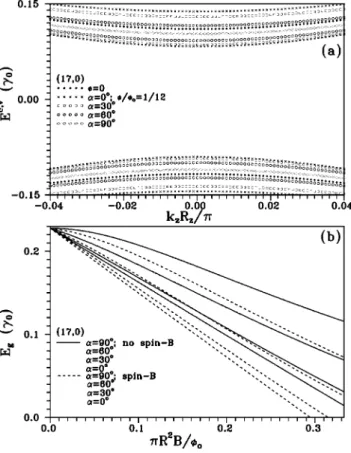
The magnetoband structures of the type-III 共17, 0兲 nano-tube are shown in Fig. 3共a兲. It has a large energy gap in the absence of. The magnetic flux leads to the splitting of the doubly degenerate energy bands, but not the shift of the kz
⫽0 band edge. It could effectively reduce the energy gap, as
shown in Fig. 3共b兲. Eg decreases withmonotonously even at large ␣. The oscillatory dependence, as seen in type-I and type-II carbon nanotubes at large␣关Figs. 1共b兲 and 2共b兲兴, is not present. The MST of the type-III carbon nanotubes happens atMST⬃0/3. However, for all carbon nanotubes, the variation of Egwithis relatively quick at small␣. The above-mentioned magnetoenergy gap can be directly verified by scanning tunneling spectroscopy,36 –38 transport measurements,39and optical-absorption spectroscopy.19–25
Our study is compared with the previous studies. From the s p3tight-binding model, thedependence of the energy gap is different for type-I, type-II, and type-III carbon nano-tubes关Figs. 1共b兲, 2共b兲, and 3共b兲兴. Energy gaps of type-I car-bon nanotubes grow in the slow increasing of , while the opposite is true for type-II carbon nanotubes. Such difference
FIG. 2. Same plot as Fig. 1, but shown for the type-II共18, 0兲 nanotube. The several identical curves in 共b兲 are plotted from␣
⫽0° to␣⫽90°.
FIG. 3. Same plot as Fig. 1, but shown for the type-III共17, 0兲 nanotube. The several identical curves in 共b兲 are plotted from␣
mainly comes from the curvature effects.9It cannot be found in the 2 pz tight-binding calculations.16,13An energy gap at
→0 would determine whether carbon nanotubes are para-magnetic or diapara-magnetic.11,12 The curvature effects might dominate over magnetic properties of type-II carbon nano-tubes. A simple relation between the nanotube radius and the
-dependent energy gap is examined. The previous study by Lu16 shows that Eg() is inversely proportional to Rd for any field direction. However, there is no simple relation in another study by Ajiki and Ando.13This work is consistent with the latter. For the perpendicular magnetic field, the Zee-man splitting can thoroughly metalize type-I carbon nano-tubes. It is very important in clarifying the low-energy physi-cal properties, such as magnetoplasmons and magnetization.
The metalization behavior is absent in the previous studies. The spin-B interaction energy increases with magnetic field linearly. The Zeeman splitting apparently destroys the peri-odical AB oscillations in electronic10,16 and optical properties.26 –27
III. MAGNETO-OPTICAL SPECTRA
The above-mentioned features of the magnetoband struc-tures will be directly reflected in the optical excitations. At
T⫽0, electrons are excited from the occupied valence bands
to the unoccupied conduction bands. The magneto-optical-absorption function of the 共m, n兲 carbon nanotube is given by34 A共;兲⬀
兺
J,J⬘冕
1stBZ dkz 2 •冏
具
⌿c共J⬘
,k z;兲兩 Eˆ•P me兩⌿ 共J,k z;兲典
冏
2 c2共J,J⬘
,kz;兲 •冉
⌫ 关⫺c共J,J⬘
,kz;兲兴2⫹⌫2 ⫺关⫹ ⌫ c共J,J⬘
,kz;兲兴2⫹⌫2冊
. 共6兲c(J,J
⬘
,kz;)⫽Ec(J⬘
,kz;)⫺E(J,kz;) is the inter-band excitation energy. ⌫(⫽0.001␥0) is the energy width from various deexcitation mechanisms. The square of the velocity matrix element in Eq. 共6兲 is evaluated within the gradient approximation.33 The electric polarization is as-sumed to be parallel to the nanotube axis. There exist two selection rules for the optical excitations that greatly simplify the calculations.26 –32 One is that ⌬kz⫽0 in Eq. 共6兲, which follows from the fact that for photons in the long-wavelength limit the initial- and final-state wave vectors are the same. Another is that the angular momentum is conserved during the vertical transitions. The wave function has 4Nu compo-nents made up of different J’s. Eight compocompo-nents, which correspond to a definite J, are treated as an entity. ⌬J⫽0 means that the optical excitations from ⌿ to ⌿c for the components with the same J are allowed.The Zeeman splitting is included in the calculations. It does not affect the low-frequency absorption spectra, when carbon nanotubes are semiconducting. That only the optical excitations from the same spin states are effective is respon-sible for this result. However, the Zeeman splitting in metal-lic carbon nanotubes can alter electron distribution and thus optical excitations. In short, the Zeeman splitting has to be taken into account in determining whether carbon nanotubes are semiconducting or metallic. For semiconducting carbon nanotubes, the optical excitation spectra, with and without the Zeeman splitting, are identical to each other.
DOS, which is associated with the number of excitation channels, is useful in explaining the optical-absorption spec-tra. It is defined as D共;兲⫽2
兺
J,h⫽c,冕
1stBZ dkz 2 ⌫ 关⫺Eh共J,k z;兲兴2⫹⌫2 . 共7兲DOS of the type-I 共10, 10兲 nanotube, without the Zeeman splitting, is shown in Fig. 4共a兲 at␣⫽0° and various’s. At
⫽0, the low-energy pleatau is due to the linear bands. The
asymmetric peaks 共vHs兲 at higher energy come from the doubly degenerate parabolic bands. The magnetic flux changes the linear energy dispersions and destroys the double degeneracy. Hence there are two new peaks at low energy and double peaks at others. The energy spacing (s) between the two neighboring peaks is widened as in-creases. DOS of the low-energy peaks is enhanced by , since the parabolic bands nearest to the Fermi level become comparatively flat共or have smaller curvatures兲. The peaks at negative energy are approximately symmetric to those at positive energy, about the Fermi level. Furthermore, the metric two peaks have the same J. Also notice that the sym-metry of band structure is somewhat destroyed by the mixing of the p and s p2 orbitals. Tunneling spectroscopy mea-surements can be used to check the asymmetric peaks in DOS.38
The vanishing velocity matrix prevents the optical excita-tions from the occupied linear band to the unoccupied linear band.26,31 The threshold interband excitations of the type-I
共10, 10兲 nanotube do not exist at⫽0, as shown in Fig. 4共b兲.
The second absorption peak, which occurs at 2⬃0.62␥0, results from the second energy bands close to the Fermi level
关Fig. 4共a兲兴. Each energy band is described by a single angular
excitations between the band-edge states of the two parabolic bands with the same J produce the asymmetric absorption peaks. These peaks are divergent in the square-root form at
⌫→0, mainly owing to the vHs in the conduction and
va-lence bands. For the first absorption peak, its frequency (1) is energy gap without the spin-B interaction, but not that with the spin-B interaction关Fig. 1共b兲兴. Both frequency and inten-sity increase as grows. The enhancement of intensity is caused by the less dispersive parabolic bands. The magnetic flux also leads to double absorption peaks at higher fre-quency.
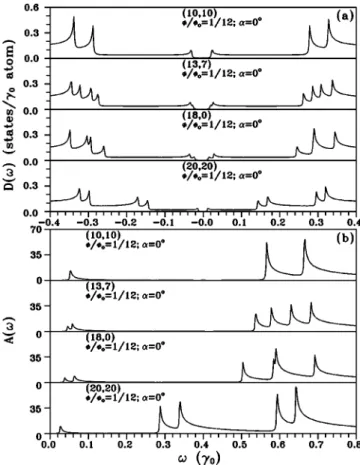
The nanotube geometry affects band structures and thus absorption peaks. Figure 5共a兲 shows DOS for different car-bon nanotubes at⫽0/12 and␣⫽0°. The type-I 共10, 10兲 nanotube, the type-II共13, 7兲 nanotube, and the type-II 共18, 0兲 nanotube have the different chiral angles. Their DOS’s ex-hibit asymmetric peaks at 兩兩⬍0.05␥0 and 0.25␥0⬍兩兩
⬍0.35␥0. That is to say, the energy range of peaks is the same for type-I and type-II carbon nanotubes. On the other hand, the differences in DOS’s are mainly determined by armchair or nonarmchair structures (⫽⫺30° or others兲. Armchair nanotubes have half the peaks compared with non-armchair nanotubes. This result could be understood from the simple zone folding model.31 Moreover, the DOS is higher for the former. Armchair nanotubes thus exhibit fewer but stronger absorption peaks 关Fig. 5共b兲兴. The number of interband excitation channels is proportional to the nanotube radius or the number of 1D subbands, as shown in Fig. 5共a兲
for the type-I 共20, 20兲 and 共10, 10兲 nanotubes. The large nanotubes have more absorption peaks and lower threshold frequency关Fig. 5共b兲兴. As for the energy spacing between the two neighboring peaks, s decreases in the increasing of radius or chiral angle.
The direction of the magnetic field plays an important role on electronic and optical properties. DOS of the type-I 共10, 10兲 nanotube is shown in Fig. 6共a兲 at⫽0/12 and different
␣’s. The main effect of B储 is to induce the subband splitting except for the two energy bands near EF. The larger B储 is 共the smaller␣is兲, the wider the energy spacing between the two neighboring peaks is. The coupling of different J’s due to B⬜is negligible at⫽0/12. Only the optical excitations from the symmetric energy bands produce the strong absorp-tion peaks, as shown in Fig. 6共b兲. To get the additional ab-sorption peaks, the magnetic flux needs to be sufficiently high, e.g.,⫽0/3. At␣⫽90°, the perpendicular magnetic field hardly affects the state degeneracy. There are fewer ab-sorption peaks. It is very special that the first abab-sorption peak is absent. The main reasons are as follows. The energy bands nearest to the Fermi level are linear except at the neighbor-hood of band edges关Fig. 6共a兲兴. The Zeeman splitting makes the 共10, 10兲 nanotube metallic, so there are no allowable optical excitations from the band-edge states with the differ-ent spin states. Moreover, the linear energy dispersions, as discussed earlier, have no contributions to absorption spectra. In addition, the type-II 共18, 0兲 nanotube exhibits the similar
FIG. 4. 共a兲 Density of states of the type-I 共10, 10兲 nanotube at ␣⫽0° and different ’s. The corresponding absorption spectra are shown in共b兲.
FIG. 5. Same plot as Fig. 4, but shown for type-I and type-II carbon nanotubes at⫽0/12 and␣⫽0°.
DOS and A() except that the first absorption peak is present at␣⫽90° and⫽0/12关Fig. 8共b兲兴.
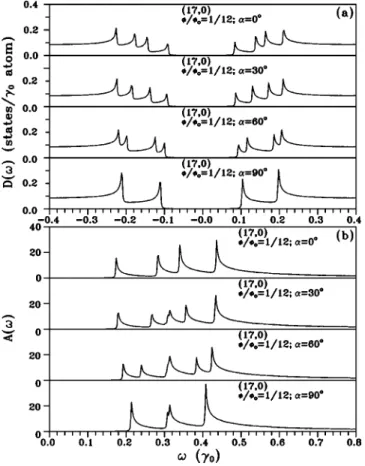
DOS of the type-III共17, 0兲 nanotube exhibits eight peaks at 0.08␥0⬍兩兩⬍0.22␥0, as shown in Fig. 7共a兲. As a result, at⫽0°, the symmetric conduction and valence bands yield four absorption peaks at 0.16␥0⬍⬍0.44␥0 关Fig. 7共b兲兴. When the magnetic field deviates from the nanotube axis, each energy band is made up of different angular momenta共J and J⫾1). The optical excitations from the asymmetric en-ergy bands are allowed; therefore the coupling of different
J’s causes two new absorption peaks at ⬃0.3␥0. Such peaks become stronger as ␣ increases; that is, the coupling effect is more important at large ␣. They hardly exist in the type-I共10, 10兲 nanotube or the type-II 共18, 0兲 nanotube 关Fig. 6共b兲兴. It is relatively easy to see the coupling of different J’s in the type-III carbon nanotubes.
The ␣-dependent absorption frequencies are important in understanding the characteristics of absorption peaks. The frequencies (i’s) of absorption peaks are shown in Fig. 8 for the type-I共10, 10兲 nanotube at⫽0/12. The frequency of the first peak is1⬃0.05␥0 at␣⫽0°. 1 is equal to the energy gap in the absence of the Zeeman splitting, and it decreases with␣. The first peak is absent at sufficiently large
␣ 共⬎81°兲, where the 共10, 10兲 nanotube is a gapless metal.
The two neighboring peaks, the second peak and the third peak, have the largest energy spacing at ␣⫽0°. Their fre-quencies are, respectively, 2⬃0.57␥0 and 3⬃0.67␥0. They gradually merge together in the increasing of ␣, since
the double degeneracy would be restored. The type-II共18, 0兲 nanotube is similar to the type-I 共10, 10兲 nanotube, such as the frequency range of absorption peaks (0.5␥0⬍i
⬍0.7␥0) and the merger of a pair of peaks at␣⫽90°. How-ever, the number of absorption peaks is double for the former
关Fig. 8共b兲兴. The absorption peaks of the type-III 共17, 0兲
nano-tube occur at the different frequency range 关0.16␥0⬍i
⬍0.44␥0 in Fig. 8共c兲兴. The two additional peaks with i
⬃0.3␥0 could survive at sufficiently large ␣, when the cou-pling of different angular momenta is strong. The difference in absorption frequency range is useful in distinguishing type-III carbon nanotubes from type-I or type-II carbon nanotubes. The Zeeman splitting does not affect the number of absorption peaks and absorption frequencies except the disappearance of the first peak from type-I and type-II car-bon nanotubes. The experimental measurements on the mag-netoabsorption spectra can verify the predicted absorption frequencies.
The effective-mass approximation had been used to study magnetoelectronic and optical spectra.26 –27 There are some similar results. The optical spectra strongly depend on the direction and the magnitude of the magnetic field. Moreover, all the absorption peaks can exist in the parallel electric po-larization. However, such works do not involve the Zeeman splitting and the curvature effects. The present work can pro-vide more detailed optical preoperties, e.g., the absorption frequencies and the number of absorption peaks.
FIG. 6. Same plot as Fig. 4, but shown at⫽0/12 and
differ-ent␣’s.
FIG. 7. Same plot as Fig. 4, but shown for the type-III共17, 0兲 nanotube at⫽0/12 and different␣’s.
IV. CONCLUDING REMARKS
In this work, we have studied the magnetoelectronic and optical properties of single-walled carbon nanotubes. They
are significantly affected by the nanotube geometry 共radius and chiral angle兲, the magnitude and the direction of the magnetic field, and the Zeeman splitting. The predicted physical properties, energy gap, density of states, and ab-sorption spectrum can be tested by scanning tunneling spectroscopy,36 –38 transport measurements,39 and optical-absorption spectroscopy.19–25The curvature effects and the Zeeman splitting are included in the calculations. There exist certain important differences between the present study and the previous studies,10,13,16such as thedependence of en-ergy gap for type-II carbon nanotubes, the relation between energy gap and magnetic field, and the metalization of type-I carbon nanotubes in the perpendicular magnetic field.
The nanotube geometry dominates the electronic proper-ties, energy gap, state degeneracy, and number of energy bands. The differences among type-I, type-II, and type-III carbon nanotubes are directly reflected in the optical excita-tions, e.g., the number of absorption peaks and the range of absorption frequencies. The magnetic field results in the change of energy gap, the destruction of state degeneracy, and the coupling of different angular momenta. Hence there are magnetic-field-dependent absorption frequencies and more absorption peaks. The Zeeman splitting can effectively reduce energy gap, so it makes the semiconductor-metal tran-sition display at lower magnetic flux. It can completely met-alize type-I carbon nanotubes in the presence of the perpen-dicular magnetic field. The Zeeman splitting is expected to play an important role on the low-energy physical properties, e.g., magnetoplasmons35 and magnetic susceptibility.11–12,16 However, it has no effect on the optical excitations except for metallic carbon nanotubes.
ACKNOWLEDGMENT
This work was supported in part by the National Science Council of Taiwan, the Republic of China, under Grant Nos. NSC 90-2112-M-006-007 and NSC 90-2112-M-145-003.
1S. Iijima, Nature共London兲 354, 56 共1991兲.
2J. W. Mintmire, B. I. Dunlap, and C. T. White, Phys. Rev. Lett.
68, 631共1992兲.
3J. W. Mintmire and C. T. White, Phys. Rev. Lett. 81, 2506共1998兲. 4C. T. White and T. N. Todorov, Nature共London兲 393, 240 共1998兲. 5N. Hamada, S. I. Sawada, and A. Oshiyama, Phys. Rev. Lett. 68,
1579共1992兲.
6For the details of geometric structures see R. Saito, M. Fujita, G. Dresselhaus, and M. S. Dresselhaus, Appl. Phys. Lett. 60, 2204 共1992兲; Phys. Rev. B 46, 1804 共1992兲.
7J.-C. Charlier and Ph. Lambin, Phys. Rev. B 57, 15 037共1998兲. 8C. L. Kane and E. J. Mele, Phys. Rev. Lett. 78, 1932共1997兲. 9F. L. Shyu and M. F. Lin, J. Phys. Soc. Jpn. 71, 1820共2002兲. 10H. Ajiki and T. Ando, J. Phys. Soc. Jpn. 62, 1255共1993兲. 11H. Ajiki and T. Ando, J. Phys. Soc. Jpn. 62, 2470共1993兲. 12
H. Ajiki and T. Ando, J. Phys. Soc. Jpn. 64, 4382共1995兲. 13H. Ajiki and T. Ando, J. Phys. Soc. Jpn. 65, 505共1996兲. 14R. Saito, G. Dresselhaus, and M. S. Dresselhaus, Phys. Rev. B 50,
14 698共1994兲; 53, 10 408共E兲 共1996兲.
15S. Roche, G. Dresselhaus, M. S. Dresselhaus, and R. Saito, Phys. Rev. B 62, 16 092共2000兲.
16
J. P. Lu, Phys. Rev. Lett. 74, 1123共1995兲.
17A. Fujiwara, K. Tomiyama, H. Suematsu, M. Yumura, and K. Uchida, Phys. Rev. B 60, 13 492共1999兲.
18S. Roche and R. Saito, Phys. Rev. Lett. 87, 246803共2001兲. 19A. Thess, R. Lee, P. Nikolaev, H. Dai, P. Petit, J. Robert, C. Xu,
Y. H. Lee, S. G. Kim, A. G. Rinzler, D. T. Colbert, G. E. Scu-seria, D. Tamonek, J. E. Fischer, and R. E. Smalley, Science 273, 483共1996兲.
20H. Kataura, Y. Kumazawa, Y. Maniwa, I. Umezu, S. Suzuki, Y. Ohtsuka, and Y. Achiba, Synth. Met. 103, 2555共1999兲. 21O. Jost, A. A. Gorbunov, W. Pompe, T. Pichler, R. Friedlein, M.
Knupfer, M. Reibold, H.-D. Bauer, L. Dunsch, M. S. Golden, and J. Fink, Appl. Phys. Lett. 75, 2217共1999兲.
22
A. Ugawa, A. G. Rinzler, and D. B. Tanner, Phys. Rev. B 60, 11 305共1999兲.
23M. Ichida, S. Mizuno, Y. Tani, Y. Saito, and A. Nakamura, J. Phys. Soc. Jpn. 68, 3131共1999兲.
FIG. 8. The␣-dependent absorption frequencies are calculated for共a兲 the type-I 共10, 10兲 nanotube, 共b兲 the type-II 共18, 0兲 nanotube, and共c兲 the type-III 共17, 0兲 nanotube.
24S. Kazaoui, N. Minami, H. Yamawaki, K. Aoki, H. Kataura, and Y. Achiba, Phys. Rev. B 62, 1643共2000兲.
25J. Hwang, H. H. Gommans, A. Ugawa, H. Tashiro, R. Haggen-mueller, K. I. Winey, J. E. Fischer, D. B. Tanner, and A. G. Rinzler, Phys. Rev. B 62, 13 310共2000兲.
26H. Ajiki and T. Ando, Physica B 201, 349共1994兲. 27H. Ajiki, Phys. Rev. B 65, 233409共2002兲. 28T. Ando, J. Phys. Soc. Jpn. 66, 1066共1997兲.
29M. F. Lin and K. W.-K. Shung, Phys. Rev. B 50, 17 744共1994兲. 30M. F. Lin, F. L. Shyu, and R. B. Chen, Phys. Rev. B 61, 14 114
共2000兲.
31M. F. Lin, Phys. Rev. B 62, 13 153共2000兲.
32S. Tasaki, K. Maekawa, and T. Yamabe, Phys. Rev. B 57, 9301 共1998兲.
33L. G. Johnson and G. Dresselhaus, Phys. Rev. B 7, 2275共1973兲. 34
G. D. Mahan, Many-Particle Physics共Plenum, New York, 1990兲. 35M. F. Lin and K. W.-K. Shung, Phys. Rev. B 48, 5567共1993兲. 36J. W. G. Wildoer, L. C. Venema, A. G. Rinzler, R. E. Richard, and
C. Dekker, Nature共London兲 391, 59 共1998兲.
37T. W. Odom, J. L. Huang, P. Kim, and C. M. Lieber, Nature 共London兲 391, 62 共1998兲.
38P. Kim, T. W. Odom, J. L. Huang, and C. M. Lieber, Phys. Rev. Lett. 82, 1225共1999兲.