國立臺灣大學文學院翻譯碩士學位學程 碩士論文
Graduate Program in Translation and Interpretation College of Liberal Arts
National Taiwan University Master Thesis
臺灣中英會議口譯員呈現之專業形象 Professional Image of
Chinese-English Conference Interpreters in Taiwan:
Self-representations vs. Perceptions
楊文斌
Danny Wen-Pin Yang
指導教授:張嘉倩 博士 Advisor: Chia-Chien Chang, Ph.D.
中華民國 106 年 6 月
June 2017
致謝詞
首先,非常感謝我的指導教授張嘉倩老師。感謝老師悉心叮嚀指導,為我指 引方向,很慶幸有機會讓老師指導寫作,從老師身上學到的不只是如何做研究,
還有人生的態度,令我受益良多。
感謝汝明麗老師擔任口試委員。老師從審查計畫書階段一直到口試,都為這 份研究提出精闢的建議,找出修改的方向。也非常感謝口試委員范家銘老師,老 師提出的建議,還有以往口譯課程的啟發,都是這份研究莫大的養分。
感謝吳敏嘉老師來參與口試,您是我的口譯啟蒙恩師,您的溫暖關懷,讓我 在學習路上遭遇挫折時,仍能繼續前進,對老師的感恩難以言喻。還要感謝郭恬 君老師來聆聽口試,看見兩位老師令我心情安定許多。
感謝口譯組同學,特別是 Christina、Eric、Michelle、Sophie、Wesley 來口 試現場給我鼓勵;特別謝謝 Christina,在關鍵時刻讓我重拾信心;謝謝 Vero 與 Steffi,成為我知心好友,無話不談;謝謝 Tony 跟 Linda,我們好似同門師兄妹,
彼此砥礪;也要謝謝所辦的玉婷和葛婷的叮嚀和幫忙。感謝我的家人,我的父母、
姊姊、妹妹、弟弟,謝謝你們的照顧與關懷,讓我無後顧之憂,專心寫作。
最後,我要感謝 Leo,因為有你的陪伴與協助,我才能度過人生路上諸多關 卡。謝謝你。我們會是一生的夥伴。
Abstract
Researchers of professionalization of conference interpreting have often suggested that the professional image of conference interpreters plays a significant role in the process of professionalization. However, few studies have been done on the professional image of conference interpreters in Taiwan. Therefore, this study attempts to explore the professional image represented by conference interpreters in Taiwan. At Tsai Ing-Wen’s 2016 international press conference, Vincent Chao, the Deputy Director of the Department of International Affairs of the Democratic Progressive Party, served in the capacity of consecutive interpreter. As a result, a wealth of commentaries on Chao’s interpretation from parties inside and outside the T&I community emerged, through which different parties’ perceptions of the professional image could be observed. This study seized the opportunity and conducted content analysis on conference interpreters’ general self-portrayals, news media’s commentaries on Chao’s interpretation, and reactions to the commentaries from the interpreting community to present the self-representation of professional image by conference interpreters through the media. This study concludes that C-E conference interpreters in Taiwan represent conference interpreting as a full-fledged profession awaiting legal recognition.
Keywords: conference interpreting, professional image, self-representation
摘要
會議口譯專業化相關文獻指出,會議口譯員之專業形象在口譯專業化進程中扮演 重要角色,然而,針對臺灣中英會議口譯員之專業形象相關研究仍為數不多。本 研究主要探討臺灣中英會議口譯員呈現之專業形象。於 2016 年蔡英文國際勝選 記者會上,民進黨國際部副主任趙怡翔提供逐步口譯服務,因而獲得「口譯哥」
稱號,廣獲口筆譯圈內外之關注,並出現大量關於口譯員專業與形象之討論。本 研究藉此機會,蒐集臺灣中英會議口譯員平時塑造專業形象之文本,再輔以「口 譯哥」事件相關評論,透過內容分析法探討會議口譯員透過媒體所形塑之專業形 象。根據研究結果,臺灣中英會議口譯員認為會議口譯已具專業事實,但仍未受 法律規範。
關鍵字:會議口譯、專業形象、自我呈現
Table of Content
Chapter One: Introduction ... 1
1.1 Research background and motivation ... 1
1.2 Research objective and questions ... 3
1.3 Value of research ... 4
1.4 Thesis organization ... 4
Chapter Two: Literature review ... 5
2.1 Professionalization of conference interpreting ... 5
2.2 Professional image of conference interpreters ... 10
2.2.1 Insiders’ self-representations of their professional images ... 13
2.2.1.1 Studies on self-representations of conference interpreters 15 2.2.1.2. Conference interpreters’ self-representations of professional image ... 20
2.2.2 Outsiders’ perceptions of interpreters ... 22
2.2.2.1. “Parrots” ... 23
2.2.2.2. Untrained bilinguals ... 24
2.2.2.3 “Big events, big money and big mistakes” ... 25
Chapter Three: Methods ... 29
3.1 Corpus construction ... 29
3.1.1 General representation by professional conference interpreters ... 30
3.1.2 Commentaries on Vincent Chao ... 36
3.2 Analysis... 40
Chapter Four: Results and Discussion ... 47
4.1 The professional image represented by conference interpreters ... 48
4.1.1 The basics of conference interpreting ... 50
4.1.2 Linguistic skills ... 57
4.1.3 Knowledge ... 61
4.1.4 Interpreting skills ... 68
4.1.5 Accuracy... 76
4.1.6 Delivery ... 80
4.1.7 Roles in communication ... 82
4.1.8 Job satisfaction ... 92
4.1.9 Personal Traits ... 98
4.1.10 Summary ... 104
4.2 Commentaries on Chao from outsiders and insiders ... 104
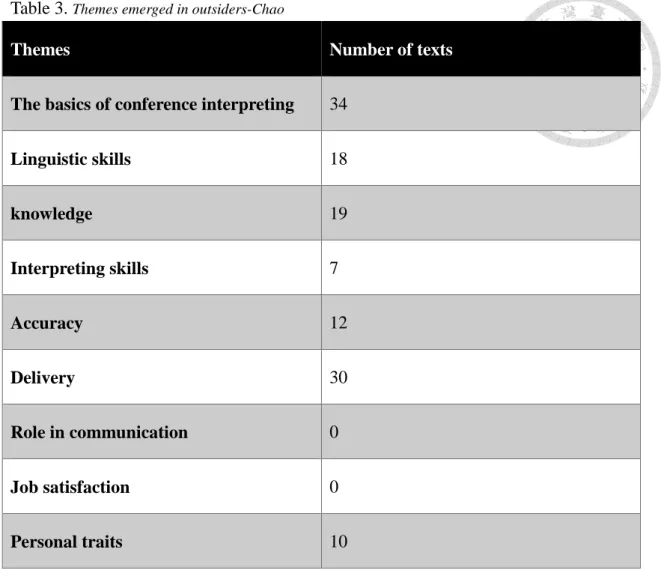
4.2.1 Outsiders-Chao ... 105
4.2.1.1 The basics of conference interpreting (34/40) ... 107
4.2.1.2 Linguistic skills (18/40) ... 111
4.2.1.3 Knowledge (19/40) ... 114
4.2.1.4 Interpreting skills (7/40) ... 116
4.2.1.5 Accuracy (12/40) ... 119
4.2.1.6 Delivery (30/40) ... 120
4.2.1.7 Personal traits (10/40) ... 123
4.2.1.8 Summary ... 124
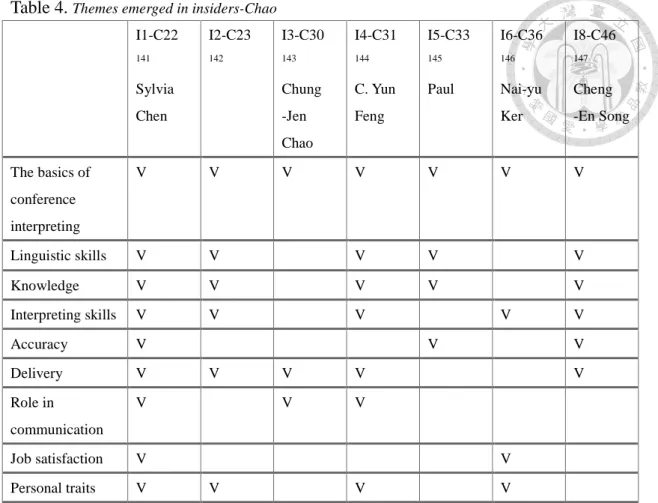
4.2.2 Reactions from the T&I community ... 125
4.2.2.1 The basics of conference Interpreting (8/8) ... 127
4.2.2.2 Linguistic skills (5/8) ... 130
4.2.2.3 Knowledge (5/8) ... 132
4.2.2.4 Interpreting skills (5/8) ... 134
4.2.2.5 Accuracy (3/8) ... 136
4.2.2.6 Delivery (5/8) ... 138
4.2.2.7 Roles in communication (3/8) ... 141
4.2.2.8 Job Satisfaction (2/8)... 144
4.2.2.9 Personal traits (4/8) ... 146
4.2.2.10 Summary ... 148
Chapter Five: Conclusion ... 151
References ... 165
Appendix I: Commentaries on Vincent Chao’s Interpretation ... 173
Appendix II: General Representations by Interpreters ... 179
Appendix III: Outsiders’ Commentaries on Vincent Chao’s Interpretation ... 180
Appendix IV: Insiders’ Commentaries on Vincent Chao’s Interpretation ... 184
List of Tables
Table 1. General representations ... 33
Table 2. Themes appeared in insiders-general’s representations ... 49
Table 3. Themes emerged in outsiders-Chao ... 106
Table 4. Themes emerged in insiders-Chao ... 126
List of Figures Figure 1. General representations ... 32
Figure 2. News on Vincent Chao's interpretation. ... 37
Figure 3. Interpreting booth posted with glossaries. ... 66
Figure 4. Brain before and after interpreting. ... 94
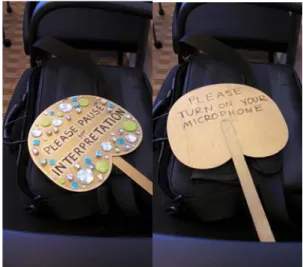
Figure 5. A fan for interpreters. ... 95
Chapter One: Introduction
1.1 Research background and motivation
Recent years have seen increased attention being given to the professional image of interpreters in the field of interpreting studies. A number of studies have
investigated the professional images of interpreters (Cronin, 2009; Diriker, 2004, 2009; Katan, 2009; Pöchhacker & Zwischenberger, 2010; Sela-Sheffy, 2008;
Sela-Sheffy & Shlesinger, 2008; Setton & Guo, 2009; Song, 2016; Zwischenberger, 2009). However, little research has been done on the professional image of conference interpreters in Taiwan (Hung 2005; Lin 2015; Setton & Guo 2009). This study aimed to take up the baton to examine the professional images represented by
Chinese-English (C-E) conference interpreters in Taiwan.
Conference interpreters in Taiwan have long been shaping their own professional image through interviews, books, or Facebook pages. These general
self-representations by conference interpreters could be viewed as the ideal image that conference interpreters wish to represent to the public. Analyzing these
self-representations may reveal the ideal professional image in the minds of C-E conference interpreters in Taiwan. Aside from the general representations, the Tsai Ing-Wen’s 2016 international press conference, which an untrained interpreter was involved in, caught the researcher’s eyes as an opportunity to learn about how the
translation and interpreting (T&I) community represents conference interpreting. In this high-profile event, Vincent Chao, the Deputy Director of the Department of International Affairs of the Democratic Progressive Party, was asked to provide C-E consecutive interpreting at the press conference, and his interpretation was broadcast live on TV and online with the video uploaded to YouTube on the same day.
After this high-profile event, a wealth of commentaries on Vincent Chao’s interpretation from the news media and the T&I community appeared. News media and the general public were fascinated by Chao’s pleasant voice, impeccable
pronunciation, and enunciation, and dubbed Chao ‘Mr. Interpreter’ (口譯哥), whereas
the T&I community’s views diverge on Chao’s performance. Some applauded his interpretation, some criticized his non-fluency in the Q&A session, and others simply took the opportunity to raise public awareness of conference interpreting or discuss the professionalization of conference interpreting in Taiwan. How the T&I community reacted to the news media’s commentaries were intriguing, leading the researcher to further compare their reactions with conference interpreters’ general
self-representations. To reveal the professional image of C-E conference interpreters represented by the interpreting community through printed and digital media in Taiwan, C-E conference interpreters’ self-representations and the T&I community’s reactions to the ‘Mr. Interpreter’ phenomenon are analyzed in this paper.
1.2 Research objective and questions
This study aims to explore the professional image represented by C-E conference interpreters in Taiwan by analyzing their self-portrayals in printed and digital media.
The researcher conducted a content analysis of a corpus of eight texts from
Chinese-English professional conference interpreters in Taiwan, including one book, three articles, three Facebook pages and one video, and 47 texts related to a
high-profile event involving an untrained interpreter, including 40 reports from members of the media and seven responses from the T&I community.
The research questions posed are as follows:
1. What is the general image represented by professional Chinese-English conference interpreters in Taiwan as revealed by their writings published in the printed and digital media?
2. How did the T&I community react to the news media’s reports on a high-profile event involving an untrained interpreter, and how did these reactions reflect the professional image represented by conference interpreters?
By understanding how professional conference interpreters represent conference interpreting and interpreters in general, and how they react to media’s perception of an untrained interpreter in particular, we hope to uncover the professional image projected by C-E conference interpreters in Taiwan.
1.3 Value of research
It is hoped that the results of this study may capture the professional image represented by conference interpreters in Taiwan through the analysis of their self-representations, thereby facilitating communication between professional conference interpreters and clients, and educating clients about conference interpreting. The results of this analysis may assist professional conference
interpreters gain more respect in the public eye, and achieve professionalization of conference interpreting in Taiwan in the long run.
1.4 Thesis organization
The research is divided into five chapters. Chapter One states the research background and motivation, research objective and questions, research value and methodology, and thesis organization. Chapter Two provides literature review, from professionalization, professional image, to self-representations. Chapter Three describes the methodology, detailing corpus construction, analysis, and coding categories. Chapter Four presents results and discussions. Chapter Five concludes the research findings and points out research limitations and suggestions for future research.
Chapter Two: Literature review
2.1 Professionalization of conference interpreting
Professionalization of conference interpreting has long been one of the most significant goals of the community of conference interpreters. Professionalization is the process and efforts of an ‘occupation’ striving to become a ‘profession’ so as to acquire higher social status, better working conditions, and control market entry (Rudvin, 2007, pp. 52-53). The Oxford Living Dictionaries defines
professionalization as the process of giving “(an occupation, activity, or group) professional qualities, typically by increasing training or raising required
qualifications.” Some key qualities of a profession might include the following: a practitioner in a “profession” receives professional training before entering the profession, possesses the expertise demanded for the profession, and is believed to be competent in both the eyes of the professional community and the general public. S/he would be financially rewarded for providing such a service; nevertheless,
compensation would never be his/her sole purpose. Contribution to society should serve as the most critical motive, as Raschke (2014) defined the profession of doctor as “not just a career,” but “a servant to others, not to ourselves” (Grbić, 2010;
Raschke, 2014; Rudvin, 2007; Setton & Dawrant, 2016).
The process of professionalization of conference interpreting started in the 1950s.
Tseng (1992) proposed an ideal model of the professionalization of conference interpreting in Taiwan, which also reflects the process of professionalization of conference interpreting around the globe.
In Tseng’s (1992) model, the process is divided into four phases. Phase I –
“Market Disorder”: the interpreting industry is in a chaotic state. Performance of interpreters and quality of training institutions vary extremely. Phase II – “Consensus
& Commitment”: the number of well-trained interpreters from high-quality institutions has accumulated to a point where clients start to realize the difference between well-trained and poorly-trained interpreters. In this phase, consensus over interpreting is gradually reached, and practitioners commit themselves to
professionalization of interpreting. Phase III – “Professional Association”: the
establishment of a professional association, whose responsibilities include overseeing parties inside and outside the interpreting community by defining professional
knowledge, regulating professional training, and standardizing working conditions, marks the start of Phase III. A professional association also defines and represents the professional image of interpreters to shape in what manner the public and clients perceive interpreter as a profession. Phase IV – “Protection and Licensure
(Professional Autonomy)”: when the professional image is deeply rooted in people’s minds, professional associations embark on political lobbying, requiring legal
authorities to establish a professional examination of interpreting. With such an examination, working without an official license would be against the law and would bring about ”occupational closure” (Setton & Dawrant, 2016, p. 358), thus completing the process. However, it should be noted that the “occupational closure” of the
industry of interpreting is yet to be accomplished all around the world (Setton &
Dawrant, 2016, p. 359).
While Tseng’s (1992) model seems comprehensive, the professionalization of conference interpreting in Taiwan has taken a slightly different path. Simultaneous interpreting was first seen in Taiwan in 1983. In 1988, the Graduate Institute of Translation and Interpretation Studies (GITIS) was founded in the Fu Jen Catholic University (FJU), which was the first training institution built in Taiwan. In 1994, the GITIS founded the Association of Interpretation and Translation, which was
transformed to be the Taiwan Association of Translation and Interpretation (TATI) in 1997.
The establishment of the TATI marked the start of Phase III in Taiwan’s professionalization of conference interpreting (Tseng, 1992), but it was at this point that Taiwan’s development of professionalization diverged from Tseng’s model. The TATI, the professional association in Taiwan, has mainly focused on studies on translation and interpreting, whereas the efforts to shape the professional image of
interpreters and translators have been relatively limited (Ju, 2009). Instead, training institutions, including the GITIS and the Graduate Institute of Translation and Interpretation (GITI) in the National Taiwan Normal University, took on the role of the professional association in Tseng’s model via holding joint professional
examinations for students, which is basically a ‘proficiency test’ without a legal base (Chang, 2008, p. 33). Students who pass the joint professional examination would be referred to professional conference organizers or institutions that have demand for professional interpreters. In 2007, lobbying by training institutions, professional conference organizers, and the TATI pressured the Ministry of Education (MOE) to hold the Translation and Interpretation Proficiency Test, which is the first certification test on translation and interpreting organized by a governmental sector in Taiwan.
From 2007 to 2009, the MOE sponsored the test, and asked training institutions to help grade participants. It should be noted that the MOE proficiency test is only a
‘certification’, not an official ‘professional examination’ (Chang, 2008, p. 31).
Therefore, the MOE proficiency test fails to regulate new entrants into the interpreting market, leaving Taiwan’s professionalization of interpreting stranded in Phase IV (Tseng, 1992).
Regarding the abovementioned discrepancies between Tseng’s model (1992) and Taiwan’s actual process of professionalization of conference interpreting, Ju (2009)
revised Tseng’s model to reflect the reality in Taiwan. In Ju’s revised model,
professional conference organizers were added to Phase III as one of the main actors, and certification supported by official sectors and training institutions was added to Phase IV as one of the steps towards the final goal of ‘protection and licensure’ (Ju, 2009).
In 2010, within one year after Ju’s (2009) model was proposed, the MOE proficiency test was commissioned to the Language Training and Testing Center (LTTC), and the proficiency test has been hosted by the LTTC and directed by the MOE since 2013 (LTTCtv, 2015). Joint professional examinations held by training institutions has since grown more robust after the Graduate Program in Translation and Interpretation (GPTI) in the National Taiwan University (NTU), established in 2012, joined the GITIS and the GITI holding the examination. As the number of examinees increases, the professional examination strengthens, and regulating entry into the interpreting market in Taiwan still remains a challenge without an official legally-binding professional examination in place.
At this stage of professionalization (Phase IV), the professional image of conference interpreters plays a significant role in moving forward because, as Tseng (1992) and Ju (2009) suggested, to successfully persuade legal authorities to regulate the profession of interpreting, a positive professional image must be created first so
that the public perceives interpreters as professionals. This social momentum is critical for lobbying. When the majority of the public perceives conference
interpreting as a profession, the time would be ripe for lobbying (Tseng, 1992). Given that Taiwan is in Phase IV now, this research would potentially contribute to the professionalization of conference interpreting in Taiwan.
2.2 Professional image of conference interpreters
The professional image, as the Free Dictionary defines it, is “the constellation of tangible or visible representations and/or perceptions resulting from a person's
conduct as a professional, linked to ethical behavior and competence (“professional image”, the Free dictionary), or as Simmons and Henderson (1964) (as quoted in Hendel and Kagan (2011)) suggested,“[i]mage signifies a composite and stereotyped
representation of the personal and vocational characteristics of an identifiable category of individuals, either as perceived by themselves or by relevant reference groups” (p. 260). According to the above definitions, professional image is a type of
“representation.” “Representation” is, as defined in Oxford Learner’s Dictionaries,
“the act of presenting somebody/something in a particular way,” and “represent”, in its verb form, means “to present or describe somebody/something in a particular way, especially when this may not be fair,” which is in line with Diriker’s (2004) notion that professional images are subjective and biased.
Sela-Sheffy and Shlesinger’s (2008) research project echoed Tseng’s model regarding the significance of professional image. Sela-Sheffy and Shlesinger’s (2008) project aimed to examine how translators and interpreters in Israel build their
professional image to raise their social status. Translators and interpreters in Israel are
“marginalized” and lack social recognition (p. 80), which, Sela-Sheffy and Shlesinger believe, makes it necessary for translators and interpreters to establish a professional image in order to acquire higher occupational prestige. Sela-Sheffy (2008) analyzed texts on Israeli literary translators from the printed media from the early 1980s to 2004, and concluded that translators who aim to create a professional image for translators in Israel perceive the image as “important assets and expect to capitalize on them [which] evidently also advances their power to bargain for the terms and prices of their work” (Sela-Sheffy, 2008, p. 620). Her findings reflect that when translators and interpreters represent their professional image, they might have a specific purpose in mind. Sela-Sheffy and Shlesinger argued that the primary
objective is to gain occupational recognition and enhance the translator’s social status, especially in a society which fails to recognize translators and interpreters
(Sela-Sheffy & Shlesinger, 2008).
That being said, professional images are difficult to control by any single party due to its “(meta-)discursive” nature. To explore the professional image of conference
interpreting, Diriker (2009) analyzed the “meta-discourses” on simultaneous interpreting in Turkey. Diriker defined “meta-discourse” as the following: “[s]ince any meta-discourse will present a selected and hierarchised set of norms, certain norms are likely to be more prevalent than others in the general meta-discursive representation of a profession.” To put it simply, a meta-discourse is a subjective interpretation, and being “meta-discursive” means being subjective or without an objective standard. As Diriker (2009) pointed out, every meta-discourse reflects unique expectations and demands for each profession, thus creating a wide diversity of meta-discursive representations of the professional image of any single profession.
Conference interpreter as a profession is no exception. Different parties have their own meta-discourses for the following two reasons. Firstly, each party hopes to take care of its own interests and thus demands certain professions to act in certain ways so as to cater to their needs. Secondly, the subjectivity and complexity of language also adds to the multifariousness of meta-discourses. In other words, even when provided an exactly identical representation, every individual receiver gains his/her own subjective and unique perceptions, generating a diversity of meta-discourses which reflect different expectations for conference interpreters. Each representation
competes against each other, casts influence over the public, and shapes “the general meta-discursive representation of interpreters” (Diriker, 2009, p. 71).
Regarding the multifariousness of meta-discourses, Diriker (2009) further categorized all related parties into outsiders and insiders, and then studied the similarities and differences between their meta-discourses to effectively analyze the meta-discourses on simultaneous interpreting. In Diriker’s study, “outsiders” refer to all parties outside the community of interpreting, including dictionaries, the
encyclopedia, and the Turkish media, while “insiders” are those inside the community of interpreting, including professional organizations, the academia of interpreting, and interpreters (via TV interviews or books).
Given that there exists no absolute professional image, this study intends to capture the professional image represented by C-E conference interpreters in Taiwan through careful analysis. To have a better understanding of the professional images represented by insiders and also outsiders’ perceptions, in section 2.2.1 and 2.2.2, insiders’ representations, outsiders’ perceptions, and related studies are discussed.
2.2.1 Insiders’ self-representations of their professional images
As stated earlier in 2.1, insiders’ self-representations are basically their efforts to enhance their professional image and social status and important means to finally achieve professionalization (Sela-Sheffy & Shlesinger, 2008, p. 81). Insiders’
self-representations and related studies are reviewed in this section to get a clear picture of the professional image represented by insiders. As studies have used
“representation” and “perception” to discuss the professional image of conference interpreters, their definitions and relationships will be detailed first.
According to the definitions by Oxford Learners’ Dictionaries, perception means
“an idea, a belief or an image you have as a result of how you see or understand something,” while representation “the act of presenting somebody/something in a particular way; something that shows or describes something.” It seems that
representation and perception are closely connected. Zwischenberger’s (2009) study supported this concept. Zwischenberger discovered that the collective
self-representation by AIIC is capable of shaping AIIC interpreters’ perceptions of their roles. Her study found that most AIIC interpreters perceive themselves as
“assisting role - Facilitator/ enabler or helper.” This resonates with the early collective self-representation by AIIC, which is “an aid in communication, an intermediary, a bridge or an actor.” This finding reflects the strong interactions between
self-representations and self-perceptions (Zwischenberger, 2009, p. 131). Clearly, self-perceptions shape self-representations, and self-representations influence
self-perceptions. That explains why a study by Pöchhacker and Zwischenberger (2010) even treated self-representations and self-perceptions as two sides of the same coin.
However, when closely examined, the definitions of representation and perception are still slightly different: representation is a purposeful product that portrays professional
image, while perception is the thought or feeling one holds through his/her experience.
In this light, a simplified process of forming professional image might be as follows:
insiders produce representations according to the perceptions of their own profession to portray the professional image of conference interpreters, while outsiders gain perceptions through insiders’ representations. Self-representations of conference interpreters will be discussed first in 2.2.1.1 and 2.2.1.2, and outsiders’ perceptions in 2.2.2.
2.2.1.1 Studies on self-representations of conference interpreters
Self-representations/self-perceptions of professional images are ever subjective.
Even when given an identical environment or condition, every individual would have unique perceptions of their roles and status because representations tend to be
purposeful and perceptions meta-discursive (Diriker, 2009, p. 71; Sela-Sheffy &
Shlesinger, 2008, p. 81). Studies have analyzed interpreters’ perceptions or representations of themselves, and the findings can be sorted into four categories:
their perceptions of social recognition, roles in communication, status compared to other professions, and common traits.
Firstly, studies have examined interpreters’ perceptions of social recognition, and it has been shown that conference interpreters are unsatisfied with their social status.
Katan (2009) surveyed translators and interpreters worldwide to learn about their
perceptions of job. More than 95% (955 out of 996) respondents believed that
interpreting and translation are “professions” (p. 70) because the act of interpreting or translating requires expertise and skills, and the need for persistent learning. However, 41 respondents suggested that their jobs are not “professions” because amateurs can enter the profession without any certification (certification was mentioned by 65% of respondents) which is possibly counterproductive to acquiring social recognition.
Hung (2005) suggested that both parties inside and outside the T&I community agree that interpreters and translators have relatively low social status. She conducted a survey on parties outside and inside T&I community which were general college students vs. students majoring in conference interpreting in graduate school in
National Taiwan Normal University. Hung realized that both “outsiders” and “insiders”
(Diriker, 2009, p. 73) acknowledged that interpreters are equipped with particular expertise and skills, and require years of training and constant learning in the
profession. However, regardless of the abovementioned items, most people know little about conference interpreting as a profession, and thus, the occupation prestige is low.
Chen (2008) administered a questionnaire survey to look at job satisfaction of Taiwan’s conference interpreters. Chen sent questionnaires to 96 interpreters based on a roster provided by a professional conference organizer, and received 36. Chen found that interpreters in Taiwan are satisfied with their job but not with their working
conditions. A lack of professionalization is a likely cause. It might be safe to say that the reasons behind unsatisfying working conditions is due to a lack of social
recognition. From these studies, it could be seen that a lack of professionalization has led interpreters to perceive themselves as having lower social status than they would otherwise have, inhibited market entry control, and created unsatisfying work conditions. It is only natural that conference interpreters have sought to raise their social recognition by representing their ideal professional image.
Secondly, interpreters have diverse representations of their roles in
communication, and the most prevalent self-representation is “facilitator.” Pöchhacker
& Zwischenberger (2010) explored conference interpreters’ perceptions of quality and self-representations of roles utilizing the Survey on Quality and Role, a web-based survey among AIIC members in 2008. From the 704 online questionnaires
Zwischenberger collected, self-representations could be sorted into the following types:
A. facilitator/enabler of communication (21.2%) or aid/helper for communication (8.9%)
B. mediator/intermediary (13.7%) or bridge/link (10.7%) C. professionals rendering a communication service:
- communicator (11.5%)
- expert/(communication-)service provider (2.1%) - who makes communication work (5.6%).
Nearly one third of respondents represented themselves as type A, a facilitating role.
Setton and Guo’s (2009) findings echoed Pöchhacker & Zwichenberger’s (2010) results. They also explored interpreters’ and translators’ attitudes to role, status, and professional identity through a questionnaire survey. The respondents included interpreters from Mainland China, translators from Taiwan, and part-time
translator-interpreters. Again, multifarious self-representations of role and status can also be observed among interpreters/translators in the results. Most interpreters believed they facilitate cultural mediation, but, interestingly, eight respondents who added voluntary comments believe that little cultural mediation is involved and said they were just “facilitating communication” for “company operations and business development” (Setton & Guo, 2009, p.112). Be it cultural communication or business communication, it is clear that most conference interpreters represent themselves as facilitators of communication.
Thirdly, status compared to other professions. An effective way to understand the social status of the profession of conference interpreting is to compare it with other well-known professions. Hung (2005) realized that when compared with other professions in terms of social position, conference interpreters are lower than
professors, engineers, and nurses, only higher than journalists. Katan (2009) also asked conference interpreters to rank their own social status, “teachers”, “secretaries”,
“journalist”, and “consultants” are the most popular choices among conference interpreters (Katan, 2009, p. 77), but they believed that they should enjoy higher social status (Katan, 2009).
Finally, studies have suggested several characteristics expected to be seen in professional conference interpreters and interpreting trainees, such as personality traits which are counted as part of aptitude for interpreting. Traditionally, the majority of research on the aptitude for interpreting has focused on “language proficiency, comprehension of source language, and speed of comprehension” (Fan, 2012, pp.
140-143), or the ability to find synonyms (Russo, 2011; Pöchhacker, 2011). However, personality traits are increasingly emphasized with regard to aptitude for interpreting.
For example, the ability to fight anxiety or even thrive under stress is upheld by studies (Bontempo & Napier, 2011; Timarová & Salaets, 2011). Shaw (2011) also suggested the importance of being an active learner and the capability to concentrate on tasks. Rosiers, Eyckmans, & Bauwens (2011), along with these studies, all
advocate for the idea that personality traits should be considered in the admission tests of T&I programs to penetrate examinees’ aptitude for interpreting, reflecting that personal traits have been receiving more attention in the area of aptitude for
interpreting.
In sum, conference interpreters perceive that they are not socially recognized, play a facilitating role in communication, and share similar social status with teachers or journalists. Studies also have suggested that conference interpreters must be active learners and function in a satisfactory manner under intense stress. However,
conference interpreters at large are not satisfied with the working conditions, and welcome further professionalization. As stated earlier, the professional image
represented by conference interpreters is critical in the process of professionalization (Ju, 2009; Tseng, 1992). Taiwan conference interpreters’ self-representations will be briefly reviewed in 2.2.1.2, and then further analyzed in Chapter Four.
2.2.1.2. Conference interpreters’ self-representations of professional image Nowadays, conference interpreters can represent their professional image through access to channels other than news media to influence the public. Publishing books and managing Facebook pages are some direct access via which conference interpreters can share their work life and knowledge to shape their professional image.
Some self-representations by conference interpreters in Taiwan are discussed in the following paragraphs.
Amy Chiang, a professional conference interpreter in Taiwan, has much to say on the matter of self-representation. Starting from 2002, Chiang was invited by the
United Daily News to write a column about conference interpreting, which lasted for about one year, and the articles in the column were later compiled into a book called About Interpreting: A Different Voice (譯口同聲) and published in 2003. Years later,
Chiang wrote another book on interpreting called Please be Seated: 25 Lessons for Those Who Aspire to Become Interpreters (來賓請入座:25 堂口譯必修課) , which
was published in 2012.In this book, she shares her work life and provides insights into her profession, shaping readers’ perceptions of the conference interpreter’s image.
In this day and age, social media is one of the most powerful media used to shape the public perception. Conference interpreters are aware of this fact.They are making good use of Facebook, the most popular social media platform, to promote themselves. Conference interpreters start and manage Facebook pages where they share their work life, interesting incidents, and reflections on interpreting,
enlightening subscribers about the profession through interpreters’
self-representations. Howard Interprets (浩爾的口筆譯日記), Meet the Translators (公平翻譯交易所), and An Interpreter, Going Soho (蘇活口譯 An interpreter, going
SOHO) are among the most well-received Facebook pages managed by conference
interpreters (Howard Interprets, and An Interpreter, Going Soho were translations by the researcher for the use of this study.). These pages are worth examining to explore the ideal professional image in conference interpreters’ minds.
While reviewing self-representations of conference interpreters and related studies could provide critical vocabulary to facilitate exploring the professional image of conference interpreters in Taiwan, learning about outsiders’ perceptions or
misperceptions of interpreters could reflect the context or environment in which insiders represent their professional image. Outsiders’ perceptions of interpreters will be discussed in 2.2.2.
2.2.2 Outsiders’ perceptions of interpreters
Outsiders being outsiders, when they express their perceptions about interpreters, they have the tendency to lump all types of interpreters together because most of them only have a vague understanding of the industry of interpreting. As a result, outsiders’
perceptions of various types of interpreters, including conference interpreters,
community interpreters, court interpreters, and untrained bilinguals are all included in 2.2.2 to capture outsiders’ views. In this study, the purpose of reviewing outsiders’
perceptions is not to reveal the image of conference interpreters in the minds of outsiders but to better comprehend the context under which conference interpreters represent their professional image.
When investigating outsiders’ perceptions of interpreters, the media, with its wide-reaching scope, offers a vast selection of sources to analyze. Films, news, and printed media have revealed a variety of perceptions of interpreters. Three features
can be observed in how these three mediums represent interpreters. Firstly, a
competent interpreter is compared to that of a “parrot”, repeating speakers’ words in another language without any discrepancies. Secondly, there is a widely held
assumption that any bilinguals with the right language combination can carry out the task of interpreting without professional training. Thirdly, interpreting is portrayed as a low-key profession. The news media pays relatively little attention to the profession of conference interpreting, and only shines the limelight on professional interpreters when ”big events, big money and big mistakes” are involved (Diriker, 2004, p. 40).
2.2.2.1. “Parrots”
Interpreters are often portrayed or expected to be “parrots” or translation machines.
Diriker (2009) analyzed the Turkish media’s perceptions of SI conference interpreters and discovered that the Turkish media believes interpreters should be loyal to every single word uttered. A famous Turkish columnist was quoted in Diriker’s study, saying that what interpreters should do is “interpret every sentence you say letter for letter” (Diriker, 2009, p. 80). As matter of fact, not only conference interpreters are
perceived as “parrots.” In Translation goes to the Movies (2009), Cronin looked into Hollywood films’ perceptions of interpreters, including community interpreters and escort interpreters, and discussed C-3PO in Star Wars (1977). Being an AI robot diplomat-interpreter, C-3PO is once called a ‘mindless philosopher’, indicating that
interpreters are no more than translation machines (Cronin, 2009, p. 134). Song (2016) also found similar perceptions in 2000-2015 Hollywood films with characters as interpreters. She discovered that interpreters are perceived engaging in little mediation in communication. It can be observed these roles had little power in communication, and were treated as translation machines (Leanza, 2005).
2.2.2.2. Untrained bilinguals
Apart from being seen as machines, it seems that the media sees any individual who speaks fluently in two languages as being qualified to be an interpreter. Taiwan’s media may even perpetuate the use of untrained interpreters by applauding their interpreting performance. Take Lesley Ma, the daughter of Ma Ying-Jeou, the former president of the Republic of China. Lesley Ma interpreted consecutively for artist Cai Guo-Qiang in a press conference in 2008 because she worked for Cai and speaks fluent Chinese and English. The news media applauded her stage presence and performance, neglecting or tolerating her lack of formal training in interpreting.
Vincent Chao is another typical example. As the Deputy Director of the Department of International Affairs of the DPP, Chao was assigned to serve as the interpreter in the Tsai Ing-Wen’s international press conference. Without formal interpreter training, Chao made mistakes and stammered in the Q&A session; however, he was not grilled over his lack of qualifications. Instead, his mistakes were justifiable in the news’
media’s eyes merely because he had never received training. This argument presented by the news media may strengthen the belief that training is not necessary for
conference interpreters, for it suggests that untrained interpreters can still perform the task well, and that the public would be more tolerant of their mistakes than those of trained conference interpreters.
2.2.2.3 “Big events, big money and big mistakes”
Regardless of being trained or not, interpreters at large receive little attention from the news media. Only when“big events, big money and big mistakes”are
involved does the media discuss interpreting (Diriker, 2004, p. 40). In “big events”
like international summits and UN conferences, simultaneous interpreting would catch outsiders’ eyes. The Turkish news media once invited its audience to imagine words being “interpreted into eight languages all at the same time” during an international event (Diriker, 2004, p.40).
A similar pattern can be observed in Taiwan’s news. News media in Taiwan does not normally cover interpreting as a profession with the exception of big events. For example, as mentioned earlier, the interpretation at the Tsai-Ing-Wen’s 2016
international press conference stimulated discussions about whether the use of an untrained interpreter was justifiable. This big event gave high exposure to the interpreter Vincent Chao. Another example is Zhang Lu, who is a Chinese diplomat
who interprets for senior Chinese officials in high-level events such as Lianghui, “the annual plenary sessions of the national or local People's Congress” in mainland China (Lianghui, 2017). Having been working as the interpreter for Mainland China’s premiers for years, Zhang Lu has received much attention from news media both in Mainland China and Taiwan, and the public has been amazed by her extraordinary stage presence and excellent consecutive interpretations of Chinese poems. Taiwan’s broadcast of the US presidential debate in 2016 is yet another example of a big event that drew the news media’s attention to interpreting. The US presidential debates were broadcasted by Taiwan’s news channels in real time with simultaneous interpreting service. Thanks to the massive viewership of the presidential debates, simultaneous interpreting was also brought into the center of attention and subsequently triggered discussions pertaining to interpreting.
In regards to “big money,” Diriker (2004) refers to the public media’s belief that simultaneous interpreters earn high salaries or hourly pay. When Taiwan’s news media interviewed interpreters, the allegedly high wages are also usually much emphasized as in Professional Interpreters got highly paid for speaking (口譯專家說 出一口高薪) (The Economic Daily News, Sep. 2007, pp.118-120) and All Walks of
Life – Interpreter ([360 行有錢賺]-口譯員) (USTV, 2016), to name a few.
Conference interpreters’ high wages are usually one of the selling points of these
interviews, even though the news media do recognize that interpreting is extremely stressful and requires special expertise.
“Big mistakes,” unfortunately, also get interpreters excessive media exposure. As Diriker (2009) described, in 1998, Helmut Kohl, the then Chancellor of Germany,
visited Turkey. An interpreter was blamed for erroneously interpreting the words of Mesut Yılmaz, then Prime Minister of Turkey, in a conference attended by both the
Turkish and German press. The simultaneous interpreter was accused of interpreting
“Old friends cannot become enemies” into “Our old friend Kohl is our new enemy,”
and thus strongly criticized as “unacceptably tactless” and heightening tensions between Turkey and Germany (Diriker, 2004, p.42). Taiwan’s news media seldom miss their chance to report on interpreters’ mistakes. For example, Ai Fukuhara, a Japanese table tennis player, was interviewed by a British journalist in Korea in 2010.
An untrained Chinese-English interpreter was asked to mediate the communication on the spot. His interpretation ended up inaccurate and incomplete. The interview was later uploaded to YouTube, reported by Taiwan’s news media, and has accumulated more than 1.3 million views. Obviously, “big mistakes” truly get interpreters high exposure, but this type of exposure might be useless, if not detrimental, to the
professionalization of interpreting. Judging from the occasions in which outsiders pay attention to interpreters, it might be safe to suggest that interpreters are closely
associated with“big events, big money and big mistakes” (Diriker, 2004, p.40).
To sum up, insiders to the T&I community have the ideal professional image of conference interpreters in their own minds, while outsiders form their perceptions or misperceptions of interpreters with or without considering the insider’s perspective. In this light, the purpose of reviewing insiders’ representations and outsiders’ perceptions is to help the researcher capture what the ideal professional image of conference interpreters could be and, in turn, contribute to shaping outsiders’ perceptions of conference interpreting as a profession.
Chapter Three: Methods
Content analysis was performed to explore the professional image of
Chinese-English conference interpreters in Taiwan. The data consist of eight general representations of conference interpreters in Taiwan and 47 commentaries on Vincent Chao’s interpretation from electronic news media.
3.1 Corpus construction
A corpus was constructed to include texts that have been shaping the professional image of conference interpreters in Taiwan. Diriker (2004) collected texts from
professional organizations, codes of ethics, dictionaries, encyclopedia, academia, the news media in Turkey, and a book by a professional interpreter to explore the
“meta-discourse” on simultaneous interpreting. This study took a similar approach but on a smaller scale due to limitation on time and resources. To maximize the value of this study, only texts that “target a larger and non-professional clientele” were included (Diriker, 2004). The texts included in this study are quotes taken from professional conference interpreters and the electronic news media in Taiwan. These types of texts may have shaped the perceptions of the general public about the conference interpreter as a profession in Taiwan.
Data was collected primarily by means of electronic search engines. To collect commentaries on Vincent Chao’s interpretation, online search was conducted during
the middle of January 2016 to the middle of February 2016. To gather texts that represent Chinese-English conference interpreters in Taiwan in general, another search was performed in August 2016. On February 28, 2017, posts about the
professional image of conference interpreting on three popular Facebook pages were collected and incorporated into the corpus.
It should be pointed out here that the representations collected in this study are by no means exhaustive. The researcher’s goal was never to cover every text on the image of conference interpreters in Taiwan, but to analyze influential representations of conference interpreters in Taiwan. The methods and process of data collection and selection are further detailed in 3.1.1 and 3.1.2.
3.1.1 General representation by professional conference interpreters
Conference interpreters represent their own profession through popular platforms or media. Their general self-representations could potentially reach “a larger and non-professional clientele” and could potentiallyshape the public’s perception of conference interpreters (Diriker, 2004). Therefore, conference interpreters’ general self-representations were included in the corpus to reflect the ideal professional image represented by C-E conference interpreters in Taiwan.
For general representations, the researcher searched “口譯” (interpreting)
through various search engines and on different platforms in August 2016. Firstly,
Google Search Engine (from results page 1-18), Google Books (from results page 1-15), and the National Taiwan University Library were used. Then the researcher searched the same key word “口譯” on the largest online bookstores in Taiwan,
including Books.com.tw, Kingstone.com.tw, and Cite.com.tw. In addition, Facebook was also searched with keyword “interpreting” which brought up many Facebook pages managed by interpreters and translators.
For the purpose of this study, only texts from Chinese-English conference
interpreters in Taiwan found among all the collected data (general self-representations) were included in the corpus. Books or magazines that were out of print, not in
circulation, and Facebook pages that had fewer than 1,000 subscriptions (when accessed) were not included. It is worth noting that the number ‘1,000’ is not treated as a critical indicator of popularity or impacts of Facebook pages; instead, ‘1,000 subscriptions’ is treated as an arbitrary threshold to help the researcher control the number of Facebook pages that were incorporated into the corpus considering the limitation on time and resources. Also, general representations by news media were not used because they are not representations by conference interpreters and the amount is negligible.
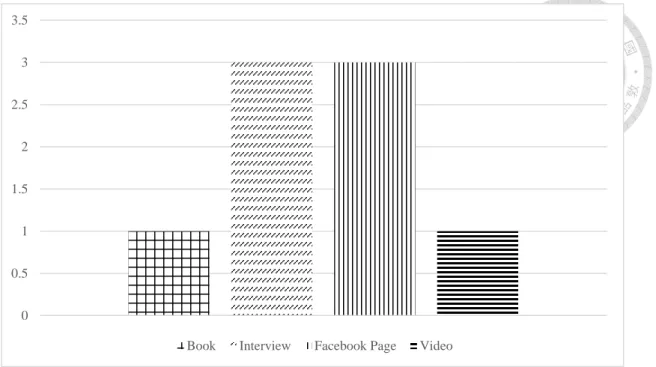
Figure 1. General representations.
As Fig. 1 shows, a total of eight texts were incorporated into the corpus,
including one book, three Facebook pages, three interviews, and one video. The title of the book is Please be Seated: 25 Lessons for Those Who Aspire to Become
Interpreters (來賓請入座:25 堂口譯必修課) by Amy Chiang, a well-experienced
conference interpreter in Taiwan. In this book, Chiang gave insights into her profession through twenty-five chapters. In each chapter, Amy Chiang shares an anecdote, some tips for solving problems mentioned in the anecdote, and then a useful glossary. For readers, the book is certainly a compelling representation of a
conference interpreter, and might be effectual in constructing a positive professional image in readers’ minds.
0 0.5 1 1.5 2 2.5 3 3.5
Book Interview Facebook Page Video
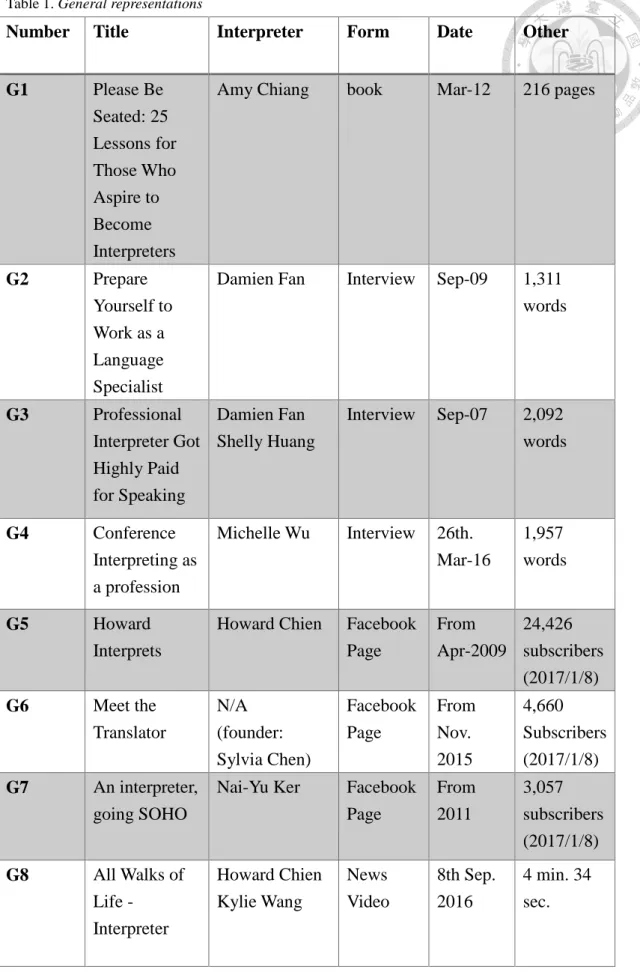
Table 1. General representations
Number Title Interpreter Form Date Other
G1 Please Be
Seated: 25 Lessons for Those Who Aspire to Become Interpreters
Amy Chiang book Mar-12 216 pages
G2 Prepare
Yourself to Work as a Language Specialist
Damien Fan Interview Sep-09 1,311 words
G3 Professional Interpreter Got Highly Paid for Speaking
Damien Fan Shelly Huang
Interview Sep-07 2,092 words
G4 Conference Interpreting as a profession
Michelle Wu Interview 26th.
Mar-16
1,957 words
G5 Howard
Interprets
Howard Chien Facebook Page
From Apr-2009
24,426 subscribers (2017/1/8)
G6 Meet the
Translator
N/A (founder:
Sylvia Chen)
Facebook Page
From Nov.
2015
4,660 Subscribers (2017/1/8) G7 An interpreter,
going SOHO
Nai-Yu Ker Facebook Page
From 2011
3,057 subscribers (2017/1/8) G8 All Walks of
Life - Interpreter
Howard Chien Kylie Wang
News Video
8th Sep.
2016
4 min. 34 sec.
In the era of social media, Facebook pages managed by conference interpreters also strongly shape the professional image of conference interpreters, especially pages with large numbers of subscribers. On these Facebook pages, conference interpreters share their work life and thoughts on conference interpreting. Subscribers learn about the profession through conference interpreters’ self-representations. Therefore, it seems necessary for this study to include Facebook pages. Facebook pages were found via the Facebook search engine and its recommendations. As stated earlier in this chapter, to limit the number of Facebook pages analyzed in this study, only those with more than 1,000 subscriptions went into the corpus. Finally, Howard Interprets (浩爾的口筆譯日記, 24,426 subscribers), Meet the Translators (公平翻譯交易所, 4,660 subscribers), An Interpreter, Going Soho (蘇活口譯 An interpreter, going
SOHO, 3,057 subscribers) were used in this study (Howard Interprets and An
Interpreter, Going Soho were translations by the researcher for the use of this study.).
Given that Facebook pages tend to be updated continually, it would be an extremely challenging task to include all the posts on the above-mentioned Facebook pages. As a result, the researcher collected posts which are related to the professional image of conference interpreters on February 28, 2017 from Howard Interprets, Meet the Translators, and An Interpreter, Going Soho. The researcher started from the latest
post, and went through past posts to collect and screenshot 30 relevant posts from
each Facebook page.
Compared to other texts produced by news media, interview articles and videos allow conference interpreters to express their opinions relatively comprehensively.
Through news media, their words can reach the general public. Regarding their comprehensiveness and strong influence on the public, two interview articles of conference interpreters were gathered into the corpus. The interviewee was Damien Fan, a professional conference interpreter. Damien Fan was interviewed by the Economic Daily News along with Shelly Huang, a professional agent of conference
interpreter, to share his life as a young and successful conference interpreter in September 2007, and interviewed again by the magazine Cheers to discourse on depending on languages for one’s bread-and-butter in September 2009. Michelle Wu was invited to compose an article about her 25 years of conference interpreting experience and her lifelong passion for this profession on Chinatimes.com in March 2016 (See Tab. 1).
All Walks of Life – Interpreter, the only video in the corpus, interviewed two
young interpreters Howard Chien and Kylie Wang to learn about the type of training conference interpreters go through, how interpreters prepare for work, and the
conference interpreting industry in Taiwan. This video was published on YouTube by Unique Satellite TV (USTV) in September 2016. The video belongs to a series
introducing professions that are not well-known in society. Found via the Facebook page Howard Interprets, this video was uploaded to YouTube and had accumulated more than 2,000 views when accessed.
The above texts were categorized according to their forms in principle. The only book is placed first, with interviews put in chronological order after the book.
Facebook pages come after interviews, in order of number of subscriptions from most to least. The video is placed in the end. For texts categorized as general
representations of professional conference interpreters, a “G” was added in front of each number. For example, the first text would be labeled “G1” while the last item in this category would be labeled “G8” (See Tab. 1).
3.1.2 Commentaries on Vincent Chao
The main sources of commentaries on Vincent Chao’s interpretation include Google News Taiwan and six top online news websites in Taiwan. The main key words used on both Google News Taiwan and online news websites include “趙怡翔 AND 口譯” (Vincent Chao AND interpreting) and “蔡英文國際記者會 AND 口譯”
(Tsai Ing-Wen’s international press conference AND interpreting). Google News Taiwan, which is “a computer-generated news site that aggregates headlines from news sources” (Google, 2013), was used to obtain commentaries within one month after the press conference (search date range: January 16th to February 16th). This is
due to the fact that most news reports are published within one month after an incident or event. The same pattern was observed in news on Vincent Chao’s
interpretation: The event happened on Jan. 16th, and most news (19 pieces) appeared on Jan.17th; the second spike appeared on Jan. 25th thanks to a radio interview with Chao. Later from Feb. 5th to Feb. 16th, there was no more news on Vincent Chao’s interpretation. For a graphical representation of these news trends, please refer to Fig.
2.
Figure 2. News on Vincent Chao's interpretation. The figure illustrates the trends of commentaries.
Even though Google News Taiwan might be fairly comprehensive, it still failed to include every news report. As a result, this study searched for commentaries on another six popular online news websites in Taiwan, including China Times, United
0 2 4 6 8 10 12 14 16 18 20
1/16 1/18 1/20 1/22 1/24 1/26 1/28 1/30 2/1 2/3 2/5 2/7 2/9 2/11 2/13 2/15
Numbers
Date
news media T&I community total
Daily News, Apple Daily, ETtoday, Liberty Times Net, and Now News. They are ranked the six most popular and influential news websites among the 2015
one-hundred top sites in Taiwan. (Business Next, 2015). As stated in 3.1, this study seeks to collect texts that reach a wide group of people. In this light, the six most popular and influential news websites were used for this work.
Regarding search date range, Apple Daily and Liberty News Net allow readers to customize date range. The researcher searched and collected news on these two news websites between the dates of Jan. 16th to Feb. 16th. Other news sites provided less customization: ETtoday only showed relevant news reports in one year, while the other three sites did not specify the date range of search. In terms of key words, “蔡英 文國際記者會 AND 口譯”(Tsai Ing-Wen’s international press conference AND
interpreting) yielded no results on ETtoday and Now News, and “趙怡翔 AND 口譯”
(Vincent Chao AND interpreting) on Now News, either. It was found through several attempts that “趙怡翔” AND “蔡英文國際記者會” (Vincent Chao AND Tsai
Ing-Wen’s international press conference) were keywords that yielded fruitful results and were therefore used in the end.
In addition to news articles, Chao was also interviewed on radio and TV about his story and experience. On January 25th, three news reports covered a radio interview with Chao by POP Radio FM91.7. Seeing the reports, the researcher
searched for “趙怡翔 AND POP Radio” (Vincent Chao AND POP Radio) on
YouTube and found the interview. Related videos were recommended on the right-hand side on YouTube. Two highly-relevant radio interviews and two TV programs with Vincent Chao were found via YouTube’s recommendations and included in this study.
Even though commentaries that did not talk about conference interpreting still appeared in the search results of Google News Taiwan and other news websites when searching with keywords “趙怡翔 AND 口譯” and “蔡英文國際記者會 AND 口譯”,
only commentaries that touched upon conference interpreting were included in this study. For example, some of these commentaries that appeared in the search results focused on Tsai Ing-Wen’s speech and the political messages in the press conference.
Even if some of the commentaries did mention Vincent Chao, they failed to discuss his interpretation. Given their low relevancy, these commentaries were not used in this work.
A total of 47 commentaries were collected via the above mentioned platforms and media. 40 were given by news media, and seven by members of the translation and interpreting (T&I) community. Commentaries were numbered according to chronological order, and a ‘C’ was added to each text (‘C’ as in ‘Chao’). For instance,
the earliest commentary was numbered ‘C1’, the latest ‘C481’. The titles, forms, publication dates, and sources are presented in Appendix I. The colored rows are responses from the T&I community.
3.2 Analysis
To explore the professional image represented by the conference interpreting community in Taiwan, texts in the corpus were divided into two categories: insiders’
general representations and commentaries by insiders and outsiders on Vincent Chao’s interpretation (Diriker, 2009). Content analysis was performed to examine the professional image represented by insiders.
The operating definitions of insiders and outsiders are loosely based on that of Diriker’s study. In this study, insiders include conference interpreters, translators, and also non-interpreters who have studied T&I for their bachelor’s or master’s degrees, while outsiders are non-interpreters that have never received T&I training (mainly news media in this case). It was for two reasons that the operating definitions of insiders are less strict. Firstly, few practicing conference interpreters reacted to the
‘Mr. Interpreter – Vincent Chao’ phenomenon publicly. To enrich the corpus and analyze insiders’ reactions to outsiders’ commentaries, conference interpreters,
1 After the content analysis, C37 was excluded because the author’s background could not be confirmed and its content was lowly relevant to professional image of conference interpreters. The numbers assigned to others texts still remain unchanged, which explains why the 47th text was
translators, and those who have studied T&I for their bachelor’s or master’s degrees were counted as insiders. Secondly, the operating definitions may be supported by existing studies. Instructors in T&I programs or departments are chiefly T&I practitioners. Thus, it may be safe to say that T&I instructors could provide
comprehensive information and high-quality training for students. Angelelli (2010) suggested, students who have studied in translation and interpretation programs at high-school level “may or may not consider pursuing studies in translation or
interpreting, but at least they will become more educated consumers of T&I services”
(p. 242), not to mention students that have studied T&I at university or
graduate-school level. Translators are also seen as insiders in this study because they are in the same industry (T&I) with conference interpreters, and as Viaggio (1992, p.1) suggested, “both translators and interpreters specialise at mediating in interlingual communication,” and that “is a bond stronger than the differences between oral and written communication rending them apart” . In this light, though non-interpreters with T&I training do not pursue conference interpreting as a career, they are definitely equipped with adequate knowledge about T&I, and could be considered insiders.
According to the operating definitions, there are 15 texts by insiders and 40 texts by outsiders in this study. All general representations of conference interpreters in this study are by conference interpreters, while among the commentaries on Vincent
Chao’s interpretation, 40 texts were by outsiders, and 7 texts by insiders (conference interpreters and translators). All 40 texts by outsiders were in Appendix III, with their titles and news sources. In addition to the original numbers assigned, an ‘O’ was added to each text (“O” as in “outsiders”), and new numbers were added in
chronological order. For instance, the earliest text was labeled “O1-C1”, and the latest
“O40-C48”.
All 15 texts by insiders were put in Appendix IV with their titles,
authors/interviewees, and qualifications. New codes were also labeled to insiders’
texts. In addition to the original codes, “I” (as in “insiders”) and new numbers were added to texts in the order as follows: commentaries on Vincent Chao’s interpretation were numbered in chronological order and listed before general representations of interpreters. For example, the earliest text was notated as “I1-C1”, and the latest
“I16-G8”.
Authors’/interviewees’ qualifications, if specified in the texts, were collected.
When not specified in the texts, Google search engine and organizations which the insiders work for were used to collect the information about their careers.
Qualifications include being a conference interpreter, a translator, an instructor of T&I programs, or those with a master’s degree in T&I. Years of work experience were noted in parentheses if available.