國立屏東大學行銷與流通管理學系碩士班
碩士論文口試本
指導教授:朱素玥博士
設立實體商店是否驅使線上購買意願增加?
Does Established Offline Store Drive Online
Purchase Intention?
研究生:陳儀芳撰
iii
Abstract
Previous studies have asserted more evaluation of multiple channels but less of synergistic.This research examines the interaction between online and offline operations. The purpose of this research istoexam the synergistic of online/offline operation and explore multiple channels retailer established the bricks and mortar whether increase online customer attitude and purchase intention. Meanwhile, explores the antecedents of affect consumer to multiple channels.
In the research, we build a model and 10hypotheses based on existing literature and collect data via questionnaires. Further, Structural Equation Modeling (SEM) is applied to examine the research model hypotheses. The results indicate that (1) basic attribute and marketing attribute of online channel positively influence online customer attitude (2) firm reputation positively influence online/offline customer attitude (3) perceived risk negatively influence online/ offline customer attitude (4)offline customer attitude and purchase intention positively influence online customer attitude and purchase intention; (5) online/offline customer attitude positively influence online/offline purchase intention.Finally, theoretical and practical implications and suggestions for future research are provided according to the results. Finally, theoretical and practical implications and suggestions for future research are provided according to the result.
iv TABLE OF CONTENTS CHATPTER 1 – INTRODUCTION ... 1 1.1 Research Background ... 1 1.2 Research Motivation ... 1 1.3 Research Objective ... 5 1.4 Research Process ... 5
CHAPTER 2 – LITERATURE REVIEW... 7
2.1 Synergistic ... 7
2.2 Store attributes ... 9
2.3 Halo effect ... 11
2.4 Intangibility and Perceived risk ... 13
2.5 Attitude ... 15
2.6 Purchase intention ... 18
CHAPTER 3 – METHODOLOGY ... 20
3.1 Conceptual Model ... 20
3.2 Hypotheses Development ... 21
3.3 Operational definition and Questionnaire design ... 28
3.4 Sampling Design ... 38
3.5 Analytical Methodology... 39
CHAPTER 4 – ANALYTICAL RESULTS ... 45
4.1 Description of Sample Source ... 45
4.2 Description of Sample property ... 49
4.3 Mean and Standard Deviation ... 50
4.4 Reliability ... 54
4.5 Validity ... 61
4.6 Hypotheses Testing ... 69
CHAPTER 5 – CONCLUSION ... 73
5.1 Discussion ... 73
5.2 Theoretical and Practical Implications ... 77
5.3 Limitations and Future Research ... 79
REFEREBCES ... 80
1. English References... 80
2. Chinese References ... 97
v
LIST OF FIGURES
vi
LIST OF TABLE
Table 3Overall Hypotheses ... 28
Table 3-1 The definition and measurement of basic attributes ... 30
Table 3-2 The definition and measurement of marketing attributes ... 31
Table 3-3 The definition and measurement of firm reputation ... 32
Table 3-4 The definition and measurement of perceived risk ... 33
Table 3-5 The definition and measurement of online customer attitude ... 33
Table 3-6 The definition and measurement of offline customer attitude ... 34
Table 3-7 The definition and measurement of online purchase intention ... 35
Table 3-8 The definition and measurement of offline purchase intention ... 36
Table 3-9 Questionnaire return ... 39
Table 4 Description of Demographic variables ... 45
Table 4-1 Description of Items ... 46
Table 4-2 Description of Sample ... 50
Table 4-3 Descriptive Statistics of Basic Attributes of Online Channel ... 51
Table 4-4 Descriptive Statistics of Marketing Attributes of Online Channel ... 51
Table 4-5 Descriptive Statistics of Firm Reputation ... 52
Table 4-6 Descriptive Statistics of Perceived Risk ... 52
Table 4-7 Descriptive Statistics of Online Customer Attitude ... 53
Table 4-8 Descriptive Statistics of Offline Consumer Attitude ... 53
Table 4-9 Descriptive Statistics of Online Purchase Intention ... 53
Table 4-10 Descriptive Statistics of Offline Purchase Intention ... 54
Table 4-11 Reliability of Basic Attributes of Online Channel ... 55
Table 4-12 Reliability of Marketing Attributes of Online Channel ... 56
Table 4-13 Reliability of Firm Reputation ... 57
Table 4-14 Reliability of Perceived Risk ... 57
Table 4-15 Reliability of Online Customer Attitude ... 58
Table 4-16 Reliability of Offline Customer Attitude ... 58
Table 4-17 Reliability of Online Purchase Intention ... 59
Table 4-18 Reliability of Offline Purchase Intention ... 59
Table 4-19 Confirmatory Factor Analysis ... 60
Table 4-20 Construct validity of basic attributes of online channel ... 63
Table 4-21 Construct validity of marketing attributes of online channel ... 65
Table 4-22 Construct validity of firm reputation ... 67
Table 4-23 Construct validity of perceived risk ... 67
Table 4-24 Construct validity of online customer attitude ... 67
Table 4-25 Construct validity of customer attitude ... 68
vii
1
CHATPTER 1 – INTRODUCTION
1.1 Research Background
Recently, the development of network technology brings more convenience for communication and created a new style business model. Led to the vigorous development of online transactions, but also changed the consumers’ shopping habits. Different from the traditional business model, the network provides the way more rapid, not affected by time and geographical restrictions to shop convenience. Through the Internet can be completed purchase, price, bargaining, even payment process, brings great convenience for consumers. Development of the network media, the convenience, interactivity, instantly updates, personalized, no time limits and cross regional characteristics. So many customers choose through the media to search information, and treat the media as the freedom to communicate with others. The popularization of smart phone accelerate the online to offline (O2O) mobile transaction volume and convenience, more and more consumers using internet to get shopping information, store promotions and share the message of discount activities to their friends. The importance of web-based channels for search and purchase of products and services to commercial transaction is growing rapidly.
1.2 Research Motivation
2
O2O also appeared a lot of deformation.
Deformation is includes O2O reverse like Offline to Online. Online shopping store began to offline include sold more kind of goods in offline and or add more offline service. The word O2O origin from America coupon website, then Groupon began widely discussed. Jin et al. (2010) pointed out multichannel retailing, operation of multiple channels (i.e. online store, offline store, catalogue, kiosk, etc.)The provision of alternative distribution channels, online and offline channels can generate a competitive advantage as the customers’ choice of an information or sales channel. Online to offline is through of online show off the offline products and services in progress the way of integrate information and provide discount etc., make finished products or services to consumers online booking payment then let online consumers go consuming and get the products and enjoy services in offline store. For example, Walmart launched the "pay with cash" service, the customer either through the smart phone or computer network to place an order or can pay cash in the near Walmart supermarket and the product will directly to consumers home to complete the final transaction. On the other hand, Taiwan 7-ELEVEN provides specific goods QR code service in the store, the convenience of consumers through the smart mobile phone directly barcode scanning, made an online purchase and pick up at home.
3
online consumers, and they will be converted to customers. Moreover, online can mastered each marketing activities, advertising effect, and tracking each order to instant analysis of customer consumption preference, consuming time and demand quantity.
4
popularization, cash flow will become more completely perfect. Also, it will surely change the ecology of existing enterprises, especially in the offline store business and transform into a more competitive enterprise electric form to meet the consumer demand. As a result, Taiwan has a large development space to study it.This is the first research motivation.
According to the search of online to offline field, we divide to three dimensions. First one is revenue dimension and one way inonline to offline store. Pauwels, k., Leeflang, P.S.H., Teerling, M.L. and Eelko Huizingh, K.R. (2011) point out offline revenues increase most for customers with high web visit frequency; hence, offline retailers should use specific online activities to target specific product categories and customer segments. Second one is emotion dimension and both way of in online to offline. According to Loureiro and Roschk (2014), the effect of the atmospheric cues graphics design and information design on positive emotions and loyalty intentions but across offline and online stores.In accordance with two kind of dimension explore the income and emotion dimension on both online and offline.
5
offline (firm reputation, consumer offline channel use, and consumer offline satisfaction) factors, which then increase e-loyalty. Specially, Jin et al. (2010) mentioned that e-satisfaction and e-loyalty are influence by satisfaction and loyalty.This study is classified into third dimension.This study conducted a survey study of third dimension to confirm whether this multiple channel is worthy of recommendation. This is the second research motivation.
In accordance with consumers who have purchase experience to investigated, Jin et al. (2010) established a good start on third dimension. If we can understand the consumer attitude and antecedent towards to new channel, it will help to attract the consumer who does or does not experience to purchase. This is the third research motivation.
1.3 Research Objective
To investigate that the consumers’ attitude, purchase intention and the effect of antecedent are towards to retailer increases offline store. Our research objective as follow:
1. To construct of consumer behavior intention model. 2. To investigate the antecedents of e-attitude/attitude.
3. To investigate the effect of e-attitude/attitude to e-purchase intention/purchase intention.
4. To investigate the effect of attitude/purchase intention toe-attitude/e-purchase.
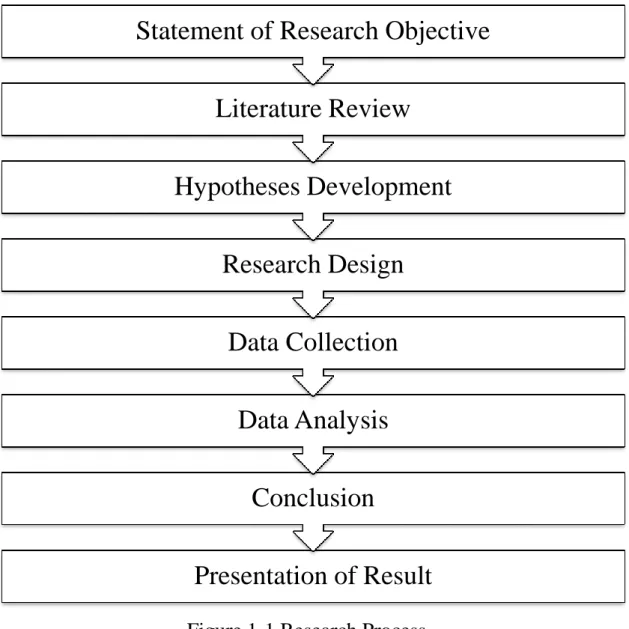
1.4 Research Process
6
Figure 1-1 Research Process
Presentation of Result
Conclusion
Data Analysis
Data Collection
Research Design
Hypotheses Development
Literature Review
7
CHAPTER 2 – LITERATURE REVIEW
2.1 Multichannel and synergistic
Multichannel service delivery has received a great deal of attention from both practitioners and academics over the last decade. Firms deploy a variety of service delivery channels ranging from physical branches, kiosks, automated machines, call centers, websites and smart phone applications to offer core and supplementary services (Lovelock et al. 2011).Service providers adopt multichannel strategies with the aim of saving transaction costs and increasing market coverage (Wallace et al. 2004). In discussing the impact of multichannel service delivery on a firm’s performance, past research has revealed that multichannel customers have higher expenditure levels and profitability than do single-channel customers (Neslin et al. 2006;Wallace et al. 2004; Venkatesan et al. 2007; Kumar and Venkatesan 2005; Kumar et al. 2006). This implies a synergistic effect at the firm level. Madlberger (2004) asserted that synergistic can be obtained by an integration of online and offline distribution channels require deeper analysis. Teltzrow et al. (2003) pointed out absence of synergistic research even though multichannel retailers enjoy synergistic advantages over pure Internet retailers, such as increase trust.
8
9
2.2 Online store atmosphere
10
the totality of experience of being in a certain place at a certain time. In the present study, we assume that physical and virtual atmosphere comprise the same number of components: graphic design and information design.Graphic designrepresents a synthesis of Turley and Milliman's (2000) offline categories interior(e.g., colors, schemes) and layout(e.g., space allocation) with KooandJu's (2010) online categories graphics (e.g., visually comforting) and colors(e.g., use of distinctive colors). Hence, graphic design catches the most visual elements in the environment(Baker etal.1994, 2002). Information design reflects Turley and Milliman's (2000) offline category point of purchase and decoration (e.g. signs, cards, price displays)and Koo and Ju's (2010) online categories links(e.g., buttons to help to find products/services)and menu(e.g. clean and neat).There is an established body of literature and decades of experience regarding the design of physical stores, the new world of online stores and website attributes are now beginning to receive attention (Jin et al. 2010).
11
marketing research, personal‐choice helper, advertising / promotion/ publicity, and entertainment. While Lii et al. (2004) listed eight attributes, termed operational factors, including content, attractiveness, ease of use, personalization, interactivity, online community involvement, security, and maintenance level.
In this study, we choose that Cheung and Lee (2005) views website design, order fulfillment and security aspects of online retailing as basic attributes and merchandising, communication and promotion aspects of online retailing as marketing-related attributes as they are necessities for online transaction.
2.3 Firm reputation
12
a result, consumers’ global impression and information gained from offline exposures can serve as a halo effect, affecting the consumer’s attitude level toward the online store (Jin et al. 2010).
In the human computer interaction (HCI) literature, the halo effect was largely applied to test an aesthetic aspect of website on evaluation of other website attributes. For example, judgment of aesthetics affected perceptions of usability, content, and overall preference (Hartmann, 2006). Further, De Angeli et al. (2006) found that the interaction style implemented in the interface affects evaluation of information quality, similar to halo effect in person perception. In marketing discipline, firm reputation and store/brand name were found to serve as a halo effect by affecting evaluation of other attributes (Caruana, 1997).
13
2.4 Perceived risk
Tarpey and Peter (1975) provided a valence framework which assumes that consumers perceive products as having both positive and negative attributes, and accordingly consumers make decisions to maximize the net valence resulting from the negative and positive attributes of the decision. These were pioneered by Lewin (1943) and Bilkey (1953, 1955) where the research recognized the fact that consumers perceive products as having both desirable (positive valence) and undesirable features (negative valence). The implicit strategy in this research is that individuals attempt to maximize the "net valence" which is the arithmetic difference between expected positive and negative utility (Kim et al., 2008). Perceived risk defined as a functional or psychosocial risk a consumer feels he/she is taking when purchasing a product (Laura Lake, 2004).
14
15
associated with transaction security and privacy; for example, the requirement that a consumer submits credit card information through the Internet can evoke apprehension due to the possibility of credit card fraud (Fram and Grady, 1997).
Laroche et al.(2005) report a stronger effect of external information sources in theformation of (service) expectation among individualistic consumers. Nevertheless, studies of perceived risk report in consistent findings. Several studies report a negative relationship between perceived risks and online shopping intentions (Jarvenpaa and Tractinsky, 1999; Kimery and McCord, 2002). Examination of the simultaneous impact of various specific dimensions of perceived risk on purchase intentions may shed greater insight on the actual role of perceived risk in the consumer decision process (Mariné, Sandra, Wi & Veena, 2010)
2.5 Attitude
16
degree to which one likes or favors performing the behavior (Finlay et al.2002). Attitude is important to understand customer attitudes because attitudes can generally predict customer purchasing intentions and behavior (Oliver, 1980; Shih, 2004). Researchers have consistently demonstrated that attitude toward the online store, i.e., an individual’s favorable or unfavorable evaluations of the store, is positively related to purchase intentions, very few studies have incorporated the premise that attitude in the context of online shopping includes both utilitarian and hedonic dimensions (Bridges and Florsheim, 2008; Childers et al. 2001). The utilitarian dimension is based on evaluation of various functions provided by the online store, whereas the hedonic dimension is based on sensations derived from the online shopping experience (Voss et al. 2003). The conceptualization of consumer attitudes toward the online store as a second-order construct made up of hedonic and utilitarian dimensions, therefore, could enable a better understanding of the complexities of the attitude formation process as well as the influence of each unique dimension on purchase intentions (Voss etal. 2003).
17
online community drives frequent interaction with the community. Although the relationship between attitude and revisit intention has not been studied in the context of online brand communities, many studies have suggested that a positive attitude toward a website or a retailer results in revisit intention (Han et al., 2009; Huang and Hsu, 2009; Umetal. 2006). Attitude takes central role in the consumer study as it influences thoughts, feelings, and most importantly consumer decision making process (Bagozzi and Warshaw, 1990). The power of attitude is reflected in both cognitive (what we think and believe) and affective (what we feel and experience) responses (Keller, 2001; Morris, Woo, Geason, & Kim, 2002; Petty, Wegener, & Fabrigar, 1997). Hence, consumers are more likely to have a stronger intention to purchase a product when they react favorably to an advertisement about that product (Haley and Baldinger, 2000; MacKenzie and Lutz, 1989).
18
consumers to switch channels. This study maintains that performance of multi- channel retailers is best evaluated both online and offline operations are taken into account.
2.6 Purchase intention
Purchase intention is a consumer’s objective intention toward a product (Fishbein and Ajzen, 1975). Purchase intention can ultimately result in actual purchase behavior (Luo et al. 2011). The greater the purchase intention is, the greater a consumer’s desire to purchase a product or service (Schiffman and Kanuk, 2000). Spears and Singh (2004) define purchase intention as a consumer’s conscious plan or intention to make an effort to purchase a product. In addition, online purchase intention focuses on whether consumers are willing and intending to buy a certain product via online transaction platforms (Pavlou, 2003). The intention to purchase a particular brand, product or service requires assessment of all brands, products or services offered by competitors (Teng et al. 2007). Intentions to purchase products/services arise when they provide the features that meet the consumers’ need (Fournier, 1998).
19
purchase behavior of four variables to measure the willingness to purchase items. Purchase intention items including three dimensions: whether to consider the purchase of products, whether you are willing to buy the product, whether to recommend this product to others (Zethaml, 1988; Dodds et al. 1991).Studies argued that purchase intention is affected by both recognized value and excellent offers of a product/service (Monroe and Krishnan, 1985; Zeithaml, 1988).
20
CHAPTER 3 – METHODOLOGY
3.1 Conceptual Model
The present study explores whether online attributes (i.e. basic attributes of online channel and marketing attributes of online channel) and offline attributes (i.e. firm reputation and perceived risk) affect e-purchase intention through e-attitude, attitude and purchase intention. For better realize the study, a research model and hypotheses connecting the variable are shown in Figure 3-1.
21
3.2 Hypotheses Development
Data collection took place through a paper and pencil survey and web-based survey. In following section, the relationships among the variables are discussed respectively, and ten hypotheses are developed in line with prior literatures.
3.2.1 Online store attributes and e-attitude
Jin et al. (2010) according to Madlberger (2004) suggestion and then chose six online store attributes: website design, security/privacy, fulfillment, merchandising, communication and promotion. Cheung and Lee (2005) and Zhang et al. (1999) view website design, order fulfillment and security aspects of online retailing as basic attributes as they are necessities for online transaction.
Montoya-Weiss et al. (2003) discover that website design factors such as navigation structure and graphic style affect customers’ overall satisfaction. Graphic design represents a synthesis of Koo and Ju (2010) online categories graphics (e.g., visually comforting) and colors (e.g., use of distinctive colors). Castaneda et al. (2007) also show that attitudes toward a website are a strong predictor of intentions to revisit the website.
22
consequences (Bulgurcu et al. 2010).
Recently, the operations management literature has explored order fulfillment in an e-commerce context (Davis-Sramek et al. 2008). Heim and Sinha (2001) found ease of return, product availability and timeliness of delivery significantly impact customers’ future buying behavior. A complementary stream of operations management e-commerce research focused on the impact of perceptions of order fulfillment service on repurchase intention(Davis-Sramek et al. 2008).
H1a: Basic attributes positively influence consumer e-attitude level. Cheung and Lee (2005) and Zhang et al. (1999) view merchandising, communication and promotion aspects of online retailing as marketing attributes as they are necessities for online transaction.The positive characteristics of communication messages canenhance the value of the store and thus increase acceptanceamong consumers. The communication aspect has been found to be important in enhancing customer online customer attitude. Moreover, quality communication can create a more positive attitude toward the store, which affects consumer willingness to purchase products (Chen, Ching, Tsai, & Kuo, 2008; Fiore, Jin, & Kim, 2005).
23
psychological and behavioral outcomes. Effective merchandise display guides and coordinates merchandise selection for shoppers (Pegler, 2001). According to Khakimdjanova and Park (2005), attitude toward visual product presentation influenced browsing and purchasing behavior in the store. A positive attitude led to more browsing and purchasing, whereas a negative attitude toward the visual product presentation resulted in an immediate exit from the store (Kerfoot et al. 2003).
Greater positive attitudes toward bonus promotions are expected to lead to stronger subscription intentions and recommendation intentions (Ajzen, 1985). Garretson et al. (2002) find that value consciousness and smart shopper self-perception affect both store brand attitudes and attitudes toward promotions. Chandon et al. (2000) argued that sales promotions providehedonic and utilitarian benefits to consumers, and that a rationaleconomicfocus on monetary savings cannot fully explain howand why consumers respond to promotional offers.Researchers have consistently demonstrated that attitude toward the online store, i.e., an individual’s favorable or unfavorable evaluations of the store, is positively related to purchase intentions, very few studies have incorporated the premise that attitude in the context of online shopping includes both utilitarian and hedonic dimensions (Bridges and Florsheim, 2008; Childers et al. 2001).However, smart shopper self-perception has a greater effect on promotions attitudes (Garretson et al. 2002).
24
3.2.2 The effect of firm reputation on online and offline attitude
Firm reputation sets the initial expectation for a consumer, serving as a halo effect (Jin et al. 2010). That is, regardless of retailers’ performance, well-known stores are evaluated more positively than relatively unknown stores (Dodds et al. 1991, Grewal et al. 1998, Estelami et al. 2003). The issue of company reputation and its impact on consumers’ attitudes and perceptions has been explored by a number of marketing researchers.Yoon et al. (1993) provided for a summary of the roles of company reputation in product/ service markets and in channel relations. For example, tested the proposition that acompany’s reputation and its service offering information collectively determine a buyer’s expectations; also, they found evidence to support the view that a buyer’s response to a service is consistent with his/her attitude toward the vendor’s reputation (Yoon et al. 1993) .
H2: Firm reputation positively influences consumer offline attitude. H3: Firm reputation positively influences consumer e-attitude.
3.2.3 The effect of perceived risk on online and offline attitude
25
2004), even though consumers may have positive attitudes toward e-customized products, they are unlikely to maintain the purchase intention long enough to purchase the products.
H4: Perceived risknegatively influences consumer offline attitude. H5: Perceived risk negatively influences consumer e-attitude.
3.2.4 The effect of attitude on purchase intention
26
attitude, and purchase intentions (Badrinarayananetal. 2012; HaandStoel, 2009). The TRA also shows how several attitudes converge together to formulate behavioral intentions (Sheppard et al. 1988). Recent studies of online advertising have also shown a positive relationship between attitude and purchase intentions and between attitude and behavior, such as the likelihood of buying, online visitations, and online shopping frequency (Bruner andKumar, 2005; Karson and Fisher, 2005; Korgaonkar and Wolin, 2002; Stevenson et al. 2000; Wang et al. 2009; Wolin et al. 2002). The conceptualization of consumer attitudes toward the online store as a second-order construct made up of hedonic and utilitarian dimensions; therefore, could enable a better understanding of the complexities of the attitude formation process as well as the influence of each unique dimension on purchase intentions (Voss et al. 2003). While it is straightforward that attitude relates positively to purchase intentions (Hwang et al. 2011).
H6: Offline attitude positively influences offline purchase intention. H7: E-attitude positively influences E-purchase intention.
27
et al. 2008).Likewise, in the multichannel retailing context, consumers’ online and offline attitudes about a retailer may be influenced by their beliefs about the retailer from all channels, not only from the respective channel (Kwon and Lennon, 2009).
H8: Offline attitude positively influences e-attitude.
28
stronger intention to repurchase and recommend the purchased product (Zeithaml et al. 1996). In other words, when customer satisfactionis enhanced, repurchase can be more frequent (Kuo et al. 2009).
H9: Offline purchase intention positively influences e- purchase intention.
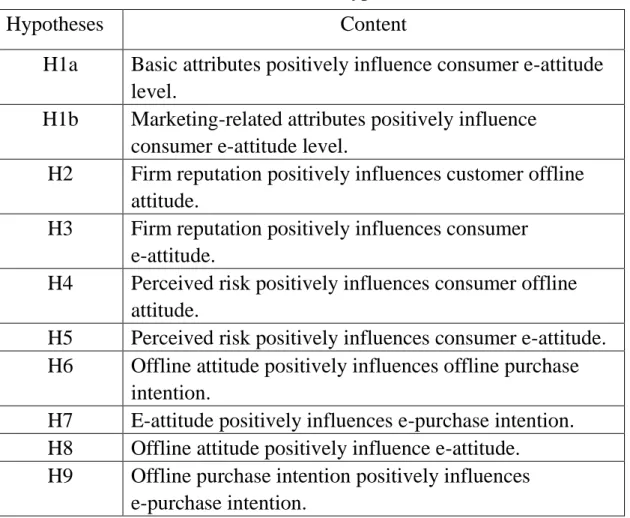
Table 3 Overall Hypotheses
Hypotheses Content
H1a Basic attributes positively influence consumer e-attitude level.
H1b Marketing-related attributes positively influence consumer e-attitude level.
H2 Firm reputation positively influences customer offline attitude.
H3 Firm reputation positively influences consumer e-attitude.
H4 Perceived risk positively influences consumer offline attitude.
H5 Perceived risk positively influences consumer e-attitude. H6 Offline attitude positively influences offline purchase
intention.
H7 E-attitude positively influences e-purchase intention. H8 Offline attitude positively influence e-attitude.
H9 Offline purchase intention positively influences e-purchase intention.
3.3 Operational definition and Questionnaire design
29
online shopping experience or shopping experience to modify items withambiguous expressions. Therefore, questionnaire respondentscould understand the questions in the formal survey and the contentvalidity of the questionnaire could be ensured.
3.3.1 The Definition and Measurement of Operational Definition The survey questionnaire comprises 52 items for measuring the eight variables including basic attributes of online channel, marketing attributes of online channel, firm reputation, perceived risk, e-attitude, attitude, e-purchase intention and purchase intention in this study.
3.3.1.1Basic attributes of online channel (BSC)
In terms of Jin et al. (2010) suggestion and e-tailing literatures, choose six online store attributes: website design, security/privacy, order fulfillment, merchandising, communication and promotion. Also, they accorded from Madlberger (2004) and (Cheung and Lee, 2005) views website design, order fulfillment and security aspects of online retailing as basic attributes as they are necessities for online transaction. Because Jin et al. (2010) and this study have same research purpose, we choose to continue to use it.
30
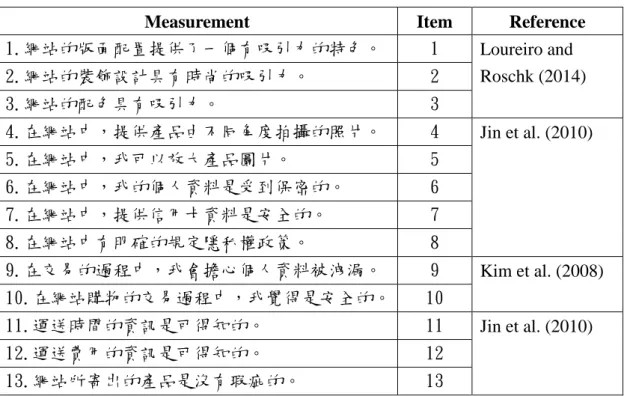
Table 3-1 The definition and measurement of basic attributes
Measurement Item Reference
1.網站的版面配置提供了一個有吸引力的特色。 1 Loureiro and Roschk (2014) 2.網站的裝飾設計具有時尚的吸引力。 2 3.網站的配色具有吸引力。 3 4.在網站中,提供產品由不同角度拍攝的照片。 4 Jin et al. (2010) 5.在網站中,我可以放大產品圖片。 5 6.在網站中,我的個人資料是受到保密的。 6 7.在網站中,提供信用卡資料是安全的。 7 8.在網站中有明確的規定隱私權政策。 8 9.在交易的過程中,我會擔心個人資料被洩漏。 9 Kim et al. (2008) 10.在網站購物的交易過程中,我覺得是安全的。 10 11.運送時間的資訊是可得知的。 11 Jin et al. (2010) 12.運送費用的資訊是可得知的。 12 13.網站所寄出的產品是沒有瑕疵的。 13
3.3.1.2 Marketing attributes of online channel (MKT)
In terms of Jin et al. (2010) suggestion and e-tailing literatures, choose six online store attributes: website design, security/privacy, order fulfillment, merchandising, communication and promotion. Also, they views communication, merchandising and promotion aspects of online retailing as marketing-related attributes as they are necessities for online transaction. Because Jin et al. (2010) and this study have same research purpose, we choose to continue to use it.
31
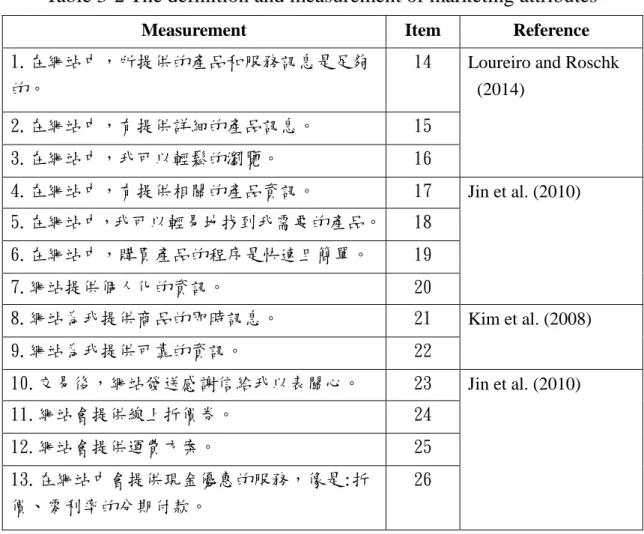
Table 3-2 The definition and measurement of marketing attributes
Measurement Item Reference
1.在網站中,所提供的產品和服務訊息是足夠 的。
14 Loureiro and Roschk (2014) 2.在網站中,有提供詳細的產品訊息。 15 3.在網站中,我可以輕鬆的瀏覽。 16 4.在網站中,有提供相關的產品資訊。 17 Jin et al. (2010) 5.在網站中,我可以輕易地找到我需要的產品。 18 6.在網站中,購買產品的程序是快速且簡單。 19 7.網站提供個人化的資訊。 20 8.網站為我提供商品的即時訊息。 21 Kim et al. (2008) 9.網站為我提供可靠的資訊。 22 10.交易後,網站發送感謝信給我以表關心。 23 Jin et al. (2010) 11.網站會提供線上折價券。 24 12.網站會提供運費方案。 25 13.在網站中會提供現金優惠的服務,像是:折 價、零利率的分期付款。 26 3.3.1.3 Firm reputation
32
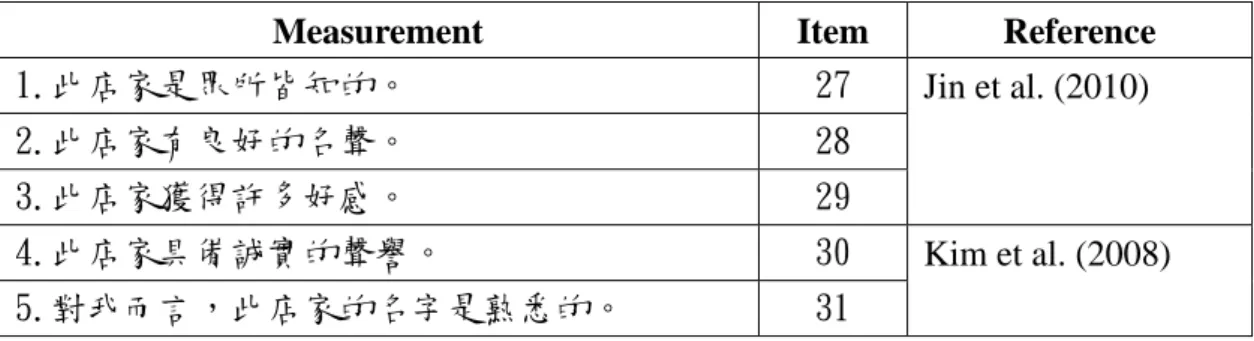
According to Kim et al. (2008) and Jin et al. (2010), this study made scale of firm reputation and regard as measuring item evidence of firm reputation. As figure 3.3.1.3, firm reputation scale is made of 5 items.All items were assessed using seven-point Likert scales from ‘‘1=strongly disagree” to 7=‘‘strongly agree”.
Table 3-3 The definition and measurement of firm reputation
Measurement Item Reference
1.此店家是眾所皆知的。 27 Jin et al. (2010) 2.此店家有良好的名聲。 28 3.此店家獲得許多好感。 29 4.此店家具備誠實的聲譽。 30 Kim et al. (2008) 5.對我而言,此店家的名字是熟悉的。 31 3.3.1.4 Perceived risk
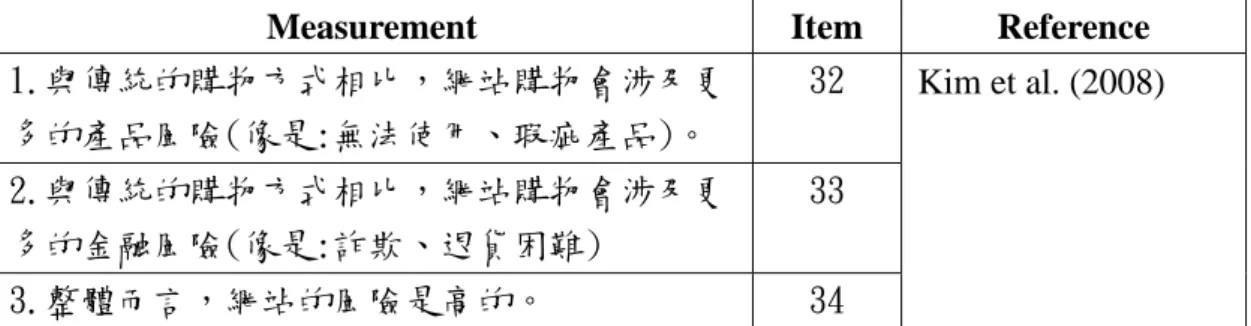
Kim et al. (2008) defined perceived risk as a consumer’s belief about the potential uncertain negative outcomes from the online transaction. A consumers’ perceived risk is an important barrier for online consumers who are considering whether to make an online purchase (Kim et al. 2008).In this study, perceived risk is definedas uncertain outcomes are considering whether to make an online transaction.
According to Kim et al. (2008), this study made scale of perceived risk and regard as measuring item evidence of perceived risk. As figure 3.3.1.4, perceived risk scale is made of 3 items.All items were assessed using seven-point Likert scales from ‘‘1=strongly disagree” to 7=‘‘strongly agree”.
33
Measurement Item Reference
1.與傳統的購物方式相比,網站購物會涉及更 多的產品風險(像是:無法使用、瑕疵產品)。 32 Kim et al. (2008) 2.與傳統的購物方式相比,網站購物會涉及更 多的金融風險(像是:詐欺、退貨困難) 33 3.整體而言,網站的風險是高的。 34
3.3.1.5 Online customer attitude
Attitudes are defined as the individual’s positive or negative feelings about performing a behavior; also, they evaluated the effect of six behavioral beliefs including perceptions of content, made for the medium, ease of use, emotion, promotion, and esthetics (Pallud and Straub, 2014).In this study, online attitude is definedas the performing a behavior of customers’ emotion when make an online purchase.
According to Lu et al. (2014), this study made scale of E-attitude and regard as measuring item evidence of E-attitude. As figure 3.3.1.5, E-attitude scale is made of 4 items. All items were assessed using seven-point Likert scales from ‘‘1=strongly disagree” to 7=‘‘strongly agree”.
Table 3-5 The definition and measurement of online customer attitude
Measurement Item Reference
1.我認為這個網站提供的資訊是真實的。 35 Lu et al. (2014)
2.我信任網站提供的資訊。 36
34
3.3.1.6 Offline customer attitude
Lu et al. (2014) consumer attitudes towardadvertisement are ‘a predisposition to respond in a favorableor unfavorable manner to a particular advertising stimulus duringa particular exposure occasion.’ In this study, consumer attitude is defined as toward consumers’ favorable or unfavorable mannerto a psychological tendencyduring aparticular exposure occasion.
According to Lu et al. (2014), this study made scale of attitude and regard as measuring item evidence of attitude. As figure 3.3.1.6, attitude scale is made of 4 items. All items were assessed using seven-point Likert scales from ‘‘1=strongly disagree” to 7=‘‘strongly agree”.
Table 3-6 The definition and measurement of offline customer attitude
Measurement Item Reference
1.我認為實體商店提供的訊息是真實的。 39 Lu et al. (2014)
2.我相信實體商店提供的資訊。 40
3.從實體商店中,我能得到正確的產品資訊。 41 4.逛過實體商店後,我能正確的了解產品資訊。 42
3.3.1.7 Online purchase intention
35
via online transaction platform.
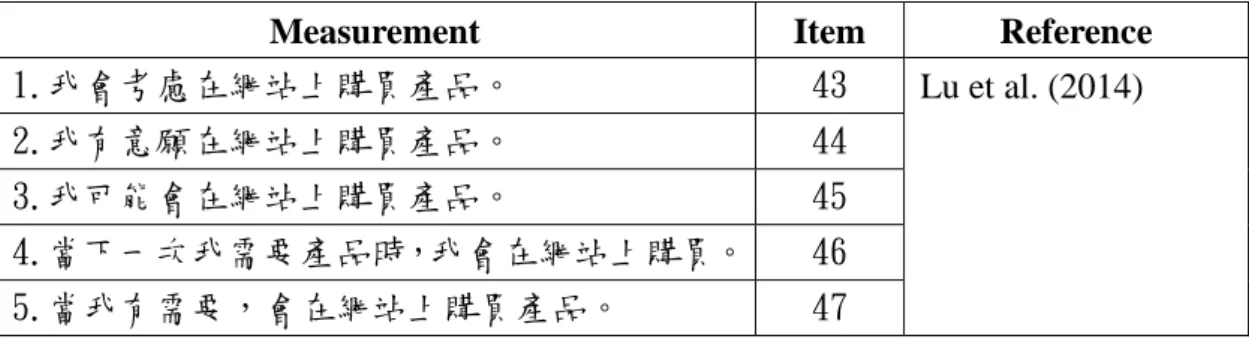
According to Lu et al. (2014), this study made scale of E-purchase intention and regard as measuring item evidence of E-purchase intention. As figure 3.3.1.2, E-purchase intention scale is made of 5 items. All items were assessed using seven-point Likert scales from ‘‘1=strongly disagree” to 7=‘‘strongly agree”.
Table 3-7 The definition and measurement of online purchase intention
Measurement Item Reference
1.我會考慮在網站上購買產品。 43 Lu et al. (2014)
2.我有意願在網站上購買產品。 44
3.我可能會在網站上購買產品。 45
4.當下一次我需要產品時,我會在網站上購買。 46
5.當我有需要,會在網站上購買產品。 47
3.3.1.8 Offline purchase intention
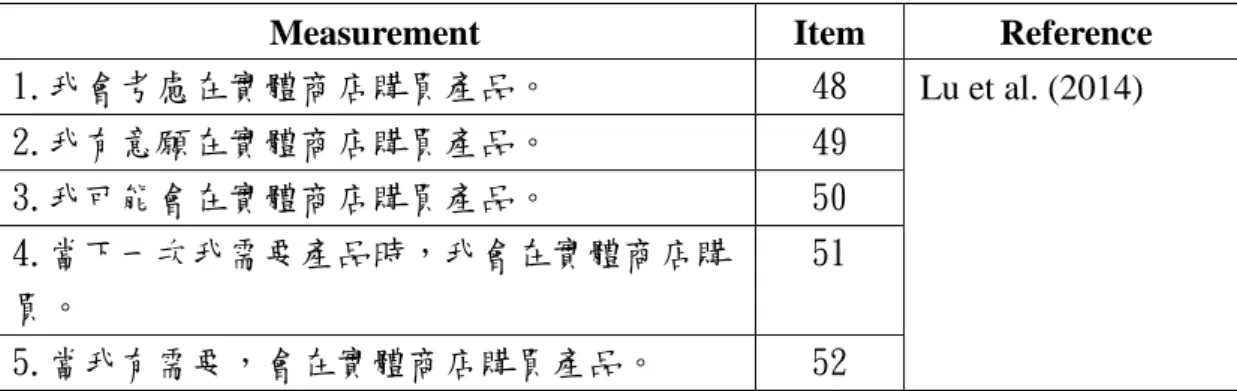
Purchase intention is a consumer’s objective intention toward a product (Fishbein & Ajzen, 1975).Lu et al. (2014) suggested that purchase intention is a consumers’willingness to buy a given product at a specific time orin a specific situation. In this study, purchase intention is defined as a consumers’ objective intention toward a product in a specific situation.
36
Table 3-8 The definition and measurement of offline purchase intention
Measurement Item Reference
37
3.3.2 The personal profile of respondents
38
3.4 Sampling Design 3.4.1 Study object
The purpose of this research is to exam the synergistic of online/offline operation and explores multiple channels retailer established the bricks and mortar whether increase online customer attitude and purchase intention. Meanwhile, explores the antecedents of affect consumer to multiple channels.We choose the customer who had online shop experience as study object.
3.4.2 Sampling methods and data collecting
In this study, we used convenience sampling. Collected questionnaire data took place through a paper and pencil survey and web-based survey.Aspect of paper and pencil survey, we delivered the survey to people who had online shopping experience on educating in senior high school, college and work. Another aspect of web-based survey,
we used Google site
39
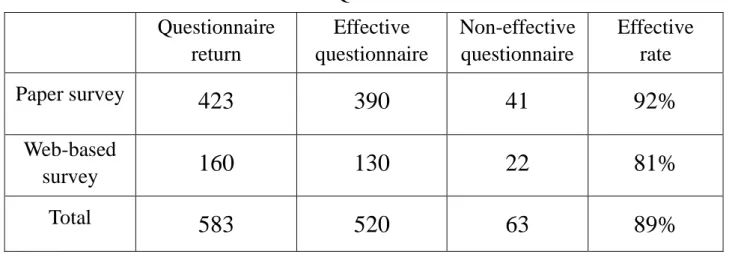
Table 3-9 Questionnaire return rate Questionnaire return Effective questionnaire Non-effective questionnaire Effective rate Paper survey
423
390
41
92%
Web-based survey160
130
22
81%
Total583
520
63
89%
3.5 Analytical Methodology3.5.1 Date detection and descriptive statistics
40
understand the opinion of the respondents. The lower the deviations, the closer it is to the expected response.
3.5.2 Reliability
The reliability is trustworthiness of measures. Also, it is the degree of consistency or stability in the measures. A measure is considered reliable if it would give us the same result over and over again. This study is used Cronbach’s Alpha and composite reliability to test consistency and stability in questionnaire.
3.5.2.1 Construct Reliability
Cronbach’s alpha is between 0 and 1. According to Guielford (1965) suggestion, when Cronbach’s alpha is greater than 0.7, it shows the questionnaire has relative high internal reliability; between 0.7 and 0.35 means medium; and below than 0.35, it has low internal reliability.
3.5.2.2 Composite Reliability, CR
Composite reliability is a reliability index for measure or test potential variables. The function of CR value lies in measuring the composition quality of construct reliability. Fornell and Larcker (1981) mention that CR value is greater than 0.6, it means have good composite reliability. When CR value is high, it shows between index has relative high internal relatively.
3.5.3 Validity
41
validity, convergent validity and discriminant validity.
3.5.3.1 Content Validity
The content validity of a measuring instrument is the extent to which it provides adequate coverage of the investigative questions guiding the study. Content validity emphasize that the breadth of content, the coverage of content and the richness of content (邱皓政, 2006). It means test have reasonable content validity that content comes from theoretical foundation, empirical research, logical reasoning and expert consensus. 3.5.3.2 Convergent Validity
The convergent validity tests are aimed at verifying whether answers from different individuals to question-statements are sufficiently correlated with the respective latent variables.
3.5.3.3 Discriminant Validity
Fornell and Larcker (1981) present a method for assessing thediscriminant validity of two or more factors. Here, a researcher compares the AVE of each construct with the shared variance between constructs. When the discriminant validity is supported, the AVE for each construct is greater than its shared variance with any other construct (Hair, Anderson, Tatham and Black, 1998).
3.5.4 Structural Equation Model, SEM
42
index of overall fit are Absolute Fit Measures, Incremental Fit Measures and Parsimonious Fit Measures. This study used AMOS to execute SEM analysis.
3.5.4.1 Absolute Fit Measure
(1) Normed Chi-Square, NC
Hayduk (1987) define that NC value below 3, it means good fitness. On the other hand, Bollen (1989) definition that NC value should below 5, it is better for overall fitness.
(2) Goodness of Fit Index, GFI
When GFI value between 0 and 1 that value more close to 1, it means the model is better in fitness. Doll, Xia and Torkzadeh (1994) pointed out if GFI value is greater than 0.9, it means good fitness, but between 0.80 and 0.89 is reasonable fitness.
(3) Adjusted Goodness of Fit Index, AGFI
Both GFI and AGFI have standardization, the value between 0 and 1. If more close to 1, it means the model is better in fitness. Doll et al. (1994) indicated that the value of AGFI is greater than 0.9, it means the model is better in fitness. As if between 0.80 and 0.89 is reasonable fitness.
(4) Standardized Root Mean Square Residual, SRMR
43
(5) Root Mean Square Error of Approximation, RMSEA
Jarvenpaa, Tractinsky and Vitale (2000) mention that when RMSEA value below 0.08 is acceptable. McDonald and Ho (2002) suggest that 0.05 is good fit and 0.08 is acceptable.
3.5.4.2 Incremental Fix Measures
(1) Normed Fix Index, NFI
The NFI value is between 0 and 1. Bentler and Bonett (1980) and Doll et al. (1994) pointed out that NFI value have greater than 0.9 means good mode.
(2) Incremental Fix Index, IFI
The IFI value is between 0 and 1. When value is more close to 1, it means have good fitness. If IFI value us equal to 1, it means the data match mode completely. Whether is acceptable in judging mode, IFI value must greater than 0.9 means ideal fitness.
(3) Non-Normed Fix Index, NNFI
At beginning, NNFI was called Tucker-Lewin Index (TLI) for use in Exploratory Factor Analysis, then it explores to SEM. Generally, the NNFI value must greater than 0.9, it means have ideal fitness (Bentler & Bonett, 1980).
44
The comparative-fix index is provided from Bentler (1990), the purpose is overcome the disadvantage of NFI. According to Bentler (1990) and Hair et al. (1998), suggest that CFI value is greater than 0.9 means acceptable in fitness.
3.5.4.3 Parsimonious Fit Measures
(1) Parsimonious Goodness of Fix Index, PGFI
The PGFI value is between 0 and 1. The value is more bigger means better fitness. Mulaik et al. (1989) claim that have greater than 0.5 is possible.
(2) Parsimonious Normed Fix Index, PNFI
45
CHAPTER 4 – ANALYTICAL RESULTS
According to the collected paper and web-based questionnaire data, a statistical analysis was conducted to verify hypotheses and examine the research model. In this section, SPSS and Amos software was applied to analyze data.
4.1 Description of Sample Source
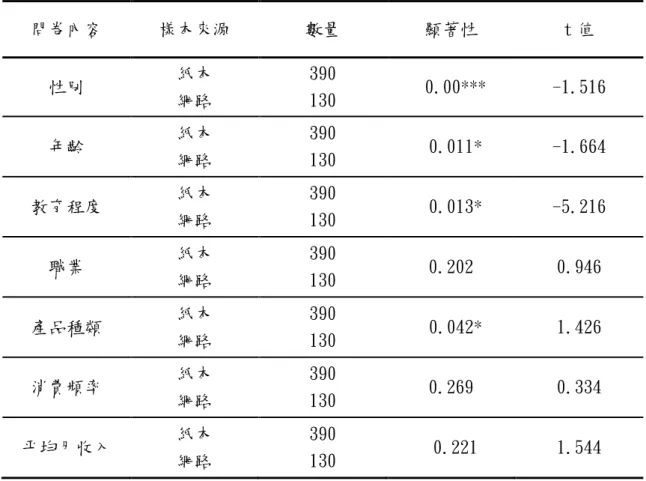
In this study, we directed at paper and web-based demographic variables to use T-test. As shown in Table 4-1. Next, we test the sample whether have response bias with T-test to detect paper and web-based questionnaire data.As shown in Table 4-2.
Table 4 Description of Demographic variables
46
Table 4-1 Description of Items (continue)
47
Table 4-1 Description of Items(continue)
48
Table 4-1 Description of Items(continue)
49 PI_5 390 130 5.389 6.056 1.170 1.081 0.101 -3.915
4.2 Description of Sample property
In this study, 583 respondents participated in the survey and effective samples from 520 respondents were included. The majority of respondents were female (52.7%), students (35.8%) and university or college students (42.9%), age between 19 and 30 years (48.7%), mostly consume product costume (19.2%), frequency twice or below a month (47.5%) and monthly income approximately NT $20,000 or under (35.6%). As shown in Table 4-2.
4.3 Mean and Standard Deviation
50
Table 4-2 Description of Sample
51
Table 4-3 Descriptive Statistics of Basic Attributes of Online Channel
題項 平均數 標準差
Basic attributes of online channel
BSC1 網站的版面配置提供了一個有吸引力的特色。 5.0173 1.07596 BSC2 網站的裝飾設計具有時尚的吸引力。 4.9712 1.07750 BSC3 網站的配色具有吸引力。 4.9288 1.05747 BSC4 在網站中,提供產品由不同角度拍攝的照片。 4.9519 1.07503 BSC5 在網站中,我可以放大產品圖片。 5.0192 1.08573 BSC6 在網站中,我的個人資料是受到保密的。 5.0788 1.10330 BSC7 在網站中,提供信用卡資料是安全的。 4.9635 1.04642 BSC8 在網站中有明確的規定隱私權政策。 5.0654 1.12579 BSC9 在交易的過程中,我會擔心個人資料被洩漏。 5.0038 1.18597 BSC10 在網站購物的交易過程中,我覺得是安全的。 4.9692 1.05303 BSC11 運送時間的資訊是可得知的。 5.1019 1.11876 BSC12 運送費用的資訊是可得知的。 5.1154 1.15393 BSC13 網站所寄出的產品是沒有瑕疵的。 4.9077 1.03835
The scale of marketing attributes of online channel consisted of 13 items. The mean of the items ranged from 4.88 to 5.20. The standard deviation of the items ranged from 1.05 to 1.16. The value of each item is listed in Table 4-4.
Table 4-4 Descriptive Statistics of Marketing Attributes of Online Channel
題項 平均數 標準差
Marketing attributes of online channel
52
MKT12 網站會提供運費方案。 5.0423 1.14723
MKT13 在網站中會提供現金優惠的服務,像是:折價、零
利率的分期付款。 4.9712 1.16183
The scale of firm reputation consisted of 5 items. The mean of the items ranged from 5.03 to 5.30. The standard deviation of the items ranged from 1.14 to 1.19. The value of each item is listed in Table 4-5.
Table 4-5 Descriptive Statistics of Firm Reputation
題項 平均數 標準差 Firm reputation RPU1 此店家是眾所皆知的。 5.0423 1.14386 RPU2 此店家有良好的名聲。 5.0385 1.18860 RPU3 此店家獲得許多好感。 5.3058 1.18304 RPU4 此店家具備誠實的聲譽。 5.2788 1.17666 RPU5 對我而言,此店家的名字是熟悉的。 5.2115 1.19789
The scale of perceived risk consisted of 3 items. The mean of the items ranged from 2.21 to 2.31. The standard deviation of the items ranged from 1.40 to 1.47. The value of each item is listed in Table 4-6.
Table 4-6 Descriptive Statistics of Perceived Risk
題項 平均數 標準差 Perceived risk PR1 與傳統的購物方式相比,網站購物會涉及更多的產品 風險(像是:無法使用、瑕疵產品)。 2.3135 1.47288 PR2 與傳統的購物方式相比,網站購物會涉及更多的金融 風險(像是:詐欺、退貨困難) 2.2192 1.46705 PR3 整體而言,網站的風險是高的。 2.2192 1.40944
53
Table 4-7 Descriptive Statistics of Online Customer Attitude
題項 平均數 標準差
Online consumer attitude
EA1 我認為這個網站提供的資訊是真實的。 4.8731 1.01018
EA2 我信任網站提供的資訊。 5.0135 1.05978
EA3 從網站中,我可以得到正確的產品資訊。 5.1404 1.08302
EA4 瀏覽網站後,我能正確的了解產品資訊。 5.3904 1.27201
The scale of offline consumer attitude consisted of 4 items. The mean of the items ranged from 5.30 to 5.51. The standard deviation of the items ranged from 1.14 to 1.29. The value of each item is listed in Table 4-8.
Table 4-8 Descriptive Statistics of Offline Consumer Attitude
題項 平均數 標準差 Consumer attitude CA1 我認為實體商店提供的訊息是真實的。 5.3038 1.14968 CA2 我相信實體商店提供的資訊。 5.3615 1.16800 CA3 從實體商店中,我能得到正確的產品資訊。 5.4558 1.22512 CA4 逛過實體商店後,我能正確的了解產品資訊。 5.5154 1.29016
The scale of online purchase intention consisted of 5 items. The mean of the items ranged from 5.380 to 5.67. The standard deviation of the items ranged from 1.16 to 1.37. The value of each item is listed in Table 4-9.
Table 4-9 Descriptive Statistics of Online Purchase Intention
題項 平均數 標準差
Online purchase intention
EPI1 我會考慮在網站上購買產品。 5.3808 1.20260
EPI2 我有意願在網站上購買產品。 5.3885 1.16924
EPI3 我可能會在網站上購買產品。 5.4038 1.20467
EPI4 當下一次我需要產品時,我會在網站上購買。 5.5192 1.31964
54
The scale of offline purchase intention consisted of 5 items. The mean of the items ranged from 5.16 to 5.34. The standard deviation of the items ranged from 1.17 to 1.29. The value of each item is listed in Table 4-10.
Table 4-10 Descriptive Statistics of Offline Purchase Intention
題項 平均數 標準差 Purchase intention PI1 我會考慮在實體商店購買產品。 5.1692 1.23150 PI2 我有意願在實體商店購買產品。 5.1942 1.17240 PI3 我可能會在實體商店購買產品。 5.1981 1.22167 PI4 當下一次我需要產品時,我會在實體商店購買。 5.2750 1.26283 PI5 當我有需要,會在實體商店購買產品。 5.3462 1.29895 4.4 Reliability 4.4.1 Construct Reliability
55
4.4.1.1 Reliability of basic attributes of online channel
The scale of basic attributes of channel consisted of 13 items.The value of Cronbach’s α is 0.938. The reliability value won’t increase from deleted any item. It means that have goodness reliability. The overall Cronbach’s α value of each scale ranges from 0.908 to 0.962. As shown in Table 4-11.
Table 4-11 Reliability of Basic Attributes of Online Channel
56
4.4.1.2 Reliability of marketing attributes of online channel
The scale of marketing attributes of online channel consisted of 13 items. The value of Cronbach’s α is 0.944. The reliability value won’t increase from deleted any item. It means that have goodness reliability.As shown in Table 4-12.
Table 4-12 Reliability of Marketing Attributes of Online Channel
57
4.4.1.3 Reliability of firm reputation
The scale of firm reputation consisted of 5 items. The value of Cronbach’s α is 0.920. The reliability value won’t increase from deleted any item. It means that have goodness reliability.As shown in Table 4-13.
Table 4-13 Reliability of Firm Reputation
Item Cronbach’s α value after deletion Delete or not Overall Cronbach’s α value 1.此店家是眾所皆知的。 0.908 NO 0.920 2.此店家有良好的名聲。 0.905 NO 3.此店家獲得許多好感。 0.896 NO 4.此店家具備誠實的聲譽。 0.893 NO 5.對我而言,此店家的名字是熟悉的。 0.908 NO
4.4.1.4 Reliability of perceived risk
The scale of perceived risk consisted of 3 items.The value of Cronbach’s α is 0.928. The reliability value won’t increase from deleted any item. It means that have goodness reliability.As shown in Table 4-14.
Table 4-14 Reliability of Perceived Risk
58
4.4.1.5 Reliability of online customer attitude
The scale of online consumer attitude consisted of 4 items. The value of Cronbach’s α is 0.908. The reliability value won’t increase from deleted any item. It means that have goodness reliability.As shown in Table 4-15.
Table 4-15 Reliability of Online Customer Attitude
Item Cronbach’s α value after deletion Delete or not Overall Cronbach’s α value 1.我認為這個網站提供的資訊是真實的。 0.891 NO 0.908 2.我信任網站提供的資訊。 0.863 NO 3.從網站中,我可以得到正確的產品資訊。 0.860 NO 4.瀏覽網站後,我能正確的了解產品資訊。 0.910 NO
4.4.1.6 Reliability of offline customer attitude
The scale of consumer attitude consisted of 4 items. The value of Cronbach’s α is 0.954. The reliability value won’t increase from deleted any item. It means that have goodness reliability.As shown in Table 4-16.
Table 4-16 Reliability of Offline Customer Attitude
59
4.4.1.7 Reliability of online purchase intention
The scale of online purchase intention consisted of 5 items. The value of Cronbach’s α is 0.962. The reliability value won’t increase from deleted any item. It means that have goodness reliability.As shown in Table 4-17.
Table 4-17 Reliability of Online Purchase Intention
Item Cronbach’s α value after deletion Delete or not Overall Cronbach’s α value 1.我會考慮在網站上購買產品。 0.955 NO 0.962 2.我有意願在網站上購買產品。 0.952 NO 3.我可能會在網站上購買產品。 0.950 NO 4.當下一次我需要產品時,我會在網站上購買。 0.953 NO 5.當我有需要,會在網站上購買產品。 0.957 NO
4.4.1.8 Reliability of offline purchase intention
The scale of purchase intention consisted of 5 items. The value of Cronbach’s α is 0.940. The reliability value won’t increase from deleted any item. It means that have goodness reliability.As shown in Table 4-18.
Table 4-18 Reliability of Offline Purchase Intention
60
4.4.2 Composite reliability
In this study, we conducted confirmatory factor analysis (CFA) to test composite reliability of scale. The measurement principle is R²greater than 40%, factor loading greater than 0.5 and significant of statistic (Bagozzi and Yi, 1988; Diamantopoulos and Siguaw, 2000). The result of confirmatory factor analysis is shown in table 4-4-9. As table 4-19 show that R² of each item ranged from to and factor loadings ranged from to. The value of CR is measure the composite quality of reliability and greater than 0.7 (Fornaell and Larcher, 1981). The value of CR ranged from 0.825 to 0.959 and AVE ranged from 0.520 to 0.949. It means have goodness composite reliability.
Table 4-19 Confirmatory Factor Analysis
Variables and Items Factor Loadings R2 CR AVE
62 EPI02 0.948 0.898 EPI03 0.938 0.881 EPI04 0.871 0.758 EPI05 0.854 0.729 Offline purchase intention 0.935 0.742 PI01 0.826 0.683 PI02 0.881 0.777 PI03 0.939 0.881 PI04 0.846 0.716 PI05 0.811 0.658 4.5Validity 4.5.1 Content validity
63
4.5.2 Construct validity
In this study, we conducted all variables of each item in part-whole correlation to test construct validity.The results exhibit that correlation value of all variables and each item is under p<0.01. It means that questionnaires have goodness construct validity.As shown in 4-20- 4-27.
64
Table 4-20 Construct validity of basic attributes of online channel (continue)
65
66
Table 4-21 Construct validity of marketing attributes of online channel (continue)
67
Table 4-22 Construct validity of firm reputation
Variable and item
RPU RPU1 RPU2 RPU3 RPU4 RPU5
RPU 1.000 RPU1 0.848** 1.000 RPU2 0.863** 0.775** 1.000 RPU3 0.890** 0.638** 0.679** 1.000 RPU4 0.901** 0.633** 0.676** 0.872** 1.000 RPU5 0.852** 0.654** 0.629** 0.682** 0.739** 1.000
Table 4-23Construct validity of perceived risk
Variable and item PR PR1 PR2 PR3
PR 1.000
PR1 0.937** 1.000
PR2 0.955** 0.869** 1.000
PR3 0.911** 0.755** 0.808** 1.000
Table 4-24 Construct validity of online customer attitude
Variable and item
EA EA1 EA2 EA3 EA4
EA 1.000
EA1 0.861** 1.000
EA2 0.913** 0.804** 1.000
EA3 0.918** 0.717** 0.792** 1.000
68
Table 4-25 Construct validity of offline customer attitude
Variable and item
CA CA1 CA2 CA3 CA4
EA 1.000
CA1 0.923** 1.000
CA2 0.943** 0.869** 1.000
CA3 0.949 0.807** 0.859** 1.000
CA4 0.938 0.800** 0.817** 0.890** 1.000
Table 4-26 Construct validity of online purchase intention
Variable and item
EPI EPI1 EPI2 EPI3 EPI4 EPI5
EPI 1.000 EPI1 0.924** 1.000 EPI2 0.938** 0.902** 1.000 EPI3 0.946** 0.854** 0.897** 1.000 EPI4 0.937** 0.794** 0.807** 0.856** 1.000 EPI5 0.927** 0.784** 0.796** 0.823** 0.901** 1.000
Table 4-27 Construct validity of offline purchase intention
Variable and item
PI PI1 PI2 PI3 PI4 PI5
69
4.6 Hypotheses Testing
70
Table 4-28 Model Fit Measurement
Index Standard Overall Result
71
Standardized path coefficients of the model are illustrated in Table 4-29. Most of structural paths are highly significant (p<0.05 or <0.001) and met the proposed causal direction so that H1a, H2, H5, H6, H7, H8 and H9 are confirmed. Some of path in the model was not significant (p>0.1) so that H1b, H3 and H4 is not confirmed.The R square value of online customer attitude is 0.753, offline customer attitude is 0.673, online purchase intention is 0.671 and offline purchase intention is 0.522. As shown in table 4-30.
Table 4-29Standardized Path Coefficients
Variable Hypotheses Standardized
Coefficient
P value T-value R2 Result
e-Customer Attitude
Basic attribute (H1a) 0.442 0.012** 2.517 0.753 Supported
Marketing attribute (H1b)
0.252 0.107 1.613 Unsupported
Firm reputation (H3) -0.033 0.736 -0.337 Unsupported
Perceived risk (H5) -0.047 0.005** -2.789 Supported
Offline customer attitude (H8)
0.211 0.000*** 4.696 Supported
Customer Attitude
Firm reputation(H2) 0.894 0.000*** 17.855 0.673 Supported
Perceived risk(H4) -0.027 0.261 -1.125 Unsupported
72
73
CHAPTER 5 – CONCLUSION
In this final section we discuss our research, providing the theoretical and practical implications according to the results. As well as advance a suggestion and future research.
5.1 Discussion
The model fitness of this research correspond to the business model of online to offline can increase the online purchase intention. The test results of each variable as following:
5.1.1 The connection of basic attributes of online channel and online customer attitude
In this study we discover that basic attributes arepositively influence online consumer attitude level. The research finding as same as the scholars are includedMontoya-Weiss et al. (2003), Bulgurcu et al.(2010) and Davis-Sramek et al.(2008). As a result, the results show that basic attributesare great so that online customer attitude will increase.
5.1.2 The connection of marketing attributes of online channel and online customer attitude
74
online store can provide consumers’ personal information. If consumer is first time member in the online store, they will give you coupon. Especially, promotions of online store are too general to attract consumers. According to observe online stores, the consistency is too high and recognizable too low in marketing attributes of online channel.
5.1.3 The connection of firm reputation and offline customer attitude In this study we invent that firm reputation is positively influence offline customer attitude. The research finding as same as the scholars are includedJin et al.(2010), Yoon et al. (1993),Dodds et al. (1991), Grewal et al. (1998), Estelami et al. (2003). Therefore, the results show that firm reputation is great so that offline customer attitude will increase.
75
that is it really as same as they claimed. As a result, consumer approaching to brick and mortar where they can touch and check the material quality for sure firm reputation is real indirectly in online channel.
5.1.5 The connection of perceived risk and offline customer attitude In this study we assume that perceived risk is negatively influence offline customer attitude.The results show that perceived risk negatively influence to offline customer attitude is insignificant.Perceive risk isinfluence the offline customer because customers could see, touch and try products in bricks and mortar but not in online store. Bricks and mortar could greatly lower the customers’ perceived risk. It means that customers thought the bricks and mortar’s risk was less than online store.
5.1.6 The connection of perceived risk and online customer attitude In this study we invent that perceived risk is negatively influence online customer attitude.The research finding as same as the scholars are includedHeijden et al. (2001),Im et al. (2008) and McKnight et al.(2004). Therefore, the results show that perceived risk is low so that offline customer attitude will highly increase.
5.1.7 The connection of offline customer attitude and offline purchase intention
76
Fygenson (2006),&Oliver(1980) and Shih(2004). Hence, the results show that offline customer attitude is great so that offline purchase intention will increase.
5.1.8 The connection of online customer attitude and online purchase intention
In this study we find that online customer attitude is positively influence online purchase intention.The research finding as same as the scholars are includedBruner and Kumar, (2005), Karson and Fisher, (2005), Korgaonkar and Wolin, (2002), Stevenson et al.(2000), Wang et al. (2009) and Wolin et al.(2002).As a result, the results demonstrate that online customer attitude is great so that online purchase intention will increase.
5.1.9 The connection of offline customer attitude and online customer attitude
In this study we invent that offline customer attitude is positively influence online customer attitude.The research finding as same as the scholars are includedLee et al. (2006), Kwon and Lennon, (2009) and Reza et al. (2008).Therefore, the results illustrate that offline customer attitude is great so that online customer attitude will increase.
5.1.10 The connection of offline purchase intention and online purchase intention