國立臺灣大學工學院土木工程學系 碩士論文
Department of Civil Engineering College of Engineering
National Taiwan University Master Thesis
物體視角故事的水環境教育應用 :
以物體視角敘事產生情感連結以激發環境態度變化 Object View Story: Changing Environmental Attitude by Stimulating Emotional Arousal in Water Education
楊舒涵 Yang, Shu-Han
指導教授:康仕仲 教授 共同指導:曾敬梅 助理教授 Advisor: Prof. Shih-Chung Kang Co-advisor: Prof. Ching-Mei Tseng
中華民國 106 年 8 月
Aug. 2017
中⽂摘要
水資源保護是一項環境教育的重要工作。環境態度,包涵環境意識、環境責任感 以及環境價值觀三個面向,是造成民眾水資源保護行動意願的因素,也環境教育的重 點,其中,與自然環境的情感連結是影響環境態度的重要來源。研究顯示「故事」是
一種能夠有效引發情感連結的工具,透過故事造成的觀點取替(perspective-taking),
讀者對故事角色的情感能夠被引發。本研究發展與設計一個適合環境教育目標的故事,
以提升「對自然的情感連結」為目標,主張以物體的視角來敘說環境議題故事,有別 多數故事以人的視角,希望藉此方法帶領讀者站在自然環境物體的觀點上,反觀人類 行為。「物體視角故事」的說故事方法,使用擬人化自然物體作為故事主角,以其視
角來敘述環境相關議題。本研究建立了物體視角故事的建構三步驟:(1) 物體素材鎖定
(Object Targeting),(2) 物體角色生成 (Object Character Formation),以及 (3) 物體經驗建
立 (Object’s Experience Building)。繪本有聲書《水寶》為本研究提出的物體視角故事
方法的一項實作,內容以水環境議題為中心,並施測於188 位高中生,其中 95 位是讀
繪本的實驗組。結果顯示受試者看過《水寶》後的環境態度有顯著的變化,並且,情 緒引發程度越高的受試者,其一個月後環境態度態度有較優異得表現。質性訪談結果 也顯示出讀者會將自己投射在擬人化的自然物體角色,並對其產生情感連結,因而對 故事中探討的環境議題產生更高的興趣以及更深入的反思。
關
關鍵鍵字字:水環境教育、觀點取替、態度、情緒、故事
ABSTRACT
Water conservation is an important issue in environmental education for all.
Environmental attitudes, including environmental awareness, responsibility and values and beliefs, have long been a priority within environmental education due to its crucial role to people’s intentions toward water conservation behaviors. Particularly, emotional connection with natural environment and its impact on pro-environmental attitudes are believed can be aroused through storytelling. Due to the effect of perspective-taking, emotional connection could possibly be aroused by a story character. Thus, we aim to construct a story specifically for environmental education purposes to change environmental attitude by stimulating emotional arousal.
For the purpose to induce readers’ emotional connection toward the “nature”, this study proposes to narrate environmental issues from the view of natural objects, instead of the most- used human view. This reversed approach, indicated as Objective View Story (OVS), is developed to help readers examine human impacts on the environment in the position of nature. In the story, a personified object is created as the lead character to describe environmental issues from the object’s view. The following three main steps were developed to construct OVS: (1) Object Targeting, (2) Object Character Formation and (3) Object Experience Building.
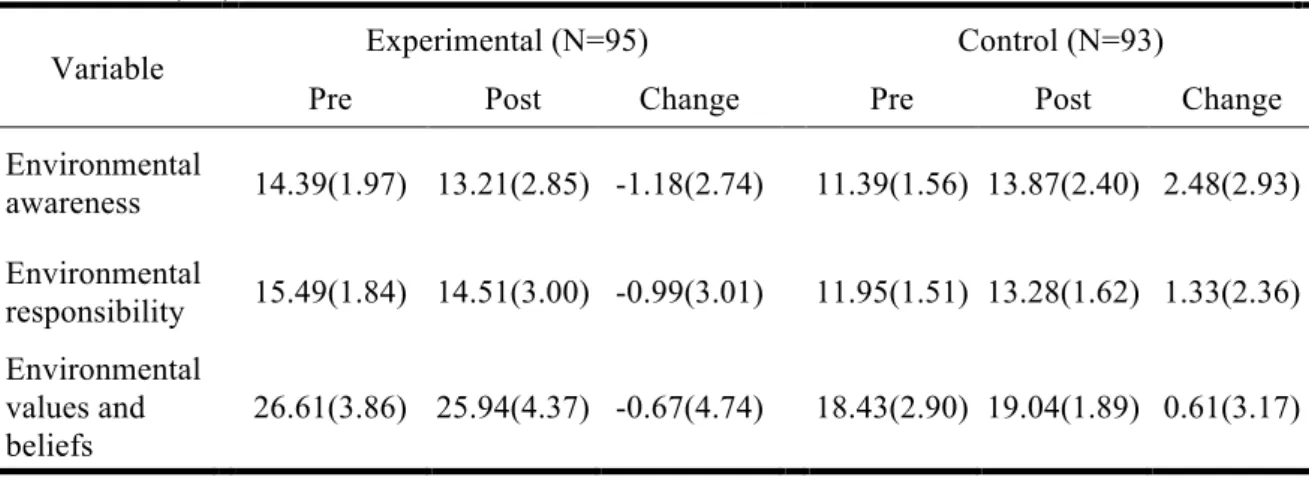
An audio picture book, entitled WaterBob, was created as a practice of OVS specifically for water environmental issues and tested among 188 high school students, with 95 in experimental group reading WaterBob and 93 in the control group. The findings show that WaterBob significantly influenced participants attitude changes in the aspects of environmental awareness and environmental values and beliefs. Besides, higher level of emotion aroused toward WaterBob significantly predicts better performance in their overall environmental
attitudes over one month. The corresponding focus group interviews also revealed that readers often projected themselves onto the personified object, produced emotions attachments, and gain more interests in and deeper reflection on the featuring environmental issues.
Keywords: Water Environmental Education, perspective-taking, attitude, emotions, storytelling, story book
TABLE OF CONTENTS
中⽂摘要... i
ABSTRACT ... ii
TABLE OF CONTENTS ... iv
LIST OF FIGURES ... vii
LIST OF TABLES ... viii
Chapter 1. Introduction ... 1
1.1 Motivation ... 1
1.2 Background ... 2
1.3 Research Goal ... 4
1.4 Research Questions ... 4
Chapter 2. Literature Review ... 6
2.1 The Role of Emotional Connections in Environmental Education ... 6
2.2 Storytelling as an Instructional Tool in Environmental Education ... 7
2.3 Perspective-taking and Effects of Personification of Objects ... 9
2.4 Summary ... 10
Chapter 3. Methodology ... 11
3.1 Overview of OVS ... 11
3.2 Research Framework ... 12
3.3 OVS Construction ... 13
3.3.1 Step1. Object Targeting ... 14
3.3.2 Step2. Object Character Formation ... 18
3.3.3 Step3. Object’s Experience Building ... 19
3.4 A Practice of OVS: WaterBob ... 24
3.4.1 Brief Introduction of WaterBob ... 24
3.4.2 OVS Construction of WaterBob ... 26
3.5 Data Collection ... 34
3.5.1 Pilot Study ... 34
3.5.2 Quantitative Investigation ... 36
3.5.3 Qualitative Investigation ... 38
Chapter 4. Result and Discussion ... 43
4.1 Pilot Study Result and Discussion ... 43
4.2 Quantitative Investigation Result ... 44
4.2.1 Environmental Attitudes ... 44
4.2.2 Emotional Connection (toward WaterBob) ... 45
4.3 Qualitative Investigation Result and Discussion ... 50
4.3.1 Projection on the Object Character ... 50
4.3.2 Perception of the Symbolized Issues ... 51
4.3.3 New Awareness in the Featuring Issues ... 53
Chapter 5. Conclusion ... 57
Reference ... 59 Appendix ... 62
LIST OF FIGURES
Figure 3.2 The process of environmental attitude change with OVS stimuli (adapted from the
research of “implicit ambivalent from attitude change” by Petty et al. (2006)). ... 13
Figure 3.3.1. OVS Construction structure ... 14
Figure 3.3.2 Structure of OVS factual ingredients ... 17
Figure 3.3.3 OVS’s story structure (adapted from Freytag’s triangle (1863)) ... 21
Figure 3.4.1 The cover of the audio picture book WaterBob. ... 25
Figure 3.4.2 (a) Symbolization in character’s settings: Personality ... 29
Figure 3.4.2 (b) Symbolization in character’s settings: Function ... 29
Figure 3.4.2 (c) Symbolization in character’s settings: Appearance ... 30
Figure 3.4.3 WaterBob eating candy ... 30
Figure 3.4.4 Simplified story scenarios of WaterBob corresponding to the story structure .... 33
LIST OF TABLES
Table 3.4.1 Simplified factual information symbolized in WaterBob ... 27
Table 4.2.1 Descriptive data of the test scores. ... 44
Table 4.2.2 OVS’s influences on environmental attitudes (ANCOVA). ... 45
Table 4.2.3 Influences of emotional connection on environmental attitudes (ANCOVA) ... 46
Chapter 1. Introduction
1.1 Motivation
Water conservation should be put into practice by everyone. However, people’s alienation from nature seems to result in neglect and damage to the natural resource, including water. To enhance people’s intentions of water conservation, environmental attitudes, contributing to the formation of behaviors, is therefore an important emphasis in environmental education for all, including enhancement in people’s environmental awareness, responsibility and values and beliefs. Particularly, people’s emotional connection with natural environment is believed to be an important factor to pro- environmental attitudes (Berenguer, 2007), and are believed to be aroused through storytelling (Johnson, 2011). Due to the effect of perspective-taking, people reading a story come to realize and feel for the lead character by taking the character's perspective.
Likewise, one’s feelings may be aroused toward an object through a story with a personified object as the lead character. Moreover, the feelings for natural objects would mediate to the natural environment as a whole (Berenguer, 2007). Hence, present study proposes using storytelling with personified natural object as the lead character, to induce people’s emotions toward the natural environment to which the object belongs. This is the concept of Object View Story (OVS), to guide people’s comprehension of environmental issues from an object’s view. In present study, OVS construction method is introduced and practiced in the field of water environmental issues, while it is wished to have more applications on general environmental topics for environmental education purposes in the future.
1.2 Background
Problems and needs in Water Environmental Education. Water conservation is a universal issue that the responsibility should be assumed by everyone (Parker and Sams, 2015). When usable water is limited, water consumers should feel their responsibilities to maintain a sustainable water environment. However, modern people seems ignorant of their misappropriation of water resource due to alienation to the nature. People’s unawareness of their impacts on nature may cause serious water environment damages.
For these reasons, it is a difficult but essential matter in water environmental education to raise people’s awareness of their involvement of environmental changes (denoted by
“environmental awareness” in this study) as well as their responsibilities to protect the water environment (denoted by “environmental responsibility”). To “close the gap”
between human and nature, studies has proposed the importance of emotional connection in people to the natural environment. In other words, affective factors have received more attention in environmental education, rather than traditional approach stressing on knowledge. Comparing to expository words, storytelling is found an effective strategy to trigger emotions in readers, as they project their sensation on the lead character due to perspective-taking. Therefore, present study aims to enhance people’s sense of their involvement in water environmental issues, by inducing people’s emotional connection toward nature through the introduced mean of storytelling.
Insufficient Research on Designing Stories for Environmental Education. There have been cases using storybooks to instruct in environmental education. However, published research in this field remain deficient, and most of them target at effects on children, not at adults or general people. Moreover, among enormous forms of stories, few studies
environmental education, as well as how to design a story which is effective to induce readers’ emotions for the nature. It is valuable to develop a designing method of stories for supporting interested educators or authors to create effective storybooks for environmental education purposes.
Story comprehension from Different Perspectives. Many storybooks display environmental problems from human standpoint via a human lead character. Readers are guided to learn the featuring environmental issues through the human character’s opinions and feelings. In this case, empathy and emotions aroused would probably point to the human character rather than the natural environment. In contrast, taking the perspective of a natural object is predicted to raise higher empathy for “nature” than taking human perspective. This idea is the foundation of OVS. For raising people’s awareness of their negative impacts on certain natural object, stories may adopt OVS approach to narrate the experience of the suffering natural object from its view. Readers are predicted to perceive those feelings of the object character, and further interpret that such way of human use on the object would lead to similar effects on natural objects in reality. Based on this comprehension, readers are expected to reflect on the way they use the referent natural object, and further get inspired to protect the object, mediated from the intention to protect the object character in the story.
In summary, for general people today, increasing emotional connection with nature, which would further improve pro-environmental attitudes, is an important matter of environmental education. Before successfully enhance the connection with nature, we propose to induce emotional connection with “natural objects” first, based on Berenguer’s findings (2007) that these emotions toward natural objects would mediate to the natural environment as a whole. To achieve this, storytelling of “an object’s experience” is
predicted to induce emotions toward the object due to perspective-taking. Hence, the concept of OVS and its construction method is developed.
1.3 Research Goal
The overall goal of this research is to develop a form of storytelling that narrates from an object’s view to enhance people’s emotional connection with the natural environment and further stimulate one’s changes in pro-environmental attitudes (including environmental awareness, responsibility, and values and beliefs). Objective View Story (OVS) is thus developed, which proposes using a personified object as the lead character to symbolize factual environmental issues from the object’s view. This reverse approach provides readers to examine human behaviors standing in the position of the environment. In brief, OVS is expected to achieve the following objectives: (1) to successfully transmit the featuring environmental issue content to readers by narrating from an object’s view, (2) to induce changes in environmental attitudes by arousing reader’s emotions toward the object character.
An audio picture book, entitled WaterBob, were created as a practice of OVS, and was used to investigate the effects of OVS, and this approach is wished to be applied to more environmental topics in the future, becoming a reference of story design for environmental education for general people.
1.4 Research Questions
Based on the objectives of an OVS, the following research questions are set to verify its effects in comprehension and attitude changes regarding environmental issues:
Q1: Do readers realize the environmental issue content through OVS?
Q2: Does OVS induce environmental attitude changes?
In Q1, we want to validate if the introduced OVS construction method works to create a story through which the readers are indeed able to comprehend the symbolized environmental issue. In Q2, we would like to verify one’s changes of environmental attitudes after reading OVS, regarding environmental awareness, responsibility, and values and beliefs.
Chapter 2. Literature Review
2.1 The Role of Emotional Connections in Environmental Education
The dominant approach of environmental education relying on increment of
“knowledge” has been found ineffective to drive pro-environmental behaviors (Kollmuss
& Agyeman, 2002). Rather, people’s beliefs, feelings, and experiences, regarding environment, are even more important factors than fact and knowledge to affect environmental attitudes (Pooley and O’Connor, 2000). Affective domain learning has therefore received more and more attention in environmental education. For the purpose of improving people’s connection to nature and thus stimulate their environmental awareness, i.e., “knowing of the impact of human behavior on the environment” defined by Kollmuss & Agyeman (2002), and willingness for pro-environmental actions, studies has emphasized the importance of emotional connections to the natural environment.
Emotions take a role in positive concern and behavior to the environment (Gifford, 2014).
As Hadzigeorgiou and Skoumios (2013) noted, students’ awareness of the natural environment is more likely raised as they perceive being involved with it. Lumber et al (2017) also suggests that emotional attachment should be one factor to focus for researchers interested in stimulating nature affinity and its associated advantages. Besides,
“empathy”, usually refers to comprehension of other people’s cognitive and affective mental states, is also considered an element of concern in strengthening one’s connection to natural environment when it comes to perspective-taking with “natural objects”.
Empathy for natural objects will increase helping behaviors and attitudes toward nature as a whole (Berenguer, 2007).
2.2 Storytelling as an Instructional Tool in Environmental Education
Research has shown that beliefs about numerous science topics, including environmental topics, may be affected through narratives (Dahlstrom and Ho, 2012).
Storytelling is based on a pedagogy in which distinctions between fact and fiction vanish (Hadzigeorgiou and Skoumios, 2013). Comparing to expository words, fictional narratives may be a more appropriate approach for science and environmental education because it’s more accessible, and more suitable for mediating human involvement with the world (Gough, 1993). For these reasons, storytelling is useful in instructions for non- experts for subjects including environmental education (Dahlstrom, 2014).
People reading a fiction appears to simulate social experience, both cognitive and emotional perception, illustrated the story (Mar et al, 2005). Stories provide the chances for readers to perceive effects similar as that of a real-world experience in cases that direct experience in the actual world is impossible. A reader sympathizes with the characters in the story to experience their encounters as if it was the reader’s own experience, through taking the perspective of the characters (Bal and Veltkamp, 2013). A fictitious experience is constructed in reader along the plot though projection on recognized character’s emotions and thoughts, which leads to an examination and reinterpretation on certain values (Kao, 2011) and thus appears possible to shifts one’s attitudes or viewpoints to the world. That story experience may become more realistic as real experience by transportation, i.e. the absorption in stories including emotional involvement and cognitive attention (Green and Brock, 2000). In the aspect of emotions, emotional perception will be affected by reading stories (Johnson, 2011). People is predicted to become more empathic when they are emotionally transported into a fiction based on transportation theory (Bal and Veltkamp, 2013). Bal and Veltkamp’s experiments found that empathic skills of readers who had read a fiction significantly changed over one week
and, in particular, higher emotional transportation results in greater enhancement in empathic skills. This conclusion appears to support the finding of Johnson (2011) that higher affective empathy for story characters was aroused in participants who were more transported into the story.
In sum, above studies are optimistic about the performance of storytelling as an educational method for enhancing people’s pro-environmental mentality. Since alienation of modern people from natural environment is considered one key to environmental damages (Pulkki et al., 2017), and that the loss of interactions with nature changes people’s emotions toward nature (inclusive of their affinity to, interest in, and love of nature) and even willingness for natural protection (Soga and Gaston, 2016), storytelling seems to play an important role in building people’s emotional connection to nature for its capability to fill the experience loss with nature. A crucial question would be that
“what kind of stories help raise environmental awareness?” (Hadzigeorgiou and Skoumios, 2013) when it comes to storytelling as a mean of environmental education. For enhancing environmental awareness, Hadzigeorgiou and Skoumios (2013) pointed that significance in relation to human life should be fully held in stories centering around nature issues.
2.3 Perspective-taking and Effects of Personification of Objects
Due to perspective-taking, readers fathom story characters’ thoughts, affection, and intentions reading a story to infer their actions and reactions (Bal and Veltkamp, 2013).
This effect of perspective-taking may also be applicable to characters of “objects”.
Rompay et al (2014) found in their experiments that people would generate abstract animated meanings for inanimate objects when they took the perspective of those objects and simulate their sensation. Moreover, “stimulating people to take an inside perspective in relation to designed objects (e.g., a car ad telling consumers to imagine driving the car) might contribute to the formation of an emotional connection” (Rompay et al, 2014).
Benefiting from perspective-taking, emotional attachments to nature may be built through the anthropomorphizing, i.e. personification, of nature (Lumber et al, 2017). Tam et al (2013) also suggests that a sense of connection will be initiated to the personified entity, and therefore motivates protective behavior to nature. In contrast, storytelling from human standpoint (via a human lead character), may guide readers to learn the issues content through projection on the human character, resulting in that feelings or empathy aroused would probably points to the human character rather than the displayed natural issue and environment. In conclusion, for environmental education purposes, storytelling using personified natural object as the lead character appears to be one probable approach to raise readers’ emotional connection with the environment, and even motivation of protection.
2.4 Summary
In summary, current challenges in water environmental education include people’s detachment with nature. In this case, emotional connection with nature is highlighted for improving people’s awareness of human impacts, sense of responsibility of water conservation, as well as desirable values and beliefs toward the water environment. Also, the affection aroused toward natural environment is proved possible to be transmitted from the emotions toward the natural objects involved. Furthermore, storytelling has been found a promising strategy in environmental education for not only its accessibility in content for general people, but also, regarding emotional arousal, its capability to create fictitious experience and emotional sensation in reader due to perspective-taking with story characters. Perspective-taking is also applicable to objects, so that emotions toward natural objects may be induced through reading storytelling with a natural object as the lead character, that is, a story from a natural object’s view. These researches contribute the idea of OVS: a story reflecting water environmental issues with a personified natural object as the lead character, guiding readers to comprehend the content from an object’s view. Readers are expected to produce emotion connection with the object character, thus the symbolized natural object character, and finally the whole natural environment.
Chapter 3. Methodology
3.1 Overview of OVS
The overall goal of OVS is to improve people’s emotional connection with the natural environment which is expected to further stimulate one’s changes in pro- environmental attitudes, in the aspects of environmental awareness, responsibility, and values and beliefs. To be specific, OVS is expected to achieve the following objectives:
(1) to successfully transmit the featuring environmental issue content to readers by narrating from an object’s view, (2) to induce changes in environmental attitudes (including awareness, responsibility, and values and beliefs) by arousing reader’s emotions toward the object character. Readers are expected to produce emotion connection with the object character, thus the symbolized natural object character, and finally the whole natural environment.
People comprehend what a character experiences, feels and thinks by perspective- taking. Hence, the main design principle of OVS is to provide readers a different standpoint, not of human but a natural object, to examine human impacts standing in the position of the environment. This could be interpreted as driving the readers to experience how the “suffering” natural objects would react and feel about to human behaviors if they were animated. Therefore, OVS proposes using personified object as the main character to symbolize a factual environmental issue from an object’s view. By assigning the object conscious sensation, how an object may feel and think about human behaviors on them (the way human use, impact and damage the object) is revealed from the character’s perspective, that is, the sufferer’s perspective. This is a strategy to raise reader’s awareness of the “suffering nature object” for initiating greater sense of responsibility to lighten this suffering, based on the altruism theory of Schwartz (1977). Awareness of human impacts on the objects, responsibility to preserve the object (and the environment),
and positive values and beliefs toward the environment are expected to be improved through reader’s emotions for the character and the story. The emotion connection aroused by OVS is considered the stimuli to evoke reader’s introspection on their attitudes toward the featuring environmental issues, and thus lead to environmental attitude changes.
3.2 Research Framework
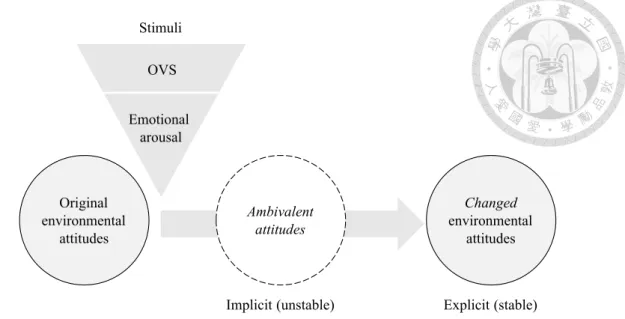
This section explains the basis of OVS to stimulate environmental attitude changes, the principle and construction method of OVS, and the validation. In brief, OVS is developed for the purpose to evoke environmental attitude changes with the strategy of emotion arousal toward the natural object character. Figure 3.2 demonstrate the conceptual process of attitude changes due to OVS stimuli. It is predicted that the old stable attitudes toward a certain environmental issue of a reader will be disturbed by stimuli of OVS, including a different set of information received from the comprehension from a different perspective (the object’s view) and the emotions aroused toward the object character and the whole story, if the OVS succeed to produce these expected effects.
An interference with an original attitude should be created as the stimuli forcing one to experience an introspection evaluating the old and new viewpoints. Based on the research of Petty et al. (2006) on implicit attitude change, before a new (or changed) attitude has stably established, a reader would undergo an unstable implicit process in which ambivalent attitudes toward one thing exist at the same time. Hence, the emphasis of OVS construction is how to design a story that would evoke reader’s introspection on its lone- held viewpoints toward human’s impacts on nature, and finally lead to environmental attitude changes. The validation of OVS is interested in readers’ states of attitude changes as well as the influences of emotional stimuli from OVS.
Figure 3.2 The process of environmental attitude change with OVS stimuli (adapted from the research of “implicit ambivalent from attitude change” by Petty et al. (2006)).
3.3 OVS Construction
This section introduces the conceptual procedure and principles to construct an OVS, and in the next section will demonstrates this procedure with the OVS practice, WaterBob.
To design an OVS to present a certain environmental issue or problem, we introduce the following three main steps to execute: Object Targeting, Object Character Formation, and Object’s Experience Building. The procedure is demonstrated in figure 3.3.1.
In the first step, Object Targeting, featuring object is determined and the resource of creation is further prepared, outputting the ‘factual ingredients’, which are sorted to three classes: object’s nature, object’s social relations, and events. Next, in the second step, Object Character Formation, we form the object character by transforming part of the factual ingredients, object’s natures and social relations, into character’s settings (personality, function and appearance). After this we will have the character’s basic information to fathom its habitual thinking, feelings, and reactions. Finally, in the final step, Object’s Experience Building, we build the featuring object’s experience to be the main body of the story. We create fictitious scenarios to symbolize factual events, and
Original environmental
attitudes
Changed environmental
attitudes Ambivalent
attitudes Stimuli
Implicit (unstable) Explicit (stable) OVS
Emotional arousal
follow them with the featuring object’s reactions. The reactions trigger another scenario, and the scenarios then lead to the object’s new reactions, occurring on and on. Detailed explanation for each design step is presented below.
Figure 3.3.1. OVS Construction structure
3.3.1 Step1. Object Targeting
In the first step, Object Targeting, we have to decide what object(s) we should target as the main character, and enumerate the associated facts about the object(s) as the ingredients for character formation and experience building later. An OVS is a fiction mirroring an actual environmental matter by symbolization. In order to create such story, necessary information about the actual subject matter has to be collected as the resource of creation. Moreover, because an OVS features a fictitious experience of “an object”, information of the target object is also required.
There are two main works to be done in Object Targeting. First, we select the actual object(s) (involved in the referent environmental matter) to play the main character.
Afterwards, we enumerate the associated actual information of the featuring object(s) and the referent environmental matter. Among numerous information, we converge the resource of creation within the scope of things related to the featuring object.
3.Object Experience Formation 2. Object Character Formation
1. Object Targeting Factual
Ingredients Character
settings Happenings ReactionsObject’s Natures
Social Relations
Events
The main object character of an OVS is determined by that from whose view we wish the readers to take to understand the story, or, with what object we expect the readers to empathize with. For the purpose to raise people’s reflection on their damaging behaviors on the environment, the featuring object should be the resource being abused by human activities. Thus, through perspective-taking with the character, readers are supposed to produce empathy on the abused object and its related environment as a whole if we target the abused object under the illustrated actual environmental matter to be the main object character.
To be specific to our application on water environmental education, readers are wished to cherish water resource and reflect over their daily use of water resource. Using an OVS, we want readers to reversely think about how the water resource would think and react to human deeds on them. Water resource thus becomes the conscious character, the target to empathize with. Readers are anticipated to watch the venture from the water’s view.
It should be noted that, more than symbolizing just one specific object, the main object character may integrate several other related objects as “a combined object” to reveal a broader concept as a whole, depending on the purpose of the story. The purpose of the story means the expected effects on the readers after they read the story.
Specifically, a story purpose may be a critical thought wished to be initiated in readers’
mind after they read the story. For example, a story purpose may be making readers not only cherish the water resource but learn the hard works and difficulties of water supply as a whole. In this case, the ‘water’ character may combine more associates, e.g., water storage, water supplier, into its attributes, making reader perceive the features of “water supply”.
b. Preparing factual ingredients
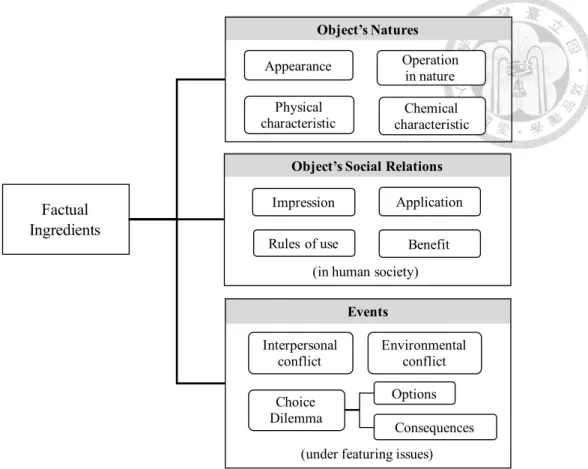
The object character should be designed to be able to reveal the facts of an environmental issue. This means readers should be able to peek the features of reality from the metaphors attached on the object character itself, and, of course, understand what natural object the character represents. Furthermore, from the character’s “experience” in the story, readers should be able to perceive the corresponding events in the real environmental issue. To achieve that, factual features have to be transformed into fictitious parts of the object character. Therefore, we have to consider what factual features, here called factual ingredients, the character may carry. The factual ingredients are sorted into three main classes: object’s natures, object’s social relations, and events, as shown in figure 3.3.2. These factual ingredients will be used in both the next two steps as the inputs, as shown in figure 3.3.1. Especially, object’s natures and social relations help forming the character’s setting, and the events help building the story scenarios.
Object’s natures. Object’s natures illustrate object’s appearance, physical and chemical characteristics, or its operation in the natural environment. Take water for example, the ingredients referring water’s appearance in observation may include being soft and transparent; physical characteristics may be being deformable, fluid or having evaporation; water’s operation in the environment may describe where water resource is from and to go (collected from precipitation, flows to the ocean, evaporate), or what water serves for the environment (being vital substance for most of the creatures). Ingredients of the object’s natures will be used to build the settings of the object character in step 2.
Illustrating the character based on the actual natures of the featuring object helps readers associate the object character with the natural object, and thus persuade them to link the character’s encounters with the real-world natural problems.
Figure 3.3.2 Structure of OVS factual ingredients
Object’s social relations. Object’s social relations explain the relationship between the object and the human society: how the object is used and interpreted by people.
Ingredients of social relations may include people’s impression on the object (e.g., “water seems easy to get in daily life”), applications (e.g., “water is used to generate power”), rules of use (e.g., “people pay to get water”), and benefits the object brings (e.g., “water contributes to industrial production”), and ...etc.
Events. Events present the happenings due to the object under the featuring issues.
Ingredients of events may include interpersonal conflicts (unsolved obstacles among people, e.g., troublesome communication without consensus, disputes or competition over interest related to the issue), environmental conflicts (the unbalance between human activities and the environment) and choice dilemmas (arguments over great questions, for which people are unable to come to a conclusion because of several options with equal
Factual Ingredients
Object’s Natures
Physical
characteristic Chemical characteristic
Appearance Operation
in nature
Object’s Social Relations
Rules of use Benefit
Impression Application
(in human society)
Events
Consequences Choice
Dilemma Interpersonal
conflict Environmental conflict Options
(under featuring issues)
importance and supports). To completely describe a choice dilemma, the controversial options and their possible consequences are important to be analyzed as extended information.
3.3.2 Step2. Object Character Formation
In this step, we personify the target object into a living character. The character’s settings are customized with three attributes: Personality, Function and Appearance.
After this we will have the character’s basic information (e.g., its temper, preference, abilities...etc.) to fathom its habitual thinking, feelings and reactions.
In OVS, the lead character is expected to symbolize the facts, so that readers will reversely obtain clues from the character to peek the real issue content. In other words, we hope to make appropriate image transformation from actual things into character’s fictitious features, to make readers able to comprehend the symbolized reality from this character itself and its life in the fiction. For this purpose, certain factual ingredients are transformed and attached to the three attributes of the main character. The following introduces the concepts of the formation of each attribute.
Personality. Attaching factual ingredients to Personality, the actual meanings of certain factual ingredients are reinterpreted with personalized impressions. Take water’s natures for example, being “soft” may be transformed into a personalized characteristic of being
“gentle” or “weak”; being ‘deformable by external forces’ may be assigned a personalized impression of being “indecisive” or “having no definite opinions”.
Function. The attribute Function explains the character’s abilities, responsibilities, and ways of interaction with the world in the story. Function means what the character servers to do, has to do and how to do to survive in the story world. Thus, ingredients of social
relations, expressing the uses of the object or how the object serves to fulfill human needs, are the reference to the formation of object character’s Function.
Appearance. Appearance of character is what it looks outside. It may simply be designed to be like the actual object (or a portion of it), expressing what actual object it represents and what functions it takes. In a picture book, the character’s outside image is a medium of clues. It may be used to clue the readers what the current status of the environment is or what might be going to happen, if in experience the object’s outside changes depending on variation of surroundings. For instance, if the character is a “water container” with a space to store water in its belly, it may use an image of low water level in its belly to reveal a situation of deficient current water resource; otherwise, an image of full water in its belly implies abundant water resource, a better environmental condition and mood.
3.3.3 Step3. Object’s Experience Building
Finally, the main body of an OVS starts to be built. An OVS may be considered as a presentation of “the experience of the object in certain environmental issue”. Therefore, in this step, we write the object’s experience. Building the object’s experience, we have to create happenings, and to each infer the object’s reactions. Happenings are the events in the story, and the object’s reactions includes its thoughts, sensation and actions toward the happenings. Apparently, the object’s reactions should be derived according to the character settings formed in step 2: the personality, function and appearance. (Appearance reactions may be the facial expression of its current emotion, or deformation of body due to influences from the surroundings.) The story is a sequence of chain events of the happenings and the characters’ reactions: some happening leads to the character’s reaction, and its reaction results in a new happening, and so on. We illustrate the object’s
thoughts and sensation for what it sees, from which the readers’ empathy and emotions are induced.
a. Scenario Construction
Again, OVS is expected to make readers able to comprehend the symbolized reality from the object character’s life in the fiction. Therefore, the actual events under the symbolized environmental issue have to be blended into parts of the character’s life in the story. That is to say, we will create story scenarios to mirror the actual events in the real world. To accomplish this, first, the factual ingredients of events (prepared in step 1) are transformed into the happenings that the object character encounters in the story. Next, we have to predict the object’s reactions to the happenings according the character’s settings, including its emotions, thoughts, intentions, final actions…etc. One happening results in the object’s reactions to it, and the reactions then result in the next happening.
This chain reaction makes the story plot. Since the character settings contains the hints of factual features of the natural object, those happenings and object’s reactions in the story reveals the ways and patterns of interaction between the natural object and human in the real world.
b. Evolvement in Object Character’s Experience
For the purpose of OVS to guide readers learn something along with the object character from its view, it should be clearly illustrated in the story that the object character grows from an ignorant state to a learned state toward certain lesson (e.g., a truth about human nature, people’s attitudes to the object...etc.). That lesson the character has finally learned is right what the OVS drives the readers to learn and reflect on. The initial state of the character’s knowledge and viewpoints should be set not far away from
usually most of the target audiences do not know, either), so that readers’ prior knowledge is adequate to construct the schema to realize every encounter in the story, and thus generate empathy and emotional connection with the object character. In other words, they will be able to know and feel the same way of the characters, since they understand and recognize the character’s reactions.
c. Object’s Experience Structure (Story Structure)
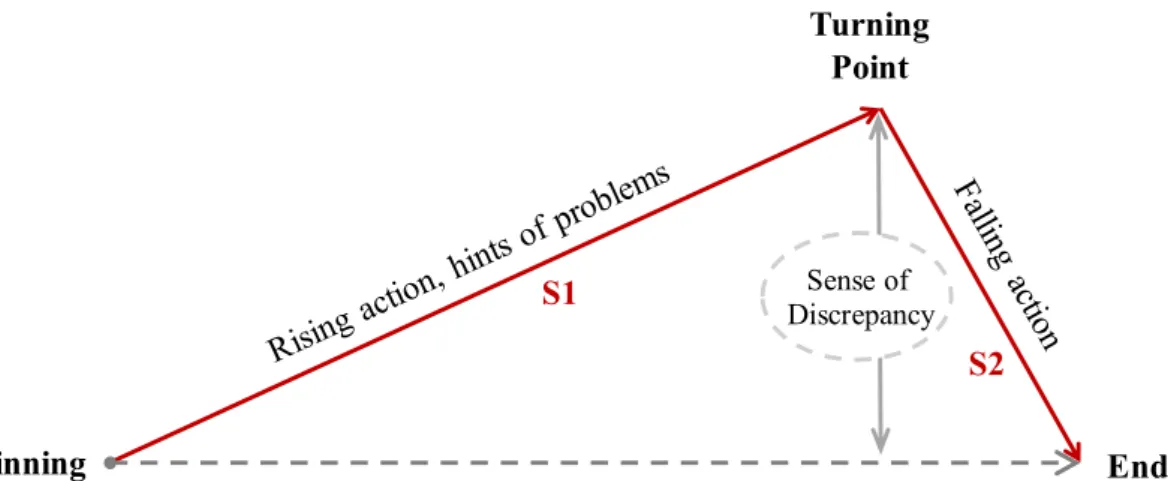
This part introduces the structure of the object’s experience, or, the story, as well as the detailed design and expected effects of each story element. Freytag’s dramatic structure (1896), or Freytag’s triangle, is adapted to explained the basic story structure (Figure 3.3.3). The object’s experience (the story) is set up with three main components, beginning, turning point and end. In between develops the rising actions and falling actions to connect the components. Rising action pushes the plot to a climax with tense or uneasy situations, that is, the turning point; the falling action redirects the proceeding and converges the story content to the end.
Figure 3.3.3 OVS’s story structure (adapted from Freytag’s triangle (1863))
Beginning End
Turning Point
Sense of Discrepancy S1
S2
As mentioned earlier, the object character will grow up from an inexperienced state to experienced state realizing certain truth that is the lesson the story drive the readers to learn. Therefore, in the beginning of the story, the characters are usually in a state of being ignorant about certain critical ideas (also the ideas for readers to learn). In this initial schema (structure of knowledge and attitudes to comprehend the world), the character is unable to deduce the end of the story. In this way, the story line (S1) from the beginning to the turning point (rising action) points to an orientation deviating from the one directly pointing to the end (dotted line). Therefore, readers are supposed not able to predict the real ending of the story, but hold another prediction of the story proceeding instead. S1 is piled up with happenings pushed forward by the character’s reactions following its initial schema. In this deviation, the character’s experience should include obstacles, conflicts and challenges supposed to happen because of the ignorance. In this progress, the problems of the environmental issue gradually emerge.
When the turning point is reached, a happening to the object character is set to trigger reader’s awareness of that things do not go the way they expect. Due to the turning point event, the character starts to change from being ignorant to aware of the critical ideas. The plot turns from S1 to the second story line, S2. At this moment, readers should start to perceive that the earlier prediction of the story proceeding was wrong.
Simultaneously, a sense of discrepancy is initiated in readers, since the actual story proceeding is different from their expectation. The sense of discrepancy describes the feelings of impact when the story goes in an orientation that they do not expect, or not favorably see, to happen. This sense of impact is wished to have similar effects of the
“disorienting dilemma” introduced in Transformative Learning Theory (Mezirow, 2000), which is an important factor to leading readers to reflect over the two different states of
d. Conditioning Emotional Arousal
Create Cognitive Conflicts. One objective of OVS is to arouse readers’ awareness of their environmental responsibilities, along with introspection on their previous attitudes and behaviors to the damaged object or environment. Based on Transformative Learning Theory (Mezirow, 2000), critical reflection for an adult, which is the key for ones to refine their schema, may result from an experience of disorienting dilemma. Disorienting dilemma describes an experience that a consequence does not make sense to one’s original assumption, so that one cannot resolve the situation without change in their views of the world. This state of cognitive conflict is what the “sense of discrepancy” in OVS structure (see figure 3.3.3) expects to create. For helping attitude changes in readers, we suggest to provide an experience closed to that of a disorienting dilemma as the turning point, that is, to challenge readers’ original assumptions and viewpoints used to realize the featuring environmental issues. Therefore, the introduced method of story building (see previous section) intends to show readers how a certain human activity (especially in which readers might also participate) may cause an unexpected disappointing consequence on the lead object character. To achieve this effect, elements such as conflicts, disorienting dilemmas and challenges in choices may be considered necessary elements for building the object’s experience.
Follow authenticity. More realistic, more persuasive. Not only helping readers feel empathy for a character, authenticity also help readers to recognize their emotions and their reactions in the character (McDonald, 2009), that is, to trust their perception for the character. Therefore, the story should proceed based on reasonable emotions and reactions of involved characters. Even if the characters and world of a fiction do not exist in the reality, strong rational cause and effect is required to persuade readers to believe the content and get involved. Readers need to place themselves (though imagination) in
the similar situation as the story to understand what the object character encounters and thinks, and therefore rehearsal in mind what would they do if they face a similar situation in the real world (i.e. mental rehearsal). If a scenario does not follow realistic cause and effect, it could produce little interests in readers for doing mental rehearsals, as the consequence in that scenario is probably believed to never happen in the reality.
3.4 A Practice of OVS: WaterBob 3.4.1 Brief Introduction of WaterBob
We practiced the OVS method and created an audio picture, entitled WaterBob, centering around environmental issues about limited water resource (full content in Appendix). The story is made into an audio picture book. The featuring water environmental issues include the vicious circle of unbalanced cost and price of limited water resource, and the argument over water distribution. WaterBob, same name as the book title, is the lead character of the story. WaterBob represents the physical natural object: “water resource”, combined with conceptual images of water supply.
Beside the lead character, there are three supporting characters, the Rat (a village chief), the Cat (a boss of factory) and the Bunny (a farm owner), which relatively represent the three different water consumption parties: people’s livelihood water, agricultural water, and industrial water.
The story in brief proceeds as: WaterBob gets involved in a competition over limited water resource among different water consumers. Due to draughts and polluted streams, WaterBob fails to collect and supply sufficient water to all consumers. During the process, problems have emerged about the priority to get water among consumer parties as well as the trade-off between breaking long-held habits or keeping original system. WaterBob is exhausted working to collect water with insufficient rewards for its living. In the end,
On the side of reality, the story presents the argument over water distribution among different parties (agriculture water, industrial water and people’s livelihood water) and the vicious circle of unbalanced cost and price of limited water resource, simultaneously revealing water users’ irrational attitudes and behaviors which will possibly result in water depletion. In sum, WaterBob is expected to make the readers not only understand how the featuring water issues form and could develop, but also raise their awareness of how they are responsible for those problems. Following the objectives of the OVS, we hope readers will initiate emotional connections toward WaterBob and further pass on the real water environment.
Figure 3.4.1 The cover of the audio picture book WaterBob.
3.4.2 OVS Construction of WaterBob Step1. Object Targeting of WaterBob
As mentioned earlier, the object character should be the abused resource under the illustrated environmental issue, to better raise readers’ reflection on their damaging behaviors and awareness of their responsibilities focusing on that featuring object. In he featuring water environmental issues of WaterBob (see table 3.4.1), “water” is the target of human abuse. Hence, “water” is selected to be the main image of the main object character. However, readers are wished to get inspired to not only cherish the water resource but learn the hardships of water supply in this story. Thus, “water” is not the only thing we hope the readers to empathize with.
Actually, more than just physically being “water”, the character WaterBob takes on images of objects and concepts related to “supplier”. In this case, readers are supposed to watch the story standing in the position of both “water” and “water supplier” along with the lead character, and thus empathize and initiate emotions with both. WaterBob is therefore designed to represent the resource “water” and “water supply” as a whole, by merging the functions of water supplying related things, e.g., water corporation and water storage facility, into WaterBob’s Function (later introduced in 3.4.2). Table 3.4.1 shows the featuring objects the character WaterBob represents. The information shown in the table is only a portion of all that will be later used to demonstrate the three steps to construct an OVS.
Table 3.4.1 Simplified factual information symbolized in WaterBob Factual Information in WaterBob
Featuring Issues • The vicious circle due to unbalanced cost and price of limited water resource.
• People’s arguments over water distribution.
Featuring objects (of the lead character)
Factual Ingredients
Object’s Natures
Object’s Social Relations
Events
Interpersonal Conflicts
Environmental Conflicts
Choice Dilemmas
Different claims of water distribution among three main parties of water users
Water demand exceeds supply Water price is lower than the cost
Human require water to fulfill their industrial production, while sometimes damage more water resource
Should water price be raised in the situation of deficient water?
How to compare the importance of demands of the three parties?
(How to determine the priority of water rights?) Individual interest vs. Public interest?
Water is soft
Water is deformable by external forces
Water resource is influenced by climates and human activities
Water is distributed under central management Water is endless demanded by people nowadays.
People paid for water Water does not voice
Water is transparent
Water resource agency Water corporation Water Water storage facility
Step2. Object’s Character Formation of WaterBob
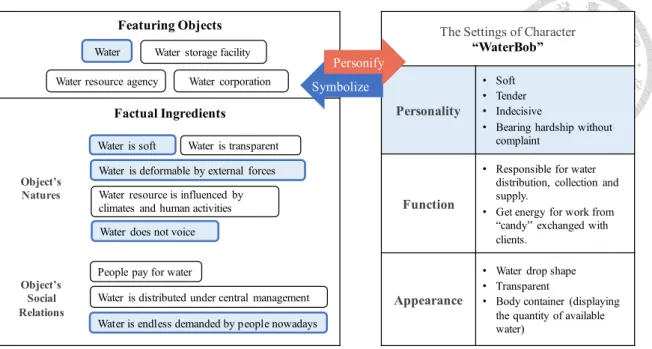
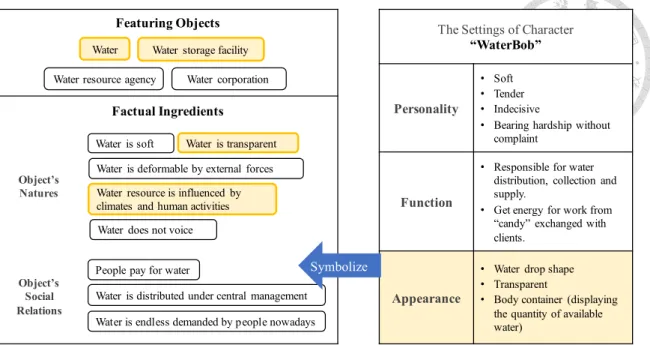
Figure 3.4.2 demonstrates the mapping of factual information and WaterBob’s three attributes: personality, function and appearance. In figure 3.4.2 (a) to (c), the table on the right shows the content of each attribute in the character’s settings, and the table on the left shows the corresponding symbolized objects and their factual ingredients used to form the attribute. Referent attribute and the symbolized factual elements are highlighted with colored background.
WaterBob’s Personality in sum, as shown in figure 3.4.2 (a), is soft (or gentle), tender, indecisive, and always bearing hardship without complaint. These characteristics is derived from reinterpretation of the images of the corresponding factual ingredients highlighted on the left. The element “water is soft” is transformed to the personalized characteristic of being “soft” (or “gentle”); the element “water is deformable by external forces” is personalized into the images of being “tender” (lacking for resistance to external impacts) and “indecisive” (easily wavers due to other’s opinions); finally, the elements “water does not voice” and “water is endless demanded by people nowadays”
form the personalized characteristic of “bearing hardship without complaint”, or, doing hard works demanded by others without voicing its discomfort.
In general, the personality of WaterBob reveals not only the image of “water”, but also that of the involved natural environment, for that the inanimate nature always take people’s impacts passively. Nature is unable to actively voice for itself and take actions to instantly react against human activities. Thus, in personalized interpretation, nature objects, including water, is somehow vulnerable. Through this image, we hope readers to perceive that just because water, as WaterBob, is such a thing unable to fight for their needs and rights, we may often consider our common ways of using water a matter of
Figure 3.4.2 (a) Symbolization in character’s settings: Personality
Figure 3.4.2 (b) Symbolization in character’s settings: Function
Featuring Objects
Factual Ingredients
Object’s Natures
Object’s Social
Relations Water is distributed under central management Water is endless demanded by people nowadays.
People pay for water
Water resource agency Water corporation Water Water storage facility
Water is soft
Water is deformable by external forces Water resource is influenced by climates and human activities Water does not voice
Water is transparent
The Settings of Character
“WaterBob”
Personality
• Soft
• Tender
• Indecisive
• Bearing hardship without complaint
Function
• Responsible for water distribution, collection and supply.
• Get energy for work from
“candy” exchanged with clients.
Appearance
• Water drop shape
• Transparent
• Body container (displaying the quantity of available water)
Symbolize Personify
Featuring Objects
Factual Ingredients
Object’s Natures
Object’s Social
Relations Water is distributed under central management Water is endless demanded by people nowadays.
People pay for water
Water resource agency Water corporation Water Water storage facility
Water is soft
Water is deformable by external forces Water resource is influenced by climates and human activities Water does not voice
Water is transparent
The Settings of Character
“WaterBob”
Personality
• Soft
• Tender
• Indecisive
• Bearing hardship without complaint
Function
• Responsible for water distribution, collection and supply.
• Get energy for work from
“candy” exchanged with clients.
Appearance
• Water drop shape
• Transparent
• Body container (displaying the quantity of available water)
Symbolize
Figure 3.4.2 (c) Symbolization in character’s settings: Appearance
Figure 3.4.3 WaterBob eating candy
WaterBob’s Function (figure 3.4.2 (b)) displays what it serves to do (its job and responsibility) in the story world. WaterBob plays a “water supplying spirit” who has to collect usable water resource from the nature, store it, and routinely distribute water for every place needing water. The job of WaterBob is a summary illustration of the works of other featuring objects: water store facilities (for water collection and storage), water corporation (for usable water processing) and the Water Resource Agency (for water
Featuring Objects
Factual Ingredients
Object’s Natures
Object’s Social
Relations Water is distributed under central management Water is endless demanded by people nowadays.
People pay for water
Water resource agency Water corporation Water Water storage facility
Water is soft
Water is deformable by external forces Water resource is influenced by climates and human activities Water does not voice
Water is transparent
The Settings of Character
“WaterBob”
Personality
• Soft
• Tender
• Indecisive
• Bearing hardship without complaint
Function
• Responsible for water distribution, collection and supply.
• Get energy for work from
“candy” exchanged with clients.
Appearance
• Water drop shape
• Transparent
• Body container (displaying the quantity of available water)
Symbolize
Besides, WaterBob receives “candy” from its clients based on their water allocations.
This character setting is made to symbolize the factual ingredient “people pay for water”.
In the story, WaterBob’s clients have to exchange candy for water, representing that in human society people pay money for their uses of water. In addition, this “candy” setting standing for “money” is a critical element for later design of the story plot that addresses the choice dilemma “Should water price be raised in the situation of deficient water?”
(see table 3.4.1).
WaterBob’s Appearance (figure 3.4.2 (c)) adopts the images of the featuring objects
“water” and “water facilities”. The main look of WaterBob is shown in figure 3.4.3. The whole body is a transparent water drop with a container belly, directly illustrating the outside features of water. We use water drop to represent water because the shape is easily associated with water. The container belly is for the storage of usable water resource in the story, playing function of water storage facilities; WaterBob’s belly itself is the water storage facility for the world of the story. Furthermore, the transparent container belly is also used as a hint on the picture to indicate the amount of usable water on different instants. Through the transparent skin of WaterBob, readers are able to observe the water level in the belly, and infer the current status of water resource (sufficient or not) at different times in the story.
Step3. Object’s Experience Building of WaterBob
The story, that is, an illustration of experience of the object character WaterBob, displays what and how conflict may form under the unbalance of water demand and supply may due to economic activities and environmental changes. In this process, WaterBob plays the role of the “victim” under the pressures from irrational demands of the Rat, Cat and Bunny. Through watching WaterBob being badly treated from other
supporting characters, readers are guided to realize how water environment suffers from human activities (abusing of water, pollution...etc.). At the same time, as they produce emotional reactions toward WaterBob’s sufferings, they are driven to increase their emotional connections toward the water environment. Overall story proceeding of WaterBob are shown with simplified scenario descriptions for each story structure component in figure 3.4.4.
It is noteworthy that the end, without providing exact solutions, only shows WaterBob’s death due to problems of previous scenarios. The story shows how the supporting characters indirectly kill WaterBob, instead of making the lead character finally rescued by a wonderful method or heroes coming from somewhere. This ending was designed for the purpose to mirror the actual current situation of the featuring issues in which problems of water deficiency remain just unsolved, and that fixing the problems should be the responsibility of each reader watching the story, not one certain extraordinary hero. We hope to arouse readers’ precautions toward the featuring issues by hinting that the end may be the “real situation”. Moreover, we made the ending sad instead of happy. Based on the research of Hofer and Wirth (2012) about the relationship between “sadness” and “enjoyment” for sad movies, sad endings stimulate audiences more emotions (higher sadness); that is, people perceive stronger emotional changes watching a sad story than they did toward a happy story. Moreover, the "sadness” could contribute to readers’ “enjoyment” in the story, while this effect is not clearly found in the case of happy endings (Hofer and Wirth, 2012). It is expected that the higher enjoyment watching WaterBob leads to readers’ stronger interests in realizing the featuring water environmental issues, and would therefore deliberate upon what they should behave to help improve the environmental problems symbolized in the sad ending
reader (feeling sadness and undergoing introspection) are important factors to evoking attitude changes in adults according to Transformative Learning Theory, as mentioned in
“conditioning emotional arousal” in 3.3.3.
Figure 3.4.4 Simplified story scenarios of WaterBob corresponding to the story structure
Beginning Rising action Turning Point Falling action End
Introduce characters, settings and current state
Distribution balance are disturbed due to change of demand in industries.
Natural resource does not afford the increasing total demand.
Conflicts between competitors.
Huge conflict between supplier and demanders.
The possible solutions are rejected by everyone (paying more candies, use less water).
The clients finally find that WaterBob may not come back.
WaterBob dies of hunger.
Beginning End
Turning Point
Sense of Discrepancy S1
S2
3.5 Data Collection
Both quantitative and qualitative investigation were conducted to find the changes in participant’s environmental attitudes due to the OVS. WaterBob is used as the material of OVS manipulation. For quantitative investigation, pre-test and post-test (spaced one month) with measures of environmental attitudes and emotions connection toward WaterBob were operated to examine the effect of OVS manipulation. The experiment group watched the audio picture book WaterBob, while the control group did not receive and treatment.
For qualitative investigation, focus group interviews on five participants were held to understand more specifically in readers’ personal realization and thoughts during and after watching WaterBob to learn a water environmental issue, and what they felt different from the more common way to learn from human standpoint.
Before these formal investigations for present study, a pilot study was also conducted to confirm the usability of the OVS manipulation tool, WaterBob, as well as explore the reactions of readers which were used to help design the following survey items.
3.5.1 Pilot Study
A pilot study was conducted for to verify people’s comprehension and acceptance toward WaterBob, as well as to explore their impressions and emotional reactions toward the story in the early stage of OVS development. The data of emotional reactions toward WaterBob was used to help design partial questionnaire for quantitative investigation.
This pilot study and all the required materials for test were online using Google Form.
Participants includes 25 people with ages from 15 to 24 (students from high school to college). Totally 7 open questions were designed in this pilot study to test the students’