行政院國家科學委員會專題研究計畫 成果報告
解構建言行為的中介效果:以個人與群體配適、心理安全 機制來預測建言行為
研究成果報告(精簡版)
計 畫 類 別 : 個別型
計 畫 編 號 : NSC 98-2410-H-011-007-
執 行 期 間 : 98 年 08 月 01 日至 99 年 07 月 31 日 執 行 單 位 : 國立臺灣科技大學企業管理系
計 畫 主 持 人 : 鄭仁偉
計畫參與人員: 碩士班研究生-兼任助理人員:魏瑞芬 博士班研究生-兼任助理人員:盧國銘
處 理 方 式 : 本計畫可公開查詢
中 華 民 國 99 年 09 月 15 日
Disentangling the Mediating Effect of Voice Behavior: Person-Group Fit and Psychological Safety Mechanism in Predicting Voice Behavior
Introduction
With today the rapid changes, uncertain and keen business competition in the
work environment, it is not enough for employee to complete their assign task (Grant,
Parker, & Collins, 2009). Organizations need employee anticipatory input of voice for
“doing things better” (Botero & Van Dyne, 2009; Janssen, De Vries, & Cozijnsen,
1998; Fuller, Barnett, Hester, Relyea, & Frey, 2007). Employee voice of ideas has
impact on improving a process, task, and solving work-related problems (Botero &
Van Dyne, 2009; Liu, Zhu, & Yang, 2010). Employee voice is defined as “promotive
behavior that emphasizes expression of constructive challenge intends to improve
rather than merely criticize” (VanDyne & LePine, 1998, p.109). It makes innovative
suggestion for change and recommending modifications to operation procedures
(Walumbwa & Schaubroeck, 2009), and play a central role in determinant effective
organizational functioning, organizational success and survival (Janssen et al, 1998;
Detert & Burris, 2007; LePine & Van Dyne, 1998; Morrison & Phelps, 1999).
Given the importance of voice, not surprisingly, many scholars have contributed
greatly to our understanding of the nature of voice behavior and its antecedent.
Individual factors such as self-esteem (LePine & Van Dyan, 1998; Premeaux &
Bedeian, 2003), big five (Nikolaou, Vakola, & Bourantas, 2008), and self-efficacy
(Morrison & Phelps, 1999), and the contextual factor such as transformational
leadership (Detert & Burris, 2007), supportive leadership (choi, 2007), and ethical
leadership (Walumbwa & Schaubroeck, 2009) have been found to be positive
relationship in voice behavior. However, the research on voice is growing, there are
two questions unanswered: (1) the level of fit perception may drive employee to
express their opinions? (2) by what mediating process may drive subordinate to speak
up. These questions result in incomplete picture of the process of voice behavior.
Therefore, the present study addressed the gap in the voice literature by
proposing the voice process. First, as work groups gradually become widely used in
the business (DeSanctis & Poole, 1997; Devine, Clayton, Philips, Dunford, & Melner,
1999; Stewart, 2006). The heterogeneity of work group and quickly changing work
condition have diminish the fit in work group (Hopkins, Hopkins, & Mallette, 2001;
Shin & Choi, 2010). Group managers hope to understand fit with group value or
culture when hiring employee who can speak up to give sensible comments to
improve situation in the future. Thus, managing Person-Group (P-G) fit constitutes an
important challenge and issue to work group. Moreover, previous studies have
indicated P-G fit influence individual positive attitude and behavior (Kristof-brown,
Zimmerman, & Johnson, 2005). These findings suggested P-G fit have critical impact
on subordinate behavior. Surprising, however, insufficient attention has been paid to
aspects characterizing the relationship between P-G fit and voice behavior. In order
to fill the limited prior theory and research gaps in voice literature, the present study
attempt to explore the relationship P-G fit and voice.
Second, psychological safety defined as the employee’s “feeling able to show
and employ self without fear of negative consequences to self-image, status, or
career” (Kahn, 1990, p. 708). Previous studies on voice behavior have been indicated
that psychology safety was important antecedent linking to voice behavior (Detert &
Burris, 2007; Walumbwa & Schaubroeck, 2009). However, relatively little is known
about the mechanism in employee voice behavior process. In addition, existing
research on perceived P-G fit ignores how and why affects display of employee voice.
We examine how P-G fit influences voice behavior by psychological safety
mechanism in this study.
Taken together, the purpose of the present study extends previous research by
investigating the mediating process of psychological safety in the relationship
between P-G fit and voice behavior. We contribute to the extant literature on voice by
clarifying the mediating mechanism and explain why and how P-G fit lead to voice
behavior.
Theory and Hypotheses
P-G fit and voice behavior
Person-Environment (P-E) fit perspective posits that “the compatibility between
an individual and a particular work environment that occurs when their characteristics
are well matched” (Kristof-Brown, Zimmerman, & Johnson, 2005, p. 281). Various fit
perception conceptions, such as a person fit with organization, group, job, and
supervisor was development in P-E literature (Kristof, 1996; Kristof-Brown,
Zimmerman, & Johnson, 2005). As team-based structure has gradually spread in
organizations (Werbel & Johnson, 2001; Stewart, 2006), fit perception has become
important in team context (DeRue & Morgeson, 2007). Thus, our focus is limited to
P-G fit.
P-G fit which means to the perceived value compatibility between individuals
and their work groups (Kristof, 1996; DeRue & Morgeson, 2007). From P-E fit
perspective suggested that “positive responses will occur when individuals fit or
match the requirements of a situation” O’Reilly, Chatman, and Caldwell, 1991, p.
489). For example, Kristof-Brown, Zimmerman, & Johnson (2005) argued that P-G
fit has been influenced on positive attitude (e.g., job satisfaction, organizational
commitment, and turnover intention) and performance (e.g. in-role performance and
extra role performance). Several empirical findings have also suggested that value
congruence would be positively work-related behavior such as organizational
citizenship behaviors (Cable & DeRue, 2002; Kristof, 1996; O'Reilly & Chatman,
1986), job performance (Hoffman & Woehr, 2006; Tziner, 1987), willingness to
recommend the organization (Shantz, 2003; Vigoda & Cohen, 2003). Base on the
findings and above points, we argued that in the team context, when employees
believe that their values match group’s value that take as one of group members, they
would feel willing to involve group affairs and more likely to contribute to the group
in constructive ways such as voice behavior in order to foster group effectiveness and
efficiency. Therefore, the hypothesis following is proposed:
Hypothesis 1: P-G fit will be positively related to voice behavior.
The mediating role of psychological safety
As noted previously, we anticipant that employee engages in voice behavior by
P-G fit perception influenced. However, it is possible existing mediating process
between P-G fit and voice behavior. Value congruence (fit) make the individuals
have similarly belief, philosophy and norm, and then facilitate the team censuses
(Chatman, 1991), and true each other. In a trusting relationship, individuals perceive
that they will not suffer ill effects from expressing their true selves at work, and they
will feel psychological safety (May, Gilson, & Harter, 2004; Kahn, 1990). For
instance, Vogel and Feldman (2009) suggested that fit with team has been related
positively to the quality of work relationships. The higher quality relationship increase
interpersonal trust without fearing, and embarrassing. Zhang, Fang, Wei, and Chen
(2010) indicated that when individual have trust in the team, they believe that other
members will not blame or punish them, and diminish their concerns about the
possible negative consequences of their behavior. Hence, the feeling of psychological
safety will increase. Likewise, Kahn (1990) implied that in trust and safety
relationship helps promote employee’s feeling of the level of psychological safety. In
contrast, a poor or incompatible value fit will produce a psychological strains, which
lead to greater illness and interpersonal entrust (Barling, Kelloway, & Frone, 2005),
and then it will reduce their feeling of psychological safety.
Voice behavior promotes change and challenges the status quo, sometime it is a
potentially risky behavior and upset interpersonal relationship for employee (LePine
& Van Dyne, 1998; Stamper & Van Dyne, 2001). Thus, employee often calculate and
evaluate the cost-benefit before engage in voice behavior (Liu et al., 2010). The cost
perception was one’s feeling of psychological safety. A shared belief that it is safe to
speak up in groups without suffering potential embarrassment and interpersonal threat
(Edmondson, 1999). When employees perceived that psychological safety in their
mind, they will loss their fear feeling and willing to speaking up to the group. Some
evidence found that psychological safety has positive impact on voice behavior. For
example, in Detert and Burris (2007) research, found that psychological safety was a
significant cognition associated with voice behavior (Detert & Burris, 2007).
Nembhard and Edmonson (2006) examine the effect on a health care team and find
that psychological safety is a key antecedent for both voice and learning behaviours.
Moreover, the finding from Walumbwa and Schaubroeck (2009) indicates that the
psychological safety was positively related to voice behavior, and mediated the
relationship between ethical leadership and voice behavior. Base on these studies,
Employees who feel more psychologically safe tend to be more engaged in their work
roles (Kahn, 1990; May et al., 2004). Psychological safety was key factor in
determine willing or unwilling to speak up of subordinate.
Taken together, when employees perceived their belief and value fit with their
group, increasing share cognition and identification with group, enhancing personally
non-threatening perception, and more likely to take risk of proposing new ideas,
constructive suggestions(West, 1990) such as voice behavior. Thus, the following
hypothesis is proposed:
Hypothesis 2: Psychological safety will mediate the relationship between P-G fit
and voice behavior.
Method
Participants and proceduresThe survey used in this study was conducted in a large trucking company in
Taiwan. Participants were frontline employees, whose interact with customer and
gather firsthand information from customer. If employees take the initiative to
integrate customer’s opinions, and then speak upward to supervisor, the group will
increase both its effectiveness and performance. Therefore, we chose frontline
employee in single trucking company as our study participants to test our hypothesis
relationship.
We contacted the headquarters of the sample firm to ascertain its willingness to
participate. After receiving their consent, 800 employees were invited to fill out the
survey. During the process, we asked the HR personnel to assist us by selecting
respondents randomly, and we guaranteed that the participants’ responses would
remain anonymous to ensure confidentiality. Data were eventually collected from 721
responses. After deleting 42 incomplete responses, we obtained 679 valid responses to
test our measures, giving a valid response rate of 84.9%. Of the respondents for this
study, 86.4% were male with the majority being between 26 and 35 years in age
(61.8%). Married respondents comprised 60.8% of the total. Some 20.0% held
associate or technical degrees and 59.9% had a high school education. The average
organizational tenure was 77.6 months.
Measures
Since the original survey instrument were developed in English, we followed
Brislin (1980)’s suggestion to translate all items into Chinese and then back-translated
into English by two independent bilingual individual to ensure the semantic
equivalency. All instrument measures were self-reported by employee participants and
all items were rated on a 6-point Likert-scale that ranged from 1, “strongly disagree”
to 6, “strongly agree”.
Person-Group fit
We used a modified version of Cable and DeRue’s (2002) three-item scale for
person-organization fit to measure P-G fit. It is developed and used prior research in
P-G fit measure (e.g. DeRue & Morgeson, 2007). We adopt DeRue & Morgeson’s
(2007) version, changing the word “organization” to “team” of the three items.
Sample items included “my personal values match my team’s values and culture”,
“this things that I value in life are very similar to the things that my team values”. The
Cronbach’s alpha for this construct was .94.
Psychological safety
We measured psychological safety with a 7-item scale derived from Brown and
Leigh (1996). Example items included, “My manager is supportive of my ideas and
ways of getting things done,” “The feelings I express at work are my true feelings,”
The Cronbach’s alpha for this measure was .86.
Voice behavior
To measure employee’s voice behavior, we adopt six indicators developed by
Van Dyne and LePine (1998). Sample items were “I develop and make
recommendations concerning issues that affect this work group,” “I speak up and
encourage others in this group to get involved in issues that affect the group,” The
Cronbach’s alpha for this variable was .91.
Data analysis
LISREL 8.51 serves as structural equation modeling (SEM) (Joreskog & Sorbom,
1993) with maximum-likelihood estimation, and we followed the two-stage analytical
procedure recommend by Anderson & Gerbing (1988) to test our hypothesized
relationships. First, a series of confirmatory factor analyses to ensure distinct factors
assessed the discriminate validity of the P-G fit, psychological safety, and voice
behaviour scales. The second step performed a model comparison procedure to assess
the structural model and overall model fit.
Results
Descriptive statistics
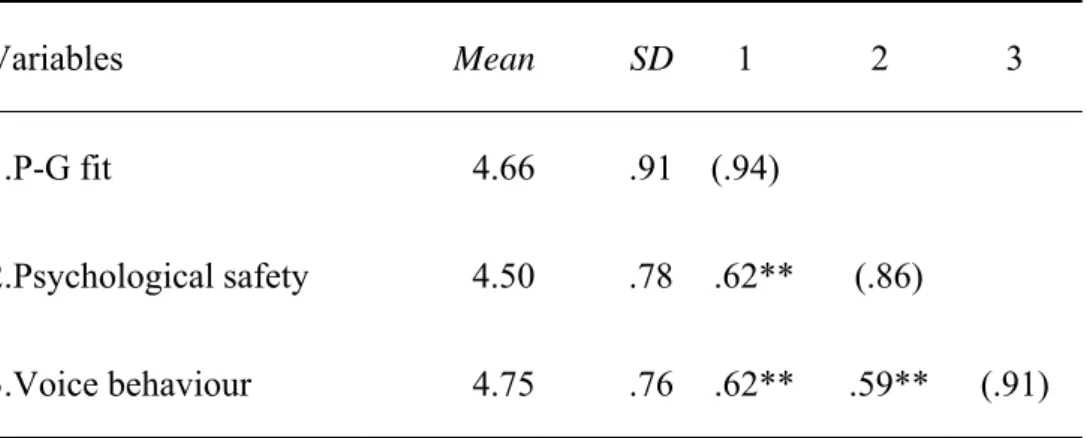
Table 2 reports the means, standard deviations, correlations, and reliability of the
study variables. The results shown that P-G fit had significantly positive association
with psychological safety and voice behavior (r=.62 and .62, p<.01, respectively), and
provided preliminary evidence to support Hypothesis 1.Psychological safety
correlated positively with voice behavior (r=.59, p<.01).
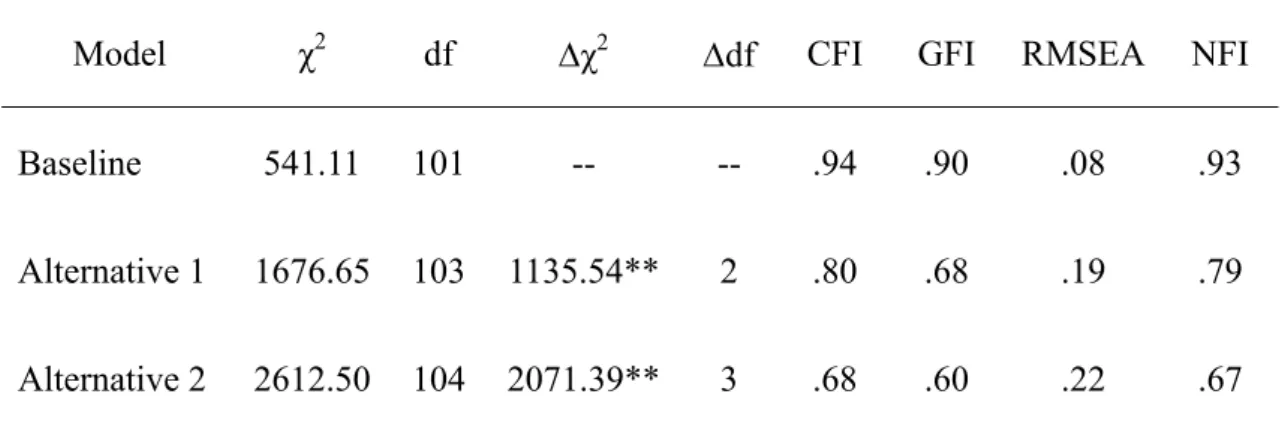
Table 1 Measurement Model Comparisons
Model χ2 df Δχ2 Δdf CFI GFI RMSEA NFI
Baseline 541.11 101 -- -- .94 .90 .08 .93
Alternative 1 1676.65 103 1135.54** 2 .80 .68 .19 .79
Alternative 2 2612.50 104 2071.39** 3 .68 .60 .22 .67 Note. The values of Δχ2 and Δdf were differences between baseline model and other models.
Baseline model: three factor (i.e, P-G fit, psychological safety, and voice behavior) Alternative 1 model: combine P-G fit and psychological safety into one factor Alternative 2 model: combine all variable into one factor
**p<.01
Confirmation factor analyses
Before testing the empirical hypotheses, we followed Wang, Law, Hackett,
Wang and Chen’s (2005) approach to assess discriminant validity between the
constructs by comparing our measurement model to various alternative models,
moving from our three-factors of interest to a restricted single-factor structure. Table
1 presents the models and gives fit statistics results. The results suggest that the
hypothesized three-factor model (X2=541.11; CFI=.94; GFI=.90; RMSEA=.08;
NFI=.93) yielded a better fit than the other alternative model with a large and
significant change in chi-square difference tests. Moreover, in the three-factor model,
summary, these results provide evidences of the discriminant and convergent validity
for this study.
Table 2 Mean, Standard Deviations, and Correlations among study Variables
Variables
Mean SD
1 2 31.P-G fit 4.66 .91 (.94)
2.Psychological safety 4.50 .78 .62** (.86)
3.Voice behaviour 4.75 .76 .62** .59** (.91) Note. Cronbach’s α coefficients appear on the diagonal;
**p<.01
Hypotheses testing
This study employed structural equation modeling to evaluate the hypothetical
structural model fit the data well(X2=541.11; CFI=.94; GFI=.90; NFI=.93;
RMSEA=.08). However, Hayduk (1987) suggested testing and comparing other
competing models while conducting structural equation analysis. Therefore, the
plausibility of three other competing models was estimated as well. In competing
Model 1, we tested one alternative structural model by removing the direct path from
P-G fit to voice behaviour. The differences between chi-squares were significant for
the baseline Model as for competing Model 1. These comparison circumstances
suggest that the competing Model 1 (X2=541.11; CFI=.94; GFI=.90; NFI=.93;
RMSEA=.08) was better than our hypothesized model(X2=653.13; CFI=.93; GFI=.88;
NFI=.92; RMSEA=.09). All of the standardized path coefficients are shown in figure
1. The results showed that P-G fit was positively related to voice behaviour (β=0.46,
p<0.01), and psychological safety (β = 0.63, p<0.01), supporting Hypothesis
1 .Psychological safety was positively associated with voice behavior (β=0.34,
p<0.01). We further tested the mediation effect (hypothesis 2) using Sobel’s (1982)
test of indirect effect. The result showed that P-G fit had a statistic significant
influence on voice behavior by psychological safety (Z=6.0, p<0.01).Thus,
Hypothesis 2 received support.
Figure 1 Standardized Path Coefficients for the Final Model
**p<.01
Discussion
The present study extends previous studies of voice behavior by empirically
examining whether P-G fit predict voice behavior, and its relationship through
psychological safety. As expected, the results of empirical analysis provide support to
P-G fit Psychological
Safety
Voice Behavior .34**
.63**
.46**
our hypotheses relationship. We found that P-G fit had a positive influence on voice
behavior. The finding is similar prior study (Kristof-brown et al., 2005), and has
implication for voice literature. This expands knowledge of the role of P-G fit in
relation to proactive behavior in the form of voice behavior. In addition, psychological
safety mediate the relationship between P-G fit and voice behavior. This extends and
advances our understanding in the voice behavior process, and indicates that P-G fit
can predict psychological safety, which in turn facilitates their engagement on voice
behavior.
This study makes two significant contributions to the extant literatures. First,
most of the extant literature on voice devotes to explore its antecedents. However,
these studies place less emphasis on fit perspective. In order to rich voice literature,
we extend the voice research in take notice of P-G fit on voice behavior. Second, P-G
fit literature put less attention on understanding how and why affects employee voice.
We expand the P-G fit literature on examining how P-G fit influences voice behavior
by psychological safety mechanism in our study.
Practical implications
From a practical point of view, our results suggest that employee voice behavior
can be motivated by P-G fit. For example, group provide communication and share
mechanism between employee and group on values and organizational responsiveness.
Moreover, employeees’ selection process might include a P-G fit screening in the
stages of the selection process which value fit the group vale and norm, and thus
promote their displays of voice behavior. Besides, managers should offer safe work
environment to build trust perception of employee. For example, managers encourage
and tell employees to speak up without negative outcome (e.g. blaming, punishment),
reduce the fear of voice, and communication with employee. This knowledge should
be especially relevant to managers in organizations with dynamic environment where
change and new ideas are essential for organizational adaptation, innovation, survival,
and success.
Limitations and recommendation for future research
The findings of the present study should be interpreted in light of its limitations.
First, from empirical perspective, cross-sectional study was conducted in the current
study, and the causal conclusions were not unambiguously determined. Hence, future
study should consider longitudinal method for data collection to explore the more
accurately the causality. In addition, all instrument of the research was using
self-report survey, and single source data may be existing potential common method
bias rather than true relationships among the study variables. We followed Korsgaard
and Roberson’s (1995) and Hung, Chi and Lu’s (2009) suggestion, and employed CFA
to check the severity of common method problems (Podsakoff, MacKenzie, Lee, &
Podsakoff, 2003; Podsakoff & Organ, 1986). Our results showed that three-factor
model provides a better fit than the one-factor model. The findings suggest that
common method bias may not be severely our results. However, further study should
collect data from different source to minimize the influence of common method bias.
Third, all data for the present study were gathered within a single organization with
mostly male participants, which limits the observed variability and decreases external
validity. It would be examined for future research to replicate the present findings to
enhance generalizability in other types of organizational settings.
Future research may examine other additional mediating process linking P-G fit
to voice behavior. For instance, Kristof-brown et al. (2005) indicated that P-G fit has
positive associated with organizational commitment. Past research indicated that
organizational commitment is an important antecedent on extra-role behavior (Organ
& Ryan, 1995) such as voice behavior. Hence, further studies may consider
organizational commitment in mediating process in linking the relationship between
P-G fit and voice behavior.
Conclusion
Despite these limitations, the results of this study advance our knowledge and
understanding of voice behavior is influenced by P-G fit, and offering explanations
how and why psychological safety mediate the relationship between P-G fit and voice
behavior. This research has confirmed that the perception of psychological safety
does indeed play an important role in employees displaying voice behavior. This
present work provides new and deeper insights into disentangling employee voice
behavior through strengthening the role of psychological safety. These results provide
applied implications and thus enrich the extant voice behavior literature.
References
Anderson, J. C., & Gerbing, D. W. (1988). Structural equation modeling in practice: A
review and recommended two-step approach. Psychological Bulletin 103,
411-423.
Barling, J., Kelloway, E. K., & Frone, M. R. (2005). Handbook of work stress. Sage
publication.
Botero, I. C., & Van Dyne, L. (2009). Employee voice behavior interactive effects of
LMX and power distance in the United States and Colombia. Management
Communication Quarterly, 23, 84-104.
Brislin, R. W. (1980). Translation and content analysis of oral and written material. In
H. C. Triandis & J. W. Berry (Eds.), Handbook of cross-cultural psychology:
methodology (Vol. 2, pp. 389-444): Boston: Allyn & Bacon.
Brown, S. P., & Leigh, T. W. (1996). A new look at psychological climate and its
Psychology, 81, 358-368.
Cable, D. M., & DeRue, D. S. (2002). The convergent and discriminant validity of
subjective fit perceptions. Journal of Applied Psychology, 87, 875-884.
Chatman, J. A. (1991). Matching people and organizations-Selection and socialization
in public accounting firms. Administrative Science Quarterly, 36, 459-484.
Choi, J. N. (2007). Change-oriented organizational citizenship behavior: Effects of
work environment characteristics and intervening psychological process.
Journal of Organizational Behavior, 28, 467-484.
DeRue, D. S., & Morgeson, F. P. (2007). Stability and change in person-team and
person-role fit over time: The effects of growth satisfaction, performance, and
general self-efficacy. Journal of Applied Psychology, 92, 1242-1253.
DeSanctis, G., & Poole, M. S. (1997). Transitions in teamwork in new organizaitonal
forms. IN B. Markovsky, M.J. Lovaglia, & L. Troyer (Eds.), Advances in
group processes (Vol. 14, pp. 157-176): Greenwich, CT: JAI Press.
Detert, J. R., & Burris, E. R. (2007). Leadership behavior and employee voice: Is the
door really open. Academy of Management Journal, 50, 869-884.
Devine, D. J., Clayton, L. D., Philips, J. L., Dunford, B. B., & Melner, S. B. (1999).
Teams in organizations: Prevalence, characteristics, and effectiveness. Small
Group Research, 30, 678-711.
Edmondson, A. (1999). Psychological safety and learning behavior in work teams.
Administrative Science Quarterly, 44, 350-383.
Fuller, J. B., Barnett, T., Hester, K., Relyea, C., & Frey, L. (2007). An exploratory
examination of voice behavior from an impression management perspective.
Journal of Managerial Issues, 19, 134-151.
Grant, A. M., Parker, S., & Collins, C. (2009). Getting credit for proactive behavior:
supervisor reactions depend on what you value and how you feel. Personnel
Psychology, 62, 31-55.
Hayduk, L.A. (1987). Structural equation modeling with LISREL: Essential and
advances, Baltimore: John Hopkins University Press.
Hoffman, B., J., & Woehr, D., J. (2006). A quantitative review of the relationship
between person-organization fit and behavioral outcomes. Journal of
Vocational Behavior, 68, 389.
Hopkins,W., Hopkins, S., & Mallette, P. (2001). Diversity and managerial value
commitment: A test of some proposed relationships. Journal of Management
Issues, 13, 288-306.
Hung, T. K., Chi, N. W., & Lu, W. L. (2009). Exploring the relationships between
perceived coworker loafing and counterproductive work behaviors: the
mediating role of a revenge motive. Journal of Business and Psychology, 24,
257-270.
Janssen, O., De Vries, T., & Cozijnsen, A. J. (1998). Voicing by adapting and
innovating employees: An empirical study on how personality and
environment interact to affect voice behavior. Human Relations, 51, 945-967.
Joreskog, K. G., & Sorbom, D. (1993). LISREL 8: User’s reference guide. Chicago:
Scientific Software International.
Kahn, W. A. (1990). Psychological conditions of personal engagement and
disengagement at work. Academy of Management Journal, 33, 692-724.
Korsgaard, M. A., & Roberson, L. (1995). Procedural justice in performance
evaluation: The role of instrumental and non-instrumental voice in
performance appraisal discussions. Journal of Management, 21, 657-669.
Kristof, A. L. (1996). Person-organization fit: An integrative review of its
conceptualizations, measurement, and implications. Personnel Psychology, 49,
1-49.
Kristof-Brown, A. L., Zimmerman, R. D., & Johnson, E. C. (2005). Consequences of
individuals’ fit at work: A meta-analysis of person-job, person-organization,
person-group, and person-supervisor fit. Personnel Psychology, 58, 281-342.
LePine, J. A., & Van Dyne, L. (1998). Predicting voice behavior in work groups.
Journal of Applied Psychology, 83, 853-868.
Liu, W., Zhu, R., & Yang, Y. (2010). I warn you because I like you: Voice behavior,
employee identifications and transformational leadership. The Leadership
Quarterly, 21, 489-202.
May, D. R., Gilson, R. L., & Harter, L. M. (2004). The psychological conditions of
meaningfulness, safety and availability and the engagement of the human
spirit at work. Journal of Occupational and Organizational Psychology, 77,
11-37.
Morrison, E. W., & Phelps, C. C. (1999). Taking charge at work: Extrarole efforts to
initiate workplace change. Academy of Management Journal, 42, 403-419.
Nembhard, I.M., and Edmondson, A.C. (2006), ‘Making it safe: The effects of leader
inclusiveness and professional status on psychological safety and
improvement efforts in health care teams’, Journal of Organizational Behavior,
27, 941-966.
Nikolaou, I., Vakola, M., & Bourantas, D. (2008). Who speaks up at work?
Dispositional influences on employees’ voice behavior. Personnel Review, 37,
666-679.
O’Reilly, C. A., Chatman, J., & Caldwell, D. F. (1991). People and organizational
culture: A profile comparison approach to assessing person-organization fit.
Academy of Management Journal, 34, 487-516.
O'Reilly, C., & Chatman, J. (1986). Organizational commitment and psychological
attachment: The effects of compliance, identification, and internalization on
prosocial behavior. Journal of Applied Psychology, 71, 492-499.
Organ, D. W., & Ryan, K. 1995. A meta analytic review of attitudinal and
dispositional predictors of organizational citizenship behavior. Personnel
Psychology, 48, 775-802.
Podsakoff, P. M., & Organ, D. W. (1986). Self-reports in organizational research:
Problems and prospects. Journal of Management, 12, 531-544.
Podsakoff, P. M., MacKenzie, S. B., Lee, J., & Podsakoff, N. (2003). Common
method biases in behavioral research: A critical review of the literature and
recommended remedies. Journal of Applied Psychology, 88, 879-903.
Premeaux, S. F., & Bedeian, A. G. (2003). Breaking the silence: The moderating
effects of self-monitoring in predicting speaking up in the workplace. Journal
of Management Studies, 40, 1537-1562.
Shantz, C. A. (2003). Person-organization fit: Individual differences, socialization
and outcomes. Wayne State University, Michigan.
Shin, Y., & Choi, J. N. (2010). What makes a group of good citizens? The role of
perceived group-level fit and critical psychological states in organizational
teams. Journal of Occupational and Organizational Psychology, 83, 531-552.
Stamper, C. L., & Van Dyne, L. (2001). Work status and organizational citizenship
behavior: A field study of restaurant employees. Journal of Organizational
Behavior, 22, 517-536.
Stewart, G. L. (2006). A meta-analytic review of relationships between team design
features and team performance. Journal of Management, 32, 29-55.
Tziner, A. (1987). Congruency issue resettled using Finean's achievement climate
notion. Journal of Social Behavior and Personality, 2, 63-78.
Van Dyne, L., & LePine, J. A. (1998). Helping and voice extra-role behaviors:
Evidence of construct and predictive validity. Academy of Management
Journal, 41, 108-119.
Vigoda, E., & Cohen, A. (2003). Work congruence and excellence in human resource
management: Empirical evidence from the Israeli nonprofit sector. Review of
Public Personnel Administration, 23, 192-216.
Vogel, R. M., & Feldman, D. C. (2009). Integrating the levels of person-environment
fit: The roles of vocational fit and group fit. Journal of Vocational Behavior,
75, 68-81.
Walumbwa, F. O., & Schaubroeck, J. (2009). Leader personality traits and employee
voice behavior: Mediating roles of ethical leadership and work group
psychological safety. Journal of Applied Psychology, 94, 1275-7286.
Wang, H., Law, K. S., Hackett, R. D., Wang, D., & Chen, Z. X. (2005).
Leader-member exchange as a mediator of the relationship between
transformational leadership and followers’ performance and organizational
citizenship behavior. Academy of Management Journal, 48, 420-432.
Werbel, J. D., & Johnson, D. J. (2001). The use of person-group fit for employment
selection: A missing link in person-environment fit. Human Resource
Management, 40, 227-240.
Zhang, Y., Fang, Y., Wei, K. K., & Chen, H. (2010). Exploring the roles of
psychological safety in promoting the intention to continue sharing knowledge
in virtual communities. International Journal of Information Management, 30,
425-436.
無研發成果推廣資料
98 年度專題研究計畫研究成果彙整表
計畫主持人:鄭仁偉 計畫編號:98-2410-H-011-007-
計畫名稱:解構建言行為的中介效果:以個人與群體配適、心理安全機制來預測建言行為 量化
成果項目 實際已達成
數(被接受 或已發表)
預期總達成 數(含實際已
達成數)
本計畫實 際貢獻百
分比
單位
備 註 ( 質 化 說 明:如 數 個 計 畫 共 同 成 果、成 果 列 為 該 期 刊 之 封 面 故 事 ...
等)
期刊論文 0 0 0%
研究報告/技術報告 0 0 0%
研討會論文 0 0 0%
論文著作 篇
專書 0 0 0%
申請中件數 0 0 0%
專利 已獲得件數 0 0 0% 件
件數 0 0 0% 件
技術移轉
權利金 0 0 0% 千元
碩士生 0 0 0%
博士生 0 0 0%
博士後研究員 0 0 0%
國內
參與計畫人力
(本國籍)
專任助理 0 0 0%
人次
期刊論文 0 1 100%
研究報告/技術報告 0 0 0%
研討會論文 0 0 0%
論文著作 篇
專書 0 0 0% 章/本
申請中件數 0 0 0%
專利 已獲得件數 0 0 0% 件
件數 0 0 0% 件
技術移轉
權利金 0 0 0% 千元
碩士生 0 0 0%
博士生 0 0 0%
博士後研究員 0 0 0%
國外
參與計畫人力
(外國籍)
專任助理 0 0 0%
人次
其他成果
(
無法以量化表達之成果如辦理學術活動、獲 得獎項、重要國際合 作、研究成果國際影響 力及其他協助產業技 術發展之具體效益事 項等,請以文字敘述填 列。)
無
成果項目 量化 名稱或內容性質簡述
測驗工具(含質性與量性) 0
課程/模組 0
電腦及網路系統或工具 0
教材 0
舉辦之活動/競賽 0
研討會/工作坊 0
電子報、網站 0
科 教 處 計 畫 加 填 項
目 計畫成果推廣之參與(閱聽)人數 0
國科會補助專題研究計畫成果報告自評表
請就研究內容與原計畫相符程度、達成預期目標情況、研究成果之學術或應用價 值(簡要敘述成果所代表之意義、價值、影響或進一步發展之可能性) 、是否適 合在學術期刊發表或申請專利、主要發現或其他有關價值等,作一綜合評估。
1. 請就研究內容與原計畫相符程度、達成預期目標情況作一綜合評估
■達成目標
□未達成目標(請說明,以 100 字為限)
□實驗失敗
□因故實驗中斷
□其他原因 說明:
2. 研究成果在學術期刊發表或申請專利等情形:
論文:□已發表 □未發表之文稿 ■撰寫中 □無 專利:□已獲得 □申請中 ■無
技轉:□已技轉 □洽談中 ■無 其他:(以 100 字為限)
3. 請依學術成就、技術創新、社會影響等方面,評估研究成果之學術或應用價 值(簡要敘述成果所代表之意義、價值、影響或進一步發展之可能性)(以 500 字為限)
本研究透過探討建言行為的歷程,進一步了解人與群體配適對於建言行為有正面的影響,
而且也會透過員工心理安全感,進而影響建言行為的產生。運用此研究結果,對於團隊管 理者欲提升與增進員工建言行為時,提供有價值的實務參考價值,可從形塑人與群體配適 以及心理安全感兩方面來著手: 第一、在形塑人與群體配適上:團隊管理者應提高團隊成 員共享的價值觀,例如主管宣達、角色模範、獎賞制度等,以傳達團隊的價值觀與文化給 予員工,內化為員工的基本信念,才會認同團隊並極力的投入熱情,促進員工展現建言行 為。另外,在人員的聘用或選擇員工時,應考慮適配團隊價值或文化的成員列為甄選的首 要考量,方能促進員工認同感,進而願意犧牲奉獻給組織,提供有利於組織改善的各式工 作建議。第二、建構員工心理安全感:團隊管理者應以鼓勵而非責備或懲罰的方式,降低 員工想要建言的恐懼感,平時也要形塑信任與安全感的工作環境,才能讓員工無後顧之憂 的提出批評與建議,促使員工願意從事建言行為。