國立交通大學
英語教學研究所碩士論文
A Master Thesis
Presented to
Institute of TESOL,
National Chiao Tung University
in Partial Fulfillment of the Requirements
for the Degree of
Master of Arts
以活動理論探究在臉書的英語學習社群成員之中介行為與參與感受
Exploring Community Members’ Mediated Actions and Perceptions
in an English Learning Community on Facebook through the Lens of
Activity Theory
研究生:姚瑋雯 Graduate: Wei-Wen Yao 指導教授:張靜芬博士 Advisor: Dr. Ching-Fen Chang
中華民國 一百年十月 October, 2011
論文名稱:以活動理論探究在臉書的英語學習社群成員之中介行為與參與感受 校所組別:國立交通大學英語教學研究所 畢業時間:一百學年度第一學期 指導教授:張靜芬博士 研究生:姚瑋雯 中文摘要 近年來,網路的進化發展改變了人們相處、合作和互動的方式。社群網站的 興起,提供人們在共有的網路空間參與共同話題的討論或是意見交換。由於社群 網站的廣泛使用,英語學習者開始利用社群網站成立線上英語學習社群尋求語言 學習機會及和其他學習者進行社交聯繫。雖然這種新興的語言學習方式在語言學 習研究領域中漸漸獲得關注,但是鮮少研究探討個人社群成員在線上語言學習社 群的中介行為與其參與感受之探究。 本研究採活動理論(Engeström,1987,1999)探究四位社群成員在一個透過臉書 成立的英語學習社群活動的動機及其中介行為。根據 Engeström,活動系統裡主 要由六個要素組成,包含包括對象(subject)、目標(object)、媒介工具(mediating artifact)、規則(rule)、角色(division of labor)以及學習者所身處的社群 (community),當個體遇到矛盾時,這六個要素將會互相交織影響個體的中介行 為。本研究主要探討影響社群成員中介行為的活動系統,並探究這四位社群成員 參與這個臉書社群的感受。 本研究採個案研究法,進行長達一年的線上觀察及兩次的訪談,所收集的資 料經由觀察歸納分析,並以活動理論架構加以分析其個別要素之間的交互影響。 研究結果指出此四位社群成員參與臉書社群中介行為包含 (1)回答問題、(2)給予 讚美、(3)聊天、(4)貢獻知識、(5)詢問問題及(6)建議發文規則。從活動理論觀點 探究社群成員的中介行為發現,雖然每位社群成員的中介行為受到個人經驗背 景、設立的參與目標及情境因素影響,但其個別的影響程度不同,也形成不同的
活動系統。此外,這四位社群成員的參與感受隨著他們參與的時間而有所改變; 起初,社群成員將此線上活動作為一獲得樂趣、成就感及交朋友的管道。然而, 隨著參與時間的增加,社群成員對於參與社群不再抱有熱情,反而將其視為一種 例行的生活習慣。 此研究指出社群網站上的學習社群具有高度潛力幫助語言學習者,教師可在 其教學上應用線上學習社群刺激學生參與學習活動。基於此概念,雖然本研究針 對教室外的線上社群作為研究場域,但其結果仍能提供三個在教學實務上的建 議。首先,當教師應用線上學習社群於教學時,教師需將學生的個人背景因素考 量其中。第二,教師需費心思設計能增加社群成員互動及引起學生興趣的線上活 動,以期達到線上社群學習的效果。第三,教師應擔起社群主持人的責任,確保 線上學習社群的秩序以讓此線上社群成員能夠持續地參與社群活動。 關鍵字:社群網站、活動理論、線上學習社群、臉書
ABSTRACT
In the recent years, the evolutional development of the Internet has changed the
ways that people meet, collaborate, and interact with each other. Social networking
sites (SNSs), the newly emerging media of online communication, provide spaces for
people to join online communities to discuss ideas, exchange opinions, and share
knowledge. Language learners show much interest in forming online communities in
SNSs in which they seek for learning opportunities and make social connection with
other language learners. While the innovative language learning has gradually drawn
attention to language learning research, few studies have focused on individual
members’ mediated actions and perception in online language learning communities.
Targeting at an English learning community on Facebook, one of the most
popular SNSs, this study attempted to examine how four targeted community
members operated in the online language learning community and what factors
underlay their mediated actions in the learning community and their perception of
participation in the online community through the lens of an activity theory
perspective (Engeström, 1987, 1999). According to Engeström, six components in an
activity system—subjects, objects, mediating artifacts, rules, division of labors, and
the situated community—are constantly interwoven with each other when an
individual encounters contradictions. Adopting activity theory as the theoretical
framework was to map out the complexity of the interwoven relationship of these
elements in each individual community member’s activity systems.
This study adopted qualitative case study methodology. The data were collected
from one-year online observations and two formal interviews with the four focal
community members. The data were analyzed based on emerged mediated actions
components underlying individuals’ activity systems. The findings of the study
indicated that the four participants’ participation included (1) answering questions, (2)
showing appreciation, (3) chatting, (4) contributing knowledge, (5) asking questions,
and (6) suggesting posting rules. From an activity theory perspective, it was found
that the community members’ mediated actions were highly influenced by their
growing background, learning experiences, the goal they set for participation, and the
contextual factors situated in the community. As for the perceptions of their
participation, the participants perceived the online experiences differently through the
time they participated. At the beginning of their participation, they considered the
online participation as a way to have fun, acquire a sense of achievement, and gain
friendship. However, through the time they participated, they lost their enthusiasm for
participation. Instead, they perceived the online participation as routine work without
any strong motivation.
Although this study targeted at an out-of-class learning community, there are still
several pedagogical implications for language teachers. First, when integrating online
learning communities into their classroom, teacher educators need to take students’
subject agency into consideration. Second, teachers need to carefully design online
activities which can enhance community members’ interaction to arise students’
interest in participating in the online discussion actively. Third, teachers should take
the responsibility to ensure that the online learning community is in order in order to
keep the community alive.
Keywords: activity theory, Facebook, online learning community, social networking
ACKNOWLEDGEMENTS
This thesis would not have been completed without the support and guidance
from many individuals. I am deeply indebted to them who have supported,
encouraged, and believed in me through this journey.
First, I am particularly grateful to my thesis advisor, Dr. Ching-Fen Chang, for
her constant guidance and encouragement during all stages of my research. She is a
mentor who not only ushered me into the field of sociocultural theory but also set a
role model of being a good teacher. She has always been patient in reading my thesis
and generous in offering her insightful advice which led me on the right track of the
study. Without her patience and wisdom, this thesis could not have been completed.
Second, my heartfelt gratitude also goes to the committee members, Dr.
Shiou-Wen Yeh and Dr. I-Ru Su, who offered insightful suggestions and comments.
Their valuable insights and constructive suggestions to my thesis undoubtedly
contributed a great deal to the revision of the thesis and made it more complete.
Third, I would like to express my deep thankfulness to the four participants who
let me enter their social network. Their generous participation in the study provided
the research with substantial data. Without the data, it was impossible to carry out the
study. Their participation made the process to a success.
Fourth, I save the deepest gratitude to my parents for their unwavering love and
support. Their unconditional love and belief in me kept me going through every
toughest moment. Lastly, and most importantly, I owe my hearty thanks to my life
partner, Li-Hsuan Chung. She always encouraged me and gave me hugs when I felt
frustrated. She is the source of my happiness that always alleviates my pressure and
TABLE OF CONTENTS 中文摘要... i ABSTRACT ... iii ACKNOWLEDGEMENTS ... v TABLE OF CONTENTS ... vi LIST OF TABLES ... ix LIST OF FIGURES ... ix
CHAPTER ONE INTRODUCTION ... 1
Background of the Study ... 1
Rationale of the Study ... 3
Purpose of the Study ... 4
Research Questions ... 5
Organization of the Thesis ... 5
CHAPTER TWO LITERATURE REVIEW ... 7
Introduction to Web 2.0 ... 7
Facebook ... 8
Applications of Facebook in Building Learning Communities ... 12
Studies on Facebook in Language Learning ... 13
Theoretical Framework: Activity Theory ... 15
The Historical Development of Activity Theory ... 15
The Six Components of Activity System ... 17
Activity Theory in Education ... 20
Activity Theory and Educational Studies ... 20
Activity Theory and Language Learning Studies ... 22
CHAPTER THREE METHODOLOGY ... 25
Study Setting ... 25
The Recruitment of Participants ... 27
Data Collection ... 28
Online Observation Field Notes ... 29
Questionnaire ... 29
Interviews ... 29
Data Collection Procedure ... 31
Analysis of Online Entries ... 33
Analysis of Different Data ... 35
Data Analysis Procedure ... 37
Trustworthiness ... 38
CHAPTER FOUR RESULTS ... 40
Mediated Actions in the Online English Learning Community ... 40
Mediated Actions and the Underlying Factors in the Online English Learning Community ... 44
Participant A ... 44
Participant A’s mediated actions in the online English learning community . 44 Factors influencing Participant A’s mediated actions ... 49
Participant B ... 51
Participant B’s mediated actions in the online English learning community 52 Factors influencing Participant B’s mediated actions ... 53
Participant C ... 55
Participant C’s mediated actions in the online English learning community 55 Factors influencing Participant C’s mediated actions ... 57
Participant D ... 58
Participant D’s mediated actions in the online English learning community 58 Factors influencing Participant D’s mediated actions ... 61
Perceptions of Engaging in the Online English Learning Community ... 63
At the Beginning Stage ... 63
At the Later Stage ... 65
CHAPTER FIVE DISCUSSION AND CONCLUSION ... 68
Discussion ... 68
Research question 1: How do community members mediate their actions in the online English learning community? ... 68
Research question 2: How do underlying factors interact with their mediated actions through the process of engaging in the online English learning community? ... 71
The interwoven relationship among subject, object, and mediating artifacts 71 The interactive relationship among contextual factors within the community ... 74
Research question 3: How do community members perceive the experiences of engaging in the online English learning community? ... 76
Summary of the Study ... 77
Pedagogical Implications... 79
Limitations of the Study ... 81
Suggestions for Future Research ... 81
REFERENCES ... 83
APPENDICES ... 90
Appendix A Chinese Version of Consent Form ... 90
Appendix B English Version of Consent Form ... 92
Appendix C Excerpts of Online Observation Filed Notes ... 94
Appendix D Questionnaire ... 95
Appendix E Interview Questions for Interview #1 ... 98
LIST OF TABLES
Table 3.1 Profiles of the targeted community members ... 27
Table 3.2 Number of entries per month on the wall of the Facebook page ... 28
Table 3.3 Summary of related information about the first and second interview ... 30
Table 3.4 Data collection period and procedure ... 32
Table 4.1 Types and frequency of participants’ mediated actions ... 41
Table 4.2 Types and frequencies of mediated actions in three stages ... 42
LIST OF FIGURES Figure 2.1 Screenshot of Facebook profile page ... 9
Figure 2.2 Screenshot of Facebook news feed page ... 10
Figure 2.3 Screenshot of Facebook page ... 11
Figure 2.4 The basic representation of activity theory (Vygotsky, 1978, 1981) ... 16
Figure 2.5 Hierarchical nature of activity, action, and operation (Jonassen & Rohrer-Murphy, 1999) ... 16
Figure 2.6 The expanded activity system (Engeström, 1987, 1999) ... 17
Figure 3.1 Screenshot of the targeted Facebook page ... 26
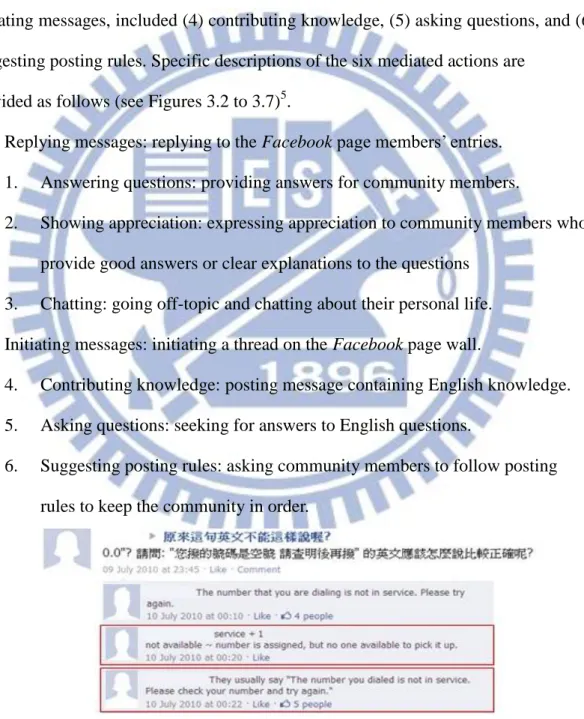
Figure 3.2 Example of answering questions posted by Participant B and C ... 33
Figure 3.3 Example of showing appreciation posted by Participant C ... 34
Figure 3.4 Example of chatting posted by Participant C ... 34
Figure 3.5 Example of contributing knowledge posted by Participant A ... 34
Figure 3.6 Example of asking questions posted by Participant D ... 35
Figure 3.7 Example of suggesting posting rules posted by Participant A ... 35
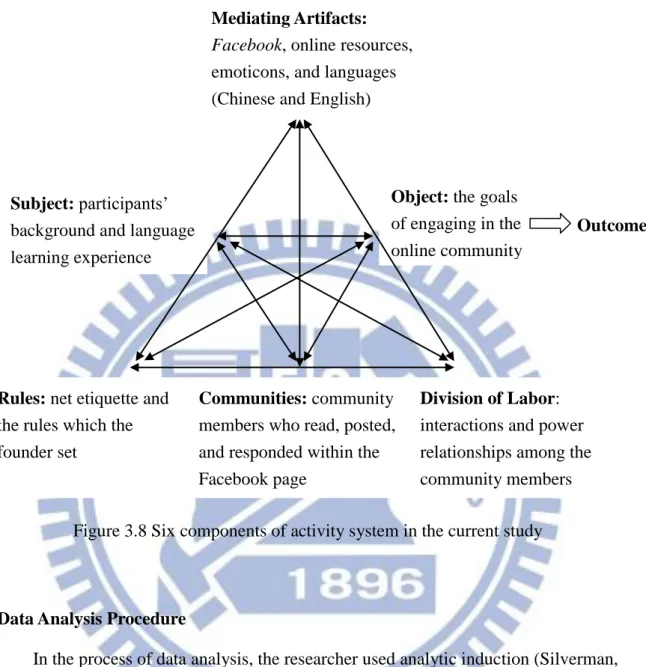
Figure 3.8 Six components of activity system in the current study ... 37
Figute 4.1 Mediated action trends over the three observation stages ... 43
Figure 4.2 Participant A’s self-description of his participation ... 45
Figure 4.3 Example of Participant A’s ―daily contribution‖ entry ... 46
Figure 4.4 Example of Participant A’s joke comment ... 47
Figure 4.5 Example of Participant A’s rule suggested ... 49
Figure 4.6 Participant A’s reply to the member who asked to add Chinese in entries . 51 Figure 4.7 Example of Participant D’s answer ... 58
CHAPTER ONE
INTRODUCTION
Background of the Study
The growth and evolution of the Internet in recent years has changed things
people do on the Internet. In the 1990s, the Web was a tool for only accessing
information which was created by small numbers of people for a very large number of
users. Less than a decade later, the situation has changed rapidly with new
development and applications emerging on the Internet (Warschauer & Grimes, 2007).
Internet users have started to interact through blogs, collaborate through wikis, and
build relationships through social networking sites (SNSs) recently. In other words,
barriers to online publishing, interaction, and collaboration have eliminated nowadays.
This new type of online communication is referred to as Web 2.0, ―the second
generation of the World Wide Web‖ (Warschauer & Grimes, 2007, p.2).
Web 2.0 technologies, such as blogs, wikis, and SNSs, provide the affordances
for Internet users not only access information via the Internet but also create and
contribute content collaboratively on the Internet. In the realms of Web 2.0
environments, users are actively involved in publishing, communicating, and
collaborating with each other. In this sense, Web 2.0 technologies can be described as
a social web which is a highly interactive and participatory platform with an obvious
focus on inter-human connectivity (Siemens, 2005). One of the representative Web
2.0 technologies is the SNS which serves primarily as a means of bringing people
with similar interests or experiences together (Davis, 2009). Users may join or build
online groups where they have a discussion about certain topics or exchange opinions
with aiming at a particular theme. By joining interaction in groups, people are linked
social contacts with other members.
Among these SNSs, Facebook has been considered as one of the most popular
SNS (Kabilan, Ahmad, & Abidin, 2010). Facebook was launched by Mark
Zuckerberg in 2004 and added its 550 millionth member in 2010 (Grossman, 2010).
The site has been one of the fastest-growing and best-known sites on the Internet
today. Grossman (2010) indicated the popularity of Facebook,
One out of every dozen people on the planet has a Facebook account. They speak 75 languages and collectively lavish more than 700 billion minutes on Facebook every month. Its membership is currently growing at a rate of about 700,000 people a day. (para.5)
In addition to its popularity, one unique feature of Facebook is its various applications
which make it far more sophisticated than many of its SNS counterparts, such as Bebo,
Friendster, and MySpace1 (Blattner & Fiori, 2009).The popularity of Facebook has
recently interested language learners in joining or forming online communities to seek
for language learning opportunities and make social connection with other language
learners. These online learning communities provide language learners a platform to
exchange information or share learning experiences in a shared online environment
beyond the boundary of time and space.
In response to the current trends of using SNSs for language learning, research
on online language learning has been spurred. From the review of these studies, it is
found that existing literature on online language learning communities is very limited
in three aspects. First, some of these studies focused on language learners’ discourse behaviors and online activities in an online community by analyzing the content of
their posts (e.g., Hoshi, 2003; Miceli, Murray, & Kennedy, 2010; Rasulo, 2009; You
& Zhang, 2007; Zeng & Takatsuka, 2008). Second, other investigated learners’
1
Facebook (http://www.facebook.com); Bebo (http://www.bebo.com); Friendster (http://www.friendster.com); MySpace (http://www.myspace.com)
perceptions and motivations of using SNSs as learning communities in support of
their language learning through their responses to questionnaires (e.g., Clark & Gruba,
2010; Hoshi, 2003, Jee & Park, 2009; Kabilan, Ahmad, & Abidin, 2010; Mills, 2009).
Third, further discussion concerning motivation explored the issue of sense of
community in an online learning community (e.g., Blattner & Fiori, 2009; Ducate &
Lomicka, 2008; Petersen, Divitini, & Chabert, 2008, 2009; Rovai, 2001, 2002).
One commonality of these studies is that most of them were carried out mainly in
formal learning context to grasp the effects of community building in language
learning class. Another commonality of these studies is that most of these studies
adopted quantitative research investigating frequencies and patterns of learners’
interactions or their perceptions and motivation toward the online learning community.
These quantitative results, however, did not clearly demonstrate how individuals
participated and interacted with other members as well as what community members
were experiencing during their participation in the online learning community.
Furthermore, this quantitative research did not afford to explore sociocultural context
within particular communities and often ignored the examination of crucial but often
hidden contextual factors (Warschauer, 1998). In order to fully understand the
complex interrelation of individual-context interaction, research paradigms should be
expanded to ―engage in critical qualitative research which takes into account broad sociocultural factors‖ (Warschauer, 1998, p.760).
Rationale of the Study
To explore the interrelation of members’ operations and contextual factors within an online learning community in Facebook, this study employs sociocultural
perspectives, especially Engeström’s (1987, 1999) activity theory to understand and describe individual community members in an online language learning community.
Sociocultural theory asserts that individuals are social beings influenced by the social,
cultural, and historical factors in specific contexts (Lantolf, 2000). According to
Jonassen and Rohrer-Murphy (1999), human practice cannot be understood or
analyzed outside the context in which they are situated. Therefore, when analyzing
human activity, research focus should be put not only on the activity that people
engage in but also on who is engaging in that activity, what their goals and intentions
are, what objects or products result from the activity, the rules and norms that
circumscribe that activity, and the larger community in which the activity occurs.
Drawing on sociocultural perspectives, activity theory is a philosophical and
multidisciplinary theory with a naturalistic emphasis on mapping out relationships of
various contextual elements within an activity (Engeström, 1999; Kuutti, 1996). It
provides a useful theoretical framework for examining how seemingly individual
human actions are interconnected by various contextual elements. Given that activity
theory contributes to unfold the complex interrelation among individual minds,
actions, and communities where they are situated, it seems that activity theory is an
appropriate theoretical framework which can be used in this study for interpreting
how individuals operate in an online language learning community and what factors
underlie their operations in an online language learning community.
Purpose of the Study
While much attention has been paid to the exploration of online language
learning community from quantitative perspectives, research on how individuals
participate and interact in an online language learning community from sociocultural
perspectives has remained largely outside the focus of research. Therefore, the current
study aimed to understand and describe individual community members in an online
More specifically, the purposes of the current study were (1) to investigate
community members’ participation within an online community and interaction with other community members; (2) to identify the underlying reasons which might take
effect on their participation and interaction in an online language learning community;
(3) to explore the interrelation between individual community members’ personal agency, participation, and contextual elements in the community; (4) to have more
understanding of community members’ perception toward their online participation experiences.
Research Questions
According to the purposes of the current study, this study adopted activity theory
as a theoretical framework to depict the experiences of community members in an
online learning community. In view of the preceding research purposes, three major
research questions were addressed as follow.
1. How do community members mediate their actions in the online English
learning community?
2. How do underlying factors interact with their mediated actions through the
process of engaging in the online English learning community?
3. How do community members perceive the experiences of engaging in the
online English learning community?
Organization of the Thesis
The organization of this thesis is as follows. In Chapter Two, related literature on
the use of Web 2.0 in language learning is reviewed first. Next, the discussion of
activity theory and its application in research is presented. In Chapter Three, the
of participants, data collection as well as the procedure of data collection and data
analysis. In Chapter Four, the results of the study are presented in response to the
research questions. In Chapter Five, as the final chapter, concludes the study by
displaying the discussion and the summary of the study findings, pedagogical
implications from the study, limitations of the study, and suggestion for future
CHAPTER TWO
LITERATURE REVIEW
In this chapter, related research is introduced in detail. First, an introduction of
Web 2.0 and its application, Facebook, is provided. Furthermore, related literature of
the use of SNSs, including Facebook, in support of language learning is reviewed.
Second, activity theory serving as a theoretical framework of the current study is
discussed from its historical development and its core components. Third, the
application of activity theory in education and research of language learning are
further discussed.
Introduction to Web 2.0
The term Web 2.0 has taken hold since its appearance at the first Web 2.0
Conference in 2004. The term which was coined by Tim O’Reilly (2005) refers to an improved form of the World Wide Web and new ways of using it. To be more specific,
Web 2.0 means the second generation of the World Wide Web (Warschauer & Grimes,
2007). The Web before Web 2.0 is thus named as Web 1.0 which is the first generation
of the World Wide Web. The retrospective term Web 1.0 refers to the initial
information-oriented Web, authored by a small number of people for a very large
number of users (Pegrum, 2009). Web 1.0 merely allows people to access information
via the Internet but it does not provide affordances of interacting and participating on
the Internet. On the other hand, in the era of Web 2.0 nowadays, people can do more
than access information via the Internet. People can apply Web 2.0 technologies to
interact through blogs, collaborate through wikis, and build relationships through
SNSs with relative ease. On the whole, the differences between Web 1.0 and 2.0 can
information on the Internet while Web 2.0 is dynamic and interactive which links both
information and people on the Internet (Warschauer & Grimes, 2007).
Web 2.0 technologies provide a platform which is easily for users to interact,
collaborate, and maintain relationships with people around the world. These
technologies including blogs, wikis, and SNSs allow Internet users to do more than
retrieve information. With Web 2.0 technologies, they build connections and
communities across the world. For example, bloggers share their personal journals or
thoughts of certain topics they are interested in while blog readers read and comment
on blog entries. Bloggers and their readers exchange opinions and interact with each
other on blogs. Under such circumstances, they build online communities through
blogs which connect them together. Another representative example of Web 2.0
technologies is wikis. Wikis are created by groups of people who work together to
generate new knowledge through an open editing and review structure (McLoughlin
& Lee, 2007). In this way, users with similar interests feel connected together through
interacting within a shared online space. In a nutshell, Web 2.0 provides an
environment for Internet users to become active participants who construct and
contribute content interactively and collaboratively, hence being connected together in
an online community.
Facebook, one of the Web 2.0 applications, is further discussed here since it has great affordances to build online communities and the major platform of this study.
Facebook provides a new way for people to meet, collaborate, and reinforce new and existing relationships. Davis (2009) suggested that Facebook appear to allow people
to not only form new relationships but also strengthen the relationships with those
Facebook, people gain some positive psychological benefits, including well-being and self-esteem, which result from positive online engagements with others (Valkenburg,
Peter, & Schouten, 2006). The social-networking feature of Facebook provides an
asset in establishing online communities which aim at different aspects, for example,
a high school community, a photography community, a sports community, or a
learning community.
The basic structure of Facebook is the ―Profile Page‖ which consists of
information such as age, location, education, work, personal interests and added
details about the user (McBride, 2009). Within these sections are more labeled spaces
to enter specific data such as hometown, political views, relationship status, favorite
music, and quotations. Besides, Facebook profile also consists of one picture which is
named as a profile picture. Facebook users can upload any pictures they want as their
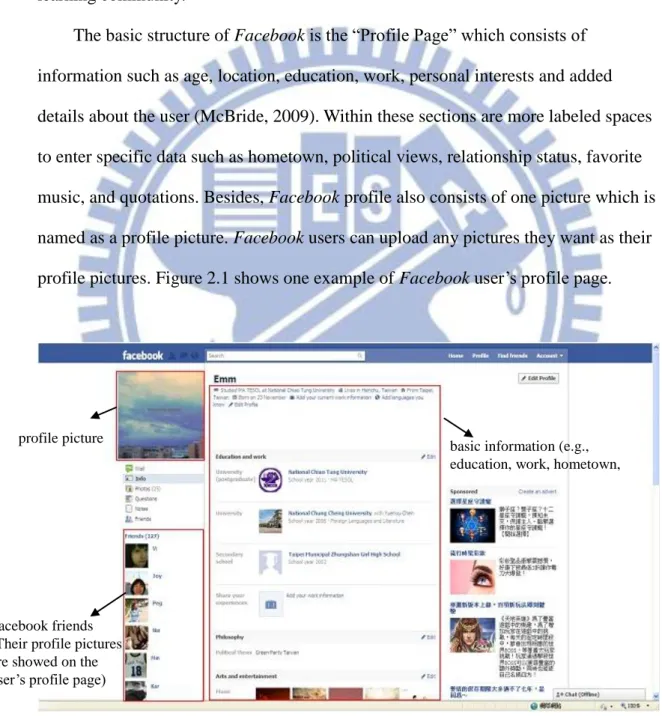
profile pictures. Figure 2.1 shows one example of Facebook user’s profile page.
Figure 2.1 Screenshot of Facebook profile page2
2
The Facebook usernames in Figures 2.1, 2.2, and 3.1 are shown in part in order to protect users’ identities.
profile picture
Facebook friends (Their profile pictures are showed on the user’s profile page)
basic information (e.g., education, work, hometown, photos, etc.)
After completing the information on profile page, users are considered as one member
of Facebook community. As Facebook community members, users can add other
Facebook users as their Facebook friends. Basically, the composition of profile page includes Facebook user’s basic information, profile picture, and Facebook friend list.
The demographic information, descriptions of interests, and sharing of photos noted
on the user’s profile page can be considered as the expression of self-disclosure (Wang & Woo, 2010).
An interesting aspect of Facebook is the viral spreading of online interactions on
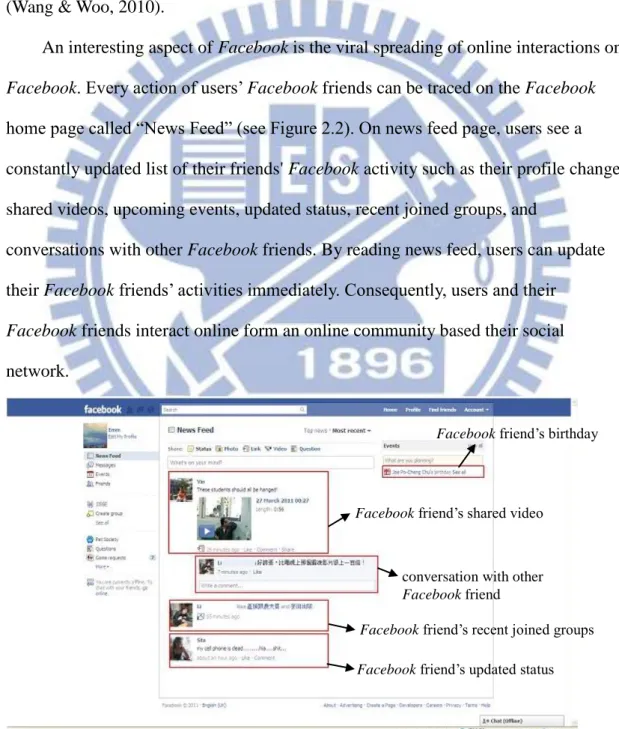
Facebook. Every action of users’ Facebook friends can be traced on the Facebook home page called ―News Feed‖ (see Figure 2.2). On news feed page, users see a constantly updated list of their friends' Facebook activity such as their profile changes,
shared videos, upcoming events, updated status, recent joined groups, and
conversations with other Facebook friends. By reading news feed, users can update
their Facebook friends’ activities immediately. Consequently, users and their
Facebook friends interact online form an online community based their social network.
Figure 2.2 Screenshot of Facebook news feed page
Facebook friend’s shared video
Facebook friend’s birthday
Facebook friend’s updated status Facebook friend’s recent joined groups
conversation with other
In addition to being one member of Facebook community, Facebook users may join
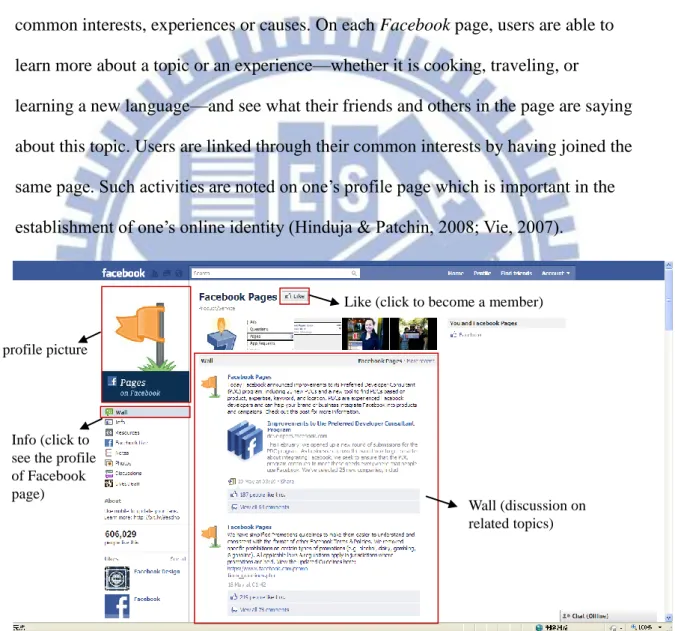
―Facebook Page‖ which created by other Facebook users with similar interests, experiences, or causes. Figure 2.3 presents an example of Facebook page which was
created by Facebook. Facebook page applications have been specifically designed to
build bonds between users that share a common interest or activity. In Facebook,
users can join pages that already exist or easily create a new one based on their
common interests, experiences or causes. On each Facebook page, users are able to
learn more about a topic or an experience—whether it is cooking, traveling, or
learning a new language—and see what their friends and others in the page are saying
about this topic. Users are linked through their common interests by having joined the
same page. Such activities are noted on one’s profile page which is important in the establishment of one’s online identity (Hinduja & Patchin, 2008; Vie, 2007).
Figure 2.3 Screenshot of Facebook page
The interface of Facebook page is similar to Facebook personal profile page.
Users can click the ―Info‖ tab to read the descriptions of Facebook pages, such as the
Like (click to become a member)
Info (click to see the profile of Facebook page) profile picture
Wall (discussion on related topics)
founded time, mission, and its website address. By reading the Info message, users
can see whether the page meets their interests and click the ―Like‖ tab to become its
members. After joining a Facebook page, users can have a discussion about certain
topics which they are interested in or exchange opinions with aiming at a particular
theme on the ―Wall‖ of the page. The wall is a virtual place where members can share their thoughts and ideas on any topics they are interested in. In addition, members
have the ability to contact, interact, or make friends with other members in a variety
of ways through the Facebook applications, such as sending private message, adding
as friends, or writing on their walls. In a nutshell, by joining interaction in a page,
users are linked together and hence establish online communities where they can
interact with other members and make new relationships or social contacts.
Applications of Facebook in Building Learning Communities
The growing popularity of Facebook provides additional avenues and purposes
for educational uses in enhancing social interactions among learners. The social and
interactive nature of Facebook supports the application of building learning
communities where collaboration and participation involved in the learning process
(Greenhow, Robelia, & Hughes, 2011). With the special social and interactive nature,
Facebook may benefit learners by allowing them to be involved in communities of collaborative learning. Therefore, the main educational use of Facebook is seen to lie
in the support for indirectly creating a learning community which is a vital component
of learning (Baker, 1999).
In an online learning community, learners can actively participate in online
discussion. They can leave comments on a discussion board and ask for more detailed
explanations which may not be easily achieved in formal educational context (Hemmi,
Furthermore, it is contended that the online learning communities may better motivate
students as engaged learners rather than learners who are primarily passive observers
of the educational process (Ziegler, 2007). In conclusion, Facebook which possesses
powerful social and interactive abilities is considered being conducive for language
learners to form online learning communities which facilitate their learning.
Studies on Facebook in Language Learning
Along with the advent of Facebook, language learners are provided with a
significant opportunity for language learning. It is found to be a very effective way of allowing people to stay in contact and communicate with others that the educational
resources are being put to good use. As Godwin-Jones (2008) noted, SNSs ―that
enhance communication and human interaction can potentially be harnessed for
language learning‖ (p.7). Within the application of Facebook in language learning, learners can contact and interact with other learners, communicate with each other as
well as collaborate on solving problems regarding language learning.
Several studies explored the application of SNSs, including Facebook, to
language learning, described the implementation in language classroom contexts,
reported on learners’ experiences and outcomes, and identified potential benefits in language learning (e.g., Clark & Gruba, 2010; Ducate & Lomicka, 2008; Hoshi, 2003;
Jee & Park, 2009; Kabilan, Ahmad, & Abidin, 2010; Mills, 2009; Miceli, Murray, &
Kennedy, 2010; Petersen, Divitini, & Chabert, 2008, 2009; Rasulo, 2009; Zeng &
Takatsuka, 2008). Conducted in language classroom contexts, recent research has
pointed out that the application of Facebook in class could help to establish and
maintain immediacy among students (Mazer, Murphy, & Simmonds, 2007). Mazer, et
al. (2007) noted that by accessing Facebook, students may see similarities with peers
The emotional connections were considered important elements of developing sense
of community which created an intrinsically rewarding reason to continue
participation in a group (McMillan & Chavis, 1986). Likewise, Blattner and Fiori
(2009) also proposed that promoting a community of learners was extremely useful as
it often positively impacted affective learning and students’ motivation.
In addition to the examination of the formation of an online learning community
on learning process, other studies focused on online activities and discourse,
indicating that Facebook provide authentic environments for enhancing
communication, interaction, and discussions (Mills, 2009). Blattner and Fiori (2009),
for example, pointed out that Facebook can be utilized for authentic language
interaction and could be used to improve the performance of language learners.
Furthermore, Mills (2009) discovered that her students within Facebook environment
felt that the language class was more interesting and the authentic environment
motivated them to use accurate language in online discussions.
To sum up, previous research investigating Facebook in language learning has
focused on online community formation in language learning, learners’ perception
and motivation toward participating in an online learning community, and the effect of
an online learning community on language learning development. Although these
studies have provided general information about the use of Facebook in language
learning, these studies were mostly conducted in classroom settings. Little attention
has been paid to examine online learning context out of class. Furthermore, previous
studies have seldom been conducted by a qualitative approach which may elicit more
solid understandings of online language learning. Hence, the present study sought to
understand individual activities as socially situated participation in an online learning
Theoretical Framework: Activity Theory
Activity theory is a philosophical and multidisciplinary theory that offers a
framework for describing human activity and provides a set of perspectives on
practice that interlink individual and social levels (Kuutti, 1996; Jonassen &
Rohrer-Murphy, 1999; Nardi, 1996). Rather than investigating an individual
separately from his/her surroundings, it focuses on the interaction of human activity
within its relevant environment context. Serving as a theoretical framework of the
study, the historical development and central ideas of the activity theory are discussed
in the following section.
The Historical Development of Activity Theory
The activity theory originated from the concept of Vygotsky’s (1978, 1981) sociocultural theory and then was expanded by Leont’ev (1981), and Engeström (1987, 1999). Vygotsky (1978, 1981) believed that human activity happens when
human beings intend to resolve problems by using tools to achieve their goals. The
central concept of Vygotsky’s theory is mediation which lies in the notion that human activity is mediated by tools and signs. These mediating tools can be physical (e.g.,
computers, books, peers, teachers) and psychological (e.g., languages, signs, beliefs,
culture) tools which serve to assist subjects working on achieving the object.
According to Vygotsky, human behavior is activity which is mediated by tools and
signs serving to connect subjects and objects. The basic structure of human mediated
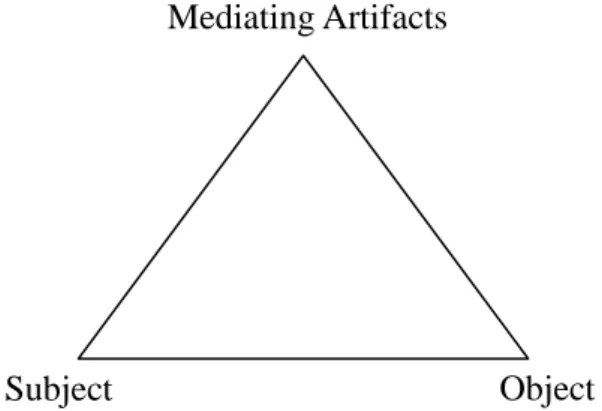
activity, including subject, object, and mediating artifacts, can be illustrated as a
triangle which shows the relationships between each item to mediate an interaction
Figure 2.4 The basic representation of activity theory (Vygotsky, 1978, 1981)
Based on Vygotsky’s concept, Leont’ev (1981) proposed a more complex model of activity theory. Leont’ev (2003) defined activity as a ―unit of life that is mediated by mental reflection‖ (p.46) and characterized it as a reciprocal transformation between subject and object. Leont’ev (1981) extended Vygotsky’s (1978) notion of the mediated relationship between subject and object in which action is a particular
instantiation of activity that is realized through situational operations (Haneda, 2007).
He viewed the nature of activity, action, and operation as incorporating three
hierarchical processes (see Figure 2.5).
Figure 2.5 Hierarchical nature of activity, action, and operation (Jonassen & Rohrer-Murphy, 1999)
The highest level of the hierarchy, activity, is conscious and driven by an
object-related motive. The middle level, individual action, is conscious and driven by
a goal. The lowest level, automatic operations, is unconscious and driven by the
conditions of the actions (Lantolf & Thorne, 2006). That is, individuals are driven by
Activity Motive Action Operation Goal Condition Mediating Artifacts Subject Object
underlying motives and these motives are realized in goal-directed actions to satisfy
the initial needs. Therefore, motives are significant and crucial elements in triggering
human action. To sum up, an activity is not merely mediated by external tools but is
also driven by the inner need to transform an object into desired outcomes.
Engeström (1987, 1999) further contextualized activity by situating it within a
community where historical and contextual factors are embedded. Accordingly, this
expanded model contains subject, object, mediating artifacts, community, rules, and
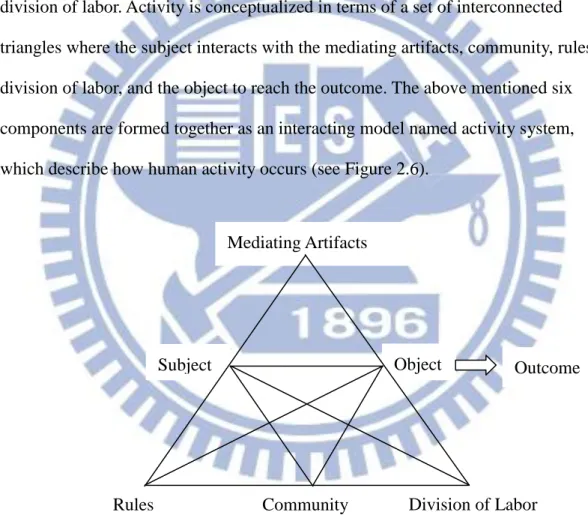
division of labor. Activity is conceptualized in terms of a set of interconnected
triangles where the subject interacts with the mediating artifacts, community, rules,
division of labor, and the object to reach the outcome. The above mentioned six
components are formed together as an interacting model named activity system,
which describe how human activity occurs (see Figure 2.6).
Figure 2.6 The expanded activity system (Engeström, 1987, 1999)
The Six Components of Activity System
An activity system has six interacting components, namely subject, object,
mediating artifacts, community, rules, division of labor, and the object. Subjects are
human agents who are engaged in an activity. Objects are goals to be achieved. Object Division of Labor Mediating Artifacts Subject Rules Community Outcome
Mediating artifacts are physical tools which are used to achieve goals such as
computers, books, and pens or psychological things such as languages, ideas, and
experiences that help to carry out an activity. Community refers to a group to which
subjects belong. Rules are customs, conventions, or regulations that govern behaviors
of subjects within the community. Division of labor is the distribution of subjects’ roles, powers, and responsibilities.
An activity system which is depicted as a triangle describes the interactions and
relationships between the six components. The triangle in the upper half of the system
depicts the relationship between subject and object as mediated by mediating artifacts.
This upper triangle describes individual action with relations between the subject,
object, and the mediating artifacts, in isolation from the community. The upper
triangle explains how subject works to achieve object through mediating artifacts. The
further lower part of the triangle incorporates three new elements, that is, community,
rules, and division of labor and links them with the elements in the top triangle. The
lower triangle describes how subject is constrained by rules to interact with
community and how community defines division of labor for subject to accomplish
object of the activity system. The triangle structure of activity system clearly states
the interrelated relationship of individuals within a community.
Within an activity system, these six components are not fixed but are reciprocally
and dynamically interacting with one another. Any changes or modifications of these
elements will influence other elements and change the operation of the activity.
According to Engeström (1999), the origins of changes and modifications come from
contradictions such as problems, breakdowns, tensions, or conflicts happen within an
activity system. To take an online leaning community as an example, when online
community members interact with other members, they form division of labor within
community, the division of labor in this community may be changed. For other
community members, contradictions here emerge between subjects, division of labor,
and objects. Hence, to solve the existing contradictions occurring in the activity
system, subjects may change their objects which lead to new directions in the
developmental process of the activity system. However, the adjustment of any
components could possibly give rise to new contradictions and then actions taken to
solve the contradictions. The cycle of the process keeps going until the activity system
achieve equilibrium. Nevertheless, activity theorists consider contradictions as source
of development. According to Engeström (1987), the effort to resolve contradictions
is the driving force of change and development activity systems. Therefore, based on
the notion of contradictions, identifying contradictions and understanding the
transformation of activity system are significant to portray the nature of the activity
(Barab, Schatz, & Scheckler, 2004).
In sum, activity theory develops an activity system which intends to explore
human activity between an individual and his/her environment through mapping out
the six components, namely subject, object, mediating artifacts, community, rules, and
division of labor in the activity system. The systematic model of activity theory
emphasizes on the interrelationship between the subject and the surrounding
environments. Furthermore, these six elements of an activity system constantly
interact with each other and could possibly develop contradictions within the activity
system. Under the circumstances, subjects would try to resolve contradictions until
the activity system achieve equilibrium. Therefore, by zooming the lens of activity
theory, the developmental path of the interrelationship is easily traced. It is concluded
that the activity theory is indeed with the potential to analyze sociocultural and
historical impact upon individuals in their choice of actions, thus proven valuable for
Activity Theory in Education
The interest of activity theory in education has been increasing in the recent
decade (Roth, 2004). Researchers have started to use activity systems to understand
and examine learning process since learning is seen as a mediated action. According
to Vygotsky (1981), learners construct meaning through interacting with artifacts and
other people in their particular sociocultural community. In the view of sociocultural
perspective, learners are regarded as social beings whose actions are influenced by
sociocultural as well as historical factors within specific context. As Scanlon and
Issroff (2005) noted, activity theory provides a language to describe some of the key
features of learning experiences. On the whole, activity theory allows educational
researchers to have an understanding of how multiple contexts in which an individual
operates work together transform internal thought processes into learning actions.
Activity Theory and Educational Studies
Since activity theory offers a holistic and contextual method of discovery, recent
educational research applied activity theory to explore both teachers’ and learners’ behaviors and actions in educational context (e.g., Barab, Barnett, Yamagata-Lynch,
Squire, & Keating, 2002; Brine & Franken, 2006; Choi & Kang, 2007, 2010; Hung,
Tan, & Koh, 2006; Jonassen & Rohrer-Murphy, 1999). For example, Karasavvidis
(2009) applied activity theory as a theoretical framework to examine teachers’
concerns regarding the use of technology in their teaching. This study discovered that
the main obstacles of technology integration in teaching were time and curriculum
constraints. Examining from the perspective of activity theory, it was found that
contradictions of mediating artifacts and object existed in the teachers’ activity system.
activity theory to examine students’ learning process. Brine and Franken (2006) used
activity theory as the basis of their analysis to evaluate students’ perceptions of a computer mediated academic writing program, coding reflective journal entry data
according to the six components of activity system. This study identified challenges in
online educational environments in relation to group processes and how new tools
facilitate or impede these processes. The challenges identified in this study were
manifested in explaining students’ activity systems where contradictions and tensions between mediating artifacts and processes were found. Another similar study
conducted by Choi and Kang (2010) found that an activity system was a useful tool to
reveal conflicting factors of contradictions during group work. The findings implied
that contradicting situations arose due to a lack of competency with tools. It was
further proposed that the most frequently observed conflicting factors were located
among subjects, object, mediating artifacts, and community.
Apart from explaining teachers and learners’ behaviors separately, educational research also explored both teaching and learning process situated in the same context
from activity theory which illuminates the whole picture of an educational context.
For instance, Barab, Barnett, Yamagata-Lynch, Squire, and Keating (2002) analyzed
participation by undergraduate students and teachers, explaining the instances of class
activity that characterized course dynamics. This study focused on the relations of
subject (student) and object (astronomy understandings) and how object
transformations leading to scientific understandings mediated by tools (both
technological and human). In addition, they also examined the interrelationship
among the overall classroom culture (emergent norms), division of labor (group
dynamics and student-instructor roles), and rules (informal, formal, and technical). It
used activity theory as an analytical lens for understanding the transactions and
Activity Theory and Language Learning Studies
Activity theory has been not only employed widely in a number of overall
educational research, but also in the studies of language learning which put emphasis
upon the social and historical influences of learners’ surrounding environments on
learners’ participation in language class (e.g., Haneda, 2007; Lantolf & Genung, 2002; Lantolf & Thorne, 2006; Nelson & Kim, 2001; Storch, 2004). In other words, to
understand how students learn language requires an analysis of the activity systems in
which they are embedded and an analysis of the contradictions inherent within
activities and between them.
Storch (2004), for example, investigated the dyadic interactions among learners
through the lens of activity theory. It was found that although language learners were
seemingly engaged in the same task, they may be engaged in different practice.
Various types of students’ interaction patterns were found in this study. Such
variations were contributed to learners’ own interpretation of the situation, the goals
they set, and the role they played. The results revealed that individuals underwent
different activity systems depending on their language learning experiences and their
own activity systems embedded in a specific context. The results were in accordance
with Haneda’s (2007) finding. The study exploring students’ learning process of writing in a foreign language concluded that students’ participation in class is mediated by the concepts and tools of the past and present activities in which they
have engaged and were engaging. In other words, from sociocultural perspective,
individuals were seen as agents who engaged in goal-oriented actions with cultural
tools, both symbolic and material, as members of a particular sociocultural
community. In another similar study, Gillete (1994) conducted an investigation of
university students studying French. In this study, there were two students, both
learning of French as two completely different activities: while one student saw it as
deeply relevant to her desire to become a writer, the other did not see any real-life
relevance in language study. It was found that the kind of learning activity the
students employed in learning French were influenced by their histories, in which
were rooted their motives for studying French and their goal on specific occasions. It
was further proposed that individuals’ actions were energized by their own activity systems.
In addition to investigating learning in language classrooms, recent research has
started to explore learning in online environments. Incorporating an online
community into consideration, these studies applied activity theory to understand and
describe learners’ online learning experiences (e.g., Aalst & Hill, 2006; Basharina, 2007; Masters, 2009). Conducting in an online learning environment, Aalst and Hill
(2006) investigated learners’ participation in class online discussion. Findings of the study illustrated that the online discourse was structured by rules, division of labor,
and mediating artifacts in the online community. In addition to examining the
interrelationship among elements of activity systems, some studies drew attentions on
the contradictions emerged in activity systems. The study of Basharina (2007) focused
on contradictions in telecollaboration among English learners from Japan, Mexico,
and Russia. These students were participants of multiple activity systems
simultaneously. They were embedded in their local classrooms, an online global
community, and broader context of their local cultures. From the perspective of
activity theory, this study identified three levels of contradictions: intra-cultural,
inter-cultural, and technology-related contradictions. On the whole, these
contradictions detected in the above studies were the result of having the same task
but engagement in different activities, characterized by differences in their different
The above-discussed studies, by adopting activity theory as a theoretical
framework, altogether put focus on the importance of a given context as well as the
impact of social and historical factors upon individuals’ choice of actions in the learning process. Furthermore, these studies also emphasized the discovery of
contradictions or tensions in individuals’ activity systems since contradictions were considered the source of changes in their learning actions. It is concluded that activity
theory offers a holistic and contextual method of discovery that can be used to support
qualitative and interpretative research. It is indeed with the potential to yield different
perspectives for analyzing the evolving learning process of individuals’ actions in an educational context.
Since activity theory provides a powerful theoretical framework to explore the
complexity of individual actions and the situated context, the present study takes the
lens of activity theory to focus on investigating an online language learning
community out of class in effort to get a portrait of what and how mediated actions of
community members are formed as well as underlying factors of their mediated
actions in an online learning community.
In the next chapter, the research methodology will be presented in detail to
CHAPTER THREE
METHODOLOGY
This chapter presents the methods of this study, including the description of the
study setting, participants, data collection, procedure, and data analysis.
Study Setting
The current study targeted at one online language learning community which
was located in one of the most popular SNS in the world—Facebook. Facebook users
may join one or several ―Pages‖ created by other Facebook users with similar interests or experiences. The targeted Facebook page, ―Oh, That is Not How We Say
It in English?‖ (原來這句英文不能這樣說喔?
http://www.facebook.com/poor.english)3 was an English learning community where
community members gathered together in a virtual space and discussed English
language problems with other members.
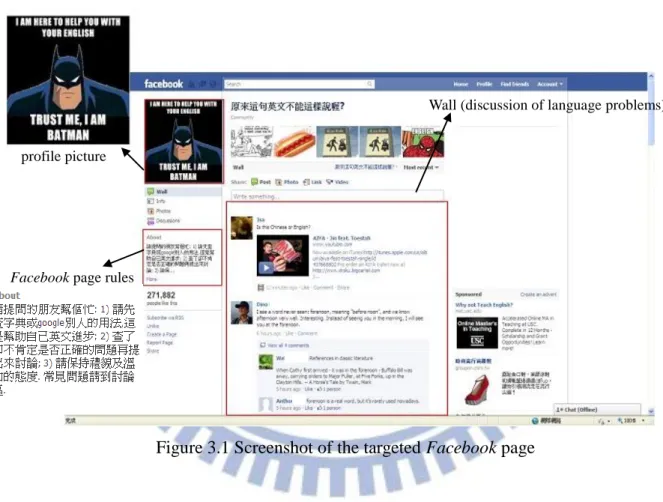
According to the profile page of the Facebook page, the mission of this page is to
provide an online space for discussion about using English correctly. Community
members can post their questions for discussion in the Facebook page. The profile
picture of this Facebook page also tells the purpose of this learning community (see
Figure 3.1). Besides, there are three Facebook page rules as follows: (1) Please look
up the word in the dictionary or google it first. This is the way to improve your
English ability; (2) If you are not sure about the answers after consulting, then drop
your questions for discussion here; (3) Please keep a polite and warm manner. The
Facebook page was founded in April 17, 2010 by an anonymous Facebook user and
3 The name of the targeted Facebook page is in Chinese, that is, 原來這句英文不能這樣說喔?The
researcher translates the Chinese name into an English name, ―Oh, That is Not How We Say It in English?‖
the number of members has been increasing to over 245,000 in April 2011.
This study tried to elicit the community members’ experiences from the very beginning of their participation and intended to capture their changes in the
community. Therefore, this online language learning community was targeted as an
ideal research site because the researcher started the study while the online
community was launched.
Figure 3.1 Screenshot of the targeted Facebook page
Community members of this Facebook page can have discussion by posting
language problems or responding to other members’ questions on the ―wall‖ of the
Facebook page. The ―wall‖ is a virtual place where community members can share their thoughts and ideas on any topics they are interested in. In this online learning
community, any topics of language learning were posted and discussed by community
members. From the online observation, it was found that discussion topics on the wall
profile picture
Wall (discussion of language problems)
of this Facebook page included English-Chinese translations, English grammar
questions, culture-embedded language issues, English learning strategies, and any
other issues related to language learning.
The Recruitment of Participants
The researcher started to search active members by doing online observation
since April 2010 right after the online community was founded. The online
observation indicated that although the number of members was huge and has been
increasing rapidly, there were a few members who participated in online discussion
intensively. By observing their participation for four months, nine members were
targeted because of their regular participation in online discussion. They posted
questions or replied to other members’ questions at least once a week.
The nine members were informed of the purpose of the study through private
message on Facebook. After they replied to the private message, the researcher sent
them both Chinese and English version of consent forms by email (see Appendix A
and B). Consequently, four of them who intensively answered members’ questions on the wall of this Facebook page agreed to be the participants for this study. Table 3.1
presents the basic demographic information of respective participants.
Table 3.1
Profiles of the targeted community members
Participant Age Gender Location First language Second Language Self-assessed English proficiency
A Mid 20s Male the U.K. English Chinese Native
B Mid 20s Male Taiwan Chinese English Intermediate
C Late 30s Female the U.S. Chinese English Advanced
Participant A lived in the U.K., Participant C in the U.S., and Participant B and D
lived in Taiwan. In other words, two of them lived in an English-speaking country
while two of them lived in an English-as-a-foreign-language (EFL) country.
Participants were all Chinese and their first language was Chinese except Participant
A who was born in the U.S. He used English as his first language and Chinese as his
second language. Furthermore, their self-assessed English proficiency was
intermediate to native.
With regard to the time of their participation in this Facebook page, Participant A
and B had joined the discussion of the community for four months while Participant C
and D had joined for almost two months by the time of the study. That is, the duration
of participants’ activity ranged from two to four months by the time the recruitment of participants took place. In spite of their different durations of participation, they
constantly and regularly engaged in the discussion during their participation. Table 3.2
illustrates the number of entries from the time of their first participation to August
2010 the time they were recruited as participants in this study.
Table 3.2
Number of entries per month on the wall of the Facebook page
Participant Date of first participation
April May June July August Total
A April 19 345 88 12 66 33 544
B April 20 85 76 42 54 56 313
C July 9 -4 - - 35 18 53
D July 16 - - - 22 81 103
Data Collection
In order to set a complete picture of what and how participants did in the online
4
Participant C and D started to join the discussion in July so there were no entries during April to June.
learning community, the researcher collected data from various sources. Data was
gathered from online observation, online questionnaire, and semi-structured
interviews with participants. Data collection started from April 2010 and lasted to
April 2011. The following sections explicitly describe the data collections which were
applied in this study.
Online Observation Field Notes
The researcher visited the targeted online learning community and kept
observation field notes twice a week (see Appendix C). The purpose of field notes
was to record the targeted community members’ participations and interactions in the online community. The observation field note served as supplementary data for
developing interview questions with participants.
Questionnaire
To gain information regarding the participants’ biographical information,
education background, English learning experiences, and perceptions of participating
in the language learning community, the researcher asked the participants to complete
the online questionnaire (see Appendix D) in September 2010 before the first
interview. The information acquired from the questionnaires was helpful for the
researcher to have further understanding of the participants and therefore developed
interview questions.
Interviews
Two interviews with each participant were guided with semi-structured
open-ended questions and also guided by questions emerging during the
the U.S., and Taiwan), the interviews were done via Windows Live Messenger (except
for Participant D who preferred to have interviews by telephone). Table 3.3
summarizes ways of conducting and other related information about both the first and
second interview.
Table 3.3
Summary of related information about the first and second interview
Participant Location Ways of conducting interviews Language used
A U.K. Windows Live Messenger English
B Taiwan Windows Live Messenger Chinese
C U.S. Windows Live Messenger English
D Taiwan Telephone Chinese
The average length of each online interview lasted from one and half hours to two
hours and the length of telephone interview was approximately one hour. The
language used in interviews was tailored to the convenience of the participants. Some
participants preferred to use Chinese while some participants felt more comfortable in
using English. Among these interviews with four participants, Chinese was used in
interviews with Participant B and D who lived in Taiwan while English was used with
Participant A and C who lived in the U.K. or the U.S.; yet, code-switching between
Chinese and English happened very often.
The first interview was conducted in October 2010 after the first six-month
online observation. The first interview aimed to probe into the following questions: (1)
the experiences of participating in the online learning community, (2) the perceptions
of their experiences in the online learning community, (3) factors or motivations of
participating in the online learning community, and (4) other specific events which
were matter to the participants (see Appendix E). The second interview was
participants’ changes of participations and perceptions of engaging in the online learning community. In the second interview, participants were asked to clarify their
changes of (1) actions and (2) perceptions in their at least nine months of participating
in the online learning community and furthermore, (3) underlying factors of their
changes were also explored in the second interview (see Appendix F).
Data Collection Procedure
The data collection procedure undertaken in the study lasted for one year. Table
3.4 summarizes the data collected time and procedure. The researcher did online
observation within the online learning community from April 2010 right after it was
founded in April 17, 2010 and lasted to April 2011. After completely observing the
community members’ participation in this online learning community for four months, the researcher was curious about the participants’ background information which was helpful for the researcher to develop the following interview questions. Hence, the
participants completed online questionnaire regarding their basic information in
September 2010 before the first interview. Then, the first interview was conducted to
collect their experiences, perception, and factors in participating in the online learning
community in October 2010. After the first interview, the researcher kept doing online
observation for four months to perceive any changes in participants’ action,
participation or interaction in the online learning community. The perceived changes
of the participants were the focus of the second interview which was conducted in
April 2011 six months later after the first interview. At this particular time after these
four participants had joined the online community at least for nine months, the
purpose of the second interview was to capture the underlying factors of changes of
community members’ participation. Through the whole data collection procedure, the researcher tried to acquire a holistic picture of things which happened in the online