
比較HAPPEN與其同義字: 以母語及學習者語料庫為基礎的非賓格存現動詞之研究 - 政大學術集成
186
0
0
全文
(2) Comparing Unaccusative HAPPEN and its Synonyms: A Study of Existence/appearance Verbs Based on Native Speaker and Learner Corpora. A Master Thesis Presented to Department of English,. 政 治 大 National Chengchi University 立 ‧. ‧ 國. 學 er. io. sit. y. Nat. n. a l In Partial Fulfillment i v n of Ch U of the Requirements for the Degree engchi Master of Arts. by Liang-Chun Wang January, 2011. ii.
(3) 立. 政 治 大. ‧. ‧ 國. 學. n. er. io. sit. y. Nat. al. Ch. engchi. i n U. v.
(4) ACKNOWLEDGEMEMTS. For the completion of the thesis, I would like to express my greatest appreciation and gratitude to the following people. Without their assistance and encouragement, accomplishing this thesis would be impossible. First of all, I would like to show my heartfelt gratitude to my advisor, Professor Siaw-Fong Chung, for her inspiring guidance and invaluable help. She penetrates insights into the issue of corpus-based integration with second language. 政 治 大 the first time we together discussed my research topic in her quantitative research 立 acquisition, which have inspired me persistently and profoundly. I will never forget. ‧ 國. 學. course, which was just vivid as things happened yesterday. I would never forget her pleasant and satisfying smile after a rigorous process of revising our paper, which. ‧. provides me with more critical thinking and builds up my confidence.. sit. y. Nat. Second, I am grateful to the committee members, Professors Doris, Chun-yin. n. al. er. io. Chen and Huei-ling Lai, for their constructive suggestions and feedbacks to make my. i n U. v. thesis better. Especially, I thank Prof. Chen because her informative speech in. Ch. engchi. National Chungcheng University three years ago triggered my interest in the issues of interlanguage in second language acquisition. I also thank her to spend time discussing problems and issues related to my research methods. In addition, I would also show my greatest gratitude to Prof. Lai for continuous assistance and encouragement since she was the chair of English Department. Her constant care and timely help for my conference presentations and thesis always give me the courage to realize my dream of exchanging views with the world. Other than my advisor and committee members, I would also thank Professors Hin-tat Cheung and Zhao-Ming Gao for offering me invaluable comments on my theoretical framework of my thesis, iii.
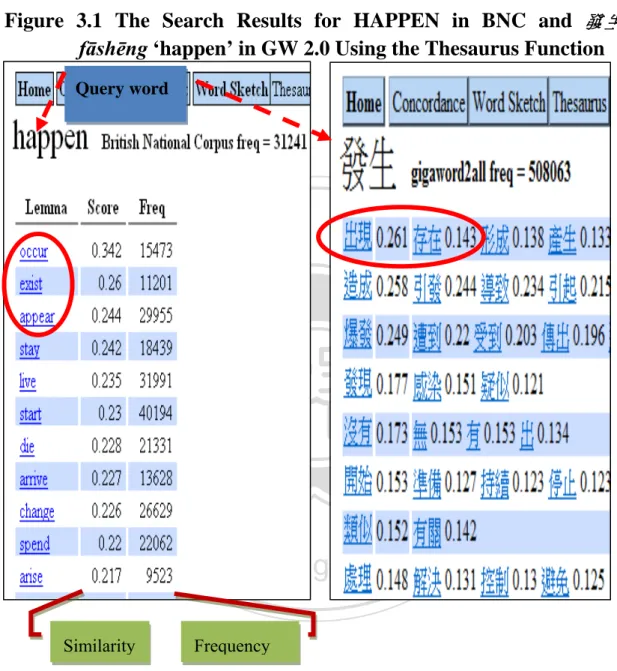
(5) which broadens my horizons of research. I would also thank the entire faculty at the TESOL MA Program of the English Department, National Chengchi University, for their abundant teaching through these three years in which I absorb my professional knowledge of applied linguistics and language teaching. I would also thank Language Training & Teaching Center as well as Foreign Language and Literature College of National Chengchi University for the invaluable learner corpora resources. Without their facilities and financial support, I would impossibly conduct my project. Additionally, I thank National Science Council for the. 政 治 大 My deepest gratitude also goes to the students and teachers in Taipei Municipal Wan 立 travel grants of my international conference presentations related to my thesis topic.. ‧ 國. 學. Fang Senior High School, National Taipei University of Science and Technology, and National Chengchi University. With their cooperation, I could accomplish my mater. ‧. thesis.. sit. y. Nat. I would also express my sincere thanks to my classmates at Chengchi. io. er. University, Jeremy Chen, Rachel Tseng, Mandy Huang, and Emily Hung.. al. Additionally, my special appreciation goes to my fellow friends in the NCCU bike. n. v i n CEmily club, Grace Kao, Samsan Chan, and Yi-Hsiang Wang, as well as other h e nLai, gchi U supportive friends, Ching Ho Lo, Valcan Ke, and Yi-yuan Chen. With their friendship and company, I never feel lonely during my completion of the thesis. Lastly, I am really blessed to have my dearest parents, Wen-yi Wang and Chin-Mien Yang, and my lovely sister, Katherine Wang. I am grateful for their unconditional love, patience, and understanding. They allowed me to have sufficient freedom to pursue my wildest dream and self-growth.. iv.
(6) TABLE OF CONTENTS CHINESE ABSTRACT.......................................................................................................................... ix ENGLISH ABSTRACT…..................................................................................................................... xi Chapter 1.INTRODUCTION…................................................................................................................... 1 1.1 Background and Motivation of the Study……………........................................................... 1 1.2 Significance of the Study….................................................................................................... 5 2.LITERATURE REVIEW…....................................................................................................... 10 2.1 L2 English Syntactic Differentiation of Unaccusative Existence/appearance Verbs….................................................................................................................................... 10 2.1.1 Syntactic Structure of Unaccusative Existence/appearance Verbs…………………… 10 2.1.2 Thematic Roles of Unaccusative Existence/appearance Verbs……….......................... 14 2.1.3 Causative Alternations of Unaccusative Existence/appearance Verbs........................... 16 2.2 Perfectivity……………………………………..................................................................... 19 2.3 Lexical Semantics-based and Corpus-based Differentiation (L1 Chinese)…………........... 24 2.4 Errors Analysis of Unaccusative Existence/appearance Verbs………………………… 30 2.5 Gaps of the Previous Research…………………………….…………………...................... 35 2.5 Summary of the Chapter………………………….…….………………………………….. 40 3. STUDY I—CORPORA ANALYSIS….................................................................................... 41 3.1 Methods and Findings of Analyzing Native Speaker Corpora…………………….............. 42 3.1.1 Native Speaker Corpora…………………………………………………………………….. 43 3.1.2 Analyzing Synonyms of HAPPEN and its Chinese Counterpart 發生 fāshēng ‘happen’….. 44 3.1.3 Analyzing Chinese Grammatical Patterns in GW 2.0………………………………….. 49 3.1.4 Grammatical Form Analysis in the Native Speaker Corpus………………………….. 52 3.2 Methods of Analyzing Learner Corpora................................................................................ 55 3.2.1 Three Learner Corpora…………………………………………………………………………55 3.2.2 The Tool of Extracting Learner Data……………………………………………………...... 57 3.2.3 Grammatical Form and Erroneous Rate Analysis…………………………………...... 59 3.2.4 Categorizing the Errors……………………………………………………………………… 59 3.3 Findings of Learner Corpora Analysis................................................................................... 62 3.3.1 Findings of Grammatical Form and Erroneous Rate Analysis in Learner Corpora………………….................................................................................................. 62 3.2.2 Findings of Categorizing the Errors…………………………………………………… 67 3.4 Summary of the Chapter........................................................................................................ 74. 立. 政 治 大. ‧. ‧ 國. 學. n. er. io. sit. y. Nat. al. Ch. engchi. i n U. v. 4. STUDY II—PSYCHOLINGUISTIC EXPERIMENTS………………………………………76 4.1 Methods of L2 English Acceptability Judgment Tasks......................................................... 77 4.1.1 Selected Stimuli of Questionnaires A and B………………………………………….. 78 4.1.2 Samples of Questionnaires A and B…………………………………………………… 81 4.1.3 Subjects and Procedures of Questionnaires A and B……………………………………84 4.2 Methods of L1 Chinese Acceptability Judgment Tasks......................................................... 86 4.2.1 Selected Stimuli of Questionnaires C and D…………………………………….……. 86 4.2.2 Samples of Questionnaires C and D…………………………………………………… 89 4.2.3 Subjects and Procedures of Questionnaires C and D……………………………….… 91 4.3 Results of Questionnaire A.................................................................................................... 93 4.4 Results of Questionnaire B.................................................................................................... 101 4.5 Results of Questionnaires C and D........................................................................................105 4.6 Summary of the Chapter........................................................................................................ 113 v.
(7) 5. DISCUSSION…………………………………………………………………………….…… 115 5.1Major Findings of the Study…............................................................................................... 115 5.2Discussion of the Results........................................................................................................120 5.2.1 Perfectivity with Transitivity of Unaccusative Existence/appearance Verbs………… 120 123 6. LIMITATIONS, PEDAGOGICAL IMPLICATION, AND CONCLUSION…………….… 6.1 Overall Summary...................................................................................................................123 6.2 Limitations and Suggestions for Future Linguistic Studies...................................................125 6.3 Conclusion and Pedagogical Implications............................................................................. 128 REFERENCE……………………………………………………………………………………. 130 APPENDIX……………………………………………………………………………………..... 135 Appendix One: Errors of Unaccusative Existence and Appearance Verbs in Learner Corpora...............................................................................................................................135 Appendix Two: Questionnaires A B C D…................................................................................ 153. 立. 政 治 大. ‧. ‧ 國. 學. n. er. io. sit. y. Nat. al. Ch. engchi. vi. i n U. v.
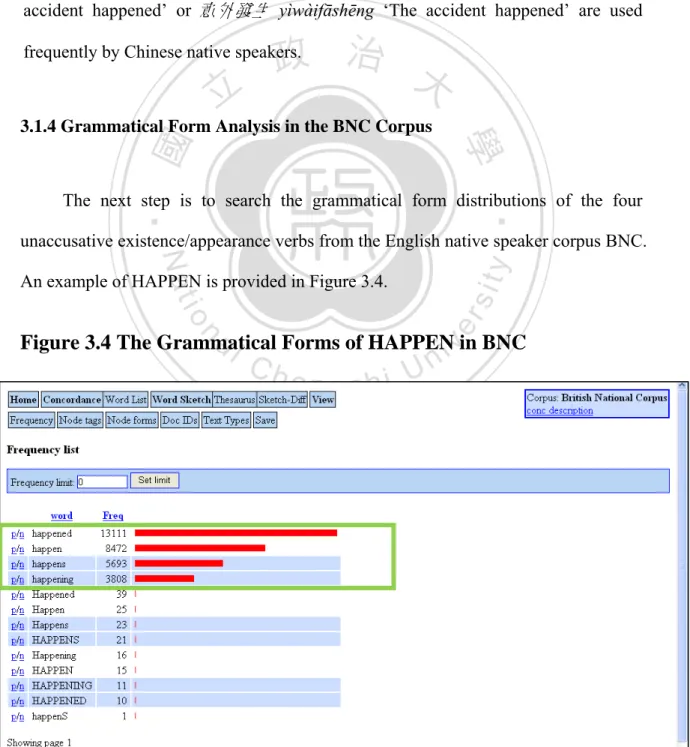
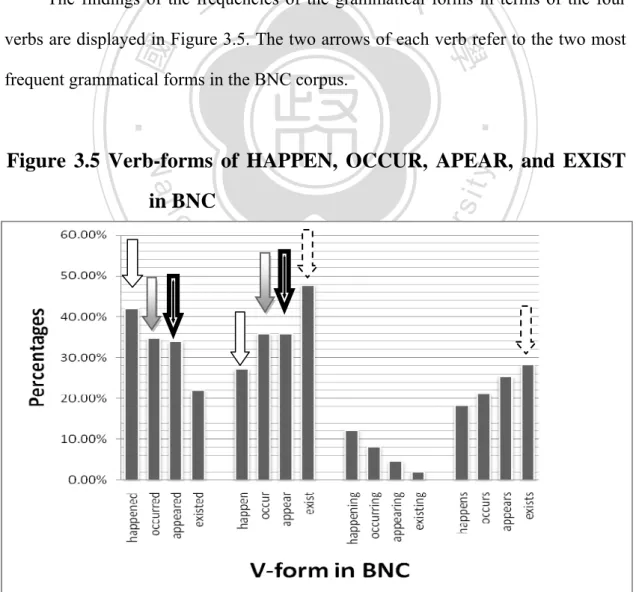
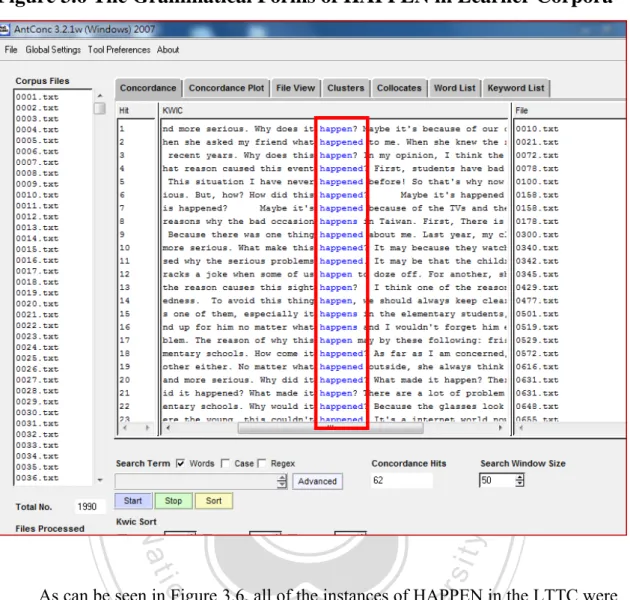
(8) LIST OF TABLES AND FIGURES TABLES Table1.1 Accusative, Ergative, Unaccussative, and Unergative verbs....................................... 1 Table 2.1 Examples of the Five Error Types (Wang & Chung, 2009)………………………… 34 Table 3.1 Frequency (and Percentages) of the Chinese Grammatical Patterns in GW 2.0……. 50 Table 3.2 Examples of the Five Error Types from Learner Corpora…………………….......... 60 Table 3.3 Two Top Grammatical Forms with High Frequency and Errors…………………… 67 Table 3.4 Frequency of Error Types in HAPPEN and OCCUR………………………………. 68 Table 3.5 Frequency of Error Types in APPEAR and EXIST………………………………… 71 Table 4.1 Stimuli Used in Questionnaire A…………………………………...……………….. 79 Table 4.2 Stimuli Used in Questionnaire B…………………………………...……………….. 80 Table 4.3 Stimuli Used in Questionnaires C and D…………………………………...……….. 87 Table 4.4 Overall Three-Way ANOVA of Colloge_High Group, Error Type, and Grammatical Form in Questionnaire A……………………………………………... 93 Table 4.5 Mean Rating (and Standard Deviation) of the Grammatical Form Rating in Questionnaire A………………………………………………………………........... 95 Table 4.6 Mean Rating (and Standard Deviation) of the Infinitive Error Type in Questionnaire A………………………………………………………………........... 98 Table 4.7 Mean Rating (and Standard Deviation) of the Overpassivization Error Type in Questionnaire A………………………………………………………………........... 100 Table 4.8 Overall Three-Way ANOVA of Colloge_High Group, Verb Type, and Grammatical Form Rating in Questionnaire B………………………………........... 102 Table 4.9 Mean Rating (and Standard Deviation) of the Transitivization Error Type in Questionnaire B……………………………………………………………………... 103 Table 4.10 Overall Three-Way ANOVA of Chinese Transfer, Collocation Pattern, and Grammatical Form in Questionnaires C and D……………………………………… 106 Table 4.11 Mean Rating (and Standard Deviation) of the Grammatical Form Rating in Questionnaires C and D…………………………………………………………...… 107 Table 4.12 Mean Rating (and Standard Deviation) of the V+ -le Collocation Pattern in Questionnaires C and D……………………………………………………………… 109 Table 4.13 Mean Rating (and Standard Deviation) of the V+ N Collocation Pattern in Questionnaires C and D…………………………………………………………....... 111 FIGURES Figure 2.1 Summaries of the Corpora Applications in Unaccusative Existence/appearance Verbs…………………………….............................................................................. 29 Figure 2.2 Summaries of the Studies on the Overpassivization in Unaccusative Existence/appearance Verbs…………………………….......................................... 32 Figure 3.1 The Search Results for HAPPEN in BNC and 發生 fāshēng ‘happen’ in GW 2.0 Using the Thesaurus Function……………………………....................................... 45 Figure 3.2 Sentence Construction Comparison of HAPPEN and OCCUR in BNC…………… 46 Figure 3.3 The Chinese Grammatical Patterns of 發生 fāshēng ‘happen’ in GW 2.0………... 49 Figure 3.4 The Grammatical Forms of HAPPEN in BNC…………………………….…......... 52 Figure 3.5 Verb-forms of HAPPEN, OCCUR, APEAR, and EXIST in BNC………………… 53 Figure 3.6 The Grammatical Forms of HAPPEN in Learner Corpora…………………............ 58 Figure 3.7 BNC Frequency of the Four Verbs……………………………………………….... 62 Figure 3.8 LTTC Frequency of the Four Verbs……………………………………………….. 62 Figure 3.9 ICLE Frequency of the Four Verbs…………………………………………............ 63 Figure 3.10 NCCU Frequency of the Four Verbs…………………………………………....... 63. 立. 政 治 大. ‧. ‧ 國. 學. n. er. io. sit. y. Nat. al. Ch. engchi. vii. i n U. v.
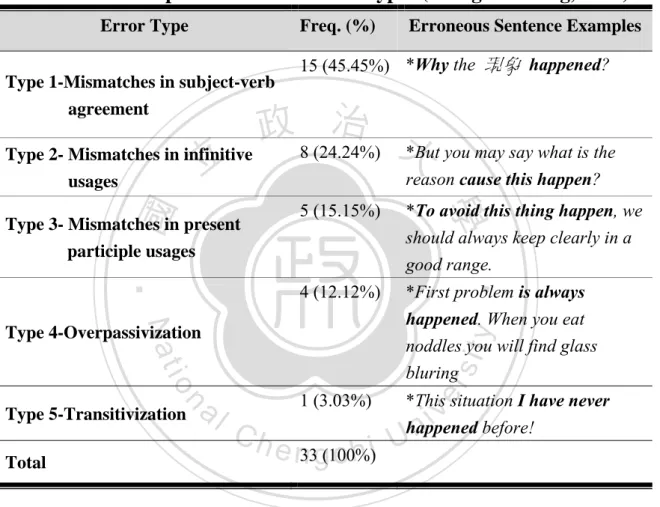
(9) Figure 5.1 Grammatical Forms of Unaccusative Existence/appearance Verbs in English and L2 English…………………………………………………………………………. 117 Figure 5.2 Errors of Unaccusative Existence/appearance Verbs in Corpora and Psycholinguistic Experiments……………………………………………………... 118 Figure 5.3 Chinese Grammatical Patterns of Unaccusative Existence/appearance verbs…….. 120. 立. 政 治 大. ‧. ‧ 國. 學. n. er. io. sit. y. Nat. al. Ch. engchi. viii. i n U. v.
(10) 國立政治大學英國語文學系碩士班 碩士論文提要. 論文名稱:比較 HAPPEN 與其同義字: 以母語及學習者語料庫為基礎的非 賓格存現動詞之研究. 指導教授:鍾曉芳 博士 研究生:王亮鈞. 立. 政 治 大. ‧ 國. 學. 論文提要內容:. 本研究,基於分辨非賓存現動詞及瞭解二語學習者如何讓習得此類動詞之. ‧. 需求,旨在分析一個高頻率之非賓格存現動詞 HAPPEN 與其三個同義字(OCCUR,. sit. y. Nat. APPEAR,與 EXIST)和中文同義字「發生」從語言使用者角度作比較。採用了母. er. io. 語語料庫 (英文採用英國國家語料庫 BNC;中文採用十億詞語料庫 GW 2.0)及. n. 學習者語料庫(含語言訓練與測驗中心學習者語料庫 a vthe LTTC,國際英語學習者 語料庫 the. i l C n h e n g c h i U the ICLE,及政治大學外語學習者語料庫. NCCU)作為第一部分的語. 料庫分析。此外,為了探索二語英文錯誤及母語中文遷移的關係,我們也進行 了以語料庫為基礎的心理語言學實驗(兩個關於中英文 HAPPEN 句子結構的接受 度判斷測驗)。 本研究結果發現,其一,就語料庫中的文法形式(Grammatical form)來分 析 HAPPEN、OCCUR、APPEAR 與 EXIST,英文母語語料庫中的高頻文法形式(例如:. happened 或 happen)與學習者語料庫中有相同的現象。然而大部份的高頻文法 形式都是二語學習者經常誤用之處,且容易與兩個常見非賓動詞錯誤—過度被 動 化 錯 誤 (Overpassivization) 和 及 物 化 錯 誤 (Transitivization)— 共 現 ix.
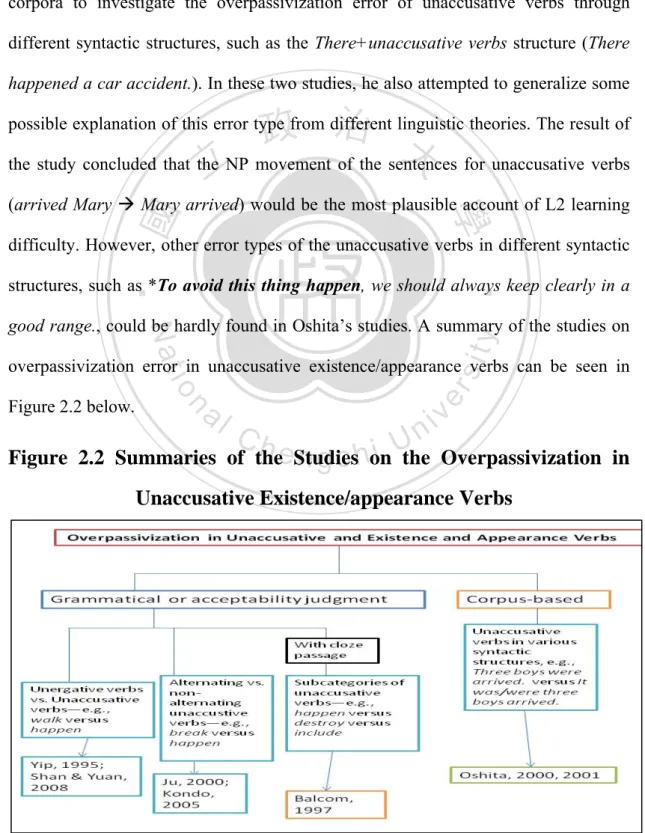
(11) (Collocated)。其二,從語料庫錯誤分析各種錯誤類型得知, HAPPEN 與 OCCUR 較常出現過度被動化錯誤;APPEAR 與 EXIST 較常有及物化錯誤。此結果顯示每 個非賓存現動詞可能會犯不同錯誤,也因此造成其錯誤的原因有所不同。其三, 從 分 析 心 理 語 言 實 驗 結 果 得 知 , 我 們 發 現 母 語 中 文 文 法 句 型 (L1 Chinese grammatical patterns),例如:「V-了」-「出現了」;抑或是「V+N」-「發 生車禍」、「發生戰爭」、「存在缺失」,都影響了二語學習者對英文非賓動 詞之文法形式的正確判定。由此揭示了母語中文大多都對二語英文非賓動詞習 得有所干擾。. 政 治 大 (Transitivity)之不同來探討中英文間存現動詞用法之異同,並試著解釋造成 立. 基 於 所 得 結 果 , 我 們 提 出 「 完 成 體 」 (Perfectivity) 及 「 及 物 性 」. 二語非賓動詞學習複雜化的原因。. ‧ 國. 學. 此研究克服了過去文獻中比較非賓存現動詞之困難也透過語料庫結合心. ‧. 理實驗研究法提供對非賓動詞習得之解釋方法。這些發現可進一步作為詮釋非. y. sit. io. er. 石。. Nat. 賓動詞的假說,並將其應用於語言教材設計或被視為未來跨語言分析研究之基. n. a l 英文母語語料庫、HAPPEN、學習者語料庫、 v 關鍵字:第二語言習得、BNC i n Ch 非賓存現動詞 i U e ngch. x.
(12) English Abstract Owing to the necessity to identify unaccusative existence/appearance verbs and realize how they are acquired by L2 learners, this present thesis aims to analyze a highly frequent English unaccusative verb HAPPEN and compare it with its three other synonyms (OCCUR, APPEAR, and EXIST), as well as its Chinese counterpart 發生 fāshēn ‘happen.’ Native speaker corpora (the British National Corpus (BNC) for English and Chinese Gigaword 2 Corpus (GW 2.0) for the Chinese), and L2 learner corpora (the Language Training and Testing Learner Corpus (the. 政 治 大 Chengchi University Foreign 立Language Learner Corpus (the NCCU)) are utilized to LTTC), International Corpus of Learner English 2.0 (the ICLE), and the National. ‧ 國. 學. analyze the unaccusative verbs in the first main section. In addition, in order to discover the relationship between L2 English errors and L1 Chinese transfer,. ‧. psycholinguistic experiments (two acceptability judgments tasks with comparable. sit. y. Nat. Chinese and English HAPPEN sentence constructions) based on the corpora data were. io. n. al. er. conducted in this thesis.. i n U. v. The results in this thesis showed that, first, the highly frequent. Ch. engchi. grammatical forms of unaccusative verbs (e.g., happened or happen) in the English native speaker corpus share some similarities with those of L2 learner corpora. However, these grammatical forms were usually misused by L2 learners and were frequently collocated with the two common unaccusative errors (overpassivization, e.g., *What is happened?. and trasitivization, e.g., *I happen a car accident.).. Second, as for the distributions of unaccusative error types, HAPPEN and OCCUR were found to mainly co-occur with overpassivization errors, whereas APPEAR and EXIST were found to mainly co-occur with transitivization errors. This indicates that each unaccusative verb may have different potential for L2 unaccusative errors, and xi.
(13) therefore the causes of these errors with different verbs may vary. Third, from the analysis of psycholinguistic experiments, we discover that the L1 Chinese grammatical patterns, such as the V-le grammatical pattern (e.g., 出現了 chūxiànle ‘appear-le’) and the V+N grammatical pattern (e.g., 發生車禍 fāshēngchēhuò ‘The car accident happened’, 發生戰爭 fāshēngzhànzhēng ‘The war occurred’, and 存在. 缺 失 cúnzàiquēshī ‘The pitfalls existed’) may influence L2 learners’ correct judgment as to the grammatical forms of unaccusative verbs. This reveals that generally L1 Chinese might have some interference with L2 unaccusative acquisition.. 政 治 大 differences between English 立and Chinese unaccusative existence/appearance verbs Based on the results, we proposed that the perfectivity and transitivity. ‧ 國. 學. could distinguish the uses among the English HAPPEN and the Chinese 發生 fāshēn ‘happen’ with their synonyms. These differences could also provide a possible reason. ‧. for the cause of the problematic L2 unaccusative acquisition.. y. Nat. sit. This thesis overcomes the difficulties of comparing unaccusative. n. al. er. io. existence/appearance verbs in the previous studies and attempts to unravel the enigma. i n U. v. of acquiring this verb type from the integrated corpus-based and empirical findings.. Ch. engchi. These findings in turn serve as the suggested assumptions to interpret unaccusative verbs, which can be applied to the design of language teaching materials or can be viewed as the basis of cross-language analysis in the future studies.. Keywords: second language acquisition, BNC, HAPPEN, learner corpora, unaccusative existence/appearance verbs. xii.
(14) 1. CHAPTER 1 INTRODUCTION. 1.1 Background and Motivation of the Study. Understanding and identifying the differences among verbs with closely related meanings is of importance in language acquisition, including first language acquisition (FLA) and second language acquisition (SLA), specifically for. 政 治 大 unaccusative verbs (e.g., happen, occur, appear, or exist), belonging to a type of 立. unaccusative verbs. Unaccusative existence/appearance verbs are a subcategory of. ‧ 國. 學. intransitive verbs. Perlmutter (1978) first proposed a syntactic hypothesis regarding unaccusative verbs which possess a simple syntactic structure (NP+V) but involve. ‧. complicated internal elements to cause language misuses, such as thematic roles (e.g.,. sit. y. Nat. an AGENT or a THEME thematic role is possibly mapped onto the subject of the. io. 2002; Zhang, 2006).. er. sentence). This hypothesis was later noticed in recent studies (Liu, 2000; Wu & Liu,. al. n. v i n C h verbs, we firstUpresent in Table 1.1 the four Before discussing unaccusative engchi. types of verb structures in English.. TABLE 1.1 Accusative, Ergative, Unaccussative, and Unergative Verbs Verb Types. Syntactic Structures. Accusative verbs. Transitive— NP + V+ NP Intransitive— NP + V. Ergative verbs (Alternating unaccusative verbs). Transitive— NP + V+ NP Intransitive— NP + V. Examples eat, see, win in English a. I won the award. b. I won in the speech contest. break, melt, fly in English c. I broke the window. d. The window broke..
(15) 2. Unaccusative verbs (Non-alternating unaccusative verbs). Unergative verbs. Intransitive— NP + V. happen, die, fall, arrive in English e. He has arrived. f. The leaf fell.. Intransitive— NP + V. talk, laugh, run in English g. The mother talked with me. h. He laughed.. As can be seen in Table 1.1, there are four types of verbs with different syntactic structures. As for accusative and ergative verbs, they can be either transitive or. 政 治 大 transitive structure which serves as the subject in the intransitive one (1.1d). On the 立 intransitive, while ergative verbs possess an object (the window in 1.1c) in the. ‧ 國. 學. other hand, regarding the unaccusative and unergative verbs, both possess intransitive. structures yet with different ‘volition control’, referring to the willingness to do the. ‧. action or to receive the action of the subject. These differences will be emphasized in. sit. y. Nat. detail in Chapter Two.. io. er. Many studies (Balcon, 1997; Yip 1990, 1995; Yuan, 1999; Oshita 2000, 2001; Yu, 2002; Hirakawa, 2001; Ju, 2000; Juffs, 1998; Chen, 2006; Park & Lakshmanan,. al. n. v i n C 2008; 2007; Lozano & Mendikoetxea, & Yuan, 2008) have pointed out the h e nShan gchi U. difficulty to acquire unaccusative verbs in a second language (L2). From the findings of these previous studies, unaccusative existence/appearance verbs, with only a single noun (Noun + Verb) in a sentence, remain an unstable ‘all or nothing’ (Liu, 2000: 2) acquired result. The ‘all or nothing’ acquired result here indicates that L2 learners seem to completely acquire the L2 unaccusative existence/appearance verbs but tend to frequently make some common errors. Two common errors of unaccusative verbs are the overpassivization errors (Kondo, 2005) (e.g., *The unforgettable experience was happened.) and the transitivization errors (or postverbal subject, e.g., *The.
(16) 3. shortage of fuels occurred the need for economical engine. (Ju, 2000:89)).1 However, to take the overpassivization error type as an example, neither L1 Mandarin Chinese, such as * 事 情 被 發 生 *Shìqíngbèifāshēng ‘*The thing is happened’ (from 事情發生 Shìqíngfāshēng ‘The thing happened’), nor L2 English, such as *The unforgettable experience was happened. (from The unforgettable experience happened.), is grammatical in these two languages respectively. For this reason, the cause for Chinese L2 learners to produce the erroneous sentences in L2 English unaccusative existence/appearance verbs may not be simply due to their L1. 政 治 大 errors in acquiring L2 has been investigated through syntactic structure (Zobl, 1989; 立. Chinese or L2 English. Hence, decoding the enigma of the frequent unaccusative. ‧ 國. 學. Yip, 1995; Oshita, 2000, 2001; Kuno & Takami, 2004), thematic roles (Burzio, 1981, 1986; Zobl, 1989; Nakano, Sugino, Ohba, Yamakawa, & Shimizu, 2005; Park &. ‧. Lakshmanan, 2007), and the causative alternation (Levin & Rappaport Hovav, 1995;. sit. y. Nat. Balcom, 1997). Each of these will be elaborated in Chapter Two.. io. al. er. Other previous studies (e.g., Sorace, 2000) pointed out the use of the two. n. perfective auxiliary selections (HAVE versus BE) to distinguish unergative and unaccusative verbs in most. v i n C h and Germanic Romance e n g c h i U languages.. However, these. auxiliary selections (HAVE versus BE) can hardly be applied to the unaccusative verbs of other languages, such as Chinese. Liu (2007) attempted to answer this question. She proposed that the perfectivity in Chinese would be different from that of Romance and Germanic languages. The two perfective auxiliaries in Chinese –. 著 –zhe versus – 了 –le represent the imperfective versus perfective aspects respectively, and these two auxiliaries are usually attached to verbs (e.g., 發生著 fāshēngzhe ‘happen-zhe’ to display the ongoing event or the imperfective state of the 1. The ‘tranisitivization’ terms could be used as the general phrases to refer to verb structures with an object following the verbs. However, in this thesis, it serves as the terms to indicate an error type of unaccusative verbs..
(17) 4. event).2 These Chinese perfective features (perfective versus imperfective) differ from those of the Romance and Germanic languages (unergative versus unaccusative). A recent study by Laws and Yuan (2010) followed Liu’s framework yet changed the term ‘perfective auxiliaries’ into ‘perfective particles.’ In their study, the perfective auxiliary selections with locative structures of unaccusative verbs are emphasized (e.g., 學校裡來了一個學生 xuéxiàolǐláileyīgèxuéshēng ‘At the school arrived a student’ (Laws & Yuan, 2010:229)). However, distinguishing the unaccusative verbs with the same concept yet in different languages (e.g., HAPPEN in English versus 發. 政 治 大 existence/appearance verbs and Chinese perfectivity have been rarely discussed in 立. 生 fāshēng ‘happen’ in Chinese) and realizing the relation between L2 unaccusative. ‧ 國. 學. previous studies.. On the other hand, the methods to investigate the causes and relationship among. ‧. the unaccusative errors in L1 and L2 have been debated in the studies of SLA. Some. sit. y. Nat. studies adopted psycholinguistic experiments, including acceptability or grammatical. io. al. er. judgment tasks, in empirical studies (e.g., Keller & Sorace, 2003; Cai, 1998; Hirakawa, 2001; Laws & Yuan, 2010). Others (e.g., Montrul, 1999) utilized picture. n. v i n C h Oshita, 2000; U judgment tasks, while still others (e.g., e n g c h i Lozano & Mendikoetxea, 2008) adopted a corpus-based approach. In recent corpus-based studies (Wang, Y.-J., 2008;. Fu, 2007; Wang & Chung, 2009; Wang & Chung, 2010), a lexical semantic approach has been adopted, focusing on one or two unaccusative existence/appearance verbs with closely related meanings, and these studies aimed to analyze the verb collocation. However, this thesis suggests that an integrated approach combining corpora analysis 2. Most linguistic scholars (e.g., Huang, 2004; Li, Lin, & Chen, 2005; Laws & Yuan, 2010) preferred to use other terms to infer –著 –zhe versus –了 –le. Huang (2004) used the perfective marker – 了 –le and the durative marker –著 –zhe to refer to these two Chinese characters, while Li et al. (2005) uses aspect markers to represent –著 –zhe and –了 –le. Laws and Yuan (2010) replaced the ‘perfective auxiliaries’ with ‘perfective particles.’ In this thesis, we choose perfective auxiliaries to stand for –著 –zhe and –了 –le for the convenience of comparison with the perfective auxiliaries HAVE and BE in western languages..
(18) 5. with empirical psycholinguistic experiments (the acceptability judgment tasks) will help display the use of the unaccusative verbs by native speakers and L2 learners of English (Gilquin & Gries, 2009).. 1.2 Significance of the Study From the previous studies, to solve the problems of distinguishing unaccusative existence/appearance verbs and provide possible explanations for the difficulty of acquiring unaccusative existence/appearance verbs would be of vital significance in. 政 治 大 quantitative approach, including corpora analysis and psycholinguistic experiments so 立. language acquisition. The present study intends to take a syntactic-semantic and. ‧ 國. 學. as to distinguish two unaccusative existence/appearance verbs (HAPPEN in English and 發生 fāshēng ‘happen’ in Chinese) with their synonyms (OCCUR, APPEAR. ‧. and EXIST in English; 出現 chūxiàn ‘appear’ and 存在 cúnzài ‘exist’ in Chinese). sit. y. Nat. through understanding different uses of those unaccusative existence/appearance. io. al. er. verbs by native speakers and L2 learners. This approach of distinguishing unaccusative existence/appearance verbs would make clear the elemental differences. n. v i n Ch U usages. With quantitative of each verb meaning from users’ perspectives e n g cand h ipractical. calculation, the distinctions of HAPPEN and 發生 fāshēng ‘happen’ with their synonyms can be more objective and precise. As for the corpora, native speaker corpora and learner corpora are adopted, which are listed in the examples in (1).. (1) a. English native speaker corpus—British National Corpus (BNC) with approximately 100 million words b. Chinese native speaker corpus—Chinese Gigaword 2 Corpus (GW 2.0) with.
(19) 6. nearly 455 million words for L1 Mandarin Chinese c. L2 English learner corpora i. the Language Training and Testing Learner Corpus (the LTTC) with 262,178 words (to date) ii. International Corpus of Learner English 2.0 (the ICLE) with 3,753,030 words iii. the National Chengchi University Foreign Language Learner Corpus (the NCCU) retrieved on Jan, 2010 with 204,945 words corpora (to date). 政 治 大 As shown in examples (1), we utilized the English and Chinese native speaker 立. ‧ 國. 學. corpora, along with L2 English learner corpora. The corpora analysis attempts to compare the similar and different uses of unaccusative existence/appearance verbs. ‧. between L1 and L2, which will be detailedly introduced in Chapter Three.. sit. y. Nat. Moreover, the psycholinguistic experiments in this thesis constitute two. io. al. er. acceptability judgment tasks based on the corpora. Between corpora analysis and psycholinguistic experiments, frequent grammatical form ratings (to-V, V-ed, V-base,. n. v i n C these grammatical U V-s, and V-ing) and the change of h e n g c h i form ratings by L2 learners will serve as the basis to compare the influence of L2 English or the possible transfer from. L1 Chinese. The significance of the present thesis is its focus on a specific unaccusative existence/appearance verb HAPPEN which is compared to in terms of similarities and differences three other synonyms (OCCUR, APPEAR, and EXIST).3 Moreover, the Chinese counterparts of the four English verbs ( 發生 fāshēng ‘happen’, 出現 chūxiàn ‘appear’, and 存在 cúnzài ‘exist’) will also be analyzed through using 3. The capitalized verbs, such as HAPPEN, refer to the four main verbs in this study to contrast the different grammatical forms of the four verbs, such as happen, happened, happening, and happens..
(20) 7. corpora for the comparison in English and for the stimuli designed for the psycholinguistic experiments. In. addition,. two. important. issues. of. acquiring. the. unaccusative. existence/appearance verbs are also investigated in the thesis. One is the puzzle whether L2 learners have different degrees of learning difficulty between writing production and their response to L2 acceptability judgment tasks. The other is to find out the possible reasons from L1 Chinese transfer or L2 English influence (e.g., the missing of the third person singular V-s by L2 English, e.g., *She speak English well.).. 政 治 大 acceptability judgment tasks in the psycholinguistic experiements to bridge the gap 立 These two issues will be examined through the two corpus-based designed. ‧ 國. 學. found in the previous related studies of the unaccusative existence/appearance verbs so as to shed some light on language education.. ‧. Based on the research scope of the study, the research questions bellow will be. al. er. io. sit. y. Nat. addressed:. n. (1) How do corpora and psycholinguistic experiments help distinguish unaccusative. Ch. existence/appearance verbs?. engchi. i n U. v. (2) How do the learners’ L1 and L2 affect their acquisition of unaccusative existence/appearance verbs?. This thesis will be arranged in the following chapters: In Chapter Two, the important issues of unaccusative existence/appearance verbs in most previous studies, such as L2 English (syntactic structure, thematic roles, and causative alternations) and L1 Chinese distinctions (lexical-semantic grammatical patterns) of this verb type, will be discussed. The gap in the literature will be pointed out in the present thesis as well..
(21) 8. Chapter Three will focus on Study I—the corpora analysis. We will first introduce the methodology of the corpora analysis, including the native speaker corpora of both L1 Chinese and L2 English and the three learner corpora of L2 English. Then we will present the result of the corpora analysis, including L1 Chinese grammatical patterns of unaccusative verbs, L2 English grammatical form distributions of HAPPEN, OCCUR, APPEAR, and EXIST, comparison of both native speaker corpora and learner corpora, as well as error analysis and categories of learner corpora. However, some issue of unaccusative existence/appearance verbs concerning language. 政 治 大 age of L2 learners, and L1 Chinese transfer to L2 English, could not be directly 立. acquisition, particularly for L2 acquisition, such as L2 English syntactic structure, the. ‧ 國. 學. analyzed through corpora analysis.. For this reason, Chapter Four will display Study II—the psycholinguistic. ‧. experiments to examine the relation between the unaccusative existence/appearance. sit. y. Nat. verbs and the acquisition of this verb type. The methodology of conducting the. io. al. er. psycholinguistic experiments will be introduced, and the result of the psycholinguistic experiments will be shown to find out the possible cause of the difficulty in acquiring. n. v i n Ch L2 English unaccusative verbs (HAPPEN, e n gOCCUR, c h i UAPPEAR, and EXIST) through L2 English syntactic structures and L1 Chinese grammatical patterns. Chapter Five will discuss the findings from both corpora analysis and. psycholinguistic experiments and compare the findings with those of the previous studies. We would like to see whether there are some new findings different from other previous studies or some similar patterns which could be generalized to be the stronger evidence for the L1 transfer or L2 influence on the acquisition of unaccusative existence/appearance verbs. Additionally, in Chapter Six, the conclusion of this thesis will be made along with some limitations in this thesis. The results of.
(22) 9. this thesis will also provide some pedagogical implications for learning L2 unaccusative existence/appearance verbs as well as some suggestions for further studies.. 立. 政 治 大. ‧. ‧ 國. 學. n. er. io. sit. y. Nat. al. Ch. engchi. i n U. v.
(23) 10. CHAPTER 2 LITERATURE REVIEW The thesis aims to conduct a research among the four unaccusative existence/appearance verbs (HAPPEN, OCCUR, APPEAR, and EXIST) and compare them with their Chinense counterparts ( 發生 fāshēng ‘happen’, 出現 chūxiàn ‘appear’, and 存在 cúnzài ‘exist’). via native speaker and learner corpora. This. chapter will review the previous studies from five main related aspects: L2 English syntactic differentiation of these unaccusative existence/appearance verbs (2.1),. 治 政 大L1 Chinese) (2.2), lexical perfectivity (focusing on learners’ L2 English and 立 semantics-based and corpus-based comparison (L1 Chinese) (2.3), errors analyses in ‧ 國. 學. SLA (2.4), and gaps of previous research (2.5).. ‧. io. y. sit. Existence/appearance Verbs. n. al. er. Nat. 2.1 L2 English Syntactic Differentiation of Unaccusative. Ch. i n U. v. In this section, unaccusative existence/appearance verbs will be reviewed from. engchi. syntactic structures, thematic roles, and causative alternations based on L2 English syntactic structures (transitive versus intransitive structures).. 2.1.1 Syntactic Structures of Unaccusative Existence/appearance Verbs Many scholars have proposed to investigate the syntactic structures of unaccusative verbs. Even though unaccusative verbs are categorized as the intransitive verbs, the subcategories of these verbs may vary as transitive alterations. Some subcategories, such as unaccusative existence/appearance verbs, are divided into the intransitive verbs with transitive alternations (break or melt, e.g., The snow.
(24) 11. melted.The sun melted the snow.) or the intransitive verbs without transitive alternations (happen or appear, e.g., An accident happened.*It happened an accident.), which has long been one of the most important issues in previous studies of second language acquisition (SLA) in English (Zobl, 1989; Yip, 1995; Oshita, 2000, 2001), Italian (Sorace, 2000), Chinese (Yuan, 1999), or Japanese (Hirakawa, 2001). To point out the complexity of unaccusative verbs, most scholars usually discussed the comparison of the intransitive verbs between the unergative and unaccusative verbs. For instance, Perlmutter (1978) first proposed a syntactic. 政 治 大 versus unaccusative verbs. The author noted that there were two main categories of 立. hypothesis of unaccusative verbs to discuss the differences between unergative verbs. ‧ 國. intransitivity’ developed by Burzio (1986).. ‧ sit. y. Nat. (1). 學. intransitive verbs shown in (1). The two structures in (1) were called ‘split. io. al. n. b.NP[vp V___] unergativity. er. a. __ [vp V NP] unaccusativity e.g., [Mary i [vp arrived ti]] e.g., [Mary i [vp laughed] ]. v i n C h (Shan & Yuan, e n g c h i U 2008: 165). As can be seen in (1) given by Shan and Yuan (2008), though the syntactic structures of both unaccusative verb (1a) and unergative verb (1b) take only one argument as their subject (i.e. Mary), the traces of the arguments in (1a) and (1b) are different.4 In (1a), the argument Mary should be traced to the post position of the unaccusative verb arrived (arrived Mary Mary arrived), while, in (1b), Mary is. 4. The traces of the arguments in sentences here refer to the movement of the syntactic positions of these arguments in sentences. For instance, the trace of The leaf fell. is from fell The leaf. to The leaf fell..
(25) 12. fixed at the previous position of the unergative verb laughed without any syntactic movement. Concerning the transitive alternations of unaccusative verbs, they vary with the verb meanings and the arguments selected by them. Two main subtypes of the unaccusative verbs can be categorized based on the transitive alternations into alternating unaccusative verbs, (or ‘ergative verbs’ by Yip, 1995; Zobl, 1989; Kuno & Takami, 2004), such as open, break, melt, roll, or stop, and non-alternating unaccusative verbs, such as arrive, happen, exist, or die. Examples in (2) below show. 政 治 大. the differences of these two types of unaccusative verbs.. 學. (2). ‧ 國. 立 a. Jay opened the window.. ‧. b. The window opened.. sit. y. Nat. c. The window is opened (by the man).. io. al. er. d. *The car happened the accident.. n. e. The car accident happened.. Ch. engchi. f. *The car accident is happened.. i n U. v. As can be seen in (2), sentences (2a), (2b), and (2c) represent the three possible alternations of the alternating unaccusative verb open. Example (2a) is the transitive alternation, while (2b) is an intransitive one. For (2c), the alternation is that of a passive one (NP+be-V) with an optional phrase by+NP, which indicates the optional agent of the sentence doing the action. However, as for (2e), the non-alternating unaccusative verb happen can only allow the intransitive alternation but not the transitive (2d) and passive (2f) ones. Therefore, for non-alternating unaccusative.
(26) 13. verbs, the transitivized patterns or passivized ones are ungrammatical in terms of the syntactic structure. On the other hand, Perlmutter (1978) also pointed out that the ‘predicates’ of the sentence (i.e. the core meaning of verbs describing the actions or the states in a sentence) will determine the meanings of unaccusative clauses. Among all types of non-alternating unaccusative verbs, the unaccusative existence/appearance verbs can be further categorized into ‘the predicates of existing and happening’, such as exist, happen, occur, take place, show up, disappear, vanish, etc.. 立. (3). c.The child has disappeared.. Nat. sit. y. ‧. ‧ 國. b.Belief in magic still exists.. 學. a.The car accident happened.. 政 治 大. io. al. er. Most of the unaccusative existence/appearance verbs have no transitivized and passivized patterns to express the state or the existence of the subjects in sentences as. n. v i n C h later studies (e.g., shown in (3) above. This point inspires e n g c h i U Levin & Rappaport Hovav, 1995; Tang, 2005; Zhang, 2006) to shift their focus to whether all of the unaccusative existence/appearance verbs contain the features of non-alternating unaccusative verbs as discussed previously. For instance, from Tang’s (2005) analysis, any verb type can become ‘temporary non-alternating unaccusative verbs’ within the locative existential syntactic structure, such as In the park walked John’s father, in which the unergative verb walk takes the unaccusativity within the locative existential syntactic structure (In the park+V+NP). While syntactic structures alone may be vague in identifying the features of the unaccusative existence/appearance verbs, the thematic roles were latter.
(27) 14. proposed to have profound classification of the unaccusative verbs as illustrated in section 2.1.2.. 2.1.2 Thematic Roles of Unaccusative Existence/appearance Verbs. Some studies (Burzio, 1981, 1986; Zobl, 1989; Nakano et al., 2005; Park & Lakshmanan, 2007) assumed that thematic roles may provide more apparent features in the arguments of the verbs to distinguish alternating and non-alternating. 政 治 大 grammatical roles and thematic roles are shown. The examples indicate that even the 立 unaccusative verbs. From example (4) to follow, four sentences with different. ‧ 國. 學. grammatical roles are the same in two sentences (e.g., (4b) and (4d)), the thematic roles might be different.. ‧ y. Nat. sit. io. a. Transitive alternation of alternating unaccusative: John broke the window. Subject Direct object (Grammatical roles) <AGENT> <THEME> (Thematic roles) b. Intransitive alternation of alternating unaccusative: The window broke.. n. al. er. (4). Ch. engchi. i n U. v. Subject (Grammatical roles) < THEME > (Thematic roles) c. Intransitive alternation of non-alternating unaccusative: The car accident happened. Subject (Grammatical roles) < THEME > (Thematic roles) d. Intransitive alternation of unergative: John laughed. Subject (Grammatical roles) < AGENT > (Thematic roles) (Park & Lakshmanan, 2007: 329).
(28) 15. Though all of the three sentences in (4b), (4c), and (4d) are intransitive, (4b) as well as (4c) are unaccustaive verbs and (4d), however, is an unergative verb. Moreover, the most distinctive feature among (4b), (4c), and (4d) is also the thematic role of the sentence subjects (the window, the car accident, and John). As previously stated, (4a) is a transitive alternation of the alternating unaccusative verbs broke, with the subject John and direct object the window, and the subject takes the thematic role of an AGENT. On the other hand, the subjects in (4b) and (4c) take the thematic role of THEME (someone or something receiving the action), while (4d) takes the AGENT. 政 治 大 co-occurred subjects may be contrasted between unaccusative verbs and unergative 立 (something or someone doing the action). Therefore, the functions and the. ‧ 國. 學. verbs.. In addition to the thematic roles, ‘volition control’ is said to be the key. ‧. distinctive feature for separative AGENT and THEME thematic roles. According to. sit. y. Nat. Hawkins’s (2001) study, the subjects with AGENT being combined with unergative. io. al. er. verbs, such as laugh, sing, or swim, usually have the will or the volition to do the action. Unlike the subjects with AGENT, those with THEME being combined with. n. v i n C unaccusative verbs, such as appear,hbreak, e n gorchappen, h i Uusually accept the unwilled and unvolitional actions. For instance, in (4d), John, as a person, has the ability to do the action laugh, whereas, in (4c), the action happen may not be done by the subject The car accident. Rather, the verb happen appears to describe the change of the whole event. From the above examples, we know that the unaccusative existence/appearance verbs (e.g., happen) are unaccusative verbs which are also non-alternating. Therefore, the subjects in the verbs are THEME subjects with no volition, and the sentence permits no transitive pattern. However, one problem still remains in differentiating the.
(29) 16. unaccusative existence/appearance verbs from other alternating unaccusative verbs in intransitive alternations. For these alternating unaccusative verbs (e.g., break), they have the intransitive pattern as in (4b), which may make it similar to that of the unaccusative existence/appearance verbs as in (4c). This problem causes the syntactic structure and thematic role of the two sentences to become indistinctive. Therefore, a possible solution to this is to discuss the causative alternations which will be introduced in the section below. 2.1.3 Causative Alternations of Unaccusative Existence/appearance Verbs In. order. 立. to. provide. 政 治 大 alternative perspectives. on. unaccusative. ‧ 國. 學. existence/appearance verbs, other scholars (e.g., Levin, 1986; Levin & Rappaport Hovav, 1995; Balcom, 1997) have come to the realization that the causative. ‧. alternations could be applied to identify these verb types and discover some causative. sit. y. Nat. features within the lexicon itself. Compared to the differentiations based on the. io. al. er. syntactic structures (section 2.1.1 previously) and the thematic roles (section 2.1.2 previously), the causative alternations can not only distinguish the alternating (e.g.,. n. v i n C h unaccusative Uverbs (e.g., happen or appear), break or open) and the non-alternating engchi. but also provide the detailed comparison of causes within verbs of existence (e.g., exist) versus verbs of appearance/occurrence (e.g., happen, occur, and appear). Two representations within the causative alternations are included: one is Lexical Semantic Representation (LSR) referring to the lexical semantic features of the verbs, and the other is Argument Structure Representation (ASR) referring to the semantic features reflected in syntactic arguments within the verbs. Levin and Rappaport Hovav (1995) used both LSR and ASR to analyze the causes among the unaccusative verbs. According to their research, each verb consists of these two representations. For LSR,.
(30) 17. it contains variables (x, y, or z) within brackets to form an internal or external cause for the verb meanings. The lexical binding linking rules serve as the mechanism to create a syntactic relation associated with the LSR, which can make the lexical meaning of verbs projected to ASR. Examples in (5) from Balcom (1997) are the application of the causative alternations to show the differences among unaccusative verbs with or without transitive alternations. From these examples in (5), we can first see the different causative alternation structures between alternating (e.g., break or open) in (5a) and. 政 治 大. non-alternating unaccusative verbs (e.g., happen or fall) in (5b). (5) a. Unaccusative with Transitive Alternations (e.g., break or open) LSR [[x DO-SOMETHING] CAUSE [y BECOME STATE]]. 立. ‧ 國. 學. Lexical Binding Linking Rules ASR Ø. ‧. . sit. y. Nat. <y>. n. al. er. io. b. Unaccusative with no Transitive Alternations (e.g., happen or fall) LSR [y BE/BECOME AT z]. Ch. i n U. Lexical Binding Linking Rules ASR <y> Ploc<z> (*Ploc referring to the locative prepositional phrases). engchi. v. (Balcom, 1997: 7) The difference between (5a) and (5b) is that alternating unaccusative verbs (5a) with transitive alternations possess an external cause [x DO-SOMETHING], equivalent to the AGENT of the previous sentence (4a), and an internal cause [y BECOME STATE], corresponding to the THEME of the previous sentence (4a) in their LSR. This means that thematic roles and causative alternations can be.
(31) 18. overlapping and supplementary when interpreting the same verbs. Then, through the lexical binding linking rules in (5a), the external cause of the alternating unaccusative verbs cannot be projected to ASR (x Ø). On the contrary, the non-alternating unaccusative verbs (4b, e.g., happen or fall) only possess two internal causes [y BE/BECOME AT z] (THEME and LOCATION) without the external causes at any level. Additionally, through the projection to ASR, these two internal causes still remain in the causative alternation structures in (5b). The next step is to see the further differentication of the unaccusative. 政 治 大 and Liu (2002), they divided the unaccusative existence/appearance verbs into the two: 立 existence/appearance verbs. From Levin and Rappaport Hovav (1995) as well as Wu. ‧ 國. 學. verbs of existence in (6) and verbs of appearance/occurrence in (7).. ‧. (6)Verbs of existence (e.g., exist). y. Nat. LSR: [y BE (Ploc z)] (7)Verbs of appearance/occurrence (e.g., happen, occur, and appear). n. al. sit er. io. LSR: [y BECOME (not) (Ploc z)] (*Ploc referring to the locative prepositional phrases). i n U. v. As previously mentioned, both of the two are included in non-alternating. Ch. engchi. unaccusative verbs, and thus they have only two internal causes [y BE/BECOME AT z] (THEME and LOCATION). Although the LSR structure of existence verbs ([y BE (Ploc z)] (for exist) and that of appearance/occurrence verbs [y BECOME (not) (Ploc z)]) (for happen, occur, and appear) are different, when they are projected to ASR through the lexical binding linking rule, they become indistinctive as in (8)..
(32) 19. (8) LSR: LSR:. e.g., [y BE (Ploc z)] [y BECOME (not) (Ploc z)]. Lexical Binding Linking Rule ASR. <y>. Ploc<z>. a. b. c. d.. The dinosaurs existed on the earth. The car accident happened on the freeway. The war occurred in Iraq. The student appeared in the classroom. ( Levin & Rappaport Hovav, 1995: 153). Both existence and appearance/occurrence verbs become identical in ASR (<y> Ploc<z>). Hence, though the LSR of the two verb types are different, it seems difficult to be identified from the ASR. This indicates that using causative alternation. 政 治 大 particularly when analyzing. alone cannot entirely distinguish the uses or the meanings of unaccusative. 立. existence/appearance. verbs,. two. individual. ‧ 國. 學. appearance/occurrence verbs, such as happen versus appear. For this reason, other perspectives, such as perfectivity (2.2) and corpous-based approaches (2.3), in. ‧. differentiating unaccusative existence/appearance verbs will be introduced in the. n. al. er. io. sit. y. Nat. following sections.. C2.2 Perfectivity hengchi. i n U. v. Aside from using the three L2 English-based syntax aspects (syntactic structures, thematic. roles,. and. causative. alternations). to. analyze. the. unaccusative. existence/appearance verbs (e.g., A car accident happened.) and compare them with unergative verbs (e.g., John walked.), perfectivity is an additional feature for analyzing unaccusative verbs. Many researchers (e.g., Falk, 1984; Sorace, 2000; Keller & Sorace, 2003) proposed to use the two perfective auxiliaries (HAVE versus BE) in the perfective clauses usually co-occurred with either unergative verbs or unaccusative verbs. The.
(33) 20. perfective auxiliary HAVE is frequently used with unergative verbs, while the perfective auxiliary BE is frequently used with unaccusative verbs. Sorace (2000) and Keller and Sorace (2003) provided some distinctive examples from German and French to differentiate unergative verbs and unaccusative verbs in (9).. (9) a. Die Lehrerin hat dauernd geredet. (German) ‘The teacher has ontinuously talked.’ b. Der efangene ist schnell entkommen. (German) ‘The prisoner is quickly escaped.’ c. Le livre est/a paru récemmrnt. (French). 政 治 大. is/has. 立appeared. recently.’. 學. ‧ 國. ‘The book. As shown in (9), the first two sentences in German indicate that the unergative. ‧. verbs (e.g., geredet ‘talk’) incline to co-occur with the perfective auxiliary HAVE,. sit. y. Nat. while the unaccusative verbs (e.g., entkommen ‘escape’) tend to co-occur with the. io. al. er. perfective auxiliary BE. However, in (9c) in French, it shows that the unaccusative existence/appearance verb (paru ‘appear’) has an optional selection regarding these. n. v i n C the two perfectiveUauxiliaries seem to be able to two auxiliaries. This implies that h engchi distinguish the uses and meanings between the unegative verbs and unaccusative verbs (entkommen ‘escape’ versus geredet ‘talk’ in German), whereas some existence/appearance verbs might not be further analyzed (e.g., paru ‘appear’ in French). Another issue is that the perfectivity of modern English and Chinese languages possesses some differences from that of Germanic and Romance languages. In terms of modern English, Klein (2009) provided a clear distinction of sentences related to perfective and imperfective aspects and regarded the time of utterance (TU) as the.
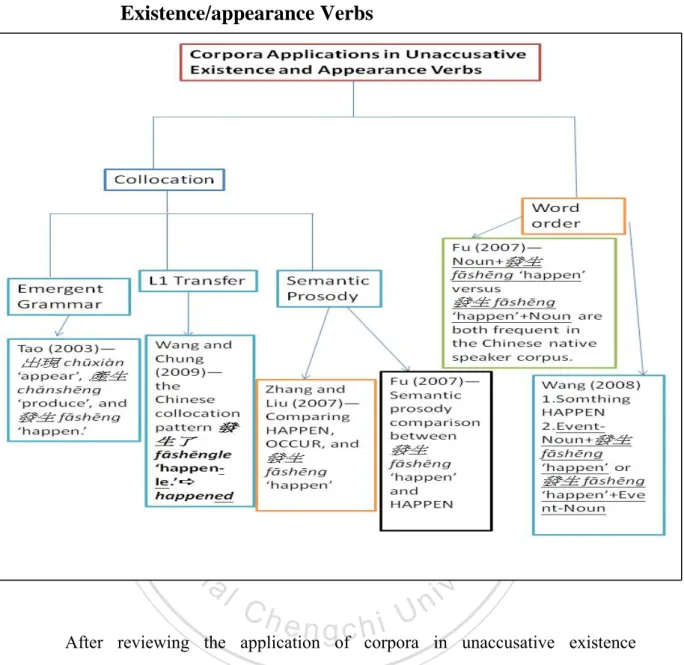
(34) 21. basis to decide the perfectivity of a sentence. Some examples are shown in (10). (10) before TU at TU after TU before TU. perfective a. Eva slept c. Eva sleeps e. Eva will sleep. imperfective b. Eva was sleeping d. Eva was sleeping f. Eva will be sleeping. g. Eva has slept. h. Eva has been sleeping (Klein, 2009: 54). Sentences in (10) show the contrast between perfective and imperfective clauses.. 政 治 大 selections (BE for impefective clauses versus HAVE perfective clauses) and the 立 In (10g) and (10h), the perfectivity in English involves two parts: the auxiliary. ‧ 國. 學. grammatical form choice (sleeping for imperfective clauses versus slept for perfective clauses). These two parts show the salient differences from the other Germanic and. ‧. Romance languages due to the fact that both BE and HAVE auxiliaries are only used. sit. y. Nat. in perfective clauses in Germanic and Romance languages (cf. examples (9). io. modern English.. al. er. previously), and the grammatical form choice seems not as consistent as that of. n. v i n C h some researchU(e.g., Liu, 2007; Laws & Yuan, On the other hand, as for Chinese, engchi. 2010) pointed out that the syntax-based perfective auxiliary selection as in Germanic and Romance languages or even in modern English appears less appropriate in analyzing unacussative verbs of Chinese. This might be because the perfectivity of Chinese lacks the choice of the grammatical forms and fewer counterparts of the auxiliary selections in Chinese could directly correspond. In order to distinguish unaccusative verbs based on Chinese perfectivity, among many, Liu (2007) attempted to propose a Chinese perfective auxiliary selection with the –著 –zhe ‘-imperfective auxiliary’ as the imperfective auxiliary versus –了 –le.
(35) 22. ‘-perfective auxiliary’ as the perfective one. As Liu emphasized, unlike other European languages suitable for syntactic analysis, the Chinese language takes semantic analysis into account more. Liu also analyzed the unaccusative verbs with the change of the state, and this subclass includes the verbs of location (e.g., 來 lái ‘come’) or the verbs of existence/appearance (e.g., 死 sǐ ‘die’).. (11) a. 田裡 Tiánlǐ. 來了/*著. 很多. lái -le/ *-zhe. hěnduō. 人。 rén.. 治 政 people 大. there come-LE/*-ZHE many ‘There came many people.’. ‧ 國. Tiánlǐ. 長了/著. (adapted from Liu, 2007: 7). cháng-le/-zhe. 很多. 種. 蔬菜。. hěnduō. zhǒng. shūcài.. 學. b.田裡. 立. ‧. Field-in grow-LE/-ZHE many kind vegetables ‘In the field is growing many kinds of vegetables.’ (adapted from Liu, 2007: 8). sit. y. Nat. n. al. er. io. According to the study, the verbs of location (e.g., 來了 lái-le ‘come-perfective. i n U. v. auxiliary’) or the verbs of existence in Chinese (e.g., 死了 sǐ-le ‘die-perfective. Ch. engchi. auxiliary’ and 長 了 cháng-le ‘grow-perfective auxiliary’) typically select the perfective auxiliary –了 –le ‘-perfective auxiliary’ as in (11a). Unless the verbs of the location or the verbs of existence/appearance have no definite endpoint or resultant state, either –著 –zhe ‘-imperfective auxiliary’ or –了 –le ‘-perfective auxiliary’ would be possible as in (11b). This preliminary study of the Chinese auxiliary selections shed some light on the lexical semantic tendency and analysis of perfectivity. Following Liu’s framework of auxiliary selections, Laws and Yuan (2010) conducted an empirical study to distinguish the uses of unaccusative existence/appearance verbs in the locative structures, such as 在橋上發生了/著意外.
(36) 23. 事故 zàiqiáoshàng fāshēng-le/zhe yìwàishìgù ‘On the bridge happened-le/-zhe an accident’. However they changed Liu’s terms ‘perfective auxiliaries’ for –著 –zhe and –了 –le into ‘perfective particles.’ The authors adopted the sentence acceptability tasks for Chinese native speakers to see whether they accepted the unaccusative verbs with –著 –zhe ‘-imperfective particle’ or –了 –le ‘-perfective particle’ in locative structures. The result showed that the unaccusative existence/appearance verbs, such as 發生 fāshēng ‘happen’ and 出現 chūxiàn ‘appear’, tend to be accepted with the perfective particle – 了 –le ‘-perfective particle’ for Chinese native speakers.. 政 治 大 such as 有 yǒu ‘exist’, was not examined in their study. Additionally, there is little 立. However, the other unaccusative existence/appearance verbs with the EXIST concept,. ‧ 國. 學. discussion regarding the uses and acceptability from L2 Chinese learners and the effect on L2 English learning brought by L1 Chinese perfectivity. When L2 learners. ‧. acquire the unaccusative existence/appearance verbs in a second language, they might. sit. y. Nat. find it difficult to use those verbs with proper grammatical forms or perfective. io. al. er. auxiliaries. This might be owing to the fact that the lexical auxiliaries in Chinese perfectivity (the imperfective auxiliary –著 -zhe versus the perfective auxiliary –. n. v i n 了 –le) would be different fromCthe htwo i U in English (BE auxiliary e nparts g cofhperfectivity + V-ing for imperfective clauses versus HAVE auxiliary + V-ed for perfective clauses). Hence, we might wonder, in term of perfectivity, whether the Chinese counterparts of English unaccusative existence/appearance verbs (e.g., 發生 fāshēng ‘happen’ of HAPPEN or 出現 chūxiàn ‘appear’ of APPEAR) have some transfer on the grammatical form choices.5 This would be possibly due to L2 English learners of 5. The transfer here means that some language features in first language, such as the Chinese perfective aspectual auxiliary –了 –le, may sometimes be applied to the use of the second language (e.g., *The car accident is happened.) by L2 language learners..
(37) 24. Chinese associating the Chinese lexical auxiliaries (–著 –zhe and –了 –le) with the decision among V-base, V-s, V-ing, and V-ed of English verbs. Moreover, for these Chinese counterparts of unaccusative existence/appearance verbs, whether or not Chinese grammatical patterns would also generate L1 Chinese transfer in the previous studies, which will be discussed in the next section.. 2.3 Lexical Semantics-based and Corpus-based Differentiation (L1 Chinese). 立. 政 治 大. After reviewing the previous studies as to the three L2 English-based syntactic. ‧ 國. 學. differentiation (syntactic structures, thematic roles, and causative alternations within transitive versus intransitive alternations) and the additional features of perfectivity. ‧. across languages, we found that the unaccusative verbs in L2 English and L1 Chinese. Nat. sit. y. would probably be different. The previous research on L2 English unaccusative verbs. n. al. er. io. tended to emphasize the ways to distinguish the subclasses among unaccusative verbs. i n U. v. (alternating versus non-alternating, such as The glass broke. versus The car accident. Ch. engchi. happened.) or to compare them with unergative verbs (e.g., John walked.) through L2 English intransitive and transitive structures. However, from Liu’s (2007) lexical semantic perspective on Chinese auxiliary selections of perfectivity, collocations of unaccusative verbs seem also crucial for Chinese native speakers. Hence, based on this Chinese lexical semantic perfective, we then would stress the corpora applications from the previous studies of unaccusative existence/appearance verbs in L1 Chinese as well as the comparison of unaccusative verbs between L1 Chinese and L2 English. In order to realize the application of corpora and collocations in unaccusative existence/appearance verbs, some studies could be reviewed as the references for.
(38) 25. comparing different verbs. In Wang and Chung (2009), the Chinese perfective auxiliary – 了 –le in 發 生 了 fāshēngle ‘happen-le’, was found to have some relationship with the overuse of the grammatical form happened in one EFL learner corpus (the Language Training and Testing Center Learner Corpus), indicating that the L1 Chinese feature seems to have an effect on L2 English learning. Tao (2003) applied the Emergent Grammar and corpora to compare the three frequent Chinese unaccussative existence/appearance verbs 出現 chūxiàn ‘appear’,. 產生 chǎnshēng ‘produce’, and 發生 fāshēng ‘happen’ via different types of texts. 政 治 大 chūxiàn ‘appear’ would be combined with unexpected objects, such as 革命 gémìng 立. in Chinese native speaker corpora.6 The main findings of this study were that 出現. ‧ 國. 學. ‘revolution’, while 產生 chǎnshēng ‘produce’ was usually collocated with abstract ideas or emotional states, e.g., 反感 fǎngǎn ‘dissatisfaction.’ The collocations of 發. ‧. 生 fāshēng ‘happen’, on the other hand, would co-occur with undesirable qualities,. sit. y. Nat. e.g., 戰爭 zhànzhēng ‘war.’ From this study, the unaccusative existence/appearance. io. al. er. verbs in L1 Chinese lexical items with synonymous meanings (e.g., 出現 chūxiàn ‘appear’, 產生 chǎnshēng ‘produce’, and 發生 fāshēng ‘happen’) appeared to. n. v i n C h in sentences.UThis suggests that to grasp the collocate with different types of subjects engchi different uses of the unaccusative verbs for L1 Chinese native speakers is necessary, in that synonymous verbs could be analyzed and realized through the naturally used linguistic texts. With the differences among the verbs, we may also understand the frequent uses and collocations of each verb in L1 Chinese. Other than Tao’s Emergent Grammar analysis on the three L1 Chinese. 6. Emergent Grammar proposed by Hopper (1987, 1998) is a linguistic theory discussing the relationship between the discourse practice and the shape of human grammar. This grammar theory is associated with the communicative purpose of language uses, such as the pseudo-cleft construction (e.g., 我開的是英文課 Wǒkāidìshìyīngwénke ‘What I open is an English course’)..
(39) 26. unaccusative existence/appearance verbs, some corpus-based related studies intended to compare the differences between an English verb HAPPEN and its Chinese counterpart 發生. fāshēng ‘happen’ from syntactic and semantic properties (Zhang. & Liu, 2007; Wang, Y.-J., 2008). This research line centered on comparing one lexical concept across two languages, which revealed some different linguistic uses among languages and the different features of each languages would be transferred mutually when speakers learn an L2. For instance, Zhang and Liu (2007) analyzed HAPPEN and OCCUR in English as well as 發生 fāshēng ‘happen’ in Chinese. 政 治 大 prosody refers to the description of the way in which some neutral words can be 立 based on the semantic prosody of the collocated subjects in sentences. The semantic. ‧ 國. 學. perceived with positive or negative associations via frequent occurrences with particular collocations. For example, set in has a negative prosody and rot is a prime. ‧. example for what is going to set in given in Sinclair’s (1991) study. The results. sit. fāshēng ‘happen’ own negative subjects (e.g. A disaster. io. al. er. HAPPEN and 發生. y. Nat. showed that all of the three verbs possess different features in their collocated subjects.. happened. versus 犯罪行為發生 fànzuìxíngwéifāshēng ‘Criminal acts happen’),. n. v i n C hor neutral subjectsU(e.g., Child abuse occurred. or while OCCUR owns either negative engchi. This behavior occurs frequently.). These findings imply that learning difficulty in acquiring L2 unaccusative existence/appearance verbs would occur due to the differences among the semantic prosody. A similar claim for L1 Chinese transfer through a corpus-based approach could be also found in Fu (2007) and Wang, Y.-J. (2008). The semantic prosody analysis for HAPPEN and its synonyms were also examined in Fu (2007) and Wang, Y.-J. (2008). Fu discovered that the Chinese counterpart 發生 fāshēng ‘happen’ is frequently collocated with a positive subject, such 巨變發生 jùbiànfāshēng ‘The great change.
數據

+7
Outline
Lexical Semantics-based and Corpus-based Differentiation (L1 Chinese)
Gaps of the Previous Research
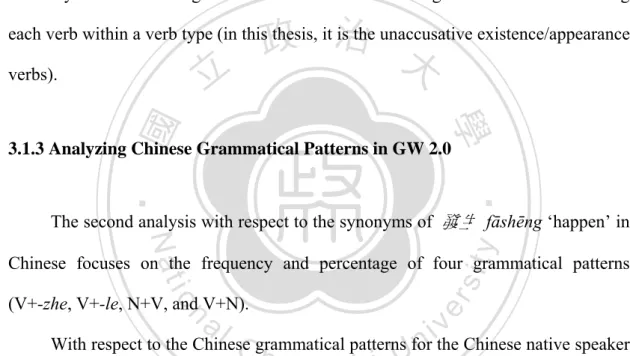
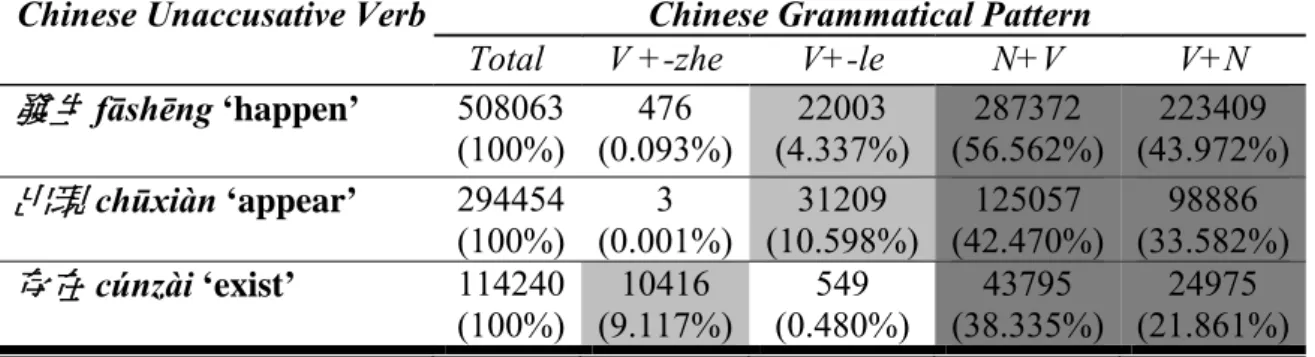
Analyzing Chinese Grammatical Patterns in GW 2.0
Findings of Grammatical Form and Erroneous Rate Analysis in Learner
Results of Questionnaire A
Results of Questionnaire B
Perfectivity with Transitivity of Unaccusative Existence/appearance Verbs
Conclusion and Pedagogical Implications
相關文件
語文運用 留意錯別字 辨識近義詞及詞語 的感情色彩 認識成語
Strange as it may sound, the little girl escaped being hurt in the accident.. (A) the little girl was hurt when escaping in the accident (B) the little girl didn’t get hurt in
語文素養重視積累、感悟和薰陶,基本內涵 和要素包括:字詞句篇的積累,語感、讀寫 聽說能力、語文學習方法和習慣的培養,以
學生平均分班,非 華語學生與本地學 生共同學習主流中 文課程,參與所有 學習活動,並安排 本地學生與非華語 學生作鄰座,互相
大學教育資助委員會資助大學及絕大部分專上院 校接納應用學習中文(非華語學生適用)的「達 標」
此外, 圖書館亦陸續引進英美文學、外語學習與研究等 相關資料庫,如 19 世紀以前出版的經典文學名著 Literature Online, Early English Books Online 與 Naxos
The growth of the Chinese bamboo: Coaching, teaching and learning in promoting reading literacy in Hong Kong primary schools – Hong Kong students in PIRLS 2011.
It clarifies that Upāyakauśalya, in the process of translation, has been accepted in Confucian culture, and is an important practice of wisdom in Mahāyāna Buddhism which
