科技部補助專題研究計畫成果報告
期末報告
美感體驗歷程與大腦心智反應--消費者對品牌識別標誌之
雙軌美感體驗歷程(第 2 年)
計 畫 類 別 : 整合型計畫 計 畫 編 號 : MOST 101-2420-H-004-012-MY2 執 行 期 間 : 102 年 01 月 01 日至 103 年 10 月 31 日 執 行 單 位 : 國立政治大學企業管理學系 計 畫 主 持 人 : 別蓮蒂 共 同 主 持 人 : 蔡介立 計畫參與人員: 博士班研究生-兼任助理人員:楊偉顥 博士班研究生-兼任助理人員:陳玉珊 博士班研究生-兼任助理人員:成力庚 博士班研究生-兼任助理人員:李俊德 報 告 附 件 : 出席國際會議研究心得報告及發表論文 處 理 方 式 : 1.公開資訊:本計畫涉及專利或其他智慧財產權,1 年後可公開查詢 2.「本研究」是否已有嚴重損及公共利益之發現:否 3.「本報告」是否建議提供政府單位施政參考:否中 華 民 國 103 年 11 月 15 日
中 文 摘 要 : 品牌識別標誌 (Logo) 的設計是各種工業與商業設計中,最 接近行銷功能的一種設計,因此本研究以品牌 Logo 的美感為 標的,探討影響消費者判斷一個品牌 Logo 美感的設計因素與 行銷因素。 過去有關美學的研究,多半是從藝術美學與美學哲學的角度 出發,關於設計美學方面則以應用為主,較少有學術類的研 究;少數設計美學的學術研究,也多以產品設計為主,Logo 設計經常被研究者所忽略。Logo 設計的美感涉及設計美學、 行銷學及消費者心理學等領域;其中,消費者的美感體驗, 更是屬於大腦高層次主觀認知的難解課題。近年來幸因神經 生理研究的科技發展,許多腦神經科學家、認知心理學家, 甚至是消費者研究者,可突破過去傳統實驗法無法解讀的認 知運作,藉由先進儀器掌握大腦的活動以佐證研究結果。 本研究共三個系列研究,分別使用傳統行為科學的訪談法及 實驗法,以及 fMRI,探討消費者對 Logo 美感體驗由下而上 與由上而下的雙軌歷程,以分析 Logo 設計本身的對稱性與比 例、Logo 設計的象徵意涵,以及消費者本身過去與品牌相關 的愉悅經驗,分別如何影響其美感體驗。 由第一階段的深入訪談結果可發現,主要的客觀美感主要包 含個體在視覺特徵上知覺到刺激外型設計中,線條、色彩、 明暗、形狀、質地、肌理等特徵組合成視覺美感元素:結構 對稱、重心均衡、彩度、明度,和顏色協調感。主觀美感則 指個體觀察到客體後因個人過去經驗、情感所投射出對客體 主觀美感的判斷,其中包含對客體設計賦形意義與背後品牌 故事精神理解的影響:意義度、設計感,與現代感。此結果 並得到第二階段問卷調查資料的因素分析驗證。 進一步,由核磁共振造影的結果可知,消費者心中有一套判 斷 Logo 美感的準則。當這個準則與所見到的有所差異時,腦 部負責處理衝突的區位 Somatosensory Association Cortex (SII)會進行處理而呈現活化。面對與之有豐富互動經驗的 Logo,消費者的反應明顯與面對全無所知的 Logo 不同。面對 曾與之有豐富互動經驗的 Logo,腦部的 inferior parietal lobule,supramarginal gyrus (Brodmann area 40),和 precuneus (Brodmann area 7) 等區域會活化。由於消費者 成長過程中,這些 Logo 所代表的品牌和產品曾帶給消費者美 好或有趣的童年記憶,活化腦中的獎酬中心 right anterior cingulate gyrus (Brodmann area 10 and 32) 和
bilateral cingulate gyrus。
本研究結果顯示,消費者的 Logo 美感判斷,除了受到 Logo 外型設計影響之外,亦會被 Logo 設計所傳達的意義與品牌精 神所影響,間接證明 Logo 意義與品牌故事的重要性。此外,
能喚起過去記憶的熟悉 Logo,可讓消費者因為親切與熟悉 感,忽略 Logo 本身設計的美感,直接產生好感。
中文關鍵詞: 品牌識別標誌設計、美學、美感體驗、消費者腦神經科學 英 文 摘 要 : This research project aims on brand logo design to
investigate who consumers evaluate the aesthetics of a logo. The objectives of this project are to
identify the objective logo design and marketing determinants and subjective emotional determinants of aesthetics, as well as the processes of consumer aesthetic experiences.
This research included three series of studies: in-depth interview, survey, and fMRI in two years to explore both bottom-up and top-down processes of aesthetic experiences. This research examined the symmetry and ratio of the logo to reveal the
objective bottom-up aesthetic process, the symbolic meaning of the logo and brand story to represent the cognitive drive of subjective top-down aesthetic process, and individual experience for the emotional drive of top-down aesthetic process.
The results of the first study illustrated 5 concrete principles (e.g., symmetry, saturation, brightness, color harmony, balance) and 3 subjective aesthetic principles (e.g., meaning, design feature, and
modernity). These two principles were also supported by the factor analysis based on the survey result from the second study.
The result of fMRI further revealed that the Somatosensory Association Cortex (SII) of a
consumer's brain would be activated when he or she was presented a logo which was against the rule of beauty. Also, when consumers were facing familiar logos, their inferior parietal lobule, supramarginal gyrus, and precuneus of brain were activated, which were different from when they were facing novel logos. The experience and memory with familiar logos were evoked, which was proved by the activated right anterior cingulate gyrus and bilateral cingulate gyrus.
processes of aesthetic experiences via both traditional and neuromarketing methods. Both subjective and objective route of judgment are important to consumers' evaluation of logo beauty. Furthermore, familiarity of logos can directly bring back consumers' memory and favorable attitudes toward the logos without judging its beauty.
英文關鍵詞: Logo Design, Aesthetics, Aesthetic Experience, Consumer Neuroscience
行政院國家科學委員會補助專題研究計畫
■ 成 果 報 告
美感體驗歷程與大腦心智反應-
消費者對品牌識別標誌之雙軌美感體驗歷程
計畫類別:□ 個別型計畫 ■ 整合型計畫
計畫編號:NSC
101-2420-H-004-012-MY2
執行期間:2012年01月1日至2013年10月31日
計畫主持人:
別蓮蒂教授 國立政治大學企業管理學系
共同主持人:蔡介立助理
教授
國立政治大學心理學系
計畫參與人員:陳玉珊、楊偉顥、李俊德
成果報告類型(依經費核定清單規定繳交):
□精簡報告 ■完整報告
本成果報告包括以下應繳交之附件:
□ 赴國外出差或研習心得報告一份
□ 赴大陸地區出差或研習心得報告一份
■ 出席國際學術會議心得報告及發表之論文各一份
□ 國際合作研究計畫國外研究報告書一份
處理方式:除產學合作研究計畫、提升產業技術及人才培育研究計畫、列
管計畫及下列情形者外,得立即公開查詢
□ 涉及專利或其他智慧財產權,■一年□二年後可公開查詢
執行單位:國立政治大學企業管理學系
中
華
民
國
103
年
10
月
31
日
行政院國家科學委員會專題研究計畫結案報告
美感體驗歷程與大腦心智反應-
消費者對品牌識別標誌之雙軌美感體驗歷程
The Dual Process of Consumer Aesthetic Experiences on Logo Evaluation
計畫編號:101-2420-H-004-012-MY2
執行期間︰2012 年 01 月 1 日至 2014 年 10 月 31 日
主 持 人︰別蓮蒂教授 國立政治大學企業管理學系
研究動機與目的
在現今以設計代工與自創品牌趨勢的競爭激烈產業環境中,廠商莫不將投資重心 轉移到設計與品牌,以期能讓自家產品異於其他競爭產品,其中設計者與行銷人的美 感培養與美學基礎便日益重要。品牌識別標誌 (Logo) 的設計是各種工業與商業設計 中,最接近行銷功能的一種設計,需在方寸空間中,設計出有辨識度、能展現企業與 品牌精神、具美感、適合品牌行銷的品牌Logo。Henderson, Cote, Leong and Schmitt (2003) 特別以中國與新加坡的品牌Logo為研究對象進行分析,提出亞洲品牌多半偏重 於品牌所代表的品質形象,對於Logo設計所傳達的視覺美感、意向、情感則著墨不 多,這對要成為一個真正的國際品牌是有影響的。本研究因此以品牌Logo的美感為標 的,探討影響消費者判斷一個品牌Logo美感的設計因素與行銷因素。 過去有關美學的研究,多半是從藝術美學哲學的角度出發,關於設計美學方面則 以應用為主,較少有學術類的研究;少數具系統性的設計美學學術研究,也多以產品 設計為主。Logo設計經常被研究者忽略,但其實Logo設計的美感是非常複雜的議題, 涉及設計美學、行銷學及消費者心理學等領域;其中,消費者的美感體驗,更是屬於 大腦主觀高層次認知的難解課題。 拜科技發展所賜,近年來透過科學儀器可以直接顯示當消費者思考或處理資訊 時,是腦中的哪些區塊在運作。原本為醫療目的的功能性核磁共振造影(functional magnetic resonance imaging,fMRI),為近年來被運用至行為科學研究的儀器之一,已 成為當今研究消費者腦神經科學(consumer neuroscience) 的一大利器。該儀器不會侵入 消費者的身體,藉由掃描觀察人們腦內的活動情形,可以動態地觀察紀錄人們大腦的 運作,因此,許多腦神經科學家、認知心理學家,甚至是消費者研究者,可突破過去 傳統實驗法亦無法瞭解的部份,甚至掌握大腦的活動以佐證研究結果。Kenning and Plassmann (2008) 亦為文推廣從消費者神經科學的角度來增進對消費行為的瞭解。 根據前述的研究動機,本研究的目的為藉由fMRI觀察消費者的注意焦點與腦部活 動,以釐清消費者對於品牌Logo美感判斷的認知與情感來源因素詳細分年研究目的如 下:一、 透過深入的美學文獻解釋,釐清可適用於設計美學判斷的標準與影響因素。(第一 年)。 二、 運用fMRI以一系列的研究探討影響消費者對於品牌Logo美感判斷的認知與情感來 源因素,自腦神經科學的證據提出腦部美感認知運作的路徑與反應。(第二年)。
文獻探討
針對上述研究目的,本研究首先回顧美學的理論脈絡與影響藝術鑑賞的因素,並 從中擷取可被用於設計美學的因素,以進一步與美學研究相呼應。 美學哲理 符號論美學是二十世紀美學研究的重要學派,符號論美學的重要人物之一Ernst Cassirer認為,人可以定義為會創造與使用符號的動物,要想了解人與人的文化,必須 通過神話、宗教、語言、藝術…等符號形式的研究(劉昌元,1986)。Cassirer指出美的 本身與對美的事物的感覺基本上是同一的,藝術的展現需經過「賦形(formative)」,色 彩、線條、韻律、節奏…等都是創作本身賦形的要素。藝術家在面對自然創作時,是 從 對 自 然 體 驗 的 本 身經 驗 去 找 尋 , 再 將 這 些 經 驗 「 純 粹 形 式 化 」 , 成 為 象 徵 的 (symbolic) 結果,換言之,Cassirer把藝術當作一種人類文化符號的形式 (張忠明, 2008;劉述先、詹景雯,2004)。Cassirer的後繼Susanne K. Langer承續將藝術視為符號 形式的論點,發展出一套完整的藝術論,把藝術品定義為一種象徵(劉昌元,1986)。 中國的美的哲學思維起源相當早,孔孟老莊均有相關論述;然而,美學研究在中 國的發展卻遲至晚近 (馮滬祥,1990)。美學家朱光潛 (1897~1986) 為中國現代美學的 開拓者和奠基者之一,他所撰寫的《西方美學史》是中國學者撰寫的第一部美學史著 作,朱光潛除介紹、翻譯西方美學外,也開拓了中國美學研究的新領域。朱光潛指出 Aesthetics 的原意是直感或直覺,建議翻譯為直覺學,但此譯名會窄化Aesthetics 的範 圍,所以後世還是習慣用「美學」一詞(劉昌元,1986)。 《中國美學史》第一卷中論述中國美學有六項基本特徵:(一) 高度強調美與善的 統一,(二) 強調情與理的統一,(三) 強調認知與直覺的統一,(四) 強調人與自然的統 一,(五) 富於古代人道主義的精神,(六) 以審美境界為人生的最高境界。馮滬祥(1990) 認為中國美學有六個主要學派:儒家美學、道家美學、楚騷美學、文心雕龍美學、佛 家美學、新儒家美學。前述六項美學基本特徵中的前三項「統一」源自於孔、孟、荀 的儒家「和諧」、「融合」美學,重視善與真理;人與自然的關係則是受到老莊思維 的影響,天人合一的自然美成為中國田園詩與山水畫中共同肯定的美。 設計美感的元素與原理 人有五覺 (five senses),因此視、聽、嗅、味、觸均可產生美感,然一般論及美 學,仍是以視覺與聽覺為主,視覺美感建立在視覺特徵上,包括線條、色彩、明暗、 形狀、質地、肌理 (趙惠玲,1995),這些特徵組合成視覺美感元素:均衡(balance)、 調和(harmony)、統一(unity)等原則,最後經由主體的體驗,得到美感經驗歷程。客觀美感體驗(Objective Aesthetic Experience) 柏拉圖在《理想國》中所言的理式,是一種客觀 (objective view) 的美學經驗;換 言之,所有人都能由特定的美學要素,例如:各式均衡、韻律、對比、比例、調和、 統一等,感受到愉悅的經驗,表示人們對於美學要素的反應可能有其生理上相同的基 本運作基礎(mechanism)。設計美學的元素係根據人類美感的共通性,所定出的數項美 的原則,例如:藝術界公認的七項美學的要素分別為均衡(balance)、重點(emphasis)、 動態(movement)、形勢(pattern)、比例(proportion)、和諧(harmony),和變化(variety) (Graves, 1941; Kim, 2006);又如視覺美感原則的對稱、對比、比例、均衡、調和、反 覆(連續)、漸層(漸變)、節奏(律動)、統一(趙惠玲,1995)。「對稱」是指在視覺畫面 中軸線的兩端為完全相同的形體,有左右對稱或上下對稱,也可是上下左右均呈現對 稱的狀態;「均衡」是指在視覺畫面的假想軸兩側,分別放置形態不相同,但質量相 當的事物,因而產生均衡的感覺;「調和」則是指將性質相似的事物並置一處,由於 彼此差距微小,仍可予人融洽相合的感覺,包括形與色的調和安排均可;「對比」的 安排方式適與調和相反,是將兩種性質完全相反的構成要素並置一處,以達到兩者之 間互相抗衡的緊張狀態,形狀、色彩、質感、方向、光線等,均可形成對比效果; 「比例」是指在一個畫面之中,部分與部分之間的關係,包括長短關係、大小關係, 寬窄關係等(趙惠玲,1995)。這五項元素比較適合應用在小範圍的畫面中,因此在 Logo設計中經常被用到,過去學者也有透過實證研究證實「對稱」、「均衡」和「比 例」是比較適合成為美學實證研究的刺激物 (e.g., Ramachandran & Hirstein, 1999)。 主觀美感體驗之認知驅力 (Cognitive Drive of Subjective Aesthetic Experience)
俄國藝術評論家Shklovsky (1965) 曾強調,藝術的目的是傳遞「可被理解」的訊 息 , 而 非 讓 人 辨 識 出 「 已 熟 知 」 的 事 物 。 藝 術 的 技 巧 旨 在 使 客 體 變 得 「 不 熟 悉 (unfamiliar)」、使形式變得更困難,以增加理解的難度與所需的時間,因為理解藝術 作品的過程即是美學的目的本身,必須予與延長。藝術著重的是體驗客體表現出的藝 術性 , 而 非只 是畫 作客體 (Art is a way of experiencing the artfulness of an object; Shklovsky, 1965, p. 20)。從這段評論中可知,美學的經驗不只對客觀視覺刺激的反應, 還應該包含由上而下的認知控制及深層的情緒感動。品牌Logo在設計時,一般均承載 某種象徵意義,因為其設計目的是為了代表特定企業或產品,因此其機能性非常重 要,必須呈現所代表主體的內涵,讓人一看就能聯想到所代表的意義或單位,所以, 理性認知對於Logo非常重要。根據過去對藝術品美感研究的結果,可以推測若是消費 者瞭解Logo設計的理由和其象徵意義,對該Logo的美感判斷應該會提高。此外,品牌 Logo是一種商業的創造象徵符號,有目的地以Logo設計代表品牌精神;換言之,設計 者將品牌精神與理念「賦形」於一個簡單的Logo上,求得到消費者的共鳴產生主觀美 感經驗。
德國心理學家與美學家Theodor Lipps 參考德國哲學家Robert Vischer 所發明的 Einfühlung (意指esthetic sympathy,後英譯為empathy,美的移情) 一詞,提出審美的
「移情作用說(empathy or esthetic sympathy)」(Wikipedia, 2010)。審美的移情不同於實 用的移情,是一種情感的投射,包括「由我及物」、「由物及我」雙方面,最後達到 「物我合一」的境界。「由我及物」是一種擬人化的過程,就如:「我見青山多嫵 媚,料青山見我應如是」中的「青山見我」就是將青山擬人化後才能「見」;而「由 物及我」則是由物再想到自己,看到青山聳立,不由自主地自己也站得筆直。在「物 我合一」的境界。移情有兩種:有自覺的「同情的理解」(是一種不帶偏見,讓對象性 質顯現的設身處地) 與不自覺的「自發感受」(如前述觀看Doric柱的感覺)。然而,審美 的移情作用說不是沒有爭議之處,許多具高度審美價值的作品,並不要求觀賞主體有 自覺的移情;而若是不自覺的移情,則觀賞主體並不會得知自己是否有移情 (劉昌元, 1986)。雖然移情作用說在哲學辨證上可能有上述爭議或邏輯謬誤,但是就審美的角度 而論,無論是前述舉例中的詩詞或建築,移情的效果的確可讓觀賞主體感受到更深刻 的美感;同理,若是因品牌故事、個人經驗、或是某些行銷手法讓消費者對品牌產生 移情作用,消費者對品牌Logo的審美評價很可能也會不同。 根據先前文獻所述,個體知覺到的美感可分為客觀與主觀的美感體驗,客觀美感 主要包含個體在視覺特徵上知覺到刺激外型設計,包括線條、色彩、明暗、形狀、質 地、肌理,以及這些特徵組合成視覺美感元素: 對稱、對比、比例、均衡、調和、反 覆(連續)、漸層(漸變)、節奏(律動)、均衡(balance)、調和(harmony)、統一(unity)等 (趙 惠玲,1995);主觀美感則指個體觀察到客體後因個人過去經驗、情感所投射出對客體 主觀美感的判斷,其中包含對客體設計賦形意義與背後品牌故事精神理解所影響。本 研究首要探討影響消費者對Logo美感知覺的設計因素,遂本研究提出命題: 命題:具有美感的Logo在形體設計上其線條、色彩、明暗、形狀、質地、肌理可能符 合對稱、對比、比例、均衡、調和、反覆(連續)、漸層(漸變)、節奏(律動)、統 一等原則;並可能具有明確意義、故事、能使消費者產生抽象移情效果的設 計。
第一階段:質化分析萃取判斷Logo美感所依據的刺激元素
本研究第一年計劃希望透過深入的美學文獻解釋,釐清可適用於設計美學Logo判 斷的標準與影響因素,並透過質性訪談的方式,深入了解影響消費者對Logo美感判斷 的依據,篩選與建立符合美學定義,可用於第二年計劃的Logos刺激物。研究方法及受試者資訊
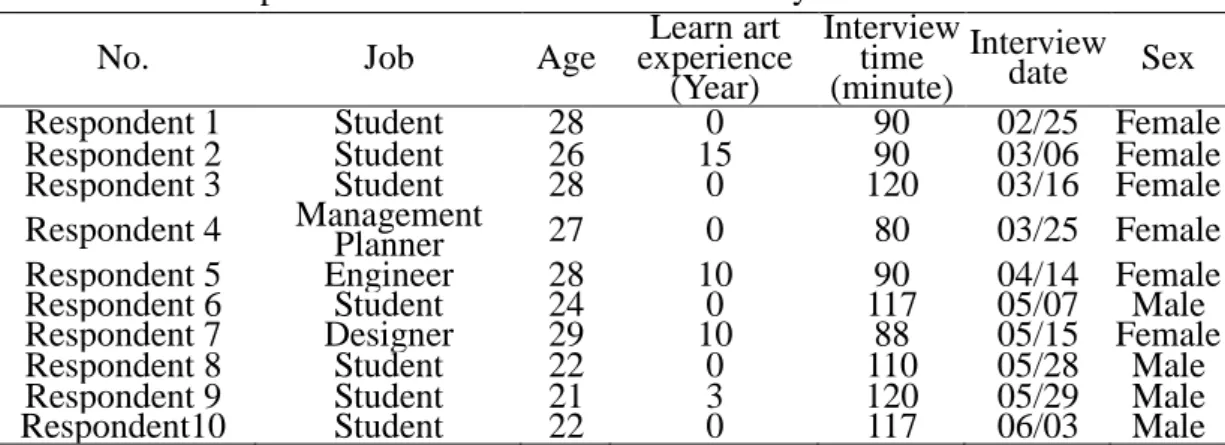
質性訪談設計目的,為深入萃取出消費者判斷Logo美感所依據的元素。遂本研究 參照凱利矩陣晤談法中的三元素組合 (Kelly, 1955),設計半結構式一對一深度訪談進行質化資料蒐集。訪談進行前,明確告知受試者訪談的目的、流程以及資料保密性, 並請受訪者簽屬訪談同意書後開始進行。共計進行十位受訪者訪談 (表一),受訪者抽 樣方式採滾雪球抽樣法,平均每位受訪者受訪時間七十八分鐘,訪談內容謄打成逐字 稿,共三百四十一頁逐字稿內容。依據逐字稿內容,進行內容分析。 表一、受訪者基本資料 職業 年齡 美術經驗 (年) 受 訪 日期 訪 問 時 間 (分) 性別 受訪者一 學生 28 0 02/25 70 女性 受訪者二 學生 27 0 03/06 60 女性 受訪者三 學生 26 15 03/16 100 女性 受訪者四 管理師 27 0 03/25 51 女性 受訪者五 工程師 28 10 04/14 60 女性 受訪者六 管理師 28 5 04/16 92 女性 受訪者七 學生 24 0 05/07 87 男性 受訪者八 設計師 29 10 05/15 88 女性 受訪者九 學生 22 0 05/28 82 男性 受訪者十 學生 27 0 05/29 90 男性
研究流程
步驟一:揀選符合美感文獻定義的Logo 為了建立質性訪談需要的分類元素,本研究根據過去文獻推倒的美學標準:對 稱、均衡、調和、對比、比例、具有象徵意義、具熟悉圖案與單獨文字八項標準從國 外品牌Logo設計網站 (http://www.brandsoftheworld.com/) 蒐集符合美學標準的logo共80 個,在隨機打散請三位博士班學生,根據美學的八項標準評選出可代表該項標準的前 三美Logo,最後取三位學生共同選出的交集24個Logo作為訪談設計所需的刺激物。 步驟二:訪談利用Kelly Triad Interview,萃取判斷Logo美感所依據的刺激元素。首先,請受試 者在二十四張Logo圖卡中任取三張,依據某個判斷Logo美感所依據的刺激元素進行二 分。其中兩張Logo圖卡,其美感的判斷依據合乎上述的美感刺激元素,餘者與另兩者 不同。訪談者深入追究,以了解受試者用來判斷Logo美感所的刺激元素。經過八個回 合,至二十四張Logo圖卡全數挑選、訪談完成。最後,將二十四張Logo圖卡混合,請 受試者挑出三個最美的三張Logo圖卡,以及最不美的三張Logo圖卡。並且,解釋其選 擇及判斷的依據。 接下來,研究者給予受試者約十五分鐘的休息時間。在這段時間之中,研究者歸
納受試者在Kelly Triad Interview中,所提到用以判斷Logo美感所依據的刺激元素。將 這些刺激元素填入元素矩陣問卷中。元素矩陣,由多組語義差異題組組成。一端,為 受試者所提出的某個判斷Logo美感所依據的刺激元素。訪問者利用訪談技巧,請受試 者提出相對於這個判斷元素的另一端。例如,簡單的另一端為複雜。並請受試者,針 對每個Logo圖卡,依據上述判斷元素的語義差異題項,進行五點尺度的評估。 完成判斷Logo美感所依據的刺激元素所組成的語義差異題項量表,訪談者詢問受 試者對此研究的疑慮及想法。訪談者詳細解答受試者疑慮後,給予研究報酬感謝受試 者參與,完成訪談。 步驟三:根據質化萃取之元素,進行因素分析 取出每位受試者萃取判斷Logo美感所依據的刺激元素相近者,先進行取樣適當性 檢定(KMO與Bartlett)和巴氏球形檢定(Bartlett Test of Sphericity)。KMO值越高表示 進行因素分析的效果越好,其值在0.9以上表示效果極佳,0.8以上表示是有價值的, 0.7以上是中度的,0.6以上是不好也不壞,0.5以上是不太好的,若值在0.5以下,就表 示其效果是無法接受的。接下來,進行刺激元素內的因素分析。以「簡單與複雜」刺 激元素為例,第一個受試者中萃取出「圖形複雜」、第二位受試者萃取出「圖案簡 單」、第三位受試者萃取出「細節」、第四位受試者萃取出「簡單設計/複雜設計」 等,再將這九位受試者在此相近的判斷Logo美感依據刺激元素評分,進行因素分析。 若這些此判斷元素,具有跨受試者的概念一致性時,因素分析將呈現單一因素。若有 混雜其他判斷元素的概念,則因素分析將呈現多個因素。 步驟四:根據判斷Logo美感的刺激元素概念,進行刺激物設計 跨受試者呈現一致的判斷元素概念者,進行第二階段質化資料收集。計萃取出n個 判斷Logo美感的元素概念,根據每一組概念,初步設計45個Logo刺激物,總計產生(45 n)個Logo刺激。再根據專家會議,從中評選出在某個概念中最具代表性且與其他概念 重疊性低的Logo刺激物,計每組概念取出近30個Logo刺激物,預計去蕪存菁,留下 300個Logo刺激。 再者,對應於本研究對客觀(button-up)與主觀的美感體驗(Top-down)的探索。研究 者搜集對於目標受試者有特殊回憶的品牌Logo,例如: 小美冰淇淋,和77乳加巧克力 等計40個既存品牌Logo。最終進入第二階段的Logo刺激物,有全新Logo刺激物300 個,既存品牌Logo刺激物40個,總計340個。
研究結果
一、質化分析研究結果部分只針對受訪者一至九的訪談內容進行分析,因為受訪者十在訪談最 後拒絕填寫元素矩陣問卷,未蒐集到完整所有訪談流程的資料,遂未納入分析。表二 為所有受訪者所提出的個人判斷Logo美感所依據的刺激元素。 表二 受訪者所提出,判斷Logo美感所依據的刺激元素 受試者 原則 一 均衡、圖形簡單、設計感、文字配置上下、用色簡單、亮眼、對 比、意義、圖字契合度、對稱 二 設計感、圖案簡單、意義、顏色協調、熟悉、文字和圖契合、框 架 三 圖案和文字契合、圖和文字比例好、立體感(主題明顯)、顏色和圖 案協調、細節、顏色的協調、文字和圖案協調、設計概念一致、 圖案的協調 四 記憶度/沒記憶度、原色飽和/漸層混色、簡單設計/複雜設計、共鳴 /沒共鳴、醒目/不醒目、酷/不酷、新鮮感/老梗、有故事/沒故事、 設計感/沒設計感、意境明確/沒有鑑別度 五 圖字平均分配(協調感)/圖字不平均、圖案簡單/圖案不簡單、對稱/ 不對稱、聚焦/不聚焦、神秘感/不神秘、意義明確/意義不明確 六 圖和字的完整性/圖和字不完整、圖和字的意義明確/圖和字意義不 明確、用色和字的平衡/用色和字不平衡、活潑性/保守、創意/沒有 創意、優雅/rich、用色和字的和諧/用色和字不和諧、不假掰/假 掰、簡單/複雜 七 圖案簡單設計、有規則的、圖和字有連結、傳達的內容明確、顏 色跳出來、引起好奇感、經典、字體的設計感、記憶度、潮流感 八 簡單大方/繁複、有意義/沒意義、配色均衡/不均衡、平衡/歪斜、 記憶度/沒記憶、協調性/不協調、設計成熟/不成熟、辨識度/沒辨 識度 九 字和圖比例好/字和圖比例不好、質感(絲、皮件、原木色)/粗糙、 完整性/不完整性、意義/不知所云、對稱/不對稱、動態性/靜態 二、質化因素分析 根據萃取出的 Logo 美感判斷的刺激元素,反覆進行概念的抽取及釐清,最後歸 結出十個判斷 Logo 美感所依據的刺激元素。其中,三個與 Logo 的形狀造型相關的判 斷元素,分別為結構對稱、重心均衡、圖案設計簡單。三個與顏色相關的判斷元素, 分別為飽和度、亮度,以及顏色協調。另外二者與設計感相關,分別是匠心獨具以及 現代感。最後一個,是 Logo 是否具有意義。表三,列出針對每個判斷 Logo 美感的刺 激元素概念,各取出兩個代表性刺激物以茲說明。 表三 判斷 Logo 美感的刺激元素概念,所選擇的 Logo 代表刺激物
結 構 對 稱 結 構 不 對 稱 重 心 均 衡 重 心 不 均 衡 圖 案 設 計 簡 單 圖 案 設 計 複 雜
高 彩 度 低 彩 度 高 明 度 低 明 度 顏 色 協 調 度 高 顏 色 協 調 度 低
匠 心 獨 具 制 式 化 現 代 感 傳 統 感 有 意 義 無 意 義
第二階段:fMRI刺激材料前測
根據第一階段所萃取出來的構面,初步設計出 288個LOGO刺激物,其中並含有 8 個一般消費者童年時期熟悉的LOGO,做為懷舊LOGO的代表。針對這288個刺激物進 行前測,藉以決定正式進入fMRI施測的代表性刺激物。
受試者資訊
受試者共計115位學生,男生56人、女生59人。年齡介於17到39歲,平均年齡22.6 歲,標準差3.4歲。研究程序
前測為電腦施測,研究者在校園中發送傳單並進行課堂宣傳。有意願的學生進入 電腦教室進行電腦單機施測。計有七個施測版本,每個版本內含有53個LOGO刺激 物。每個版本,根據所代表的刺激元素個數,分配如下表所示。星號所代表其中有一 個LOGO重複出現在其他版本之中,七個版本中的八個懷舊LOGO皆相同。重複的 LOGO是做為檢定組間差異之用 表四 前測 LOGO 刺激物分配列表 LOGO刺激元素
版本一
版本二
版本三
版本四
版本五
版本六
版本七
對稱
(34個
) 5* 5 5 5 5 5 5重心均衡
(33個
) 5 5 5* 5 5 5* 5圖案簡單
(31個
) 5 5* 5 5* 5* 5* 5高彩度
(32個
) 5* 5 5* 5* 5 5 5高明度
(32個
) 5 5* 5 5 5* 5 5*顏色協調
(32個
) 5 5* 5 5 5 5* 5*設計感
(32個
) 5* 5 5 5* 5 5 5*現代感
(31個
) 5* 5* 5* 5* 5 5* 5意義度
(31個
) 5 5* 5* 5 5* 5 5*懷舊
(8個
) 8* 8* 8* 8* 8* 8* 8*總計
53 53 53 53 53 53 53 在進行正式評量之前,受試者先閱讀表五的各美感構面定義與評分標準說明。評 分說明中,明確指示題項中所提及的美學相關判斷的概念。例如:結構對稱,指的是 LOGO整體結構設計有對稱感。提供說明的原因,主要是顧及美學相關判斷的概念抽 象,且不易瞭解。故特此說明,以利受訪者選擇出適當的LOGO刺激物。 表五 美感構面定義與評分說明 結構對稱 指此 Logo 整體結構設計有對稱感。 彩度 指此 Logo 顏色彩度較高,指的是色彩的強弱,例如大紅 色 鮮黃色,讓人感覺色彩比較濃厚。 明度 指此 Logo 顏色彩度較低,明度較高,越亮越淡,用比較 多柔和的顏色。 意義 指此 Logo 有傳達某種意義。 設計感 指此 Logo 轉換既有的元素成不同的樣貌,令人有意想不 到的驚喜,或是有 WOW 的感覺。 制式感 指此 Logo 設計比較中規中矩,沒有特別創新的地方,令 人感覺無聊。 顏色協調感 指此 Logo 彼此間顏色協調性高,沒有對比太強烈或是奇 怪的配色。 重心均衡 指此 Logo 的整體圖案重心均衡。 圖案設計概念簡單 指此 Logo 整體設計的概念,傳達出來的形式簡單,但可 能存有許多複雜的元素。 圖案設計概念複雜 指此 Logo 整體設計概念較複雜,同時存有多種設計概 念,例如特殊造型設計又搭配豐富的顏色,設計元素與主 題太複雜。 傳統 指此 Logo 設計是舊有,過去有看過的特定類別型式,具 有隱含某種特定類別 Logo 的設計系列。 現代 指此 Logo 設計較為前衛,是過往較少見的,比較符合時 下潮流的設計風格。 接著,電腦螢幕上會隨機出現七個版本之一的 53 個 LOGO 刺激物。每位受試者 需要針對這 53 個 LOGO 刺激物,以六點量表評量語意差異評分,題項的兩端語義標 示如下:「結構不對稱-結構對稱」、「重心不均衡-重心均衡」、「圖案設計概念簡單-圖案設計概念複雜」、「低彩度-高彩度」、「低明度-高明度」、「顏色協調感低-顏色協調感 高」、「制式感-設計感」、「傳統-現代」,以及「沒意義-有意義」。之後以六點表量評量 「此 LOGO 整體美感」以及「對此 Logo 的喜好程度」。最後,請受試者提供「年齡」 與「性別」兩項個人基本資料。
干擾檢定:組間差異檢定
組間重複施測 Logo 計有 28 個,每一個 Logo 刺激物由不同組的 32 位受試者進行 評判。例如: A logo,由 16 位第一組受試者及 16 位第二組受試者進行六點量表評量語 意差異評分。分別對兩組受試者對 28 個 Logo 的美感構面評量進行獨立樣本 t 檢定。 共計有 252 個反應項目,組間差異達到 .05 顯著者僅有 16 個,細目如表六所示,整體 組間反應的一致性達 93.7%。 表六 Logo 刺激物反應的組間差異檢定 美感構面評量 #1 #2 #3 #4 #5 #6 #7 #8 #9 #10 #11 #12 #13 #14 對稱 0.03 0.14 0.43 0.48 0.03 0.67 0.27 1.60 1.19 0.05 0.77 0.99 1.10 1.07 彩度 0.24 0.33 1.43 0.33 2.34* 0.54 2.46* 1.13 0.00 0.28 0.23 1.43 3.10* 1.87 明度 1.20 0.79 1.02 0.59 0.70 0.29 1.62 0.95 1.48 0.71 0.28 1.68 0.64 0.09 意義 0.89 0.11 0.82 0.55 0.01 1.22 0.55 1.24 0.12 0.01 0.72 0.42 2.19* 0.32 設計感 0.76 1.49 1.27 1.46 1.06 3.23* 1.65 0.49 0.68 0.98 1.32 1.22 1.14 0.04 顏色協調感 0.72 0.00 1.89 1.93 1.43 1.13 0.47 0.04 1.39 0.31 1.40 0.92 0.40 0.89 重心均衡 0.21 1.12 1.02 0.12 0.66 0.49 1.34 0.90 0.29 0.79 0.86 1.54 0.32 0.98 圖案設計概念簡單 1.04 0.70 2.40* 0.39 0.68 1.13 0.46 0.79 0.75 1.45 1.78 0.16 0.74 1.70 現代感 0.78 0.50 0.28 1.33 0.50 3.56* 1.24 0.10 1.09 0.73 0.92 0.82 0.92 0.51 美感構面評量 #15 #16 #17 #18 #19 #20 #21 #22 #23 #24 #25 #26 #27 #28 對稱 0.40 0.39 0.17 1.87 0.00 1.44 1.77 2.23* 0.44 1.19 1.11 1.43 1.14 0.95 彩度 0.25 1.18 0.87 0.62 0.87 0.60 2.13* 1.84 0.99 0.27 1.24 0.51 0.58 0.98 明度 1.43 1.52 1.86 1.51 1.02 0.86 0.70 2.00 0.34 0.04 1.45 1.42 2.57* 1.18 意義 0.21 2.59* 0.69 0.14 0.39 1.86* 0.47 0.69 0.10 1.51 0.69 0.28 0.34 0.58 設計感 2.26* 0.39 0.88 0.29 0.13 0.67 0.58 0.47 2.23* 1.05 1.47 0.83 0.66 0.08 顏色協調感 0.70 0.90 0.59 1.82 2.11* 0.92 0.25 0.23 0.02 0.50 1.65 1.39 1.57 0.57 重心均衡 1.03 0.50 0.37 2.00 0.36 0.53 0.17 1.43 0.42 0.24 0.21 0.87 0.98 0.20 圖案設計概念簡單 2.65* 0.76 0.75 0.11 1.58 0.82 0.98 1.13 0.41 1.96 0.97 0.04 0.65 0.62 現代感 1.33 1.43 0.23 0.56 0.94 0.09 0.86 1.29 1.61 1.70 1.88 0.36 0.63 0.63研究結果
首先以描述性統計簡單分析受試者針對每個 LOGO 刺激物在九個美感構面的分數 分配,原則以各刺激元素相關題項中,受試者反應相對一致性高者,該 LOGO 為此構 面的代表。 故將各題項反應值中,標準差大於二者先刪除。計篩除 3 個受試者反應在「結構 不對稱-結構對稱」上變異過大的 LOGO 刺激物、3 個在「重心不均衡-重心均衡」上變 異過大的 LOGO 刺激物、4 個在「圖案設計概念簡單-圖案設計概念複雜」上變異過大 的 LOGO 刺激物、3 個在「低彩度-高彩度」上變異過大的 LOGO 刺激物、9 個在「低 明度-高明度」上變異過大的 LOGO 刺激物、2 個在「顏色協調感低-顏色協調感高」上 變異過大的 LOGO 刺激物、10 個在「制式感-設計感」上變異過大的 LOGO 刺激物、 16 個在「傳統-現代」上變異過大的 LOGO 刺激物,以及 5 個在「沒意義-有意義」上 變異過大的 LOGO。共計篩選掉 55 個 LOGO 刺激物,留下 233 個 LOGO 刺激物加上 51 個懷舊的 LOGO,共 284 個 LOGO 進入 fMRI 進行 LOGO 刺激物與腦區活化相關實 驗。
第三階段: fMRI實驗
根據前測所篩選出來的,計有 284 個 LOGO 刺激物。針對這 234 個刺激物,將進 行 fMRI 施測。受試者資訊
受試者共有 32 位,男生 12 人、女生 20 人。年齡介於 19 到 30 歲,平均年齡 21.6 歲,標準差 2.60 歲。刺激材料
因為 LOGO 刺激物計有 284 個之多,其中,有 233 個全新 LOGO 刺激物,51 個市 場上既有存在之 LOGO 刺激物,故將 LOGO 刺激物分為兩個版本加以測試。每個版本 中各包含 150 個 LOGO 刺激物,134 個獨立 LOGO 刺激,16 個重複出現的刺激,在需 要檢定兩組組間差異之備用。實驗程序
實驗進行時間約一個小時,受試者進入正式實驗之前,必先簽署實驗進行同意 書,並確定受試者是否有心臟及相關生理疾病,或是幽閉恐懼症等不適合進行實驗之 狀況。若有上述情事,則不宜進入 fMRI 掃描。狀況良好之受試者,研究者為其講解 實驗流程,並針對受試者可能有的疑慮,釋疑並加以說明。正式進入 fMRI 掃描,每位受試者針對 150 個 LOGO 刺激物回答「不美-美」以及 「不喜歡-喜歡」的判斷。顧及受試者的注意力持續度,實驗共分成四個階段。第一階 段受試者針對其中一半(隨機分配),計 75 個 LOGO 刺激物先進行「不美-美」的判 斷。經過休息 5 分鐘之後,再判斷剩餘 75 個 LOGO 刺激物是否為美的 LOGO。第三 階段以及第四階段則依照上訴程序進行喜歡與否的判斷。 完成四個階段的判斷之後,研究者引導受試者離開 fMRI 實驗室。在隔壁研究小 間,進行操弄檢定。操弄檢定是一組從 234 個刺激物中,隨機挑選出的 30 個 LOGO 刺激物。受試者針對「結構不對稱-結構對稱」、「重心不均衡-重心均衡」、「圖案設計 概念簡單-圖案設計概念複雜」、「低彩度-高彩度」、「低明度-高明度」、「顏色協調感低-顏色協調感高」、「制式感-設計感」、「傳統-現代」,以及「沒意義-有意義」九個 LOGO 美感構面的相關題項,採六點量表進行,以確認 fMRI 受測者的看法與前測受訪者相 同。 最後,研究者向受試者說明研究的相關訊息。確保受試者對本研究完全了解並無 疑慮之後,簽收領據並領取相關酬謝。
fMRI資料收集
受試者平躺進入功能性磁共振造影儀(fMRI)進行 LOGO 刺激判斷,記錄受試者 對 LOGO 刺激物反應與大腦的血流量變化的相關性,據以依據不同腦區的活化情形印 證本研究所提出之推論。功能性磁共振造影儀以 3T 的磁場強度,改變去氧血紅素的氫 原子旋轉排列方向,經過共振吸收及共振發射,描繪出 LOGO 刺激活化腦區的立體圖 像。因為腦部活化消耗氧氣,而去氧血紅素順磁性物質(paramagnetic) 會干擾磁場。當 去氧血紅素比例的減少可以使影像強度增加內生性對比增強劑(endogenous contrast enhancing agent),產生血氧濃度相依對比(Blood oxygen-level dependent, BOLD)。利用 血氧濃度相依對比,比較出不同群組 LOGO 刺激物間所涉及腦區活化區域的差異。全腦掃描以每張 1 毫米,共計 160 張橫斷面影像。每位受試者的橫斷面影像,經 過 MDEFT 序列轉換 (modified-driven equilibrium Fourier transformation sequence),組合 成三維立體影像。
實驗結果
一、操弄檢定 首先就每位受試者於 fMRI 完成後所填寫的操弄檢定資料進行分析,檢定受試者 「全新 LOGO 刺激物」與「既有 LOGO 刺激物」在「完全沒看過-確定有看過」題項 的分數。「既有 LOGO 刺激物」(平均數 = 5.20,標準差 = 1.52)在「完全沒看過-確定有 看過」的評量,顯著大於「全新 LOGO 刺激物」(平均數 = 1.87,標準差 = 1.11),獨立 t 檢定值=32.44,顯著性 < .001。再者,本研究假定,LOGO 刺激物有三個基本美感構念所組成。其中二個基本美 感構念,是由刺激物的基本元素所主導的知覺反應,由 LOGO 刺激物的形態(form)及 顏色(color)所組成。另一個基本構念,則是由上述形態及顏色所組合成的設計感及現 代感(design)。本研究以因素分析法,先就以上三個基本美感構念的組成進行因素分 析。因為考量美感判斷的構念間相依性,選擇最大斜交轉軸法(Rotated Factor Matrix) 萃取美感構念。如下表所示,如同本研究所預期,代表設計概念的「設計感」及「現 代感」題項同屬一個美感構念,其因素負荷量分別為 0.803 以及 0.755。代表形態的 「重心均衡」及「對稱」題項同屬一個美感構念,其因素負荷量分別為 0.722 以及 0.716。代表顏色的「彩度」和「明度」題項同屬一個美感構念,其因素負荷量分別為 0.484 以及 0.416。 表七 判斷 LOGO 美感之因素 因素 因素一 因素二 因素三 設計感 .803 .005 .112 現代感 .755 .060 .103 重心均衡 .094 .722 .013 形態對稱 -.031 .716 .031 顏色彩度 -.004 .000 .484 顏色明度 .164 .032 .416 接著進行三個群組刺激物分別代表形態、顏色及設計的操弄檢定。首先是形態因 素中「高對稱性與重心均衡的 LOGO 刺激物」與「低對稱性與重心均衡的 LOGO 刺激 物」獨立 t 檢定。結果顯示,「高對稱性與重心均衡的 LOGO 刺激物」在「不對稱-對 稱」(平均數 = 4.82,標準差 = 1.26)的評量顯著高於「低對稱性與重心均衡的 LOGO 刺 激物」(平均數 = 3.14,標準差 = 1.41),獨立 t 檢定值=14.11,顯著性 < .001;「高對 稱性與重心均衡的 LOGO 刺激物」在「重心不均衡-均衡」(平均數 = 4.73,標準差 = 1.10)的評量顯著高於「低對稱性與重心均衡的 LOGO 刺激物」(平均數 = 3.65,標準差 = 1.26),獨立 t 檢定值=10.41,顯著性 < .001。 繼之,進行顏色因素中「高彩度及明度的 LOGO 刺激物」與「低彩度及明度的 LOGO 刺激物」的獨立 t 檢定。結果顯示,「高彩度及明度的 LOGO 刺激物」在「低彩 度-高彩度」(平均數 = 4.34,標準差 = 1.51)的評量顯著高於「低彩度及明度的 LOGO 刺激物」(平均數 = 2.59,標準差 = 1.41),獨立 t 檢定值=13.43,顯著性 < .001;「高彩 度及明度的 LOGO 刺激物」在「低明度-高明度」(平均數 = 4.02,標準差 = 1.44)的評 量顯著高於「低彩度及明度的 LOGO 刺激物」(平均數 = 2.84,標準差 = 1.37),獨立 t 檢定值=9.43,顯著性 < .001。
最後是設計因素中「高設計感及現代感的 LOGO 刺激物」與「低設計感及現代感 的 LOGO 刺激物」之間的獨立 t 檢定。結果顯示,「高設計感及現代感的 LOGO 刺激 物」在「低設計感-高設計感」(平均數 = 4.21,標準差 = 1.36)的評量顯著高於「低設 計感及現代感的 LOGO 刺激物」(平均數 = 3.11,標準差 = 1.37),獨立 t 檢定值=8.80, 顯著性 < .001;「高設計感及現代感的 LOGO 刺激物」在「低現代感-高現代感」(平均 數 = 4.28,標準差 = 1.29)的評量顯著高於「低設計感及現代感的 LOGO 刺激物」(平均 數 = 3.07,標準差 = 1.42),獨立 t 檢定值=9.83,顯著性 < .001。
二、「客觀美感體驗」與「主觀美感體驗之認知驅力」所誘發腦部的活化
區域比較Ⅰ: 懷舊 LOGO
INTRODUCTIONWith modern rapidly growing commercial activities, fleeting symbolic images as our
target logos bombards our visual worlds. The images designed engender rapid and automatic
hedonic responses despite the passive viewing (e.g., Wheeler 2006). How rapidly and
implicitly responses to a logo and generalize to beauty remains unclear, but the cognitive
stimulus processing is sensitive to some implicit evaluative response is relatively well-known.
Previous studies supported that people can rapidly and unconsciously evaluate the valence of
visual image (Herr and Page 2004) and even for unfamiliar stimuli (Duckworth et al. 2002).
Based on cognitive theories and studies, we will explore the implicit processing of beauty
evaluation to logo stimuli by functional magnetic resonance imaging (fMRI), a brain-imaging
technique that measures blood flow changes based on neural activity in different regions of
the brain. This fundamental brain imaging may tap into the cognitive and affective processes
related to aesthetic evaluation for brand logos.
Theories on beauty have been developed in this century such as Gestalt theory (Eysenck
1974). The neural correlates of artistic production, aesthetic preference, and similar
phenomena, has not been addressed by means of functional neuroimaging techniques until
quite recently, although it has been investigated from a neuropsychological perspective
(Chatterjee 2004b; Skov and Vartanian 2009). This study offers an exploration of
neuroimaging studies of aesthetic preference toward commercial logos.
Art Theory
Artists are experts of visual representations and experimentally employ lines, forms, and
colors of depiction to create visual aesthetics. They discovered what now psychologists and
neuroscientists are identifying as principles of visual perception. Conway and Livingstone
(2007) revealed how artists employ the complex interaction of components to create the
aesthetic impression and experience in their paintings. Sometimes, artists create paintings
violate the physics of shadows, colors, reflections or contours. Artists use this alternative
physics because these particular deviations from true physics do not matter to the consumers’
perception. This shortcuts representing visual cues more economically and suit the message
of the piece rather than the requirements of the physical world (Cavanagh 2005).
Ramachandran and Hirstein (1999) proposed a set of perceptual principle that artists use to
create aesthetic experience. They highlighted the “peak shift” phenomenon in perceiving the
aesthetics of abstract art. Artists producing abstracts employ specific visual stimuli that
respond high vigorously (a shift in their peak response) to evoke our aesthetic responses.
In fact, people’s preference for art primitives differs. Neoclassicism truly represented
the world. Barbizon school emphasized on realism and most prominent features of paintings
are its tonal qualities, color, loose brushwork, and softness of form. Such as exhibited work
“The Gleaners” by of Jean-François Millet. The characteristics of impressionism painting, as
composition. However, every primitive has fans. The neuroaesthetics could recognizes how
the nervous system apprehends and organizes it visual stimulus.
Interaction of Bottom-up and Top-down for Logo Aesthetic Preference and Judgment
The real world is full with an abundance of stimuli that individuals are capable of
evaluating. When consumers are asked to evaluate a logo, they may form an attitude based
on the information presented (bottom-up) and they may retrieve information stored in
long-term memory (top-down). As the fundamental cognitive neuroscience model of visual
perception proposed by Chatterjee (2004b), after consumers are confronted with the visual
stimulus, they firstly process the information of features in visual stimulus such as color,
luminance, shape, motion and location. This early processes extract and analyze simple
components in different brain areas. Operations in the intermediate stage segregate elements
and group others, forming coherent representations. A stage of intermediate vision by
grouping these features is followed. In this later stage, certain regions of the object are
selected for further scrutiny, memories are activated, and objects are recognized and
associated with meanings. Finally, subsequent emotional response and evaluation are
involved. Aesthetically pleasing and experience feedback are into the system via attentional
mechanisms. Chatterjee (2004b) suggested that processing both aesthetic stimuli and visual
stimuli involves similar visual brain region. What differs cognitive processing of aesthetic
stimuli and other visual stimuli is the engagement and interplay of additional non-bottom-up
processes, such as emotions and memory-based judgment.
The early visual processing of the basic features of either aesthetic or other visual
stimuli takes place in occipital brain regions. Later, the features or elements processed in
intermediate stages, such as composition, engage frontal-parietal attentional circuits. Finally,
preference and judgment about the objects. As we experienced, the well artworks touch
people affectively. The anterior medial temporal lobe, medial and orbital cortices in the
frontal lobe, as well as subcortical structures, mediate emotions, might also be involved in
processing affection of the aesthetics (Chatterjee 2004a, b).
As aforementioned visual perception processing, the bottom-up information inevitably
interact with top-down information to render a logo’s beauty. The bottom-up processing could
not be purified from top-down processing. We could simply learn from the effects of
neurological disease on the production of art, we may figure out how bottom-up information
is processed. The effect of brain damage on the capacity to produce visual art contrasts to its
effects on common human capacities. Previous researches discovered that people with
neurological disorder of frontotemporal dementias (FTDs) have propensity to produce art.
They perceived art tended to be realistic rather than symbolic (Mell, Howard, and Miller
2003; Miller et al. 1998; Miller and Hou 2004).
Here, we review neuroimaging studies concerned with the neuroanatomical correlates of
aesthetic preference for visual stimuli among healthy participants. These studies have
comparing neuro-activation for beauty and non-beauty (or ugly) visual stimuli. Cela-Conde
et al. (2004, p.6321) noted “brain areas activated during the visual perception of aesthetic
objects” and proposed that “prefrontal cortex is selectively activated in humans during the
perception of objects qualified as beautiful by the participants.” Participants were asked to
decide whether each visual stimulus being beautiful or not beautiful. The prefrontal
dorsolateral cortex (PDC) is corresponding to this aesthetic judgment. This study also remind
us that “aesthetic” and “beautiful” only refers to stimuli considered as such by participants
themselves.
Similarly, in Kawabata and Zeki (2004), participants viewed a large amount of paintings
and classified them into beautiful, neutral, or ugly. They aimed to verify whether there are
beautiful and, conversely, whether there are brain areas that are specifically active when they
view paintings that they consider to ugly (Kawabata and Zeki, 2004, p. 1699). They found
that activity in the orbitofrontal cortex was greater for stimuli classified as beautiful, while
activity in the motor cortex was greater for stimuli classified as ugly. The orbitofrontal cortex
was previously observed with beauty for high reward value. Nadal et al. (2008) laid
empirical results over medial orbitofrontal cortex (mOFC) and dorsolateral prefrontal cortex
(DL-PFC) as cortical component of reward value of the aesthetics. Visual stimuli rated as
beautiful were associated with a higher reward value in brain than those rated as ugly.
Vartanian and Goel (2004) focused on the neuroanatomical correlates of aesthetic
preference for paintings. They also contrasted participants’ brain activity associated with
participants’ positively and negatively rating for stimuli. The magnetoencephalography
(MEG) record indicated that activity in the left dorsolateral prefrontal cortex increased in late
latencies (400-1000 ms) when participants judged stimuli as beautiful, as compared to the
non-beautiful stimuli. By fMRI, Vartanian and Goel (2004) found that right caudate nucleus
activities decreased with preference ratings decreasing. Left anterior cingulate gyrus and
bilateral occipital gyri activities increased with preference ratings increasing. The caudate
cortex works as the subcortical components of reward value. The aesthetically preferred
stimuli aroused subjective emotional experience. The subjective emotion experience
corresponds to caudate nucleus and anterior cingulate gyrus.
Current study contributes to daily consumers’ responses for aesthetics. At present it is
not clear whether decisions about the beauty of commercial stimuli, logos, involve the same
cognitive processes as judging the beauty of artistic and decorative stimuli. There is the
advantage of studying reactions to real visual stimulus that contains practical meaning. The
essential components of real-life daily aesthetic behavior could be identified. In real
commercial communication, logos are always designed to be aesthetic for representing the
activity responding to aesthetics detected by (Cela-Conde et al. 2004, PDC), Kawabata and
Zeki (2004, orbitofrontal cortex), and Vartanian and Goel (2004, anterior cingulate).
Furthermore, we follows above studies, our participants created different stimuli conditions
varying in beauty or preference as a result of their aesthetic preference ratings while their
brain activity was being recorded.
MATERIALS AND METHOD
Participants
Thirty-four participants were recruited from the National Chengchi University in Taipei.
Two participants were excluded because of the image interference of participants’ dental
mouthpiece. Finally, thirty-two participants (mean age 21.6; 12 male and 20 female) were
included in analyses. Participants had normal or corrected-to-normal visual acuity and no
known neurological condition. After being informed about potential risks, participants gave
informed written consent before participating. The experimental standards were approved by
the local ethics committee of National Taiwan University in Taipei.
Materials
Totally 150 stimuli including 51 familiar and 99 novel logos selected by researchers
were used in current study. The stimuli were divided into two groups. One group had 75
stimuli including 25 familiar and 50 novel logos. The other group had 75 stimuli including
26 familiar and 49 novel logos. These two groups of stimuli were counterbalanced among
participants in the study. Event-related design with random ISI (inter-stimulus interval) was
employed. Based on each participant’s aesthetic response, beautiful versus unbeautiful logos
were formed.
Procedure
fMRI experiment
The paradigm comprised two sets of experimental stimuli. One set contained familiar
logos and the other set contained novel logos. Stimuli were presented in random order.
Background color of the screen was black throughout the experimental session. Within each
trial, the screen-centered presentation of the target stimulus lasted until participants made the
responses, and then was preceded by 2-second resting baseline condition. Participants were
asked to judge whether the logo stimulus was beautiful or not beautiful. They were instructed
to press one of the two response bottoms (“right” for beautiful or “left” for not beautiful)
when they were ready for decision while the stimulus was presented. In the resting baseline
condition, no stimulus was presented but only a black screen with a centered fixation cross.
Participants were instructed to fixate at the cross and wait for the next trial.
Data acquisition
Participants were briefed before the fMRI experiment. In the fMRI session, participants
were supine on the scanner bed. To prevent postural adjustments, form-fitting cushions were
used to prevent head motion. Participants were provided with earplugs to attenuate scanner
noise. Imaging was performed at 3T. A set of two-dimensional (2D) anatomical images was
acquired for each participant immediately before the functional experiment, using a
modified-driven equilibrium Fourier transformation (MDEFT) sequence. In a separate session,
high-resolution whole-brain images (160 slices and 1 mm slice thickness) were acquired from each
subject to improve the localization of activation foci using a T1-weighted three-dimensional
fMRI data analysis
Prior to statistical analysis, all images were reconstructed, aligned, and corrected (in the
x and y dimension) for movement artifacts (Woods, Mazziotta, and Cherry 1993). A
two-dimensional Gaussian filter (approximately 3 mm at half-height) was applied to enhance
signal-to-noise characteristics for each voxel. Signal changes during brain activity were
identified using a “block design” that compared average signal amplitude acquired during the
activity epochs with average signals acquired during baseline epochs according to a general
linear model. An “active” voxel was defined as one in which the average magnetic resonance
signal acquired during the stimulation periods was significantly different from the average
baseline levels, p < .005, corrected for multiple comparisons based on empirically validated
false-positive rates obtained using both resting brain and copper sulfate phantoms (Hirsch et
al. 2000). This particular analysis procedure was developed to map sensory/motor, language,
and visual-sensitive areas for neurosurgical planning using fMRI, and has been validated by
conventional mapping techniques such as direct cortical stimulation, somatosensory evoked
potentials, and surgical outcome studies. An active area was defined for each subject as a
cluster of at least 5 contiguous voxels each with a false-positive rate, p < .005.
To preserve the highest spatial resolution for each participant, an idiopathic strategy was
applied for the first stage of data analysis where each subject was processed separately. A
modified “forward transform” method was employed to assign labels to the active individual
brain areas for each subject where the brain topology was employed as an index to labels of
the Human Brain Atlas (Lancaster et al. 2000). Accordingly, the stages of assignment
included identification of the brain slice passing through the AC/PC line and location of
respective commissures of the axial view; assignment of an atlas plate to each brain slice;
the central sulcus and confirmation of those landmarks on all T1-weighted images of brain
slices; assignment of the anatomical labels, Brodmann’s areas, and atlas sectors for each
active cluster; and determination of each active cluster volume on the basis of voxel count.
RESULTS
Manipulation checks
The familiar versus novel logos were checked by participants’ post-test behavioral
responses for whether they have seen the logo or not. Participants recognized the familiar
logos more (mean = 5.20, s.d. = 1.52) than novel logos (mean = 1.87, s.d. = 1.11), t-value =
32.44, p <.001.
Beauty versus Non-Beauty Contrast
The contrast of beautiful versus unbeautiful novel logos indicated stronger activation of
the medial and inferior frontal gyrus as well as inferior parietal lobule. On the other hand, the
contrast of beautiful versus unbeautiful familiar logos involves lots areas. As predicted,
frontal cortex activations were associated with beautiful versus unbeautiful judgment for
logos. The main responsible areas were medial frontal gyrus (Brodmann area 6 and 46) and
superior frontal gyrus (Brodmann area 9 and 10). The parietal cortex activation also
indicated in beautiful versus unbeautiful contrast among familiar logos. These areas involve
frontal cortex that are associated with aesthetic evaluation from top-down cognitive
processing. Further, the stronger activation was found in inferior parietal lobule and
supramarginal gyrus (Brodmann area 40) and precuneus (Brodmann area 7). Similar with
Vartanian and Goel (2004), we found that right anterior cingulate gyrus (Brodmann area 10
areas involve caudate cortex that are associated with reward value.
Figure 1. Beautiful versus Unbeautiful Contrast among Familiar Logos
Familiar versus Novel Contrast among Beautiful Logos
By comparison of brain area activation between familiar and novel, we explore the
possible brand influencing aesthetic perception meaning within logos. As Figure 2 indicated,
the contrast indicated mainly stronger activation of the medial and superior frontal gyrus
(Brodmann area 9). Posterior cingulate (Brodmann area 31), middle temporal gyrus
(Brodmann area 39), and superior temporal gyrus (Brodmann area 22) had stronger activation
Figure 2. Familiar versus Novel Contrast among Beautiful Logos
三、「客觀美感體驗」與「主觀美感體驗之認知驅力」所誘發腦部的活化
區域比較Ⅱ: 預期與其落差
INTRODUCTION
Previous studies investigating sensory feedback such as speech had a relative
suppression of activity within top-down processing (e.g., auditory cortex in Houde et al.
2002). This presents an alternative hypothesis about the behavioral consequences of an
interaction between the expected and actual encoded sensory consequences of an action. This
study argued that consumers processed logo aesthetics through self-generated principle
interacting with externally presented stimuli (Blakemore 2003); therefore, the response of
stimulus that did not match with their existing aesthetical references.
MATERIALS AND METHOD
Participants
Thirty-four participants were recruited from the National Chengchi University in Taipei.
Two participants were excluded because of the image interference of participants’ dental
mouthpiece. Finally, thirty-two participants (mean age 21.6; 12 male and 20 female) were
included in analyses. Participants had normal or corrected-to-normal visual acuity and no
known neurological condition. After being informed about potential risks, participants signed
written consent before participating. The experimental standards were approved by the local
ethics committee of National Taiwan University in Taipei.
Materials
Totally, 99 novel logos selected by researchers were used in current study. The random
ISI (inter-stimulus interval) from 0 to 3 second was employed. Based on each participant’s
aesthetic response, beautiful versus unbeautiful logos were grouped; therefore, a beautiful
versus non-beautiful contrast was formed.
Procedure
fMRI experiment
The experimental stimuli were randomly appeared on the screen with a black
background. Within each trial, the screen-centered presentation of the target stimulus lasted
condition. Participants were asked to judge whether the logo stimulus is beautiful (i.e.,
“right” bottom) or not beautiful (i.e., “left” bottom). In the resting baseline condition, no
stimulus was presented but a fixation cross on a black screen. Participants were instructed to
fixate at the cross and wait for the next trial.
Data acquisition
Participants were well-explained before the fMRI experiment. In the fMRI session,
participants were supine on the scanner bed. To prevent postural adjustments, form-fitting
cushions were used to prevent head motion. Participants were provided with earplugs to
attenuate scanner noise. Imaging was performed at 3T. A set of two-dimensional (2D)
anatomical images was acquired for each participant immediately before the functional
experiment, using a modified-driven equilibrium Fourier transformation (MDEFT) sequence.
In a separate session, high-resolution whole-brain images (160 slices and 1 mm slice
thickness) were acquired from each subject to improve the localization of activation foci
using a T1-weighted three-dimensional (3D) segmented MDEFT sequence covering the
whole brain.
fMRI data analysis
Prior to statistical analysis, all images were reconstructed, aligned, and corrected (in the
x and y dimension) for movement artifacts (Woods et al. 1993). A two-dimensional Gaussian
filter (approximately 3 mm at half-height) was applied to enhance signal-to-noise
characteristics for each voxel. Signal changes during brain activity were identified using a
“block design” that compared average signal amplitude acquired during the activity epochs
with average signals acquired during baseline epochs according to a general linear model. An
during the stimulation periods was significantly different from the average baseline levels, p
< .005, corrected for multiple comparisons based on empirically validated false-positive rates
obtained using both resting brain and copper sulfate phantoms (Hirsch et al. 2000). This
particular analysis procedure was developed to map sensory/motor, language, and
visual-sensitive areas for neurosurgical planning using fMRI, and has been validated by
conventional mapping techniques such as direct cortical stimulation, somatosensory evoked
potentials, and surgical outcome studies. An active area was defined for each subject as a
cluster of at least 5 contiguous voxels each with a false-positive rate, p < .005.
To preserve the highest spatial resolution for each participant, an idiopathic strategy was
applied for the first stage of data analysis where each subject was processed separately. A
modified “forward transform” method was employed to assign labels to the active individual
brain areas for each subject where the brain topology was employed as an index to labels of
the Human Brain Atlas (Lancaster et al. 2000). Accordingly, the stages of assignment
included identification of the brain slice passing through the AC/PC line and location of
respective commissures of the axial view; assignment of an atlas plate to each brain slice;
location of the vertical AC/PC plane on all T2*-weighted images of brain slices; location of
the central sulcus and confirmation of those landmarks on all T1-weighted images of brain
slices; assignment of the anatomical labels, Brodmann’s areas, and atlas sectors for each
active cluster; and determination of each active cluster volume on the basis of voxel count.
RESULTS AND DISCUSSION
The contrast of beautiful versus non-beautiful novel logos indicated stronger activation
of the precentral gyrus and superior parietal lobule at significant level of .005. The main
responsible areas in precentral gyrus were BA 4 and BA6. The BA6 part of the frontal cortex
premotor cortex and, medially, or the supplementary motor area. These areas are believed to
play a role in the planning of complex and coordinated movements. The main responsible
area in superior parietal lobule was BA 7 that is related to spatial processing (i.e. spatial
attention, spatial orientation, and motion processing visual-motor transformations receives
widespread connections from visual and premotor areas). In addition, BA 7 along with BA 5
are corresponds to Somatosensory Association Cortex (SII) which is involved speech and
language. Speech is considered in some models to be a somatosensory activity and so studies
have looked at activation of the speech articulators in conjunction with activity in the SII.
The acquisition and maintenance of fluent speech depend on the rapid temporal integration of
motor feedforward and polysensory (auditory and somatosensory) feedback signals (Dhanjal
et al. 2008).
With the results, we suggest that consumers have their general guidelines for expecting
an aesthetical logo. When the logo is not matched with the internal guideline, the
Somatosensory Association Cortex would deal with the conflict and suggest the present logo
not being beauty. The current study proposed that such guideline for objective aesthetic
experience is from symmetry, balance, color brightness, and color chroma.
結論
本研究根據先前文獻所述,將美感體驗分為客觀與主觀的美感體驗。由第一階段 的深入訪談結果可發現,主要的客觀美感主要包含個體在視覺特徵上知覺到刺激外型 設計中,線條、色彩、明暗、形狀、質地、肌理等特徵組合成視覺美感元素:結構對 稱、重心均衡、彩度、明度,和顏色協調感。主觀美感則指個體觀察到客體後因個人 過去經驗、情感所投射出對客體主觀美感的判斷,其中包含對客體設計賦形意義與背 後品牌故事精神理解的影響:意義度、設計感,與現代感。此結果並得到第二階段問 卷調查資料的因素分析驗證。 進一步,由核磁共振造影的結果可知,消費者心中有一套判斷 Logo 美感的準則。 當這個準則與所見到的有所差異時,腦部負責處理衝突的區位 SomatosensoryAssociation Cortex (SII)會進行處理而呈現活化。面對與之有豐富互動經驗的 Logo,消 費者的反應明顯與面對全無所知的 Logo 不同。面對曾與之有豐富互動經驗的 Logo,
腦部的 inferior parietal lobule,supramarginal gyrus (Brodmann area 40),和 precuneus (Brodmann area 7) 等區域會活化。由於消費者成長過程中,這些 Logo 所代表的品牌和 產品曾帶給消費者美好或有趣的童年記憶,活化腦中的獎酬中心 right anterior cingulate gyrus (Brodmann area 10 and 32) 和 bilateral cingulate gyrus。
本研究結果顯示,消費者的 Logo 美感判斷,除了受到 Logo 外型設計影響之外, 亦會被 Logo 設計所傳達的意義與品牌精神所影響,間接證明 Logo 意義與品牌故事的 重要性。此外,能喚起過去記憶的熟悉 Logo,可讓消費者因為親切與熟悉感,忽略 Logo 本身設計的美感,直接產生好感。