
電子繪本教學對國小英語補救教學學生認字表現之成效 - 政大學術集成
111
0
0
全文
(2) THE EFFECTS OF ELECTRONIC STORYBOOK INSTRUCTION ON THE ENGLISH WORD RECOGNITION PERFORMANCE OF ELEMENTARY SCHOOL STUDENTS IN REMEDIAL INSTRUCTION. 立. 政 治 大 As Master Thesis. ‧ 國. 學. Presented to Department of English,. ‧. National Chengchi University. n. er. io. sit. y. Nat. al. Ch. engchi. i Un. v. In Partial Fulfillment of the Requirements for the Degree of Master of Arts. by Yi-ju Tsai July, 2010.
(3) Acknowledgements I would like to express my greatest gratitude to many people for their advice, encouragement, and support. It would not have been possible to complete this thesis without their assistance. I am sincerely thankful to my advisor, Prof. Ming-chung Yu, for his inspiring guidance, insightful suggestions, and precious time. His kindness and patience gave me strength during the difficult process of writing this thesis. My heartfelt appreciation is extended to the committee members, Chin-ching Peng and Chi-yee Lin, who provided me with valuable comments and professional suggestions.. 治 政 I am also grateful to my colleagues, Ju-wen Lee, 大 Rong-hui Su, Ya-zhu Zeng, 立 Min-ci Yang, You-jheng Chen, Pei-jing Wu, Wan-jhen Jhang, and Pei-jhen Yang, for ‧ 國. 學. their assistance and encouragement. They always cheer me up when I feel frustrated.. ‧. I would like to give heartfelt thankfulness to my lovely graduate classmates,. sit. y. Nat. Teresa, Vicky, Jessie, and Eva, who were generous to share their experiences in thesis. io. er. writing with me. I deeply appreciate my friends, Chin-yuan Liu and Wei-cherng Liao,. al. for giving me suggestions and sparing no efforts to help me revise the thesis. Their. n. iv n C friendship was very precious during my graduate life. With their assistance, I hen gchi U completed this study successfully and smoothly.. Additionally, I would like to deliver my thanks to Fan-hsuan Hsu and his family for their company through many difficult times. They take good care of me and show consideration for me all the time. Without their spiritual support, I would not have been able to complete this thesis. Finally, I want to express my hearty appreciation to my beloved family for their love and constant support. Without their encouragement, everything seemed difficult to me. Their patience and thoughtfulness made this thesis completed.. iii.
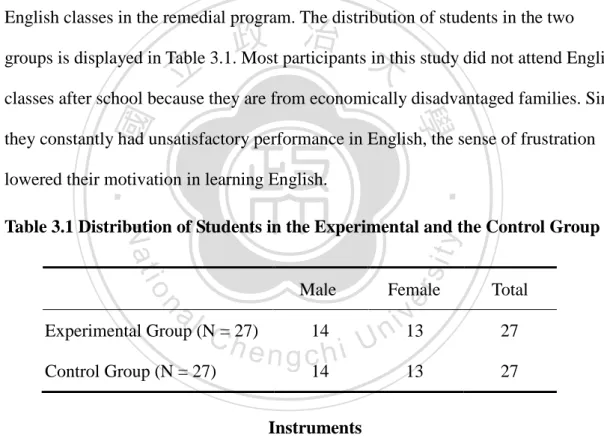
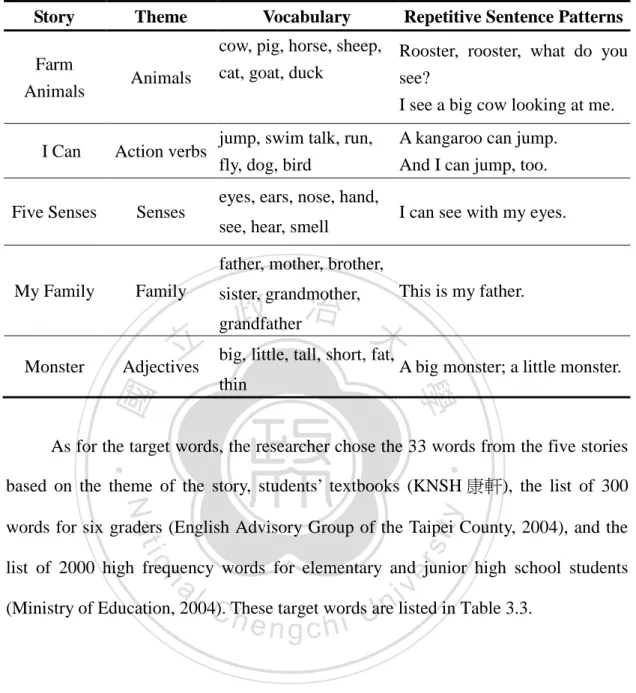
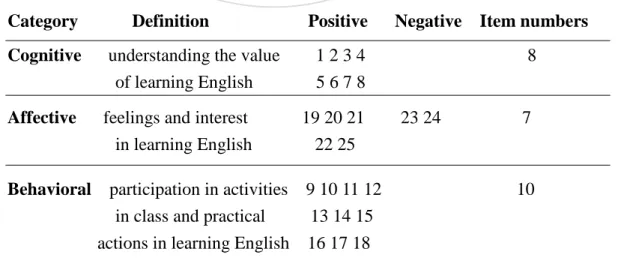
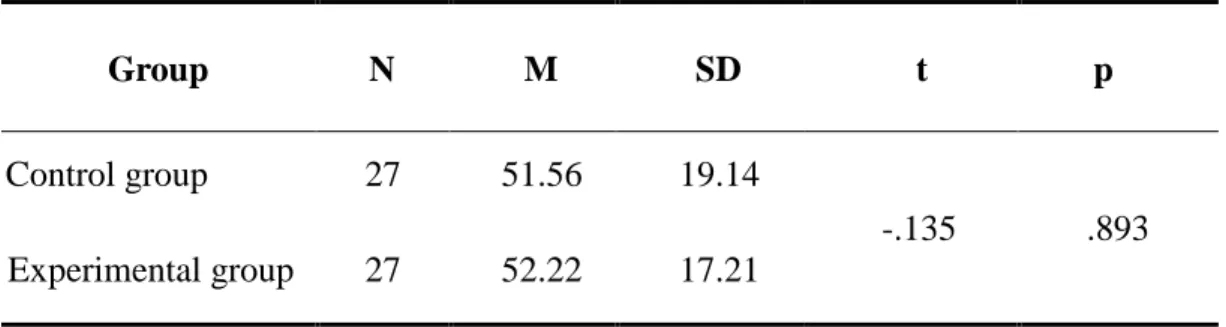
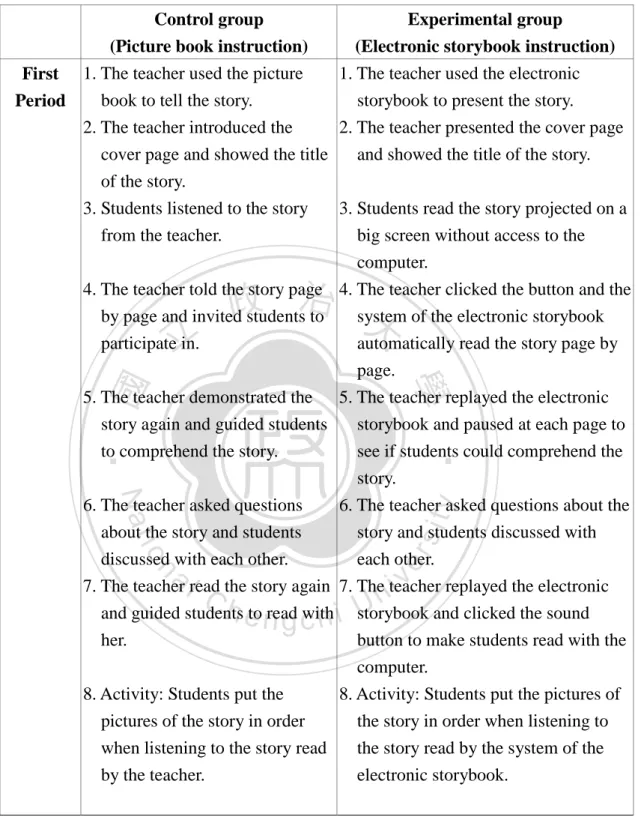
(4) Table of Contents Acknowledgements…………………………………………………………………...iii Chinese Abstract…………………………………………………………………….viii English Abstract………………………………………………………………………ix Chapter One: Introduction……………………………………………………………..1 Background and Motivation……………………………………………………...1 Purpose of the Study……………………………………………………………...3 Significance of the Study………………………………………………………...4 Organization of the Study………………………………………………………...5 Chapter Two: Literature Review……………………………………………………6 The Importance of Vocabulary Learning…………………………………………6 Picture Books and Vocabulary Learning………………………………………8 Picture Books……………………………………………………………….8 The Values of Picture Books………………………………………………..10 Benefits of Picture Books on Vocabulary Learning………………………...14 Electronic Storybooks and Vocabulary Learning………………………………15 Electronic Storybooks………………………………………………………16 The Values of Electronic Storybooks………………………………………20 Benefits of Electronic Storybooks on Vocabulary Learning………………..22 Related Studies of Comparison between Picture Books and Electronic Storybooks………………………………………………………25 Word Recognition……………………………………………………………….26 Remedial Instruction in Taiwanese Context…………………………………….27 English Learning Attitude………………………………………………………29 Critiques on the Previous Research……………………………………………..30 Chapter Three: Methodology………………………………………………………32 Participants……………………………………………………………………...32 Instruments……………………………………………………………………33 Teaching Materials………………………………………………………….34 Taipei County Student English Proficiency Test - Grade 4…………………36 Word Recognition Test……………………………………………………..37 Learning Attitude Questionnaire……………………………………………38 Procedure………………………………………………………………………40 Comparison between the Two Groups in the Pretest…………………………...41 Teaching Process………………………………………………………………..42 Picture Book Instruction…………………………………………………….44 Electronic Storybook Instruction…………………………………………...45. 立. 政 治 大. ‧. ‧ 國. 學. n. er. io. sit. y. Nat. al. Ch. engchi. iv. i Un. v.
(5) Data Analysis…………………………………………………………………47 Chapter Four: Results………………………………………………………………...48 Post-test…...…………………………………………………………………….48 English Learning Attitude Questionnaire………………………………………50 Chapter Five: Discussion…………………………………………………………….58 Effects of Electronic Storybook Instruction on Word Recognition Performance………………………………………………………………58 Effects of Electronic Storybook Instruction on English Learning Attitudes…………………………………………………………………….64 Chapter Six: Conclusion……………………………………………………………68 Summary of Findings…………………………………………………………...68 Pedagogical Implications………………………………………………………70 Limitations of this Study………………………………………………………..72 Suggestions for Future Research………………………………………………..73 References……………………………………………………………………………75 Appendix A: Taipei County Student English Proficiency Test - Grade 4……………82 Appendix B: Word Recognition Test………………………………………………...88 Appendix C: Learning Attitude Questionnaire (Chinese Version)…………………..93 Appendix D: Learning Attitude Questionnaire (English Version)…………………...95 Appendix E: Cameron (2001) Knowing About a Word……………………………...97 Appendix F: Lesson Plan (Control Group)…………………………………………..98 Appendix G: Lesson Plan (Experimental Group)…………………………………100 Appendix I: Worksheet………….…………………………………………………..102. 立. 政 治 大. ‧. ‧ 國. 學. n. er. io. sit. y. Nat. al. Ch. engchi. v. i Un. v.
(6) List of Tables Table 2.1 Examples of Repeated Language………………………………………….10 Table 3.1 Distribution of Students in the Experimental and the Control Group……..33 Table 3.2 Introduction of the Five Stories……………………………………………35 Table 3.3 Sources of the Target Words of this Study…………………………………36 Table 3.4 Internal-consistency Reliability of the Word Recognition Test……………37 Table 3.5 Three Categories of the Learning Attitude Questionnaire…………………39 Table 3.6 Comparison of the Scores on the Pretest of the Word Recognition Test between the Two Groups……………………………………………..........42 Table 3.7 Comparison of the Teaching Process between the Two Groups………..….43 Table 4.1 Comparison of the Scores on the Post-test of the Word Recognition Test. 政 治 大 Table 4.2 Comparison of 立the Listening Section and Reading Section of the Word. between the Two Groups…………………………………………………..48. ‧ 國. 學. Recognition Test between the Two Groups………………………………..50 Table 4.3 Comparison of the Scores on the Pre-questionnaire between the Two Groups……………………………………………………………………..50. ‧. Table 4.4 Comparison of the Scores on the Post-questionnaire between the Two. n. al. er. io. sit. y. Nat. Groups……………………………………………………………………..51 Table 4.5 Three Categories of Attitude in the Post-questionnaire between the Two Groups……………………………………………………………………..52 Table 4.6 Comparison of the Items in the Cognitive Category of Attitude in the Post-questionnaire between the Two Groups……………………………...54. Ch. engchi. i Un. v. Table 4.7 Comparison of the Items in the Affective Category of Attitude in the Post-questionnaire between the Two Groups……………………………...56 Table 4.8 Scores between the Pre- and Post-questionnaire within the Experimental Group………………………………………………………………………57. vi.
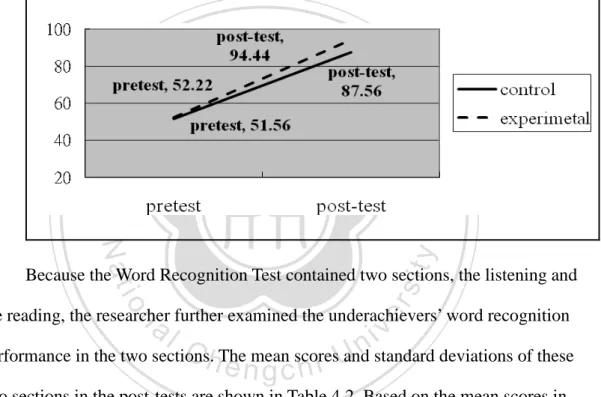
(7) List of Figures Figure 3.1 Procedure of the Study……………………………………………………41 Figure 4.1 Developmental Curves of the Pretest and Post-test of the Two Groups’ Word Recognition Test…………………………………………………...49. 立. 政 治 大. ‧. ‧ 國. 學. n. er. io. sit. y. Nat. al. Ch. engchi. vii. i Un. v.
(8) 中文摘要 本研究在探討英語電子繪本教學對於國小學生在認字表現以及學習態度的影 響。此研究以 54 位來自台中市四年級英語低成就的小學生為研究對象,他們分 別來自 7 個不同的班級,這 54 位學生被分成實驗組跟對照組,兩組無論在數量、 性別、背景以及認字表現上皆相似。實驗組實施電子繪本教學而對照組則實施紙 本繪本教學,每週上課一次,經過 16 週的教學後,兩組皆進行認字表現測驗及. 政 治 大. 施以英語學習態度問卷。蒐集測驗及問卷所得的資料以獨立樣本 t 檢定及相對樣. 立. 本 t 檢定來進行統計分析,研究結果顯示實驗組及對照組在認字表現及學習態度. ‧ 國. 學. 皆有顯著差異,電子繪本組在認字表現測驗成績比紙本繪本組好,而且英語低成. ‧. 就學生在電子繪本教學後,學習態度有正向的改變。希望實驗的結果能幫助老師. Nat. 結果,對未來研究方向提出一些建議。. n. al. Ch. engchi. viii. er. io. sit. y. 提升學生的認字能力並且廣泛推行英語電子繪本教學。最後,研究者根據實驗的. i Un. v.
(9) Abstract This study investigated the effects of the electronic storybook instruction on the word recognition performance of elementary school students. Additionally, the effects of the electronic storybook instruction on students’ English learning attitudes were explored. Fifty four fourth-grade underachievers selected from seven classes at an elementary school in Taichung City were the participants of this study. The participants were divided into two groups and they were matched based on the numbers, gender, background, and word recognition performance. The control group received picture book instruction, while the experimental group took electronic. 治 政 storybook instruction once a week. The Word Recognition 大 Test and Learning Attitude 立 Questionnaire were administered to both groups after the 16-week instruction. The ‧ 國. 學. data collected from pre-test, post-test, pre-questionnaire, and post-questionnaire were. ‧. analyzed by an independent samples t test and a paired samples t test. The results. sit. y. Nat. showed there were significant differences between the two groups in their word. io. er. recognition performance and English learning attitudes. The results presented that the. al. underachievers receiving electronic storybook instruction performed significantly. n. iv n C better than those who received picture instruction on word recognition h e nbook gchi U. performance. Moreover, it was found that electronic storybook instruction positively changed the underachievers’ English learning attitudes. It is hoped that the findings will help teachers improve students’ word recognition ability and promote the widely adoption of electronic storybooks. Based on the findings of this study, some suggestions for the future research were offered at last. Keywords: e-books, word recognition, English learning attitudes, underachievers, remedial instruction. ix.
(10) CHAPTER 1 INTRODUCTION This study used electronic storybooks as teaching materials in order to help underachievers learn English more efficiently. This chapter consists of four sections and provides an overall introduction of this study. First, it presents the background information and motivation of the study. Second, the relevant literature is reviewed and the purpose of this study is stated. Third, the significance of the study is described in detail. At last, the organization of the study is demonstrated in this chapter.. 政 治 大 Nowadays, English is believed to be an important key to open a window to the 立 Background and Motivation. ‧ 國. 學. world. Therefore, the importance of English teaching is strongly emphasized. In 2005, the Ministry of Education (MOE) required all the elementary school students to learn. ‧. English from the third grade; two periods of English classes per week were required.. Nat. sit. y. In order to promote students’ English learning, currently, English courses have been. n. al. er. io. implemented starting from the second grade at elementary schools in Taichung City.. i Un. v. Nevertheless, teachers have been challenged in teaching students with different. Ch. engchi. English proficiency simultaneously. Seventy-six percent of the elementary school teachers in Taiwan perceived the proficiency gap among students and this gap made English teaching more difficult (Lin, 2001). Students’ English proficiency is heterogeneous in one class, so it is hard for teachers to meet every student’s need for all levels. Since most students already took English courses at cram schools before entering elementary schools, those who have not had any English training could be classified as underachievers in class (Chen, 2004). Low achievers do not have interests and are in lack of motivation in learning English. According to the United. 1.
(11) 2. Daily News in March 2009, it is believed that the earlier students learn English, the earlier they give up. In view of this, it is imperative to implement remedial instruction to enhance underachievers’ English learning and to arouse their interest in English. It is necessary for teachers to select various materials to meet underachievers’ needs and attract their attention. Most investigators agreed that picture books are appropriate and interesting for students to learn English. Sheu (2008) addressed three educational values of using picture books perceived by English teachers in Taiwan: (a) the linguistic value, (b) the value of the story, and (c) the value of the picture. Furthermore, Wu (2005) indicated that using English picture books as teaching. 治 政 materials in remedial instruction could enhance students’ 大 motivation, increase their 立 comprehension, lower their anxiety, build up their confidence, and improve their ‧ 國. 學. vocabulary learning. Since there are many benefits of picture books, English teachers. ‧. can make good use of them in English remedial programs. With the advance of. sit. y. Nat. technology, there are many valuable resources that can be integrated into English. io. al. er. teaching. Internet resources and multimedia, appropriately used, can provide authentic materials for English learning, increase students’ motivation, and have positive. n. iv n C influence on students’ achievement 2004; Lin, 2008). Electronic storybooks h e(Chen, ngchi U might be good materials for teachers to choose in remedial instruction. Higgins and Cooks (1999) supported that electronic storybooks have the same words and illustrations as picture books, but they have additional features that are not available in picture books. Sound effects accompanying the narration, animations, pronunciation of individual words, and colorful pictures in electronic storybooks have a powerful motivating force to capture students’ attention and enhance their vocabulary development (Grant, 2004; Higgins & Cooks, 1999; Matthew, 1995). As a result, electronic storybook is a promising tool to use at elementary schools..
(12) 3. Purpose of the Study Previous studies mostly compared the effects of electronic storybooks with those of picture books on students’ reading comprehension (Greenlee-Moore & Smith, 1996; Matthew, 1997; Standish, 1992). However, only a number of researchers have reported the influence of electronic storybooks on elementary school students’ vocabulary learning (Doty, Popplewell, & Byers, 2001; Lefever-Davis & Pearman, 2006). Even fewer researchers focused on the effects of electronic storybooks on students’ word recognition performance in remedial instruction (Liu, 2005). Many researchers regarded electronic storybooks as valuable resources for. 治 政 teachers to use. The animations, sound effects, and大 colorful pictures of electronic 立 storybooks could attract underachievers’ attention and help them understand the ‧ 國. 學. meaning of the word in the story (Higgins & Cocks, 1999; Lefever-Davis & Pearman,. ‧. 2006; Lin, 2009). Additionally, the oral reading fuction of electronic storybooks could. sit. y. Nat. provide an accurate model for underachievers to imitate (Lefever-Davis & Pearman,. io. al. er. 2006). Nevertheless, not all investigators agreed that the oral reading function and animations of electronic storybooks are beneficial to these learners. Lewin (1996) and. n. iv n C Mckenna (1998) proposed that h overly depending on e n g c h i U the use of computer. pronunciation might hinder children’s development to decode words. Besides, Trushell et al. (2003) and Yang (2005) argued that animations of electronic storybooks could distract students’ attention from the meaning of the story. There is no sufficient research about the effects of electronic storybooks on students’ word recognition performance and there is a conflict among investigators of previous studies over the benefits of electronic storybooks. Therefore, the researcher attempted to investigate the effects of electronic storybook instruction on elementary school students’ word recognition performance in remedial instruction. In addition, the influence of electronic storybook instruction on students’ attitudes should be.
(13) 4. further explored because attitudes have a great impact on students’ learning. Nevertheless, only few studies examined the effects of electronic storybooks on students’ attitudes (Lin, 2009; Liu, 2005). The researcher conducted this study to see if there were attitudinal changes in students’ English learning. The two research questions of this study are listed as follows. 1. Is there any significant difference in underachievers’ word recognition performance and/ or English learning attitudes between the electronic storybook group and the picture book group? 2. Does electronic storybook instruction change underachievers’ attitudes toward learning English?. 立. 政 治 大. Significance of the Study. ‧ 國. 學. Since the implementation of Nine-Year Integrated Curriculum in Taiwan,. ‧. English education has been extended to the third grade at elementary schools. For. sit. y. Nat. most elementary school teachers, it has been an enormous challenge to teach students. io. al. er. of different levels in one class and to make underachievers more interested in learning English. Consequently, it is necessary for teachers to conduct remedial instruction.. n. iv n C This study investigated the h influence i U storybook instruction on the e n g cofhelectronic. word recognition performance and learning attitudes of the fourth-grade underachievers. The findings may provide some useful insights for teachers that electronic storybooks can be valuable resources for underachievers in recognizing words. The results might give teachers suggestions that they could adopt various materials to enhance students’ learning motivation and meet the needs of students. Furthermore, the findings might benefit teachers to gain a deeper insight into the importance of word recognition ability to low achievers. The results of this study might also inspire textbook editors or publishers to provide electronic storybooks as supplementary materials for teachers to use in class..
(14) 5. Organization of the Study This study consists of six chapters. Chapter One presents motivation, the purpose of the study, the significance of the study, and the organization of the study. Chapter Two reviews relevant studies, including the importance of vocabulary learning, electronic storybooks, picture books, word recognition, remedial instruction, and English learning attitudes. The method and procedure of this study are presented. The results and findings of the study are shown in Chapter Four and discussed in detail in Chapter Five. The last chapter provides some pedagogical implications for English teachers and offers suggestions for the future studies to rectify the limitations of this study as well.. 立. 政 治 大. ‧. ‧ 國. 學. n. er. io. sit. y. Nat. al. Ch. engchi. i Un. v.
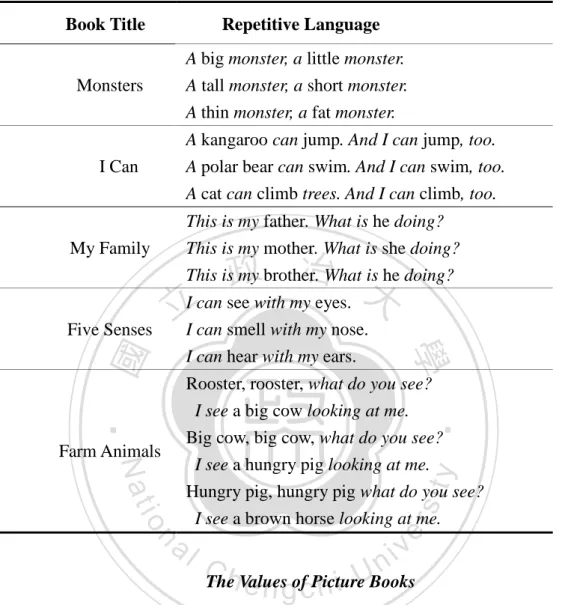
(15) CHAPTER 2 LITERATURE REVIEW The study aims to compare the effects of electronic storybooks with those of picture books on fourth graders’ English word recognition performance and learning attitudes in remedial instruction. This chapter presents relevant literature in six sections: The first section describes the importance of vocabulary learning. Section two reviews studies related to picture books and vocabulary learning. Section three elaborates on studies concerning electronic storybooks and vocabulary learning. Section four reviews literature about word recognition. Section five explores remedial. 治 政 instruction focusing on vocabulary learning in Taiwan 大and the last section deals with 立 English learning attitudes. ‧ 國. 學 Importance of Vocabulary Learning. ‧. Vocabulary acquisition plays a vital role in English teaching and it is essential. Nat. sit. y. to language learning. The importance of vocabulary is now more widely recognized,. n. al. er. io. compared with the case 40 years ago (Graves, 2009). Many scholars have claimed. i Un. v. that vocabulary has a great influence in one’s language proficiency in the four. Ch. engchi. language skills (Coady, 1979; Laufer, 1997; Ridway, 1997). These studies have shown that vocabulary knowledge and language proficiency are closely related. Vocabulary knowledge is one of the most important indicators of verbal ability (Sternberg, 1987). Vocabulary specialists agreed that vocabulary is at the heart of communicative competence, the ability to communicate properly and successfully (Coady & Huckin, 1997). Without vocabulary, it is impossible to communicate with others and then conversation will be disjointed. Wilkins (1972) declared that “Without grammar, there is very little can be conveyed; but without vocabulary, there is nothing can be conveyed (p.111).” You can say anything with words, but you can say very. 6.
(16) 7. little with grammar. Provided that children are lack of useful vocabulary, it will be hard for them to express their own opinions and speak fluently. Since vocabulary problems can interfere with communication, children have to learn more words and expressions. If children want to have great improvement in learning English, they have to spend time learning vocabulary. In view of this, it is necessary for teachers to underline the importance of vocabulary instruction and help students enlarge their vocabulary. There is a strong relationship between vocabulary and reading comprehension. It has been shown that students’ level of vocabulary knowledge is a significant. 治 政 predictor of reading fluency and reading comprehension 大 for English learners (Grabe, 立 1991). It is obvious that reading comprehension depends on understanding speech, ‧ 國. 學. which relies on understanding the meanings of words (Bloom, 2000). Davis (1994). ‧. also advocated that word knowledge is crucial to reading comprehension. If students. sit. y. Nat. learn more words, they will understand the text better. It is impossible for children to. io. al. er. comprehend the text without knowing what the words mean. Lacking of vocabulary will become a major obstacle for students to read. Therefore, teachers should place. n. iv n C strong emphasis on vocabulary h instruction. Since U e n g c h i vocabulary knowledge is. fundamental to reading comprehension, teachers have to know what kind of vocabulary instruction is effective in improving reading comprehension. Mason and Au (1986) stated that it is necessary to provide a meaningful context for children to learn vocabulary. Students can learn vocabulary more efficiently if they encounter new words repeatedly in a meaningful context. What teachers have to do first is to realize what students’ difficulty is in learning new words. Moreover, teachers have to provide various materials such as storybooks or online English resources and design suitable programs for children to learn vocabulary successfully and effectively..
(17) 8. Picture Books and Vocabulary Learning Some studies have proved that children’s language learning has much to do with children’s literature experience (Cullinan, 1989; Wu, 2005). This section explains what picture books are, describes their values, and specifies their benefits on vocabulary learning. Picture Books Picture books, also called picture story books or storybooks, refer to books that convey information or tell stories through pictures and texts (Strasser & Seplocha, 2007). A picture book is a book in which the pictures are as important as the words or. 治 政 even more important than the words. In picture books, 大 there are illustrations on every 立 page with little text. Pictures which help readers understand the concept of the story ‧ 國. 學. play a significant role in picture books. Nevertheless, both the picture and the text are. ‧. important because “neither of them is completely effective without each other”. sit. y. Nat. (Norton, 1999, p.214). The story line is short, the concept of the story is simple, the. io. al. er. text is direct, and the illustrations are consistent with the text in picture books (Jalongo, 2004). The illustrations in the picture books can be photographers, collage,. n. iv n C paintings, as well as drawings (Strasser 2007) that can stimulate h e n g&cSeplocha, hi U children’s imagination and bring them to enter the imagining world.. There are various types of picture books, inclusive of toy books, alphabet books, counting books, interactive books, picture storybooks, wordless books, pattern books, concept books, easy-to-read books, and so forth (Lynch-Brown & Tomlinson, 1999). According to the format, Glazer (1997) classified children’s books into different types such as toy books, board books, picture books, wordless picture books, chapter books, illustrated books, and junior novels. The format refers to the physical appearance, organization or layout of the book such as size, shape, style, binding, quality of paper, margins, design, etc. A good format will make the book more attractive and.
(18) 9. successful. Liao (1999) categorized picture books into three types: alphabet books, predictable books, and easy-to-read books. The alphabet book provides children with a meaningful context to learn the 26 English letters. Children can learn the English alphabet in a vivid and interesting way through stories. Since the letters in the stories are colorful, lively, and personified, learning the alphabet is no longer abstract or boring. Chicka Chicka Boom Boom, Dr. Seuss’s ABC and Alphabet Ice Cream are examples of alphabet books. As for predictable books and easy-to-read books, they can not be clearly distinguished. Lynch-Brown and Tomlinson’s (1999) did not. 治 政 include predictable books in the types of picture books. 大 Liao (1999) stated that the 立 language and sentence patterns in predictable books are more complicated than those ‧ 國. 學. in easy-to-read books. Many predictable books make good use of rhyme to develop. ‧. children’s English language skills (Linse, 2007). Predictable books provide repetitive. sit. y. Nat. and predictable sentence patterns for children to read and memorize the stories more. io. al. er. easily. In addition, the patterns of predictable books are continuous and cumulative (Du, 2006). The stories, Brown Bear, Brown Bear, What do you see, The Very Hungry. n. iv n C Caterpillar, and Goodnight Moon kind. Easy-to-read picture books contain h earenofgthis chi U repetitive language and predictable patterns as predictable books, but the sentence patterned are not continuous or cumulative. Picture books that introduce numbers, animals, or body parts are the examples of easy-to-read books (Du, 2006). The stories except Farm Animals adopted by the researcher in the present study are classified as easy-to-read books. The four stories contain simple language and repetitive sentence patterns, but they are not continuous or cumulative. Farm Animals is a predictable book because the sentence patterns of the story are not only repetitive but also continuous. The table below lists the examples of repetitive language in the five stories. They are good materials for children to read and promote their language.
(19) 10. development. Table 2.1 Examples of Repetitive Language Book Title. Repetitive Language. Monsters. A big monster, a little monster. A tall monster, a short monster. A thin monster, a fat monster. A kangaroo can jump. And I can jump, too. A polar bear can swim. And I can swim, too. A cat can climb trees. And I can climb, too.. I Can. I can hear with my ears.. 學. ‧ 國. Five Senses. 政 治 大 see with my eyes. 立II can can smell with my nose.. ‧. sit. y. Nat. Farm Animals. io. Rooster, rooster, what do you see? I see a big cow looking at me. Big cow, big cow, what do you see? I see a hungry pig looking at me. Hungry pig, hungry pig what do you see? I see a brown horse looking at me.. n. al. er. My Family. This is my father. What is he doing? This is my mother. What is she doing? This is my brother. What is he doing?. iv n C hValues The e n gofcPicture h i UBooks. There are many advantages of picture books in promoting children’s language learning. Many studies have shown that children’s language development is enhanced by the exposure to children’s literature. Accordingly, the use of picture books as teaching materials is more and more popular. Picture books provide children a meaningful and memorable context instead of boring and mechanical language learning. The values of picture books demonstrated by previous studies are described as follows:.
(20) 11. Providing Authentic Materials Wu (2005) expressed that picture books that are authentic materials can offer children a real and meaningful context to learn a language. The theme and content of the picture books are always related to children’s life experiences. Picture books can help children experience the world where they live. Take the story No, David for example. It describes a naughty boy who makes troubles all the time and his mom always says “No, David!” When children read this book, they might take themselves as the character in the story because they have the same kind of experience in their daily life. Picture books have the function of connecting experiences from home and. 治 政 family to stories (Strasser & Seplocha, 2007). Through 大 reading picture books, 立 children can learn how to solve the problems, learn how to treat people around them, ‧ 國. 學. and learn to care about the society. All in all, picture books are one of the most. sit. y. Nat. Facilitating Language Development. ‧. important authentic materials in learning English.. io. al. er. Cullinan (1989) pointed out that children’s literature can not only enhance their own language learning but also accelerate their second or foreign language. n. iv n C development. Sheu (2008) proposed values of using picture books h e ntheglinguistic chi U perceived by the teachers in Taiwan. Most of the teachers maintained that picture books can be used to help students review words and sentences that they have learned in the textbook in a meaningful context (Sheu, 2008). Littlewood (1981) further claimed that learners should be exposed to different kinds of situations to know how to use the language to express its meaning. Picture books provide different kinds of situations, so that students can learn how a word is used in different circumstances. Additionally, pictures or illustrations of the stories can increase students’ comprehension of the story and promote language learning. Sheu (2008) maintained that the illustrations of the picture books could be a learning aid to facilitate students’.
(21) 12. English learning. When students look at the picture, they have an impression of the meaning of the word. Therefore, they can recall the word easily. Goodman (1986) advocated that children should learn a language in a meaningful, natural, and authentic context. Picture books provide a comprehensible input, so children can develop language skills naturally through picture books. Through listening to stories, children’s oral and written abilities could be enhanced (Strickland & Morrow, 1989). In short, picture books are valuable resources to accelerate children’s language development. Enhancing Learning Motivation and Interests. 治 政 Picture books can arouse students’ interest and 大enhance their motivation in 立 learning English. Sheu (2008) proposed the values of stories in the picture books and ‧ 國. 學. pointed out that a good story could attract students and motivate them to learn English.. ‧. The content of the story is important and it is good to have a dramatic ending that is. sit. y. Nat. out of children’s expectation (Sheu, 2008). Children are easily fascinated by good. io. al. er. stories; therefore, they would like to hear them numerous times. Besides, with powerful and vivid illustrations, picture books are able to hold children’s attention and. n. iv n C encourage them to learn English. also provide pleasure for children h Picture e n gbooks chi U. when reading. Chien and Huang (2002) claimed that “the repetitious structures and the element of fun in the story invariably make reading easy and are intrinsically motivating for young learners (p. 265).” In sum, picture book plays a significant role in entertaining children and motivating them to learn English. Stimulating Imagination and Creativity Pictures in the picture books can stimulate children’s imagination and improve their creativity (Hsu, 2005; Sheu, 2008; Wu, 2005). Through pictures, children seem to enter a different world and they can experience everything never happened in their real life. Picture books can help children accept different lifestyles and liberate them.
(22) 13. from their own perception of the world. Lee (1998) proposed that picture books help children escape from the limits of the physical world. Cho and Kim (1999) also asserted that good picture books have a power to expand children’s imagination, stir their senses, stimulate their creativity, and help them to visualize new concepts. Picture books are always full of magic elements that can solve difficult problems creatively and easily. Through picture books, children can exercise their imagination and expand their perspective of the world. In view of this, teachers have to enhance children’s creative potential and give them chances to create their own interpretation. Enriching Cultural Knowledge. 治 政 Through reading picture books, children can大 understand cultural differences, 立 enrich cultural knowledge, and learn to respect other cultures. According to Kress and ‧ 國. 學. Van Leeuwen (1996), picture books could help to increase understanding of other. ‧. cultures and encourage tolerance of different viewpoints. Picture books offer excellent. sit. y. Nat. opportunities for children to raise their cultural awareness and allow children to. io. al. er. accept interpretation different from their own opinions (Oster, 1989). Since many picture books introduce festivals of different countries, they give children an insight. n. iv n C into various cultures and offer children to learn to be tolerant of different h e n gchances chi U. viewpoints. Picture books are good resources for teachers to enrich children’s cultural knowledge and to develop children’s critical thinking. Teachers should teach children to appreciate other cultures and view things from different angles. Lowering Anxiety Since picture books are interesting and entertaining, they can help children release their emotions and lower their anxiety in language learning. Krashen (1980) proposed the theory of the affective filter hypothesis and he found that students could learn better in low-anxiety situations. Picture books not only provide pleasure but also build up confidence. Through reading picture books, children can forget the burden of.
(23) 14. learning. Besides, they are fascinated by the plots of the story and enjoy themselves in reading. Since it is more effective for children to learn in a low-anxiety environment, teachers should make good use of picture books to promote children’s language learning. Developing Reading Habits Picture books can enhance children’s motivation to read willingly and thus develop children’s reading habits (Hsu, 2005; Tomlinson & Lynch-Brown, 1999). Huck, et al. (1997) advocated that children’s reading habits and could be developed through the process of reading picture books aloud to them. Every child enjoys. 治 政 listening to stories, so teachers can help them develop 大good reading habits by reading 立 stories aloud to them. ‧ 國. 學. Benefits of Picture Books on Vocabulary Learning. ‧. Many studies have proved the effects of stories on vocabulary acquisition. sit. y. Nat. (Cameron, 2001; Elley, 1989; Jenkins et al., 1984; Nagy et al., 1985; 1987; Robbins &. io. al. er. Ehri, 1994). Effective vocabulary instruction through picture books can enhance students’ vocabulary learning. Since children learn words better in a meaningful. n. iv n C context, it is effective for them h to build vocabularyUthrough picture books. engchi. Additionally, teachers should relate the words to students’ familiar concepts by building on their prior knowledge and providing chances for students to use new vocabulary to describe their life experiences (Nagy, 1988). Picture books containing repetitive words and sentence patterns are beneficial to promote students’ vocabulary learning. When words occur many times in a storybook, children’s vocabulary learning would be facilitated (Elley, 1989; Justice, Meier, & Walpole, 2005). The number of times a word occurs in a story has a lot to do with the possibility that children learn that word. As a result, teachers should choose picture books with words and sentence patterns that are full of repetition. Children’s.
(24) 15. vocabulary learning is regarded as a gradual process, so it is important for children to be exposed to new words through repeated reading of picture books. Hargrave and Senechal (2000) confirmed that children’s language development is further enhanced when teachers read a story to children with the explanation of specific words, dialogues about the new words and questions about the story. These activities make students involved when the teacher tells the story, and thus students’ vocabulary learning is facilitated. Children gain more vocabulary with the explanation of the meaning of a word by teachers when listening to stories (Brett, Rothlein, & Hurley, 1996; Elley, 1989). Students can learn new vocabulary easily with a brief. 治 政 explanation of new words by teachers as they encounter 大 these words in the stories. 立 Generally speaking, vocabulary gains are greatest as the meanings of words are ‧ 國. 學. directly discussed or deeply processed (Dickinson, 1984; Elley, 1989).. ‧. Different types of interaction during storybook reading may have different. sit. y. Nat. effects on the acquisition of children’s receptive and expressive vocabulary. Senechal. io. al. er. (1997) discovered that answering questions during storybook reading is more helpful to the acquisition of children’s expressive vocabulary than their receptive vocabulary,. n. iv n C while listening to storybooks increases of both expressive and h e n gthecacquisition hi U. receptive vocabulary. Teachers need to understand that children need more than one exposure to a storybook to learn new words, so the teachers can ask simple questions and provide interactive opportunities for children to actively participate during the storybook reading (Senechal et al., 1995). There are many benefits of picture books in promoting children’s vocabulary learning. Picture books can provide a low-cost and authentic activity for children’s vocabulary development. In view of this, if teachers can make good use of picture books in English teaching and provide effective instruction during storybook reading, students’ vocabulary learning will be accelerated..
(25) 16. Electronic Storybooks and Vocabulary Learning Several studies have proved that electronic storybooks with features such as colorful pictures, animations, sound effects, highlighting function, etc. can enhance students’ vocabulary learning (Grant, 2004; Lin, 2009; Mckenna, 1998). Recently, electronic storybooks, a form of multimedia software, become very popular among teachers and students. This section introduces electronics storybooks first and then describes the values of electronic storybooks. At last, the benefits of electronic storybooks on vocabulary learning are specified in detail.. 立. Electronic治 Storybooks 政 大. Electronic storybook (ES), also known as CD-ROM storybook, e-book, or. ‧ 國. 學. animated storybook, presents stories with text, illustrations, sound, audio, video, graphics, and animations where book character talks and settings come alive. ‧. (Lefever-Davis & Pearman, 2006; Shamir & Korat, 2006). Technologies have. Nat. sit. y. dramatically changed the format and presentation of the stories in their look and feel. n. al. er. io. to electronic storybooks. Chen (2002) pointed out three features of the electronic. i Un. v. storybook: (a) the text, sound, audio, video, graphic, and animation are used to present. Ch. engchi. the plot of the story, (b) it is interactive, and (c) the content of the story is both educational and entertaining. However, there is not one simple definition of what makes an ES. Technologies with simple interaction such as cartoon videos with sound effects and animations are at one hand of the scale; at the other end of the scale are the more advanced products that imitate the human experience of storytelling (Chen, Ferdig, & Wood, 2003). There are various types and diverse formats of electronic storybooks; they vary according to the quality of presentation, medium of delivery, ease of use, educational value, and so on (Chen, Ferdig, & Wood, 2003). Chen, Ferdig, and Wood (2003).
(26) 17. categorized ESs into four types in light of various features from simple to complex, including interactive toys and games, educational CD-ROMs, web-based storybooks, and story-sharing tools. Interactive Toys and Games This category of ESs includes interactive toys and games that tell children stories, help them learn how to tell stories, and develop their story-creating abilities. The main characteristics of this category contain game-access learning, the interaction between the user, the electronic medium, real-world simulations, non-linear user control, feedback-based programs, etc. Oravec (2001) has demonstrated that. Educational CD-ROMs. 學. ‧ 國. 治 政 interactive games and toys could be important to children’s 大 education and could 立 change the way children think and behave. ‧. This type of ES exists exclusively on CDs in a closed environment. Educational. sit. y. Nat. CD-ROMs combine content with music, sound, movies, audio-video clips, graphics,. io. al. er. animations, slide shows, and hypermedia without using hyperlinks to the Internet’s websites. Educational CD-ROMs, involving the learner in the simulated environment. n. iv n C on the CD, focus on delivering h knowledge or training e n g c h i U in some specific topic.. CD-ROM talking book, which is the electronic version of stories, is an example of this category. CD-ROM talking books, integrating music, sound, animations, and other digital media, are interactive. Learners can have the text re-read for them and hear the pronunciation of the words when they see animations. Several studies indicated that CD-ROM storybooks could improve students’ comprehension and motivate students to read (Doty, Popplewell, & Byers, 2001; Matthew, 1997). Besides, CD-ROM storybooks provide learners with immediate support and allow them to focus on the meaning rather than to decode words (Doty, Popplewell, & Byers, 2001)..
(27) 18. Web-based ESs Web-based Electronic Storybooks, which are online resources, can be divided into three sub-categories from the simple to the integrated version. 1. One dimensional ES One dimensional ES use hypertext on the Internet for readers to browse the stories online with the application of the mouse and keyboard. This type of ES contains text illustrations, graphics, linear links, story plot, but this ES does not include the elements such as animations or audio. However, this type of ES adds many links or resources for learners to visit. 2. Multi-dimensional ES. 立. 政 治 大. This type of ES includes symbolic graphics, musical background, and simple. ‧ 國. 學. animations that can attract children’s attention. The simple animations of this ES can. ‧. make still pictures become dynamic. This type of ES lacks vocal storytelling, the. io. 3. Hypermedia ES. al. er. story and helps them gain deeper meaning.. sit. y. Nat. audio of this ES is used as background music that involves readers in the mood of the. n. iv n C Hypermedia ES owns thehfeatures of one-dimensional and multi-dimensional engchi U. ES. This ES contains storytelling items and integrates graphics, animations, videos, and audio. The audio in this ES includes not only background music but also spoken word and supporting sounds that create the mood or setting of the story. All these features of the hypermedia ES are connected to tell a rich and multi-sensory story. Story-sharing tools In this category, it focuses on the sharing of students’ created storybooks through the web instead of existing stories. These ESs offer readers opportunities to interact with others, write stories from prompts being provided, and read stories written by others online. This category contains stories created by users in the virtual.
(28) 19. internet and provides ample opportunities for creativity. The main characteristics of this ES include user control, an open-ended environment on the Internet, non-linear story playing, self-expression, feedback programs, and so forth. This type of ES provides children with chances to write online that makes children become meta-cognitive about their writing (Strassman & D’Amore, 2002). Zeng (2004) divided electronic storybooks into two types according to the ways to read, including interactive ES and non-interactive ES. 1. Interactive ES The content of the story in this ES is the same as that in the printed books. A. users to choose instead of linear modes.. ‧. 2. Non-interactive ES. 學. ‧ 國. 治 政 series of games are designed in this ES and a brief 大 animation related to the word is 立 displayed when the user clicks the word. It offers different plots of the stories for. sit. y. Nat. This type of ES adopts linear user control when reading. The plot of the story is. io. al. fixed and can not be changed.. er. played in order, but users can stop at any scene they like. The ending of the story is. n. iv n C The electronic storybookshused in the present e n g c h i Ustudy are free online resources. from the website Kizclub. The researcher chose the five electronic storybooks, evaluated as level one, for the participants of this study. On the average, a sentence is at each page, and the sentence pattern is repetitive. The five electronic storybooks show the text with illustrations and animations. Additionally, the story character models fluent reading and highlights the words as she works through the text. Readers can hear the sentence read again and again if they click on the sound button. Furthermore, they have to click the right arrow button in order to move to the next page. Of course, they can move back to the previous page by clicking the left arrow button. The five electronic storybooks are web-based ESs because they are online.
(29) 20. resources. They are hypermedia ES since they contain animations, graphics, and vocal story telling. Moreover, they are non-interactive ES because readers can not choose the plots of the story. The ending of the five stories is fixed. The electronic storybooks used in this study are basic and helpful to underachievers in English learning. The Values of Electronic Storybooks There are many advantages of electronic storybooks and they are seen as valuable tools in educational settings (Liu, 2005; Yang, 2005). The values of electronic storybooks proposed by previous studies are listed as follows.. 政 治 大 Many researchers have investigated the impact of electronic storybooks on 立. Promoting Reading Comprehension. ‧ 國. 學. reading comprehension (Doty, Popplewell, & Byers, 2001; Greenlee-Moore & Smith, 1996; Higgins & Hess, 1998; Matthew, 1997). Lefever-Davis and Pearman (2006). ‧. advocated that electronic storybooks build the story setting through animated graphics. Nat. sit. y. and sound effects that express the mood and events of the story, so students’. n. al. er. io. comprehension can be fostered. Sound effects that put the readers in the setting and. i Un. v. suggest the upcoming events can promote students’ reading comprehension. Reading. Ch. engchi. aloud by the computer can help children remove the burden of decoding words; therefore, fluent reading is not interrupted and the meaning of the story is maintained (Mckenna, 1998). It is well-known that sight word acquisition is crucial to reading fluency. Repeated reading of electronic storybooks can result in gains in sight word acquisition and develop reading fluency (Mckenna, 1998). If children can recognize the words automatically, their reading rate will be increased and they can understand the meaning of the text easily. Motivating Students to Read Many studies have shown that the animations and sound effects of electronic.
(30) 21. storybooks can arouse students’ interests and enhance their motivation in language learning. The animations of electronic storybooks can make the flat images alive and attract children’s attention (Chen, Ferdig, & Wood, 2003). The animations also provide an entertaining value for students to read joyfully. The sound effects, animations, and other features of electronic storybooks add pleasure and increase motivation for children to explore the story (Shamir & Korat, 2006). Lefever-Davis and Pearman (2006) further indicated that animated storybooks can not only prolong students’ attention and engagement with texts but also motivate students to read through the use of animations. In addition, some electronic storybooks use different. 治 政 voices for each character, and this makes reading more 大 interesting. Since children like 立 role playing, electronic storybooks can increase students’ learning motivation by ‧ 國. 學. modeling the voices of characters in the story. In sum, the additional features such as. ‧. animations and sound effects that are not available in traditional picture books can. io. al. er. Increasing Self-efficacy. sit. y. Nat. motivate students to read and increase their reading enthusiasm.. Students can have the electronic storybooks read aloud to them several times. n. iv n C without requiring the patience of hteachers i Uso as to increase feelings of e n g corhadults self-efficacy (McNabb, 1998). Since electronic storybooks are able to provide immediate assistance to children, teachers or adults can remove the burden of. providing instant attention to children (Doty, Popplewell, & Byers, 2001). Even though the assistance from teachers or parents is not available, students can imitate the computer to read and engage in repeated reading through ESs. Readers can select which word or sentence they need support and rehearse the computer pronunciation without embarrassment. Besides, they can control the pace of reading. Readers can self-select where to pause when they can not understand the meaning of the text while reading. In view of this, students can become more confident and self-reliant in.
(31) 22. English learning through the use of electronic storybooks. Enhancing Oral Ability Johnston (1995) provided evidence that children’s verbal abilities were enhanced through electronic storybooks. These devices include auditory features that can automatically read aloud the story and provide an accurate model for children to mimic. Children can listen to the pronunciation of words spoken by the computer and then follow it to read. Children need sufficient listening input before they are ready to speak. Accordingly, electronic storybooks which can be replayed for children to imitate the pronunciation of words and the reading of the story are able to facilitate. 治 政 children’s oral ability. Electronic storybooks provide 大a fluent model of expression, 立 intonation, and punctuation pauses as well for learners to facilitate their oral ‧ 國. 學. proficiency (Lefever-Davis & Pearman, 2006). Students can have the computer read. ‧. the entire lines and then follow up by reading the same lines on their own. Students’. sit. y. Nat. oral abilities can be promoted through echo-reading with the computer.. io. al. er. In brief, electronic storybooks have shown a significant influence on English teaching and learning. Electronics books can be valuable resources and excellent tools. n. iv n C for teachers to use as an instructional to facilitate students’ language learning. h e nsupport gchi U Benefits of Electronic Storybooks on Vocabulary Learning. Several studies have proved that electronic storybooks could be used to enhance students’ vocabulary development (Doty, Popplewell, & Byers, 2001; Lefever-Davis & Pearman, 2006; Mathew, 1995; Mckenna, 1998). Grant (2004) also addressed that electronic storybooks could enhance students’ word recognition ability. ES becomes increasingly important in promoting students’ vocabulary learning. The ESs have additional features that are not available in printed books such as animations, sound effects, oral reading functions, pronunciation of the words, the highlighting features,.
(32) 23. and repetition. These features of electronic storybooks are able to facilitate students’ vocabulary development. The animations of the electronic storybooks that arouse students’ interest and enhance their motivation to learn are often entertaining as well as informative. Animations that reinforce context by signaling story events and mood could further enhance students’ comprehension of the story and their vocabulary learning (Higgins & Hess, 1998; Lefever-Davis & Pearman, 2006). Using electronic storybooks for supplemental activities can reinforce target words acquisition, and children could familiarize the meaning of unfamiliar words through animations. In Higgins and. 治 政 Cocks’ (1999) study, they discovered that animated大 cues in electronic storybooks 立 could facilitate vocabulary learning for most of the children. The animations and ‧ 國. 學. sound effects embedded in electronic storybooks provide richer contextual support for. sit. y. Nat. children’s vocabulary development.. ‧. children to guess the meanings of unknown words and these features can enhance. io. al. er. Segers, Takke, and Verhoeven (2004) claimed that children’s vocabulary gain could be enhanced from listening to stories read to them by the computer. McKenna. n. iv n C (1998) and Tompkins (2003) also that the auditory feature of the h emaintained ngchi U. electronic storybooks could enhance vocabulary development. Electronic storybooks can read the whole story automatically and simulate a read-aloud experience for children. Since children learn most of the words in their oral language, the oral reading function of electronic storybooks exposes them to new words modeled by a fluent reader in a meaningful context. Students can hear story characters in animated scenes reading the text aloud, and this feature of electronic storybooks provides an accurate model for students to imitate. Students can read along with the computer or echo the voices of the character. With the aid of the sound effects, oral reading function, and the animations of electronic storybooks, students can recognize the.
(33) 24. words effectively. They can hear the sound of the word and connect the sound to its meaning through the animations or pictures. Electronic storybooks not only show the words with pictures or animations but also contain an audio component and the highlighting feature while the narrator works through the text (Besalel, 2005; Higgins & Cocks, 1999). Since the computer pronunciation of the text enables students to hear the words spoken at the same time they are highlighted in the text, students’ awareness of letter-sound relationship is thereby facilitated (Lefever-Davis & Pearman, 2006). Students can build phonemic awareness when individual words are highlighted through electronic storybooks.. 治 政 Students may encounter unknown words they do not 大know how to pronounce and 立 phonics does not always ensure accurate pronunciation. Therefore, pronunciation of ‧ 國. 學. the words by the computer with the words highlighted can guarantee accurate word. ‧. pronunciation and provide model for children to learn. Children acquire the. sit. y. Nat. vocabulary through frequent exposure to the words in the story. Repeated. io. al. er. pronunciation of words with the highlighting feature in electronic storybooks can help. n. reinforce the connection between the sounds of spoken language and the symbols of the written language.. Ch. engchi. i Un. v. Weber and Cavanaugh (2006) asserted that students are attracted to the use of computers and they are much more tolerant of the repetition from the computer. Students are always impatient to learn words and sentence patterns. Moreover, mechanic drills lack meaningful context and make students lose interest easily. Electronic storybooks can solve this problem since they offer students a meaningful context. The animations of the electronic storybooks can prolong students’ interests in learning English and they can be replayed to reinforce students’ learning. Reading electronic storybooks several times enables children to notice more details and have a deeper understanding of the story, which leads to more word gains (Senechal, 1997)..
(34) 25. Since electronic storybooks provide multi-sensory learning for students, teachers can take advantage of them and integrate them into English teaching. Related Studies of Comparison between Picture Books and Electronic Storybooks Several studies have been conducted to compare the effects of picture books with those of electronic storybooks on reading comprehension. Standish (1992) found no significant differences between the two groups in the second-grade students’ reading comprehension: one group read electronic texts; the other read traditional printed texts. Miller, Blackstock, and Miller (1994) discovered that students had better. 政 治 大 and Smith (1996) compared electronic books with printed books in fourth-grade 立. comprehension when they read electronic texts than printed ones. Greenlee-Moore. ‧ 國. 學. children’s comprehension of stories and reported that electronic books were more effective in enhancing their comprehension when the stories were long and difficult.. ‧. Matthew (1997) examined the effects of electronic storybooks and printed books on. Nat. sit. y. third-grade children’s reading achievement and gained mixed results. The results. n. al. er. io. showed that children who read electronic books obtained significantly higher scores. i Un. v. than those who read printed books on story retelling and there was no significant. Ch. engchi. difference between the two groups in a story comprehension test with open-ended questions. Doty, Popplewell, and Byers (2001) investigated the differences between two second-grade students in oral retelling and reading comprehension. One group read interactive CD-ROM storybooks, while the other group read the same story of the conventionally printed book. The results revealed that there was no significant difference in the oral retelling between the two groups, but the group who read interactive CD-ROM storybooks performed significantly better in reading comprehension. Zhu (2004) compared the effects of the electronic storybooks with those of.
(35) 26. printed books on second-grade and fifth-grade children’s reading comprehension and reading attitudes. The results revealed that second graders who read electronic storybooks scored significantly higher in reading comprehension tests than those who read traditional printed books, but there was no significant difference between the two groups of the fifth graders. As for reading attitudes, the results also showed that electronic storybooks could improve the second and fifth graders’ reading attitudes. There was little research about the effects of printed books or electronic storybooks on vocabulary learning. Liu’s (2005) study compared the effects of electronic storybook instruction with those of picture book instruction on students’ word. 治 政 recognition performance and learning attitudes. After 大the 10-week instruction, the 立 fourth-grade students in the two groups took a Word Recognition Test and a ‧ 國. 學. Vocabulary Cueing Usage Test. However, no significant difference was found. ‧. between the two groups both in word recognition performance and learning attitudes.. Nat. sit. y. Word Recognition. n. al. er. io. The importance of word recognition ability should be highlighted since it is. i Un. v. always considered fundamental and central to language learning, especially in reading. Ch. engchi. and writing. Previous studies have shown that the ability of word recognition is closely related to reading comprehension (Burns, 2002; Juel, Griffith, & Gough, 1986; Mason & Au, 1986; Stanovich, 1991). Furthermore, Allen (1983) underlined the importance of vocabulary teaching in the classroom since it would be difficult to communicate without vocabulary. If students do not use the right words, communication will break down. Provided that students can not recognize words, it is impossible for them to read and communicate with others. In view of this, it is necessary for teachers to help students develop word recognition ability, especially for low achievers..
(36) 27. Cameron (2001) claimed that it is crucial to learn a foreign language by building up a useful vocabulary at primary level. He also proposed that there are different aspects of vocabulary knowledge and the first type of knowing about a word is the receptive knowledge (see Appendix E). It signifies that students can understand the meaning of the word when it is spoken and written. McGee and Richards (2003) also pointed out that “concept about words includes children’s recognition that words are units of written language and that spoken words can match up with written words (p.42).” The Ministry of Education (2004) classified vocabulary into “word for. 治 政 recognition” and “word for production.” The former 大means students have to 立 understand the meaning of the word when it is spoken without spelling or using it. ‧ 國. 學. Investigators found that many learners’ difficulties in learning English resulted from. ‧. insufficient receptive and productive vocabulary (Nation, 1990). Therefore, teachers. sit. y. Nat. should enhance students’ English learning starting from vocabulary teaching.. n. al. er. io. Remedial Instruction in Taiwanese Context. i Un. v. Since all students in Taiwan have to learn English from the third grade, the gap. Ch. engchi. between students’ English proficiency level has widened. Students who have low motivation and have no support from others to reinforce learning after school always have poor academic performance in English. Furthermore, there are only two periods of English classes per week. It will be hard for low-achievers to catch up with other classmates if they do not spend enough time reviewing English after school. Low achievers always feel helpless and have no interest in learning English, so they give up learning easily. For this reason, we should put more emphasis on remedial instruction to help underachievers enhance their learning and arouse their interest. Since low achievers have low motivation in learning English, it is necessary for.
(37) 28. teachers to provide various teaching materials to meet their needs. Previous studies have shown the benefits and values of picture books and electronic storybooks in students’ vocabulary learning. Hence, the present study used picture books and electronic books for remedial instruction. Teachers have to teach underachievers to identify words first because word recognition is crucial to reading comprehension and central to English learning. Several studies have proved the positive effects of remedial instruction on student’s word recognition performance in Taiwan. Wu (2005) examined the effects of picture book instruction on low achievers in remedial instruction in order to improve. 治 政 students’ English learning and to enhance their learning 大 attitudes. The results showed 立 that the use of storybooks could improve low achievers’ oral proficiency and enhance ‧ 國. 學. their learning attitudes. Kuo (2006) reported the effects of applying analogy strategies. ‧. to word recognition in remedial instruction, and the results revealed that. sit. y. Nat. underachievers who used analogy strategies performed significantly better in word. io. al. er. recognition tests. Wu (2006) confirmed the effects of nursery rhyme instruction on underachievers’ phonemic awareness skills, word recognition, and spelling abilities in. n. iv n C remedial instruction. Chen (2007) English cartoons as teaching materials to h eused ngchi U. enhance underachievers’ English learning and discovered that their learning in the awareness of phonics and vocabulary learning was enhanced. Lin (2008) explored the effects of internet-assisted English instruction on low achievers’ phonemic awareness skills and English learning; the results demonstrated that low achievers had a significant improvement in phonemic awareness skills, including word recognition, identifying distinctive features, vowels, blending, and initial phonemes. Since word recognition is indispensable to English learning, teachers have to reinforce underachievers’ word recognition ability as soon as possible..
數據

+7


相關文件
候用校長、候用主任、教師 甄選業務、考卷業務及試 務、教師介聘、外籍英語教 師及協同教學人員招募、推
本教材設定使用對象為國中數學低成就的學生,考量《補救教學基本學習內 容》 , 並配合不同學習狀態的學生,發展了兩套教材:「精進教材」適用於百分等 級
A study on the spatial orientation ability for sixth grader students of elementary school― using three-dimensional views (Unpublished master’s thesis). National
• 第三種教學觀認為,教學的目的是改變學生對事物、現象 的理解。教學( Teaching )的焦點是學生對學習內容的理解 和掌握。教師須瞭解學生想什麼
中學中國語文科 小學中國語文科 中學英國語文科 小學英國語文科 中學數學科 小學數學科.
• elearning pilot scheme (Four True Light Schools): WIFI construction, iPad procurement, elearning school visit and teacher training, English starts the elearning lesson.. 2012 •
利用學習成果促進音樂科的學與教(新辦) 小學 有效的課堂器樂演奏學與教策略(新辦) 小學 小學音樂教師基礎教學知識課程(新辦)
在香港,公營學校為本地適齡學生 (包括非華語學生) 提供中小 學免費教育,開設中、英文課程,培養學生「兩文 (中、英文) 三語
