
反武器擴散:資料採礦技術於我國戰略性高科技貨品出口管制之應用 - 政大學術集成
79
0
0
全文
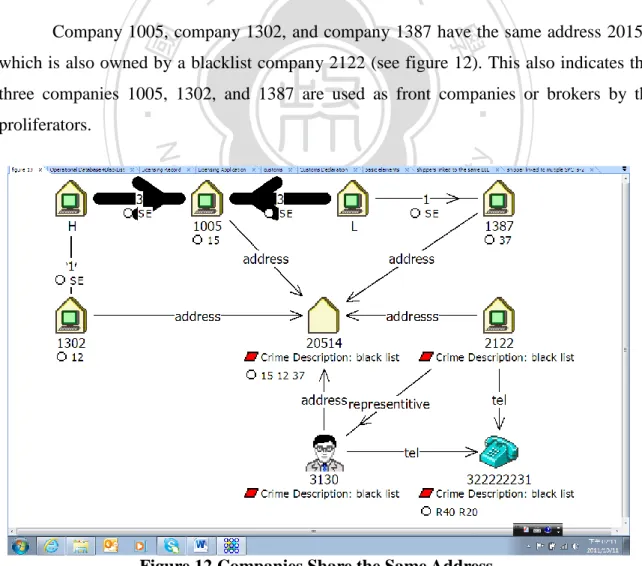
(2) 反武器擴散:資料採礦技術於我國戰略性高科技貨品出口 管制之應用 Counter Proliferation: The Application of Data Mining Technologies in Taiwan Strategic High-Tech Commodities Export Control Management 研究生:邱建凱. Student: Chiou, Chien-Kai. 指導教授:冷則剛. 國立政治大學. 學. ‧ 國. 立. Advisor: Leng, Tse-Kang 政 治 大. ‧. 商學院國際經營管理英語碩士學位學程 碩士論文. er. io. sit. y. Nat. A Thesis. n. a to International MBA Program Submitted iv l C n NationalhChengchi i U e n g c hUniversity. in partial fulfillment of the Requirements for the degree of Master in Business Administration. 中華民國一百年十二月 December 2011. i.
(3) Acknowledgements. I am heartily thankful to my thesis advisor, Professor Tse-Kang Leng, whose encouragement, guidance, and support from the initial to the final level enabled me to complete the research. He has made available his support in numbers of ways. With his strong knowledge in political and economic affairs, he guided me to decide the thesis topic of export control, which covers both security and trade issues. He encouraged me to focus on research on gaps of current export control systems that the thesis can fill in to add value to the research. I would like to thank Professor Yu-Ting Cheng and Professor Jia-Ju Deng, who introduce me. 治 政 大 the inspiration for the research. mining tools in risk management so that I could come up with 立 I also would like to thank Professor Jack Wu and Yung-Cheng Shen, who gave me precious the knowledge about data mining solutions. They enlightened me the application of data. ‧ 國. 學. suggestions on revision of the thesis and encouraged me to elaborate the concept of export control management.. ‧. I would like to express my gratitude to Professor Samuel Chen, the director of IMBA NCCU,. Nat. sit. y. and all the staffs and faculties. The IMBA NCCU program accepts individuals with prior. io. er. education in any discipline and of various profession backgrounds. It is my honor to be a part of the program and gain comprehensive knowledge on business management. Without the. n. al. Ch. i Un. v. resources from the IMBA NCCU program, the thesis would not have been possible.. engchi. Nevertheless, I would like to express my grateful thanks to Miss Lichi Ho, the staff of IMBA NCCU, for her assistance and suggestions to the thesis. Last but not the least, I would like to thank my family and offer my regards and blessings to all of those who support me in any respect during the completion of the thesis. Chien-Kai Chiou. ii.
(4) Abstract. Counter Proliferation: The Application of Data Mining Technologies in Taiwan Strategic High-Tech Commodities Export Control Management. By Chiou, Chien-Kai. WMD (weapons of mass destruction) proliferation and nuclear terrorism are the gravest dangers that the world faces. The international society established counter proliferation. 治 政 大 weapons. However, there are related commodities that can be used in producing the 立 limitations in export control systems. The trade security and facilitation should be both regimes and export control systems to prevent the proliferators from acquiring WMD and the. ‧ 國. 學. considered, while the proliferators attempt to establish procurement networks to circumvent export control systems and globalization has introduced challenges from the emergence of. ‧. increasing number of global corporations and increasing volume of dual-use trade. By using the data mining tool of link analysis, the thesis attempts to develop a methodology to increase. y. Nat. sit. the coerciveness and accuracy of detecting problematic shipments from ordinary export. er. io. activities in order to improve the export control management. From the research, it suggests. al. n. iv n C discovering with not only h eentities ngchi U. that data mining is a feasible solution to improve the effectiveness and efficiency of export control. It can be used for. explicit but also implicit. proliferation concerns from a large quantity of datasets and increase the cost and difficulties of circumventing export control so that the proliferation activities are to be contained or hindered. Based on the findings, the thesis established an export control management model with data-mining solutions.. iii.
(5) TABLE OF CONTENTS. Acknowledgements ....................................................................................................................ii Abstract .................................................................................................................................... iii TABLE OF CONTENTS .......................................................................................................... iv TABLE OF FIGURES .............................................................................................................. vi Introduction ........................................................................................................................ 1 1.1.. Why is Export Control Important? ............................................................................ 1. 1.2.. Taiwan‘s Obligations on International Export Control ............................................. 2. 1.3.. The Need to Improve Export Control Management .................................................. 3. 1.4.. US Example to Reform Export Control Mechanism ................................................. 4. 1.5.. The Proposed Management Model for Taiwan Export Control ................................ 5. 1.6.. Literature Review....................................................................................................... 6. 立. Export Controls in Public and Private Sectors ................................................... 6. 1.6.2.. Categories of Data Mining Technologies .......................................................... 8. 1.6.3.. Gaps of Current Methods ................................................................................... 9. ‧. The Utility of the Research ...................................................................................... 10. 1.8.. Purpose of Research ................................................................................................. 12. 1.9.. Research Questions .................................................................................................. 13. al. er. io. sit. y. Nat. 1.7.. n. Overview .............................................................................................................. 13. Ch. i Un. v. The Proliferation Network ............................................................................................... 15 2.1.. 3.. 學. 1.6.1.. 1.10. 2.. 政 治 大. ‧ 國. 1.. engchi. The Nuclear Proliferation Network: Potential Sources of Nuclear Terrorism ........ 15. 2.1.1.. Russia ............................................................................................................... 16. 2.1.2.. Pakistan ............................................................................................................ 17. 2.1.3.. Libya ................................................................................................................ 18. 2.1.4.. Iran ................................................................................................................... 19. 2.1.5.. North Korea ..................................................................................................... 20. 2.2.. Nuclear Black Market .............................................................................................. 22. 2.3.. Types of Networks ................................................................................................... 23. Evaluation of Export Control System .............................................................................. 26 3.1.. What Are Export Controls? ..................................................................................... 26. 3.2.. Key Elements of Export Control System ................................................................. 27. 3.3.. Taiwan Export Control Mechanism ......................................................................... 30 iv.
(6) Bureaucratic Process ........................................................................................ 31. 3.3.2.. Control list ....................................................................................................... 31. 3.3.3.. Licensing System ............................................................................................. 31. 3.3.4.. Customs Authority ........................................................................................... 32. 3.3.5.. Verification ...................................................................................................... 32. 3.3.6.. Penalties ........................................................................................................... 32. 3.4.. Information Sharing-US Example ........................................................................... 33. 3.5.. Export Control Challenges ....................................................................................... 34. Data Mining Solution ....................................................................................................... 36 4.1.. What is Data Mining? .............................................................................................. 36. 4.2.. Evaluation of Current Data Mining Technologies ................................................... 37. 4.2.1. 4.2.2.. Landscape Visualization Tools ............................................................................ 38. 4.2.3.. Selection of a Proper Tool ....................................................................................... 38. 4.4.. Sample Case--A. Q. Khan Proliferation Networks .................................................. 39. 4.5.. Implementing Data Mining Solution to Export Control .......................................... 41. 學. 4.3.. ‧. 4.5.1.. Defining the Problem to Be Solved ................................................................. 41. 4.5.2.. Accessing and Preparing the Data ................................................................... 41. 4.5.3.. Defining Entities and Linkages ........................................................................ 41. 4.5.4.. Data Processing ................................................................................................ 44. 4.5.5.. Link Analysis ................................................................................................... 46. y. sit. n. al. er. io. 6.. 立. Quantitative Data Mining Tools ...................................................................... 38. Nat. 5.. 政 治 大. Link Analysis ................................................................................................... 37. ‧ 國. 4.. 3.3.1.. Ch. engchi. i Un. v. Findings and Discussions ................................................................................................. 56 5.1.. Estimate of Proliferation Situation........................................................................... 57. 5.2.. Evaluation of Export Control System ...................................................................... 57. 5.3.. Selecting Link Analysis as the Research Method .................................................... 58. 5.4.. Results of Analyzing Simulated Datasets ................................................................ 58. 5.5.. Export Control Management Model ........................................................................ 61. Recommendations ............................................................................................................ 65. Bibliography ............................................................................................................................ 66 Appendix 1 Related Articles under the Foreign Trade Act ..................................................... 70. v.
(7) TABLE OF FIGURES. Figure 1 Nuclear Proliferation Network .................................................................................. 16 Figure 2 Potential Sources for Terrorist Organizations to Acquire Nuclear Weapons Summarized ............................................................................................................................. 22 Figure 3 Three Basic Types of Networks ................................................................................ 24 Figure 4 Basic Elements of Link Analysis .............................................................................. 42 Figure 5 Data Sets of Customs Records. ................................................................................. 43 Figure 6 Data Sets of Licensing Records. ................................................................................ 43 Figure 7 Data Sets of Black Lists. ........................................................................................... 44. 政 治 大. Figure 8 The Full Picture of the Data Sets ............................................................................... 45 Figure 9 Zoom-in of the Full Picture of Data Sets................................................................... 45. 立. Figure 10 Find Linked Entities ................................................................................................ 46. ‧ 國. 學. Figure 11 Entities Own the Same Telephone Number ............................................................ 47 Figure 12 Companies Share the Same Address. ...................................................................... 47. ‧. Figure 13 End User Linked to a Blacklist Entity. .................................................................... 48 Figure 14 A Representative Linked to Multiple Entities. ........................................................ 49. Nat. sit. y. Figure 15 Shippers that Linked to Multiple Suspicious Entities. ............................................ 49. al. er. io. Figure 16 Shippers Linked to the Same Blacklist Entity ......................................................... 50. n. Figure 17 Simulated Dataset of Licensing Applications. ........................................................ 51. Ch. i Un. v. Figure 18 Review Licensing Applications ............................................................................... 51. engchi. Figure 19 the Direct Link to a Blacklist Entity. ....................................................................... 52 Figure 20 End Users on the Black List .................................................................................... 52 Figure 21 Cases Link to Proliferators ...................................................................................... 53 Figure 22 Cases with Implicit Links to Proliferators. .............................................................. 54 Figure 23 Cases with Implicit Concern. .................................................................................. 54 Figure 24 Export Control Management Model ........................................................................ 62. vi.
(8) 1. Introduction The international society faces an important issue in counter proliferation: how to improve export control system in order to ensure trade security and sustain economic development simultaneously. Many are concerned about countries such as North Korea and Iran, which attempt to acquire or develop WMD (weapons of mass destruction), especially nuclear weapons. Even more are concerned about the risk of those countries supplying nuclear weapons and technology to radical states or terrorist groups. Therefore, the international society has developed export control mechanism to prevent critical material, equipment, and technology being shipped to restricted area for developing WMD.. 政 治 大 civilian use. When it comes to civilian use, most goods are for legitimate business activities, 立 which need to be promoted and facilitated, while only a small portion of shipments are However, many of the goods in export control are dual-use in both military and. ‧ 國. 學. violating export control laws to transfer controlled commodities to proliferators. Therefore, there is a need to not only address security concerns but also maintain the efficiency of. ‧. ordinary business activities. In the prospective of management, it is worth of developing. y. Nat. methodologies by using data mining technology to distinguish problematic deals from normal. Why is Export Control a Important?. er. io. iv l C n h etonaddress i U threat was deterrence, by which During Cold War, the major strategy g c h nuclear n. 1.1.. sit. ones in order to foil problematic shipments without interrupting normal export activities.. the super powers declared mutually assured destruction to deter the opponents from launching nuclear attacks. The deterrence against state rivals was proved to be highly effective according to the experience during the Cold War, but it was not expected that nuclear weapons would be proliferated to countries, such as North Korea and Iran. The September 11th attacks aroused the fear of nuclear terrorism. Deterrence strategy is effective to state actors because states have territories, which would be the target of retaliation. However, terrorist organizations do not have permanent territories, so the confidence in deterrence strategy is obviously lowered when the opponents are non-state actors. Therefore, the international community started to emphasize the dissuasion strategy, which is to dissuade adversary from expanding, improving or transferring WMD. The focus of dissuasion is to discourage the proliferators developing WMD before they can possess the. 1.
(9) weapons. Export control, which is an important tool of counter proliferation, is designed to prevent the proliferators from acquiring and transferring the weapons at the early stage of WMD development. For fulfilling the gap of deterrence strategy to non-state actors, export control is an essential tool to ensure international security. In the globalization era, no country can avoid the catastrophic impact if there is a nuclear attack. The UN Security Council has issued resolutions against WMD proliferation. Countries including US, Japan, and European Countries have legislations and sanction lists against proliferators. International regimes, such as Wassenaar Arrangement, Nuclear Suppliers Group, Australia Group, and Missile Technology Control Regime, regulates international export control norms and the controlled items for conventional, nuclear, biological, and chemical weapons and missiles as for weapon platforms. The members of. 政 治 大 Canada, France, Germany, Italy, 立Japan, Korea, Russia, UK, and US. The advanced countries. these international regimes include thirty some major industrial countries, such as Australia,. interested. ‧ 國. highly. counter-proliferation.. implementing. export. control. 1. systems. for. WMD. ‧. 1.2.. in. 學. are. Taiwan’s Obligations on International Export Control. Nat. sit. y. Many people might think export control is solely to control the weapons. However, the. al. er. io. international controls on the weapons are so strict that the proliferators are hardly able to. n. acquire the final product of weapons; instead, the proliferators acquire the technologies. Ch. i Un. v. (know-how), raw material, equipment, and sub-components, to build the weapons in their. engchi. territories. These required commodities are mainly dual-use, for example, computers and machine tools, which have both military and civilian applications. Most of the sensitive commodities used to be produced by companies in advanced industrial countries, but Taiwan industries are able to produce these dual-use commodities after decades of industrial development. Therefore, the international community expects Taiwan to establish export control systems to meet the international norms. Although Taiwan is not the member of UN and the international counter-proliferation regimes, Taiwan followed international norms and. 1. 虞孝成, 徐振榮, 張世其"出口管制制度之探討," 科技發展政策報導, no. SR9012 (Dec, 2001), 942-945.. 2.
(10) implemented Strategic High-Tech Commodities (SHTC) export control mechanism in 1995 to fulfill the obligations as a member of the international community.2 Export control is essential to industrial development. Taiwan economy highly relies on the trade of exports, so the importance of export control is usually mistakenly neglected. However, Taiwan high-tech industries rely on the supply of technologies, material, and equipment from advanced countries. If Taiwan does not meet the requirement of export control systems, the international community, for example, US, Japan, and EU, might prohibit exports of high-tech commodities and technologies to Taiwan, which would be a severe impact on Taiwan industrial development.3 In addition, the entities which violate international sanctions might be added to. 治 政 大 is essential for sustaining export control regimes. The reputation of global companies 立 business development. Most companies are willing to take responsibilities to obey export sanction lists and cannot conduct any business with countries obliged by the international. ‧ 國. 學. control regulations to maintain their reputation. Some corporations establish internal control programs to review their exports in order to prevent from violating any international. country as a whole but also to the industries individually.. sit. y. Nat. er. The Need to Improve Export Control Management. io. 1.3.. ‧. sanctions. To meet the international requirement of export control is beneficial not only to the. al. n. iv n C U But the proliferators usually use h e nsensitive black lists, to which are prohibited to export g c h iitems. Current export control management mainly focuses on screening the entities on the. legitimate businesses which are not yet on the blacklists to circumvent export control. Government authorities have to scrutinize the exports to restricted area or transshipment locations in order to verify the proliferation concern. Nevertheless, the problematic shipments account for a tiny portion of the total export activities. As a result, the exporters frequently complain that export controls delay the shipments and raise the costs of exports. In Taiwan, there are more than 10,000 licensing applications of SHTC exports yearly, so the licensing agency is hard to conduct a comprehensive regulation and control; instead, it focuses on specific cases by risk management. As to the SHTC exports which intentionally or unintentionally avoid applying for permits, the licensing agency would not be able to discern 2 3. Ibid, 948. Ibid, 941.. 3.
(11) the real number of violations. In addition, there are about 7.8 million containers and 19 million customs declaration cases yearly, so the Customs can only randomly inspect five percent of the total shipments by risk management and few export violators can be detected. Therefore, the system tends to let exporters to take chance to export goods without licensing.4. 1.4.. US Example to Reform Export Control Mechanism Because the US export control system is rooted in the Cold War, so US is undergoing. an export control reform initiative to update to address the threats today and changing economic and technological landscape. The US reform is an adequate example for the improvement of Taiwan export control system. It is assessed that the current US export control system is overly complicated, contains too many redundancies, and tries to protect too. 政 治 大 the current system is based on two different control lists administered by two different 立 departments, three different primary licensing agencies, a multitude of enforcement agencies much. The fact sheet on the US President's Export Control Reform Initiative described that. ‧ 國. 學. with overlapping and duplicative authorities, and a number of separate information technology systems, or agencies with no IT system at all that issues licenses. The fragmented. ‧. system, combined with the extensive list of controlled items which resulted in almost 130,000. y. Nat. licenses in 2009 in US, dilutes the ability to adequately control and protect those key items. sit. and technologies that must be protected for national security. The goal of the US reform is "to. n. al. i Un. targets. The reform plans to transform US export control to a:. Ch. engchi. . Single Control List,. . Single Primary Enforcement Coordination Agency,. . Single Information Technology System, and. . Single Licensing Agency.5. 4. er. io. build high walls around a smaller yard" by focusing enforcement efforts on the key items and. v. Kwo Shing Lai, "The Concept of Cooperative State and its Impact on the Regulations for Trade administration-a Focused Examination on Control Over High-Technology Commodities in Taiwan" (Master thesis, National Chengchi University, Taiwan), http://nccur.lib.nccu.edu.tw/handle/140.119/37129 (accessed Dec 12, 2012), 100. 5 Fact Sheet on the President's Export Control Reform Initiative (USA: The White House, Office of the Press Secretary, April 20, 2010). 4.
(12) 1.5.. The Proposed Management Model for Taiwan Export Control Current Taiwan export control system has already adopted a single control list and a. single licensing agency but not yet establish a single information technology system. Taiwan export control system may adopt the concept of US reform to establish a single IT system by incorporating databases of the customs records, licensing records for both licensing and enforcement in order to improve export control management. The thesis attempts to combine the integrated IT system with data mining technologies in order to discover the problematic shipments and the patterns used by proliferation networks. While the system is able to identify the problematic items and entities more accurately and efficiently, the licensing authority would be able to relax the control on ordinary trade activities. By the reform discussed above, the export control management would be transformed to a comprehensive. 政 治 大. and targeting-oriented process, which would be more efficient and practical.. 立. Current export control management relies on screening end-users to determine if they. ‧ 國. 學. are on the blacklists. However, the proliferators would find other legitimate companies to hide the real end-users, while the licensing authorities depend on internal knowledge to assess. ‧. the risk. If there is no intelligence tip-off, it is extremely difficult for the authorities to screen. y. Nat. problematic exports from the large amount of export activities. Therefore, to fill the gaps in. sit. export control, the thesis attempts to establish a methodology to discover WMD procurement. n. al. i Un. able to improve export control management in several ways:. Ch. engchi. er. io. activities, which the proliferators use legitimate entities to cover. The methodology will be. v. . to increase effectiveness in detecting risks,. . to increase efficiency in licensing process,. . to strengthen credibility of the export control mechanism to deter violations,. . to raise the difficulties and costs for the proliferators to circumvent export control, and. . to shorten the time needed to issue export permits.. 5.
(13) 1.6.. Literature Review. 1.6.1. Export Controls in Public and Private Sectors Currently, the major methodologies adopted by countries, such as US and Germany etc., are focusing on ICP (Internal Compliance Program) and end-user screening. In the public sector, the ExportCont.org introduces in the Overview of the U.S. Export Control System that preventive enforcement should include established procedures related to export license applications (i.e. screening the proposed item, quantity, end-use and all parties involved in the transaction for any potential export) and compliance mechanisms (i.e. working in partnership with industry to educate them on how and why to monitor and control their own export activity).6. 立. 政 治 大. Georg Pietsch, Director General of Germany Federal Office of Economics and Export. ‧ 國. 學. Controls, emphasizes that the end-user screening of export control should ensure a differentiated approach, especially with regard to:. . the different sensitivity levels of consignee states concerned,. . the reliability of the persons involved in the transactions,. sit. al. er. io. iv n C and the principle that sensitive cases more efforts than cases of less sensitivity.7 U h eneed ngchi n. . y. ‧. be able to properly evaluate each individual case,. Nat. . In addition, Pietsch explains the criteria of plausible licensing check are: . technical aspects,. . internal knowledge and other information of the authority,. . submitted documents and papers,. 6. ExportControl.org, "Overview of the U.S. Export Control System," ExportControl.org, http://exportcontrol.org/links/2081c.aspx (accessed Nov, 12, 2011). 7 Georg Pietsch, "End use End-User-Screening" (Seventh Annual International Export Control Conference, Stockholm, Federal Office of Economics and Export Control (BAFA) Germany, 20-22 Sep, 2005, 2005)., 1.. 6.
(14) . reliability of the persons involved in the transaction (exporter, consignee, end-user and other persons involved),. . risk analysis.8 Pietsch further elaborates that in German the backbone of risk analysis is a database. with information about applicants, countries of concern, purchase, consignee, end-user and military or civil projects. The purpose of the end-user screening is to support decisions, to discover front-or mailbox-companies, procurement networks and other sensitive projects, overall to minimize the risk to diversion to proliferation end-use.9 In the private sector, there are compliance programs developed by IT or consultant. 政 治 大. companies. For example, the eCustoms–MSR Inc. provides Visual Compliance to assist customers to conduct comprehensive denied party screening for export shipments. Visual. 立. Compliance provides documentation and on-line tools to help avoiding non-compliance with. ‧ 國. 學. U.S. Export Control Regulations. The Visual Compliance software solutions system performs Restricted Party Screening against all relevant U.S. Government lists, including Specially. ‧. Designated Nationals and Blocked Persons (SDN).10 NextLabs, IBM, and SAP AG also developed an information export control solution to extend the export compliance capability. y. Nat. sit. of the SAP GRC Global Trade Services application. The solution manages the handling and. er. io. export of technical information that is subject to International Traffic in Arms Regulations (ITAR), Export Administration Regulations (EAR), or other U.S. federal regulations.11. n. al. Ch. engchi. i Un. v. Basically, current export-control screening methodologies both in the public and private sectors are focusing on screening the entities which are already on the black lists. For the entities which are not on the black lists but used by the proliferators as conduits, governments usually rely on internal knowledge and other information of the authority. However, the internal knowledge is not likely to cover all the applications since there are usually thousands of applications in a year. In addition, it is difficult to discover implicit 8. Ibid, 3. Ibid, 6. 10 eCustoms, "Visual Compliance – Export Control Compliance, Comprehensive Denied Party Screening, Controlled Goods Classification, Export License Determination and U.S. Munitions List Classification for Your Export Shipments," eCustoms – MSR Inc., http://www.ecustoms.com/vc/vc.cfm (accessed Nov, 15, 2011). 11 Lawrence Dietz, "IBM, SAP, and NextLabs Collaborative Effort Yields Export Control Solution," Sageza Group, Inc., IT Analysis Communications Ltd., http://www.it-director.com/business/content.php?cid=9482 (accessed Nov 15, 2011). 9. 7.
(15) violation by human screening. Therefore, it is worth researching in using data mining technologies to develop a methodology to discover implicit signs indicating potential violations to improve and supplement the end-user screening process.. 1.6.2. Categories of Data Mining Technologies Richard J. Roiger and Michael W. Greatz define data mining as a process of acquiring knowledge by using computer technology to analyze information from databases. They note that the goal of data mining is to discover trend and patterns from data.12 For using data mining tools to solve real-world problems, Christopher Westphal and Teresa Blaxton noted in Data Mining Solutions, “When you begin a data mining engagement. 治 政 大 display paradigms to use, and separate sources, what types of models to implement, what 立 which tools to choose for the application environment ―. There are a variety of commercial you have to make a series of decisions concerning such issues as how to integrate data from 13. ‧ 國. 學. tools for data mining application. How can we choose appropriate data mining tools for handling export control issues?. ‧. Christopher Westphal and Teresa Blaxton introduce data mining systems in three. Nat. sit. y. paradigms of link analysis, landscape display, and quantitative analysis. They provide. io. er. descriptions of some link analysis tools including NETMAP, Analyst‘s Notebook, Imagix 4D, Daisy, and others. They also discuss several tools that use landscape visualization, including. n. al. Ch. i Un. v. Mineset 2.0, Metaphor Mixer, In3D, and others. Regarding quantitative analysis, they. engchi. introduce tools of Clementine, Enterprise Miner, Diamond, and CrossGraphs. In addition, they also provide discussion of future trend in data mining technology, such as web visualizer, free text visualizers, full scope systems.14 In another way, Shia Ben-Chang categorizes data mining tools into case-based reasoning, data visualization, fuzzy query and analysis, knowledge discovery, and. 12. Richard J. Roiger and Michael W. Geatz, Data Mining: A Tutorial-Based Primer, trans. 曾新穆 and 李建億, 初版四刷 ed. (台北市: 台灣培生教育出版股份有限公司, 2006), 393, 4. 13 Christopher Westphal and Teresa Blaxton, Data Mining Solutions: Methods and Tools for Solving Real-World Problems, Vol. 1 (USA: Wiley Computer Publishing, 1998), 617, 441. 14 Ibid, 198.. 8.
(16) neural networks. 15 Data mining also can be categorized into six fields, including database systems, machine learning, statistical and data analysis methods, visualization, mathematical programming, and high performance computing. The major functions of data mining include classification, estimation, prediction, affinity grouping, and clustering.16 There are a wide variety of applications by using data mining, including pharmaceutical research, telecommunications, banking, retail sales and marketing, stock market analysis, and money laundering investigations.17 Data mining can also be used in customer profiling to predict potential customers, understanding customer behavior to decide logistic flow, or customer relations to maintain current customers. Recently, telephone, credit card, insurance, and government agencies are highly interested in fraud detection for decreasing loss. In addition, data mining can help us on detecting signals of customers with. 政 治 大. bad credit records, and we can use the signals to screen customers with high risks.18. 立. 1.6.3. Gaps of Current Methods. ‧ 國. 學. However, there is rarely discussions on data mining applications in export control.. ‧. Most data mining applications are designed to find patterns from large source databases by integrating statistical method into data mining. In export control, the number of violating. y. Nat. sit. cases is usually not enough to generate a model for predicting proliferation patterns. The. al. n. issues.. er. io. thesis will try to develop a way different from statistical method to solve export control. Ch. engchi. i Un. v. Some of the current applications have similarities to the management in export control, for example, money laundering investigation, fraud detection, screening bad-credit customers, and criminal investigation. Those applications are focusing on detecting problematic individuals from a whole or following leads to find the targets. For developing the methodologies to deal with export control issues, there are some research puzzles that we need to solve as follows.. 15. 謝邦昌 and others, 資料採礦與商業智慧 SQL Server 2005: Data Mining & Business Intelligence with SQL Server 2005 (Taiwan Taipei: 中華資料採礦協會, 2005), 381. 16 韋端 and others, Data Mining 概述: 以 Clementine 7.0 為例, 初版一刷, 2003), 885.Ibid. 17 Westphal and Blaxton, Data Mining Solutions: Methods and Tools for Solving Real-World Problems, 617, 442. 18 韋 and others, Data Mining 概述: 以 Clementine 7.0 為例, 885.. 9.
(17) . What is the essence and logic of the problems in export control?. . What are the difference between the application in export control and other fields?. . Besides of statistical methods, if using link analysis, which is used widely in investigation, is a proper way to build an effective data mining solution for export control? By evaluating current application of data mining tools in various fields, the thesis will. try to integrate investigation logic into data mining methodologies to develop proper solutions for improving export control management. The research will hopefully fulfill the gaps which have not yet been addressed in previous research, including using the data mining. 政 治 大. applications in export control, and enhance the research in using investigation method in data mining solutions.. The Utility of the Research. ‧ 國. 學. 1.7.. 立. The subject is important and worth studying because nuclear terrorism has already. ‧. been identified as perhaps the gravest danger and most critical concern after Sep 11, 2001. As. y. Nat. U.S. President Obama Barak noted in his 13 April, 2010 speech at the Nuclear Security. al. er. io. sit. Summit in Washington, D.C.:. v. n. Two decades after the end of the Cold War, we face a cruel irony of history -- the risk of a nuclear. Ch. i Un. confrontation between nations has gone down, but the risk of nuclear attack has gone up. Nuclear. engchi. materials that could be sold or stolen and fashioned into a nuclear weapon exist in dozens of nations. Just the smallest amount of plutonium -- about the size of an apple -- could kill and injure hundreds of thousands of innocent people. Terrorist networks such as al Qaeda have tried to acquire the material for a nuclear weapon, and if they ever succeeded, they would surely use it. Were they to do so, it would be a catastrophe for the world -- causing extraordinary loss of life, and striking a major blow to global peace and stability. In short, it is increasingly clear that the danger of nuclear terrorism is one of the greatest threats to global security -- to our collective security.19. Al Qaeda has demonstrated intent to acquire nuclear weapons to attack the United States and its allies. Osama bin Laden had declared that the acquisition of nuclear weapons is. 19. Barak Obama, Obama's Speech at the Nuclear Security Summit (USA: Council on Foreign Relations, April 2010). 10.
(18) a religious duty. Responding to a question regarding the issue of using WMD, Bin Laden stated in a 1998 interview that: To seek to possess the weapons that would counter those of the infidels is a religious duty. . . . It would be a sin for Muslims not to try to possess the weapons that would prevent the infidels from inflicting harm on Muslims. But how we would use these weapons if we possess them is up to us. 20. Bin Laden tried to buy uranium during the mid-1990s when he was in Sudan. After September 11th, Bin Laden met with Pakistani nuclear scientists to discuss weapons issues.21 Since the late 1990s, there have been allegations that al Qaeda was trying to purchase nuclear weapons, nuclear weapons materials, and nuclear technologies. Some reports have claimed the successful purchase or production of NBC/R (nuclear, biological, chemical, or radiological) weaponry based on intelligence agency assessments. 22 According to the. 政 治 大. materials seized and activities uncovered in U.S.-led military action against al Qaeda, al. 立. Qaeda conducted research and experiments on nuclear weapons. Officials found more. ‧ 國. 學. confirmation from the interrogation of al Qaeda detainees as well as from trial testimony of arrested al Qaeda personnel.23(Dunn, National Defense University, and Center for the Study. ‧. of Weapons of Mass Destruction 2005). y. Nat. But why has there not been an al Qaeda nuclear attack? The answer could be lack of. io. sit. materials and limited expertise to manufacture a nuclear device and/or purchase a weapon.24. n. al. er. Therefore, it is essential to evaluate the potential sources of nuclear materials and expertise. i Un. v. that terrorist groups could collect. Professor Graham Allison, a nuclear terrorism expert at. Ch. engchi. Harvard University, warns that North Korea could be close to selling a nuclear bomb to al Qaeda. "North Korea currently sells anything that anyone will pay for," said Allison. Allison points out that despite all the problems with Iran (this year), North Korea has continued to sell weapons to that country. "North Korea succeeded in selling them 18 missiles," he said. "So if they sold these missiles, why wouldn't they sell these things for a bomb?" 20. 25. Rahimullah Yusufzai, "Conversation with Terror," Time (January 11, 1999), 38-39. Steve Coll, "The Unthinkable: Can the United States be made Safe from Nuclear Terrorism?" The New Yorker (March 12, 2007), 3. 22 Lewis A. Dunn, National Defense University and Center for the Study of Weapons of Mass Destruction, Can Al Qaeda be Deterred from using Nuclear Weapons? (Washington, D.C: Center for the Study of Weapons of Mass Destruction, National Defense University, 2005), 27, 4. 23 Ibid, 5. 24 Ibid, 6. 25 Brianand Ross and Dana Hughes, "'Missiles 'R' Us,' but would North Korea Sell their Nukes?" ABC News (July 28, 2006). 21. 11.
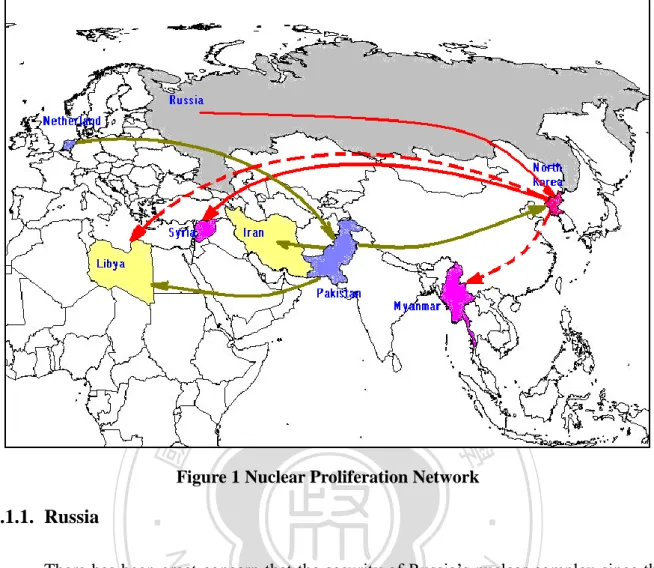
(19) Therefore, the international community all agree that the supplying WMD and relative materials and equipment should be denied. However, export controls on munitions items and nuclear equipment are highly identifiable and less controversial, but export control on dual-use technologies and commodities, which may have both commercial and military application, have more disputes.26. For example, computers and machine tools used in nuclear program can be also. used in automobile or other civilian industries. The export control system has to prevent the dual-use commodities from being exported to designated entities without causing impact on ordinary trade activities. In its 1987 study, the U.S. National Academy of Sciences found that ―licensing delays and uncertainties remain a problem for a significant percentage of export transactions…shipping delays impose immediate financial of exporters as well as a. 政 治 大. longer-term cost in customer confidence.‖27 Taiwan export control mechanism also has been. 立. encountering this paradox in the past years. Therefore, it is essential to find a way to improve. ‧ 國. 學. current system in order to distinguish problematic shipments from legitimate ones so that we can minimize interference in ordinary trade activities.. ‧. Since the development of information technologies, data mining technologies have. y. Nat. been applied to varieties of fields, including telecommunication services, banking, retail,. sit. financial market, money laundering investigation, and medical research. From evaluating the. er. io. successful applications of data mining, we can hopefully find a solution. Therefore, it is. n. al. i n C U and efficiency of export control management. hengchi. v. worth analyzing the applications of data mining technologies to improve the effectiveness. 1.8.. Purpose of Research The thesis will discover the operation and black market of proliferation network and. discuss the limitations of export control system. Based on the findings, the thesis will review and evaluate current data mining tools and select appropriate tool(s) to use in export control process. By implementing the selected data mining tools, the thesis attempts to establish methodologies to improve export control mechanism.. 26. John Heinz, U.S. Strategic Trade: An Export Control System for the 1990s (USA: Westview Press, 1991), 170, 9. 27 Ibid, 26.. 12.
(20) 1.9.. Research Questions For analyzing the situation and achieving a solution, this thesis will discuss the. following questions. What is the status of WMD proliferation, taking nuclear weapon as an example? Having the serious concern of supplying WMD to failing states and non-state actors, who will be the potential proliferators and buyers of WMD? How do the proliferation network and procurement black market operate? How does the export control mechanism work in major countries and in Taiwan?. 政 治 大. What are the limitations of export control?. 立. What is data mining? What can data mining technologies provide to improve the. ‧ 國. 學. management of export control?. ‧. What are the currently available data mining tools and their applications?. sit. y. Nat. Regarding the nature of export control, which data mining tools are suitable for providing. io. al. er. a solution in improving export control?. v. n. How can we use the data mining tools to establish methodologies and/or models in the management of export control? C h. engchi. i Un. 1.10. Overview This paper is structured in the following way. The first section of the article is an estimate of proliferation network, addressing the potential sources of nuclear terrorism and the network of nuclear black market. This is followed by a review of global counter proliferation strategies, addressing the background of export control. The third section evaluates Taiwan export control system to find the limitation and downside that need to be improved. The forth section is to evaluate current data mining tools and select proper one(s) for implementing in export control management. The fifth section discusses the results and findings, addressing possible solutions. The last section gives recommendations for future research.. 13.
(21) Before the discussion of data mining technologies, we need to estimate the situation of WMD proliferation and export control system.. 立. 政 治 大. ‧. ‧ 國. 學. n. er. io. sit. y. Nat. al. Ch. engchi. 14. i Un. v.
(22) 2. The Proliferation Network 2.1.. The Nuclear Proliferation Network: Potential Sources of Nuclear Terrorism Nuclear terrorism is a gravest danger that the world faces now. North Korea and Iran. are on the top of list of nuclear proliferation. The North Korea nuclear programs are originally from the Soviet Union and Pakistan. Starting in the mid-1980s, the Pakistani nuclear smuggling network exported know-how on uranium enrichment centrifuge technology and weapons design, and to North Korea, Iran, and Libya. 28 North Korea assisted Syria with a nuclear power plant,29 and it also reportedly supplied exported nuclear material to Libya.30 There is a growing concern that North Korea will transfer nuclear weapons to. 政 治 大. other states, such as Myanmar,31 which can have an impact on regional security and increase the risk of nuclear terrorism.. 立. ‧ 國. 學. Figure 1 shows the proliferation network. In order to evaluate the threat of nuclear proliferation, we need to review the status of Russia, Pakistan, Libya, Iran, North Korea and. ‧. the related proliferation networks.. n. er. io. sit. y. Nat. al. Ch. engchi. 28. i Un. v. Bruno Tertrais, "Pakistan's Nuclear Exports: Was there a State Strategy?" Paper Prepared for the Nonproliferation Policy Education Center (20 July, 2006). 29 Henry Sokolski, "From Pyongyang with Love," Far Eastern Economic Review (April, 2008). 30 Glenn Kessler, "North Korea may have Sent Libya Nuclear Material, U.S. Tells Allies," Washington Post (February 2, 2005, 2005), http://www.washingtonpost.com/wp-dyn/articles/A55947-2005Feb2.html. 31 Norman Robespierre, "Nuclear Bond for North Korea and Myanmar," Asia Times Online (Oct 4, 2008), http://www.atimes.com/atimes/Southeast_Asia/JJ04Ae01.html.. 15.
(23) 立. 政 治 大. ‧ 國. 學. Figure 1 Nuclear Proliferation Network. ‧. 2.1.1. Russia. y. Nat. sit. There has been great concern that the security of Russia‘s nuclear complex since the. al. er. io. collapse of the Soviet Union made the possible theft or unauthorized use of a Russian nuclear. n. weapon a real threat.32 There are rumors about the penetration of organized crime into the. Ch. i Un. v. Russian nuclear forces, and about ―suitcase bombs,‖ which are said to have been built for the. engchi. KGB in the late 1970s and 1980s, and then lost into the black market following the Soviet breakup. However, the existence of suitcase bombs has never been proved, and there has never been a single verified case of theft of nuclear weapon.33 The United States and Russia together possess about 95 percent of the world‘s nuclear material. This fact has led the United States to work closely with Russia to make sure that all of this material is safe from theft and that Russia‘s former WMD scientists find employment. 32. Joseph Cirincione, Jon B. Wolfsthal and Miriam Rajkumar, Deadly Arsenals : Nuclear, Biological, and Chemical Threats, 2nd ed. (Washington, D.C: Carnegie Endowment for International Peace, 2005), 490, http://www.loc.gov/catdir/toc/ecip0512/2005012915.html; Materials specified: Table of contents http://www.loc.gov/catdir/toc/ecip0512/2005012915.html., 130. 33 William Langewiesche, "How to Get a Nuclear Bomb," The Atlantic Online (December, 2006), 4.. 16.
(24) outside of the nuclear military complex.34 U.S.-funded programs have helped to secure the transport of Russia nuclear war heads and to develop a modern warhead accounting system.35 Now Russia is cooperating with the U.S. to address common security threats; nevertheless, the U.S. is dedicated in promoting cooperating with Russia in helping other states improve their nuclear security and safety.36. 2.1.2. Pakistan In the end of 2005, Pakistan may have produced between 1,110 and 1,440 kilograms of weapons-grade uranium, enough to produce between 50 and 110 nuclear weapons. 37 The serious issue is that the Pakistan nuclear programs have been proliferated to Libya, North Korea and Iran.. 治 政 Pakistan decided to acquire nuclear weapons due大 to competition with India. In the 立 1970s, Dr. A.Q. Khan stole enrichment technology from his workplace, URENCO, in the ‧ 國. 學. Netherlands to offer his services to his home country, Pakistan. A.Q. Khan has been described by the Pakistanis as ‗the father of the Pakistani bomb.‘ Khan‘s mission was to. ‧. provide Pakistan with capability to produce the enriched uranium required for an atomic bomb, for which Pakistani governments gave A.Q. Khan some extend of authority and. er. io. sit. y. Nat. autonomy.38. In January 2004, U.S. agents intercepted a German ship named the BBC China. n. al. Ch. i Un. v. carrying parts for a Libyan nuclear-weapons-production program. Libya had named the Khan. engchi. Research Laboratories of Pakistan as the supplier of the nuclear-weapons program. According to William Langewiesche, a national correspondent for the Atlantic, at about the same time, the Pakistani-run network had provided information and nuclear-weapons. 34. Bob Graham and others, World at Risk [Electronic Resource]: The Report of the Commission on the Prevention of WMD Proliferation and Terrorism (New York: Vintage Books, 2008), xxi. 35 Cirincione, Wolfsthal and Rajkumar, Deadly Arsenals: Nuclear, Biological, and Chemical Threats, 490, 131. 36 Graham and others, World at Risk [Electronic Resource]: The Report of the Commission on the Prevention of WMD Proliferation and Terrorism, xxi. 37 Cirincione, Wolfsthal and Rajkumar, Deadly Arsenals: Nuclear, Biological, and Chemical Threats, 490, 239. 38 William Langewiesche, "The Wrath of Khan," The Atlantic Online (November, 2005).. 17.
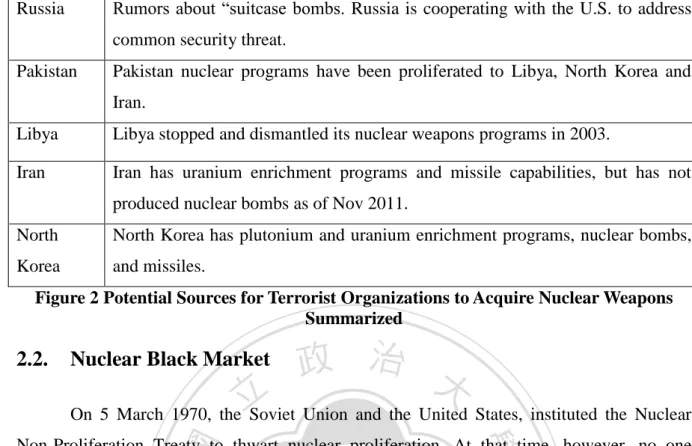
(25) components to Iran and North Korea, and had begun negotiations with a fourth country, perhaps Syria or Saudi Arabia.39 In a written confession in 2004, Khan admitted to supplying North Korea with about 24 centrifuge machines together with sets of drawings, sketches, technical data and depleted uranium hexafluoride (UF6) gas. Khan also reportedly provided a ‗shopping list‘ to the North Koreans, which enabled Pyongyang to purchase additional components directly from other foreign suppliers. 40 Successive Pakistani governments have insisted that their country‘s ballistic missile cooperation with North Korea was based on a cash payment, and that there was no official nuclear-for-missile technology exchange. Khan may have acted largely on his own volition, for profit. The broad cooperation between Pyongyang and Islamabad, however, is significant reason to suspect state complicity, at least in terms of having knowledge of and. 政 治 大. thereby implicitly condoning the centrifuge deal.41. 立. Whatever reasons led Pakistani leaders to ignore, and in some cases possibly assist. ‧ 國. 學. Khan‘s nuclear-related sales, the terrorist attacks on New York and Washington on 11 September 2001 dramatically changed the dynamic, forcing President Musharraf to ensure. ‧. that his country was not on the wrong side of the United States. A robust control system is. y. Nat. now in place to protect Pakistan‘s nuclear assets from diversion, theft and accidental. sit. misuse.42 Pakistan passed new export-control legislation in 2004. The new law prohibits the. er. io. diversion of controlled goods and technologies. The act also calls for the creation of an. n. al. i n C 43 U for export and re-export of nuclear-related h etechnology. ngchi. v. oversight board to administer export control regulations, enforcement of the act, and licensing. 2.1.3. Libya After almost thirty years of trying to acquire nuclear weapons capabilities, Libya announced that it was abandoning its clandestine nuclear program on December 19, 2003. Libya‘s major nuclear facilities include a 10-megawatt light-water research reactor, supplied 39. Ibid, 1. John Chipman, "Nuclear Black Market: Pakistan, A.Q. Khan and the Rise of Proliferation Networks," The International Institute for Strategic Studies, London, Strategic Dossier (2 May, 2007), 2. 41 Ibid, 2. 42 Ibid, 3. 43 Cirincione, Wolfsthal and Rajkumar, Deadly Arsenals: Nuclear, Biological, and Chemical Threats, 490, 249-250. 40. 18.
(26) by the Soviet Union in 1975, and a critical assembly. In 2003, Libya allowed international officials to inspect previously undisclosed nuclear sites and to remove key components of its nuclear weapons program.44 In September 2004, after removing related nuclear equipment and highly enriched uranium and implementing verification mechanisms, President Bush lifted most remaining U.S. sanctions on Libya as a response. Libya acquired centrifuge through various sources, including the A.Q. Khan network. The Khan network‘s business with Libya involved nuclear specialists, middlemen, and supplier companies from three continents. Libya wanted the Khan network to provide the entire enrichment process from start to finish. By the time of the Libya deal, the network had become a globalized supply chain.45 Libya has developed a gas-centrifuge-based uranium enrichment facility. Libya also provided the IAEA (International Atomic Energy Agency). 政 治 大. with documents related to the design and fabrication of a nuclear explosive device that were. 立. provided by the A.Q. Khan network. Libyan officials have told investigators that they bought. ‧. 2.1.4. Iran. ‧ 國. million.46. 學. the blueprints from dealers who are part of that network, apparently for more than $50. y. Nat. sit. Iran has acquired considerable uranium-enrichment capabilities through the black. er. io. market network run by A.Q. Khan. Pakistani centrifuges were shipped to Iran through a. al. company located in Dubai in the United Arab Emirates, called the SMB Group. Khan‘s group. n. iv n C also supplied Iran with used centrifuge h e ncomponents i U and designs. Again, Pakistan‘s h c g government claims this was an unauthorized transfer of technology and expertise carried out by Khan and his associates.47 Iran also has made significant progress in its missile capabilities. Iran benefited from. its collaboration with North Korea, having obtained both missiles and missile production capabilities form Pyongyang. Iran‘s continued links to terror groups, in combination with its 44. Ibid., 317. Chipman, Nuclear Black Market: Pakistan, A.Q. Khan and the Rise of Proliferation Networks, 2. 46 Cirincione, Wolfsthal and Rajkumar, Deadly Arsenals: Nuclear, Biological, and Chemical Threats, 490, 323. 47 Barry R. Schneider and Jim A. Davis, Avoiding the Abyss : Progress, Shortfalls, and the Way Ahead in Combating the WMD Threat (Westport, Conn: Praeger Security International, 2006), 430, http://www.loc.gov/catdir/toc/ecip069/2006006637.html; Materials specified: Table of contents http://www.loc.gov/catdir/toc/ecip069/2006006637.html., 28. 45. 19.
(27) weapons of mass destruction programs, place that country in the center of U.S. regional concerns.. 2.1.5. North Korea North Korea poses two kinds of threat. One is from the missiles they could launch. The other is the nuclear bomb or technology they might sell to terrorists or radical regimes. In 1961, North Korea began construction of a nuclear energy research complex. The Soviet Union provided a small research reactor at the site in 1965, and Pyongyang subsequently expanded the complex and built a number of new facilities, including a large plutonium reprocessing plant. In the mid-1990s, North Korea had produced one, possibly two,. 治 政 大facility. North Korea‘s nuclear receiving materials from Pakistan for a uranium enrichment 立 test of October 9, 2006, ended any doubt as to whether Pyongyang has developed nuclear nuclear weapons. In mid-2002, U.S. intelligence discovered that North Korea had been 48. ‧ 國. 學. weapons.. ‧. North Korea might have exported uranium hexafluoride, which can be enriched into weapons-grade nuclear material, to Libya in 2005.49 North Korea also assisted Syria with a. Nat. sit. y. nuclear power plant on the Euphrates before Israel bombs destroyed it in September 2007.. io. er. The Syrian power plant appeared to be a near-replica of North Korea‘s Yongbyon reactor.50. al. n. iv n C h ethat Japan‘s public broadcaster NHK reported h i Uhas been importing multiple-launch n gMyanmar c 51. North Korea and Myanmar resumed diplomatic relations in 2007. In April 2008,. rockets from North Korea.. In Oct 2008, Asia Times Online reported that a number of. high-level contacts between North Korea and Myanmar raised new concerns that North Korea might transfer nuclear-weapon capabilities to Myanmar.52 According to Liana Sun Wyler, Analyst of CRS Report for Congress, observers claim that ―Western intelligence officials have suspected for several years that the regime (Myanmar) has had an interest in 48. Cirincione, Wolfsthal and Rajkumar, Deadly Arsenals: Nuclear, Biological, and Chemical Threats, 490, 284-288. 49 Kessler, North Korea may have Sent Libya Nuclear Material, U.S. Tells Allies 50 Sokolski, From Pyongyang with Love. 51 Liana Sun Wyler, Library of Congress and Congressional Research Service, Burma and Transnational Crime (Washington, D.C: Congressional Research Service, Library of Congress, 2007), http://bosun.nps.edu/uhtbin/hyperion-image.exe/CRS-RL34225.pdf; http://bosun.nps.edu/uhtbin/hyperion-image.exe/CRS-RL34225.pdf Note: (100 KB)., 12. 52 Robespierre, Nuclear Bond for North Korea and Myanmar. 20.
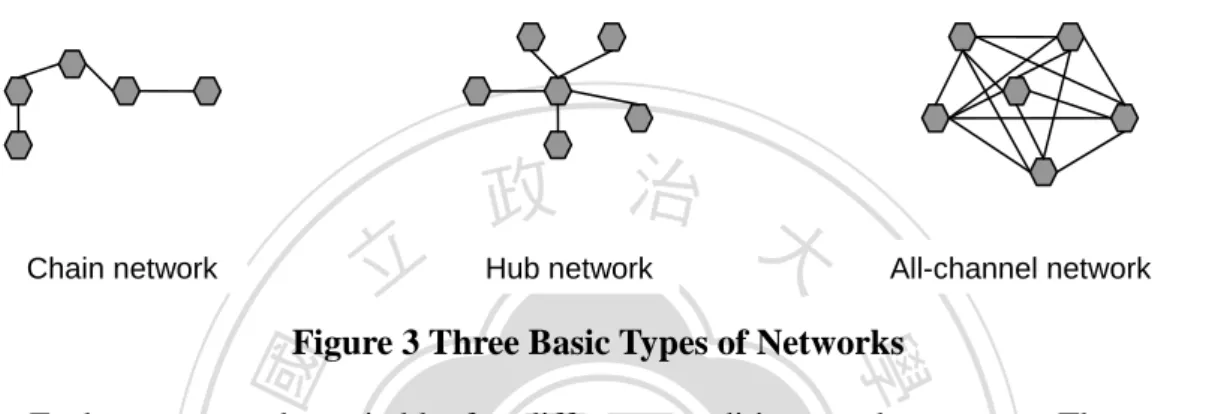
(28) following the model of North Korea and achieving military autarky by developing ballistic missiles and nuclear weapons.‖53 Pyongyang has produced short-range, medium-range and long-range missiles, and deployed about 175-200 long-range missiles. North Korea tested a long-range missile with a range of 4-6,000 km in 2006. The Paektusan-2 potentially has inter-continental range, but it failed after about 40 seconds of flight. It poses a direct threat to the continental U.S. In missile sales, North Korea has exported missiles, missile components, and technology to Egypt, Iran, Libya, Pakistan, Syria, and Yemen.54 Since 1980s, The U.S. Government considers North Korea as a Rogue state, which is threatening to the world's peace. In 2005, United States Secretary of State Condoleezza Rice. 政 治 大 In his State of the Union Address on January 29, 2002 ,. described the governments of North Korea together with Belarus, Myanmar, Cuba, Iran, and Zimbabwe as outposts of tyranny.55. 立. President Bush labeled North Korea, Iran, and Iraq "axis of evil‖ and accused them of. ‧ 國. 學. helping terrorism and seeking weapons of mass destruction.56 October 2002, the Central Intelligence Agency (CIA) concluded that Pyongyang was pursuing a uranium enrichment. ‧. program.57. y. Nat. n. al. er. io. summarized in figure 2.. sit. Potential sources for terrorist organizations to acquire nuclear weapons are. Ch. engchi. 53. i Un. v. Wyler, Library of Congress and Congressional Research Service, Burma and Transnational Crime, 13. 54 Cirincione, Wolfsthal and Rajkumar, Deadly Arsenals: Nuclear, Biological, and Chemical Threats, 490, 289-290. 55 Condoleezza Rice, "Opening Statement in Senate Foreign Relations Committee," (January 18, 2005), 4. 56 George W. Bush, "Presidential Determination on Major Drug Transit Or Major Illicit Drug Producing Countries for Fiscal Year 2007," Presidential Determination 71, no. 189 (September 29, 2006). 57 Carin Zissis and Jayshree Bajoria, "The Six-Party Talks on North Korea‘s Nuclear Program," (2008); Ibid, 1.. 21.
(29) Rumors about ―suitcase bombs. Russia is cooperating with the U.S. to address. Russia. common security threat. Pakistan. Pakistan nuclear programs have been proliferated to Libya, North Korea and Iran.. Libya. Libya stopped and dismantled its nuclear weapons programs in 2003.. Iran. Iran has uranium enrichment programs and missile capabilities, but has not produced nuclear bombs as of Nov 2011.. North. North Korea has plutonium and uranium enrichment programs, nuclear bombs,. Korea. and missiles.. Figure 2 Potential Sources for Terrorist Organizations to Acquire Nuclear Weapons Summarized. 2.2.. Nuclear Black Market. 立. 政 治 大. On 5 March 1970, the Soviet Union and the United States, instituted the Nuclear. ‧ 國. 學. Non-Proliferation Treaty to thwart nuclear proliferation. At that time, however, no one thought that proliferation could come from Arab countries, Africa, and South America. The. ‧. treaty was aimed at dissuading the developed countries, such as Western Germany and Japan, from acquiring nuclear weapons, and it worked because they accepted the United States and. y. Nat. sit. Soviet nuclear umbrellas.58 Now, the threats come from countries which might not accept the. er. io. nuclear umbrellas and lack the willingness and abilities to control nuclear proliferation. India. al. iv n C the two states, at least, have the willingness to secure their nuclear complexes.59 U h e nandgabilities chi n. and Israel, which own nuclear weapons capability, have declined to sign the treaty; however,. Although Pakistan has ensured that it will not be on the wrong side of the United States regarding counterterrorism, A.Q. Khan has supplied nuclear technologies to North Korea and Iran and increased risk of nuclear terrorism. There are concerns of further proliferating to other countries, which could complicate the possibility of nuclear proliferation to terrorists. Some nuclear black market activity has been well documented by various sources, including the International Atomic Energy Agency and the press. Naturally, much of the open-source information concerning such clandestine activity is fragmentary or ambiguous. 58. Langewiesche, How to Get a Nuclear Bomb, 2. Cirincione, Wolfsthal and Rajkumar, Deadly Arsenals: Nuclear, Biological, and Chemical Threats, 490, 221, 259. 59. 22.
(30) In addition, some countries are reluctant to share information on illicit activities within their borders or involving their citizens. Therefore, information is too fragmentary to make a firm judgment.60 In order to circumvent increased controls on nuclear technology, the Khan network developed means to import necessary materials. Khan‘s techniques were replicated by other states, such as Iraq, Iran, and North Korea. These countries have engaged the private sector in nuclear technology to further a military program and relied on similar methods of black market procurement, including systematically using the country‘s foreign embassies, paying a premium over the market price, using multiple connections and buyers to search for a given item, using front companies, falsifying end users, and altering product specifications so they would appear to operate below the international guidelines. Iraq, Pakistan and Iran all made. 政 治 大. extensive use of free ports, some of which have since tightened controls, while others still. 立. have a long way to go.61. ‧ 國. 學. By reviewing the countries above, North Korea is at the critical node in the nuclear proliferation network and has been proliferating nuclear capabilities to other states. Iran is. ‧. also pursuing nuclear weapons, although it has not yet acquired them as of November 2011.. y. Nat. The proliferation from Pakistan remains concerned since it is a region, where terrorism and. n. al. 2.3.. Types of Networks. Ch. engchi. er. io. being at risk. Time is on the proliferators‘ side.. sit. nuclear capability coexist. If threat of proliferation is not eliminated, the world will continue. i Un. v. Countries, such as North Korea and Iran, have already developed multiorganizational networks of the nuclear black market. In their networks, North Korea and Iran is likely to set up a set of diverse, dispersed ―nodes‖. If any part of the networks is disrupted, others can reorganize a new network to replace the function. The networks are flexible and difficult to detect and clarify, so interagency cooperation will be needed to identify, track, and stop the money and people that make up these networks.62 John Arquilla and David Ronfeldt discussed countering networked threats 60. Chipman, Nuclear Black Market: Pakistan, A.Q. Khan and the Rise of Proliferation Networks, 2. Ibid., 2. 62 Andrew C. Winner, "The Proliferation Security Initiative: The New Face of Interdiction," Washington Quarterly 28, no. 2 (2005): 129-143, 61. 23.
(31) in their book, Networks and Netwars, which introduces methodology for developing strategies to counter proliferation network. The international society may consider using their model to counter the proliferation networks. Arquilla categorizes networks to three types (see Figure 3): (1) the chain network, as in a smuggling chain where people, goods, or information move along a line of contacts, (2) the hub network, as in a franchise where a set of actors are tied to a central node, (3) the all-channel network, as in a collaborative network where everybody is connected to everybody else.63. 立. Chain network. 政 治 大 Hub network. All-channel network. ‧ 國. 學. Figure 3 Three Basic Types of Networks. Each type may be suitable for different conditions and purposes. There may be. ‧. hybrids of the three types, with different tasks being organized around different types of networks.64 The proliferation network may have a hierarchical organization overall but use. y. Nat. sit. network designs for tactical operations in nuclear proliferation and illicit activities. These. al. er. io. kinds of networks tend to challenge and cut across standard boundaries, jurisdictions, and. v. n. distinctions between state and society, public and private, war and peace, war and crime,. Ch. i Un. civilian and military, and legal and illegal. This makes it difficult for the international society. engchi. to assign responsibility to any single agency to be in charge of responding. Arquilla suggests three key principles of countering networked threats: (1) hierarchies have a difficult time fighting networks, (2) it takes networks to fight networks, and (3) whoever masters the network form first and best will gain major advantages. The principles depend partly on technological innovation, but mainly on a willingness to innovate organizationally, perhaps especially by building new mechanisms for interagency and. http://search.ebscohost.com/login.aspx?direct=true&db=mth&AN=16382204&site=ehost-live, 139-141 63 John Arquilla and others, Networks and Netwars: The Future of Terror, Crime, and Militancy (Santa Monica, CA: Rand, 2001), 375, http://www.rand.org/publications/MR/MR1382/; http://www.rand.org/publications/MR/MR1382/, 7-8. 64 Ibid, 8.. 24.
(32) multijurisdictional cooperation. It may require very effective interagency approaches, which involve networked structures. The challenge is to bring together the forms of hierarchy and network skillfully so that governments may become better prepared to deal with the new threats. 65 In addition, the counternetwork should extend to international cooperation in counter proliferation. Many countries still lack laws and regulations to govern and control trade in nuclear-related goods and technologies, many of which are military and civil dual-use items. Lacking of resources further weakens the capability to control these sensitive items internationally. The international society might need to work with allies to ensure that they have (1) law enforcement and intelligence agencies trained and equipped to deal with nuclear smuggling cases; (2) mechanisms to prevent suspected countries from acquiring controlled. 政 治 大. materials, equipment, and technologies for developing nuclear weapons and programs; (3). 立. effectively legislate related laws, and making any participation in smuggling of nuclear. ‧. ‧ 國. penalties.66. 學. weapons or weapons-usable materials, or nuclear terrorism, control materials, crimes with. n. er. io. sit. y. Nat. al. Ch. engchi. 65. i Un. v. Ibid, 15-16. Matthew Bunn and others, Preventing Nuclear Terrorism : An Agenda for the Next President (Cambridge, Mass. ; Washington, D.C.: Harvard Kennedy School, Belfer Center for Science and International Affairs : [Nuclear Threat Initiative, 2008), http://belfercenter.ksg.harvard.edu/files/uploads/Preventing_Nuclear_Terrorism-An_Agenda.pdf; http://belfercenter.ksg.harvard.edu/files/uploads/Preventing_Nuclear_Terrorism-An_Agenda.pdf Note: Adobe Acrobat or other PDF file reader required., 5. 66. 25.
(33) 3. Evaluation of Export Control System The continued possession and proliferation of WMD are undoubtedly among the gravest challenges that the international community are facing. A series of tools have been developed to manage these challenges. The international community set up treaties, such as the Nuclear Nonproliferation Treaty (NPT), the Chemical Weapons Convention (CWC), and the Biological Weapon Treaty (BWC), to universalize the formal and binding commitments by states not to acquire or develop WMD. In addition, specific countries organize arrangements, such as the Australia Group, Missile Technology Control Regime and the Nuclear Suppliers Group, to pursue to regulate trade in and transfer of most sensitive components and technologies as well as related dual-use goods. Export controls are tools on. 政 治 大. the supply-side of the counter proliferation strategy. They are designed to implement the obligation not to assist proliferators to acquire and develop WMD, which are found in major. 立. WMD treaties, while ensuring the flow of legitimate trade. Besides conventional military. ‧ 國. 學. goods and technologies, WMD export controls manage the trade in dual-use items. The difficulty is to balance trade and security imperatives. The rapid growth in dual-use. ‧. technology around the globe is redefining national interests and severely complicating national capabilities to regulate trade in sensitive commodities. Therefore, it is imperative to. y. Nat. sit. pursue the efficient and effective implementation of national nonproliferation export controls,. n. al. er. io. while ensuring the responsiveness to new challenges.67. Ch. i Un. v. However, the effectiveness and efficiency of export control as a tool for preventing. engchi. the proliferation of controlled technologies and weaponry has been called into question by globalization and international developments. Therefore, it is likely that export control policies and institutions need to be carefully studied.. 3.1.. What Are Export Controls? Export control as a tool for combating weapons proliferation is usually neglected and. misunderstood. Many government officials seem to believe that preventing the spread of WMD needs only that these weapons and materials be physically secured. They assume that groups or states seeking such weapons will try to acquire entire weapons systems. Although,. 67. Michael D. Beck and others, To Supply or to Deny: Comparing Nonproliferation Export Control in Five Key Countries (The Netherlands: Kluwer Law International, 2003), foreword.. 26.
(34) this is a real concern, it is not typically how most states have acquired WMD. Actually, most proliferators purchase the components, equipment, and materials for such weapons, most of which have both commercial and military applications, are dual-use commodities.. 68. Almost all countries possessing and pursuing WMD have procured the necessary components, tools, and technologies from suppliers in other countries. The commodities for such weapons include commercial items, such as machine tools and aluminum alloy, which can be used for developing missiles. This implies that policy makers need to pay more attention to strengthening export control in order to impede efforts by states or terrorists to acquire the goods and technologies for developing WMD. Governments in key supplier states can improve monitoring and tracking exports of sensitive commodities. Regarding the capability of export control, first, export control can delay a country seeking WMD. Further,. 政 治 大. export control can buy time for political change or diplomatic pressure to solve the risk of. 立. WMD. Export controls can be used as a deterrent, which can raise the costs of developing. ‧ 國. 學. WMD. Nevertheless, export controls support to strengthen international nonproliferation norms. However, there are things that export controls cannot achieve. Export controls, as. ‧. supply-side strategies, are not a solution to the problem of counter proliferation. Given sufficient time and funding, a determined country will finally be able to procure commodities. sit. y. Nat. for developing WMD even if the export control mechanism is functioning well. Therefore, it needs other efforts, such as diplomatic and negotiation measures, to complement to reduce or. io. er. eliminate the threat and demand of WMD.69. n. al. 3.2.. i n C U h e n gSystem Key Elements of Export Control chi. v. For better implementing data mining technologies, it is necessary to review the elements of export control. The key elements of export control include licensing system, control list, bureaucratic process, customs authority, catch-all clause, regime adherence, information gathering/sharing, verification, training, and penalties.70 Licensing System: A licensing system is a requirement for effective controls. Government authorities use licensing to regulate the transfer of sensitive goods and technologies. A licensing system consists of all the legal bases, institutions, and forms that serve to issue the export license. The export 68 69 70. Ibid, 2-3. Ibid, 3-4. Ibid, 16-18.. 27.
數據
+7

相關文件
Annular Bearing Engineers Committee American Gear Manufactures’ Association attitude and heading reference systems American Iron and Steel Institute arithmetic logic unit..
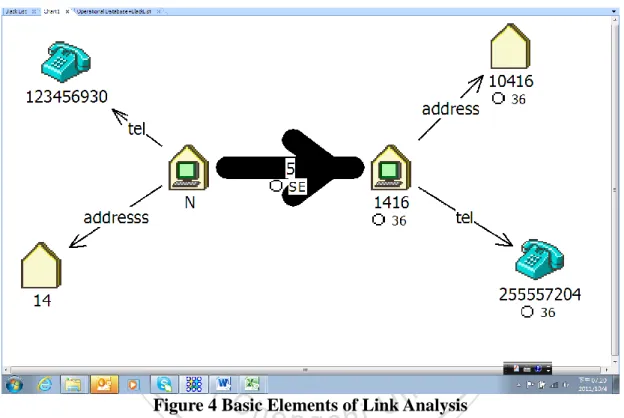
Annular Bearing Engineers Committee American Gear Manufactures’ Association attitude and heading reference systems American Iron and Steel Institute arithmetic logic unit2.
飛彈技術管制協議(Missile Technology Control Regime, MTCR). 瓦聖那協議 (Wassenaar
為因應國際貿易情勢改變,藉提高罰鍰額度達 到加強管理及提升嚇阻之效果。本條禁止行為
八、 應檢人參加技術士技能檢定學科或術科採筆試非測驗題職類,測試使用計算器,除
In our AI term project, all chosen machine learning tools will be use to diagnose cancer Wisconsin dataset.. To be consistent with the literature [1, 2] we removed the 16
After the desired content has been identified, the control point needs to determine which transfer protocol and data format should be used to transfer the content from the
2 machine learning, data mining and statistics all need data. 3 data mining is just another name for
