行政院國家科學委員會專題研究計畫 成果報告
憲政爭議與司法判斷:布希控高爾案之研究
計畫類別: 個別型計畫 計畫編號: NSC94-2414-H-003-001- 執行期間: 94 年 08 月 01 日至 95 年 07 月 31 日 執行單位: 國立臺灣師範大學政治學研究所 計畫主持人: 陳文政 計畫參與人員: 陳閔翔 報告類型: 精簡報告 處理方式: 本計畫可公開查詢中 華 民 國 95 年 10 月 31 日
壹、中、英文摘要及關鍵詞
一、中文摘要
緣因於 2000 年美國總統大選爭議之聯邦最高法院憲法判決「布希控高爾」 案,係美國憲政史上唯一由司法判斷終局決定總統選舉爭議之案例。 「布希控高爾」案是 2000 年美國總統大選諸多司法訴訟之終局判決,該案 之演變有其相關脈絡。本研究發現有 5 個重要訴訟案件構成了「布希控高爾」案 之脈絡案件。 由於「布希控高爾」案係以嚴重分裂之 5:4 表決通過,格外引發爭議。從 研究中發現,吾人可從「法唯實主義」和「黨派鞏固理論」來詮釋 5 位多數意見 大法官在本案「程序爭點」與「實體爭點」上之政治意涵。二、英文摘要
The United States Supreme Court decision, Bush v. Gore, was caused by the 2000 presidential disputes, and it is the unique case which the presidential disputes need to be solved by judicial judgment in American constitutional history.
Bush v. Gore is the final decision of 2000 presidential election lawsuits, and there is
complicated context before it was sent to the Court. This study finds that Bush v. Gore is composed of five significant cases.
It is seriously contested when Bush v. Gore was handed down by 5:4 vote. According to this study, we may illuminate the political significance of Bush v.Gore’s procedural and substantial issues from the perspectives of legal realism and partisan entrenchment theory.
三、關鍵詞
布希控高爾案、選舉異議階段、選舉訴訟階段、平等保護條款、安全防護條款、 選舉人團。
Bush v. Gore, Protest phase, Contest phase, Equal protection clause, Safe harbor provision, Electoral college.
貳、報告內容
一、前言
美國總統選舉史上,雖然發生過若干次憲政爭議,但皆能依據憲政規範由國 會順利解決。然而,2000 年美國總統大選所引發之憲政爭議,卻由聯邦最高法 院經過三度介入,1最後於 12 月 12 日「布希控高爾」一案作成判決後,始告平 息。此一舉動讓全國普選票(popular vote)落後卻在關鍵州佛州僅贏得普選票 537 票之共和黨候選人小布希(George W. Bush),因為贏得佛州 25 張選舉人票而贏得 總統大選,從而創下了美國憲政史上,由司法部門終局裁定總統選舉爭議之唯一 案例。 此一判決不但決定了總統當選人,進而使共和黨在美國獲得政治優勢,而且 讓共和黨得以在司法部門延續其憲法政策之主導權,對美國未來的憲政發展具有 重大影響。尤其是,聯邦最高法院在「布希控高爾」一案,一反過去審理重大爭 議案件常以一致決(unanimous)或相當多數決之經驗,2 而係以嚴重分裂之 5:4 表決通過,其政治意涵不言可喻。況且,五位多數意見大法官(Rehnquist, Scalia, Thomas, O’Connor, Kennedy)賴以作成判斷之平等保護論證基礎,鮮少適用於各州選舉事務,3因而格外引發學術界之批判。是以,本案無論在政治層面或法律 層面皆值得加以探究。
二、研究目的
本研究之主要目的有四: (一)歸納分析美國總統選舉憲政爭議之歷史經驗,以突顯 2000 年「布希控 高爾」案之特殊性; (二)釐清「布希控高爾」案前之重要訴訟案件脈絡。由於 2000 年總統選舉 爭議州(佛州)的選舉法規,將選舉爭議之解決分為「選舉異議」(protest)與「選舉 訴訟」(protest)兩個階段,而且該次選舉爭訟復涉及佛州郡法院、佛州最高法院 及聯邦最高法院之判決,案件甚多,案情亦相當複雜。因此必須先行掌握主要訴 1 美國聯邦最高法院的三度介入,分別是:(一)在選舉異議階段(protest phase),聯邦最高法院於12 月 4 日 Bush v. Palm Beach County Canvassing Board(Bush I)案,推翻佛州最高法院「延長各 郡提交選舉結果給州選舉委員會之最後期限」的判決;(二)在選舉異議階段(contest phase)聯邦 最高法院於 12 月 9 日 Bush v. Gore 案,發布暫時禁制(stay)佛州最高法院裁定「人工重新計算佛 州所有『劃記不足選票』(undervotes)」之命令;(三) 12 月 12 日於 Bush v. Gore(Bush II)案,聯 邦最高法院判決:佛州人工重計票作業因欠缺「全州統一適用之計票基準」而違反聯邦憲法增 修條文第十四條「平等保護條款」。
2 大法官在布希案之表決是 5 比 4,不像 1954 年解除學校種族隔離之 Brown v. Board of Education
(347 U. S. 483)案及 1974 年尼克森(Richard M. Nixon, 1913-1994)總統水門事件之 United States v. Nixon (418 U. S. 683)案大法官皆採取「一致決」(unanimous)。
3 美國在布希案之前,投票權平等保護之層次僅及於「投票資格」與「選票價值」(選票受到平
等衡量之保護),布希案則大幅擴充至地方選舉事務「投票程序及投票機制」之平等保護。而且, 布希案多數意見大法官對於為何必須擴充保護領域之正當理由,並未詳加論證。
訟案件之背景和要旨,始能理解聯邦最高法院作成「布希控高爾」案之理路; (三)針對 2000 年聯邦最高法院之司法終局判決「布希控高爾」案,進行個 案分析,以期掌握各種意見書之主要論證邏輯; (四)針對「布希控高爾」案以逸出美國憲政經驗之司法裁判途徑來解決憲政 爭議之事實,從「程序爭點」與「實質爭點」兩個面向,進行政治分析與批判。
三、文獻探討
本案可供參考之中文文獻不多,直接與本案有關之學術論著更少。雷飛龍所 撰〈二○○○年美國總統選舉及其缺失析述〉4一文,旨在敘述二○○○年美國 總統選舉之紛爭及選舉實務上之缺失,對布希案憲法判決並無探討;本研究計畫 主持人雖曾撰寫〈二○○○年美國總統選舉憲法判決之學術爭議〉5,對於布希 案憲法判決亦有所著墨,惟限於篇幅,故重點僅置於該案所引發之學術爭議。在 書籍方面,中國大陸學者王磊雖編有《布什訴戈爾》6一書,但該書在內容上屬 於資料彙整性質,欠缺議題討論,對於布希案的文本及各種意見書之論證均無討 論。 其他與美國聯邦最高法院有關之憲法解釋論著,則有葉俊榮〈邁向自制之路 -美國最高法院對環保團體當事人適格的緊縮〉7、李建良〈政治問題與司法審 查─試評司法院大法官相關解釋〉8、〈論司法審查的政治界限─美國「政治問題 原則」初探〉9、李念祖〈美國憲法上「政治問題」理論與釋字第 328 號解釋〉 10、湯德宗〈權力分立原則與違憲審查權限:大法官抽象釋憲權之商榷〉11、〈立 法裁量之司法審查的憲法依據-違憲審查正當性理論初探〉12等論著,可供參考。 在美國聯邦最高法院審查基準方面,黃昭元教授所撰〈憲法權利限制的司法審查 標準:美國類型化多元標準模式的比較分析〉13有深入的分析。該文對本書在探 4 雷飛龍一文原刊於《選舉研究》(2001 年卷 8 期 1),後收於氏著,《社會科學與比較政治》,台 北:韋伯文化,2002 年,頁 259-284。 5 陳文政,〈二 OOO 年美國總統選舉憲法判決之學術爭議〉,《師大政治論叢》,4 期,2005 年, 頁 69-125。 6 王磊編著,《布什訴戈爾》,北京:北京大學出版社,2002 年。 7 葉俊榮,〈邁向自制之路─美國最高法院對環保團體當事人適格的緊縮〉,焦興鎧主編,《美國 聯邦最高法院論文集》,(台北,中央研究院歐美研究所,民國 82 年 7 月),頁 111-135。 8 李建良,〈政治問題與司法審查─試評司法院大法官相關解釋〉,收於劉孔中、李建良編,《憲 法解釋之理論與實務》(第一輯),台北:中央研究院人文社會科學研究所,1998 年,頁 161-197。 9 李建良,〈論司法審查的政治界限─美國「政治問題原則」初探〉,收於李建良,《憲法理論與 實踐(一)》,台北:學林文化,1999 年,頁 269-320。 10 李念祖,〈美國憲法上「政治問題」理論與釋字第 328 號解釋〉,收於李念祖《司法者的憲法》。 台北:五南書局,2000 年,頁 159-174。 11 湯德宗,〈權力分立原則與違憲審查權限:大法官抽象釋憲權之商榷〉,收於劉孔中、李建良 編,《憲法解釋之理論與實務》(第一輯),台北:中央研究院人文社會科學研究所,1998 年, 頁 121-160。 12 湯德宗,〈立法裁量之司法審查的憲法依據-違憲審查正當性理論初探〉,收於氏著,《權力分立 新論》,台北:元照,2000 年,頁 1-74。 13 黃昭元,〈憲法權利限制的司法審查標準:美國類型化多元標準模式的比較分析〉,《台大法學 論叢》,33 卷,3 期,2004 年,頁 45-148。討聯邦最高法院有關平等保護基準之發展,並用於檢視其在布希案之適用情形, 具有啟發意義。另林子儀〈言論自由的限制與雙軌理論〉14一文有關「三重基準」 之架構,對本研究頗有參考價值。而有關「美國憲法平等保護條款」議題,特別 是選舉權平等問題方面,法治斌〈司法審查中之平等權:建構雙重基準之研究〉 15一文,對於美國聯邦最高法院在審查平等權議題時所採用之審查基準,有深入 分析,該文對本研究亦有參照作用。 本研究主要之參考文獻絕大多數來自美國本土所出版之英文文獻,在形式上 可分為「案件彙編」(case report)、學術專書(books)、研討會(symposium)論文集、 以及期刊論文(journal or review)等。 美國聯邦最高法院判決及司法見解之案件彙編,共有三種版本。16第一種是
官方版本,由美國政府出版,名為「美國判決彙編」(United States Reports),例 如: Roe v. Wade, 410 U.S. 113(1973) 是指 1973 年著名之「羅伊控韋德」墮胎案, 係被編入「美國判決彙編」第 410 卷第 113 頁起;第二種版本由「西方出版公司」 (West Publishing Company)出版,名為「最高法院案件彙編」(The Supreme Court Reporter),例如:Bush v. Gore, 121 S. Ct. 525(2000)是指 2000 年「布希控高爾」 案,係被編入「最高法院案件彙編」第 121 卷第 525 頁起;第三種版本由「律師 合作出版公司」(Lawyer’sCooperativePublishing Company)出版,名為「美國最 高法院案件彙編」(U.S. Supreme Court Reports),例如:Roe v. Wade, 35 L. Ed. 2d 147(1973) 是指 1973 年之「羅伊控韋德」墮胎案,係被編入「美國最高法院案 件彙編」第 2 版第 35 卷第 147 頁起。本書研究之主要判例 12 月 12 日之「布希 控高爾」(Bush v. Gore)案的文本及各種意見書,以及 12 月 4 日 Bush v. Palm Beach County Canvassing Board 案,12 月 9 日暫時禁制佛州最高法院人工重計全州「劃 記不足選票」命令之「布希控高爾」(Bush v. Gore)案,奇文本均採自美國政府出 版之「美國判決彙編」。至於,布希案脈絡五個重要案件之其他二個佛州最高法 院判決,均採自美國學術界通用之「南方案件彙編」(Southern Reporter)。 在學術專書方面,以哈佛大學自由派法學教授 Alan M. Dershowitz 所著《最 高不正義:最高法院如何綁架 2000 年大選》17,以及保守派聯邦法院法官兼法 學教授 Richard A. Posner 所著《打破僵局:2000 年大選、憲法與法院》18最具代 表性。Dershowitz 教授站在自由派立場,對於布希案判決展開激烈之批判,尤其 對布希案五位多數意見大法官之司法決策,更是指證歷歷,毫不留餘地。 Dershowitz 教 授 在 該 書 緒 論 中 , 即 點 出 布 希 案 創 下 多 項 第 一 (a number of 14 林子儀,〈言論自由的限制與雙軌理論〉,《現代國家與憲法》,台北:月旦,1997 年,頁 639-707。 15 法治斌,〈司法審查中之平等權:建構雙重基準之研究〉,《國家科學委員會研究彙刊:人文及 社會科學》,6 卷,1 期,1996 年,頁 35-50; 該文另收於法治斌,《法治國家與表意自由》,台 北:正典,2003 年,頁 213-231。 16 參見林利芝譯,William Burnham 著,《英美法導論》,台北:元照出版,2001 年,頁 65。
17Alan M. Dershowitz, Supreme Injustice: How the High Court Hijacked Election 2000 (New York:
Oxford University Press, 2001).
18 Richard A. Posner, Breaking the Deadlock-The 2000 Election, the Constitution, and the Courts
significant firsts),包括:(1)美國史上第一次總統大選由聯邦最高法院決定(2)第 一次有這麼多的法律學者、歷史學者、政治學者、聯邦最高法院訴訟律師、採訪 最高法院記者及其他專家們,大致認同多數意見是無法無天的(lawless)、不正當 的 (illegitimate) 、 不 符 原 則 的 (unprincipled) 、 黨 派 之 私 的 (partisan) 、 詐 欺 的 (fraudulent)、不正直的(disingenuous)等評論。19Dershowitz 於文末更強力批判, 認為布希案是聯邦最高法院史上最墮落腐敗的判例 (the single most corrupt decision in Supreme Court history)。20相對的,Richard A. Posner 所著《打破僵局: 2000 年大選、憲法與法院》則是保守派立場的代表作。Posner 首先認定 2000 年 總統大選初步結果是一種僵局,21佛州選舉人票爭議若延宕過久可能引發憲法危 機(constitutional crisis)。22 Posner 雖然不認同多數意見大法官的平等保護論證,23 但卻認為聯邦最高法院的判決務實地解決了即將浮現之國家危機。24至於,其他 專書還有專門探究選舉爭議兼論其他議題(如選舉人團制)者,25亦有專論布希陣 營何以贏得選舉訴訟者,26這些專書在本研究都是重要參考資料。 本研究參考資料中尚有一種學術專書值得一述,此類專書是由一人或多人所 主 編 之 論 文 集 或 資 料選 集 。 在 這 類 文 集 中 , 以 Bruce Ackerman ,27 Ronald Dworkin,28Cass R. Sunstein and Richard A. Epstein,29Arthur J. Jacobson and Michel Rosenfeld,30E. J. Dionne Jr. and William Kristol,31Samuel Issacharoff, Pamela S. Karlan and Richard H. Pildes 等32所編著為代表。其中,Bruce Ackerman、Ronald Dworkin 及 Cass R. Sunstein and Richard A. Epstein 等教授所編之文集,純粹為學 者學術論文之彙整,後三者除了論文外還附有案件資料。以上文集所蒐羅之論 文,多為美國知名或權威的憲法學者或法學者所撰,極富參考價值。
在研討會論文集方面,主要有四:它們分別是美國《佛羅里達州立大學法學
19See Alan M. Dershowitz, supra note 17, p.5. 20
Id., p.174.
21Richard A. Posner, supra note 18 , p.1. 22Id., p.140.
23 Posner 認為,布希案多數意見若採用聯邦憲法第二條「選舉人條款」論證,較具有說服力。
See Richard A. Posner , id, pp. 140, 187.
24Id., p.175.
25Edwin D Dover, The Disputed Presidential Election of 2000 (Westport, Conn.:Greenwood Press,
2003).
26Robert Zelnick, Winning Florida-How the Bush Team Fought the Battle (Stanford, Calif.:Hoover
Institution Press, 2001).
27Bruce Ackerman (ed.), Bush v.Gore-The Question of Legitimacy (New Heaven: Yale University Press,
2002).
28Ronald Dworkin, A Badly Flawed Election-Debating Bush v. Gore, the Supreme Court and American
Democracy (New York:The New Press, 2002).
29 Cass R. Sunstein and Richard A. Epstein (eds.), The Vote-Bush, Gore & the Supreme Court
(Chicago:The University of Chicago Press, 2001).
30Arthur J. Jacobson and Michel Rosenfeld (eds.), The Longest Night-Polemics and Perspectives on
Election 2000 ( Berkeley, Calif.:University of California Press, 2002).
31 E. J. Dionne Jr. & William Kristol (eds.), Bush v. Gore-The Court Cases and the Commentary
(Washington, D. C.: Brookings Institution Press, 2001).
32Samuel Issacharoff, Pamela S. Karlan and Richard H. Pildes(eds.), When Elections Go Bad-The
評論》(Florida State University Law Review)(2001 年出版)、《芝加哥大學法學評論》 (The University of Chicago Law Review)(2001 年出版)、《馬里蘭法學評論》 (Maryland Law Review)(2002 年出 版) 以及 《 羅耀 拉大 學法 學期 刊 》 (Loyola University Chicago Law Journal)(2002 年出版)。《佛羅里達州立大學法學評論》(29 卷 2 期)為「布希控高爾案」(Bush v. Gore Issue)專刊。該論文集除序言外,長達 七百多頁,共有 21 篇,內容含蓋布希案之各相關議題,如憲法平等保護條款、 選舉人團條款、獨立州議會原則(independent legislature doctrine)等。不過,由於
該專刊屬於論文集性質,論文雖多,但略顯零碎;《芝加哥大學法學評論》、《馬 里蘭法學評論》與《羅耀拉大學法學期刊》也有類似情形,但也都是本論文撰寫 時不可或缺之重要參考素材。《芝加哥大學法學評論》與《羅耀拉大學法學期刊》 兩者所收集之論文各 8 篇,《馬里蘭法學評論》則有 5 篇。至於,在期刊論文方 面,由於數量相當多,且以單篇形式散見於各學術期刊,於此不一一贅述。
四、研究方法
本研究係採取政治與法律整合研究途徑,針對美國 2000 年總統大選所引發 之憲政爭議,以及因此爭議所發生之司法訴訟案件,先行歸納重要司法訴訟案件 的背景與判決要旨,以釐清整個憲政爭議之事件脈絡。其次,從最具關鍵之聯邦 最高法院終局判決「布希控高爾」案,進行詳細之個案分析,以掌握九位大法官 之司法決策邏輯。最後,針對聯邦最高法院以司法判斷裁定具有高度政治意涵之 總統大選,從該憲法判決之「程序爭點」與「實體爭點」中從事政治分析。所採 用之研究方法包括:(一)歷史研究法
本研究為了理解美國憲政發展史上之總統選舉爭議,首先從歷史資料中歸納 出若干重要歷史爭議事件。從 1800 年、1824 年、1876 年、1888 年及 1960 年等 歷史紀錄中,歸納出「2000 年總統大選憲政爭議演變為司法訴訟,最終並由聯 邦最高法院作成判決後才告底定」之事實,係美國憲政史上之唯一案例。換言之, 本研究從美國總統選舉憲政爭議之歷史經驗中,尋繹出 2000 年總統大選之特殊 性。(二)個案分析法
就布希案此一重大憲法判決之背景事實進行探究,包括本案如何發生、如何 到達聯邦最高法院、聯邦最高法院如何受理、如何進行實體審查(on the merits) 等、系爭要點、判決文(聯邦最高法院如何作成判決、判決文的脈絡和要點)、協 同意見書(主要內涵和提出者的論證邏輯)、不同意見書(主要內涵和提出者的論證 邏輯、批判之焦點)等,逐一加以釐清,使本判決能夠清晰而完整的呈現。本研究在從事「布希控高爾」案及其相關脈絡案件時,必須就判決文文本中 多數意見大法官們的原始意圖(original intention),進行理解與詮釋。特別是就文 本之字句與整個判決文之關聯、整個判決文與相關憲法議題之關聯、相關憲法議 題與整個憲法價值體系之關聯等,須從事整體的理解與詮釋,方能得出意義與爭 點之真正所在。此外,對於若干大法官之協同意見書所扮演的協同論證角色和論 證意涵,以及扮演異議者角色的不同意見書,大法官們如何傳達其批判和論辯意 旨,也會以詮釋方法來加以理解和掌握。 此外,其他相關研究方法,如比較法、歸納法、演繹法等,亦將於適當文脈 中援引使用,於此不一一贅述。
五、結論與建議
(一)結論
本研究獲得之主要結論如下: 1.美國憲政史上之總統選舉,雖曾於 1800 年、331824 年、341876 年、35188833 1800 年總統選舉,同屬民主共和黨(Democratic Republican)之候選人傑佛遜(Thomas Jefferson,
1743-1826) 與布爾(Aaron Burr, 1756-1836)均獲得超過半數之 73 張選舉人票(electoral votes),依 美國聯邦憲法第二條第一項第三款規定,由眾議院選舉總統,參議院選舉副總統。眾議院於 1801 年 2 月 11 日至 17 日之間共投了 36 次票,才選出傑佛遜為總統。參考 William A. DeGregorio (ed.), The Complete Books of U.S. Presidents ( New York: Barnes&Noble Books, 2004), p. 46.
34 1824 年總統選舉,由於共有 4 位候選人,且實力接近分散票源,因而無人獲得過半數選舉人
票(當時美國已有 24 州,共有 261 張選舉人票,過半數為 131 張)。經過眾議院投票後,才由 John Quincy Adams 當選總統。See William A. DeGregorio (ed.), id., pp. 97-98.
35 1876 年總統選舉,民主黨候選人提爾登(Samuel J. Tilden, 1814-1886)獲得 4,284,757 張普選票, 得票率百分之 51,但僅獲得 184 張總統選舉人票(離過半數僅差 1 票);共和黨候選人海斯 (Rutherford B. Hayes, 1814-1893),獲得 4,033,950 張普選票,得票率僅百分之 48,確定獲得之 總統選舉人票有 166 張。其餘分屬南卡羅萊納(South Carolina)、路易斯安那(Louisiana)及佛羅 里達(Florida)3 州之 19 張總統選舉人票則發生爭議,這 3 州皆各送兩組選舉人名單至國會。不 料,由於國會嚴重黨派分裂,國會乃成立一個「15 人委員會」,分由 5 位眾議員、5 位參議員 及 5 位大法官所組成,目的在解決爭議選舉人票之歸屬。根據當時之國會生態,由於民主黨主 控眾議院,因此五位眾議員中 3 位屬民主黨籍,2 位屬共和黨籍;相對的,參議院由共和黨主 控,因此 5 位參議員中 3 位屬共和黨籍,2 位屬民主黨籍;至於,5 位大法官則由最資深者出 任,其中 2 位民主黨,2 位共和黨籍,1 位則為無黨派人士。然而,該名無黨派大法官隨即辭 去大法官,依序遞補之資深大法官為共和黨籍。結果,「15 人委員會」以 8 比 7 之表決認定 19 張爭議性總統選舉人票歸共和黨候選人海斯所有。不過,「15 人委員會」議決之結果,仍須由 國會兩院認可後始為有效,當時參議院認可了「15 人委員會」之決議(因為由共和黨主控),眾 議院初雖不贊成,但一些南方眾議員以任命數位南方人士擔任新政符官員為代價而支持「15 人委員會」之決議。從而,海斯遂獲得關鍵之十九張總統選舉人票,終以 185 比 184 反敗為勝 而當選總統。有關 1876 年總統選舉爭議,參見 William A. DeGregorio(ed.), id., p. 286;Edwin D. Dover, The Disputed Presidential Election of 2000( Westport, Conn.: Greenwood Press, 2003), p. 30;Jesse H. Choper, Why the Supreme Court Should Not Have Decided the Presidential Election of 2000, 18 Constitutional Commentary 335, 342-43,n.30(2002);Ransford C. Pyle, Heather Slusher and Carol Bast, Bush v. Gore-Understanding the American Legal System( Dallas, Taxas:Pearson Publications Co., 2001), p. 46; Richard D. Friedman, Trying to Make Peace with Bush v. Gore, 29 Florida State University Law Review 811, 821, n.37(2001);Rachel E. Barkow, More Supreme Than Court?The Fall of the Political Question Doctrine and the Rise of Judicial Supremacy,102 Columbia Law Review 237,288(2002);Alexander M. Bickel, The Least Dangerous Branch : The
年、36
1960 年37等,發生選舉爭議,惟最後皆依據憲政規範由美國國會予以順利
解決。然而,2000 年總統大選最後卻由聯邦最高法院判決所決定。
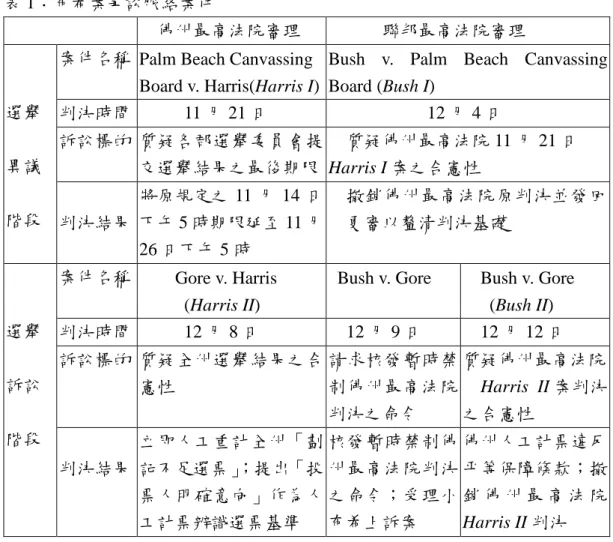
2.2000 年總統大選憲政爭議係由 5 件重要司法訴訟所構成。其中在佛州 「選舉異議階段」有 2 件,包括佛州最高法院「延長各郡提交選舉結果給州選舉 委員會最後期限」之 Palm Beach County Canvassing Board v. Harris 判決 (Harris I),以及聯邦最高法院撤銷前述判決之 Bush v. Palm Beach County Canvassing Board 案(Bush I);在佛州「選舉訴訟階段」有 3 件,包括佛州最高法院裁定立即 重新計算佛州全州「劃記不足選票」之 Gore v. Harris 案(Harris II),聯邦最高法 院暫時禁制前述命令之 Bush v. Gore 案(12 月 9 日),以及 12 月 12 日聯邦最高法 院宣告佛州重計票作業因欠缺全州統一適用標準而違反聯邦憲法增修條文第 14 條「平等保護條款」之 Bush v. Gore 案(Bush II)。本研究將上述 5 件重要訴訟案 件整理如表 1。
Supreme Court at the Bar of Politics, 2nd ed.( New Haven: Yale University Press, 1986), p. 185; Jeffrey Rosen,“PoliticalQuestion and theHazardsofPragmatism,”in Bruce Ackerman(ed.), Bush v. Gore-The Question of Legitimacy( New Heaven: Yale University Press, 2002), p. 148;Jamin B. Raskin,What’sWrong with Bush v.Goreand Why WeNeed to Amend theConstitution to Ensureit Never Happens Again, 61 Maryland Law Review 652, 700 (2002).
36
1888 年總統選舉,民主黨籍現任總統 Grover Cleveland(1837-1908)競選連任,雖然在普選票 (popular votes)方面比對手 Benjamin Harrison(1833-1901)多得 10 萬餘票(5540329: 5439853),但
是卻輸了選舉人票(168:233),因而失去總統寶座。該次選舉中,奧瑞岡(Oregon)州雖有兩分
選舉人名單送往國會,但未發生太多爭議。理由是,這兩分名單中,一分由州長確認,另
一分則是怪異人士(crank)的惡作劇,國會當然承認州長所確認的選舉人名單。參見 William
A. DeGregorio (ed.), id., pp. 336-37; Richard Friedman, supra note 35.
37 1960 年美國總統選舉,夏威夷(Hawaii)州初步開票結果,官方公布共和黨候選人尼克森(Richard M. Nixon, 1913-1994)以領先普選票 98 票贏得該州 3 張總統選舉人票。然而,民主黨候選人甘 迺迪(John F. Kennedy, 1917-1963)聲請重計票,州法院於 12 月 28 日重計票結果(已超過美國聯 邦法典第 3 篇第 5 條所規定之最後期限)後,宣布甘迺迪以領先 115 票贏得夏威夷州 3 張總統 選舉人票。然雙方為該州選舉結果對簿公堂,在司法訴訟期間,雙方各任命一組選舉人名單, 兩組各於 12 月 19 日於夏威夷州首府集會投票,隨後該州代理州長確認了共和黨那一組名單, 惟司法訴訟結果卻確認了民主黨之選舉人名單。1961 年 1 月 4 日新任州長也確認了民主黨之名 單。國會於 1 月 6 日統計各州總統選舉人票時,擔任主席之尼克森眼見甘迺迪已贏得過半數之 總統選舉人票(300 張,過半數 270 張),因而建議國會接受支持甘迺迪之夏威夷州 3 張爭議選 舉人名單。結果國會接受此一建議,最後甘迺迪所獲得之總統選舉人票為 303 張。參考下列文 獻:Jed Rubenfeld,“Not as Bad as Plessey. Worse,”in Bruce Ackerman (ed.), supra note 35, p. 22, n. 1;Diana K. Sergis, Bush v. Gore-Controversial Presidential Election Case( Berkeley, N.J.: Enslow Publishers, Inc., 2003), p. 87;William A. DeGregorio (ed.), supra note 33, p. 553; Bruce Ackerman, “Off Balance,”in Bruce Ackerman (ed.), supra note 35, p. 196;BruceAckerman,“Anatomy of a Constitutional Coup,” in Arthur J. Jacobson and Michel Rosenfeld (eds.),The Longest Night-Polemics and Perspectives on Election 2000( Berkeley: University of California Press, 2002), p. 235;Jack M. Balkin, Bush v. Gore and the Boundary between Law and Politics, 110 The Yale Law Journal 1407, 1421, n. 55 (2001);Ann Althouse, The Authoritative Lawsaying Power of the State Supreme Court and the United States Supreme Court: Conflicts of Judicial Orthodoxy in the Bush-Gore Litigation, 61 Maryland Law Review 508, 538, n. 123 (2002);Vincent Bugliosi, The Betrayal of America-How the Supreme Court Undermine the Constitution and Chose Our President ( New York:Thunder’sMouth Press/Nation Books, 2001), p.134;Richard A. Posner, supra note 18, p. 135.
表 1:布希案爭訟脈絡案件
佛州最高法院審理 聯邦最高法院審理
案件名稱 Palm Beach Canvassing Board v. Harris(Harris I)
Bush v. Palm Beach Canvassing Board (Bush I) 判決時間 11 月 21 日 12 月 4 日 訴訟標的 質疑各郡選舉委員會提 交選舉結果之最後期限 質疑佛州最高法院 11 月 21 日 Harris I 案之合憲性 選舉 異議 階段 判決結果 將原規定之 11 月 14 日 下午 5 時期限延至 11 月 26 日下午 5 時 撤銷佛州最高法院原判決並發回 更審以釐清判決基礎 案件名稱 Gore v. Harris (Harris II)
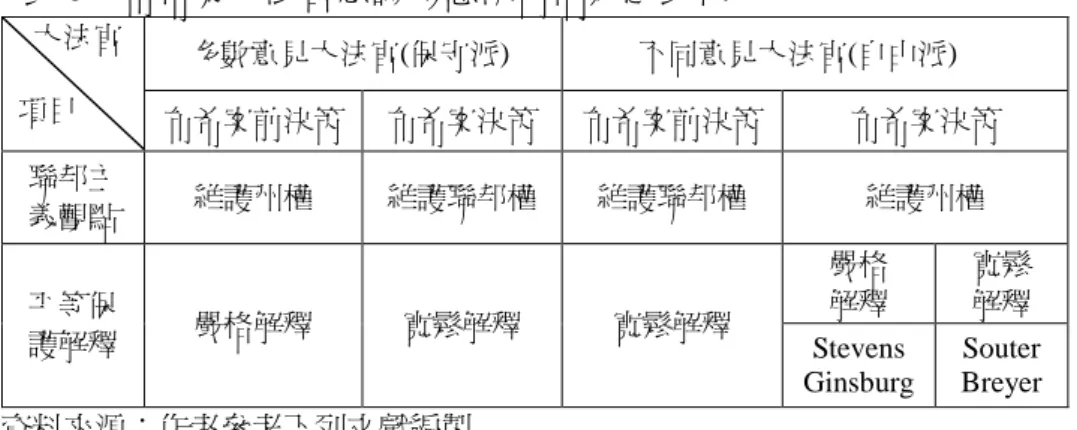
Bush v. Gore Bush v. Gore (Bush II) 判決時間 12 月 8 日 12 月 9 日 12 月 12 日 訴訟標的 質疑全州選舉結果之合 憲性 請求核發暫時禁 制佛州最高法院 判決之命令 質疑佛州最高法院 Harris II 案判決 之合憲性 選舉 訴訟 階段 判決結果 立即人工重計全州「劃 記不足選票」;提出「投 票人明確意向」作為人 工計票辨識選票基準 核發暫時禁制佛 州最高法院判決 之命令;受理小 布希上訴案 佛州人工計票違反 平等保障條款;撤 銷 佛 州 最 高 法 院 Harris II 判決 資料來源:作者整理 3.2000 年憲政爭議之司法終局判決「布希控高爾」案(Bush II),係以極分裂 之 5 比 4 作成判決,多數意見大法官聯盟由 3 位保守派(Rehnquist, Scalia, Thomas) 及 2 位溫和保守派(O’Connor,Kennedy)大法官所組成,以平等保護論證為基礎, 宣告佛州人工重新計票作業違反憲法平等保護條款;3 位保守派大法官更發布一 份協同意見書,強調佛州人工重新計票不但違反憲法平等保護條款,亦因侵犯佛 州議會本於聯邦憲法授與「決定各州總統選舉人選任方式」之權力,而牴觸聯邦 憲法第 2 條第 1 項第 2 款。4 位不同意見大法官(Stevens, Souter, Breyer, Ginsburg) 則各自發布一份不同意見書,除共同批判 3 位保守派大法官之協同意見書外,2 位大法官(Stevens, Ginsburg)堅決否認佛州人工重新計票有違反憲法平等保護條 款,另 2 位大法官(Souter, Breyer)雖然承認佛州人工重新計票會發生平等保護問 題,但皆主張本案應發回原審佛州最高法院更審,由原審法院決定統一適用之計 票標準後,再決定是否繼續重新計票。 4.聯邦最高法院以司法判斷介入具有高度政治性之憲政爭議,無論在「程序 爭點」或「實體爭點」上,均有可議之處。就「程序爭點」而言,小布希是否具 有「當事人適格」(standing to sue)、本案是否屬於「政治問題不審查」之適用範 圍,以及本案是否屬「聯邦權限爭議問題」等,皆非無疑義。然而,5 位多數意
見大法官卻不顧程序爭點而受理本案,因而遭致「黨派偏私」、「發動司法政變」、 「違反法治」、「侵蝕司法威信」等批判;就「實體爭點」而言,布希案所涉及之 「平等保護條款」、「安全防護條款」38及「救濟方式」等爭點,自由派法政學者 皆曾提出強烈抨擊。蓋美國聯邦最高法院對於選舉權之平等保護,僅適用於「投 票資格」與「選票價值」,從未擴張適用於涉及計票基準之「選舉實務」。在「安 全防護條款」方面,美國聯邦法典第 3 篇第 5 條雖規定「各州有關選任選舉人之 爭議於選舉人集會投票日前六天作成決定者,即對國會統計全國選舉人票具有拘 束力」,但此一規定係對各州之保護而非限制。然聯邦最高法院於布希案卻解讀 為「強制規定」,並以時間不足為由而不提供任何救濟措施,格外引發爭論。 上述各項爭議,若從政治分析,本研究發現:(一)從法唯實主義(legal realism) 觀點觀察,39布希控高爾案 5 位多數意見大法官對於「程序爭點」與「實體爭點」, 乃是利用本案所涉法律具有「兩可解釋」空間,而逕自以自己之政治立場進行解 釋。事實上,5 位多數意見大法官若有意維持司法自制精神,從數個程序爭點之 任何爭點上即可以駁回不受理。然而,5 位多數意見大法官在三度介入過程中, 不但積極受理本案,而且為了形成多數意見聯盟,3 位最保守之大法官竟然放緝 原先所主張之「憲法第二條論證」,而加入堅持平等保護論證之 O’Connor與 Kennedy 兩位大法官。凡此,皆足以顯現渠等之政治意圖;(二)就「黨派鞏固理 論」(partisan entrenchment theory)觀點分析,40五位多數意見大法官皆屬共和黨
38 美國聯邦法典第 3 篇第 5 條(3 U.S.C.§ 5)規定:各州依據選任總統選舉人法定期日前所制定之
法律規定,就該州選任所有或任何選舉人之爭議或訴訟,規定以司法或其他方法、程序作成終 局決定者,至遲應於選舉人集會(投票)前六日完成。此一依據選任總統選舉人法定期日前制定 之法律,且至遲於選舉人集會(投票)前六日所作成之決定,應具有終局性,對於依聯邦憲法及
本法有關(國會)計算各州總統選舉人票之規定,亦具有拘束效力。該條款原文為:“Ifany State
shall have provided by laws enacted prior to the day fixed for the appointment of the electors, for its final determination of any controversy or contest concerning the appointment of all or any of the electors of such State, by judicial or other methods or procedures, and such determination shall have been made at least six days before the time fixed for the meeting of the electors, such determination made pursuant to such law so existing on said day, and made at least six days prior to said time of meeting of the electors, shall be conclusive, and shall govern in the counting of the electoral votes as provided in the Constitution, and as hereinafter regulated, so far as the ascertainment of the electors appointed by such Stateisconcerned.”
39 法律唯實主義(legal realism)盛行於 1930 年代,其傳統觀點認為:「法律判斷與政治判斷之間的
界線既不清晰又不單純」(The line between legal judgment and political judgment is far from crisp and simple),並極力主張「法官基於個人價值作成案例判決,大多毋須顧及法律規則」(Judges decide cases on the basis of their personal values, largely without regard to legal rules)。因此,當法 律資料不足以讓民眾或法官們做為判斷基準時,他們通常都會依據自己的政治立場(political grounds)來判斷。See Cass R. Sunstein, “LawlessOrderand HotCases,”in Ronald Dworkin(ed.), A Badly Flawed Election-Debating Bush v. Gore, the Supreme Court, and American Democracy (New York: The New Press, 2002), p.100; Richard H. Fallon Jr., Marbury and the Constitutional Mind: A Bicentennial Essay On the Wages of Doctrinal Tension, 91 California Law Review 1, 48 (2003).
40「黨派鞏固理論」係由耶魯大學 Jack M. Balkin 及德州大學 Sanford Levinson 兩位教授所提出,
渠等指出:「黨派鞏固」乃是美國憲法變遷特別重要之動力,也是理解憲法革命(constitutional revolution)如何發生、事實上即司法審查如何運作(尤其是 20 世紀)最為重要之因素。當某一政 黨贏得總統寶座後,該黨便會讓同黨人士進駐聯邦司法體系(尤其是聯邦最高法院),只要某一 政黨所任命的聯邦法官夠多,即可透過司法違憲審查所作成之憲法判決影響美國憲法的走向。 如果在相當短時間內通過相當多數的同黨人士之聯邦司法任命,憲法的變遷就會趨於快速,而
籍,有關平等保護之司法決策又前後不一致,而類似O’Connor大法官顧慮高爾 當選將難以退休等種種傳聞,皆足以令人有「黨派鞏固現象」之確信。從而,批 評者所謂「五位共和黨籍總統提名之多數意見大法官,藉由將小布希送進白宮來 確保渠等繼任者為共和黨派,進而在嗣後聯邦最高法院決策的議程中繼續維持優 勢地位」41,便有相當之可信度。
(二)建議
本研究之具體建議如下: 1.美國總統選舉之特色為「總統選舉人團」(electoral college)制,該制度自 1800 年總統選舉爭議起即引發改革芻議,歷次爭議後皆不乏主張廢除「總統選 舉人團」制之修憲提案,惟二百餘年來始終未能成功。從務實面看,一個可以維 持二百餘年之制度,必有其可取之處。學術界似乎可以就此一制度之優劣進行理 論與實務之研究,除了在比較政治領域中可以填補漏洞,亦可提供我國制度調整 之參考。 2.依據本研究顯示,5 位保守派大法官在布希控高爾案中,顯然有依據黨派 意識進行司法決策之現象,然而聯邦最高法院在「布希案」判決發布後,雖遭受 許多指責(尤其是民主黨人、法學界人士),但民間聲望僅從百分之 62 略降為百 分之 59。42在聯邦政府三大部門中仍擁有最高聲望,其原因究竟為何?與美國法 院長期累積之制度性威望(institutional prestige)有關嗎?值此司法權日益重要之 當代民主社會,此一現象實在值得學術界進一步探究。參、參考文獻
一、中文文獻
王 磊編 (2002),《布什訴戈爾》(Bush v. Gore),北京:北京大學出版社。 司法院編 (2001-2003),《美國聯邦最高法院憲法判決選譯》(一至四輯),台北: 司法院。 李念祖 (2000),〈美國憲法上「政治問題」理論與釋字第 328 號解釋〉,收於李 念祖《司法者的憲法》。台北:五南書局,頁 159-174。 李念祖 (2000),〈再論美國「政治問題」理論在我國憲法解釋上之運用〉,收於 李念祖《司法者的憲法》。台北:五南書局,頁 175-214。 李建良 (1999),〈論司法審查的政治界限─美國「政治問題原則」初探〉,收於李 建良,《憲法理論與實踐(一)》,台北:學林文化,頁 269-320。 李建良 (1998),〈政治問題與司法審查─試評司法院大法官相關解釋〉,收於劉孔憲法革命就是成功的黨派鞏固所累積之結果。See Jack M. Balkin and Sanford Levinson, Understanding the Constitutional Revolution, 87 Virginia Law Review 1066-68(2001).
41Jack M. Balkin and Sanford Levinson, id., p.1053.
42 此乃布希案判決後(2001 年 1 月)一項美國蓋洛普民調結果顯示。See John C. Yoo, In Defense
中、李建良編,《憲法解釋之理論與實務》(第一輯),台北:中央研究院人 文社會科學研究所,頁 161-197。 林子儀 (1997),〈言論自由的限制與雙軌理論〉,《現代國家與憲法》,台北:月 旦,頁 639-707。 林利芝譯 (2001),William Burnham 著,《英美法導論》,台北:元照出版。 法治斌 (1996),〈司法審查中之平等權:建構雙重基準之研究〉,《國家科學委員 會研究彙刊:人文及社會科學》,6 卷,1 期,頁 35-50; 該文另收於法治斌 (2003),《法治國家與表意自由》,台北:正典,頁 213-231。 陳文政 (2005),〈二 OOO 年美國總統選舉憲法判決之學術爭議〉,《師大政治論 叢》,4 期,頁 69-126。 陳文政(2006-2007),《世紀憲法判決:布希控高爾案之分析》,台北:五南圖書, 出版籌備中。 陳文政(2006),〈憲政爭議與司法判斷:布希控高爾案大法官決策之分析〉《臺 大法學論叢》(已通過初審,狀態為複審後修正回覆該刊編委會,該刊為 TSSCI 刊物)(第一年計畫部分研究成果)。 陳文政(2006),〈憲政主義結構內涵之體系分析〉,《師大政治論叢》,第 6 期。 頁 47-162(第一年計畫部分研究成果)。 陳文政(2006),〈總統任命大法官,大法官選任總統:布希控高爾案之政治分析〉 發表於 2006 年中國政治學會年會暨「憲政、民主與人權」學術研討會(政 治大學社科院主辦,2006 年 9 月 16-17 日),該文經修正後已投稿中國政治 學會發行之《政治學報》(TSSCI 刊物,狀態為審查中)。 黃昭元 (2004),〈憲法權利限制的司法審查標準:美國類型化多元標準模式的比 較分析〉,《台大法學論叢》,33 卷,3 期,頁 45-148。 湯德宗 (1998),〈權力分立原則與違憲審查權限:大法官抽象釋憲權之商榷〉, 收於劉孔中、李建良編,《憲法解釋之理論與實務》(第一輯),台北:中央 研究院人文社會科學研究所,頁 121-160。 湯德宗,〈立法裁量之司法審查的憲法依據-違憲審查正當性理論初探〉,收於氏 著,《權力分立新論》,台北:元照,2000 年,頁 1-74。 葉俊榮 (1993),〈邁向自制之路─美國最高法院對環保團體當事人適格的緊縮〉, 焦興鎧主編,《美國聯邦最高法院論文集》,台北,中央研究院歐美研究所, 頁 111-135。 雷飛龍 (2002),〈二 OOO 年美國總統選舉及其缺失析述〉,收於氏著《社會科學 與比較政治》,台北:韋伯文化,頁 259-284。
二、英文文獻
(一)本結案報告英文文獻Ackerman,Bruce(2002),“OffBalance,”in BruceAckerman (ed.),Bush v. Gore-The Question of Legitimacy (New Heaven: Yale University Press), pp.192-209.
Althouse, Ann (2002), The Authoritative Lawsaying Power of the State Supreme Court and the United States Supreme Court: Conflicts of Judicial Orthodoxy in the Bush-Gore Litigation, 61 Maryland Law Review 508-575.
Balkin, Jack M. and Sanford Levinson (2001), Understanding the Constitutional Revolution, 87 Virginia Law Review 1045-1109.
Balkin, Jack M. (2001), Bush v. Gore and the Boundary between Law and Politics, 110 The Yale Law Journal 1407-1458.
Barkow, Rachel E. (2002), More Supreme Than Court? The Fall of Political Question Doctrine and the Rise of Judicial Supremacy, 102 Columbia Law Review 237-336.
Bickel, Alexander M. (1986), The Least Dangerous Branch : The Supreme Court at
the Bar of Politics, 2nded. (New Haven: Yale University Press).
Bugliosi, Vincent (2001), The Betrayal of America-How the Supreme Court
Undermined the Constitution and Chose Our President (New York:Thunder’s
Mouth Press).
Choper, Jesse H. (2001), Why the Supreme Court Should Not Have Decided the Presidential Election of 2000, 18 Constitutional Commentary 335-357.
DeGregorio, William A. (ed.) (2004), The Complete Books of U.S. Presidents ( New York: Barnes&Noble Books).
Dershowitz, Alan M. (2001), Supreme Injustice-How the High Court Hijacked
Election 2000 (New York: Oxford University Press).
Dionne, E. J. Jr. and William Kristol (eds.) (2001), Bush v. Gore-The Court Cases
and the Commentary (Washington, D.C.: Brookings Institution Press).
Dover, Edwin D. (2003), The Disputed Presidential Election of 2000 (Westport, Conn.: Greenwood Press).
Dworkin, Ronald (ed.) (2002), A Badly Flawed Election- Debating Bush v. Gore, The
Supreme Court and American Democracy (New York:The New Press).
Fallon, Richard H. Jr. (2003), Marbury and the Constitutional Mind: A Bicentennial Essay on the Wages of Doctrinal Tension, 91 California Law Review 1-55.
Friedman, Richard (2001), Trying to Making Peace with Bush v. Gore, 29 Florida
State University Law Review 811-869.
Issacharoff, Samuel, Pamela S. Karlan and Richard H. Pildes (2001), When Elections
Go Bad-The Law of Democracy and the Presidential Election of 2000 (New York:
Foundation Press).
Jacobson, Arthur J. and Michel Rosenfeld (eds.) (2002), The Longest Night-Polemics
and Perspectives on Election 2000 (Berkeley, Calif.: University of California
Press).
Constitutions, and the Courts (Princeton, N.J.: Princeton University Press).
Pyle, Ransford C., Heather Slusher and Bast Carol (2001), Bush v. Gore-Understanding the American Legal System (Dallas, Texas: Pearson
Publications Co.).
Raskin, Jamin B. (2002), What’sWrong with Bush v.Goreand Why WeNeed to Amend the Constitution to Ensure it Never Happens Again, 61 Maryland Law
Review 652-710.
Rosen,Jeffrey (2002),“PoliticalQuestion and theHazardsofPragmatism,”in Bruce Ackerman (ed.), Bush v. Gore-The Question of Legitimacy (New Heaven: Yale University Press), pp.145-162.
Rubenfeld,Jed (2002), “Notas Bad asPlessy. Worse,”in BruceAckerman (ed.),
Bush v. Gove-The Question of Legitimacy (New Haven: Yale University Press),
pp.20-38.
Sergis, Diana K.(2003), Bush v. Gore-Controversial Presidential Election Case (Berkeley, N.J.: Enslow Publishers, Inc.).
Sunstein,CassR.(2002),“LawlessOrderand HotCases,”in Ronald Dworkin (ed.),
A Badly Flawed Election-Debating Bush v. Gore, the Supreme Court, and American Democracy (New York: The New Press), pp.75-104.
Sunstein, Cass R. & Richard A. Epstein (eds.), The Vote-Bush, Gore & the
Supreme Court (Chicago:The University of Chicago Press).
Yoo,John C.(2001), In DefenseoftheCourt’s Legitimacy,68 The University of Chicago Law Review, 775-791.
Zelnick, Robert (2001), Winning Florida-How the Bush Team Fought the Battle (Stanford, California: Hoover Institution Press).
(二)本研究相關英文文獻
Abramowicz, Michael and Maxwell L. Stearns (2001), Beyond Counting Votes: The Political Economy of Bush v. Gore, 54 Vanderbilt Law Review 1849-1952.
Ackerman,Bruce(2002),“Anatomy ofaConstitutionalCoup,”in ArthurJ.Jacobson and Michel Rosenfeld (eds.), The Longest Night-Polemics and Perspectives on
Election 2000 (Berkeley, Calif.: University of California Press), pp. 227-235.
Ackerman, Bruce (2002), “Introduction: The Question of Legitimacy,” in Bruce Ackerman (ed.), Bush v. Gore-The Question of Legitimacy (New Haven: Yale University Press), pp. vii-xiii.
Ackerman, Bruce (2001), We the People : Transformations (Cambridge, Mass : Harvard University Press).
Alexander, Larry and Lawrence B. Solum (2005), Book Review: Popular ? Constitutionalism?, 118 Harvard Law Review 1594-1640.
Interpretation, 110 Harvard Law Review 1359-1387.
Anastaplo, George (2002), Bush v. Gore and a Proper Separation of Powers, 34
Loyola University Chicago Law Journal 131-148.
Araiza, William D. (2005), The Section 5 Power and the Rational Basis Standard of Equal Protection, 79 Tulane Law Review 519-585.
Baker,Gordon E.(2005),“Reynoldsv.Sims,”in KermitL.Hall(ed.),The Oxford Companion to the Supreme Court of the United States, 2nded. (New York: Oxford
University Press), pp.853-855.
Baker,Gordon E.(2005),“Gray v.Sanders,”in Kermit L. Hall (ed.), The Oxford
Companion to the Supreme Court of the United States, 2nded. (New York: Oxford
University Press), p.402.
Balkin,Jack M.(2002),“Legitimacy and the2000 Election,”in Bruce Ackerman (ed.),
Bush v. Gore-The Question of Legitimacy (New Heaven: Yale University Press.),
pp.210-228.
Barak, Aharon (2002), The Supreme Court 2001 Term, Forward: A Judge on Judging: The Role of a Supreme Court in a Democracy, 116 Harvard Law Review 16-162. Benedict, Michael Les (1999), Constitutional History and Constitutional Theory:
Reflections on Ackerman, Reconstruction, and the Transformation of the American Constitution, 108 The Yale Law Journal 2011-2038.
Bickerstaff, Steve (2001), Courts, Recounts, And Election Contests:Lessons from the Florida President Election, 29 Florida State University Law Review 425-467. Brady, Henry E. (2002), “Equal Protection for Votes,” in Arthur J. Jacobson and
Michel Rosenfeld(eds.), The Longest Night-Polemics and Perspectives on
Election 2000(Berkeley:University of California Press), pp.47-49.
Briffault, Richard (2001), Bush v. Gore as an Equal Protection Case, 29 Florida State
University Law Review 325-376.
Brookhiser,Richard (2002),“SpringtimeforRousseau,”in ArthurJ.Jacobson and Michel Rosenfeld(eds.), The Longest Night-Polemics and Perspectives on
Election 2000 (Berkeley, Calif.: University of California Press), pp.250-255 .
Calabresi,Guido (2002),“In Partial(but not partisan)PraiseofPrinciple,”in Bruce Ackerman (ed.), Bush v. Gore-The Question of Legitimacy (New Haven: Yale University Press), pp.67-83.
Calabresi,Steven G.(2002),“A PoliticalQuestion,”in BruceAckerman(ed.), Bush v.
Gore-The Question of Legitimacy (New Haven: Yale University Press),
pp.129-144.
Chemerinsky, Erwin (2002), How Should We Think about Bush v. Gore?34 Loyola
University Chicago Law Journal 1-21.
71 The George Washington Law Review 91-130.
Coar, David H. (2002), It Is Emphatically the Province and Duty of the Judicial Department to Say Who the President Is?, 34 Loyola University Chicago Law
Journal 121-130.
Cohen, William and Jonathan D. Varat (eds.) ( 2001), Constitutional Law, 11th ed. (New York: Foundation Press).
Cooper, Charles J. (1988), Stare Decisis: Precedent and Principle in Constitutional Adjudication, 73 Cornell Law Review 401-410.
Dahl, Robert A. (2001), Decision-Making in a Democracy: The Supreme Court as a National Policy-Maker, 50 Emory Law Journal 563-582.
Dahl, Robert A. (2001), How Democratic Is the American Constitution?(New Haven: Yale University Press) .
Dame, Paul A. (2002), Stare Decisis, Chevron, and Skidmore: Do Administrative Agencies Have the Power to Overrule Courts? 44 William and Mary Law Review 405-439.
Dionne. E. J. Jr. & William Kristol(2001),“Introduction-TheFloridaMoment,” in E. J. Dionne Jr. & William Kristol (eds.), Bush v. Gore-The Court Cases
and the Commentary (Washington, D.C.: Brookings Institution Press,), pp.1-6.
Dorf, Michael C. (2001), The 2000 Presidential Election: Archetype or Exception?, 99 Michigan Law Review 1279-1297.
Dworkin, Ronald (2002), “A Badly Flawed Election,” in Arthur J. Jacobson and Michel Rosenfeld (eds.), The Longest Night-Polemics and Perspectives on
Election 2000 (Berkeley, Calif.: University of California Press), pp. 89-99.
Dworkin,Ronald (2002),“Introduction,”in Ronald Dworkin (ed.),A Badly Flawed Election-Debating Bush v. Gore, the Supreme Court, and American Democracy
(New York: The New Press), pp.1-55.
Dworkin, Ronald (1996), A Matter of Principle (Oxford: Clarendon Press).
Editors (2002), Litigating the Presidency: The Election 2000 Decision and Its Ramifications for the Supreme Court, 61 Maryland Law Review 505-507.
Edwards, Harry T. (2002), Race and the Judiciary, 20 Yale Law & Policy Review 325-330.
Eisgruber, Christopher L.(2003), Marbury, Marshall, and the Politics of Constitutional Judgment, 89 Virginia Law Review 1203-1234.
Eisgruber, Christopher L. (2001), Constitutional Self-Government (Cambridge, Mass.: Harvard University Press).
Endicott, Timothy (2003), The Reason of the Law, 48 The American Journal of
Jurisprudence 83-106.
Presidential Election, 61 Maryland Law Review 576-605.
Epstein, Lee, Jack Knight, and Andrew D. Martin (2001), The Supreme Court as a Strategic National Policymaker, 50 Emory Law Journal 583-611.
Epstein,Richard A.(2001),“In Such MannerastheLegislature ThereofMay Direct”: The Outcome in Bush v. Gore Defended, 68 The University of Chicago Law
Review 613-635.
Erikson, Robert S. (2001), The 2000 Presidential Election in Historical Perspective, 116(1) Political Science Quarterly 29-52.
Fallon, Richard H. Jr. (2005), Legitimacy and the Constitution, 118 Harvard Law
Review 1787-1853.
Fallon, Richard H. Jr. (2004), The Dynamic Constitution-An Introduction to American
Constitutional Law (New York: Cambridge University Press).
Fallon,Richard H.Jr.(2004),“Appendix:TheConstitution oftheUnited States,”in Richard H. Fallon, Jr., The Dynamic Constitution-An Introduction to American
Constitutional Law ( New York: Cambridge University Press), pp.278-297.
Fallon, Richard H. Jr. (2001), Stare Decisis and the Constitution: An Essay on Constitutional Methodology, 76 New York University Law Review 570-597. Fallon, Richard H. Jr.(1993), Some Confusions About Due Process, Judicial Review
and Constitutional Remedies, 93 Columbia Law Review 309-373.
Farber, Daniel A. (1982), The Supreme Court and the Rule of Law: Cooper v. Aaron Revisited, 1982 University of Illinois Law Review 387-412.
Ferejohn, John A. and Larry D. Kramer (2002), Independent Judges, Dependent Judiciary: Institutionalizing Judicial Restraint, 77 New York University Law
Review 962-1039.
Fisher, Louis (1988), Constitutional Dialogues-Interpretation as Political Process (Princeton, N.J.: Princeton University Press).
Fiss,Owen (2002),“The Fallibility ofReason,”in BruceAckerman(ed.), Bush v.
Gore-The Question of Legitimacy ( New Haven: Yale University Press ) ,
pp.84-95.
Fitzgerald, James Eugene (2001), State Sovereign Immunity: Searching for Stability, 48 ULCA Law Review 1203-1243.
Fletcher,GeorgeP.(2002),“ The Many FacesofBush v.Gore,” in ArthurJ.Jacobson and Michel Rosenfeld(eds.), The Longest Night-Polemics and Perspectives on
Election 2000 (Berkeley, Calif.: University of California Press), pp.236-249.
Fried, Charles (2002), “An Unreasonable Reaction to a Reasonable Decision,” in Bruce Ackerman (ed.), Bush v. Gore-The Question of Legitimacy (New Heaven: Yale University Press), pp.3-19 .
Right to Vote, and Our Federalism: A Comment on a Lasting Institution, 29
Florida State University Law Review 879-924.
Gardner, James A. (2001), The Regulatory Role of State Constitutional Structural Constraints in Presidential Election, 29 Florida State University Law Review 625-659.
Garrett, Elizabeth (2001), Institutional Lessons from the 2000 Presidential Election, 29 Florida State University Law Review 975-993.
Garrett,Elizabeth (2001),“Leaving the Decision to Congress,” in CassR.Sunstein & Richard A. Epstein (eds.),The Vote-Bush, Gore & the Supreme Court (Chicago:The University of Chicago Press), pp.38-54.
Gey, Steven G. (2001), The Odd Consequences of Taking Bush v. Gore Seriously, 29
Florida State University Law Review 1005-1029.
Gillman, Howard (2005), “Bush v. Gore,” in Kermit L. Hall (ed.), The Oxford
Companion to the Supreme Court of the United States, 2nded.(New York: Oxford
University Press), pp.126-127.
Gillman, Howard (2003), Judicial Independence through the Lens of Bush v. Gore: Four Lessons from Political Science, 64 Ohio State Law Journal 249-264. Goldman, Sheldon (1991), Constitutional Law-Case and Essays 2nd ed. (New York:
Harper Collins Publishers).
Graglia, Lino A. (2003), The Myth of a Conservative Supreme Court: The October 2000 Term, 26 Harvard Journal of Law & Public Policy 281-313.
Griffin, Stephen M. (1996), American Constitutionalism- From Theory to Politics (Princeton, New Jersey: Princeton University Press).
Guinier, Lani (2002), Supreme Democracy: Bush v. Gore Redux, 34 Loyola
University Chicago Law Journal 23-76.
Guinier, Lani (2002), “And to the C Students:The Lessons of Bush v. Gore,” in Ronald Dworkin(ed.), A Badly Flawed Election-Debating Bush v. Gore, the
Supreme Court, and American Democracy (New York: The New Press),
pp.231-264.
Hall, Kermit L. (ed.) (2005), The Oxford Companion to the Supreme Court of the
United States, 2nded. (New York: Oxford University Press).
Harrison, John (1998), The Constitutional Origins and Implications of Judicial Review, 84 Virginia Law Review 333-387.
Hasen, Richard L. (2003), The Supreme Court and Election Law-Judging Equality
from Baker v. Carr to Bush v. Gore (New York: New York University Press).
Hasen, Richard L. (2001), Bush v. Gore and the Future of Equal Protection Law in Elections, 29 Florida State University Law Review 377-406.
Thought, 45 Boston College Law Review 499-594.
Hill, John Lawrence (2002), A Third Theory of Liberty: the Evolution of Our Conception of Freedom in American Constitutional Thought, 29 Hastings
Constitutional Law Quarterly 115-184.
Ifill, Sherrilyn A. (2002), Do Appearances Matter? : Judicial Impartiality and the Supreme Court in Bush v. Gore, 61 Maryland Law Review 606-651.
Jacobson, Arthur J.(2002), “The Ghostwriters,” in Arthur J. Jacobson and Michel Rosenfeld(eds.), The Longest Night-Polemics and Perspectives on Election
2000 (Berkeley, Calif.:University of California Press), pp.189-211.
Jacobson, Arthur J.and MichelRosenfeld (2002),“Castand Chronology,” in ArthurJ. Jacobson and Michel Rosenfeld (eds.), The Longest Night-Polemics and
Perspectives on Election 2000 (Berkeley, Calif.:University of California Press),
pp.22-46.
Jones, Jeffrey M. (2000), Public Willing to Accept Supreme Court as Final Arbiter of Election Dispute, 423 The Gallup Monthly 11-14.
Kaplin, William A. (1992), The Concepts and Methods of Constitutional Law (Durham, N.C.: Carolina Academic Press).
Karlan, Pamela S. (2003), When Freedom Isn’t Free: The Costs of Judicial Independence in Bush v. Gore, 64 Ohio State Law Journal 265-282.
Karlan, Pamela S. (2001), Unduly Partial: The Supreme Court and the Fourteenth Amendment in Bush v. Gore, 29 Florida State University Law Review 587-602. Karlan,PamelaS.(2001),“TheNewestEqualProtection RegressiveDoctrineon a
Changeable Court,” in Cass R. Sunstein & Richard A. Epstein (eds.),The
Vote-Bush, Gore and the Supreme Court (Chicago: The University of Chicago
Press), pp.77-97.
Klarman, Michael J. (2001), Bush v. Gore through the Lens of Constitutional History, 89 California Law Review 1721-1765.
Kramer, Larry D. (2001) The Supreme Court 2000 Term, Forward: We the Court, 115
Harvard Law Review 4-169.
Krent, Harold J. (2001), Judging Judging: The Problem of Second-Guessing State Judges’Interpretation ofStateLaw in Bush v.Gore,29 Florida State University Law Review 493-534.
Krotoszynski, Ronald J. Jr. (2002), An Epitaphios for Neutral Principles in Constitutional Law: Bush v. Gore and the Emerging Jurisprudence of Oprah!, 90 The Georgetown Law Journal 2087-2141.
Kumm, Mattias (2002), “Democracy in America: A European Perspective on the MillennialElection,”in ArthurJ.Jacobson and MichelRosenfeld (eds.),The
University of California Press), pp.332-344.
Lain, Corinna Barrett (2004), Countermajoritarian Hero or Zero?Rethinking the Warren Court’sRolein theCriminalProcedureRevolution,152 University of Pennsylvania Law Review 1361-1452.
Lawson,Gary (2003),An EmpiricalTestofJusticeScalia’sCommitmentto theRule of Law, 26 Harvard Journal of Law & Public Policy 803-809.
Levasseur, Alain A. (2002) Legitimacy of Judges, 50 The American Journal of
Comparative Law 43-85.
Levinson, Sanford and Ernest A. Young (2001), Who’s Afraid of the Twelfth Amendment?, 29 Florida State University Law Review 925-973.
Lund, Nelson (2002), “The Unbearable Rightness of Bush v. Gore,” in Arthur J. Jacobson and Michel Rosenfeld (eds.), The Longest Night-Polemics and
Perspectives on Election 2000 (Berkeley, Calif.: University of California Press),
pp.144-188.
Madison, James, Alexander Hamilton, and John Jay (1987), The Federalist Papers (London: Penguin Books).
Mansfield,Harvey J.(2001),“WhatWe’llRememberin 2050,”in E.J.DionneJr.and William Kristol (eds.), Bush v. Gore-The Court Cases and the Commentary (Washington, D.C.: Brookings Institution Press), pp.340-341.
Marshall, William P. (2001), The Supreme Court, Bush v. Gore, and Rough Justice, 29
Florida State University Law Review 787-809.
Mason, Alpheus Thomas and Donald Grier Stephenson, Jr. (1996), American
Constitutional Law-Introductory Essays and Selected Cases (Upper Saddle River,
N. J.: Prentice-Hall).
McConnell, Michael W. (2001), Two-and-a-Half Cheers for Bush v. Gore, 68 The
University of Chicago Law Review 657-678.
Monaghan, Henry Paul (2003), Supreme Court Review of State-Court Determinations of State Law in Constitutional Cases, 103 Columbia Law Review 1919-1991. Moore, David W. (2000), Ultimately, Americans Would Accept Either Bush or Gore
as Legitimate President, 422 Gallup Poll Monthly 7-14.
Newport, Frank (2000), President-Elect Bush Faces Politically Divided Nation, but Relatively Few Americans Are Angry or Bitter Over Election Overcome, 423
The Gallup Monthly 15-19.
Nichol,GeneR.(2003),Review Essay:Toward a People’sConstitution,91 California Law Review 621-639.
Note (2001), Rethinking the Electoral College Debate: The Framers, Federalism, and One Person, One Vote, 114 Harvard Law Review 2526-2549.
Speech and Property, 115 Harvard Law Review 1713-1736.
Note (2001), Non Sub Homine?A Survey and Analysis of the Legal Resolution of Election 2000, 114 Harvard Law Review 2170-2193.
O’Brien,David M.(1986), Storm Center-The Supreme Court in American Politics (New York: W.W. Norton&Company).
Otter, Ronald C. Den (2004), The Place of Moral Judgment in Constitutional Interpretation, 37 Indiana Law Review 375-416.
Overton, Spencer (2002), Rules, Standards, and Bush v. Gore: Form and the Law of Democracy, 37 Harvard Civil Rights-Civil Liberties Law Review 67-102.
Overton, Spencer (2001), A Place at the Table: Bush v. Gore through the Lens of Race, 29 Florida State University Law Review 469-492.
Paulsen, Michael Stokes (2000), Abrogating Stare Decisis by Statute: May Congress Remove the Precedential Effect of Roe and Casey? 109 The Yale Law Journal 1535-1602.
Pildes, Richard H. (2002), “Constitutionalizing Democratic Politics,” in Ronald Dworkin (ed.), A Badly Flawed Election-Debating Bush v. Gore, the Supreme
Court, and American Democracy (New York: The New Press), pp.155-186.
Pildes,Richard H.(2002),“Disputing Elections,”in ArthurJ.Jacobson and Michel Rosenfeld (eds.), The Longest Night-Polemics and Perspectives on Election
2000 (Berkeley, Calif.: University of California Press), pp.69-88.
Pildes,Richard H.(2001),Judging “New Law”in Election Disputed,29 Florida State University Law Review 691-730.
Polsby, Nelson W. (2002), “Holy Cow! Preliminary Reflections on the 2000 Election,”in Ronald Dworkin (ed.),A Badly Flawed Election-Debating Bush v. Gore, the Supreme Court and American Democracy (New York:The New Press),
pp. 265-283.
Posner, Richard A. (2001), Bush v. Gore: Prolegomenon to an Assessment, 68 The
University of Chicago Law Review 719-736.
Posner, Richard A. (2002), “Bush v. Gore as Pragmatic Adjudication,” in Ronald Dworkin (ed.), A Badly Flawed Election-Debating Bush v. Gore, the Supreme
Court, and American Democracy (New York: The New Press), pp.187-214.
Posner, Richard A. (2001), Bush v. Gore: Reply to Friedman, 29 Florida State
University Law Review 871-877.
Post, Robert (2002), “Sustaining the Premise of Legality: Learning to Live with Bush v.Gore”, in Bruce Ackerman (ed.), Bush v. Gore-The Question of Legitimacy
(Princeton, N.J.: Princeton University Press), pp.96-109.
Prakash, Saikrishna B. (2003), Overcoming the Constitution, 91 The Georgetown Law
Prakash, Saikrishna B. and John C. Yoo (2003), The Origins of Judicial Review, 70
The University of Chicago Law Review 887-982.
Puro,Steven (2005),“Harperv.Virginia StateBoard ofElections,” in KermitL.Hall (ed.), The Oxford Companion to the Supreme Court of the United States, 2nd ed.
(New York: Oxford University Press), pp.424-25.
Pushaw, Robert J. Jr. (2001), Bush v. Gore: Looking at Baker v. Carr in a Conservative Mirror, 18 Constitutional Commentary 359-402.
Pushaw, Robert J. Jr. (2001), The Presidential Election Dispute, the Political Question Doctrine, and the Fourteenth Amendment: A Reply to Professors Krent and Shane, 29 Florida State University Law Review 603-624.
Radin,MargaretJane(2002),“Can theRule of Law Survive Bush v. Gore?” in Bruce Ackerman (ed.), Bush v. Gore-The Question of Legitimacy (New Heaven: Yale University Press), pp.110-128.
Rosenfeld, Michel (2002), “Bush v. Gore: Three Strikes for the Constitution, the Court,and Democracy,butThereIsAlwaysNextSeason,”in Arthur J. Jacobson and Michel Rosenfeld(eds.), The Longest Night-Polemics and Perspectives on
Election 2000 (Berkeley, Calif.: University of California Press), pp.111-143.
Rotunda, Ronald D. (2003), Yet another Article on Bush v. Gore, 64 Ohio State Law
Journal 283-321.
Scalia, Antonin (1998),The Rule of Law as a Law of Rules, 56 The University of
Chicago Law Review 1175-1188; reprinted in Tom Campbell and Adrienne Stone
(eds.) (2003), Law and Democracy (Burlington, England: Ashgate Publishing), pp.347-60.
Schapiro, Robert A. (2001), Conceptions and Misconceptions of State Constitutional Law in Bush v. Gore, 29 Florida State University Law Review 661-690.
Schlag, Pierre (1985), Rules and Standards, 33 UCLA Law Review 379-430.
Schlesinger, Arthur Jr. (2002), “How to Democratize American Democracy,” in Ronald Dworkin (ed.), A Badly Flawed Election-Debating Bush v. Gore, the
Supreme Court, and American Democracy (New York: The New Press),
pp.215-229.
Schwartz, Paul M. (2002), Voting Technology and Democracy, 77 New York
University Law Review 625-698.
Segal, Jeffrey A. & Harold J. Spaeth (2004), The Supreme Court and the Attitudinal
Model Revisited (Cambridge:Cambridge University Press).
Segal, Jeffrey A. & Harold J. Spaeth ( 1993), The Supreme Court and the Attitudinal
Model (Cambridge:Cambridge University Press).
Segal, Jeffrey A., Harold J. Spaeth, and Sara C. Benesh (2005), The Supreme Court in
Shane, Peter M. (2001), Disappearing Democracy: How Bush v. Gore Undermined the Federal Right to Vote for Presidential Electors, 29 Florida State University
Law Review 535-586.
Smith, Hayward H. (2001), History of the Article II Independent State Legislature Doctrine, 29 Florida State University Law Review 731-785.
Stone, Geoffrey R. (1987), Content- Neutral Restrictions, 54 The University of
Chicago Law Review 46-118.
Strauss, David A. (2001), The Irrelevance of Constitutional Amendments, 114
Harvard Law Review 1457-1505.
Strauss, David A. (2001), Bush v. Gore: What Were They Thinking?, 68 The
University of Chicago Law Review 737-756.
Sunstein,CassR.(2001),“Introduction:OfLaw and Politics”in CassR.Sunstein and Richard A. Epstein (eds.), The Vote-Bush , Gore & The Supreme Court (Chicago : The University of Chicago Press.), pp.1-12.
Sunstein, Cass R. (2001), Order without Law, 68 The University of Chicago Law
Review 757-773.
Sunstein,CassR.(2001),“WhatWe’llRememberin 2050,”in E.J.DionneJr.& William Kristol (eds.), Bush v. Gore-The Court Cases and the Commentary (Washington, D.C.: Brookings Institution Press), pp.339-340.
Tokaji, Daniel P. (2003), First Amendment Equal Protection: On Discretion, Inequality, and Participation, 101 Michigan Law Review 2409-2424.
Tribe, Laurence H. (2002), “Freeing Bush v. Gore from Its Hall of Mirrors,” in Ronald Dworkin (ed.), A Badly Flawed Election-Debating Bush v. Gore, the
Supreme Court, and American Democracy (New York: The New Press),
pp.105-154.
Tribe, Laurence H. (2001), Gore v. Bush and Its Disguises: Freeing Bush v. Gore from Its Hall of Mirrors, 115 Harvard Law Review 179-274.
Tribe, Laurence H. (2002), eroG .v hsuB: Through the Looking Glass, in Bruce Ackerman (ed.), Bush v. Gore-The Question of Legitimacy (Princeton, N.J.: Princeton University Press), pp.39-66.
Tushnet, Mark (2005), A Court Divided-The Rehnquist Court and the Future of
Constitutional Law (New York: W.W. Norton & Company).
Tushnet, Mark (2003), The New Constitutional Order (Princeton, N.J.: Princeton University Press).
Tushnet. Mark (2002), “TheConservatism in Bush v.Gore,”in Bruce Ackerman (ed.),
Bush v. Gore-The Question of Legitimacy (New Haven: Yale University Press),
pp.163-176.
History, 90 The Georgetown Law Journal 113-125.
Tyler, Tom R. & Gregory Mitchell (1994), Legitimacy and the Empowerment of Discretionary Legal Authority: The United States Supreme Court and Abortion Rights, 43 Duke Law Journal 703-815.
Wattenberg, Martin P. (2003), Elections: Was the 2000 Presidential Election Fair?An Analysis of Comparative and Retrospective Survey Data, 33 (4) Presidential
Studies Quarterly 889-897.
Wechsler, Herbert (1959), Toward Neutral Principles of Constitutional Law, 73
Harvard Law Review 1-35.
Wells, Michael L. (2001), Were There Adequate State Grounds in Bush v. Gore? 18
Constitutional Commentary 403-421.
Wells, Michael L. and Jeffry M. Netter (2002), Article Ⅱ and the Florida Election Case: A Public Choice Perspective, 61 Maryland Law Review 711-738.
West, Robin (2001), Reconstructing the Rule of Law, 90 The Georgetown Law
Journal 215-221.
Whittington, Keith E. (2002), Yet another Constitutional Crisis?, 43 William and
Mary Law Review 2093-2149.
Wiecek,William M.(2005),“ObiterDictum,”in KermitL.Hall(ed.),The Oxford Companion to the Supreme Court of the United States, 2nded. (New York: Oxford
University Press), p.699.
Wolfe, Christopher (1986), The Rise of Modern Judicial Review-From Constitutional
Interpretation to Judge-Made Law (New York:Basic Books, Inc., Publishers).