
國 立 交 通 大 學
材料科學與工程研究所
博 士 論 文
有機材料及無機奈米粒子之氫鍵超分子作用
於光電材料之應用
H-Bonded Supramolecular Interactions of Organic
Materials and Inorganic Nanoparticles for
Applications of Electro-Optical Materials
研 究 生 : 方曉萍
指導教授 : 林宏洲 博士
中華民國一 o 二年 一 月
有機材料及無機奈米粒子之氫鍵超分子作用
於光電材料之應用
H-Bonded Supramolecular Interactions of Organic
Materials and Inorganic Nanoparticles for
Applications of Electro-Optical Materials
研 究 生 : 方曉萍 Student: Hsiao-Ping Fang
指導教授 : 林宏洲 Advisor: Prof. Hong-Cheu Lin
國立交通大學
材料科學與工程學系
博士論文
A Thesis
Submitted to Department of Materials Science and Engineering
College of Engineering
National Chiao Tung University
In Partial Fulfillment of the Requirement
for the Degree of Doctor of Philosophy of Science
In Materials Science and Engineering
January 2013
Hsinchu, Taiwan
中華民國一 o 二年 一月
H-Bonded Supramolecular Interactions of Organic
Materials and Inorganic Nanoparticles for
Applications of Electro-Optical Materials
Student: Hsiao-Ping Fang Advisor: Prof. Hong-Cheu Lin
Department of Materials Science and Engineering National Chiao Tung
University
Abstract
First, Two kinds of novel conjugated polymers containing 2,7-carbazole, thiophene, and fused-dithienothiophene rings as backbones bearing acid-protected and benzoic acid pendants (PCA and PCB, respectively) were utilized for organic solar cell applications. The absorption spectra of these polymers (in both solutions and solid films) showed an absorption range at 300–580 nm. Furthermore, ZnO nanoparticles were synthesized and surface-modified with pyridyl surfactants (ZnOpy) to be ca. 3–4 nm. The pyridyl surfactants of ZnOpy nanoparticles (as electron acceptors to partially replace expensive electron acceptor PCBM) not only induce supramolecular interactions with benzoic acid pendants of polymer PCB via H-bonds, but also enhance the homogeneous dispersions of ZnOpy nanoparticles in polymer PCB. Thus, the ternary systems of PCA,PCB/ZnOpy/PCBM in weight ratios of 1:0.05:1 and 1:0.1:1 were investigated in bulk heterojunction polymer solar cells (PSCs). Under the
standard illumination of AM 1.5, 100 mW/cm2, the best power conversion efficiency (PCE) of the PSC cell containing a polymer blend of PCB/ZnOpy/PCBM=1:0.05:1 reached PCE=0.55%, with Jsc=2.11 mA/cm2, Voc=0.88 V, and FF=29.4%.
Second, Three kinds of dithienothiophene/carbazole-based conjugated polymers (PCA, PCB, PCC), which bear acid-protected and benzoic acid pendants in PCA and
PCB, respectively, were synthesized via Suzuki coupling reaction. Interestingly, PCA, PCB, and PCC exhibited reversible electrochromism during the oxidation processes
of cyclic voltammogram studies, and PCB (with H-bonds) revealed the best electrochromic property with the most noticeable color change. According to powder X-ray diffraction (XRD) analysis, these polymers exhibited obvious diffraction features indicating bilayered packings between polymer backbones and π - π
stacking between layers in the solid state. Compared with the XRD data of PCA (without H-bands), H-bonds of PCB induced a higher crystallinity in the small-angle region (corresponding to a higher ordered bilayered packings between polymer backbones), but with a similar crystallinity in the wide angle region indicating a comparable π - π stacking distance between layers. Moreover, based on the
preliminary photovoltaic properties of PSC devices (PCA, PCB, and PCC blended individually with PCBM acceptor in the weight ratio of 1:1), PCB (with H-bonds) possessed the highest power conversion efficiency of 0.61% (with Jsc = 2.26 mA/cm2,
FF = 29.8%, and Voc = 0.9 V). In contrast to PCA (without H-bands), the thermal
stability, crystallinity, and electrochromic along with photovoltaic properties of PCB were generally enhanced due to its H-bonded effects.
Third,Four novel metallo-polymers (P1-P4) containing aryl-imidazo-phenanthrolines (AIP) ligands (incorporated with phenyl and fused-thiophene cores) were synthesized and characterized. Interestingly, P1-P4 exhibited electrochromism during the
oxidation processes of cyclic voltammogram studies. In addition, P1-P4 were blended with surface-modified pyridyl-ZnO nanoparticles (ZnOpy as proton acceptors) to form nanocomposites, where P3-P4 were functionalized with carboxylic acid pendants (as proton donors) on the polymer backbones to study for the H-bonded effects on surface-modified ZnOpy nanoparticles. In order to investigate the nanocomposites containing metallo-polymers P1-P4 and surface-modified ZnOpy nanoparticles, nanocomposites P1-P4/ZnOpy were characterized by UV-visible (UV) absorption spectra, Fourier transform infrared (FTIR), photoluminescence (PL) spectra, time-resolved photoluminescence decays, X-ray diffraction (XRD) measurements, and transmission electron microscopy (TEM) analyses. In contrast to nanocomposites P1/ZnOpy and P2/ZnOpy, higher crystallinities with a distinct layered-structure of H-bonded nanocomposites P3/ZnOpy and P4/ZnOpy in XRD measurements were induced by the introduction of surface-modified ZnOpy nanoparticles to metallo-polymers P3 and P4, correspondingly. Furthermore, due to the supramolecular interactions of surface-modified ZnOpy nanoparticles with metallo-polymers P3-P4, TEM images verified that ZnOpy nanoparticles were more homogeneously distributed in nanocomposites P3-P4/ZnOpy (with H-bonds) than those in P1-P2/ZnOpy (without H-bonds), respectively.
Finally, In this study we synthesized three metal-free organic dyes (Cpd11, Cpd16, and Cpd22) featuring 3,4,5-tris(dodecyloxy)phenyl and cyanoacrylic acid moieties as electron-donor and electron-acceptor/anchoring units, respectively, linked through various dithienothiophenyl conjugated spacers. Cpd16 exhibits mesomorphic properties, confirmed through polarizing optical microscopy, differential scanning calorimetry, and X-ray diffraction (XRD), due to the appropriate ratio of the lengths of its flexible chain to its rigid core. Molecular modeling of Cpd16, and its d-spacing
determined from XRD data, verified the existence of a tilt angle in the SmC phase. Among these metal-free organic dyes, a dye-sensitized solar cell incorporating
Cpd16 exhibited the best performance, presumably because of its better packing and
its mesomorphic properties; the power conversion efficiency was 3.72% (Voc = 0.58
V; Jsc = 9.98 mA cm–2; FF = 0.65) under simulated AM 1.5 irradiation (100 mW
摘 要
本論文研究方向為探討一系列包含有機材料及無機奈米粒子之氫鍵超分子作用
在有機光電材料為研究主軸。
第一部分,兩種主鏈包含 2,7-carbazole 和 fused-dithienothiophene 環的共軛高分 子在側邊懸掛 acid-protected 和 benzoic acid 官能基 (PCA 和 PCB),此系列高 分子的吸收範圍約在 300 nm-580 nm, 以作為太陽能電池的應用。此外也合成 氧化鋅奈米粒子, 和表面改質含有吡啶官能基(ZnOpy),大小約 3-4 奈米。
ZnOpy 奈米粒子當電子接受者取代部分 PCBM,不但透過氫鍵與高分子 PCB 的
benzoic acid 產生超分子作用力,而且增加 ZnOpy 奈米粒子在高分子 PCB 均勻 的分散性。因此,在複合系統中, PCB/ ZnOpy/PCBM 在重量 1:0.05:1 混摻時,
在 AM 1.5 的標準太陽光照射下,最佳元件效率可達到 0.55%,Jsc=2.11 mA/cm2,
Voc=0.88 V,FF=29.4 %。
第二部分,我們利用 Suzuki coupling reaction 合成了以 2,7-carbazole 及 fused dithienothiophene 單元為分子主鏈的共軛型高分子(PCA, PCB, 和 PCC ) ,此系 列高分子的吸收範圍約在 300 nm-550 nm。其中 PCB 主鏈側邊修飾有酸的保護 基,而 PCB 的主鏈側邊修飾有酸的官能基,相互作為研究氫鍵效應的對照組,而 且 PCA, PCB, 和 PCC 在電化學實驗氧化過程中有電致變色的性質,PCB 有明 顯的顏色變化(由橘變黑) , X 光繞射光譜儀(XRD)也可觀察到 PCB 的氫鍵結 構有較高的結晶度,在小角度繞射區段可觀察到高分子主鏈層的層間距。且當與 PCBM 重量比 1:1 混摻時,在 AM 1.5 的標準太陽光照射下,最佳元件效率可 達到 0.61%,Jsc= 2.26 mA/cm2,Voc=0.9 V,FF=29.8%。相較於高分子 PCA 無氫 鍵形成, PCB 含有氫鍵結構其熱穩定性,結晶度,電致變色及太陽能電池轉化 效率都因為 PCB 含有氫鍵結構而提高其性質。 第三部分,合成鑑定四個高分子(P1-P4)包含aryl-imidazo-phenanthrolines (AIP) 敖合基,其中修飾含有phenyl 和 fused-thiophene。高分子(P1-P4)在電化學氧化 過程中顯示有電致變色的性質,另外,四個高分子(P1-P4) ,其中P3-P4高分子 側邊修飾含有carboxylic acid的官能基和表面改質吡啶的氧化鋅奈米粒子混摻以
形成奈米複合材料加以討論氫鍵效應。利用紫外光光譜儀(UV) ,螢光光譜儀 (PL) , 時間解析光激螢光光譜儀(TRPL) , X光繞射光譜儀(XRD) , 穿透 式電子顯微鏡(TEM)加以分析氫鍵的效應。P3/ZnOpy, P4/ZnOpy 奈米複合材 料因為氫鍵結構顯示有較高的結晶度,此外,由於氧化鋅和高分子的超分子作用 力,從TEM圖可得知含有氫鍵的奈米複合材料(P3/ZnOpy, P4/ZnOpy)其分散性 較好。 最後一個部份,本研究中擬開發新的非金屬系(metal-free)有機光敏化染料,所設 計的染料分子是以 tris-dodecyloxyphenyl-與 cyanoacrylic acid 為電子予體與受 體,而主要是合成修飾不同的電子予體或電子予體與電子受體間之共軛橋樑 (conjugated spacer)。在共軛橋樑設計上 ,主結構是以 dithieno[3,3-b:2’,3’-d] thiophene,其中再分別含有 dithiophene 以及 bithiazole 來延長共軛系統長度,以 提升電荷轉移的能力和加強吸收光譜的強度和範圍。由於含有液晶性質的分子, 具有較良好的分子排列性,藉由引入一般運用在液晶上的片段液晶分子結構 trioxyphenyl-,加上共平面性較好的融合環 dithieno[3,3-b:2’,3’-d] thiophene,來探 討所設計的分子在染料敏化型太陽能電池上的應用與特性。其中所設計的染料分 子化合物 16 其光轉換效率為 3.72% (Voc= 0.58V, Jsc=9.98 mA/cm2, FF =0.65), 在相同條件下,已可達 N719 效率(7.04%)的 53%,雖然效率不及以往文獻 triarylamine 為電子予體的效率,但成功的開發出新一系列不同於以往的電子 予體染料分子,未來可在分子的設計上,對於電子予體上做取代基的轉換,以利 於光轉換效率的提升。
ACKNOWLEDGEMENTS
本論文首先感謝林宏洲老師這些年來對我的照顧及鼓勵,老師對
於研究上的辛苦用心及待人處世的教導,使我一路成長,如今順利完
成博士學業,老師指導的恩惠,學生將永記於心。感謝韋光華老師、
韓建中老師、林建村老師、徐新光、許千樹老師於百忙之中審核論文
並給予寶貴的建議及指正。
博士班近五年半的時光使我獲益良多,很幸運也很快樂地在這實
驗室度過這些日子,在此特別感謝實驗室的學長們在實驗上的教導與
幫助,並感謝實驗室的衆多的同學及學弟妹在實驗上的協助,使我的
實驗得以順利完成,還有張立實驗室、呂志鵬實驗室以及許許多多材
料所的學長、同學、學弟妹們在這些日子的陪伴,使我的交大生活更
增添的許多歡樂。謝謝所有真心愛我、支持我的人,我會努力成為更
好的人,以達謝大家對我的支持與愛護。
最後要特別由衷地感謝一直栽培我的父母親、支持我的老公、妹
妹、弟弟和所有家人,謝謝你們一路上的支持與鼓勵,讓我能在無後
顧之憂下求學並完成博士學位。
Table of Contents
Abstract...II Acknowledgements ...V III Table of Contents ... I IX Table Lists... XIIII Figure Lists ...XIII III
Chapter 1 Introduction ... 1
1.1 Polymeric Solar Cells (PSCs)………..1
1.2. Hybrid Polymer-Inorganic Solar Cells ... 2
1.3 Supramolecular H-Bond Polymers for Organic Solar Cells ... 4
1.4 Dye-Sensitized Solar Cells (DSSCs) ... 5
1.4.1 Metal-Free Organic Dye in DSSCs... 8
1.5 Metallopolymer ... 10
1.5.1 Nanocomposite Systems Base on Metallpolymer and Nanoparticles ... 13
Chapter 2 Applications of novel dithienothiophene- and 2,7-carbazole-based conjugated polymers with surface-modified ZnO nanoparticles for organic photovoltaic cells………... 14
2.1 Introduction ... 15
2.2 Experimental... 20
2.2.1 Materials ... 20
2.2.2 Measurements and characterization ... 20
2.2.3 Device fabrication and characterization of polymer solar cells... 22
2.2.4 Synthesis ... 23
2.3.1 Thermal properties ... 25
2.3.2 Optical properties ... 25
2.3.3 Electrochemical characterization ... 29
2.3.4 Morphology ... 32
2.3.5 Polymeric photovoltaic cell properties... 34
2.4 Conclusions ... 36
Chapter 3 Synthesis of Novel Dithienothiophene- and 2,7-Carbazole-Based Conjugated Polymers and H-Bonded Effects on Electrochromic and Photovoltaic Properties ... 37
3.1 Introduction ... 38
3.2 Experimental Section ... 41
3.2.1 Materials ... 41
3.3 Results and Discussion... 53
3.3.1 Syntheses and Chemical Characterization... 53
3.3.2 Optical Properties... 55
3.3.3 Electrochemical Properties ... 55
3.3.4 X-Ray Diffraction (XRD) Analyses... 64
3.3.5 Morphology ... 66
3.4 Conclusions ... 68
Chapter 4 Synthesis and Study of Novel Supramolecular Nanocomposites Containing Aryl-Imidazo-Phenanthroline-Based Metallo-Polymers (H-Donors) and Surface-Modified ZnO Nanoparticles (H-Acceptors)………... ….70
4.1 Introduction ... 71
4.2 Experimental Section ... 74
4.2.2 Synthesis ... 75
4.2.3 General Synthetic Procedure for Metallo-Polymers P1-P4………... 76
4.3 Results and Discussion... 82
4.3.1 Syntheses and chemical characterization………...84
4.3.2 UV spectroscopic studies... 85
4.3.3 Electrochemical characterization………87
4.3.4 FT-IR spectroscopic studies………89
4.3.5 Time-resolved PL spectroscopic studies……….…91
4.3.6 X-ray diffraction (XRD) analyses………..……….…....94
4.3.7 Transmission electron microscopy studies………...96
4.4 Conclusions ... 98
Chapter 5 Synthesis of Metal-Free Organic Dyes Containing Tris(dodecyloxy)phenyl and Dithienothiophenyl Units and a Study of Their Mesomorphic and Photovoltaic Properties………100
5.1 Introduction ...101
5.2 Experimental...101
5.2.1 Materials ...104
5.3 Results and Discussion...104
5.3.1 Optical properties ...115 5.3.2 Electrochemical properties ...120 5.3.3 Mesomorphic properties ...122 5.3.4 Photovoltaic properties of DSSCs……….…127 5.4 Conclusions ...115 Chapter 6 Conclusion...131 References...135
Table Lists
Table 2.1 Molecular weights, yields, and thermal data of polymers PCA, and
PCB………..26 Table 2.2 Photophysical data of polymers PCA, and PCB in chloroform solutions
and solid films... 27
Table 2.3 Electrochemical potentials, energy levels, and band gap energies of
polymers PCA, and PCB ... 30
Table 2.4 Photovoltaic properties of PSC devices containing an active layer of
Polymer:ZnOpy:PCBM (w/w) with a device configuration of
ITO/PEDOT:PSS/Polymer:ZnOpy:PCBM/Ca/Al ………..33
Table 3.1 Molecular Weights, Yields, and Thermal Data of Polymers PCC, PCA, and PCB…...55 Table 3.2 Photophysical Data in THF Solutions and Solid Films, Optical Band Gaps,
Electrochemical Potentials, Energy Levels and Band Gap Energies of Polymers PCC,
PCA, and PCB………... …..57 Table 4.1 Photophysical Data in DMF Solutions and Solid Films and Electrochemical
Potentials, Energy Levels, and Band Gap Energies of Metallo-Polymers P1-P4 ... 87
Table 4.2 Fluorescence Lifetimes of Metallo-Polymers P1-P4 and its
Nanocomposites………. …..94
Table 5.1 Absorption, emission, and electrochemical properties of
dyes………...118
Table 5.2 Phase transition temperatures and enthalpies of the dyes Cpd11, Cpd16,
and Cpd22……….………….124
Table 5.3 Cell performance of Cpd11, Cpd16, Cpd22, and N719-sensitized solar
Figure Lists
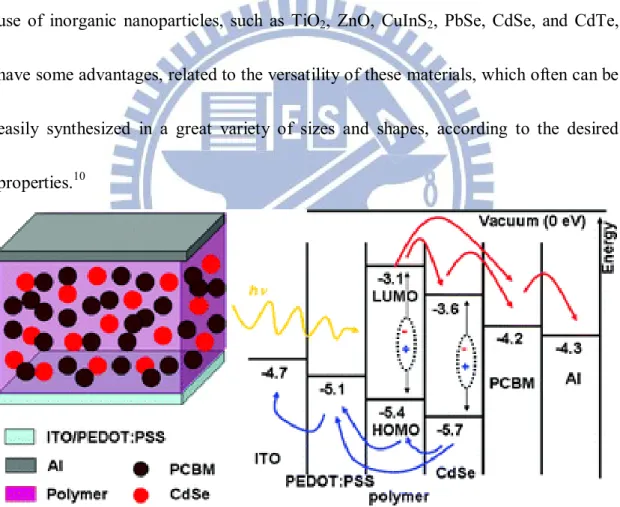
Figure 1.2.1 The energy levels of in the ternary system solar cell showing the HOMO
and LUMO levels of the materials and work function of the electrodes. The arrows indicate the expected charge transfer and charge transport processes……... 3
Figure 1.3.1 Superstructure of self-assembly of [60]fullerene derivative 1 with
perylene bisimide 5 by H-bonding………. 5
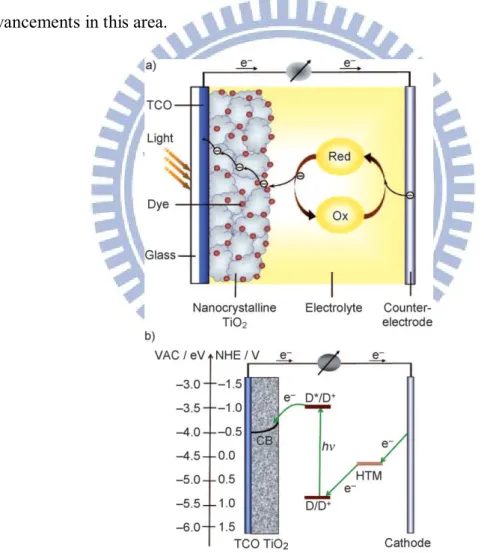
Figure 1.4.1 a) Fundamental processes in a dye-sensitized solar cell. b) Energy-level
diagram of a DSSC. TCO=transparent conducting oxide……….. 7
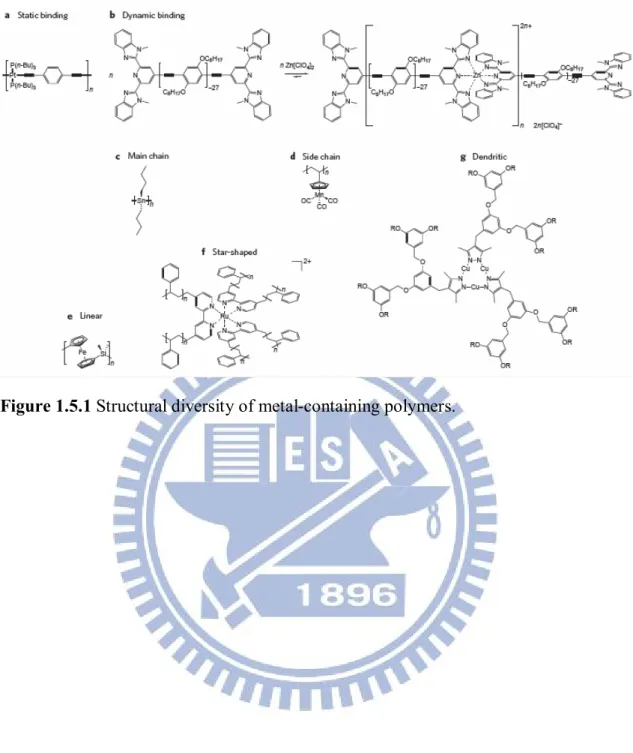
Figure 1.5.1 Structural diversity of metal-containing polymers………... …..12 Figure 1.5.2 Characterization of photo- and electro-active noncovalent assemblies
based on hydrogen bond……… …. 13
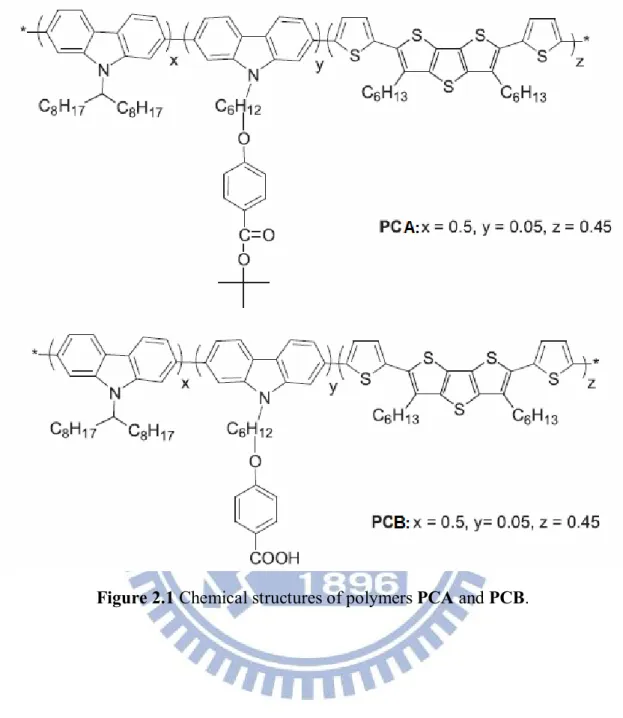
Figure 2.1 Chemical structures of polymers PCA and PCB.. ... 19 Figure 2.2 Thermogravimetric curves of ZnO nanoparticles before and after pyridyl
surface-modification………...25
Figure 2.3 Normalized optical absorption spectra of polymers PCA and PCB in
solutions(chlorobenzene) (10−6 M), and solid films (spin-coating from chlorobenzene solutions)... 28
Figure 2.4 Normalized photoluminescence (PL) spectra of polymers PCA and PCB
in solutions (chlorobenzene) (10−6 M), and solid films (spin-coating from
chlorobenzene solutions)………... 28
Figure 2.5 Cyclic voltammograms of polymers PCA and PCB (solid films) at a scan
rate of 100 mV/s………...31
Figure 2.6 Energy band diagram of HOMO/LUMO levels for electron donor
polymers PCA and PCB, electron acceptors ZnOpy and PCBM, and the work functions of ITO and Al... 31
Figure 2.7 The AFM images obtained for films of PCA/ZnOpy/PCBM and PCB/ZnOpy/PCBM containing different amounts of nanoparticles and fullerene. .. 33 Figure 2.8 I–V curves of solar cells under simulated AM 1.5 solar irradiation with an
active layer of (a) PCA:ZnOpy:PCBM (with different weight ratios of ZnOpy) and (b) PCB:ZnOpy:PCBM (with different weight ratios of ZnOpy)………..…35
Figure 3.1 Normalized optical absorption spectra of polymers PCC, PCA, and PCB
in (a) solutions (THF) (10-6 M) and (b) solid films (spin-coating from THF solutions)………..58
Figure 3.2 Normalized photoluminescence (PL) spectra of polymers PCC, PCA, and PCB in (a) solutions (THF) (10-6 M), and (b) solid films (spin-coating from THF solutions)……….…59
Figure 3.3 (a) Cyclic voltammograms of polymers PCC, PCA, and PCB (in solid
films) at a scan rate of 100 mV/s, (b) absorption spectra and optical images of PCB on ITO at various applied potentials (0 V–1.3 V), (c) CIE chromaticity diagram of
PCB at ‘‘off’’ (0 V) and ‘‘on’’ (1.3 V) states………... 62 Figure 3.4 Energy band diagram with HOMO/LUMO levels of donor polymers
P1-P3 in relation to the work functions of ITO and Al. ... 63
Figure 3.5 Powder X-ray diffraction (XRD) spectra of (a) PCC and (b) PCA and PCB; and schematic representations of proposed three-dimensional layered and π-π
stacked arrangements of (c) PCC and (d) PCA in their XRD measurements (PCB is similar to PCA)……….……….……..66
Figure 3.6 AFM images obtained from solid films of PCC, PCA, and PCB/PCBM
(1:1w/w)………..………..…....…..68
Figure 4.1Chemical structures of metallo-polymers P1-P4………77 Figure 4.2 1H NMR spectra (aromatic region) of ligand L1 and metallo-polymers
P1 and P3 in DMSO-d6………...80
Figure 4.3 1H NMR spectra (aromatic region) of ligand L2 and metallo-polymers
P2 and P4 in DMSO-d6………...80
Figure 4.4 Supramolecular structures of H-bonded nanocomposites P3/ZnOpy and P4/ZnOpy………... 82 Figure 4.5 Normalized UV-vis spectra of ligands L1-L2 and metallo-polymers P1-P4
in (a) DMF solutions and (b) solid films………... 86
Figure 4.6 Cyclic voltammagrams and electrochromic photos of metallo-polymers P1-P4 in solid films………... …..89 Figure 4.7 FTIR spectra of metallo-polymers (P3 and P4) and nanocomposites
(P3/ZnOpy and P4/ZnOpy)………90
Figure 4.8 PL spectra of metallo-polymers P1-P4 and nanoparticle ZnOpy.
... 92
Figure 4.9 Normalized time-resolved photoluminescence decays of (a)
metallo-polymers P1-P4 and (b) nanocomposites P1/ZnOpy, P2/ZnOpy, P3/ZnOpy, and P4/ZnOpy……….93
P2/ZnOpy, (c) P3/ZnOpy, and (d) P4/ZnOpy………...96 Figure 4.11 Schematic illustrations of possible structural arrangements for polymer
chains in nanocomposites by powder X-ray diffractions………96
Figure 4.12 TEM images of nanocomposites (a) P1/ZnOpy, (b) P2/ZnOpy, (c) P3/ZnOpy, and (d) P4/ZnOpy………98 Figure 5.1 Chemical structures of dyes Cpd11, Cpd16, andCpd22………....118 Figure 5.2 a) UV-vis absorption spectra of metal-free organic dyes in THF solutions
(10-5 M) and (b) Normalized photoluminescence (PL) spectra of metal-free organic
dyes in THF solutions (10-5 M)………..119
Figure 5.3 Cyclic voltammograms of dyes (in THF) at a scan rate of 100 mV/s.
...122
Figure 5.4 (a) Optical texture of the nematic phase in dye Cpd16 observed by POM
at 225 °C (cooling) and (b) XRD intensity against angle profiles obtained from dye
Cpd16 at 225 °C………125 Figure 5.5 Molecular modeling of dye Cpd16……….126 Figure 5.6 (a) IPCE plots of DSSCs fabricated using dyes Cpd11, Cpd16, Cpd22,
and N719. (b) I-V curves of DSSCs based on dyes Cpd11, Cpd16, Cpd22, and N719. ...129
Chapter 1
Introduction
The need to develop inexpensive renewable energy sources stimulates scientific
research for efficient, low-cost photovoltaic devices. The organic polymer-based
photovoltaic elements have introduced at least the potential of obtaining cheap and
easy methods to produce energy from light. The possibility of chemically
manipulating the material properties of polymers (plastics) combined with a variety of
easy and cheap processing techniques has made polymer-based materials present in
almost every aspect of modern society. Organic semiconductors have several
advantages: (a) low cost synthesis, and (b) easy manufacture of thin film devices by
vacuum evaporation/sublimation or solution cast or printing technologies.1
1.1 Polymeric Solar Cells (PSCs)
Novel materials are developed for organic optoelectronic devices, such as
polymeric solar cells (PSCs), which is a popular research topic in recent decades,
because they are low cost and green materials for sustainable resources to reduce
consumptions of fossil energy and nuclear power.2 In particularly, bulk
heterojunction (BHJ) solar cells consisting of electron-donating conjugated
films.3 Up to now, regio-regular poly[2-methoxy-5-(3’,7’-
dimethyloctyloxy)-p-phenylenevinylene] (MDMO-PPV)4 and
poly(3-hexylthiophene) (P3HT)5 as electron donors blended with
[6,6]-phenyl-C61-butyric acid methyl ester (PCBM) as an electron acceptor
approached high power conversion efficiency (PCE) values of 5.0% in PSCs. More
recently, the PCE values of BHJ solar cells using new low-band gap conjugated
polymers have reached 6 to 8%.6,7 The PCE values of BHJ solar cells were affected by,
for example, the energy band gaps of polymers, which is related to the chemical
structure of the conjugated polymers.
1.2 H
ybrid Polymer-Inorganic Solar CellsThese hybrid polymer-inorganic solar cells utilize the high electron mobility of the
inorganic phase to overcome charge-transport limitations associatedwith organic
materials. The efficient BHJ solar cells made of ZnO nanoparticles and a conjugated
polymer have been reported previously.8 The ZnO nanoparticles were blended with
poly[2-methoxy-5-(3′,7′-dimethyloctyloxy)-p-phenylenevinylene] (MDMOPPV) to
possess a highest power conversion efficiency (PCE) approaching 1.6% in PSCs.9
Hybrid solar cells based on CdSe nanoparticles and a PPV-type polymer containing
very low photocurrent and fill factor values, which were attributed to the poor charge
transport in the trioctylphosphine oxide (TOPO)-capped CdSe nanoparticle phase.
Thus, ternary systems based on mixtures of PFT/CdSe and the fullerene derivative
[6,6]-phenyl C61 butyric acid methyl ester (PCBM) were investigated. It was
observed that for the optimized composition of 20 wt.% PFT+40 wt.% CdSe+40 wt.%
PCBM the devices presented higher photocurrents and efficiencies.(Figure 1.2.1) The
use of inorganic nanoparticles, such as TiO2, ZnO, CuInS2, PbSe, CdSe, and CdTe,
have some advantages, related to the versatility of these materials, which often can be
easily synthesized in a great variety of sizes and shapes, according to the desired
properties.10
Figure 1.2.1 The energy levels of in the ternary system solar cell showing the HOMO
and LUMO levels of the materials and work function of the electrodes. The arrows indicate the expected charge transfer and charge transport processes.
1.3 Supramolecular H-bond Polymers for Organic Solar Cells
Nanostructured materials with tailor-made properties and functions can be developed
by exploiting the supramolecular approach through molecular recognition.In fact, the
hierarchical self-assembly of multivalent molecular modules through the concerted
action of multiple noncovalent interactions represents a very powerful approach as it
makes possible the simultaneous organization of various molecular systems into
intrinsically defect-free 2D architecture featuring a long-range order.11
Hydrogen bonds (H-bonds) are ideal noncovalent interactions to form self-assembled
architectures due to their selectivity and directionality. A numerous advantages of
H-bonded polymers, such as stronger light absorptions, lower HOMO levels, higher
Voc values, higher hole mobilities, and higher crystallinities, were utilized for organic
solar cells.12 Therefore, great efforts have been taken toward the preparation and
characterization of photo- and electroactive noncovalent assemblies based on
hydrogen bonds (H-bonds). Wurthner,12(a,b) El-ghayoury et al., and Jonkheijm et
al.12(c,d) reported H-bonded assemblies of perylene bisimide and melamine derivatives.
In addition, El-ghayoury et al. reported a PCE value of 0.39% for PSCs by utilizing a
H-bonded polymer containing oligo(p-phenylene vinyene) and ureido-pyrimidinone
units.12(c) Because of several advantages in polymers, including low cost, easy
processing, and tunable chemical properties, the conjugated polymers consisting of
electrochromic behavior as well as photovoltaic properties.
Moreover, connecting the electrooptical properties in organic devices have been
established through the supramolecular interactions, e.g. H-bonds, in organic,
dendritic, and polymeric H-bonded complex systems. This was illustrated by a recent
report on a triple hydrogen-bonded triad consisting of a central perylene that was
connected to two C60 chromophores (Figure 1.3.1).13
Figure 1.3.1 Superstructure of self-assembly of [60]fullerene derivative 1 with
perylene bisimide 5 by H-bonding.
1.4 Dye-Sensitized Solar Cells (DSSCs)
14Dye-sensitized solar cells (DSSC) have attracted considerable attention in recent years
as they offer the possibility of low-cost conversion of photovoltaic energy. In this
context, dye-sensitized solar cells (DSSC) have attracted considerable attention in
recent years. Efforts in the synthesis of sensitizers for DSSCs can be grouped into two
broad areas: 1) Functional ruthenium(II)–polypyridyl complexes such as N3,15 N719,
former class of compounds contains expensive ruthenium metal and requires careful
synthesis and tricky purification steps. On the other hand, the second class can be
prepared rather inexpensively by following established design strategies.
Conventional DSSCs typically contain five components: 1) a photoanode, 2) a
mesoporous semiconductor metal oxide film, 3) a sensitizer (dye), 4) an
electrolyte/hole transporter, and 5) a counter electrode. In DSSCs, the incoming light
is absorbed by the sensitizer, which is anchored to the surface of semiconducting TiO2
nanocrystals. Charge separation takes place at the interface through photoinduced
electron injection from the excited dye into the conduction band of the TiO2. Holes
are created at the dye ground state, which is further regenerated through reduction by
the hole-transport material (HTM), which itself is regenerated at the counterelectrode
by electrons through an external circuit. In principle, for efficient DSSCs the
regeneration of the sensitizer by a hole transporter should be much faster than the
recombination of the conduction band electrons with the oxidized sensitizer.
Additionally, the highest occupied molecular orbital (HOMO) of the dye should lie
below the energy level of the hole transporter, so that the oxidized dyes formed after
electron injection into the conduction band of TiO2 can be effectively regenerated by
accepting electrons from the HTM. The general operating principle of a
DSSCs is expanding very rapidly and attracting scientist from different disciplines: 1)
Chemists to design and synthesize suitable donor–acceptor dyes and study
structure–property relationships; 2) physicists to build solar cell devices with the
novel materials, to characterize and optimize their performances, and to understand
the fundamental photophysical processes; and 3) engineers to develop new device
architectures. The synergy between all the disciplines will play a major role for future
advancements in this area.
Figure 1.4.1 a) Fundamental processes in a dye-sensitized solar cell. b) Energy-level
1.4.1 Metal-Free Organic Dyes in
DSSCs
The development of novel materials for use in organic optoelectronic devices, such as
dye-sensitized solar cells (DSSCs),16 has become a popular research topic in the quest
for low-cost, green materials for sustainable use and a decrease in demand for fossil
fuels and nuclear power. DSSCs based on Ru-photosensitizers,17-18 such as
cis-bis(isothiocyanato)bis(2,2´-bipyridyl-4,4´-dicarboxylato)-ruthenium(II) (N3)15and
related derivatives, have been applied very successfully with high power conversion
efficiencies (PCEs) of 9–12%.15,19-23 Recently, it has been demonstrated that DSSCs
can also be constructed from metal-free organic dyes.14 Because of the high cost of
rare Ru metal and the relatively low molar extinction coefficients and tedious
purification of Ru-photosensitizes,19 metal-free organic sensitizers have become
increasingly attractive and widely developed.24,25 Nevertheless, the ability to reach
higher efficiencies when using metal-free organic dyes remains a challenge, although
great progress has been made in this field.26-29 The key characteristics for a dye to be
used in a DSSC are high absorption over a wide range of the solar spectrum with high
molar extinction coefficients, efficient charge separation, redox stability, andsuitable
functional groups to interact with the electron sink (TiO2). Metal-free organic dyes
featuring a donor/acceptor structural design were synthesized have particularly wide
Some general principles to construct an efficient dye and efficient DSSCs are as
follows: 1) The absorption range of the dye should cover the whole visible and some
of the near-infrared region, and its molar extinction coefficient must be as high as
possible to enable efficient light harvesting with thinner TiO2 layers (panchromatic
absorption). 2) For efficient electron injection into the anode, the lowest unoccupied
molecular orbital (LUMO) of the dye should be localized near the anchoring group
(usually a carboxylic or phosphonic acid) and above the conduction band edge of the
semiconductor electrode (typically TiO2). 3) The HOMO of the dye should lie below
the energy level of the redox mediator to allow efficient regeneration of the oxidized
dye. 4) To minimize charge recombination between the injected electrons and the
resulting oxidized dye, the positive charge resulting after electron injection should be
localized on the donor part, which is further away from the TiO2 surface. 5) The
periphery of the dye should be hydrophobic to minimize direct contact between the
electrolyte and the anode to prevent water-induced desorption of the dye from the
TiO2 surface and consequently enhance the longterm stability. 6) The dye should not
aggregate on the surface to avoid nonradiative decay of the excited state to the ground
1.5 Metalloplymer
33The rapid growth of supramolecular chemistry since the 1970s has led to many new
opportunities to take advantage of reversible interactions. A major contribution to the
diversity of the field of metal-containing polymers has involved the development of
metallosupramolecular polymers, in which the metal ions are bound by non-covalent
coordination interactions that allow for reversible, ‘dynamic’, binding analogous to
hydrogen bonding (figure panel b).34-35 The recent developments are illustrated by the
formation of metallosupramolecular polymers that involve labile multidentate ligation
and metallophilic interactions. As another key contributor to structural diversity,
metal containing polymers can contain a variety of metal centres, from
transition-metal ions and main-group metals through to lanthanides and actinides. In
addition, the metal centres can be located either in the polymer main chain or in the
side-chain structure (figure panels c and d) (Figure 1.5.1). As examples of further
subdivisions, metallopolymers can be linear, star-shaped, highly branched or
dendritic36-42 (figure panels e, f and g) (Figure 1.5.1). Significantly, with all of these
materials the typical classical polymer processing possibilities, such as spin coating,
inkjet printing, extrusion, compounding and film blowing, are maintained.
Metal-ligand coordination seems to be particularly attractive in past few decades
supramolecular metallo-polymers applied to electro-optical materials have been
commonly conducted, because the advantages of these materials, such as easy
processability, cheap fabrication, rapid coordination, and tunability of the optical band
gap, can promote long-range electrons or energy transfers.43 Supramolecular
metallo-architecture is formed with coordination ability of transition metal ions and
chelating ligands because of their self-recognition and self-assembly.44-46 Moreover,
metal-ligand complexes realized ideal conditions from self-assembly to form the
kinetically labile but nevertheless thermodynamically stable bonds.47 In the
meanwhile, metallo-polymers are also good candidates to study for their
electrochromic properties during the redox processes.48-49
2,2’:6’,2’’-Terpyridine(terpy) and bipyrdine (bpy) derivatives have been utilized
recently for multinuclear supramolecular interactions.50-52 The transport of energy and
electrons within nanoscale ordered materials is significant to optoelectronics. It needs
to control over both of their physical and chemical properties in the self-assembled
1.5.1 Nanocomposite Systems Base on Metallopolymer and
Nanoparticles
Nanocomposite systems are that combine the favorable features of, for example,
fullerenes and porphyrins as electron acceptors and donors, respectively.49 They have
received interest in the areas of light-induced electron-transfer chemistry and solar
energy conversion.53 Common electron donor-acceptor systems are based on covalent
linkages. However, much less is, known about noncovalent electron donor-acceptor
nanocomposites and the function of the intervening spacers.54 Compared with other
intermolecular forces, such as van der Waals, π-π stacking, or Coulombic interactions,
hydrogen bonds are particularly attractive as they are directional and do not possess
electronic energy levels that interfere with those in materials for organic
electro-optical applications.55-56 Therefore, that great efforts have been expended
toward the preparation and characterization of photo- and electro-active noncovalent
assemblies based on hydrogen bonds (H-bonds). (Figure 1.5.2)
Figure 1.5.2 Characterization of photo- and electro-active noncovalent assemblies
Chapter 2
Applications of novel dithienothiophene- and
2,7-carbazole-based conjugated
polymers with surface-modified ZnO nanoparticles
for organic photovoltaic cells
Two kinds of novel conjugated polymers containing 2,7-carbazole, thiophene, and
fused-dithienothiophene rings as backbones bearing acid-protected and benzoic acid
pendants (PCA and PCB, respectively) were utilized for organic solar cell
applications. The absorption spectra of these polymers (in both solutions and solid
films) showed an absorption range at 300–580 nm. Furthermore, ZnO nanoparticles
were synthesized and surface-modified with pyridyl surfactants (ZnOpy) to be ca.
3–4 nm. The pyridyl surfactants of ZnOpy nanoparticles (as electron acceptors to
partially replace expensive electron acceptor PCBM) not only induce supramolecular
interactions with benzoic acid pendants of polymer PCB via H-bonds, but also
enhance the homogeneous dispersions of ZnOpy nanoparticles in polymer PCB. Thus,
the ternary systems of PCA,PCB/ZnOpy/PCBM in weight ratios of 1:0.05:1 and
1:0.1:1 were investigated in bulk heterojunction polymer solar cells (PSCs). Under
the standard illumination of AM 1.5, 100 mW/cm2, the best power conversion
PCB/ZnOpy/PCBM=1:0.05:1 reached PCE=0.55%, with Jsc=2.11 mA/cm2,
Voc=0.88 V, and FF=29.4%.
2.1 Introduction
The developments of new materials to be used in organic optoelectronic devices such
as polymeric solar cells (PSCs) have become dramatically attractive because they
represent a green and renewable energy alternative to fossil energy and nuclear power.
In particular, the so-called bulk heterojunction (BHJ) concept2 has been established in
thin films of organic solar cell devices utilizing electron-donating conjugated
polymers blended with electron-accepting species, such as fullerenes,3 dicyano-based
polymers,4,57 or n-type nanoparticles.58 These hybrid polymer-inorganic solar cells
utilize the high electron mobility of the inorganic phase to overcome charge-transport
limitations associated with organic materials. The efficient BHJ solar cells made of
ZnO nanoparticles and a conjugated polymer have been reported previously.8 The
ZnO nanoparticles were blended with poly[2-
methoxy-5-(3′,7′-dimethyloctyloxy)-p-phenylenevinylene] (MDMOPPV) to possess a
highest power conversion efficiency (PCE) approaching 1.6% in PSCs.9 Hybrid solar
cells based on CdSe nanoparticles and a PPV-type polymer containing fluorene and
thiophene units (PFT) wereinvestigated. The CdSe/PFT devices showed very low
in the trioctylphosphine oxide (TOPO)-capped CdSe nanoparticle phase. Thus,
ternary systems based on mixtures of PFT/CdSe and the fullerene derivative
[6,6]-phenyl C61 butyric acid methyl ester (PCBM) were investigated. It was
observed that for the optimized composition of 20 wt.% PFT+40 wt.% CdSe+40 wt.%
PCBM the devices presented higher photocurrents and efficiencies. The use of
inorganic nanoparticles, such as TiO2, ZnO, CuInS2, PbSe, CdSe, and CdTe, have
some advantages, related to the versatility of these materials, which often can be
easily synthesized in a great variety of sizes and shapes, according to the desired
properties.10 In parallel, oligo- and poly(2,7-carbazole)61 derivatives have been
successfully used in polymer light emitting diodes (PLEDs)62 and organic field-effect
transistors (OFETs)62-63, demonstrating good p-type transport properties.60 Recently,
Müllen and co-workers61 have reported solar cells consisting of
poly(N-alkyl-2,7-carbazole)with a PCE value of 0.6%. Moreover, in contrast to the
fluorene unit the carbazole moiety is fully aromatic, providing a better chemical and
environmental stability. Taking all of these results into account, the development of
new copolymers based on carbazoles should therefore lead to interesting features for
photovoltaic applications. A class of polymers that have to date received little
attention as p-type materials for use in solar cells is polycarbazoles. Carbazole is a
candidates as p-type materials for solar cells.64 Dithieno[3,2-b:2′,3′-d]thiophene (DTT)
is a sulfur rich (three-S atoms) and electron rich segment, and serves as an important
building block of a wide variety of materials for electronic and optical applications,
such as electroluminescence, two photon absorptions, nonlinear optics,
photochromism, OFETs, and OPVs.65 Besides, the fused aromatic rings can make the
polymer backbones more rigid and coplanar, therefore enhancing effective
π-conjugation lengths, lowering band gaps, and extending absorption lengths. Powder
X-ray diffraction (XRD) analyses suggested that these copolymers formed
self-assembled π–π stacking and pseudo-bilayered structures.66 Molecules containing
fused ring systems intend to maximize the π-orbital overlaps by restricting
intramolecular rotation in these systems and possibly to induce face-to-face π–π
stackings, facilitating intermolecular hoppings and charge transports.65 In order to
increase the solubility in poly(DTT) without causing any additional twisting of the
repeating units in the resulting polymers, alkylsubstituted thiophene units were
incorporated into the polymer backbones as copolymers to fabricate OPVs12 and
OFETs.67 Based on this concept, two different moieties, i.e., fused dithienothiophene
and carbazole, were utilized as donor monomers to synthesize fused
dithienothiophene-based polymers PCA and PCB (see Figure 2.1). In order to
pyridyl-surface-modified ZnO nanoparticles (ZnOpy) were synthesized according to
Scheme 2.1. Compared with those reported fused dithienothiophene-based polymers,
polymers PCA and PCB showed much improved open circuit voltage (Voc) values
with a highest open-circuit voltage of up to 0.88 V (in PCB) as well as suitable
electronic energy levels and good processabilities for PSC applications. So far, the
preliminary PSC performance of these structurally related copolymers showed the
best PCE value of up to 0.55% while blended with ZnOpy and PCBM in a weight
ratio of 1:0.05:1, with a short circuit current density (Isc) of 2.11 mA/cm2, an open
circuit voltage (Voc) of 0.88 V, and a fill factor (FF) of 0.29 under the solar simulator
adjusted to give 100 mW/cm2 of AM 1.5 G irradiation. Although the results for the
PCE values of these nonoptimized PSCs are not sufficiently high enough, this
research affords a new concept to incorporate electron donor polymers and electron
2.2 Experimental
2.2.1 Materials
All chemicals and solvents were used as received.
2,7-dibromo-9-(heptadecan-9-yl)-9H-carbazole,60 2,7-dibromo-carbazole,60 and
3,5-didecanyldithieno[3,2-b:2′3′-d]thiophene)68-69 were synthesized according to the
literature procedures. The detailed synthetic routes of polymers PCA and PCB will be
published somewhere later. The synthetic routes of surface-modified ZnO
nanoparticles (ZnOpy) are shown in Scheme 1. ZnO nanoparticles were synthesized
by following the literature procedures.70 Chemicals and solvents were reagent grades
and purchased from Aldrich, ACROS, TCI, and Lancaster Chemical Co. Toluene,
tetrahydrofuran, and diethyl ether were distilled to keep anhydrous before use.
2.2.2 Measurements and characterization
1H NMR spectra were recorded on a Varian Unity 300 MHz spectrometer using
CDCl3 solvents. Elemental analyseswere performed on a HERAEUS CHN-OS
RAPID elemental analyzer. Transition temperature were determined by differential
scanning calorimetry (DSC, Perkin-Elmer Pyris 7) with a heating and cooling rate of
10 °C/min. Thermogravimetric analyses (TGA) were conducted with a TA instrument
Q500 at a heating rate of 10 °C/min under nitrogen. Gel permeation chromatography
polystyrene as a standard and THF as an eluent. UV–visible absorption and
photoluminescence (PL) spectrawere recorded in dilute chlorobenzene solutions (10−6
M) on a HP G1103A and Hitachi F-4500 spectrophotometer, respectively. Solid films
of UV–vis and PL measurements were spin-coated on quartz substrates from
chlorobenzene solutions with a concentration of 10 mg/mL. Cyclic voltammetry (CV)
measurements were performed using a BAS 100 electrochemical analyzer with a
standard threeelectrode electrochemical cell in a 0.1M tetrabutylammonium
hexafluorophosphate (TBAPF6) solution (in chorobenzene) at room temperature
with a scanning rate of 50mV/s. In each case, a carbon working electrode coated with
a thin layer of these copolymers, a platinum wire as the counter electrode, and a silver
wire as the quasireference electrode were used. Ag/AgCl (3MKCl) electrode was
served as a reference electrode for all potentials quoted herein. During the CV
measurements, the solutions were purged with nitrogen for 30 s, and the redox couple
ferrocene/ferrocenium ion (Fc/Fc+) was used as an external standard. The
corresponding HOMO and LUMO levels in copolymer films of PCA, PCB and
ZnOpy were calculated from Eox/onset and Ered/onset values of the electrochemical
experiments. The LUMO value of PCBM69 was in accordance with the literature data.
Each onset potential in the CV measurements was defined by the intersection of two
morphology were determined using a Veeco Nanoscope DI 3100 AFM microscope
operating in the tapping mode. The actual resolution of AFM measurements is 50 nm.
2.2.3
Device fabrication and characterization of polymer solar cellsThe photovoltaic cell (PVC) device structure used in this study was a sandwich
configuration of ITO/PEDOT:PSS/active layer/Ca/Al, where the active layer was
made of electron donor polymers PCA and PCB mixed with both electron acceptors
ZnOpy and [6,6]-phenyl C61 butyric acid methyl ester (PCBM) in the weight ratios
of polymer:ZnOpy:PCBM=1:0.05:1 and 1:0.1:1. The PVC devices were fabricated
according to the procedures similar to those of EL devices. The ITO coated glass
substrates were pre-cleaned and treated with oxygen plasma prior to use. A thin layer
(~50 nm) of PEDOT:PSS was spincoated on an ITO substrate and heated at 130 °C
for 1 h. Subsequently, the preliminary active layer was prepared by spin coating from
composite solutions of PCA, PCB:ZnOpy:PCBM in chlorobenzene (10 mg/mL) on
the top of PEDOT:PSS layer. The spin rate was about 800 rpm, and the thickness of
the active layer was typically ranged at 100–160 nm, unless the detailed thickness is
specified. The PVC devices were completed by deposition with 1 nm of Ca and 120
nm of Al. The film thicknesses were measured by a profilometer (Dektak3,
Veeco/Sloan Instruments Inc., USA). For photovoltaic measurements, I–V curves
300W xenon lamp (Oriel, #6258) with AM 1.5 filter (Oriel, #81080 kit) was used as
the white light source, and the optical power shone on the sample was 100 mW/cm2
detected by Oriel thermopile 71964. The I-V characteristics were measured using a
CHI 650B potentiostat/galvanostat. The external quantum efficiency (EQE) was
measured using a CHI 650B coupled with Oriel Cornerstone 260 monochromator. All
PVC devices were prepared and measured under ambient conditions.
2.2.4
SynthesisThe synthetic routes of surfactant and pyridyl-modified ZnO (ZnOpy) are shown in
Scheme 2.1.
(Pyridine-4-yl) methyl-3-(trethoxysily)propylcarbamate
4-Pyridinylmethanol (628 mg, 5.76 mmol) and 3-(triethoxysilyl) propyl isocyanate
(2.8 g, 11.48 mmol) were dissolved in dry THF (40 mL) and stirred in a flask. Besides,
dibutyltin dilaurate (36 mg, 0.058 mmol) was added dropwise. The mixture was
refluxed overnight. Solvent was removed under vacuum, and the crude product was
purified by flash column chromatography using hexane/ethyl acetate=1:2, v/v as
eluent. Subsequently, the pure compound was obtained as a yellow powder. Yield:
1.84 g (66%). 1H NMR (300 MHz, CDCl3): δ (ppm) 8.68 (dd, 2H), 8.05 (d, 1H), 7.52
(dd, 2H), 5.34 (s, 2H), 3.82 (quart, 6H), 3.18 (m, 2H), 1.87 (quint, 2H), 1.22
356. Element analysis calculation for C16H28N2O5Si: N, 7.86; C, 53.91; and H, 7.92.
Found: N, 7.90; C, 53.94; and H, 7.81.
Synthesis of pyridyl-modified ZnO nanoparticles (ZnOpy)
ZnO nanoparticles70 were dissolved and stirred in dry toluene (10 mL). Then,
(pyridine-4-yl) methyl-3-(trethoxysily)propylcarbamate (1 g, 0.058 mmol) was added
dropwise. The mixture was stirred to react overnight at 100 °C. The resulting
precipitates were isolated by centrifugation along with decantation, and then were
rewashed several times to remove all residues. The resulting product was
subsequently collected and dried under vacuum. The amount of pyridyl
surface-modifiers attached to ZnO nanoparticle surface can be estimated by TGA
analysis and was found ca. 5 wt.% in Figure 2.2. In addition, the sizes of ZnO
nanoparticles surface-modified with pyridyl surfactants (ZnOpy) were ca. 3-4 nm.
Figure 2.2 Thermogravimetric curves of ZnO nanoparticles before and after pyridyl
surface- modification.
2.3 Results and Discussion
2.3.1
Thermal propertiesThe thermal stabilities and phase transition properties of polymers PCA and PCB
were characterized by thermogravimetric analyses (TGA) and differential scanning
calorimetry (DSC) measurements under nitrogen atmosphere, and the thermal
decomposition temperatures (Td) and melting points (Tm) are summarized in Table 2.1.
It is apparent that all copolymers exhibited good thermal stabilities, which showed
less than 5% weight loss upon heating to 366–408 °C. Regarding DSC experiments,
samples (weighted 1-5 mg) sealed in an aluminum pan were operated at 30-250 °C
under N2 atmosphere with a scan rate of 10 °C/min. These polymers showed
melting of the polymer backbones, and two polymers exhibited the glass transition (Tg)
temperatures at 135 °C and 143 °C for PCA and PCB, respectively. The Tg and Td
values of PCB are higher than that of PCA, implying that the polymer networks
formed by H-bonds (due to acid groups) of PCB make the structure more rigid.
2.3.2
Optical propertiesThe optical absorption spectra of polymers PCA and PCB in chlorobenzene solutions
(10−6 M) and solid films are shown in Figure 2.3, and their photophysical properties
are demonstrated in Table 2.2. As can be seen, the absorption spectra of polymers
PCA and PCB covered broad wavelength ranges for both solutions and solid films.
Similar maximum absorption wavelengths (442 and 441 nm) of PCA and PCB in
chlorobenzene solutions were observed. These donor polymers (PCA and PCB)
achieved the absorption spectra in the visible range of 350–580 nm (with tailing up to
around 650 nm) in solid films. Due to the π–π stacking of these polymer chains in
465 nm in polymers PCA and PCB. In addition, the long tailing around 650 nm in the
absorption spectra of PCA and PCB in both solutions and solid films were observed.
As shown in Table 2.2, the optical band gaps (Eg,opt) of 2.25 eV in polymers PCA and
PCB can be determined by the cut off of the absorption spectra in solid films. The
photoluminescence (PL) spectra of polymers PCA and PCB in chlorobenzene
solutions and solid films excited at incident wavelengths of 465 nm are shown in
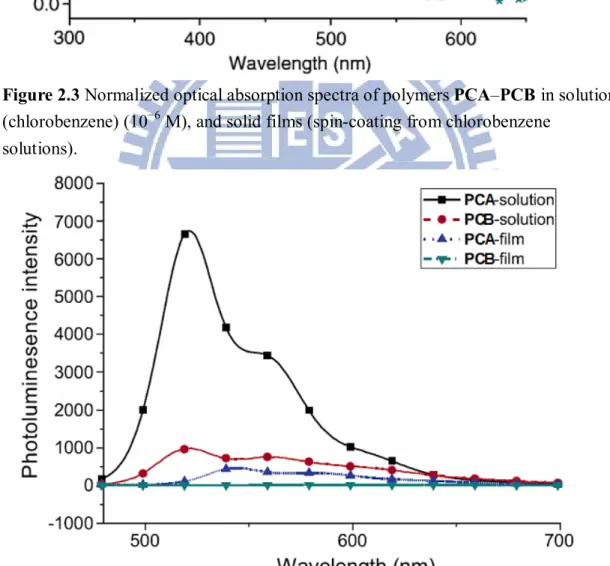
Figure 2.4, respectively. The PL emission spectra of the polymers in the film were
dramatically quenched. Interestingly, in contrast to polymer PCA in Figure 2.4, the
PL spectra of PCB containing acid moieties were completely quenched in solid films.
The corresponding optical properties of these copolymers in solid films, including the
broad and strong optical absorptions, proposed their potential applications in the
Figure 2.3 Normalized optical absorption spectra of polymers PCA–PCB in solutions
(chlorobenzene) (10−6 M), and solid films (spin-coating from chlorobenzene solutions).
Figure 2.4 Normalized photoluminescence (PL) spectra of polymers PCA–PCB in
solutions (chlorobenzene) (10−6 M), and solid films (spin-coating from chlorobenzene solutions).
2.3.3 Electrochemical characterization
The electronic states, i.e. highest occupied molecular orbital (HOMO) and lowest
unoccupied molecular orbital (LUMO) levels, of the polymers were investigated by
cyclic voltammetry (CV) in order to understand the charge injection processes in
these polymers and their PSC devices. The oxidation and reduction cyclic
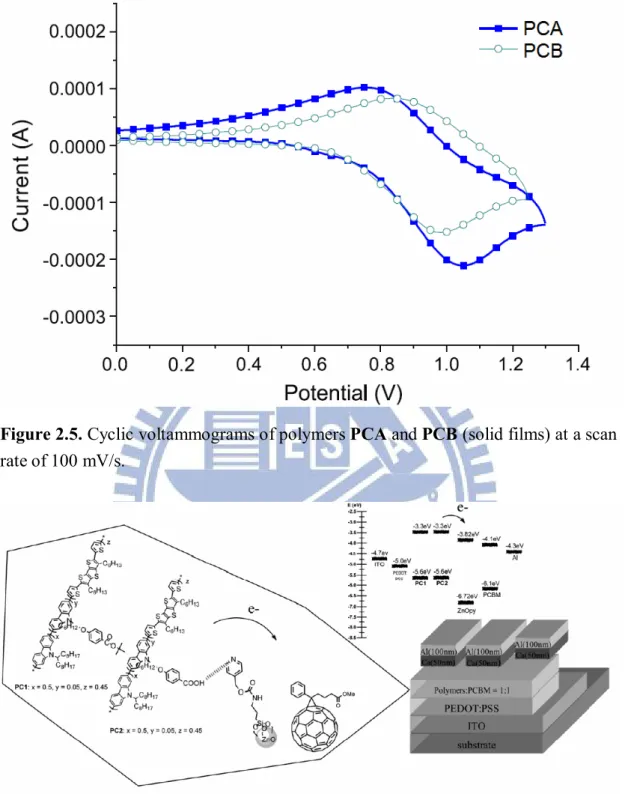
voltammograms of polymers PCA and PCB in solid films are displayed in Figure 2.5.
In order to obtain the solid films with an equal thickness, the concentrations in the
THF solutions and film forming conditions were kept constant (ca. 5 mg/mL). The
electrochemical measurements of the formal potentials, onset potentials, and band
gaps, along with the estimated positions of the upper edges of the valence band
(HOMO levels) and the lower edges of the conduction band (LUMO levels) are
summarized in Table 2.3. On the contrary, all polymers PCA and PCB exhibited one
quasi-reversible oxidation peaks as evident from the areas and close proximity of the
anodic and cathodic scans in Figure 2.5, which are a good sign for high structural
stability in the charged state. As illustrated in Table 2.3, the formal oxidation
potentials of these polymers were in the range of 0.7–1.1 V.The moderate onset
oxidation potentials of polymers PCA and PCB occurred between 0.7 and 1.1 V
fromwhich the estimated HOMO levels of −5.60 eV and LUMO levels of ca. −3.35
eV were acquired according to the following equation:72-73 EHOMO/LUMO=[−(Eonset (vs
ferrocene below the vacuum level and Eonset (Fc/Fc+ vs Ag/AgCl)=0.4 eV. In contrast, the
electrochemical reductions of polymers PCA and PCB showed similar LUMO energy
levels at ca. −3.35 eV, which represent to possess high electron affinities and also
make these polymers suitable electron donors for electron injection and transporting
to ZnOpy and PCBM acceptors (with 0.4 eV offsets in LUMO levels regarding
PCBM with a LUMO level of −3.75 eV,70 as shown in Fig. 6 for the polymeric bulk
heterojunction solar cell devices.71 Interestingly, the energy band gaps Eg, measured
directly from CV (Eg,=Eox/onset−Ered/onset, where Eg, values are 2.25 eV) are close to the
Figure 2.5. Cyclic voltammograms of polymers PCA and PCB (solid films) at a scan
rate of 100 mV/s.
Figure 2.6. Energy band diagram of HOMO/LUMO levels for electron donor
polymers PCA and PCB, electron acceptors ZnOpy and PCBM, and the work functions of ITO and Al.
2.3.4
MorphologyThe AFM topographies by the tappingmode of polymer blends
(PCA,PCB:ZnOpy:PCBM=1:0.05:1 and 1:0.1:1 in wt. ratios) were investigated via
casting films of dichlorobenzene solutions as shown in Figure 2.7, where the bumps
on the surface views are possibly attributed to the aggregation of ZnOnanoparticles
(ZnOpy) and polymers (PCA and PCB). The results show that the morphologies of
blends PCA/ZnOpy/PCBM have larger roughnesses (34 and 19 nmin Figure 2.7(a)
and (b), respectively) than those (10 and 11 nmin Figure 2.7(c) and (d), respectively)
of blends PCB/ZnOpy/PCBM. PCA/ZnOpy/PCBM films exhibited larger roughness
variations than PCB/ ZnOpy/PCBM. The roughness and phase separation must be
controlled/ optimized in order to improve the efficiency of devices. 74-76 It is worthy to
mention that the solid films of blended PCA:ZnOpy:PCBM in different ratios of
1:0.05:1 and 1:0.1:1w/w showed rougher surfaces, but the larger values of rms
roughnesses (34 and 19 nm, respectively) were contributed from the aggregation of
nanoparticles due to no interaction between polymer and nanoparticles, which
reduced the interfaces between donor (polymers) and acceptor (ZnOpy:PCBM)
significantly. Owing to the unfavorable morphologies for charge transport offered by
the aggregation of nanoparticles, the PSC devices based on PCA gave relatively low
Figure 2.7 The AFM images obtained for films of PCA/ZnOpy/PCBM and
2.3.5
Polymeric photovoltaic cell propertiesThe motivation for the design and syntheses of the conjugated polymers is to look for
new polymers for the application of PSCs. To investigate the potential use of
polymers PCA and PCB in PSCs, bulk heterojunction devices were fabricated from
an active layer in which polymers PCA and PCB were blended with the ZnOpy and
PCBM. The PSC devices with a configuration of ITO/PEDOT:PSS/PCA,
PCB:ZnOpy: PCBM(w/w)/Ca/Al were fabricated by depositing a thin layer (ca. 50
nm) of PEDOT:PSS onto patterned ITO slides. The active layer (ca. 100-160 nm)
consisting of PCA, PCB, ZnOpy and PCBM (w/w) was then deposited from a
solution (10 mg/mL in dichlorobenzene) by a spin rate of 500 rpm on the
PEDOT:PSS film, and followed by the deposition of Ca (ca. 50 nm) and aluminum
(100 nm) back electrodes.
The PSC devices were measured under AM 1.5 illuminations for a calibrated solar
simulator with an intensity of 100 mW/cm2. The preliminarily obtained properties are
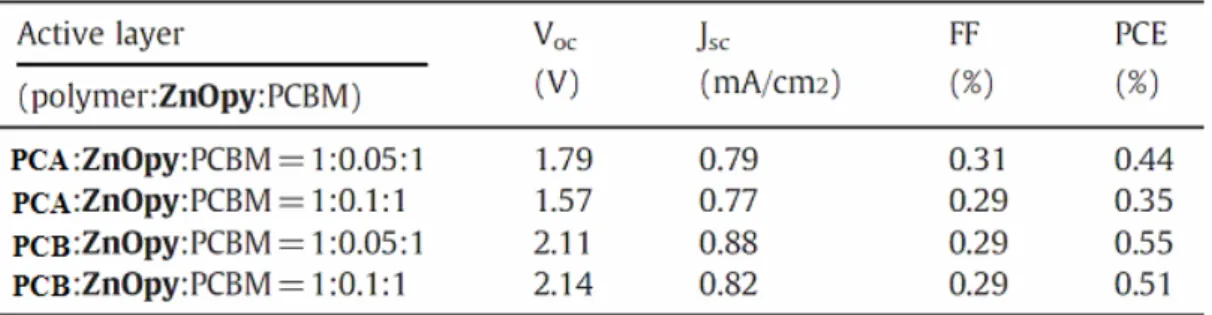
summarized in Table 2.4, and the typical I-V characteristics of all PSC devices are
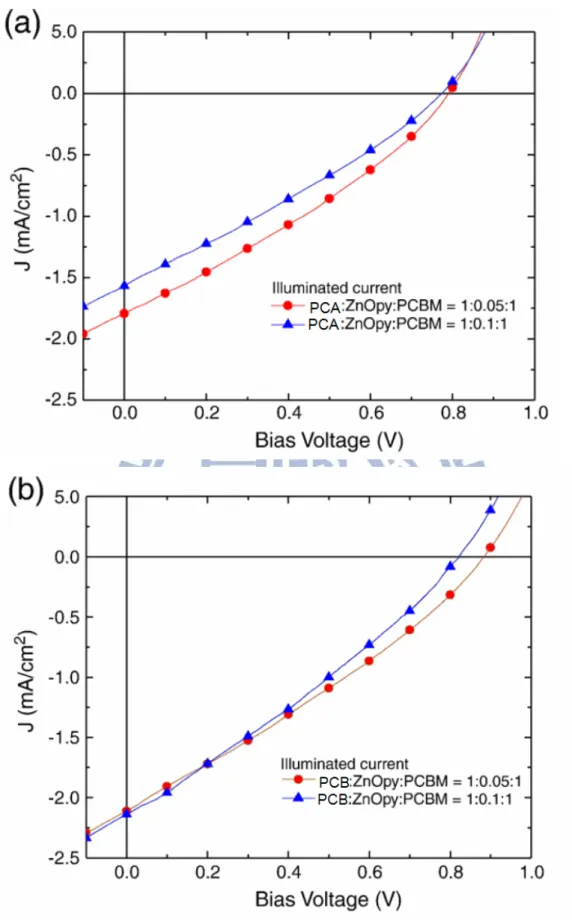
shown in Figure 2.8. The PSC device containing polymer PCB blended with ZnOpy
and PCBM acceptors had the highest PCE value of 0.55% with the values of Isc=2.11
Figure 2.8 I-V curves of solar cells under simulated AM 1.5 solar irradiation with an
active layer of (a) PCA:ZnOpy:PCBM (with different weight ratios of ZnOpy) and (b) PCB: ZnOpy:PCBM (with different weight ratios of ZnOpy).
2.4 Conclusions
The concept of supermolecular interactions, such as H-bonds formed between
conjugated polymers (PCA and PCB) and surface-modified nanoparticles ZnO
(ZnOpy), has been introduced by the syntheses of ZnOpy nanoparticles and two
fused dithienothiophene/carbazole-based polymers. The band gaps and the
HOMO/LUMO energy levels of these resulting copolymers can be finely tuned as
demonstrated by the investigation of optical absorption properties and electrochemical
studies. The pyridyl surfactants of ZnOpy nanoparticles (as electron acceptors to
partially replace expensive electron acceptor PCBM) not only induce supramolecular
interactions with benzoic acid pendants of polymer PCB via H-bonds, but also
enhance the homogeneous dispersions of ZnOpy nanoparticles in polymer PCB.
Thus, the PSC device containing ternary components of polymer PCB blended with
ZnOpy and PCBM acceptors (PCB:ZnOpy:PCBM=1:0.05:1) had the power
conversion efficiency of up to 0.55%, which gave the best performance with the
Chapter 3
Synthesis
of
Novel
Dithienothiophene-
and
2,7-Carbazole-Based
Conjugated
Polymers
and
H-Bonded Effects on Electrochromic and
Photovoltaic Properties
Three kinds of dithienothiophene/carbazole-based conjugated polymers (PCC, PCA
and PCB), which bear acid-protected and benzoic acid pendants in PCA and PCB,
respectively, were synthesized via Suzuki coupling reaction. Interestingly, PCC, PCA
and PCB exhibited reversible electrochromism during the oxidation processes of
cyclic voltammogram studies, and PCB (with H-bonds) revealed the best
electrochromic property with the most noticeable color change. According to powder
X-ray diffraction (XRD) analysis, these polymers exhibited obvious diffraction
features indicating bilayered packings between polymer backbones and π–π stacking
between layers in the solid state. Compared with the XRD data of PCA (without
H-bands), H-bonds of PCB induced a higher crystallinity in the small-angle region
(corresponding to a higher ordered bilayered packings between polymer backbones),
butwith a similar crystallinity in the wide angle region indicating a comparable π–π
stacking distance between layers. Moreover, based on the preliminary photovoltaic
(PCC, PCA and PCB blended individually with PCBM acceptor in the weight ratio of
1:1), PCB (with H-bonds) possessed the highest power conversion efficiency of 0.61%
(with Jsc =2.26 mA/cm2, FF=29.8%, and Voc = 0.9 V). In contrast to PCA (without
H-bands), the thermal stability, crystallinity, and electrochromic along with
photovoltaic properties of PCB were generally enhanced due to its H-bonded effects.
3.1 Introduction
Novel materials are developed for organic optoelectronic devices, such as
polymeric solar cells (PSCs), which is a popular research topic in recent decades,
because they are low cost and green materials for sustainable resources to reduce
consumptions of fossil energy and nuclear power.2 In particularly, bulk
heterojunction (BHJ) solar cells consisting of electron-donating conjugated
polymers blended with electron-accepting fullerenes are fabricated in solid thin
films.3 Up to now, regio-regular poly[2-methoxy-5-(3’,7’-
dimethyloctyloxy)-p-phenylenevinylene] (MDMO-PPV)4 and
poly(3-hexylthiophene) (P3HT)5 as electron donors blended with
[6,6]-phenyl-C61-butyric acid methyl ester (PCBM) as an electron acceptor
approached high power conversion efficiency (PCE) values of 5.0% in PSCs. More
recently, the PCE values of BHJ solar cells using new low-band gap conjugated
![Figure 1.3.1 Superstructure of self-assembly of [60]fullerene derivative 1 with perylene bisimide 5 by H-bonding](https://thumb-ap.123doks.com/thumbv2/9libinfo/8526431.186887/21.892.136.757.430.817/figure-superstructure-assembly-fullerene-derivative-perylene-bisimide-bonding.webp)

![HPSH [ 分子間作用力 - 氫鍵 ]](data:image/gif;base64,R0lGODlhAQABAIAAAP///wAAACH5BAEAAAAALAAAAAABAAEAAAICRAEAOw==)